




We may earn a commission when you buy through links on this page. It never changes what we recommend. How we pick
On this page9 parts
- Why a Vertuo Pod Can't Go in the Recycling Bin
- The Free Prepaid Bag Is the Default Route
- When a Boutique or Collection Point Beats the Mail
- The Bin Works in Exactly Two Places
- Where the Bag Waits and What Grows in It
- How Long One Bag Takes to Fill
- When the Better Fix Is Keeping the Pod Out of the Bag
- The Route, the Container and the Date to Write Down Today
- Frequently Asked Questions
The capsule is still warm in your hand, the kitchen bin is two steps away, and the free bag that came in your last box of the Vertuo line pods has been sitting beside the machine since last month. Knowing how to recycle Nespresso Vertuo pods starts with one fact about the shell: it is aluminum with other materials bonded to it, so the household bin refuses it in most places, and the bag that replaces the bin becomes its own problem once it starts to fill. This guide puts the three routes in order, follows the pods through the weeks they spend waiting, and says when it is simpler to keep the pod out of the bag altogether.
Quick Answer
The free prepaid bag works wherever the service runs, which excludes Hawaii, Alaska and US territories. Beyond that, pick the nearest of the other two routes.
- Fill the free prepaid bag with used pods, then drop it at any UPS location.
- Take the pods to a Nespresso boutique or collection point if one is close.
- Use the household bin only in New York City or low-rise Jersey City buildings.
Why a Vertuo Pod Can’t Go in the Recycling Bin
Most people rinse the pod and toss it in with the cans, and across most of the country that is the wrong bin. The shell hides the reason, and the reason is what makes the three routes that follow make sense.

What the pod is made of
The capsule shell looks like plain aluminum, which is why the habit feels harmless. According to Consumer Reports’ recycling guide to coffee pods, “because of other materials in the pods, you can’t just throw them in your recycling bin.” The Vertuo capsule is the larger, dome-shaped one and the Original capsule is a different shape, but the construction logic is the same for both.
A rinsed pod is also not a clean pod. Leave it on a rack for a day and the foil lid still holds a wet film of grounds, and that film is exactly what the waiting bag will later grow something on.
Why sorting it at home doesn’t work
The layers are bonded, so there is nothing to peel apart at the counter. A pod is partly aluminum and partly something else, which is why Nespresso runs its own collection system instead of leaning on the curbside bin.
The confusion starts at the first step. A common question is whether the pods need to be emptied before they go in the bag, or can simply be tossed in. Part of that answer sits in the grounds section further down; the short form is that the pod does not have to be empty for the bag.
The Free Prepaid Bag Is the Default Route
The Nespresso Recycling Bag is the only route that works almost everywhere in the 48 states, which makes it the default. It is free, it is prepaid, and its limits are written in the maker’s own terms, so the useful questions are how much it holds, where it goes back, and what it costs you in waiting.
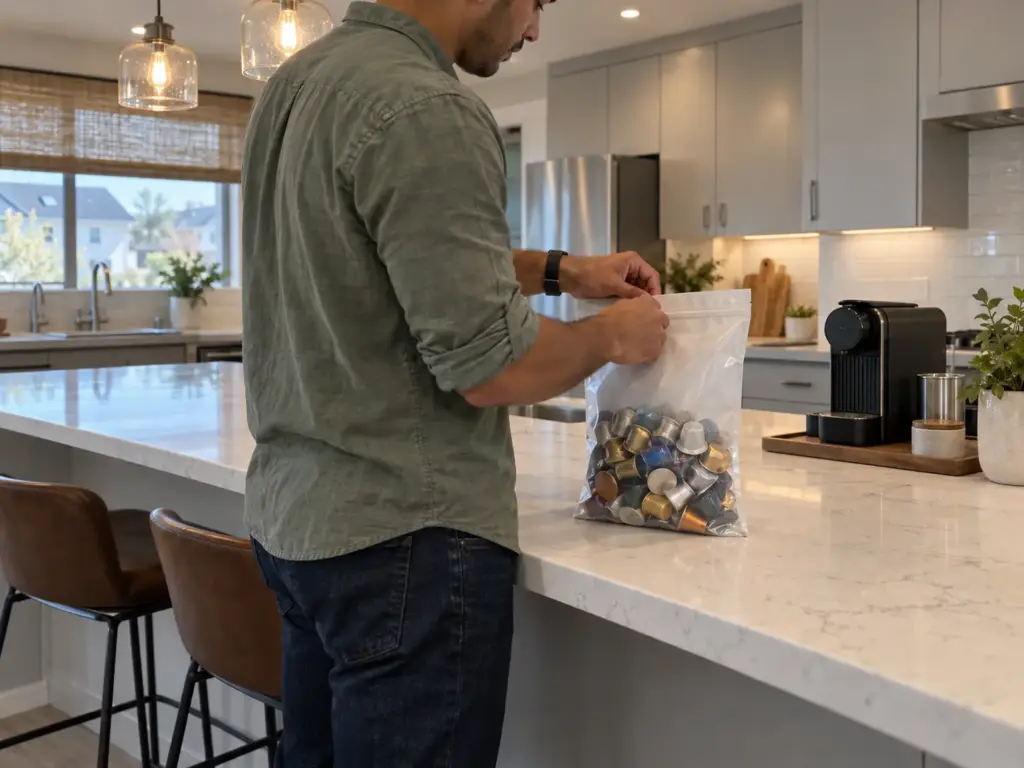
What the bag holds and where it goes
Per Nespresso’s own bag page, “Each bag can hold up to 200 OriginalLine / 100 VertuoLine capsules.” For a Vertuo household the number to remember is 100. Once the bag is full you seal it and drop it at any UPS drop off location at no charge; the return label is already on it.
Nespresso’s US recycling FAQ describes prepaid UPS labels across 48 states and a large network of drop-off points, and a separate set of collection points at boutiques and select retailers. The live list lives in the store locator on Nespresso’s site, which is better than any list printed here, because the brand says it is still adding locations.
Where the bag isn’t offered
The service does not run in Hawaii, Alaska or US territories. A reader there is left with a boutique or collection point if one exists, or with keeping the pod out of the bag, which is the last section of this guide.
The one flaw of the bag: it waits
The bag only leaves once it is full, and the trip is one way. So the cost of the route is not postage. It is the weeks a bag of wet grounds sits in your kitchen waiting to be full enough to send.
Keeping used pods in the free bag can bring drain flies, and one fix is to throw the pods out, rinse them and store them in the bag again. Their verdict: “I have a choice between recycling and flies or not recycling and no flies.” A bag that sits open beside the machine reads as fine in the first weeks, and that is exactly when the habit gets decided.
Write the date of the first pod on the bag with a marker the day you start it, and a tally mark for every ten pods. A bag with no date is a bag you will stop checking, and the oldest pods in it are the ones that turn first.
When a Boutique or Collection Point Beats the Mail
A reader who walks past a Nespresso boutique anyway can skip the wait entirely. The decision is whether the trip is worth it, who actually takes the pods, and how to choose among the routes without sorting three lists by hand.

Boutiques and select retailers
Nespresso’s US FAQ names boutiques and “select retailers” as collection points, and gives the number of those points as 250, with more promised. Consumer Reports’ guide names Sur La Table and Williams Sonoma as participating stores, while the maker’s own page speaks only of boutiques and select retailers. The two lists do not match, and either can be out of date, so check the store locator before making the trip rather than trusting a list in an article.
One detail the pages leave open: a collection point accepts a sealed container of pods, but the maker does not spell out what that container must be. If you plan to carry pods in anything other than the prepaid bag, ask at the counter or check the locator entry first.
The rule for picking a route
Three options leave the reader to sort them, so here is one decision rule, in order:
- The free bag, wherever the service runs. It costs nothing and works in the 48 states.
- A boutique or collection point, if one is close and you drink enough pods that the wait is the problem. Someone with two pods a day does not want a bag of wet grounds on the counter for seven weeks; a drop-off every couple of weeks empties the counter the same day.
- The household bin, only in the two places Nespresso names. That is the next section, and it is narrow.
The trade between the first two is simple. A boutique empties the counter the day you go, and the bag empties it after a wait. If the nearest drop-off is a long drive, the bag wins on effort even with its flaw, because a bag with a dry setup (covered below) is a smaller problem than a monthly detour.
The Bin Works in Exactly Two Places
The household recycling bin is a real route but a narrow one: a reader in New York City or in a low-rise Jersey City building can use it, and everyone else is on the bag or the boutique. Nespresso’s own recycling page says that in those places you can drop capsules in your regular residential recycling bin, and the New York City rule needs no bag at all.
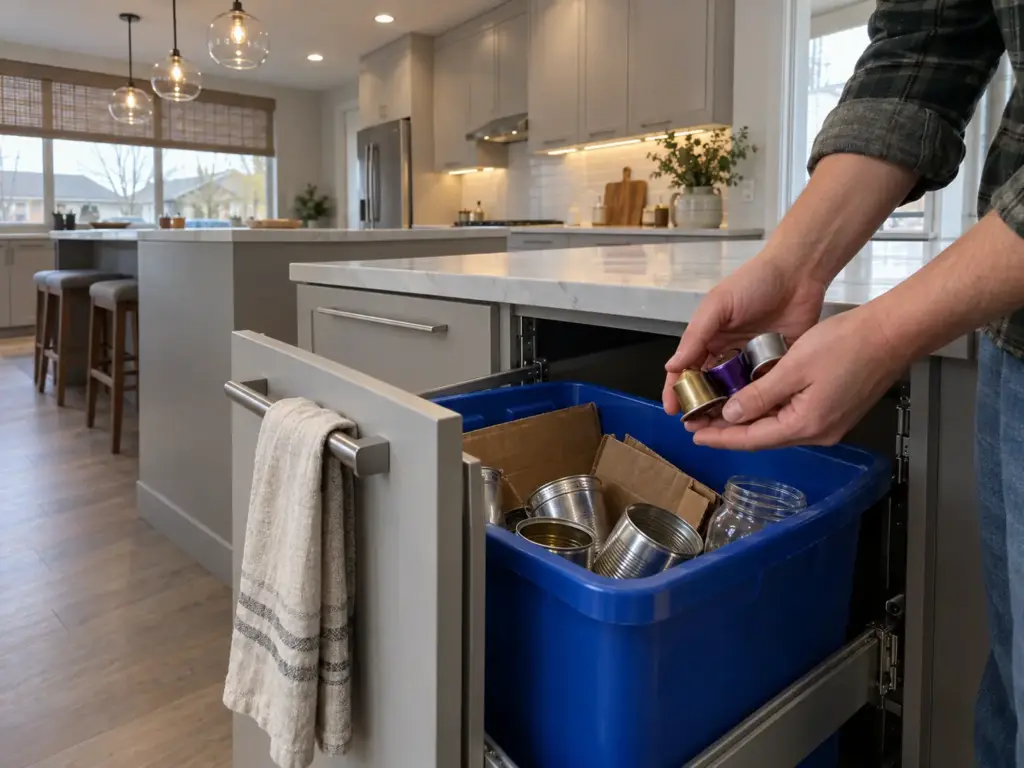
The Jersey City line is drawn by height. Nespresso’s US FAQ puts it at buildings lower than 6 stories, so a reader in a Jersey City tower hits that limit in practice and goes back to the bag. The brand also says it is working to bring curbside collection to more US cities, so the store locator is the place to confirm whether your own city has been added.
One honest caveat: this rule rests on Nespresso’s pages. There is no city sanitation page or federal guidance this guide could point to that states it, so treat the locator as the check before you tip a week of pods into the blue bin.
Where the Bag Waits and What Grows in It
While the bag fills, used pods sit wet for weeks, and the people who have lived through that report mold, a moldy smell and flies. This is the section that decides whether the free route is actually free.
What goes wrong around week three
Somewhere around the third week, for a household drinking a pod or two a day, the oldest pods at the bottom have been wet long enough to matter. No date is given for when problems start, so treat it as the point to start checking, not as a deadline.
The pattern is the same in every report. Drain flies really like Nespresso pods, and the flies can come back even after rinsing. Waiting pods can attract drain flies and fruit flies in much the same way.
A closed, lidded bin can start to smell moldy until the lid is drilled for air. And one person asked whether to send in pods that had already grown mold.
A drain-fly problem shows up near the sink before it shows up in the bag, so the first sign is usually a small fly on the counter rather than a smell.
The setups that held
The usual instinct is a sealed container, to keep the smell in. The reports point the other way: what held was airflow and dryness, not a tight lid. Wet grounds in a closed space is where the moldy smell comes from, and a lid only keeps the moisture where it is.
The setups that worked, roughly in the order worth trying:
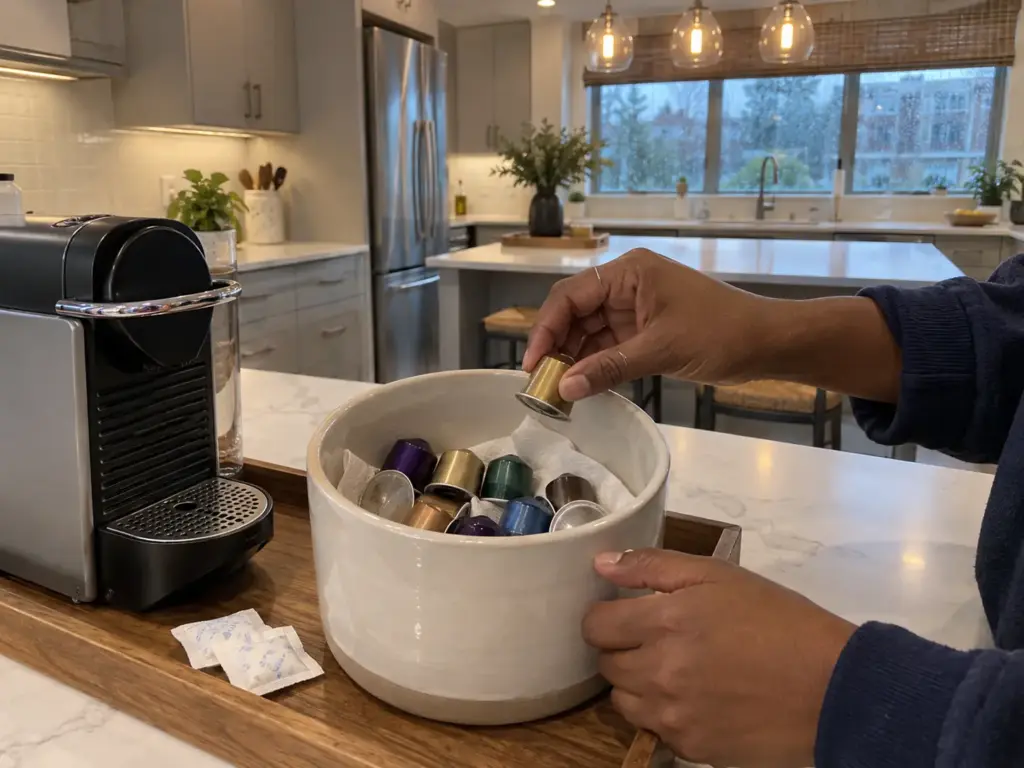
- A container without its lid. A lidless cereal container can hold the free bag, with a paper towel at the bottom and a couple of silica packets, shaken after each new pod.
- The freezer for the full bag. Keeping the bag in the refrigerator or freezer until it is ready to go helps prevent that.
- A dry absorber. A diaper tucked into the bag “helped to curb the moldy coffee smell,” according to the person who tried it.
- A paper bag on the floor. A bin kept in the kitchen can stay free of flies. That is a single report, not a rule.
Change one thing, then watch the next week. If the towel at the bottom is damp when you shake the container, replace it before adding more pods; if it stays dry, the setup is working.
Keep the container away from the sink. Drain flies breed where it is damp, and a pod container beside a wet sponge gives them the same ground twice. The cabinet beside the machine is a better spot than the windowsill above the drain.
Grounds: empty them or leave them in
Nespresso’s pages say the grounds become compost and the aluminum is reused, and gardeners often put the grounds in the compost before the pod goes into the bag. The pod does not have to be empty for the bag, so this is a choice rather than a rule.
Emptying a pod takes a minute and removes the wet coffee grounds, which are what the flies are after. If you drink one pod a day, emptying is a small habit that pays off mostly in the bag, and if you do not compost, a pod that goes in with its grounds still gets recycled.
Let a freshly used pod sit open on a paper towel for a few minutes before it goes in the container. The grounds in a spent Vertuo pod are at their wettest right after the brew, and a pod that drips into the towel is a pod that does not drip into the bag.
How Long One Bag Takes to Fill
The bag’s capacity turns recycling from a chore into a calendar. At one pod a day, two and three, the length of the wait is simple division, and it decides how often you make the trip and how long the oldest pods sit.
One pod a day, a bag in about 100 days
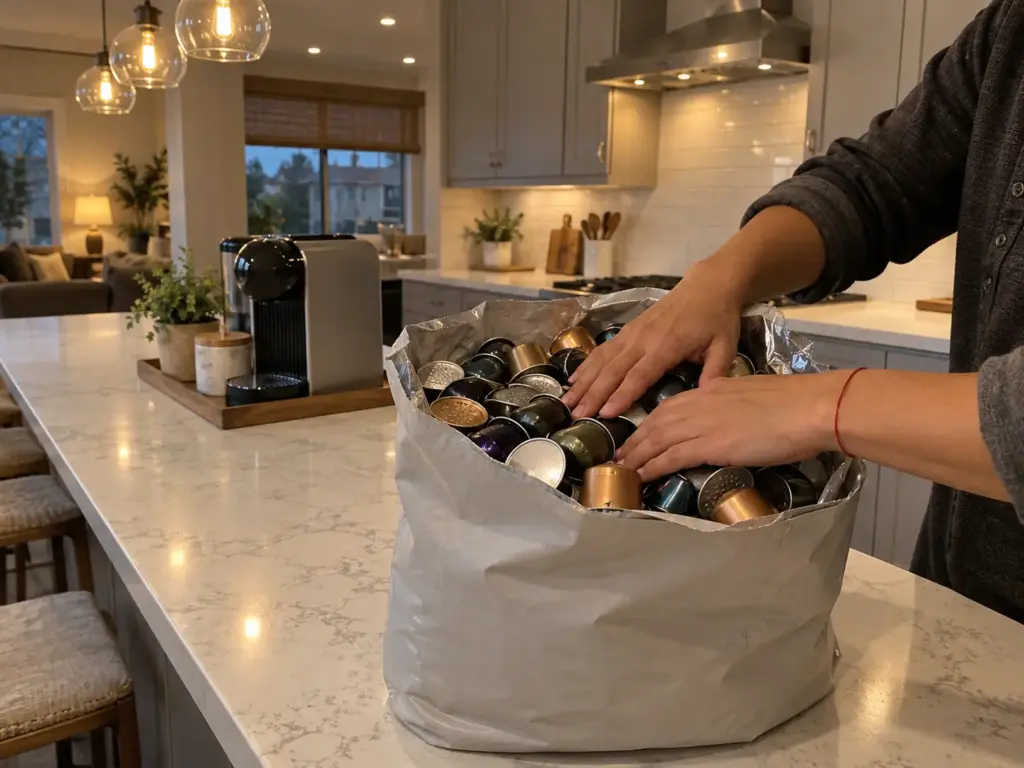
A Vertuo bag holds 100 capsules, so the arithmetic runs on what you drink. At one pod a day it takes about 100 days to fill, at two a day about 50, at three a day about 34 (33.3, rounded up), and at four a day about 25. The trip is quarterly for a one-a-day household and a matter of a few weeks for a heavier one.
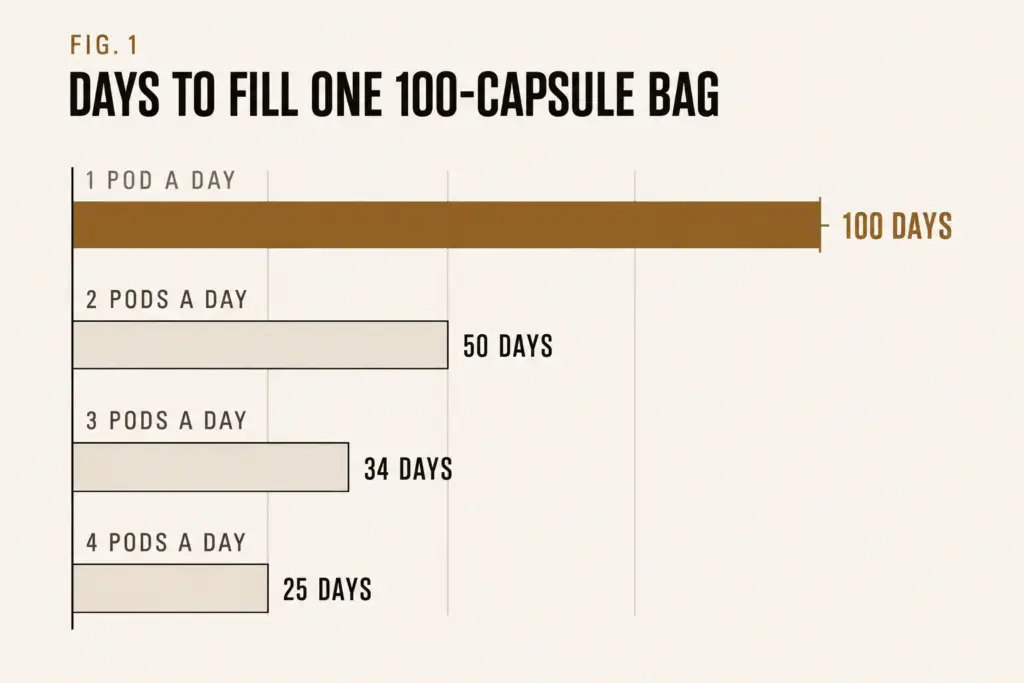
Those 100 days are also why the storage setup matters. A bag that takes that long to fill is a bag where the oldest pods have had weeks to build the smell, and the arithmetic and the previous section are the same fact seen from two sides.
Divide 100 by the pods you actually drink in a week, not the ones you plan to. If the answer is more than two months, start the bag in the freezer from the first pod, and the oldest pods never get the chance to turn.
The cost of the trip
The bag is free and the return costs no postage, so the price of the route is the trip and the wait. Add the terms: one way only, full bags only, nothing for Hawaii, Alaska or US territories, and the bin as a two-city exception. All of those are Nespresso’s own terms, not a verdict on the program.
The counterweight is to keep the pod out of the bag in the first place. That route has its own work and its own flaw, and it is the subject of the next section.
When the Better Fix Is Keeping the Pod Out of the Bag
Everything above assumes a pod used once and sent away. The next decision is whether to keep buying that pod, or to fill one yourself, which trades the bag and its storage problem for a different kind of work.
What a reusable pod changes
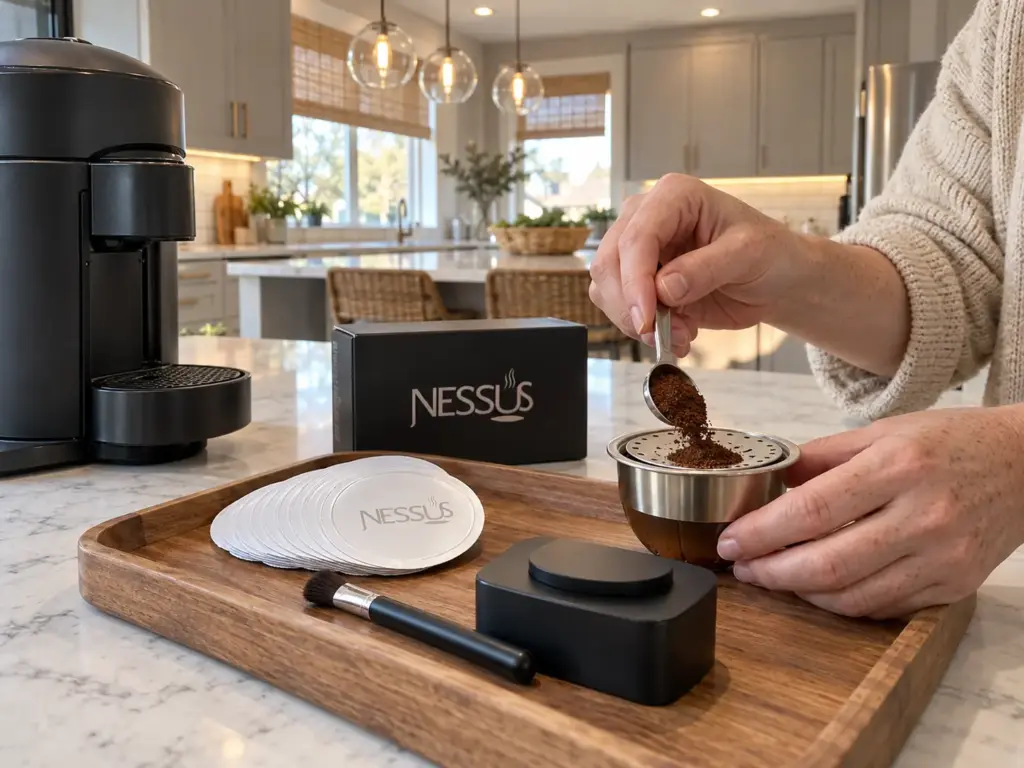
A reusable Nespresso pod you fill yourself keeps the spent capsule out of the bag entirely. A Vertuo machine reads a barcode on the capsule rim, which is why the only generic pods that work are pods you fill yourself. The fill, the grams and the flaws of the pod itself are covered in the guide to reusable Nespresso pods.
For the lids that make it work, the NESSUS Refill Kit for Reusable Nespresso Vertuo Pods comes with 100 aluminum lids, a holder, a cutter and a brush. The trade is lids: the foil lids are single use, so a reusable pod is a recurring buy of lids and a cleanup after every pod, not a one-off. The listing count for the kit reads as 50 or 100 lids depending on the listing, so check the count before buying.
Where recycling still wins
A household that drinks one pod a day and lives where the bag, a boutique or the bin is easy has no reason to fill pods by hand. The bag’s storage fix is a smaller job than rinsing and drying a pod after every cup.
The cheapest version of this decision costs nothing. The same freezer and lidless container from the storage section work for the bag, and a reader who sets those up has solved the part of recycling that was actually going wrong.
The Route, the Container and the Date to Write Down Today
Three things to keep:
- The bag is the default route, a boutique is the shortcut when one is close, and the household bin is an exception for two cities.
- The bag’s real problem is the wait. Airflow and dryness, or the freezer, keep it from growing mold and flies.
- At a pod a day the bag fills in about 100 days, so the trip is a quarterly habit, not a weekly one.
A month from now, look at the bag before it is full. If it smells or you see a fly near the sink, move it to the freezer and do not let it keep sitting.
For tomorrow morning, pick the container and the spot for the bag today, and note the date it will be full. There is no cup to taste after this one; the check is whether the counter stays clean until the day the bag goes out.
Frequently Asked Questions
01Can Nespresso Vertuo pods be recycled?
Yes, through Nespresso’s own program rather than the household bin in most places. The free prepaid bag returns them at any UPS drop-off, and a boutique or collection point takes them too.
02How do I get rid of my Nespresso pods?
Fill the free prepaid bag and return it at a UPS drop-off, or take the pods to a boutique or collection point. In New York City and low-rise Jersey City buildings, the household recycling bin works.
03Is it worth it to recycle Nespresso pods?
Only if the wait fits your kitchen. The bag is free, but it takes about 100 days to fill at a pod a day, so the real cost is storing it without mold or flies.
04Where do I drop off my used Nespresso pods?
At any UPS drop-off location with the prepaid bag, or at a Nespresso boutique or select retailer. The store locator on Nespresso’s site shows the live list of collection points.
05How do I recycle Nespresso pods without the bag?
Take them to a boutique or collection point (check the locator for what each accepts), or use the household bin in New York City or low-rise Jersey City buildings. Everywhere else, the bag is the route.


How did your cup turn out?
No comments yet. Tell us what you changed — and whether the needle moved.