


We may earn a commission when you buy through links on this page. It never changes what we recommend. How we pick
On this page8 parts
- Which Nespresso Line You Own Decides What You Can Reuse
- A Thin Cup Is a Dose Problem Before It Is a Grind Problem
- Grind Finer Than Pre-Ground, and What to Do Without a Grinder
- The Seal Decides the Crema and the Leaks
- The Picks by Line, With the Flaw of Each
- What Month Two Looks Like: Leaks, Lids and What the Warranty Says
- Weigh One Official Pod Tomorrow, Then Check the Lid in a Month
- Frequently Asked Questions
Your Nespresso is on the counter, the refillable Nespresso pod just arrived, the lid pressed down flat and the pour ran clean, and the cup is thin and pale anyway. That cup rarely comes from the machine. An Original reads nothing from the pod it brews, so the grams inside decide the cup before the grind does, and a Vertuo reads the rim, so the pod you reuse has to be its own. This guide to the best reusable Nespresso pods goes line first, then the dose, the grind, the seal, the picks with what is wrong with each, and what month two looks like.
Which reusable pod works depends on the machine line, and every route has one flaw worth knowing before you click.
| Machine line | What you reuse | The seal | Its one flaw |
|---|---|---|---|
| Original | Stainless steel shell, with its own steel lid (i Cafilas) or sticker lids (Triplot) | Steel lid with a seal ring, or glue-backed stickers | Holds less coffee than the official pod; sticker glue is hard to clean off |
| Original | Plastic shell (Bluecup) | Crimped foil lid, no glue | The cup can taste like weak tea; Original Line only |
| Vertuo | The official pod, refilled (NESSUS kit) | Foil lid that leaves the rim clear | Reviews say the seals do not stay on and the cutter blade breaks easily |
| Vertuo | A steel shell | Steel | Forum warnings that it harms the machine, so skip it |
Which Nespresso Line You Own Decides What You Can Reuse
Before any shell gets compared, the machine has to be able to use it. An Original reads nothing from the pod, a Vertuo reads the rim, and that one fact splits every shopping page into two kinds of listing that look the same. If you are still deciding which of the two systems suits you at all, that comparison has its own page.
Original Line: a shell, or a pod you reseal
The Bluecup listing says Original Line only, and it is not compatible with Vertuo, VertuoLine, or VertuoPlus. That is a seller’s claim, and it is the one to check against the machine.
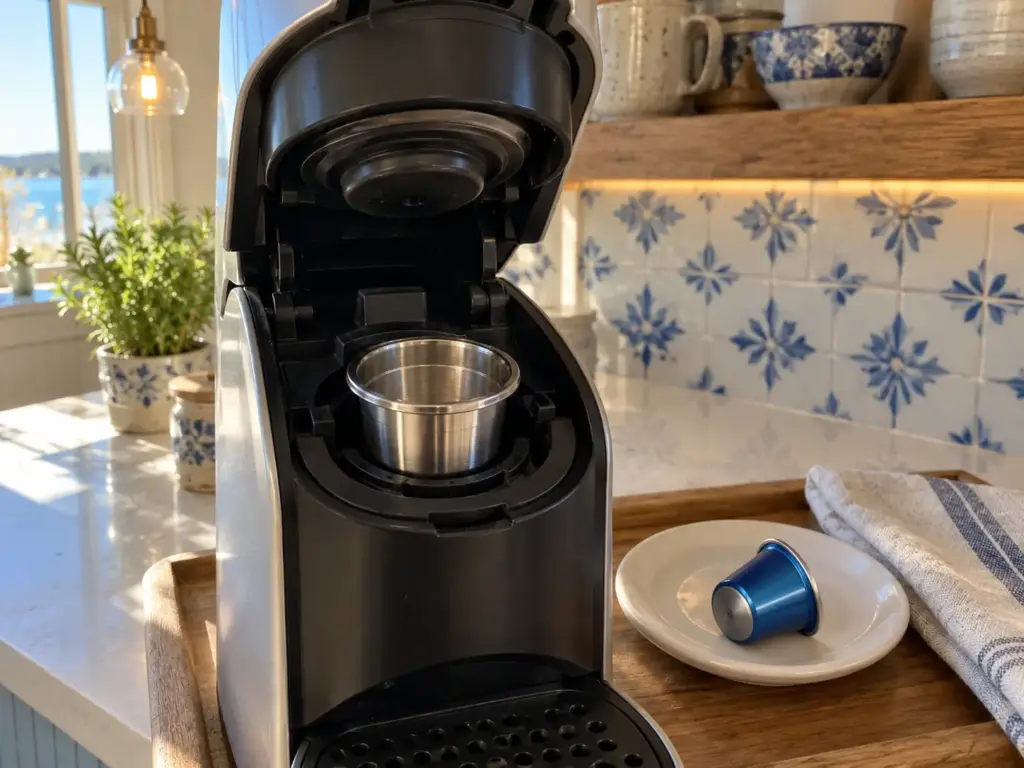
A reusable Nespresso Original pod comes in two families: a stainless shell with a lid of its own or a sticker, and a plastic shell closed with a crimped foil lid. Both take ground coffee, and the cup tells you which one worked. When someone asks which reusable to buy, the first answer is often a long list of brands with no mention of a grind, which is the wrong order: weight and grind decide more of the cup than the brand does.
Vertuo: the official pod, refilled under a foil lid
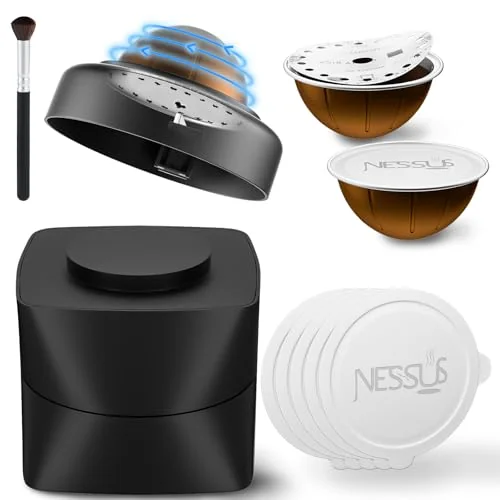
A reusable Vertuo capsule is the official pod, washed, dried, refilled and resealed with a foil lid that leaves the rim clear. The NESSUS kit is built around that: a holder, a cutter and 100 lids. Whether a filled third-party Vertuo pod exists at all, and how the rim barcode, or rim code, works, is a separate question with its own page.
Why a steel shell in a Vertuo is the one to skip
Some warn that steel capsules can damage the machines, while foil lids are considered safe. Others argue that reusables do not work in a Vertuo because of how it spins the pod at high speed. Neither view comes with a test, so neither mechanism is established physics.
The two sides of the bet are unequal, though: a foil lid costs you nothing to try, and a steel shell puts the machine at risk on an unproven claim. That is enough to skip it. Where a bad Vertuo seal shows up first comes up again in the month-two section.
A Thin Cup Is a Dose Problem Before It Is a Grind Problem
The reflex is to blame the beans or the machine, and sometimes that is right. The likelier culprit is plainer: a reusable shell holds less coffee than the official pod it replaces, and a cup made from less coffee tastes thin no matter how well the rest is done.
Weigh the pod you are replacing
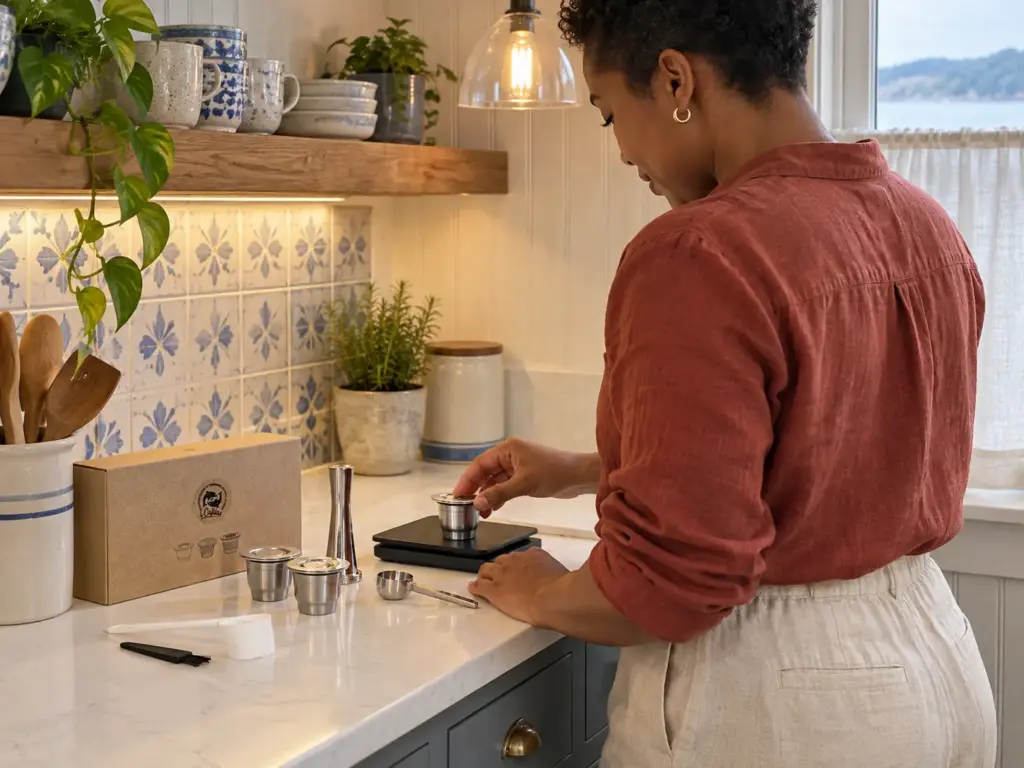
The reference is the official pod, weighed, never a number copied from a blog. A practical rule is to weigh each official pod you want to refill, since anything more or less than the original weight can cause pod instability or suboptimal coffee. That is not a Nespresso spec, but the logic holds: the machine was built around one weight. On a 5.7 g dose, 2 % is about a tenth of a gram, so a kitchen scale that reads to 0.1 g is the tool for this job.
For a sense of scale, one reviewer weighed an official Original pod at about 6.4 g with about 5.7 g of coffee inside. That is one person’s scale, not a published figure, so weigh your own.
The Bluecup listing gives 5.2 g of coffee per pod, which is a listing figure and should be read as one. In a 7.7 oz reusable pod, a fill that is only leveled, not packed, holds noticeably less coffee than the official pod, so the fill is the first thing to check. Treat that as a second reference, one user’s number, after you have weighed your own.
Put the empty shell on the scale and zero the display before you spoon anything in. Then fill until the reading matches the coffee weight of your official pod. A scale that starts from the shell’s own weight gives you a coffee number; one that does not gives you a guess.
Why the stainless shell comes up short
The i Cafilas set shows the problem plainly: it ships with a tamper and a scoop, so you can weigh the dose with what comes in the box. Some reusable pods hold noticeably less coffee than the official one, and that gap alone can make a cup taste thin.
On some models the shell comes out shorter than the official pod, and the cup can be too weak. Amazon’s review summary describes the coffee as often weak and tasteless, and the listing itself warns that the lid’s ring must be intact or water will leak.
So the advice to buy a stainless shell because it is closest to the official size has a catch. Close in size is not the same as equal in dose, and the dose is what you taste first.
Read the cup: weak, gritty or pale points at a different change
Name which way the cup is off before you touch anything. Weak and watery points at the dose, which is this section’s fix. Gritty points at the grind or at the lid’s filter, which is the next section. Pale with little crema points at the seal, which is the section after.
One change per cup, and taste between each, because three changes at once leave you not knowing which one worked.
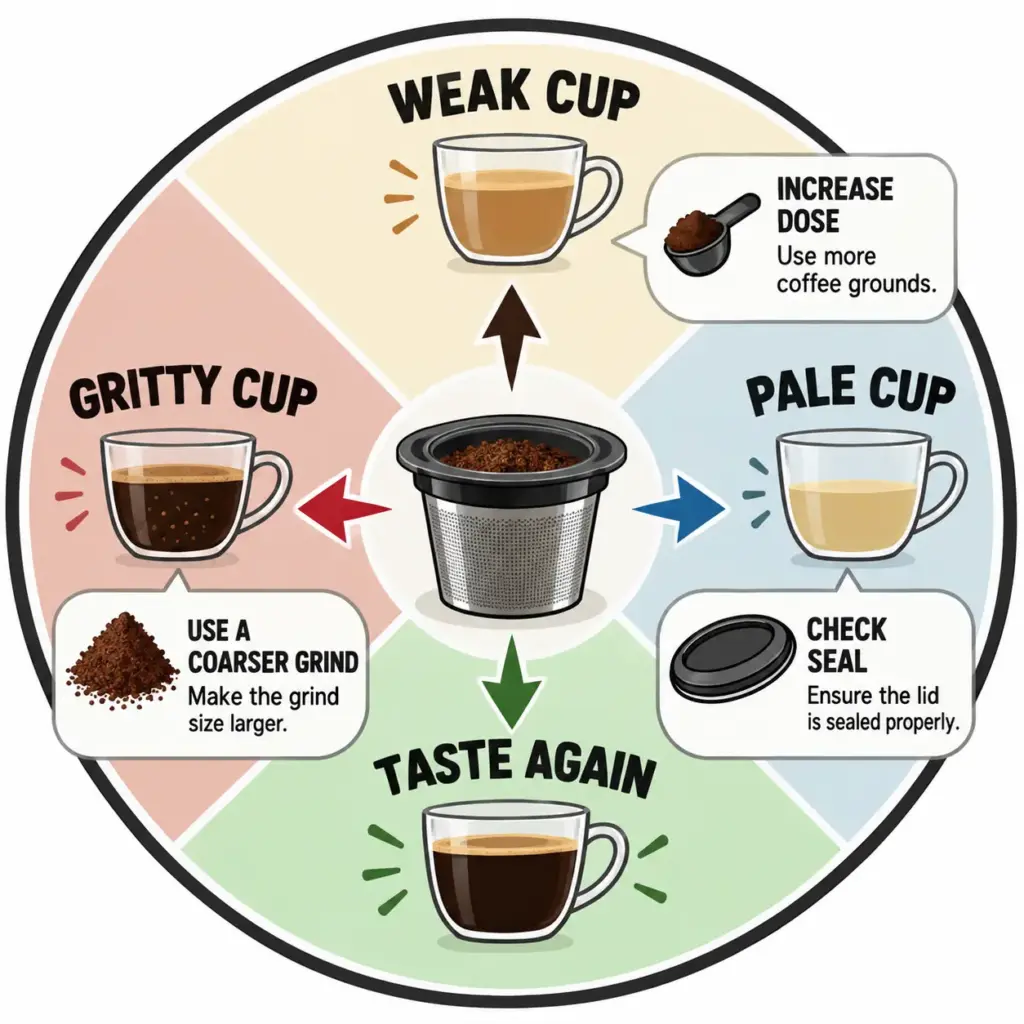
If the cup moves from thin to only flat after the dose is right, that is progress, and it leaves the grind as the next suspect. Which way the cup is off decides how far to move it, and a cup that turns bitter means you went one step too far.
Grind Finer Than Pre-Ground, and What to Do Without a Grinder
With the weight right, the next free change is the grind. It is also where the reader with no grinder gets skipped, so that case gets its own answer here.
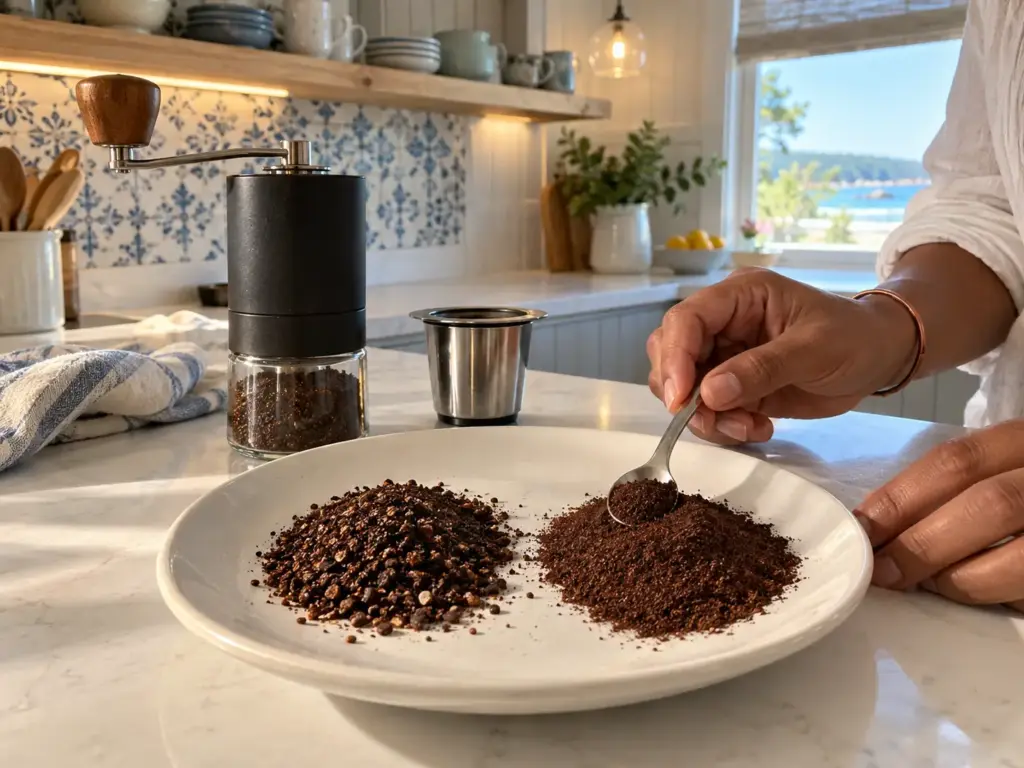
Fine for a pod, and finer than pre-ground
A pod machine pushes water through a thin, short bed of coffee, so the grind has to be fine enough to slow the water. The i Cafilas listing puts the failure in a line: “Coarse grinds will cause water to rush through too fast, resulting in weak coffee.” That is a seller’s sentence, but the mechanism is plain: water that passes quickly takes too little from the coffee. The nearest reference is the espresso grind the pod is closest to.
That puts pre-ground coffee in an awkward spot. Even pre-ground coffee can be ground a bit finer for Nespresso. It also runs against the usual advice for other brewers: re-grinding pre-ground coffee goes the other way for a drip or a press, where the advice is to set it coarser. A pod is the opposite case, so read that page for those machines, not this one.
The signs are mechanical. A quick, pale pour means the grind is too coarse. A gurgle or a stalled drip means it is too fine. Move in half steps, not whole ones.
After any grinder adjustment, run a small throwaway dose first. The burrs hold grounds from the old setting, so the first dose after a change still comes out at the old grind, and tasting it tells you nothing about the new one.
With no grinder: what is possible, and what is not
Without a grinder, dialing in the grind is more challenging. Getting a grinder is worth it. Both points are blunt, and both are right about the ceiling.
A blade grinder makes dust and chunks together, which in a pod means the dust slows the water and the chunks let it through, and the cup is thin and harsh at once. A burr grinder is what cuts that mix down. What you can do without a grinder is worth knowing, and it will not give a Nespresso-fine grind.
A reusable pod is a grinder decision in disguise. If the cup is still off once weight, grind and seal are right, which grinder to buy first is the next question, not another pod.
The Seal Decides the Crema and the Leaks
With dose and grind right, a cup can still come out pale, because the foil seal or sticker is the last thing between the water and the cup. When it lets go, the water takes the easy way out and the coffee never gets its full contact time.
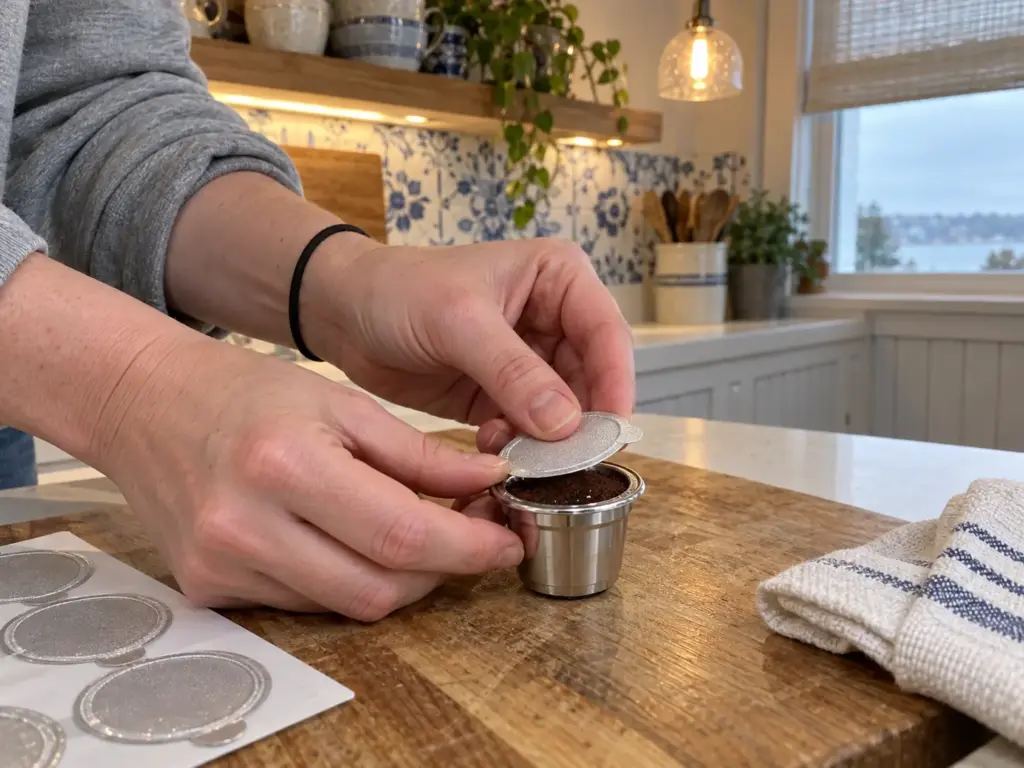
Foil, sticker and silicone lids: what each one lets go
Foil and silicone lids keep a refill for different lengths of time. Aluminum foil lids can keep a filled pod fine for several days, so you can fill a few at once. Refills under silicone lids “have to be used immediately,” which makes them same-day pods.
Sticker lids carry a different cost. On the Triplot set, the sticker lids are the weak point: the glue is very hard to remove once used, and coffee can get stuck on the rim and stop the capsule from sealing. Some sets work for the first batch and not the next.
Even a full fill can come out quite watery. Each sticker is a single-use part, and the set ships with 300 of them.
Wipe the rim of the shell with a dry paper towel before the lid goes on. A film of grounds or oil on the rim is what a sticker or foil sits on, and a lid pressed onto a dirty rim is the one that lets go in the machine.
A shell with its own lid, and what its filter catches
A shell with a lid of its own, like the i Cafilas, has no sticker to peel and depends on its seal ring instead. Check the ring before every use, because the listing says a damaged one means “there will be water leakage.” The lid also carries the filter, so grit in the cup points at the grind first and at the lid’s mesh second. Look at the grind before you blame the steel.
One honest gap belongs here: no source reports how a stainless shell’s seal holds after many months of use. Anyone who tells you it lasts is guessing, and so is anyone who tells you it fails.
A fresh lid every time, and how long a refill keeps
Foil and stickers do not re-seal. A used lid has already been crimped or stuck once, so a new lid on every refill is the only way to compare one pour with the next. Overfilling spoils it too: one extra spoonful can make a pod burst, and a foil edge that sits on a mound of coffee instead of the rim will curl and leak. Fill level, press flat, and keep the refilled pods within the days the foil allows.
The Picks by Line, With the Flaw of Each
The picks are sorted by machine line first, not by star rating, because a pod that does not fit your machine has no rating that matters. Each one carries what is wrong with it.
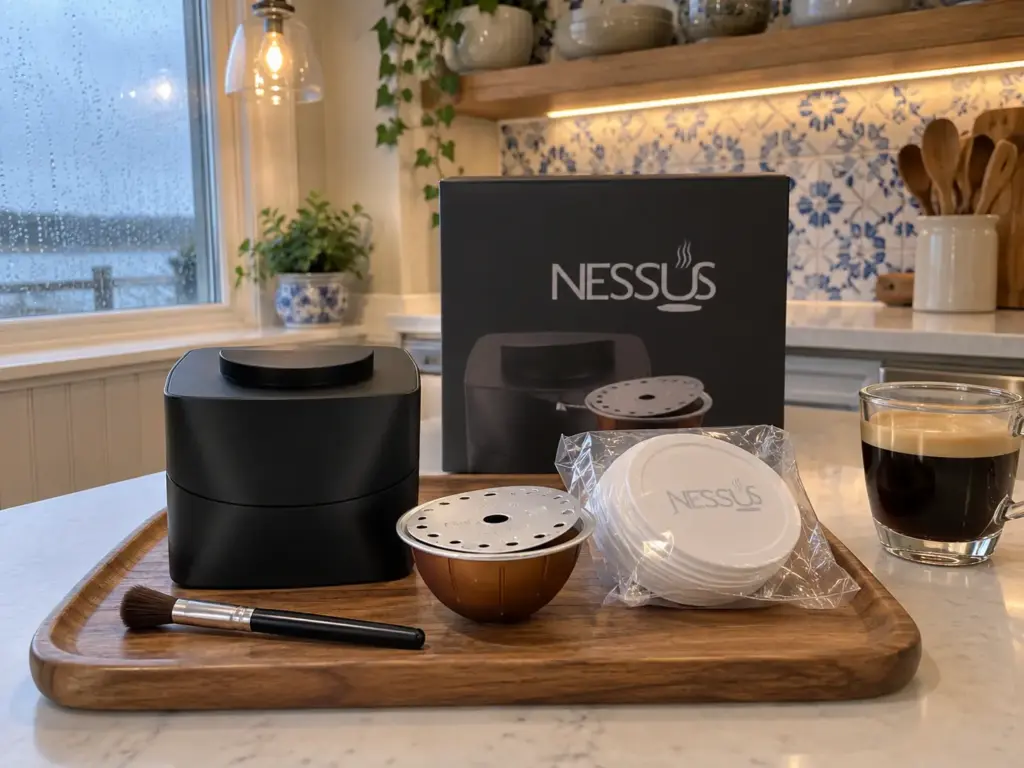
The baseline is the pods you already own and the cup they make. A reusable that cannot match that cup is not worth the trouble, and the way to know is to taste them side by side with the same dose and a new lid.
For an Original: Bluecup, and its crimped foil lid
Bluecup is the only Original pick here whose seal is a crimp, not a glue sticker. The obvious reading is that this makes it the better pod, and the reviews are less sure. Buyers often complain that the coffee comes out no stronger than weak tea, and a firmware change on some Ninja units can bring up an “Add Water” error, which points at the machine, not the pod. Both are one-person reports. Read together with the 5.2 g listing figure, they say the same thing as the dose section: weigh it against your official pod.
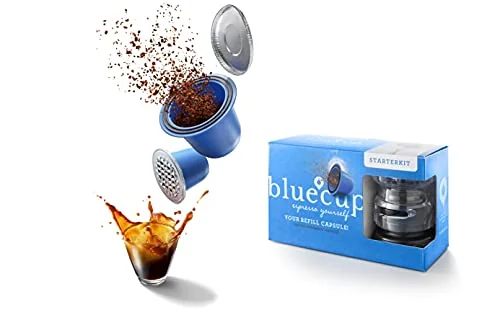
If you have a stainless shell already, the i Cafilas and Triplot sections above tell you what to watch. The shell is a fine choice, and its limit is the dose.
For a Vertuo: the NESSUS refill kit
The NESSUS kit is the only Vertuo pick here that is in stock and uses a foil lid, not a steel shell. It refills the official pod, so the dose reference is the pod you already own: weigh one, fill to it, leveled and not packed.
When the official pod is still the better answer
SealPod, WayCap and a Vertuo version of CAPMESSO come up in discussions, but their listings were not on Amazon when checked, so none of them is verified or recommended here. And a reusable that cannot match the official cup is not a saving: if the pod you started with still makes the better cup, keep using it.
If the cup is still short with the weight, grind and seal all fixed, it is the grinder, not the pod. The same shell-and-fill question on another machine is answered for a Keurig.
What Month Two Looks Like: Leaks, Lids and What the Warranty Says
The reviews that sell a reusable pod are written in the first week. What follows is where the shell, the lid and the machine’s manual start to matter.

The leaks the reviews keep reporting
The NESSUS kit’s durability gets mixed marks, and a repeated complaint is that the cutter blade breaks easily. Some reusable Vertuo pod caps let brewed coffee leak into the discard chamber, especially with the bigger pods that brew 8 oz or more, and a fraction of the cup can be lost that way, with no issue with the machine yet. That is one user’s report, not a rule, but it shows where the failure appears: the larger pours, not the espresso sizes.
The wet spot under the pod after a pour, which is the pod catching compartment, is the first sign of a lid that has let go. The Bluecup six-month review and Triplot’s “works for the first batch” line fit the same pattern from the Original side.
Look at the compartment under the pod after the first pour of every refill, not just the cup. Wet means the lid let go, and that pod is done, whatever the cup tastes like.
Rinse, dry, and descale the machine as the manual says
Rinse and dry the shell or the official pod before the next fill, as one reply does with the official pods it refills after washing and drying them. Then descale the machine on the schedule in your manual. This is the cheapest habit in the article and, as the next section shows, the one the warranty text cares about.
What the two Nespresso warranty texts say, and what neither says
According to Nespresso’s own warranty for the US and Canada, the machine is covered for one year on defects in materials and workmanship, and the exclusions include “failure to follow the product instructions and User Manual,” “improper or inadequate maintenance, calcium deposits or descaling,” and “unauthorized product modification.” That text does not mention capsules or pods.
The older Vertuoline manual says something the 2025 text does not: “any defect or dysfunction resulting from the use of non-genuine Nespresso VertuoLine capsules will not be covered by this warranty.” It does not say whether a refilled official pod counts as non-genuine, and this article does not guess. The two documents differ, so each claim here belongs to its own document.
The practical reading is a mechanism, not legal advice: the exclusion both texts share is about how the machine is looked after, so the descale and a clean rim are the habits that cost nothing. For anything more specific, Nespresso is the one to ask.
Weigh One Official Pod Tomorrow, Then Check the Lid in a Month
Three things carry the whole article:
- The machine line decides what you can reuse at all.
- Fill to the weight of your official pod, not to a number from a blog.
- The lid decides the leaks, so use a fresh one each time.
A month from now, brew one cup from the reusable and one from a pod you still own, with the same dose and a new lid, and see whether the gap has widened.
Tomorrow morning, weigh one official pod, fill the reusable to that weight, wipe the rim, seal it and taste. If the cup is still thin, change one thing next: the grind, by half a step. If you hold a stash of other pods, decant instead of buying a second pod type.
Frequently Asked Questions
01Are reusable Nespresso pods any good?
They work when the dose matches your official pod and the lid seals. The cup is often a little thinner than the official one. The usual faults are a light fill and a lid that lets go, and both are fixable.
02Is there such a thing as a reusable Nespresso pod?
Yes, and the machine line decides which kind. An Original takes a reusable shell. A Vertuo takes its own official pod, refilled and resealed under a foil lid that leaves the rim clear.
03What coffee is best for reusable Nespresso pods?
Fresh coffee ground fine, close to an espresso grind, and weighed to match your official pod. Pre-ground is usually coarser than a pod needs, so a grinder is the real upgrade.
04Do reusable Nespresso pods damage the machine?
Some warn that steel shells can damage a Vertuo, but no test backs it. The 2025 US and Canada warranty does not name pods. The older Vertuoline manual excludes non-genuine capsules and says nothing on refilled official pods.
05What are the best alternatives to Nespresso pods?
The first alternative is the official pod you already own. After that, decanting other pods into the format your machine takes beats buying a second pod type.



How did your cup turn out?
No comments yet. Tell us what you changed — and whether the needle moved.