




We may earn a commission when you buy through links on this page. It never changes what we recommend. How we pick
On this page8 parts
- Which Keurig You Own Decides Which Pod Fits
- Why a Thin Cup and a Gritty Cup Are One Fault
- The Free Fix First: A Paper Disc, Then the Grind
- The Pods, With One Flaw Written Down for Each
- What a Reusable Pod Looks Like in Month Two
- Using the Pod You Already Own Before Buying Another
- Match the Needle, Add the Disc, Then Judge the Pod
- Frequently Asked Questions
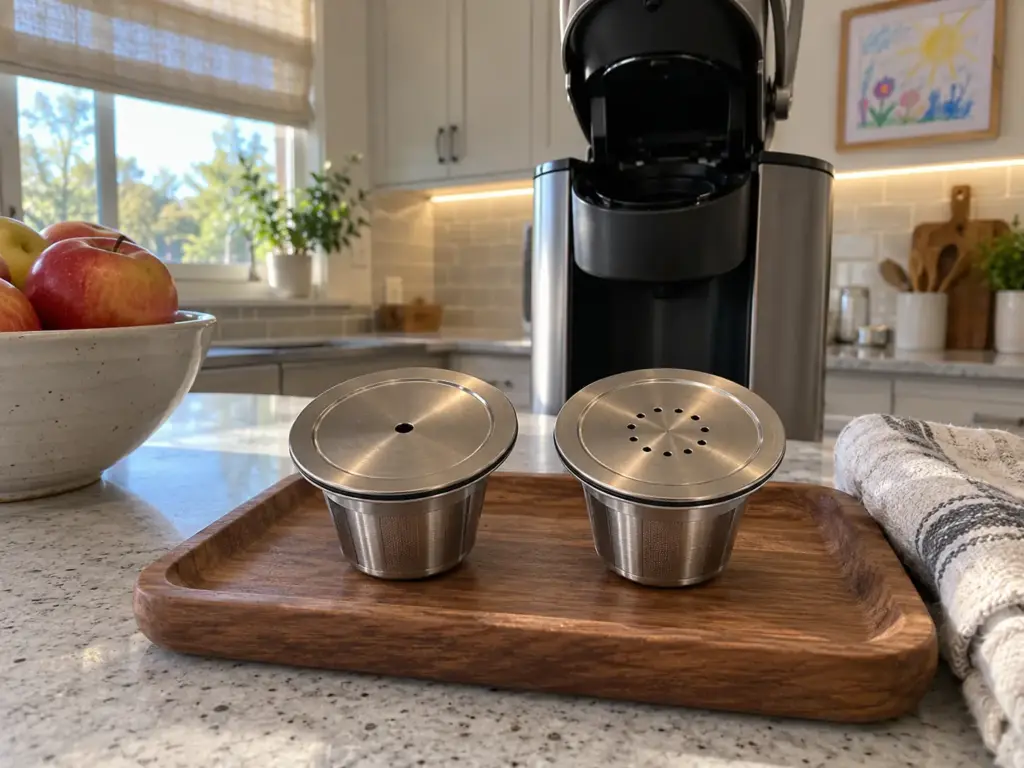
You dropped a reusable pod into the Keurig to stop buying K-Cups, and the mug came out pale with a layer of grounds in the last inch. The best reusable coffee pods for Keurig are not separated by flavor at first, because a reusable pod is a flow decision before it is anything else: the openings in its mesh set how fast the water passes the grounds, and the needle inside the machine decides which pods fit at all.
This guide goes in that order. It checks the fit, shows why a thin cup and a gritty one are usually one fault, gives the free fix, and then reads each pod next to its flaw. After that comes what a pod looks like once the novelty is gone, and how to get more from the one already in your drawer.
Every fit in the table is the listing’s own claim, so read the flaw column as closely as the fit column.
| Pod | Fits (the listing’s claim) | Build | The flaw in writing |
|---|---|---|---|
| Keurig My K-Cup | MultiStream: K Supreme, K Supreme Plus, K Slim, K-Duo Gen2, K-Brew Chill | Stainless mesh in a plastic holder with a lid | The lid: a listing review fears it will snap off after a few uses |
| CAPMESSO 4 pack | 5-hole machines only | Stainless, micro mesh, 5-hole lid, silicone ring | Grounds stuck on the lid, and a lid that came off after a descale, per listing reviews |
| Noalto 2 pack | 1-hole (single-needle) machines only | Stainless with silicone seals and lid | No repeated complaint found in the listing. |
| Irmidi paper discs | Keurig 1.0 and 2.0 | Paper, 300 count | The thin ones tear on removal, per a listing review |
Which Keurig You Own Decides Which Pod Fits
A ranking of pods is no use to a reader whose machine will not take the top pick, so the fit comes before any talk of flavor. The sources also disagree with each other on it. What follows is what each listing claims, who is making the claim, and what stayed unconfirmed.
Single-needle and MultiStream, as the listings use the words
Listings sort Keurigs into two families. A single-needle machine is the 1.0 line, and the pod’s lid gets one hole. A MultiStream machine is the 2.0 line, and its lid gets a ring of holes, which is why pods are sold as “1-hole” or “5-hole.” A pod built for one family is not a pod for the other, and that is the first thing a ranking by flavor skips.
The CAPMESSO listing opens its fit line with “Only fits Keurig 5-hole machines, except” a K-Crema exception, then names the 1-hole machines it leaves out: K-Mini, K-Elite, K-Express, K-Compact, K-Duo Gen 1 and K-Classic. The Noalto listing draws the line the opposite way: single-needle (1-hole) brewers only, naming the K-Mini, K-Express, K-Classic, K-Elite, K-Latte, K-Select, K-Compact, K-Duo, K-Duo Plus and the K200 to K560 models, and not for 3- or 5-needle machines. Both are the seller’s claim, not an independent check.
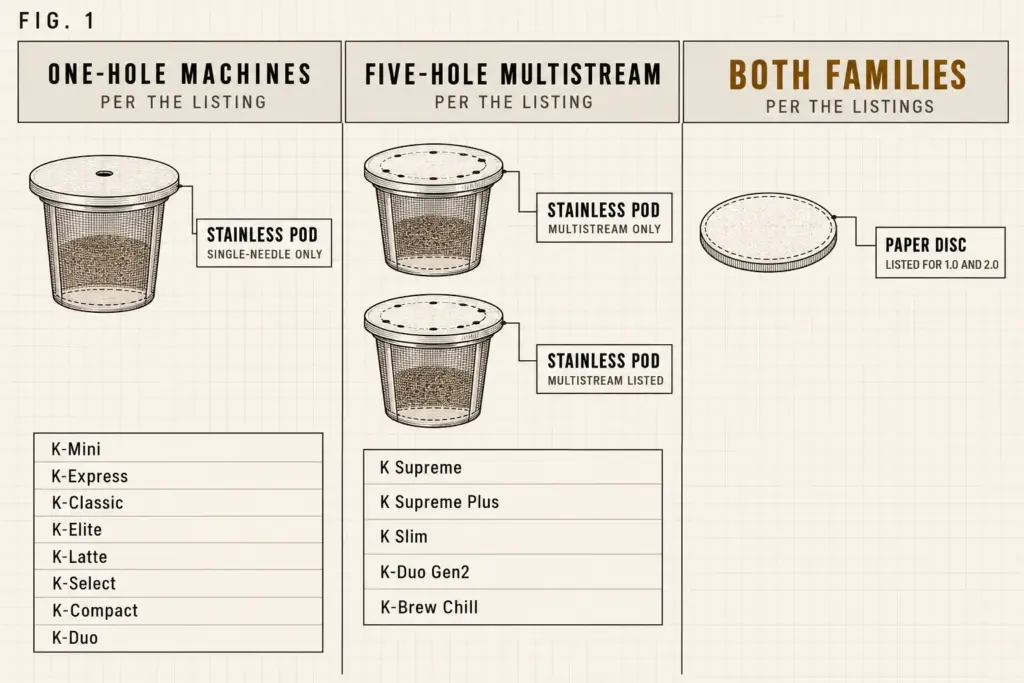
The brand’s own pod sits on the MultiStream side: its listing claims a fit for the K Supreme, K Supreme Plus, K Slim, K-Duo Gen2 and K-Brew Chill. The paper disc is the odd one out, listed for both 1.0 and 2.0, which is why it can be the first fix whatever the machine.
And the pod everybody names as the stainless pick stops being the obvious pick the moment the needle is wrong. A page elsewhere describes the Noalto as fitting 2.0 models, while the Amazon listing says single-needle only. The listing is the one quoted here, because it names models.
If you are not sure which line you own, the Keurig lines and what each one adds sorts them.
The model lists on the listings, and what they leave out
No readable source explained how to tell a single-needle machine from a MultiStream one by looking at it, so no physical test is offered here. The route that can be sourced is plainer: find the model name on the machine’s housing or in its manual, and match it against the model list on the listing. A pod that fits the holder can still be wrong for the needle, because the lid’s holes and the needle have to line up, and that is why listings name models instead of a size.
Read the model list on the listing before you read a single review. If your Keurig’s model name is not on it, treat the fit as unconfirmed, however good the stars look.
Why a Thin Cup and a Gritty Cup Are One Fault
You probably have two complaints and assume two causes: a pale, weak mug, and grounds at the bottom of it. With a mesh pod they usually share one cause, and the order of fixes depends on seeing that.
Openings set the flow
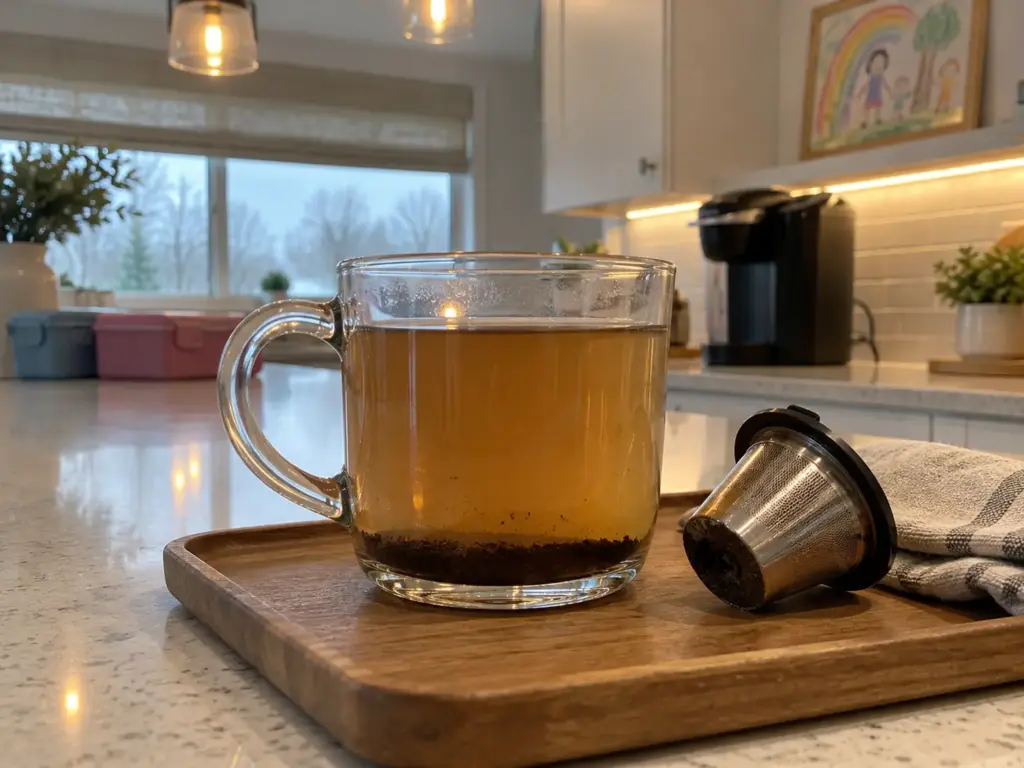
The mechanism is simple: when the openings are too big, the water goes through too fast to brew, and grounds end up in the cup. Water that passes quickly has less contact time with the coffee, so the cup comes out thin, and the same speed carries fine grounds through the mesh with it. That is a common reading of the problem, and it is not something checked here.
The direction matters because it decides the first change. A pod whose openings pass water quickly points at the water, not at the coffee, so the first move is to slow the flow rather than swap beans. Contact time is set by the openings and the grind together, and how a drip coffee maker works, and why the grind sets the time explains the second half.
Opinions differ on mesh. Some dislike any filter with a mesh screen, while others find that stainless versions let fewer grounds through. That is opinion, not evidence, so it does not set a ranking here.
It also leaves a gap: the brand’s own pod is a stainless mesh, so the word stainless alone does not settle anything. The size of the openings does.
Reading the cup: thin, gritty, or both
Thin means pale, flat, and short on taste: the water left before it finished. Gritty means grounds in the mug, and they show themselves late, because they settle. Look at the last inch of the mug before the first sip and you can see them.
Both together is the usual case, and it is one fault. Grit with a cup of ordinary strength is a different reading: it points away from the openings and toward the rim, where grounds slip past the lid instead of through the mesh. The month-two section comes back to that.
What the grind guide covers and this one does not
If the cup tastes sour or bitter instead of thin, you are on a different ladder, and how grind size changes taste, from sour to bitter walks it. The setting itself, the mesh buildup and the chart belong to the grind guide linked in the next section. Here the only question is which way the cup is off.
The Free Fix First: A Paper Disc, Then the Grind
If the openings let the water through too fast, the cheapest brake is a paper disc inside the pod. The grind earns a change only after that.
Change one thing, then taste again
Several fixes exist, and a reader who changes three of them in one morning cannot tell which one worked. So they go in order, free and likeliest first, with a taste between each:
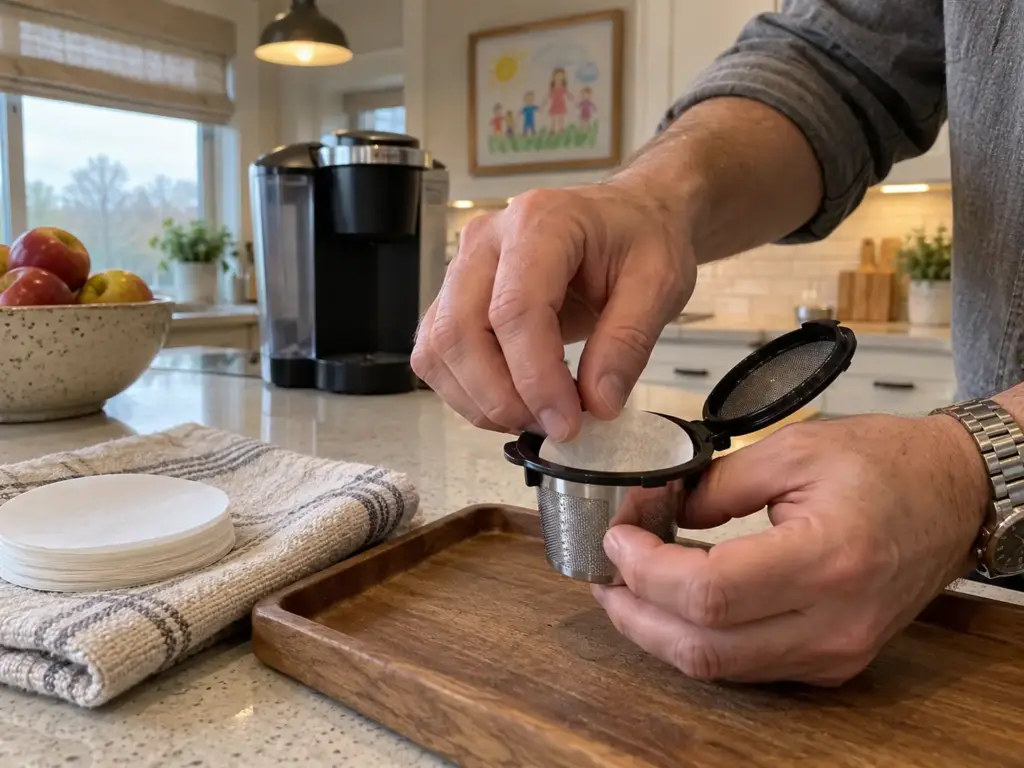
- Put a paper disc in the pod you already own. The next cup should taste fuller and the bottom inch of the mug should come up clearer. If it overshoots, it turns bitter, because the water now stays too long.
- Taste it, and change nothing else.
- Only if the cup is still off, move the grind, using the K-cup grind guide below.
- Taste again.
- Only then consider a different pod.
Change the paper disc or the grind, never both in the same cup. The cup can only tell you which one moved it if only one moved.
The paper disc as a brake
The thread treats the disc as a normal part of the fix, not a sign of a broken pod. A near-espresso pre-ground in a mesh pod would probably need a paper filter for that fine grind, and Keurig’s own reusable still really needs one.
There is a reason behind it. A finer grind is the usual advice for a weak cup, but in a mesh with large openings a finer grind slips through, so the cup gets grittier, not stronger. The disc has to come first.
The Irmidi paper filters are listed for 1.0 and 2.0, so they are the one piece of this fix that works whichever needle you have. Thin discs can be so weak that they tear when you remove them, and torn paper sends wet grounds into the pod. A thin disc fails as the brake.
A disc that lies flat in the pod before the grounds go in lifts out whole, and one that folds at the edge tears sooner. If you are weighing the paper step against a permanent mesh, paper versus permanent filters covers the trade between a clean cup and a full one.
Then the grind, the one the pod already asks for
When the disc has done what it can and the cup is still off, the setting is next. The grind size that works for a K-cup holds the setting, the mesh buildup and the chart, so this article does not rebuild them. The fill amount is a separate question and is not answered here.
The Pods, With One Flaw Written Down for Each
With the machine’s needle and the openings in mind, each pod can be read against its own listing and its own reviews, with the flaw written next to the fit.
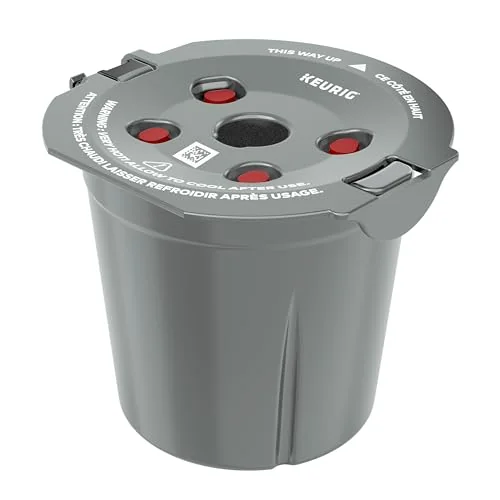
Keurig My K-Cup, the baseline everyone compares with
The Keurig My K-Cup is the brand’s own reusable: a stainless mesh in a plastic holder with a lid, fill lines marked on the holder, and a listing that claims a MultiStream fit. Reviews on that listing worry about the plastic. One says “I fear the lid will snap off after a few uses,” and another calls it “Cheap and flimsy and doesn’t work nearly as well as the old version.” The complaint is the holder and the lid, not the mesh.
The same point applies here: this pod still needs a paper filter, so the disc from the last section belongs with it.
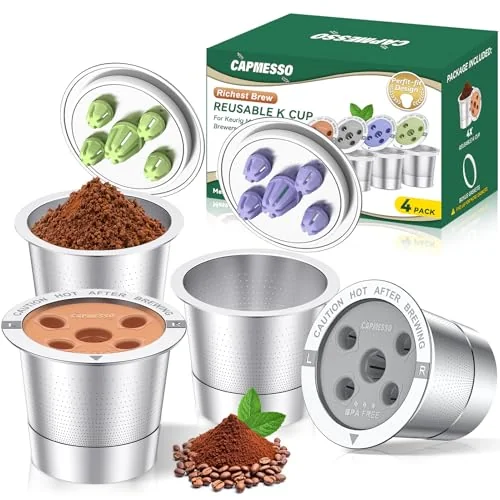
CAPMESSO, the stainless pod for a MultiStream machine
The CAPMESSO pack brings four stainless pods, each with a 5-hole lid, a silicone ring and micro mesh. It is the one stainless pick here whose fit is written out with a machine list: the K Supreme, K Supreme Plus, K Slim, K-Duo Gen2 and K-Brew Chill, and nothing with a single hole. The reviews on its listing include “coffee grinds get stuck on lid,” plus one weak-coffee complaint, and a review written as an update after a descale says “the lid had tendency to come off.” Those read as fit and wear problems to check on the lid, not grind problems to fix at the grinder.
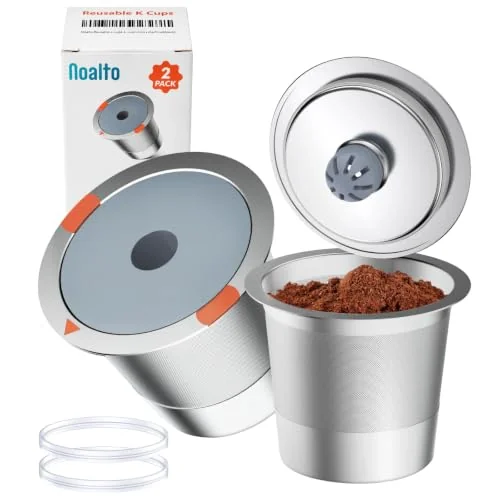
Noalto, the stainless pod for a single-needle machine
The Noalto two-pack is the stainless pod for the other family: silicone seals and a lid, and a listing that limits it to single-needle machines. No repeated complaint turned up in that listing, and none is invented here. What exists is opinion in its favor: stainless ones let fewer grounds through. The fit is where it can go wrong, and the listing, not the page that calls it a 2.0 pod, is the one to follow.
Run the paper disc test on the pod you already own before buying a second one. If it brews well with and without the disc, the pod was fine. If only the disc rescues it, the openings were the problem, and a new pod with the same openings will not fix it.
Two names the thread praises that could not be checked
Rethrone comes up as a pick, and it is said to work with or without a paper filter. Its build is not settled: it is described two different ways, and no listing could be found to settle it, so neither its build nor its fit is stated here and it gets no link. A paper disc on a pod you already own does the same braking job for the price of a disc.
GoodCups is the other name. With no listing to read, it is not recommended here either.
What a Reusable Pod Looks Like in Month Two
Reviews tend to be written near unboxing, and the part that moves later is rarely the mesh. The same few complaints come back, and a complaint that repeats is a design flaw, not bad luck.
The lid is the part that moves
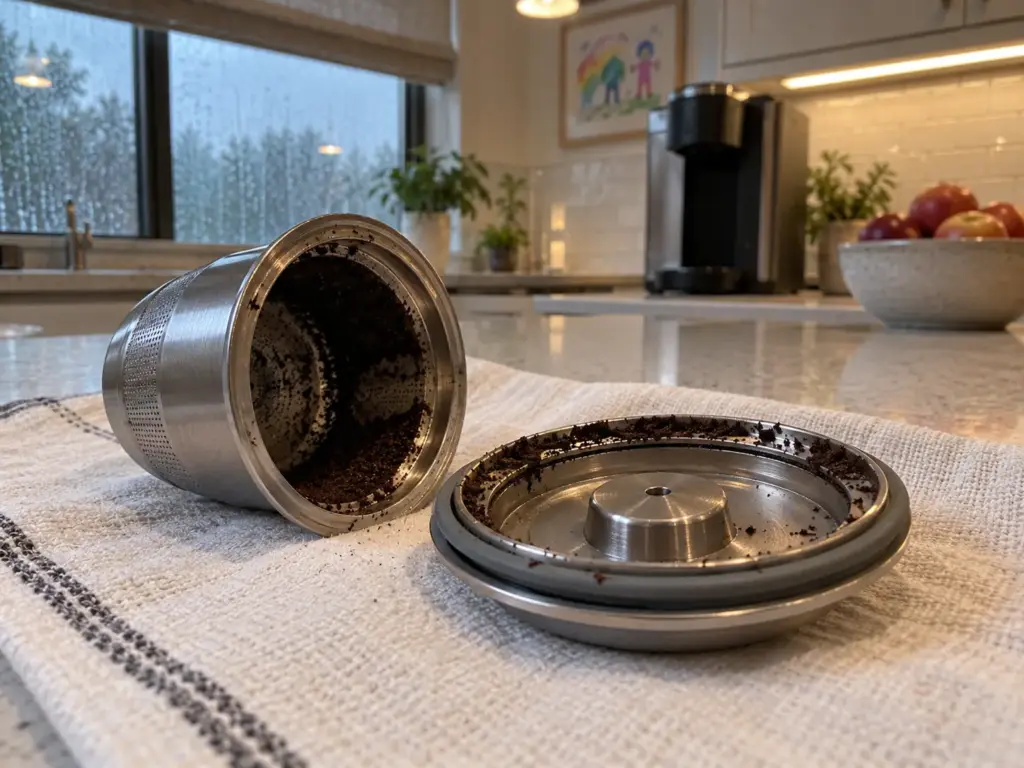
The month-two report on the CAPMESSO listing is a review written as an update after a descale, and it says the lid had a tendency to come off. The My K-Cup review that fears the lid will snap off after a few uses is the same failure on a plastic lid. Two pods, one pattern: the mesh is not what fails first, the lid is.
Grounds on the lid and the rim after each rinse
A lid that clicks in when new and sits loose after a few weeks lets grounds under the rim. That shows as grit at the bottom of the mug before it shows as a thin cup, which is why grit with an ordinary-strength cup is a reason to look at the lid before touching the grind. The CAPMESSO review of “coffee grinds get stuck on lid” is the early form of it.
After rinsing, press the lid on dry and look along the rim for a thin line of old grounds before you fill the pod again. A rim that is not clean is where the grit starts.
What no source here measured
If a pod goes wrong in month two, the check is the lid’s fit first and the rim second, in that order. The mesh comes last.
Using the Pod You Already Own Before Buying Another
The cheapest answer to “which pod” is often the pod and the machine already on the counter. The next question after that is whether the Keurig suits your mornings at all.
The kitchen workaround that uses what is on the counter
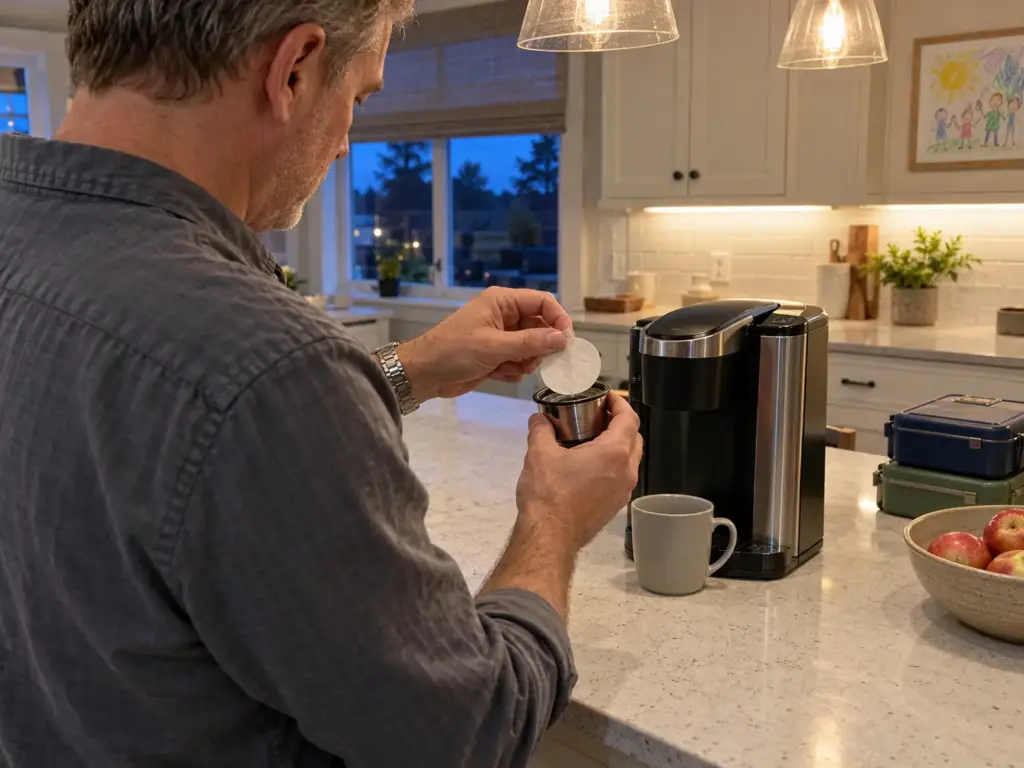
One method is to pull the foil top off a used regular K-cup, rinse it, dry it, refill it, and cover it with the cap of the reusable pod. That method comes with no fill amount, and it is not checked here. The detail that matters is dryness: a rinsed foil top fits snugly only if it is dry, and a damp one sticks to the cap. It also makes the same point as the Rethrone comment, that a reusable pod that works with or without a disc is worth testing with the disc before you buy anything else.
When the pod is not the problem
If the cup is off and the pod is fitted and braked, the cause usually lies in one of three places. The grind is the first, and it lives in the K-cup grind guide linked earlier. The amount of coffee in the pod is its own question and is not answered here. The third is the machine, and the Keurig pillar linked earlier sorts the lines.
For a pot instead of a pod, the dose is a weight and not a scoop, and how to use a drip coffee maker in grams, not scoops shows how.
The next decision after the pod
If a reusable pod is fighting the machine every morning, the cup may belong to a different machine. A drip machine that makes one cup without wasting a pot is the next question to ask. Whether a reusable pod pays for itself at all is a division you run yourself, pods per box against cups per bag, and it is not settled here.
Match the Needle, Add the Disc, Then Judge the Pod
Three things carry this guide. Match the pod to your machine’s needle first, using the model name and the listing’s model list. A thin cup and a gritty cup are usually one fault, so slow the water with a paper disc before changing anything else, one change at a time. And every pick here has a flaw in writing, with the lid as the part to watch.
A month from now, look at the lid’s fit and the rim of the pod, and at the bottom inch of the mug. Tomorrow morning, put a paper disc in the pod you own, brew, and taste: the cup should come out fuller and the last inch of the mug should be clear. Only then decide whether a different pod is needed.
Frequently Asked Questions
01What is the best reusable pod for a Keurig?
The best one is the pod that fits your Keurig’s needle type: a 5-hole stainless pod for a MultiStream machine, a 1-hole one for a single-needle machine. The table near the top lists each pick with its fit and its flaw, and the listing’s model list settles the match.
02Are reusable Keurig pods worth it?
They are worth it when the cup comes out right with the pod and a paper disc, because a pod that brews thin or gritty saves nothing worth drinking. The payoff is a division you run yourself: pods per box against cups per bag.
03Do reusable K-cups work in all Keurigs?
No, reusable K-cups do not fit every Keurig: a pod made for 5-hole machines is not listed for 1-hole ones, and the reverse, according to their listings. Check your model name against the listing’s model list. Paper discs are the exception, listed for both 1.0 and 2.0.
04Do you need a paper filter in a reusable K-cup?
Not always, but a mesh pod with large openings or a fine fill often does, because the disc slows the water and keeps grounds out of the cup. Keurig’s own reusable still needs a paper filter. Brew with and without it, and compare.




How did your cup turn out?
No comments yet. Tell us what you changed — and whether the needle moved.