



We may earn a commission when you buy through links on this page. It never changes what we recommend. How we pick
On this page9 parts
- What Actually Makes a Roasted Bean Go Stale
- Bag or Opaque Airtight Container, and the Flaw of Each
- Where in the Kitchen the Beans Should Sit
- Why Grinding Last Matters More Than the Container
- The Fridge and the Freezer, One Verdict Each
- How Long a Bag Lasts at Your Own Pace
- Buy a Bag You Can Finish
- Fold the Bag, Move It Off the Stove, Grind Last
- Frequently Asked Questions
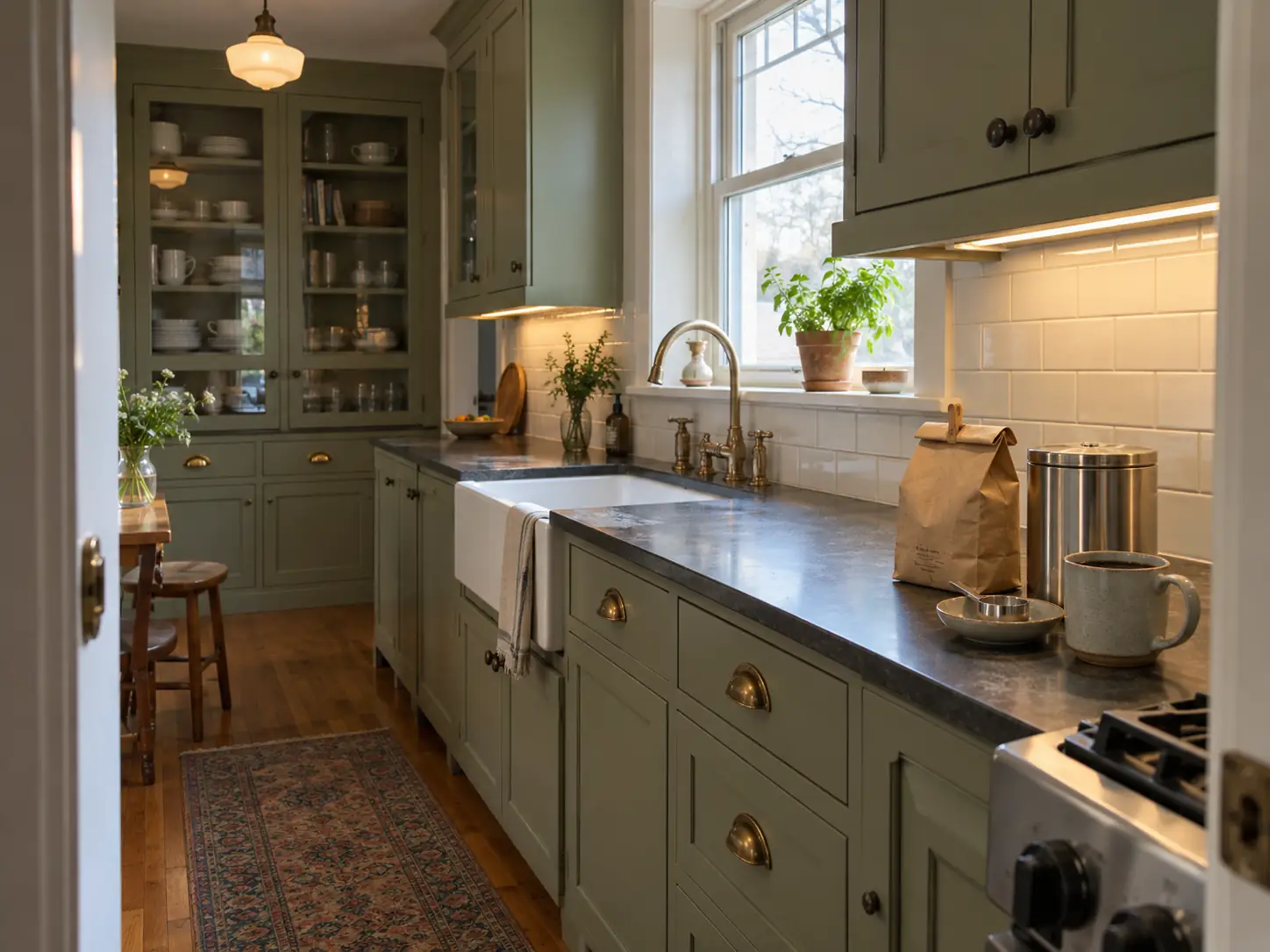
The bag has lived on the shelf beside the stove for three weeks, and the cup it makes now tastes hollow: no smell when the water hits the grounds, nothing left of the brightness the first week had. Before you blame the beans, know that how to store coffee beans to keep them fresh comes down to four things that age a roasted bean: air, damp, heat and time. A fresh bag fights the first of those on its own for about two weeks, because the beans are still pushing out carbon dioxide and that gas shoves oxygen out of the bag.
After that, the storage you chose is doing all the work. The decisions of coffee storage below come in the order your kitchen meets them: the bag or a container, the spot it sits in, grinding last, the fridge and the freezer, and how long a bag really lasts at your own pace.
Quick Answer
Air, light, heat and moisture age a roasted bean, so every step below keeps one of them away.
- Squeeze the air out of the valve bag, fold it twice and clip it.
- Switch to an opaque airtight container if the bag will outlast two weeks.
- Keep it in a cool, dark cupboard, away from the stove and the sun.
- Grind only the beans you are about to brew.
- Skip the fridge: cold beans sweat the moment they meet kitchen air.
- Freeze only sealed, unopened bags, and take each one out once.
What Actually Makes a Roasted Bean Go Stale
A storage fix only helps keep coffee fresh if it beats something specific. So before the clips, canisters and freezers, it pays to know the four things that age a bean, and the clock a fresh bag runs on its own before any of your choices start to count.
The Four Things That Age a Bean
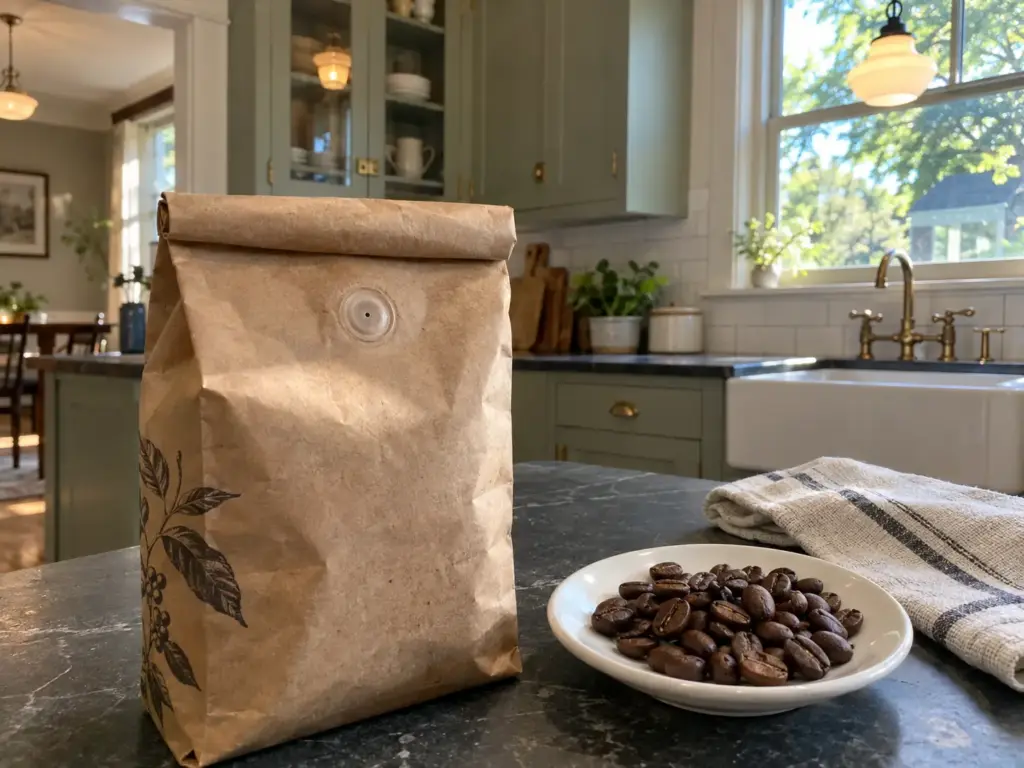
The Specialty Coffee Association names them: oxygen, moisture, temperature and time. Oxygen reacts with the oils and volatile aromatics the roast created, and that reaction is where the papery, flat taste of an old bag comes from. Moisture speeds the reaction up, heat speeds everything up, and time is the one you can only slow. Sunlight adds heat on top of light, which is why a sunny spot lands in the same column as the stovetop.
Of the four, air is the one you can do the most about. According to the Specialty Coffee Association’s Coffee Freshness Handbook, “simply reducing oxygen content to 0.5% in a coffee container can increase shelf life by up to 20 times.” Ordinary air is about 21% oxygen, so that is a steep drop, and the twentyfold figure is an upper bound measured under controlled conditions (your cupboard will not get there). But the direction is the lesson: the less air around the beans, the slower they fade, which is why a bag squeezed flat beats a jar that is two-thirds empty.
Why a Fresh Bag Protects Itself for About Two Weeks
Up to 2% of a freshly roasted bean’s weight is carbon dioxide (CO2) trapped inside it, per the SCA. The beans release it fastest in the first 24 to 48 hours after roasting and more slowly after that, and darker or faster roasts let it go sooner than light ones. In a sealed bag with a one-way valve, that gas builds to about 80% of what is inside during the first week and pushes oxygen out through the valve. The beans are guarding themselves.
That protection is real, and it is temporary. Once the degassing (off-gassing) tapers, somewhere around the two-week mark for a typical roast, nothing pushes outward any more, and every time the bag opens, room air walks in and stays. You can feel the change with your hand: a fresh bag is puffed and the valve hisses when you press it, while a three-week-old bag sits slack and silent. The cups from the slack bag are the flat ones.
Write the day you cut the bag open on the bag itself with a marker, right under the roast date. The two dates together tell you where the beans sit on their clock, and when the cup starts to go hollow you will know whether to look at the bag or at the grinder.
Why the Advice on How Long Never Agrees
The advice on how long beans stay fresh runs from one week after opening to two to four weeks to one to three months, and none of it is wrong. A dark roast that shed its gas quickly fades sooner than a light roast; a specialty bag sealed with a valve the day it was roasted starts its clock later than a grocery bag that sat in a warehouse; and an espresso, where a lost aroma shows up in a concentrated shot, gets called stale earlier than a drip pot with milk in it.
So the true answer is a range, and where you sit in it depends on the roast, the bag and the cup you make. Two weeks is the useful number, not because beans fall off a cliff on day fifteen, but because that is roughly when the bag stops helping. The full ranges are in how long a bag really lasts.
Bag or Opaque Airtight Container, and the Flaw of Each
The bag your beans came in is already a container, and for a lot of kitchens it is the right one. The only question that decides whether anything else is worth buying is whether that bag will outlast about two weeks.
The Bag You Already Own, Folded Flat
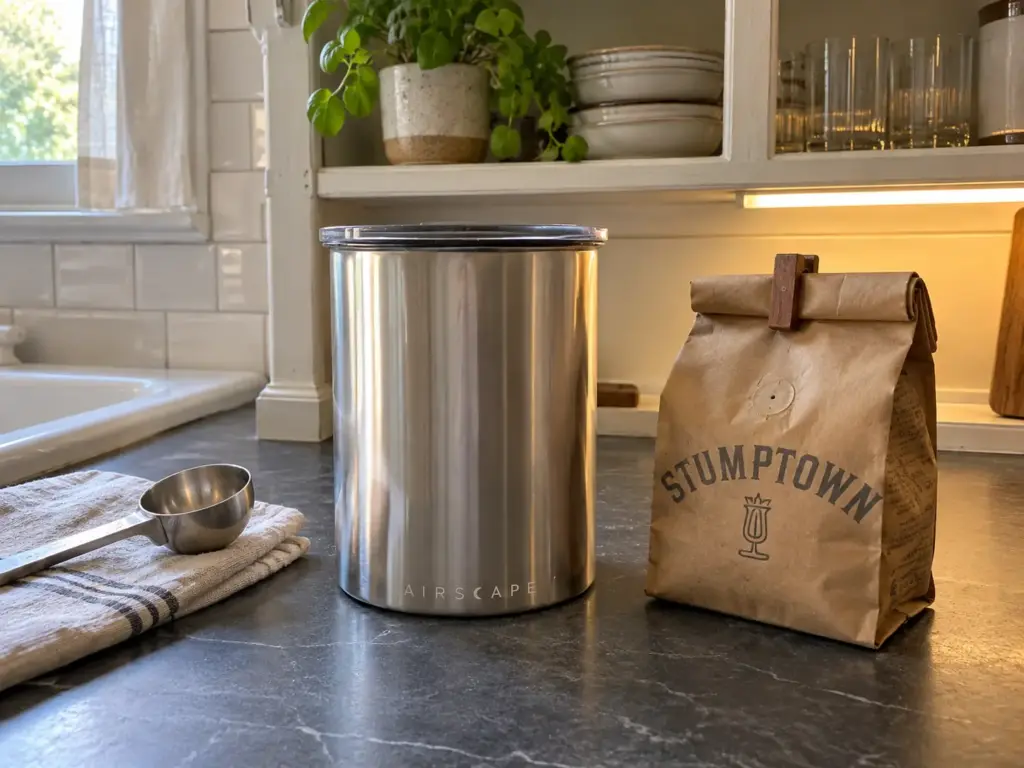
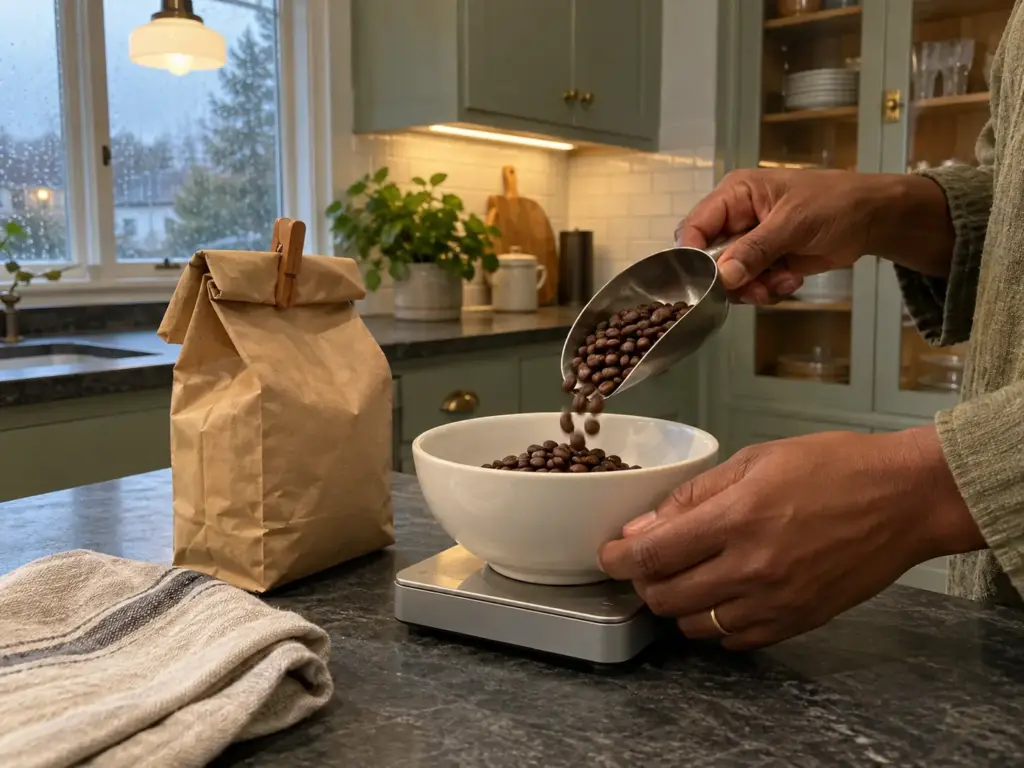
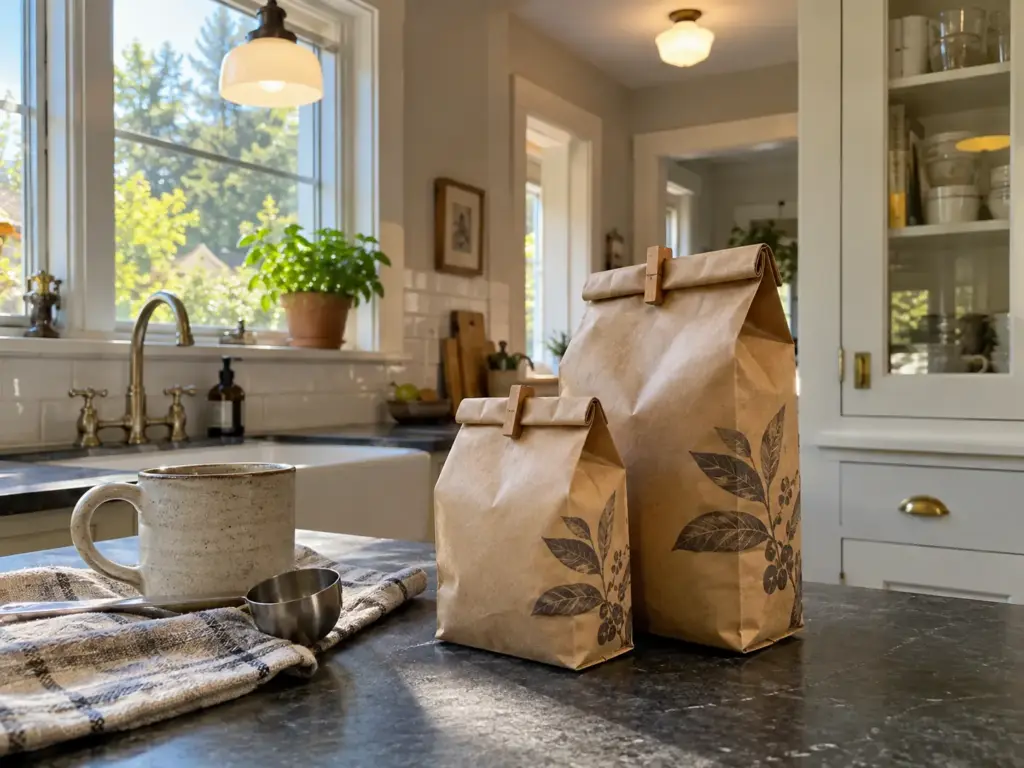
After each scoop, squeeze the air out through the valve, fold the top over twice, and close it with a bag clip. If the bag is the old fold-over kind with no zip, slide it into a gallon freezer bag and press that flat too; it works because it goes after oxygen, the biggest of the four.
And respect the baseline. Plenty of coffee drinkers keep a 12 oz bag on the counter, finish it in two to three weeks, and report no problem at all. For their pace they are right: the bag’s own gas covers most of that stretch, and the last few days are gone before the beans have time to go flat.
The bag’s weakness shows up later. A clip is not a seal, and after weeks of folding the foil creases and the zip (if it has one) stops closing evenly, so a bag that lasts a month is leaking a little air every day by the end of it.
When an Opaque Airtight Container Earns Its Place
The standard line is to move beans into an airtight container the day the bag opens. It breaks on a simple point: a rigid container takes in fresh air every time the lid comes off, and it cannot be squeezed flat as it empties. For a bag you will finish inside two weeks, the folded bag is the better call. A container earns its place when the bag will outlast its own protection: a 2 lb bag, a slow pace, a household of one.
An opaque container keeps out light and an airtight one keeps out oxygen. The Planetary Design Airscape is a displacement canister: its plunger lid presses down onto the beans and forces most of the air out above them. The medium size holds about 500 g, so a 12 oz bag fits with room to spare.
What it cannot fix is the daily opening, which still lets fresh air over the beans you have not reached yet. That is why many people run two: a small one for the week, opened daily, and the large one opened only to refill it. Past that routine, the owners report nothing that repeats.
On the cheaper side, the Veken 22 oz canister and the Coffee Gator 22 oz canister do the same opaque, airtight job in stainless, each with a one-way valve for a fresh bag’s first days. No pattern of complaints turned up for either, and the limit of every container applies to both: a bag that is already two weeks old gets no younger inside steel. The ranking, size by size, is in the full container comparison.
Size a canister to a week of beans, not to the bag. A container that is nearly full when you close it holds little air; one that is a quarter full by the end of the bag is mostly a jar of oxygen. Keep the rest of the bag folded and clipped, and refill the canister once a week.
The Vacuum Canister and Why It Splits Opinion
Everybody names the vacuum canister first, and its case thins out next to a valve bag that is folded and clipped. The Fellow Atmos is the best known: you twist the lid to pull the air out, and the 0.7 L size holds about 11 oz of beans. Fellow’s own claim is that the seal keeps air out for around a week between brews when the lid stays closed, a shorter promise than the hardware suggests.
The owners fill in the rest. Vacuum canisters vary: one lid can hold vacuum significantly worse than the others, fresh beans break the vacuum by off-gassing and may need a reseal every day or two, and some think vacuum is more trouble than it’s worth.
It works. It is also fiddly. For a bag that sits three or four weeks it can earn its keep; for anything shorter, a lid that held on Monday and let go by Friday is a chore that buys very little over the bag.
The Clear Jar by the Window
The prettiest option fails outright: a clear glass jar on a sunny sill lets light and heat at the beans all day. Put the same jar in a closed drawer or a dark cupboard and it does the job, because the glass is not the problem, the window is.
Where in the Kitchen the Beans Should Sit
The container matters less than the cupboard it sits in. Heat, light and damp each live in particular spots in a kitchen, and most of them are the spots a bag lands in first, because they are within reach of the coffee maker.
Cool, Dark and Away From the Stove
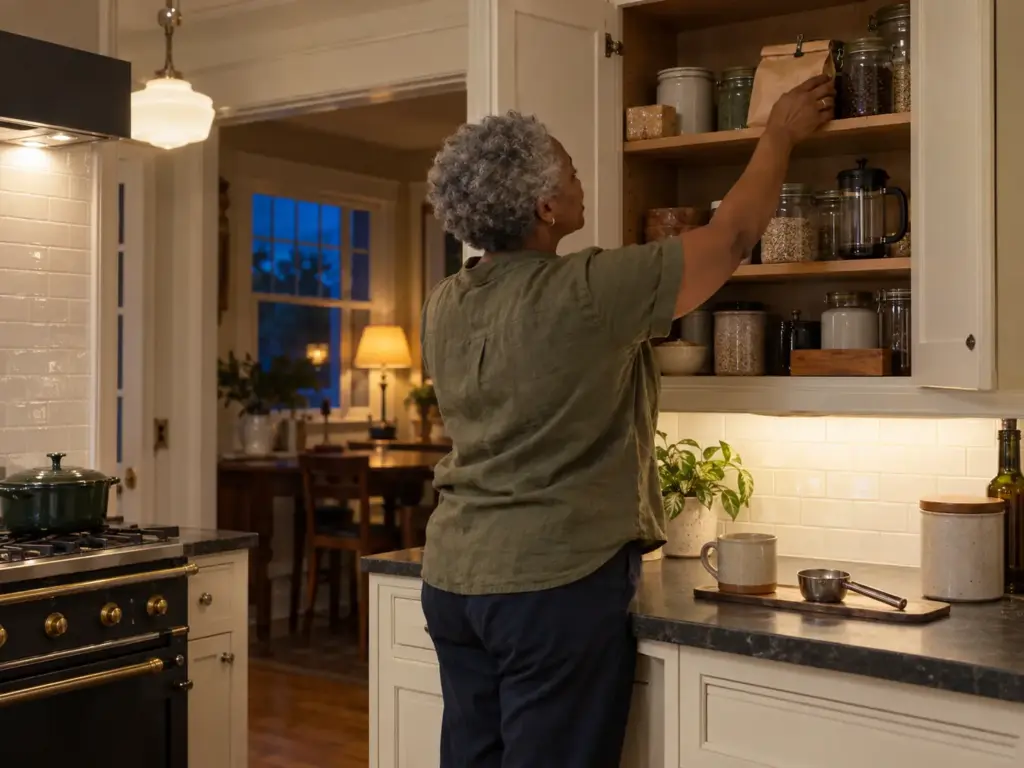
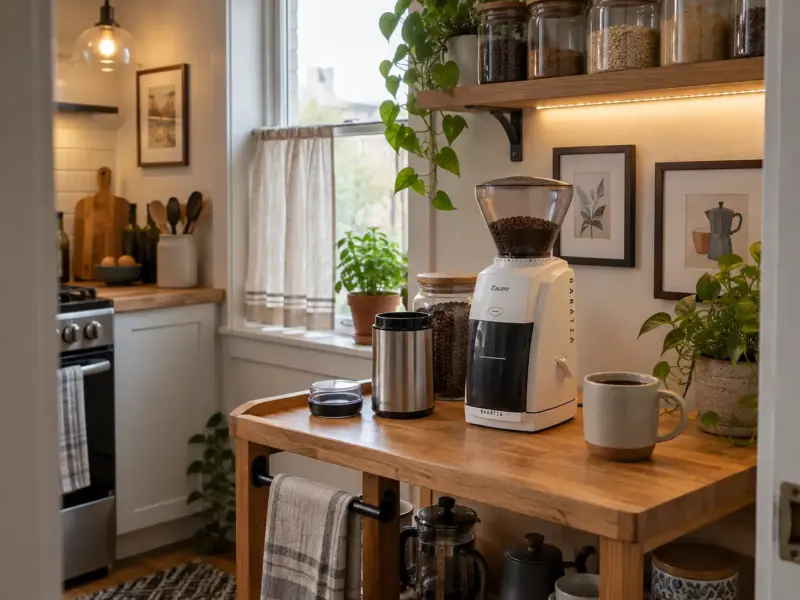
The right place is a cool dark place, and it is dull: a closed cabinet that stays at room temperature, away from humidity and direct sunlight, and away from the range, the oven vent, the dishwasher and the steam off the kettle. A pantry works. Or better, the lowest cupboard on the wall farthest from the stove, since warm air rises and the shelf above the cooktop is the warmest storage in the house.
This is the cheapest fix in the article, because it costs nothing. Moving the bag comes before buying any canister: the best canister on a warm shelf still loses to a folded bag in a cool one.
The Spots That Quietly Spoil a Bag
Three places look convenient and work against you. The shelf next to the stove is the first, and a bag that has sat there for a month can feel warm in the hand even when nothing is cooking. The top of the fridge is the second, because the compressor gives off its heat and the cabinet above it collects it. The windowsill is the third, for the light and the sun.
A bag left open on the counter is less a place than a habit, and it does the same harm from another angle: the air gets in all day. None of these spots looks like a mistake, which is exactly why bags end up in them.
After you cook, put your palm flat on the inside wall of the cupboard where the coffee lives. If the wood or the shelf feels warm, so do the beans. Move them to the cupboard that stays cool to the touch, even if it means an extra step from the coffee maker.
The Hopper Holds Days, Not Weeks
The storage spot people forget is the grinder itself. A hopper sits out on the counter in the light and is open to the air every time it is topped up, so a whole bag poured into it is going stale in the worst container in the kitchen.
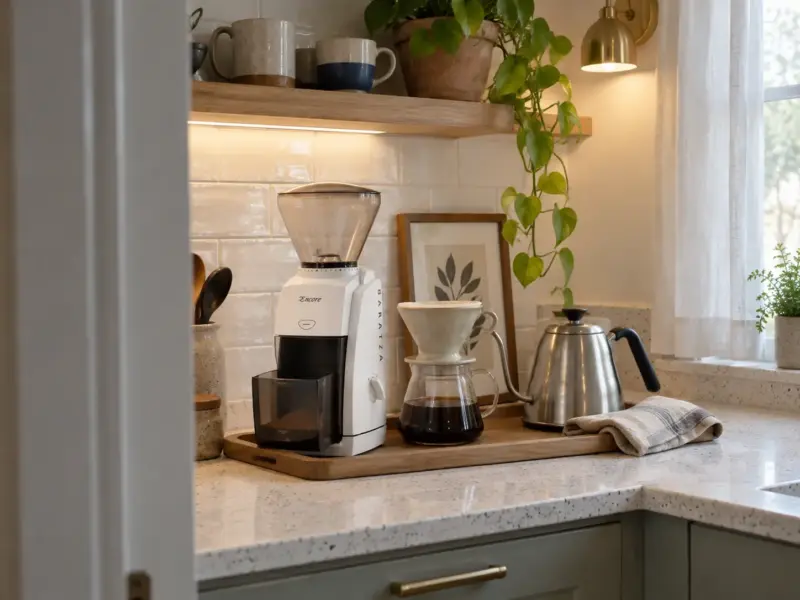
The plainest form of the question is whether to pour the entire bag in, and the usual answer is four or five days of beans in the hopper and the rest sealed. Some go further and weigh out only the day’s dose, which is called single dosing. How much to load at a time, by the size of your bag, is worked out in when to grind a bag’s worth of beans.
Why Grinding Last Matters More Than the Container
A container protects whole beans. The moment the beans are ground, most of that protection is gone, so the choice between grinding at home and buying pre-ground decides how fast the clock runs before any lid comes into it.
Surface Area Is the Whole Story
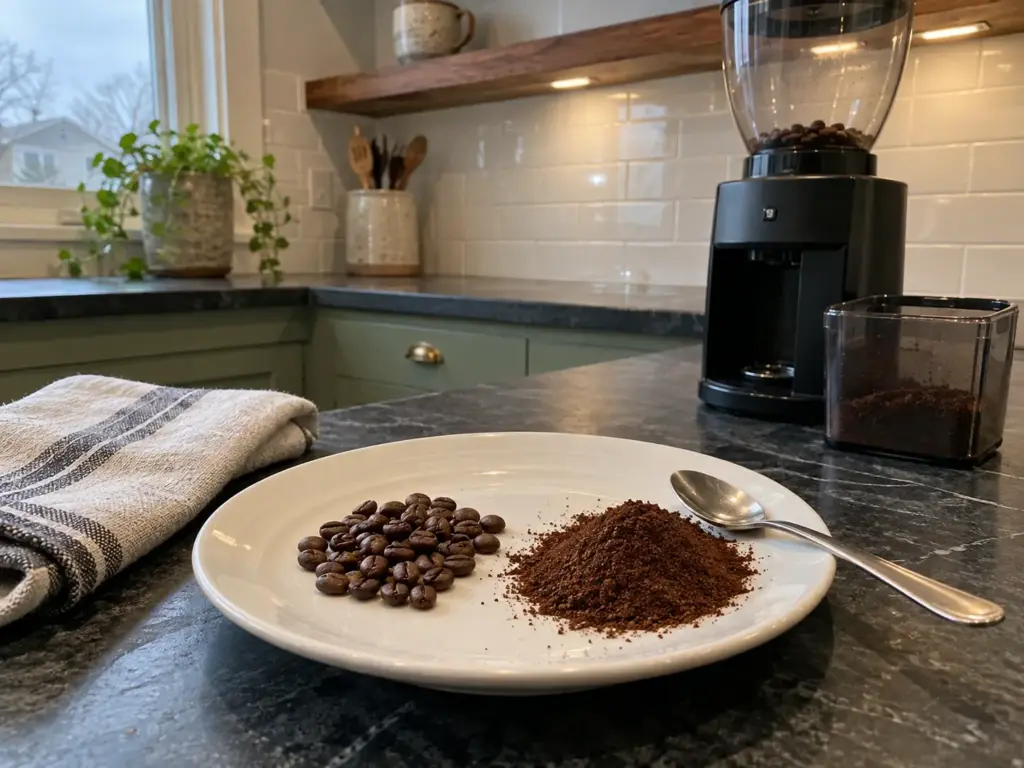
A whole bean keeps most of its aroma inside a roasted shell, and the air only reaches the outside. Grind it and every particle has its own exposed surface, so the same 20 g now offers the air many times the area it did a minute earlier. The oxidation a bag of beans goes through over weeks, ground coffee goes through over days. You can smell it across the room: a spoon of fresh grounds fills the kitchen, while a spoon from a can opened a month ago barely registers at arm’s length.
So the rule that does more than any container is to grind right before brewing, the day’s dose and no more. Grinding the week’s coffee in one session throws away most of what careful storage bought. Whether a grinder earns its counter space is its own decision, and whether grinding at home is worth it starts with the roast date on your bag.
What to Do When Ground Coffee Is What You Have
Plenty of kitchens run on pre-ground, and that is fine. The four enemies are the same, so the logic is the same, only faster: squeeze the bag flat, clip it, keep it in the dark cupboard, and buy a smaller bag so it is finished while it still smells like coffee. A container helps ground coffee for the same reason it helps beans, but it cannot win back the head start the grinder gave the air. The details, including how long it holds, are in how to store ground coffee.
The Fridge and the Freezer, One Verdict Each
Both are cold, and both are really about damp. That is why one gets a no and the other a narrow yes.
Why the Fridge Is Out
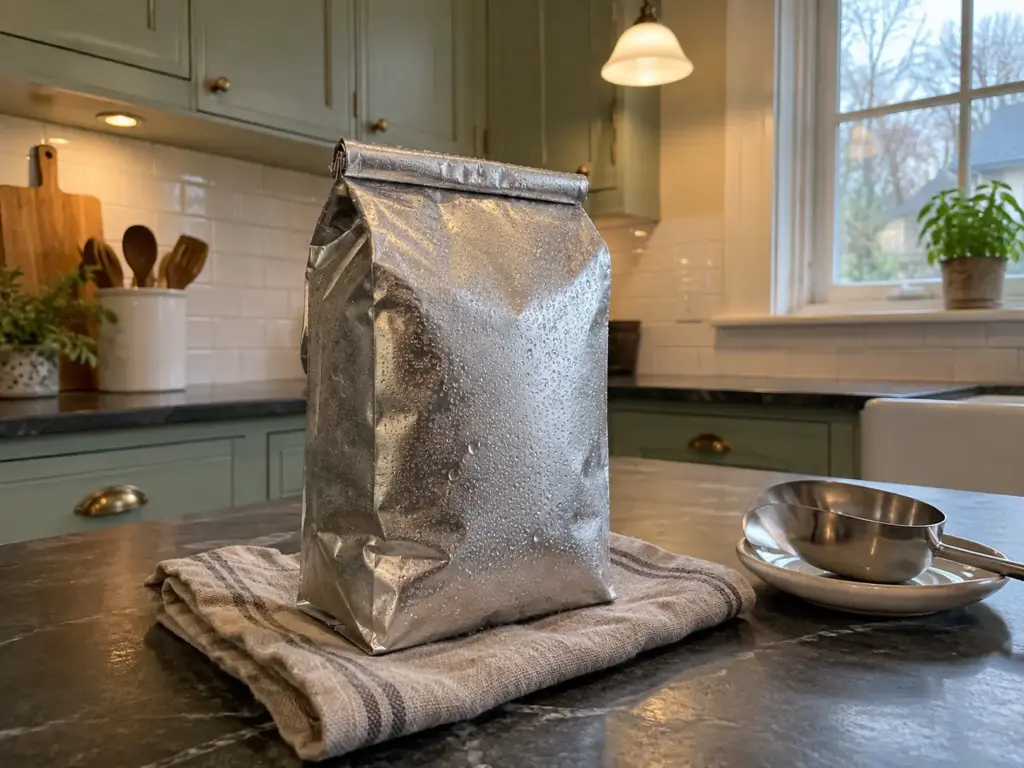
The SCA treats a high-moisture environment as a catalyst for aging in coffee, and a fridge produces one every time the door opens. Cold beans meet warm kitchen air and water condenses on them; a bag taken out of the fridge sweats on the counter within minutes. Add the odors coffee picks up from the shelves around it, and the daily opening that lets all of it in, and the fridge ages beans faster than a cupboard would.
Some people keep beans in mason jars or metal tins in the fridge anyway, and the coffee is drinkable. But nothing in the fridge works for the bean, and a dark cupboard does the same job without the condensation.
The Freezer, Sealed and Once
The freezer is the one tool that actually works on temperature, and the only real option for long-term storage. The SCA reports that freshly roasted coffee held at -13°F (-25°C) off-gassed up to 35 times more slowly than at 95°F (35°C), which on paper could stretch a one-to-four-week freshness window to somewhere between three months and a year. That is a lab comparison, and the catch is the fridge’s problem in a harsher form: a frozen bag opened cold sweats the moment it leaves the freezer, and doing that every morning undoes the point.
Roasters disagree about it in writing. One camp says never freeze coffee you drink daily; the other says freeze only a sealed, unopened bag, tape over the valve, and take it out once. Both agree on the daily bag, which stays out.
The verdict fits in a line: freeze sealed, portioned bags you will not touch for weeks, take each out once, and let it reach room temperature before you open it. The portions, the thaw and the refreezing question are in how to freeze coffee beans without ruining them.
How Long a Bag Lasts at Your Own Pace
Every fix so far matters only if the bag lasts longer than its own protection does. So the real storage question is a piece of arithmetic: how many weeks of cups are in the bag on your counter?
How Many Weeks Are in Your Bag
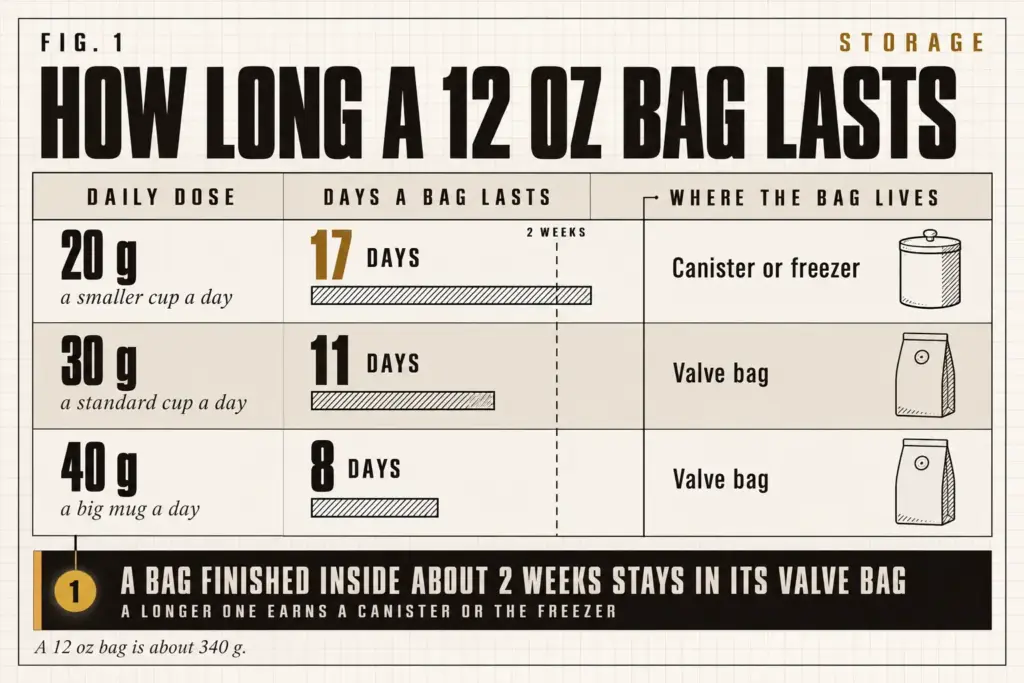
A 12 oz bag holds about 340 g of beans. If you brew about 20 g a day (roughly two standard scoops, one large mug at a normal ratio), it lasts about 17 days. At 30 g a day, three scoops, it lasts about 11. At 40 g a day, a pot shared by two people, it is gone in about 8.
A 250 g bag at 18 g a day lasts about two weeks. The count of cups in a bag is worth knowing for its own sake, and how many cups are in a 12 oz bag works it out by brew method.
Hold those numbers against the two-week clock and the storage decision makes itself. A bag you finish inside about two weeks can live in its own valve bag, folded and clipped, in the cupboard; nothing you buy will improve on that by enough to taste. A bag that outlasts two weeks earns a canister, or a split: keep one week’s worth out and freeze the rest sealed. I would not buy a canister for a bag that is gone in ten days.
One correction to that clock: it starts at the roast, not at the day you cut the bag open. A bag roasted ten days before it reached your counter has already spent most of its gas, because the off-gassing runs whether the bag is open or not. At 20 g a day, that bag is finished 27 days after roasting, not 17, and its last week runs past the point where the valve was doing anything.
So read the roast date first, add the days the bag has already lived, and only then do the division. Grocery coffee with no roast date gets the cautious answer: assume it is already past the first two weeks and treat the bag’s own protection as spent.
The same division settles the big bag that tempts a slow drinker, and it shows why one shelf-life number cannot fit every kitchen. A 2 lb bag is about 907 g; at 20 g a day it lasts about 45 days, three times the window the bag protects.
Split it the day it arrives into four portions of roughly 225 g, about 11 days each, keep one out in its folded bag or a canister, and seal the other three for the freezer. Each portion then lives its open life inside the two weeks, and the bulk price stops costing you the last month of flat cups. For the full answer, see how long coffee beans last opened, sealed and frozen.
Weigh your daily dose on a kitchen scale for one week instead of guessing from scoops, then divide the bag’s weight by the average. Scoops of light and dark roast weigh differently, and the real number tells you whether you need a canister before you buy one.
What a Stale Cup Gives Away
Stale beans announce themselves before you taste them. The bag no longer smells when you open it, the grounds barely bloom when the hot water hits them because there is little gas left to push up, and the cup is hollow, with nothing at the front and a papery note behind. The last quarter of a bag that has been open for a month often brews quicker and flatter than the first cups did, which can send you to the grinder dial when the dial was never the problem. The full list of signs is in how to tell if coffee beans are stale.
The Bag That Goes in the Bin
Old is not the same as spoiled. A two-year-old bag that stayed dry is simply flat, and it will brew a dull cup. But a bag that got wet, smells musty or shows any visible mold goes in the trash, with no tasting and no rescue. Damp is the usual route there: a bag kept near the kettle’s steam, or one that sweated after a stretch in the fridge.
Buy a Bag You Can Finish
The cheapest storage fix is not a container at all. It is the size of the bag you bring home, and the date printed on it.
Roast Date or Best-By Date
A roast date tells you how old the beans are. A best by date mostly does not: it can sit a year out, set by the packer, with nothing on the bag to say when the coffee was roasted. Plenty of supermarket bags, the commodity kind of coffee, carry only the best by date, which means the clock started at a point you cannot see. That changes the storage advice for grocery store coffee beans: a container cannot win back days you do not know about, so the better move is to buy smaller bags you can finish inside about two weeks.
When you can get a bag with a roast date, buy that one; what the bag tells you covers the date, the valve and the rest of the label.
Why a Dark Roast Fades Sooner
Darker and faster roasts release their carbon dioxide sooner, according to the SCA, so the gas that protects a dark roast in its bag runs out earlier than it does for a light one. In practice a dark roast belongs at the short end of every range in this article: a smaller bag, or the canister sooner. Why roasts behave so differently goes back to what heat does to the bean, the subject of what changes between light and dark roasts.
The Next Decision Is the Grinder
Grinding at brew time is what makes all of this storage matter, so the grinder is the next thing to settle. Before you turn its dial over a flat cup, check the roast date and how long the bag has been open. If the beans are fresh and the cup is still off, the grind is where to look, starting with whether you need a burr or blade grinder and how to set the grind by roast.
Fold the Bag, Move It Off the Stove, Grind Last
Three habits carry most of the weight:
- Fold and clip the bag the beans came in, and move to an opaque airtight container only when the bag will outlast about two weeks. Either way, keep it in a cool, dark cupboard, away from the stove and the sun.
- Leave the fridge out entirely, and treat the freezer as a once-only home for sealed bags you will not open for weeks.
- Grind at brew time, from a bag sized to the pace your kitchen actually drinks.
A month from now, look at the roast date and at what is left in the bag, and ask whether the last cups still taste like the first ones; if they do not, the bag is outliving its protection and the next one should be smaller.
Tomorrow morning, move the bag out from beside the stove, squeeze it flat, fold it twice and clip it. Then taste the same coffee a week later and compare it with the last bag at the same age: you are looking for a smell that still meets you when the bag opens, and a cup that still has something at the front instead of a papery finish.
Frequently Asked Questions
01Is it better to keep coffee beans in the bag or in a jar?
The bag is fine if you squeeze it flat, clip it and finish it inside about two weeks, while the beans’ own carbon dioxide still protects them. A jar helps only when it is opaque and airtight and the bag would outlast that window. A clear jar on the counter does worse than the bag.
02Is it okay to store coffee beans in a Ziploc bag?
Yes, for a short stretch, as long as you press the air out and keep the bag in a dark cupboard. It works best as a second layer, with the original bag inside a freezer-grade zip bag. A clear bag on a sunny counter undoes the point.
03Are 2 year old coffee beans still good?
Two-year-old beans can still be brewed if they stayed dry and smell of coffee rather than must, but nearly all their aroma is gone and the cup will taste flat. A bag that is wet, musty or moldy goes in the trash. Roast-fresh flavor is measured in weeks, not years.
04What is the best way to store coffee beans for long-term storage?
For long-term storage, freeze sealed, unopened bags or portions you will not touch for weeks, then take each one out once and let it reach room temperature before opening. Never put a thawed bag back. The full routine is in our guide to freezing coffee beans without ruining them.
05Should I keep a week of beans in the grinder’s hopper?
A few days is the line most people use: four or five days of beans in the hopper and the rest of the bag sealed in the cupboard. A hopper is exposed to light and air, so a full week fades faster there than in the bag. Single dosing avoids the problem.

How did your cup turn out?
No comments yet. Tell us what you changed — and whether the needle moved.