



We may earn a commission when you buy through links on this page. It never changes what we recommend. How we pick
On this page7 parts
- Why a Can of Ground Coffee Goes Flat Before the Beans Do
- The Free Options First: The Bag, a Jar and a Zip Bag
- When a Canister Earns Its Counter Space, and the One That Refuses Grounds
- Where It Lives: The Cupboard, Not the Stove or the Fridge
- The Clock Nobody Agrees On, and When the Can Is Just Old
- Less Coffee per Bag Beats a Better Lid
- Frequently Asked Questions
The can of supermarket ground is down to its last third, the scoop reaches a little deeper every morning, and the cup tastes like wet cardboard even though the lid still snaps shut with a satisfying click. Before you go shopping for a better lid, the question of what to store ground coffee beans in has a less flattering answer than the canister aisle suggests. Grinding multiplies the surface of coffee that touches air, so ground coffee runs on a clock of days to a few weeks while whole beans last longer, and a container can only slow that clock, never stop it. So this is the answer in the order to try it: the bag, the jar, the canisters (including a famous one that refuses grounds), where the coffee lives, how long it lasts, and how to tell when the can is simply old.
Quick Answer
Keep ground coffee in the bag it came in, pressed flat and sealed, or in a small opaque airtight container it fills, in a cupboard away from the stove. Skip the fridge and the clear counter jar. No container turns weeks into months, so buying less matters more, and the Fellow Atmos vacuum canister says not to take grounds.
Why a Can of Ground Coffee Goes Flat Before the Beans Do
That papery taste is the first clue, and it points somewhere specific: at air and time, not at the drip coffee maker. Before picking a container, it helps to know why grounds give up so much faster than the whole beans sitting next to them on the shelf, because that reason decides which containers help and which only look like they do.
What Grinding Does to the Surface
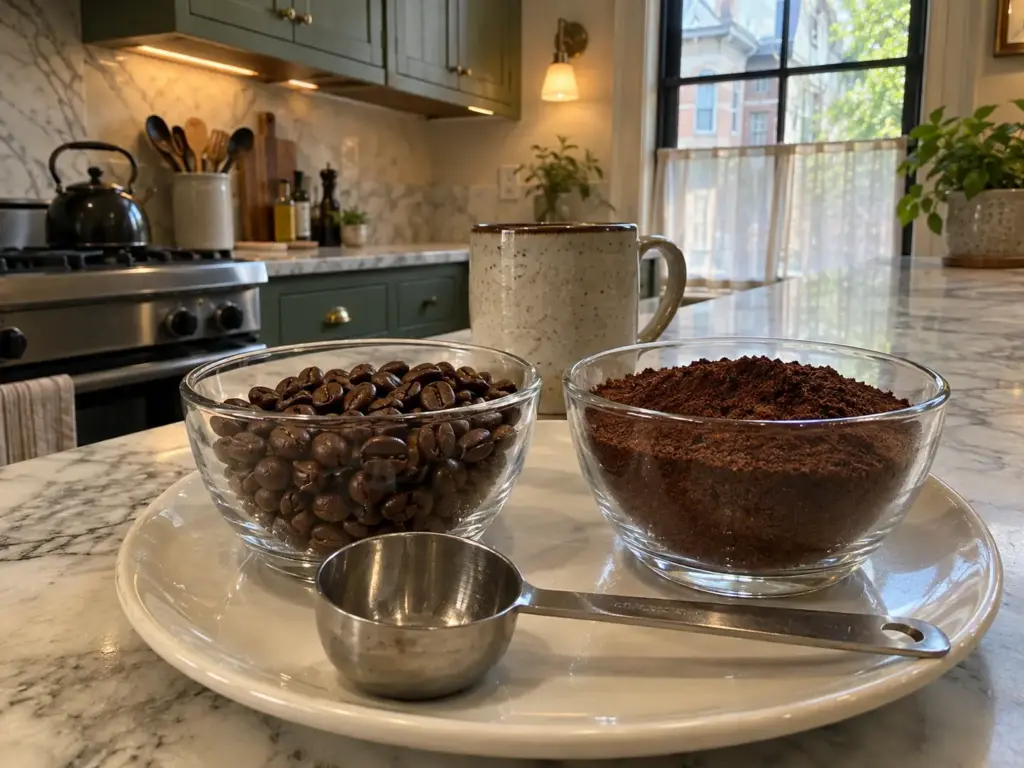
A whole bean is a closed package. Grinding breaks it into thousands of particles, and every one of them has a face exposed to the air that used to be sealed inside the bean. According to the Specialty Coffee Association’s review of the staling literature, “When coffee is ground, the porosity and surface-to-volume ratio increase, which accelerates degassing and staling.” The same review ties rancidity, the stale-oil taste that comes from the coffee’s fats oxidizing, to the surface area of ground coffee, and it names moisture, oxygen and temperature as the things that speed it up, with oxygen availability as the one that matters most.
Now the direction. A cup can be off in three ways, and they point to different places. Sour means the water left the grounds before it finished, bitter means it stayed too long, and flat (thin, papery, a cardboard note with no sour edge and no bite) means the aroma had already left before the water arrived. That third one is not an extraction problem, so no change of ratio or water temperature brings it back.
With pre-ground coffee you cannot move the grind anyway. The only change that reaches a flat cup is upstream of the machine: less air, and less time.
Smell the dry grounds the moment the lid comes off, before any water touches them. If the smell is faint, dusty or a little like paper, the cup will brew flat whatever you do at the machine, so save your ratio and temperature experiments for a fresher bag. That ten-second sniff tells you whether the storage or the brewing is the thing to change.
Why the One-Way Valve Helps Grounds Less
The standard line is to keep coffee in its valve bag, and for whole beans it holds up. Beans keep releasing carbon dioxide for days after roasting, that gas pushes outward through the little one-way valve, and the slight outward pressure keeps oxygen from creeping in. Grinding changes that. The SCA’s Coffee Freshness Handbook, as quoted by Serious Eats, says grinding triggers a rapid release of CO2, which removes what the article calls “coffee’s natural preservation agent,” and that some volatile aroma compounds begin to leave almost as soon as the coffee is ground.
So the valve has much less gas to vent once the coffee is ground, and the cushion it protects is mostly gone. That does not make the bag useless. A good coffee bag is still a decent barrier against air and light, and it can be pressed flat, which a rigid can cannot. The better call for grounds is to keep the bag because it collapses around the coffee, not because of the valve.
The Clock Starts at the First Scoop
The sealed can on the supermarket shelf and the open can on your counter run on two different clocks. The SCA review describes a secondary shelf life that begins when the package is opened and can run faster than the staling inside the sealed pack; it also cites a study in which nitrogen-flushed ground coffee held its taste for six months against three for the same coffee packed without the flush. Those months belong to the sealed can. Once the seal breaks, the countdown that matters is the one in your kitchen.
A supermarket can prints a best-by date, not a roast date, so you have nothing to count from except the day you opened it.
Mass-market pre-ground coffee is often already old by the time anyone opens it.
Then the daily scoop adds its own problem. Every morning removes a little coffee and leaves a little more air in its place, so by the last third of a big can, the grounds sit under a tall pocket of kitchen air that gets swapped out every time the lid opens. The third week of the can tastes thinner than the first, with the same scoop and the same machine. For the full table of days by roast and by package, see how long beans last once the bag is open.
The Free Options First: The Bag, a Jar and a Zip Bag
Nothing in that first section has a lid-shaped answer. A container slows the clock and nothing more, so the cheapest one that keeps air, light and damp out is a fair first move, and the odds are good it is already in your kitchen.
The Original Bag, Pressed Flat
Someone without a grinder who buys coffee the shop grinds for them still needs a canister that keeps it fresh. The top answer turned the question around: unless you will not finish it within a week and are willing to spend, it is “best just to keep your coffee in the bag it came in.” Burp the air out, roll the top down tight, and close it with the zipper or a clip. That is the whole method, and it works because a bag shrinks with the coffee while a can does not.
The flaw shows up below the halfway mark. A rolled bag gets awkward to scoop from, the fold springs back open unless something holds it, and every opening lets air back in. Once coffee is ground, every opening introduces air, so no canister fully solves it. Which is true of every container on this page, and the reason the bag is not the worst one.
A Clean, Dry Jar With a Gasket Lid
A glass jar with a rubber gasket and a clamp lid (a mason jar will do), washed and dried completely, is the second free option for most kitchens. Glass does not hold smells; plastic can, so plastic jars can make coffee smell bad. Dry means dry. A jar that still carries a few drops from the dish rack gives the grounds the moisture that turns them musty, which is the one failure no amount of tight lid will fix.
The jar has two flaws in writing. Clear glass lets light in, so it lives in the cupboard, never on the counter where it looks nice. And a jar that is half full is half air, so the jar should be about the size of the coffee you put in it.
Some people keep ground coffee in a glass jar for months and still enjoy it to the end. That one report runs against the National Coffee Association, which puts opened ground coffee at one to two weeks at room temperature. Plan around the trade association’s number, not the anecdote. Whole beans are a longer conversation, and how the containers compare for whole beans is its own read.
A Zip Bag for a Week’s Worth
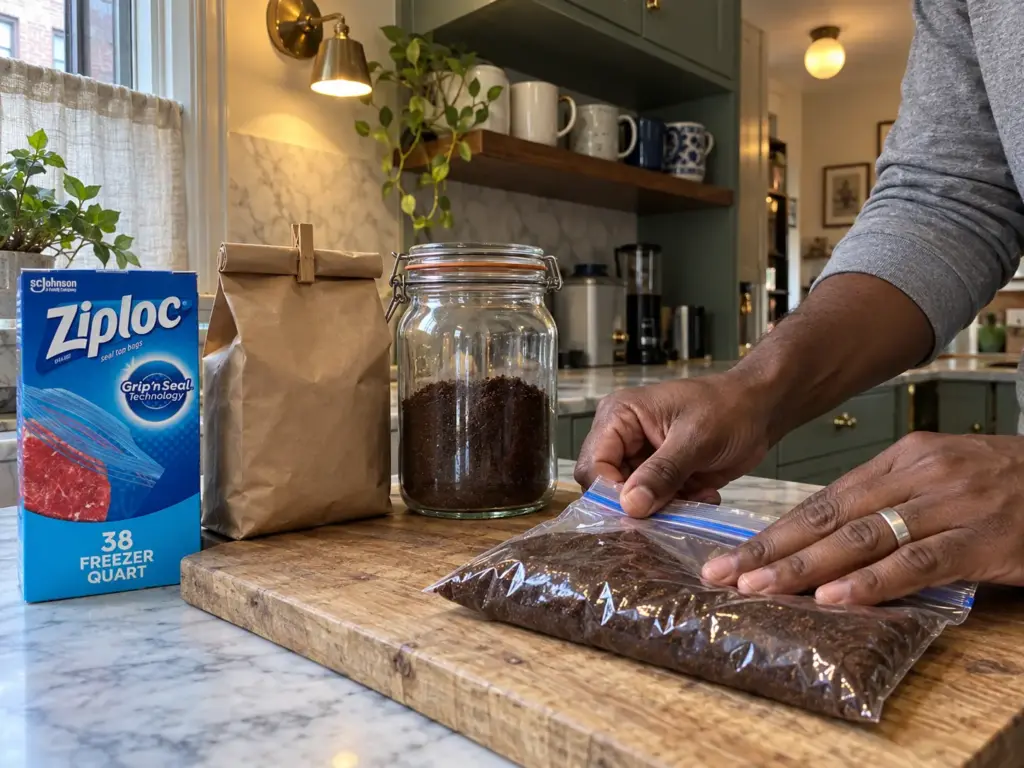
A big can is where the bag and the jar both struggle. A standard 12 oz bag is 340 g; at 30 g a day (roughly three level two-tablespoon scoops), it lasts about eleven days, and a big supermarket can at that rate lasts a month or more, well beyond the NCA’s window. Splitting it on the day you open it keeps most of the coffee sealed while you work through one portion. The cheap tool for that is a box of Ziploc Freezer Bags Grip n Seal Quart: thick freezer-grade plastic, a resealable zipper, and a quart that holds a week’s worth pressed into a flat slab, sold in a three-box pack that covers months of portions.
Zip bags work well if you do not mind the extra plastic. The bags are not opaque either, so they belong in a cupboard, and the zipper on a bag reused for weeks stops gripping along one end before you notice. Keeping portioned bags inside the original coffee bag works as a double airtight system, which also solves the light problem.
Lay the filled zip bag flat on the counter, close the zipper from one corner and stop a finger’s width short of the other. Press the grounds into an even slab from the closed end toward the gap, then seal the last inch. The air leaves through the gap instead of getting trapped in a bubble on top, and flat slabs stack in a cupboard without wasting space.
When a Canister Earns Its Counter Space, and the One That Refuses Grounds
A canister pays off in one situation: a can or bag you scoop from every day, where folding and clipping the bag has turned into a chore. But one of the best-known canisters says in its own FAQ that it does not take grounds, so this aisle has a trap in it, and the trap is the one most people would buy first.
The Vacuum Canister That Says No to Grounds
The Fellow Atmos is the coffee canister most people picture: twist the lid and it pulls air out through a small valve, which suits whole beans well. For the can of ground it is the wrong tool, and Fellow says so in its FAQ: “We recommend storing only whole bean coffee in your Atmos. Storing ground coffee or other fine substances may clog the intake valve and prevent a proper vacuum seal and may also void the warranty.” Buyers often only find out this limit after the purchase.
The mechanism is simple enough. As the lid pulls air out, fine particles ride along with it toward the valve, and coffee ground for drip is fine enough to lodge there. A clogged valve stops pulling a vacuum, and a vacuum canister that cannot pull a vacuum is an ordinary opaque jar with a warranty question attached. So the obvious pick for beans stops being the obvious pick the moment the coffee is already ground.
Two Canisters Without a Valve to Clog
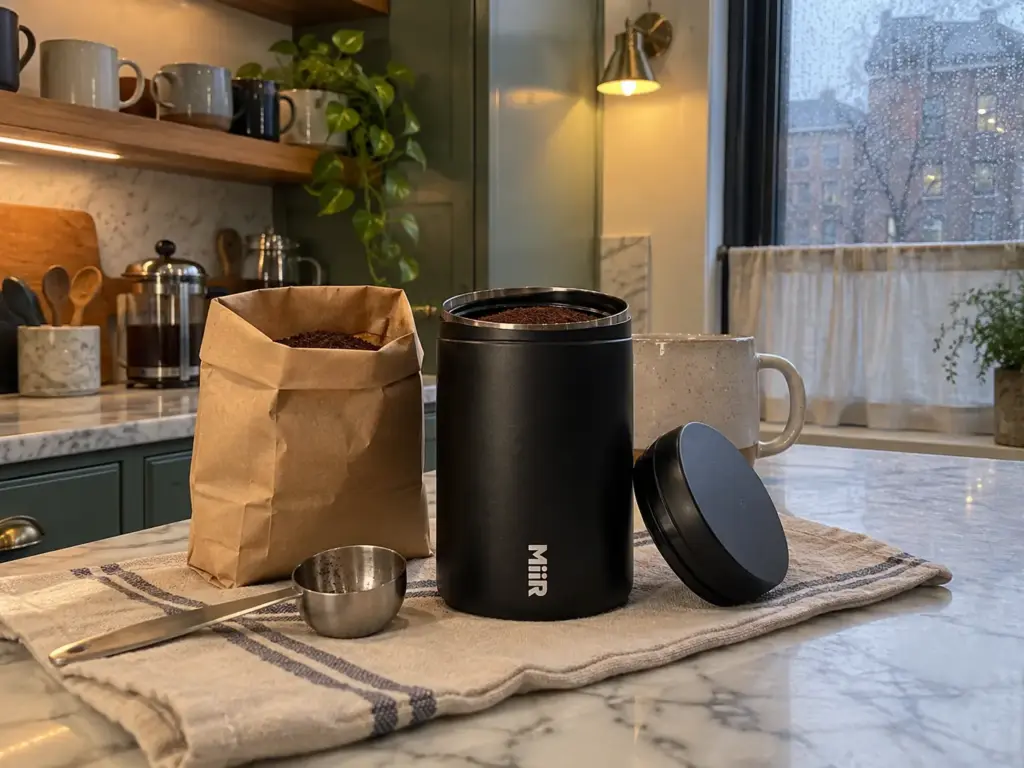
A displacement canister skips the valve entirely: a plunger or inner lid pushes down onto the coffee and squeezes the air out above it. The MiiR Airlock is the tidy version, an opaque 18/8 stainless steel canister with a press-button plug, listed for both beans and ground, and sized so an ordinary 12 oz bag fits. Its limits are in the same sentence as its strengths: 12 oz is all it takes, so a one-pound bag will not go in, and it costs a good deal more than the free bag, which only makes sense if you scoop from it daily.
There is also a finding that applies to displacement canisters as a type. In Serious Eats’ own test (on whole beans, and with a different displacement canister, not the MiiR), coffee kept eight days in the canister had a more muted dry aroma than the same coffee left in its own bag, though the brewed flavor held up in both. The writer’s guess at a cause includes the transfer itself, which exposed the coffee to more oxygen than the coffee that never left its bag.
A popular choice for grounds is the Planetary Design Airscape in the Medium size: an inner plunger lid you push down onto the coffee, a clasp handle on top, room for about a pound, 5 in wide by 7 in tall, and no valve anywhere. Airscapes have a loyal following among long-term users.
The known flaw is that the design can be a decent idea poorly implemented: the opening may not be perfectly round, and a unit can arrive badly misshapen. That is one person’s report, not a test, but it is worth checking the lid seats evenly when the box arrives. Stock on Amazon has been thin, so it may take some looking.
Push an inner lid all the way down until it rests on the grounds every time you close it, not just to the point where it feels snug. A displacement lid only removes the air it actually reaches, so a lid parked two inches above a half-empty load leaves two inches of kitchen air sealed in with the coffee.
Size It to the Coffee, Not to the Shelf
Any rigid container has the same weakness the big can has: it does not shrink. A large canister holding the last third of a can has more air inside than the same coffee would have in its folded bag, and that headspace is exactly what the SCA review flags as the factor that matters most. The container should match the coffee you will scoop from it in a week, and the rest should stay sealed somewhere else.
That also answers the decanting question. Serious Eats’ suggestion that the transfer itself cost the canister some aroma is a good reason not to pour a whole bag into anything at once. Decant a week, keep the remainder in its bag with the air pressed out, and refill from it when the canister runs low.
A practical method is to move half of a bag into an airtight container for daily use and squeeze the air out of what stays behind. No canister can rescue coffee that was already flat when the can was opened, a case the last section takes up.
Where It Lives: The Cupboard, Not the Stove or the Fridge
The container handles the air. Light, heat and damp do the rest of the damage, so where the coffee sits matters about as much as what it sits in, and the usual spots in a kitchen are the worst ones.
A Cupboard Away From the Stove and the Window
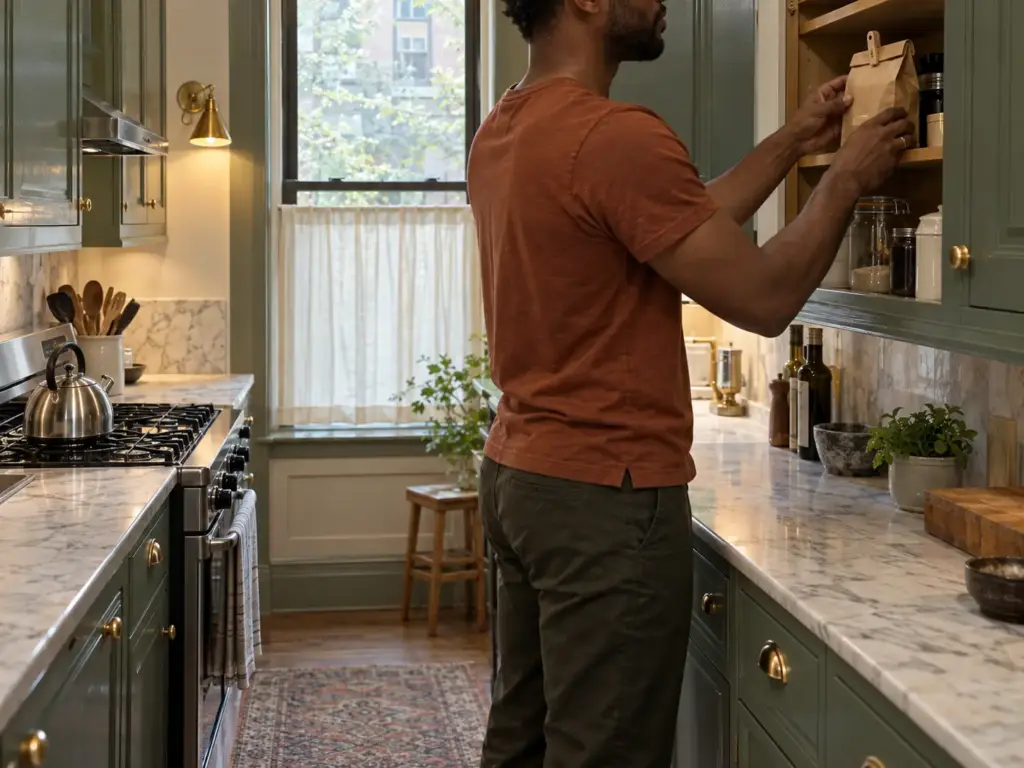
The National Coffee Association’s storage guide asks for an opaque container in a dark, cool place, and it names the cabinets to avoid: the ones near the oven or the dishwasher, and anywhere that takes strong afternoon sun. Keeping the can away from heat matters because heat speeds up the oxidation that turns grounds flat, and light does its share through anything clear.
Look at where the coffee actually lives. The open shelf above the range warms up every time a burner runs, the sunny windowsill heats a glass jar like a greenhouse, and the spot beside the toaster or the kettle catches warmth and steam all morning. A closed cupboard or pantry shelf, away from all of that heat, is the right home even if it means one more step to the coffee maker.
Why the Fridge Is Wrong for Ground Coffee
The fridge sounds like the cool, dark place the NCA asks for, but it fails on moisture. Coffee is hygroscopic: it pulls in moisture, odors and tastes, and the NCA notes that condensation can build up in a refrigerator. Ground coffee has far more surface to soak up both than whole beans do.
Each morning the cold can comes out into warm kitchen air, moisture beads on the inside of the lid and on the top layer of grounds, and the can goes back in damp. Within a week or two the cup picks up a faint note of whatever shares the shelf. For the can you open daily, the fridge is a no.
Damp coffee has one more outcome, and it is not a brewing problem. If the grounds clump, smell musty, or show any fuzzy mold, the can is finished: throw it out rather than trying to brew around it.
The Freezer Is for a Sealed Spare
The freezer earns a place only for long-term storage of coffee you are not opening yet. An unopened bag, or a portion sealed with the air pressed out, can go in, and it should come back to room temperature still sealed before anyone opens it, so the kitchen’s moisture does not condense straight onto cold grounds. Splitting a large bag of ground into small baggies, pressing the air out, sealing them inside larger bags and thawing one at a time before opening it is a workable method for a big purchase. That is the sealed-spare use, and it works because each portion is opened only once.
The daily can is another story; taking it in and out of the freezer turns every morning into a condensation cycle. Even the brands disagree on how long frozen ground keeps. Lavazza says up to two years, Folgers says to plan on using it within a few weeks of freezing, and a vendor claim that long is not one to build a habit on. The full method, with timings, is in the freezer protocol for beans.
The Clock Nobody Agrees On, and When the Can Is Just Old
No container changes this part. The numbers you find for ground coffee disagree, they count from different days, and the lever that works best costs nothing at all.
Four Numbers, Counted From Different Days
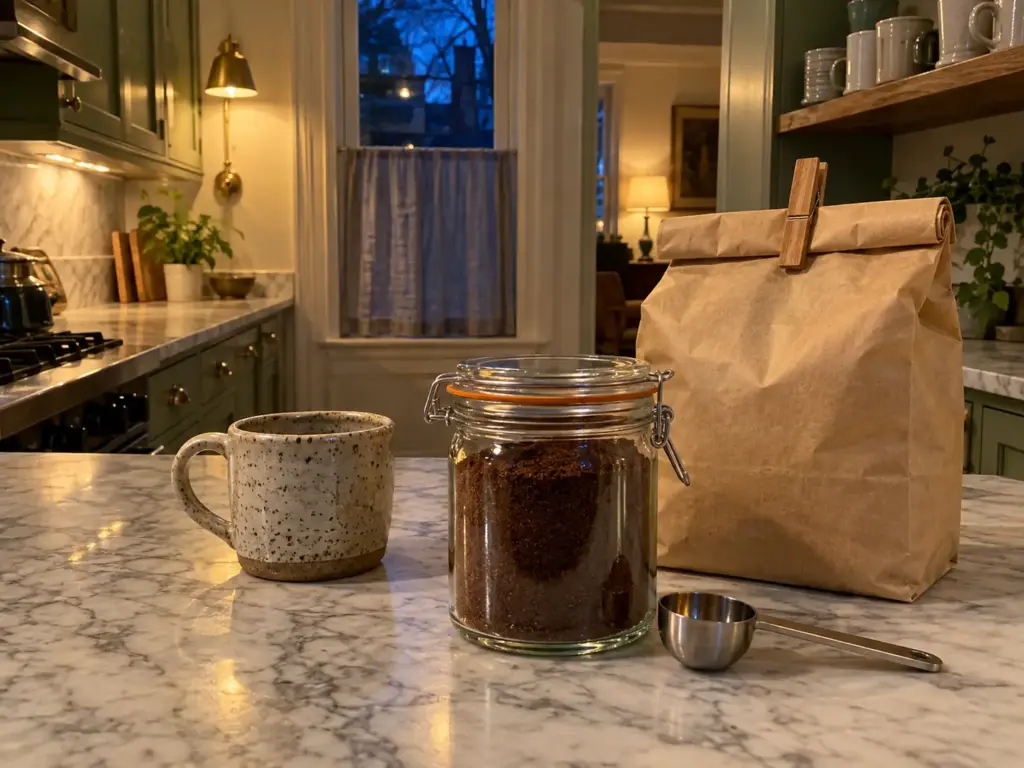
This is the ground-coffee half of storing coffee beans in general, and its numbers are shorter. The National Coffee Association gives opened ground coffee one to two weeks at room temperature in an airtight container, and as the trade association’s figure it is the one to treat as the average.
Folgers says one to three weeks after opening. Lavazza says within a month. Spruce Eats puts ground at its best for about ten days.
And the SCA’s Coffee Freshness Handbook, as quoted by Serious Eats, has the main aroma compounds largely gone in about two to three weeks at room temperature, however the coffee is stored. Starbucks, for its part, counts about a week from opening.
The brand clocks mostly start when you break the seal; the Handbook’s starts at the roast and the grind, which happened long before the can reached your cupboard.
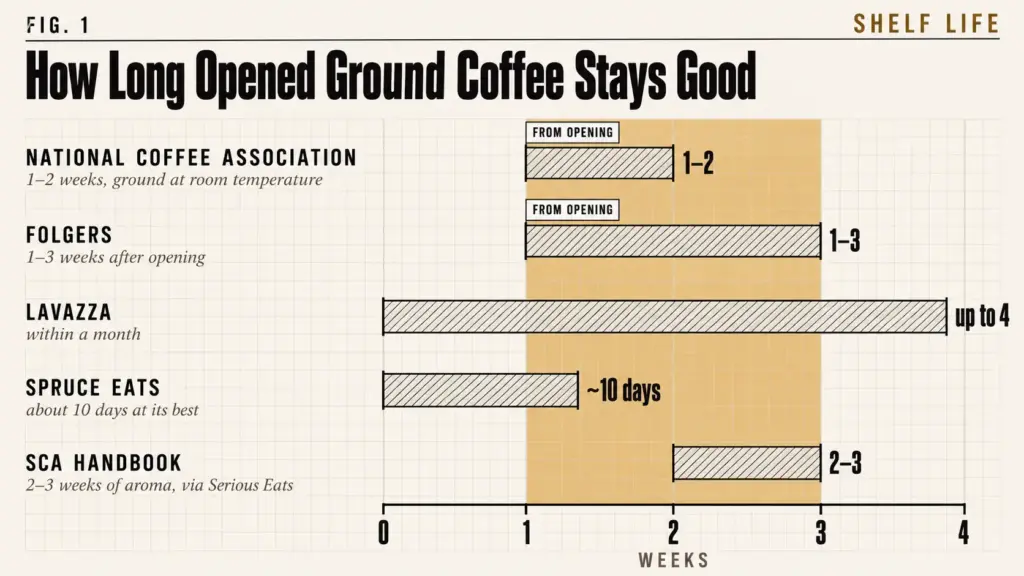
Put the numbers side by side and they overlap more than they argue. Plan around one to two weeks of a good cup from an opened can, and a few weeks of an acceptable one after that. A jar that stays good for months may be fine for some cups, but it is a different standard of good than the one that asks why the coffee tastes like cardboard.
The Fix That Is Not a Container
The NCA’s first rule for storing coffee is not about storage at all: buy small batches, a week or two of coffee at a time, and Folgers says the same. The arithmetic takes a minute. Weigh what you brew in a day, in grams, multiply by fourteen, and that is the most coffee you should have open at once. At 30 g a day that comes to 420 g, a little under a pound; at 20 g a day, a 12 oz bag is about right.
Buy a smaller can, then. Or, if buying in bulk is what makes sense for your budget, split it into week-sized portions the day you open it and keep the rest sealed. A kitchen scale and a smaller bag change more cups than any canister.
Where the coffee comes from shifts the starting line. Supermarket coffee is mostly commodity coffee, and Serious Eats notes it is typically warehoused for over a year as green coffee before it is roasted, then ground and canned with no roast date. Coffee ground to order at a roaster or a shop starts fresher, and its clock is the strict one: the aroma it has on day one is the most it will ever have.
Write the opening date on the lid or the bag with a marker the first time you open it. A supermarket can gives you nothing else to count from, and two weeks goes by faster than it feels. When the date says week three and the cup tastes thin, you know it is the calendar talking, not your coffee maker.
When the Can Was Flat Before You Opened It
Sometimes the container is not the problem at all. If the first scoop from a freshly opened can already smells faint and brews a flat, papery cup, the coffee aged before it reached you, and no lid, jar or canister can put back aroma that left before the seal broke.
That cup is the coffee’s age, not the container’s fault. The change to make is the next purchase: a smaller bag, ideally one with a roast date printed on it. The sensory checks for telling old coffee from badly stored coffee are in how to tell if beans are already stale.
And if you are tired of racing a clock measured in days, a grinder is the answer that makes the whole question go away, which is why whether grinding at home is worth it is the next decision, while grinding coffee that is already ground is the opposite one.
Less Coffee per Bag Beats a Better Lid
Three things decide how the last scoop of a can tastes. Keep the coffee in its own bag pressed flat, or in a small, dry, opaque jar it nearly fills. Keep it in a closed cupboard away from the stove, the window and the fridge. And buy less at a time, decanting a week and leaving the rest sealed, because no lid stops a clock that runs in days once coffee is ground.
The check for later is a taste comparison: a month from now, ask whether the cup from the third week of a bag tastes as clean as the cup from the first, and if it does not, the answer is the next bag in a smaller size, not another container.
Start with tonight’s bag. Press the air out of it, move about a week of coffee into the smallest jar that holds it, and put both in the cupboard. Then taste the last cup of the week against the first. If they taste alike, the storage is doing its job; if the last one is flat, your bag is still too big.
Frequently Asked Questions
01What is the best way to store ground coffee beans to keep them fresh?
Keep ground coffee in its original bag with the air pressed out, or in a small opaque airtight container, inside a cupboard away from the stove. Size the container so the grounds nearly fill it. Buying only a week or two of coffee at a time does more for freshness than any lid.
02Is it okay to store ground coffee in a Ziploc bag?
Yes, for a week or two of coffee, as long as you press the air out and keep the bag in a cupboard. Zip bags are a cheap way to split a big can into portions. The trade-offs are the extra plastic and the clear sides, which let light in.
03Is it better to store ground coffee in the refrigerator or the freezer?
Neither suits the can you open every day. The fridge adds moisture and odors that ground coffee soaks up quickly. The freezer works only for a sealed spare portion, brought back to room temperature before you open it.
04What is the best container to store ground coffee in?
A small, opaque, airtight container sized so the grounds nearly fill it. A dry gasket jar kept in a cupboard or a displacement canister without a valve both work. Avoid vacuum canisters with a valve, since fine grounds can clog it.
05How long does ground coffee last once the bag is open?
About one to two weeks at room temperature in an airtight container, according to the National Coffee Association. If the can prints no roast date, count from the day you opened it, and expect the cup to keep thinning after that.



How did your cup turn out?
No comments yet. Tell us what you changed — and whether the needle moved.