
We may earn a commission when you buy through links on this page. It never changes what we recommend. How we pick
On this page8 parts
- What a Coffee Container Has to Keep Out
- Four Kinds of Lid, and What a Blind Test Found
- Steel, Glass or Plastic: Where the Container Stands
- Size the Container to the Bag, Not the Shelf
- The Valve and Displacement Picks, With Their Flaws
- The Jar or Bag You Already Own, and When the Lid Is Not the Problem
- Choose the Seal First, Then Taste the Last Cup of the Bag
- Frequently Asked Questions
You poured the new bag into the good-looking glass jar by the window, and for a week every cup tasted the way the bag promised. By week three the cup is flat, a little papery at the finish, and nothing else changed: same grind setting, same water, same scoop. Air got to the beans first, then light, in a jar that was too big and too bright for them, which is why the answer to what is the best container to store coffee beans starts with an order of jobs rather than a brand. What follows is that order, the four kinds of lid, glass against steel, the size question that matters more than the material, the picks with their flaws, and the free option that came within a whisker of the winner.
Quick Answer
The best container is airtight, opaque and sized so the beans nearly fill it. Rank the jobs this way: seal first, then little air inside, then darkness. A vacuum or displacement lid is a bonus. A resealable valve bag pressed flat, or a lidded jar sized to the beans in a closed cupboard, covers most of the gain.
What a Coffee Container Has to Keep Out
Before choosing a lid or a metal, it helps to name what the beans are actually losing to. There are three things, and they do not matter equally. The order decides where money is worth spending and where it buys nothing you can taste.
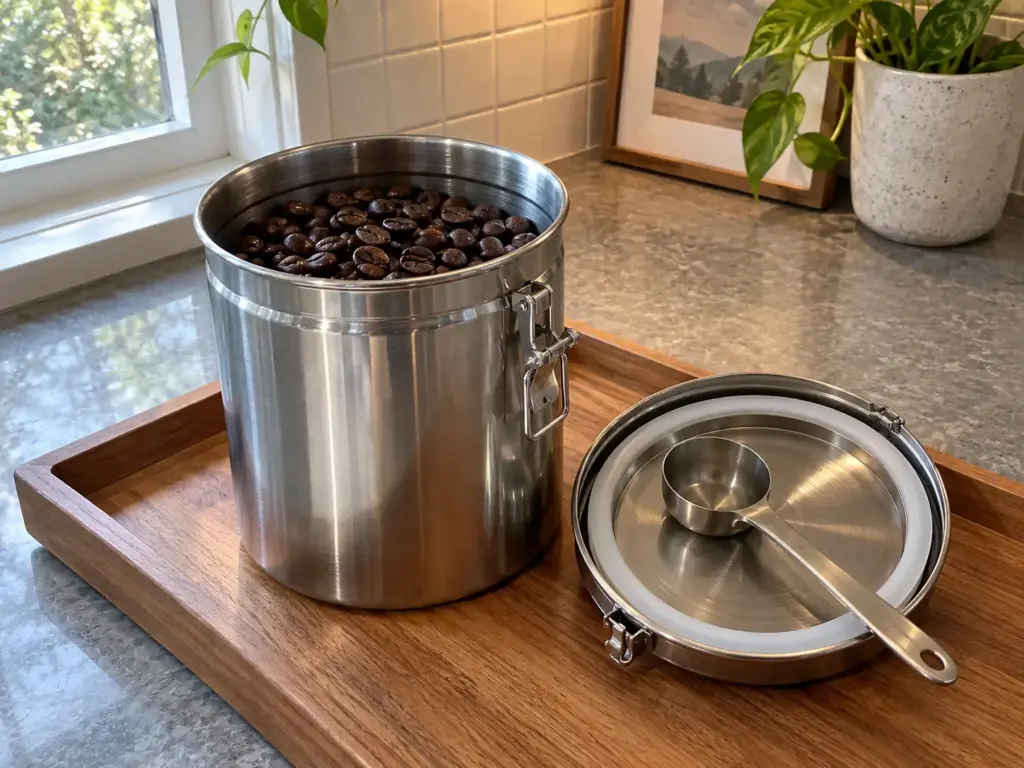
Air comes first
Roasted coffee goes stale mostly by reacting with oxygen. The aromatic compounds that make a fresh cup smell like more than just coffee go through oxidation, and the oils in the bean slowly turn the way old nuts do. According to the Specialty Coffee Association’s review of the staling research, “Oxygen availability is deemed by many the primary enemy of roasted coffee.” The studies it reports put numbers on that: in sealed packs, bringing the oxygen down to half a percent stretched shelf life about twentyfold, and every extra percent of oxygen sped up the damage by roughly ten percent.
Those are lab figures for sealed packaging. No kitchen canister gets anywhere near half a percent oxygen, so no lid on a counter can promise a shelf life like that, whatever the box says. What the numbers do settle is the order: keeping air out is the first job of any coffee storage container, and everything else comes after it.
The same review makes an admission worth keeping in mind. It says there are very few published studies comparing specific packaging types. No standard ranks coffee canisters against each other. The comparisons that exist are one careful home taste test and one peer-reviewed study of opened bags, and both are treated below as exactly that.
Light and moisture come after
The National Coffee Association’s storage rules put the rest in plain terms: airtight, opaque, cool and dark, away from the oven, the dishwasher and the afternoon sun, and bought one to two weeks at a time. Its window for whole beans at room temperature, kept airtight after opening, is one to three weeks of freshness. Light breaks down aroma compounds, which is why clear containers are a problem, and a canister beside the stove warms every time the stove does, which speeds up every one of the reactions oxygen started.
Moisture is the job most kitchens already handle without thinking: keep the container dry and away from the sink and the kettle’s steam, because humidity gets into beans faster than most people expect. Beans that got wet and show mold go in the trash. There is no rinsing or drying them back. It is also why the fridge makes a poor shelf for beans in daily use (cold beans pull condensation out of the air every time the door opens and the container comes out).
So the order for the rest of this article is seal first, then little air inside, then darkness, with a vacuum as a bonus on top. A container that gets the first two right and sits in a cupboard has done almost everything a container can do.
What no container can do
A container slows staling. It never reverses it. Beans that went flat in a loose bag will taste flat in the best canister on the market, because the compounds that made them taste fresh are already gone, and the best any lid can do is protect what is left.
The container is also not the only place beans sit in air. Beans left in the grinder’s hopper all day face the same problem as a lid left loose. Beans that live in the hopper can need a slightly finer grind every morning, while sealed canisters let the setting stay put until the next bag, when each bag is gone in under a week. That daily nudge finer is staling you can read off the grinder’s dial.
Keep the hopper empty, or hold no more than the next brew in it, and weigh each dose straight from the sealed container. If you find yourself moving the grinder a notch finer every few days within the same bag, the beans are staling faster than you drink them, and a smaller bag will help more than a better lid.
For the whole storage question, from the cupboard shelf to the freezer, the place to start is how to keep beans fresh past week two.
Four Kinds of Lid, and What a Blind Test Found
Seal comes first, and the seal lives in the lid, which is where canisters actually differ from each other. The one controlled taste test of these containers puts them in a different order than their boxes would suggest. And the free option sits much closer to the top of that order than anyone selling a canister would like.
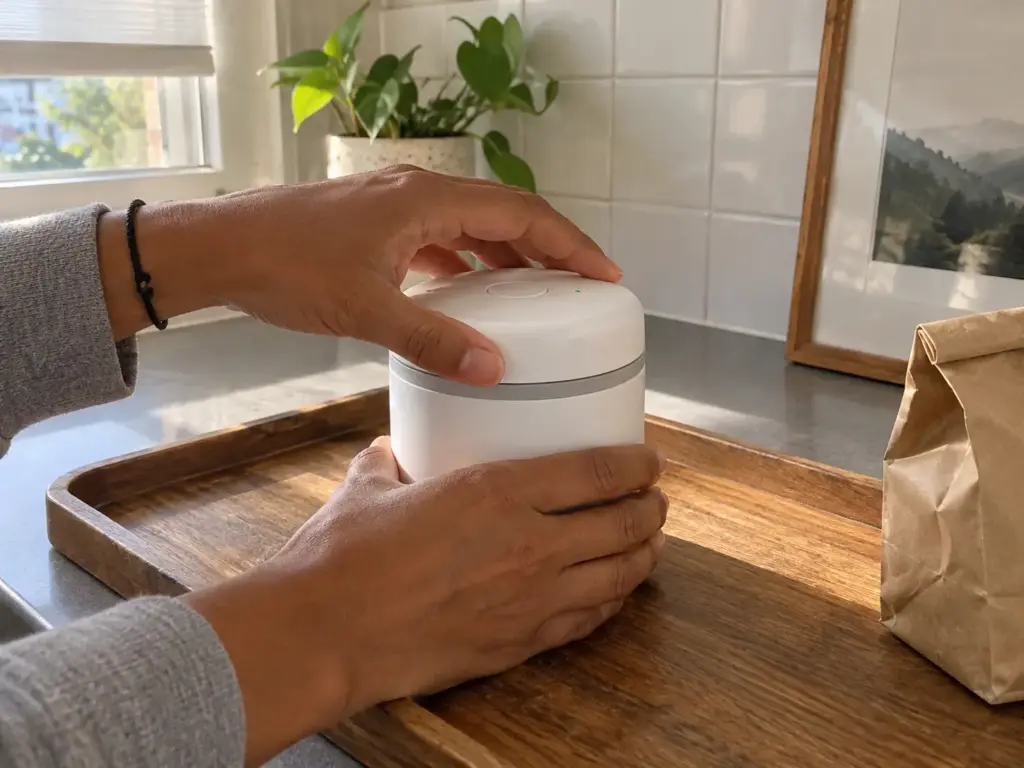
Airtight and valve: what they hold back
A plain airtight container lid is a silicone gasket plus a clasp, a screw thread or a push-button. It stops new air from getting in. It does nothing about the air already inside, so a plain airtight canister is only as good as how full it is, which is the subject of the sizing section further down.
A one-way valve lets carbon dioxide out without letting outside air back in. Beans keep releasing CO2 for days after roasting (the offgasing that makes a fresh bag puff up), and a valve lets that gas escape without opening the seal. It earns its place in those first days.
A few weeks off roast, the beans have mostly stopped giving off gas and the valve has little left to do. And a valve only works while the seal around it holds: in one small study the SCA review reports, valve bags held zero oxygen while their seals were intact, but half of the six bags leaked, and the authors drew no conclusion from them.
Vacuum and displacement: what they cannot do
A vacuum lid pumps air out when you twist or press it. On paper it is the best answer to the air trapped inside.
At the counter the beans push back: freshly roasted coffee keeps releasing CO2 into the space the pump just emptied, so the vacuum fades within days while the beans are still degassing. That comes from review summaries and the maker’s own advice rather than from a measurement, but it has a practical consequence. On beans roasted three days ago, a vacuum lid needs pumping again and again, and a valve does the same job without the effort. Vacuum lids also refuse ground coffee, because fine grounds clog the mesh the pump draws air through, which sends that question to what to keep ground coffee in.
A displacement lid works the other way round. Instead of pulling air out, it presses an inner lid or a stopper down onto the beans so there is little room left for air above them. It cannot touch the air between the beans, and it is only as good as the seal the stopper makes against the canister wall.
Put side by side, each lid has a gap. The plain airtight lid keeps the air it closed in, the valve matters mainly in the first days and only while its seal holds, the vacuum fades against fresh beans and cannot take grounds, and the displacement stopper leaves the air between the beans where it was.
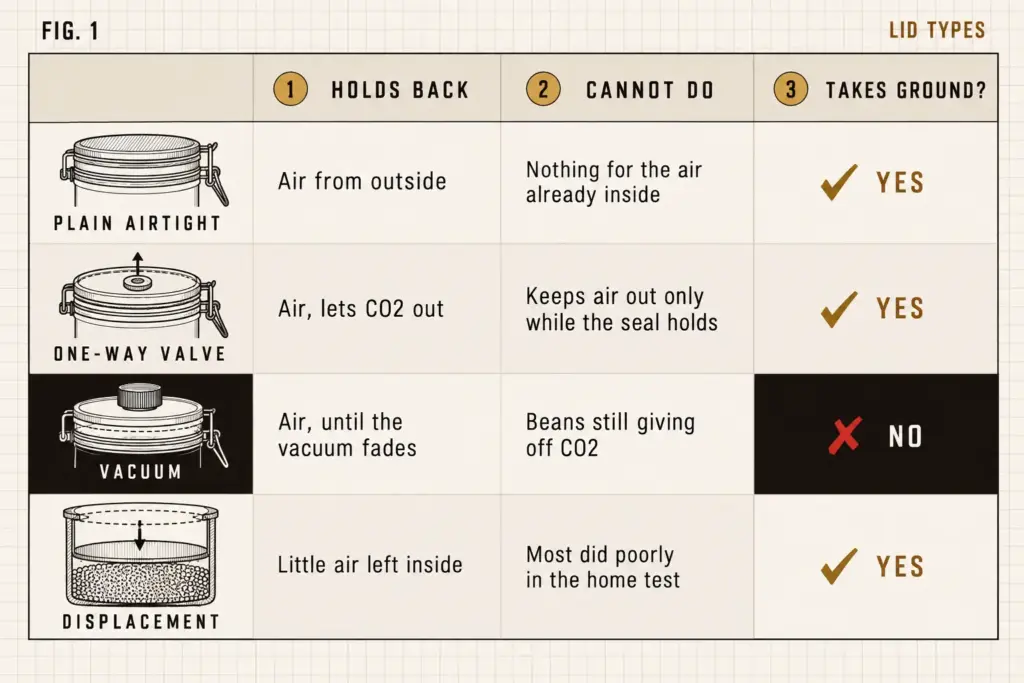
With a vacuum canister and beans roasted within the last week, pump or twist the lid again each time you close it, because the beans have refilled the space with CO2 since the last opening. Two or three weeks off roast, the vacuum holds much longer: there is less gas left in the beans to fill it.
What the 10-day test actually found
Serious Eats ran the closest thing to a controlled comparison: 200 g of the same beans, from the same roast day, went into each of ten canisters plus the original bag, and after ten days each was brewed at 18 g of coffee to 288 g of water (1:16, roughly three level tablespoons of grounds to 10 fl oz of water) and tasted blind.
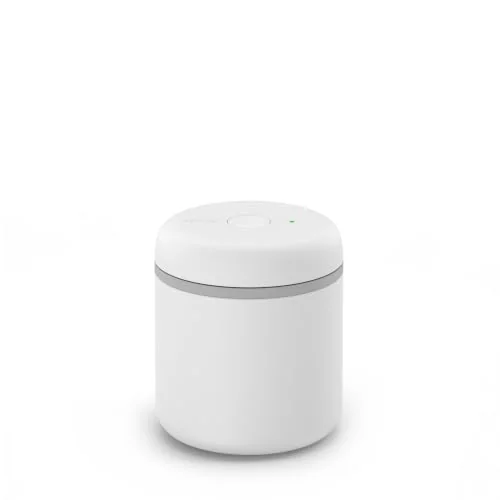
The tasters picked the Fellow Atmos unanimously. That is the result that gets repeated. The more useful one sits just below it: coffee kept in a resealable bag “tasted almost as good as that stored in the Fellow Atmos,” while beans in a bag that could only be closed with a clip came out worst, with tasters describing the coffee as “thin,” “stale,” and even “papery.” Most of the displacement canisters did poorly.
The one peer-reviewed comparison cuts the same way. A 2022 peer-reviewed study of opened bags stored whole beans four ways after opening: in an airtight canister, in the original bag taped shut, in the bag with a clip, and in a bag with a built-in screw cap. The screw-cap bag kept freshness best, and the authors found that “transferring beans into a container resulted in a faster loss of freshness.” Two caveats belong in the same breath: the study measured aroma compounds in a lab rather than taste in a cup, and its abstract does not say what kind of canister it used.
Moving beans out of the retail bag and into an airtight canister is the first storage rule most people learn, and the NCA lists it. It holds for a bag that cannot close. For a resealable valve bag with the air squeezed out, the move buys very little, and in the study above it cost freshness. The canister earns its place when the bag is the clip-and-fold kind, or when the beans arrive in paper.
The winner has its own month-two story. Serious Eats noted that the Atmos took a fair amount of twisting to seal once the canister was mostly empty, and that its lid cannot get wet when you wash it. A vacuum that wins over ten days still has to keep sealing for months, and the lid is the part that decides that.
Steel, Glass or Plastic: Where the Container Stands
Material gets argued about as if it settled the whole question. Mostly it settles where the container is allowed to stand. Steel can live on an open counter, clear glass cannot, and the jar itself is rarely the thing that went wrong.
Steel and opaque ceramic: the default
Stainless steel and opaque ceramic block light by themselves, which makes them the safe choice for a container that has to sit out on the counter next to the grinder. Both wash clean of old coffee oil with hot water and soap, though the lid is often the part that cannot go in the dishwasher, so check it before the first wash.
The cost of steel is practical rather than about freshness: you cannot see how much is left. You find out the bag is running low when the scoop scrapes the bottom. Several steel canisters carry a date wheel or marker on the lid, which at least answers the other thing you cannot see through steel, how long the beans have been in there.
Clear glass: fine in a closed cupboard, not on the sill
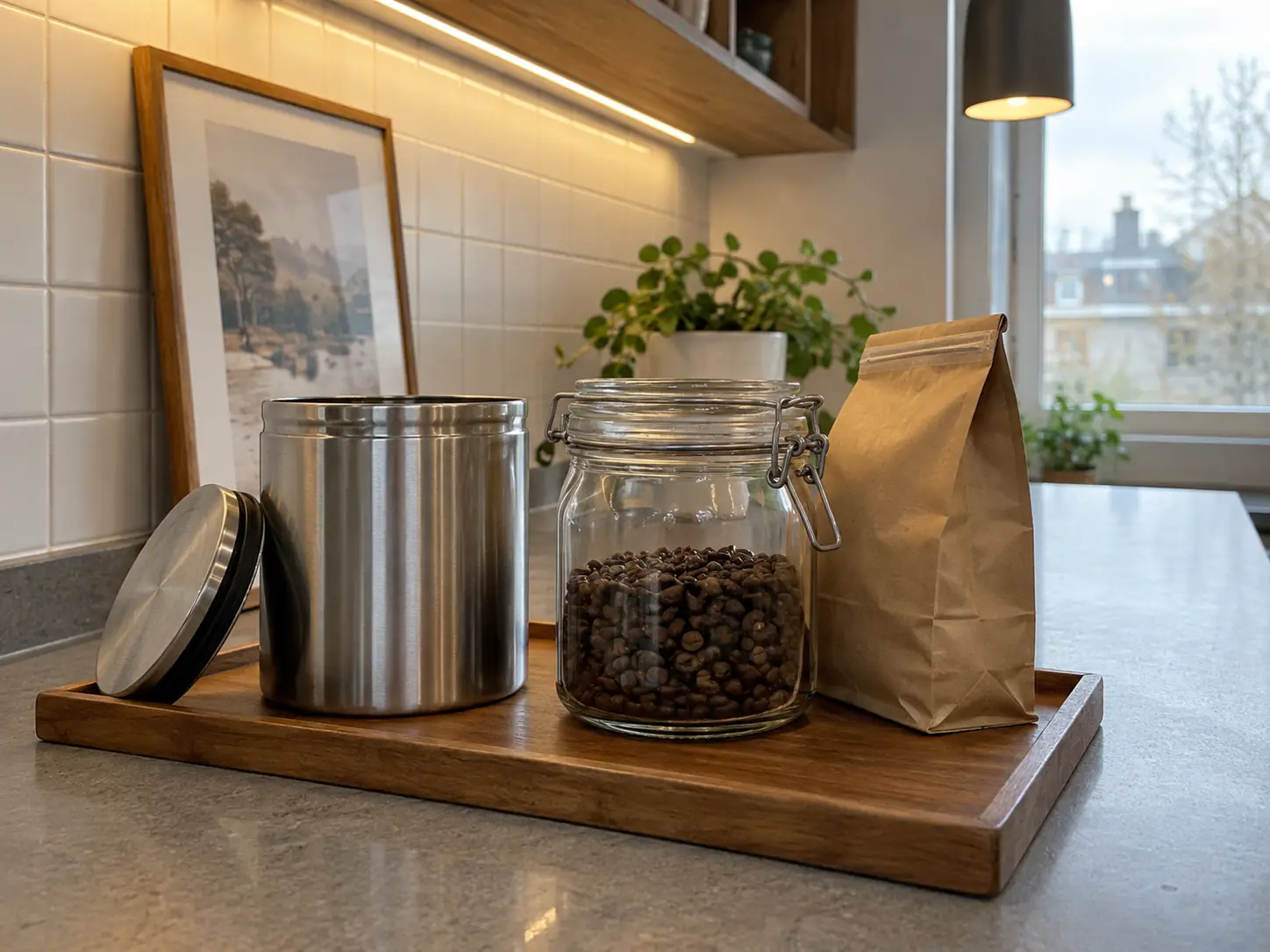
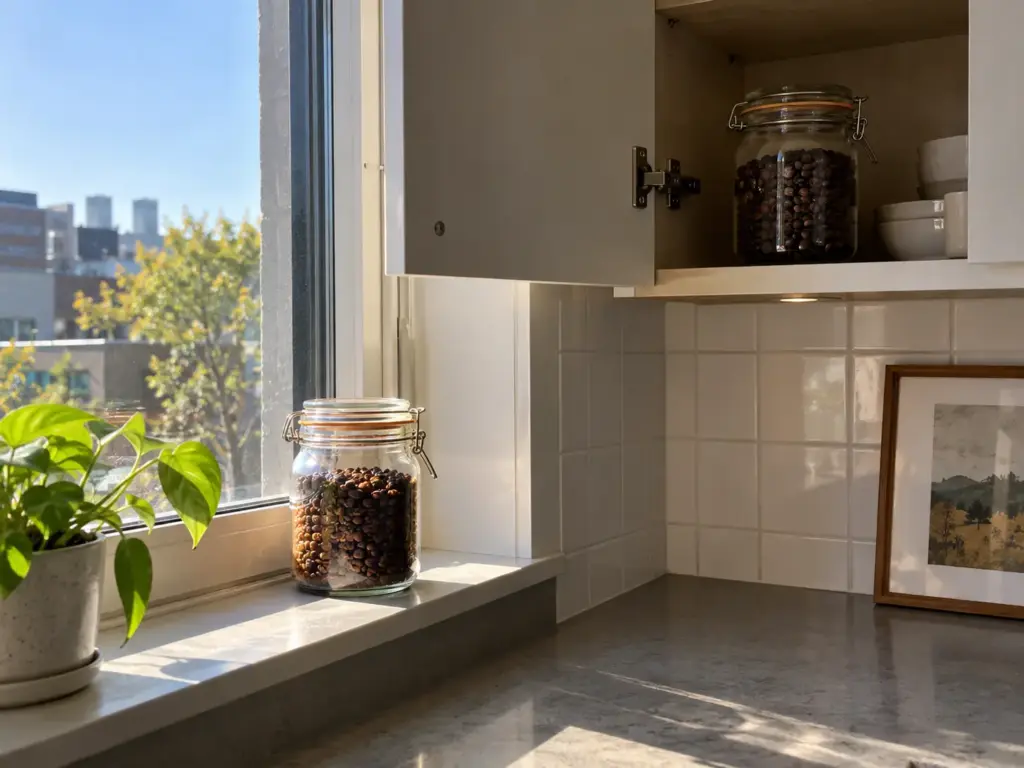
The NCA’s warning about clear canisters is a warning about light, and the Serious Eats tester’s advice for clear or tinted canisters was to keep them in a dark cabinet or drawer. Put together, the verdict on glass is a verdict on location. A lidded glass jar sized to the beans (a mason jar with a gasket lid does it), in a closed cupboard or pantry away from the stove, the dishwasher and the window, does the same job as an opaque canister, because the cupboard door is doing the blocking.
So glass is the worse material. Or rather, glass on the counter is the worse arrangement; the same jar behind a cupboard door is fine. The jar on the windowsill looks right on day one, and that is the trap: the difference does not show for a week or two, by which time the cup has lost its brightness and nothing about the jar looks any different. Heat adds to the damage, since a sunny sill or the counter beside the range warms the beans every day, and warm beans stale faster.
Skip the cabinet right above the range or the drip machine, even though it is the handiest. It takes the heat and the steam of every brew. A lower cupboard away from the stove and the dishwasher is the darker, cooler, drier shelf, and it costs nothing to move the beans there.
Tinted plastic and the UV claim nobody verified
Tinted plastic canisters, such as the OXO further down, advertise UV blocking. The Serious Eats tester said plainly that they could not speak to those claims, and no measurement backs them. Treat a tinted canister as a clear one that happens to be a little darker: it goes in the cupboard too. BPA-free, the other label printed on these canisters, is a statement about the plastic, not about how long the beans stay fresh.
If a jar that sat in the light has already given you a flat cup, how to tell if beans have gone stale covers the signs before the grinder gets the blame.
Size the Container to the Bag, Not the Shelf
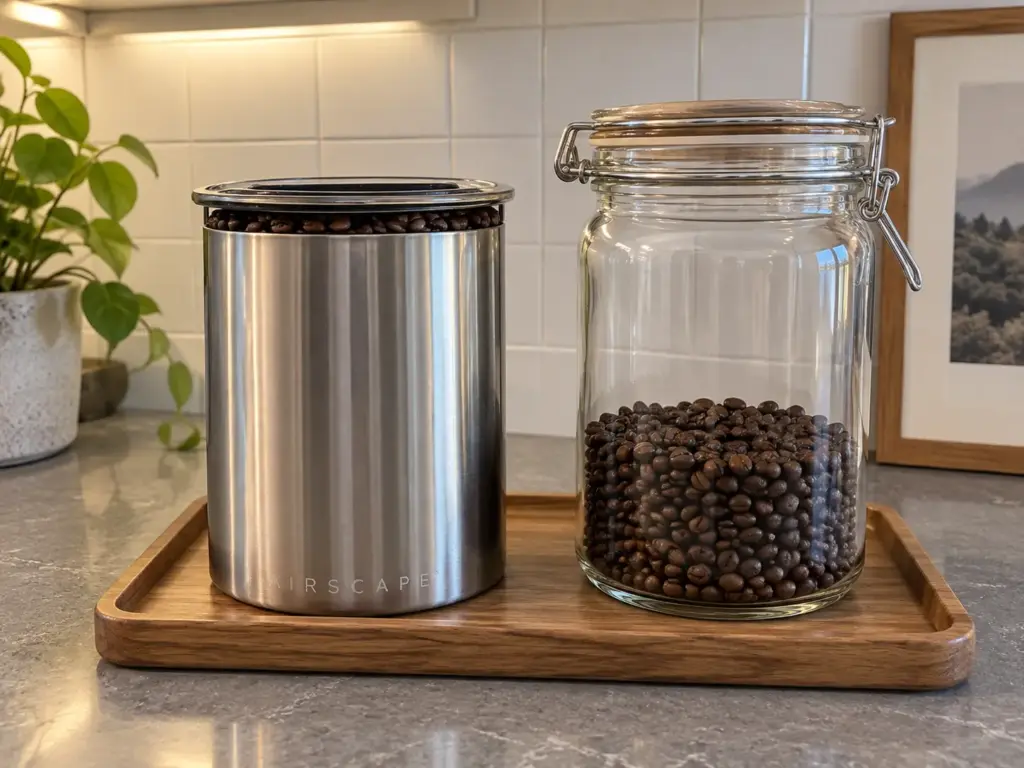
This is the variable most containers get wrong without anyone noticing. A container that holds twice the beans holds twice the air once it is half empty. A big canister with half a bag in it can do worse than the folded bag it replaced.
More container, more air
The SCA review notes that packing density and surface area influence how fast oxygen reacts with coffee. In a kitchen that becomes plain geometry: every inch of air space above the beans is air that came in with them and stays in with them when the lid shuts. A plain airtight lid locks that air in rather than taking it out, and a canister two-thirds empty is mostly air with some coffee at the bottom.
The problem grows as the bag goes down. The last third of the beans sits with the most air of all, which is part of why the last cups of a bag taste flatter than the first even in a container that seals well. A resealable bag works the other way: squeeze it before you seal it and it shrinks with its contents. That is a large part of why it came so close to the vacuum winner in the blind test, and why the clipped bag, which keeps its shape and its air, finished last.
What fits a one-pound bag, and what does not
A one-pound bag holds 16 oz of beans, and the opaque container that suits it is one that holds about that much. The capacities the makers and retailers list for the containers covered here:
- Fellow Atmos 0.7 L: 11 oz of beans; the 1.2 L size holds a full pound
- Coffee Gator and Veken: 22 oz each, a pound with room to spare
- MiiR Airlock: 12 ounces, so a full one-pound bag will not fit
- OXO Steel POP 1.7 qt (about 1.6 L): sized for a pound
- Planetary Design Airscape: about a pound in the Medium, 2.2 lb in the Kilo
The match is to the bag you actually buy, and to how fast you get through it. The NCA’s advice to buy one to two weeks of beans at a time is the other half of sizing. Run the arithmetic on your own dose: at two 18 g brews a day, a one-pound bag (454 g) lasts about twelve days and stays inside that window; at one brew a day it lasts about twenty-five, and the last week of it is past the window whatever the container. The same division decides whether to grind ahead, which is worked through in how to decide when to grind by bag size.
To size a container you already own, pour one full bag into it once. If the beans stop below the halfway mark, that container is for a bigger bag: use it for the sealed reserve, and keep the beans you are actually brewing in something smaller.
The inner lid that presses down
When the container is too big for the bag, the free answer comes first: pour a few days’ worth into a small lidded jar and leave the rest sealed in its bag with the air pressed out. A small flip-top jar for the next two or three days means the big container gets opened far less often. Another, who buys 400 to 600 g at a time, said they could not find a reason to buy an Airscape at all. Both come down to the same idea: fewer openings, less air.
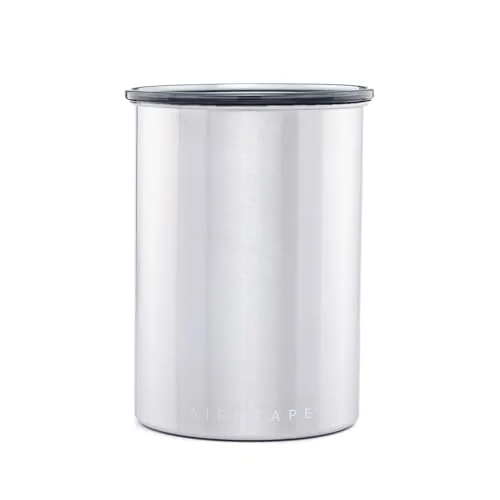
The product answer to headspace is displacement, an inner lid that comes down to the surface of the beans wherever that surface happens to be. The Planetary Design Airscape does it with a plunger lid that pushes the air out through a valve as you lower it, then locks with a handle. In Spruce Eats’ test the Kilo size tied for top freshness. That test used the big one, so the Medium below is the size a one-pound bag actually fits.
The Valve and Displacement Picks, With Their Flaws
With the size and the spot settled, what remains is which lid suits which kitchen. Each of the next three canisters comes with the failure that showed up in use. For one of them the sources turned up no failure at all, and that is reported as it is rather than read as praise.
Valve canisters for fresh-roasted beans
Beans from a local roaster are often only a few days off roast when you open the bag, and they are still releasing CO2. A one-way valve lets that gas out while the clasp keeps outside air from coming in, which is the job a vacuum lid struggles with at that age. The Coffee Gator is the common example: a 22 oz opaque stainless steel canister with a clasp lid, a one-way CO2 valve, a date wheel and a scoop. Spruce Eats found coffee kept in it noticeably fresher than coffee from a bag left open on the counter.
Where it falls short is the valve itself. The filter behind it cannot get wet and needs replacing every so often, so washing the lid means working around it, and in the Serious Eats test the coffee from it tasted a bit on the acidic side after ten days. That filter is a chore that shows up after a few washes, never in the first week.
The Veken sits in the same class, with 304 stainless steel, 22 oz of capacity, a one-way valve, a date marker and a scoop. Neither of the two published taste tests included it, and no repeated complaint about it turned up in the reviews available. That is an absence of evidence rather than a clean record, so expect the same valve care as any canister built this way.
Both hold 22 oz, which by the logic of the sizing section means a pound bag leaves room for air from day one, and more of it every day after. A valve canister suits beans in their first two weeks off roast. Once the beans have stopped degassing, the valve has nothing left to do, and what you own is a plain airtight canister with extra headspace. For beans that are already a month old when they reach you, a jar sized to the bag does as much.
The displacement canister that takes grounds
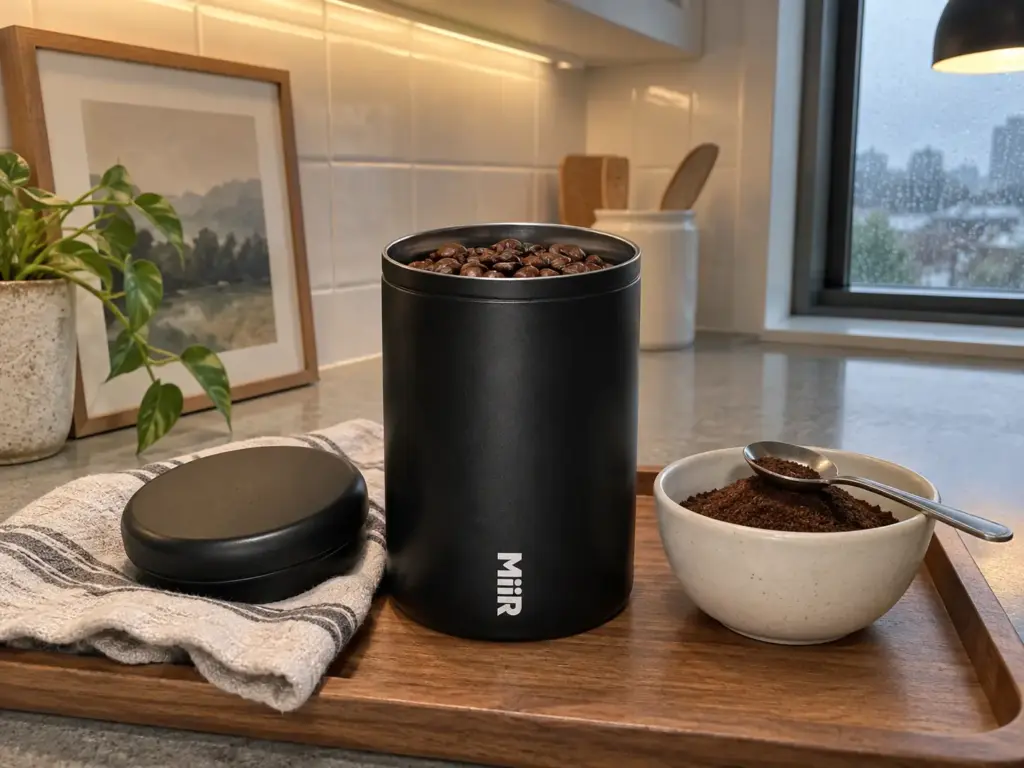
The MiiR Airlock is a 12 oz canister in 18/8 stainless steel with a stopper you push down onto the beans, and unlike the Atmos it takes ground coffee as well as whole beans. In the Serious Eats test the coffee “tasted a bit flat” by day ten. The outer lid “fits loosely,” which matters less for freshness, since the stopper does the sealing, than for the moment you lift the canister by its lid and the lid comes off in your hand.
At 12 oz, a full one-pound bag will not go in either. The stopper also only works where it touches: pushed down until it rests on the beans, it leaves almost no air above them, while a stopper left halfway up the canister is just a second lid with air under it.
Displacement canisters mostly lost that test, so the obvious reading is to skip them. For whole beans that reading holds. For anyone who buys pre-ground, the vacuum canister is off the table, and a stopper sitting right on the grounds is the closest a rigid container gets to a pressed-flat bag. Ground coffee stales faster than whole beans, which makes it its own decision, worked through in the separate question of storing pre-ground coffee.
The Jar or Bag You Already Own, and When the Lid Is Not the Problem
Everything above keeps circling one concession: the best container may already be on your shelf. For a lot of kitchens the bigger variables are how old the beans were when the bag opened and how fast the bag disappears, and a lid can do little about either.
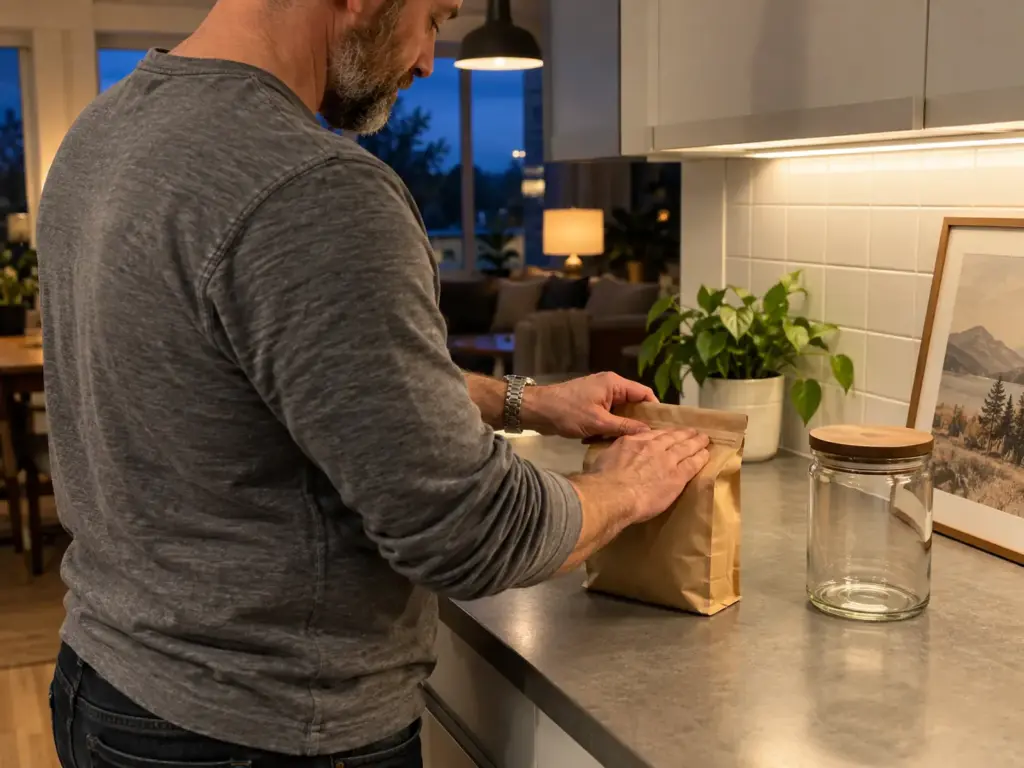
The pressed-flat bag and the lidded jar
The free options come in order, and each one is a single change you can taste across the next bag:
- If the beans came in a resealable valve bag, keep them in it. Squeeze the air out toward the valve, seal it, and put it in a closed cupboard.
- If the bag only folds or takes a clip, move the beans into a lidded jar with a gasket, sized so the beans nearly fill it, in the same cupboard. The clipped bag is the one to retire.
- If the only jar you have is too big, split the bag. A few days’ worth goes in a small jar, and the rest stays sealed and pressed flat.
If storage was what flattened your cups, the last cups of the next bag should keep most of the brightness of the first week instead of turning thin and papery. If they still go flat on schedule, look at the beans’ age instead, below.
The budget airtight option, and its flaw
For a counter that wants a scoop, the OXO Steel POP is the plain airtight comparison point: a push-button lid with a gasket, a tinted plastic canister under a steel-look lid, 1.7 qt sized for a pound, and a scoop. The Amazon listing linked here sells it as a pack of two. Spruce Eats picked it as its value choice, and it costs a fraction of the vacuum canister.
Airtight without a pump, it did not keep coffee as fresh as the Atmos in the Serious Eats test, which measures what a vacuum adds: the gap between holding air out and taking some of it away. The steel-look lid shows water spots and scratches, the UV-blocking claim on the tinted plastic is unverified (so it belongs in the cupboard like any clear jar), and purchasers report that the button may stick after long use, which Spruce Eats did not see in its own test: a risk, not a verdict.
When the lid is not what is wrong
A canister slows staling and never reverses it, so the roast date and the pace you drink decide more than any lid. Spruce Eats’ test kitchen puts whole beans at their best within about 14 days of roasting and ground coffee within about ten days; those are one kitchen’s ranges, not an SCA figure. The NCA’s window is one to three weeks after opening at room temperature.
That window assumes beans that were fresh when the bag opened. A bag roasted six weeks before it reached the store shelf started its clock without you. The roast date and the valve on the bag are the first things to read when you buy, which is what the bag tells you before it ever reaches a container. And if a bag will outlast your window no matter what, freezing what you will not finish once, sealed in small portions, beats any canister for the extra.
The cheapest freshness check needs no gear beyond the kettle. When hot water hits fresh grounds, the bloom rises and domes the bed as trapped gas escapes; grounds that barely move are old, and no container brings that back.
Write two dates on a strip of masking tape on the container: the roast date from the bag and the day you opened it. When the cup goes flat, those two dates tell you whether to blame the lid or the calendar, and they usually point at the calendar.
Choose the Seal First, Then Taste the Last Cup of the Bag
Three things decide whether the last cup of a bag tastes like the first:
- Rank the jobs and buy in that order. Seal first, then little air inside, then darkness; a vacuum is a bonus, not the point.
- Size the container to the bag you buy. A half-empty big canister holds more air than a bag pressed flat.
- Start with what you own. A resealable valve bag with the air squeezed out nearly tied the winning vacuum canister, and a lidded jar in a closed cupboard does the opaque job for free.
A month from now, compare the last cup of a bag with the first, and notice whether the lid still seals without a fight; a seal that needs coaxing has started to go. Tomorrow, make just one change: press the air out of the bag before it closes, or move the beans into a lidded jar sized to them, and put either one in a closed cupboard away from the stove. Then taste the last cups of that bag for the brightness the first ones had. Once storage stops being the variable, the next thing to settle is how many weeks an opened bag really has.
Frequently Asked Questions
01What is the best container for storing coffee beans?
The best container is airtight, opaque and sized so the beans nearly fill it, kept in a closed cupboard away from the stove. Rank the jobs as seal first, then little air inside, then darkness. A vacuum or displacement lid is a bonus on top.
02Is it better to store coffee in glass or stainless steel?
Stainless steel blocks light on its own, so it can sit on an open counter, while clear glass only works inside a closed, dark cupboard. The deciding factor is where the container stands, not the material itself.
03What type of jar is best for storing coffee beans?
A jar with a gasketed lid, sized so your beans nearly fill it and kept in a closed cupboard away from heat and light, is the best jar for beans. A big jar that is half full holds more air than the bag did.
04Should I keep coffee beans in the bag they came in?
Yes, if the bag reseals: a resealable valve bag with the air pressed out tasted almost as good as the top vacuum canister in a 10-day blind test. A bag closed with a clip tasted thin, stale and papery, so move those beans into a jar.
05Can I put ground coffee in a vacuum canister?
Not in every vacuum canister: the Fellow Atmos cannot take ground coffee, because fine grounds clog the mesh its vacuum mechanism draws air through. A displacement canister such as the MiiR Airlock holds both whole beans and grounds.

How did your cup turn out?
No comments yet. Tell us what you changed — and whether the needle moved.