



We may earn a commission when you buy through links on this page. It never changes what we recommend. How we pick
On this page8 parts
- Ground Coffee Starts Losing Its Aroma in Minutes
- Four Clocks That Disagree, and What Each One Measured
- Your Bag Size Decides How Far Ahead You Can Grind
- A Good Grinder Beats a Fresh Grind From a Bad One
- If You Grind Ahead, Weigh the Beans and Grind Last
- When a Flat Cup Is Not the Clock
- Divide the Bag Before You Move the Clock
- Frequently Asked Questions
It is 5:45 a.m., the kettle is starting to tick, and the grinder in your hand is about to be the loudest thing in the apartment while somebody sleeps down the hall. Deciding when to grind coffee beans starts with what the grinder does: a whole bean holds gas that keeps air away from its aroma, and cutting it into many small pieces lets that gas out within minutes, so the clock on a dose starts at the grinder, not at the brewer. Grinding last gives the best cup, yet the loss after that is a slope rather than a cliff, and the sources that time it disagree for reasons worth knowing. The bag you buy and how fast you empty it decide how far ahead you can go, and there is a way to grind ahead that gives up very little (whether grinding at home is worth it is a separate decision; this one is only about the clock).
Quick Answer
Grind right before you brew for the best cup, but the loss is a slope: small overnight, real by day three or four, clear by a week. A bag you finish in about five days can be ground ahead; one that lasts ten to fourteen days should be ground fresh. And a fresh blade grind still brews unevenly.
Ground Coffee Starts Losing Its Aroma in Minutes
Grind right before you brew is the rule everybody repeats, and it holds up. The reason behind it is a mechanism, not a habit, and knowing the mechanism tells you how much the rule costs on the mornings you break it.
Why grinding starts the clock
Roasting leaves a bean full of carbon dioxide, and while the bean stays whole that gas works its way out over weeks. Grinding multiplies the surface area the gas can escape from.
According to the Specialty Coffee Association’s Coffee Decoded column, “the CO₂ that is lost over weeks in whole bean coffee is lost in minutes after coffee is ground.” The gas itself stales nothing. It was holding the air out, and once it leaves, oxygen-rich air takes its place and the off-flavors begin. Oxidation is the word for what follows, and the extra surface speeds it up.
That is why coffee ground too early points one way in the cup: flat and dull, the aroma gone, the cup hollow without being sharp. A sour cup points somewhere else entirely, at the grind size, and the last section of this article comes back to that difference. For timing, the thing you change is when you grind, never how fine.
What “fresh for about an hour” actually measures
The SCA does put a number on it, and hedges it in the same breath: using CO₂ degassing as a guide, ground coffee might count as fresh for about an hour after grinding. That is a guide built on a gas, not a tasting result. The same column, by the same measure, gives whole beans about three weeks from the roast, so grinding shrinks the window from weeks to something you can count on a kitchen timer.
The lab numbers are steeper. In a gravimetric degassing study in the Journal of Agricultural and Food Chemistry, Smrke and colleagues report that “up to 75% of the trapped gas was released during and immediately after grinding.” That figure comes from espresso-fine grounds out of a single lab grinder, so it describes that grinder, not the one on your counter.
The older studies the paper cites fill in the rest. They put the loss in the first minutes at 40 to 50 percent in one case and 59 to 73 percent in another, and by grind size at 26 to 30 percent for coarse, 33 to 38 for medium and 45 to 59 for fine.
So the hour depends on the grind. A coarse French press dose sitting on the counter is in far less of a hurry than an espresso dose, and a drip grind sits somewhere between the two. After those first minutes the loss slows to a crawl: the same paper cites a further 4 to 12 percent over 30 to 200 hours.
The first hour is the steep part. The next day is a gentle slope.
The aroma you smell is the aroma leaving
Gas is a stand-in. CO₂ tracks aroma loss, but no one has turned it into a flavor score, and a grind that has lost half its gas has not lost half its taste. What you can use at the counter is your nose: the smell that fills the kitchen when the grinder stops is the loss you can smell, coffee leaving the grounds before the water ever reaches them.
The minute you spend hunting for a filter with the dose sitting in an open bin counts too: at espresso fineness that minute is the steep part of the curve, while a coarse French press dose barely registers it.
Switch the kettle on first, then grind, so the dose goes into the filter as the water comes up to temperature (195 to 205°F, or 91 to 96°C, is the range Sweet Maria’s gives) instead of sitting in the bin beside a cold kettle.
Four Clocks That Disagree, and What Each One Measured
Ask four sources how long ground coffee stays good and you get an hour, two hours, four days and three weeks. None of them is wrong. Each one timed something different, and once you see what, the numbers stop fighting.
An hour, two hours and two to four days
The SCA’s hour is the gas guide from the section above. Sweet Maria’s, a green-coffee retailer, is tighter on the clock and looser on the method: its grinding page says “Within 2 hours of grinding, you will notice a loss of quality.” That is a seller’s rule of thumb, stated without a test attached.
Prima Coffee, also a retailer, ran the closest thing to a test. In October 2016 about a dozen tasters compared pre-ground and fresh-ground coffee blind over ten days. A pre-grind from a commercial shop grinder kept about 95 percent of its character on day two, and by day four it tasted roughly level with coffee ground fresh on a home burr grinder; Prima’s own description of that day-four cup is duller, with stale, oxidized flavors coming in. It is one retailer’s panel of roughly twelve people, not a standard, and it deserves to be read that way.
The same rough picture holds: not much lost overnight, a lot after three or four days, and a week’s worth kept sealed still pretty good for a camp AeroPress. A gas measurement, a seller’s rule, a small blind panel and a general consensus are four different instruments. They disagree most about the first 24 hours, which is exactly the stretch you live in when you grind at night.
Why a sealed bag is a different question
The Coffee Bean & Tea Leaf says its pre-ground coffee is freshest for two to three weeks after the bag is opened. That sounds like it contradicts everything above, and it does not. That coffee was ground at the roaster and sealed before air reached it, which is a different product from a dose ground in your kitchen and left in the grinder’s bin overnight. The three weeks is also the roaster’s own claim about its own bag.
Whole beans run on a slower clock of their own, which is how long whole beans last once the bag is open. This article stays with the ground dose.
What nobody has measured
There is no SCA, National Coffee Association or World Coffee Research figure for taste loss by hours or days after grinding. The only institutional numbers are the gas numbers, and even the grind-size figures from the lab describe gas, not a cup anyone tasted at a drip grind and again at a French press grind days later. No owner has reported what happens across months of grinding ahead either: the longest record is Prima’s ten days, with one set of tasters and two coffees.
So each of these day-counts comes from a small panel or a general consensus, the ones in this article included. I would trust the shape more than any single number, because the sources agree on the shape: a steep first hour, a gentle night, a clear drop by the end of the week. That is also the case for running your own comparison, which the next section sets up.
Your Bag Size Decides How Far Ahead You Can Grind
The question underneath all of this is not how long ground coffee stays good. It is how long this bag lasts in this house, and that is arithmetic you can do before you touch the grinder.
The arithmetic of a bag
Days per bag equals the grams in the bag divided by the grams you brew a day. A 12-ounce bag holds about 340 g, and here is how long it lasts at three common daily doses:
- 20 g a day (one large mug, roughly two level coffee scoops): about 17 days
- 40 g a day (two mugs): about 8 days
- 60 g a day (a pot of about six drip-machine cups): about 6 days
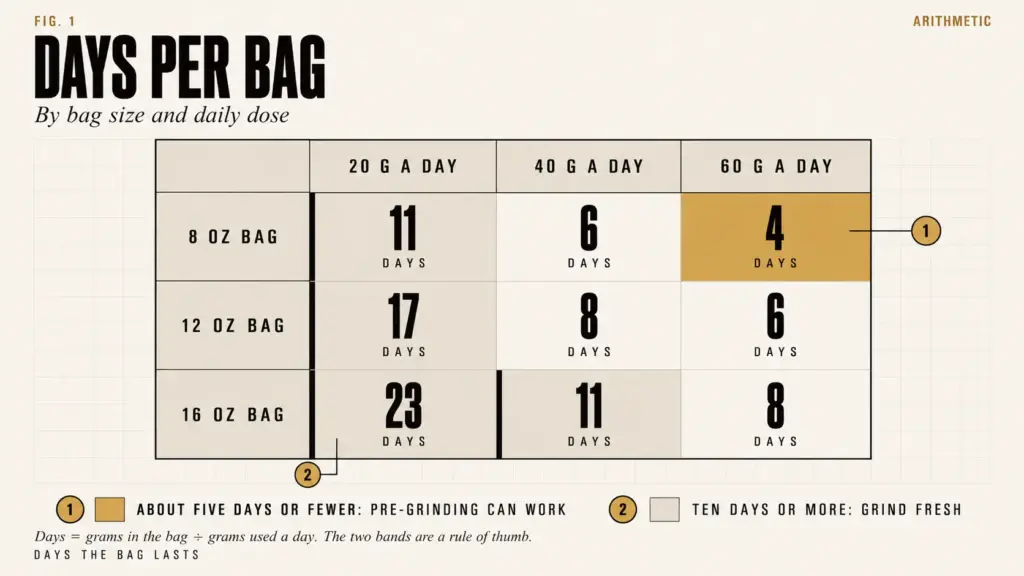
An 8-ounce bag runs out in about 11, 6 and 4 days at the same doses; a 1-pound bag in about 23, 11 and 8. These are plain division, not test data. What they tell you is which half of Prima’s rule of thumb you live in.
A bag you finish in about five days
Prima’s advice from its test is direct: if you go through a bag every five days or so, pre-grinding is worth a blind comparison against your fresh-ground cups. At that pace the last dose in the jar is four or five days old, which is about where Prima’s panel found the shop pre-grind level with a fresh home burr grind. Turning that into “your bag size decides” is this article’s reading of their test, not their wording, but the direction comes straight from it.
The household that brews a full pot every morning is the one where grinding fresh every day matters least. It is also where grinding ahead costs you something specific: pre-ground coffee cannot be re-tuned. If Monday’s pot comes out sour because the grind is too coarse, the rest of the week’s coffee is already cut at that size.
A bag that lasts two weeks or more
One cup a day from a bag that lasts ten to fourteen days is the other half of the rule, and Prima’s advice there, for someone with a good burr grinder, is to keep grinding fresh. Ground all at once, the last third of that bag would be a week or more old, the stretch every source above treats as past the easy part.
The difference shows up at the end of the bag, not the start. The first mugs from a big bag ground ahead taste fine; by day sixteen the mug tastes flat next to your memory of the first. But grinding fresh has its own cost: it is loud, and it adds a minute to every morning.
The partner who will not be woken, and the camp trip
Noise is the reason that comes up most for grinding the night before. The usual routine is a grind late in the evening and a brew eight to ten hours later, with the grounds in an airtight jar in a dark cabinet, and most people who describe it say they could not tell the difference, some of them with a fruity natural Ethiopian through a V60.
A hand grinder looks like the obvious quiet answer, and it only half is. A good hand grinder takes about 30 to 40 seconds for 20 g, while a cheap one takes far longer and throws off a lot of fines (it is worth knowing how long a hand grinder takes, timed against the kettle before you buy one to solve a noise problem). For a week of camping, a week’s worth ground and sealed is an acceptable trade for an AeroPress in a tent, and there is always what to do when there is no grinder at all.
Run the blind test the threads keep recommending, with one change only: grind one dose the night before and one fresh, then brew both at the same weight, water and time. Put a strip of tape under one mug and let someone else pour. If you cannot pick the fresh cup twice in a row, the night-before grind is free in your kitchen.
A Good Grinder Beats a Fresh Grind From a Bad One
Before you move the clock, look at what is doing the grinding. In the one test on record, a fresh grind from a poor grinder lost to a good grinder’s pre-ground coffee from the first day to the last.
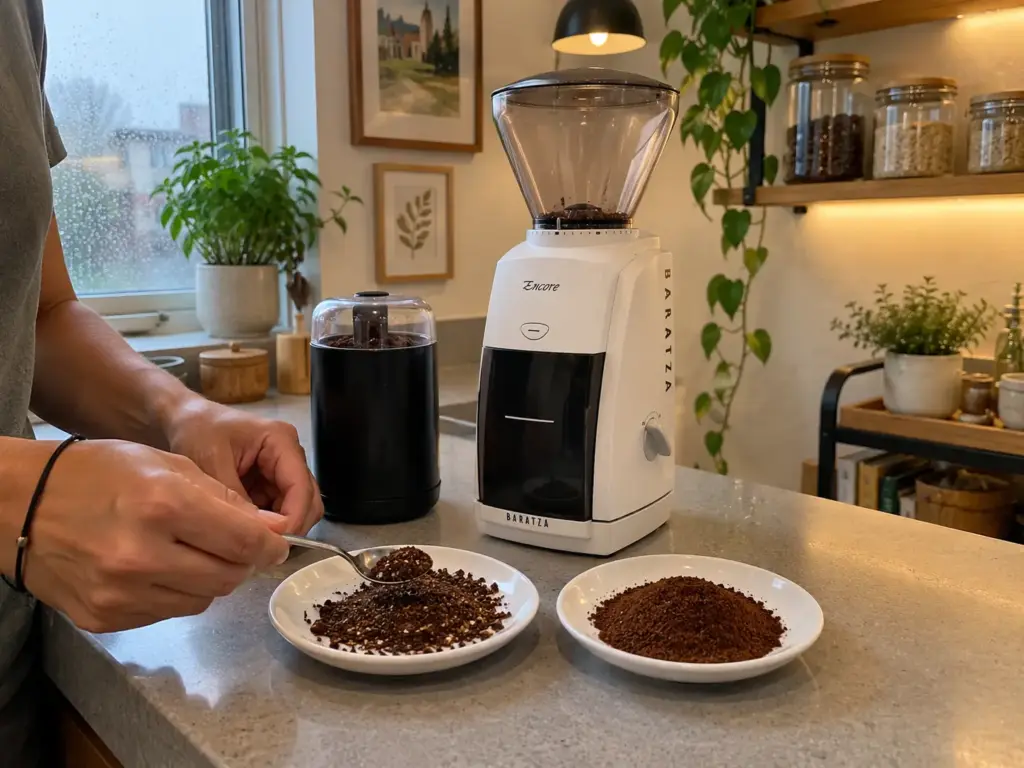
A fresh blade grind is still boulders and powder
A cup that tastes sour and bitter at once points at uneven particles, not at the clock. A blade grinder smashes the bean rather than cutting it, and Sweet Maria’s calls the result “boulders, rocks and powder”: the powder over-extracts and clogs a paper filter, the boulders give up too little, and the cup carries both faults together. That is why a blade grinder makes a cup sour and bitter at once, and how long to run a blade grinder only changes the ratio of boulders to powder.
The Hamilton Beach Fresh Grind is the everyday version: stainless steel blades, enough for up to 12 cups, and random particle sizes whatever you do with the timing. Prima’s blade grinder was a Krups, not this one, but it cuts the same way, and its fresh cup stayed extremely imbalanced all week while the shop’s pre-grind tasted better to the end.
So “grind right before you brew” is the wrong priority for anyone grinding with a blade. The better call is a burr grind from a shop, used within three or four days. Tip a spoonful of blade-ground coffee onto a saucer next to one from a burr grinder and you can see the difference before you taste it: chunks and fine dust in one pile, an even sand in the other. (Sweet Maria’s does give blades their due: they are cheap, they last, and a paper filter catches most of the powder.)
The free move: a shop’s grinder for part of the bag
Prima’s own suggestion costs nothing: have the shop grind part of the bag on its commercial burr grinder, brew through that part in three or four days, then grind the rest at home. The only condition is that the setting fits your brewer, so tell them what you brew with; a grind for a drip machine is not a grind for a French press. If the shop’s grind comes out slightly off, Prima’s advice is to adjust the brew rather than the coffee: for immersion brewers, the time; for drip and pour-over, the water temperature or the dose.
The grinders worth growing into, and what each still gets wrong
The cheaper route to a burr set is the Cuisinart Electric Burr One-Touch grinder, with an 18-position slide dial and a removable 8-ounce hopper. Prima tested the DBM-8, found that it “uses faux burrs,” and got a more balanced cup than the blade but still an imbalanced extraction that never beat the shop’s pre-ground coffee. This listing is the DBM-8P1, a close relative rather than the tested unit, and its 18 steps are wide: a drip grind that falls between two of them stays out of reach.
What more money buys is real burrs and smaller steps. The Baratza Encore has 40 mm conical steel burrs and 40 settings, and it came closest to the commercial grinder in Prima’s test. Its cup still showed a noticeable imbalance, a mix of sour, sweet and bitter, only less of it than the other home grinders. And it is loud first thing in the morning, which is the very problem this article started with.
The Cuisinart costs a fraction of the Encore for the same idea, though only the Encore’s dial moves in steps small enough to correct a sour or bitter cup.
If You Grind Ahead, Weigh the Beans and Grind Last
For some kitchens the night-before grind is the right call. The question then is how to do it so the cup gives up as little as possible and you can still change course when it comes out wrong.
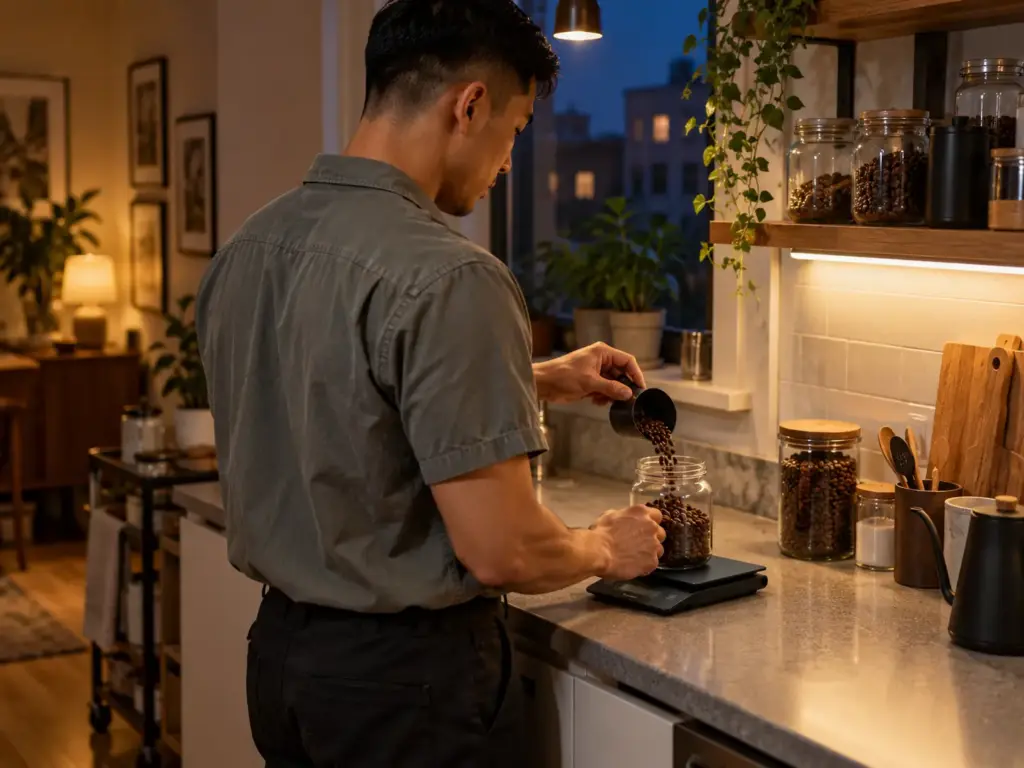
Weigh the beans, not the grounds
A middle path keeps both the quiet and the fresh grind: measure the whole beans the evening before and grind them in the morning. The beans hold their gas until the grinder runs, so a dose weighed at night loses almost nothing by morning. At a real counter this looks like a small glass jar with the lid on, sitting by the grinder, holding a measured dose rather than a guessed scoop.
A scale is what turns that jar into the same dose every night. The Hario Drip Scale Timer reads in 0.1 g steps and has a built-in timer for the brew itself. Be clear about what it does: it fixes the dose, and it does nothing to slow the clock on grounds. It also switches itself off after five minutes, so weigh the beans in one go rather than coming back to it halfway through the dishes.
Grind last, somewhere else, or by hand
With the dose already weighed, the grinding can move. One practical fix is to run the electric grinder in the laundry room or the bathroom with the door closed, or to hand grind in the kitchen. Either way the routine stays and the noise goes somewhere else. Finish the grind while the kettle comes up and you get the within-minutes window without planning for it.
Each version has its price. A hand grinder costs minutes, a closed door only muffles an electric motor, and the loud grinder remains the cost of the freshest cup.
A burr grinder keeps some grounds inside, so the first dose after you move the dial still comes out partly at the old setting. Never judge a new setting on a night-before batch. Grind the morning after a dial change fresh, taste that cup, and only then go back to grinding ahead.
If you grind a few days ahead
When the mornings really will not allow it, grind a week’s worth. Or rather, grind three days’ worth twice a week, and keep it in an airtight container somewhere dark and cool, out of the fridge. Two short batches beat one long one, since three to four days is where the sources above start to agree the drop is real. The container and the rest of the routine belong to how to keep coffee you grind ahead, and if what you have is a bag the store already ground, the question becomes what to do with grounds that are already cut.
When a Flat Cup Is Not the Clock
A dull cup gets blamed on grinding too early more often than it should. Before you change your mornings, rule out the other suspects one at a time, starting with the one that costs nothing to check.
Flat is the clock, sour is the grind
The mechanism from the first section points one way: as the gas leaves, air comes in and the cup goes flat and dull, which is also how Prima’s panel described its day-four coffee. A sour cup is a different direction altogether. Sour means the water left before it finished extracting, which is a grind and extraction problem, and it is covered in how grind size changes the taste from sour to bitter. Treat this as a tell rather than a measured law; no study has timed sour against flat by the age of the grounds.
The check is one change. Grind the next pot fresh and keep the beans, dose, water and brewer exactly as they were. If the fresh cup tastes livelier, the clock was the problem. If it is just as flat, grinding ahead was not the cause, and you move on to the next suspect.
For most kitchens the brewer is a drip coffee maker, so it helps to start from the grind a drip machine wants.
One suspect sits on the machine itself. Sweet Maria’s makes the point that coffee held hot goes stale by any method that keeps it hot, so a pot left on a drip machine’s hot plate is its own clock, whatever time the beans were ground. Judge the first cup poured, never the one poured after the carafe has sat through breakfast.
Check the roast date before the grinder
Beans have their own clock, and it starts at the roaster. The old 15/15/15 rule is outdated, and the peak sits somewhere around 4 to 14 or more days after roasting, depending on the roast and the process. A bag with no roast date printed on it is a bag you cannot rule out, and the SCA column gives whole beans about three weeks from the roast, so a bag months past that will taste flat whether you grind it that morning or the night before.
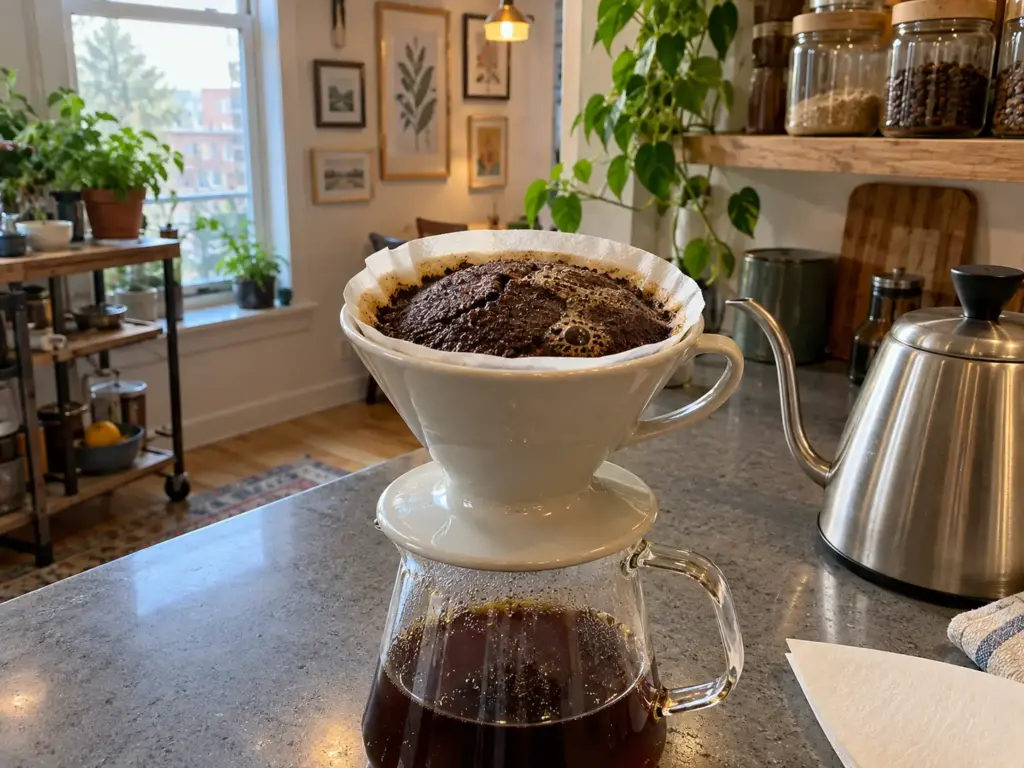
The small sign comes before the first sip. Pour a little hot water over fresh grounds and they rise and dome as the gas pushes out; stale beans barely move. If the bloom stays flat, check how to tell if the beans themselves are stale before you touch the grind, and keep weighing the dose before touching the dial so the dose is not a second variable.
In a pour-over or a French press, watch the first splash of water for 30 seconds before you blame the grinder. A bed that swells and cracks on top still has gas in it; a bed that just darkens and sinks points at old beans, and no change to your grinding schedule will bring that cup back.
The water can do it too
Water is the suspect people check last. Sweet Maria’s claims that very soft water can make coffee taste dull and flat, while very hard water can push the acidity toward sourness. That is a retailer’s rule rather than a measurement, but it is cheap to test: if fresh-ground coffee from fresh beans still tastes flat, brew one pot with filtered tap water and change nothing else.
Put together, the suspects come in this order, with one change and one taste at a time:
- Grind the next pot fresh and change nothing else. A livelier cup means the clock was the cause.
- Check the roast date and watch the bloom. A bed that barely rises means the beans.
- Brew one pot with filtered water. A brighter cup means the water.
- If the cup is sour rather than flat, leave the schedule alone and move the grind setting finer.
No owner has tracked any of this over months of grinding ahead; the longest record is still the ten-day panel. That leaves your own kitchen as the best source over the long run.
Divide the Bag Before You Move the Clock
Grinding right before you brew gives the best cup, but the loss is a slope: small overnight, real by day three or four. Your bag size and your daily dose decide how far ahead you can go, so divide before you decide. A good grinder also beats a fresh grind from a poor one, so check what is doing the grinding before you worry about when.
A month from now, notice how many days a bag really lasts in your house and whether its last cups taste flat beside its first; if they do, your grind-ahead window is shorter than the bag.
Tonight, weigh tomorrow’s beans into a jar and leave the grinder alone. In the morning, grind them last, as the kettle heats, and taste that cup against the last one you made from pre-ground coffee, with everything else unchanged. If the fresh cup tastes brighter and fuller of aroma, the clock was costing you something; if you cannot tell them apart, the night-before grind is yours to keep.
Frequently Asked Questions
01How far in advance can you grind coffee beans?
A night ahead costs little, a few days in a sealed container is an acceptable trade, and a week is where most sources agree the loss is clear. No standard sets the limit: these windows come from a retailer’s blind panel and general consensus.
02Can you grind coffee beans the night before?
Yes. Grinding the night before is common, and the cost is small when the grounds sit in an airtight jar in the dark. Weigh the dose, use a burr grinder, and taste one cup against a fresh grind before you make it your routine.
03Does grinding coffee make it go stale faster?
Yes. Grinding lets out in minutes the gas that whole beans lose over weeks, and that gas was keeping air away from the aroma. The Specialty Coffee Association’s Coffee Decoded column explains the mechanism.
04What are common mistakes when grinding coffee?
Four come up most: grinding further ahead than the bag lasts, trusting a fresh blade grind to fix uneven particles, changing more than one thing at once, and judging the first dose after a dial change, which still comes out partly at the old setting.
05Can you over grind coffee beans?
Yes. Grinding too fine, or running a blade too long, makes more dust, and the cup turns muddy and bitter. The right run time depends on the grinder; see how long to run a blade grinder.

How did your cup turn out?
No comments yet. Tell us what you changed — and whether the needle moved.