



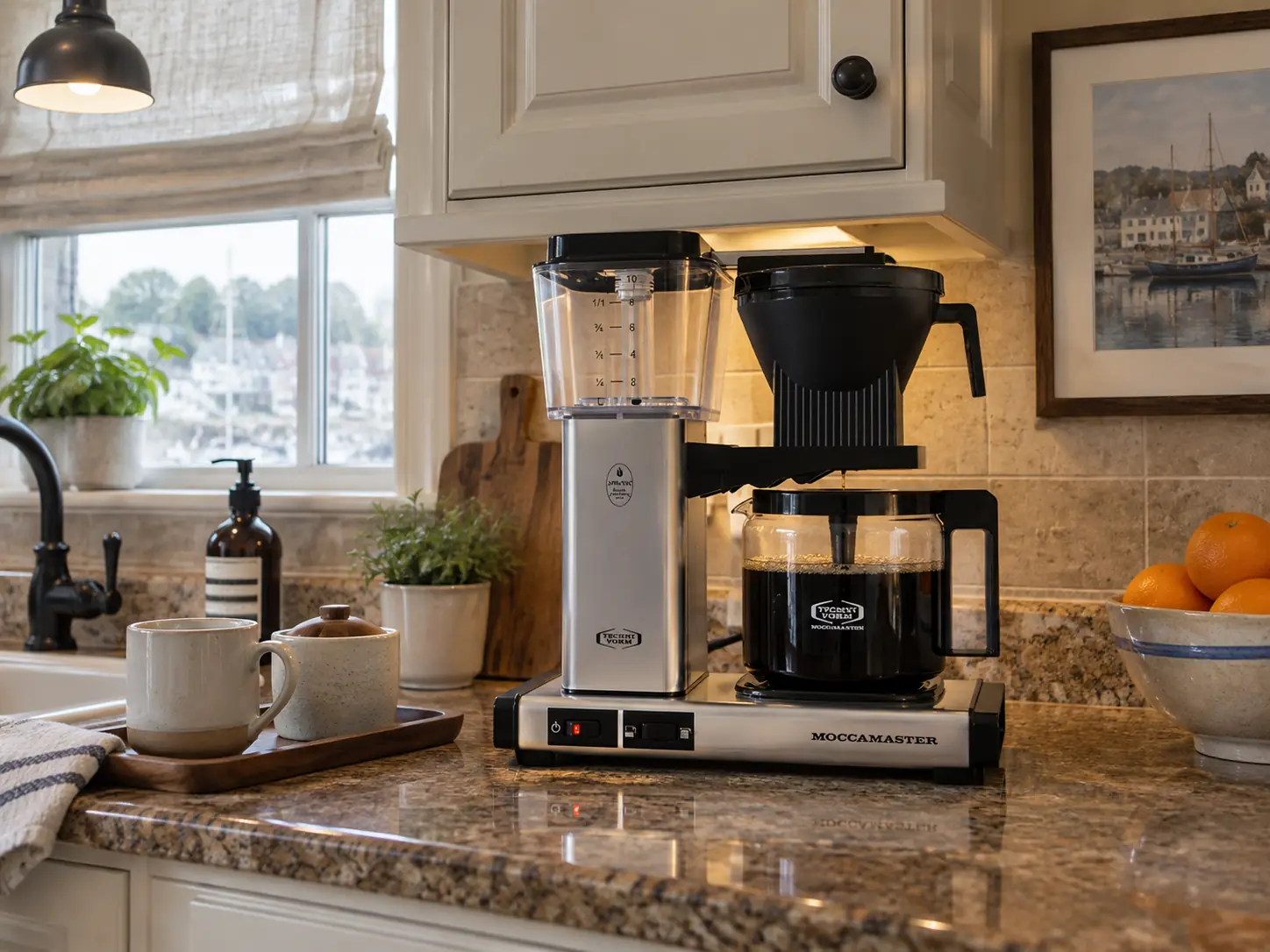
We may earn a commission when you buy through links on this page. It never changes what we recommend. How we pick
On this page8 parts
- The Best Coffee Grind Size for a Drip Coffee Maker Is Medium
- Your Basket and Your Batch Size Move the Grind
- Read the Pot to Know Which Way to Move
- When the Pot Is Off and It Isn't the Grind
- The Grinder Side: Burr, Blade or Pre-Ground
- Month Two: When Last Month's Setting Stops Working
- Start at Sand and Let the Pot Pick the Direction
- Frequently Asked Questions
You press the button, walk away, and come back to the only evidence of what happened inside the machine: a pale pot that tastes thin and sharp, or a dark one with a bitter edge. Nobody watched the water cross the grounds, and on a drip machine nobody can.
That is why the best coffee grind size for drip coffee maker pots is a starting texture plus a direction rather than one number. The showerhead and the heater set the pace, so the grind is the lever left to you, and it works on time as much as on size: finer grounds slow the water down and let it pull more out of the coffee, coarser ones let it run through with less. What follows is where to start, why your basket and your batch shift it, how to read the pot, the suspects that aren’t the grind at all, and what drifts after a few weeks.
Quick Answer
Start a drip coffee maker at medium, grounds about the texture of sand. Then let the pot choose: sour, thin or weak means one step finer, bitter or harsh means one step coarser, and you taste between steps. The medium-coarse some makers print is their number for their own brewer, and a step inside medium is hard to taste anyway.
The Best Coffee Grind Size for a Drip Coffee Maker Is Medium
On an auto-drip or electric drip machine, the drip coffee grind size to start at is a medium grind: grounds that feel like sand, separate grains with no powder and no chunks. Moccamaster and Counter Culture print medium-coarse instead, and the gap is smaller than it looks, because each one is describing its own brewer and its own grinder rather than a different cup. The micron ranges for every brew method live in the full grind size chart, in microns; this page keeps to the machine with the carafe.
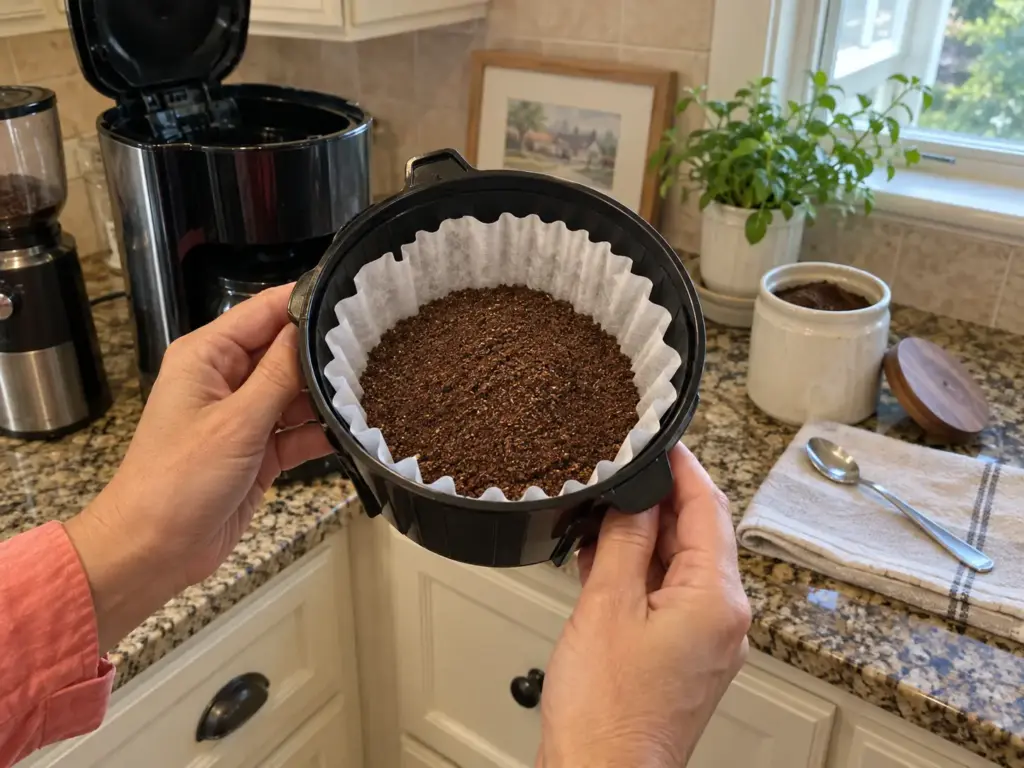
What Medium Actually Feels Like Between Your Fingers
A bag labeled drip grind is a promise about a machine the roaster has never seen. The words describe a band of textures, and medium sits in the middle of it: coarser than table salt, finer than the coarse sea salt of the coarse grind a French press wants. Rubbed between two fingers it feels gritty, the grains stay separate, and very little dust sticks in the lines of your skin.
If you can’t tell which of those you are holding, how to tell fine, medium and coarse apart by feel walks through the pinch test. The label drifts too. Moccamaster says supermarket pre-ground usually comes out too fine for its own brewer, which means a can marked for drip machines can run fine in one kitchen and too fine in the next.
Trust the grounds between your fingers over the word on the package.
Why Some Makers Say Medium-Coarse
Moccamaster’s advice for its brewers is “medium-coarse, like sea salt or rough sand.” Counter Culture, a roaster, says medium-coarse for most automatic drip machines and puts a number on it: “On a scale of one to 10, you should grind to a six, then adjust to taste.” A six on which grinder, though? That scale has no unit, and the six on one dial sits nowhere near the six on another.
The SCA doesn’t settle it with a word either. Its Protocols and Best Practices ties the spread of particle sizes in the grind to the contact time, how long the water stays with the coffee, and the lane it gives drip brewing is four to six minutes. The standard defines a drip grind by what it does inside the machine, not by how it looks in the bag.
Medium-coarse makes sense on a brewer that sprays its water hot and wets the bed evenly, which is the brewer Moccamaster sells. Put the same setting in a machine that runs cooler and the pot lands on the sour side, because cooler water pulls less out of the same grounds. On a machine I didn’t know yet, I’d start at medium: it leaves room to move in either direction.
How Much a Step Inside Medium Really Changes the Pot
Researchers at the UC Davis Coffee Center put that question to a drip brewer with two grinds: medium, at a median particle of about 1,065 microns, and medium-fine, at about 799, roughly a quarter smaller. Each taster got three cups, two of them alike, and had to pick the odd one; by luck alone, 15 of 45 people get it right.
In a UC Davis Coffee Center study published by the SCA, 45 untrained tasters scored 18 with the flat-bottom basket and 15 with the cone, and the authors wrote, “Surprisingly, however, our triangle tests also revealed that our non-expert panellists were not able to tell the difference in grind size.” The result comes with caveats worth keeping: these are early findings from an ongoing project, Breville underwrote it, only two grind sizes were tested, and the triangle tests used untrained tasters (a trained panel did the flavor descriptions).
So the step inside medium doesn’t matter? It matters less than the argument over the word suggests, which is a different claim. Two points a quarter apart inside one band are hard to tell apart; a jump out of the band, toward table salt or toward sea salt, is not, and one step at a time is still how you find where your pot sits.
A common starting point is that drip grind is similar to pour over. That holds up: the grind range for pour-over is the nearest neighbor, and a drip pot starts from the same patch of sand.
Your Basket and Your Batch Size Move the Grind
If a step between medium and medium-fine is hard to taste, the basket it sits in is not: in the same study, basket shape was the change the untrained tasters caught. The size of the batch matters as well, because two cups and a full carafe give the water two different beds of coffee to cross.
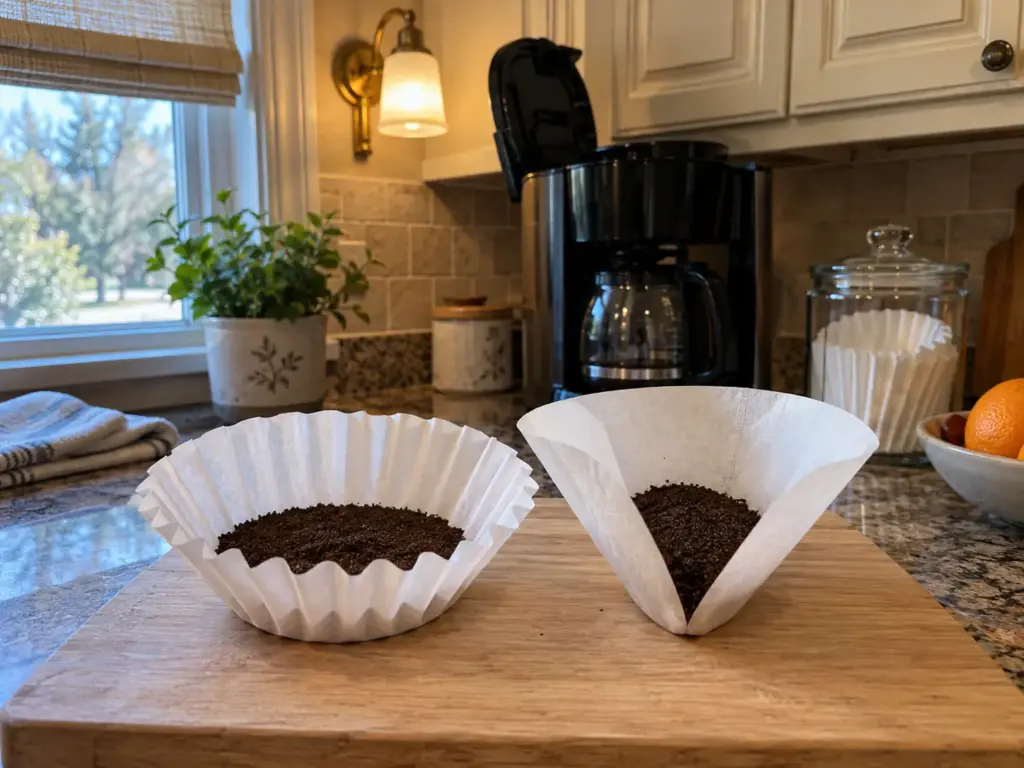
Flat-Bottom or Cone: What Changes in the Cup
With the grind held the same, 25 of the 45 tasters picked out the cup from the other basket, against the 15 that luck would give (p = 0.004). A trained panel then described the difference. With a light roast, the flat-bottom basket gave “more dried fruit, sweet, and floral flavor intensities,” while the cone filter basket leaned toward citrus, berry and sour; with a dark roast, the cone brought “much more intense bitterness.”
Same beans, same grind, same water, and the shape alone moved the cup: a cone leans sour on a light roast and bitter on a dark one. Know which basket your machine has before you read the pot, because part of what you taste may be the basket’s lean rather than the grind.
What sits inside the brew basket counts too. A paper filter holds back the finest particles and most of the oil, while a permanent metal mesh filter lets some of both through, so a grind that runs a little fine shows up in a mesh or gold-tone filter as silt and sediment in the last sip. With a permanent filter, stay at medium rather than creeping finer, and read grit at the bottom of the cup as a coarser-step signal.
Some brand guides go further and tell you to grind coarser for a flat-bottom basket than for a cone. The study brewed both grinds in both baskets and found flavor differences by basket, not a grind rule, so let your own pot make that call. A percolator’s basket is where the answer really does change: it cycles hot water through the same grounds again and again, and it wants a coarser grind than any drip machine.
Two Cups or a Full Carafe
A full carafe of water over a full basket makes a deep bed of coffee; two cups over a few spoonfuls make a shallow bed. On most machines the showerhead pours at about the same rate either way, so the shallow bed drains quickly and the water spends less time with each grain. On a large machine, a two-cup brew at the setting that made the full pot right tends to finish fast and taste thin.
On an OXO machine, the small-batch attachment can work at pour-over settings, while full and half carafes run a bit coarser. That is an impression, and no lab has measured it. The mechanism behind it holds, though: the fix for a thin two-cup pot is one step finer for that batch only, not a new bag.
Dose the small pot the way you dose the big one, which at the SCA’s ratio comes to about 16 g of coffee for 10 oz of water. Take it all the way down to one cup and you reach the grind for a reusable K-Cup, the single-serve end of the same medium question.
Keep two numbers, not one. When the full pot tastes right, write its setting on a strip of masking tape stuck to the grinder, and the first time you brew two cups, start one step finer and add that number underneath. Switching batch sizes stops being a new experiment every weekend.
Machines That Adjust for the Batch Themselves
Most machines leave the batch-size correction to you, and one step finer for small pots costs nothing. The Technivorm Moccamaster KBGV Select builds it into the brewer: a half/full carafe switch that, per the maker’s listing, makes “brewing speed and hotplate temperature adjust according to your choice,” with 40 oz brewed in four to six minutes. It also costs several times what an ordinary drip machine does, and the price buys no immunity, since some units stop working within months. Its certification claim rests on the maker’s listing as well, because the SCA’s own certified list did not show it when checked.
It is said to use more grounds than traditional drip makers, which may say more about how thin a scoop-measured pot usually runs than about the machine. The grams-per-liter arithmetic further down shows why.
Read the Pot to Know Which Way to Move
A pour-over lets you watch the water drain, but a drip machine hides it under a lid. What you get instead is the finished pot, the time it took, and the taste in the cup, and each of those points one way or the other.
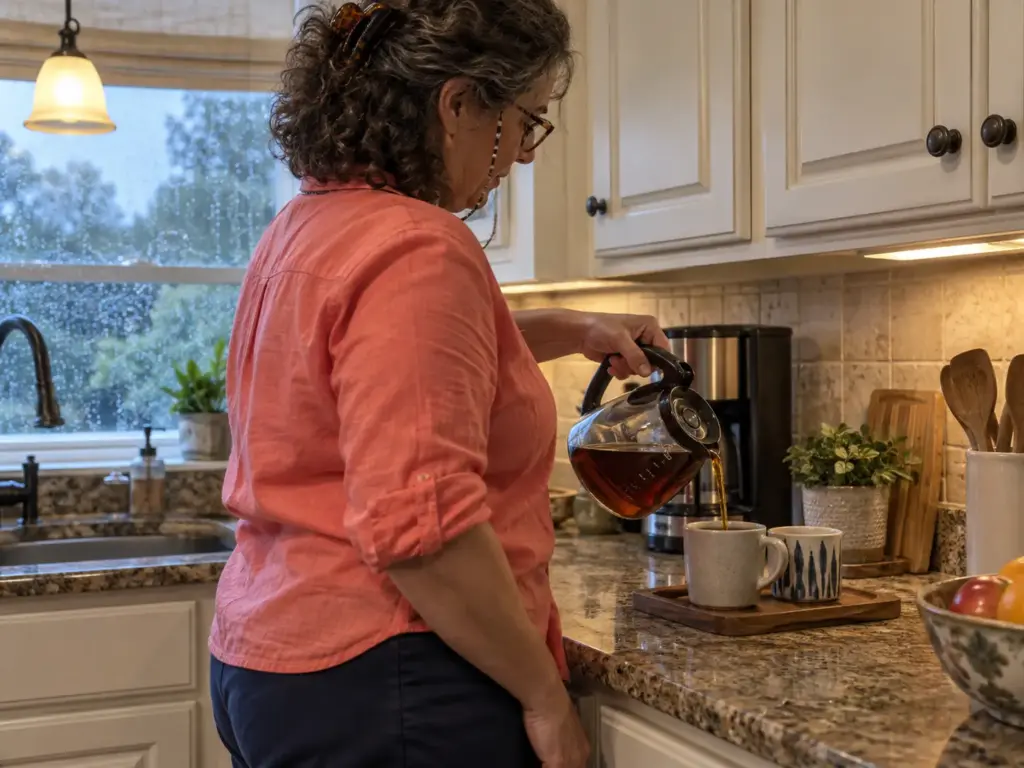
Sour, Thin or Hollow Means One Step Finer
Start with the direction. The SCA Golden Cup Standard, as Roastopedia summarizes it, puts good extraction at 18 to 22 percent of the coffee’s weight dissolved into the pot, and below 18 the cup reads “sour, sharp, or thin-bodied.” Grounds that are too coarse, or water that runs through too fast, leave it there.
A cup that tastes flat, hollow, with something missing calls for a finer grind. So move one step.
If it worked, the next pot tastes rounder and sweeter, and the sharp edge at the front of the sip softens. Overshoot, and a dry bitterness shows up at the back of the swallow; come back half a step if your grinder allows it.
A grind that is too fine can also taste hollow. If one step finer made the pot worse, you were already past the middle, so go the other way.
Bitter, Dry or Harsh Means One Step Coarser
Above 22 percent, Roastopedia’s summary turns to “bitter, dry, or astringent”: the water stayed long enough to pull out the harsh compounds that dissolve last. Too fine a grind is the usual cause of a bitter, muddy pot in a drip machine, because fine grounds slow the drain and stretch every second of contact.
A cup that tastes bitter and astringent calls for a coarser grind. One step coarser should take the drying grip off your tongue; overshoot and the sourness from the section above comes back.
Grinding finer for a stronger pot works for about one step. Past that, the extra extraction arrives as bitterness, the basket starts to back up, and the pot is no stronger in the way you wanted. What makes a drip pot stronger is more coffee per liter, which is why which grind makes the strongest pot turns out to be a question about the ratio.
If the bitterness shows up only in the second or third cup, poured half an hour after the first, leave the grinder alone. That is the hot plate, and it has its own section below.
Time the Brew Against the Four-to-Six-Minute Lane
A drip machine’s drawdown is its total brew time. The SCA’s Protocols and Best Practices pairs the drip grind with four to six minutes of contact between water and coffee, Moccamaster lists its 40 oz pot at four to six minutes, and a full eight-cup pot on an OXO Brew takes a similar time. Start your phone’s stopwatch when the first water hits the grounds and stop it when the basket stops dripping.
A full pot that finishes well under four minutes is running through, so the grind is likely too coarse and a step finer comes first. One that drags well past six is choking, so go a step coarser. Roastopedia notes that brew times over eight minutes fail a brewer outright in SCA equipment certification, so a pot past eight has a problem the grinder may not fix alone.
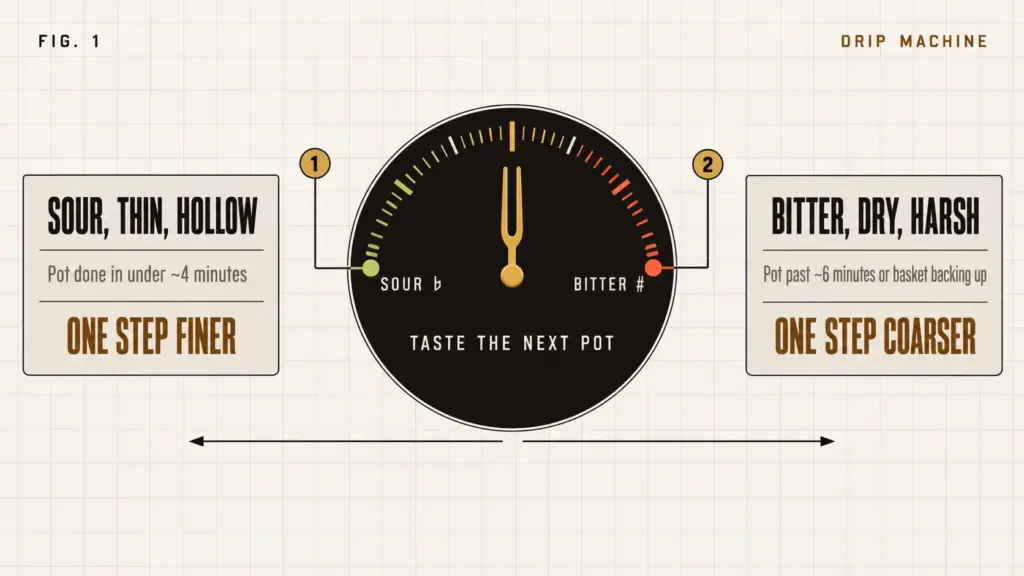
The clock only reads a full pot. Small batches finish faster by design, so hold them to the taste.
The basket can also tell you. KitchenAid’s help page puts it plainly: “Grounds that are too fine can clog the filter and lead to an overflow.” A basket overflow that leaves grounds high on the sides of the paper is a coarser-step signal, unless it overflows on a coarse setting too, in which case look at the fill, the filter seating and the basket itself. The opposite end is quieter: a grind that is too coarse lets the water run through without saturating the bed, and all it leaves behind is the thin, fast pot from the section above.
One Change, Then Taste the Next Pot
Keep everything else still: same dose, same water, same batch size, and move the grinder one step. Brew, taste, decide. If you change the dose and the grind together and the pot improves, you have no way of knowing which one did it.
Judge the second pot after a change, not the first. A grinder holds some grounds inside its chute, so the first dose after a new setting still comes out partly at the old one, and a pot brewed with it tells you about two settings at once. Once a pot is right, write the grinder setting down.
Swirl the carafe before you pour the cup you are going to judge. The first coffee to drip through is the most concentrated and the last is the weakest, and they don’t always mix on their own; a cup poured off the top of an unswirled pot can send you a step in the wrong direction.
When the Pot Is Off and It Isn’t the Grind
Before another click on the grinder, rule out the things that cost nothing and move the pot further than a step of grind can. They come below free and likeliest first, and each one gets a pot of its own.
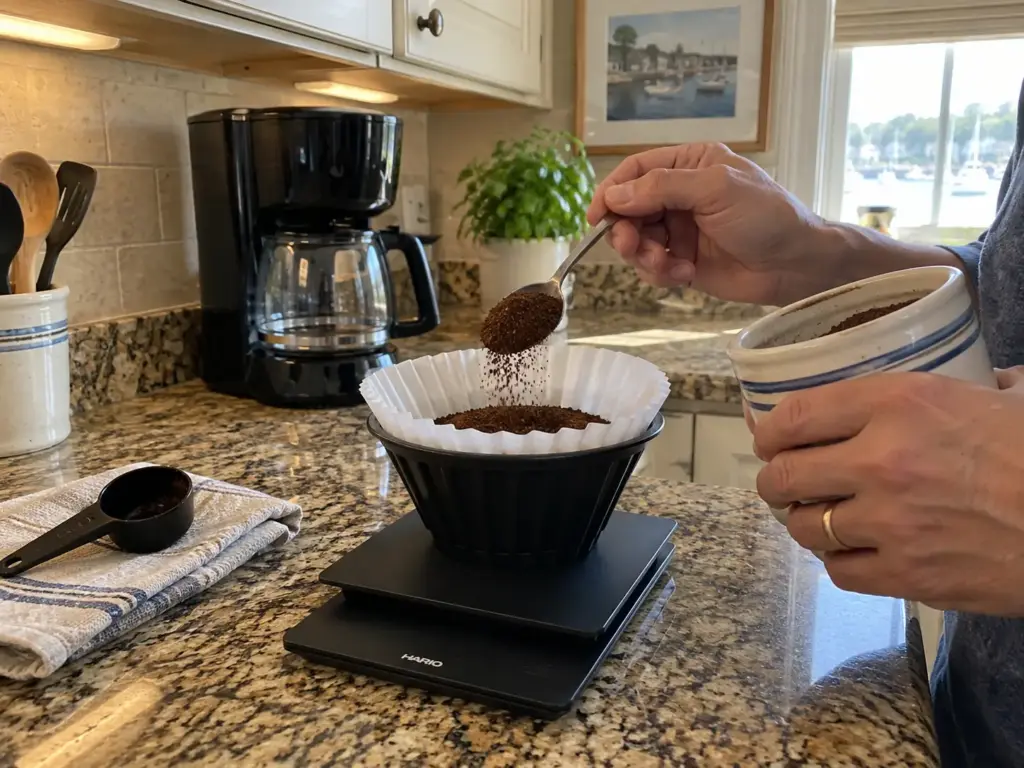
Scoops Instead of Grams
The SCA’s ratio is “55 g/L ± 10%,” which means about 50 to 60 grams of coffee per liter of water. The catch is the word cup: on a drip machine it means a 5 oz cup, give or take, as Cuisinart’s listing states, and an 8-cup pot can turn out to be eight five-ounce servings. A 12-cup machine brews about 60 oz, not twelve mugs.
At the pot sizes a drip machine actually brews, the SCA band works out like this:
- 10 oz (two small cups, about 0.3 L): about 16 g of coffee, 15 to 18 g inside the band
- 40 oz (an 8-cup OXO or a 10-cup Moccamaster, about 1.2 L): about 65 g, 59 to 72 g inside the band
- 60 oz (a 12-cup machine, about 1.8 L): about 97 g, 88 to 107 g inside the band
A standard coffee scoop is two level tablespoons, which is a volume, and the grams inside it change with the grind and with how level you fill it. If your scoop holds about 10 g, a 40-oz pot wants six or seven of them; if it holds 7 g, it wants nine. Run the same arithmetic from the bag’s side and you get how many pots a bag actually makes.
The number itself depends on the pot you like. Counter Culture recommends 20 g of coffee to 320 g of water per cup, a 1:16 ratio that works out to about 62 g per liter, just above the top of the SCA band. If your pot tastes weak but not sour, thin without the sharp edge, move the dose toward 60 g per liter before you touch the grind: sourness is the grind’s job, and a watery pot is often the ratio’s.
A kitchen scale turns 55 g per liter into a number instead of a guess, and any scale you already own with 1 g steps is enough for a drip pot. If you are buying one, the Hario Drip Scale Timer reads in 0.1 g steps and has a timer built in, which puts the dose and the brew clock on one display. The auto-off is the sore point: of the reviews that mention it, 44 of 75 complain, and some say it turns off too soon, so weigh the dose on it and time a six-minute pot on your phone (the scale will not wait that long).
Weigh your scoop once, filled with your own coffee at your own grind, and write the grams on the lid of the canister. A level scoop of fine pre-ground and one of coarser fresh grounds do not weigh the same, and across six or seven scoops that difference can carry a 40-oz pot from one end of the SCA band to the other.
The Hot Plate and the Dirty Basket
A pot that tasted right when it finished and bitter half an hour later was the same brew; only the plate under it changed. Counter Culture puts the mechanism this way: the hot plate‘s “steady heat after brewing accelerates chemical reactions that make your coffee taste bitter.” Even a premium brewer’s plate runs at 175 to 185 °F (79 to 85 °C) on Moccamaster’s own spec, so this is not a cheap-machine problem. Brew only what you will drink soon, or pour the rest into a preheated thermos, and taste a fresh cup before you blame the grind for that stewed, burnt edge.
The basket is the next free check. Old coffee oil and fines build up on the basket and around its outlet and slow the flow, which stretches the brew and pushes the pot toward bitter, and KitchenAid lists clogs among the causes of an overflowing basket. Wash the basket and the carafe in hot soapy water before you judge a new grind setting, or you are tasting last week along with today.
Water That Never Gets Hot Enough
The SCA wants the water at 200 °F ± 5 °F (93 °C ± 3 °C) where it meets the coffee. Counter Culture says many machines start spraying “at around 185˚F” (85 °C), and a machine that never climbs out of that range makes a sour, thin pot at any grind: a finer step only adds bitterness to the sourness. The tell is a pot that stays sour after two finer steps and a full dose.
And this is the one suspect that costs money, which is why it comes last. The SCA’s list of certified home brewers shows which machines were tested against the brewing standard, so you can check whether yours is an SCA certified brewer before you replace anything.
The OXO Brew 8-Cup Coffee Maker with Thermal Carafe is on that list, certified in 2025, and its listing puts the water at the grounds at 194 to 205 °F (90 to 96 °C). Its stainless thermal carafe also takes the hot plate out of the picture, and its cups are the 5 oz kind, so the 8-cup pot is 40 oz.
The complaints are about water ending up in the wrong place and heat leaving too soon. Of the reviews that mention leaking, 286 of 335 are negative, and of those about heat retention, 289 of 551 are unhappy, with carafes that do not keep coffee hot a common complaint. A lukewarm cup tastes sharper than a hot one, so a carafe that loses heat gets the grind blamed for a sour pot it did not make.
The Moccamaster from the batch section is the first name most people give for a better drip machine. But its KBGV Select pours into a glass carafe that sits on a plate, so for a pot that turns bitter while it waits, the OXO’s thermal carafe answers the problem and the Moccamaster does not.
The Grinder Side: Burr, Blade or Pre-Ground
Everything above assumes your grinder can hold one step and repeat it tomorrow. Whether it can depends on what does the grinding, and a pre-ground bag leaves you only the dose.
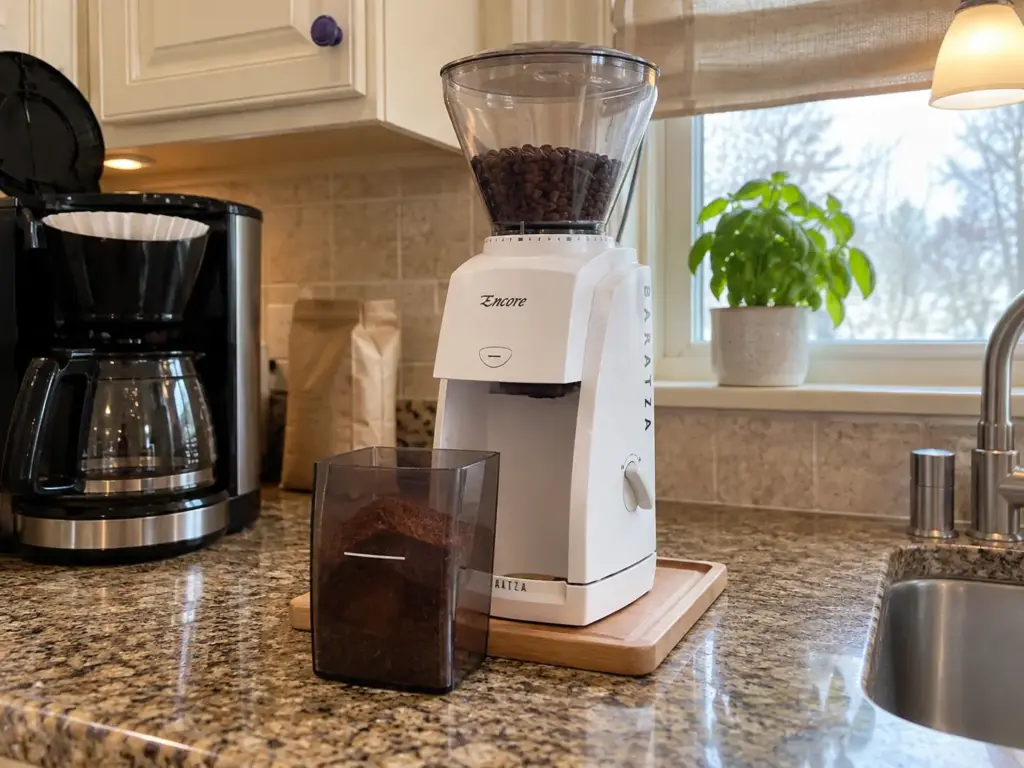
Why a Blade Grinder Can’t Hold Medium
A blade grinder doesn’t grind to a size; it chops until you let go of the button, and the same load ends up uneven, boulders and dust together. The dust over-extracts and turns bitter, the boulders under-extract and stay sour, and the pot tastes of both, which is why a blade grinder makes a pot bitter and sour at once. With grind consistency that poor there is no medium to step from, because every pulse widens the spread in both directions.
Some blade owners count seconds instead. Timing is one way people dial it in: too fast tends to taste watery and too slow tends to taste bitter. That holds for one grinder and one dose, and it breaks the day you grind for a bigger pot, because more beans in the cup take longer to come down to the same size. If you are keeping the blade grinder for now, how long to run a blade grinder is the place to start.
Pre-Ground Coffee Leaves You the Dose
With pre-ground coffee the grind is fixed at whatever the roaster chose, so the pot still points a direction you can’t follow with a grinder. Moccamaster says supermarket pre-ground usually comes out too fine for its brewer, and its advice if you keep buying it is to “experiment with using less coffee.” A smaller dose makes a shallower bed that drains faster, which is the nearest a fixed grind gets to a coarser step.
So a bitter pot, or a basket that backs up, means taking a few grams out; a pot that is thin but not sour means adding grams up to the top of the SCA band. A sour one points at the water temperature before anything else. If you buy from a roaster, ask them to grind the bag for a drip or pour-over brewer instead of taking the default.
The bigger trade-off is freshness, since ground coffee goes stale faster than whole beans, and that is half the case for whether grinding your own is worth it.
Finding Your Own Number on a Burr Grinder
A click is not a micron. Counter Culture’s six on a one-to-ten scale and an 18 on a Baratza Encore for a V60 are starting guesses for their own grinders, and they don’t carry over to yours. The method does: start where the grounds feel like sand, brew a full pot at a weighed dose, read it by the rules above, move one step, and write the number down. The coffee maker grind size you end up with belongs to your grinder and your machine together, which is why a friend’s number rarely works on your counter.
Once you dial in a number, what number your grinder should be on is the next question, with the dial numbers of the common home grinders side by side.
If you are stepping up from a blade, the Cuisinart DBM-8P1 is the cheapest burr grinder here: 18 positions and a cups dial that grinds for the size of pot you set. It is also loud and not built to last in many kitchens, with 2,961 of the 3,544 reviews that mention noise negative, and some units stop working early even with light use. The budget end has its own comparison in cheap burr grinders that stay even.
The OXO Brew Conical Burr Grinder adds what the direction rule wants most: 15 main settings with micro-adjustments between them, on 40 mm stainless conical burrs, and it remembers where you left it. Durability is where its reviews turn, with 715 of the 970 that mention it negative and “Broke after 6 months” as the kind of line that repeats.
The Baratza Encore is the grinder most drip owners get told to buy: 40 settings on 40 mm conical burrs, with room to move one step at a time around medium. It is noisy (721 of 1,198 noise mentions are negative, and it can be loud in the morning and a little messy), and static turns grounds clinging to the catch bin into a daily chore. Its reviews sit at both ends of its life, with some units lasting well and others failing within months.
Tap the bin on the counter before you tip it in: grounds stuck to it stay behind, and the pot comes out weaker than the dose you weighed. The full comparison, including what wears out first, is in the grinders worth buying for home.
Month Two: When Last Month’s Setting Stops Working
A setting that made a good pot in the first week can drift without anyone touching the dial. The beans, the machine and the grinder all change underneath it, so the check is the same pot, timed and tasted again.
A New Bag Moves the Setting
A new bag is the most common reason. A lighter roast level, a different origin, or beans much fresher or older than the last bag can each want a different step, and the pot tells you which way by the same rules as before. Brew the new bag once at your old number before you move anything, and see why a lighter roast needs a finer grind for the reasons behind the shift.
Scale Inside the Machine Slows and Cools the Brew
Minerals from tap water coat the heater and the lines inside the machine, and two things follow from that scale buildup: the water moves more slowly, and it leaves the showerhead cooler. The first sign is usually the clock, not the taste. The same full pot takes a minute or two longer before it tastes any different, and by the time it goes flat or sour, the brew time has crept past six minutes.
Descale on the interval your machine’s manual gives, with the method the manual gives. Counter Culture’s fallback for daily use is “every three months,” and hard water shortens that. A cleaning light is a reminder, not a gauge: on an OXO Brew the light can keep blinking even after a clean cycle, so trust the timer over the light.
Burrs, Fines and a Grinder That Needs Cleaning
Grinders keep a little of every batch. Fines and old oil collect around the burrs and in the chute, where they flavor the next pot and slowly change how the grounds come out, and sometimes they do more than that: the grinder can stop until it is cleaned, then run again. A brush and a few minutes with the hopper off keep that residue from building up.
When you land on the setting that makes a good pot, grind one extra spoonful into a small clear jar and keep it next to the grinder. It goes stale for drinking but not for looking: a few weeks on, grind a fresh spoonful at the same number and set the two side by side, and if the new one looks dustier or chunkier, the grinder has moved, not the beans.
Burrs also wear. If a clean grinder starts making a pot that is bitter and sour at once, the way a blade grinder does, and the grounds look dustier at your usual number, check when the burrs themselves are worn. How fast that happens depends on the grinder and how much you put through it, so go by the pot and the grounds rather than the calendar.
Start at Sand and Let the Pot Pick the Direction
Start at medium, grounds about the feel of sand, and don’t agonize over medium versus medium-coarse: a step inside that band is hard to taste, while your basket and your batch size are not. Let the pot choose the direction, one step finer for sour, thin or fast and one step coarser for bitter, dry or slow, with a full pot of its own for every change. Before you blame the grinder, rule out the ratio, the hot plate, the dirty basket and the water temperature, in that order.
A month from now, time a full pot again, and if it has crept past six minutes with nothing else changed, the machine needs descaling and the grinder was never the problem.
Tomorrow, weigh the dose for the pot you actually brew, swirl the carafe, and taste a cup. That cup decides the one step: finer if it is sharp, coarser if it is harsh. Brew the next pot, taste again, and it should come out sweeter than this one. When the setting holds, the grinder-settings page linked above has the dial numbers, and the ratio and a machine that gets its water hot enough are the two questions waiting after that.
Frequently Asked Questions
01What grind size is best for drip coffee?
Medium, with grounds about the texture of sand, is the right starting point for most automatic drip coffee makers, whatever the bag or the grinder dial says. Then the pot decides: one step finer if it tastes sour or thin, one step coarser if it tastes bitter.
02Is drip coffee grind the same as pour-over grind?
Close enough to start from the same place, since both sit around a medium grind with the texture of sand on most home grinders. The difference is that a drip machine sets its own pour, so the finished pot and its brew time, not a drawdown you watch, tell you which way to move.
03What is the golden ratio for drip coffee?
The SCA standard is 55 grams of coffee per liter of water, give or take 10 percent, which is roughly 1 gram of coffee for every 18 grams of water. For a 40-ounce pot that comes to about 65 grams, so weigh it: a scoop is a volume, not a weight.
04What grind gives you the strongest coffee in a drip machine?
Not the finest one: more coffee per liter of water makes a drip pot stronger, while a finer grind soon turns it bitter or backs up the basket. Raise the dose toward the top of the SCA range, about 60 grams per liter, before you touch the grinder.
05Why does my drip coffee maker overflow?
Grounds that are too fine can clog the paper filter and back the basket up, so move one step coarser first and brew the same dose again. If it still overflows on the coarser setting, check how the filter sits, the basket itself and the water fill line instead.

How did your cup turn out?
No comments yet. Tell us what you changed — and whether the needle moved.