
We may earn a commission when you buy through links on this page. It never changes what we recommend. How we pick
On this page8 parts
- Coffee Grind Size for Cold Brew Depends on What Strains It
- Why Cold Brew Wants a Coarser Grind Than Hot Coffee
- Reading the Batch Before You Touch the Dial
- The Strainer and the Grind Are One Decision
- Pre-Ground, a Blade Grinder or a Cheap Burr's Coarse End
- When a Flat Batch Is Not the Grind
- Coarse for Your Strainer, One Notch a Batch
- Frequently Asked Questions
You tip the jar into the strainer after a full day of steeping, and one of two things happens: the last inch slides out as muddy brown sludge, or the whole batch pours pale and tastes more like weak tea than coffee. Both are questions about coffee grind size for cold brew, and they point in opposite directions. Cold water pulls flavor out of ground coffee slowly, but a batch gives it twelve hours or more, so even a coarse grind has time to finish; what the grind mostly decides is how much powder rides into your glass and how long the strain takes.
A thin 22-hour cold brew can have three different culprits, and no order to check them in. Below you will find the range for the strainer you own, why coarse works, how to read a batch before you move the dial, the free fixes at the strain, the gear already in your kitchen, and the flat batches no grinder caused.
Quick Answer
Coarse, about the size of coarse sea salt or raw sugar, at or just past your grinder’s French press setting. Paper or a fine-mesh basket can take a notch or two finer. Gritty, cloudy or bitter means go coarser; watery means check the ratio and hours first, then go finer. Move one notch per batch, nothing else.
Coffee Grind Size for Cold Brew Depends on What Strains It
Coarse, roughly the size of coarse sea salt, and on most grinders that lands at or just past the French press setting. That is the answer, and it is also where the agreement ends. The companies that make cold brew gear print different words for how coarse, and the difference traces back to whatever holds the grounds back when you pour.
The Range Most Batches Land In
Start from the French press setting on your own grinder, because it is the one mark most cold brew instructions lean on. Starbucks’ home recipe asks for coarse ground coffee and nothing more precise. Ratio Coffee goes toward the big end: extra coarse, the feel of raw sugar or coarse breadcrumbs, and a touch coarser for a concentrate than for a ready-to-drink batch. Counter Culture Coffee sits at the other side of the range with medium-coarse, “a seven or so” (call it 7 out of 10 on its scale), and says that going as coarse as the grinder allows is “really not necessary”.
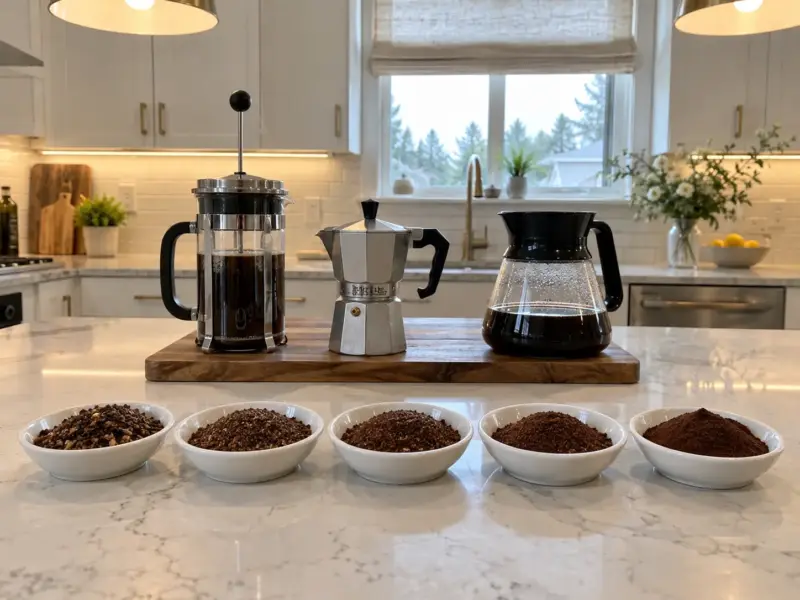
Line them up and the working band runs from coarse sea salt to raw sugar, the same texture words the full grind size chart uses for its coarse end.
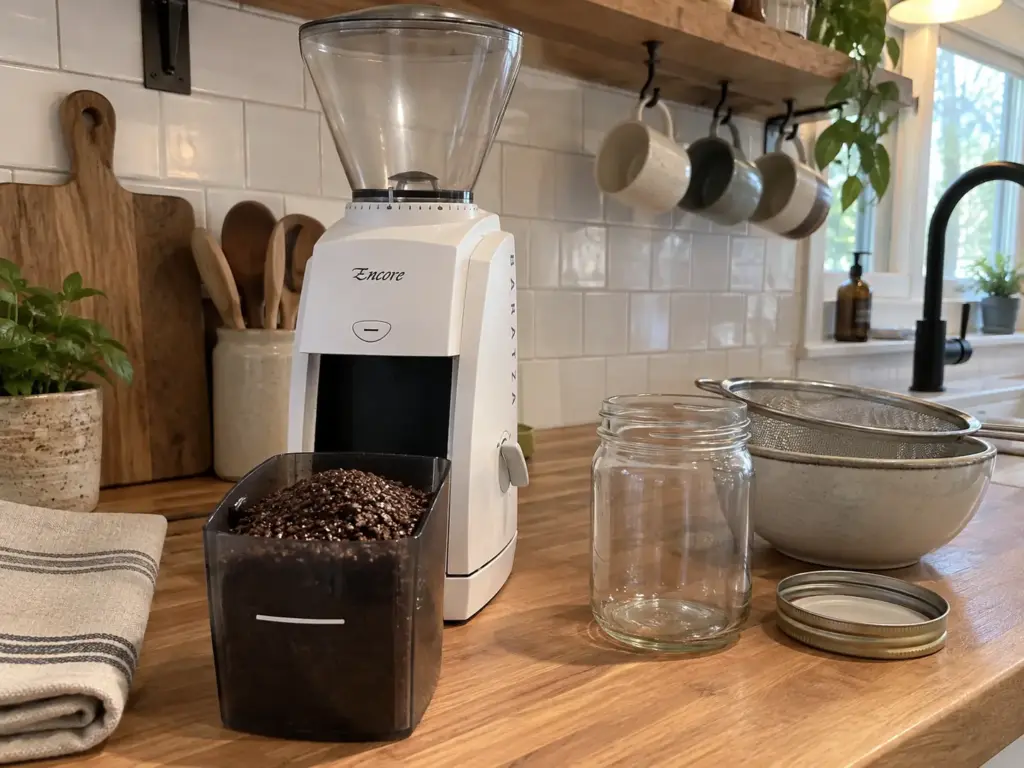
A numbered dial makes the spread concrete. The Baratza Encore has 40 mm conical steel burrs and 40 steps, 1 the finest and 40 the coarsest, and Baratza prints 28 as its French press starting point, with twelve coarser clicks still above it. The Amazon listing says the dial runs “from espresso fine to cold brew coarse”, yet the manual has no cold brew row at all, and it treats every number it does print as a place to begin, since the right setting “can only be found through experimentation.”
Owners bear that out. Cold brew grinds run coarse, and buyers often mention some inconsistencies in the grounds at that coarser end of a home grinder. Ten clicks apart, both making cold brew, which is why what number your grinder should be on is a question about your machine rather than about a number anyone can print for you.
The very last click deserves some suspicion. Keeping the dial a few clicks away from the coarsest setting is common, and for good reason: the coarse end of a home grinder is where the grounds tend to come out least even. That makes the end of the dial a poor default. A known grinder setting a little short of the end is the better start, because you can repeat it and count from it.
Before the first batch, grind a teaspoon at your French press number and a teaspoon three clicks coarser, and tip both onto a white plate. The pile with less brown powder dusting the plate around the big pieces is your starting setting. Write that number down, because every change after it is counted in clicks from there.
Felt, Fine Mesh, a Press or Paper
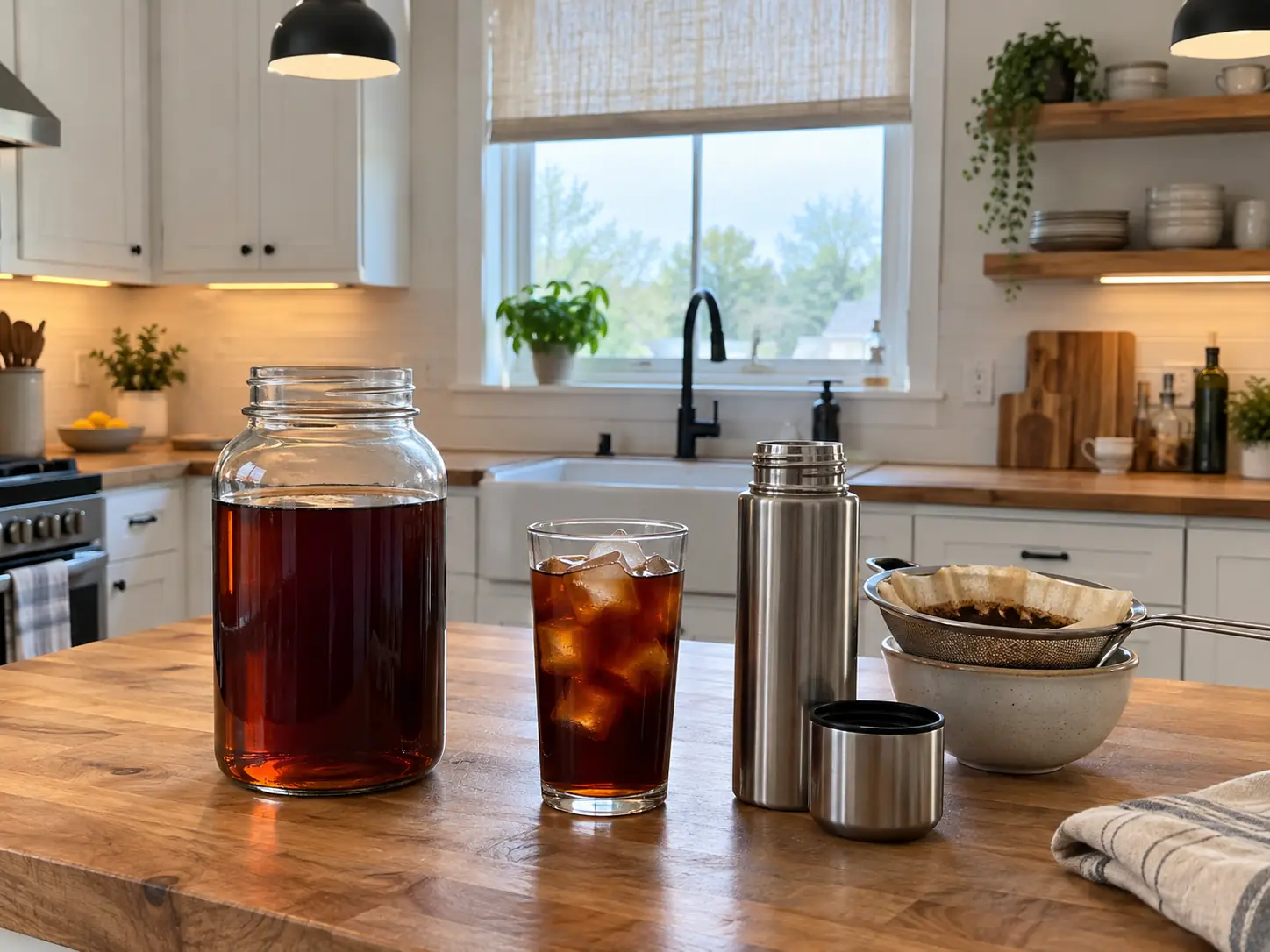
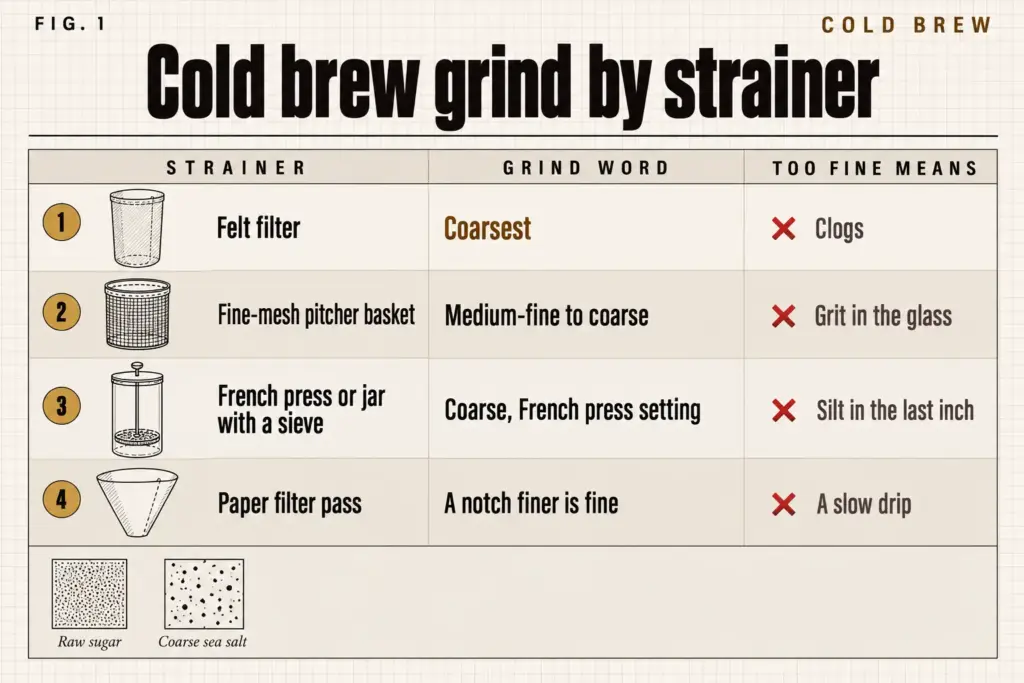
The Toddy Cold Brew System sits at the coarse extreme. Its instructions put it flatly: “Use the coarsest grind setting for best results.” They also tell anyone buying beans at a shop to ask for a French press grind. The reason is its felt filter: fine grounds pack into the felt and the drain stalls, and the maker’s own answer for a batch that will not drain is a coarser grind.
That felt is also a consumable, good for up to ten uses and thrown out after three months, so a too-fine grind wears down the one part you have to keep replacing.
The manual for the Hario Mizudashi cold brew pot, which strains through a fine mesh, says nearly the opposite: use medium-fine grounds, because a coarse grind lowers the extraction and gives a weak brew, while a fine one slips “through the strainer making the coffee grainy”. Hario’s own US product page softens that into a choice, coarser for a lighter cup and finer for a stronger one. A French press, or a mason jar poured through a kitchen sieve, sits between the two. Paper can go a notch finer than any of them, since it catches what a mesh lets through (at the price of a slower drip).
Put the makers side by side and each one is describing its own strainer. Felt clogs, so its maker says coarsest. A fine mesh holds a finer grind and leaks a powdery one, so its maker says medium-fine. A press screen has wider gaps than either and wants the French press setting.
Read the grind word on a box as a word about that box’s filter.
Why There Is No Single Number
According to a 2023 paper in Foods on cold brew conditions, “While the brewing practices for hot brew have been established, those for cold brew remain unclear due to a lack of scientific literature”. There is no cold brew standard to settle it. The target most coffee people know, the Specialty Coffee Association’s Golden Cup range of 18 to 22 percent extraction, was built for hot brewing, and none of the SCA’s published standards covers cold brew as of this writing. Cold Bruer, a company that makes slow-drip cold brewers, says the same from its own bench: accepted standards for cold brew barely exist yet.
So the setting gets settled against three things you can check at your own counter: the strainer, the hours and what ends up in the glass. The rest of this article works through them in that order.
Why Cold Brew Wants a Coarser Grind Than Hot Coffee
Every one of those ranges sits on the coarse side of a hot pour-over, and time is the reason. Cold extraction is slow extraction, but it gets twelve hours or more to work, so the grind is chosen for what it leaves in the jar rather than for speed.
A Night Does What a Fine Grind Does in Minutes
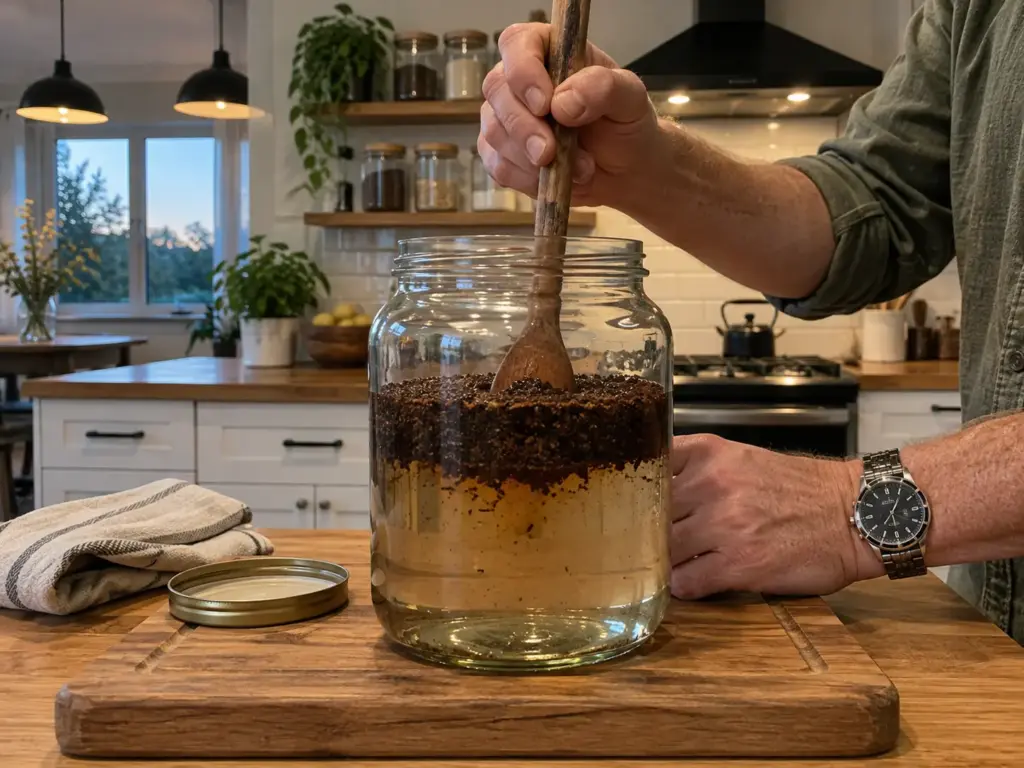
A 2023 study in Applied Food Research steeped five grind sizes of one coffee in room-temperature water and put the pattern plainly: “The extraction rate had an inverse relationship with the ground particle size.” The numbers show how lopsided the start is. After five minutes, the very fine grind had already given up 93 percent of what it would give by the end, while the very coarse grind stood at 61 percent. By the one-hour mark, both extremes were above 90 percent.
And after 18 hours the difference in total yield was small: 18.6 percent for the very coarse grind against 20.0 percent for the very fine, 1.4 points across the whole range of that grinder. The study has limits worth keeping in view. The water sat at 73°F (23°C), the ratio was 1 part coffee to 3 parts water (far stronger than anything you would drink), the brew was paper-filtered, and it used a single Colombian medium roast.
Within those limits, the reading is clear. A finer grind exposes more surface area, so it extracts faster, but a notch on the dial mostly changes how fast a cold steep gets where it is going, not whether it gets there, and a twelve-hour batch gives even a coarse grind the time. It is the cold version of what grind size changes in the cup with a hot brew, stretched across a night.
What the Fines Do Over a Whole Night
If a notch barely moves where extraction ends, what it does move is the fines: the powdery fragments every grinder sheds, more of them the finer you set it. Fines are what gets past the strainer, clouds the glass, packs into paper and settles as silt. Ratio Coffee’s list of too-fine symptoms reads like fines at work: a gritty bottom to the jar, a bitter and cloudy cup, and filters that clog and slow the strain.
Cold Bruer caught the taste side in a blind tasting of three grinds brewed in its slow-drip maker: the espresso-fine batch came out over-extracted, “harsh and bitter” in the maker’s words, while the drip grind held a dark chocolate sweetness the longest. That was a drip brewer and one coffee, so it is a direction rather than a spec. Straining shows the same thing faster. Paper filters clog on a coarse batch, because the fine stuff blocks the paper, and a liter can take a long time to get through.
A jar that looks clear on top can hide the grind’s whole story at the bottom. Pour carefully and the last inch holds most of the batch’s fines, and the thickness of that layer tells you more about your setting than the first glass does.
What “Coarse” Means in the Lab
The word has a measurable meaning. In a 2017 Scientific Reports study of cold brew extraction, the coarse grind had more than 70 percent of its mass sitting on the 841-micron (#20) sieve, the same line the grind size chart uses for coarse. The same study found grind size made no significant difference to the concentrations of caffeine and chlorogenic acid in the finished brew, and both compounds leveled off in six to seven hours, well inside a 12-to-24-hour steep.
That finding covers those two compounds only. The researchers did not taste the coffee or measure silt, so it cannot tell you the grind is irrelevant to the cup.
Two more numbers put the lab’s coarse on your dial. The coarsest setting in the Applied Food Research study averaged 1,057 microns, which is French press territory, not the last click of a grinder. The Foods paper found mesh size among the factors that moved strength, with its strongest brew on the finest fraction, but it sieved its grounds to 0.71 mm and smaller, finer than any French press grind. It supports finer-extracts-more; it says nothing in favor of coarsest-is-best.
So in cold brew the grind’s job is mostly clarity and how the strain behaves, while strength comes from the ratio and the hours (both get their own section below). If you have no sieve, how to tell fine, medium and coarse apart by pinch and by eye gets you close enough.
Reading the Batch Before You Touch the Dial
Knowing why coarse works does not tell you which way this particular jar is off, and cold brew hands you its verdict a day late. So read the batch closely before changing anything, then change one thing.
Gritty, Cloudy, Bitter or Slow to Strain
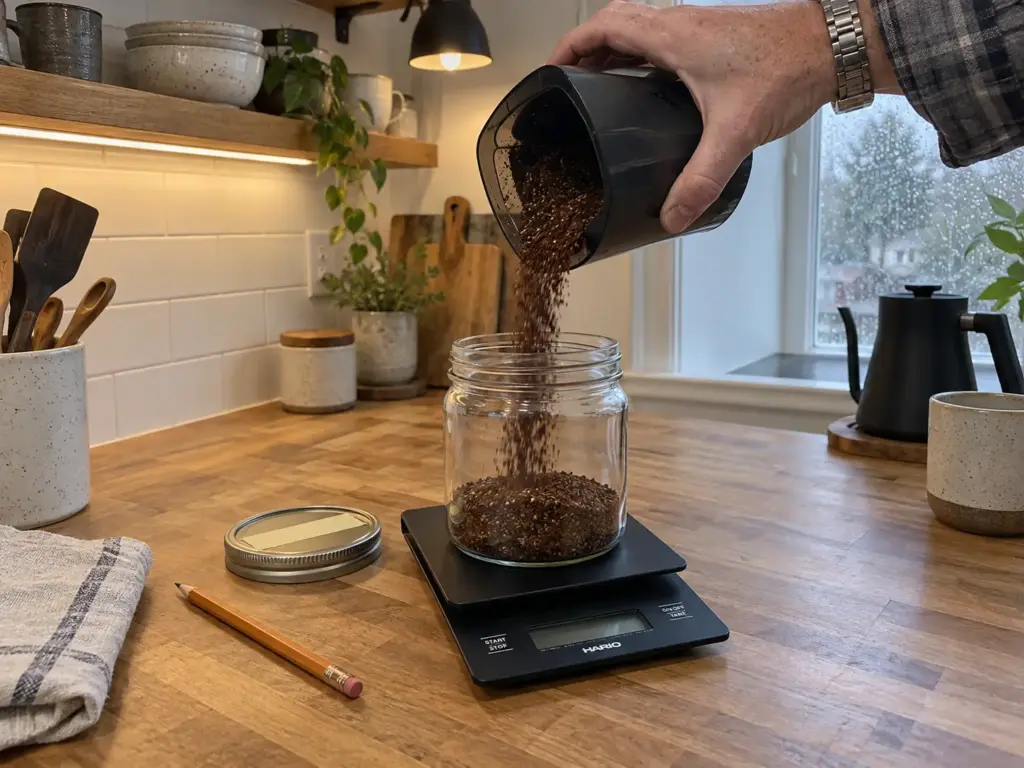
These symptoms all point one way: too fine for your strainer. Grit on the tongue, a haze that will not settle, a bitter edge and a strain that crawls are fines doing what fines do, and Cold Bruer’s rule for its own brewers says the same thing, move coarser when the brew tastes bitter. Go one notch coarser. Actually, look at where the grit sits before you touch anything: if it lives only in the last inch of the jar, the strain can fix it for free, and that comes in the next section.
When the grit is spread through the whole batch, the dial is the right move. Change the grind by one notch and nothing else. If it worked, the next batch pours clearer, the sludge at the bottom is thinner and the strain runs faster. If you went too far, the cup turns thin and pale, and the following batch goes back one notch.
Watery, Pale or Thin
This direction means under-extracted, and it is where the grinder gets blamed too early. Check the ratio, the hours and the age of the bag first (the section on flat batches, further down, goes through each), and only if all three held should you move one notch finer. Cold Bruer gives the same direction for a weak, watery brew.
Counter Culture’s reason for grinding “slightly finer” than tradition is this exact batch: a grind so coarse it never pulls out enough of the sugars leaves cold brew sour. It is the same sour-means-finer rule a drip machine follows, with a day between tries instead of five minutes.
This is why the order matters. A thin batch brewed at 1 part coffee to 15 of water, in a cloth bag, for 22 hours in the fridge, with a grind about like supermarket pre-ground, can come out under extracted. Three suspects come up in order: the grind, the bag holding the grounds away from the water, and the ratio.
Any of them might be right. Changing all three at once would fix the batch without telling you which one did.
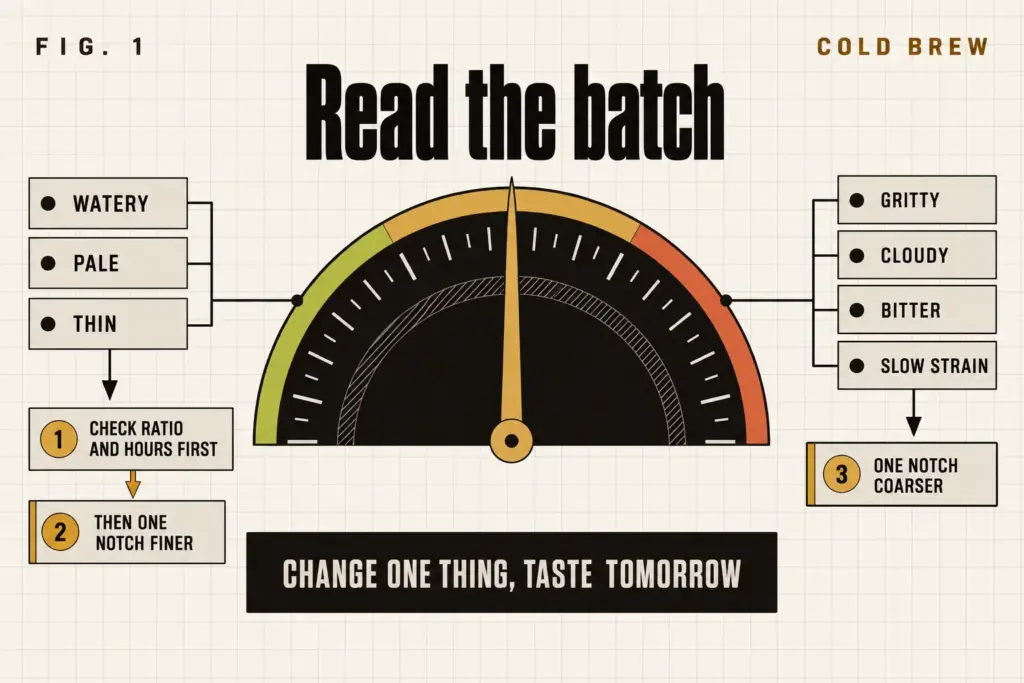
One Notch per Batch, Everything Else Held
A batch is a day, so two changes at once cost two days and teach you nothing. The advice for a beginner is not to change more than one variable at a time, and in cold brew that rule has teeth. The loop looks like this:
- Weigh the coffee and the water, both of them.
- Write down the grind setting, the grams, the hours, and whether the jar sat in the fridge or on the counter.
- Taste the finished batch and name its direction: gritty and bitter, or thin and pale.
- Move the dial one notch that way, and hold everything else exactly where it was.
- Taste the next batch against your note, grit first, then strength.
Hours and grind are kept apart on purpose. Grind and time trade against each other, so a batch that changes both cannot tell you which one mattered. On the Encore, Baratza’s manual adds a mechanical rule for the dial itself: turn it only while the grinder is running or completely empty of beans, to avoid damaging it.
The dose is where most notch tests quietly fall apart. Starbucks’ own cold brew page prints four tablespoons of coarse grounds as 20 g in one line and 22 g in another, a 10 percent swing inside a single recipe, and a heaped scoop moves more than that. If there is a kitchen scale anywhere in the house, weigh your usual scoop once and you will know what it holds.
A dedicated coffee scale comes after that: the Hario Drip Scale Timer reads in 0.1 g steps and has a timer built in, which is more precision than a 118 g batch needs. Several owners on its listing report it broke within six months and it is slow to respond, so any scale that reads in 1 g steps past a few hundred grams will do this job just as well.
Put a strip of masking tape on the jar lid and write the grind setting, the grams and the hours on it before the water goes in. By the time you taste the batch tomorrow you will not remember which click you used, and the tape rides into the fridge with the jar instead of sitting in a notebook across the kitchen.
The Strainer and the Grind Are One Decision
Most batches that get called a wrong grind are really a grind that does not match its strainer. That is also the cheapest mismatch to fix, often without touching the grinder at all: start from the strainer you own, set the grind for it, and let the pour do the rest.
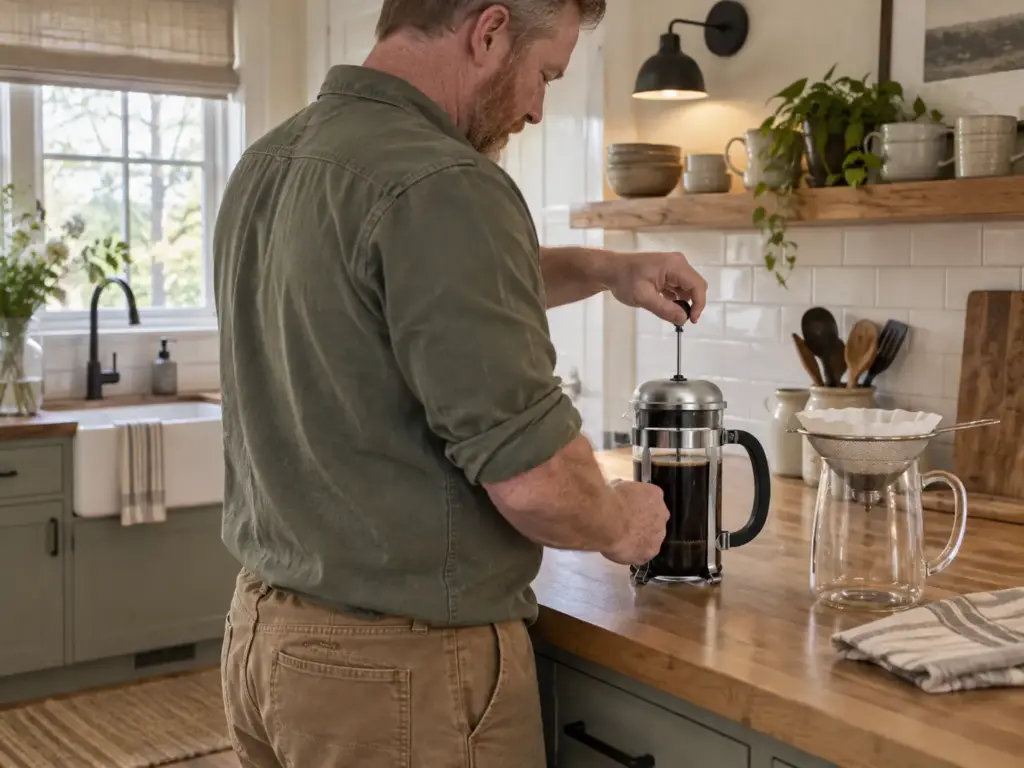
A Fine-Mesh Pitcher
A mesh basket needs a coarse grind to keep the glass clear. Ratio Coffee puts the failure in one line: “A fine grind in a coarse mesh filter leaks sediment into the final cup.” The mesh in a cold brew pitcher is finer than a French press screen, but it still has openings, and anything small enough to fit through them ends up at the bottom of the pitcher.
The Takeya Deluxe Cold Brew Coffee Maker is the familiar cold brew maker: a 2-quart Tritan pitcher with a fine-mesh basket attached to its airtight lid. Its owners are candid about where it falls short. The basket can come loose from the lid while shaking, and getting packed grounds out of it is a chore, while fine grounds can show up as sediment at the bottom. Start it at your French press setting, and if the bottom of the pitcher collects silt, go one notch coarser on the next batch.
A French Press as Brewer and Strainer
A French press does both jobs at once, and plenty of kitchens already have one. Use the same grind you would for a hot press, fill it with cold water, and let the plunger be the first strain the next day.
The Bodum Chambord French Press in the 34 oz (1 L) size is the classic shape: a borosilicate glass carafe in a stainless steel frame, with a metal filter, a steel mesh, on the plunger. The glass is the weak point, and the glass pot can be fragile. The mesh is the other catch, because it lets fines through, which is why the cold brew habit is a second pass through paper when a clear glass matters.
A French press on its own filters coarse grounds well enough for a drinker who does not mind a little haze. If silt keeps showing up batch after batch at a sensible setting, the grinder becomes the suspect, and a grinder that leaves less silt is where that question goes.
Paper, Cheesecloth and the Second Pass
Paper is the obvious pick for a clear glass, and it stops being obvious the moment a batch carries a lot of fines. It clears nearly everything, and fines are exactly what it chokes on. A liter that takes that long is the ordinary result of pouring a whole batch through one cone: the fines eventually block the pores in the filter paper, and it stops filtering. Starbucks’ home recipe offers a second paper filter as an optional last step, and the community version is double filtration, a mesh on the first pass for the grounds and paper on the second for the sediment.
Counter Culture frames the choice as texture. Paper gives more clarity; cheesecloth or a fiber filter lets more solids and oils through for more weight in the cup. Neither is wrong, and they are two different drinks from the same grind.
A paper filter that slows to a drip halfway through is not a bad filter. It is the fines packing into it. Lift it out, drop in a fresh one, and the rest of the pour moves again. Paper does let you run a notch finer without grit in the glass; what it charges for that is time, and the finer the grind, the more filters a batch eats.
Save the paper for the part of the batch that needs it. Pour the clear top through the mesh or the press screen first, then run only the cloudy last inch through a paper filter. The paper sees a fraction of the fines, so a single filter usually gets through the whole batch in minutes instead of clogging halfway.
The Last Inch in the Jar
The cheapest fix in cold brew costs about an inch of coffee. Pour off slowly, stop when the dark layer reaches the lip, and leave it behind. With fine pre-ground coffee, the routine is to pour carefully and either toss the last bit that has silt or pour through a standard coffee filter. Many people simply pour out the last inch of the bottle.
That puts the free fixes in order. Leave the last inch first. If the glass is still cloudy, run what is left through a paper filter. Only if both fail does the next batch go one notch coarser.
Pre-Ground, a Blade Grinder or a Cheap Burr’s Coarse End
Not every kitchen has a grinder with a coarse end worth trusting, and the standard answer from roasters, buy one, skips the kitchen most people actually have. Each of these set-ups can make a clean batch if the strain changes along with the grind.
Store Pre-Ground
Ratio Coffee’s verdict is that pre-ground coffee is “usually too fine and stale”. With a Toddy setup, store-bought pre-ground gives great results. The only cost is that a finer grind takes longer to saturate at the start, so give the jar one stir to break up any dry pockets. Both can be right. Supermarket pre-ground is usually cut for a drip machine, so the fines are real, and the answer is the strain: a mesh pass, then paper, with the last inch left in the jar.
Staleness is a separate problem, and it gets its own place with the flat batches below. And if the store has a commercial grinder by the whole beans, there is a middle road: buy whole bean and have it ground coarse right there, on a machine built to do exactly that.
A Blade Grinder, Pulsed
A blade smashes beans instead of cutting them to a size, which is why a blade grinder makes bitter and sour at once, and in cold brew it means boulders and dust in the same jar. Short pulses with a shake between them even it out somewhat. Toddy gives a rule for grinders with no settings: run it for 75 percent of the time you would for hot coffee.
From there, how long to run a blade grinder comes down to seconds you can count, and the strain takes care of the dust, exactly as it does for pre-ground.
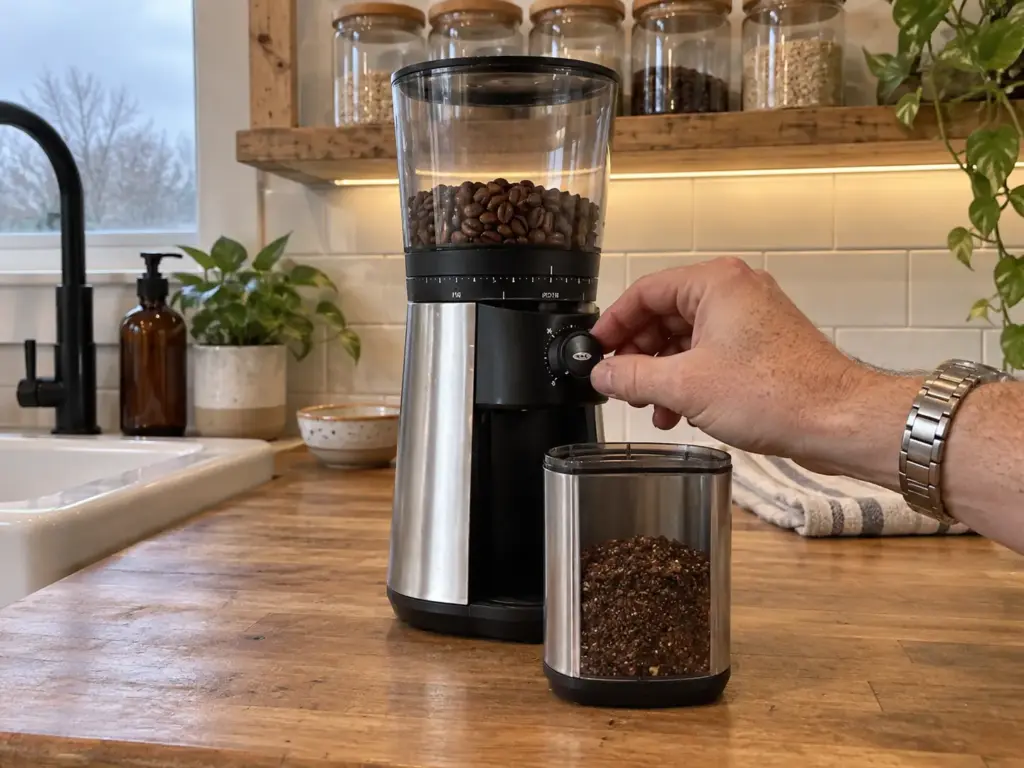
The Coarse End of a Budget Burr Grinder
The OXO Brew Conical Burr Coffee Grinder is a budget burr grinder, and its listing claims exactly this job: conical stainless steel burrs, 15 settings plus 43 micro-adjustments, and a coarse end sold for French press and cold brew. The coarse end is also where owners report trouble. Buyers who use it for cold brew can find it clogs at a large grind, and the listing’s summary counts 715 negative durability mentions out of 970.
At the coarse end of a cheap electric grinder, a clog looks like a grinder that runs but stops sending grounds: the motor keeps going, the hopper still looks full and the bin comes out half-empty.
Note where that reviewer was, too. Setting 13 is two short of the coarsest, so backing off the last click is no cure on this machine. Watch the chute on your first coarse batch, and if it jams, the problem is the unit rather than your recipe. Cheap grinders that stay even at the coarse end is the comparison worth reading before you replace it.
A Hand Grinder at Batch Size
A good hand grinder makes a clean coarse grind and a lot of work at cold brew scale. A 32 oz batch at 1:8 wants about 118 g of beans (roughly 4 oz), and a compact hand grinder holds 20 to 25 g a load, so that is five or six loads.
How long grinding by hand really takes puts minutes on those loads. It works, it is a chore, and it is where an electric burr grinder earns its counter space.
When a Flat Batch Is Not the Grind
The grind is the first suspect for a flat, watery batch, and often the wrong one. The lab numbers earlier already showed that a notch changes how fast a cold steep moves far more than where a 12-hour steep ends up, so the other settings get checked first: the ratio, the steep time, then the bag.
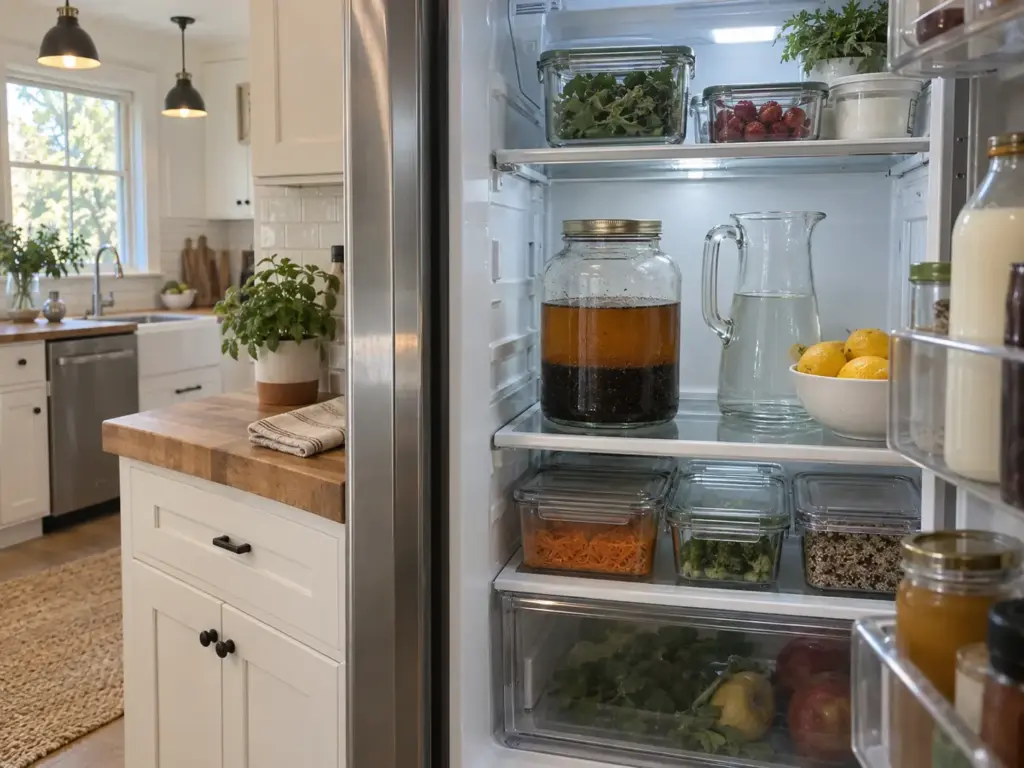
The Ratio
Go back to the thin 22-hour batch. It was brewed at 1 part coffee to 15 of water.
Counter Culture brews at 1:8 and then dilutes as the last step, which works out to about 125 g of coffee per liter, and it offers 1:11 for anyone who wants to skip the dilution. A 1:15 batch is weaker than that no-dilution ratio before any water goes in, and cut again at the glass, it tastes thin at any setting. I would put the ratio first on that list, though reading a stranger’s batch from a post is always partly a guess.
The right brew ratio is its own question. For a grind test, what matters is that it stays the same from one batch to the next.
Taste a spoonful of the concentrate straight before you dilute it. If the concentrate itself is thin, the steep is the suspect: the ratio, the hours or the grind. If it is dense and only the glass tastes watery, the problem is how much water went in at the end, and the grinder can stay exactly where it is.
The Hours and the Fridge
Cold slows everything down, grind included. In the same Applied Food Research study, a brew held at 39°F (4°C) for 20 hours still did not reach the strength of one made at 73°F (23°C) in 8 hours: 2.71 percent dissolved solids against 2.95 percent, at a 1:6 ratio. A fridge steep needs its hours, and pulling a fridge jar at the 12 hours a counter recipe calls for can give you a thin batch at a perfectly good setting.
How long to steep is, like the ratio, a question of its own. For the grind test, keep both the hours and the place the jar sits the same from one batch to the next.
A Stale Bag
If you are unsure how to tell if your beans are stale, start with the roast date, because a bag that has been open for weeks makes a flat batch at any setting. Pre-ground loses ground here too: ground coffee goes stale faster than whole beans ground fresh for each batch, which is one more reason the shortcut from the last section needs a fresh bag.
A batch that was right last month and flat this month, on the same setting and the same recipe, is almost always the bag. It is the one ingredient that changed without anyone touching it.
Once the grind, the ratio and the hours hold steady, the variable left is the bean itself (a light roast or a dark roast), and which roast makes better cold brew is the next setting to decide.
Coarse for Your Strainer, One Notch a Batch
Cold brew grind size comes down to three moves. Set it coarse, around your grinder’s French press setting, and adjust for the strainer you own: coarsest for felt, a notch finer for paper or a fine mesh. Read the batch before you touch the dial, because gritty and bitter mean coarser while watery means the ratio and the hours get checked first. And change one notch per batch, with the dose weighed and the hours written down, so each day of waiting teaches you something.
A month from now, look at the last inch of the jar and at how long the strain takes, because if either has grown on the same setting, the grinder’s coarse end or the bag has changed rather than your recipe.
For the next batch, write the setting, the grams and the hours on the lid, change nothing else, and taste it the following day for grit first, then for strength.
Frequently Asked Questions
01What is the best grind size for cold brew?
Coarse, about the size of coarse sea salt, at or just past your grinder’s French press setting, is where most cold brew batches come out clear and full. Go a notch finer with paper or a fine-mesh basket, and to the coarsest setting with a felt filter.
02What grind does Starbucks use for cold brew?
The Starbucks cold brew recipe for home calls for whole bean coffee ground coarse, steeped 12 to 24 hours in a coffee press or a jar with a metal sieve or paper filter. The page does not say what grind its stores use, so coarse is the answer for home.
03How much ground coffee for 32 oz of cold brew?
About 118 g of coarse grounds for 32 oz (946 g) of water at a 1:8 concentrate, or about 105 g at the 1:9 ratio Starbucks uses for its home concentrate. Weigh it if you can: Starbucks prints 4 tablespoons of coarse grounds as both 20 g and 22 g.
04Is French press grind the same as cold brew grind?
Close to it: most cold brew recipes say the same as French press, or a notch coarser, and the strainer you brew with decides which. A felt filter wants the coarsest setting, while a fine-mesh basket or a paper pass can take a notch finer.
05Can you make cold brew with fine ground coffee?
Yes, fine ground coffee makes cold brew, but it clogs paper, leaks through mesh and settles as silt at the bottom of the jar. Strain it twice, a mesh and then a paper filter, and leave the last inch behind when you pour.


How did your cup turn out?
No comments yet. Tell us what you changed — and whether the needle moved.