



We may earn a commission when you buy through links on this page. It never changes what we recommend. How we pick
On this page7 parts
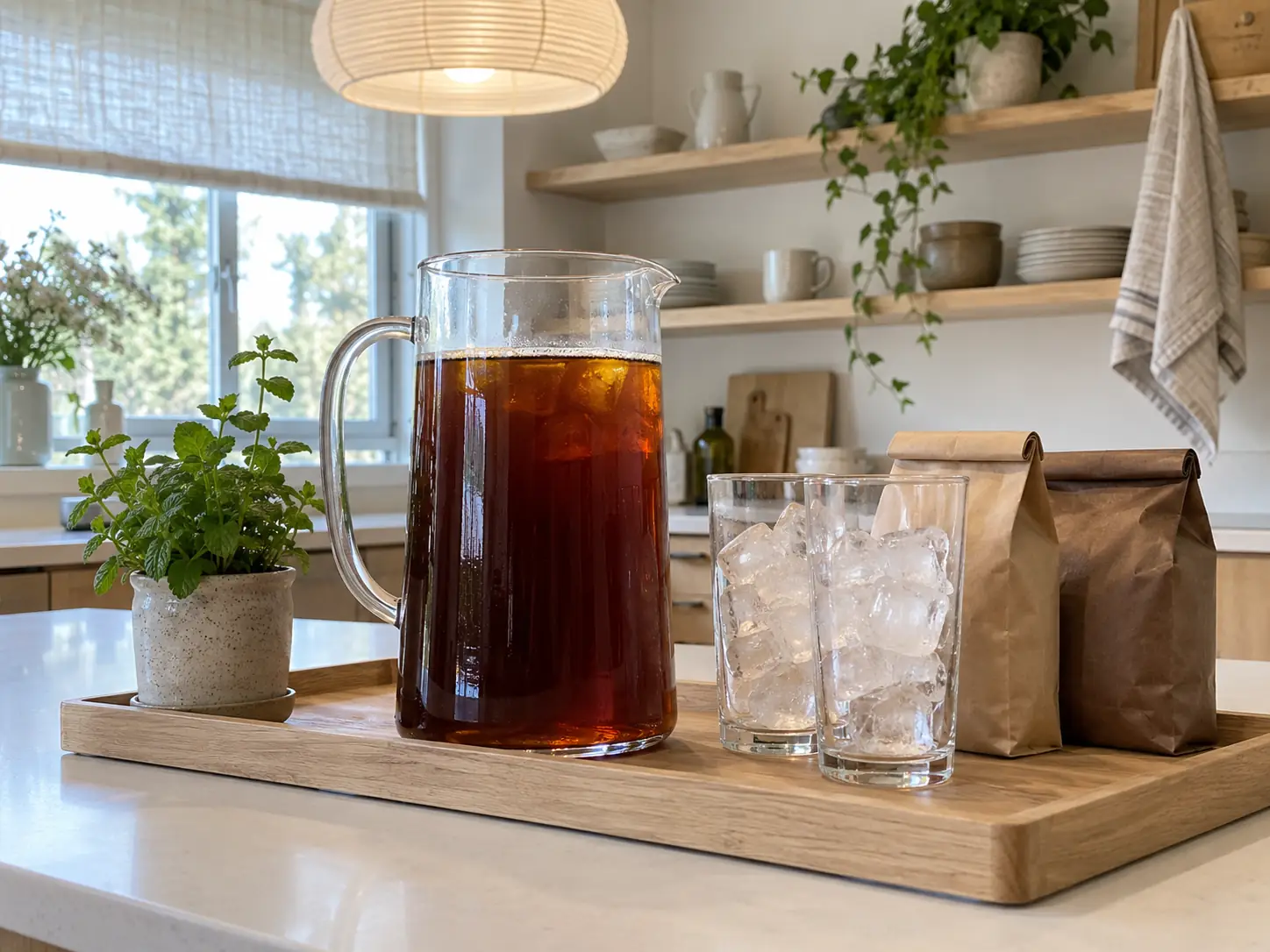
Your jar of cold brew has been in the fridge for two days. You pour a glass, add ice, and it tastes sour and thin, like lemon water that walked past a coffee bean. The bag on the counter says light roast, and now you are wondering: is light or dark roast better for cold brew, or did you just steep it wrong?
The roast decides which way a jar goes wrong, and the steep time is the lever that pulls it back. In a lab test at UC Davis, roast level shaped the flavor of cold brew more than temperature or brew time did. Below: why cold water changes the usual verdict, what each roast does in a jar, how to tell which way your batch is off, and what to do with the bag you already own.
Quick Answer
Neither roast wins outright. Medium to dark is the safe default for a cold brew jar: cold water extracts slowly, and darker beans give up their chocolate, nutty flavor easily enough to stand up to milk. Light roast works if you accept a thinner cup or give it more extraction. Sour batch? Change the steep time before the bag.
Why Cold Water Changes What Roast Does
Saying dark is safer in a jar is really a claim about cold water, so start there. Hot water does most of the extracting in a pour-over or a drip machine; in a jar, nothing is hot, and the coffee has to give up its flavor on its own. That one difference is why the advice about roast that holds for hot coffee does not carry over, and why the pillar on how light and dark roasts differ in every method treats the jar as its own case.
What the UC Davis study found
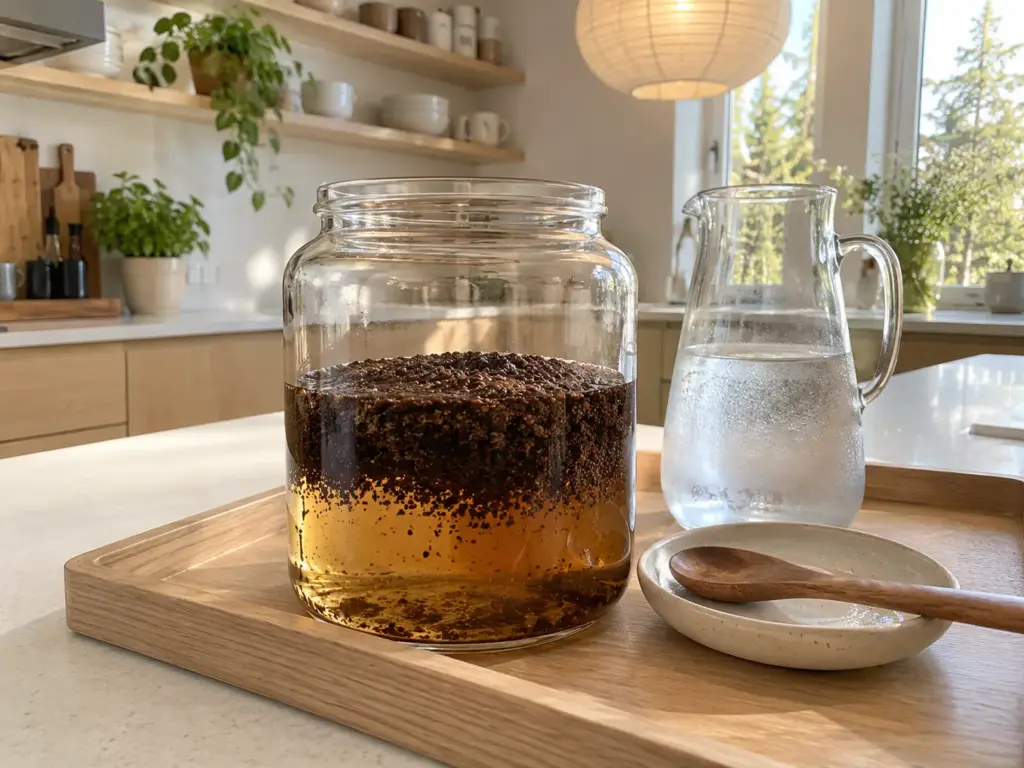
The best measurement of this comes from a UC Davis study in Scientific Reports on roast, temperature and time. The researchers brewed a light blend and a medium-dark blend by full immersion at three temperatures, 39°F (4°C), 72°F (22°C) and 198°F (92°C), and tasted them at several brew times. In the study’s own words, “Roast level was the primary driver of flavor, followed by temperature, and then longer brew times as TDS plateaued.”
Read that order again, because it runs against what most people tweak first. The bag in your cupboard set most of what the jar tasted like. Temperature came second, and the extra hours came last, once the strength had stopped climbing.
And each roast drifted in its own direction. For the dark roast, bitter and burnt kept changing with time in both the fridge and room-temperature brews. For the light roast, sour and citrus moved more in the colder brews. Same lever, opposite directions, which is the whole logic of the fixes further down.
One limit worth keeping in mind: these were two blends of Salvadoran and Nicaraguan Arabica, measured on a roast-color meter in a lab. They stand for two points on the roast scale, not for every bag on a supermarket shelf.
Why a light roast is slower to give up its flavor in cold water
A dark roast is the more soluble of the two, so in cold water it gives up its flavor sooner. A light roast hands it over more slowly. In hot water that gap closes in a few minutes, because heat does the work for either bean. In cold water nothing closes it except time, and a short steep ends before a light roast has caught up.
Dip a spoon into a light-roast jar and a dark-roast jar at the same hour and they taste like two different drinks. The dark one already tastes like coffee. The light one is still catching up.
The acidity shows up in the numbers too. In the UC Davis Coffee Center’s cold brew research, published by the SCA, brews diluted to 2 % TDS averaged a pH of about 4.9 for light roast, 5.1 for medium and 5.5 for dark. That is a taste fact: the darker jar tastes less sharp.
The same work found cold brew came out less bitter, less sour and less rubbery than hot coffee that had been chilled, so cold water is gentler in both directions. It is just slower.
Someone who has been put off by bitter coffee for years, and then stumbles upon cold brew, may ask which roast to buy. Light roasts are more likely to produce a grassy, sour or astringent immersion brew, while medium to dark roasts fare better for immersion cold brewing. That is the common verdict, and the lab verdict points the same way.
Judge a jar the way you will drink it. Concentrate straight from the jar tastes sharper than the same coffee cut with water or milk over ice, so dilute a spoonful in a glass before deciding a light roast has failed.
A label is not a lab number
The SCA’s extraction target of 18 to 22 % is a hot-coffee number. It describes a drip or pour-over cup, and a jar of cold brew is not supposed to hit it. Cold brew is judged by the cup and by the steep range, not by a figure borrowed from a different method. If you have seen that percentage quoted next to a cold brew recipe, it was the wrong number in the wrong place.
The same caution applies to the word on the bag. Light, medium and dark are a roaster’s description, not a measurement, and one company’s medium is another’s dark.
The honest markers are the two cracks: a light roast is pulled near first crack, when the bean pops as its moisture escapes, and a dark roast goes into or past second crack, when the oils come to the surface. If you want the full picture of what heat does to a bean during roasting, it starts with those two sounds. Roasters disagree about single temperatures, so go by the bag instead: an oily surface and a smoky smell tell you more about the bag in your hand than a number from somebody else’s roaster.
What Each Roast Tastes Like in a Jar
The verdict above is a default, not a rule. Each roast has a good side in a jar and a way it fails, and you want both in front of you before you change anything.
Dark roast: chocolate and body, until it goes flat
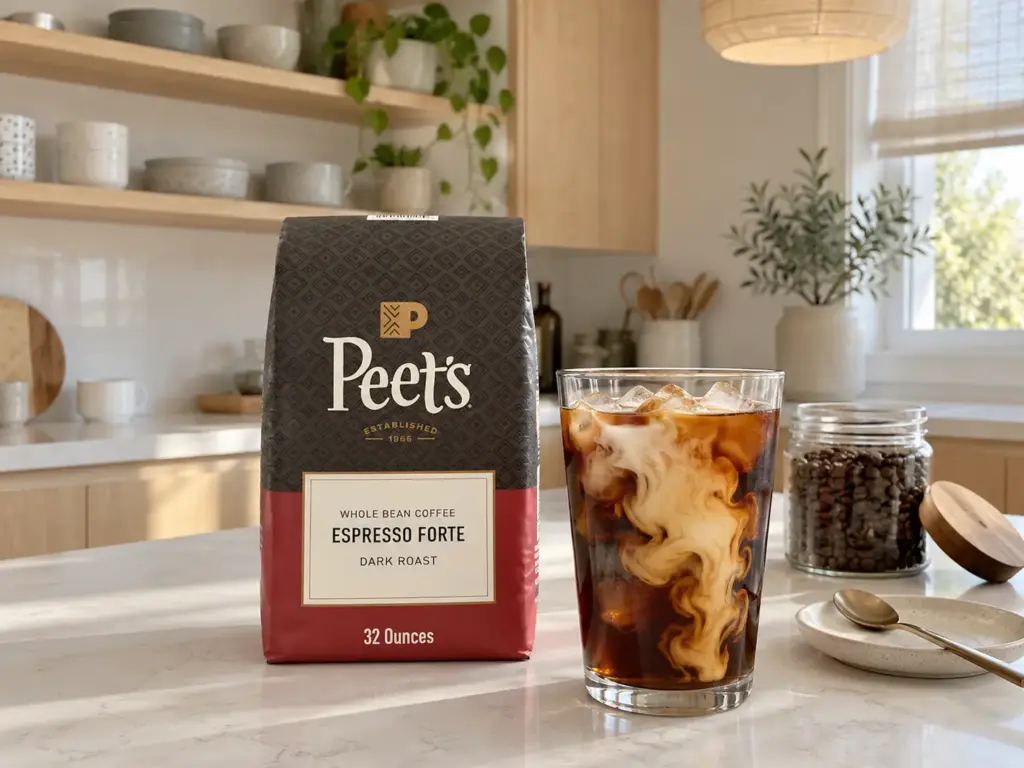
A dark roast in cold water gives you the cup most people picture: chocolate, toasted nuts, a heavy body that still tastes like coffee after you pour in milk. Low acidity is part of that, since the pH is highest at this end of the scale.
Time is where a dark roast goes wrong. The UC Davis and SCA work found that bitter, burnt and rubber notes kept changing long after the first rinse, especially for dark roasts. Leave a dark jar too long and the chocolate turns into something flat and heavy, one note from start to finish.
A peer-reviewed study of medium and dark Kona coffee suggests why: over-brewing may pull slow-extracting harsh compounds that keep arriving after the easy flavors are done. That study did not test a light roast and did not control the grind, so take it as a likely mechanism, not a verdict.
A bag like Peet’s Espresso Forte, a dark roast of 100 % Arabica sold as whole bean in a 32-ounce bag, is the kind of coffee that gives a jar that chocolate weight and takes milk without disappearing. It is labeled as an espresso blend, not a cold brew bag. Over-steep it and it goes bitter and burnt, but that is the roast talking, not the product.
Do not use the color of the brew as a timer. A dark-roast jar turns deep brown within the first few hours, long before the flavor is finished, and a light-roast jar can look weak when it is close to done. Taste a spoonful; the color only tells you the roast.
Medium roast: the middle that forgives a few hours
Medium sits where the two failures are furthest away. It has enough solubility to give the jar body in cold water and enough of the bean left to taste of something besides roast. It is also the most forgiving about timing: a few extra hours nudge it darker without tipping it into burnt, and a few short ones leave it bright rather than sour.
Stumptown Hair Bender is a medium roast blend sold whole bean in a 12-ounce bag, named here as an example of the roast level rather than a pick of the best beans (that is a different question, about which beans to buy for cold brew). A 12-ounce bag does not go far in a two-quart jar, and nothing printed on it promises how it behaves over a long steep, so taste it the way you would any medium bag. If you also run an espresso machine, the reasoning changes, and there is a separate look at the same roast question for an espresso machine.
Light roast: when it works and when it stays thin
Light roast in a jar is the bag most likely to taste sour, citrusy and grassy, because that is the end of the cup that shows up when the coffee has not had enough time. Even when it is not sour, it can taste thin, like a weak tea with a coffee aftertaste. For light roasts, a slow cold drip tower beats a jar, since the drip keeps the bright, origin character that immersion flattens.
But “light never works” is too strong.
Even fruity light roasts can come out with subdued acidity and often nice chocolatey tones after a long steep in the fridge. So a light roast in a jar can land, given more time than a dark one needs. The cost is real: it needs more coffee or more hours to reach the same weight, and it will never taste as heavy as a dark roast. The place where light roast shines when hot water does the work is a pour-over, not a pitcher.
Sour or Flat? Read the Jar Before You Change the Bag
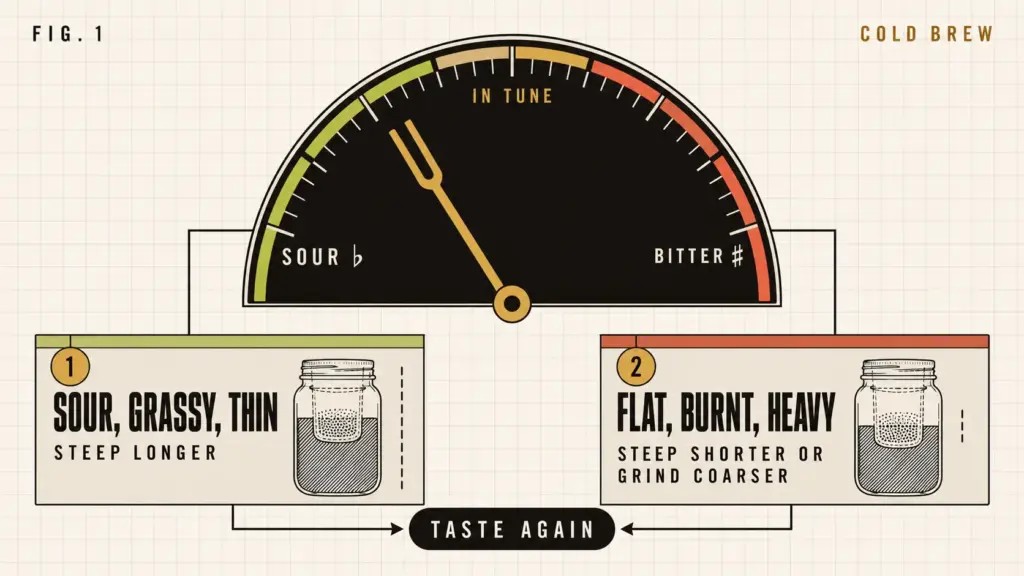
The roast sets the direction, but the batch in front of you is off one way or the other: thin and sour, or flat and heavy. Which one it is tells you the single thing to change. Name the direction first, then touch one thing, then taste again.
Sour, grassy or thin: it needs more extraction
A jar that tastes sour, grassy or thin is under-extracted. The water left before it finished, which in a cold jar means it did not get enough time with the grounds. This is the light roast’s usual failure, and it can happen to a medium bag pulled early.
A muddy jar is a different problem. If your glass has a gritty film at the bottom and tastes sour and bitter at once, look at the basket before the beans.
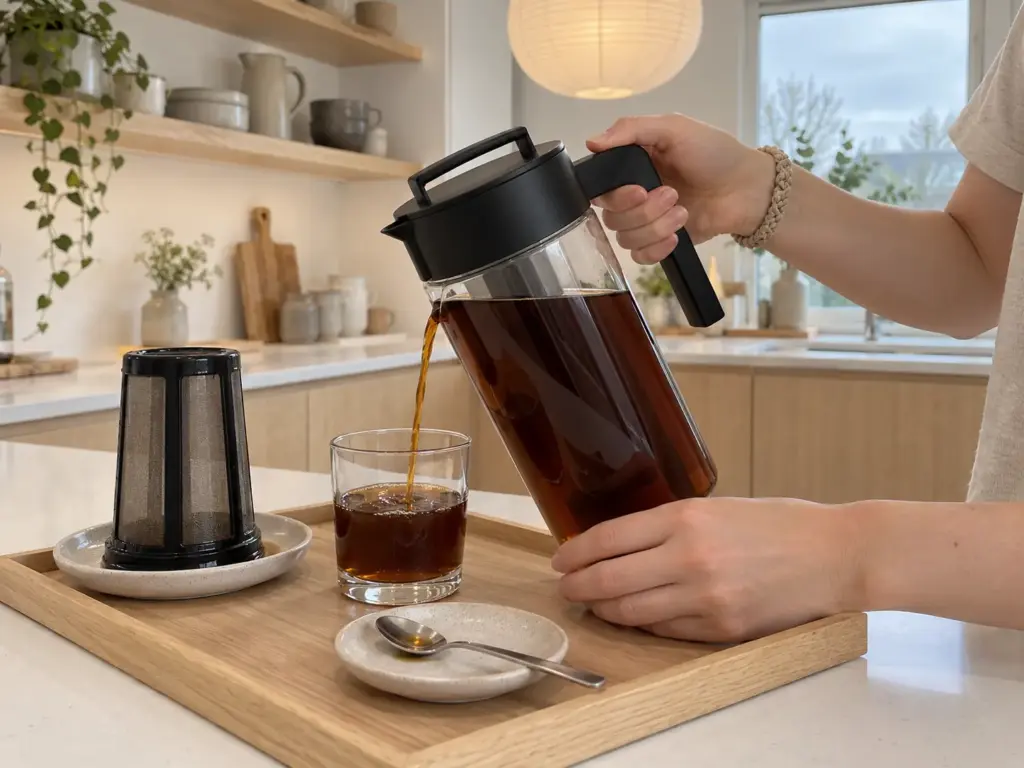
The Takeya Deluxe Cold Brew Coffee Maker, the 2-quart Tritan pitcher with a fine-mesh filter basket that a lot of kitchens use for this, lets sediment through if the basket is not screwed in tight or if the pitcher gets a hard shake. The long filter is also a chore to scrub out. A mason jar and a fine strainer do the same job for free, with the same rule: pour gently.
So the two directions sit opposite each other. Sour, grassy and thin call for more extraction. Flat, burnt and heavy call for less.
Flat, burnt or heavy: it has had too much
A jar that tastes flat, burnt or heavy has had too much time. This is the dark roast’s failure, and it is the one the UC Davis data track most clearly: bitter and burnt keep climbing as the hours go by. The change is the mirror image of the sour fix. Shorten the steep, and if your timing is already short, go one step coarser on the grinder.
Why does time matter more than you would think once the strength stops rising? A peer-reviewed study of caffeine and chlorogenic acid in cold brew found both compounds reached equilibrium within about six to seven hours in every sample. The jar was done extracting those, but the slow, harsh compounds may keep arriving. That is one way a dark jar can be at full strength at hour eight and taste worse at hour twenty.
If you have been steeping a full day out of habit, this is the range to start from. The UC Davis Coffee Center found cold brews reached their final strength in about 5 to 6 hours at room temperature and about 10 to 12 hours in the fridge. That was one set of beans in a lab, so treat it as a starting point. Still, it means a thin light-roast jar is rarely short of hours once it is past that range, and a heavy dark-roast jar has probably had hours it never needed.
The order: steep time, then the dose, then one grind step
When a batch is sour or thin, change these one at a time, in this order, with a tasting between each:
- Steep time. Free, and the likeliest cause. Add a few hours, not a whole day, and taste. If it worked, the sour edge softens and the coffee starts to taste of chocolate or fruit instead of lemon. If you overshot, the jar turns flat and bitter; come back halfway.
- The dose. Weigh the coffee. If you have been scooping, you may have been using less than you think.
- One grind step finer. Only if the jar is still thin after the first two. The right setting is set by the filter you use, so one step is the limit before the basket starts letting fines through.
The flat, burnt jar runs the list backward: shorten the steep first, then coarsen one step.
On the dose: a scoop measures volume, and dark beans are larger and lighter than light ones, so a scoop of dark roast holds less coffee by weight than a scoop of light. Switch roasts with the same scoop and you have changed the dose too, which is two changes, not one.
An Etekcity kitchen scale reads in 1 g steps with a tare button and handles up to 11 pounds, plenty for a jar dose. One-gram steps are coarse for weighing a single pour-over, though, and it has no timer. If you want the timer built in, the Hario Drip Scale Timer reads in 0.1 g steps. Either way, the same weight in every jar is what makes a roast change readable, and it is also why roast changes where the grinder dial should sit.
Put a strip of tape on the lid and write three things: the roast, the hour you started, and the one change you made from the last jar. Taste a spoonful at hour ten and again at hour fourteen. A jar that is sour at ten and round by fourteen was only short of time, and the tape tells you so next week.
When the Bag You Own Is the Wrong Roast
Bags rarely get bought to suit one jar. You have a supermarket dark roast, a gift of light roast, or a bag of pre-ground coffee, and the question is what to do with it tonight, without buying anything.
A light bag in a jar
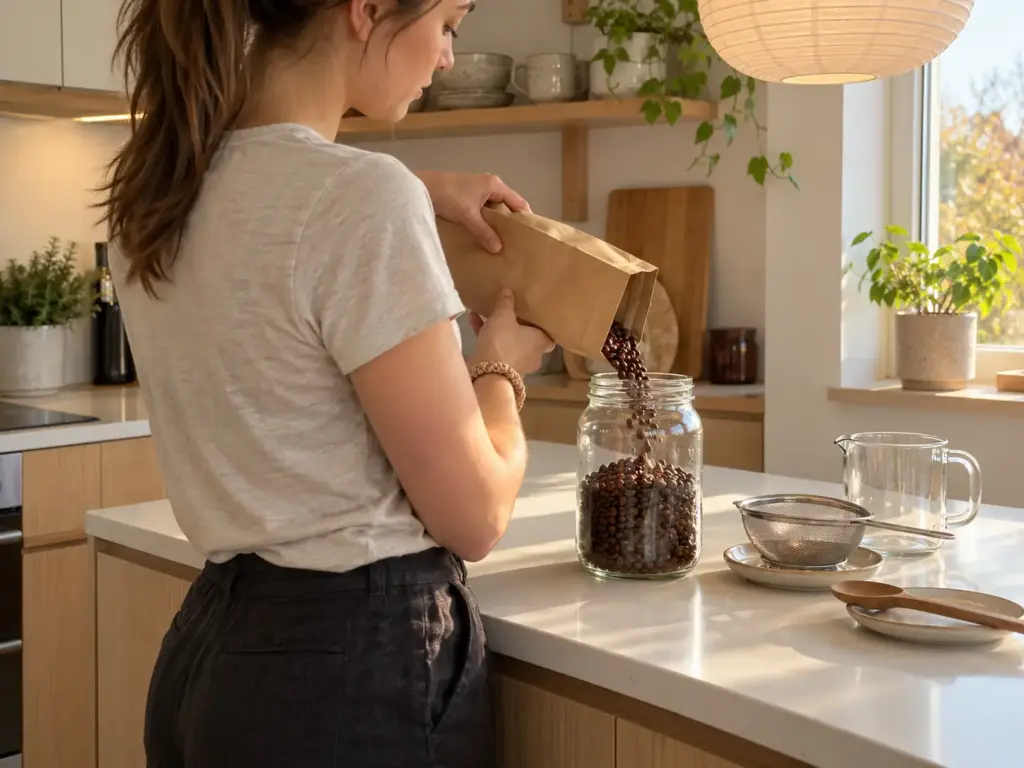
A light roast in a jar is not a lost cause, but it asks for more. Your choices, in order:
- Give it more extraction. A longer steep first, then one grind step finer. Both are free.
- Drink it over milk. A thinner, brighter concentrate tastes more complete with milk than black.
- Save the bag for a hot method. If the jar still tastes grassy, the bean wants heat. Brew the rest as pour-over or drip and buy a medium or dark bag for the next jar.
The setup where a light roast keeps its character is the cold drip tower, the slow Kyoto-style drip. Most kitchens do not have one and do not need one for this, which is why it comes last. A tower is a different method from a jar, not an upgrade to it.
A cheaper route, if the light bag is a one-off, is a traditional blended espresso for cold brew: a medium-dark roast with lots of chocolaty flavors. In other words, the espresso blend you already know is a reasonable jar coffee.
And if your concentrate tastes unfinished, dilute it before blaming the roast. A tester at healthykitchen101 cut Takeya concentrate 1:1 with filtered water and found that cream gave it a “more finished taste.”
Pre-ground coffee and a blade grinder
A muddy, bitter jar from pre-ground coffee or a blade grinder is usually the grind, not the roast. Both make fines, the powder-sized particles that over-extract even in cold water, while the larger chunks under-extract next to them. The jar ends up sour and bitter at once, and swapping a light bag for a dark one only changes which taste wins.
A blade grinder leaves a film of powder on the bottom of the jar that tastes like the bag’s worst minute. You can taste it in the last glass more than the first.
A burr grinder at a coarse grind gives the even particles a jar wants. The authors of the Kona study note that grind size was not controlled in their own data, so there is no clean number for how much fines cost a cold brew; the taste in that last glass is the evidence you have. Pre-ground coffee also comes with a second problem, which is age, and the question of whether to read the roast date first matters more for a long steep than for a quick cup.
With pre-ground or blade-ground coffee, strain the jar twice: once through the basket or strainer, then again through a paper filter as you pour. The second pass takes a few minutes and catches most of the fines that make the bottom of the glass taste bitter.
Jar or drip tower
For most kitchens the answer is the jar, and the roast should suit it. A jar is immersion: the grounds sit in water for hours, and the slow, even contact favors what dissolves easily, which is why medium and dark do well there.
A drip tower is the opposite: water passes through the grounds a drop at a time, the contact is short, and the brighter compounds of a light roast survive. If you already own a jar and like light coffee, the cheaper move is to brew light roasts hot and keep the jar for a darker bag. Buying a tower for one bag of beans is a lot of glass for one coffee.
Why the Roast Date Matters More Than the Roast
The roast is the first choice. The age of the bag decides whether any choice can be rescued by a long cold steep, and that is where a jar most often goes wrong without anybody noticing.
A stale light bag tastes flat, not sour
A long steep does not hide old beans. It shows them off. Stale coffee has lost the aromatics that a slow, cold extraction relies on, so the jar comes out muted and flat whatever the roast. That catches people out with light roast in particular: a light bag that is two months old tends to taste flat rather than sour in a jar, and the reader decides light roast does not work when the bag had simply run out of flavor.
Roast level does not drift over months. The bag does. Before you change roasts, check whether the flat jar is the age of the beans, and if you are not sure how, here is how to tell if coffee beans are stale, from the smell to the cup.
What to check on the bag before you steep
Three checks, before the beans go in the jar:
- The roast date. Not the best-by date, which can fall long after the roast. If there is no roast date at all, assume the coffee is older than you would like.
- The smell. Open the bag and smell a handful. Fresh beans smell of the roast: chocolate, fruit, toast. Old ones smell faint, dusty or like paper.
- How it was stored. A bag left open on the counter for weeks has aged faster than one clipped shut and kept away from the stove.
The full timeline, counted from the roast date, is in the guide to how long to keep coffee beans after opening.
Grind a small pinch and smell it before you fill the jar. If the ground coffee smells weaker than the whole beans did, the bag is past its best, and twelve hours in cold water will only make that clearer.
The next decision: which beans to buy next
Once you know which roast suits your jar, the next question is the bag itself: origin, blend or single origin, and how fresh it is when it reaches you. Before you buy, it helps to know what the bag tells you when you pick the next one, because the bag prints the roast level and, on the better ones, the roast date. The other cold brew levers, the steep time in hours and the ratio of coffee to water, have their own answers, and they are easier to tune once the roast is settled.
Start With the Jar You Already Have
Three things to take from all of this. In a jar, medium to dark is the safe default, and light roast is a deliberate choice that asks for more time or a different method. A sour, thin batch needs more extraction and a flat, burnt one needs less, so change the steep time before anything else. And check the roast date before you blame the roast, because a stale bag tastes flat in any jar.
A month from now, look at the date on the bag against the date you opened it; the jar that started out right will drift flat as the beans age, and the roast will not have changed at all.
Tomorrow, take the jar you already have and the bag you already own. Change only the steep time, a few hours longer if the last batch was sour or a few hours shorter if it was flat, and taste a spoonful before you pour the rest.
Frequently Asked Questions
01Can you use light roast for cold brew?
Yes, you can use light roast for cold brew if you accept a thinner, brighter cup or give it more extraction with a longer steep or a finer grind. In a plain jar it is the roast most likely to taste sour, and a slow cold drip tower suits it better.
02Is dark or medium roast better for cold brew with milk?
Both dark and medium roast hold up to milk in cold brew, and dark gives the chocolate and nutty weight most people expect under milk. If the dark jar tastes flat or burnt, shorten the steep before you change the bag.
03Why does my light roast cold brew taste sour?
Light roast cold brew tastes sour and grassy when it is under-extracted, because the water has not had enough time with the grounds. Lengthen the steep by a few hours and taste, then weigh the dose, then go one grind step finer if it is still thin.
04Does roast level change how long to steep cold brew?
Roast level changes how forgiving the steep is more than the exact hours: dark roast drifts toward bitter and burnt the longer it sits, while light stays sour until it has had enough. Start near 10 to 12 hours in the fridge and taste.
05Can I use pre-ground coffee for cold brew?
You can use pre-ground coffee for cold brew, but its fines over-extract even in cold water, so the jar can taste muddy and bitter. A coarse, even grind is the cleaner fix, and a second strain through paper helps in the meantime.



How did your cup turn out?
No comments yet. Tell us what you changed — and whether the needle moved.