



We may earn a commission when you buy through links on this page. It never changes what we recommend. How we pick
On this page12 parts
- The Water Temperature a Drip Coffee Maker Really Reaches
- Which Way Your Pot Is Off, and the Free Fixes Before You Buy Anything
- Convenience, the Cup, or the Middle: Choosing the Job Before the Machine
- The Premium Pick Rated for the Cup
- Thermal Carafe or Glass on a Warming Plate
- The Thermal Carafe Pick That Skips the Hot Plate
- Cups on the Box, Mugs in Your Hand, and the Timer That Starts the Pot
- The Glass Carafe Pick With Presets for the Cup You Want
- What Wears Out First, in Months
- The Budget Pick, and When the Cheap One Does the Same Job
- Tomorrow's Pot, and the Check to Run a Month From Now
- Frequently Asked Questions
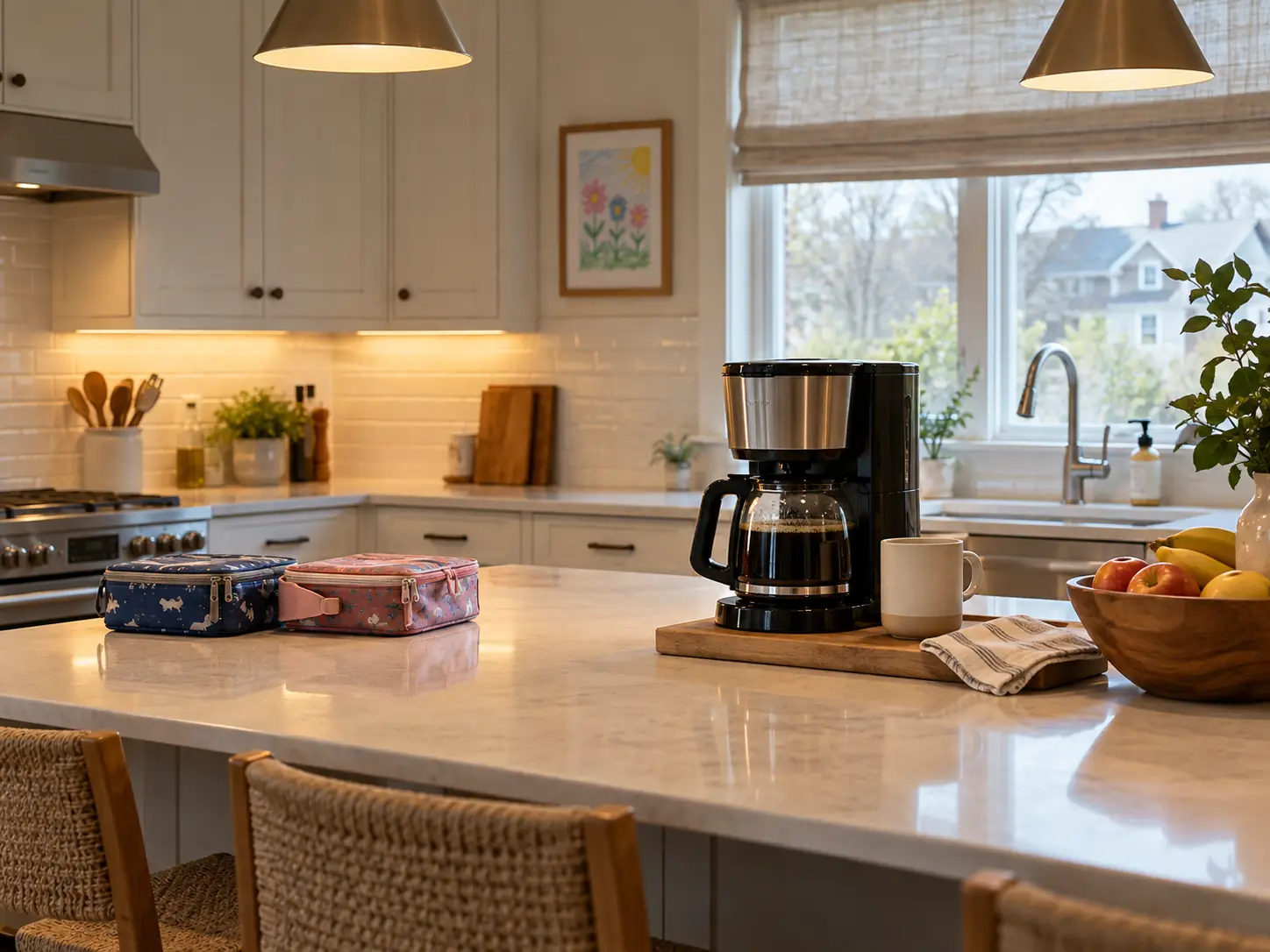
The pot finished on schedule, the carafe is full, and the first mug tastes flat and a little cool. A machine can be sold as the best drip coffee maker in its class and still do that, because the cup is made by the temperature of the water that reaches the grounds and how evenly it lands on them, and neither number is printed on the box in a way you can trust. A pot that is off also points a direction, and the direction names a change you can make tomorrow for nothing. That check comes first below, then four named picks with the flaw each one carries, and the parts that wear out once a machine has run for six months.
Quick Answer
The best drip coffee maker keeps its water between about 195 and 205°F (91 to 96°C) and wets the grounds evenly, because that decides the cup. Carafe, timer and size decide whether you still use it in month six.
The Water Temperature a Drip Coffee Maker Really Reaches
An automatic drip coffee maker is a heater and a showerhead with a basket under it, and nothing else in the box touches the coffee. The cup follows from how hot the water is when it arrives and how evenly it lands on the grounds. The box rarely settles either one.
What the temperature does to the cup
Water that arrives too cool leaves part of the coffee behind. Hot water pulls the sharp acids out of the grounds first, the sweetness next and the heavy, bitter compounds last, so a pot brewed cool stops early and tastes sour and thin, then flatter still as it sits. Hot enough water finishes the job.
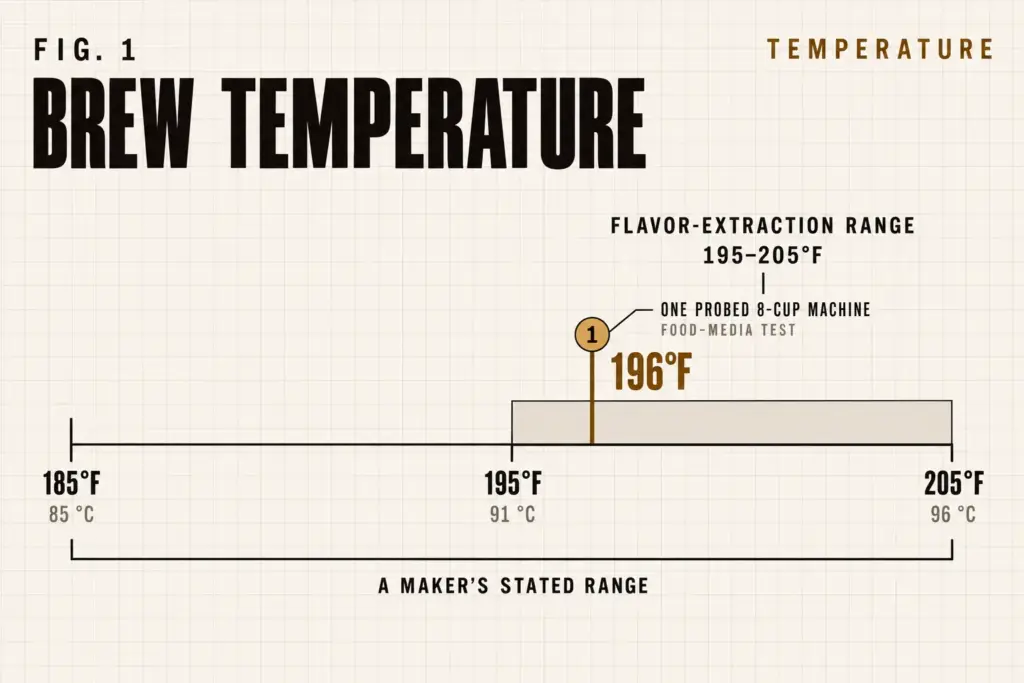
The only question is how hot “hot enough” is, and there is a published answer. According to Consumer Reports’ brew-temperature test, “Our brew performance tests measure brew temperature and contact time.” Contact time is how long the water stays inside the flavor-extraction window the lab scores against, 195 to 205°F (91 to 96°C). In the same lab’s description of a top-scoring machine, the water holds that range for 5 to 6 minutes, so a good drip maker has to arrive in the window and stay there for the whole brew, not touch it at the first drip.
That gives you a number to hold a machine against, which a printed range never does. Bon Appétit’s probe test put an OXO 8-cup thermal machine at 196°F (91°C), a degree above the floor of the window, and found a budget Braun running more than 10°F (5.5°C) hotter than the other cheap machines it tried. Cheap machines, in other words, are not interchangeable in the one respect that matters most, and a machine near the edge of the window leaves you no margin on a cold morning with a cold carafe.
The number on the box versus the water that reaches the grounds
A range printed on a box is the maker’s claim about the water. What checks the claim is a third party.
According to the Specialty Coffee Association’s Certified Home Brewers list, “SCA Certified Home Brewers undergo independent third-party testing to verify they meet established standards for brew temperature, extraction, consistency, and overall brewing performance.” A badge, then, means a lab looked at the water and at how evenly it wet the bed. It is a pass or a fail, not a temperature, and a listing that says “SCA Certified” (the Bonavita’s does) is a claim you can look up rather than a verdict you have to accept.
Read the printed ranges with that in mind. The listings for the Bonavita and the OXO picks below both say 194 to 205°F (90 to 96°C), and one certified GE machine states 185 to 205°F (85 to 96°C) for itself in the SCA’s own release, so the floor of its range sits ten degrees under the window the lab scores. A stated range that starts below the window tells you the machine is allowed to run cooler than the window; only a probe says where a given pot landed. And the water you taste is never the water at the heater: it loses heat in the air under the showerhead, in the paper, in the grounds and in a cold carafe, so a reading taken at the showerhead is the ceiling for your cup, not the cup.
Run one water-only cycle into the carafe and hold an instant-read thermometer in the stream just under the showerhead, tip clear of the plastic. That number is the ceiling for your bed. If the highest reading is under 195°F (91°C), nothing you change at the grinder will lift the water, and the machine itself is the suspect.
Why the showerhead matters as much as the heater
Hot water is half the job. The other half is where it lands. A showerhead with a few holes drops its water on one spot, digs a trench (channeling, in coffee terms), and leaves a dry patch at the edge of the basket; the coffee in the trench is over-extracted and the coffee in the dry patch is barely touched, so a single pot comes out sour and bitter at once.
A wide, even shower over a bed of the right depth wets everything at the same pace, and that is the whole argument for paying more for the better-built machines. The water distribution on a Moccamaster is a little exuberant, meaning wide and generous, and that same trait is why it needs more coffee than you would guess, which the next section gets to.
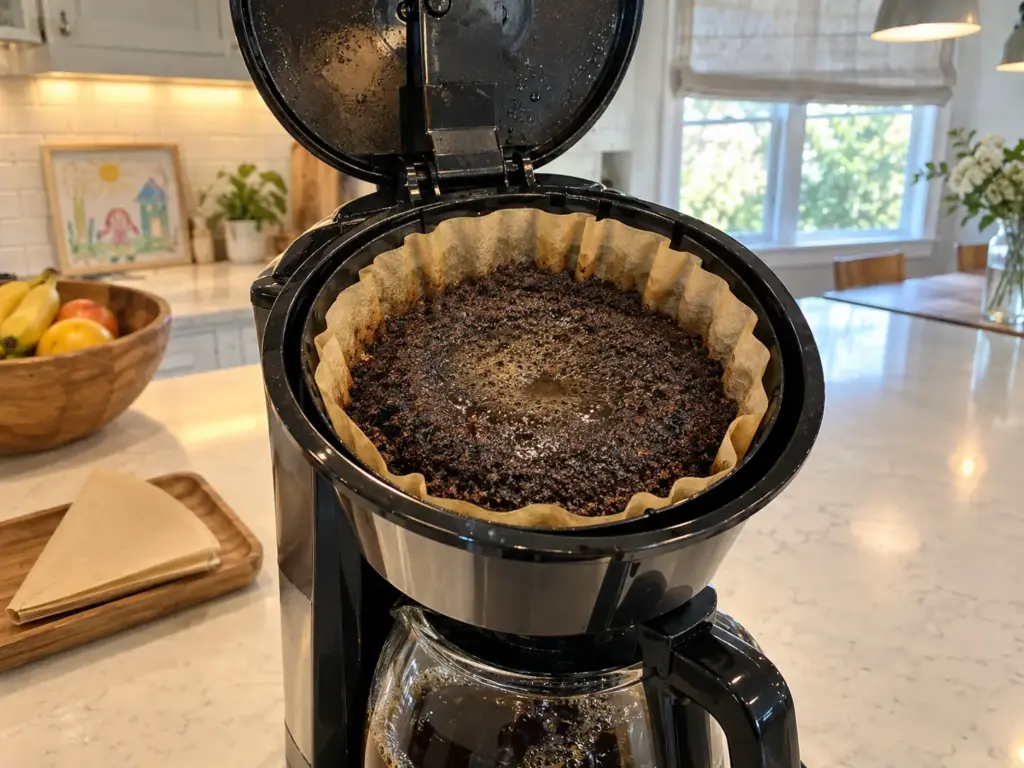
You can read the shower off the spent bed. After the pot finishes and the basket has cooled enough to lift, an even dome with a uniformly dark, flat surface means the water reached everything. A pale, dry-looking corner, or a crater in the middle, is the signature of a pot that finished in a quiet trickle: the water took the shortest path and skipped the rest. If you see that every morning, no grind setting will repair it, because the grinder never decided where the water fell.
Which Way Your Pot Is Off, and the Free Fixes Before You Buy Anything
Before the machine takes the blame, the pot itself points a direction: sour and weak one way, bitter and harsh the other. The direction picks the first change. Make one change, taste, and only then make the next, because a household that changes three things at once cannot tell which one worked.
Sour or weak: a step finer, then check the water
Sour and bitter point in opposite directions, so the first job is to name which one is in the mug. Sour, sharp and thin means the water left before it finished: the grounds were too coarse, the water too cool, or the contact too short. On a drip machine the brew time is not yours to set and the temperature barely is, which leaves the grind as the free lever. Go one step finer on the grinder, the move laid out in going a step finer on the grind for a drip basket, and change nothing else.
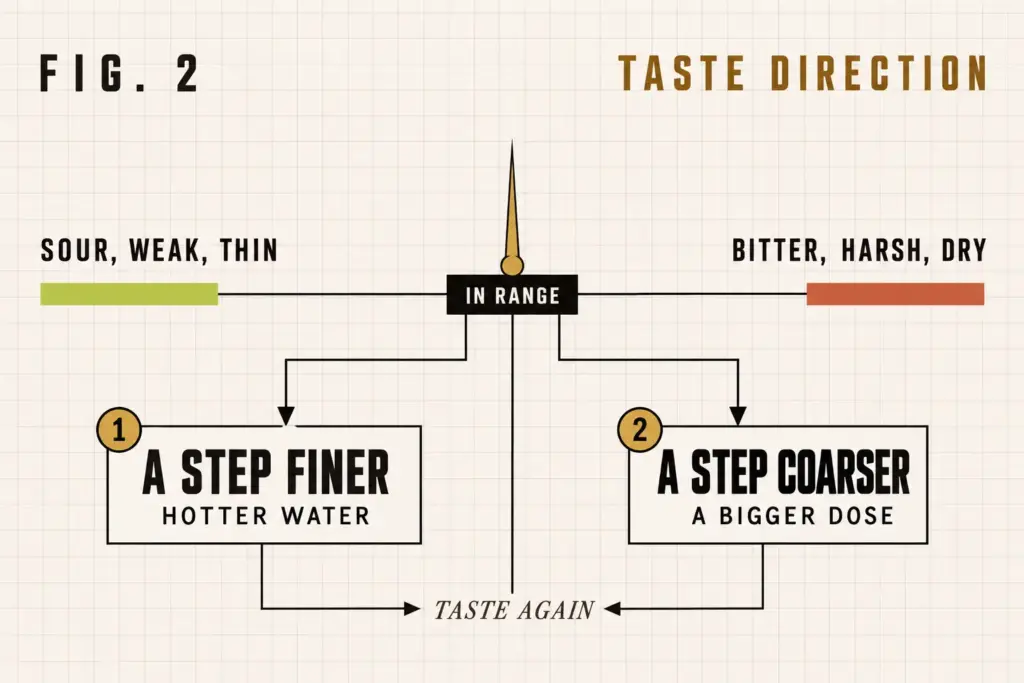
Then brew the same dose the same way. The next pot should come out rounder, with the sharp edge gone from the first sip. If it did, you are finished.
If it turned dry and harsh at the end, you went too far, so come back half a step. A finer grind also slows the water through the paper, so a basket that fills toward the rim is the limit of the move, not a setting to push through.
Taste the second pot after a grinder change, not the first. A grinder keeps a little of the previous grind inside it, so the first dose still comes out at the old setting, and judging a change on pot one is the easiest way to undo a fix that worked.
If the cup stays sour at a finer step and has not turned bitter, suspect the water. A machine that runs cooler than the window under-extracts whatever grind you give it, and the thermometer check above is how you find out. When the reading is low, the buying sections below are for you.
Bitter or harsh: a step coarser, then check the dose and the flow
Bitter and harsh is the opposite verdict. The water stayed too long or pulled too much, and the cup leaves a dry, tightening finish with the sweetness gone. Go one step coarser, brew the same dose, and taste the second pot. The next cup should lose the dry edge and show a little sweetness; if the thin, sharp edge returns, you overshot and half a step back is the answer.
If the grind is right and a small pot is still bitter, the cause is usually the basket, not the grinder, and that is the next fix. The reasoning behind this two-way move, grind to taste and back again, runs through how grind size moves a cup from sour to bitter.
The dose a big basket needs, weighed
A ten-cup basket is built for a full pot, so a small scoop of coffee lands in it as a thin layer. Small batches are where a Moccamaster struggles, and the reason is the shower. The water distribution is a little exuberant for the diameter of the basket, so at small doses the bed is shallow and over-agitated, and the cup turns bitter and astringent.
The thermal-carafe sibling of that machine has the same fix, and it costs nothing: flip the flow restrictor switch on the brew basket to the half position. More water collects in the basket before it drains, so the brew turns into a hybrid immersion brew, and good pots come out at 28 g of coffee to 500 ml of water. The change is easy to try in a single morning, though it has not been measured.
That ratio is about 1 to 18, or roughly five and a half level tablespoons of grounds for 17 fluid ounces of water, and 40 g at the same ratio is about 24 fluid ounces, two full 12-ounce mugs.
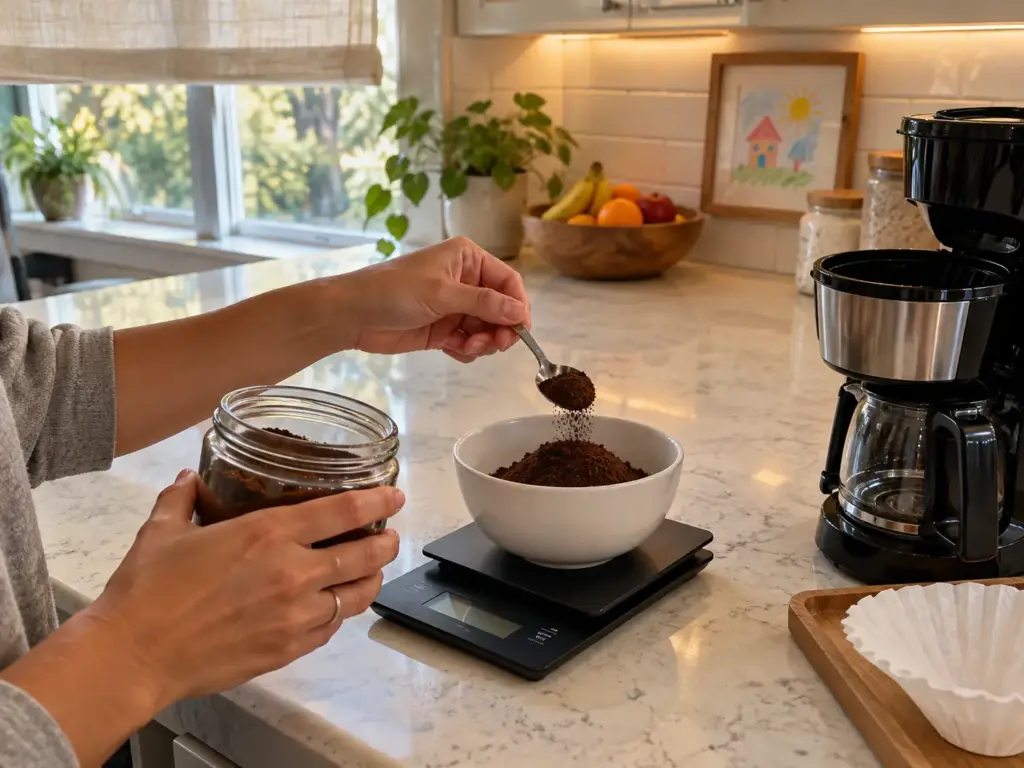
Weigh the dose instead of counting scoops, because a scoop holds a different weight with every roast and grind. A scale such as the Hario Drip Scale Timer reads in 0.1 g steps, has a timer built in and switches itself off after 5 minutes, which is long enough to weigh the dose and the water together. A scale changes more pots than a new machine does, and its cost is one extra step in a morning that a scoop did not have. Weigh your usual two scoops once, write the number down, and from then on change grams instead of scoops.
When it is not the machine: the lid, the plate, the scale inside, the descale
Before blaming a machine that used to make good coffee, rule out what sits around it. A thermal carafe lid or a mug that still holds last week’s coffee flavors this week’s, and a rinse with warm water and a brush costs less than a replacement. A glass pot left on its plate has been cooking since the brew ended, which the carafe sections below take apart.
Mineral scale inside the machine slows the water and cools the brew, and a machine that is not descaled can overheat on the heating element. And a cold carafe or mug pulls heat out of a small pot before you taste it, so pre-warming one with hot tap water is a free fix that Bon Appétit recommends for small batches.
One failure has no single dial. A pot that is sour and bitter together is the signature of a blade grinder, which chops beans into boulders and dust in the same pass, so one part of the grounds under-extracts while another over-extracts. The pot looks like two problems because it is two, and it is explained in why a blade grinder gives a pot that is sour and bitter at once. In that case the grinder is the next thing to change, ahead of the drip machine.
Convenience, the Cup, or the Middle: Choosing the Job Before the Machine
Once the pot is tuned, the question that sorts the machines is what this one is for. Your answer to that decides which pick below is yours, and a ranking cannot make that call for you. The answer is also more often a mix than a choice.
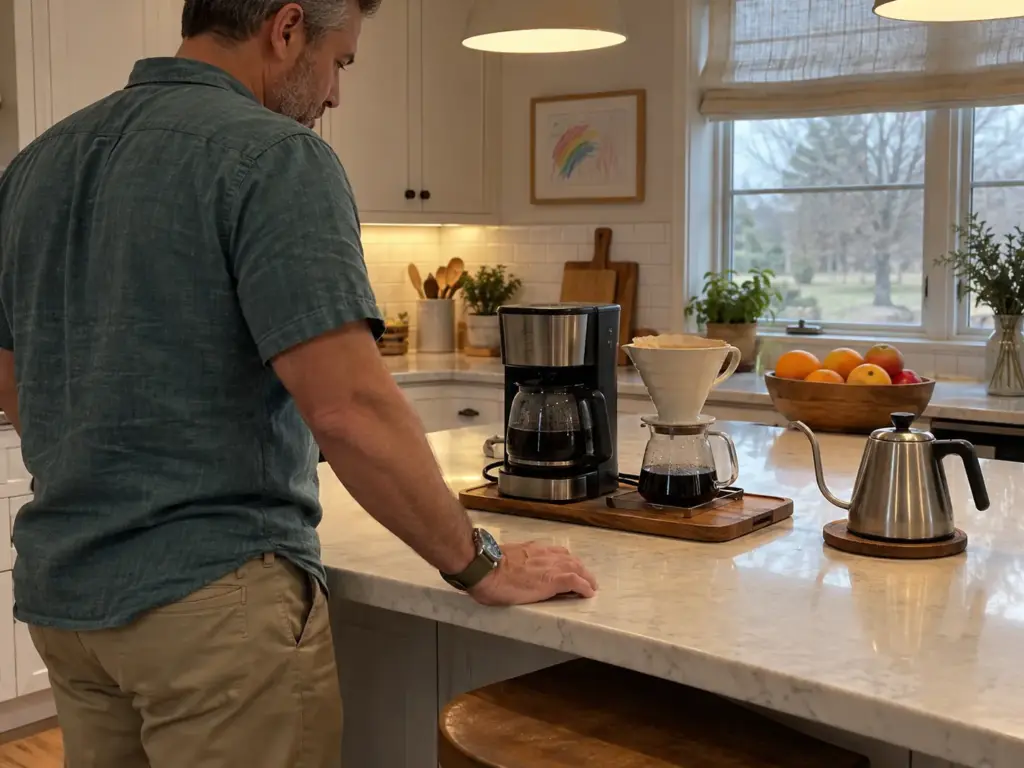
Convenience, the cup, or the middle
The first question to ask about a drip machine is the priority, not a model: convenience, cup quality, or the middle. Convenience means a timer, a big tank and a pot that makes itself while you are in the shower. Cup quality means the water range and the shower from the first section, plus a carafe that does not keep cooking what it holds.
The middle is a machine that does both at a size you will actually brew. Decide that before reading a single spec, because the field narrows quickly once the answer is on the table.
Drip is not an Americano, and it is not a pour-over
Two comparisons come up constantly, drip vs Americano and drip vs pour over, and both come down to who controls the water. An Americano is espresso with hot water added, a short, pressurized extraction thinned afterward. Drip is hot water passing through a bed of grounds under gravity for minutes, and the cup is a different drink. A pour-over, whether on a V60 or a Kalita Wave, uses the same paper and the same idea with one change: a person controls the pour, the pace and the timing, in pulses if they like.
A French press is a different method again, because the grounds sit in the water instead of letting it pass through. A drip machine’s entire value is that nobody has to. The grind is the lever in both methods, but the right number differs, and what a pour-over needs from the grind is not what a drip basket wants.
What a drip machine gives up, and what it keeps
It gives up control. There is one fixed pour, one wetting pattern, and whatever the shower decides. The better machines reach for what a hand does, a wider shower, a short pre-wetting, a bloom that lets the trapped gas out before the main pour, and what that reach costs shows up in the temperature and in the picks that follow.
What a drip machine keeps is the reason it earns its counter space: the same pot, on a morning when you are nowhere near the counter. The first morning on a timer shows both sides at once, a pot ready before anyone is awake and a carafe that has been sitting since.
The Premium Pick Rated for the Cup
For the reader whose priority is the cup in a machine that still runs itself, the premium end is where the heater and the shower were designed together rather than advertised separately. The Moccamaster KBGV is the reference there, and it is also the clearest example of a good machine with a catch.
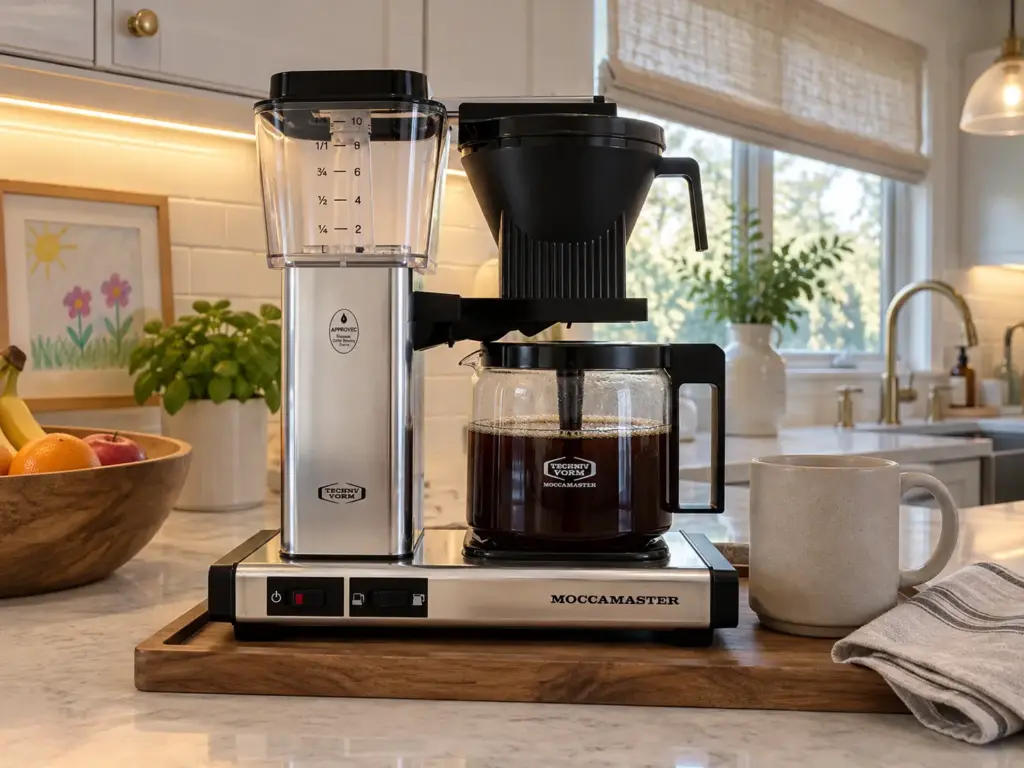
What the Moccamaster does that the box machines do not
The Technivorm Moccamaster KBGV Select 10 Cup pairs a 1475 W copper heating element with a wide shower and a half/full flow selector in the basket. Its listing gives 40 oz in 4 to 6 minutes, a warming plate at 175 to 185°F (79 to 85°C) and a 5-year warranty. “Ten cups” on the box is 40 ounces, which is three to four mugs; the arithmetic comes a few sections on. What the premium buys is the heater and the shower working together, which is the thing the first section argued matters, and a warranty of a length the budget row does not match.
The warming plate is the one design choice to watch. At 175 to 185°F it keeps anything sitting on it at brewing-adjacent heat, so a pot left there keeps cooking, and the next section is about what that does.
The small-dose flaw, and the flow switch that softens it
Below about 40 g of grounds the water spreads wider than the bed can take, the cup turns bitter and astringent, and the half position on the flow selector is the reported fix, which you should try before deciding the machine is wrong for you. A V60 cone can take the place of the basket to speed the water, and a shower screen from Coffee Pilot on top of it stops the over-agitation. It is extra spend on an already expensive machine. That is a workaround for tinkerers, not a recommendation.
The second flaw comes from Wirecutter’s review of the Moccamaster, which notes that it has no clock and no descale reminder. For a machine with no clock, an old analog timer does the job, with a prewetted paper filter and the flow set to half, so the pot is waiting in the morning. That works because there is nothing to program, and it means a full pot starts whenever the timer says, awake or not.
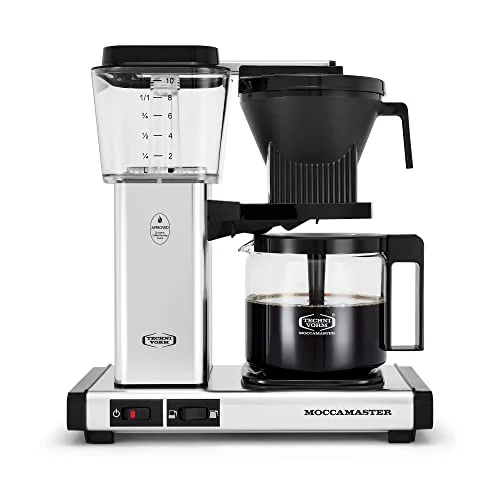
Who should skip it
Skip it if you brew one mug at a time. Small batches are the hard case: a wide shower sits over a shallow bed, and the half position is the only softener. Skip it too if the money is better spent on a grinder that holds a setting, because a scale and a good grind move a cup further than a premium heater does.
The budget row at the end of this article does much of the same job for a fraction of the cost, and the difference it leaves is the shower, the speed and the length of the warranty. And if a timer matters more to you than a copper element, a machine with a clock beats this one.
Thermal Carafe or Glass on a Warming Plate
A warming plate is where a good pot goes bad, and the carafe is the part that decides whether the coffee still tastes right an hour later. Both belong in the buying decision as much as the heater does.
What a hot plate does to a pot
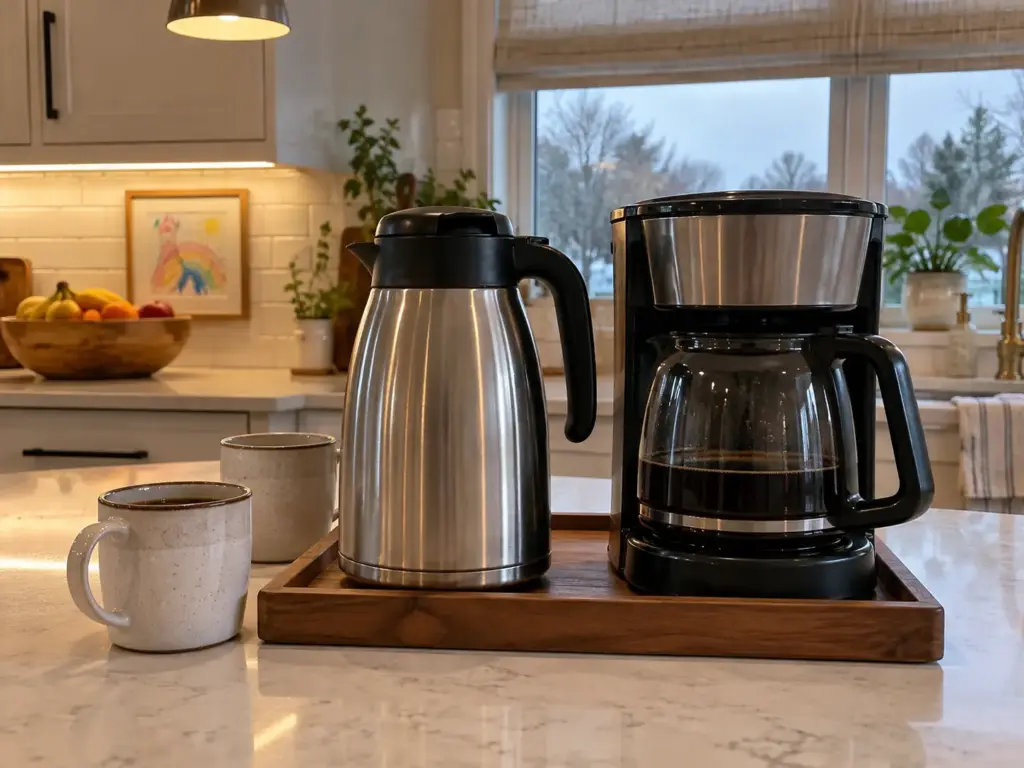
Glass on a plate sits at plate heat. The Moccamaster’s plate runs at 175 to 185°F (79 to 85°C) by its listing, 10 to 30 degrees under the window the water was brewed in, and heat keeps working on whatever is in the pot. The taste moves in a direction you can name: burnt and bitter first, then flat and stale as the aromatics leave and the heavy compounds stay.
The second pot of a weekend morning is the usual victim. It sits an hour after the first on a glass carafe still on its plate, and by the third mug it tastes like the pot is older than the clock says.
What a thermal carafe holds, and what it traps
A thermal carafe is an insulated flask, double-wall stainless on the Bonavita, and it holds heat without a heater, so nothing is cooking what it holds. It does not hold heat forever. In Bon Appétit’s tests one thermal carafe from another brand still held water above 120°F (49°C) after four hours, which is warm and not hot, so the first two hours are where a thermal carafe earns its keep.
The catch is the lid. A threaded lid with a gasket and a narrow spout is a place old coffee collects, and a food-media long-term test found one carafe’s lid tended to trap old coffee over the years.
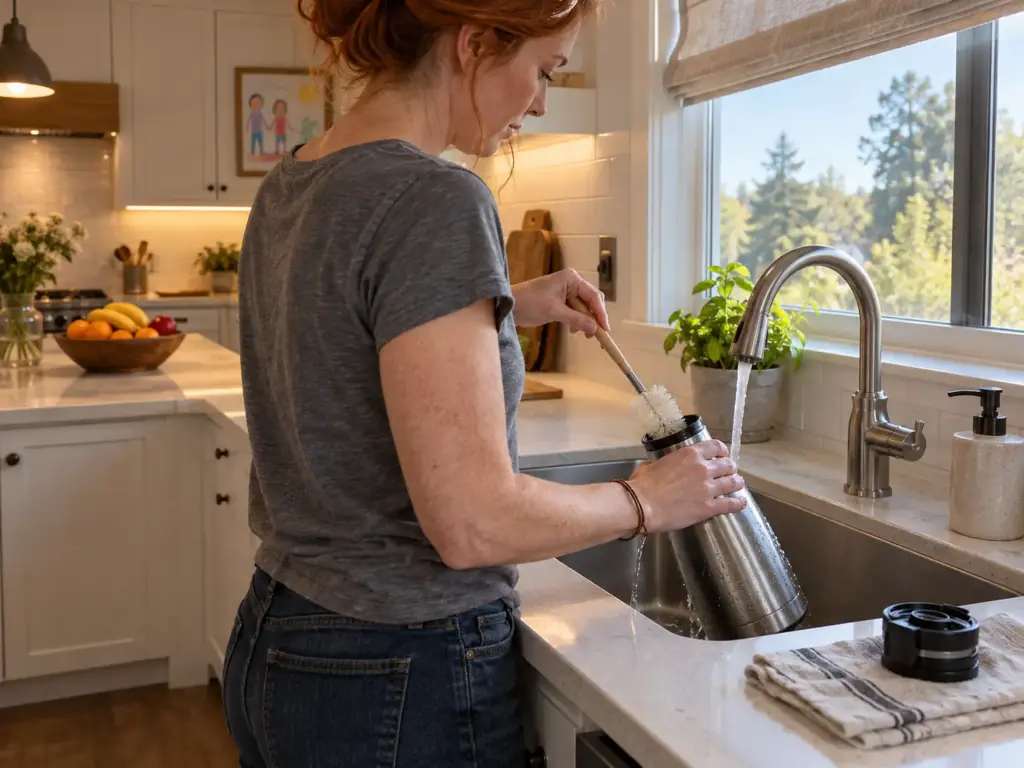
You notice it first as a sour-stale smell at the lid after a week, one that a rinse alone does not move, because water carries off the coffee and leaves the oils. Warm water and a brush do. Pair a thermal carafe with a bottle brush that reaches the narrow mouth, and the problem mostly goes away.
Preheat a thermal carafe too. Fill it with hot tap water while the machine heats and tip it out just before the first drip lands. A steel carafe that starts cold takes heat out of the first cup of the pot, and that is the cup that tasted lukewarm.
Which one fits the household that pours two mugs and leaves the rest
If you pour two mugs and leave the rest, the plate cooks what remains, and the pot that was good at the start is stale by the afternoon. A thermal carafe lets those two mugs go early and the third at a drinkable heat later. If everyone empties the pot within half an hour, glass on a plate loses nothing and you do not pay for the insulation. This is the whole decision: how long does the pot sit, and who is there to drink it.
The Thermal Carafe Pick That Skips the Hot Plate
For a reader who wants a thermal carafe from a maker that prints its specs, one pick makes the hot plate irrelevant. It is the cleanest answer to the problem of the last section, with one lid to look after.
What the OXO changes
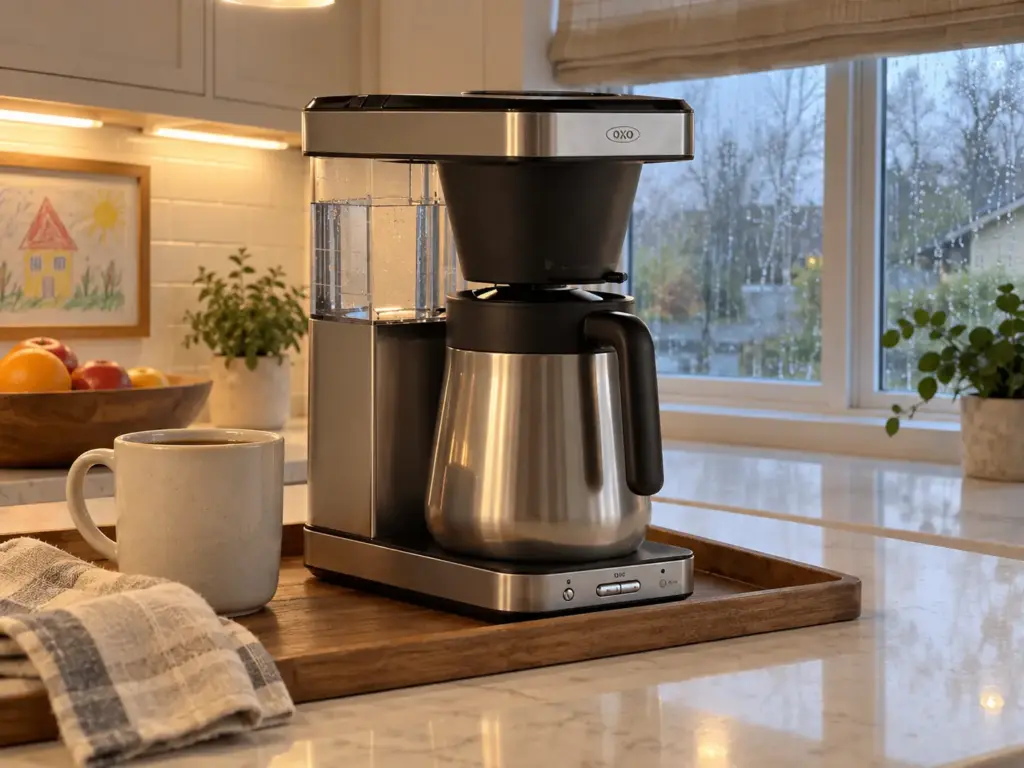
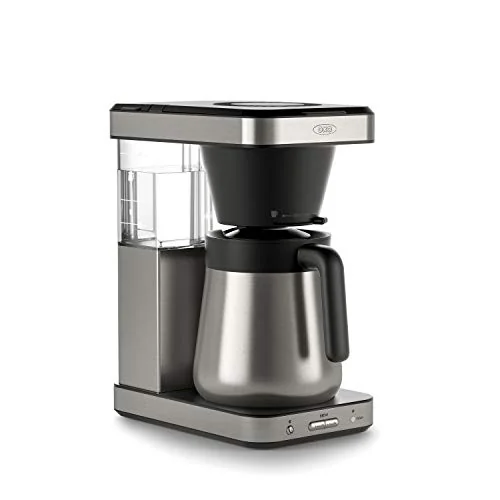
The OXO Brew 8-Cup Coffee Maker with Thermal Carafe is an OXO 8 cup machine of 5-ounce cups, 10 to 40 ounces per brew on the listing, with a 1400 W heater, a Rainmaker showerhead and a stainless thermal carafe. There is no plate to scorch the pot, so the coffee sits in the insulation instead of on a heater. The Rainmaker head is the OXO’s answer to the shower question from the first section: it is built to spread the water over the bed instead of dropping it in one stream.
The temperature it reaches, measured against its range
The listing states 194 to 205°F (90 to 96°C), which is the maker’s claim. Bon Appétit’s probe measured it at 196°F (91°C), the low end of the acceptable range. You can read that two ways, and the choice is yours: the machine is inside the window and the margin is thin, or the listing’s top number is not what the cup gets. If a sour edge shows up and a finer step does not fix it, the thermometer check from earlier is the way to tell which side your unit is on.
The lid, and the rinse routine it needs
The trouble sits in the carafe, not the heater. Wirecutter’s long-term testing found that the OXO’s lid tends to trap old coffee after years of use. That is a design flaw you can manage but not remove, so it needs a routine: unscrew the lid after each pot, rinse the threads, and brush the spout once a week. If the lid starts to rasp on its threads or you catch a faint sour smell at the seal, that is the early sign that it needs more than a rinse.
Cups on the Box, Mugs in Your Hand, and the Timer That Starts the Pot
Capacity and the timer are what turn a good machine into one that is still in use in month six, and both are printed in units that do not match your kitchen. A cup on the box is not a cup you drink from, and a timer is only as good as the pot that waits for you.
A box “cup” is not a mug
A cup on a drip machine’s box is about 4 to 5 ounces. An 8-cup machine of 5-ounce cups holds 40 ounces, which is about three 12-ounce mugs, and a 10-cup Moccamaster, whose cups are 4 ounces each, holds the same 40. Same ounces, different count on the box. Coffeekev’s review puts the Moccamaster at three to four mugs and the Breville’s 60-ounce carafe at five to six, and the gap between those two sentences and the number on the box is where most disappointment begins.
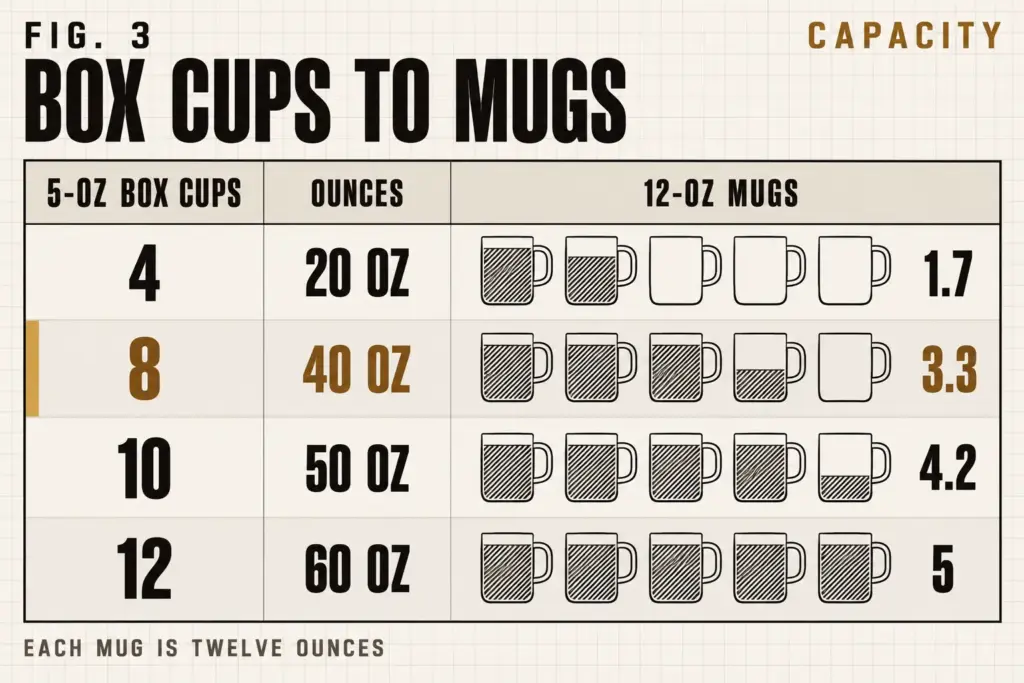
Run the same sum on any machine: box cups times ounces per cup, divided by 12 for mugs. Even between the picks here the box cup is not constant. The OXO 8 cup machine counts 5 ounces to a cup, while the Bonavita’s listing gives 64 fluid ounces for its capacity and calls the carafe 1.3 liters, about 44 ounces, so a single listing can carry two numbers.
Look for the ounces of the carafe, not the cups. The same sum runs from the other side in how many cups a 12-ounce bag of beans really makes, where grams of coffee become pots instead of the other way around.
The small pot problem
Below a full basket, and especially for a single cup, the cup goes thin or bitter, and the problem recurs across the machines. A wide shower over a small dose makes a shallow bed that the water over-agitates, and the cup turns bitter, as the Moccamaster owners report below about 40 g. The machine’s own answers are half-pot modes: the flow selector on that basket, or a half-pot setting on others.
Weighing is the dose-side answer. At a ratio of 28 g in 500 ml, a 12-ounce mug (355 ml) takes about 20 g, roughly four level tablespoons, while one 5-ounce box cup takes about 8 g, under two. That is why one scoop per cup goes wrong: it mixes box cups and mugs.
Weigh the dose per mug before touching the dial, the habit explained in weighing the dose before touching the dial. If a machine has no half-pot mode, the options are to brew a full pot into a thermal carafe and pour a mug later, or to preheat the mug so a small pot keeps its heat. Both are free.
The timer, the programmable start and the strength switch
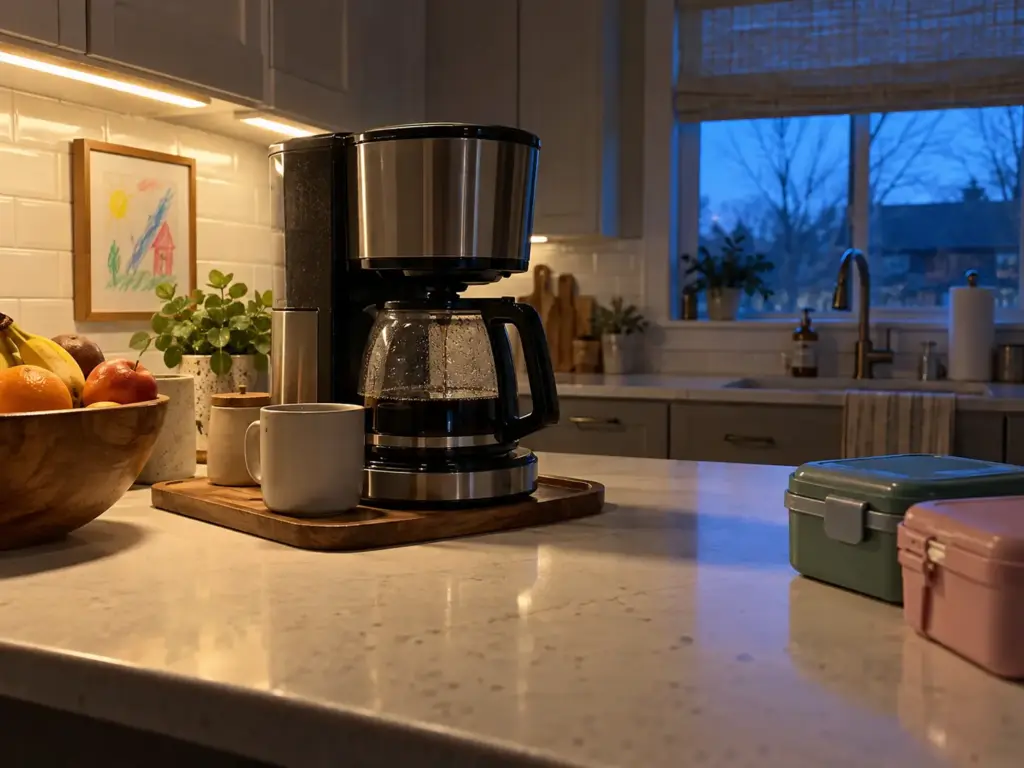
A timer, or an auto brew start, starts the pot before anyone is up. The cost is the pot sitting until somebody arrives, which is fine in a thermal carafe and slowly ruinous on a plate. The Moccamaster’s lack of a clock, from the premium section, is the other side of the same trade: a machine without a timer has nothing to program and nothing to forget. If the pre-dawn pot, starting on its own while only the under-cabinet strip is lit, is why you want a drip machine, then the timer is the feature you are really buying and the carafe is the feature that decides whether the timer was a good idea.
A strength switch is the feature most easily misread. It cannot add coffee to the basket. Whatever it does, it does to the water’s pace or its pauses, which moves extraction and not dose. A pot that tastes weak is still a dose question first, and the scale from earlier is where that starts.
The Glass Carafe Pick With Presets for the Cup You Want
The next pick is for a reader who wants the machine to name the cup, a preset for a fast pot, an iced one or a cold brew, and who accepts a glass carafe to get it. It is the one pick here with a menu, and the menu is the first thing worth taking apart.
What presets change in the cup
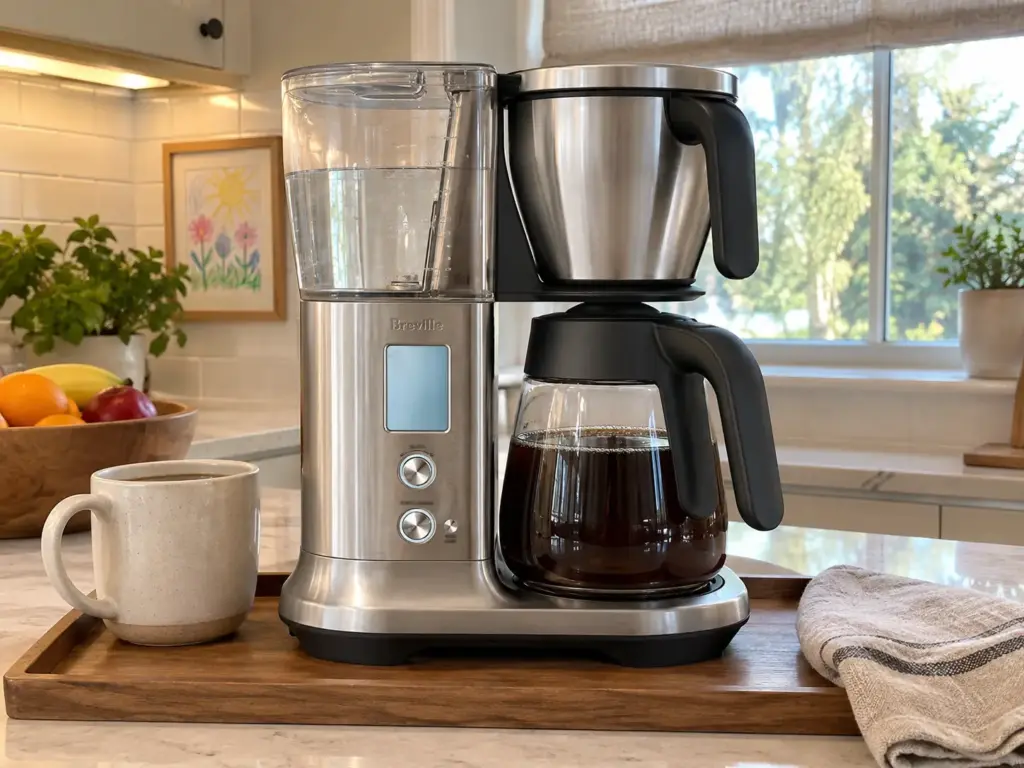
The Breville BDC400BSS Precision Brewer lists Gold, Fast, Strong, Iced and Cold Brew presets. A preset is a recipe the maker chose: a program for the water, not a measurement of your coffee. The preset named Strong cannot add grams to the basket, so the dose and the grind are still yours, and a wrong grind stays wrong under every name.
Where a preset helps is repeatability. The Breville Precision Brewer runs the same program for the same cup each morning, which suits the household that likes control but not a kettle.
The basket choice and the carafe
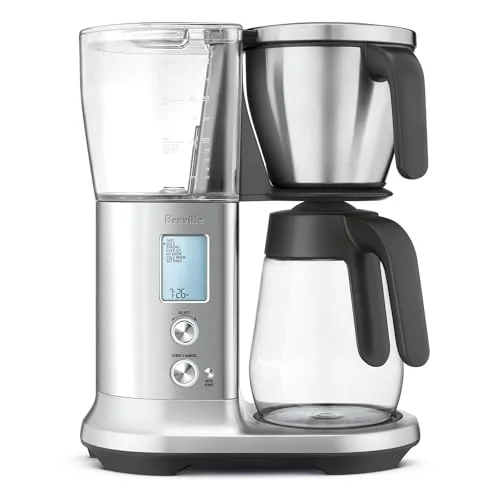
It ships with flat-bottom and cone baskets, and the choice matters more than the labels. A cone gathers the same grams into a deeper, narrower bed, so the water has to travel through more coffee, while a flat bottom spreads them wide and shallow, which is the small-dose problem from the Moccamaster section in reverse. The carafe is glass, 60 ounces on the listing, about five or six mugs. Glass holds no heat of its own, so anything that keeps it warm is a heater, and the plate from the carafe section is back.
The lid you cannot open to rinse
The lid is the weak point. The Breville carafe lid cannot be opened to drain and rinse, so water stays trapped in it. Drilling holes in the top to rinse it properly and running a cleaning powder through is a workaround, not a feature.
A button can eventually stop working, which seems to be a common problem. Water that cannot drain is water that sits, and a lid that stays wet is the one that smells by the third week.
What Wears Out First, in Months
Every pick here makes a good pot in week one. What matters by month six is the part that fails first, and the people who live with these machines report the same few failures again and again. A complaint that repeats is a design flaw, not bad luck, and counting them is the closest thing to a long-term test a buyer can get.
The water path: backing up and brewing halfway, and scale
The most-reported fault sits in the water path. A budget thermal machine can back up, leak and brew only halfway, and the fix can be taking off the bottom panel and clearing a connecting tube. A halfway pot is half a carafe and a basket that is still wet, and it is the first sign that something upstream of the coffee has gone wrong.
Scale does the slow version of the same thing. Minerals build up inside the heater and the tubing, the water slows, the pot comes out cooler, and the cup gets thinner without any single morning to blame. Hard water speeds that up, and a filter does not fix it: filtered water handles sediment and particulates but does not solve hard water.
A food-media long-term test reports pump noise returning after skipped descaling at almost two years. The sputter before the water starts and a pump that sounds louder than it did in the first week are the early signs, and they show up well before the machine stops.
Time one full pot today, from the button to the last drip, and write the number inside a cabinet door. In a month, time it again. A pot that takes noticeably longer is scale in the water path, and a descale is the free fix before anything else.
The parts that trap or rust: lids, showerheads, baskets
Lids come first, and you have met two already: the Breville’s cannot be opened to rinse, and the OXO’s tends to hold old coffee. Shower heads and baskets come next. A pricier machine can rust through at the shower head and brew basket, which leaves the brewer unusable. Metal that sits wet and hot every morning is the likeliest part to give out, and the cheap prevention is the same for all of them: dry the basket, take the lid off between pots, and use a bottle brush on a narrow carafe mouth.
Descaling, reminders and the warranty as a tie-breaker
How often to descale depends on your water and your machine, and your manual’s interval beats any article’s. A machine with a cleaning indicator tells you when, and one without it leaves the counting to you. One maker’s advice, quoted in a review, is monthly; the Moccamaster has no reminder, per Wirecutter’s review, which leaves the timing to you. A pot that gets slower or louder is the signal either way, and the descale itself is cheap.
When two machines are otherwise close, the warranty settles it, and it is easy to do in arithmetic. Five years is 60 months, and a fault at month six has used a tenth of it. The Moccamaster’s five years is the only warranty figure stated here, because the figures for the other picks differ between sources; read the one on your own listing. A machine that backs up again after you clear the tube is done, and a warranty is what turns that from an expense into a claim.
The Budget Pick, and When the Cheap One Does the Same Job
The last pick is the budget row, with an honest account of when the cheap machine does the same job as the premium ones and when it does not. It is also where the month-six complaints from the last section get tied to a name, with a caution attached.
What the Bonavita 8-cup gives
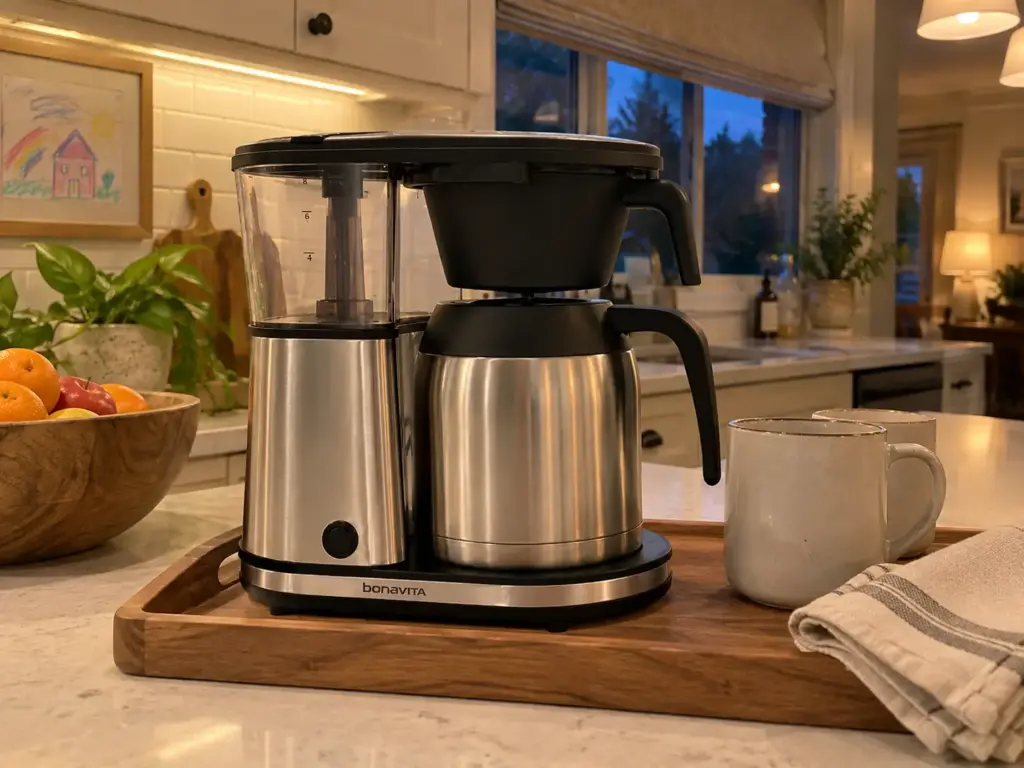
The Bonavita 8 Cup Drip Coffee Maker, One-Touch Pour Over (BV1901TS) brews 8 cups in about 6 minutes with a 1500 W heater, and its listing gives a stated 194 to 205°F (90 to 96°C). It has a double-wall stainless thermal carafe, a hanging flat-bottom basket and a pre-infusion mode that wets the bed before the main pour. The listing also says it is SCA Certified, the claim from the first section that you can look up on the SCA’s list rather than take on trust. A thermal carafe with a certified brew range is what most of the picks above sell, and this is the budget way to buy it.
The flaw that shows up at about six months
The complaint is the water-path one from the last section. The comment does not give the model, and the brand also makes other sizes, including a 5-cup, so treat it as a caution about the water path of the brand and not a verdict on this unit. If a first pot ever comes out with the carafe half full and the basket still wet, that is the thing to check, and the bottom-panel fix is the reported remedy.
When the cheap one does the same job
A pot that reaches the window and holds it in a thermal carafe is what most of the picks above are selling, and the budget row does that. What the premium machines buy is the shower, the speed and the five-year warranty. If your pot is a daily one for two people and you have a scale and a decent grind, the difference in the cup is smaller than the specs suggest. If you brew one mug, make a half pot, or want the longer warranty behind the machine, the premium row earns its extra.
Tomorrow’s Pot, and the Check to Run a Month From Now
Three things carry out of this article. The cup follows the temperature and the evenness of the water, so name the direction of the pot first and change one thing at a time, free first. The job decides the machine: a thermal carafe if the pot sits, glass if it empties fast, a scale for either, and the budget row if two people drink one pot a day. And the carafe, the lid and the descale decide month six, which is when a good machine and a poor one stop looking alike.
A month from now, time a full pot again and look at the spent bed: if it finishes in the same time and the basket is wet evenly to the edge, the water path is clean. If the pot is slower or the corner is dry, descale before you blame the beans.
Tomorrow, weigh your usual dose and write it down. If the pot is sour, go one step finer on the grind for a drip basket; if it is bitter, one step coarser; then taste the second pot, not the first. The next decision after a drip machine is the grinder, and a grinder that holds up after the burrs wear in is the second half of the same system. After that come the beans suited to a drip machine.
Frequently Asked Questions
01What is the best drip coffee maker?
The best drip coffee maker keeps its water between about 195 and 205°F (91 to 96°C) and wets the grounds evenly. Then match the carafe, the size and the timer to how you drink, and weigh the flaw each pick above carries.
02How many mugs does a 10-cup coffee maker make?
A 10-cup coffee maker fills about three to four 12-ounce mugs, because a box cup is only 4 to 5 ounces. Multiply the box cups by the ounces per cup, then divide by 12 to count mugs.
03Is a thermal carafe better than a glass one on a hot plate?
A thermal carafe is better for a pot that sits, because it holds heat without a heater that keeps cooking the coffee. Its lid needs a rinse and a brush, since old coffee can collect there.
04Why is my drip coffee bitter when I make a small pot?
A small pot turns bitter in a wide basket because a small dose forms a shallow bed that the water over-agitates. Weigh the dose, use the half-flow setting if your machine has one, or brew a full pot into a thermal carafe.
05How do I know if my coffee maker needs descaling?
A coffee maker needs descaling when brews run slower, the pump gets louder, the pot comes out cooler, or the coffee tastes thinner than it used to. Follow the steps and the interval in your manual.



How did your cup turn out?
No comments yet. Tell us what you changed — and whether the needle moved.