
We may earn a commission when you buy through links on this page. It never changes what we recommend. How we pick
On this page8 parts
- Blade or Burr: What the Built-In Grinder Does to the Pot
- Run the Coarse End Before You Blame the Grinder
- The Grind-and-Brew Picks, Each With Its Flaw
- The Loud Grinder and the Chute You Cannot Take Out
- When the Welded Grinder Is the Part That Fails
- A Separate Grinder With a Drip Machine, and When It Wins
- Check the Type, Walk the Dial, and Treat the Grinder as Permanent
- Frequently Asked Questions
Last month’s pot was fine. This morning’s is thin and sharp, with the same beans, the same tap water and the same dose, and the one part you would check first is bolted inside the brewer, where you cannot take it out, swap it or run it alone. That is the real question behind the best coffee maker with built in grinder: the grinder sets the cup before the water touches it, and in a grind-and-brew coffee maker the grinder and the brewer are welded together, so the choice gets made once. The order below runs from blade or burr, to a test for the coarse end of the dial, to the picks and what is wrong with each, then the noise, the chute, the part that fails, and the cases where two separate parts win.
Quick Answer
A coffee maker with a built-in grinder is worth buying only when the grinder is a burr set whose settings reach the medium grind a drip basket needs, and you accept that it cannot be replaced without replacing the machine. A blade grinder makes the pot sour and bitter at once, so check the grinder type first.
Blade or Burr: What the Built-In Grinder Does to the Pot
The question is less which machine than which grinder sits inside it, because that part sets the cup before any water reaches the grounds. A blade chops and a burr set crushes between two surfaces, and the difference shows up in the same pot as one flavor or two. Three things settle it: what a blade does, what burrs change, and how to find out which one is in your machine.
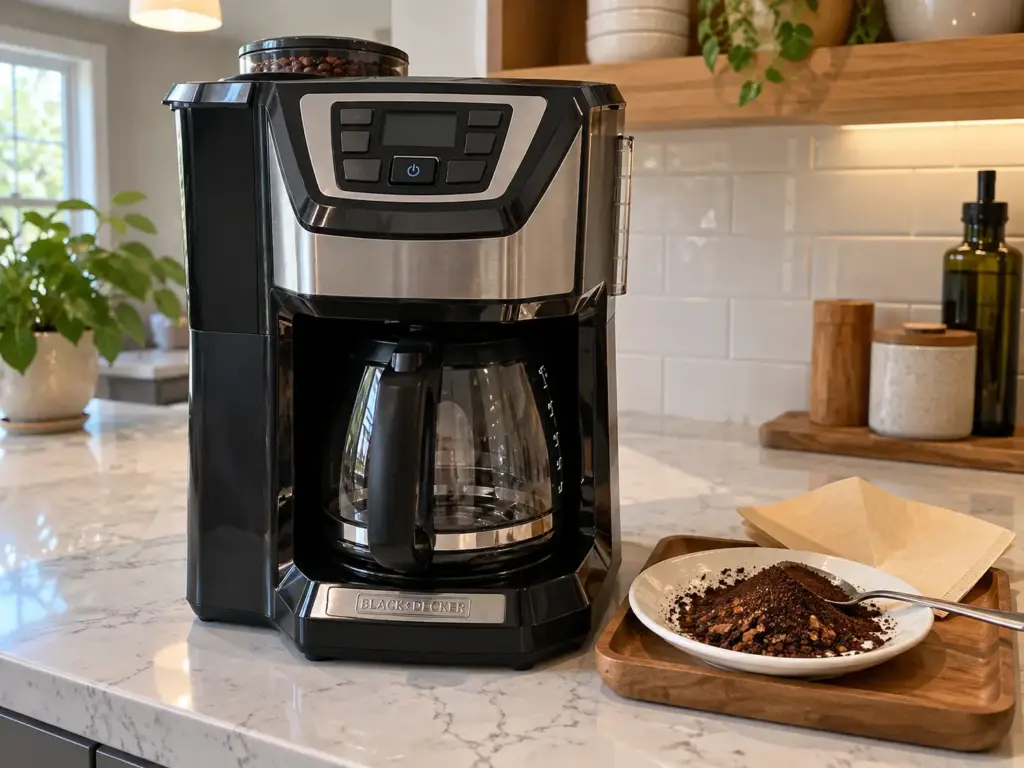
What a blade does to one pot
A blade grinder is a small propeller that spins through the beans and cuts whatever it reaches. There is no gap to set, so the grounds leave in whatever sizes the blade happened to make: boulders it hit once and dust it hit a dozen times. Water treats the two very differently.
A boulder keeps most of its flavor deep inside, so the water moves on before it has finished and that share of the pot tastes sour and thin. The dust gives up everything in the first minute and keeps giving, so another share of the same pot tastes bitter and harsh. Sour and bitter arrive together, and neither the dose nor the water temperature can pull them back, because the trouble is the spread of sizes, not the average.
Running the blade longer does not help. It shifts the average finer by making more dust, which is the part that was already over-extracting. One review of a grind-and-brew machine with an integrated blade says that design “may lead to less consistent grinds and a slightly less refined cup” (Spruce Eats), and that is the polite version of the same pot.
The BLACK+DECKER 12-Cup Grind and Brew Coffee Maker (CM5000B) is the machine a reader on a short budget is most likely to meet with this pattern. It makes 12 cups (60 oz), Spruce Eats describes the Black+Decker grind-and-brew machine as having an “integrated blade grinder,” and its drawback comes in one line: “One drawback we found with this coffee maker is the loud grinder.” Amazon lists it as usually shipping in one to three weeks, so it may not be on your counter when you want it.
What the pot does with that grinder switched off belongs to a different guide, which holds the grinder-off test on the BLACK+DECKER and is not repeated here. The longer comparison of the two grinder types, with what each does to a cup, is in burr versus blade grinders.
What a burr set changes
A burr set works the other way around: two toothed surfaces a fixed distance apart, and a bean has to get small enough to pass between them. The gap is the setting. Move it and every bean in the next dose is cut to roughly the same limit, so the sizes land in a narrow band instead of a scatter.
Narrow does not mean perfect (burrs wear, and a dull set makes more dust than a sharp one), but for a drip basket it is the difference between one flavor and two. How a burr grinder works and how it drifts covers the wear side.
Breville’s owner’s manual for the Grind Control describes its flat stainless steel burrs in terms of the grind they make: the “optimum size for Drip Filter brewing.” That is a maker’s claim, but a checkable one, because the same manual prints the settings that go with it, and the next section puts them to work.
One thing a burr set does not change: a grinder keeps a little coffee inside, in the burr chamber and the chute, so the first dose after any change in setting still carries some of the old grind. Allow for that before you decide a change did nothing.
How to tell which one is in your machine
Start with the hopper. A dial, a slider or a row of numbers beside it means a burr set, because only burrs have a gap to adjust. No setting at all, plus a short, loud whir when it runs, points to a blade.
That is a rule of thumb and not a guarantee, so the manual has the last word: look for the grinder in the parts list, where Breville’s, for one, names an “Integrated Adjustable Burr Grinder.” If the manual lists no type and the machine has no dial, treat it as a blade until something shows otherwise.
“Grind and brew” on a box describes a feature, not a grinder. The type is a separate line in the specs, and a listing that leaves it out has left out the one fact that sets the cup.
The reason to settle this before anything else is that a built-in grinder is the part you cannot separate from the rest. A built-in grinder is such a hassle to deal with when it is bad, and the usual answer to the all-in-one question is two machines. Section six comes back to that answer.
Run the Coarse End Before You Blame the Grinder
A sour pot makes the grinder the first suspect, and the grinder is often the wrong one. The order is beans first, then the direction of the grind, then the coarse end of the dial, with one change and one taste in between. The thread has a phrase for that adjusting, “dial things in,” and this is how to dial in a machine whose grinder is welded in.
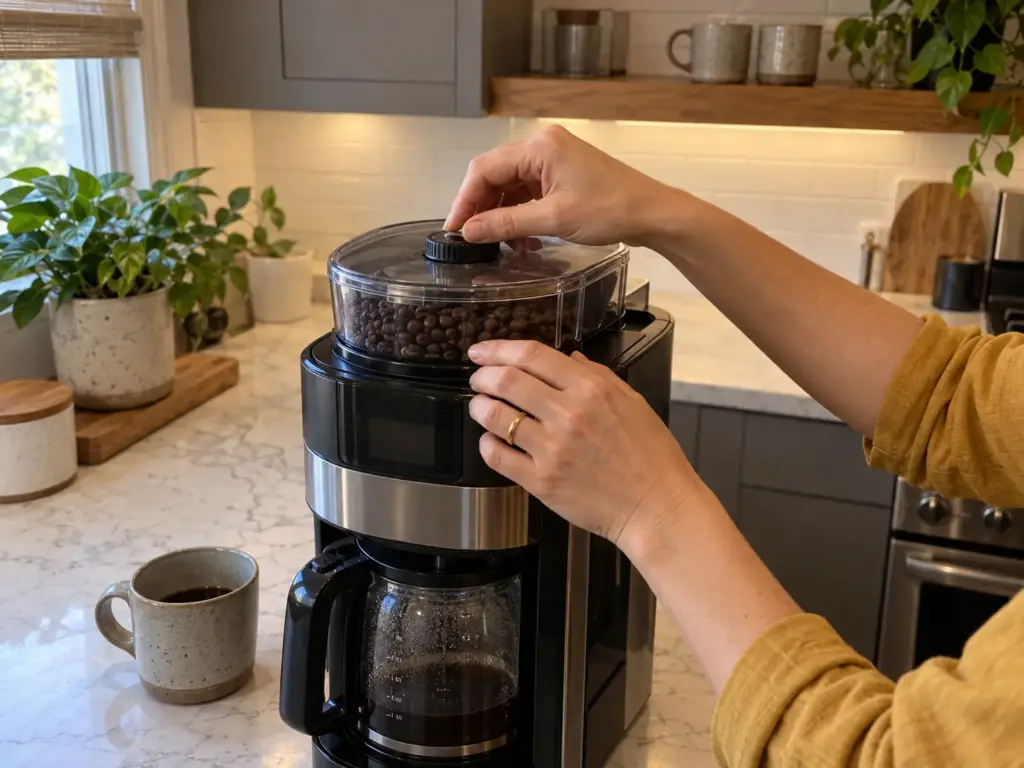
Start from the range the maker prints
A grind-and-brew machine with a dial usually prints a range, and the range is where the test starts. Breville’s manual for the Grind Control is a useful example, not a rule for every machine: setting 3 “should cover most coffees,” a grind size “between 2 and 4” suits most origins, and the manual steers a small 10 oz cup finer (2 to 3) and a full 12-cup carafe toward a medium-coarse grind (3 to 5). That breaks the number most guides repeat.
“Use the middle setting” is half an answer when the right setting moves with the size of the batch, because a full basket keeps the water in contact with the grounds for longer. The grind a drip basket needs gets its own page in the drip grind, sour means finer.
Before the dial, read the bag. Breville’s manual says coffee is at its peak flavor potential “5-20 days after roasting,” and it asks for a roasted-on date on the bag. A bag with no date cannot be placed on that window, and beans well past it taste flat at any setting, which is easy to mistake for a grind that is too coarse. Fix the beans first and the dial may not need touching at all.
If the date is fine and the pot is still off, the dial is next, and the direction rule does the work: how grind size changes the taste, sour to bitter shows it at every setting. Sour points one way and bitter the other, so a pot has to be named before it can be fixed.
The coarse-end test, one notch at a time
Call the coarse end the side of the dial where sour pots come from, and the test is a walk away from it. It needs a dial. On a machine with no setting there is nothing to walk along, and that absence is the finding: the grinder is a fixed part of the cup, and the only moves left are the beans, the water and the dose. Check the grounds by eye as well as by taste, because rub, sift and time it shows boulders and dust that the number on the dial never mentions.
The rule the walk follows is the one the maker prints. A grind that is too fine, Breville’s manual says, gives coffee that is “over extracted, too dark and bitter,” and one that is too coarse gives “an under-extracted coffee lacking in flavor.” In the cup, the second is the sour, thin, watery pot and the first is the harsh, dark one.
Sour means finer. Bitter means coarser. Nothing else moves.
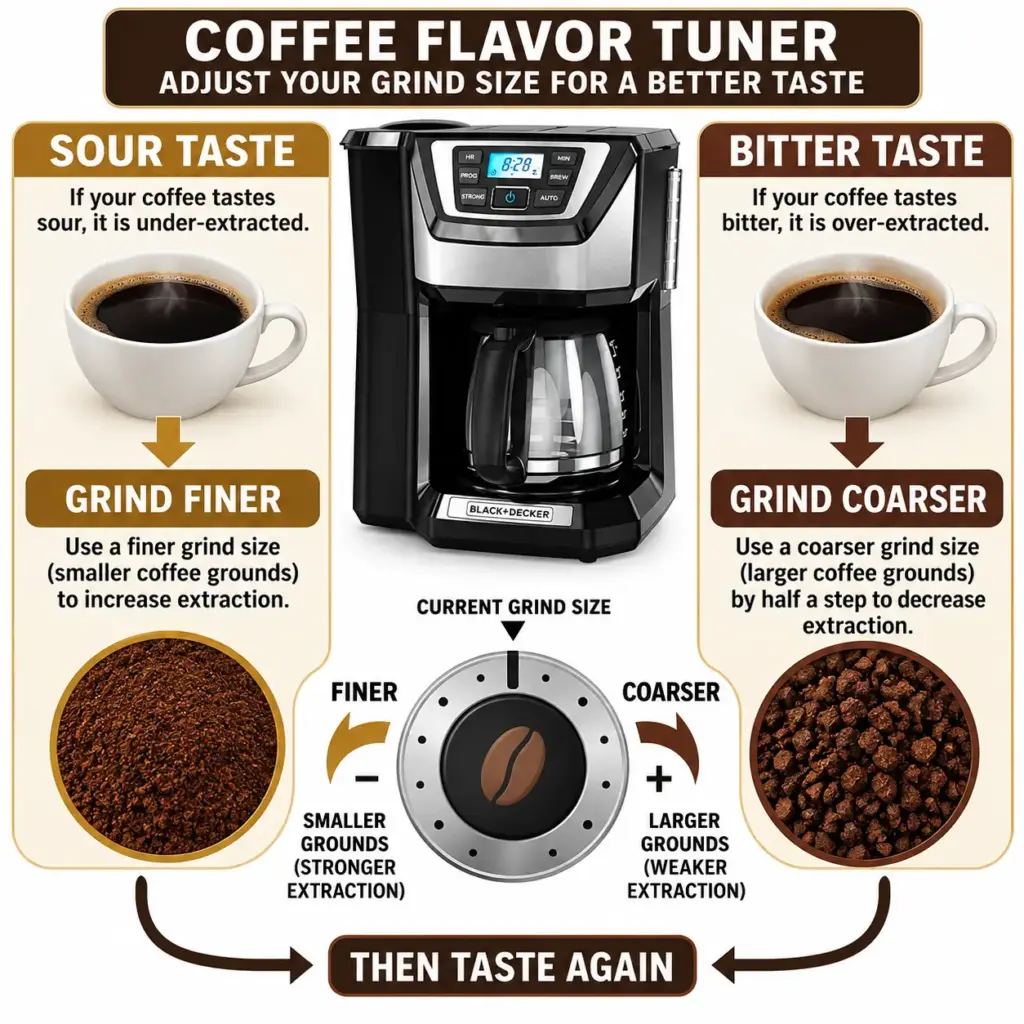
The walk itself is short:
- Brew a full pot at the setting the maker prints as the start, with fresh beans and your usual dose, and taste it.
- If it is sour or thin, move the dial one notch finer. Change nothing else, brew the same amount, and taste the second cup, because the first still carries the old setting.
- If the cup is flatter but the sharpness is still there, take another notch.
- If it turns harsh or dark, go back one notch and stop.
A dial with six positions, like the Grind Control’s, has no half notch, so an overshoot costs a whole notch. A 12-cup pot that is sour at 5, the manual’s own coarse end for that carafe, should go to 4 before anything else; if it is still sharp at 3, the dial has come down most of its useful range and the grinder has earned the suspicion. If every notch lands either sour or bitter and none lands in between, the step between positions is wider than the pot is forgiving, which is a limit of the built-in grinder and not a mistake in the method.
Move the dial one notch per pot and write down only the notch count and one word for the taste: sour, flat or bitter. If the word stops agreeing with the number, the grinder is the thing to question, and the beans and the water can wait.
Still sour at the coarse end? The next suspect
Take the walk as far as the dial goes. If the pot is still sour at the finest setting, the reach of the grinder is the limit, and no change in the water will repair that. A bean-to-cup filter machine can still give weak coffee even at max dose and finest grind.
That is a different machine type from a grind-and-brew drip unit, so it is not a rule for yours, but the picture is familiar: a dial pinned at its end and a cup that has not moved. Maxed out or worn splits the two causes, a grinder that cannot reach the grind and one that used to.
That also corrects the shortcut that a burr set is a safe buy. A burr set is only as good as the range its dial covers, and a machine whose finest setting stops short of what its basket needs is a burr grinder that still makes a sour pot.
If the pot is sour at a setting well inside the range, the dial is not the culprit. The next suspects come in a fixed order, cheapest to check first: the dose, then the water, then the beans. For the dose, a 12-cup pot is 60 oz of water, and Breville’s pre-ground rule is one level tablespoon per 5 oz cup, so twelve level tablespoons for a full pot; a heaped or a short scoop moves the pot more than a notch does.
For the water, ordinary tap water leaves scale inside a machine over time, and scale slows the flow and cools the brew. For the beans, a bag with no roast date is a stale bag until proven otherwise.
The Grind-and-Brew Picks, Each With Its Flaw
Two machines earn a card, and the reason is the same for both: the grinder inside is a burr set, not a blade. Each comes with what is wrong with it written next to what is right. Both come after the free checks of the section before, because a card is the expensive answer to a sour pot.
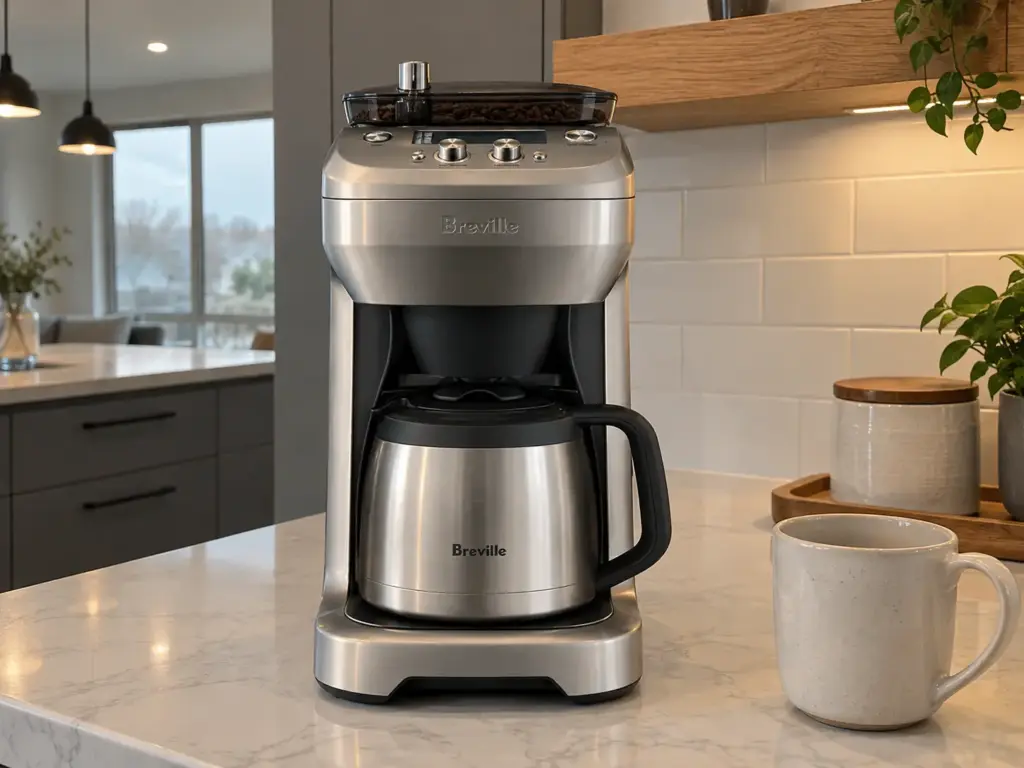
The burr machine with a printed range
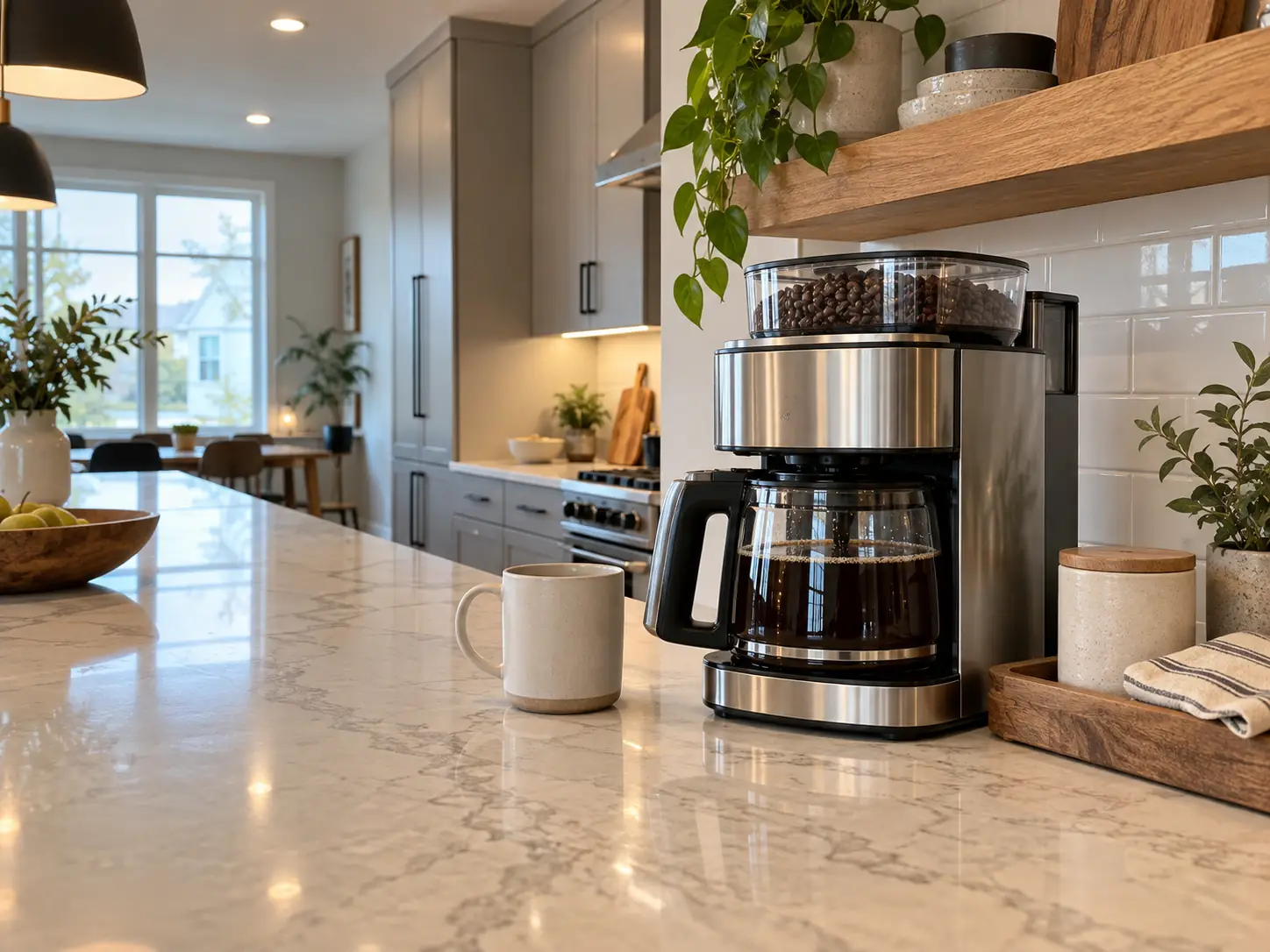
The Breville The Grind Control (BDC650BSS) is the machine where the dial test has something to work with. Its flat stainless steel burrs have six grind settings, the manual prints what each part of the range is for, the brew strength runs through eight settings, and the bean hopper holds half a pound at most (0.5 lb, and the manual warns against over-packing it). The carafe makes 12 cups, 60 oz, with two cups as the minimum for a pot, since one cup is a different mode.
Calibration is by weight, so the dose can be corrected on the machine itself, and section five explains what that does. Of the grind-and-brew machines read for this guide, it is the only one whose grind range is printed in its own manual, with a dial you can read through the hopper lid.
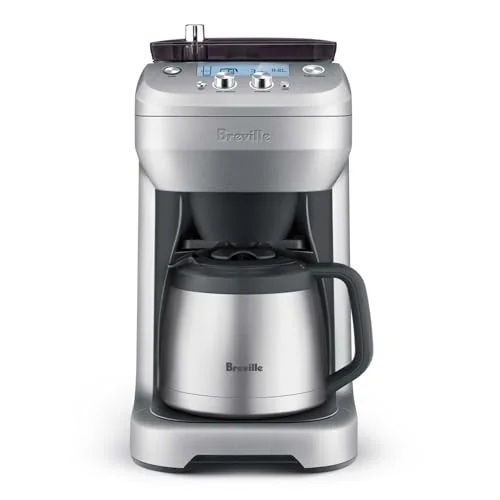
Two flaws go with it. The first is a chore the manual states plainly: the coffee chute has to be cleared every 2 to 3 weeks, or the basket overflows, and section four covers what that looks like. The second is a reviewer’s judgment: Serious Eats says the Grind Control “didn’t get hot enough to brew really good coffee” and is “more likely to get glitchy and break over time.” Neither is a measurement, which matters in the third part of this section, and a review’s read on mechanical parts is an opinion about the parts, not a failure rate.
The one an independent lab certified
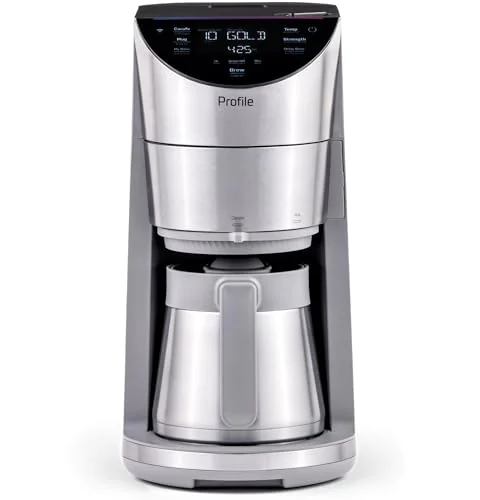
Certificates are scarce in this corner, and a box that says “professional” is not one. According to the SCA’s certified home equipment list, “The following models have successfully completed SCA third-party testing.” Of the grind-and-brew machines, the list as read names two from GE, the Café Specialty Grind & Brew (10 cup, 2023) and the GE Profile Smart Grind & Brew (2023).
The Breville and Cuisinart grind-and-brew machines are not on it. A certificate means a lab tested the machine, which is more than a box can say for itself.
The GE Profile is a podless machine with an adjustable burr grinder (six grind settings in its listing), a 10-cup thermal carafe and a 90 oz reservoir. A thermal carafe keeps the pot off the warming plate that a glass carafe sits on, which is where a pot goes bitter as it sits. No repeated complaint about the machine turned up in what was read, and that is an absence in the reading, not a clean bill. Two limits apply regardless of the certificate: the grinder is one of the machine’s numbered parts and cannot be replaced without replacing the machine, and a certificate speaks to the day of the test, not to month two.
What the reviews measure, and what they leave out
Two reviews of the Grind Control look as if they disagree, and the disagreement is the useful part. Spruce Eats measures time: it brewed “a full pot in just about six minutes” and kept the coffee “warm for hours.” Serious Eats judges heat, with no number: the machine “didn’t get hot enough to brew really good coffee.”
They are not measuring the same thing. A fast pot can still be a cool one, and a warm carafe is not a brew temperature.
Neither the Grind Control nor the GE Profile has a published brew temperature. The only measured temperature in the reviews belongs to a Cuisinart machine this guide drops: Spruce Eats recorded a brew “reaching 188 degrees Fahrenheit” (87°C) and named it the hottest of the machines it measured. Treat it as a reference point, not a pick. Whether 188°F is hot enough is a question for the brewing standard, and the drip guide that picked by water temperature is where the standard gets applied to whole machines.
So for a reader choosing between the two cards, the call depends on which unknown matters more. The Grind Control gives a dial test you can run today and a heat question with no measurement behind it. The GE Profile gives an independent certificate and a thermal carafe, and a grinder whose range is not printed in anything read. Pick the Grind Control to be able to walk the dial; pick the GE Profile for the lab’s word and the carafe.
| Machine | Grinder and settings | Hopper and carafe | The flaw |
|---|---|---|---|
| Breville The Grind Control | Flat stainless steel burrs, 6 grind settings, 8 strength settings | 0.5 lb hopper at most, 12-cup (60 oz) carafe | Chute cleared every 2 to 3 weeks; one review found it too cool |
| GE Profile Smart Grind & Brew | Adjustable burr grinder, 6 settings in the listing, SCA certified | Hopper not read; 10-cup thermal carafe, 90 oz reservoir | No repeated complaint found; the grinder cannot be replaced alone |
| BLACK+DECKER Grind and Brew (CM5000B) | Integrated blade grinder, no setting range read | 12 cups (60 oz); about 7 to 8 oz hopper on blade models reviewed | Loud grinder; less consistent grinds |
A reader who wants to spend a fraction of what the Grind Control costs has the cheaper drip machines and the heat they give up, and the BLACK+DECKER from the first section is the grind-and-brew version of that same trade.
The Loud Grinder and the Chute You Cannot Take Out
A grinder inside a coffee maker runs at the hour the house is asleep, and it lives behind a door that never opens all the way. This section prices that morning in noise and chores, then the version of both that shows up after a few weeks.
The grinder at six in the morning
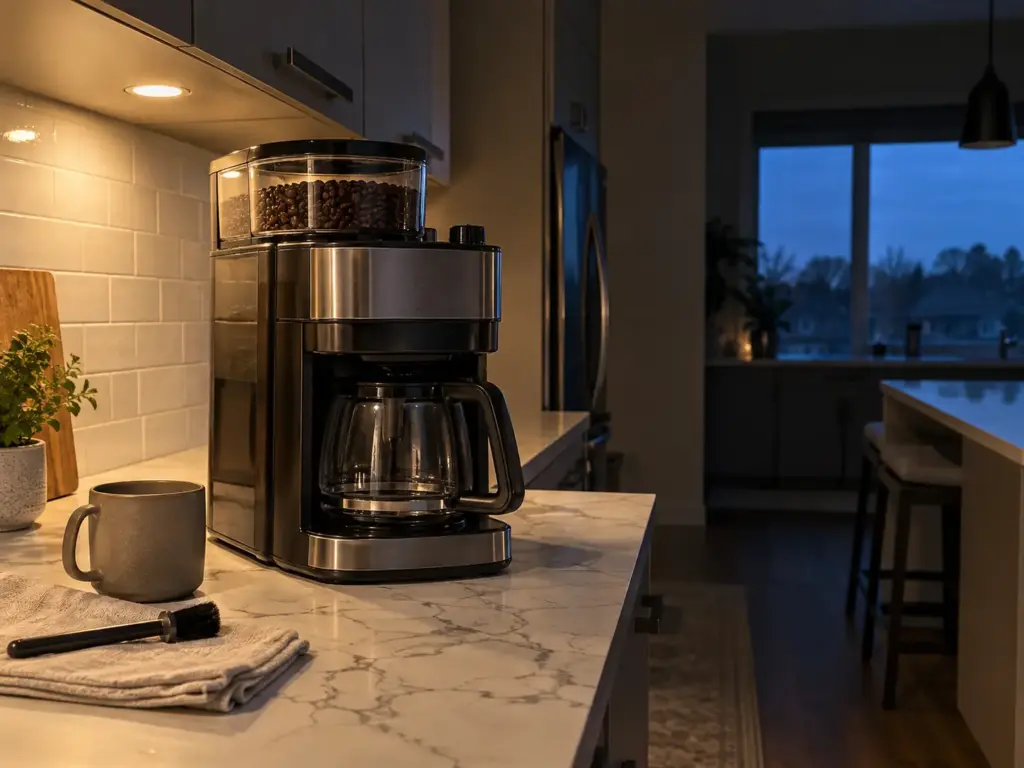
Noise is the cost no review put a number on. What exists is a verdict by ear: Spruce Eats calls the Black+Decker’s grinder “the loud grinder” and the blade in its Cuisinart Coffee Center review “a bit loud.”
The timer is where that bites. A machine set to start before anyone is awake takes the whole house with it, and the grinder runs for the length of one dose before any water moves. For the separate-grinder side of the question, check the RPM, not the box is the comparison to read.
Dust is the other half. Wirecutter’s flaws for the Baratza Encore, a separate grinder, say “the Baratza machines can be messy when grinding coffee, spreading dust and chaff over the counter.” Chaff is the papery skin that comes off the bean, and a built-in grinder does not remove it; it moves the mess into the chute and the space around it. A built-in grinder tidies the counter and dirties a place you cannot see, which is a fair trade only if you remember to look.
If the noise is the problem, the machine offers one answer and a workaround. The answer is a later start time. The workaround is to stop grinding in the machine: the Grind Control has a pre-ground setting that turns the grinder off, and a separate grinder can be run at a time of your choosing.
Pre-ground coffee goes flat sooner than freshly ground coffee from whole beans, so that trade has a cost in the cup, and it is the reader’s to weigh. All in one means no separate grinder, and the price of that is noise and mess you cannot move elsewhere.
The chute and the hopper chores
On the Grind Control the screen shows CLEAN COFFEE CHUTE when the chute wants attention, and the maker says that, depending on how often you use it, “you may choose to do this every 2-3 weeks.” Skip it and grounds left in the chute make the basket overflow, in the manual’s own words. Cleaning the grinder this way is a chore on the maker’s own schedule, and a separate grinder does not hand it to you in the same place.
A smaller version runs after every brew. The screen reminds you to empty the filter, and the disc under the swing door collects a film of grounds. A film is easy to wipe and easier to forget, and what it does is leave old grounds in the path of the next dose. The machine ships with a cleaning brush, and the brush is the whole tool for this job.
Keep the cleaning brush where you can see it, on the counter beside the machine and not in the drawer. A chute you check is a basket that does not overflow, and a brush in the drawer is a chute nobody checks.
What not to put in the hopper
The manual gives three rules, and each has a mechanism behind it. Never over-pack the hopper, because the grinder may jam. Keep no more than about a week of beans in it, because the hopper is an open bag on the counter and the maker’s own window for peak flavor is 5 to 20 days after roasting. And never pour water into it, because moisture clogs the grinder.
The week-of-beans rule fits an ordinary kitchen badly if the bag lasts three weeks. The answer is to fill the hopper for the week and keep the rest of the bag sealed, not to fill it for the bag. The water rule also decides how the hopper gets cleaned: with a brush and a dry cloth, never a rinse. When the grinder stops mid-dose, a hopper jam, or heat is the quickest way to tell which of the two has stopped it.
When the Welded Grinder Is the Part That Fails
Week-one reviews cannot see a grinder wear. A grinder built into the machine shows its age in month two or later, and the first sign is a pot that drifts, not a part that stops. This section sorts the grinder from the water and the beans, and says what the end of a built-in grinder means.
Calibrate and reset: what each one actually changes
Serious Eats mentions a “calibration reset if your coffee doesn’t taste right” for the Grind Control, and the phrase makes the two sound like one rescue. They are two different things, and neither touches the grind. Breville’s manual says the calibration mode “allows you adjust the amount of coffee delivered.”
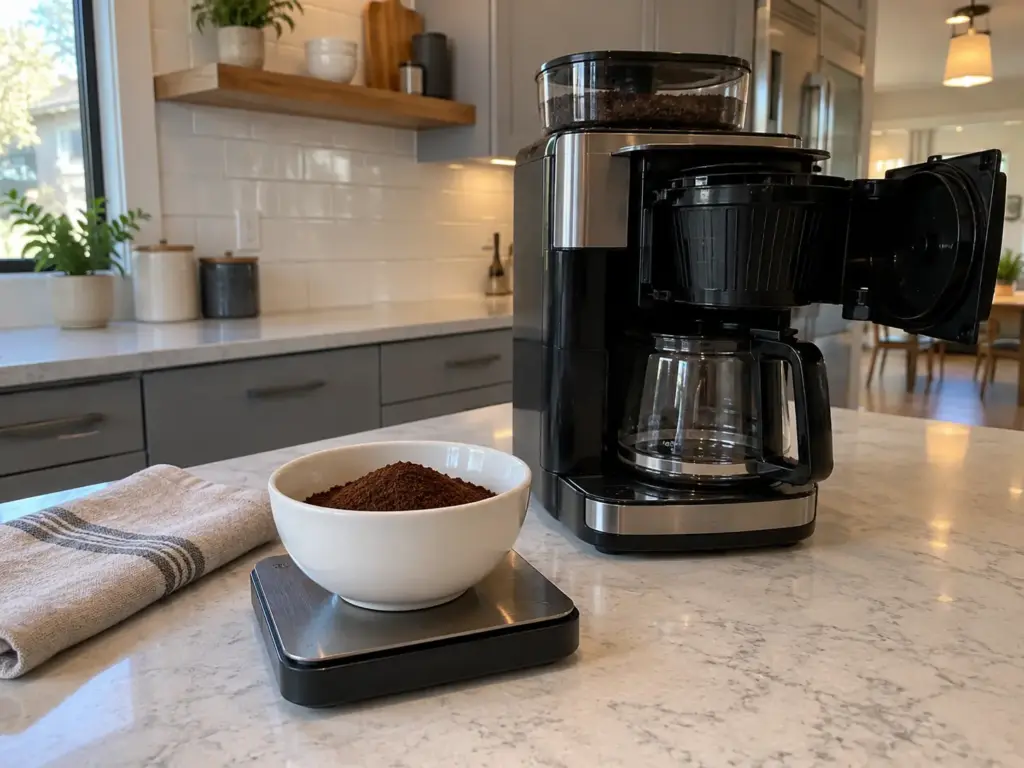
You run the grinder for 10 seconds, weigh what came out on a scale accurate to 1 g, and match that weight on the strength dial. It fixes the dose. The reset is a different button with a different job: it restores “the CLOCK, AUTO START ON time and the Grinder output times” to factory settings.
In the cup, the line between them is the direction. Dose changes strength; grind changes direction. A pot that is too weak or too concentrated but tastes of the right thing is a dose problem, and calibration can reach it.
A pot that is sour or bitter is a grind problem, and neither calibration nor reset will move it, because neither moves the dial. Running a reset because the pot tastes sharp is a way to lose the clock settings and keep the sharpness.
The calibration run has a small bonus. It is the only moment you hold the grinder’s output in a bowl, ten seconds of it, and a quick look at the grounds before they hit the scale is the cheapest look at the grind the machine will ever give you.
Signs it is the grinder, not the water
A built-in grinder does not announce its end. A burr set that wears cuts less cleanly, and the usual first sign is that a setting that worked starts to give a coarser, more uneven pot. The signs that point at the grinder, in the order they tend to show, are these:
- The beans are fresh and the dose is right, but the pot stays off at a setting well inside the range.
- The grounds look uneven by eye, with visible boulders next to dust, when you sift them.
- The dial no longer changes the pot: a notch finer and a notch coarser taste the same.
The signs that do not point at the grinder come first in the check, because they are free: scale in the machine, a carafe that has not been washed properly, and beans that are past their window. A machine that has run on tap water for months has probably collected scale whether or not the grinder has changed, and scale alone can make a pot thin and cool. Clear those three before blaming a grinder that cannot be removed. For the grinder itself, signs, not pounds lays out what wear looks like in a separate grinder, which is the same wear a built-in one goes through without the option of a swap.
Rinse the filter basket after each brew and let it dry fully, and wipe the chute area dry with a cloth. The maker asks for the filter to be emptied after every brew, and a wet chute is the first place grounds cling and clog.
The decision when it is
If it is the grinder, the options are narrow. The manual lists the grinder as one of the machine’s numbered parts, “Integrated Adjustable Burr Grinder,” and the opened sources name no spare for it. This guide does not claim a part is sold or is not sold, because no source says either way. What the sources do support is the decision rule: a new machine, or a separate grinder with the old machine kept as a plain drip machine, grinder off.
The GE Profile and the Grind Control share this property: the grinder cannot be replaced without replacing the machine. That is the price of the convenience and it is paid at the end, not at checkout. Serious Eats’ “more likely to get glitchy and break over time” is the review’s own reading of the mechanical parts, so it should be read as a reason to expect a finite life, not as a failure rate for either machine. How long coffee grinders last gives the lifespan question its own page, and the answer there applies to the part inside your machine too.
The second option, a separate grinder with the old machine, is where the next section picks up. It turns a failed grinder into the loss of one part, and it leaves the brewer, which may be perfectly good, still brewing.
A Separate Grinder With a Drip Machine, and When It Wins
Asked which one machine to buy, the answer is two machines. This section says what two parts give up and when they win, and it closes on the next decision a reader faces.
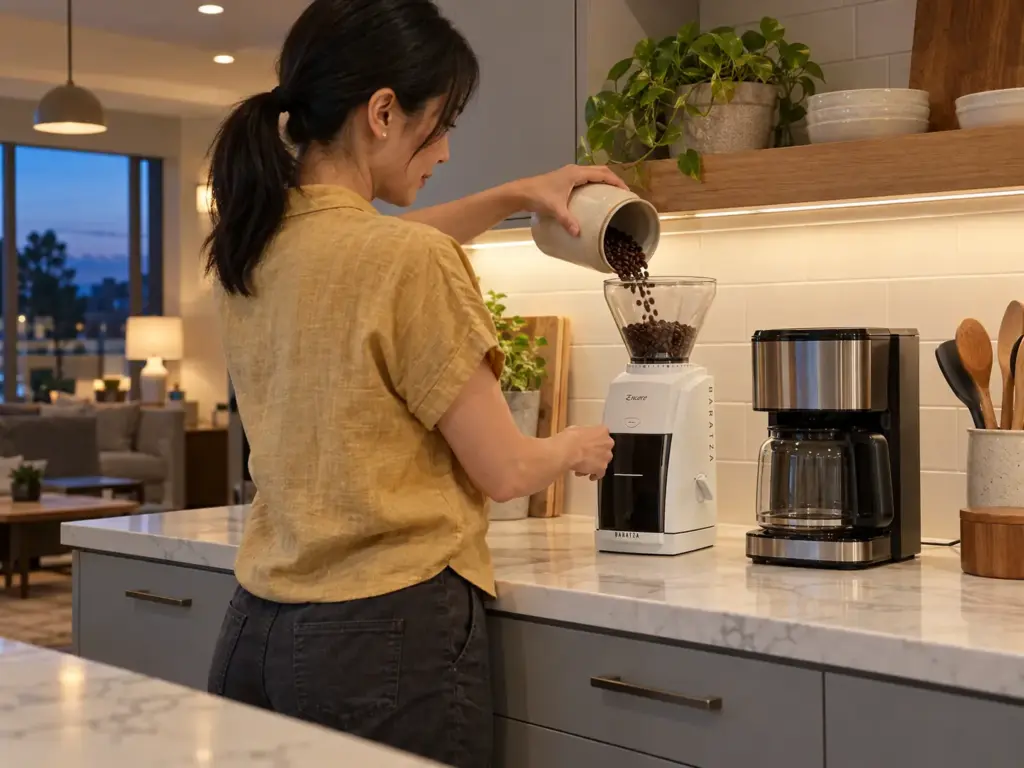
What two parts give up
Separate grinder and machine setups cost the same money or less, which is the case for two parts. The case against is the cost in daily use: a second plug, a second part to wipe, and counter space for both. A separate grinder also lets you judge the range on its own terms, and the grind size chart, in microns puts settings from different grinders on the same scale.
Two parts win when the drip coffee maker is fine and the grinder is the weak link, or when the reader wants to replace the grinder without replacing the machine. They lose on a counter with no room for two, and for a reader who will not wash two things. The dial test still applies, and on a separate grinder it has a clean version: a setting count you choose when you buy, a notch you can move without touching the brewer, and a part that can be swapped if it fails.
The free fixes before any purchase
Before a second part, the free ones. A fresh bag with a roast date comes first, and read the roast date first is the reason why the date matters more than the dial. Then the grind direction, one notch at a time, as in the coarse-end test.
Then a clean basket and a clean chute. If a sour pot survives all three at a setting well inside the range, the grinder is the candidate.
The two grinders, with their flaws
For the reader who goes the separate-grinder route, the budget path runs through the Baratza Encore Coffee Grinder (ZCG484WHT). It has 40 mm conical steel burrs and 40 grind settings, which solves the six-position problem from the coarse-end test: with forty positions, a notch is small enough to taste. It has an on-off switch and no timer, and Wirecutter lists its flaws as “Flaws but not dealbreakers”: it “can take a long time to grind on a very fine, espresso-like setting,” and it is messy. A cheap grinder that stays even at the coarse end is the comparison to read for the reader still choosing.
The step up is the Breville Smart Grinder Pro (BCG820BSS), a programmable conical burr grinder with a dose timer, per its listing. It suits the reader who needs more than the Encore offers, and it is a bigger commitment on the counter.
A separate grinder holds grounds too, so the first dose after a dial change still comes out at the old setting, the same as inside a grind-and-brew. The next decision is which grinder, and what wears out first in a home grinder is where that comparison starts.
Check the Type, Walk the Dial, and Treat the Grinder as Permanent
Three things decide whether a grind-and-brew machine earns its counter space. First, the grinder type: a burr set with a dial gives a narrow spread of sizes and a way to move it, and a blade gives neither. Second, the walk: one notch at a time, same dose, the second cup tasted, with a pot that stays sour at the finest setting pointing at the grinder’s reach and a pot that is sour well inside the range pointing at the dose, the water or the beans. Third, the permanence: the grinder lives and dies with the machine, so the choice is made once, and a separate grinder with a drip machine is the safer buy for anyone who would rather replace one part than both.
A month from now, brew at the same setting with the same dose and compare the pot to today’s. A pot that has drifted at an unchanged setting, or a chute that shows a film of grounds, is the grinder asking for attention before the machine does.
Tomorrow morning, make one change: one notch finer, the same dose, and taste the second cup. If the sharpness softens and nothing turns harsh, leave the dial where it landed.
Frequently Asked Questions
01What is the best coffee machine with a built-in grinder?
The best pick has a burr grinder with a setting range that reaches the medium grind a drip basket needs. Of the machines read here, the Breville Grind Control prints its range in the manual and the GE Profile Smart Grind & Brew has an SCA certificate.
02Are coffee makers with built-in grinders worth it?
Only when the grinder is a burr set and you accept that it cannot be replaced without replacing the machine. A blade grinder makes sour and bitter in one pot. Otherwise a separate grinder with a drip machine is the safer buy.
03What is a good combo coffee maker with a grinder?
For a reader who wants one unit, a burr machine such as the Breville Grind Control, with its chute cleared on schedule, is the better combo. The BLACK+DECKER is the budget blade option, and its grinder is the loud part.
04Can you use pre-ground coffee in a grind-and-brew machine?
Yes, on machines that have a pre-ground setting, which switches the grinder off and sends your own grounds straight into the basket. Breville’s manual for the Grind Control asks for one level tablespoon per 5 oz cup, up to twelve, in a drip grind and never an espresso grind.
05How often should you clean the grinder chute?
On the Grind Control the maker suggests every 2 to 3 weeks, or whenever the screen shows CLEAN COFFEE CHUTE. Grounds left in the chute make the basket overflow, so the reminder is worth following.


How did your cup turn out?
No comments yet. Tell us what you changed — and whether the needle moved.