
We may earn a commission when you buy through links on this page. It never changes what we recommend. How we pick
On this page8 parts
- How Long Do Coffee Grinders Last? What Owners Actually Report
- The Pounds Behind the Years, Worked Out for Your Dose
- What Wears Out First on an Electric Burr Grinder
- Blade and Hand Grinders, the Two Ends of the Range
- Worn Out, Drifted or Just Dirty
- Repair, Replace or Retire, in That Order
- Weigh One Morning's Dose Before You Shop
- Frequently Asked Questions
The grinder on your counter is old enough that no one remembers where the box went, the dial sits two or three steps finer than where it started, and a pot’s worth of beans takes noticeably longer to go through. So the question is practical: how long do coffee grinders last, and is this one near the end? The burrs in a home grinder are rated for a weight of coffee that a one-pot kitchen needs a decade or more to push through, so what ends most electric grinders is smaller and cheaper: a burr holder, a gear, a motor, a switch, most of them sold as parts. Below are the years by type, the arithmetic for your own dose, the parts that go first and the order to try before buying new, all resting on how grind size moves a cup from sour to bitter, since an aging grinder first shows up as a cup that drifts one way.
Quick Answer
Used daily, an electric burr grinder runs about a decade, longer when its maker sells parts. The burrs rarely end it: Baratza rates its steel ones at about 500 lb, near ten years at a full pot a day, so a holder, gear or motor goes first. Blade grinders are retired by the cup; hand grinders last longest.
How Long Do Coffee Grinders Last? What Owners Actually Report
The honest number depends on which of three machines sits on your counter, and on whether anybody still sells parts for it. A warranty is measured in months, a grinder’s life in years, and the two have surprisingly little to do with each other.
Electric Burr Grinders, With and Without Their Parts
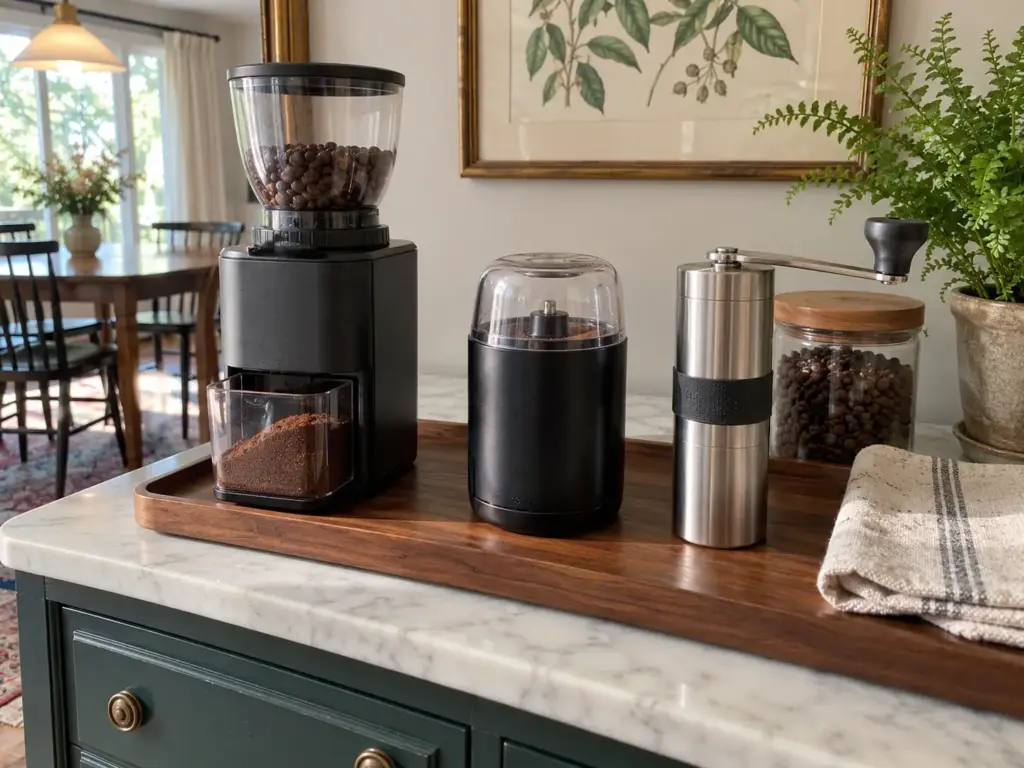
For an electric burr grinder in daily use at home, about a decade is the lifespan that comes up most often. A Consumer Reports writer’s ten-year report on her Baratza Encore covers almost ten years at 35 to 51 g a day, burrs that show little wear, and the reason she would keep it going: “the consumer-friendly Baratza has extensive repair instructions and sells spare parts.” Older Baratza models can last twenty years with a rebuild or two. That decade is a common rule of thumb, not a rating any manufacturer prints, and without a parts list the same machine lasts only as long as its weakest piece of plastic.
Why the Warranty Is One Year and the Life Is Ten
Baratza’s warranty runs one year and excludes normal wear and tear and lack of cleaning, so the maker promises one year and sells the parts for the other nine. That is the real difference between two grinders at about the same money: whether a holder, a gear or a burr set can still be ordered in year six.
An old grinder rarely announces its age with a breakdown. It announces it with time. An older Encore can grind slowly even after a free burr and ring from Baratza. At a pound a week, nine years comes to roughly 470 lb, around where the maker says its steel burrs are due, and the motor and gearing can wear too.
Why the Numbers You Read Run From Five Years to Thirty
Coffee retailers print five, seven, ten and thirty years, sometimes on one page, and their burr ratings disagree even on whether ceramic outlasts steel. Each figure describes a different grinder, a different dose, or nothing in particular. The two numbers worth holding are the maker’s rating for its own burr and the grams your kitchen grinds each morning.
The Pounds Behind the Years, Worked Out for Your Dose
A burr rating is a weight, not a date. Turning it into years means dividing it by what your kitchen grinds, and at a home dose the answer runs longer than most people expect.
The Maker’s Number, and the Ones That Disagree
Baratza’s support team puts its steel burrs at around 500 pounds of coffee and its ceramic burrs at about 750 lb, so on its own grinders ceramic lasts longer. A café-equipment retailer prints the reverse order: roughly 1,000 lb (450 kg) for steel and 750 lb (340 kg) for ceramic. The 1,000 lb figure is the one that gets repeated most, but for a Baratza steel burr the maker’s number is half of it, and planning on the lower one costs nothing. Bean density, roast and fineness move burr life too, Baratza adds, so dense light roasts at an espresso setting wear through the rating faster than a medium roast ground for a drip pot.
The Division, at One Mug, Two, and a Full Pot
Weigh (or scoop) your grams per day on a normal morning and read across. The arithmetic is ours, from the ratings above: 500 lb is 227 kg and 1,000 lb is 454 kg, divided by what each daily dose adds up to in a year.
| Daily dose | Per year | Years to 500 lb | Years to 1,000 lb |
|---|---|---|---|
| One mug, about 18 g (two level scoops) | ~6.6 kg (14.5 lb) | ~34 years | ~69 years |
| Two mugs, about 30 g | ~11 kg (24 lb) | ~21 years | ~41 years |
| A full pot, about 60 g (six scoops) | ~22 kg (48 lb) | ~10 years | ~21 years |
| A pound a week | ~24 kg (52 lb) | ~10 years | ~19 years |
At a full pot a day, the maker’s 500 lb and the owners’ ten years land on the same number, a decent sign the rating is honest. At one mug a day the burrs outlive the machine around them by decades, so in most kitchens the burrs are not the clock; the parts around them are. The scoop is where this goes wrong at home: a heaped scoop of a light roast and a level scoop of a dark roast are not the same weight, which is why the table starts from grams.
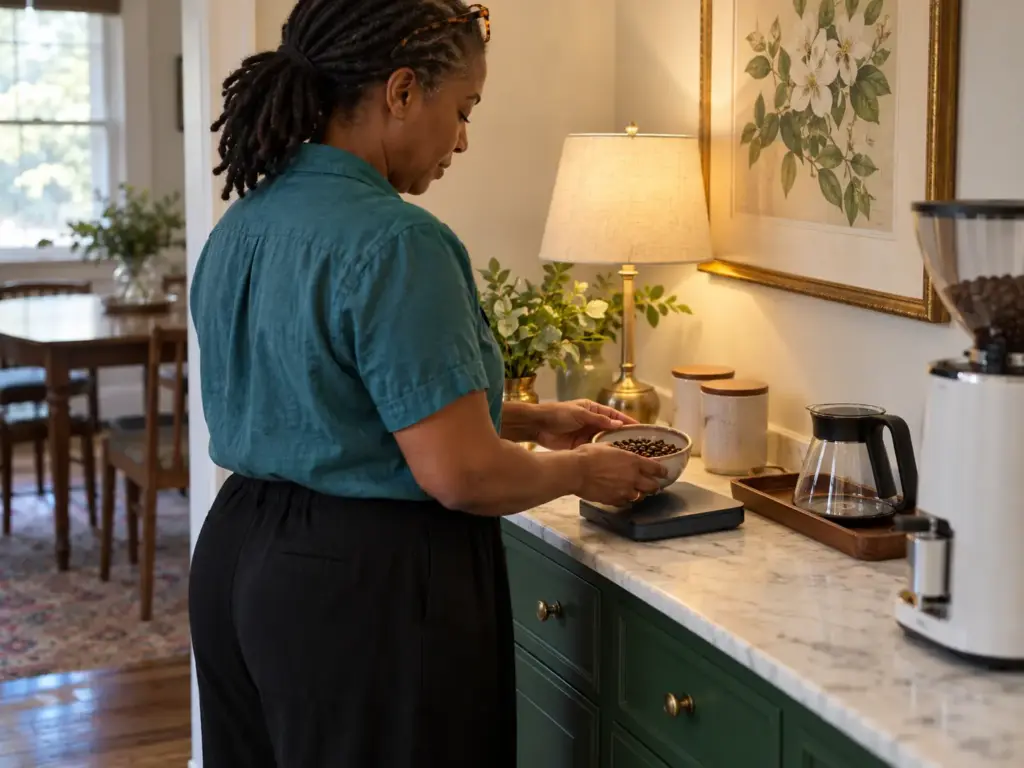
Weigh your usual scoop of whole beans three times on a kitchen scale and take the average. That one number turns two scoops into grams, grams into a row of the table, and a vague sense that the grinder is old into a count of how many pounds it has actually ground.
Barista Hustle notes that some professionals change their burrs at half the stated life. That is a café standard, set for grinders that pull the same shot hundreds of times a day, and no reason to buy a burr set at year five at home. At home the cup says when. The calendar does not.
Why Café Ratings Don’t Apply to a Kitchen
Café grinders are rated on another scale entirely: Barista Hustle lists manufacturer figures from about 660 lb for a Mazzer Mini, a small commercial espresso grinder, to 40,000 lb for a bulk grinder (judging a home grinder by those is like reading a truck’s mileage off a lawnmower). And a home grinder’s rating assumes it is used as designed, one dose at a time.
Baratza says its grinders are not designed to batch-grind, and according to the Specialty Coffee Association’s guide to matching a grinder to its workload, “Using such a grinder for bulk batches will prematurely wear the burrs, motor and other critical components.” The SCA wrote that about a small café grinder pushed into bulk work, but the mechanism holds on a kitchen counter: a week’s beans ground in one long run load a small motor past what it was sized for, and the heat lands on parts the table does not count.
What Wears Out First on an Electric Burr Grinder
If the burrs have decades in them, something else ends the grinder. On the grinders owners write about, the list of what goes first is short, repeats from one owner to the next, and is mostly sold as parts.
The Burr Holder That Is Built to Break
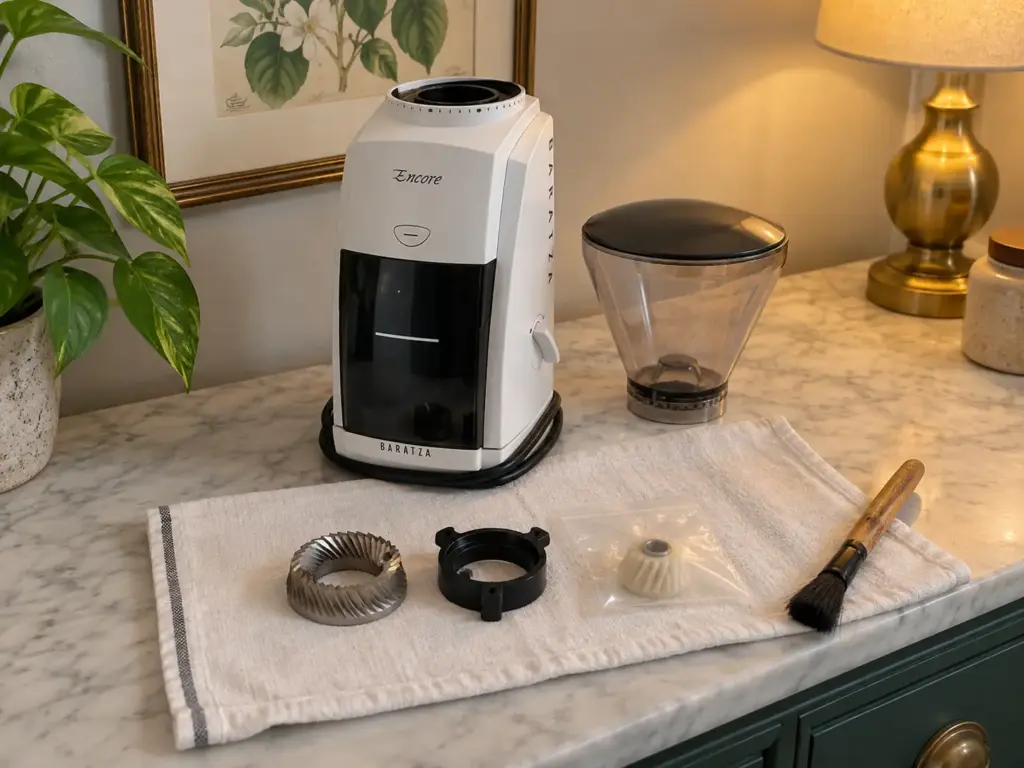
The most common failure is designed in. On the Baratza Encore, which grinds on 40 mm conical steel burrs across 40 settings, the burr holder that carries the upper burr (owners call it the carrier, a plastic ring with three tabs) is designed to break if a rock fragment, an unroasted bean or something else very dense gets between the burrs. It takes the hit so the burrs, the motor and the gears do not, and Baratza’s support team names a broken or badly installed holder as the number-one problem it hears about: a cheap part and a five-minute job at the counter.
But a fuse gets used. Amazon reviews mention burrs breaking within a year and recommend keeping spares, and the one-year warranty excludes wear, so each replacement is yours to buy. You will know when it happens: the grind jumps from even to uneven overnight, with chunks in a drip grind that was fine the day before.
When the grind goes uneven overnight, lift out the hopper and look at the tabs on the upper burr holder before you touch the dial. A cracked tab lets the burr sit crooked, and no setting on the dial corrects a crooked burr. Buying three holders at a time costs less than a bag of good beans and saves a morning without coffee.
The Drive Gear and the Motor
Next comes the main drive gear between the motor and the burr, which Baratza sells as a part for the Encore, the Encore ESP and the Virtuoso+. The part is plastic and tends to strip every few years, and a grinder can run rougher, vibrate more and sound harsher as it wears. A stripped gear is heard before it is seen: the grinder buzzes harder against the counter and the pitch turns harsh while the grounds still look fine.
The motor and the circuit board fail less often and cost more. Something else usually breaks first, more often the motor, bushing or switch than the burrs. A sluggish motor or a failed power board can stop an Encore, and Baratza has been reported to replace parts outside the warranty. Before assuming the motor is gone, rule out a jam: a grinder that hums and won’t turn is more often blocked than burned out, and that check is free.
The OXO Brew Conical Burr is the other entry-level electric on a lot of American counters, with stainless steel conical burrs and 15 settings, and Consumer Reports’ testers rated it above the Encore. It ages differently. A year-old OXO grinder can turn finicky, sometimes grinding only a few beans and getting louder, and it can hold a fair amount of coffee inside after each grind, so the first grams of every dose are left over from the last one.
What You Can Replace at the Counter, and What Goes Back to the Maker
Put in order of how often owners report them and how cheap they are, the parts line up like this: the burr holder first, then the burrs, replaced as a set, then the drive gear, then the motor and the power board. The first three are counter jobs with the maker’s instructions. The motor and the board belong to the maker, or to a repair shop.
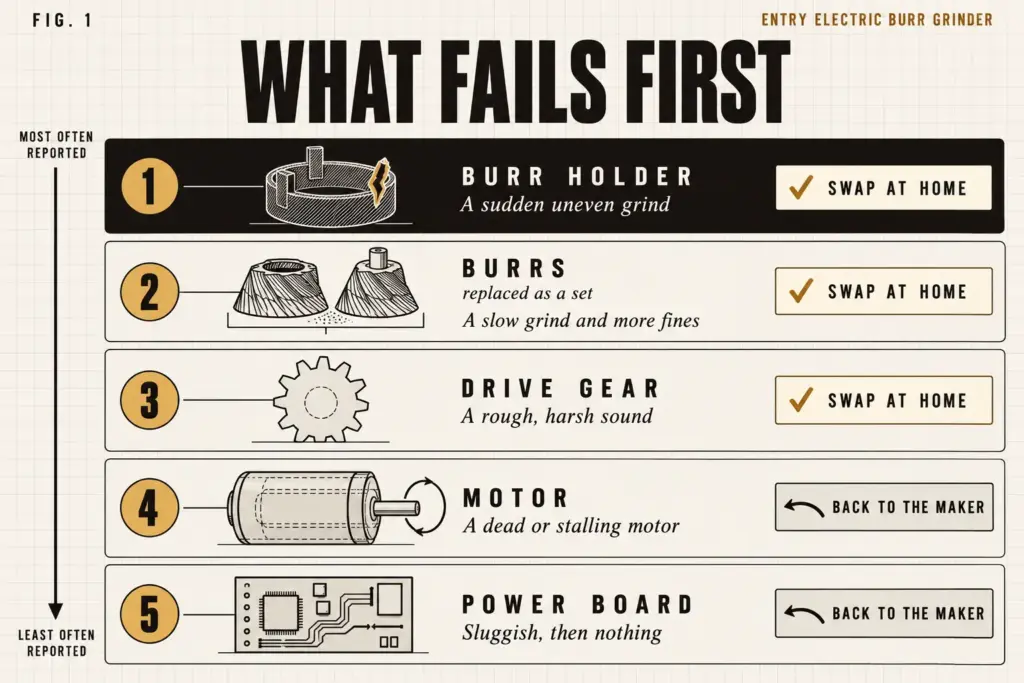
Some Encore grinders are repaired so many times that little of the original is left. That is the whole case for a grinder with a parts list: it can be kept, piece by piece, for as long as you like the cup it makes.
Blade and Hand Grinders, the Two Ends of the Range
The other two grinders on American counters sit at opposite ends of the lifespan question. One has no rating to reach at all, and the other has no motor to burn out.
A Blade Grinder Is Retired by the Cup
A blade grinder has no burr-style rating anywhere; the 1,000 lb figure sometimes attached to blades has nothing behind it. What a maker does put in writing is a warranty: a blade-grinder manual from Proctor Silex, a sister brand of Hamilton Beach, gives three years and excludes wear from normal use.
The Hamilton Beach Fresh Grind 80335R is the blade grinder most kitchens know, with stainless steel blades and room for up to 12 cups a batch. Amazon’s review summary says several buyers saw it break down around four months, and a few reports mention smoke from the base; both come from a minority of reviews, not a measured rate.
A blade grinder that still spins is not a grinder that still works, though. The blades never set a size; they chop until you let go, so every dose holds boulders and dust together, and that mix is why a blade grinder makes a cup sour and bitter at once. If the dose that used to look even after a few pulses now needs a long press and still shows chunks, it has told you what it has left, and in most kitchens the cup retires a blade grinder well before it breaks.
A Hand Grinder Has No Motor to Wear Out
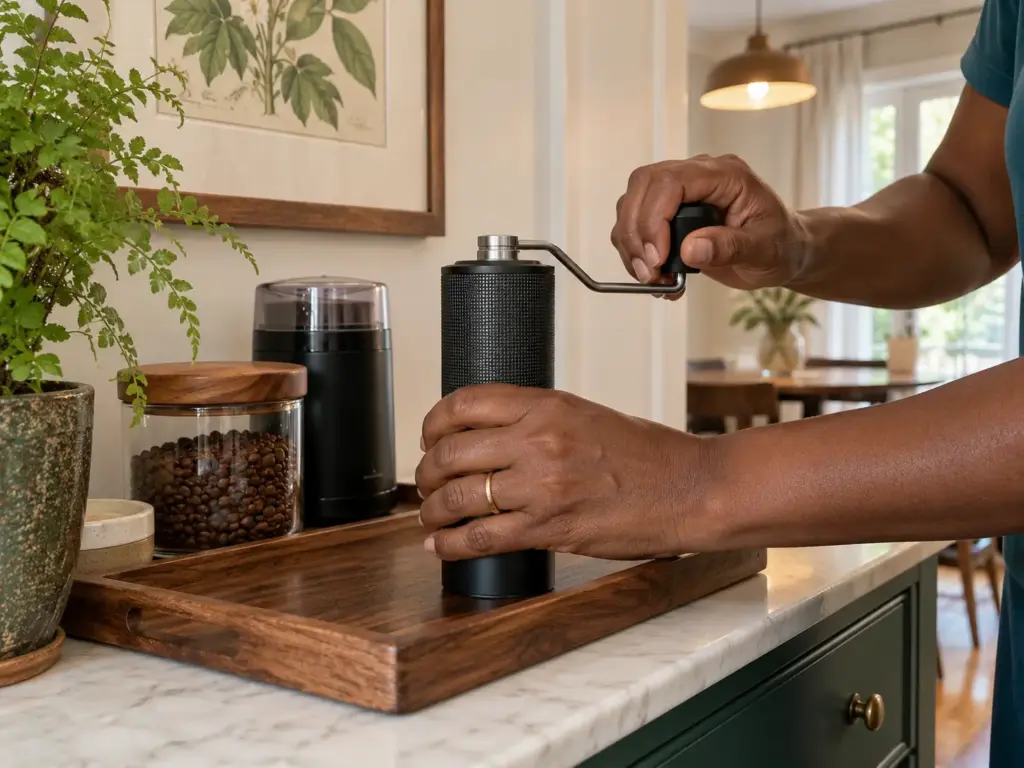
A hand grinder removes most of the failure list above: no motor, no board, no switch, no drive gear. The TIMEMORE Chestnut C2S is where many people start: a 38 mm conical burr in 420 steel, about 36 internal clicks, a 20 g hopper and an aluminum alloy shell. Its limit is range rather than age: the steps are much too large for espresso.
And the long-lived answer stops being the obvious one at a full pot. Cranking 18 g for one mug is a small chore; cranking 60 g, six scoops, every morning is the kind that sends people back to an electric grinder, parts and all, which is the trade behind a manual grinder against an electric one, counted in grams a day.
What Still Wears on a Hand Grinder
Fewer parts is not no parts. The wear shows up in the handle’s fit, in play at the shaft (a wobble you can feel at the top of the crank) and at the adjustment stop that holds your setting. A wobbling shaft lets the burr swing off center and spreads the grind, which is why a hand grinder that won’t wobble matters more over the years than one with more clicks.
Worn Out, Drifted or Just Dirty
Most grinders that feel worn out are not. Three different causes make an old grinder slow and uneven, they look alike from the outside, and two of them cost nothing to fix. Check them in order, one per brew, with the same bag of beans.
Dirty First: Old Oils and a Packed Chute
Name the direction before touching anything. A cup that has turned thin and sour at your usual setting points to a grind that got coarser; a cup that is flat and muddy, sour and bitter at once, points to a grind that got less even. Dirt is free to rule out, so it goes first whichever way the cup points.
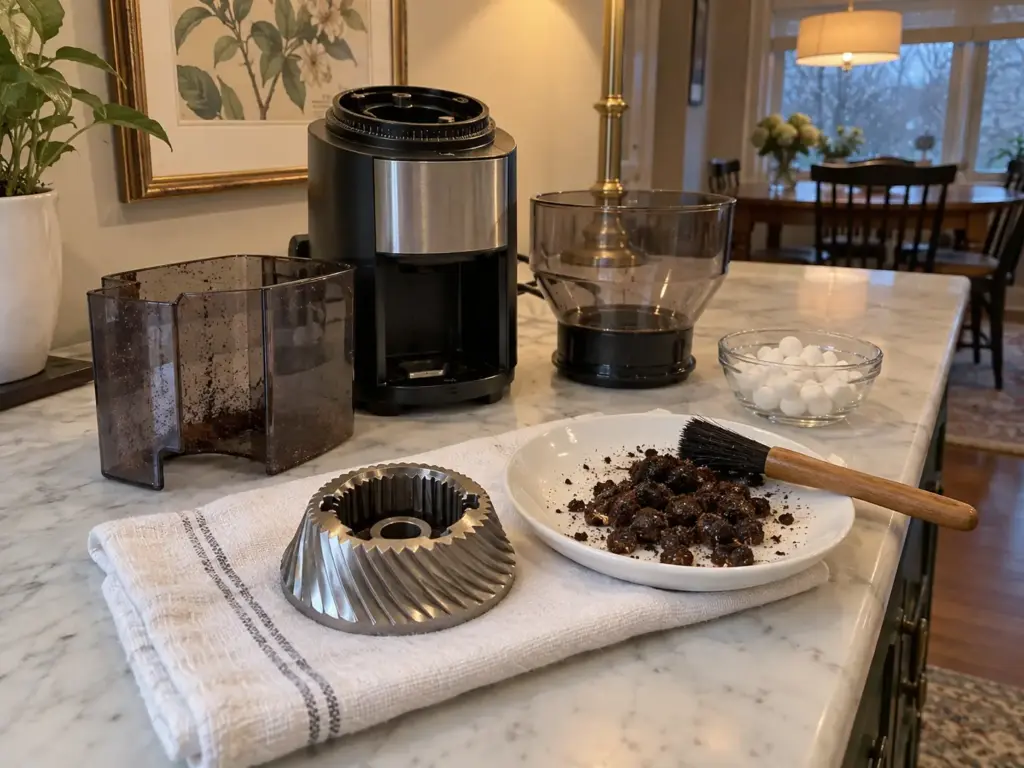
Baratza’s warranty excludes lack of cleaning, and by the eight-year Encore owner’s account, the first question its support asked every time the grind slowed was whether the grinder had been cleaned. The Consumer Reports writer hardly cleaned hers for years and now runs grinder cleaning tablets through it monthly. Old oil is the look-alike: the residue of dark, oily roasts builds up on the burrs and in the chute, slows the grind and dulls the cup much the way worn edges do, and it comes off with a brush.
So brush the burrs and the chute, then grind the same beans at the same setting and brew them the same way. If dirt was the problem, the dose grinds faster and the cup gets some sweetness back at the old number. If nothing changed, you have spent ten minutes and crossed one suspect off.
Keep one bag of beans for the whole diagnosis, and buy the next one only after the verdict. Baratza’s support team points out that bean density, roast and age change the grind on their own, so a fresh bag halfway through can make a clean grinder look worn, or a worn one look fixed.
Drifted Second: The Zero Moved, Not the Burrs
If the grinder is clean and the cup is still thin and sour at your usual number, the number may no longer mean the same grind. The instinct is to turn the dial a step finer and move on. That fixes tomorrow’s cup while the reference keeps sliding underneath you; the zero point the whole scale hangs from can creep over the years, and the first thing to check is whether the calibration screw on the side of the adjuster has crept.
So find your grinder’s zero again first, then brew at your old setting. The cup should come back toward what it was; if it overshoots into bitter, come back one step coarser and taste again. And if the grinder is already at its finest step and still cannot get there, that is a different problem from wear, and a grinder that has run out of fine steps needs its own answer.
Worn Last: What Burr Wear Looks Like in the Cup
Worn burrs do not fail on a date. Barista Hustle describes the wear as gradual, with no single moment: the grinder gets slower, louder and hotter, the grounds clump more, and the best cup you can get from it (Barista Hustle calls that limit the extraction ceiling) slowly slides. Baratza’s support team adds the warning that matters most here: more fines or a slower grind alone do not prove the burrs are worn, because the beans’ density, roast and age change both, and the real test is to replace the burrs and see.
If you get that far, a burr replacement means both burrs, as a set; changing only the ring burr improves the grind a little at most. The signs that the burrs themselves are done get their own full treatment. What matters here is the order:
- Brush the burrs and the chute, brew the same beans the same way, and taste.
- Re-zero the grinder, brew at your usual setting, and taste.
- Only then replace the burrs as a set, and taste again.
Never all three in one morning. Do them together and a good result cannot tell you which step earned it, and one of them may have been money spent for nothing.
Repair, Replace or Retire, in That Order
Once the grinder is clean and zeroed and the cup is still wrong, the repair or replace decision runs one way: the cheapest part that explains the symptom first, the maker second, a new grinder last. One exception skips the whole queue, and it has nothing to do with the cup.
Ask the Maker Before You Buy Anything
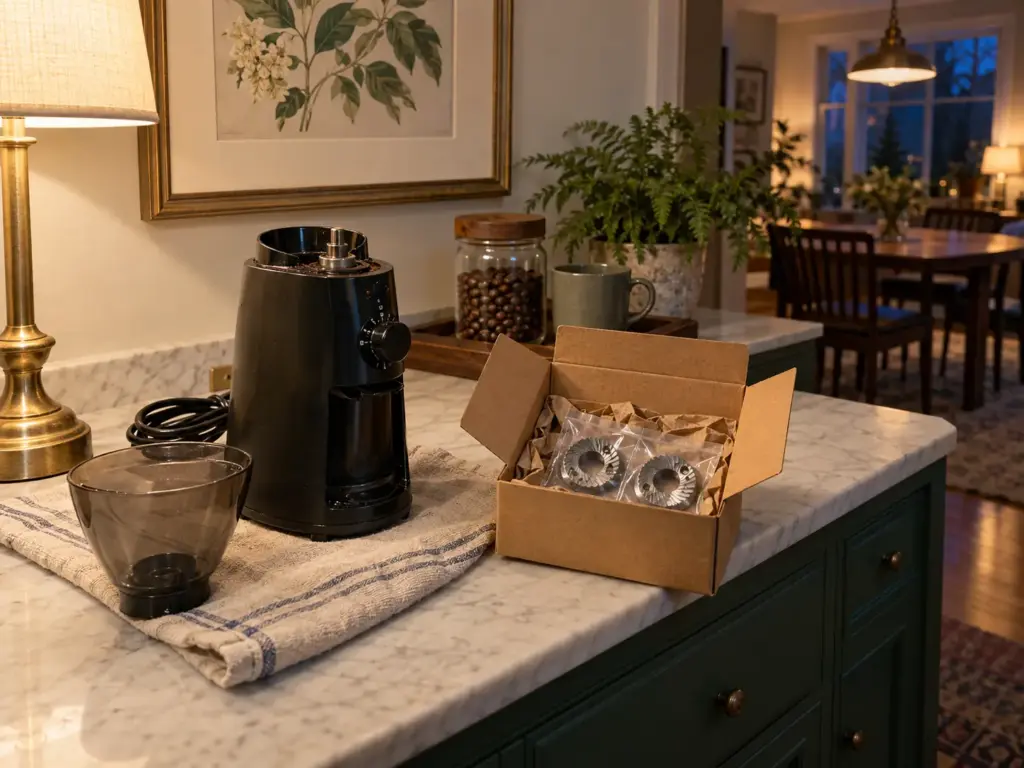
Baratza has been reported to send a free upper burr and ring years after the warranty ended, and its repair and rebuild service costs a fraction of a new grinder. One of them sums up the customer service as parts that are available and reasonably priced, with how-to videos. Those are owner reports, not maker promises, though they come up again and again, and they turn a broken grinder into a parcel instead of a replacement.
Clean the grinder before you contact support, then write down three numbers: the setting, the dose in grams and how many seconds that dose takes to grind. The first question owners report hearing is whether it was cleaned, and arriving with that answered and the numbers in hand skips a round of emails.
When the Grinder, Not the Part, Is Done
A grinder is done when the replacement parts it needs are no longer sold, when the motor goes on a machine that has no parts list, or when a new burr set and holder did not bring the cup back. The eight-year Encore owner reached that last point: coffee stopped passing through the burrs, the fines piled up, and a thorough cleaning and a new ring burr did not fix it this time, so the grinder was retired.
One part in a year is maintenance. A second part in the same year is a pattern, and that is usually the point to stop repairing. If you do replace it, buy the grinder whose parts exist, which is the only reason the Encore keeps coming back here, weak point and all.
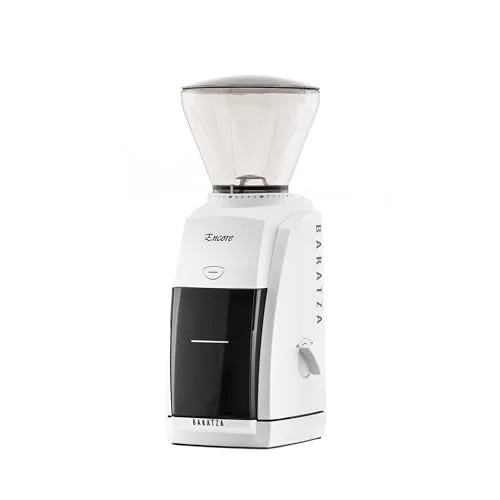
If the Encore does not suit your counter or your brewer, the next question is which grinder will outlast the one you have, and home grinders ranked by what wears out first takes it model by model.
Is an Old Coffee Grinder Safe to Use?
Age alone does not make a grinder unsafe; its condition does. A blade-grinder manual from Proctor Silex says not to operate an appliance with a damaged cord or plug, or after it malfunctions or has been dropped, and to send repairs to the maker or a qualified person. That is the exception that skips the queue: a frayed power cord, a cracked housing or a grinder that fell off the counter goes to repair before it grinds again, and if yours ever smells hot or throws a spark, unplug it (by the plug, not the cord) and stop there.
Weigh One Morning’s Dose Before You Shop
An electric burr grinder in a home kitchen runs about a decade, and longer while you can still buy its parts. The burrs are rarely what ends it: at a home dose they have decades in them, and a holder, a gear or a motor gives out first. When the cup drifts, clean and re-zero before replacing anything, and replace the part before the grinder.
A month from now, write down the setting you grind at and how long one dose takes, so the next time the cup drifts you can tell whether the grinder moved or the beans did.
Tomorrow morning, weigh the dose you actually grind and find its row in the table, then brush out the chute and taste the next cup at your usual setting. If it comes back sweeter, the grinder you have is not the problem yet.
Frequently Asked Questions
01What is the life expectancy of a coffee grinder?
An electric burr grinder used daily at home typically lasts about ten years, and longer when its maker still sells the parts that wear out first. A blade grinder lasts until its uneven cup bothers you, and a hand grinder, with no motor to fail, lasts longest.
02How often should I replace coffee grinder burrs?
At home, rarely: Baratza rates its steel burrs at about 500 lb of coffee, which is roughly ten years at a full pot a day and decades at one mug. Replace them as a set when cleaning and re-zeroing no longer bring the cup back.
03How do I know if my coffee grinder burrs are worn out?
Worn burrs show up as a slower grind, more fines and a flat cup that neither a thorough cleaning nor re-zeroing the grinder will fix. Those signs alone are not proof, since beans and roast change them too, so the only sure test is a new set of burrs.
04Are old coffee grinders safe to use?
An old grinder is safe to use as long as its cord, plug and housing are intact and it has not been dropped or started to malfunction. A maker’s manual says a damaged appliance goes to the maker or a qualified repairer, not back on the counter.
05Do ceramic burrs last longer than steel?
For Baratza’s own burrs, yes: the maker rates ceramic at about 750 lb of coffee and steel at about 500 lb, so ceramic lasts roughly half again as long. Some retailers print the opposite order, so go by your grinder’s own rating; at a home dose either one lasts many years.


How did your cup turn out?
No comments yet. Tell us what you changed — and whether the needle moved.