

We may earn a commission when you buy through links on this page. It never changes what we recommend. How we pick
On this page7 parts
- What Makes the Best Manual Coffee Grinder: The Axle Before the Burrs
- Four Hand Grinders Worth Buying, and the Flaw Each One Carries
- Why a Hand Grinder Can Match an Electric at the Same Spend
- Matching the Grinder to Your Hand and Your Counter
- What Wears Out by Month Two
- Feel for Play First, Then Pick the Grinder by What You Brew
- Frequently Asked Questions
Your hand grinder’s box promised precision conical burrs, and the pour-over tasted sharp and sour on the first sip, then dry and bitter on the way down. Precision describes how the burr was machined, not how it is held, and a cup that goes both ways at once points straight at the holding.
A burr on a shaft supported at only one end drifts sideways under the load of the beans, the gap between the burrs opens and closes as it turns, and one dose comes out as dust and chunks together. So the useful answer to what’s the best manual coffee grinder, or the best hand coffee grinder by any name, starts at the axle, below the burr spec on the box. What follows covers what separates a steady grinder from a wobbly one, the four worth buying and the flaw each carries, why a crank can keep pace with a motor at the same spend, how to fit one to your hand and counter, and what wears first; if you haven’t settled whether to grind by hand at all, that question has its own page.
Quick Answer
The best manual coffee grinder has steel burrs on a shaft held at two or more points, plus steps you can find again. No model wins for everyone: the Comandante C40 MK4 for durability, the 1Zpresso K-Ultra if you switch between filter and espresso, and the Timemore Chestnut C2S as the entry to two bearings and steel burrs.
What Makes the Best Manual Coffee Grinder: The Axle Before the Burrs
Spec sheets sell the burr: its width in millimeters, its steel, the shape of its teeth. Whether that burr cuts evenly depends on something most listings skip, which is how the shaft carrying it is held in place while you crank. So the test for every grinder in this article starts there, and it ends with a check you can run on the grinder already in your cupboard.
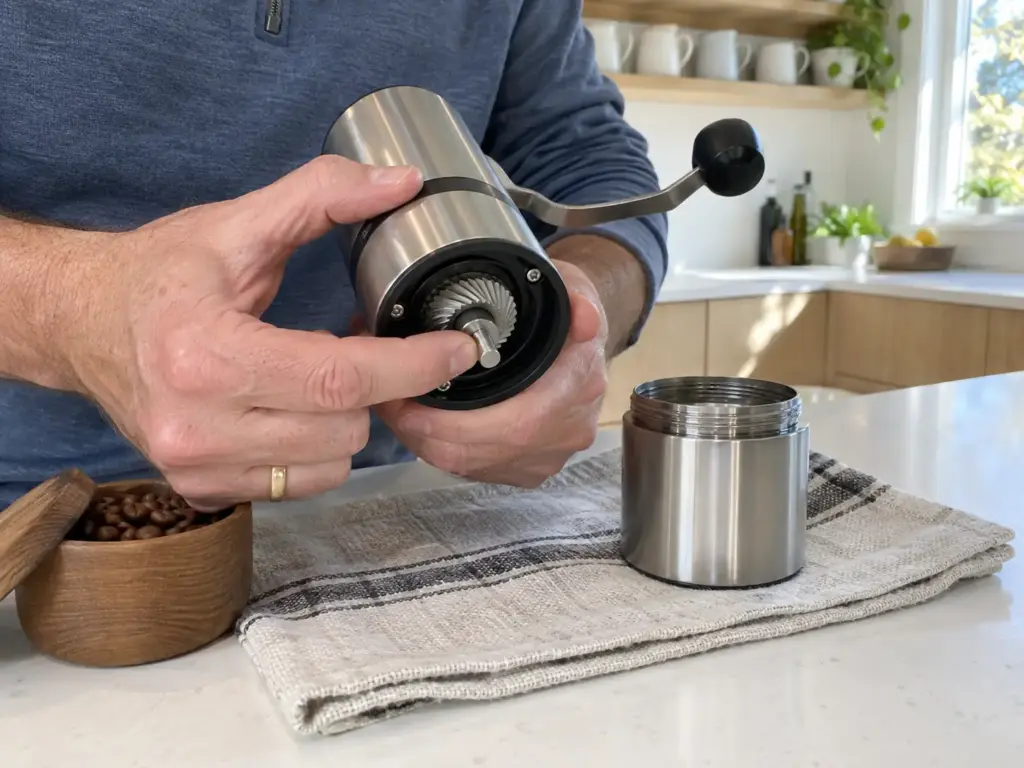
Why a Loose Axle Makes Boulders and Fines in the Same Dose
A conical hand grinder is a simple machine. An inner burr, fixed to a vertical shaft, turns inside a stationary outer ring, and the gap between the two decides the size of every particle that falls through. That gap is the grind setting, the whole of it, which is why how a burr set cuts and why it drifts always comes back to the same measurement.
A U.S. patent application for a burr-grinder stabilizer, No. 20160135646, filed by two Miami inventors in 2015 and published in 2016 (an application, never a granted patent), describes the older design without flattery.
The shaft is held at the top, and “the central shaft is essentially rotably coupled on one end and freely dangles from the single bearing.” The next line is the diagnosis: “Because the burr does not remain stable, it wobbles during grinding, thus yielding diversely sized grains.”
Picture one turn of the crank on that design. The lower end of the shaft carries the burr and has nothing beneath it holding it on center, so every bean that jams against one side pushes the burr toward the other.
On the near side the gap closes for an instant and crushes beans to powder; on the far side it opens and lets half-cut pieces drop straight through. The same filing states the consequence in one line: “Wobbling, or fluctuation in the space between the burrs, during grinding results in the creation of uneven grain sizes.” Its own remedy is a second bearing under the burr, held by a removable cage, so the shaft is supported at both ends instead of hanging from one.
In the cup, those two sizes pull in opposite directions. The chunks, the boulders in common shorthand, are too big for water to get through in a three-minute pour-over, so they give up their bright acids and not much else: sour, thin, watery at the edges. The dust, the fines, extracts in seconds and keeps going, and it lands as bitterness and a dry, chalky finish at the back of the tongue. A cup that tastes sour and bitter at the same time is the signature of a wide particle distribution, not of a bad bag of beans, and it hides whatever the roast was meant to taste like: the sweetness and clarity of a light roast go first, and a dark roast turns ashy.
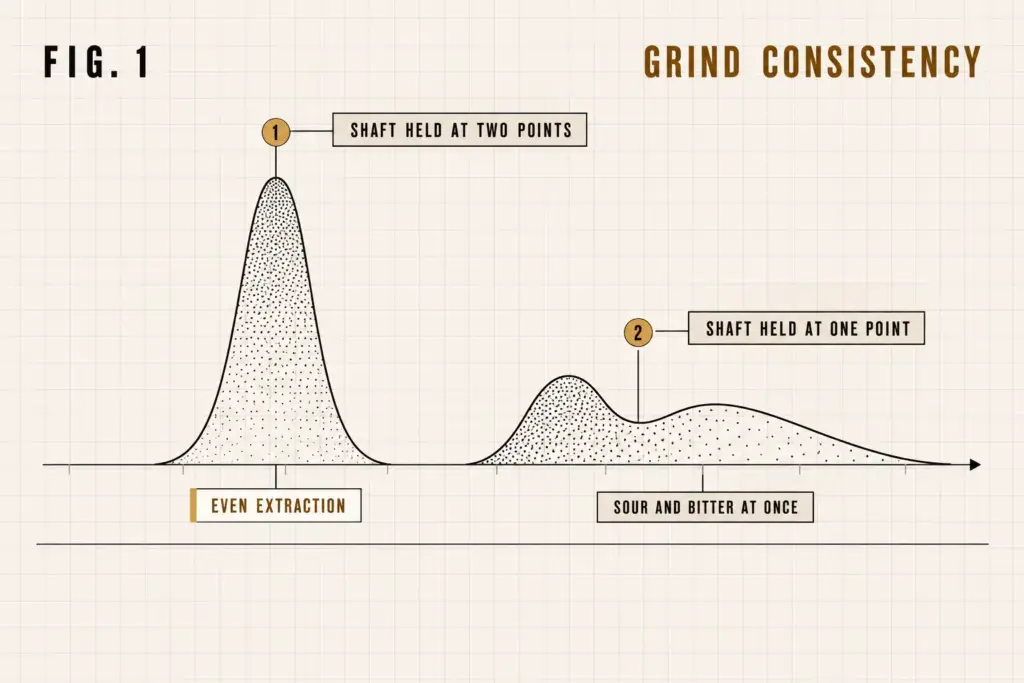
That signature is also why the standard advice misfires on a wobbly grinder. For a sour cup, the usual move is a step finer, and on a steady grinder it works: the whole spread shifts smaller and the sourness recedes.
But on a grinder whose burr wanders, going finer shrinks the average and keeps the wobble, so you make more dust while the biggest pieces still slip through on the open side of each turn. The cup gets more bitter without losing its sour edge. When a step finer and a step coarser both taste wrong, each in its own way, the setting has stopped being the thing to change.
You can often feel this before you taste it. A crank that rocks in a small circle at the top of each turn, or a grinding sound that rises and falls within a single revolution, is the burr moving. (A grinder that sounds even and still makes a muddy cup has a different problem, and the beans or the recipe are the next suspects.)
How even is even enough? There is an official answer, and most people can’t read it.
The Specialty Coffee Association’s standard for home grinders is SCA-320, “Home Coffee Grinders: Specifications and Test Methods,” and the association describes its standards this way: “SCA Standards create a shared framework for quality, consistency, and best practices across the coffee industry.” The pass figures inside SCA-320 are open to members only, which is why no particle percentages appear in this article. What a buyer can check without them is the construction that produces a narrow spread, the grind consistency the standard is testing for, and that means the axle.
Steel or Ceramic Burrs, and What Each Does After a Few Months
Burr material matters less than the axle, but it decides how a grinder survives its first fall onto a tile floor. Ceramic burrs don’t rust and hold an edge a long time, which is why they sit in so many compact and low-cost grinders.
They are also brittle. A ceramic burr can chip when the grinder is dropped, and a chip is a notch that changes the gap at one point of every turn, the same fault as a wobble arriving from a different direction. That is the known risk on a small travel grinder like the Porlex, which comes up again below.
Steel burrs, stainless or hardened carbon steel, take a knock without cracking, and steel is what the makers of the better hand grinders machine into tighter shapes. Every pick in the next section uses a steel conical burr; the question of conical against flat burrs barely comes up with hand grinders, since nearly all of them are conical. Then come the alloys and coatings that fill a box: Comandante’s high-nitrogen steel, the titanium coating on the AeroPress grinder, 1Zpresso’s seven-sided heptagonal burr. Each is a real engineering choice. Each is also a claim about the edge, and a sharp edge only helps while it stays centered.
What changes over the first months is slower than the box suggests. A steel burr dulls gradually, and you taste it before you see it: the same setting starts needing a click finer to reach the same flow and the same brightness, because a rounded edge crushes where it used to cut. A ceramic burr dulls more slowly still, and it tends to either stay whole or chip. For one household’s daily coffee, the burrs are rarely the first part to go; the handle, the catch cup and the knob usually are, and the last section of this article is about them.
Adjustment Steps You Can Find Again
An even grind helps little if you can’t land on it twice. Two designs dominate stepped adjustment on hand grinders (a few use stepless adjustment instead, a smooth collar with no clicks at all, which is precise and very hard to return to).
An external numbered ring, the external adjustment dial on the 1Zpresso K-Ultra, shows the setting on the outside of the grinder, and Balance Journal’s long-term log of that grinder measured each click at about 20 microns, a step small enough to nudge a sour shot without jumping past it. Internal clicks, the internal adjustment on the Comandante and the Timemore, work just as finely but hide the number inside: you close the burrs to the zero point, count back out, and remember where you stopped. Finding zero and counting clicks has a page of its own; what matters for buying is how often you’ll change the setting.
If one recipe sits on your counter all week, internal clicks cost you nothing. If you move between a pour-over setting and an espresso setting several times a week, a ring you can read saves a count every morning, and a miscount is a wasted dose of beans.
The number on the box can mislead in the other direction. Sixty settings or forty clicks tells you how many stops there are, not how far apart they sit or how many of them fall in the grind range you’ll actually use, from espresso and moka pot at the fine end to French press at the coarse end.
A grinder with fewer, evenly spaced steps can be easier to dial in than one with many steps bunched at the coarse end, and the figure that settles it, the distance per click, is the one most listings leave out. Several grinders in this article publish a step count and no step size. That is a question to ask before buying, not after.
Check the Grinder You Already Own Before You Buy Another
Start with the setting on the grinder you have? Not yet. The check comes first, because it tells you whether a new setting can help at all, and it costs five minutes and nothing else. With the grinder empty:
- Take off the catch cup and turn the grinder upside down so the inner burr faces you.
- Set it somewhere in the middle of its range, not closed down to zero.
- Push the inner burr sideways with a fingertip, toward you and away, then left and right.
- Turn the crank slowly and watch the gap between the inner burr and the outer ring as it goes around.
- Reassemble it and give the crank a few slow empty turns, feeling for a rock at the top.
A steady grinder barely moves under the fingertip, and the gap looks the same all the way around. A cheap ceramic-burr grinder set next to a pricier steel one shows the difference by hand before a single bean goes in. The cheap one’s burr could be pushed around a good bit and even shifted as the crank turned, and the warning that came with it was blunt: “when you get the beans in there, the wobble will be even more.” The pricier grinder in the same test had no play at all.
Wear can produce the same symptom in a grinder that started out steady. A rebuilt old PeDe box mill had a worn axle at the top bearing. Not only was this not good for the consistency of the grind, it also made the grinder feel wobbly while grinding.”
He built the worn spot back up with epoxy, clamped the axle in a power drill as a makeshift lathe, filed it round again and sanded it to fit the top bearing, and reported that it felt far better afterward. Few readers will go that far. The useful part is the order he noticed things in: the feel first, the grind second.
If the burr moves under your fingertip, stop adjusting: no click will rescue that cup, and the next grinder is the fix you are shopping for. If it holds still, change one thing only, a step finer after a sour cup or a step coarser after a bitter one, brew the same dose the same way, and taste before you touch anything else.
Four Hand Grinders Worth Buying, and the Flaw Each One Carries
Hold the market up to those three tests (the axle, the burr, steps you can return to) and four grinders pass, each suited to a different kitchen. Each also comes with the thing its owners keep reporting against it, and that goes right next to the pick, where you’ll read it before you buy.
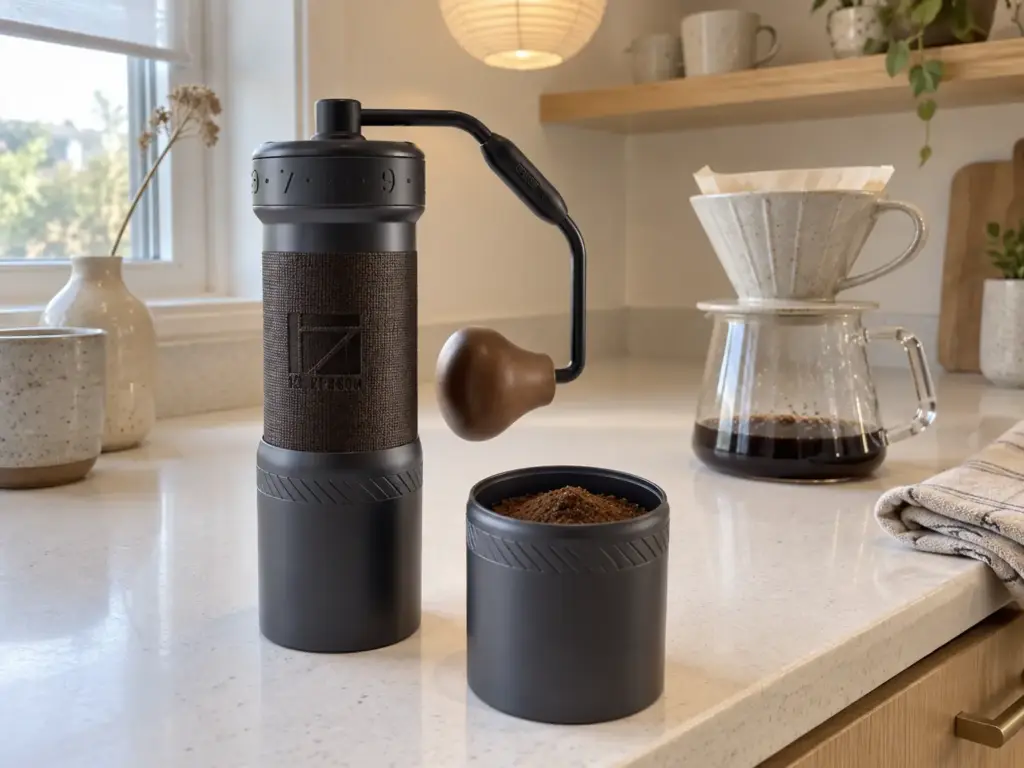
Comandante C40 MK4: The Three-Point Axle
The Comandante C40 MK4 is the grinder most people name first, and the reason is a part you never see. Comandante says the axle is supported at three points, a design it describes as tri-fan. That is the maker’s claim, not something an independent teardown in these sources confirmed, but it takes the patent application’s two-point fix one step further and answers the wobble question directly. The burr is Comandante’s Nitro Blade, a high-nitrogen martensitic steel formulated to hold its edge, and the setting is made with internal clicks counted out from zero.
That combination makes it the all-rounder for someone who brews more than one way and wants to buy once. If the cup you keep chasing comes from a grinder for a V60 that runs muddy, this is the default answer, and the one the other hand grinders get measured against.
Two things count against it. Owners report that the crank knob needs a firm push to seat properly the first time the grinder is assembled, and a knob that isn’t fully home clicks and rocks, which feels exactly like the wobble you paid to avoid.
Press it on before you judge anything. And stock runs thin: when this was checked, most color versions were down to a handful of units, which matters if you want a particular finish. It is also the splurge of the four.
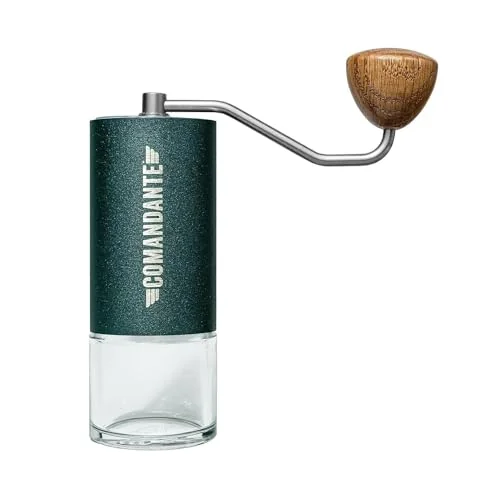
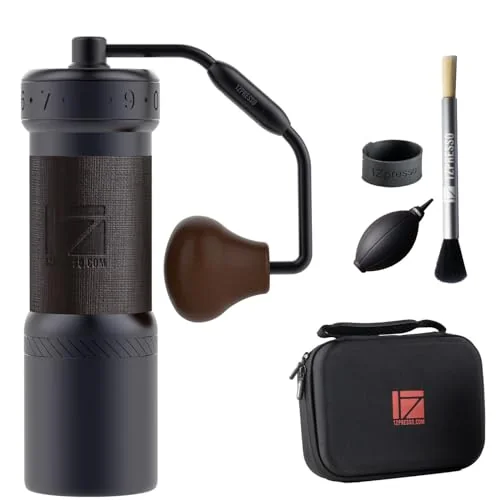
1Zpresso K-Ultra: A Ring You Can Read, for Filter and Espresso
The 1Zpresso K-Ultra has the most independent numbers behind it, thanks to one careful log. Balance Journal’s reviewer ran it for 14 weeks and more than 140 brews with a scale and a refractometer, and set it against a Comandante C40 MK4 in 12 parallel V60 brews at an identical recipe.
The K-Ultra’s cups measured 1.38 % TDS (total dissolved solids, the strength of the brew); the Comandante’s measured 1.40 %. That gap sits inside the instrument’s own noise. In the cup, on that evidence, the two are equals.
What separates them is the adjustment. The K-Ultra’s 48 mm heptagonal steel burr is set from an external numbered ring, and the same log measured about 20 microns per click, the kind of figure worth comparing when you read up on microns per click on espresso grinders. On a Flair 58 lever machine, one click moved an 18 g shot (a little under two level coffee scoops of beans) by roughly two to three seconds. That is fine enough control for espresso, a job only some hand grinders can do, and which hand grinders can really do espresso is a question with its own answer.
Everybody names the Comandante, and for one brew method it’s hard to argue with. Once you move between methods a few times a week, the call flips. A ring you read at a glance beats clicks you count from zero, and the K-Ultra reaches the same extraction for roughly half the spend. The magnetic catch cup earns its place in the daily routine too: it lets you grind straight into a dripper’s paper or a portafilter and skip a transfer, which is the difference you notice at the counter, more than any line on the spec sheet.
After any change of setting, the first grounds out still carry some of the old size, held between the burrs. Give the empty grinder a few seconds of cranking, or grind and throw out a pinch of beans, before you brew the cup you are going to judge. Otherwise you taste half the old setting and half the new one, and learn nothing from either.
The wear point is the handle. Balance Journal reports that the handle develops play after a few weeks of daily use, and the same pattern shows up across K-series grinders.
The adjustment ring showed no play and the grind held, so this is a part loosening, not the grind failing. The brand has since revised the handle on newer batches, so ask the seller which version you’re getting before you pay. At about 700 g (just over 1.5 lb), it’s also a solid weight to hold through a long, fine espresso grind.
Timemore Chestnut C2S: Two Bearings and Steel Burrs at the Entry Level
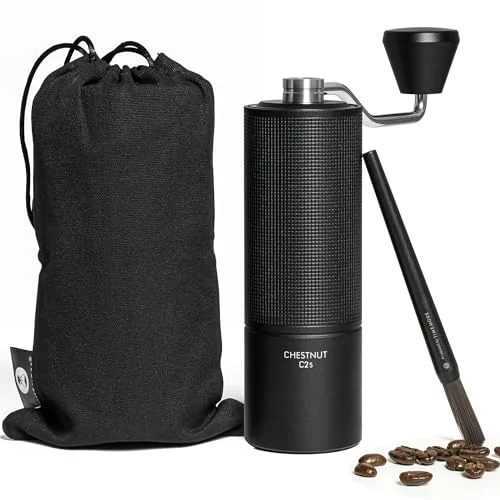
The TIMEMORE Chestnut C2S is where the patent’s two-point idea becomes affordable. Its 38 mm conical burr (a burr size typical of this class) is 420 stainless steel, the shaft runs on dual ball bearings, and according to BrewCoffeeHome’s hands-on review the plastic on the grinder (the hopper lid, the adjustment knob and the handle knob) carries no load at all. About 36 internal clicks cover the range. The hopper takes 20 g of beans, about two coffee scoops, which makes one generous mug of pour-over or two small ones, not a full drip carafe.
That is the value argument of the whole category in one entry-level grinder: a supported shaft and a metal burr, so the first real hand grinder you buy doesn’t have to be a wobbly one. For a daily pour-over or AeroPress, it is where most readers should start, and a fair bet to still be in use long after a cheaper grinder has been retired.
The weak point is the catch cup. It is translucent plastic, it looks cheap next to the aluminum shell, and fine grounds cling to its walls by static, so part of your dose ends up tapped out onto the counter instead of into the filter. Timemore sells a metal replacement cup, which ends the cling without replacing the grinder.
AeroPress Manual Coffee Grinder: Sixty Settings in a Compact Shell
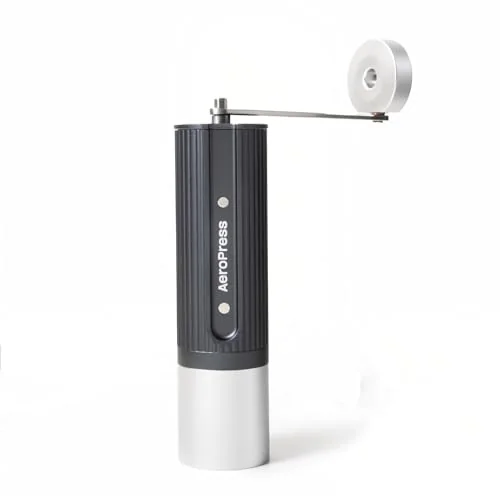
The AeroPress Manual Coffee Grinder is the newest of the four and the tidiest to store: titanium-coated steel conical burrs, 60 grind settings, a 25 g hopper (about two and a half scoops), and a magnetic crank that stows inside the grinder so nothing loose rattles around a drawer. Sixty is the highest setting count in this article, and by the step-size point above, the count alone doesn’t say how far apart those settings sit.
What can’t be said yet is how it holds up. No repeated failure after the first months turned up, because it hasn’t been on enough counters for long enough to produce one. That cuts both ways. Treat it as promising on paper and unproven over time, and run the empty-burr check the week it arrives.
Why a Hand Grinder Can Match an Electric at the Same Spend
The full crank-against-motor case lives on its own page. This section answers only the doubt a buyer of the four picks tends to carry, that a hand grinder is the poor relation of an electric one. Often it isn’t, for mechanical reasons, and in a few kitchens it genuinely is.
Slow Turning and Fewer Fines
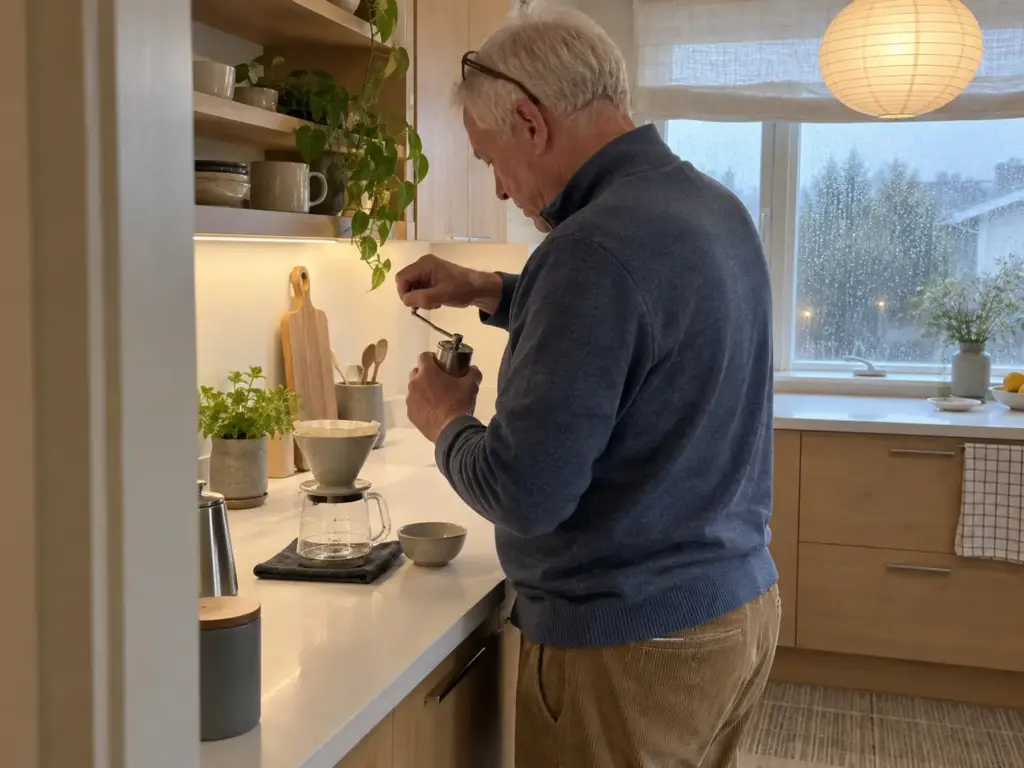
A hand crank turns the burr far slower than any motor-driven grinder does. No crank-speed figure with a published measurement method turned up for this article, so no number goes here, but the direction isn’t in dispute. The accepted explanation is that a slow burr shears each bean instead of flinging fragments around the grinding chamber, where they get struck again and broken into dust. The hands-on figures in the K-Ultra log fit that explanation without proving it: two hand grinders landing within two hundredths of a TDS point of each other suggests both are cutting cleanly.
Retention points the same way. Retention is the coffee a grinder keeps inside after a dose, and a hand grinder with a magnetic catch cup keeps almost none; Balance Journal measured 0.1 to 0.2 grams left in the K-Ultra, still at 14 weeks, a few grounds, less than a pinch. Its value isn’t the coffee saved. The dose you weighed is the dose you brew, and yesterday’s stale grounds don’t tumble into today’s cup, something a grinder with a long chute and a big hopper can’t always promise.
Weigh the beans before you grind, not the grounds after. What lands in the catch cup is whatever the burrs and the static let through, while the beans on the scale are the recipe itself. Weighing them keeps tomorrow’s dose identical to today’s, so when the cup changes you know the dose didn’t.
What a Cheap Real Burr Grinder Already Beats
One comparison came at the question from the other direction. An old, cheap ceramic-burr grinder can be run side by side with a premium one to see whether the expensive one earns its price. The cheap grinder’s burr moved under a fingertip, the same wobble described above, and it still beat pre-ground coffee and most café cups. The conclusion was practical: good water, fresh beans and a real burr grinder, even a cheap one, carry you a long way before an expensive upgrade becomes the fix.
Some experienced hands go further, arguing that far more is made of small variations in particle size than an ordinary drinker could ever taste. Both of them are right about the floor.
Any burr grinder beats a blade and beats a bag of pre-ground, and the distance between a cheap burr and a great one is usually smaller than the distance between a blade and any burr at all. Where the wobble shows is the cup that turns sour and bitter at once, and the brew methods that expose it, pour-over first. What the higher price of a grinder buys is mostly that: a narrower spread of sizes and a setting that stays where you put it.
Where the Electric Still Wins
In some kitchens the crank is the wrong tool. Grinding for a full carafe of drip coffee, or for several cups in a row, means several times a single pour-over’s dose, and by hand that becomes a chore on a workday morning.
Speed is the second reason: an electric grinder finishes in seconds what takes a noticeably longer spell of cranking, and how long grinding by hand takes depends on the dose and how fine you go. The third reason is the hand itself. If your wrists or grip make cranking something you dread, the steadiest axle in this article won’t help from the back of a cupboard, and a decent electric grinder will actually get used.
The hand grinder keeps one advantage no motor matches, and it’s the quiet. A slow crank makes a low crunch you can run before anyone else in the house is awake, with a bedroom on the other side of the wall, and among the quietest grinders a crank is hard to beat.
Matching the Grinder to Your Hand and Your Counter
All four picks grind well; what decides whether one gets used every morning is the hand turning the crank, the bag it rides in and the counter where it lives. A grinder you dread using ends up in a drawer, whatever its burr. Spec sheets leave this part of the decision to chance.
Grip and Crank for Smaller or Tired Hands
Grip is a buying variable, not a footnote. A hand grinder works as a pair: one hand turns the crank, the other holds the barrel still, and the holding hand does half the work. A thick barrel that a smaller hand can’t close around slips a little on every turn, the crank starts to rock, and the rocking brings back the wobble the first section was about, from the outside this time. No bearing inside can correct a grinder that moves in your hand.
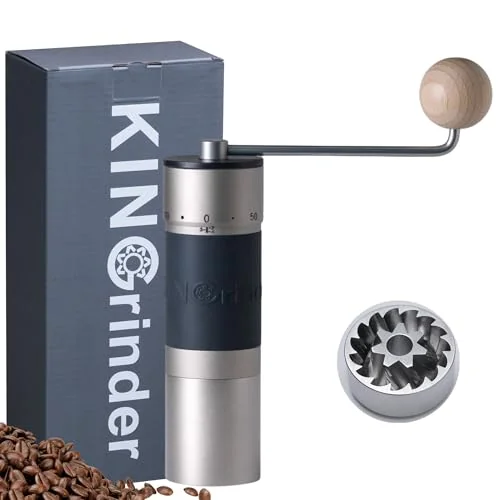
The KINGrinder K6 approaches this through the crank. Its straight, non-folding handle gives a different leverage from the foldable handle on several picks above, a fixed arm with no hinge to flex, and its steel conical burr is set from an external click adjustment you can read without opening anything. For a reader whose hand tires halfway through a two-cup dose, that change of leverage is the thing worth trying.
It is a pick on spec. No repeated owner complaint about the K6 turned up, and that is less reassuring than it sounds: independent long-term coverage of this model is thin, far thinner than for 1Zpresso’s K series, so the absence of complaints mostly reflects an absence of reports. Run the burr check in the first week.
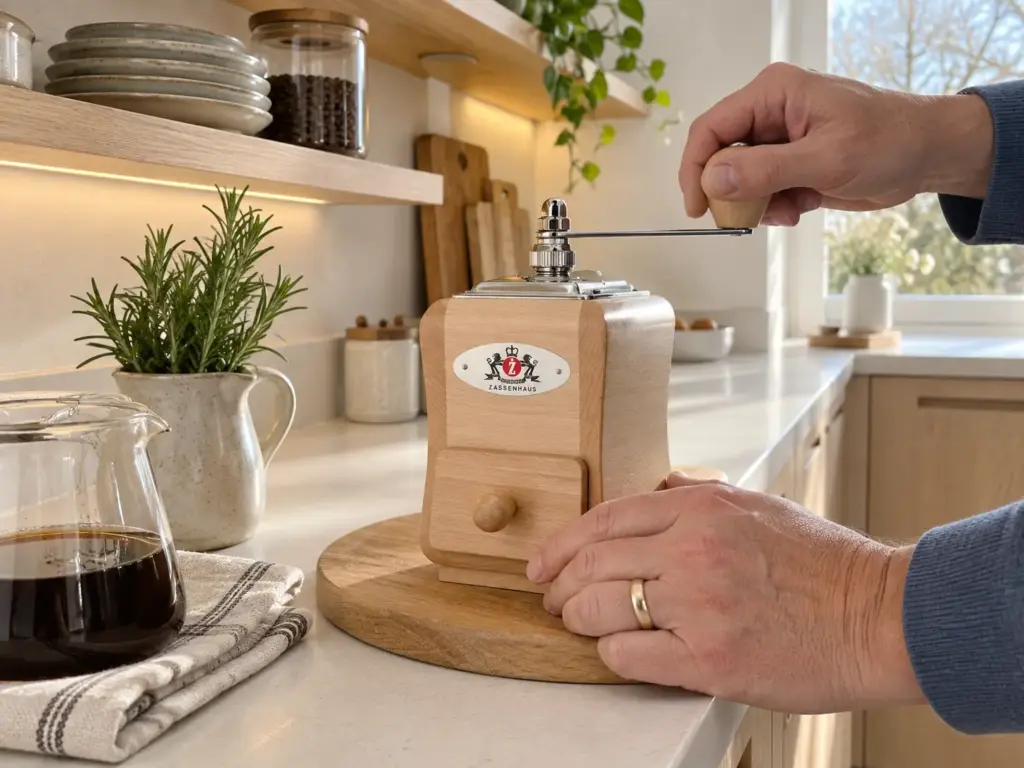
Whatever the handle, how you hold the grinder decides as much as what you bought. A tired hand grips harder and steadies less, which is the wrong way round.
Brace the grinder instead of holding it in the air: tuck it against your chest, or press its base onto the counter edge with the heel of your hand, and crank slowly and evenly. A barrel that can’t move keeps the crank from rocking, and a crank that doesn’t rock keeps the axle centered, which is the whole point of the grinder you chose.
Weight and Packing for Travel
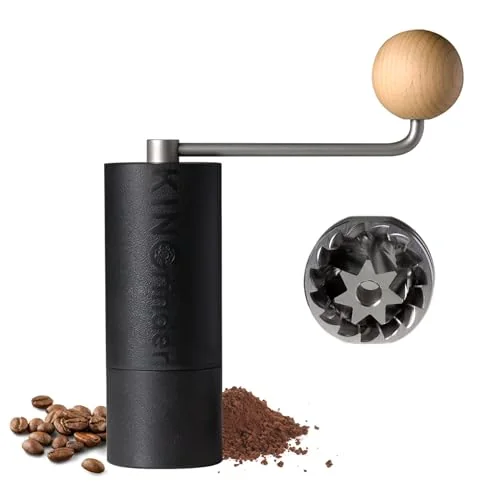
For a grinder that travels, the numbers change order: weight and size first, then the burr. The KINGrinder P2 is the lightest build here, an ABS plastic shell around a stainless steel burr, which makes it the easy one to drop into a weekend bag.
The trade is feel. Some reviewers read the plastic shell as less premium than the metal grinders above, and in the hand it has less heft to steady against. It sits among hand grinders at the lower end of the price range, where the weight saving comes cheap.
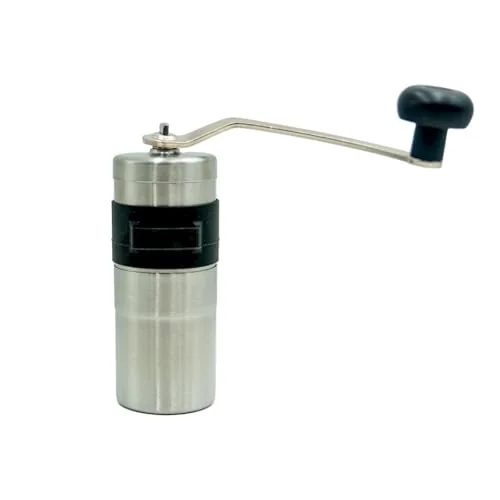
Packing by shape is the other approach. The Porlex Mini II has a stainless steel barrel about 5.3 inches tall and 1.8 inches across (13.5 × 4.6 cm), sized to travel with an AeroPress, and the crank comes off for the bag.
Inside is a ceramic burr, and that is the risk you pack with it: ceramic shrugs off a damp campsite but can chip if the grinder hits a hard floor, and a chipped burr grinds unevenly from then on. Stock was also low when it was checked. Several of these same grinders turn up among grinders built for packing, with the travel details worked through.
A Mill That Lives on the Counter
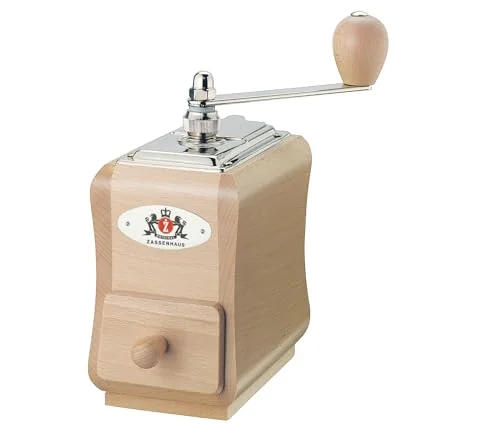
Some grinders are meant to stay out. The Zassenhaus Santiago is a traditional mill with a beech wood housing, a crank with brass details and a hardened carbon-steel conical burr: a real cutting burr under a decorative shell, not an ornament that happens to grind. It suits a kitchen where the grinder sits on the counter between uses, ready for the next dose, rather than living in a drawer.
The wood sets the rules. It can’t go under the tap the way a steel grinder can, so cleaning is a dry brush and a wipe, and the carbon-steel burr wants to stay dry anyway. For anyone used to rinsing a grinder, that is a real change of habit. Stock was low on this one too when it was checked.
On a grinder used every day, where the grounds land matters about as much as the burr. A magnetic or twist-lock catch cup lets you grind straight into a portafilter or a French press beaker and skip a transfer, the detail Balance Journal’s reviewer singled out as what made single-dosing (grinding exactly one brew’s worth at a time) faster in daily use. A counter mill that drops its grounds into its own base asks for that extra step every time. If your brewer is a press, a coarse, even grind for a French press matters more than hopper capacity, and a cup that fits the brewer saves a spill before work.
What Wears Out by Month Two
Every grinder in this article grinds well out of the box, and that is when most reviews get written. What separates them shows up after weeks of daily cranking: the part that starts to give, and whether the same complaint repeats often enough to be the design rather than one unlucky unit.
The Handle, the Catch Cup and the Crank Knob
Say it’s week six, and the K-Ultra’s handle has a little side-to-side give where it meets the grinder that wasn’t there at the start. That is the known one. In Balance Journal’s log, the handle joint developed play at about six weeks, while the adjustment ring stayed tight and retention still measured 0.1 to 0.2 g at week fourteen.
The distinction matters because the two failures feel alike and mean different things. Play at the handle is a part loosening at the top of the shaft; wobble at the burr is the grind itself going wide. The test is the one from the first section: catch cup off, push the burr. If the burr is still steady and the cup tastes the way it did, the grinder is fine and the handle is a nuisance, not a verdict.
Wear goes where the force goes. On a rebuilt PeDe mill, the worn side of the axle can be the handle side, because leaning on the handle loads the shaft unevenly. On old hand grinders, the wear is common and most prominent on the handle side of the axle.
Those were decades-old box mills, so this is the mechanism, not a claim about any grinder in this article. The lesson carries over anyway. Turn the crank; don’t bear down on it. Pressing down while you crank pushes the shaft against one side of its bearing on every turn, and that side is where the play arrives first.
A free fix comes before any tools: refit the handle half a turn round so the uneven load falls on fresh metal. It didn’t work on that mill, whose tapered threads lock the handle in one position, and it is a fair picture of how these problems get solved in practice (try the free thing, find out why it doesn’t fit, then decide whether the repair is worth it).
Real axle wear announces itself the way the knob problem below does, as a small circle at the top of the crank’s turn, and you usually feel it before you taste it. Check the feel now and then, and the cup won’t be the first to tell you.
On the Timemore, the part that shows its age is the catch cup rather than the axle. The translucent plastic holds a static charge, fine grounds stick to the walls, and the cling doesn’t improve with use. Try the free fix before buying anything, the trick known as RDT: wet the tip of a spoon handle, stir it through the beans, then grind, and most of the cling goes. If it doesn’t, Timemore’s metal replacement cup ends it, and catch cups and hoppers with no plastic are a category of their own if plastic in the grind path bothers you.
The Comandante’s crank knob belongs on this list for the opposite reason: it’s a first-week issue, not a slow one. A knob that isn’t pressed fully home clicks and rocks at the top of each turn, and a buyer who mistakes it for axle wobble sends back a good grinder. Seat it firmly and the rock goes. Across electric and hand grinders alike, which grinder parts wear out first follows the same logic: the moving parts your hands touch give before the burrs do.
The Grinder That Doesn’t Say How Its Axle Is Held
The JavaPresse Manual Stainless Steel Coffee Grinder is the lowest-cost grinder with a steel shell in this article: a ceramic burr, 18 click settings and a stainless barrel at about 10 oz, light enough to forget in a bag. Its listing publishes no bearing count.
By the standard this article opened with, that is the one question you can’t answer before buying, and it lands where it matters most, because a ceramic burr on a low-cost build is the combination that wobbles in the comparison above. That doesn’t mean this grinder wobbles. It means the listing can’t tell you, so the burr check becomes your spec sheet: run it the day the grinder arrives, while it can still go back.
Several other grinders here don’t state their axle support either, as the table below shows. The difference is what surrounds the silence. A grinder with a steel burr and a long record of buyer reviews gives you other evidence to lean on; a ceramic burr on the cheapest build here gives you less, which is why the check matters more on this one than on any other.
The coarse end is where a loosely held burr shows itself first. On many hand grinders the inner burr sits lower and looser at coarse settings, so a shaft with play has more room to swing, and the spread of sizes widens just where a French press or a batch of cold brew needs it narrow. A cheap hand grinder can get less consistent the coarser it is set, and the question is whether that is a known limit of the model or a sign to upgrade. One reply’s workaround says a lot about the answer: pour the finished brew through a V60 paper to strip out the sludge at the bottom of the cup.
It works. It also means the grinder is producing the same mix of dust and chunks as a blade grinder’s sour-and-bitter cup, only less of it, and a paper filter is catching what the burr should never have made. A second filter is a fine stopgap while you save up. As a permanent part of the recipe, it is the grinder telling you it has reached its limit.
The Nine Side by Side, With the Part That Wears First
All nine grinders in this article, with what their makers state about the axle and the part that gives first:
| Grinder | Burr and adjustment | Axle support, as stated | Best for | Wears first, or the known flaw |
|---|---|---|---|---|
| Comandante C40 MK4 | Nitro Blade steel conical; internal clicks | Three points (maker’s claim) | An all-rounder to buy once | Crank knob needs a firm seat on first assembly |
| 1Zpresso K-Ultra | 48 mm heptagonal steel; external ring, about 20 microns a click | Not stated; V60 cups matched the Comandante | Switching between filter and espresso | Handle play at about six weeks |
| TIMEMORE Chestnut C2S | 38 mm 420 stainless conical; about 36 internal clicks | Dual ball bearings | A first steel-burr grinder | Plastic catch cup, static cling |
| AeroPress Manual Coffee Grinder | Titanium-coated steel conical; 60 settings | Not stated | Many settings, compact storage | Newest here, no long-term record yet |
| KINGrinder K6 | Steel conical; external clicks | Not stated | A straight-handle grip | Thin long-term owner record |
| KINGrinder P2 | Stainless steel burr; ABS shell | Not stated | The lightest to carry | Plastic shell feels less premium |
| Porlex Mini II | Ceramic burr; slim steel barrel | Not stated | Packing with an AeroPress | Ceramic can chip if dropped |
| Zassenhaus Santiago | Hardened carbon-steel conical; beech wood | Not stated | A mill that stays on the counter | Wipe-only cleaning, no rinsing |
| JavaPresse Manual Grinder | Ceramic burr; 18 settings | Not published | The lowest-cost steel shell | Ceramic burr, axle support unknown |
Read the axle column as a list of questions, not verdicts. A grinder marked not stated isn’t a bad grinder; it’s one whose steadiness you confirm with a fingertip instead of a spec line, and only two of the nine put an answer in writing. The last column is the more useful one over time, because it tells you which part to watch, and none of the entries in it is the burr.
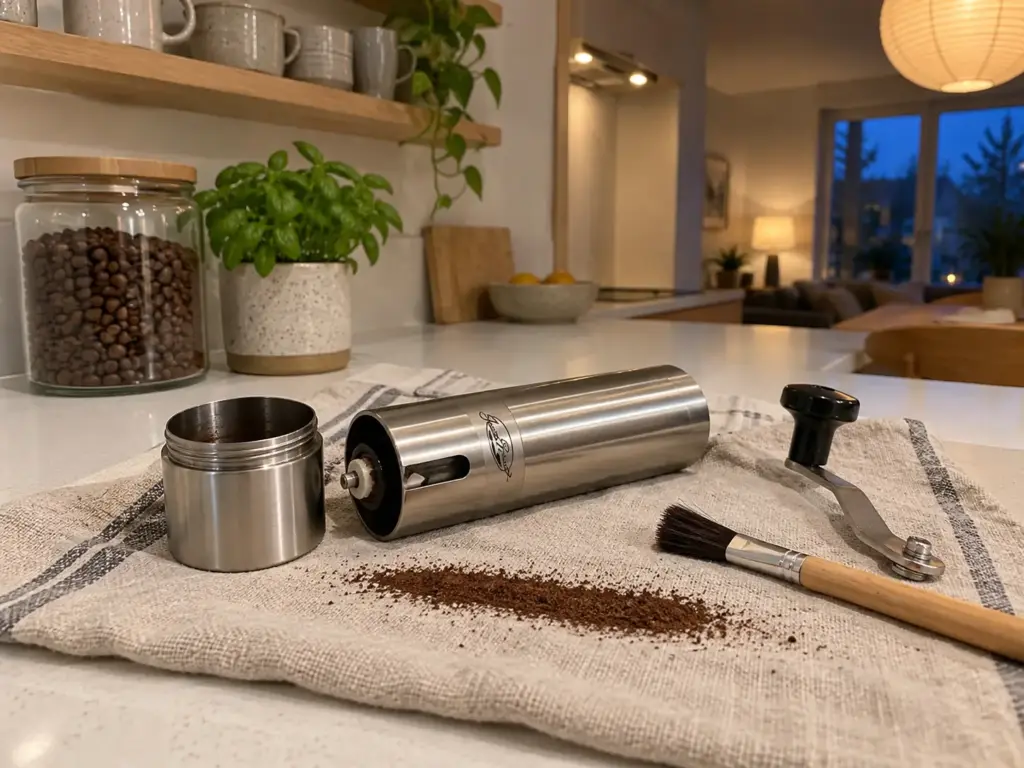
Brush the burrs dry once a week with the catch cup off, using the small cleaning brush most hand grinders ship with. Old oils and fines packed into the burr teeth turn up as a flat, stale edge in the cup well before anything looks dirty, and a stiff brush removes them in a minute. Never rinse a wood or carbon-steel mill: the wood swells and the carbon-steel burr can rust.
Once the grinder is chosen, the next question is which grind your brew method wants, and what the grind size changes in the cup is where that decision starts.
Feel for Play First, Then Pick the Grinder by What You Brew
Three things carry over from everything above:
- Judge a hand grinder by how its shaft is held before you judge its burr. A burr that moves under a fingertip makes a cup that is sour and bitter at once, and no setting fixes it.
- Pick by the job, and take the flaw along with the pick: the Comandante C40 MK4 to buy once, the 1Zpresso K-Ultra if you switch between filter and espresso, the Timemore C2S as the entry to two bearings and a steel burr. The knob, the handle and the plastic cup are what each one asks you to live with.
- Expect the handle, the catch cup or the knob to give before the burrs do, and tell a loose part from a wandering burr before deciding the grinder has failed.
A month from now, take the catch cup off, push the burr sideways again and feel the top of the crank’s turn; if nothing has moved since the first day, whatever changed in your cup came from the beans or the recipe, not the grinder.
Tomorrow morning, before you buy anything, run that same check on the grinder you already own. If the burr holds still, move the setting one step, finer if the last cup was sour and coarser if it was bitter, brew the same dose the same way, and taste whether the edge you disliked has moved toward the middle.
Frequently Asked Questions
01What’s the best manual coffee grinder for most people?
The best manual coffee grinder for most people has steel burrs on a shaft held at two or more points, with steps you can find again. The Comandante C40 MK4, the 1Zpresso K-Ultra and the Timemore Chestnut C2S each meet that, at different levels of spend.
02Are manual coffee grinders any good?
Yes. A real burr hand grinder grinds more evenly than a blade grinder and can match an electric burr grinder that costs about the same. The trade is time and effort: cranking for a full carafe or several cups in a row gets tiring fast.
03Which brand of hand grinder is best?
No brand is best across its whole range, so judge each model by how its axle is supported and how its adjustment steps work. Comandante and Timemore state how their shafts are held, some budget listings say nothing, and a burr that moves under a fingertip settles it.
04Is a ceramic or steel burr better in a hand grinder?
Steel is the better choice for most hand grinders, because it takes a knock without cracking and is what the best-made conical burrs are machined from. Ceramic won’t rust, but it can chip if the grinder is dropped, and a chipped burr grinds unevenly from then on.
05How long does a manual coffee grinder last?
A well-built manual grinder usually outlasts its own small parts: the handle, the catch cup and the knob wear before the burrs do. In one 14-week log, a K-Ultra’s handle developed play at about six weeks while the grind stayed consistent.


How did your cup turn out?
No comments yet. Tell us what you changed — and whether the needle moved.