



We may earn a commission when you buy through links on this page. It never changes what we recommend. How we pick
On this page7 parts
- What Makes a Manual Grinder Espresso-Capable: Room at the Fine End
- Three Hand Grinders Built for Espresso, and the Flaw Each One Carries
- Why Grinding for Espresso by Hand Takes Twice the Cranking
- Two All-Rounders That Also Pull Espresso, With a Catch
- What Wears First When a Hand Grinder Lives at the Espresso End
- Count the Clicks Between Gush and Choke Before You Buy
- Frequently Asked Questions
Your hand coffee grinder lists espresso on the box, and this morning’s shot ran fast and sour at one click, then crawled out thick and bitter at the next click finer. If that sent you looking for the best manual coffee grinder for espresso, the word on the box is where the trouble starts: it only promises that the burrs can close far enough, not how far a single click moves them.
Espresso extracts well inside a band of grind sizes so narrow that a step you would never notice at pour-over can jump clean across it. So the useful question is how much room a grinder gives you at the fine end, and this guide covers what creates that room, three grinders built around it with the flaw each one carries, why the crank fights harder there, two all-rounders that also pull shots, and what wears once a grinder lives at espresso. If you are still deciding whether a hand grinder makes sense at all, settle that first and come back.
Quick Answer
An espresso-capable hand grinder has small steps at the fine end (single-digit microns per click, or stepless) and a burr its maker built for espresso; reaching fine is not enough. The 1Zpresso J-Ultra has the finest clicks, the Kinu M47 Simplicity has no clicks at all, and the TIMEMORE C3 ESP is the entry point that still reaches.
What Makes a Manual Grinder Espresso-Capable: Room at the Fine End
Almost every hand grinder sold today will turn fine enough to make powder, so a grind range that stretches to espresso is a low bar and a poor test. The test that matters is how many usable stops fit inside the narrow window where a shot tastes right, and the size of one click decides that, not how far the dial turns.
Why One Click Matters More at Espresso Than at Pour-Over
Say it’s the third shot of the morning. The second ran fast and tasted thin and sharp, all acidity and no sweetness, so you went one click finer, and the third came out dark and slow with a harsh, astringent finish. Both shots were off, in opposite directions, and the grinder offered nothing in between.
That is a grinder limit, not a technique problem, and the reason sits in how the two methods move water. At pour-over, water drains through a deep, loose bed of grounds over a few minutes; a slightly finer grind slows the drain a little and pulls a little more out of the coffee, so the cup moves, but gently. Espresso forces water through a packed puck under pressure in well under a minute, and the flow depends almost entirely on how tightly those particles pack together.
So the same small change in particle size that nudges a pour-over can change a shot’s running time by half. On a lever machine, a few clicks can move a shot from very fast to very slow, so the setting you want may sit in a narrow band. Three clicks covered the whole distance from gushing to crawling.
Extraction is the number underneath all of it. The idea of a target band comes from the Specialty Coffee Association’s brewing standards, and the association states their purpose plainly: “SCA Standards create a shared framework for quality, consistency, and best practices across the coffee industry.” Its Golden Cup target for brewed coffee puts extraction at 18 to 22 percent of the grounds’ weight, reached through grind, ratio, temperature and time together.
Espresso chases the same middle ground with far less time to get there, and at espresso the grind is the lever that moves fastest. Dose, yield and temperature are still yours to adjust. But when the grind can only land on either side of the window, you end up using those other levers to patch a setting you cannot reach.
The first sign that the step is too big usually shows on the scale before it shows in the cup. Picture a shot that runs its yield in 20 seconds; one click finer and the same dose takes 40, with no setting in between. That jump, repeated with every new bag, is what an espresso-capable grinder removes.
Stepped, Near-Stepless and Stepless
A grinder moves its burrs apart in one of two ways, and how stepped and stepless burr adjustment works decides what the numbers on a spec sheet mean. A stepped grinder clicks from one fixed position to the next; a stepless one slides anywhere along its range. Between them sits a stepped grinder with steps so small they behave almost like no steps at all.
The step sizes for the grinders in this guide, as their makers or reviewers state them:
- The Kinu M47 Simplicity is stepless, with adjustments “as fine as 5 microns” by Kinu’s own figure; an owner review of the M47 Classic, which shares the mechanism, counts 50 subdivisions per turn of the wheel.
- The 1Zpresso J-Ultra moves 8 microns per click, with 100 numbered clicks to a full turn of its external adjustment ring (Home Coffee Expert’s and Roast Aroma’s reviews).
- The 1Zpresso K-Ultra moves 20 microns per click, also by external adjustment on a numbered ring (Home Coffee Expert’s review).
- The TIMEMORE Chestnut C3 ESP moves 0.0233 mm per click, about 23 microns, on an internal adjustment dial (the listing’s own spec).
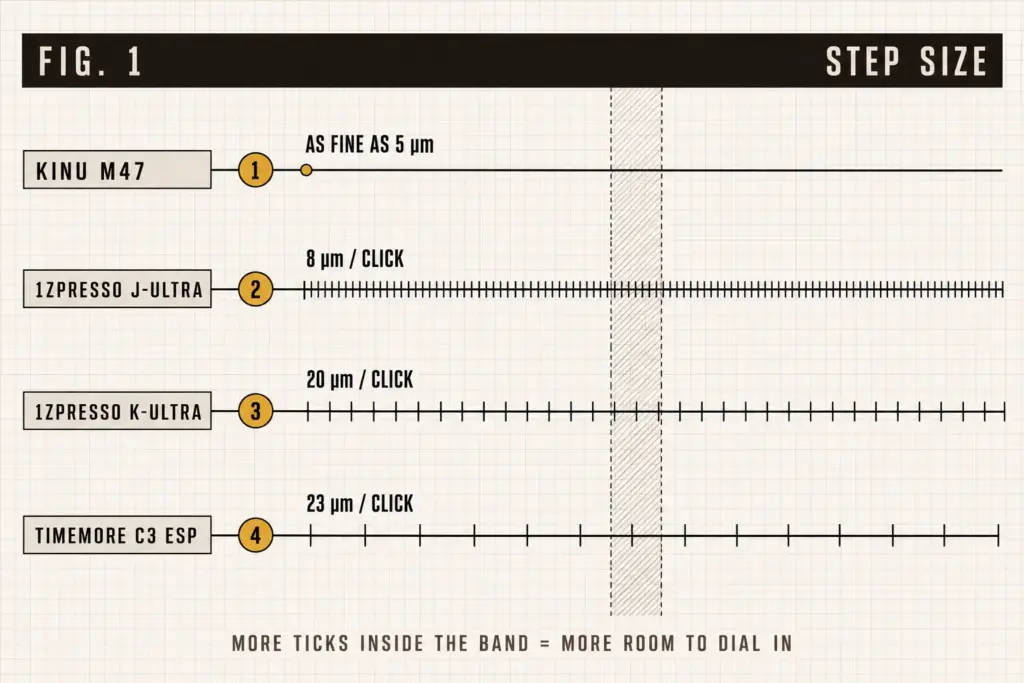
Read each micron per click as the size of a nudge. At 8 microns, a fine step, one click is a small correction, and one J-Ultra review notes that a single click or two measurably shifts shot time, which is the scale you want when a shot is only a few seconds off. At 20 microns and up, a click is a coarse step, and on some beans the shot you want sits between two of them.
Stepless sounds like the complete answer, and on paper it is: any point on the range is available, so the window can never fall between two settings. But stepless also means there is no number to come back to. The owner who wrote that M47 review found the indicator line on the wheel too small to see, felt little tactile feedback from each micro-adjustment, and wrote to Kinu asking for a mark he could feel.
Near-stepless clicks keep both halves of the bargain: steps small enough to land inside the window, and a number you can write down. Roast Aroma’s review describes the J-Ultra’s ring as working like a near-stepless adjustment for practical espresso, and that is a fair picture of what 8 microns does on a real counter. For one or two shots a day, that middle design is the one I would aim for.
The Burr Decides What the Fine Setting Tastes Like
Step size decides whether you can land in the window. The burr decides what the shot tastes like once you are there. Nearly every hand grinder uses conical burrs, and the difference between them comes down to the relative amounts of fines produced. Makers list some burrs as better suited to espresso and others to pour-over.
Fines are the smallest particles a burr throws, the dust-sized pieces well below the target size. In a shot, some of them help build resistance in the puck; too many choke it, push the cup toward muddy and harsh, and take away its clarity. Together with the boulders at the other end, they make up the particle distribution of a dose. The geometry behind why conical and flat burrs throw different fines is a subject of its own, and among conical burrs the maker’s burr design shifts the balance again.
1Zpresso makes the point with two of its own grinders. The J-Ultra’s burr is tuned for espresso, and one review notes that it throws more fines at coarse settings than the filter-oriented K-Ultra does, which is the price of a burr built for the fine end. Kinu goes further and sells a separate pour-over burr for the M47, so even the maker does not treat one burr as right for every job.
So read the maker’s stated orientation before assuming a fine setting will taste good. Every grinder in this guide uses steel burrs rather than a ceramic burr, and each is either built for espresso or pulls it well in the hands of owners. That still leaves the question of what they are like to use once they get there.
Reaching Espresso Is Not the Same as Dialing It In
Some grinders cannot get to espresso at all, and a grinder that will not go fine enough is a different problem with a different fix. The harder case is the grinder that gets there with too little room. The Comandante C40 shows the difference well, because it does pull espresso on its stock adjustment nut.
Shots on several different machines land in roughly the 8 to 12 click range. One owner grinding light roasts for a Flair, though, landed at 4 to 5 clicks from zero, so his whole espresso range sat inside a handful of big steps. He fitted Comandante’s optional Red Clix adjustment, which doubles the click count across the same range, and wrote afterward: “The number of clicks I since use has indeed doubled and I get more precision for espresso.”
The grinder had reached espresso the whole time. What changed was how many places inside the window he could stop, and that is the whole difference between reaching and dialing in. It is also why a spec sheet that only promises a range from espresso to French press tells you almost nothing.
One spec printed on nearly every listing, hopper capacity, can come off your list entirely. Nearly all hand grinders can hold about 30 g of beans, more than enough for a double shot. A double runs about 16 to 20 g (a little over half an ounce), so bean capacity only matters if you grind for several drinks at once.
Before you buy anything, find the two settings that bracket espresso on the grinder you already own: the one that gushes and the one that chokes. If they sit one click apart, the grinder is the limit and no technique will fix it. If there are two or three clicks between them, move to the middle one, pull the same dose to the same yield, and taste. A shot that is sweeter, with neither the sharp edge nor the dry finish, means the room was there all along.
Three Hand Grinders Built for Espresso, and the Flaw Each One Carries
With the size of one step as the test, three hand grinders are built around it: one with the finest clicks, one with no clicks at all, and one that brings a smaller budget into the espresso range. Each comes here with the complaint owners make about it, in the same breath as the reason to buy it. If you brew more pour-over than espresso, the best hand grinder across every brew method is a different ranking with different winners.
1Zpresso J-Ultra: the Finest Clicks
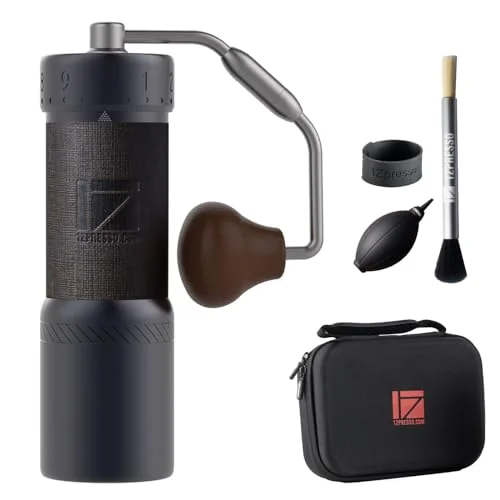
The 1Zpresso J-Ultra has the smallest clicks of any stepped grinder in this guide: 8 microns each, with 100 numbered clicks to a full turn of the external ring. At that size a click is a nudge rather than a jump. A shot running three or four seconds fast is a click or two away, and the rest of your recipe can stay exactly where it was.
The ring is the other half of the case. Because the numbers sit on the outside, you can write down the setting that worked (1Zpresso’s notation reads full rotations, then the number on the ring, then extra clicks) and dial straight back to it after grinding for something else. You can even keep the espresso setting on a strip of tape on the barrel and never count again.
The 48 mm conical burr is tuned for espresso, and one review lists retention at about 0.1 g, so the dose you weigh going in is very nearly the dose that lands in the catch cup. For single dosing, where you weigh 18 g of beans for one shot and grind all of it, low retention matters more than any capacity figure. Another reviewer’s summary of the grinder’s appeal was that one or two clicks measurably move the shot, which is the behavior the previous section asked for.
The price of those small clicks is effort. One J-Ultra review puts the grind time for an 18 g espresso dose (about 0.6 oz of beans) at roughly 40 to 50 seconds of cranking, and says lighter, denser roasts add noticeably to the resistance. Home Coffee Expert’s testers also found that one of them, with smaller hands, struggled to hold the barrel firmly at the finer settings, so the slim shell helps but does not remove the work.
Kinu M47 Simplicity: No Clicks at All
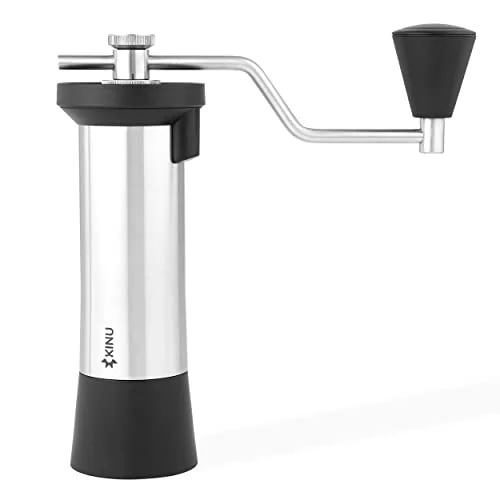
The Kinu M47 Simplicity drops clicks entirely. Its adjustment is stepless, which Kinu describes as adjustments “as fine as 5 microns,” and by Kinu’s spec its 47 mm conical steel burr turns on four ball bearings split between the grinder and the handle knob. Every point on the range is available, so the espresso window can never fall between two settings.
Stepless is the design most people name as the ideal for espresso, and this is where the obvious pick stops being obvious. Home Coffee Expert, setting it against the J-Ultra, found the M47 harder to use and saw little to no gain in grind consistency over the J-Ultra’s 8-micron clicks; stepless also makes moving between brew methods harder. For an espresso-only kitchen that never switches methods and wants no gap between any two settings, the Kinu earns its place, while for almost everyone else 8 microns already lands close enough.
What it takes away is a number to come back to. The owner review of the M47 Classic describes an indicator line on the wheel so small it was hard to see, and each micro-adjustment gives little tactile feedback, so returning to yesterday’s setting takes a careful eye. A fine line of your own drawn on the wheel beside the maker’s mark is the cheap workaround.
It is also heavy. Kinu lists the Simplicity at 1,050 g (about 2.3 lb), with a 40 g capacity and a magnetic catch cup held by 11 magnets, and the weight is something you definitely feel while grinding. Amazon stock on it comes and goes, too, so check before you plan around it.
TIMEMORE C3 ESP: the Entry Point That Still Reaches
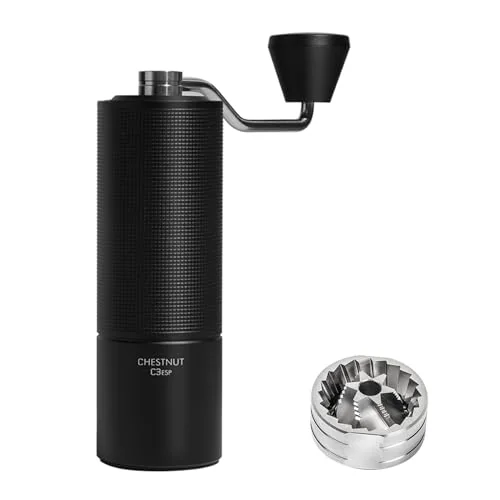
The TIMEMORE Chestnut C3 ESP exists because the plain C3 was not enough. Owners who tried to pull espresso on the base C3 found its steps too coarse to land a shot reliably, and the ESP version answers with a finer pitch: 0.0233 mm per click on the listing, about 23 microns, with S2C660 steel burrs, dual bearings and an all-metal one-piece shell. The listing says so directly: “ESP pitch is finer and the adjusting disk is more precise, which is more suitable for espresso making.”
It is also the entry-level pick, and where a lot of people start. A hand grinder can be a budget route to good espresso, since a modest spend on a manual grinder can get you there. One common shopping list for that step is a Timemore C3 ESP Pro, an IMS basket, a bottomless portafilter and a WDT tool.
Of the three, it carries the coarsest step, close to three times the J-Ultra’s. Expect to spend a few more shots landing each new bag, and expect the gap between two clicks to show up as a shot that runs a little fast on one and a little slow on the next. The adjustment is internal, so you count clicks from zero rather than reading a number off a ring.
Choosing among the three comes down to what you are willing to put up with. The finest repeatable clicks and a number on the outside point to the J-Ultra; no steps at all, plus the patience for a small mark on a wheel, point to the Kinu; a tighter budget and a few more shots per bag point to the C3 ESP. Price tiers get their full treatment in cheaper hand grinders, tier by tier.
Moving the dial does not clear what is already sitting between the burrs, so the dose right after a change is partly ground at the old setting. Before you judge a shot at a new setting, spin the empty grinder for a few turns or grind and toss a few beans. Skip it and you taste a blend of two settings, then blame the wrong one.
Why Grinding for Espresso by Hand Takes Twice the Cranking
Hand-grinding espresso is work, and every warning you have read about that is right. What usually goes unsaid is why: the effort is the fine setting doing its job, and the roast in the hopper can turn the same dose from a workout into a breeze on the same grinder.
More Surface per Gram, More Resistance per Turn
Picture the dose half-ground, the espresso machine still heating, and your forearm starting to burn around the halfway point. Nothing is wrong with the grinder. A finer setting narrows the gap between the burrs, so every bean has to be cut into many more, much smaller pieces before any of it can fall through.
More cutting per gram means more resistance on every turn and more turns per dose. The work tracks the new surface you create, and an espresso grind creates far more of it than a pour-over grind does from the same beans. That is the fine grind being made, not a defect in the burr.
The times owners and reviewers report bear this out, as long as you read them as data points rather than a law. Home Coffee Expert timed the K-Ultra and reported that “it took us 45 seconds to grind 30g for espresso and around 25 seconds for pour over” on the same grinder. A review of the J-Ultra puts an 18 g espresso dose at 40 to 50 seconds, and a KINGrinder K6 takes some muscle to run.
The heading says twice the cranking. The one review that timed both settings on the same grinder lands a little short of that (45 seconds against 25, closer to 1.8 times), which is near enough to plan a morning around. The spread between grinders comes from the burr, the step and the roast, and how long grinding by hand really takes works through it grinder by grinder.
Burr diameter matters here too. A bigger burr cuts more coffee per turn, which is why one review of the J-Ultra credits its 48 mm burr with reducing the torque you need compared with smaller burr sets, while still calling the job a meaningful manual effort. The Kinu Classic owner, with a 47 mm burr, said it ground at least twice as fast as his previous grinder; five months in, though, spending a whole minute on 18 g for espresso bothered him more than it had at filter settings.
The resistance is not even through a dose, either. The first beans crack loudly and the crank lurches as they catch; halfway through, it settles into a steady grind, and at the end it goes light and quiet as the last pieces drop. That silence is how you know the dose is done.
Light Roasts Fight Back, Dark Roasts Give Way
The grinder is only half of the effort question. Light roasts are tough to grind by hand, while Full City+ and darker roasts are a relative breeze. Neither was describing a special grinder: the roast was the variable.
A light roast spends less time in the roaster, so the bean stays denser and tougher, and the burr has to cut through more material that gives way less readily. A dark roast has been taken further, and its structure breaks apart more easily under the burr. So if a light-roast dose wears you out, you may be holding the right grinder and the hardest bean on the shelf.
The roast also moves where the setting lands. Light roasts usually need a finer grind to extract enough, which pushes the dial further toward the tight end, exactly where effort peaks and step size bites hardest (the Comandante owner stuck at 4 to 5 clicks was grinding light roasts). A medium roast sits between the two on both counts, and a Full City roast leans toward the easier end.
If you are still deciding between light or dark roast for espresso, put grind effort on the list of things that decision changes. It never appears on a bag, but you feel it every morning. And it compounds with the grinder: a coarse-stepped grinder asked to reach a light roast’s setting gives you the hardest crank and the least room at once.
Tedious or Worth It: What Owners Actually Say
Before deciding the crank is not for you, work through the free changes one at a time, and notice how each dose felt before changing the next thing:
- Brace the grinder. Rest its base against the counter edge or your chest instead of holding it in the air, so your arms turn the crank instead of also holding the grinder up.
- Grind only the dose you weighed, never a hopper-full for later shots, so each session ends at 18 g rather than 40.
- If the daily bean is a light roast and the crank is still too much, try a medium roast for a few days with the same grinder; if the effort drops, the bean was the load.
Hand strength is part of it, and grip strength more so. Home Coffee Expert’s smaller-handed tester struggled to hold the J-Ultra’s barrel at fine settings, and Timemore markets the C3 ESP’s 52 mm shell as easy to grasp for small hands. A grinder that fits your hand puts more of your forearm effort into the turning and less into the holding.
Owners still split on whether it is worth it, and the split does not depend on the grinder. Hand grinding for espresso is tedious unless you are on a tight budget or enjoy the manual approach. Some find the crank less annoying than the vrrrr of an electric grinder, and grinding while a machine heats up makes the wait pass.
The case for the crank is not only about budget, either. For one cup a day and very little counter space, a whole espresso setup can be packed away in a 20-liter box (about 5 gallons). A hand grinder is quiet, it needs no outlet, and it goes back in a drawer when the shot is done.
No grinder settles that argument for you. Decide which of those two people you are before choosing a model, because the best grinder in this guide still asks for somewhere around forty seconds of cranking every morning. That is a fair trade for some readers and a daily irritation for others, and only one of those two should buy a hand grinder for espresso.
If a light-roast dose leaves your forearm burning, change one thing before you blame the grinder: set its base on the counter edge and lean into each turn instead of holding it up. Grind the same dose of the same beans the same way the next morning and compare how it felt. If it is still a fight, the bean is the next thing to change, and the grinder comes last.
Two All-Rounders That Also Pull Espresso, With a Catch
Not everyone grinding for espresso grinds only for espresso. If you pull a shot on weekdays and brew a pour-over on Saturday, one grinder for both is a reasonable wish, and two good all-rounders do both. Each has a catch at the espresso end, and the catch belongs in the verdict rather than in a footnote.
1Zpresso K-Ultra: an External Ring for Switching Back and Forth
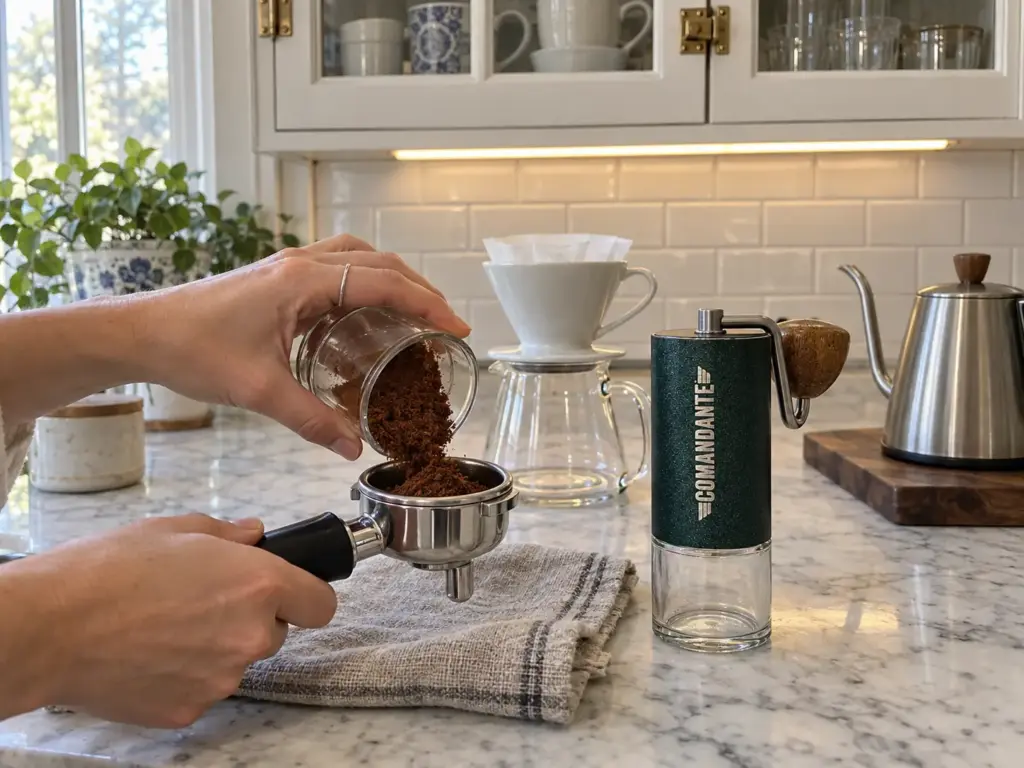
The 1Zpresso K-Ultra moves 20 microns per click on an external numbered ring, driving a 48 mm heptagonal burr in steel. That is two and a half times the J-Ultra’s step, so each click moves a shot further, and Home Coffee Expert’s verdict is fair: fine for pulling the occasional shot, not precise enough for anyone set on dialing in closely. They got a good espresso at setting 3.2 with medium-roast beans, which tells you it gets there.
What the ring buys is the switch. Going from espresso to pour-over is a twist of the ring to a number you can read, where the J-Ultra’s tiny clicks mean moving hundreds of them every time you change methods. The same reviewers who preferred the J-Ultra for espresso said, of that grinder, that you have to be happy to count a few hundred clicks along the way.
The weak point is the handle. Balance Journal’s 14-week daily log found the joint where the handle meets the grinder developing play at about six weeks, a part loosening rather than the grind failing. Home Coffee Expert had already reported that product engineers raised concerns about the foldable handle as a possible weak point, and the K-Ultra’s warranty runs one year.
At about 700 g (just over 1.5 lb), it is also a solid weight to hold through a fine espresso dose. It will not suit a reader who pulls espresso daily and wants every shot dialed to the second.
Comandante C40 MK4: Espresso on the Stock Nut, More Room With Red Clix
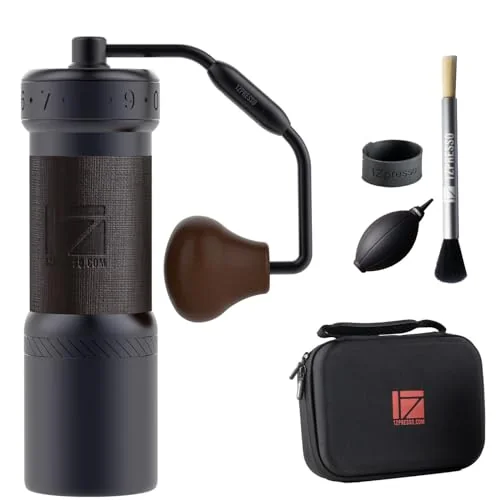
The Comandante C40 MK4 pulls espresso as it comes. Settings differ from machine to machine, even on the stock adjustment nut, so a number from one machine means little on another. A grinder that finds the window on three different machines is not short of range.
The catch is the size of each click at the fine end. Grinding light roasts can leave you only a few clicks from zero, so every move is a big one compared with how little range is left. The optional Red Clix kit doubles the number of clicks over the same range; as another member remembered it, its thread is double the standard one, so your click numbers double too.
Read that as an upgrade for control, not a part the grinder needs to reach espresso. For medium and darker espresso roasts, the stock Comandante does the job. A light-roast espresso drinker should plan on Red Clix, a small extra part, and should know that before buying rather than after a week of shots that land on either side of the target.
The click numbers in the manual are a starting point at best. Some settings run far finer than a manufacturer’s chart, so the chart is a starting point, not a rule. Numbers on any grinder are really only useful for reference and consistency, and even units of the same model can have slightly different zero points.
So your number is yours, counted from your own zero, and finding the zero and counting clicks is a short lesson worth doing once. On an internal-click grinder like this one, the count is the whole adjustment system. Get it wrong by two and every setting you read online or wrote down last week shifts with it.
Specialist or All-Rounder: Which One Fits Your Week
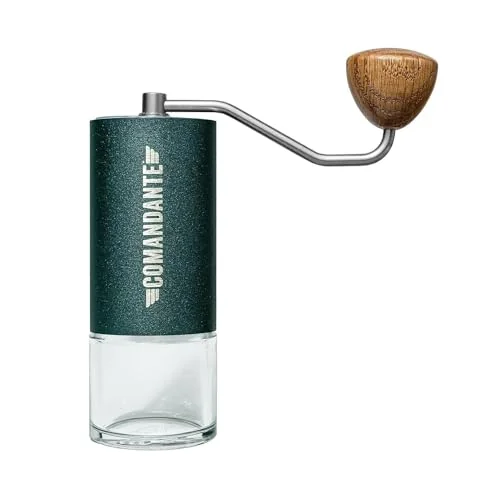
On an all-rounder, the painful moment is the switch back. Going from pour-over to espresso on internal clicks means counting down from the coarse end every time, and a miscount of two clicks at espresso is the difference between a shot that runs and one that stalls. That is why people who switch daily end up writing both settings on a strip of tape on the barrel, while on the K-Ultra you simply read them off the ring.
Sort it by your week. Mostly espresso points back to the three specialists in the previous section. Espresso and filter in the same week points to the K-Ultra for its ring, or to the Comandante for its build if your espresso roast is medium or darker.
And if the crank itself is what you cannot live with, an electric grinder for espresso answers the same question with a motor. The trade there is counter space and noise instead of forearm work. Neither answer is wrong; they suit different mornings.
The day a shot tastes right, write the setting down, counted from the zero where the burrs just touch and the handle stops turning freely, never from the chart in the manual. Owners of the same model report espresso settings several clicks apart, so a borrowed number is only a place to start your own dial-in.
What Wears First When a Hand Grinder Lives at the Espresso End
Reviews get written the week the grinder arrives. A grinder kept at the fine end takes more force on every turn for months, and the complaints that repeat from owners are about what that force finds first: rarely the burrs, usually the small parts around them.
The Handle and the Knob Take the Load First
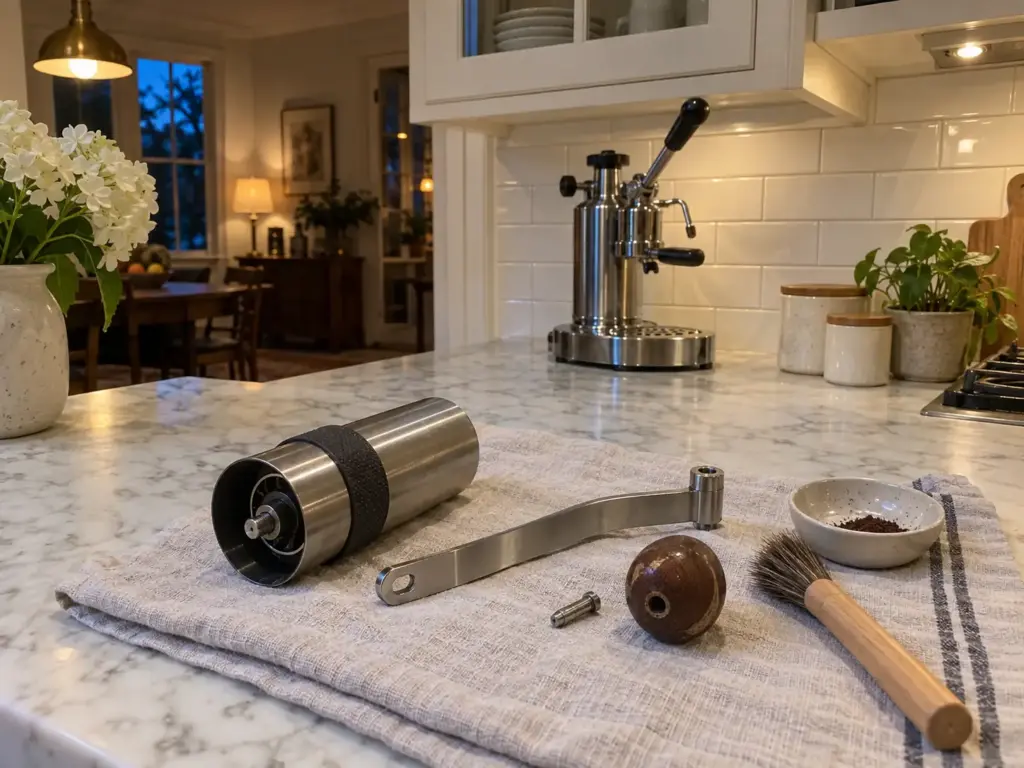
A few months in, with the same beans at the same setting, the knob on the crank starts to shift in your palm at the top of each turn. That is usually the first sign, and it arrives by touch before it reaches the cup. On an espresso grinder the handle carries the most force, because the fine setting asks for the most torque on every turn.
An owner on coffeeforums.co.uk who bought a used 1Zpresso J-Max, the espresso grinder the J-Ultra replaced, found its wood knob would not stay on the crank. Inside the knob sat a snap fastener like the ones on baby clothes, pressed into a bushing, and that snap was the part that had failed. He called it a poor design, since “the JMax is an espresso grinder and the amount of force transmitting through the handle can be high.”
It is not one unlucky unit. A KINGrinder K4 can fail the same way within half a year, and the maker’s answer was that the grinder had been overloaded. The J-Max owner, who also has a K-Ultra, said he was tempted to keep spare clips in case that knob went the same way.
Timing is the reason these reports matter more than a launch review. Home Coffee Expert, writing about the K-Ultra’s fold-away handle while the grinder was new, said plainly that it was too new to know whether the worry would come true. It took a daily log running past the first month to find the handle play at about six weeks, and none of that would show up in the week a grinder is unboxed.
A loose knob or a handle with a little give is a nuisance, not a grind problem, as long as the burr itself stays put. The knob does not set the gap between the burrs, so a shot ground with a wobbly knob tastes the same as one ground with a tight one, and a new clip or a tightened joint sorts it out. A burr that rocks on its shaft is a different and more serious matter, because then the gap opens and closes as you turn, and the axle check for that belongs with the general hand-grinder ranking linked earlier.
The same used J-Max had also turned rough and loud, with a little play in its ball bearings and rust residue in one bearing seat; its owner suspected a previous owner had used RDT (the drop of water stirred into the beans to cut static) regularly. He replaced the bearings himself, with a careful disassembly that most owners would rather not attempt, though it shows the grinder is repairable. None of it touched the burrs.
The detail in his repair is useful even if you never open a grinder. The original bearings were shielded rather than sealed, which keeps resistance low, and by his account the shields had done a terrible job; he fitted rubber-sealed stainless ones and accepted a touch more drag for a longer life. If you use RDT to tame static and clumping, keep it to a single drop or a light mist on the beans, since any more is water heading toward the parts that turn.
That is the pattern worth remembering. The force of fine grinding finds the knob, the handle joint and the bearings long before it wears the cutting edges, which is why the K-Ultra’s handle play at about six weeks shows up in the same kind of report. Durability shows up in the warranty terms too, so read them with that in mind: Kinu covers its grinders for five years, 1Zpresso’s K-Ultra for one, and Home Coffee Expert noted that a handle failing years later would fall outside the K-Ultra’s cover.
The Setting You Wrote Down Starts to Drift
The other slow change is the setting itself. The number that pulled a good shot in March may not do it in May: a new bag, a lighter roast or older beans, and the grind you need moves. That is the coffee changing, not the grinder.
On internal-click grinders, the most common drift is not drift at all. It is a miscount from zero. When settings stop making sense, check whether you are counting from the first click where the handle no longer swings freely. If not, everything will be out.
Old grounds build up too. Home Coffee Expert recommends taking the K-Ultra apart and cleaning it weekly, because fines start to pack in if you do not, and with a cleaning brush and a few loose pieces it takes minutes. A chamber packed with stale fines feeds some of them into the next dose, and they bring their stale taste with them.
When a shot at your written setting starts running faster than it used to, work through it in order, one change at a time, and taste after each:
- Re-find the zero and recount to your setting, then pull the same dose to the same yield. If the count was off, the shot should run in its old time and taste the way it did the day you wrote the number down.
- If the count was right, clean the burrs and the chamber, then pull again with the same beans. A cleaner, less muddy shot means the buildup was the problem.
- If it still runs fast, go one click finer and taste. A shot that turns slow and harsh means you went a click too far, so come back.
When the Burrs Themselves Are the Problem
Dull burrs are the last suspect, and the rarest of the problems here. When they do go, the signs are more fines and a muddier, harsher shot at a setting that used to be right, even after the zero and the cleaning check out. That is a replacement question, and the signs that burrs need replacing are worth learning before you order a set.
One pattern looks like wear and is not. Owners who start on a base Timemore C3 and move to the ESP version are reporting a design limit they found in use: the step was never small enough for espresso. If your grinder has always landed shots in big jumps, no maintenance will change that, and the step size from the first section is the thing to shop for.
Once the grinder holds its setting, the next question is the setting itself: how fine espresso grind actually needs to be for the lever machine, the portable espresso maker or the pump machine you are feeding. After that comes the bean, and a less forgiving coffee, like single origin beans for espresso, is where the room you paid for at the fine end starts to earn its keep.
Once a month, run one check: grind a dose at your written setting with a bag of the same beans and time the shot. If it runs noticeably faster than it used to, re-find the zero before you touch the setting. In owner reports, a miscounted zero turns up far more often than a worn burr.
Count the Clicks Between Gush and Choke Before You Buy
Three things decide whether a hand grinder earns a place next to an espresso machine:
- Judge it by the size of one step at the fine end, not by whether it reaches fine. Single-digit microns per click, or stepless, gives you room to land, and where espresso sits on the grind size chart shows how narrow that band is.
- Expect the crank to get harder at espresso, and harder again with light roasts. Brace the grinder, grind only the dose, and decide whether that is a trade you will make every morning.
- An all-rounder can pull shots too: the K-Ultra with its readable ring, the Comandante on its stock nut, as long as you know where each one runs out of room.
A month from now, time a shot at your written setting with the same beans, and if it runs faster than it did, re-find the zero before you blame the burrs.
Tomorrow morning, on the grinder you already own, find the click that gushes and the click that chokes, count what lies between them, and pull a shot from the middle. If it tastes sweet and even, with neither a sour edge nor a dry, bitter finish, the grinder has room and your next money goes elsewhere. If there is no middle to pull from, you know exactly what the new grinder has to fix.
Frequently Asked Questions
01Are manual coffee grinders good for espresso?
The good ones are, because what limits a hand grinder at espresso is how small one step is at the fine end, not how fine it can go. The 1Zpresso J-Ultra and Kinu M47 give you room to dial in, while many all-purpose grinders reach espresso only in big jumps.
02Which manual grinder is best for making espresso?
The 1Zpresso J-Ultra has the finest repeatable clicks at 8 microns each, the Kinu M47 Simplicity has no steps at all, and the TIMEMORE C3 ESP suits a smaller budget. Each carries a trade-off: effort, a hard-to-read marker, or a coarser step.
03What is the best manual burr grinder for espresso, conical or flat?
Almost every hand grinder uses conical burrs, and the best espresso hand grinders are conical too. What matters more than the shape is whether the maker designed the burr for espresso, how many fines it throws at the fine end, and how small each adjustment step is.
04How long does it take to grind espresso by hand?
Reported times run from under 30 seconds to about 50 seconds for an 18 g espresso dose, depending on the grinder, its step size and the roast. Light roasts take noticeably longer and more force than darker roasts on the same grinder.
05Do you need Red Clix on a Comandante for espresso?
No, owners pull espresso on a stock Comandante C40, usually somewhere around 8 to 12 clicks from zero depending on the machine. Red Clix doubles the number of clicks across the same range, which helps most with light roasts that push the setting close to zero.

How did your cup turn out?
No comments yet. Tell us what you changed — and whether the needle moved.