
We may earn a commission when you buy through links on this page. It never changes what we recommend. How we pick
On this page7 parts
- What a Cheap Manual Coffee Grinder Gives Up, Part by Part
- Three Cheap Hand Grinders Worth Buying for Drip and Pour-Over, Each With Its Flaw
- Which Cheap Hand Grinder Suits the Brewer You Already Own
- Two Cheap Hand Grinders for a Different Kitchen: Small, or No Plastic at All
- What Breaks by Month Two on a Cheap Hand Grinder, and When to Spend More
- Look Past the Burr, Then Size the Grinder to Your Morning Dose
- Frequently Asked Questions
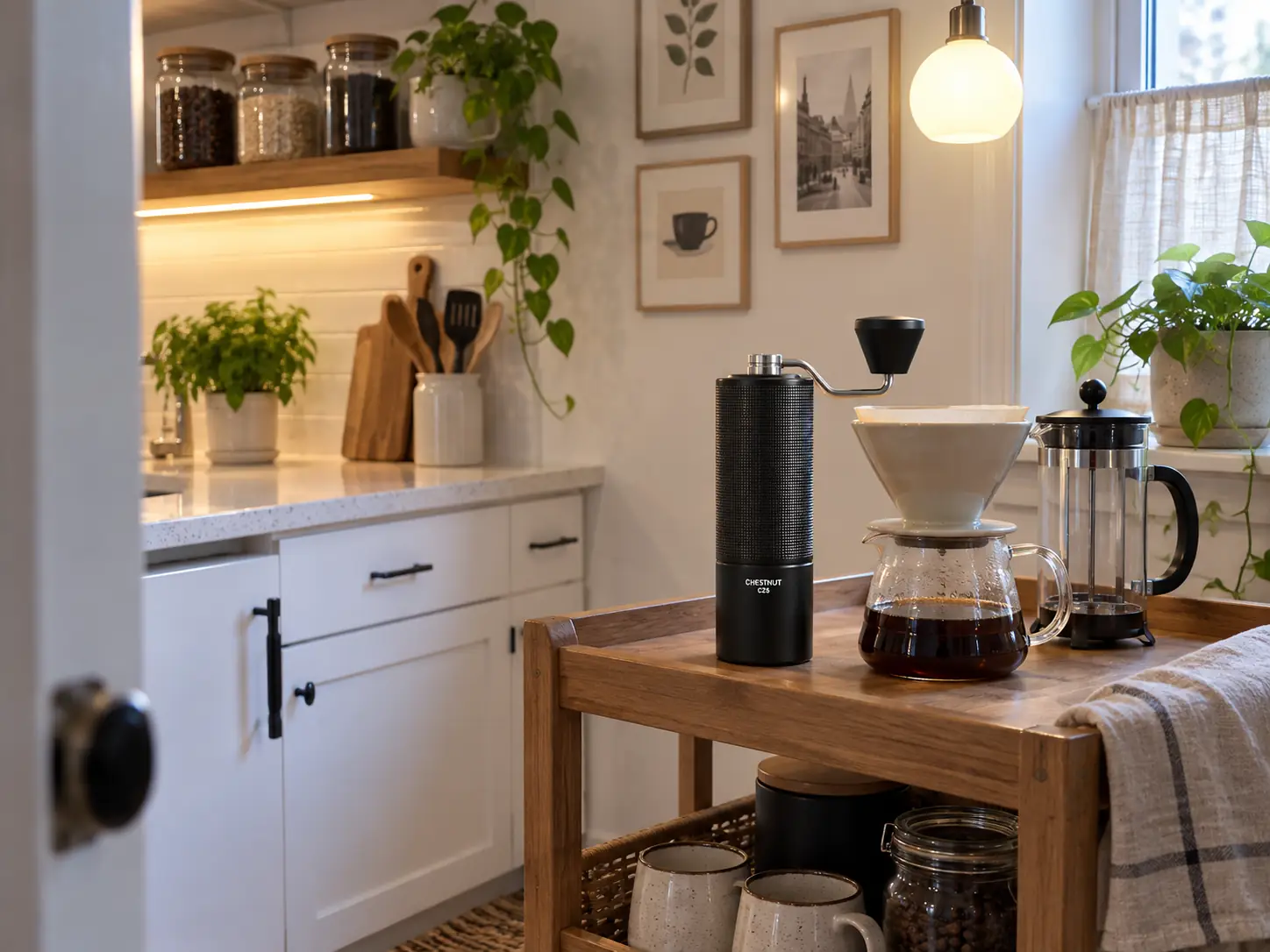
A cheap hand grinder gets judged on its first morning, and on its first morning almost any of them turns out a clean, even dose. The trouble shows up weeks later: the handle lurches off the shaft halfway through a crank, the setting you counted out on Monday has crept by Friday, and two cups brewed the same way stop tasting alike. If you are hunting for the best cheap manual coffee grinder, that later stretch is where the answer lives, and it is almost never about the burr.
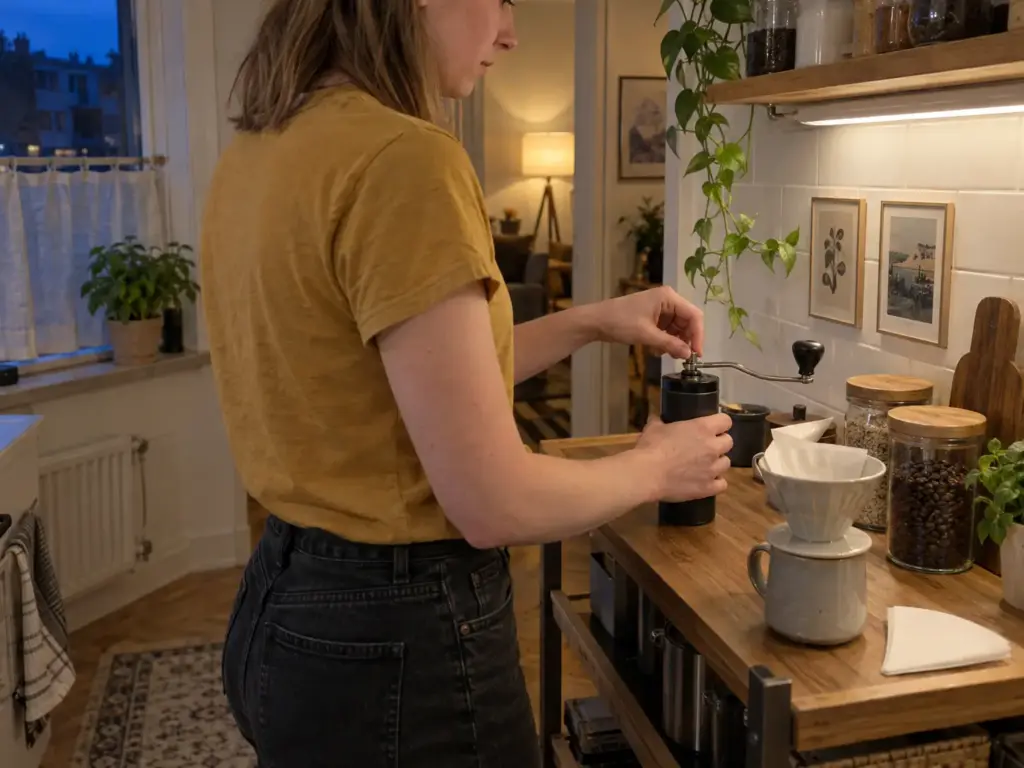
A hand grinder is a burr on an axle, held still by a frame, turned by a handle and set by a dial. At a low price the maker protects the burr and saves on the other three, so the flaw worth looking for sits in the parts that hold, turn and set it. What follows goes through where a cheap grinder saves its money, part by part; three all-rounders for drip and pour-over, each with the flaw its owners report; which one suits the brewer already on your counter; two for a different kitchen; and what breaks first once the novelty is gone. If you have not yet settled whether cranking by hand beats a motor for you, that question has its own page.
Quick Answer
Pick by what you brew, and look for a steel burr seated in metal, a handle that stays on its shaft and a setting that holds.
- TIMEMORE Chestnut C2S: the all-rounder, steel burr, all-metal shell. Gives up: a hard drop can end it.
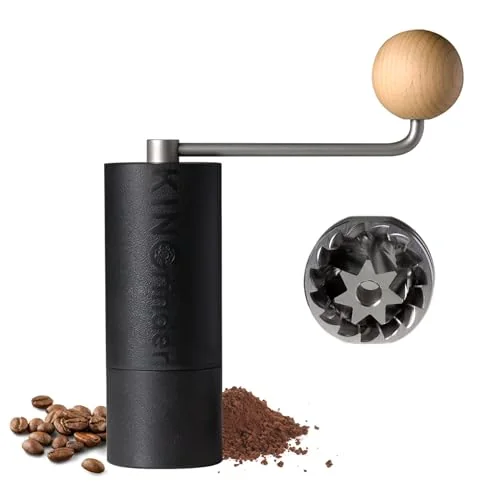
- KINGrinder P2: the smallest spend that keeps a steel burr. Gives up: the handle pops off.
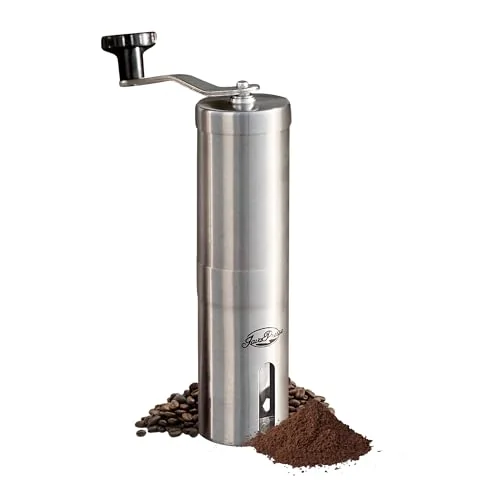
- JavaPresse: the most-reviewed, ceramic burr. Gives up: slow at coarse settings, loose handle.
- Porlex Mini II: small enough for one cup or a bag. Gives up: tiny hopper, slow for two.
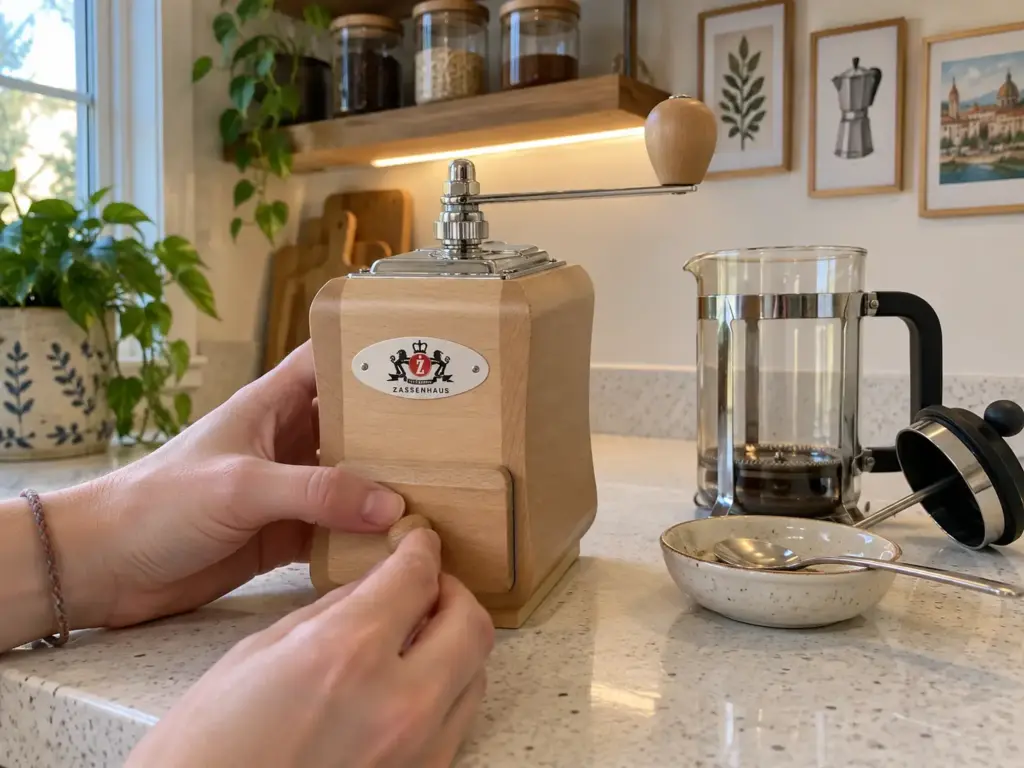
- Zassenhaus Santiago: wood and steel, no plastic. Gives up: the setting walks coarser mid-dose.
- Espresso is not this price’s job: buy for drip, pour-over and French press.
What a Cheap Manual Coffee Grinder Gives Up, Part by Part
A cheap hand grinder does not save its money on the burr. Most of the steel burrs at this price grind evenly enough for drip and pour-over, and the savings sit in the parts that hold the burr still, turn it and set it. Those parts are what owners start writing about once the first few weeks are over.
The Burr Is Rarely the Cheap Part
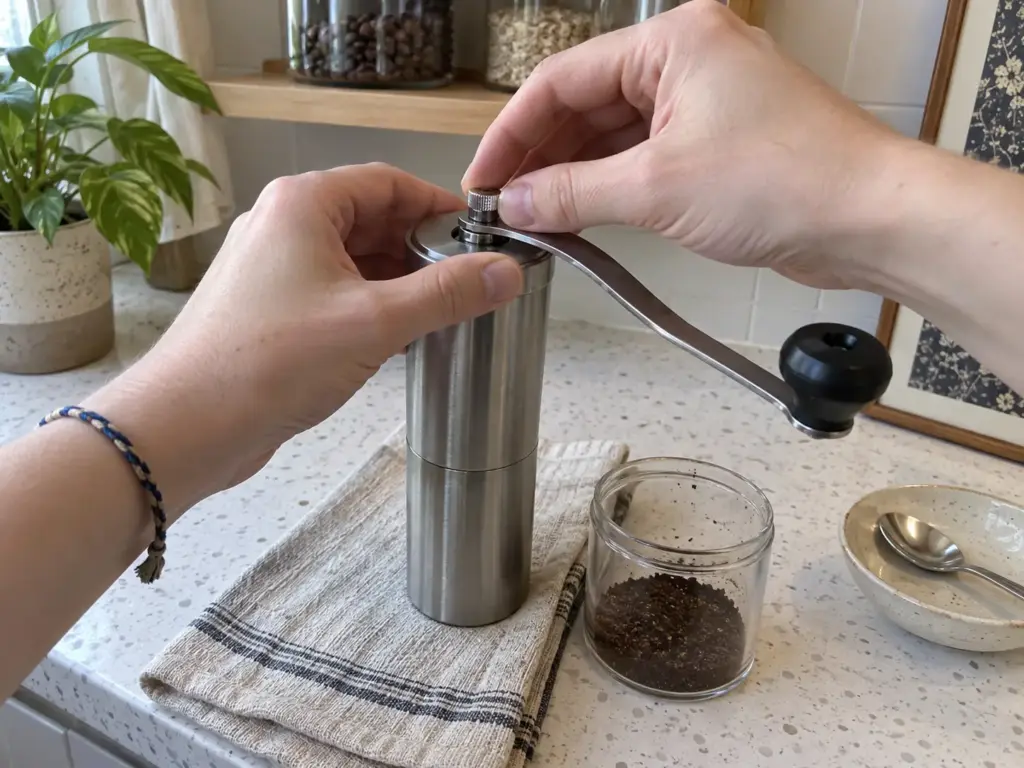
Open the listing of almost any hand grinder at this price and the burr is the one part described in numbers. The TIMEMORE Chestnut C2S prints a 38 mm conical burr in 420 stainless steel; the KINGrinder P2 prints a 38 mm conical burr in SUS420, the same family of steel under a different label. That is a real burr, the kind of cone-inside-a-ring that cuts beans to a size instead of smashing them, and it is the reason any burr beats a blade no matter how little the grinder costs.
Owners draw the same line. The KINGrinder P2 grinds nice and uniformly, but the handle is the weak point.
That split turns up again and again in what people write after a few weeks of use: the grind gets praise, and the complaint lands somewhere else on the grinder. When the burr is fine, the particles come out close to one particle size and the cup is easy to steer. Every piece gives up its flavor at roughly the same pace, so extraction lands on one side of the target: under-extraction tastes sour, over-extraction bitter, and a single click moves it back.
The labels are another matter. The JavaPresse listing calls its burr “professional grade” and promises “100% precision & control over the coarseness of your grind.”
Neither phrase names a measurement. Professional grade is not a steel, a size or a step between settings, and precision says nothing about how far apart the clicks sit. The C2S listing promises “exceptional grind uniformity”, which may well be true of the cone on its first morning, and says nothing about whether that cone stays centered once you have cranked a few hundred doses through it.
Staying centered is the whole question, and it has a name: burr alignment. Grind consistency depends on the gap between the inner and outer burr staying the same all the way around every turn, and that gap is held by the parts that never make it into the product photos.
Where the Savings Go: the Seat, the Handle and the Dial
Start with the seat, the piece holding the inner burr square on its axle. Handground, a grinder maker, explains the fault plainly on its own support page: if the plastic inserts at the top and bottom of its ceramic inner burr are not pressed all the way in, “they will cause the inner burr to sit crooked on the axle.” A crooked burr opens the gap on one side of each turn and closes it on the other. Half the dose comes out coarse, half comes out as dust, and the cup tastes sour and bitter at the same time, which no single click can fix.
Plastic that holds a burr can also lose its grip slowly. The Timemore C2, the plastic-framed grinder the C2S replaced, has a reputation for going downhill over time. The diagnosis: “the burrs and bearings are mounted in plastics, meaning even if your burrs are better aligned than mine, this can go off over time as the plastic is stressed through repeated grinds.”
And the symptom: “This also results in significant wobble when the grinder is spun.” Other C2 units have run without trouble, so the problems are not universal. But it names the mechanism exactly, and it is the reason some readers go looking for a grinder with no plastic on the coffee’s path in the first place.
Treat the next point as reasoning, not a measured result. A burr that is only loosely seated has room to move, and when the gap is set wide for a French press, that movement has more space in which to open and close as the crank turns. A tight gap for pour-over leaves the same looseness less room to show. If you want to feel for that burr wobble with your own fingers before you buy, the wobble check and the full ranking of hand grinders walks through it step by step.
Next comes the handle, and here the same complaint shows up across brands that share nothing else. On the JavaPresse, the handle can fall off repeatedly.
On the KINGrinder P2, the handle is a known problem: it can fall off too easily, and it pays to keep an eye on it. Two makers, two price points, the same joint.
The reason is simple mechanics. On many cheap grinders the handle drops onto a square or hex tip at the top of the shaft, and some are held there by nothing but a snug fit. On a JavaPresse the arm has a hex cutout that fits over the hex-shaped shaft, and the whole assembly is held by a friction fit. Every turn of the crank pushes that joint sideways as well as around. Over weeks, the hole in the handle wears a hair wider than the shaft.
You can hear it before it fails. A faint click at the same point of every turn, or a small lurch in the crank as the handle catches up with the shaft, means the hole has started to round off. That is the moment to press the handle fully home before each dose, not the morning it lands on the floor.
Last comes the dial, the ring or knob that sets the gap. Two owners of the Zassenhaus Santiago report its adjustment moving toward coarse as they crank; one sent the grinder back over it. On the KINGrinder P2 the opposite failure has been reported too: the adjustment mechanism can break the first time it is adjusted, while other units hold their setting well. Same model, different units, different luck.
A setting that moves mid-dose makes a dose of two sizes, and it quietly breaks the most common advice in coffee. A sour cup means grind a step finer, and on a grinder that holds its setting, that works. On a grinder whose dial walks, going finer only starts the next dose finer; by the end of the crank it has drifted back, the cup is still sour, and you conclude the beans are the problem. Before you chase the setting, check that it stayed where you left it.
There is a yardstick for all of this, and a buyer cannot read it. The Specialty Coffee Association publishes SCA-320, Home Coffee Grinders: Specifications and Test Methods, as the Specialty Coffee Association’s own standard for home grinders, and the association lists it among the certification standards open only to members who log in.
So its pass figures are not public, and no listing at this price cites it. The words consistent, uniform and precision on the box borrow the standard’s vocabulary without its numbers. What you can check yourself is the construction: how the burr is seated, how the handle meets the shaft, and whether the dial holds.
When a cheap grinder that used to make a clean cup starts tasting sour and bitter at once, leave the setting alone for a day. Press the handle fully onto its shaft (and snug the nut, if yours has one), grind your usual dose at your usual click, and taste. Still muddled? Take the inner burr out, seat it the way the manual shows, and grind the same dose again. Only a cup that stays muddled after both is a grinder problem.
Steel or Ceramic Burrs at This Price
Two of the five grinders in this article cut with ceramic (the JavaPresse and the Porlex Mini II) and three with steel (the C2S and the P2 in stainless, the Zassenhaus in hardened carbon steel). Neither material is simply better. Each fails in its own way.
Ceramic holds its edge for a long time and never rusts. The JavaPresse listing goes further and claims its ceramic burr lasts “5 times longer than comparable stainless steel coffee burrs”, which is the maker’s own claim, not a measurement anyone outside the company has published, and even taken at face value it describes wear, not knocks.
Ceramic is brittle. A drop onto a tile floor or a small stone hiding in a bag of beans can chip it, and a chip is a notch in the cutting edge that changes the gap at one point of every turn. The cup goes muddy in the same way a crooked burr makes it muddy, from a different cause.
Steel takes a knock without cracking. It dulls gradually instead, and the sign is a setting that slowly needs to go a click finer to taste the way it used to, because a rounded edge crushes where it once cut.
At home, for one or two cups a day, that takes a long time. Steel has its own care rule: the KINGrinder listing says flatly “Do not wash with water”, and carbon steel in particular wants to stay dry. A brush, not the sink.
So the trade at this price looks like this. Steel if the grinder will live on a counter and occasionally get knocked over; ceramic if it will travel in a bag where a stone is less likely than rust, and you will treat it gently. For durability, neither choice matters as much as the seat, the handle and the dial above.
Three Cheap Hand Grinders Worth Buying for Drip and Pour-Over, Each With Its Flaw
With the seat, the handle and the dial as the test, three cheap hand grinders cover most kitchens. One put its money into an all-metal shell, one kept the steel burr and moved the plastic to the outside, and one has been bought by more people than any other hand grinder at its price. Each comes here with the complaint most often raised about it, stated right next to the reason to buy it.
TIMEMORE Chestnut C2S: the All-Metal All-Rounder
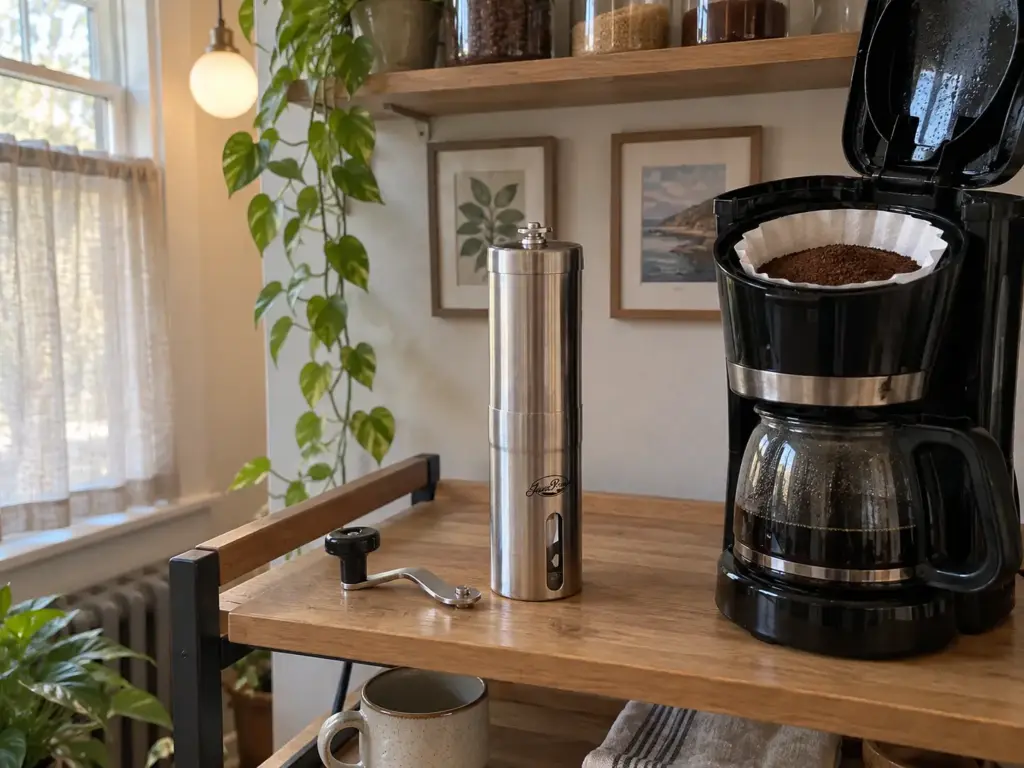
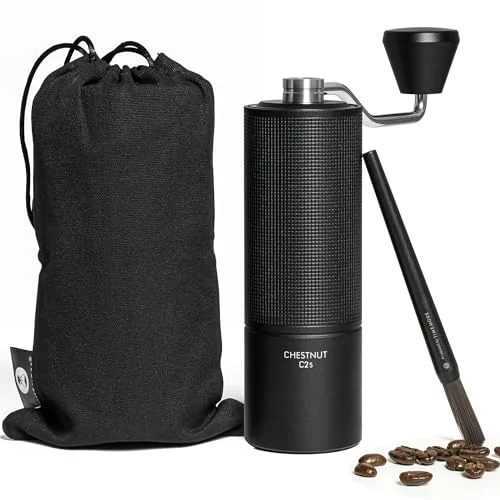
The TIMEMORE Chestnut C2S is the pick for a reader who brews one or two cups of drip or pour-over a day, has been making do with a blade grinder or a bag of pre-ground, and wants the next grinder not to become the next problem. Its burr is a 38 mm conical cone in 420 stainless steel. It adjusts in about 36 internal clicks, the hopper holds 20 g of beans (0.7 oz, roughly two level coffee scoops), and the whole grinder weighs 430 g, a little under a pound.
What sets it apart is written on its own listing: the C2S “is upgraded from TIMEMORE C2”, with an aluminum-alloy frame and “no plastic part inside”. That is the answer, in the spec, to the complaint the C2 owner made about burrs and bearings mounted in plastic.
The listing does not say the redesign was made because of those complaints, and this page does not claim it was. But on the one part of a cheap grinder most likely to loosen with time, the C2S has metal where its predecessor had plastic. It is also a fine match for a V60 or a Kalita at home, and if pour-over is your main brewer, grinders for pour-over at every price compares it against the electric options.
Internal clicks change how you use it. There is no number printed on the outside, so a setting is counted from the zero point: close the burrs gently until they touch, then count clicks back out.
Owners end up carrying a number in their heads. A starting click number means something only on that grinder, counted from its own zero, and adjusting up or down a click or two depending on taste is the usual move. The catch of sharing one grinder between two brewers is that the setting has to be checked every time the moka pot comes out.
The flaw is the C2S’s own. A drop can end this exact model for good.
A metal frame shrugs off daily cranking better than plastic does, but a hard fall onto a floor can still bend or knock something that does not go back, and in that owner’s case, support did not step in. A second, gentler complaint comes from a reviewer who wished the handle folded for travel. Keep it on the counter, grind over the counter, and it has nothing else against it.
KINGrinder P2: the Cheapest Steel Burr
The C2S looks like the automatic choice until you line it up against the KINGrinder P2 and see how much the two share. Both carry a 38 mm stainless steel conical burr. Both hold 20 g of beans.
The P2 costs noticeably less, and it gets there by making the outer shell from ABS plastic instead of aluminum, which also brings its weight down to 330 g. The plastic went into the housing you hold, not the path the coffee takes through the burrs. For a reader who makes one pour-over or one AeroPress a day and wants to spend as little as possible without dropping to ceramic, the P2 is the better call.
Its adjustment is finer grained than the C2S’s: 30 clicks for one full turn of the dial, and KINGrinder’s own chart puts pour-over at 45 to 60 clicks and French press at 70 to 80. The listing is less consistent about what the grinder is for. One line recommends the burr “for drip coffee”; another calls the P2 “Recommended for espresso coffee lovers.” Both can’t be the headline, and the owners settle it: the praise is for filter coffee, and the one owner who tried espresso found the grounds too chunky for a shot.
Owners like it for what it is. One rates it great, “especially for the price. Homogenous grind, easy to care, does what it should as it should.” Another notes “some static charge issue, but it is easy to work around”, which on a plastic shell usually means a few grounds clinging to the catch cup (a light tap on the counter before you open it helps).
The flaw is the handle, and it is the same flaw that runs through this whole price range. The P2’s handle lifts straight off the shaft, and it can do so on its own.
The habit that deals with it costs nothing. Press the handle down firmly before every dose, and keep one hand over the top of it while you crank. It is a daily chore, and it is the price of a steel burr at this level.
JavaPresse: the Most-Reviewed, With a Ceramic Burr
The JavaPresse manual grinder is the one that tens of thousands of buyers have rated, which makes it the widest sample of owners at this price. It pairs a ceramic conical burr with 18 settings and a stainless steel shell, and it is the grinder a lot of readers already have in a drawer.
That sample is useful precisely because it is large. The complaints that survive tens of thousands of ratings are not bad luck, and on the JavaPresse they point in one direction.
Speed at the coarse end can be slow, the grip can be hard to hold steady, and the handle can fall off again. The grind itself is even, and most people who use it for French press and drip do not complain about it.
The most telling review is from an owner who came to the JavaPresse after a Handground, a hand grinder with extra gearing at the top so the handle turns in an upright circle. The JavaPresse is cheaper, faster and easier to use, because its handle is connected directly to the grind shaft, and on the Handground the gearing is the part that wears down and breaks. The burr outlived the mechanism around it. Every added moving part between your hand and the burr is one more place for a cheap grinder to fail, and the JavaPresse has almost none.
That simplicity has a cost of its own. The handle is held on its hex shaft by a friction fit, which is why it works loose, and the cure is the same as on the P2: press it home before each dose.
Choosing among the three comes down to what you will put up with. If you want a grinder that lasts and you are not the kind of person who knocks things off counters, the C2S.
If the budget is the tightest constraint and you will press the handle home every morning, the P2 gives you the same size of steel burr for less. If you already own a JavaPresse, keep using it for drip and pour-over and accept a slower crank at the coarse end; there is no reason to replace a grinder that grinds evenly. And if espresso is the plan, none of the three is the right tool; a hand grinder built for espresso is a different purchase at a different price.
Whichever of the three arrives, grind your first bag at one setting and leave it there for three mornings. Beans, water and your own pouring all wobble a little from day to day, and three cups at one click tell you where the grinder really sits. Then move a single click: finer if the cups were sharp and sour, coarser if they were harsh and dry. A new grinder that gets a new setting every morning teaches you nothing.
Which Cheap Hand Grinder Suits the Brewer You Already Own
Three picks is still a choice, and the brewer on your counter makes most of it for you. A single pour-over, a full French press for two and a drip machine each ask something different of a cheap grinder: capacity, speed at the coarse end, or just a steady medium grind.
Lined up side by side, the five grinders in this article differ less in the burr than in what surrounds it. The last column matters most over time, because it tells you which part to watch, and not one entry in it is the burr.
| Grinder | Burr and adjustment | Shell | Best with | What it gives up |
|---|---|---|---|---|
| TIMEMORE Chestnut C2S | 38 mm stainless steel; about 36 internal clicks | All-metal aluminum alloy | Drip, pour-over, AeroPress | A hard drop ended one |
| KINGrinder P2 | 38 mm stainless steel; 30 clicks per turn | ABS plastic | Pour-over, AeroPress | The handle pops off |
| JavaPresse | Ceramic conical; 18 settings | Stainless steel | Drip, pour-over | Slow at coarse, handle works loose |
| Porlex Mini II | Ceramic conical; internal adjustment | Stainless steel, about 5.3 in tall | One cup, travel | Small hopper, slow for two |
| Zassenhaus Santiago | Hardened carbon steel; knob below the crank | Beechwood | Drip, French press | The setting walks coarser |
Read the table from the right. A grinder whose weak point you can live with every morning is a better buy than one with a nicer spec and a weak point you will fight.
Drip Machine and Pour-Over: a Steady Medium Grind
Medium is the easy part of the range, and all five grinders here reach it and hold it well enough for a drip machine or a cone. The question for these two brewers is not whether the grinder can do it, but how much of it the grinder can do at once.
Capacity is the first filter. The C2S and the P2 each hold about 20 g (0.7 oz) of beans. The C2S listing calls that “enough for preparing a cup or two”, and whether that is true depends entirely on your cup.
For one pour-over, one hopper is plenty. For a large travel mug, one hopper may be your whole dose. For a drip carafe meant to fill several mugs, it is two or three loads, and at that point a hand grinder becomes a job every morning rather than a minute.
With a drip machine, the grind is the only thing you can steer. The machine decides the water temperature and how long the water sits in the basket, so if the cup is sour and thin, the grounds were too coarse for that contact time, and a step finer is the move. If it is bitter and dry at the back of the tongue, go a step coarser.
Change that one thing, brew the same amount the same way, and taste again. A good correction lands in the middle: sweeter, rounder, neither sharp nor harsh. Overshoot and you flip to the opposite complaint, which tells you to come back one click.
With pour-over you get an extra signal: the drawdown, the time it takes the water to drain through the bed. A grind that is too fine for the cone drains slowly and tastes bitter, and a grind that is too coarse rushes through and tastes sour. On a grinder that holds its setting, the drawdown should be about the same from morning to morning. When it starts drifting at the same click, look at the grinder before you look at the beans.
French Press and Cold Brew: Coarse, and Enough of It
The French press is where a cheap hand grinder shows its limits first, for two reasons: the grind is coarse, and the dose is big. The right grind size for French press sits near the coarse end of any dial, where the burrs are furthest apart, and a full press for two usually takes 30 g or more (about 1 oz) of beans.
Speed at the coarse end is the JavaPresse complaint, and it is worth taking at face value. That owner did not say the grind was uneven, only that coarse settings take “FOREVER”.
A reader making one small pour-over a day may never notice. A reader grinding 30 g or more for a press every morning will notice every time. How long a dose really takes depends on the grinder, the beans and the arm, and how long grinding by hand really takes covers that in detail.
Then there is the arithmetic. A 20 g hopper and a 30 g press is two loads, every morning. The second one always feels longer than the first: your arm is warm, the hopper has to be refilled halfway through, and the kettle has already clicked off behind you. None of that shows up in a spec list, and all of it decides whether the grinder stays in use.
For a press, a metal-seated burr is worth more than it is for pour-over, which puts the C2S ahead of the P2 here, and the Zassenhaus, with its steel burr in a wooden frame, has owners who use it for French press every day. A drip-first reader can ignore that distinction. If French press is your only brewer and you have not settled on a hand grinder at all, a grinder for French press at any price lays out the electric side of the choice too.
Cold brew asks for the same coarse grind in an even bigger batch. A full cold brew jar is several hopper loads on any of these grinders, and that is where a cheap hand grinder stops being a pleasure. If cold brew is a weekly habit, grind it in two sittings or accept the workout.
Espresso: Where Cheap Hand Grinders Stop
At this price, hand grinders are not espresso grinders. Most of them can reach a fine enough setting, but they land there in steps too far apart to dial a shot in, and a shot that runs fast at one click and chokes at the next never settles.
The older Timemore C2 can reach the fine end, but it takes forever and has few steps. The KINGrinder P2 is not an espresso grinder, and the description is easy to misread on that point. Buy one of these for filter coffee and they do the job they were built for. Buy one for espresso and you are buying frustration at a lower price.
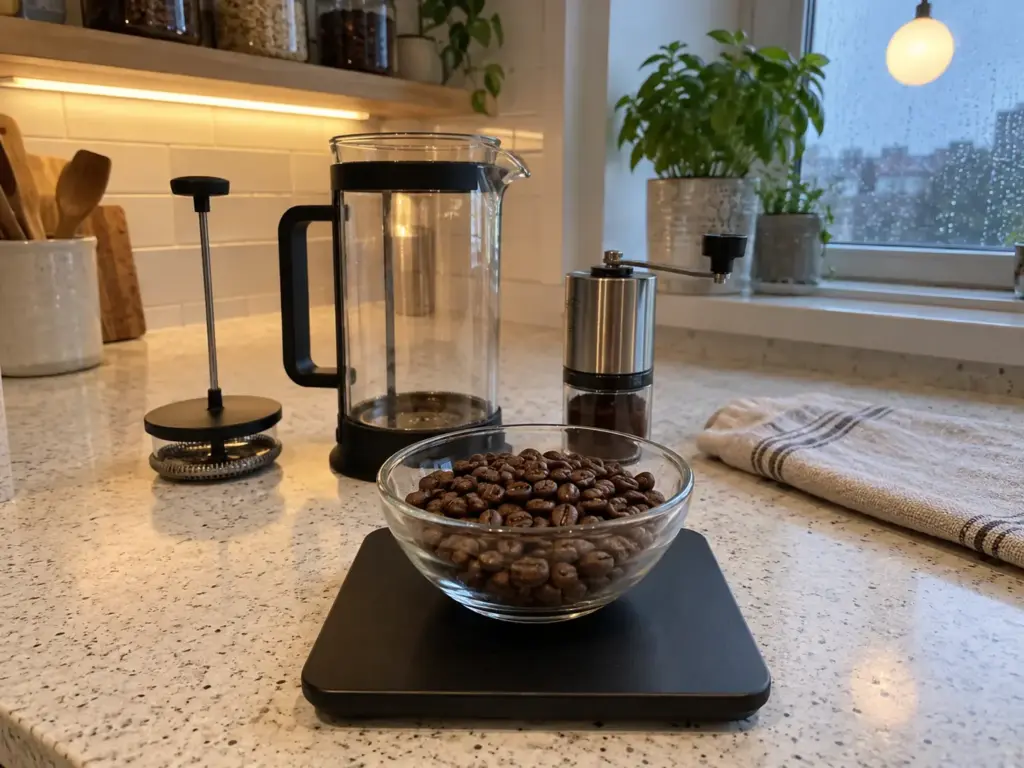
Before you choose, put your mug or your press on a kitchen scale and weigh the beans you actually use for one morning. If the number is bigger than the grinder’s hopper, you will grind twice every day for as long as you own it. Thirty seconds on a scale settles the choice better than any spec sheet.
Two Cheap Hand Grinders for a Different Kitchen: Small, or No Plastic at All
Not every kitchen wants an all-rounder. One reader grinds a single cup and wants something that fits in a drawer or a weekend bag; another has spent a year getting plastic off the counter and has the grinder next on the list. Two cheap grinders answer those two readers, and each gives up something the three above do not.
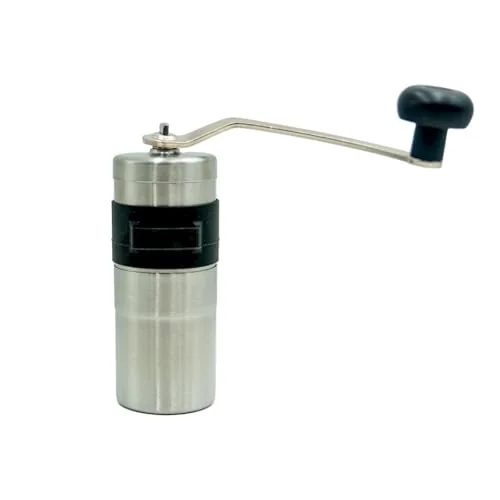
Porlex Mini II: Small Enough to Pack
The Porlex Mini II is a stainless steel tube about 5.3 in (13.5 cm) tall and 1.8 in (4.6 cm) across, with a ceramic conical burr inside and a crank that comes off for packing. It is built to travel. One owner who carried it around the world with an AeroPress points out that it “fits perfectly in an aero press”, which is the kind of detail that decides a travel grinder. For a trip, it is a portable grinder that asks for no outlet and very little space.
It also suits a one-cup kitchen at home, especially a small apartment where someone else is still asleep. Hand grinding is about as quiet as grinding gets, and if noise is the real reason you are looking, a quiet grinder compares the hand option against the electric ones.
The flaw is size: it is small and does not grind that much coffee at a time, so for two people the larger version makes sense.
And: “When I make coffee for me and my wife, I have to grind two loads of coffee.” The full-load grind time is “around one minute and 40 seconds, if I don’t stop to rest, which is about twice what I expected.” To be fair, the same review adds “I don’t believe this to be the fault of the grinder.” That is one owner’s pace, not a rule, but the direction is clear: one cup, fine; two cups, twice the work.
The ceramic burr brings back the trade from earlier in this article, in a sharper form. A travel grinder is the grinder most likely to be dropped, and a drop that would dent a steel burr can crack a ceramic one. Pack it inside something soft. Stock of this one comes and goes, so if it is out, the JavaPresse is the nearest ceramic-burr alternative.
Zassenhaus Santiago: Wood, Steel and a Ring That Walks
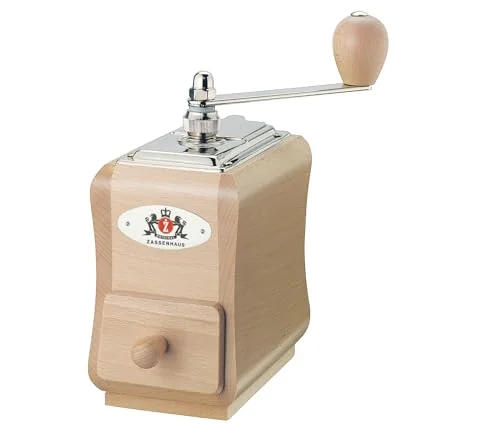
The Zassenhaus Santiago is the old shape of a coffee mill: a beechwood box, a hardened carbon-steel conical burr made in Germany, brass fittings on the crank and a small drawer that catches the grounds. There is no plastic anywhere on it. The listing describes it as a lap mill, meant to be held in your lap while you sit and crank, though it works on a counter too, and owners use it for everything from drip to French press.
That shape has a practical cost before you reach the flaw. It can be hard to hold steady, and it can slide around while you use it. A mill with a wide base and a crank on top wants two hands and a little practice.
The flaw is the adjustment, set with a knurled knob just below the crank. Some units move toward coarse as the crank turns, and there is no easy fix for it. A workaround is to hold the knob during grinding, but that keeps the hand in an awkward position. The grind size can change if you do not check it.
What that does to the cup is the problem from the first section, in its purest form. A dose that starts at a medium setting and finishes coarse is a dose of two sizes, and the cup comes out sour and bitter at once. The fix is a habit rather than a repair: check the setting between doses, and look again partway through a big one.
You will often feel it before you taste it. The crank suddenly turns lighter halfway through the dose, because the burrs have opened up and the beans are falling through with less resistance. Stop, reset, carry on. Like the Porlex, this one is in and out of stock.
What Breaks by Month Two on a Cheap Hand Grinder, and When to Spend More
Every pick above has a flaw, and most of those flaws do not show on the first morning. This section puts them in the order they tend to show up, says which ones have a free fix, and names the point where spending several times more buys something you can actually taste.
The Handle, the Seat and the Ring: What Goes First
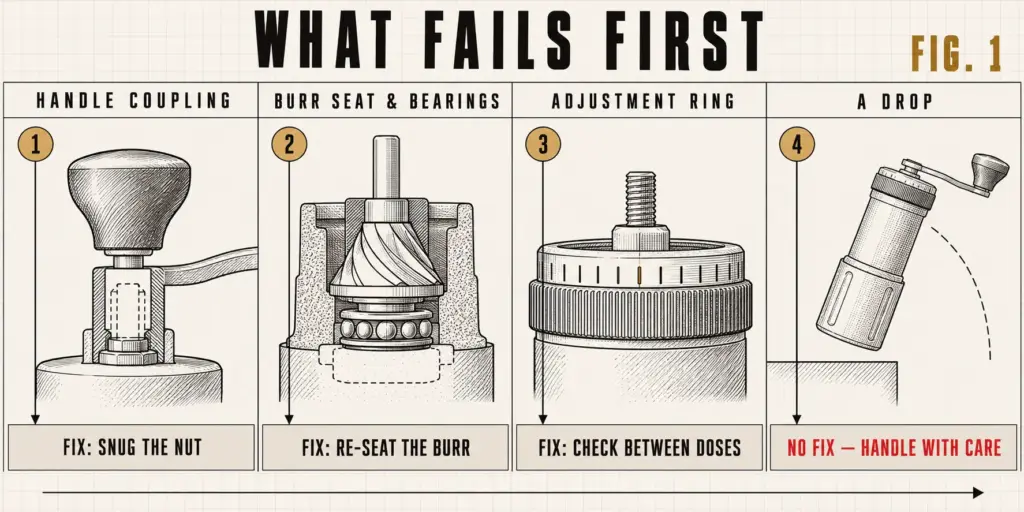
Put the owners’ reports side by side and a rough order appears. First, the handle: on the JavaPresse and the KINGrinder P2 it is the complaint that comes up once the grinder is in daily use, a joint that starts to click and then lets go. Second, the seat that holds the burr and its bearings, which on plastic-framed grinders loosens over months rather than days; the same timeline shows up on the C2, where issues slowly get more and more annoying.
Third, the adjustment ring that walks, as on the Zassenhaus, which can show from the start and can loosen further over time. And outside the order, a drop, which can end the C2S or any of them in a second. None of these shows up in the first week, because none of them has happened yet.
Plastic is not automatically the villain in that list, which is worth knowing before you pay extra to avoid every gram of it. A fixed plastic knob has the advantage that it does not come off mid-grind, which can happen with the wooden magnetic knobs on some other hand grinders.
What matters is which job the plastic is doing. Plastic you hold is a matter of feel. Plastic that holds the burr or the bearings is the part to worry about, because that is where a small give turns into an uneven grind.
The order matters because it tells you where to look first. A cheap grinder that has started making muddled cups is far more likely to have a loose handle or a burr that has shifted in its seat than dull burrs, and both of those can be put right at the counter in a couple of minutes.
A grinder whose seat has started to go does not fail all at once, and the first sign is usually in the filter, not the cup. The same click that gave you a clean pour-over last month now drains a little slower, and when you tip out the spent grounds, there is a thin layer of fine, silty dust at the bottom of the paper that was not there before. That dust is the fines a wobbling burr makes on the side where the gap closes. The cup follows a week or two later: a little more bitterness at the back, a little less sweetness.
Some of what fails is not wear at all but luck. At this price, one unit is not always the same as the next.
Early Timemore grinders could vary a lot in alignment: one spun freely, another wobbled, and another scraped the sides. Another put the whole price range in one line: “you paid for a budget grinder and you got a budget grinder.” The practical answer is to check a new cheap grinder the week it arrives, while it can still go back.
The Free Fixes, One at a Time
Before anything gets replaced, work through the free fixes in order, likeliest first, and change only one thing each time. A reader who tightens the handle, reseats the burr and moves the setting on the same morning has no idea which of the three did the work.
- Seat the handle. Press it fully onto the shaft and, if your grinder has a nut on top, snug it. Owners with loose handles make this a thirty-second habit before every session instead of replacing the grinder. Grind your usual dose at your usual click and taste. If the cup had been sour and bitter at once and now lands on one side, the handle was letting the shaft rock.
- Reseat the burr. Take the inner burr out, clean the grounds from around it with the brush, and put it back exactly the way the manual shows. Handground’s own routine is a good model: press the inserts home on a hard surface, set the grinder to its finest setting, push the burr down until it touches the outer one, tighten the nut, and if it still sits crooked, turn it 180 degrees on the axle and try again. Same dose, same click, taste.
- Check the setting between doses. On a grinder whose ring walks, count or look before every load, and partway through a large one. If the cup was drifting sour by the end of the week, a setting that stays put should bring it back to where it was on Monday.
- Only then, move the setting. One click: finer if the cup is sour and thin, coarser if it is bitter and dry. Once a grinder is set for a brewer, the adjustment is simple: too sour means one click finer, and too bitter means one click coarser. If the next cup overshoots to the opposite side, go back one.
A drop has no free fix. If a grinder stops turning or starts scraping after a fall, a scraping sound means metal on metal or ceramic on ceramic, and cranking on will damage the burr. Stop and contact the seller while you still can.
Write down the setting that made your best cup this week, counted from zero, on a strip of tape stuck under the grinder. When the cups start drifting next month, grind at that exact setting before you touch anything else. If the same click no longer tastes the same with the same beans, the grinder moved, not you, and the handle and the burr seat are where to look.
When Several Times the Price Buys Something Real
For a lot of kitchens, cheap is enough. If you run a drip machine or make one pour-over a day, a steel-burr hand grinder with a handle that stays on does the whole job, because the burr was never the weak part. Spending more will not make that cup taste noticeably different. And if you have worked through all of this and decided that cranking every morning is simply not for you, a cheap electric grinder is a better purchase than a pricier hand grinder you will resent.
Spending more does buy something, though, and it is worth being specific about what. The 1Zpresso K-Ultra gives you a steel conical burr with a numbered external ring, so the setting is a number you read and return to instead of a count from zero, which solves the moka-pot-and-V60 household problem from earlier.
That sounds like a convenience until you count what a miscount costs. On an internal-click grinder you have to count every click from zero, and the clicks are not very tactile, so it is easy to skip one and have to start over.
A skipped click on a cheap grinder is a cup one step off where you meant it, and it tastes exactly like the grinder drifting: a little sharper or a little harsher than yesterday, for no reason you can see. You then correct for a drift that never happened. A number printed on the outside takes that whole loop away, and for a household that moves between two brewers every day, it is the upgrade that shows up in the cup most often.
At the far end, the Comandante C40 MK4 puts a high-nitrogen steel burr on a shaft that its maker says is supported in three places. That is the maker’s claim rather than an independent measurement, but it is the problem this whole article is about, solved at a price. Both cost several times what any grinder above does, and what you get for it is a setting that holds, a shaft that does not move, and the fine steps espresso needs. What you do not get is a meaningfully better cup of drip.
For picky buyers the advice is to buy nice or buy twice. Three times the price is not a small step for most households, and that objection is fair. The honest line runs between them: if the cheap grinder’s flaw is one you can manage with a thirty-second habit, keep it; if it is one that changes your cup no matter what you do, that is when the upgrade pays.
Once the grinder is on your counter, the next question is how to set it, and how to use and adjust a hand grinder picks up from there, along with which number to start your grinder on for the brewer you own.
Look Past the Burr, Then Size the Grinder to Your Morning Dose
- On a cheap hand grinder, the burr is rarely where the money was saved. Look at the handle, the seat and the dial, because that is where the trouble starts, and that is where most of the free fixes are.
- Pick by the brewer on your counter and the grams you grind each morning: the C2S for most kitchens, the P2 for the tightest budget, the Porlex for one cup or a bag, the Zassenhaus if plastic is what you are getting rid of. If you are still weighing every kind of grinder for a home kitchen, start wider and come back.
- Most of what goes wrong in the first months has a free fix at the counter. Spend several times more only for a setting that holds, a supported shaft, or espresso.
A month from now, grind at the setting you wrote down, brew the way you always do, and look at the bottom of the filter before you throw it out: if there is more fine dust than there used to be, check the handle and the burr seat before anything else.
Tomorrow morning, weigh the beans you actually brew and compare that number with the hopper of the grinder you are about to buy. Then grind that dose once at a middle setting, brew it, and taste which way the cup leans: sour means your next click goes finer, bitter means it goes coarser.
Frequently Asked Questions
01What is the best affordable manual coffee grinder?
For most kitchens, the TIMEMORE Chestnut C2S is the best affordable manual coffee grinder: a 38 mm steel burr in an all-metal frame with no plastic inside. The KINGrinder P2 costs less and keeps a steel burr, but its handle comes off too easily.
02Are manual coffee grinders any good?
Yes. Even cheap manual grinders grind evenly enough for drip and pour-over when the burr is a real conical burr. What separates them is the build around it: the handle, the seat that holds the burr, and a setting that holds.
03Is a ceramic or steel burr better on a cheap hand grinder?
Steel takes a knock better, while ceramic holds its edge longer but can chip or crack from a drop or a stray stone. For a grinder you use every day on a counter, a steel burr in a metal frame is the safer choice at this price.
04Can a cheap manual coffee grinder make espresso?
Most cheap manual grinders can reach a fine enough setting for espresso, but they move in steps too big to dial a shot in. For espresso, buy a hand grinder built for it; for drip, pour-over and French press, a cheap one is enough.
05What is the best inexpensive coffee grinder, manual or electric?
At the same low price, a hand grinder usually gets you a real steel or ceramic conical burr, because none of the money goes into a motor. The trade is your time and a minute or two of cranking every morning, which a cheap electric burr grinder saves.

How did your cup turn out?
No comments yet. Tell us what you changed — and whether the needle moved.