




We may earn a commission when you buy through links on this page. It never changes what we recommend. How we pick
On this page7 parts
- Hand Crank or Battery: Settle This Before Choosing a Portable Coffee Grinder
- What "Portable" Should Mean in Ounces, Inches and Grams
- The Portable Grinders That Pack Smallest, Flaw Included
- Packing It So It Still Grinds Evenly on the Fifth Morning
- Count the Trips: What Wears Out on a Travel Grinder
- Pack the Crank, Measure the Brewer, Watch the Coarse End
- Frequently Asked Questions
The bag is half packed, the good beans are on the counter, and the grinder that stays on your counter at home is still plugged into the wall, too heavy and too dependent on that plug for a campsite with no outlet. Before comparing a single model, one question splits every portable coffee grinder into two camps: will there be anywhere to charge it where you are going? After that, a travel grinder is judged by three numbers its box rarely prints together (its weight, the width that decides whether it rides inside your brewer, and the grams one fill holds) and by whether it still grinds evenly after the bag has been dropped a few times. What follows settles crank or battery, puts numbers on “portable,” names the grinders worth packing with their flaws in writing, and covers how to pack one and what wears out after a few trips.
Quick Answer
For most trips, the safer portable coffee grinder is a compact hand-crank burr grinder: nothing to charge, and it survives a drop.
- Default to a hand crank: no battery to die, no outlet needed.
- Choose electric only with an outlet every night, or hands that can’t crank.
- Weigh it: around 12 oz is a sensible travel guideline, not a rule.
- Measure it: slimmer than about 1.9 in rides inside an AeroPress.
- Count grams: 20 to 25 g per fill means one mug per grind.
- To nest: AeroPress grinder or Porlex Mini II. For knocks: JavaPresse or TIMEMORE C2S.
Hand Crank or Battery: Settle This Before Choosing a Portable Coffee Grinder
Two grinders can share the same burrs and the same weight and still be opposite choices for a trip, because one needs a charge and the other needs only you. Settle that first, and settle it by thinking through the morning when there is nowhere to plug anything in.
What a dead battery costs you on the third morning
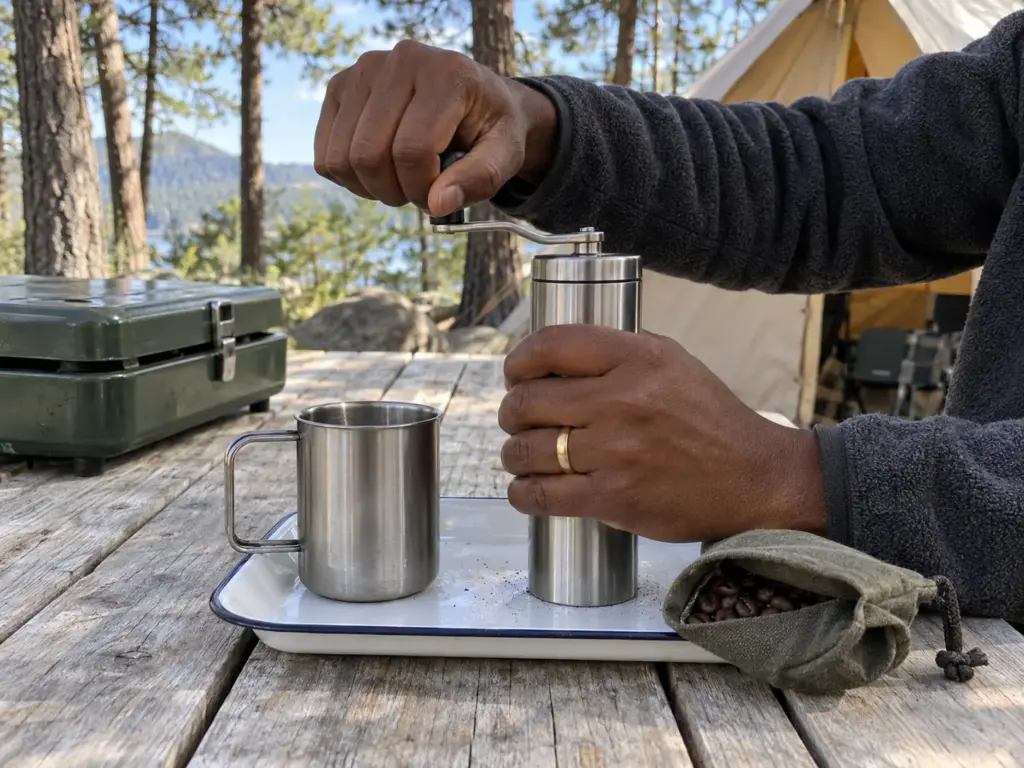
A hand-crank grinder needs one thing to work, and it comes attached to your arms. A rechargeable coffee grinder needs a charge, which means a cable, a port and an outlet, so on a trip with none of those its useful life ends the morning the battery does. One camping review team that has rotated through several grinders over the years draws the line the same way: for most camping trips, when they are not in an RV, they choose a manual grinder, and an electric one only starts to make sense when they are car camping with electrical hookups.
Picture the third morning of a week with no outlet. The electric grinder that ground beautifully at home is now dead weight at the bottom of the pack, the whole beans you carried in are still whole, and no cable in the world fixes that at a campsite. A crank has no equivalent failure. It gets slower when you are tired, but it never runs flat.
A small electric portable grinder looks like the obvious upgrade from cranking, and in a kitchen it often is. Away from an outlet the calculation turns over: the battery becomes the part most likely to end your coffee, and a burr grinder with no battery at all is the safer thing to pack. That is why the hand crank is the default here, and electric is the exception that has to earn its place.
When a small electric grinder is the better call
Electric wins when the constraint is your hands or your time rather than the power supply. An RV with hookups, a hotel room every night, a road trip that ends at a plug each evening: each of those removes the battery problem, and a motor then saves you the few minutes of cranking effort each dose asks for. The same goes for a group where one person grinds for everyone, because four fills by hand is a chore before anyone has had a cup.
Hands that cannot comfortably crank for several minutes are a reason on their own. A manual coffee grinder asks for a steady grip on the barrel and a few minutes of turning per dose (longer on a slow grinder at a fine setting), and the complaints that pile up on the slower models are about exactly that, as the last section shows.
But the hotel room cuts the other way too. If someone is still asleep a few feet away, in a hotel room or a dorm room, a motor spinning up at the start of the day is the wrong sound, and a hand grinder is also the quietest option you can make coffee with. The wider question of whether a hand grinder or an electric one suits your mornings at home changes once an outlet is always within reach; this section only settles it for the road.
The free option: grind at home before you leave, and what that gives up
Before buying anything, there is an option that costs nothing: grind the trip’s coffee at home the night before, at the setting for the brewer you are taking, and pack it in a sealed bag with the air pressed out. For a weekend it works. What it gives up is aroma and some of the brightness, because grinding multiplies the surface of the coffee exposed to air, and the compounds that carry both leave ground coffee far faster than they leave whole bean coffee.
Grinding fresh before every cup is sound advice, and on a two-night trip it is also more gear than the cups repay. The trade flips as the trip gets longer, because pre-ground coffee keeps fading every day it sits in the bag while whole beans hold on much longer. A week away is where a grinder starts to repay the space it takes, and fresh ground coffee starts to taste like the reason you brought it.
Pre-ground also makes a good spare. A traveler was grinding the last of the good beans bought in Copenhagen when a cheap no-name hand grinder snapped at the nut under the crank, and the trip’s coffee went with it. A small pouch ground at home and tucked into the kit would have turned that into a slightly flatter cup instead of no cup.
And if you already own a hand grinder, you may already own your travel grinder. Hold it up to the three numbers in the next section before you buy a second one.
If a rechargeable grinder is still on your list, run one flat at home before trusting it on a trip. Grind your usual dose each morning without charging it, at the setting you would really use, and count the doses until it quits. That count, not the figure on the box, is how many mornings it gives you with no outlet.
What “Portable” Should Mean in Ounces, Inches and Grams
The word portable is printed on hand grinders that weigh 10 ounces and on grinders that weigh a pound and a half. The label settles nothing, so three numbers have to: what it weighs, how wide it is, and how many grams one fill holds. The same three suit a small kitchen, where the counter is the constraint instead of the outlet.
Weight: the 12-ounce line, and the good grinders that cross it
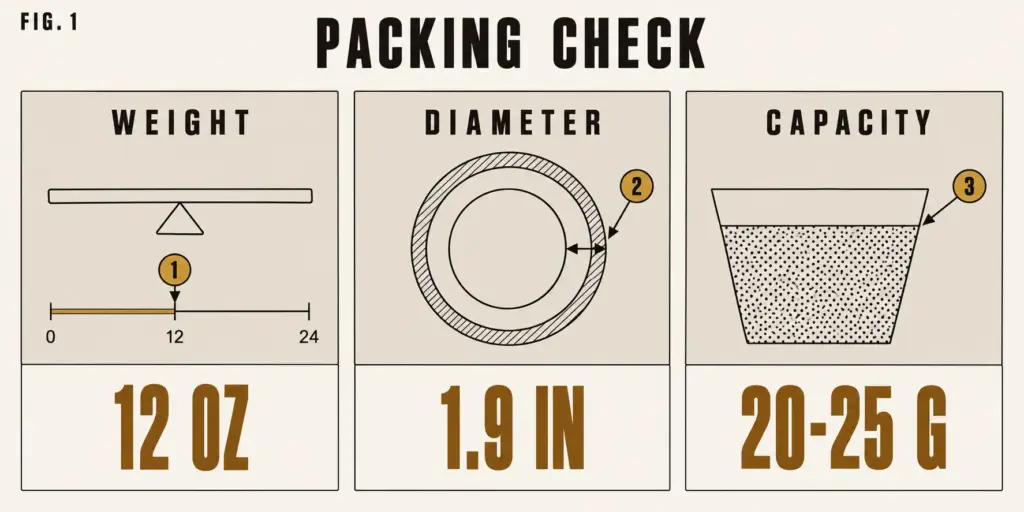
The only concrete cutoff for a travel coffee grinder comes from the same campers who put the crank first: under 12 ounces (about 340 g) is what they call ideal for travel. It is a useful line, as long as you read it as a guideline rather than a rule. The JavaPresse hand grinder, at about 10 oz, sits under it; the 1Zpresso Q2 at about 405 g (14.3 oz) and the Timemore C2 at about 465 g (16.4 oz) sit over it and are still sold and carried as travel grinders; the AeroPress Manual Coffee Grinder weighs 1.5 lb, twice the line.
A pound and a half sounds disqualifying. For a backpacker counting ounces it is; for anyone whose grinder rides in a car trunk, or inside the brewer it serves, the extra weight barely registers, and the burr and the build matter more. Weight trades against both: a bigger conical burr and a metal housing cost ounces, and a heavier all-metal grinder that survives a drop onto rock can be a better travel grinder than an ultralight one with plastic where the fall lands.
So weigh the trip before you weigh the grinder. A backpacking coffee grinder lives close to the 12-ounce line, a camping coffee grinder that rides in the car can ignore it, and a hotel room removes it altogether.
Diameter: will it ride inside the brewer?
For anyone traveling with an AeroPress, width is the sharper test, because a grinder that fits inside an AeroPress takes no space of its own in the bag. A press’s top chamber measures roughly 1.9 inches (about 4.8 cm), and the grinder’s diameter should be slightly smaller than that to fit comfortably. A few millimeters decide it.
Run the models through that test and they split cleanly. The Porlex Mini II is 4.6 cm (about 1.8 in) across, just under the chamber. The standard Timemore C2 measures 160 by 60 mm, about 2.4 inches wide, and a detailed review of it says flatly that it is too big to fit inside an AeroPress. The AeroPress grinder skips the question, since the brewer’s own maker built it to nest in the press with its crank stored inside.
Listing photos and dimensions printed as a single number will not tell you any of this. A grinder can look slim next to a coffee bag and still turn out a few millimeters too wide for the chamber, and then it rides loose in the pack after all, taking up exactly the space you bought it to save. The 1.9-inch figure is for the standard press, too; if you travel with the smaller AeroPress Go, measure its chamber yourself before trusting any fit claim.
Check fit with a strip of paper instead of a spec sheet. Wrap it around the widest point of the grinder, adjustment ring and crank collar included, tape it into a loop, and try to slide the loop into the brewer’s chamber. The loop catches the lip or the ring that a single diameter on a listing can leave out.
Capacity: one fill, one or two cups
The third number decides how many times you crank. A grinder’s hopper holds the whole beans and its catch cup (some makers call it a dosing cup) holds the grounds, so whichever is smaller sets how much coffee one pass can make.
Travel grinders hold about 20 to 25 g per fill: the Timemore C2S hopper takes 20 g and the AeroPress grinder’s catch takes 25 g. That is roughly two level coffee scoops, a single dose for one large mug (grams are the reliable way to read it, since a scoop of light roast and a scoop of dark roast do not weigh the same). It is a single cup grinder by design, and the grams say so before the box does.
A couple, or a small group, means grinding twice or more, and that is where the cranking time starts to add up. It is also why travelers packing for months on the road look for a grinder that will last, fit into the bags, and still grind two to four cups. For a pot rather than a mug, a full French press needs a bigger dose than one fill holds, so plan on two or three fills for the big one.
The Portable Grinders That Pack Smallest, Flaw Included
With the crank settled and the numbers in hand, the grinders that earn a place in a small bag are the ones that ride with the brewer, and each gives something up to get there. The three here make the smallest kits; if you are not traveling light, the wider list of manual grinders has more to choose from.
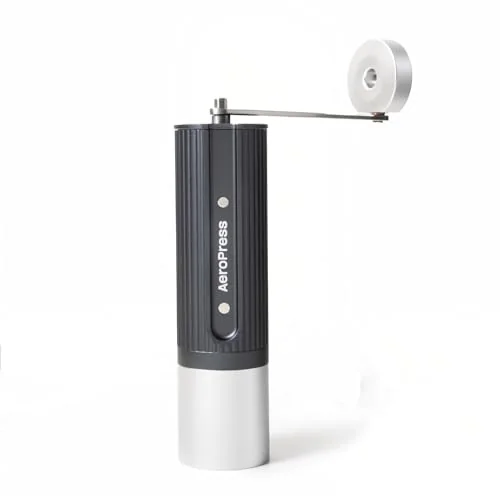
Built to nest inside an AeroPress
Nesting matters because it turns two objects into one. With the grinder stored inside the press, the whole coffee kit becomes one packable object that fits in one hand, and there is no second thing to forget at the last campsite. The crank is what usually spoils it: on most hand grinders it has to come off for packing and then lives somewhere, and makers try a folding handle, a magnetic handle or a handle that doubles as a carabiner clip to stop it becoming the loose part that goes missing in a tent.
The AeroPress Manual Coffee Grinder is the only one here built by the brewer’s own maker to solve that. Its titanium-coated stainless steel conical burrs sit under 60 grind settings, the catch holds 25 g, and the magnetic crank stores inside the grinder, so the whole assembly nests in the press with nothing left over. It passes the width test by design rather than by luck.
The fit costs weight. At 1.5 lb it is double the 12-ounce line, so it earns its place by fitting, not by being light, and its Amazon listing sits at 4.2 stars on 61 ratings, below the brand’s usual. Sixty-one ratings is a young record; read that score as a question still open.
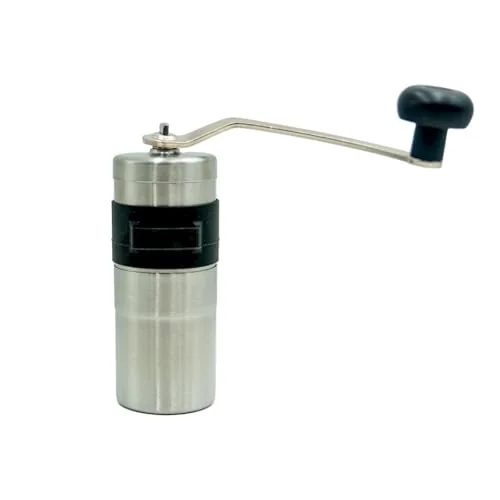
The ultralight that keeps coming up
For well over a decade, Porlex’s small hand grinders have been a common answer to what to pair with an AeroPress on the road. When choosing between a Porlex and the glass Hario Skerton, the Porlex is the more portable of the two, and the Skerton is cheaper but heavier and made of glass, which many campers do not want in a bag. A glass jar is the wrong material for a pack that gets dropped.
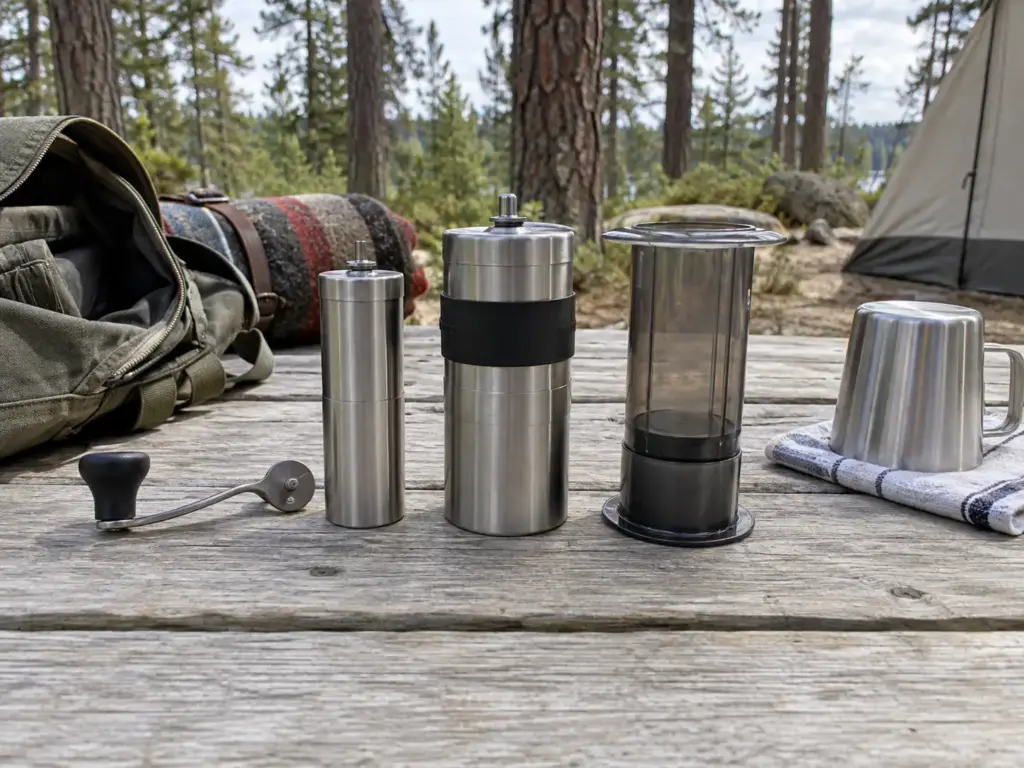
The Porlex Mini II keeps that shape: a stainless steel shell, a ceramic burr, 13.5 cm tall (about 5.3 in) and 4.6 cm across, with a detachable crank for packing. It slides into the press with a couple of millimeters to spare, which is the whole reason it has held its place as the ultralight companion.
The warning that travels with it comes from the class it belongs to. Cheap hand grinders in this class have a reputation for breaking within a year or two. That is a warning about small hand grinders across the board rather than a defect on this listing, which has only five ratings, too few to show a pattern either way.
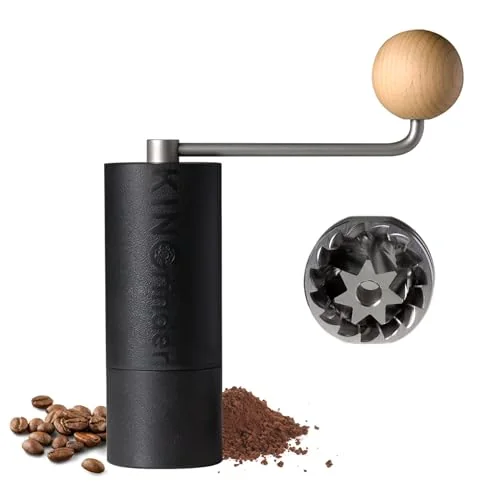
The light budget pick with a short track record
The KINGrinder P2 is the light, low-cost way into a burr hand grinder: a lightweight housing over stainless steel burrs, at the budget end of what these grinders cost. It does double duty at home as well, and the same KINGrinder shows up among the pour-over picks for that reason.
Years are what it does not have yet. Owners have not converged on a repeated complaint, which for a newer brand means a short track record rather than a proven one, and the long camping reports that exist for older grinders do not exist for it yet. Whether it slides inside an AeroPress is not stated anywhere reliable, so do not plan a nesting kit around it until the paper loop says yes.
Most travel grinders are built for the middle of the grind range, from pour-over, drip coffee and the AeroPress out to a French press or a cold brew jar; a moka pot asks for something finer, and espresso finer still. Whichever of these rides with the brewer you already travel with, the next thing to settle is the grind each AeroPress recipe wants, since the setting you dial in at home is the one you will be hunting for at camp.
Packing It So It Still Grinds Evenly on the Fifth Morning
A grinder that grinds well at home can come out of a bag with its setting moved, its catch cup coated in clinging grounds and its crank missing. None of that is the burrs’ fault, and all of it is decided by how the grinder is packed and how the first dose of the day is handled.
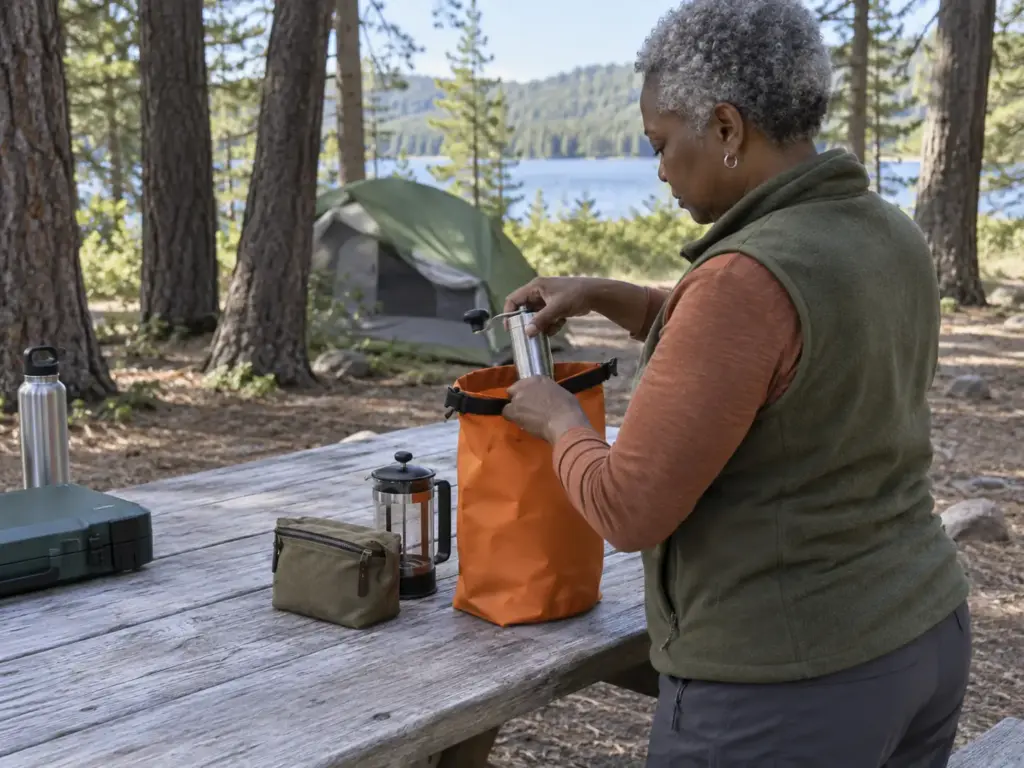
Check the setting before the first grind, every time
A grinder with an external adjustment ring can turn in a bag, nudged a click or two by whatever was packed against it. One with internal clicks counted from zero (the C2S works that way) is harder to bump but easy to lose count on after a cleaning at camp. Either way, the setting you left home with is a guess until you check it.
The check costs a few beans. Grind three or four at your usual setting, tip them onto something pale, a paper plate or the back of the filter packet, and look at the particles before committing the full dose. A hand grinder also keeps a little coffee inside it (retention), so the first particles after any change come out at the old setting; grind a pinch and discard it before judging.
A stepped adjustment moves in fixed clicks, each a set distance apart (a micron step, when the maker prints one), which makes the reset easy to count. A stepless adjustment can sit anywhere in between, which is lovely for dialing in at home and harder to find again after a bag has turned it; how to read and reset a hand grinder’s setting goes through both.
Before the trip, grind one dose at your brewer’s setting, pour a teaspoon of it onto a white plate next to a coin, and photograph it. At camp, run the three-bean check and hold the phone beside the new pile. Comparing against a picture beats comparing against memory, and it takes about ten seconds.
A dry sack, away from the thermos
Those long-haul camping reviewers keep their grinder in a dry sack with the rest of the coffee kit, protected from moisture and coffee dust, a habit that began the one time the grinder was left behind at a campsite. A bright, dedicated sack or a small travel case does both jobs: it keeps water out, and it is hard to walk away from.
Keep it apart from the thermos. A leaking lid in the same pocket puts water into the burrs, and water left in a steel burr set is how rust starts. Drying them very well, with a towel and a hair dryer, prevents that. The beans travel in their own sealed bag, never loose in the hopper, so a lid that pops open in transit spills nothing into the rest of your gear.
A grinder with tool-free disassembly has an edge here. If it does get wet, you can take it apart at camp and let the pieces air-dry instead of packing it damp, and the detachable crank belongs inside the sack too, or clipped to it, because it is the smallest part and the easiest to lose.
Static in a plastic catch cup, and the drop of water that fixes it
Dry mountain air makes the next problem worse. Grinding builds a static charge, a plastic catch cup holds it, and the finest dust clings to the inside of the cup, then jumps onto the picnic table the moment you pull it off. What you lose is mostly fines, a small amount by weight and a mess out of all proportion to it.
A drop of water stops it. The trick is credited to David Ross, who described it in 2005, and it is known as the Ross Droplet Technique, or RDT: one or two drops of water on the beans before grinding.
With this trick, the chaff and fines that almost always cling to the sidewalls of the dosing container can disappear. The worry is that water and grinder insides do not mix, and the usual answer is that one or two drops add very little moisture to the beans.At camp you do not even need a dropper. A simpler version is to dip a clean fingertip in water and flick it over the dose. If grounds still leap out of the cup after that, why grounds fly out of the catch cup goes through the other causes of static buildup.
Grinding for two without losing ten minutes
One fill is one dose, so two mugs means two passes, and the cranking time doubles with it. On a slow grinder that is where the fifth minute of turning becomes the thing you notice; one camping reviewer’s standing complaint about a current hand grinder is how it feels in the hand after three to five minutes of cranking. How long a dose takes by hand varies a lot by grinder and setting, and a coarse French press dose goes faster than a fine one.
Split the work with the brew. With an AeroPress, grind the second dose while the first one steeps, so the two passes overlap instead of stacking up; with two people, whoever is not brewing cranks. Ergonomics show up on that second pass, too, which is where a textured grip or a silicone sleeve earns its keep, because a smooth metal barrel starts to slip in a cold hand.
Count the Trips: What Wears Out on a Travel Grinder
A grinder tested for a week at a kitchen table has not met a bag yet. A travel grinder’s failures show up after it has been dropped, packed wet and cranked half-asleep for a season, and the people who have done that to theirs keep writing down the same few things.
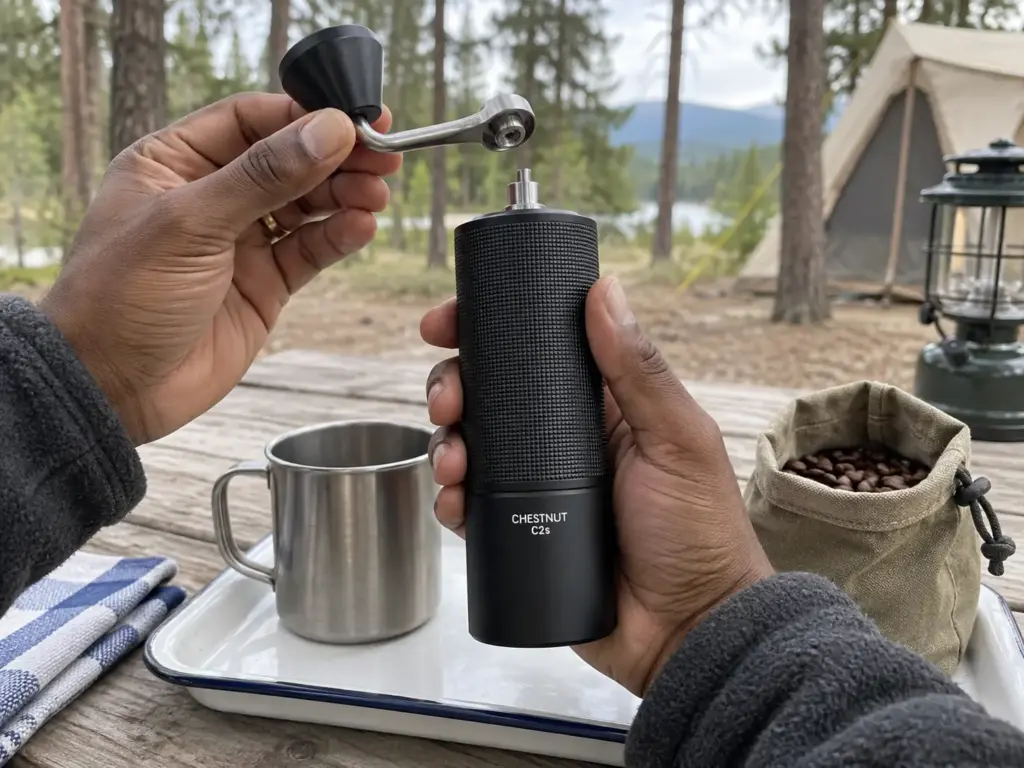
The plastic parts hiding inside a metal shell
An aluminum barrel can hide plastic exactly where a fall lands. The standard Timemore C2 has an aluminum-alloy housing, but its lid, crank knob, adjustment knob and internal stabilizers are plastic, and the detailed review of it says plainly that the grinder “is not fall-proof,” adding that dropping it “could result in some of the plastic parts cracking.” On a kitchen counter that rarely matters. On a granite ledge beside a tent, it is the likeliest way the grinder ends.
The TIMEMORE Chestnut C2S answers that with an all-aluminum-alloy housing, which is why it is one of the two picks below. It still does not ride inside an AeroPress; the metal does not change the size. If a grinder with no plastic at all is the goal, grinders with no plastic parts sorts through them, and the glass jar of a Skerton-style grinder is the other material to leave at home.
The handle, the nut and the grind that wanders
The reports from the field cluster around the moving parts. The Copenhagen grinder snapped at the nut under the crank; cheap hand grinders of this kind tend to break within one to two years, and the JavaPresse handle is a common complaint in buyer reviews, since it keeps falling off and beans can get clogged inside.
The failure usually announces itself first. The crank starts to wobble on its square shaft, a little more after every trip, until one morning it slips off mid-turn and the beans in the hopper go nowhere. That wobble is the early warning, and how long a grinder lasts in general is a longer story, but on a travel grinder the field reports point at the crank and the nut far more often than at the burrs.
The quieter failure is a grind that wanders. The same writeup’s author described French press at a group campsite coming out “anywhere from beans being cut in fourths to something that should be for pour overs,” which makes a cup that tastes sour and bitter at once: the big chunks give up too little, the dust gives up too much, and silt settles at the bottom of every mug. That is a burr set that cannot hold an even coarse grind, and no amount of steeping corrects it.
Before blaming the burrs, change one thing at a time. Run the three-bean check first, since a ring that moved in the bag makes the same mess, and brew again. If the next cup is still sour and muddy at once, go one step coarser and taste: a cup that turns cleaner and sweeter says the setting was the problem, while one that turns thinner and sharper with the silt still there says the burrs are cutting unevenly at every step.
Evenness is the whole job, and it can be measured. The Specialty Coffee Association’s grinder standard for home grinders, SCA-320, sits behind a member login, but the association’s own description of why it writes standards is plain: “SCA Standards create a shared framework for quality, consistency, and best practices across the coffee industry.” For a budget grinder on the road, the bar worth holding it to is a cheap grinder that still grinds even at the coarse end, because the coarse end is where grind consistency decides a French press or a cold brew jar.
Before each trip, hold the grinder still and wiggle the crank. If it rocks on the shaft, tighten or replace whatever holds it on while you are still at home, and pack the tool that fits it. A lost screw at home is an errand; the same screw in the dirt by a tent is the end of the trip’s coffee.
Two grinders that take the knocks
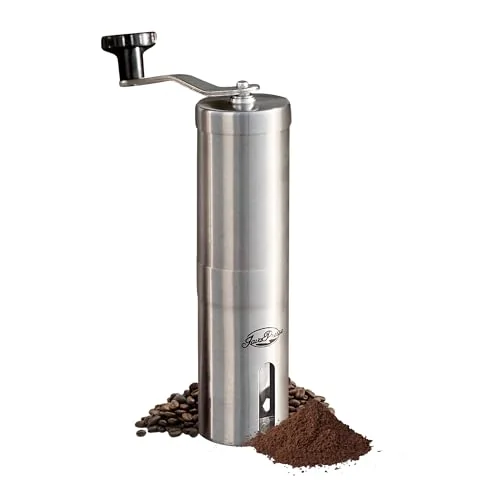
The JavaPresse Manual Stainless Steel Coffee Grinder has the longest field record of anything here. The camping reviewers behind the 12-ounce line carried it as their only camping grinder from 2017 to 2023, and their summary of those years reads like a durability test: “we dropped it on rocks, packed it wet, used it half-asleep,” and it kept working. At about 10 oz, with a stainless steel shell, a ceramic burr and 18 settings, it also sits comfortably under the 12-ounce line.
Speed is what it gives up for that record. Grinding time is the complaint its own Amazon owners raise most (of 1,792 mentions of it in the reviews, 1,223 are negative), and the loose handle and the clogging come after. It fits inside an AeroPress plunger, yet it grinds unevenly with lots of fines, and it is considered entry-level next to better grinders. It is where budget manual grinders start, not where they peak.
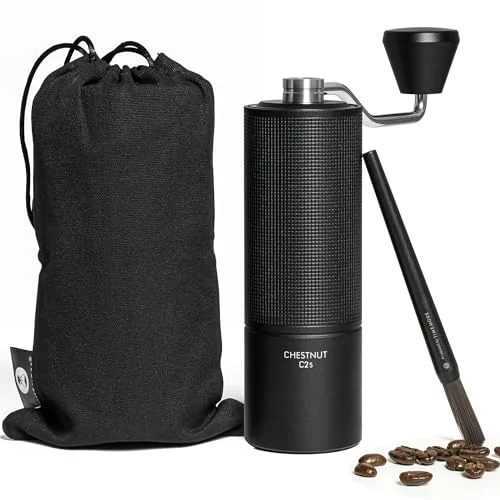
The TIMEMORE Chestnut C2S is the other way to survive a drop: metal where the C2 used plastic. Inside the all-aluminum-alloy housing are 38 mm conical burrs in 420 steel, about 36 internal clicks of adjustment and a 20 g hopper, a spec that gives the burr size, the step count and the dose in one line, which is more than most travel listings manage.
The metal does not shrink it, though. Like the standard C2, it is too big to ride inside an AeroPress, and it is heavier than the ultralights (the C2 itself is about 16.4 oz), so it belongs in a car, a duffel or a hotel room more than a backpack. Its clicks are internal and counted from closed, one more reason to run the three-bean check at camp.
All five grinders, side by side on what decides a travel grinder:
| Grinder | Burrs | Weight | Rides inside an AeroPress | The flaw |
|---|---|---|---|---|
| AeroPress Manual Coffee Grinder | Titanium-coated steel conical | 1.5 lb (24 oz) | Yes, by design | Twice the 12 oz line; young rating record |
| Porlex Mini II | Ceramic | Not stated | Yes, 4.6 cm across | Its class reported breaking in 1 to 2 years |
| KINGrinder P2 | Stainless steel | Not stated | Not stated | Short track record |
| JavaPresse | Ceramic | About 10 oz | Reported as usable, but not claimed by the maker | Slow to grind; handle can fall off |
| TIMEMORE Chestnut C2S | 38 mm conical, 420 steel | Not stated (the C2 is about 16.4 oz) | No | Too wide to nest; heavier than the ultralights |
None of the five is a flagship grinder, on purpose. A grinder that has to survive a dry sack and a picnic table is a different buy from a precision instrument for the kitchen, and what the expensive grinders actually buy you is a question of its own.
Pack the Crank, Measure the Brewer, Watch the Coarse End
Three things decide whether a grinder is worth its space in the bag:
- Settle crank or battery first. Without a reliable outlet every night, the hand crank is the default, because it is the one grinder that cannot run flat.
- Hold any grinder to three numbers. Around 12 oz for weight, a width under the brewer’s chamber if it has to nest, and 20 to 25 g per fill for one mug.
- Pack it dry and check it before the first dose. Keep it away from the thermos, grind a few beans to confirm the setting, and let a drop of water handle the static.
After a few trips, check two things at home: that the crank still sits tight on its shaft, and that the coarse end still gives you even particles instead of chunks and dust.
Tomorrow morning, before buying anything, weigh and measure the hand grinder you already own against those numbers, then grind your usual dose at your French press setting and tip it onto a white plate. If the pieces look even and the cup brewed from them tastes sweet rather than sour and muddy at once, the travel grinder may already be in your kitchen drawer.
Frequently Asked Questions
01What is the best portable coffee bean grinder?
For most trips, the best portable coffee bean grinder is a compact hand-crank burr grinder, because it needs no charge, no outlet, and survives being dropped in a bag. If you travel with an AeroPress, pick one slim enough to ride inside it.
02Are handheld coffee grinders any good?
Yes, the burr ones are: a decent handheld burr grinder cuts more evenly than any blade grinder, which keeps a cup from tasting sour and bitter at once. The cost is time, a few minutes of cranking per dose.
03What is the best handheld coffee grinder for travel with an AeroPress?
The best handheld grinder for AeroPress travel is one that nests inside the press: the AeroPress grinder does it by design, and the slim Porlex Mini II is a long-standing favorite. Check any other model against the chamber, about 1.9 inches across.
04Can a portable coffee grinder grind fine enough for espresso?
Some can, but most portable grinders are built for the middle of the grind range, from pour-over and the AeroPress to a French press, not for espresso. If espresso matters at home too, look at the manual grinders that can do espresso.
05How do I stop static in a hand grinder’s catch cup?
Add one or two drops of water to the beans before grinding, a trick known as the Ross Droplet Technique, and the grounds stop clinging to the plastic cup. A clean fingertip dipped in water and flicked over the dose is enough.



How did your cup turn out?
No comments yet. Tell us what you changed — and whether the needle moved.