




We may earn a commission when you buy through links on this page. It never changes what we recommend. How we pick
On this page7 parts
- Where the Plastic Hides on a Grinder That Looks Like Steel
- Check the Grinder You Already Own Before Buying Another
- The Hand Grinders That Get Closest, Part by Part
- Hand or Electric: What a Plastic-Free Grind Path Costs You
- What a Metal Grind Path Looks Like at Month Six
- Follow the Beans, Swap the Cup, Listen to the Crank
- Frequently Asked Questions
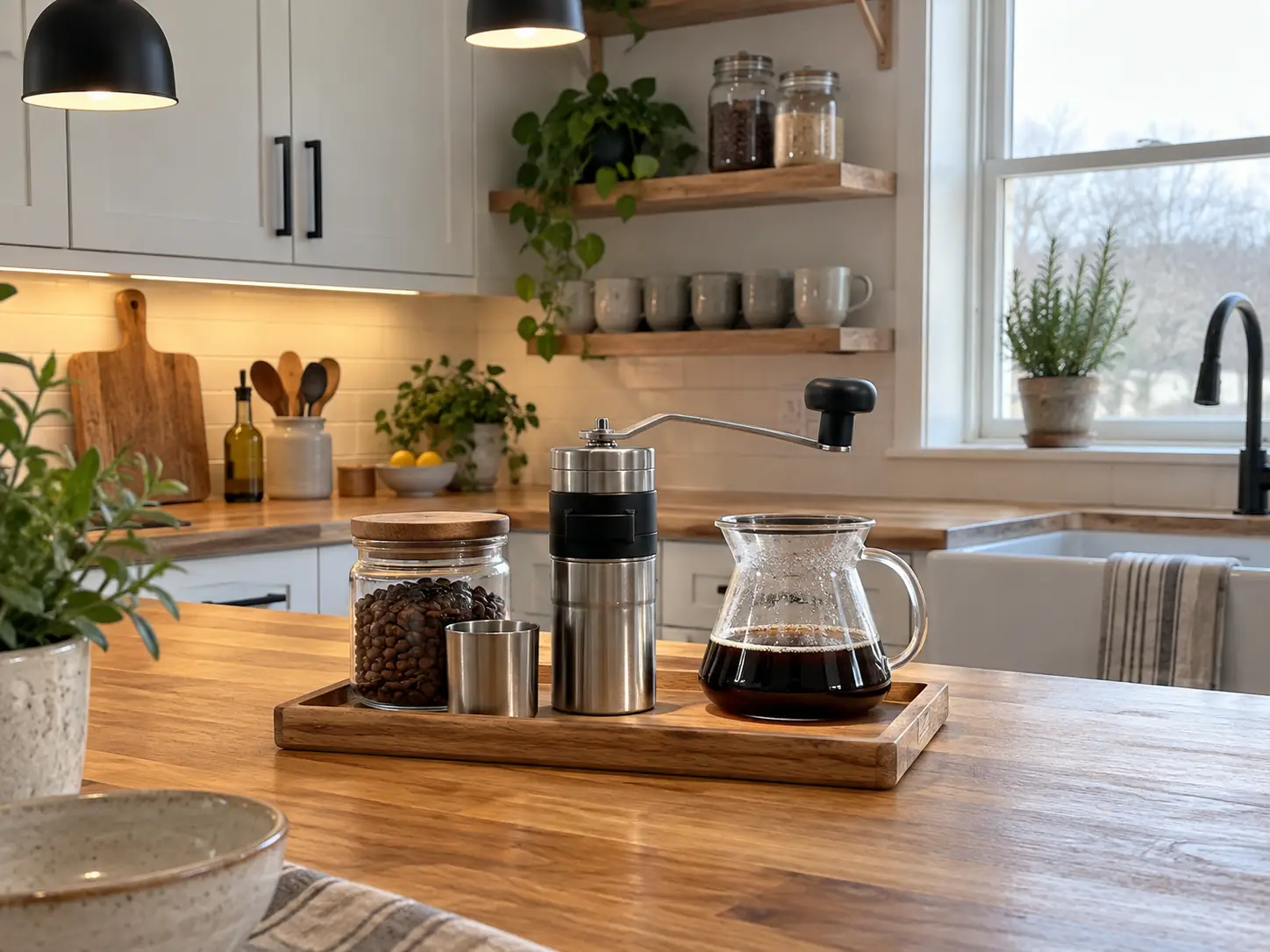
You went looking for a coffee grinder with no plastic parts, the listing said stainless steel, and the grinder on your counter is stainless steel right up until you pull the catch cup and find the grounds sitting in molded plastic: the word on the box was describing the shell. A grinder is a path, and the coffee touches four things along it: the hopper that holds whole beans, the burrs that break them, the chute they fall through and the catch cup that collects them. A material word on a listing usually covers one of the four, which is why it is hard to tell online which parts are plastic. Whether your reason is less plastic touching food or parts that outlast molded ones, the answer is in the path, so this walks it in order, narrowing the grinders we’d put on a home counter down to the few that pass: where the plastic hides, the check to run on the grinder you already own, the hand grinders that get closest, what going plastic-free costs in grams and minutes, and what a metal grind path looks like after months of use.
Quick Answer
A grinder with no plastic anywhere on the coffee’s path nearly exists, and where it does, it has a crank.
- Hand grinders get closest; the rare all-metal electric ones cost more than most espresso machines.
- Check four places: the hopper lid, the chute, the catch cup and the parts inside.
- A steel shell describes the outside, not the brackets and couplings that hold the burrs.
- Plastic touching whole beans matters less than plastic the grounds sit in.
- “BPA-free” says which plastic, not that there is none.
- Closest pick: the Porlex Mini II, steel lid and catch cup, one small internal spindle.
Where the Plastic Hides on a Grinder That Looks Like Steel
The outer shell is what the listing photographs, and on a grinder sold as stainless it is the part least likely to be plastic. The plastic sits where the coffee goes in, where it comes out and where the mechanism is held in place, so the audit follows the beans from the hopper, past the burrs themselves, the part that actually breaks the beans, to the chute and the cup. On any burr grinder worth buying the burrs are steel or ceramic, and everything around them is where the question lives.
The hopper and its lid: plastic that touches whole beans
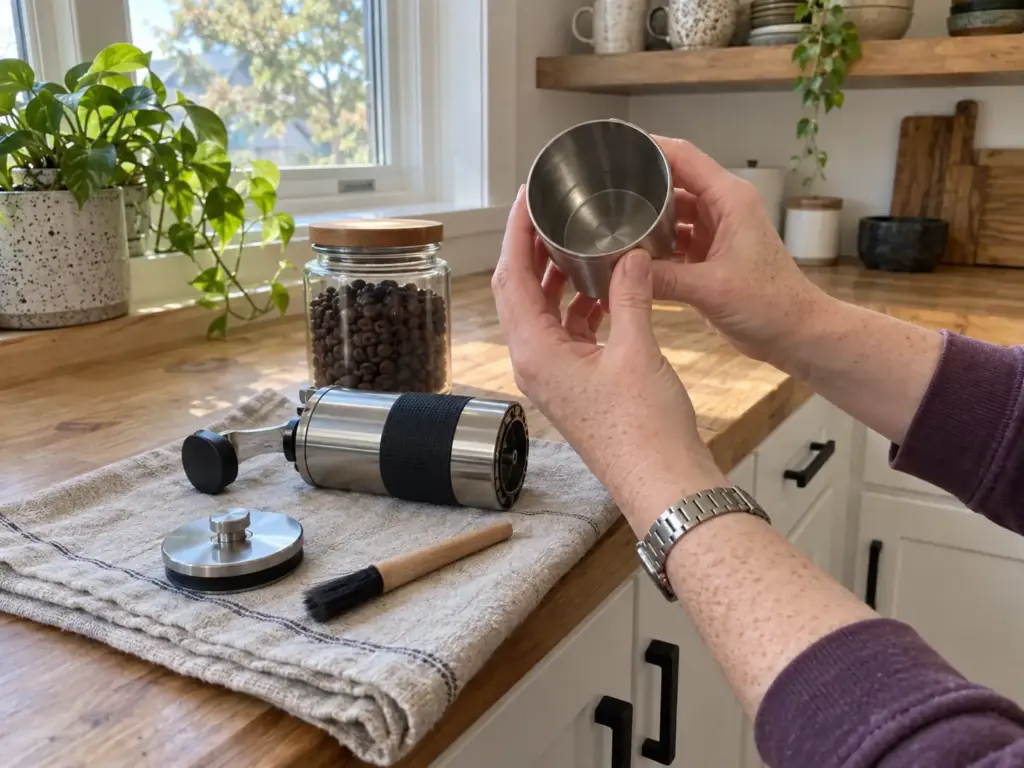
On an electric grinder the hopper is usually a clear molded tub, clear so you can see how many beans are left, which makes it the easiest plastic on the machine to spot. Hand grinders are built differently. The hopper is simply the top of the metal tube, and the plastic, when there is any, tends to be the lid you press on before cranking. The original TIMEMORE C2 had exactly that: a plastic hopper lid on a metal grinder, later replaced with metal on its successor.
What sits against this plastic is whole beans. They are dry and intact, and they stay in contact with it for as long as they wait to be ground, which on a hand grinder is the minute before you crank and on an electric one can be the whole week the hopper stays topped up.
A conical burr grinder can have metal teeth doing the work and plastic parts to hold beans, and that trade-off is comfortable for some. It is a reasonable line to draw. Whether it is your line is the first decision of the audit, and every later step is easier once it is made.
Dark roasts complicate the hopper a little. They carry oil on the surface of the bean, that oil leaves a film on whatever holds them, and a plastic hopper keeps the film and its smell longer than steel does. Wipe it out and the film is back with the next bag.
The chute and the catch cup: plastic that touches grounds
Past the burrs the coffee is grounds, with far more exposed surface than the bean had, and this is where plastic is hardest to avoid on an electric grinder. The chute that carries grounds from the burr chamber to the front of the machine is molded on most models, and the grounds bin under it almost always is. The bin is the part owners most often find out about late, usually on the first morning they tip it out and look at it empty (listing photos show it clipped in place, from the outside).
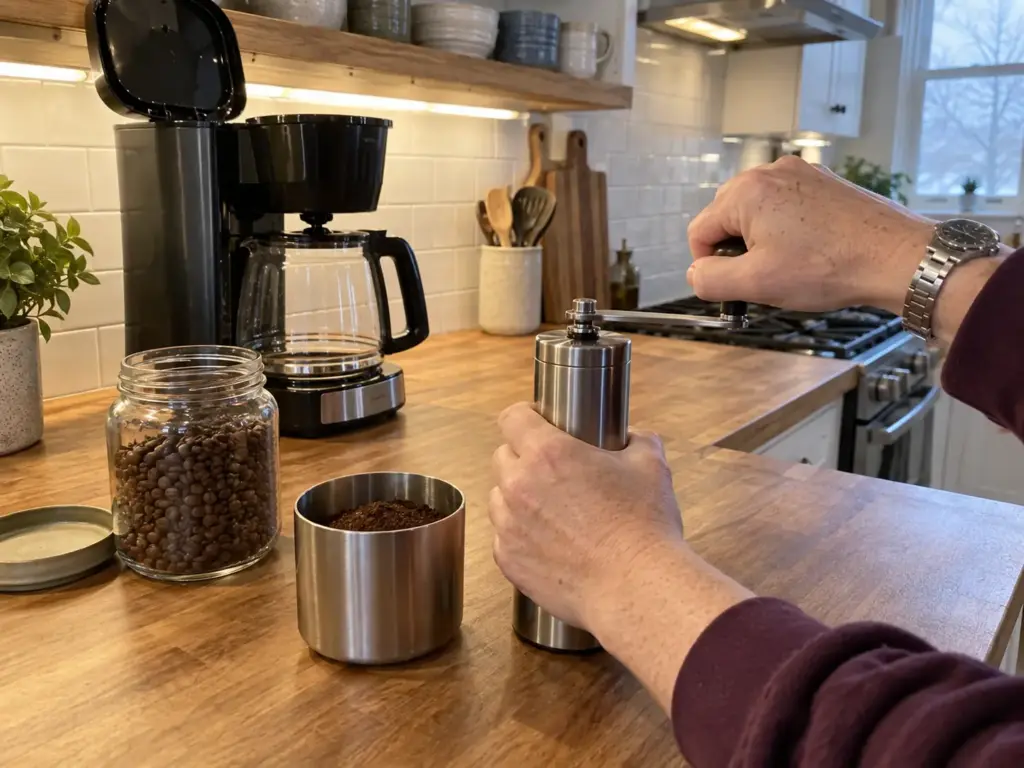
Hand grinders replace the chute with gravity. The grounds fall straight from the burr into a catch cup that screws on, presses on or hangs from a magnet underneath, and that cup is where materials vary most from one model to the next. Some are steel all the way through, some are molded, and on some the only way to know is to take the cup off and look at its inside.
Plastic in this position has a cost you can see without any lab. It holds a static charge, so the finest grounds cling to the walls, climb the sides and jump out when you pour. Steel and glass let the same dose slide out in one go.
Before buying, look for a listing photo of the catch cup or bin on its own, off the grinder. If there is none, ask the seller one question: which parts touch beans or grounds, and what is each one made of? A reply that only repeats “stainless steel” has told you about the shell and nothing else.
Inside the mechanism: couplings, brackets and spindles
The parts that hold the burr in place and turn it are where plastic survives on grinders that look metal all the way through. A shaft needs a coupling to connect it to the burr, a bushing or bearing to keep it centered, and a bracket to hold the whole assembly inside the tube, and any of those can be molded to save cost or weight. Most of them sit beside the coffee’s path rather than in it, so they matter less for what touches your coffee and more for how long the grinder lasts. What reviewers found inside four hand grinders that come up again further down:
- JavaPresse Manual: a nylon coupling joining the burr to the shaft, on some units
- TIMEMORE C2, the older model: a plastic support bracket, since replaced in the C2S
- Porlex Mini II: one small internal spindle, with the brand name molded into it
- 1Zpresso K-Ultra: polycarbonate, listed on the maker’s own list of materials
Anyone who asks for zero plastic gets pointed, sooner or later, to an old wooden mill. Wood and brass do not settle it either.
The Zassenhaus Santiago Coffee Mill is the grinder most people picture when they imagine a grinder with no plastic: a beech-wood box, a hardened steel conical burr, a brass-trimmed crank handle and a small drawer that catches the grounds. A teardown-style review found an internal plastic mounting bracket holding its grinding mechanism in place, and the drawer’s parts can give out early. Its grind consistency also drops at coarse settings compared with fine ones, and taking it apart to clean is reported as real work, so it suits someone who loves the old mill more than someone auditing for plastic.
“BPA-Free” names a plastic, not its absence
BPA-free on a grinder listing tells you what the plastic was made without: bisphenol A, a chemical used in making some hard plastics. It does not say there is no plastic. It says which plastic. A hopper stamped BPA-free is still a plastic hopper, and a listing that leads with the label usually has plastic to put the label on.
Its cousins on the box work the same way. Food-grade says a material is meant to touch food, and plastics carry that description as readily as food-grade stainless steel does.
Non-toxic is a marketing word with no test behind it on a listing. “Stainless steel” names one part, usually the largest one. None of them tells you what the catch cup is.
The same goes for microplastics, the word that brings a lot of people to this question: a listing that promises none is making a claim about the whole path, and the path is what you can check.
Whether any of this matters for your health is a question for a doctor, and not one a parts list can answer. What a parts list can tell you is where the plastic is, what it touches and what it is made of, and that is enough to shop on.
Check the Grinder You Already Own Before Buying Another
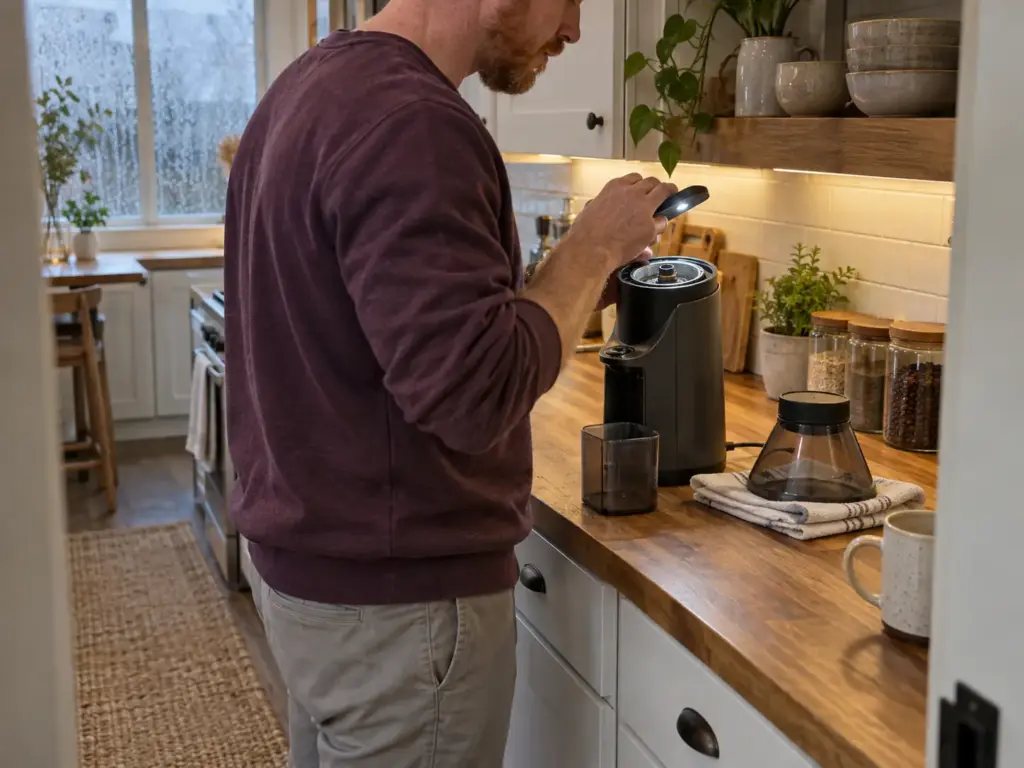
Most people asking this already have a grinder on the counter, and the cheapest plastic-free grinder is sometimes the one you find you nearly own. So before buying anything, look at yours part by part and decide which part, if any, is worth changing. It takes a few minutes, a phone flashlight and the manual.
The two-minute look: hopper, chute, catch cup
Unplug the grinder, take the hopper off and go in the order the beans travel:
- Turn the lid over and look at its underside, the face the beans actually touch.
- Look at the hopper walls: clear, tinted or slightly flexible means plastic; rigid, cold and ringing when tapped means metal.
- Point the flashlight down the chute on an electric grinder, or up into the burr housing on a hand grinder, and note what the channel is made of.
- Pull the catch cup or bin, empty it and look at it inside and out, including the rim and any thread.
- Write down anything you could not identify. It goes on the list to check in the manual, not the list of plastic parts.
A few tells make the calls easier. A thin raised seam where two halves of a mold met means plastic, however metallic the finish looks, because brushed-steel finishes can be printed or plated onto plastic. A part that feels warmer to your fingers than the metal around it is plastic too, and that goes for a viewing window, the adjustment wheel and the cap on the crank.
A magnet looks like the fastest test of all, and it would be if stainless steel were reliably magnetic. It is not: many of the stainless grades used around food barely react to a magnet, so one that slides off proves nothing. Tapping works better. Metal answers with a sharp click or a ring, plastic with a dull tock.
Then settle your rule before you read the verdict. If the only plastic is the hopper or its lid, and whole beans are all it touches, you may already be where you want to be. If the catch cup is plastic, that is the part the grounds sit in, and it also happens to be the easiest part on the grinder to change.
What the manual and the parts list will tell you
The manual’s exploded diagram shows the parts no flashlight reaches: the coupling at the top of the burr shaft, the bracket that holds the assembly, the bushings. Some manuals, and many spare-parts pages, name the material next to each part number, and that is often how a plastic part turns up on a grinder sold on its metal. The 1Zpresso K-Ultra is the clearest case. Its polycarbonate is on the material list, not in the product photos.
When the manual says nothing, the maker is the next stop, and one email covers it: which parts touch beans or grounds, and what is each one made of? A company that knows its grinder can answer in a line. One that replies with “premium food-safe materials” has also told you something.
The parts list says something beyond materials, too. A maker that sells replacement parts (the catch cup, the lid, the burr set) separately has built a grinder you can repair one piece at a time, which counts for more at month six than on the day the box arrives. Read the warranty in the same sitting: it tells you which parts the maker expects to fail.
Swap the one part instead of the grinder
The catch cup is the one part that people often replace on their own. Some grinders ship with a stainless catch cup, which many buyers are happy to have in place of a plastic measuring cup. Others fit an aftermarket catch cup and a dosing funnel to the grinders they already have. None of them replaced the grinder to change the cup.
The free version needs nothing new. If your electric grinder will run with the bin out (check the manual first, because some models will not start without it), set a small steel or glass cup under the chute. On a hand grinder with a plastic catch cup, check whether the maker sells a metal one; the threads and magnets are specific to each model, so a generic cup rarely fits.
Change the cup first and keep everything else the same for a week: same beans, same setting, same brewer. If the grounds pour cleaner and nothing else bothers you, the audit is finished.
If the hopper lid still bothers you, that is next week’s decision, made with one change already behind you. And a whole new grinder to get rid of a plastic lid that only ever touches whole beans spends the most money on the stretch of the path that matters least. If what you own is a budget burr grinder with a plastic hopper, the cup swap gets you most of the way for nothing.
Set a small steel or glass cup on your kitchen scale, tare it, and grind or tip the dose straight into it. The plastic bin never holds the grounds, the weight is on the display without a second step, and the same cup pours into the filter in one move.
The Hand Grinders That Get Closest, Part by Part
If the check says the grinder has to go, the shortlist for a plastic-free coffee grinder is short: four hand grinders, each steel or aluminum where you look first, and each with a plastic part or a flaw its listing does not lead with. They are ordered by how close each one gets to no plastic on the coffee’s path. The same grinders judged on grind quality instead are in the best manual coffee grinders, judged on the grind.
Closest to none: steel shell, lid and catch cup
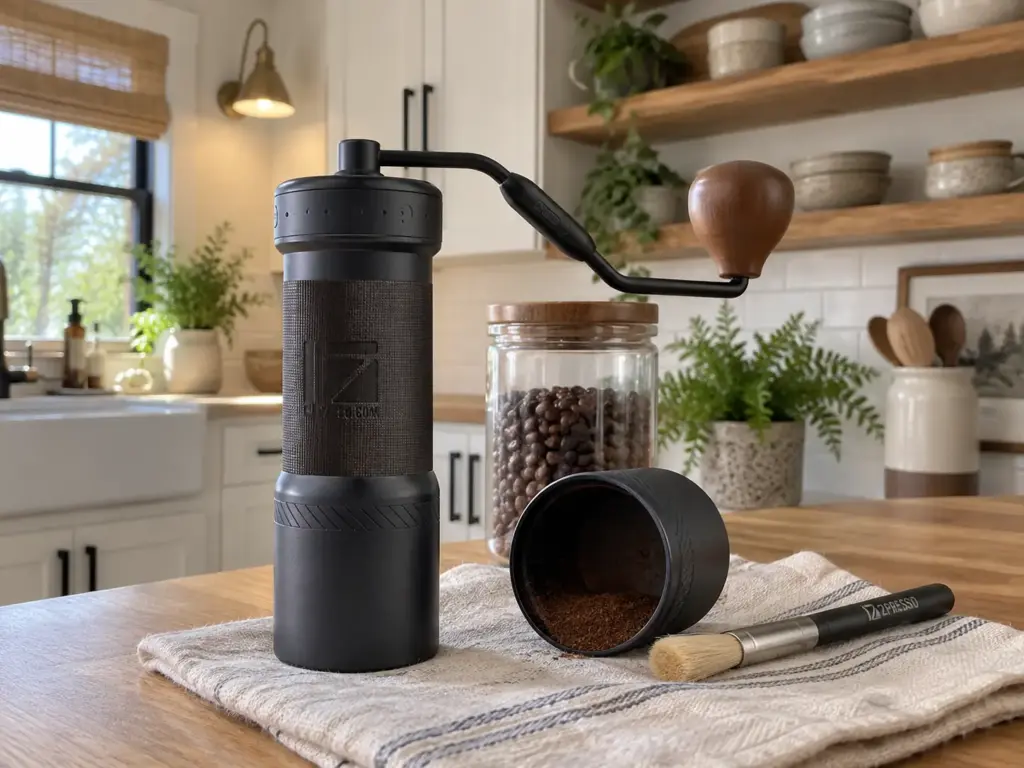
Walk the Porlex Mini II along the path and it holds up at every stop. The lid is stainless, the hopper is the stainless tube itself, the burr is ceramic and conical, and the catch cup threads on in stainless too, confirmed by two independent reviews that checked. The one plastic part either review found is a small spindle inside, with the brand name molded into it, and it touches neither beans nor grounds.
Capacity and pace are what it gives up. It is a single dose grinder, about 20 g per fill, one mug’s worth, and the ceramic burr grinds more slowly than steel at the coarse settings a French press wants. Stock on the listing was thin when it was checked, so look before you plan around it. (A steel tube is also cold and a little slippery in a damp hand on a winter morning; a dry dish towel around it fixes both.)
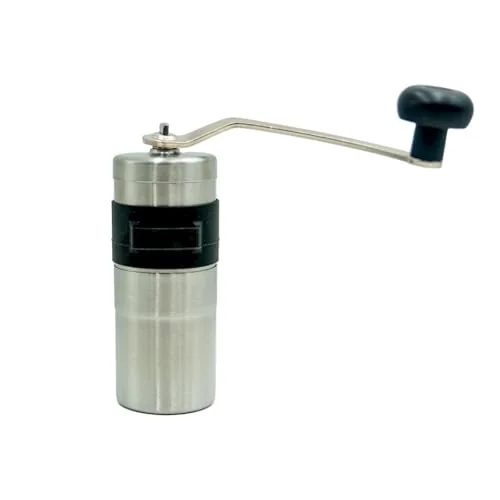
Small, light and steel, the Porlex is also a popular pick for travel, where one mug per fill is exactly what a trip asks for.
The one a maker fixed: plastic bracket out, metal in
The TIMEMORE Chestnut C2 had plastic in three places: the support bracket inside, the adjusting knob and the hopper lid. The bracket can crack after a few months of hard use, especially with dense light roasts, which take more force on every turn. The C2S replaced all three with metal in an aluminum-alloy unibody, around a 38 mm conical burr in 420 stainless steel with about 36 click settings of internal adjustment.
Credit where it is earned: a maker took the plastic out in a named upgrade instead of calling the old model premium. The upgrade was needed, though, and the older C2 still circulates, so read the model name on the listing. The hopper holds 20 g, the same one-mug ceiling as the Porlex.
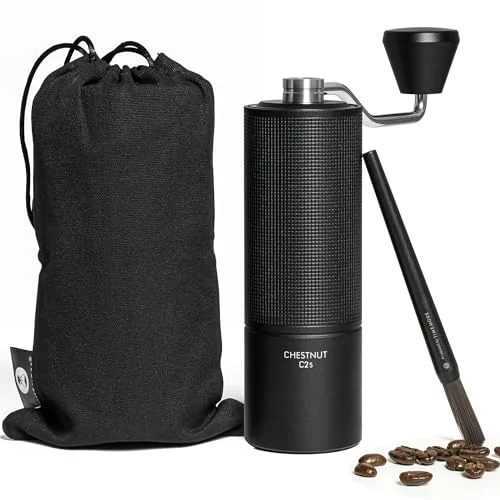
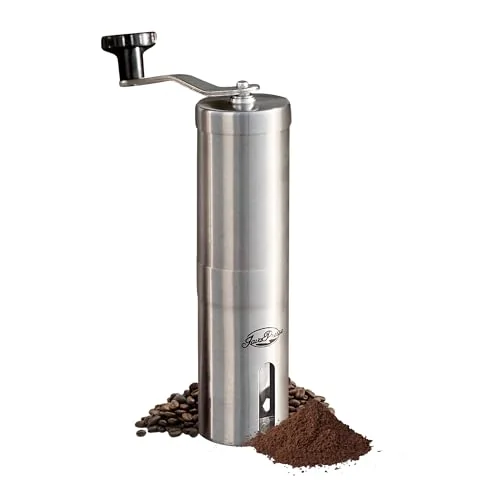
The budget steel shell with a nylon coupling inside
The JavaPresse Manual has the lowest-cost stainless exterior here: a steel housing and hopper, a ceramic burr and 18 grind settings. It is also the clearest proof that the outside does not describe the inside. On some units the coupling that joins the burr to the shaft is nylon, and it can fail under heavy use. Separately, the crank arm can wobble and, in some cases, come off its hex nut halfway through a grind.
Both weak points take the most strain when the grinder works hardest, so it suits one mug a day far better than a full pot every morning. If you already own one, snug the nut the first time the arm has play.
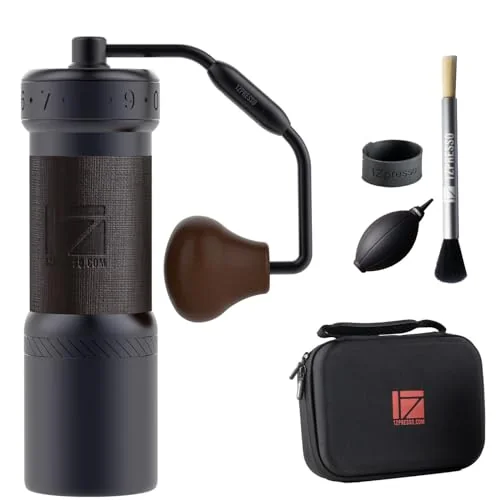
The premium pick that lists polycarbonate
Nearly every roundup names the 1Zpresso K-Ultra as the hand grinder to beat, and on the grind it earns the title: a 48 mm heptagonal stainless steel conical burr, an external numbered dial at 20 microns per click, and a magnetic catch cup that holds about 30 to 35 g. For the plastic question, though, it is not the pick. The maker’s own material list reads aluminum alloy, stainless steel, polycarbonate, wood and silicone, and polycarbonate is a plastic. A metal grinder and a grinder with no plastic are two separate claims, and this one makes the first.
The catch cup brings a second catch. It is held on by a magnet, and it can knock off easily, spilling grounds across the counter. If the plastic question is what brought you here, the Porlex gets closer for a fraction of the cost. If the grind is what you are paying for, the K-Ultra is still the grinder the others get measured against.
No standard will run this audit for you. The coffee world does have the Specialty Coffee Association’s standard for home grinders, and the SCA’s own title for it says what it covers: “SCA-320 Home Coffee Grinders: Specifications and Test Methods.” Its test figures are kept for members, and its subject is how a grinder grinds; what the hopper and the catch cup are made of is not in its name, so that question stays with the buyer. Here are the four side by side on the one question this page asks:
| Grinder | Burr | Where plastic was found | Beans per fill | The flaw |
|---|---|---|---|---|
| Porlex Mini II | Ceramic conical | One small internal spindle, touching neither beans nor grounds | About 20 g | One mug per fill; slow at coarse settings |
| TIMEMORE Chestnut C2S | 38 mm 420 stainless conical | None found in the reviews read; the older C2’s bracket, knob and lid were plastic | 20 g | One mug per fill; make sure it is the C2S |
| JavaPresse Manual | Ceramic | Nylon burr-to-shaft coupling, on some units | Not given in the reviews read | Coupling can fail under heavy use; crank can work loose |
| 1Zpresso K-Ultra | 48 mm heptagonal stainless conical | Polycarbonate, on the maker’s material list | About 30 to 35 g | Magnetic catch cup knocks off easily |
Hand or Electric: What a Plastic-Free Grind Path Costs You
Every grinder above has a crank, and that is not a quirk of the shortlist. It is what the plastic-free question costs, and the bill arrives in grams per fill, minutes per morning and a pair of hands well before it arrives in money.
Why an electric grinder almost never gets there
An electric grinder needs a motor, and a motor needs a housing around it, something above it to hold the beans and somewhere below it for the grounds to land. Almost every brand molds those three in plastic: the hopper clear so the bean level shows, the bin light so it slides out easily, the housing because plastic is cheap to shape around a motor. Steel burrs and a steel front panel do not change what the hopper and the bin are made of.
The exceptions exist, and they make the point for the rule. The few all-metal coffee grinders with a motor cost more than most home espresso machines, or were still on pre-order when checked, and what the money in a grinder actually buys explains most of that gap: tooled metal where a molded part would have done.
For most kitchens that is not a real option, which is why the usual answer to this question keeps coming back to going old school with a hand grinder. The strict answer is correct. Whether it fits your mornings depends on how much coffee you make.
Grams per fill against the pot you actually brew
Hopper capacity is the number that decides it.
Start with one 12 oz mug. That is about 355 g of water, and at a 1:16 ratio (1 g of coffee for every 16 g of water) it wants about 22 g of beans, a little over two level coffee scoops. A grinder that holds about 20 g handles that in a single fill. Nearly: 22 g is two grams over, so either brew the mug at 20 g and accept a slightly lighter cup, or run a short second grind for the last two grams.
An 8-cup drip carafe is where the arithmetic turns. A drip machine’s “cup” is 5 fl oz, so eight of them come to 40 fl oz, about 1,183 g of water, and at the same 1:16 that is about 74 g of coffee, seven level scoops or so. A 20 g grinder needs four fills to get there. A grinder that holds 30 to 35 g, like the K-Ultra, needs two or three.
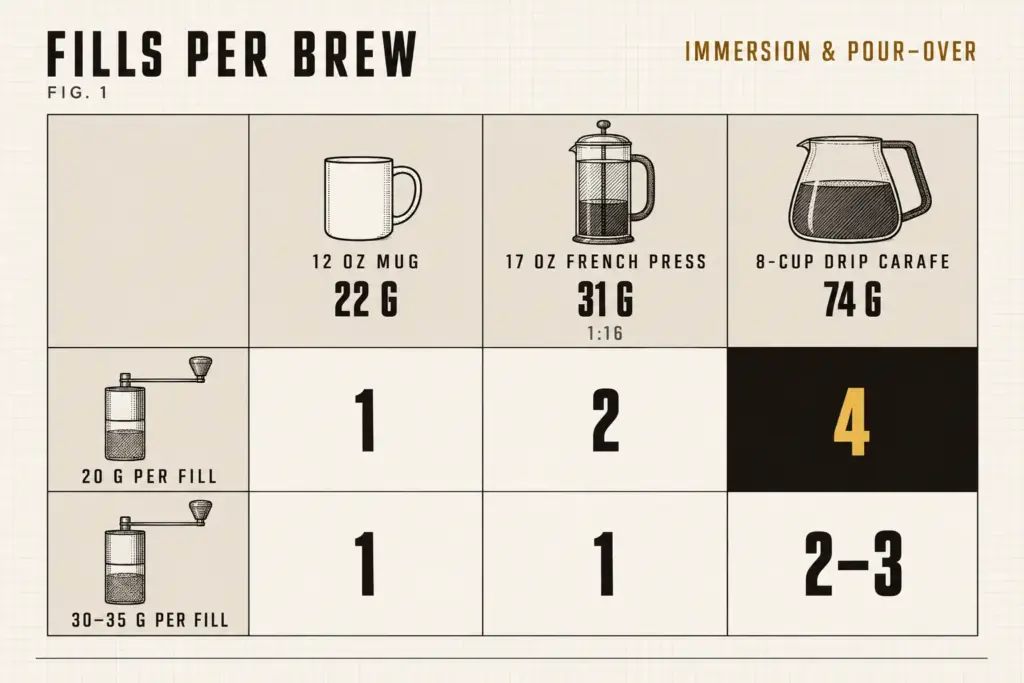
Each of those fills is a full run of cranking, and how long grinding by hand actually takes depends on the burr, the setting and the roast, which is why it is worth timing one fill on a grinder you are considering, or on a friend’s, before you commit. For a mug a day, capacity barely comes up. For a pot a day, it is most of the decision.
For a full pot by hand, weigh the whole dose first, all 74 g of it, into one steel cup. Then feed the grinder from that cup a fill at a time and tip each fill into a second steel or glass container, without touching the dial in between. One weighing keeps the pot’s dose right even when the fills come out uneven, and one setting keeps every fill the same grind.
Heat comes from the burrs, not the shell
The heat that can take aroma out of fresh grounds is made where the beans fracture against the burrs, in a hand grinder and an electric one alike, so a steel shell around the motor housing does not cool the grind. Heat and friction live in the grind chamber, at the burr face. That puts the question back where it started. Choosing a plastic-free grinder is a choice about what touches the coffee and how long the parts last, and it is not a way to grind cooler.
It also means a listing that sells its metal casing as a benefit to the grind is selling you the casing. What the metal buys is contact and longevity, which are good reasons on their own.
The morning you are too tired to crank
The old-school answer has a catch that shows up on weekdays. A manual grinder can become the obstacle in the morning, and some people are ready to trade up to an electric grinder and accept a plastic hopper to get there. That is the trade-off stated by someone living it.
A mug a day rarely gets to that point. A pot does: the first 20 g feels like nothing, the second is fine, and by the fourth fill the arm has noticed and the kettle has been waiting a while.
There is a middle path for a pot-a-day household, and it is a choice you can make, not a verdict. An electric burr grinder with a plastic hopper keeps plastic against whole beans only, and with the steel or glass cup from the swap above set under its chute, the grounds never sit in plastic (they still pass through a molded chute on the way). No cranking, and the strictest part of the audit still passes. If the crank is really the question, settle manual or electric for your mornings as a whole before coming back to materials.
What a Metal Grind Path Looks Like at Month Six
Reviews get written the week a grinder arrives, and the reason to want metal instead of plastic only shows up months later. A metal grind path has its own story at that point, and it is not that nothing happens. None of the sources here tracked a plastic-free grinder for months on end, so what follows is owner-reported timelines, not a controlled test.
The plastic that fails first: brackets, couplings, drawers
Where failures cluster on grinders that look metal, they cluster on the plastic left inside. The TIMEMORE C2’s plastic bracket cracked after a few months of hard use, which is the reason the C2S exists. On the wooden Zassenhaus, the drawer’s parts can fail early. On the JavaPresse, the nylon coupling is the part that gives way under heavy use.
Three grinders, three different plastic parts, one pattern. The plastic that holds a mechanism together takes the load of every turn, and dense, light-roasted beans ask the most of it. A grinder with less plastic inside has fewer of those parts to fail, and that is the long-term argument for metal that rests on nothing but wear.
On your own grinder, a failing internal part usually shows up in how it grinds before anything breaks off. The dial turns but the grind stays the same, the burr wobbles when you push the shaft sideways with a finger, or one setting gives you a different grind size from one morning to the next. Each of those points at something between the knob and the burr that has slipped, split or worn, and on a grinder that looks metal, that something is where the leftover plastic tends to be. For the wider question of how long a coffee grinder lasts, plastic parts are one line on a longer list.
What steel and ceramic do with months of mornings
Metal parts wear too, just differently. The K-Ultra’s magnetic catch cup does not crack; it knocks off, and that does not improve with time. Burr wear comes with every bag the burrs break, steel and ceramic, conical or flat burr alike, and the cup notices before the burrs look any different: more fines, a pour-over that drains slower and tastes muddier, a grind that no longer matches the number on the dial, the grinder drift owners notice first. Those are the signs that the burrs themselves have worn, and they have nothing to do with plastic.
Ceramic has one weakness steel does not share. It is harder but more brittle, so a small stone in a bag of beans can chip a ceramic burr where it would scratch or dent a steel one. It is rare, and it is worth knowing before you tip in the last beans from the bottom of a bag.
The catch cup is the other part that ages by accident rather than by wear. A steel cup that hits a tile floor comes back dented, and a dent near the thread or the rim is enough to stop it seating cleanly, which is how grounds end up on the counter. A glass cup or jar survives most drops onto a wooden counter and very few onto tile. Neither is a reason to choose plastic; both are a reason to set the cup down somewhere it cannot roll.
A steel chute also holds on to coffee oil and a thin layer of old grounds if it is never brushed. Every grinder keeps a little coffee inside after each use, so after a few days without grinding, the first grams out are the stale ones from last time, and the cup brewed from that dose tastes flatter than the rest of the bag. And a hand grinder that has started to loosen tends to say so by sound first, with a click on each turn that was not there in the first weeks.
Brush, don’t wash: the care a metal grinder needs
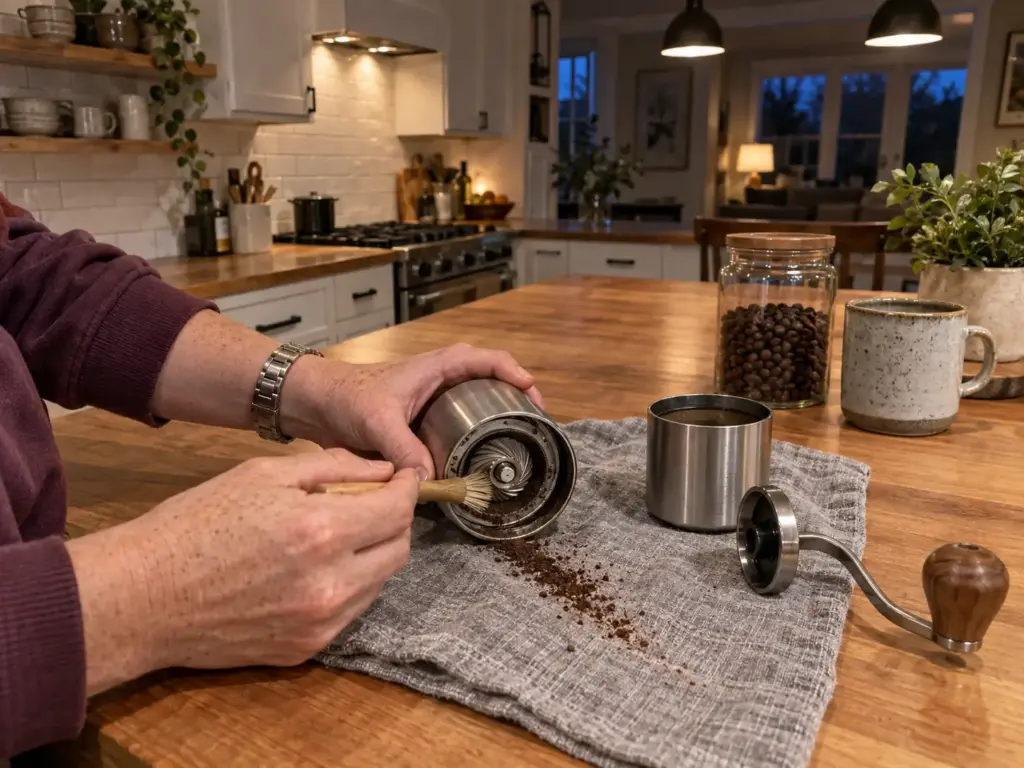
Care for a metal grinder is mostly dry. Cleaning the burrs means a brush, not a rinse: brush the burrs and the chute, wipe the catch cup, and keep water away from anything you cannot dry in a minute.
A wooden housing swells and cracks when it soaks, a carbon-steel burr like the one in a traditional mill will rust if it is put away damp, a silicone gasket or grip ring holds water against the metal, and no part of a burr set belongs in a dishwasher. A catch cup that is plain steel or borosilicate glass is the exception: wash and dry it like any other cup. Brush its thread too, because grounds packed into a thread are what make a metal cup bind or cross-thread on the way back on.
Taking a hand grinder apart for a deeper clean means finding your grind setting again afterward, which goes faster if you know how the adjustment works before the burr comes out. Using and adjusting a hand grinder covers the ring, the clicks and where zero sits.
Once a week, hold the grinder upside down and run a dry brush down the chute and around the outer burr, so loose grounds fall out instead of back into the burrs. Once a month, take it apart the way the manual shows and brush each piece before reassembling. Before the first real dose afterward, grind a few grams and throw them out: they carry whatever the brush missed.
Follow the Beans, Swap the Cup, Listen to the Crank
Three things to take from all of this:
- Audit the path, not the listing: hopper, burrs, chute, catch cup, and the parts inside that hold it all together.
- Decide how strict you are before judging any grinder. Plastic that holds whole beans and plastic the grounds sit in are different questions, and the catch cup is the one part you can change today.
- The grinders that get closest are hand grinders, and they cost grams per fill and minutes per morning as well as money.
A month from now, check two things: whether the crank has started to click on each turn, and whether the catch cup still seats the way it did in the first week, since that is where a grinder starts to go, plastic or not.
Tomorrow morning, pull the catch cup, empty it and look at it. If it is plastic, tip the next dose into a small steel or glass cup and brew exactly as you always do. The grounds should pour out cleaner, and the coffee should taste the same, which is the point: you changed the container, not the brew.
After the grinder comes the brewer it feeds. If you are still matching the two, the grind side is covered for the grinder for a pour-over or for a French press, and after that the kettle and the brewer are the next pieces to walk through the same check, from the first place the water touches to the filter the grounds land in.
Frequently Asked Questions
01Is there a coffee grinder with no plastic parts?
Very nearly, among hand grinders: the Porlex Mini II keeps steel on its shell, lid and catch cup, and its only plastic part found is one small internal spindle. All-metal electric grinders exist, but they cost more than most home espresso machines.
02Is there a stainless steel coffee grinder that doesn’t contain plastic?
Stainless steel on a listing usually describes the outer shell, so check the hopper lid, the chute, the catch cup and the coupling or bracket inside before trusting it. Hand grinders get closest; most electric ones keep a plastic hopper or bin.
03Does a plastic hopper matter if it only touches whole beans?
It matters less than plastic the grounds sit in, because whole beans only wait in the hopper while the grounds collect in the catch cup. The catch cup is also the easiest part to replace with steel or glass, so most owners change it first.
04Is a BPA-free grinder the same as a plastic-free grinder?
No, BPA-free tells you which chemical the plastic was made without, and a BPA-free hopper, chute or catch cup is still a plastic part. A plastic-free grinder keeps steel, ceramic, glass or wood along the whole path from the hopper to the catch cup.
05Are there coffee makers that have no plastic parts?
A few brewers are glass, steel and ceramic throughout, mostly manual ones such as a ceramic pour-over cone rather than drip machines, which need a reservoir, tubing and a housing. The same check applies: follow the water and the grounds through every part.



How did your cup turn out?
No comments yet. Tell us what you changed — and whether the needle moved.