



We may earn a commission when you buy through links on this page. It never changes what we recommend. How we pick
On this page8 parts
The kettle is on, you have ten minutes before work, and you hope your new hand grinder will finish in under a minute. The kettle clicks off while you’re still turning the handle, with a third of the beans waiting in the hopper. The answer to how long to grind coffee by hand is real, but it depends on the dose and the burrs.
The grind time on a manual coffee grinder is set by how many grams pass through the burrs and how many turns each gram needs, and that moves with the dose, the setting, the burr’s design and the roast. Below is the working range by dose, what stretches it, how to time your own grinder once, where the crank fits against the kettle, how to go faster for free, and what it means when your number starts creeping up.
Quick Answer
A filter mug (13–18 g) takes about 20 seconds to a minute on a decent hand grinder, and an espresso dose (16–20 g) 30 seconds to a minute, light roasts slowest. A coarse-built grinder at espresso-fine can need several minutes. Two mugs (26 g) overfill a 20 g hopper. Time one dose yourself and divide by the grams.
How Long It Takes to Grind Coffee by Hand, Dose by Dose
The times people post for grinding by hand run from about 20 seconds to 7 minutes, which reads like a flat disagreement until you notice that each one is a different dose on a different grinder. Put them all on one scale, seconds per gram, and most of them land in the same band.
The Numbers People Report, on One Scale
The conversion is plain arithmetic: divide the seconds by the grams. A report of 25 seconds for 18 g becomes about 1.4 seconds per gram, and now it can sit next to a report for 45 g or 14 g and mean something. The table does that for every report that gave both a time and a dose in grams, and it says how each figure was taken, because an owner’s guess and a measured time are not the same kind of number.
| Who reported it | Grinder | Dose | Time | Seconds per gram (derived) | How it was timed |
|---|---|---|---|---|---|
| Bylined K-Ultra review | 1Zpresso K-Ultra (48 mm steel) | 18 g filter | ~25 s | ~1.4 | Measured |
| Bylined K-Ultra review | 1Zpresso K-Ultra | 30 g espresso | ~45 s | ~1.5 | Measured |
Figures that gave the dose in scoops or tablespoons, or gave no dose at all, are left out: there is nothing to divide them by.
Both measured figures sit at about 1.4 to 1.5 seconds per gram. None of this is a promise for your grinder, only the band your number should land in when nothing is wrong.
Count the handle turns for one dose while you time it. Turns don’t care how fast you crank, so they describe the burr and the setting alone: a 20 g dose can take anywhere from 30 turns to about 200, depending on the burr. If next month the seconds go up and the turns stay put, your pace changed. If the turns go up too, the grinder did.
A Filter Mug Versus an Espresso Dose
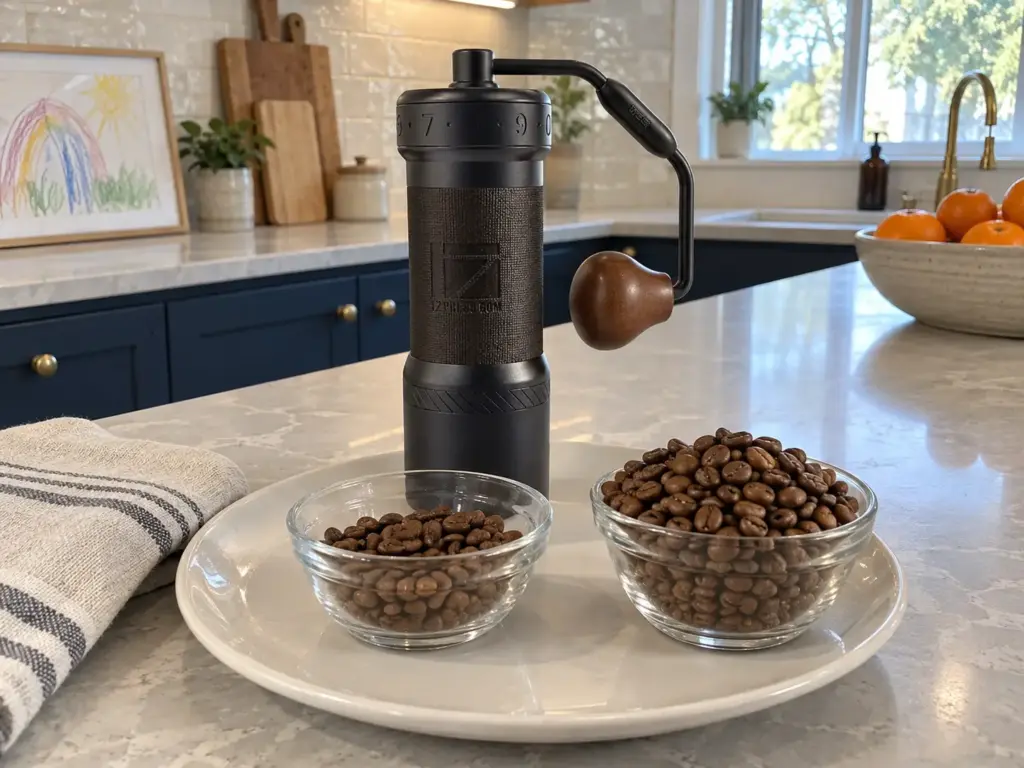
The only bylined, dosed measurement in the set comes from a review of the 1Zpresso K-Ultra, a hand grinder built around a 48 mm stainless steel conical burr, which is large for the category. The reviewer’s measurements: “an 18 gram filter dose grinds in roughly 25 seconds and a 30 gram espresso dose lands around 45 seconds.” Per gram, the espresso setting costs only about a tenth more than the filter one, so most of the extra 20 seconds is the extra 12 grams.
The speed gets paid for in effort instead. Espresso at the fine end can feel like a workout, grinding takes much more effort for light roasts and finer settings, and the zero point may shift quite a bit at first use, a detail that matters once your own time becomes a gauge.
Taken together, the figures point the same way: on a decent conical hand grinder, a mug of filter coffee (13 to 18 g of beans) takes roughly 20 seconds to a minute, and an espresso dose 30 seconds to a minute. If your mug comes out of a drip machine, the grind a drip coffee maker wants is a medium setting, well away from the slow fine end. The espresso dose costs more mainly because it’s a bigger dose, and how fine an espresso grind actually is explains why the handle gets heavier there before the clock notices.
Why the Old Forum Numbers Run Slow
They read slow for reasons that have little to do with anyone’s cranking. A scoop isn’t a gram, so three scoops can’t be divided into anything, the grinders are fifteen years older than the ones owners time now, and most of those doses were at the fine end. The one that can be divided, 45 g in 2 minutes, works out to about 2.7 seconds per gram, comfortably inside the modern band.
A large-burr grinder can do an espresso dose quickly, but the whole process, with getting beans in and out again, takes longer. Loading the hopper, knocking the last fragments through and tapping out the catch cup is a fixed cost that no seconds-per-gram figure counts. On a short dose it can take as long as the grinding.
What Makes Grinding by Hand Take Longer
If your number sits well outside that band, how fast you turn is rarely the reason. The dose, the setting, the burr’s design and the roast each move the clock in a way you can predict.
The Dose Does Most of the Work
Seconds scale with grams. On the K-Ultra the 30 g espresso dose takes 20 seconds longer than the 18 g filter dose, yet per gram the two sit at about 1.5 and 1.4 seconds, and 25 g of French press coffee comes out “under 25 seconds.”
Only at the extra-fine end of Turkish coffee does a single dose stretch toward a minute. Short of that, grind size moves the clock less than the dose does. On a large steel burr, the fine end shows up first as a heavier handle.
Thirty Turns or Two Hundred: the Burr’s Design
Count turns of the handle per dose, the rotations of the hand-crank, and the burr’s design shows up directly. Large-burr hand grinders are much faster but harder to turn. Burr size and burr set matter more than the brand on the lid.
So the fastest burr looks like the obvious buy, right up until the beans get hard. Harder beans can be a struggle on some aggressive 48 mm sets, which need relatively few turns, while grinders with longer turn counts take hard beans without complaint. If your grinder is slow at every setting and with every roast, a hand grinder with a bigger, faster burr is the real answer. If it’s only slow on light roasts, the burr may be doing what it was built to do.
A Lighter Roast Pushes Back
Premium hand grinders are slower on light roasts than on darker ones. A light roast stays denser and harder (dense beans are the slow ones), while a darker one shatters with less force (why light roasts grind differently goes further), and you can feel it through the handle: it spins almost freely on a dark roast and starts to tick the moment a light one goes in, each bean a separate bite for the burr.
A Grinder Asked for a Setting It Was Not Built For
The 5-to-7-minute row belongs here: a grinder “only made for coarser grinds,” pushed to espresso-fine, where “it took me around 5-7 mins for a 14g coffee.” The burr was being asked for a size it wasn’t shaped to cut, which hand grinders built for the espresso end solve by design.
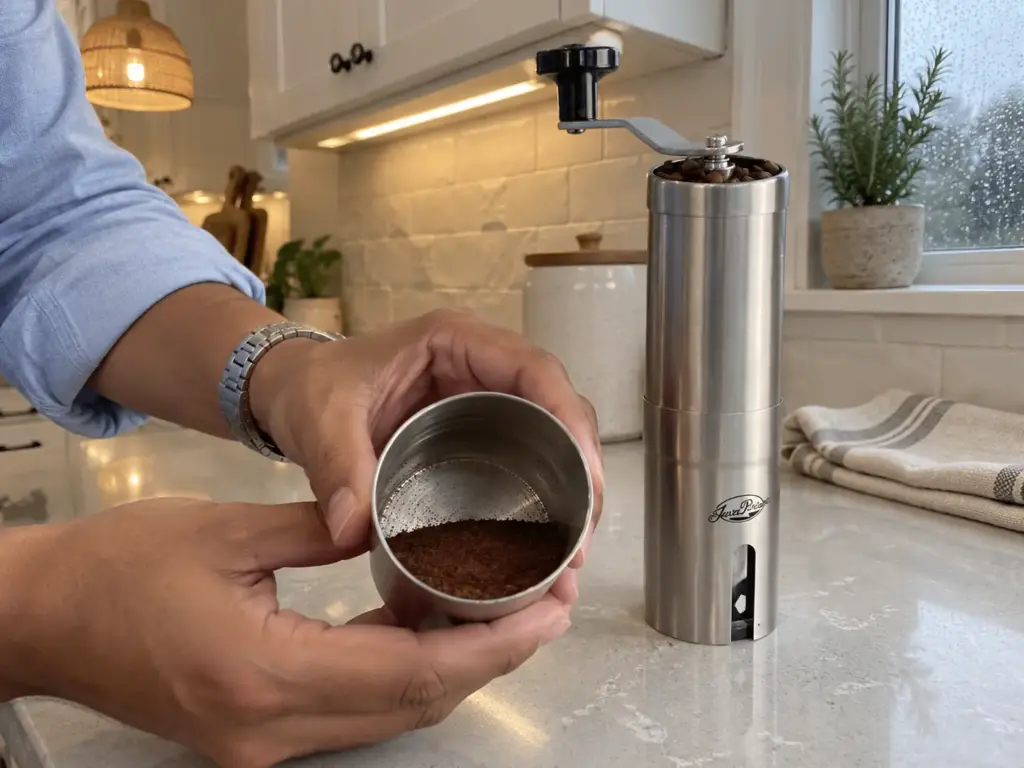
On Amazon, the clearest slow record belongs to the JavaPresse Manual Stainless Steel Coffee Grinder, a budget grinder with a ceramic burr (the fast grinders above cut with a steel burr) and 18 settings. It can take a long time to grind enough beans for a pour-over, and at a fine setting, hand grinding takes a lot longer than you think. Its handle also sits on a five-sided bolt that no drill socket fits, and a hexagonal bolt would have been easier.
Before blaming any grinder, a slow crank plus a bitter, hollow cup at a filter setting means you’re finer than you think, and the coffee is over-extracted: go one step coarser and taste, and if the cup turns thin and sour (under-extracted), come back a step (tell a fine grind from a medium one if you’re unsure).
Time Your Own Grinder Once
Your own number matters more than any published one. It takes one dose, a phone and about a minute, and it gives you the only figure that describes your grinder, your beans and your pace.
One Dose, One Stopwatch, One Division
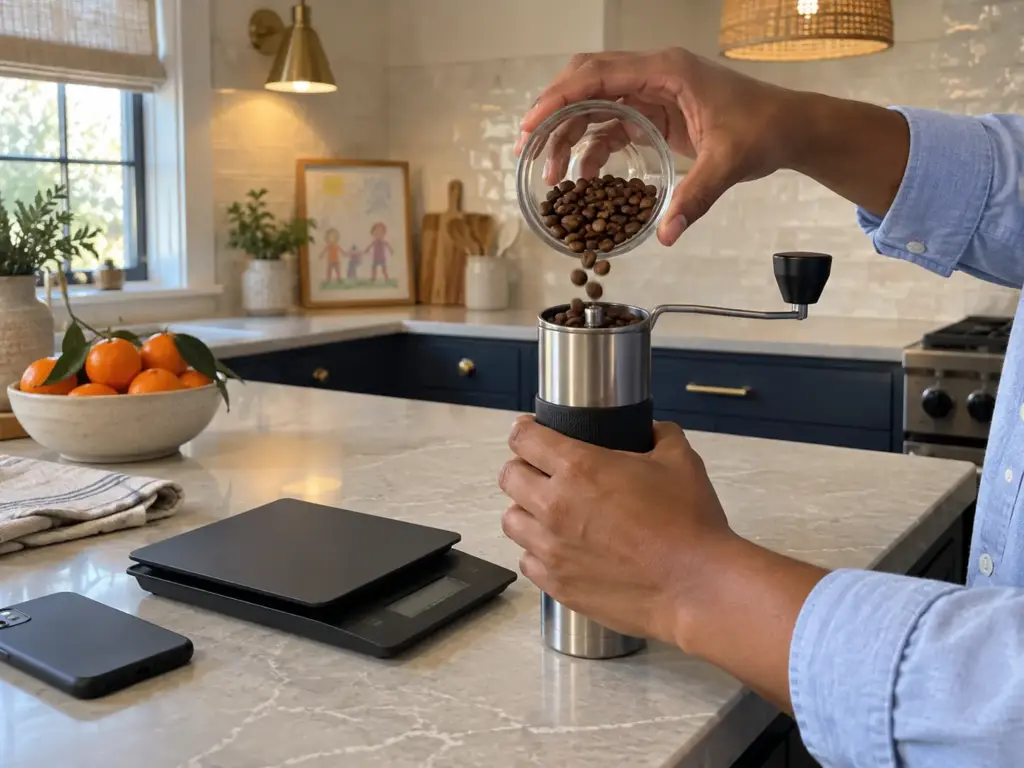
The method needs a phone and whatever you already weigh coffee with:
- Weigh your usual dose, or level your usual scoop and weigh it once so you know what it holds.
- Load the hopper and set the phone’s stopwatch next to the grinder.
- Start the stopwatch on the first turn and crank at your normal pace, not a sprint.
- Stop it when the handle turns with no resistance left.
- Divide the seconds by the grams.
Say 18 g takes 40 seconds: 40 divided by 18 is 2.2 seconds per gram, the same arithmetic the table used, now on your own grinder. Do it once at your filter setting and once more at your finest if you ever grind for espresso or a moka pot, because each setting gets its own number.
One detail changes the reading. After you move the setting, the first dose still carries grounds from the old setting that were sitting between the burrs, so it comes out faster or slower than the next one. Time the second dose, not the first. And hold the grinder the way you’ll hold it every morning: braced against the counter, the same dose goes through with fewer stops than it does held loose, and the number should describe your real routine rather than your best one.
Reading Your Number
Between about 1.4 and 3.5 seconds per gram, you’re where owners of decent hand grinders land. Near the top of that range at a filter setting, check the setting and the roast before you suspect the grinder.
Several times the top of the range (10 or 20 seconds per gram) points at the grinder or the setting rather than at you: that’s the coarse-built grinder at espresso-fine from the table. Write the number down next to the setting it was taken at. Finding that setting again is its own job, covered in finding zero and counting clicks.
Then the number plans the morning. At 2.2 seconds per gram, one cup of 13 g is about 29 seconds and two mugs at 26 g about 57 seconds, plus a reload if your hopper holds less than that.
For a French press you could multiply the filter number by the press dose. Actually, time the press setting on its own instead: coarse runs faster per gram, so the filter number will overestimate it (the K-Ultra’s press figure came in under a second per gram). An AeroPress or a V60 dose gets its own quick timing too, since each sits at its own grind size.
Take your number with the beans you’ll be brewing for the next few weeks, and note the roast next to it. A light roast can take half again as long as a dark one on the same grinder, so a number taken with the last of a dark bag will make a grinder with nothing wrong look slow the day you open a light one.
When a Scale With a Timer Earns Its Place
None of this needs new gear. Any kitchen scale gives you the grams and any phone gives you the seconds, and the only thing a scale with a built-in timer saves is juggling two devices on the counter while you crank.
If you’ll repeat the test every few weeks, the Hario Drip Scale Timer puts both in one device: it reads in 0.1 g steps and runs a timer from the same panel. It is less kind about how long it lasts, since it can break within six months, and its display can be slow to catch up with weight changes, with a lag of a few seconds at power-on. The plastic housing is also a question over the years. For a test you run once a month, the phone does the job at no cost.
The Crank Against the Kettle
Most people asking this question are thinking about a morning, not a stopwatch: will the grinder be done before the water is? For one mug it almost always is. For two mugs, the hopper decides.
The Kettle’s Head Start
According to Consumer Reports’ lab test of electric kettles, “The electric kettles brought the water to a boil in about 4 to 5½ minutes.” That was a full liter, a little over 4 cups; on gas the same liter took a little over 4½ minutes, and a 1,200-watt microwave needed 6 minutes 45 seconds. Against that, a filter mug at 20 seconds to a minute of cranking fits inside the boil several times over.
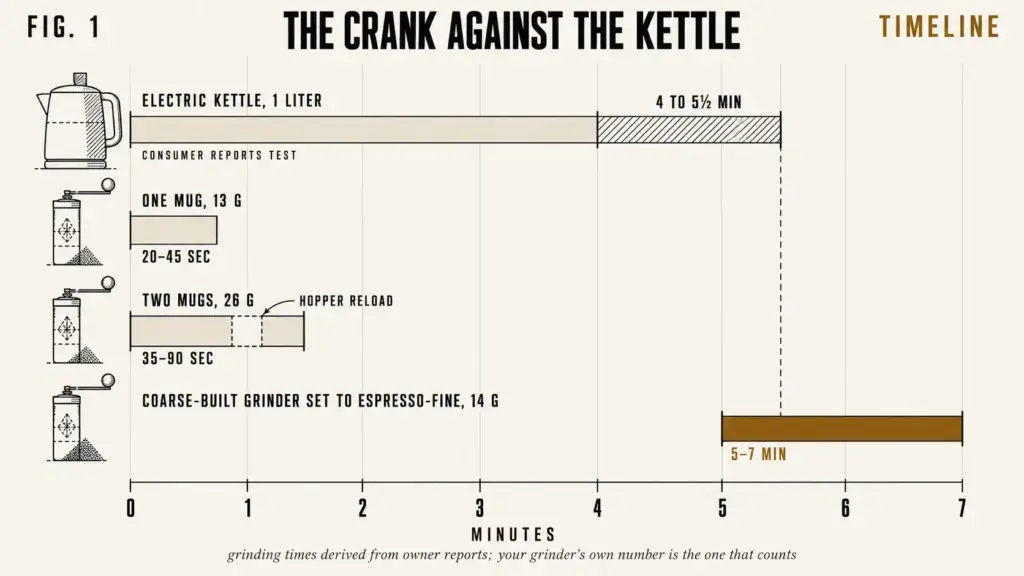
A mug’s worth of water boils faster than a full liter, so the margin is smaller on a one-mug morning. Cranking while the water heats is still the routine most people are after, since a hand grind can take about as long as the water does to heat.
Grinding while the kettle heats is sound advice. At 5 to 7 minutes for 14 g of espresso-fine coffee it runs past an electric kettle’s full-liter boil, and the water sits waiting for the grounds. The kettle clicking off is the easiest timer in the kitchen. If it beats you every morning, the dose, the setting or the burr is telling you something before any stopwatch does.
One Mug or Two
The dose is the other half of the arithmetic. Standard 310-2021, the SCA’s home-brewer standard and the source of its Golden Cup ratio, tests brewers at “55 g of coffee per 1.000 kg of water.” That works out to about 13 g of beans for an 8 fl oz (240 ml) mug and about 26 g for two.
A common kitchen ratio of 1:16, 15 g per 240 ml, comes to 62.5 g per liter, a stronger cup than the standard because more coffee meets the same water. Either brews a good mug. But for the clock the difference matters: at 15 g, two mugs are 30 g, not 26.
That’s where the hopper becomes a second clock. The TIMEMORE Chestnut C2S has a 38 mm steel conical burr and a 20 g hopper that its listing calls “enough for preparing a cup or two in daily use.” At the SCA ratio two mugs need about 26 g, more than its hopper capacity, so that’s two loads, and the refill is part of the time.
The listing also says it can “grind enough for a big cup in one minute,” a claim from the seller rather than a timed test. Two things are worth weighing before counting on it for a two-mug morning: it can stop working after a drop, and the folding-handle version is the one to pick.
Capacity is one of the first things to shrink as hand grinders get cheaper, so if two mugs is your daily dose, read cheaper hand grinders and what each one gives up with your gram count in hand.
On a two-load morning, weigh the whole dose into a small cup before you start, then pour the first 20 g into the hopper. The second load is already sitting there when the handle goes light, so the refill is a pour instead of another round with the bag and the scale, and the kettle loses its lead by seconds rather than a minute.
When the Daily Dose Outgrows the Crank
The crank is only part of the morning. Loading, the last few turns and tapping out the grounds turn a 30-second grind into something closer to a minute. For one or two cups that hardly matters.
One owner who grinds espresso by hand on several premium grinders set the line plainly: “If you’re only making 1-2 espresso a day you’ll be fine.” The owner of the 200-turn grinders from the burr section drew his line in the same spot: “for more than a couple espressos at a time, the 200 revs gets to be a bit much.”
Past that, run the arithmetic on your own number. A full pot, a liter of coffee at the SCA ratio, takes 55 g of beans, which is three loads of a 20 g hopper and, at 2.2 seconds per gram, about two minutes of cranking before the refills. Once a household pot is the daily job, that’s the point to weigh whether a hand grinder or an electric one fits your mornings.
Faster Without Buying Anything
Before any new grinder, two free changes shorten the crank, and a drill you may already own shortens it a lot. The drill comes with catches worth knowing first.
Brace the Grinder, Keep a Steady Pace
Much of the lost time is stopping, not slow cranking. Holding the grinder steady matters: when it is not anchored, the rhythm breaks as beans catch, and when it is anchored, even the hardest beans are no problem. How to hold it steady is technique, covered in the guide to using a hand grinder mentioned above.
Pace comes second. “Depends how fast you crank, of course,” one 2011 reply said, but a steady speed you can hold for the whole dose finishes sooner than a sprint that keeps catching. If the handle starts to fight, slow down rather than push through.
The Cordless Drill, in Its Low Gear
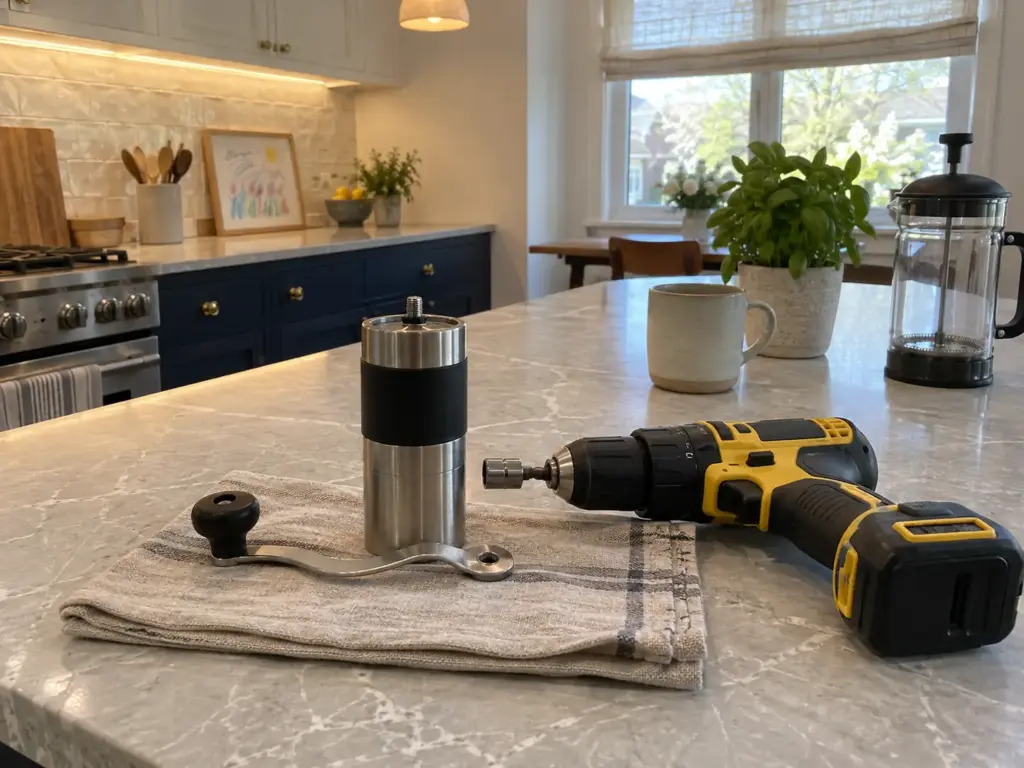
Take the handle off, drive the grinder’s nut with a drill, and the job becomes one of torque rather than speed. A corded drill can stall at the slow speeds a hand grinder wants, while a cordless drill in its low, screwdriving mode suits it because it has lots of torque at low speeds. Feeding the beans in slowly helps too.
The drill hack has no single right rpm to give you. Measured with a tachometer on a 20 V cordless drill, the stall point gives a different speed for each hand grinder, and the numbers are not a precise guide. You’ll usually hear a stall coming: the motor note drops and the socket starts to shudder on the nut, which is the moment to ease off the trigger.
What the Drill Trick Costs You
The first cost is fit. Some grinders come with no easy way to connect a drill, and the budget grinder with the five-sided bolt takes no ordinary socket. The second is the grind itself: a 1Zpresso J-Max can grind finer the faster it spins, while other grinders show no change. One person’s observation, not a test, but reason enough to taste a drilled dose before trusting it.
The third is setup. Whether a drill is worth buying just for this is doubtful for most people. For one mug a day, I’d brace the grinder and leave the drill where it is.
When Your Number Creeps Up in Month Two
Once you have your number, it becomes a gauge. The same dose, at the same setting, with the same kind of beans, should take about the same time next month, and when it doesn’t, the grinder is telling you something before the cup does.
Same Dose, Same Setting, More Seconds
Say the mug that took 30 seconds in the first week now takes 45, and you can’t say when that drift started. Spread over a month, that’s about half a second a morning, far too little to notice at the counter and plenty for a stopwatch to catch. A slow creep like that is useful information, as long as you compare like with like.
If you counted turns alongside the seconds, split the two before anything else. Same turns, more seconds: the grinder hasn’t changed, your cranking has, and a grinder that has started to catch or wobble in your grip is the usual reason (bracing it again is free). More turns for the same dose: something inside is cutting less per turn, and the list below is where to look.
Before either, rule out the beans. A lighter roast or a different bean makes the handle heavier and the clock slower, as the roast section showed, so a new bag can add seconds with nothing wrong in the grinder. Retime with the same kind of beans your number was taken with before you touch anything.
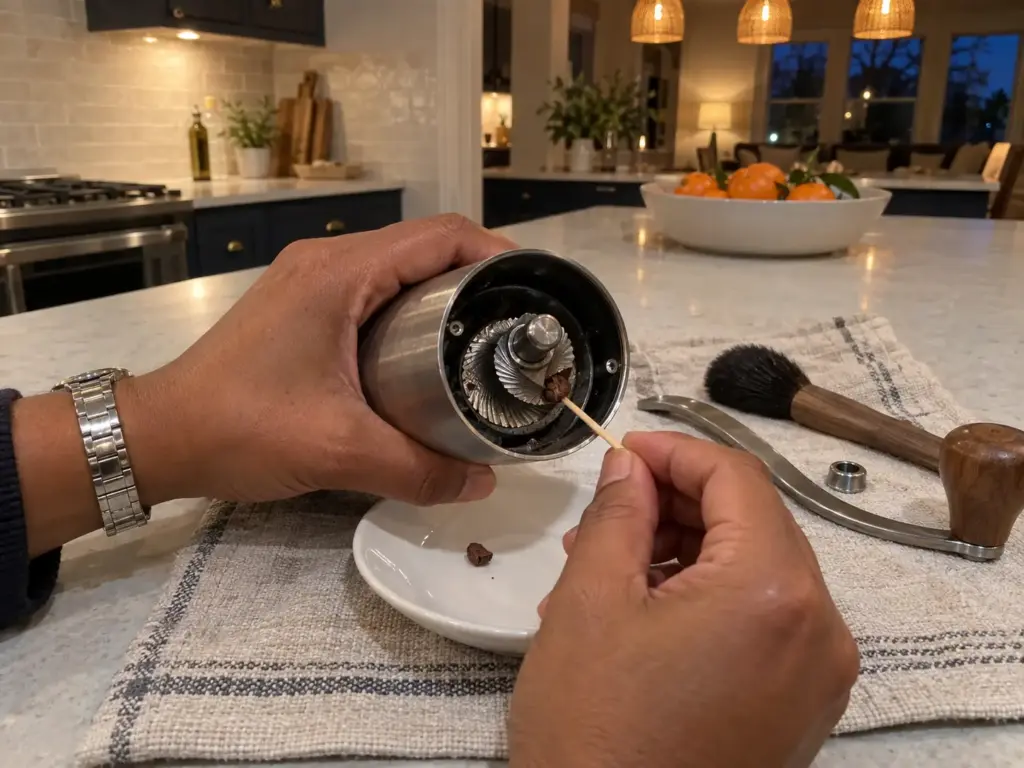
If the beans match and the number still climbed, something inside changed. The possibilities are few and mechanical: a stuck bean in the way of the burrs, packed fines on them, a setting that moved, or worn burrs.
Check them in the order below, free and likeliest first, and time the same dose again after each one. Change one thing, retime, taste. Three fixes at once leave you with a faster grinder and no idea which one did it.
What to Check, in Order
- A fragment wedged between the burrs. Empty the grinder and clear it the way the manual describes, then retime.
- Grounds packed on the burr and in the chute. Fines and oils build up where the grounds leave the burrs, and a packed exit slows everything behind it. Brush them out dry; whether water is allowed is the maker’s call, so check the manual. Retime.
- A loose handle nut or an adjustment ring that worked loose. If the setting crept finer, the crank slows and the cup turns more bitter at the same time, which makes a useful cross-check. Recheck zero: the zero point can shift early on, so check it from time to time. Retime.
- The burrs themselves, only once the first three check out. Worn, dull burrs or chipped ones cut less per turn, so the same dose takes more turns and more seconds. Wear is slow, so it shows up as a creep across months; a jump from one morning to the next points back up the list. Read the signs that a grinder’s burrs are worn before you order a set, and how long a coffee grinder lasts puts that wear on a longer timeline.
A crank that jams or stops turning altogether is a different problem from a slow one, and a grinder that jams or will not turn has its own set of checks. After any of the four fixes above, brew and taste as well as retiming. If the number drops back and the cup tastes the way it did, you found it; if the number drops and the cup turns sour, the setting moved coarser along the way, so check zero again.
Listen while you retime. A catch that comes back once per turn, in the same spot every time, is almost always something wedged between the burrs. A handle that feels heavier evenly, all the way round, points at the setting or the burrs instead, and that tells you which item on the list to start with.
Your Seconds per Gram Is the Only Number to Trust
Three things to take from all of this:
- On a decent hand grinder, a filter mug takes roughly 20 seconds to a minute and an espresso dose about 30 seconds to a minute. A number far outside that points at the dose, the setting, the burr or the roast before it points at you.
- Time one dose of your own grinder and divide by the grams. After that, the kettle, the second mug and the hopper are simple multiplication.
- For one or two cups a day, the crank fits inside the boil. When the daily dose keeps outgrowing the hopper, that’s the moment to weigh an electric grinder.
A month from now, time the same dose at the same setting with the same kind of beans, and if it takes noticeably longer, look at the burrs and the handle nut before you blame the next bag.
Tomorrow morning, start the phone’s stopwatch on the first turn, stop it when the handle goes light, and divide by the grams you loaded. Then brew as usual and taste the cup: that number and that taste together are your baseline, and the kettle will tell you whether the number fits.
Frequently Asked Questions
01How long does it take to grind coffee by hand for espresso?
On a good hand grinder, a 16 to 20 g espresso dose takes about 30 seconds to a minute. Light roasts sit near a minute and darker roasts nearer 40 seconds. A grinder built for coarse work can take several minutes at espresso-fine.
02How much coffee should I grind for 2 cups of coffee?
About 26 g of beans for two 8 fl oz mugs, using the SCA’s standard ratio of 55 g of coffee per liter of water. A 1:16 ratio, 15 g per mug and 30 g for two, brews stronger than the standard. In a 20 g hopper, either amount means two loads.
03How long does coffee stay fresh after you grind it?
Not long: ground coffee loses aroma much faster than whole beans, because far more of it is exposed to air, which is why the minute of cranking belongs right before brewing: grind fresh, then brew. For the trade-offs of grinding the night before, see when to grind your beans.
04Is it hard to hand grind coffee?
At filter and French press settings it takes little effort, and a large-burr grinder can turn out 25 g of press coffee in under 25 seconds. The fine end and light roasts are harder, and espresso at that end can feel like a workout. Bracing the grinder helps more than cranking faster.
05Is a blade grinder faster than grinding by hand?
Yes, a blade grinder takes seconds instead of a minute, but it chops the beans unevenly into dust and chunks rather than cutting them to one size. How long to run it is its own question, covered in how long to run a blade grinder.

How did your cup turn out?
No comments yet. Tell us what you changed — and whether the needle moved.