




We may earn a commission when you buy through links on this page. It never changes what we recommend. How we pick
On this page8 parts
- What the Best Coffee Grinder for Pour Over Actually Has to Do
- Read the Drawdown Before You Buy Anything
- Hand Grinders: The Most Evenness for the Least Money
- Why an Espresso Grinder Is the Wrong Buy for a V60
- Electric Grinders for a Pour-Over Before Work
- What a Pour-Over Grinder Looks Like in Month Ten
- Start One Step Coarser, and Buy Only If the Mud Stays
- Frequently Asked Questions
You pour the last of the water, and the bed in the V60 just sits there: the level barely drops, a gray-brown sludge settles over the grounds, and the cup that finally drips through tastes bitter and thin in the same sip. That combination is the grinder answering the question you typed, because the best coffee grinder for pour over is simply the one that leaves the fewest dust-sized particles in the dose. A paper filter drains only as fast as its finest particles let it, so a dose full of dust clogs the paper, stretches the brew and over-extracts the dust while the bigger pieces around it stay sour. Below you will find what a pour-over grinder actually has to do, what to try on the one already on your counter, the hand and electric grinders worth buying with their flaws in writing, why an espresso grinder is the wrong buy, and how each holds up by month ten, which is the part of choosing a home coffee grinder that decides a cone.
Quick Answer
The best coffee grinder for pour over is a burr grinder that grinds evenly at medium and medium-fine; the settings count and the espresso range matter far less. By hand: KINGrinder P2 on a budget, 1Zpresso K-Ultra as the splurge. Electric: Baratza Encore, or the filter-only Fellow Ode Gen 2. Try one step coarser on your current grinder first.
What the Best Coffee Grinder for Pour Over Actually Has to Do
A muddy V60 that stalls is a particle problem before it is a pouring problem. The dose that went into the paper carried too many fines, the dust a burr set sheds as it breaks a bean, and how much of that dust comes out is a property of the grinder, not of the kettle, the beans or your pouring hand.
Fines Clog the Filter, Boulders Stay Sour
Start with the direction, because it decides everything after it. A pour-over that drains slowly, leaves a muddy layer on top of the bed and tastes bitter and thin at once is not simply ground too fine. It is two extractions running in one brew: the fines give up everything they hold in the first minute, including the harsh, astringent compounds that come out last, while the boulders (the oversized chunks from the same dose) are still releasing acid when the water runs out, a pocket of under-extraction inside an over-extracted cup. Sour and bitter in one cup is the signature of a wide particle distribution, and no single setting can fix a spread.
The paper makes it worse in a way an immersion brewer never does. Fines migrate down through the bed as you pour, settle against the filter and plug its pores, so the water sits on the grounds longer than your recipe planned. That extra contact time pushes the whole dose further toward over-extraction, which is why a clogged cone tastes harsher than the same grounds would in a French press. And the dripper that finally empties leaves the evidence on top.
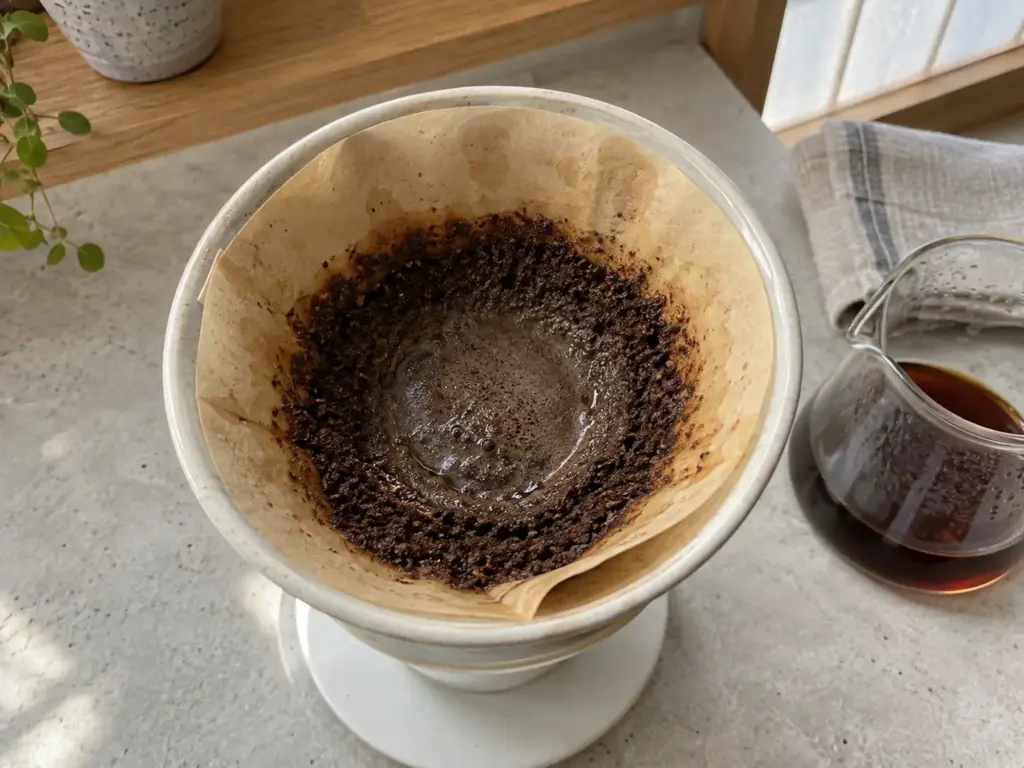
Lift the dripper off the server and look at the spent bed. A skin that looks like wet silt, slick and a shade darker than the grounds under it, is the fines that floated up during the pour and settled last. A grinder that cuts more evenly leaves a flatter bed with a paler edge, and the drawdown finishes without that crawl at the end.
A V60 shows this sooner than most drippers. Its single large hole and steep cone are built to let water through fast, so the paper and the particles, not the dripper, set the flow rate; when fines plug that paper, the whole design stops working the way it was meant to. A flat-bottomed dripper like the Kalita Wave, with its small holes, hides a little more of the problem behind its own restriction, but the same dust reaches the same filter.
Pinch a little of the top layer from the spent bed and rub it between finger and thumb. Fines smear like wet clay and leave a brown film on your skin, while an even grind feels like damp sand and brushes straight off. It is the quickest read you will ever get on a grinder, and it costs one used filter.
Why the Settings Count Is the Wrong Number
Pour-over sits in the middle of the dial, at medium to medium-fine: coarser than espresso, finer than a French press, and the grind size chart for every brew method places it right next to drip for that reason. The grinder’s job is to hold that one band evenly. Reaching the far ends of its own dial is a different job, and it is one a V60 will never ask of it.
Which is why the biggest number on the box tells you so little. The Baratza Encore lists 40 grind settings, and that figure says how far the dial travels, not the grind consistency at any one stop. Burr diameter works the same way: the Ode’s 64 mm flat burrs and the Encore’s 40 mm conical ones say what kind of set is inside, not how evenly it cuts at your setting.
Fellow went the other way with the Ode Gen 2, whose own listing calls it “Designed specifically for brewed coffee. Not for espresso.” That is a grinder giving up the fine end on purpose, so it can spend all 31 of its settings on the brewed-coffee range.
The number that would settle it is hard to find at home. The coffee world treats filter grinding and espresso grinding as separate problems: the Specialty Coffee Association’s own standard for home grinders, SCA-320, is a different document from its espresso-grinder standard, and its test methods sit behind a member login. So when a listing gives you a settings count and nothing about evenness, read the count as a range, never as a grade.
Your eyes do a rough version of that test for free. Tip a dose onto a sheet of white paper: a good medium-fine grind looks like table salt, one size and one shade of brown. A poor one looks like table salt with flour dusted through it and a few grains the size of coarse sea salt mixed in, and that flour is what ends up as the silt on your bed.
Where a Blade Grinder Drops Out
A blade grinder has no setting to get wrong. It spins a propeller through the beans for as long as you hold the button, so the dose comes out as powder and chunks together, which is the muddy-and-sour cup from above in its purest form.
There is no free fix inside that machine. Grind longer and you make more powder; grind shorter and you keep more chunks, and the cup moves from bitter-and-sour to sour-and-bitter without ever getting clean. The mechanism is laid out in why a blade grinder makes a cup sour and bitter at once, and for a cone the conclusion is short: if the grinder on your counter has a blade, the next section’s test does not apply to you, and the hand grinders after it are where to look.
Read the Drawdown Before You Buy Anything
The grinder on your counter might not be the villain yet. A burr grinder set one step too fine makes a slow, bitter pour-over too, and that costs nothing to fix, while a grinder that sheds fines at every setting does not. One change at a time, the drawdown and the spent bed tell you which of the two you have.
Time the Drawdown, Not Just the Brew
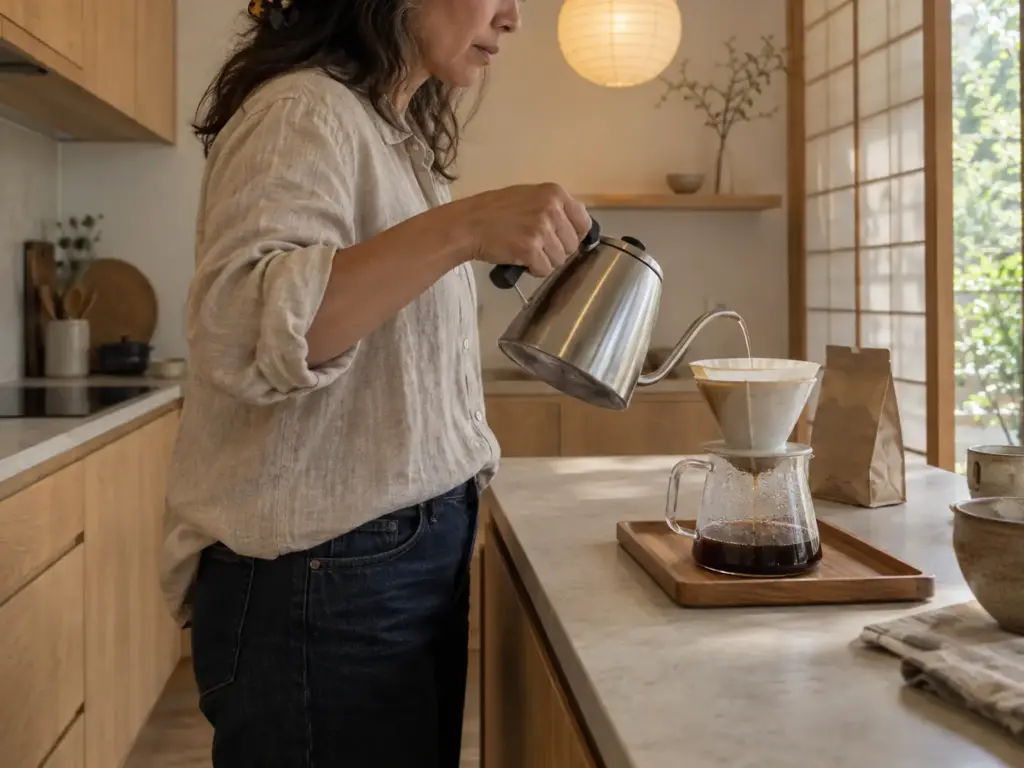
Most people time a pour-over from the first splash to the last drip, and that single number blurs two different things. Time the drawdown on its own: start a phone timer as the last of the water leaves the gooseneck kettle, and stop it when the surface of the bed turns from glossy to matte. By then the pouring is over, so only the paper and the particles decide how fast the water leaves, which makes this the stretch the fines control.
No universal target exists for that number, and anyone who quotes one is guessing about your dripper, your dose and your filter papers. What matters is your own baseline. Brew your usual recipe, write the drawdown down, and use it as the yardstick for every change that follows.
Before the grinder takes the blame, rule out the two other things that slow a cone. A new box of filter papers can drain at a different speed from the last one, and a heavy, fast pour stirs the bed hard enough to drive fines into the paper. If either changed recently, change it back first and brew one cup, because a grinder test run on top of a new paper tells you nothing about the grinder.
Write the drawdown time and the grinder setting on a strip of masking tape stuck to the bean canister, and update it whenever either one changes. A recipe you remember drifts; a number on the canister lets you compare this morning against last week instead of against a memory.
One Step Coarser, Then Taste Again
On a decent grinder, a slow, bitter pour-over is usually just a setting that sits too fine. Move one step coarser, keep the same dose, the same water and the same pour, and taste. If the drawdown speeds up and the cup keeps its sweetness while losing the harsh finish, the setting was simply too fine and no new grinder is needed; the grind size each dripper wants is where you fine-tune from there. Overshoot and the next cup says so, sharp and hollow in the middle, so go back to the old setting and look for a smaller move if your grinder has one.
But that advice assumes the grinder is even, and this is where it breaks. If one step coarser turns the cup sour and thin while the drawdown still drags and the muddy layer is still on top, coarsening only traded bitterness for sourness. The big pieces got bigger and the dust stayed, because the grinder is making fines at every setting. At that point the setting is not the problem; the burrs are.
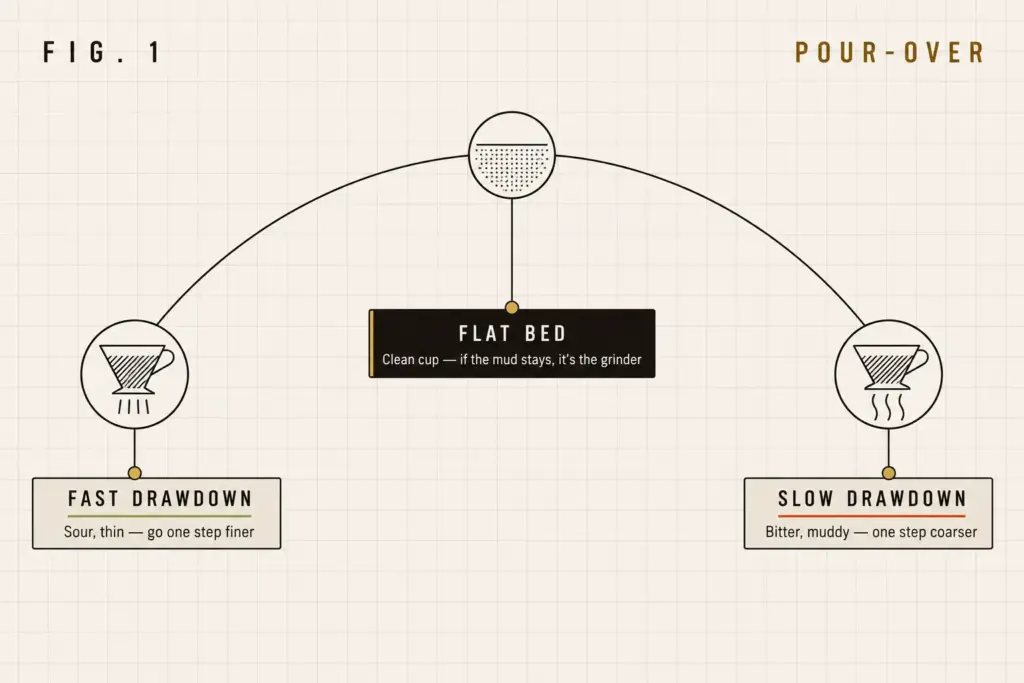
Check the opposite direction before you condemn anything. A cup that runs fast and tastes sour with no mud points finer, and one step finer is the only change to make next. If the grinder reaches a setting that slows the water without the bed turning to sludge, it is even enough, and the problem was the dial all along.
Look at the Bed That’s Left
The spent bed is the second witness. After an even grind the bed sits flat with no sludge on top, and a ring of grounds climbs the paper walls evenly all the way around, left behind as the water level dropped. A crater in the middle, a sludge layer, or a bed that has dried in patches while other spots stay wet points at fines or at channeling, where the water finds a fast path through the bed and skips the rest.
Channeling can come from the pour as easily as from the grinder, which is why the bed only counts when it agrees with the taste and the drawdown. Three witnesses saying the same thing is a verdict. One on its own is a hint.
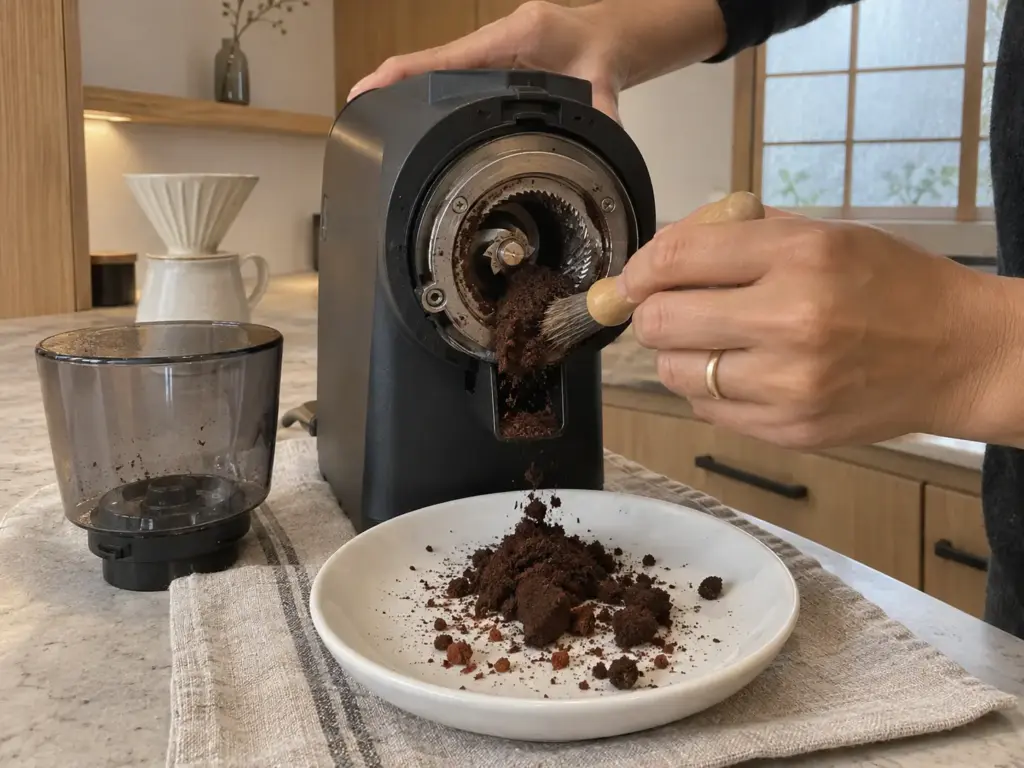
And if the grinder used to be fine and has slowly started producing mud, clean it before replacing anything. When an Ode Gen 2 starts leaving mud in the bottom of the dripper, the first suspects are internal clogging and burr alignment rather than new burrs, and grounds clinging to the chute, packed there by static cling, are the first thing to brush out. That story, and the months it took, comes back in the last section.
Hand Grinders: The Most Evenness for the Least Money
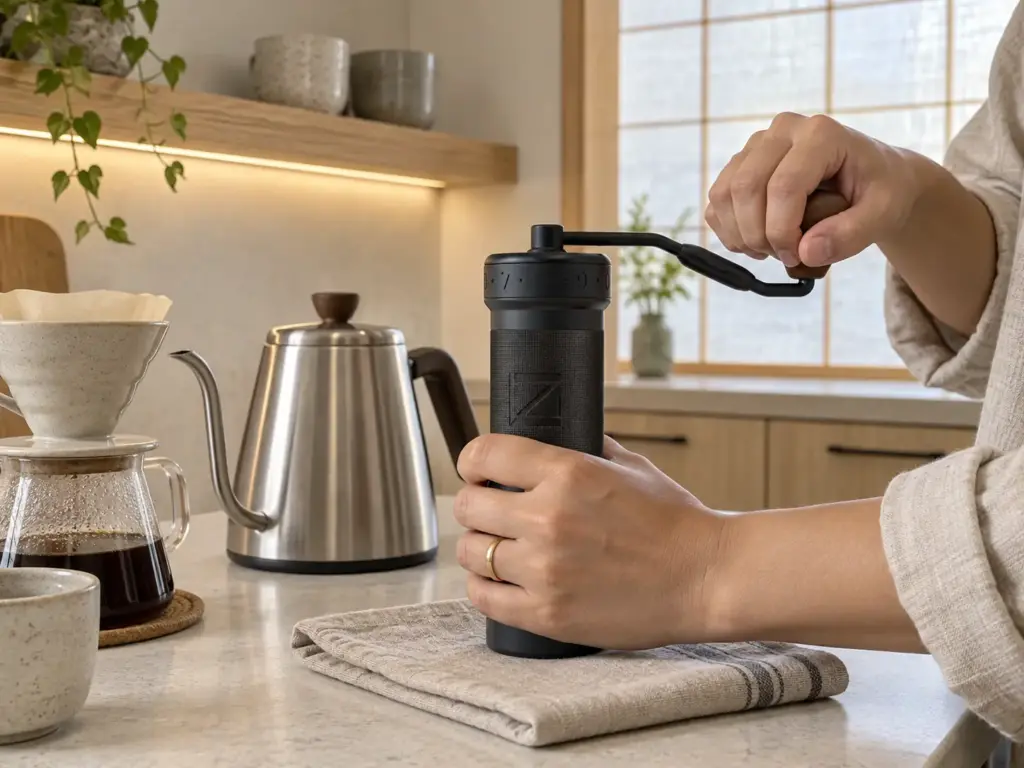
Once the drawdown says the grinder is the problem, the first fork is hand or electric. At the entry end of the budget, a crank buys more evenness than a motor at the same money, so dropping the electric requirement opens up many great grinders.
Why a Crank Beats a Cheap Motor Here
An electric grinder spends a large share of its cost on parts that are not the burrs: the motor, the gearing, the housing, the switch. A hand grinder spends nearly all of it on the burr set and the shaft that holds it steady, and that is where evenness comes from. At the same money the difference lands in the cup, which is the heart of the manual vs electric grinder question.
The one real cost is the cranking, and for pour-over it is small. A single cup takes a single dose, which is exactly where a hand grinder is at its easiest. That changes as the cup count goes up: two doses is a short chore, a full carafe for a household is a daily workout, and that reader belongs in the electric section below.
The cheapest budget grinder with a motor is a real option for drip and French press, where they give up evenness mostly at the ends of the dial, and cheap grinders that stay even takes that trade apart. For a cone at medium-fine, the same money buys a better burr on a crank. I’d spend it there, if one cup a day is the whole job.
The Budget Pair, Plastic or All-Metal
Two hand grinders sit at the same entry tier and grind the pour-over band well. Both use conical burrs of steel and both are one-cup tools, so the difference is in what you hold every morning. If you want the whole tier side by side, the budget hand grinders go through it model by model.
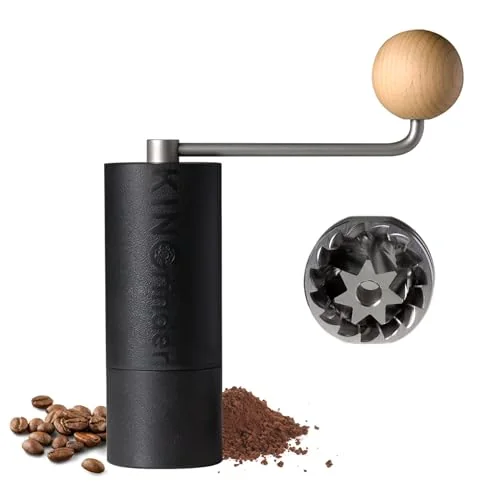
The KINGrinder P2 is the lightest, least expensive route to an even medium-fine dose: a stainless steel conical burr inside an ABS plastic shell. The plastic is why it is light and why it costs what it does, and it is also what you give up, because it will never feel as solid in the hand as a metal housing over years of daily cranking. For one careful cup a day, the burr inside matters more than the shell around it.
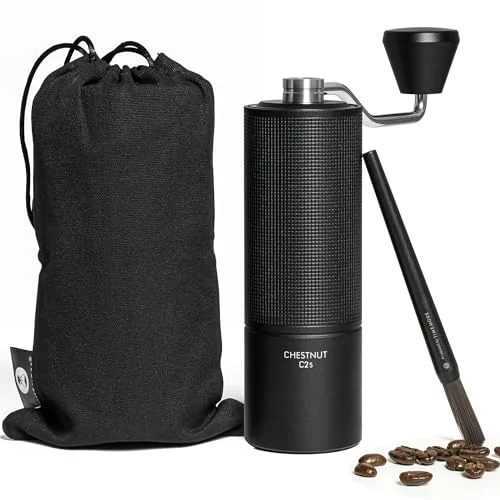
The TIMEMORE Chestnut C2S is the same tier with no plastic in the housing: a 38 mm conical burr in 420 steel inside an all-aluminum shell, about 36 clicks of adjustment, and a 20 g hopper (roughly two level coffee scoops, one large mug). What it asks of you is bookkeeping. The stepped adjustment sits inside the grinder and is counted from the point where the burrs touch, so there is no number to read from the outside.
Lose count after a cleaning or a bean change and the only way back is to re-zero before the morning dose: close the burrs until they just meet, then count back out click by click to your setting. It takes a minute and turns into habit within a week, but it is a minute an external dial would have saved you.
Between the two, the choice is about what bothers you more. If a plastic shell nags at you every time you pick it up, the C2S is the answer and the re-zeroing is the price. If you want the lightest thing in the drawer and a setting you rarely move, the P2 does the same job in the cup.
The Splurge Hand Grinder
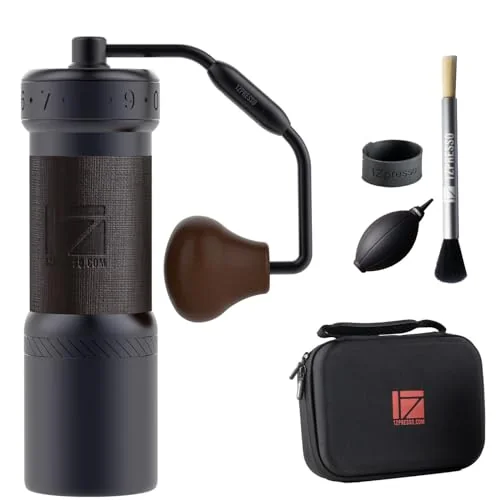
One tier up, the 1Zpresso K-Ultra keeps the crank and removes that minute of counting. Its stainless steel conical burr sits under an external numbered dial, so the setting is readable from the outside, mid-grind, without opening anything or starting from zero. For a reader who keeps one grinder for years and moves between beans often, that dial is most of what the extra money buys, and the carrying case in the box lets it double as a travel grinder.
The K-Ultra has no repeated complaint that counts as a defect, so the thing to know is a trade-off rather than a flaw. It costs about what an entry electric does, and it is still a crank every morning. If the reason you are shopping is that you will not crank, this is the wrong splurge, and the Encore in the electric section is a better use of the same money.
For the whole field, including the hand grinders tuned more for the espresso end than for a cone, the best manual grinders are compared on their own page.
Write the setting on the bean bag, not in your head. A pour-over setting belongs to one bean at one roast level, so a new bag at the old number is a starting guess: brew it, time the drawdown, and move one step from there before you call it your recipe.
Why an Espresso Grinder Is the Wrong Buy for a V60
The obvious upgrade is one expensive grinder that does everything, and at the pour-over end it buys a compromise. The reason is the burrs themselves, not the price, and it holds even at the top of the market.
Filter Burrs and Espresso Burrs Want Opposite Things
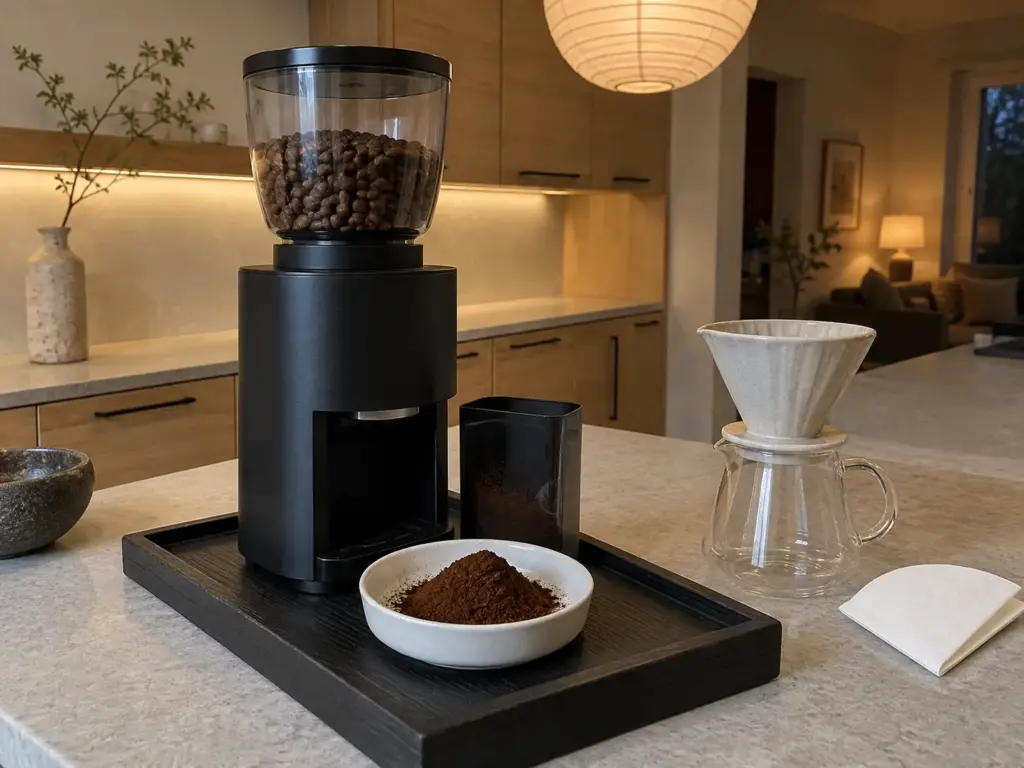
A traditional espresso shot gets part of its thick, syrupy texture from a share of very fine particles packed into the puck. A pour-over gets its clarity from the opposite, a narrow spread with as few fines as possible, so nothing clouds the cup or chokes the paper. A burr set shaped to be good at one is, by its geometry, working against the other.
No single burr set at any price can do both, because the two sets of requirements pull against each other. A follow-up post spelled out the cost in each direction: filter burrs will not give you a syrupy traditional shot, and traditional espresso burrs will not give you a clear filter cup. For a V60 kitchen, that makes what makes a grinder good for espresso a separate question with a separate answer, never a bonus feature on a pour-over grinder.
The same line shows up from the other side of the counter. In the words of a Consumer Reports writer who has used the same Encore for nearly a decade, “If you make espresso at home, the Encore maybe isn’t for you… But for most other preparations, an Encore will be the ideal companion.” That is a description of a grinder built for the middle of the dial, which is exactly where a cone lives.
The conflict is narrower than it sounds. A grinder bought for pour-over also covers a French press, an AeroPress and a drip coffee maker, since all three sit at or near the pour-over band (a Chemex already leans a step toward medium-coarse). Only the fine end of espresso breaks the arrangement, so the question to ask before buying is whether a shot is ever going to come out of this grinder.
The Beans a Hopper Wastes When You Switch
The second cost is paid every morning you change methods. A grinder with a hopper keeps beans sitting over the burrs, and it has to be running while you move it from a coarse pour-over setting to a fine espresso one. The beans that pass through during the move are wasted, and the routine turns into a nuisance for anyone who switches often.
At the counter it looks like this: you turn the dial, grind a little, and tip a small pile of grounds at the old setting, or somewhere between the two, into the trash before the first real dose. That is coffee you paid for, thrown away before anyone drank a cup, and it happens again on the way back to pour-over. A single-dose grinder or a hand grinder skips most of it, because nothing sits over the burrs between doses except what the grinder itself retains and what is left in the catch cup.
Flat or Conical for a Light Roast
Burr shape comes up next, and for pour-over the conclusion fits in two sentences. Flat burrs are the usual pick for clarity on light roasts, while conical burrs are the more forgiving, cheaper route that still brews a clean cone, and the full mechanism lives in conical or flat burrs. What matters more than the shape is whether the set grinds evenly at medium-fine.
The shape starts to matter when the roast does. If most of your bags are light-roast single origins brewed for clarity, a flat burr earns its place; if you drink medium and darker roasts, a conical burr gives up little you would taste, and light or dark roast for pour over is the question to settle before paying extra for flat burrs.
The five grinders in this article, side by side on the things that decide a pour-over:
| Grinder | Hand or electric | Burr | Best for | The catch |
|---|---|---|---|---|
| KINGrinder P2 | Hand | Stainless steel conical | The lightest, lowest-cost route to one even cup | ABS housing, less solid than all-metal |
| TIMEMORE Chestnut C2S | Hand | 38 mm conical, 420 steel | One cup, no plastic in the housing | Internal clicks, no dial to read |
| 1Zpresso K-Ultra | Hand | Stainless steel conical | One grinder for years, setting read from outside | Costs like an entry electric, still a crank |
| Baratza Encore | Electric, hopper | 40 mm steel conical | One method every morning, medium roasts | Plastic build with a breakdown reputation |
| Fellow Ode Gen 2 | Electric, single dose | 64 mm stainless flat | Filter only, light roasts, changing beans | Owner reports of failures near month ten |
Electric Grinders for a Pour-Over Before Work
A reader with this budget deserves a straight answer. Someone with a full-time job may know hand grinders are better at their price and still want a routine that stays quick and simple every morning, because electric is just a tad more convenient. The electric picks exist, and each one’s catch is written next to it.
The Entry Electric That Has Lasted a Decade
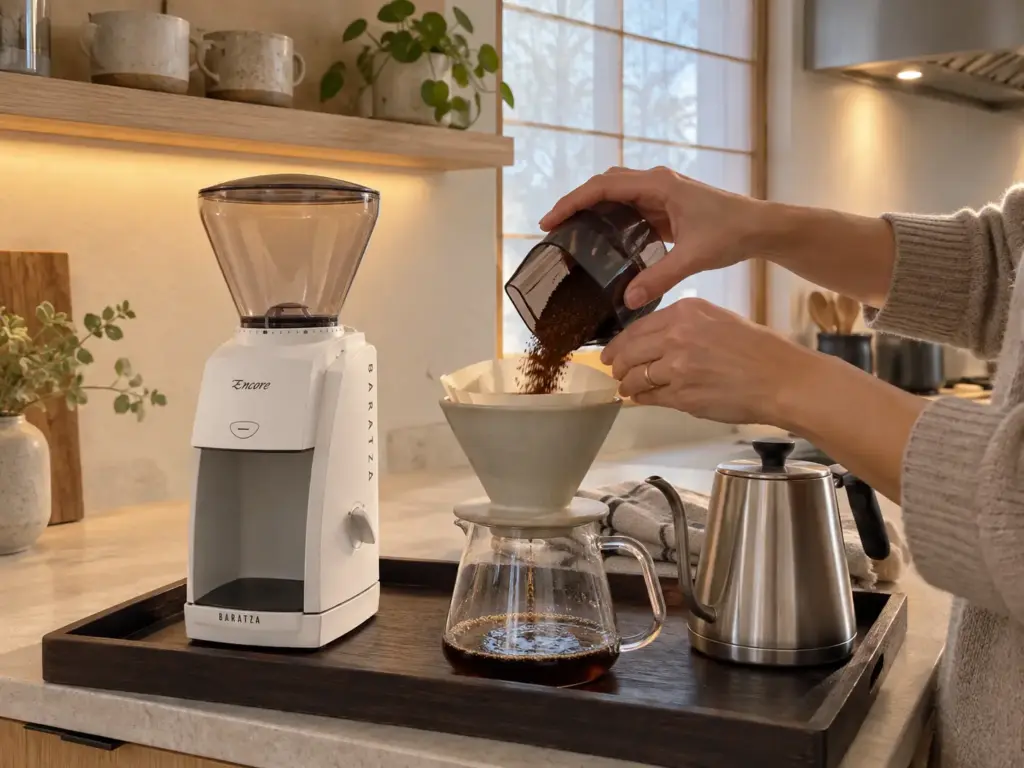
Some people insist an electric grinder at that budget will not deliver good pour-over, while others find electrics at that level work fine, and the drink you like is what decides it. Both are right, about different readers. For light roasts brewed for clarity the hand grinder wins, while for a medium roast, drunk black before work, the entry-level grinder that does the job is the Baratza Encore.
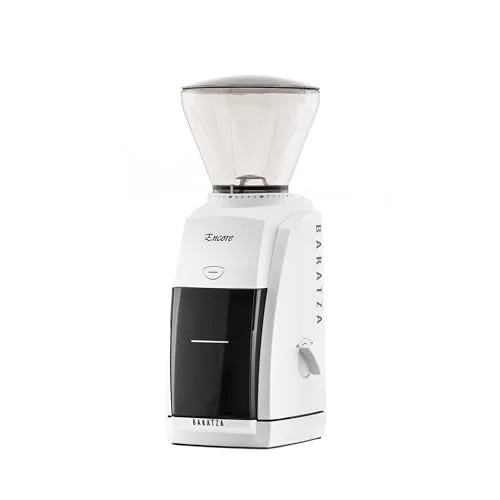
The Encore uses 40 mm conical steel burrs, 40 settings, a DC motor and a hopper on top. Its best evidence is time: that Consumer Reports writer has run the same unit daily for close to ten years, grinding between 35 and 51 grams a day, with a daily Chemex dialed at settings 19 to 21 the whole time.
Those numbers belong to one kitchen, not to a recipe. That 19 to 21 is tied to one Chemex, one set of beans and one box of filters, and a V60 at a different dose will land somewhere else on the same dial. Start near the middle, and let the drawdown move you one step at a time.
The weak point is the build. The Encore and its Virtuoso siblings are often said to be built with a lot of plastic and to break down frequently, but that is a reputation rather than a test, and Consumer Reports’ own decade sits on the other side of it. Consumer Reports’ testing team also rated a competing conical burr grinder above the Encore overall, so treat the Encore as the well-known safe pick, not an unbeatable one.
The Filter-Only Grinder
The Fellow Ode Gen 2 is the one grinder here built and sold only for brewed coffee. It pairs 64 mm stainless steel flat burrs with 31 settings aimed at pour-over, drip, French press and cold brew, a 100 g single-dose load bin, and an anti-static design with a built-in knocker meant to cut what stays inside between doses. Fellow puts no gram figure on that retention, so read the claim as a direction, not a number.
The calendar is where it falls short. Ode grinders can fail after a relatively short stretch of light-to-medium-roast home use. Fines can creep in over time, and the advice is to clean and check alignment before replacing anything, which the last section follows through.
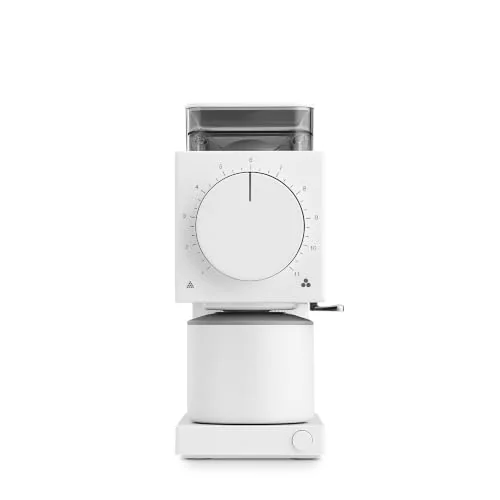
The Ode sits well above the Encore on the shelf, and why good grinders cost what they do goes through where that kind of money goes. For a cone, what it buys is flat burrs and a design that never has to stretch toward espresso.
Hopper or Single Dose
The last choice follows your week, not the spec sheet. One method and one bag at a time, every morning: a hopper is fine, and the convenience of beans already waiting over the burrs is real. Switching methods, or opening a new bag every few days: single dose saves you the purge from the espresso section, at the price of weighing every dose.
That weighing is the step people don’t expect. A single-dose grinder puts a scale into the routine before the grinder even starts, every morning, whether you planned to own one or not (and if you don’t, the scale becomes the next purchase). If that routine happens while the house is still asleep, a grinder quiet enough for early mornings is its own question with its own answer.
Retention matters more for a one-cup pour-over than for a full drip pot. The grounds a grinder keeps from yesterday drop into today’s dose, stale and at whatever setting they were ground, and in a small dose they make up a larger share of the cup. A hopper grinder feeding a carafe barely notices; a single V60 does.
On a single-dose grinder, weigh the beans going in and the grounds coming out for a week. The gap between the two is what the grinder keeps, and when that gap starts growing on the same beans, the chute is packing up, which your scale shows you before the drawdown or the cup does.
What a Pour-Over Grinder Looks Like in Month Ten
Every grinder in this article looks good out of the box. The evidence worth having is what owners report after ten months, eighteen months and ten years, so this section reads the months and ends with the check to run and the decision that comes next.
The Ten-Month Failures and the Decade-Old Encore
The two ends of the category sit a long way apart. On one side are Odes that failed after a short stretch of ordinary home use; on the other is a Consumer Reports writer’s Encore, still grinding a daily Chemex on the same 19-to-21 range after nearly ten years. Neither is a lab result, and one owner’s run of bad units is not a failure rate, but both run far longer than any first-week impression can.
Neither story is about burrs wearing out. The Encore’s burrs held their range for close to a decade, and the Ode failures were whole grinders stopping, not cups slowly going muddy. For a pour-over grinder the parts to watch in the first years are the ones around the burrs, and how long a coffee grinder lasts goes through them part by part.
Which leaves an uncomfortable result for the spec sheet. On paper the Ode is the better filter tool, with flat burrs and a design that ignores espresso; on the calendar, the plastic-bodied Encore is the one with a decade of daily pour-over behind it. If the grinder has to last and you drink medium roasts, that record counts for more than the burr shape.
When Fines Creep Back In
The slower failure is the more common story, and it starts at the dripper, not at the grinder. An Ode can grind cleanly for a long stretch and then drift, so the change is easy to miss at first. Fines can build up into mud at the bottom of the dripper, and the drawdown can slow until it takes forever to empty.
The thread’s reading was internal clogging or burr alignment, and the top reply was flat about the rest: “there is zero chance your burrs need replacement from usage.” So the checks run from cheapest to most involved, one at a time, with a brew and a timed drawdown between each.
- Brush out the chute and the burr chamber, brew your usual recipe and time the drawdown. If it is back near your baseline and the mud is gone, stop there.
- If the mud stays, check the burr alignment the way the maker describes for your model, then brew and time it again.
- Only if both fail does replacing burrs, or the grinder, come into question.
The same order holds for every grinder in this article. Cleaning is free, alignment is an evening, and replacement is money, so they come in that order and never all at once.
Before you lift the burr out to clean it, write down the dial setting. On many grinders the burr loses its position when it comes out, and a clean grinder reset to the wrong number sends you chasing a problem you already fixed.
After the Grinder: The Setting for Your Dripper
The earliest warning is the one from the drawdown section. On an unchanged recipe, a drawdown that grows a little each week is the grinder talking, weeks before the cup tastes wrong, so keep that number on the canister and glance at it once a month.
Once the grinder holds its setting, the next decision is the setting itself, and it changes with the cone: a V60, a Chemex and a Kalita each want their own spot on the dial, and that is where you dial in the grind for your dripper.
Start One Step Coarser, and Buy Only If the Mud Stays
A pour-over grinder has one job, and the cup and the drawdown tell you whether it is doing it. Three things to carry out of this:
- Evenness at medium and medium-fine is the whole job. A settings count or an espresso range says nothing about it, and a muddy, slow, bitter-and-thin cup is the grinder saying it is not even.
- At the entry end of the budget, a hand grinder buys more evenness than an electric at the same money. An electric is still the right call for a reader who will not crank every morning, and the Encore and the Ode are the honest picks, flaws included.
- An espresso grinder is the wrong buy for a V60, because filter burrs and espresso burrs want opposite particle spreads, and a hopper grinder charges you beans every time you switch.
A month from now, time the drawdown on the same recipe; if it has stretched with nothing else changed, clean the grinder before you blame the beans.
Tomorrow morning, move the grinder already on your counter one step coarser, keep the same dose and the same pour, and taste whether the mud goes or only the bitterness does.
Frequently Asked Questions
01Which grinder is best for pour over coffee?
A burr grinder that grinds evenly at medium to medium-fine is best for pour over, such as the KINGrinder P2 by hand or the Baratza Encore if you want electric. The number of settings on the box matters far less than evenness in that one band.
02Is a hand grinder better than an electric one for pour over?
At the entry end of the budget, a hand grinder usually grinds more evenly than an electric at the same money. Electric wins on convenience, and the Encore or the Ode is worth it if you will not crank every morning.
03Can I use my espresso grinder for pour over?
You can, but expect a compromise, because burrs shaped for traditional espresso and burrs shaped for a clear filter cup want opposite particle spreads. A hopper grinder also wastes beans every time you move between the two settings.
04How do I know my grinder makes too many fines for pour over?
Watch the drawdown and the spent bed: a slow drain, a muddy layer on top of the grounds and a cup that tastes bitter and thin at once point to fines. If one step coarser only makes it sour, the grinder is the cause.
05Do I need a flat burr grinder for light roast pour over?
No, a conical burr grinder that stays even at medium-fine brews a clean light-roast pour-over too, even though flat burrs are the usual pick for clarity. Evenness in that band matters more than the burr shape.



How did your cup turn out?
No comments yet. Tell us what you changed — and whether the needle moved.