
We may earn a commission when you buy through links on this page. It never changes what we recommend. How we pick
On this page8 parts
- Dark Roast vs Light Roast in a Paper-Filter Pour Over: What Changes
- A Sour Light Roast Needs Finer First, Then Hotter, Then Slower
- A Harsh Dark Roast Needs Coarser First, Then Cooler
- Water Without a Dial: Off the Boil, or Let It Sit
- Brew One Bag Each: A Side-by-Side That Settles It in Your Kitchen
- When the Roast Is Not the Problem
- Start From the Bag's Direction, Then Change One Thing
- Frequently Asked Questions
You open a new bag of light roast, brew it in the cone exactly the way your usual dark bag goes in, and the cup comes out thin and sharp, closer to lemon water than to coffee. Nothing broke: a light bean is dense and slow to give up its flavor, while a dark bean is porous and hands everything over fast, so one recipe cannot serve both. The real question in dark roast vs light roast for pour over is where each bag starts in the dripper, not which one wins (whether one roast sits better with your stomach or your health is a question for your doctor; this article stays on the cup). Below are the direction each bag points, the order of the changes, and a side-by-side you can run with the kettle and grinder you already own.
Quick Answer
A light-to-medium roast is the natural fit for a paper-filter pour over, because the clean cup shows what the bean tastes like. A dark roast works too with a coarser grind and slightly cooler water. Sour light bag: finer, then hotter. Harsh dark bag: coarser, then cooler. The roast sets the starting point, not a winner.
Dark Roast vs Light Roast in a Paper-Filter Pour Over: What Changes
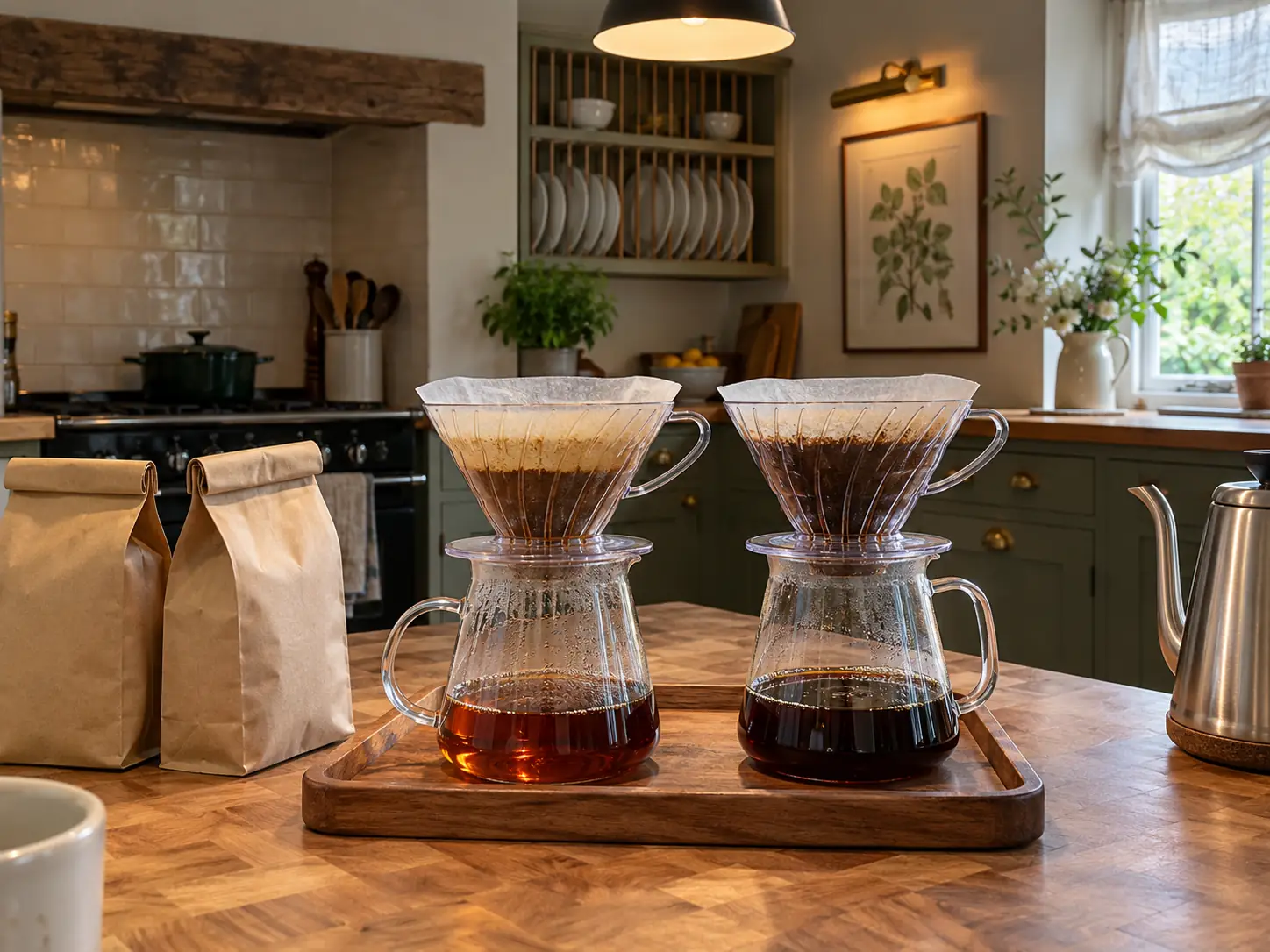
Pour the same water over the same weight of two different bags and you get two different cups, even when both bags were sold as perfectly ordinary coffee. The difference is decided inside the dripper, by how fast each bean gives up its flavor, and the word printed on the bag only hints at it. The general flavor story of each roast lives in what each roast level changes in the cup; this section stays inside the cone.
Light roast: dense, slow to give up its flavor
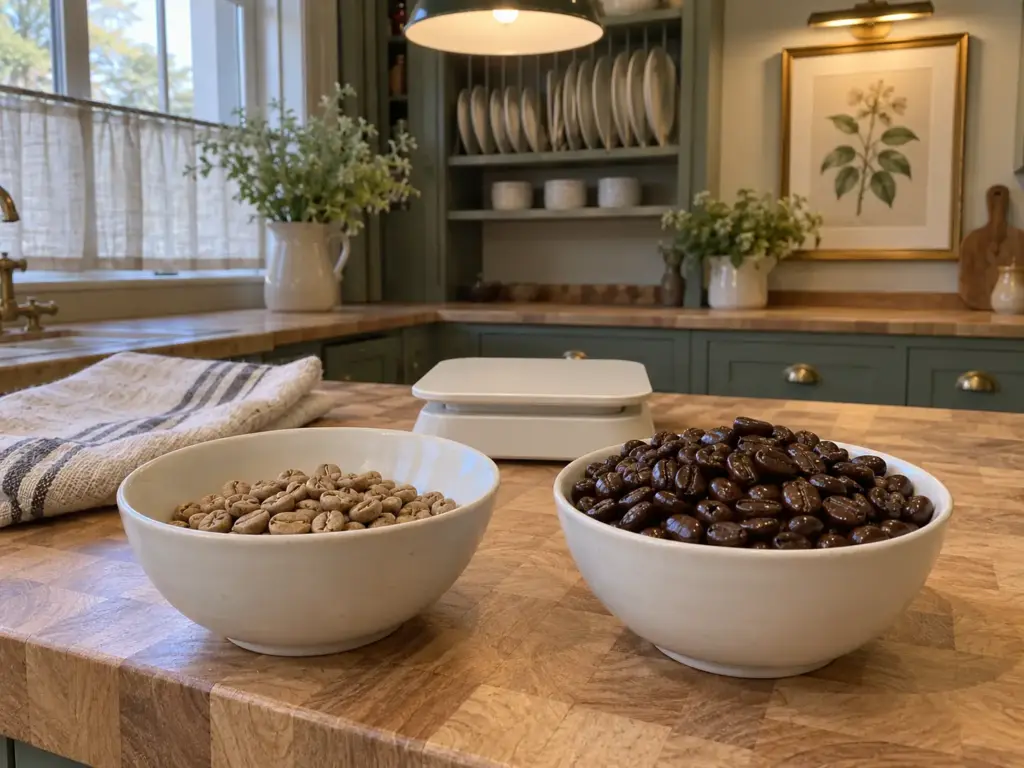
A light roast leaves the roaster early, not long after first crack, while the bean is still hard and dense. Roasters and brew guides share the same working rule: a light bean is less soluble, so water has to work longer to dissolve what it holds, and a pour that suits a darker bag drains away before it has finished. What lands in the cup tastes sour, thin and sometimes grassy, which is the taste of too little pulled out.
The Specialty Coffee Association’s write-up of the UC Davis brewing work puts a scale on it: sour taste peaked at low extraction, around 16 percent, and a brown, roasted taste peaked near 24 percent. That work used one medium roast on a drip machine, so read it as a direction rather than a pour-over recipe.
When a light bag is extracted far enough, the paper lets its fruit and acidity through cleanly, and that clarity is why so many cone owners buy light. When it falls short, the brightness turns sharp with no sweetness underneath to carry it. Same bean, same paper, two very different cups, separated by how long the water stayed.
Dark roast: porous, quick to give up everything
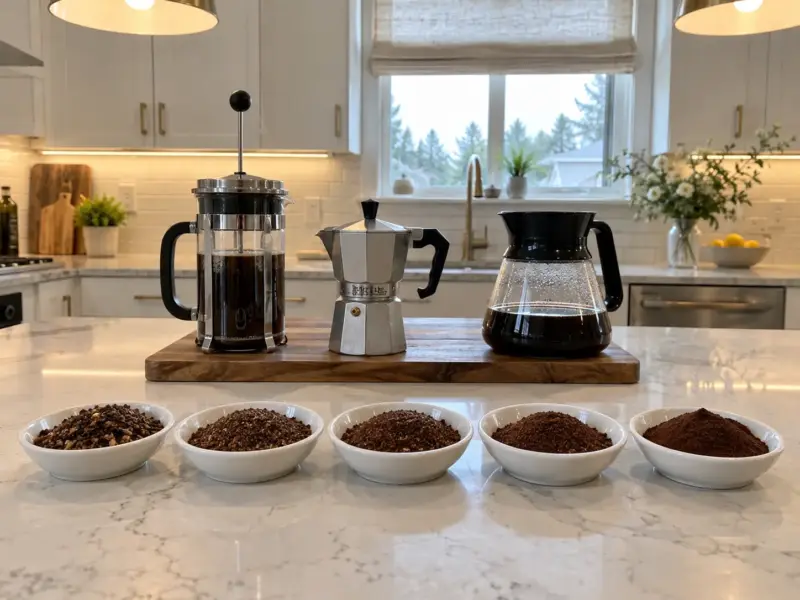
A dark roast stays in the roaster well past first crack. The bean swells, loses weight and turns brittle and full of tiny gaps, which is what the heat does to the bean. Weigh the same amount of each bag into two matching bowls and the dark one fills visibly more of its bowl: bigger, lighter beans, and the first hint that they will behave differently in water.
Water gets into a porous bean quickly and pulls flavor out quickly, so the recipe that was right for the light bag drags too much out of the dark one. The cup goes harsh: bitter at the back of the tongue, ashy, or a flat bitterness with nothing bright on top. Dark beans also carry oil on the surface, and the roast flavor itself (smoke, char, cocoa) is heavy enough to cover most of what the farm put into the bean. A dark roast tastes bold because the roast is doing the talking, not the origin.
What the paper filter holds back
A paper filter catches the oils and the fine particles that a French press lets through. The pour-over cup ends up lighter in body and clearer in taste, so whatever the roast did shows plainly: the light bag’s fruit and acidity, the dark bag’s smoke. A Chemex’s bonded paper is thicker than ordinary cone filters and takes out more again.
For a light roast, that is the whole appeal of the method. For a dark roast it cuts both ways. The cup loses some of the heavy, syrupy body people buy a dark roast for, and the charred edge stays put, because paper strips oil, not bitterness.
Why the word on the bag is a clue, not a spec
Roast names have no regulated scale. One roaster’s medium is another’s dark, and a supermarket bag labeled medium roast can hold beans so dark they are practically dripping oil. The label tells you roughly where to start; the bean and the cup tell you where you actually are.
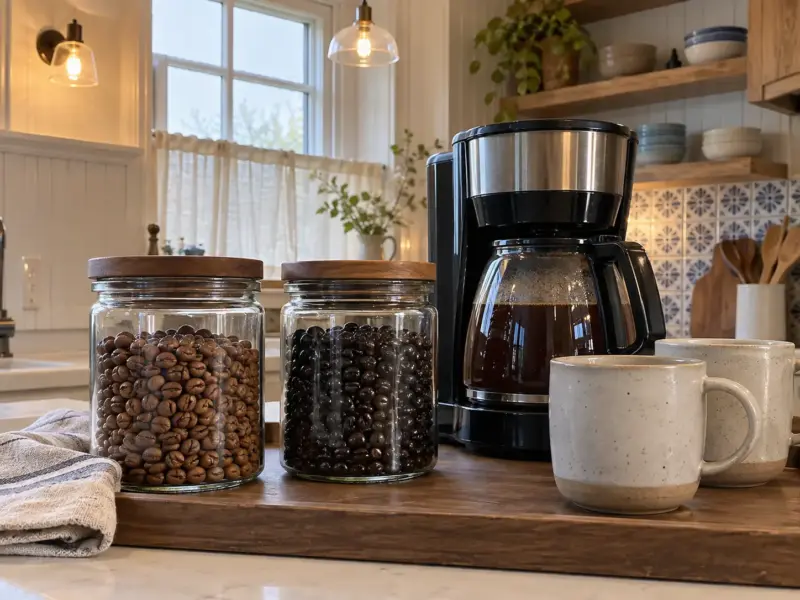
Look at color and surface before you trust the name. Dry beans in the cinnamon-to-milk-chocolate range point light. Dark brown beans with oil spots point dark, whatever the bag says.
Tip a few beans from a new bag onto a white plate beside a few from the bag you already know. If the newcomer is darker or shinier, start it on your dark-roast grind setting, whatever the label promises, and let the first cup tell you which way to move.
Side by side, for a cone with a paper filter, the two bags compare like this.
| Pour over | Light roast | Dark roast |
|---|---|---|
| In the dripper | Dense, slow to give up its flavor | Porous, gives it up fast |
| Goes wrong as | Sour, thin, grassy | Bitter, ashy or flat |
| First change | One notch finer | One notch coarser |
| Water | Right off the boil | Off the boil, rested a little |
| Flaw | Unforgiving: shows every grind and pour error | Hides origin, turns bitter fast |
A Sour Light Roast Needs Finer First, Then Hotter, Then Slower
The light bag points one way: thin, sharp, a little grassy, with a finish that vanishes as soon as you swallow. Three changes pull it back, and they go one at a time, the free one first, with a taste in between so you know which change did the work.
Taste the direction before touching anything
Sour is a direction. It means the water left the grounds before it had pulled enough out, and a light roast brewed on a dark-roast recipe lands here almost every time. A cone makes it easier to spot, because a fast drawdown is itself the clue: the quicker the water leaves the bed, the less time it had to work. Taste for it before moving any dial. Sharp at the front of the tongue, hollow in the middle, gone at the finish. If the cup is bitter and drying instead, you are in the next section already.
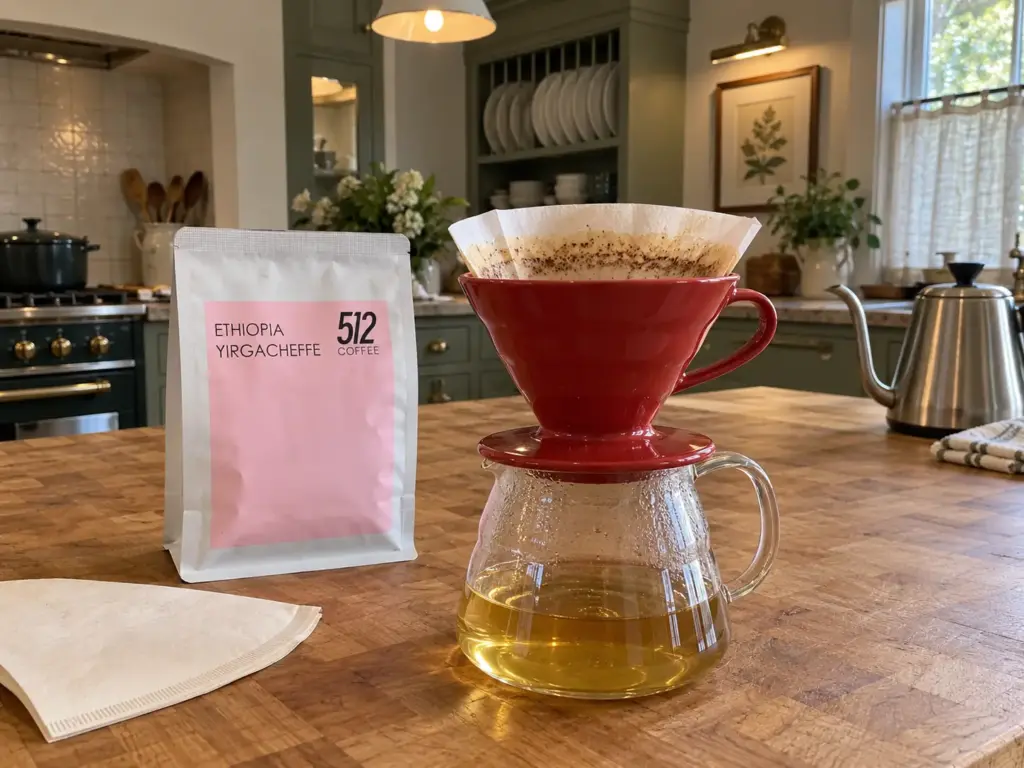
For the light side of the test, the 512 Coffee Ethiopia Yirgacheffe Light Roast is a whole-bean single origin in a 12-ounce bag, roasted with filter brewing in mind and labeled with raspberry, honey and floral notes. It is exactly the kind of bag that goes sour when it gets treated like a dark one. Some bags arrive with the best-by date long past, and the listing shows no roast date, so read the bag on the day it lands before you blame the recipe.
Change one: a finer grind
Move the grinder one notch finer. A finer grind gives the water more surface to work on and slows the drawdown a little, and both pull more out of a dense bean. It costs nothing and it is the likeliest cause, which is why it goes first. Brew the same dose with the same water and the same pour, then taste: if it worked, the sharp edge rounds off and some sweetness shows up underneath.
If the cup turned flat or faintly bitter, you overshot, so come back half the distance rather than all the way to where you started.
How big a notch is depends entirely on your grinder, and the exact step belongs to two other pieces: which way to move the grinder for each roast, and a starting grind for your dripper if you are setting up from scratch.
The cone you brew in decides how loudly a grind mistake shows. A plastic Hario V60 02 has one large hole and spiral ribs that let water run through quickly, so a light bag ground too coarse finishes draining almost before you stop pouring. That speed is the whole point for diagnosis. It also forgives nothing in the pour: a heavy-handed stream channels straight through the bed and the cup goes sour for a reason the grinder had nothing to do with.
Between changes, keep everything else frozen: the same dose by weight, the same water, the same pour pattern. Taste the cup twice, once hot and once a few minutes later, since a cup changes as it cools.
Change two: hotter water
Only once the grind has moved, and the cup is better but still a little sharp, raise the water temperature. For a light bag that means water right off the boil; the numbers and the kettle come in the water section below. Hotter water dissolves more of what a dense bean holds, so it pushes in the same direction as the finer grind, only by less.
A lot of brewing advice puts temperature first for light roasts. It belongs second, and the reason is in the research the SCA itself published: with extraction held steady, the degrees alone barely moved the taste. So spend the free change on the grind, and treat the kettle as fine tuning.
Change three: a slower pour
The last lever is contact time. Pour in smaller pulses, let the bloom sit a little longer, and finish with a gentle swirl so the bed settles flat and drains evenly. Each of those keeps water on the grounds for longer, which is what a light bean needs. Taste again; if the cup is rounder and sweeter, stop there.
When the pour itself is the trouble while you learn a new bag, the stainless Kalita Wave 185 is the forgiving alternative to the V60. Its flat bed and three small holes hold the water evenly over the grounds, so an uneven stream matters less. The trade-off is built into those same holes: the water drains slower whatever you do, so the drawdown says less about whether the grind is right, and a grind error the V60 would expose stays hidden longer.
Light roast is the unforgiving bag. It shows every grind error and every wobble in the pour, it turns sour quickly, and in a kitchen with a mid-range grinder and hard tap water it can lose the very clarity that made it worth buying. So the familiar advice that light roast is the pour-over bean needs a condition attached. With an uneven grinder and hard water, a medium roast lands a good cup more often, and the light bag can wait until the grinder improves.
A Harsh Dark Roast Needs Coarser First, Then Cooler
Turn everything around for the dark bag. It points the other way, toward bitter, ashy and flat, and its fixes mirror the light bag’s, again one at a time and again with a taste between each.
Name the harshness: bitter, ashy or just flat
Harsh comes in three flavors, and naming the right one tells you how much the cone can fix. Bitter that grips the back of the tongue, dry and astringent, and lingers is over-extraction, and the grind and the water can move it. Ashy, like a cold fireplace, is partly the roast itself. Flat is a heavy cup with no brightness at all, where nothing changes from the first sip to the finish.
A dark bag brewed at light-roast settings often keeps tasting burnt however carefully it is poured. The sign is that the bitter edge arrives at the end of each sip and does not budge when you change your pouring. That points at the grind and the water, not your hand. The grind-and-taste pillar, how grind size moves a cup from sour to bitter, covers the full range.
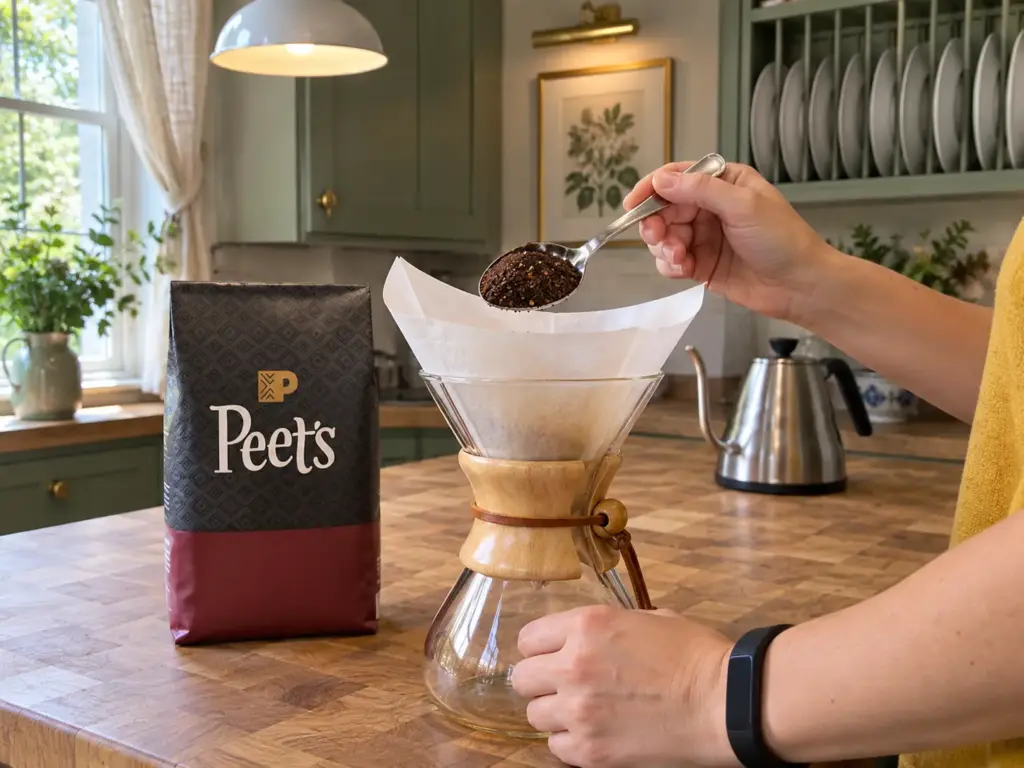
For the dark half of the test, Peet’s French Roast is the roaster’s darkest, whole bean in an 18-ounce bag of 100 percent Arabica, and dark enough that a light-roast recipe turns it harsh in the first cup. Buyers are split on how fresh it arrives, with one reporting packs that came close to their expiry date, so check the date printed on the bag before the first brew.
Change one: a coarser grind
Go one notch coarser. A porous bean gives its flavor up fast, and a coarser grind cuts the surface the water can reach while letting it drain a little sooner. Brew the same dose the same way and taste. If it worked, the bitter tail shortens and some sweetness or cocoa comes forward.
If the cup turned thin and faintly sour, you went too far: come back half a notch.
Change two: cooler water
If the cup is better but still harsh, cool the water. Let the kettle sit off the boil for a short while before the first pour; the starting temperatures and how to judge them without a dial are in the next section. Cooler water dissolves less, so it pushes the same direction as the coarser grind, by a smaller step.
Change three: a gentler pour
Agitation pulls more out of the grounds, so the dark bag wants less of it. Pour in a lower, steadier stream, skip the stirring and the hard swirl at the end, and let the bed drain on its own. Taste once more.
The other dripper worth knowing for a dark bag is the CHEMEX Classic 6-Cup, a borosilicate brewer that uses bonded square filters thicker than cone papers. It does give a cleaner, lighter cup. But the thick filter strips body, not bitterness: it takes away exactly the weight many people buy a dark roast for and leaves the charred edge where it was, so it suits a dark-roast drinker who wants clarity more than one who wants the cup to taste less burnt.
If you would rather burn through a cheaper dark bag while dialing in, Peet’s also sells a larger one. The Peet’s Espresso Forte is a dark, whole-bean 32-ounce bag, but it is labeled for espresso rather than filter, and that is a lot of coffee to finish before an opened bag starts going stale.
And a dark roast hides origin. The smoke and char can bury whatever fruit the bean carried, and no change in the cone brings back what the roast burned off.
Add how quickly it tips into bitter and you have what the dark bag costs you. Its strength is the flip side: it forgives a sloppy pour far better than the light bag does. Cold water changes the picture again, as how the same two roasts behave in cold brew explains, because the risk there shifts from harsh to flat.
Water Without a Dial: Off the Boil, or Let It Sit
The temperature changes in the last two sections are small next to the grind, and most kitchens own a kettle with no number on it anyway. So the useful question is how far to trust the water, and how to aim it with nothing more than a boil.
What the standard says, and how little temperature moves the cup
According to the Specialty Coffee Association’s write-up of the UC Davis temperature work, a brew temperature near 199°F (93°C) is widely believed to be best, and home brewers certified by the SCA must reach about 198°F (92°C). The same write-up then admits the ground under that belief is thin: “there is little empirical (and even less scientific) evidence, however, to support any particular range of brew temperatures for optimal sensory quality and consumer acceptance.”
The study behind it brewed a medium roast on a drip machine between roughly 189°F and 199°F (87–93°C). Once strength and extraction were held equal, temperature on its own changed the flavor very little. That was one roast and one kind of brewer, not a pour-over and not a dark bag, so it does not prove the kettle is irrelevant in your cone. It does say where the bigger lever is.
So the light-roast figure you will meet below, 200–205°F (93–96°C), depends on the rest of your setup. With a grinder that can move a notch, the grind will change the cup more than chasing three degrees ever will. With a grinder that cannot go finer, the hotter water is the only push left, and then the number matters more.
Light roast: right off the boil
Roasters and pour-over threads put light-roast water around 200–205°F (93–96°C). Without a dial, that means pouring as soon as the rolling boil stops. Water loses heat in the spout and again in the cone, so the bed never actually sees boiling water, and a light bag can take everything the kettle gives it.
Dark roast: let the kettle sit
For dark roasts, the water is usually kept lower, around 185–195°F (85–90°C). The common kitchen rule is to let the kettle sit, lid off, for 30 to 60 seconds after the boil. Treat that as a starting point rather than a measured figure: kettles lose heat at different speeds, and the cup will tell you whether to wait longer.
On a stovetop kettle with no whistle, the boil gives itself away by sound and steam. The rumble stops, the steam at the spout thins, and that is the moment to start counting for a dark bag.
Rinse the paper filter with the same hot water you are about to brew with, and pour the rinse water away. It washes out the papery taste and warms the cone, so your first pour onto the grounds is not cooled by cold plastic or glass, which matters most for the light bag.
The kettle: a stovetop gooseneck or a preset
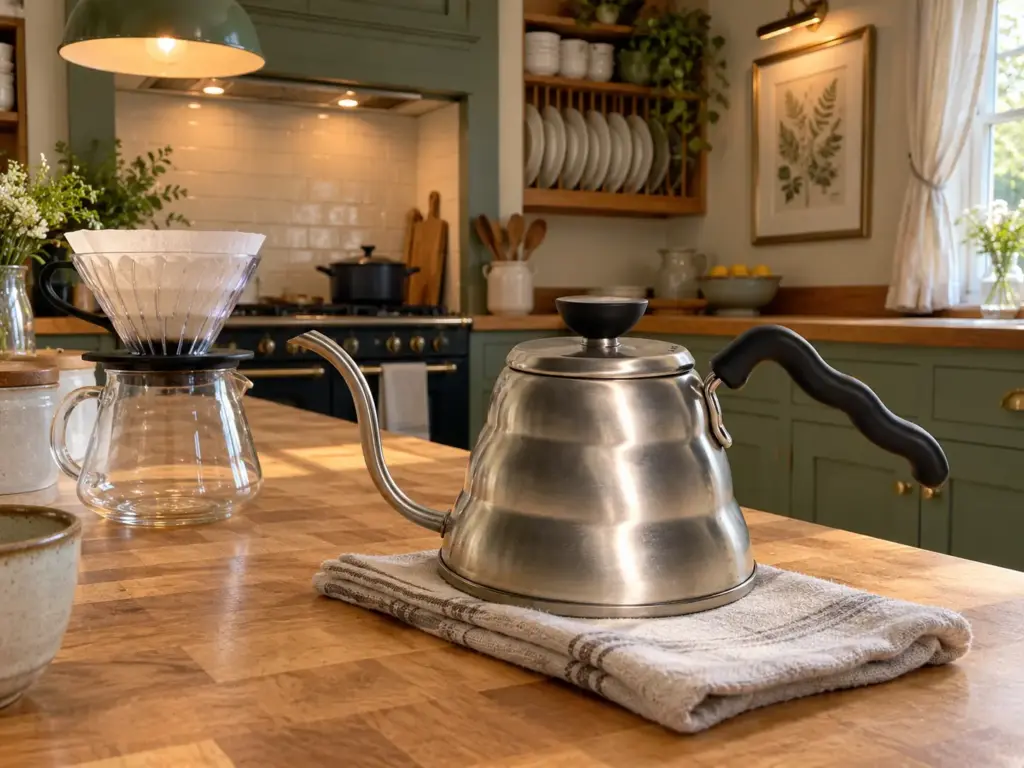
The no-dial route is a stovetop gooseneck. The Hario V60 Buono is a 1-liter stainless gooseneck kettle with a thin spout that gives the slow, steady stream both bags need. It has no thermometer and no whistle, so a rolling boil is hard to judge unless you stand next to it and read the steam and the rumble. An older review adds that it is hard to clean inside and slower to boil than a pot.
Over the weeks, the reports are better than that start suggests. One buyer, about a month in, found no rust even with water left sitting in it most of the time. Another uses bottled water because the local tap water is hard, which is worth knowing before you blame a kettle for a flat cup.
For a dial, the Bonavita Cosmopolitan is a 1.0-liter electric gooseneck at 1,200 watts with six preset temperatures on a glass touch panel. The presets turn the two roasts into two buttons. They are also fixed steps rather than any degree you like, so you pick the nearest one, and the kettle needs an outlet within reach of where you pour.
Once the water is settled, the next piece of gear that decides both bags is a pour-over grinder that holds a setting.
Brew One Bag Each: A Side-by-Side That Settles It in Your Kitchen
The roast word has no regulated scale, so the only way to know which bag suits your dripper is to change one variable and taste. This step turns everything above into your own answer instead of a label’s.
Same dripper, same water, same dose, one bag each
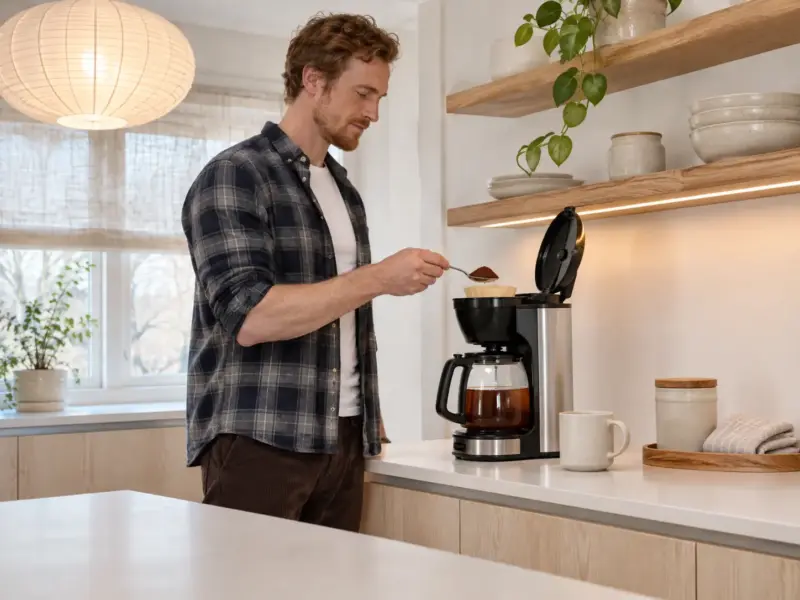
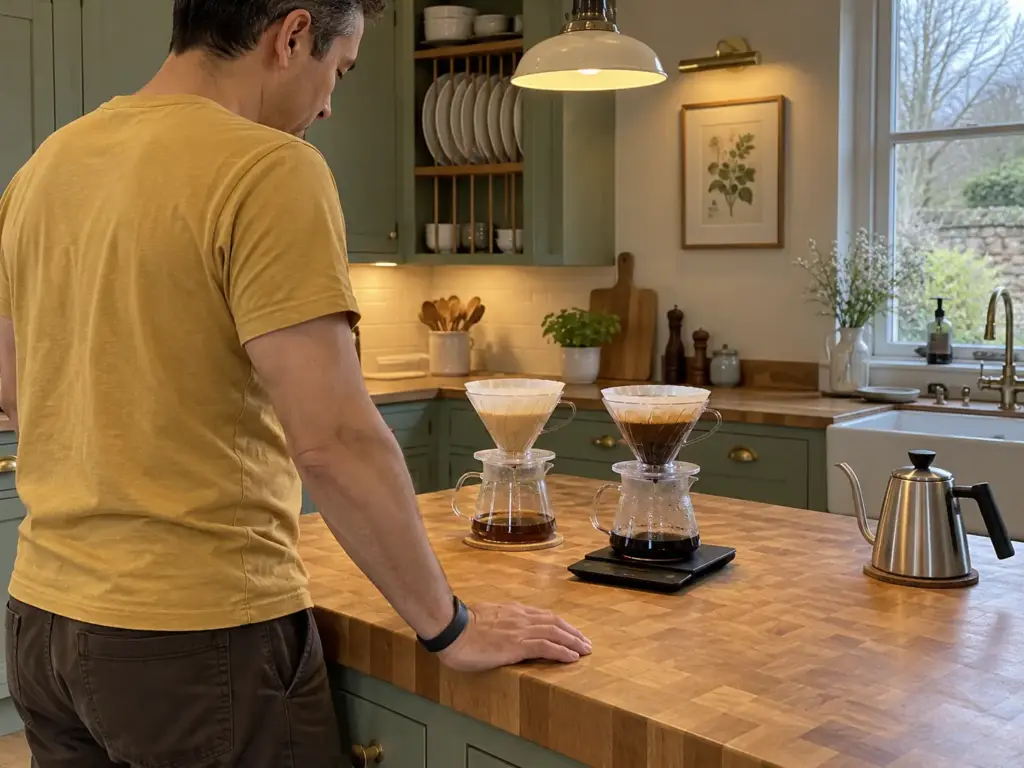
Set up two brews that differ in exactly one thing: the bag. Same dripper (or two identical ones), the same water from the same kettle, the same dose by weight (which keeps the brew ratio identical), the same pour. Change the grind only for the bag that asks for it, and only after the first round.
- Weigh the same dose from each bag.
- Grind both on the same setting.
- Rinse both filters and brew with the same water, poured the same way.
- Time each drawdown from first pour to last drip.
- Taste both side by side, hot and again as they cool.
A scale is the cheapest upgrade in this whole article, because without it the two cups are not comparable. The Hario Drip Scale weighs in 0.1-gram steps and has a timer built in, so dose and drawdown come off one display. It does switch itself off after five minutes, which can cut out in the middle of a slow brew if you stop to taste.
On a tighter budget, a kitchen scale does the weighing part. The Etekcity Food Kitchen Scale reads in 1-gram steps with a tare button and no timer, so the phone clock times the drawdown. At a single-cup dose, a one-gram error is a large share of the coffee, so weigh slowly.
The timer is what exposes the light bag. Run both through the same pour and the light roast often drains noticeably faster than the dark, and that gap matches the sour cup you are about to taste.
Read the direction of each cup
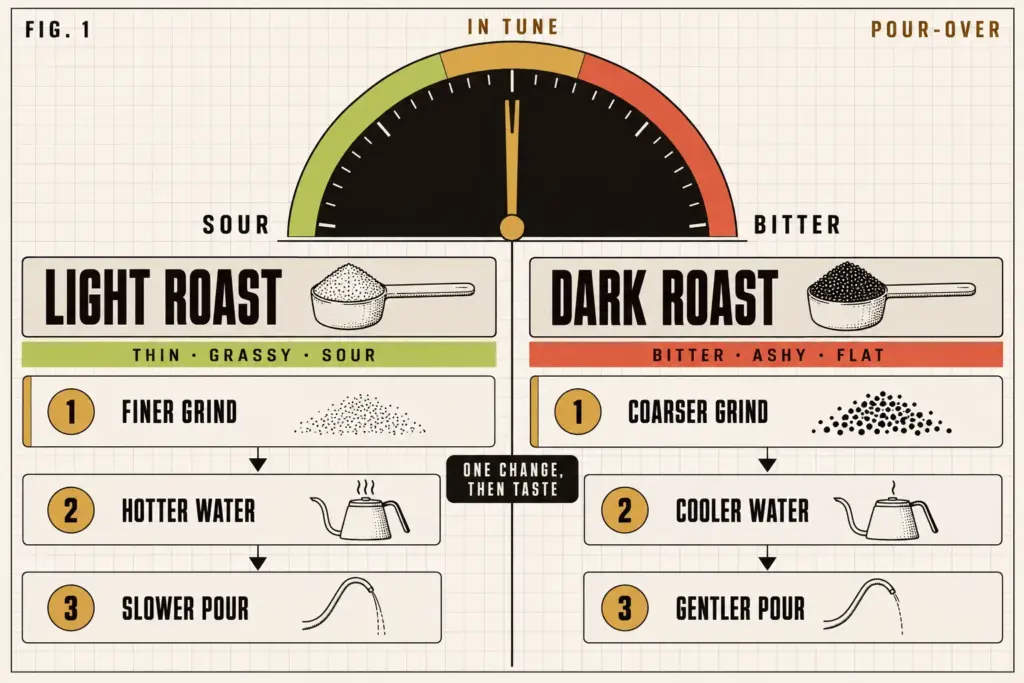
Taste each cup for its direction, not for whether you like it. Sour, thin or grassy means too little was pulled out, and that goes back to the light-roast changes above: finer, then hotter, then slower. Bitter, ashy or flat means too much, and that goes to the dark-roast changes: coarser, then cooler, then gentler. The same rule holds for both bags, which is why one setting rarely serves them both.
Some of what reads as a fault is a preference. The SCA’s write-up notes that drinkers split into two groups, one liking a lighter-strength cup and the other a stronger one. If one cup is clean and balanced but simply not to your taste, the brew did not fail; you prefer the other bag, and that is a perfectly good answer to the test.
Stick a note beside the grinder with the bag’s name, the dose and the grind notch that worked. The next bag of the same roast level starts from that record instead of from zero, and the first cup is usually one notch from right.
The middle ground: a medium roast
If you only want to buy one bag, a medium roast is the forgiving answer. It is soluble enough not to go sour at the first coarse grind, and not so porous that it turns ashy at the first hot pour. The Stumptown Hair Bender is a whole-bean medium roast in a 12-ounce bag that sits in that middle. What it gives up is the extremes: less of the light bag’s bright fruit, less of the dark bag’s weight.
The same one-bag question gets a different answer in a machine, which is how the same question is answered for espresso.
When the Roast Is Not the Problem
Sometimes the cup is off for a reason the roast never touched, and no grind change will fix it. If neither bag lands after the side-by-side, look here before buying another.
A bag that is too fresh, or too old
Light roasts need rest. Light roasts can taste muted and flat in their first two or three weeks after roasting, then open up, and some fade again by around the second month, with the timing depending heavily on the roaster. So a light bag opened a few days after roasting can taste sour for a reason that has nothing to do with your grind. Their advice is to taste it at intervals rather than trust a date.
The other end is a bag that arrives old, which is the complaint on more than one listing above. A cup that tastes papery and hollow, with a bloom that barely rises, points that way; how to tell if beans have gone stale walks through the signs from the smell onward, how long to keep beans after opening covers the freshness window, and what the bag’s label tells you covers reading the roast date.
Buy the next bag in a size you will finish in a few weeks, and read the roast date before you read the brand. A bag with only a best-by date tells you when it expires, not when it was roasted, and for a light roast the roast date is the number that matters.
Tap water and a kettle with scale
If both bags taste off in the same way, taste the water on its own. Hard tap water carries minerals that flatten a cup and leave scale inside the kettle, and one Buono owner switched to bottled water for exactly that reason and descales with citric acid. If the water is the suspect, your kettle’s manual is the authority on how to descale it. Try one brew with filtered or bottled water before changing anything else.
A grinder that cannot hold a setting
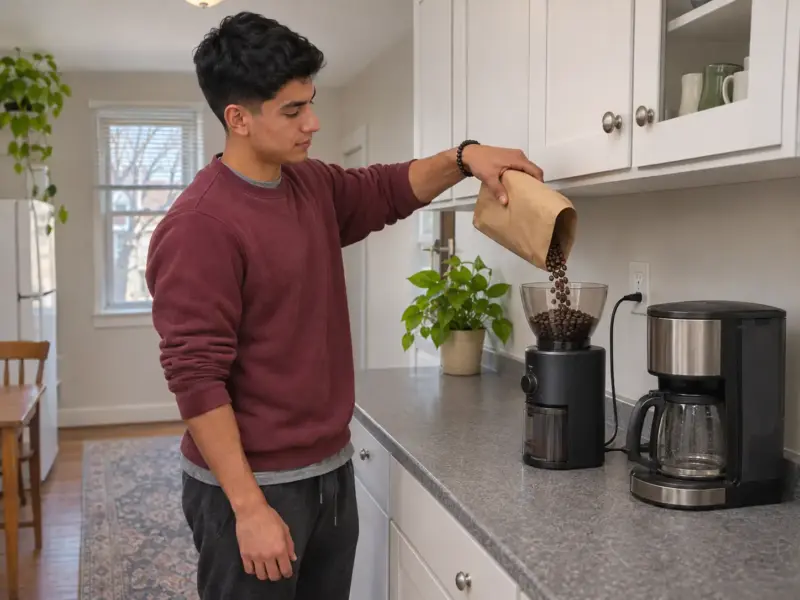
A blade grinder chops rather than grinds, so it makes boulders and dust in the same batch. The dust over-extracts while the boulders under-extract, and the cup comes out sour and bitter at once (why a blade grinder does that has its own page), which no roast and no kettle can fix. Neither bag can be dialed in on it, because there is no setting to move.
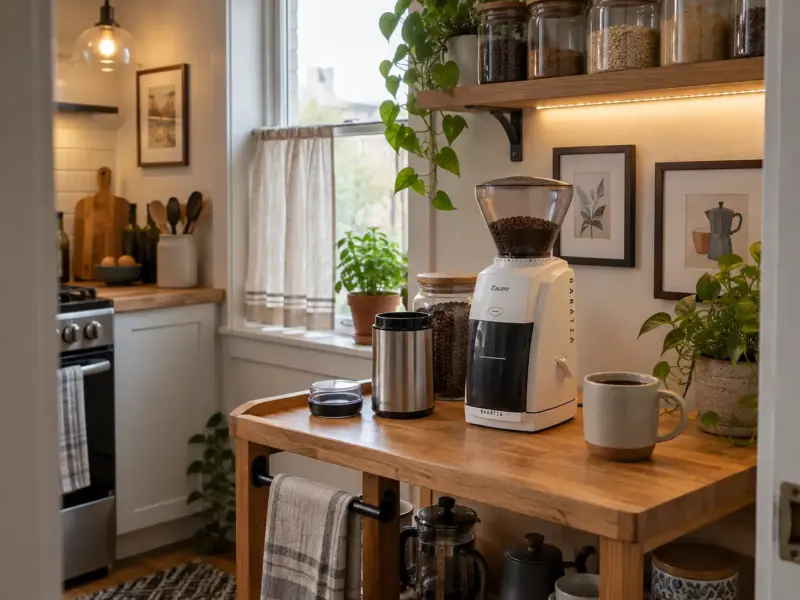
A burr grinder with fine steps is what makes one notch mean something. The Baratza Encore uses 40 mm conical steel burrs with 40 grind settings, enough to move a light bag finer and a dark bag coarser in small, repeatable steps. Those settings are fixed clicks, though, so when the right grind sits between two of them you take the nearer one and adjust the pour instead.
For one cup at a time, there is a manual route. The TIMEMORE Chestnut C2S has 38 mm conical steel burrs and around 36 internal clicks, and it is the cheaper route of the two. Its hopper holds about a single cup’s worth of beans, and grinding by hand takes a minute of real effort every morning.
Every cause in this section is cheaper than a new bag of coffee. None is guaranteed, though, and sometimes it really is the roast; the side-by-side is how you find out which.
Start From the Bag’s Direction, Then Change One Thing
The roast is a starting point for the dripper, not a winner. A light bag points sour and wants finer, then hotter, then slower. A dark bag points harsh and wants coarser, then cooler, then gentler.
The grind always goes first and the water second, one change at a time with a taste between, because temperature on its own moves the cup less than most advice suggests. And when neither bag lands, the bag’s age, the water and the grinder deserve a look before another roast does.
A month from now, check the roast date on whatever bag is in the cone and listen to whether the kettle still boils the way it did, since an aging bag and a scaling kettle both pull the cup off without changing anything you can see.
Tomorrow morning, move the grinder one notch toward your bag’s direction (finer for the light one, coarser for the dark), brew it exactly as before, and taste for whether the sharp edge or the bitter tail got shorter.
Frequently Asked Questions
01Which roast is best for pour over?
Light to medium roasts suit a paper-filter pour over best, because the clean cup shows their fruit and acidity instead of hiding it under roast flavor. A dark roast still works if you grind coarser and let the water cool slightly off the boil.
02Can you use light roast for pour over?
Yes, light roast is the most common choice for pour over, but it needs a finer grind and water right off the boil, or the cup tastes sour and thin. Move the grind first, then the water, tasting between changes.
03Is dark roast or light roast better for pour over?
Neither wins outright: it depends on the cup you want and on whether you adjust the grind and water for the bag. Light gives clarity and fruit; dark gives weight and roast flavor. Brewing one bag of each side by side settles it for your dripper.
04What are the downsides of dark roast for pour over?
Dark roast hides the bean’s origin under smoke and char, turns bitter or ashy quickly, and tastes harsh on a light-roast recipe. A coarser grind and slightly cooler water tame the bitterness, but no pour brings back what the roast burned off.

How did your cup turn out?
No comments yet. Tell us what you changed — and whether the needle moved.