




We may earn a commission when you buy through links on this page. It never changes what we recommend. How we pick
On this page10 parts
- How Grind Size Affects Taste: It Decides How Much the Water Takes Out
- The Order Flavors Leave the Grounds, and the Band in the Middle
- Strength and Extraction Are Two Different Dials
- Reading the Cup: Sour, Bitter, Muted or Both at Once
- Where "Finer" Stops Working: Channels, Stalls and Fines
- The Same Step Tastes Different in a French Press, a Drip Machine and a Pour-Over
- Turning the Dial: One Step, Then Trust the Second Cup
- What No Turn of the Dial Can Fix
- The Grind Chooses Which Flavors Reach the Cup
- Frequently Asked Questions
The bag promised blueberry and jasmine, so you turned the grinder two clicks finer to pull more of it out, and the next cup came back flatter instead of brighter. The tasting notes on a bag describe what the bean can give; the grinder decides how much of it the water actually takes. That’s the real answer to how does coffee grind size affect taste: the grind adds no flavor of its own, it sets how much of the coffee dissolves, and because different flavors dissolve at different moments, it chooses which of them make it into the cup. What follows covers what the grind does to the water, the order flavors come out, strength against extraction, four ways to read a cup, where finer stops working, why one step feels bigger in some brewers, how to turn the dial, and what no setting can reach.
Quick Answer
Grind size sets how fast water pulls flavor from the grounds. Too coarse leaves the cup sour and thin, too fine makes it bitter and harsh, and balance sits between, near the 18–22% extraction band of the classic brewing chart. Move one small step, then taste. One caveat: past a point, finer mutes a cup instead of turning it bitter.
How Grind Size Affects Taste: It Decides How Much the Water Takes Out
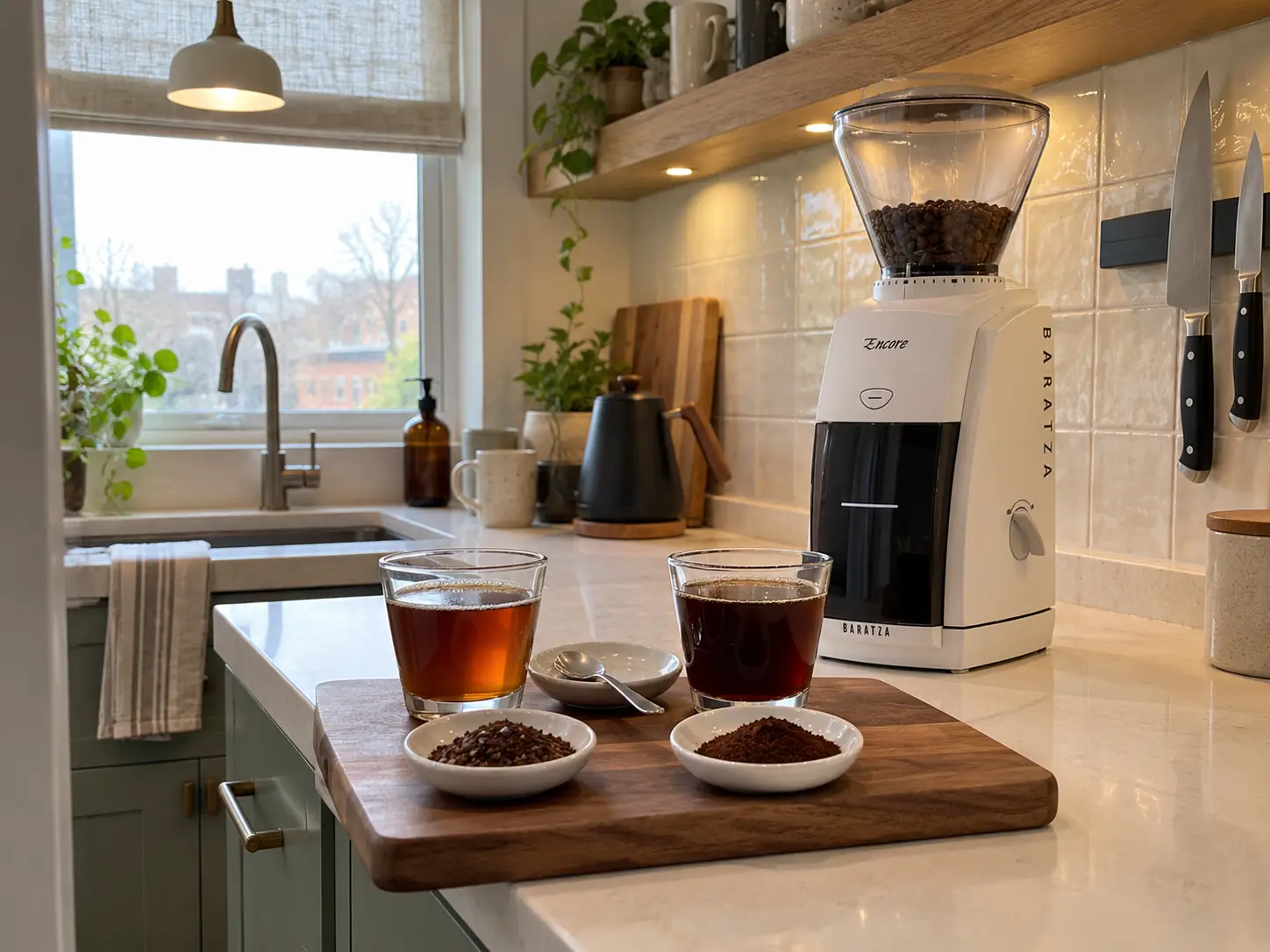
Grind size doesn’t carry a taste. It sets how much of the coffee dissolves into the water, and the cup tastes like that amount. That amount is called extraction, and the rest of this page is what it tastes like.
Extraction Is the Share of the Grounds That Ends Up in the Cup
Roasted coffee is only partly soluble. Extraction (written PE, for percent extraction, and also called extraction yield) is the share of the ground coffee’s weight that ended up dissolved in the drink; strength (written TDS, for total dissolved solids) is how concentrated that drink is. They sound alike and aren’t, and section three pulls them apart. The grind moves extraction most directly, since smaller pieces expose more surface to the water (the neighbor guide on how surface area and the grind size chart fit together has that part in full).
Fines Slow the Water, and Slower Water Takes More
Every grinder makes a spread of particle sizes, and the dust at the bottom of that spread, the fines, packs into the gaps between the bigger pieces. A finer setting makes more of them: pull the bin out after a finer grind and the powder clings to its walls in a film, where the coarser grounds poured out loose. According to a 2024 Scientific Reports study on fines and flow, “An increase of share of fines decreases coffee bed permeability, leads to reduced flow rates and longer extraction times.” The researchers worked on espresso and counted anything under 100 µm as a fine, but the flow logic holds for any bed the water has to pass through.
So a finer grind works twice in a brewer where the water runs through. More surface, and more time. Spotting fine from medium by eye is covered in how to tell fine, medium and coarse apart.
The Cup Follows Extraction, Not the Kettle Number
A UC Davis Coffee Center team drip-brewed one coffee to fixed strength and extraction targets at 189°F, 194°F and 199°F (87, 90 and 93°C), changing the grind and brew time to land each target, and the authors of a UC Davis sensory study of brew strength and extraction reported: “Although the TDS and PE both significantly affected the sensory profile of the coffee, surprisingly the brew temperature had no appreciable impact.”
If going coarser does not help, the usual next step is to lower the temperature, though water temperature is best left as the last variable you change.
Both are partly right: temperature changes the cup only through what it does to extraction, and the grinder is the more direct handle on that same number. (The study used one kind of commercial drip brewer, so take the direction, not a promise that the kettle never matters.) If you can’t move the grind at all, the last section is yours.
The Order Flavors Leave the Grounds, and the Band in the Middle
If the grind only set “how much,” every off cup would taste weaker or stronger and nothing else. It tastes different because the water doesn’t take everything at once. The order is what makes a too-coarse cup taste sour rather than simply watery.
Acids and Salts Come Out First
The UC Davis paper cites earlier work finding that 50% of measured coffee components extract within the first quarter of brewing volume, while slower, flavor-active compounds keep coming later. So what dissolves early is not the whole cup. Brewers describe the sequence as a rule of thumb: acids first, then sweetness, then bitterness. No lab table draws those three lines that cleanly, but the first step is easy to taste.
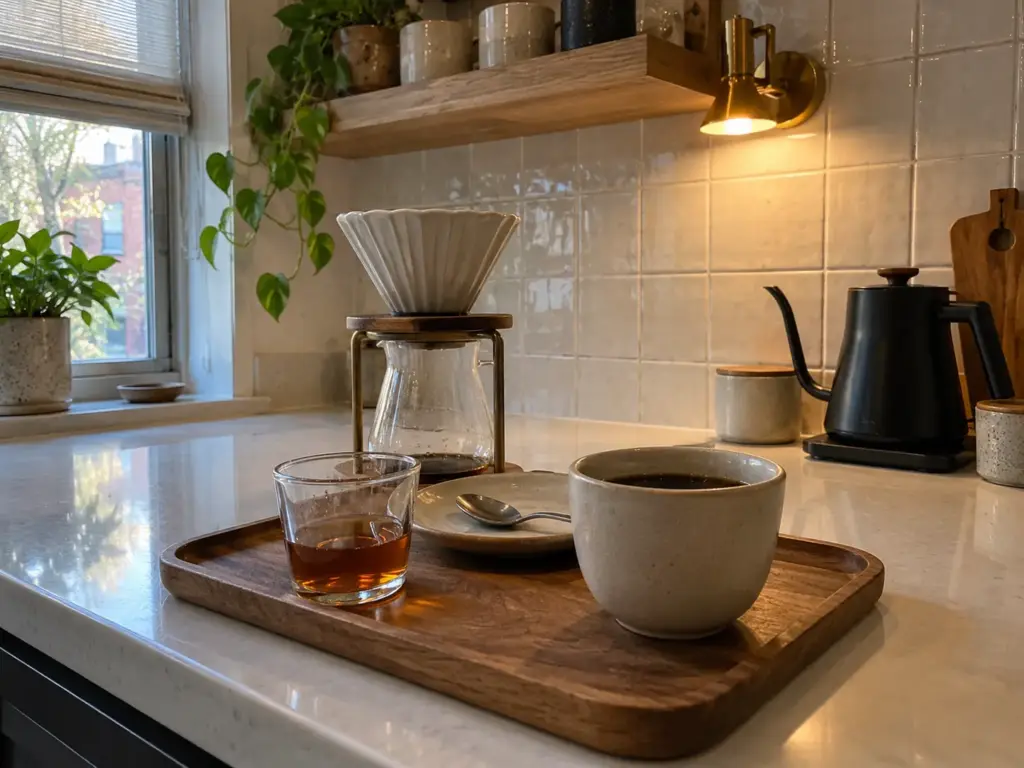
Acids and salts are the easiest things in coffee to extract, so the drip that comes through during the bloom tastes very sour and salty. Try it: catch the first few drops of a pour-over on a spoon, then taste the finished cup from the same brew. The spoon is sharp and a little salty; the cup is rounder. A brew that runs too fast, from grounds that are too coarse, keeps more of that spoon in the cup.
What the Tasting Panel Found on Each Side
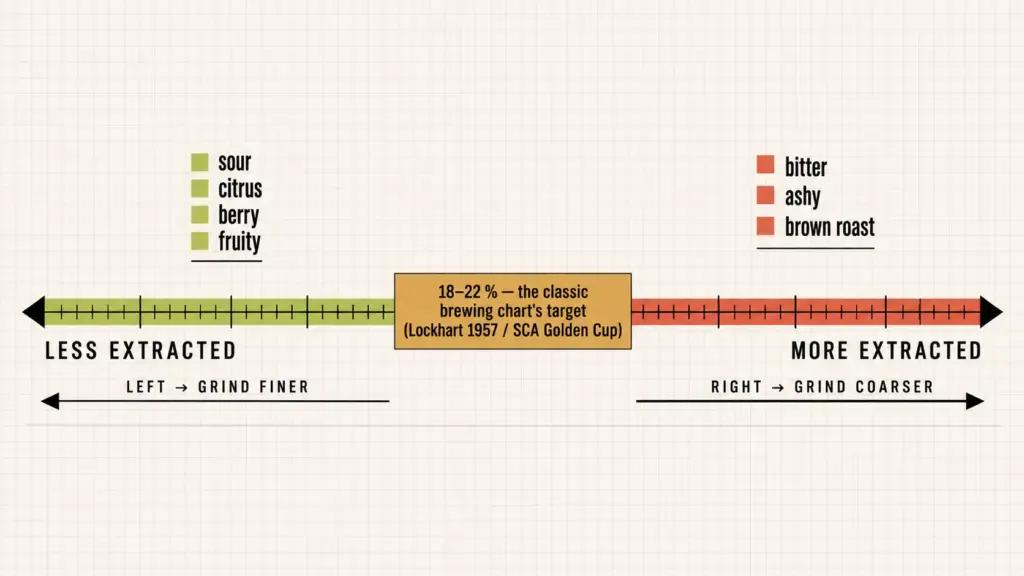
The same UC Davis study is the best evidence for the direction rule. When the panel’s descriptions were mapped against extraction, sour, citrus, berry and fruity all grew stronger as extraction fell, while bitter, ashy and brown roast grew toward the high-extraction side, as set out in the UC Davis panel’s results. Under-extraction leans tart and fruity. Over-extraction leans roasty and harsh.
Look closer at the per-attribute results and the picture gets more useful. Plain bitterness climbed with strength, and its link to extraction on its own wasn’t statistically significant. Sour peaked in cups that were concentrated and under-extracted at once.
The two notes that kept climbing with extraction were ashy and brown roast, and even those leveled off past a threshold. In kitchen terms, the harsh, burnt edge of an over-extracted cup is roast and ash more than plain bitterness, and a cup brewed too concentrated can taste bitter at a perfectly normal extraction.
Judge every test cup at the same drinking temperature, a few minutes after pouring. The UC Davis paper notes that coffee served hotter has been perceived as more roasty and bitter, with most other flavors reading weaker, so a scalding first sip can send you coarser for a cup that was fine once it cooled.
18–22 % Is Where to Aim, Not a Verdict
The band comes from Ernest Lockhart’s Coffee Brewing Control Chart of 1957, whose central region covers TDS of 1.15–1.35% and extraction of 18–22%. The UC Davis paper identifies that region as the SCA’s Golden Cup Standard. Below 18%, cups lean to the sour, thin side; above 22%, toward the ashy, roasty one.
The same authors also call the chart problematic from a modern sensory point of view, because it mixes a quality word (“ideal”) with scale words and taste words and leaves out most flavors. And in the UC Davis Coffee Center’s piece on the chart’s update, Peter Giuliano of the SCA’s Coffee Science Foundation points out that Lockhart asserted one ideal brewing zone, while people’s idea of good coffee varies a lot. A cup inside the band can still taste wrong to you, and one outside it can taste great.
At home there’s no refractometer on the counter anyway. Sour and roasty in your own mouth are the measurement you have, and the band is simply where that measurement tends to settle.
Strength and Extraction Are Two Different Dials
The band has two numbers for a reason: how concentrated a cup is and how much of the grounds went into it are separate things. Mixing them up is why “grind finer for stronger coffee” works right up until the cup turns harsh.
Weak Is About the Ratio, Sour Is About Extraction
The brewing chart has two axes. Strength runs up the side and is mostly set by the ratio, how much coffee goes into how much water. Extraction runs along the bottom and is mostly set by the grind and the time.
So a cup can be weak and balanced, which is a brew ratio problem, or strong and sour, which is an extraction problem, and the words people use for them overlap badly. “Weak” belongs to the ratio. “Sour” and “harsh” belong to extraction.
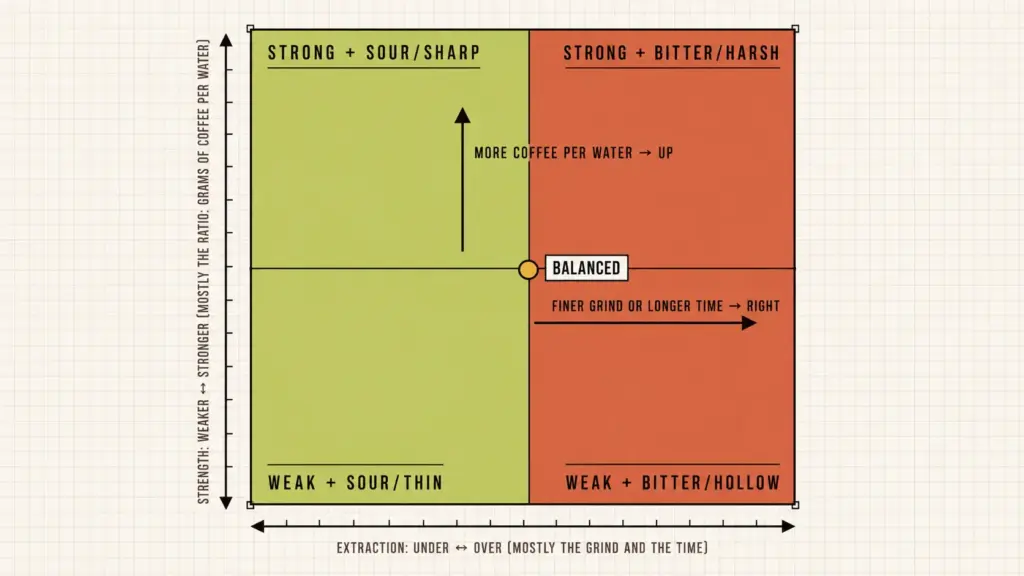
The UC Davis Coffee Center makes the same split for home brewers without a meter: weigh the coffee, compare your coffee-to-water ratio to the chart, and adjust the grind and brew time, and you get a good idea of the flavors to expect. Prof. William Ristenpart, who directs the center, adds that the same pile of beans can end up in different corners of the chart depending on how it’s ground and extracted.
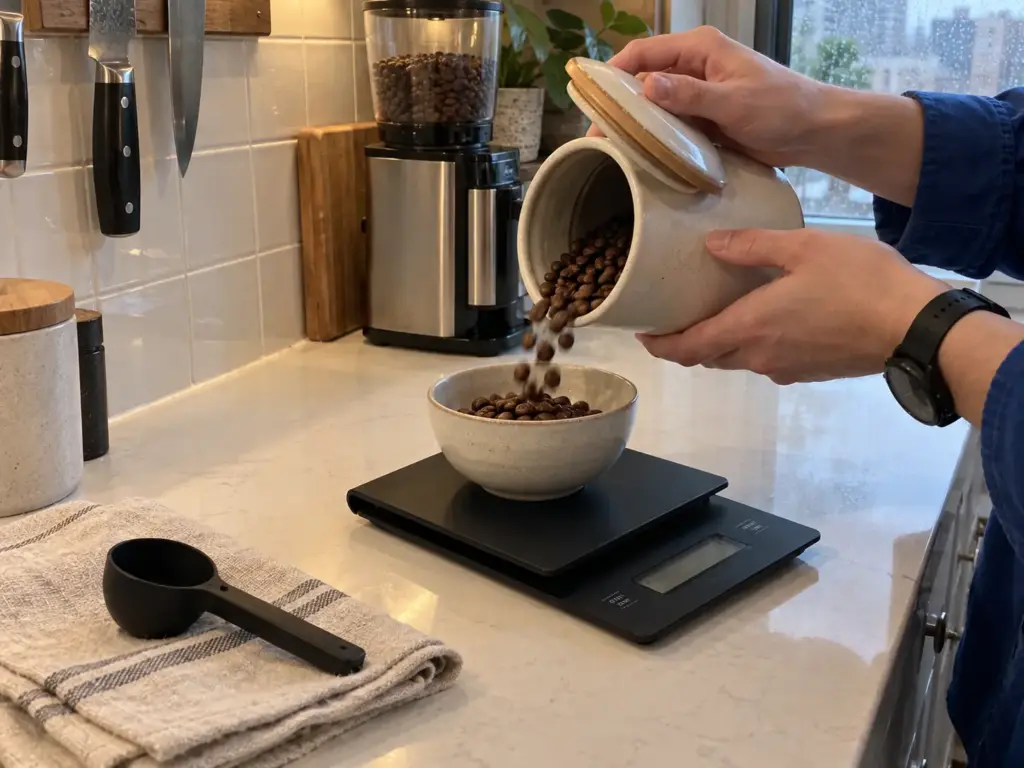
Weighing is what makes “same recipe, one change” true. Any kitchen scale plus the stopwatch on your phone does it for free. If you want both on one pad, the Hario Drip Scale Timer reads in 0.1 g steps, has the timer built in, and turns itself off after five minutes. Buyer reports are where it gets shakier: several say theirs died within six months, the display trails a fast pour so the dose can overshoot before the number catches up, and it takes a few seconds to wake after you press the button.
Not sure whether a cup is too strong or over-extracted? Pour half of it into a second mug and top that half up with a splash of hot water. If the diluted half tastes right, the grind was fine and the ratio was the problem, so use a little more water tomorrow. If it is still ashy or still sour once thinned, dilution can’t reach it, and the grinder is the dial to turn.
Why a Finer Grind Tastes Stronger Until It Doesn’t
A finer grind does raise strength a little, because more dissolves from the same dose. But it gets there by moving along the extraction axis, and that axis runs straight into the roasty, ashy corner. For the first step or two the cup seems fuller. Keep going and it turns harsh without getting any stronger in the way you meant.
When the cup tastes balanced and just a bit thin, more coffee per cup of water moves it up the chart without dragging it sideways. The detail, dose by dose, is in which grind size makes the strongest coffee.
Change the Dose and the Right Grind Moves Too
The two dials are separate on the chart and tied together in the brewer. A cup that is just a hair weak, with the acidity already where you want it, is the case where adding a little more coffee is worth testing. The reply: that would most likely work, but the grind might need to move coarser to suit the new ratio.
The reason is the bed. More coffee in the same cone makes a deeper bed, the water takes longer to get through it, and the longer contact extracts more. So raise the dose, taste, and only then move the grind back a step if the cup has tipped toward harsh.
Scoops hide this. The same scoop, heaped one morning and level the next, can move the cup further than one click on the grinder, and the difference only becomes visible once a scale sits under the brewer. That’s why the order for a weak cup is the ratio first, weighed, and the grind second.
Reading the Cup: Sour, Bitter, Muted or Both at Once
With the two dials separated, what’s left in the cup can be read, and it says more than “too coarse” or “too fine.” There are four readings. Only two of them are answered by turning the grind the obvious way.
Sour and Thin: The Water Left Early
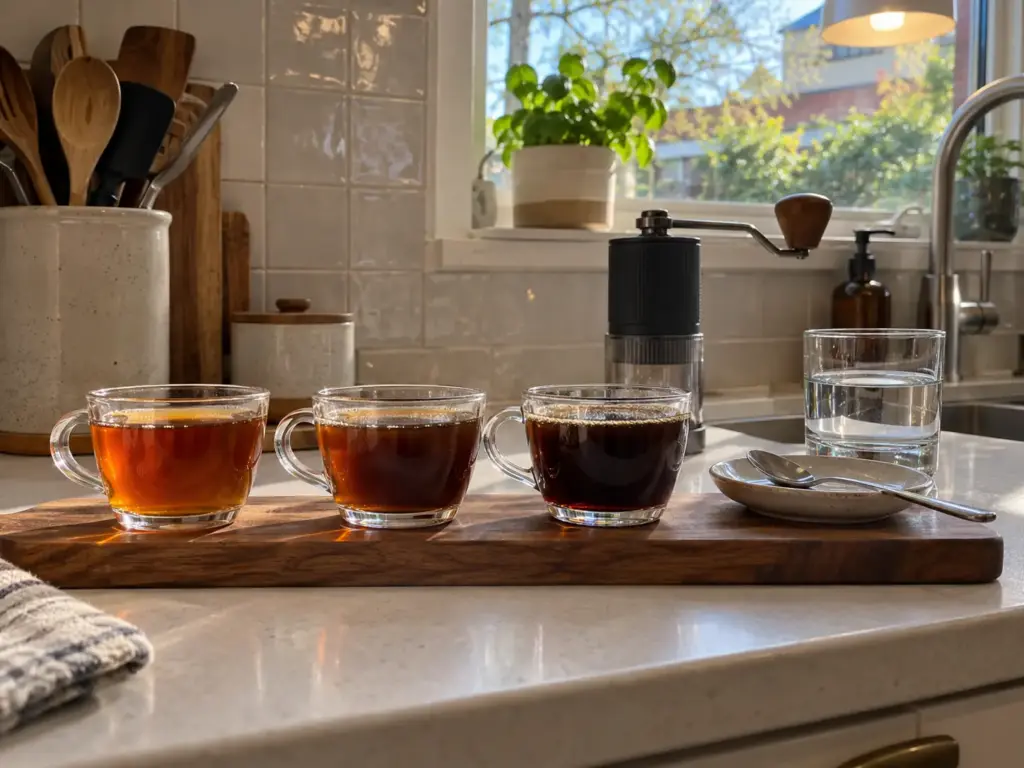
Sharp, salty, thin, with a finish that disappears fast: the water left before it reached the sweeter compounds, so go one step finer. Too coarse a grind leaves the coffee under-extracted, weak and acidic.
Thin and bland without the sharpness is often something else. That exact cup can come from old beans or the wrong ratio of coffee to water, and an over-thick filter is a less likely cause. No grind setting brings back beans that have gone flat, so check the roast date and how to tell if coffee beans are stale before you touch the dial.
Bitter and Dry: It Stayed Too Long
Ashy, dry, harsh, with a finish that hangs on after you swallow: the water kept working after the good part was out, so go one step coarser. That’s the roast-and-ash side of the panel’s map.
But a cup that is simply bitter, without the dry, ashy edge, and also tastes heavy may not be over-extracted at all. Given how closely bitterness tracked strength in the panel’s data, try a few more grams of water per cup before you move the grinder.
Flat and Muted: Finer Went Past the Fruit
This is the reading the simple rule leaves out. Instead: “the finer I go the less acidity/berry I get”, and no bitterness or astringency either.
Grind too fine and you lose acidity and get more maillard notes, the bakery and caramel side of the cup, until the flavors go muted. Another reminded the thread that more extracted doesn’t “necessarily mean more of the flavors you like.” The reader ran a small test and landed at 93, with “90 missing a little acidity and 95 having a little too much.”
So a cup that went flat after a finer step hasn’t turned bitter yet. It has passed the fruit, and the move is back toward coarse. A light roast can also taste bright on purpose, which is part of why light roasts usually grind finer and still keep their acidity.
To tell muted from over-extracted, ignore the first sip and pay attention to the tongue ten seconds after swallowing. A muted cup still tastes clean and a little sweet at the front and leaves the mouth wet. An over-extracted one leaves the tongue dry and rough against the roof of the mouth. Dry means coarser; clean but dull means you went past the fruit.
Sour and Bitter in One Sip Is Not a Setting
A cup that is sharp and harsh at the same time has an uneven grind: the dust over-extracts while the chunks under-extract, and turning the dial moves both ends of that spread together. No step in either direction helps, which is why a blade grinder makes a cup sour and bitter at once.
Where “Finer” Stops Working: Channels, Stalls and Fines
The muted cup was the first sign that “finer means more” has a limit. There’s a physical reason for it too, and past that point a finer grind can take less out of the coffee, not more.
A Bed Too Fine Lets the Water Take a Shortcut
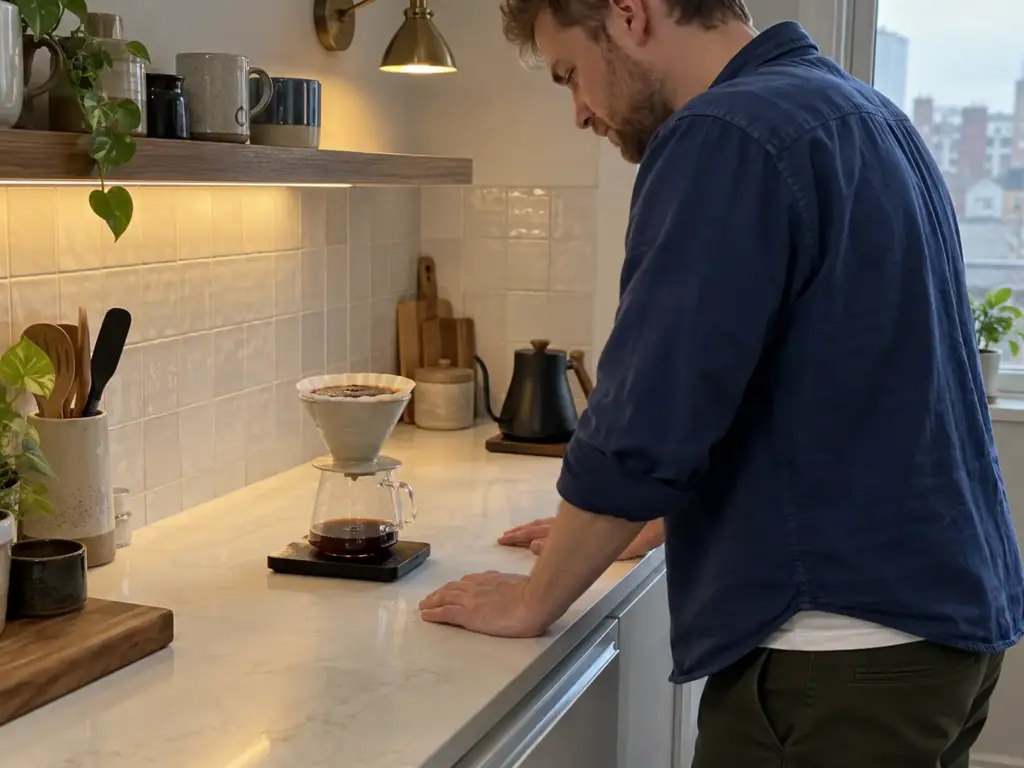
A bed of very fine grounds resists the water so hard that the water looks for a way around. Grind fine enough and the brew water creates channels in the bed of coffee, so only parts of the grounds actually get brewed. There is also an odder spot, where the grind is coarse enough to flow well and still over-extracts.
Physicists have modeled it. A fluid-dynamics model published in Physics of Fluids by Lee, Smith and Arshad starts from an experimental finding that, beyond a cutoff point, grinding coffee more finely gives lower extraction, and the model links that drop to uneven flow through the bed. In their model the water favors one path, strips everything soluble from the grounds along it, and leaves the grounds on the other path short.
That produces a strange cup: harsh at the edges and hollow in the middle, both from one brew. Going finer again makes it worse.
A Stalled Drawdown Is a Taste Warning
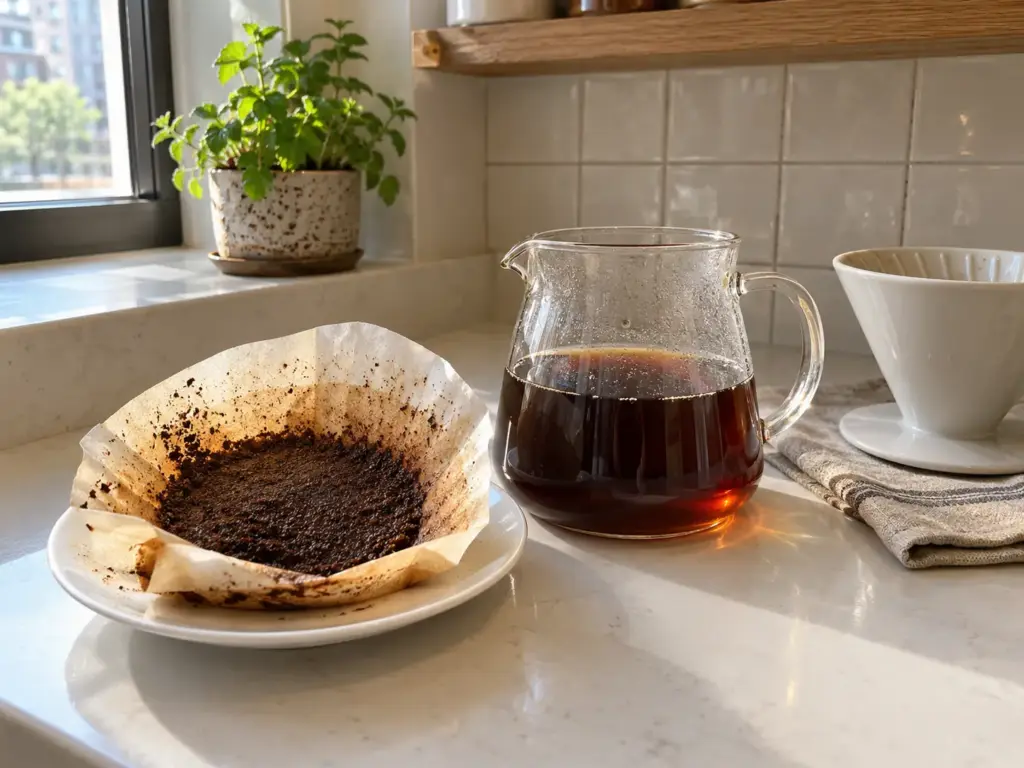
More fines, slower water; that’s the flow line from the first section, and in a cone it shows before you taste anything. Water still pooled on top well after the last pour, a small crater or hole where the water drilled through, grounds stranded high on the paper while the center sank: each one says the bed choked, and the next cup should go a step coarser. Reading that finish is covered brewer by brewer in reading the drawdown on a pour-over.
One stall on its own isn’t a verdict on the setting, though. If the same grind drains cleanly one morning and chokes the next, the difference is probably in the pour (a heavy stream straight into the center can dig the hole itself) or in a filter that sat wrong in the cone. Two stalls in a row at one setting are the grind talking.
Fines aren’t simply the enemy, though. The same 2024 espresso study found no penalty in its sensory scores when extra fines were added, and two of its best-scoring samples had a gram or two of fines mixed back in. That was one taster, espresso, and not blind, so it proves little on its own. It’s still a reason to let the cup, not a particle theory, have the final say.
Espresso Runs on the Shot Clock
Espresso sits at the fine end because its contact time is so short. The same study puts a typical shot at about 20% of the coffee extracted, with traditional shots running 25 to 30 seconds and the newer fast “turbo” style running 10 to 20. Both are real; they’re two styles.
The grind for either is set by the clock, and the grind size for espresso has the numbers. If your grinder can’t reach that end of the dial at all, the problem is a grinder that won’t grind fine enough.
The Same Step Tastes Different in a French Press, a Drip Machine and a Pour-Over
One click is one click on the dial, but not in the cup. How much a step changes the taste depends on whether the brewer lets the grind change the brewing time as well.
Immersion: You Hold the Clock
In a French press, a cold brew jar or an AeroPress steep, all the grounds sit in all the water for as long as you choose. The grind acts through surface alone, because the clock is yours, not the bed’s. So a step on the grinder moves the cup gently, and the steep time is a second lever right next to it.
Too fine shows up here as texture as much as taste: a muddy cup with silt at the bottom of the mug, a gritty last sip, and a plunger that pushes back. A French press that tastes a little sour is often fixed by an extra minute of steep before the grinder needs to move at all.
Pour-Over: The Grind Sets the Clock Too
On a pour-over, the water passes through the bed and drains out the bottom. A finer grind adds surface and also slows the water, two effects stacked on each other, which is why the same click that barely registered in a French press swings a V60 cup noticeably.
Take smaller steps here. On a percolation brewer, half a step (on a grinder that has half-steps) is often the right size of move, and a full step can overshoot.
Start your phone timer with the first pour and stop it when the bed goes matte, before and after a grind change. If the finish time didn’t move, the step was too small to taste yet, and judging the cup would be guessing. If it moved a lot on a half-step, that brewer is sensitive and every change from here should be a half-step too.
The Automatic Drip Machine Leaves the Grind as Your Only Control
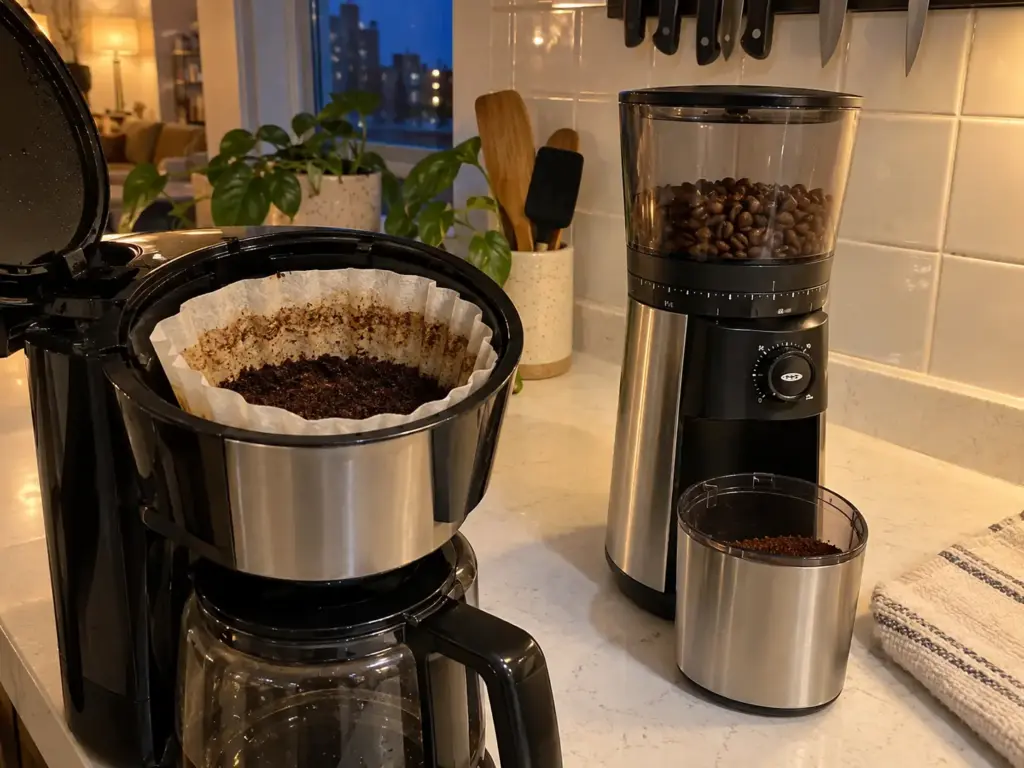
The starting point is the grind size for a drip coffee maker; what matters here is what the machine takes away. It sets the water’s flow and the brew time itself, so the grind and the dose are the only two controls left. KitchenAid’s support page warns that grounds that are too fine can clog the filter and overflow the basket, which makes coarser the safe side to err on with a machine.
Learning to dial in a machine takes patience. Dialing in a Breville Precision Brewer can take a couple of weeks, and a separate grinder may need to be set as fine as it will go without crossing into espresso territory. Watch the filter after each step: a ring of grounds left on the paper’s rim after one click finer means the water rose higher than it used to, the first sign before an overflow.
For a drip owner whose grinder can’t return to the same setting twice, the OXO Brew Conical Burr Grinder gives 15 settings on stainless conical burrs, with smaller in-between adjustments for when a whole step is too much. It’s the cheaper way into a dial you can come back to. Expect the catch bin to pick up a static charge, though, with grounds clinging to its walls, so a few taps and a brush after each dose become part of the routine; there’s more on grounds clinging to the grinder.
Turning the Dial: One Step, Then Trust the Second Cup
Knowing which way to go is half of it. The other half is how far a step really moves on your grinder, and why the first cup after a change can mislead you about it.
How Big One Step Is on Your Grinder
A step is not a unit. A number on an electric dial and a click on a hand grinder move the burrs different distances, and where to start is its own question, answered in what number your coffee grinder should be on. What matters for tasting is that the step repeats: you have to be able to go to a setting, leave it, and come back to exactly the same place.
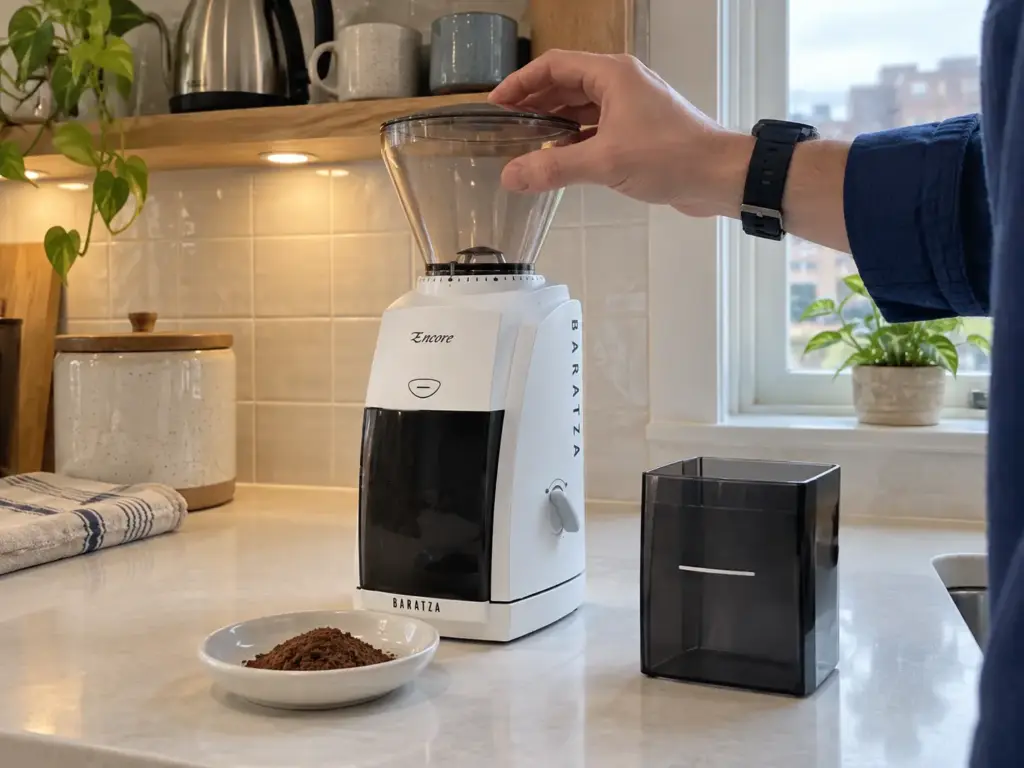
The Baratza Encore is built around that. It has 40 numbered settings on 40 mm conical steel burrs, so “one finer” is a defined move you can write down and undo. It’s a filter grinder, though: its finest settings stop short of what a real espresso basket without a pressurized insert needs.
A hand grinder makes the step something you feel. The TIMEMORE Chestnut C2S has a 38 mm conical burr in 420 stainless steel and about 36 internal clicks, and counting them from fully closed is how you set a hand grinder from zero. Its 20 g hopper holds one or two cups’ worth of beans per fill, and every one of those cups is cranked by hand.
The First Dose Still Carries the Old Setting
Every grinder keeps some grounds inside, and the first dose after a change pushes them out with the new ones. How much varies enormously.
A Niche owner on coffeeforums.co.uk measures the gap between beans in and grounds out at “under 0.2g if I change the grind setting”. After changing the grind setting, the safest approach is to grind and discard a full single’s worth to get consistent performance; the extra amount is cheap insurance, and a smaller amount may do. One grinder can show different retention figures depending on whether it is used from the hopper or one dose at a time, and both can be valid.
So the number depends on the grinder, from a pinch to a full espresso dose. You can find yours for free: weigh the beans going in and the grounds coming out for a few doses in a row, and the gap is what the grinder keeps. After a big move on the dial the first grounds out can even look mixed, a few coarser flakes among the new powder.
Either purge a little before the real dose, or brew the first cup and judge the second. I’d do the second on a grinder that holds a lot, since tasting it costs less than throwing coffee away.
When You Overshoot, Come Back Half
Test one thing at a time. The rule is to change only one variable at a time, and keeping notes helps a lot. Sometimes the answer is just one more click away, and it can take several cups to find it.
If a step swings the cup from sharp to flat, or from flat to dry, come back. A full step is the obvious move, but it just returns you to the cup you already rejected; half a step, on a stepless grinder or one with half-clicks, is where the answer usually sits. A setting between one that lacks acidity and one with a bit too much is exactly that shape. And judge the overshoot on the second cup too, for the same retention reason.
What No Turn of the Dial Can Fix
Every step so far assumes a grinder that makes one size and holds it. The direction rule has a flaw of its own, and some kitchens, and some months, are exactly where it breaks down.
An Uneven Grinder Makes the Rule Useless
The rule only works if the grinder repeats itself. If a grinder’s output is a random number generator or birdshot, adjusting it means chasing your own tail. Each turn changes the spread as much as the size, and the cup can’t tell you which way to go.
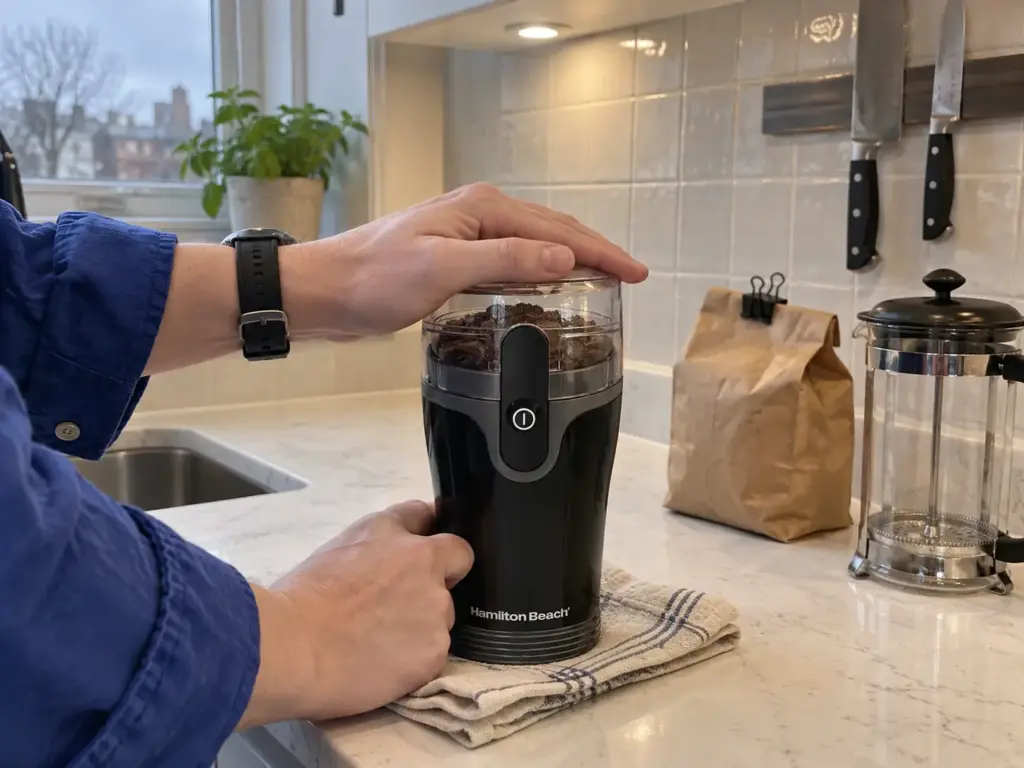
A blade grinder is the everyday version of that. It has no setting, only how long it runs and how many beans are in it, and every run makes boulders and dust together instead of a uniform size.
The Hamilton Beach Fresh Grind is the one on a lot of counters: stainless blades, one button, room for up to 12 cups of beans. It’s named here because it’s already in many kitchens, not as a recommendation. A hands-on reviewer rated its output at pour-over fineness as inconsistent, powder and pieces together, and after a year to a year and a half of use the blade dulls, so the same run time gives a chunkier grind. Short pulses with a shake between them narrow the spread a little, and how long to run a blade grinder gives the seconds per brewer.
A Pre-Ground Bag Has No Dial
With pre-ground coffee the grind is fixed (picking the bag whose size word matches your brewer is a chart question). What’s left to move is the dose, the brew time where the brewer lets you choose it, and the age of the bag.
The direction still reads the same way: a sour cup from a drip machine can take a few more grams in the basket, since a deeper bed drains slower and extracts a little more; a sour French press can take a longer steep. A bitter one goes the other way on either lever, one change per brew. Ground coffee loses its freshness much faster than whole beans, so a bag open for weeks starts tasting thin and flat whatever you do with the dose, which is where when to grind your beans comes in. Whether a grinder is worth adding at all is its own decision: whether grinding your own coffee is worth it.
The Setting Drifts With the Months
A setting that tasted right with one bag often won’t with the next, because the roast level and the bean’s density change what the same gap does: a dark roast is more brittle and gives up its solubles faster, so it usually wants a step coarser than a light one at the same water temperature. Over a longer stretch the burrs themselves wear, and a dulled burr crushes more than it cuts, which widens the spread and pushes the cup toward sour and harsh together. If that’s where yours is heading, when a grinder’s burrs need replacing lists the signs to check.
A grinder that jams, stalls or won’t turn on isn’t a taste question at all; that’s a grinder that’s jammed or won’t run. For the long view, including which parts go first, see how long a coffee grinder lasts.
The Grind Chooses Which Flavors Reach the Cup
Three things to carry to the counter:
- The grind sets how much of the coffee the water takes, and flavors leave in an order: tart and salty early, roasty and ashy late, so the grind picks which ones you taste.
- Weak is a ratio word and sour is an extraction word. Weigh the coffee before you turn the grinder, because a heaped scoop moves the cup further than a click.
- Read the cup four ways (sour, bitter, muted, or sour and bitter together), move one step toward balance, and judge the second cup after the change.
A month from now, brew the bag you know best at your usual setting and compare it with your notes; if it has drifted while the dose, water and beans stayed the same, the grinder is the thing that moved.
Tomorrow, weigh the same dose you used today, move the grinder one step in the direction today’s cup pointed, and taste the second cup brewed at the new setting: sharper to rounder means you went the right way, and flat or dry means come back half. If the grinder can’t land on the same step twice, the next question is a grinder that holds its setting.
Frequently Asked Questions
01What grind of coffee gives the best flavor?
The best-tasting grind is the one that suits your brewer’s contact time and leaves the cup neither sour nor bitter. No single size wins everywhere. Start in your method’s range, then move one step toward whatever the cup is missing.
02Does a finer grind make coffee stronger?
A finer grind makes coffee slightly stronger, because more dissolves from the same dose, until the cup turns harsh or the brewer stalls. Strength is mostly the ratio, so add coffee first and adjust the grind after.
03Should I grind finer or coarser if my coffee is bitter?
Grind one step coarser if your coffee tastes bitter, dry and ashy, then judge the second cup brewed at the new setting. If it is bitter and sour in the same sip, the grind is uneven, and no step in either direction will fix it.
04Why does my coffee taste flat after grinding finer?
Coffee tastes flat after grinding finer when the grind has passed the point where fruit and acidity peak, so roasty caramel notes start covering the bright ones. Go back half a step to a full step coarser and taste again.
05What is the best grind size for coffee?
The best grind size depends on the brewer: coarse for a French press or cold brew, medium for drip, and fine for espresso. The full chart by method is in the grind size guide, and the cup decides the last step.



How did your cup turn out?
No comments yet. Tell us what you changed — and whether the needle moved.