



We may earn a commission when you buy through links on this page. It never changes what we recommend. How we pick
On this page8 parts
- Which Coffee Grind Is Strongest Depends on Which Strong You Mean
- Why a Finer Grind Takes More Out, and Where It Stops
- One Step Finer or One More Gram? The Arithmetic
- Why Espresso, Moka and Turkish Coffee Are Ground Fine
- Getting a Stronger Cup From the Gear on Your Counter
- When the Cup Is Weak and the Grind Isn't the Reason
- Finer Until the Water Drags, Then One More Gram
- Frequently Asked Questions
You turned the grinder one click finer because the mug tasted thin, and the next cup came out just as thin, with a dry, rough edge on the finish that wasn’t there the day before. So which coffee grind is strongest, if finer didn’t do it? Strength is a number in the cup, the share of the drink that is dissolved coffee, and the grinder mostly moves a different number: how much of the grounds the water manages to take out. This page settles which grind brews the strongest cup and where finer stops helping, then puts the click and the gram side by side in plain arithmetic, takes the famously strong drinks apart, and walks through the brewer on your counter and what to check when the grind isn’t the reason.
Quick Answer
A finer grind makes coffee stronger, but only until the cup turns harsh or the water stalls. The strongest grind is the finest setting your brewer still drains at its normal speed, not the finest your grinder makes. Go one step finer, then taste. Past that point, add weighed coffee: one more gram adds strength without the edge.
Which Coffee Grind Is Strongest Depends on Which Strong You Mean
The word covers three different complaints: a cup that tastes watery and flat, a cup that tastes thin and sour at the same time, and a cup you want to carry more caffeine. The grind fully answers only the second one. The other two belong to other dials, and turning the grinder for them is how a thin cup ends up thin and harsh.
Strength Is How Much Coffee Is Dissolved in the Water
Coffee brewers write strength as TDS, for total dissolved solids, and the definition in a UC Davis sensory study of brew strength and extraction is exact: the mass fraction of soluble solids in the brew. The same paper defines extraction as the share of the grounds’ weight that ended up dissolved, and ties the two together through the brew ratio of water to coffee. Two numbers, then, linked by a third.
The target for a drip cup on the classic brewing chart, the one the SCA’s Golden Cup is built on, is a TDS of 1.15 to 1.35%, with 18 to 22% of the grounds extracted. Round it to 1.25% and a well-made mug of drip coffee is 98.75% water. That’s why a mug can look plenty dark and still taste like coffee-flavored water: the color follows the roast more than the dose, and a dark roast tints the water deep brown at a strength that still tastes thin. (The UC Davis authors themselves call the old chart problematic by modern tasting standards, so treat the band as an aim, not a verdict.)
In grams, the whole thing is small. A 10 fl oz mug brewed at 1:17 starts from about 17.4 g of ground coffee. At 20% extraction about 3.5 g of that dissolves, and those three and a half grams are the entire difference between a mug of coffee and a mug of hot water; the other 14 g or so go into the trash with the filter. Every way of making the cup stronger is a way of getting more of those grams into the mug, either by pulling a bigger share out of the grounds or by starting with more grounds.
Extraction Is How Much Came Out of the Grounds
This is where the two dials separate. The brew ratio, grams of coffee per gram of water, is the strength dial. The grind size is an extraction dial: it sets how much of each gram of coffee dissolves. A finer grind raises strength only by way of extraction, which means it raises strength a little and shifts the balance of the cup a lot, from the sour, fruity side toward the bitter, roasty one.
The two get tangled quickly in practice. Brewing 75 g of coffee into 1,250 ml of water, about 1:16.7 and already at the strong end of the SCA’s band, they found that “even at its finest setting the coffee tastes weak/bland”. The complaint was strength, the dial being turned was extraction, and the recipe on paper was a strong one. When a strong ratio tastes weak, the water didn’t take enough out, and the grinder is the right dial right up until the brewer stops it (which is where this owner ended up, as the drip machine section below shows).
The opposite case is the more common one. A cup that tastes thin and harsh at once, weak in the middle with a dry edge on the finish, is the sign the grind went finer while the dose was the thing that was short. Extraction climbed past the sweet part, strength barely moved, and the cup got the worst of both.
Read the cup before the dial: thin and sour points at the grinder, thin and harsh points at the scoop. The full two-dial picture, with the four ways a cup can read, is in how grind size moves the taste from sour to bitter.
Where Caffeine Fits In
Some people asking about the strongest grind mean something else again: they want more caffeine in the mug. A finer grind lets more of everything soluble dissolve, caffeine included, so the caffeine in the cup rises a little along with the extraction. How much caffeine a given method or drink carries is its own question, with its own measurements, and this page stays with the taste.
Why a Finer Grind Takes More Out, and Where It Stops
If the grind is the extraction dial, finer ought to mean more, every time. Up to a point it does. That’s exactly why people keep turning it past the point where it stops paying.
Smaller Particles, Slower Water
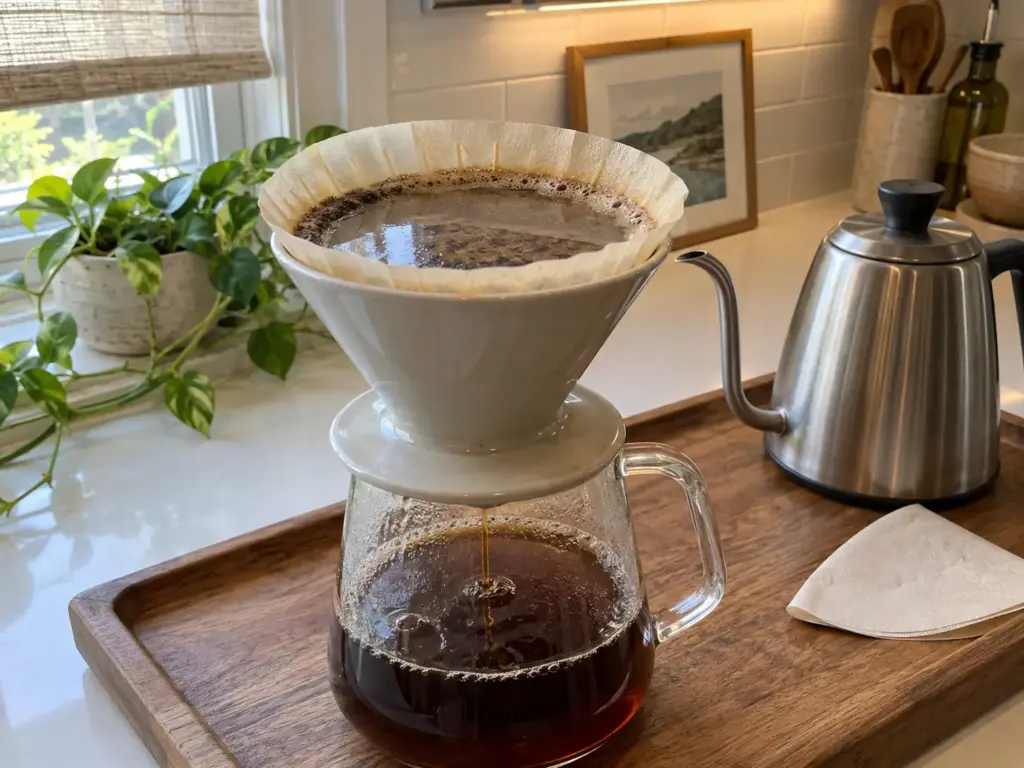
Cut a bean into smaller pieces, a smaller particle size, and every gram has more surface area for the water to work on, and less distance from the outside of each piece to its center. A finer setting also makes more fines, the dust at the bottom of the size spread, and fines pack into the gaps of the bed. A 2024 Scientific Reports study of espresso from the Zurich University of Applied Sciences found that a bigger share of fines makes the bed less permeable, slows the flow rate and stretches the extraction time. If you can’t yet say where your current setting sits, learn to tell a fine grind from a coarse one by hand before you turn anything.
So in any brewer where water runs through the grounds, finer works twice: more surface, and more time in contact with it. Both push extraction up. Both are also why the brew slows down as you go finer, which is the first warning you’ll get.
The Ceiling Is Measured, Not a Rumor
The limit has numbers behind it. According to a 2020 study of espresso extraction in the journal Matter, “experimental measurements show a peak in the extraction yield versus grind setting relationship, with lower extraction yields at both very coarse and fine settings.” The researchers put the drop at the fine end down to uneven flow: the water finds channels through a bed that resists it, strips the grounds along those paths and leaves the rest short, which they describe as poor reproducibility and wasted raw material. A separate fluid-dynamics model by Lee, Smith and Arshad in Physics of Fluids lands on the same cutoff, past which grinding finer gives lower extraction.
That’s espresso, the clearest measured case, not a law for a drip basket. But the shape carries over. In kitchen terms, the extraction and strength numbers reach a ceiling limit, and past it a finer grind adds nothing you want. What you taste there is a bitter, dry, astringent edge, and in a paper-filtered cup sometimes sour and bitter in the same sip, because the channeled bed over-extracts some grounds while it skips others.
The Strongest Setting Is the Finest One That Still Drains
Put the two halves together and the working rule for any brewer falls out. The strongest grind is the finest setting that still drains, or runs, at your method’s normal speed. Past that, the cup gets harsher, not stronger. Normal speed differs from brewer to brewer, and the grind size chart by brewer has each one’s target.
Your ears and the timer tell you before the cup does. The drip that used to finish in a steady trickle now ends in single drops. The brew runs a minute longer than it did yesterday, or water still sits on top of the bed after the last pour. Any of those after a finer click means you’ve found the edge, and the setting one step back is the strongest one your brewer will give you.
Before you touch the grinder, time one brew at your current setting, from the first water to the last drip. That time is your brewer’s normal speed and the reference for every click after it. A finer step that finishes in about the same time and tastes fuller is working. A step that adds a long tail of slow drips has gone past the edge, even if the first sip seems stronger.
One Step Finer or One More Gram? The Arithmetic
What one click of your grinder buys in extraction isn’t a number anyone can hand you; it depends on the grinder, the burrs and the brewer. The formula that ties strength, extraction and dose together is simple enough to run at the counter, though. And it says the gram is the cheaper lever almost every time the cup already tastes right.
The Formula Behind Every Strong Cup
The extraction formula in the Golden Cup Standard as Roastopedia sets it out is extraction (%) = TDS × brewed coffee mass ÷ dry coffee dose. Turn it around and strength = extraction × dose ÷ the mass of the drink. Every lever is a multiplication, which makes the trade easy to see: raise the extraction by a tenth, raise the dose by a tenth, or pour a tenth less into the mug, and the cup comes out roughly 10% stronger each way. Two points of extraction on a 20% base, from 20 to 22%, is exactly that tenth.
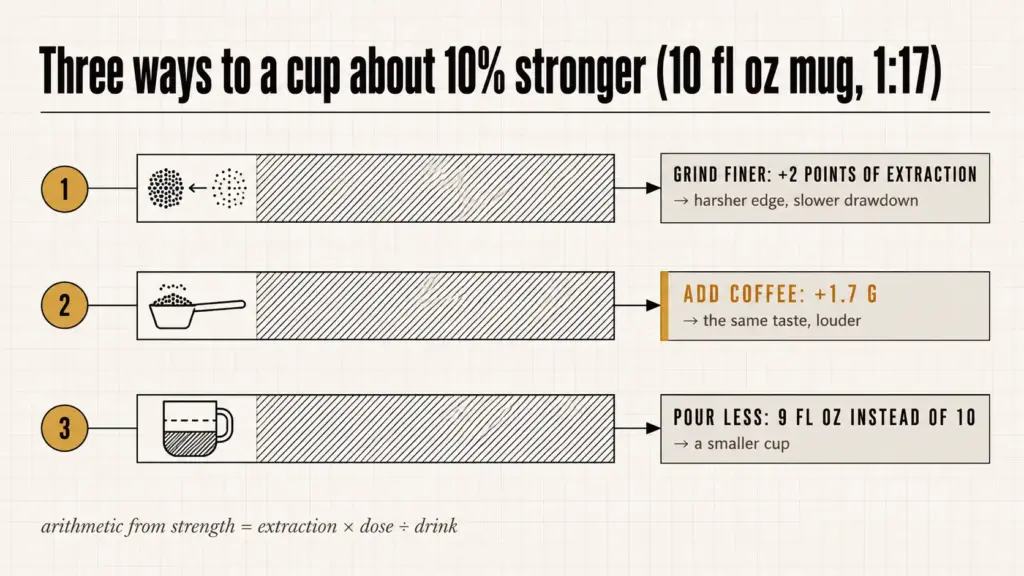
The SCA’s own number for the dose fits inside this math. Its Protocols and Best Practices give a coffee-to-water ratio of 55 g/L ± 10%, which works out to 1:18.2, with a band running from about 1:16.5 to 1:20.2. A 1:17 cup sits inside that band. The 1:16 that so many recipes present as the standard sits just past its strong end: a fine ratio if you like the cup that way, but not the SCA’s figure, and worth knowing before you add grams on top of it.
For a 10 fl oz mug (about 296 g of water) at 1:17, the dose is about 17.4 g, and that’s the mug the table below runs on.
What 10 Percent Stronger Costs Each Way
The table takes each lever on that mug with everything else held still. It’s arithmetic from the formula, not a lab measurement, so read it as what each change is worth, not as what any particular grinder click delivers.
| Lever | The change on a 10 fl oz mug at 1:17 | Strength | What it costs |
|---|---|---|---|
| Finer grind, one point | Extraction 20% → 21% | +5% | A slower drawdown |
| Finer grind, two points | Extraction 20% → 22% | +10% | A harsher edge, a slower drawdown, a risk of channels |
| More coffee | 17.4 g → 19.1 g (+1.7 g) | +10% | 1.7 g of coffee |
| One gram | 17.4 g → 18.4 g | About +5.7% | 1 g of coffee |
| Tighter ratio | 1:17 → 1:16 | +6.25% | About 1.1 g of coffee |
| Smaller cup | 9 fl oz instead of 10 | About +11% | A smaller cup |
Several rows land on the same strength, and the taste is where they part. In the UC Davis panel, nearly every flavor attribute grew as strength rose, while extraction slid the balance from sour, citrus and berry toward bitter, ashy and brown roast. So the gram makes the same cup louder, and the click makes a different cup. Less coffee ground finer and more coffee ground coarser can meet at the same strength, but they will taste different.
One catch in a drip basket. As the dose goes up, the extraction percentage can slip a little, so the gain from a gram can come in a touch under the table’s figure. Taste after the gram, the same way you would after a click.
When the Gram Beats the Click
The gram wins whenever you like the taste and just want more of it. The rule of thumb: if the flavors you’re getting are the ones you want and there simply isn’t enough of them, raise the dose; if the good stuff isn’t coming out at all, that’s when to grind finer. A cup that’s thin and sour at once flips the order. There the grind is the problem, and one step finer comes first, because more coffee in an under-extracted cup mostly gives you more of the sourness.
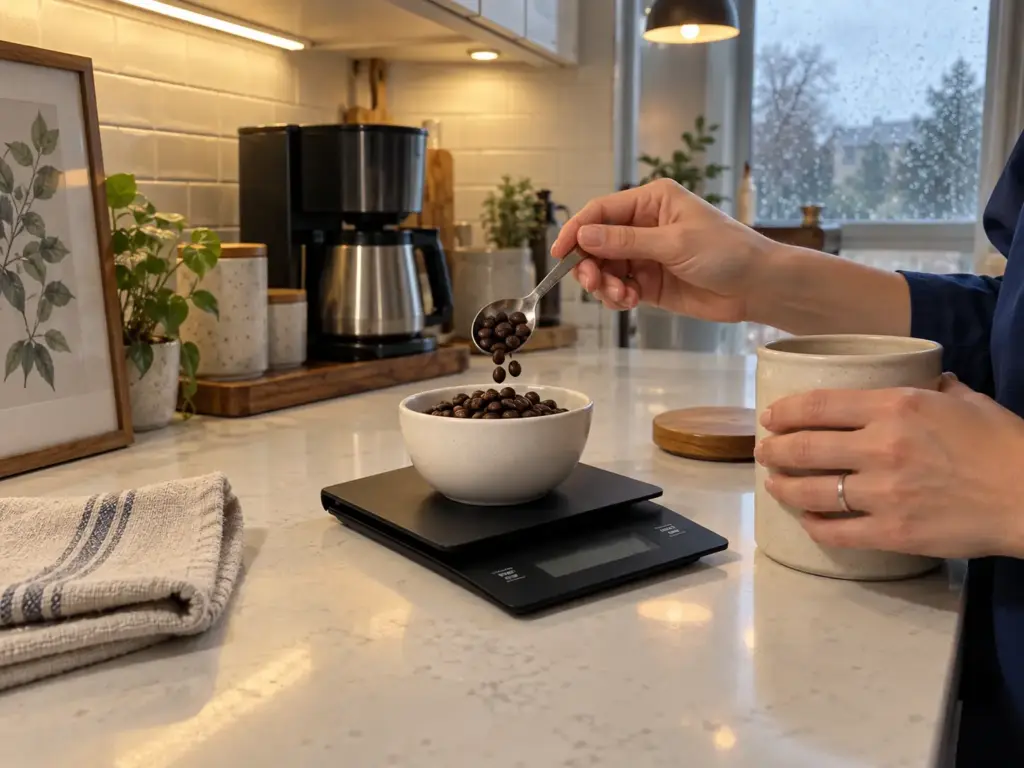
The first gram costs nothing to find. Level the scoop the same way every morning before you buy anything, because a scoop of the same beans can swing by more than the whole 1.7 g this section is arguing about, depending on the roast and how high it’s heaped. A darker roast is puffier and lighter per bean, so the same scoop holds fewer grams of it. Level it, brew, taste.
Grams only mean something if something reads them, and any kitchen scale that shows whole grams is enough for a 17 g dose. The Hario Drip Scale Timer reads in 0.1 g steps and has a brew timer on the same pad, which covers the drawdown timing from the section above. It is meant to switch itself off after five minutes, yet the auto-off is the most common complaint, and it can shut off early, which can land in the middle of a brew.
Weigh your usual scoop of beans on three different mornings, leveled the way you really level it when you’re in a hurry. If the three readings spread by more than a gram, the scoop is moving your cup more than one grinder click would, and weighing the dose is the first change to make, before the dial.
The arithmetic runs the other way too. A coarse grind that lands at 18% extraction instead of 20% needs about 11% more coffee to reach the same strength: roughly 1.9 g more per 10 fl oz mug at 1:17. From a 12 oz (340 g) bag, that’s about 17.6 mugs instead of 19.5, close to two mugs thrown out with grounds whose centers never gave up what they held. The same division, from the buying side, is in how many cups a 12 oz bag really makes.
Why Espresso, Moka and Turkish Coffee Are Ground Fine
The drinks everybody calls strongest also use the finest grinds, and that’s where the idea that fine equals strong comes from. Their strength comes from how little water meets how much coffee. Their fineness comes from the clock.
Their Strength Comes From the Ratio
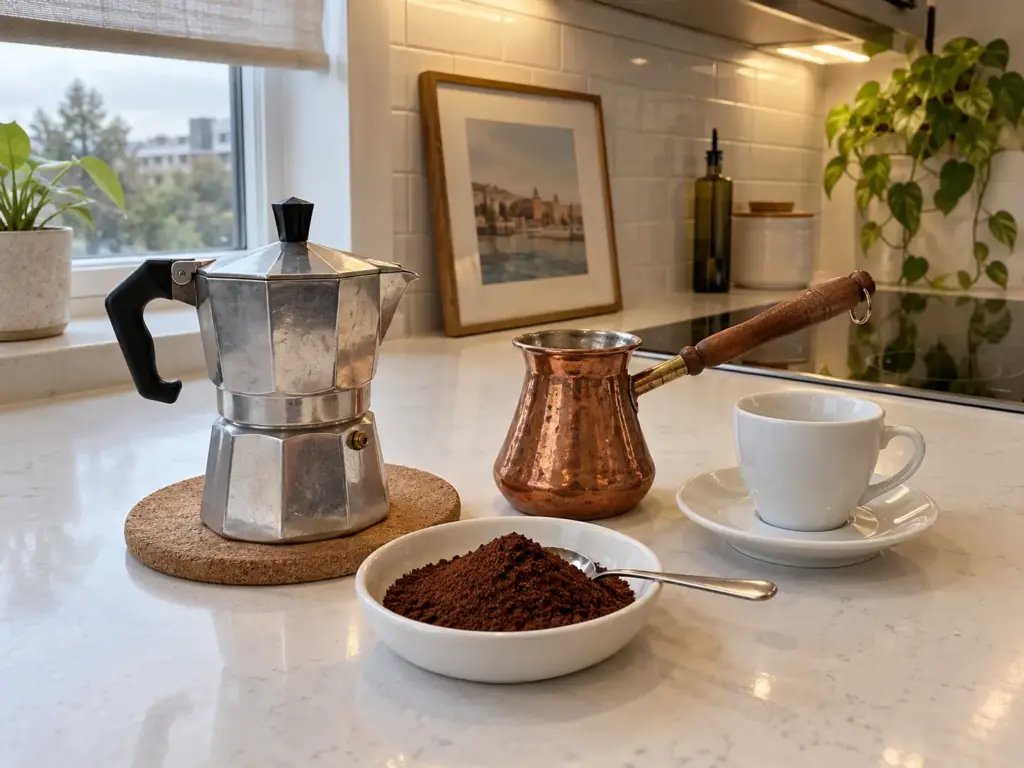
Line up the numbers by weight and the pattern is plain. Espresso runs about 1:2, 18 g of coffee in and 36 g of drink out, in 25 to 30 seconds, and lands at roughly 7 to 12% TDS. A moka pot comes in around 2 to 4%, a cezve for Turkish coffee around 4 to 8%.
A French press, with a coarse grind and a dose of 60 to 75 g per liter, sits at 1.30 to 1.55%, stronger than the 1.15 to 1.35% a drip cup aims for, and it gets there with the coarsest grind of the lot. The ratio did that, not the grind.
Immersion adds a twist. According to a UC Davis model of brew strength and extraction yield, in a full-immersion brew strength is “approximately inversely proportional to the water/coffee mass brew ratio, while E is independent of the brew ratio”, with E standing for extraction. For a French press soak, then (and the same goes for an AeroPress steep or a jar of cold brew), the ratio is the strength dial, and the grind mostly changes how fast the soak gets where it’s going. That holds for immersion only: a drip basket is percolation, and its extraction does shift with the dose.
In a soak, the water becomes saturated and cannot extract more coffee unless you leave it for a long while.
The Grind Follows the Clock
Espresso is ground fine because the water passes through in seconds, and only a fine grind gives up enough in that window; the timing side is covered in espresso grind is set by the seconds. A moka pot is fine for another reason: the bed has to hold the water back while steam pressure pushes it up through the grounds, and the moka pot’s grind is a balance between a bed too loose to resist and one so tight the pot stalls.
In both, the grind was chosen to match the contact time. Strength was never the reason for it.
Espresso-Fine in the Wrong Brewer
A bag labeled espresso grind sounds like the strongest thing on the shelf, so it ends up in French presses and drip machines. The label names the brewer it was ground for, and says nothing about how strong it makes anything.
In a press, the fine particles slip through the mesh and settle as silt, and the cup turns muddy and bitter rather than stronger. The grit at the bottom of the last sip is the tell. The mesh screen assumes coarse grounds, which is why a French press wants a coarse grind.
In a moka pot, espresso-fine grounds can choke the flow until the pot sputters or stalls. In a drip basket they meet the paper filter, which has its own limit, and that’s where the next section starts.
Getting a Stronger Cup From the Gear on Your Counter
What the formula allows depends on what sits on your counter. Some setups give you only the grind, some only the dose, and a pod machine gives you almost nothing to turn. So the one change comes in a different order for each.
An Automatic Drip Machine
A drip coffee maker sets its own brew time and water temperature, so the grind is the only extraction lever you have. In the UC Davis drip trials, the researchers hit each strength and extraction target by changing the grind size and the overall brew time together; at home the machine has already fixed the second one for you.
The same study found that, once strength and extraction were matched, the water temperature made no appreciable difference to the taste, so the grind is the lever worth your attention. The grind also has a floor. KitchenAid’s support page says it plainly: “Grounds that are too fine can clog the filter and lead to an overflow.”
Grinding finer for a stronger cup works in a pour-over like a V60, where you can watch the drawdown and pour around a slow bed. In a drip machine it runs into the paper. Going finer until the basket is almost overflowing can give a better cup, yet still not the one you want. A useful stopping point is the grind where the water sits just above the coffee during the brew, and no finer.
So the order is one step finer, brew, taste. If the next cup is fuller without a dry edge, keep the setting. If the filter basket runs up near the rim, stop there and add a gram of coffee instead — and never both in the same brew, or you won’t know which one did it. The basket, the filter and the rest of it are in the drip machine’s grind.
A Burr Grinder With Numbered Steps
With a numbered burr grinder you dial in the way the drip section does: one step, the same dose, and a taste. Don’t treat the first cup after the change as a clean test: the grinder keeps some grounds inside, so the first dose after a click still carries part of the old setting (the retention story is in the two-dial guide linked earlier).
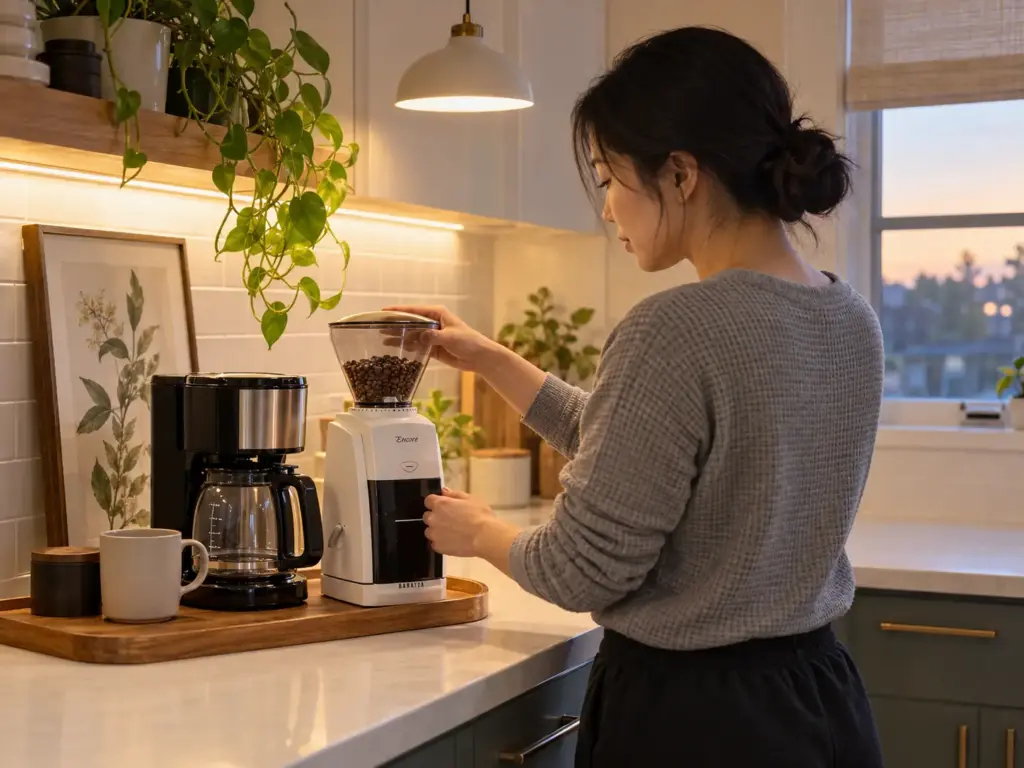
The Baratza Encore has 40 numbered settings on 40 mm conical steel burrs, so one step finer is a defined change you can repeat, or undo the next morning if it overshoots. Reviews aren’t all kind to it: some units stop working after a few months. Static that makes grounds cling to the bin, and a loud grind, are the complaints that keep coming back.
On a grinder with a coarser dial, go one full step at a time. Actually, where the grinder allows it, I’d start with half. The OXO Brew Conical Burr Grinder has 15 settings plus micro-adjustments between them, and half a step is about the size of change this page keeps recommending, though durability is its sore spot: of the 970 mentions of durability in its Amazon reviews, 715 are negative, mostly motors that burn out or seize.
A Blade Grinder or a Pre-Ground Bag
A blade grinder has no setting at all. It grinds by time: the longer it runs, the finer the average, and the more dust it makes alongside the chunks. So finer on a blade grinder means dustier, and the dust over-extracts while the chunks, the boulders, under-extract (why a blade grinder makes a cup sour and bitter at once is the full story).
The Hamilton Beach Fresh Grind 80335R is a typical one, a single button over stainless blades, and one reviewer’s warning doubles as the technique: “Just be careful, the motor burns out easily. Grind in little 3-second pulses.”
Short pulses with a shake between them keep the spread tighter than one long run, and how long to run a blade grinder has the seconds. It still won’t give you a strongest setting. It doesn’t have one.
A pre-ground bag has the opposite problem. The grind was set at the factory, whatever the label says about fine, bold or extra bold, and those words describe the roast or the brand’s idea of the cup, not a grind you can move. That leaves the dose and the ratio: add a gram, taste, and add another only if the cup still tastes right but light. Freshness is the bag’s other limit, and it comes up in the next section.
A Pod Machine and Its Strong Button
A pod machine fixes almost everything. Keurig’s user guides say the strong button (other machines call it a bold setting) kicks up your coffee’s strength and intensity, and give no mechanism. Some describe it as a slower flow through the same pod, so the brew simply takes longer to finish. With the dose fixed, that longer contact can only pull a little more from the same grounds, so expect a modest change for the extra wait. A 12 oz brew can taste a little weak, and a common answer is that the real problem with Keurigs is that the K-Cups are just too small.
The free lever is the brew size. The same pod brewed at 8 oz instead of 10 oz comes out about 25% more concentrated, by the same arithmetic as the table. Pick the smaller size first and taste. If that mug is too small for you, the next step gives you back the dose: the Keurig My K-Cup Reusable Coffee Filter, a stainless mesh basket in a plastic holder with MAX, cup and mug fill lines, lets you choose both the grams and the grind.
Filling a reusable pod to the top can give a much richer cup than a K-Cup. Two weak points stand out: the lid is held on by a very fragile plastic hinge pin, and without a paper liner the mesh lets sludge into the cup. When a pod cup tastes weak for reasons that have nothing to do with strength, look at when a weak K-Cup is not the grind.
The fill lines on a reusable pod measure volume, not grams, and what a fill weighs changes with the roast and the grind. Weigh one fill at the line you use, once. At 1:17, a 10 fl oz brew wants about 17 g of coffee; if your fill comes in well under that, choose the next brew size down rather than living with a thin mug.
When the Cup Is Weak and the Grind Isn’t the Reason
A cup that tasted right last month and tastes weak now, at the same setting, rarely needs a finer grind. Something else moved. Turning the dial to chase it only hides whatever that was.
Check the Dose Before the Dial
Start with the scoop, because it moves most. A new bag of a darker or lighter roast changes how many grams a scoop holds, and so does the way it gets heaped on a hurried morning. Put one dose on the scale and compare it with your recipe before blaming anything else.
Then check what lands in the mug, because the yield isn’t the water you poured. Weighed both ways, the coffee bed holds back water, so the yield comes out lower than the water poured in.
Strength is counted per gram of drink, so two recipes that pour the same water can land different mugs, and comparing them by the kettle hides the difference.
Worn Burrs and Old Beans
Burrs dull with use, and a dull edge breaks beans into slightly bigger pieces at the same number, so the setting that brewed a full cup when the grinder was new brews a thinner one months later. If you find yourself going a click or two finer to get last month’s cup, the number stayed where it was and the burrs didn’t. The signs that burrs need changing and how long a grinder lasts cover what to look and listen for.
Old beans are the other quiet cause. Stale beans give up less at any grind than fresh beans do, so a finer setting ends up chasing a cup the beans can no longer deliver; tell if the beans have gone stale before you blame the grinder. Ground coffee loses its freshness faster than whole beans, which is part of whether grinding your own is worth it if you’ve been buying the bag pre-ground.
Whenever a cup tastes right, write the grinder setting, the grams and the roast date on a strip of masking tape stuck to the grinder. When a weaker cup turns up weeks later at the same number, the tape tells you whether the beans changed or the burrs did, instead of your memory of where the dial used to sit.
The Next Question Is the Number on Your Grinder
Making a cup stronger without it turning bitter, through the roast, the water and the rest of the recipe, is a bigger question than the grind, and it has its own answers. If the grind is still the dial you’re turning, the next thing to settle is what number your grinder should be on and which direction on its dial means finer.
The roast moves that number too, which is why light roasts need a finer grind for the same strength. And if your dial runs out before the cup gets there, you’re dealing with a grinder that won’t go fine enough, a separate problem with its own fixes.
Finer Until the Water Drags, Then One More Gram
- Strong means how much coffee is dissolved in the cup. The ratio sets most of it, and the grind moves it only through extraction.
- The strongest grind is the finest one your brewer still runs at its normal speed. Past it, the cup gets harsher, not stronger.
- When the cup tastes right but light, add weighed coffee: about 1.7 g on a 10 fl oz mug buys what two points of extraction would, without the edge.
A month from now, if the same setting and the same weighed dose brew a weaker mug, look at the burrs and the roast date on the bag before you touch the dial.
Tomorrow, change one thing only: one step finer if today’s cup tasted sour and thin, one more gram if it tasted right but light. Then taste for which way it moved, whether the cup got louder or only rougher.
Frequently Asked Questions
01What grind gives you the strongest coffee?
The strongest coffee grind is the finest one your brewer still drains at its normal speed, because finer takes more out until the water starts to stall or channel. Past that point the cup turns harsher, not stronger, so add a gram of weighed coffee instead.
02Which coffee grind is stronger, fine or coarse?
At the same dose, a fine grind brews a slightly stronger cup than a coarse one, because smaller particles give up more of what they hold to the water. It also brews a more bitter one. Coarse brews weaker: a grind that extracts two points less needs about 1.9 g more coffee per 10 fl oz mug to match.
03Is a finer grind a higher or lower number?
It depends on the grinder: on many burr grinders a lower number means finer, but some brands count the other way, so check the manual once. Then move one step at a time, and see which number to use for your brewer.
04What grind of coffee gives the best flavor?
The grind that gives the best flavor is the one matched to your brewer’s contact time: coarse for a French press, medium for drip, fine for espresso. From there, adjust one step by taste. Sour means go finer, bitter means go coarser.
05Does the strong button on a Keurig use more coffee?
No, the strong button can’t add coffee, because the pod holds a fixed dose; Keurig says the setting raises strength, and owners describe a slower flow through the same pod. Choosing a smaller brew size raises strength more: 8 oz from one pod is about 25% more concentrated than 10 oz.

How did your cup turn out?
No comments yet. Tell us what you changed — and whether the needle moved.