




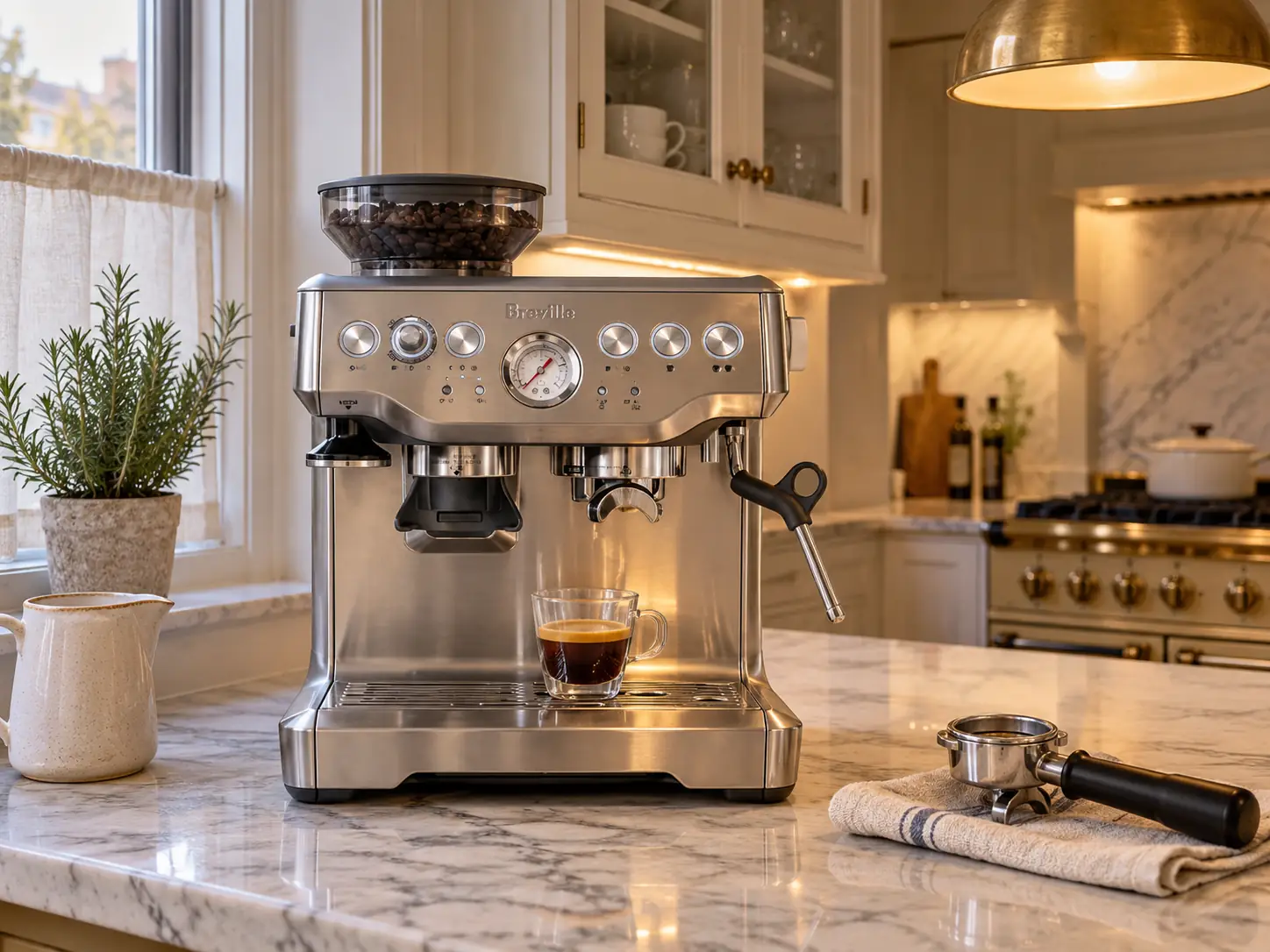
We may earn a commission when you buy through links on this page. It never changes what we recommend. How we pick
On this page8 parts
- Coffee Grinder Not Grinding Fine Enough — Never, or Did It Stop?
- Rule Out the Dose, the Beans and the Basket First
- After a Cleaning, Re-Seat the Burrs and Find the Setting Again
- A Stone, a Knock or Worn Burrs
- When the Grinder Never Could Go That Fine
- What to Do When the Finest Stop Isn't Enough
- Before You Replace Anything, Weigh and Re-Seat
- Frequently Asked Questions
The dial is already on its finest mark, the beans were roasted last week, and the shot still races through the basket in sixteen seconds, thin and sour; on a drip machine the same trouble shows up as a weak, sharp cup. A coffee grinder not grinding fine enough is two different problems wearing one complaint, and a single question tells them apart: did this grinder ever make that grind?
If it never did, you have reached the end of what it was built to do, and nothing is broken. If it did and then stopped, something changed, and the makers themselves print the order in which to look, starting with the checks that cost nothing. Below is the fork, then the free checks, then the grinder itself, and finally the way out when the finest stop is simply the end of the dial, all resting on how grind size moves the taste from sour to bitter.
Quick Answer
Ask the fork question first, then work down the list one change at a time, tasting or timing between steps.
- Ask if it ever ground that fine; if never, its reach is the limit.
- Weigh the dose and time the shot before touching the dial.
- Check for a new bag of beans or a basket swap.
- Re-seat the burrs after any cleaning and retest one setting.
- Look for damage from a stone, metal or a broken burr holder.
- Replace worn burrs, or buy espresso reach only if espresso needs it.
Coffee Grinder Not Grinding Fine Enough — Never, or Did It Stop?
The dial sits at its finest setting and the cup still tastes like a coarse grind. Before you open anything, one question splits the problem in two, and each half has its own fix.
How a Grind That Is Too Coarse Shows Up in the Cup
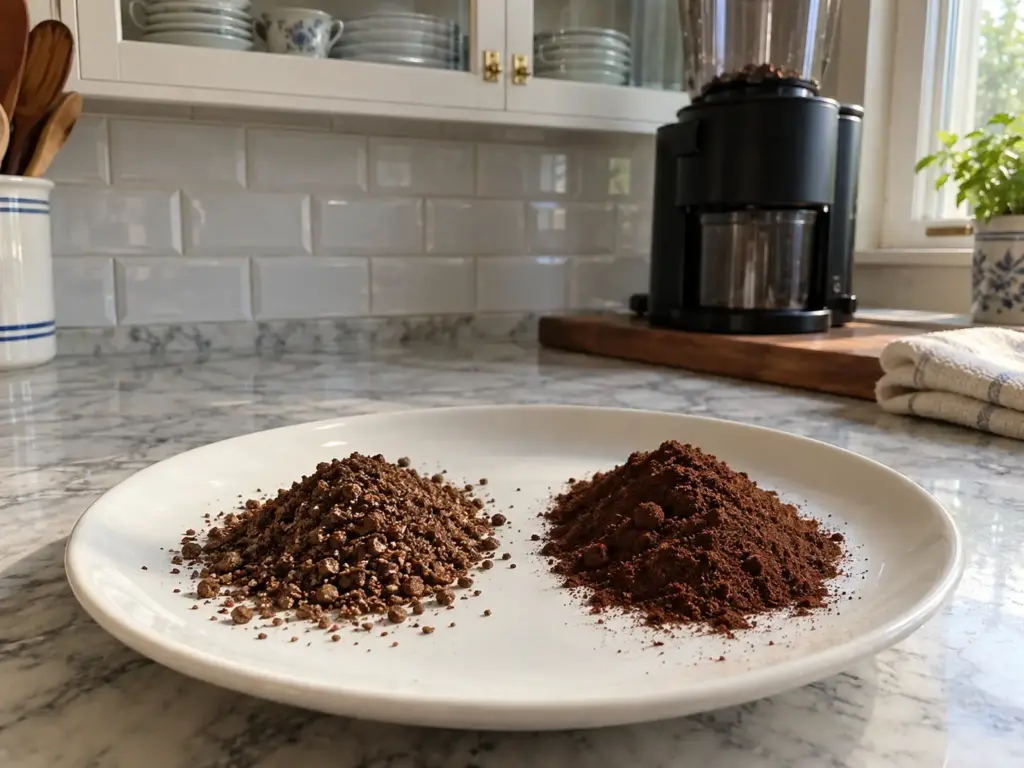
Start with the direction. A grind that is too coarse lets the water run through before it has pulled enough out of the grounds, so the cup comes out sour, thin and weak rather than bitter. The Specialty Coffee Association’s research on brewing charts puts it this way: “To the left at low extraction we have ‘under-developed’ flavors (which are usually interpreted as sour or grassy).” A bitter, harsh cup is over-extracted and points the other way, and grinding finer will only make it worse.
On an espresso machine the shot gives you a number to go with the taste. Breville’s booklet for the Barista Express puts a double shot of 16 to 19 g at 25 to 35 seconds, calls anything under 20 seconds too coarse and under-extracted, and reads a first drip in under 3 seconds as an under-dosed basket, a grind that is too coarse, or both. The extreme case has a name: pouring like a tap. A drip machine has no shot clock, though a brew time that runs short hints at the same thing, so the taste and a look at the grounds do the work (it helps to know how to tell a fine grind from a coarse one by eye and between two fingers).
It Never Went That Fine
Grounds from the finest of a grinder’s 15 settings can still look like coarse grit. A grinder that cannot reach espresso makes a wildly uneven mix of boulders and fines, which explains why its espresso tastes weak. Those are two separate limits hiding behind one word. Reach is how fine the last click goes; grind consistency is how much dust and how many chunks ride along with it.
If your answer is never, nothing needs repairing, and the sections on reach and on the way out are the ones for you. A cheap burr grinder often ends right about there, and that is by design. Most drip and pour-over owners never meet this wall, because they brew well short of the finest stop. The complaint usually starts the day a single-wall basket replaces the pressurized one that came with an entry machine, or the day an espresso machine joins a grinder that was bought for filter.
It Used To, Then It Stopped
A grinder can give good shots for a while and then drift until it only goes slightly too coarse, with the shots pouring out like a tap. Stripping it down and cleaning the burrs did not bring the old grind back. The options split two ways: get a refund and buy a better grinder, or check whether the beans have changed. The second reply is the one to act on first, because a grinder that made the grind once has a state problem, and a state problem usually has a cause you can name.
So ask what happened just before the grind went coarse. A cleaning is the most common answer, then a new bag of beans, then a knock or a hard crack you may have heard during a dose, then plain weeks of use. Each one points to a different check, and they are worth taking in that order, because the first two cost nothing and the last one can cost a set of burrs.
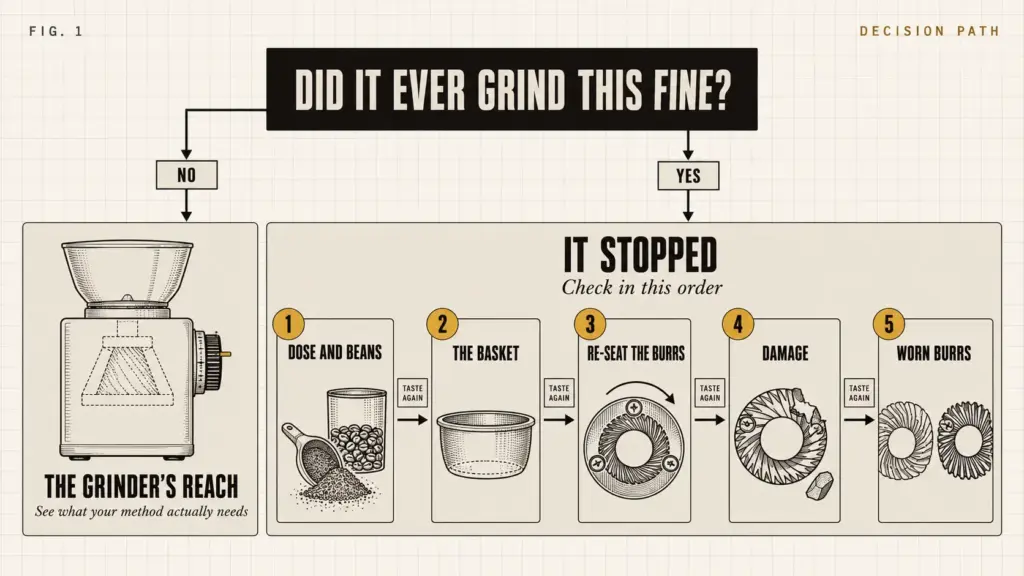
Change one thing at each step and taste or time the result before moving on. Change two at once and you will never know which one did the work.
Rule Out the Dose, the Beans and the Basket First
A light dose, a different bag and a pressurized basket all look exactly like a coarse grind in the cup, and none of them lives inside the grinder. Baratza’s own dial-in guide puts them first: fresh beans, water that is hot enough and a steady flow before any change to the grind.
Weigh the Dose and Time the Shot
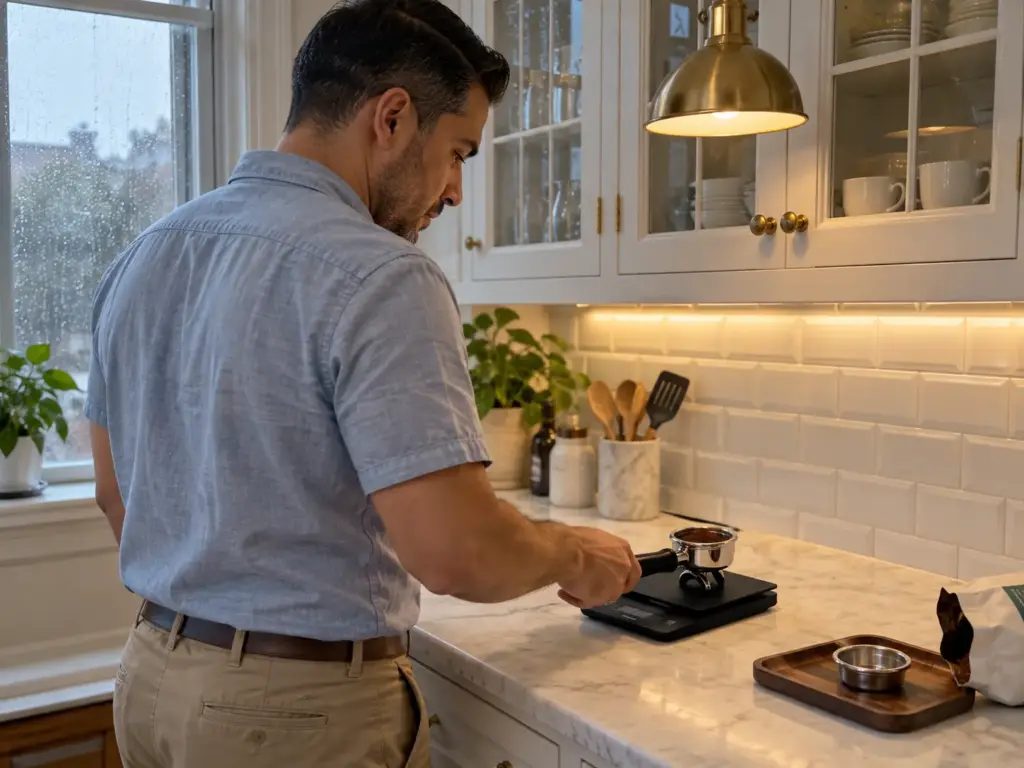
A scoop is a guess, and a low dose passes for a coarse grind. Baratza’s test recipe is 18 g of ground coffee in and 36 g of espresso out in 25 to 32 seconds, with the dose held steady while only the grind moves; Breville, which owns Baratza, gives a close range of 25 to 35 seconds for a 16 to 19 g double. Two grams short in the basket and the shot runs fast at a setting that was fine last week. So weigh the grounds and time the shot before the dial moves at all, and read the time against what espresso grind size actually looks like in seconds.
A drip machine works the same way. A level scoop of whole beans and a level scoop of grounds do not weigh the same, and a cup that tastes weak and sour may be short on coffee rather than long on grind size. Weigh it once, write the number down, and keep it fixed while you judge the grinder.
For that you need a scale that reads small steps. The Hario Drip Scale Timer weighs in 0.1 g steps and runs a timer on the same screen, so the dose and the shot time come from one place; the tenth-of-a-gram precision only earns its keep at espresso doses, though, and a drip brewer can live without it. If filter coffee is all you make, a plain kitchen scale covers it. The Etekcity Food Kitchen Scale reads in 1 g steps with a tare button, which suits a drip dose and is too coarse to steer a 16 to 19 g espresso dose, where one gram is a real share of the basket.
Weigh what lands in the basket, not the beans you pour into the hopper. Every grinder keeps a little coffee inside (retention), so 18 g of beans can come out as slightly less in the portafilter, and that shortfall reads exactly like a coarse grind. Put the portafilter on the scale after grinding, then tare and pull.
A New Bag Can Need a Different Setting
The shot that runs fast the week a new bag arrives says nothing about the grinder. One coffeeforums reply described two bags from the same farm and the same process, roasted by two London roasters and looking identical; on the setting that suited the first, the second ran 8 to 10 seconds too fast, shot after shot. Roast profiles differ even when the beans look alike, and a light roast usually wants a finer setting than a dark roast, which is why a different roast asks for a different setting.
Age moves the setting too. The grind needs adjusting every day as the beans age. Breville’s booklet asks for beans 5 to 20 days past the roast date, and stale beans well past that window flow faster at the same number, so it pays to know how to tell if the beans have gone stale before blaming the burrs. The first shot from a new or older bag is the one that misleads you, because the setting that worked last week is now fast and nothing in the grinder moved.
The Basket That Hides a Coarse Grind
Many entry machines ship with a dual-wall, or pressurized, basket. Breville’s booklet says these baskets regulate the pressure and help extraction regardless of grind, dose, tamp pressure or freshness, which is a polite way of saying they cover for a grind that is too coarse. A grinder can look perfectly adequate for months behind one. Then the single-wall basket goes in, the shot gushes, and the grinder gets blamed for a limit it always had.
Treat the basket swap as a change of its own. Pull a shot, taste it, and leave the grind, the dose and the beans alone until you know what the new basket did by itself; Breville’s own advice here is to make only one adjustment at a time.
After a Cleaning, Re-Seat the Burrs and Find the Setting Again
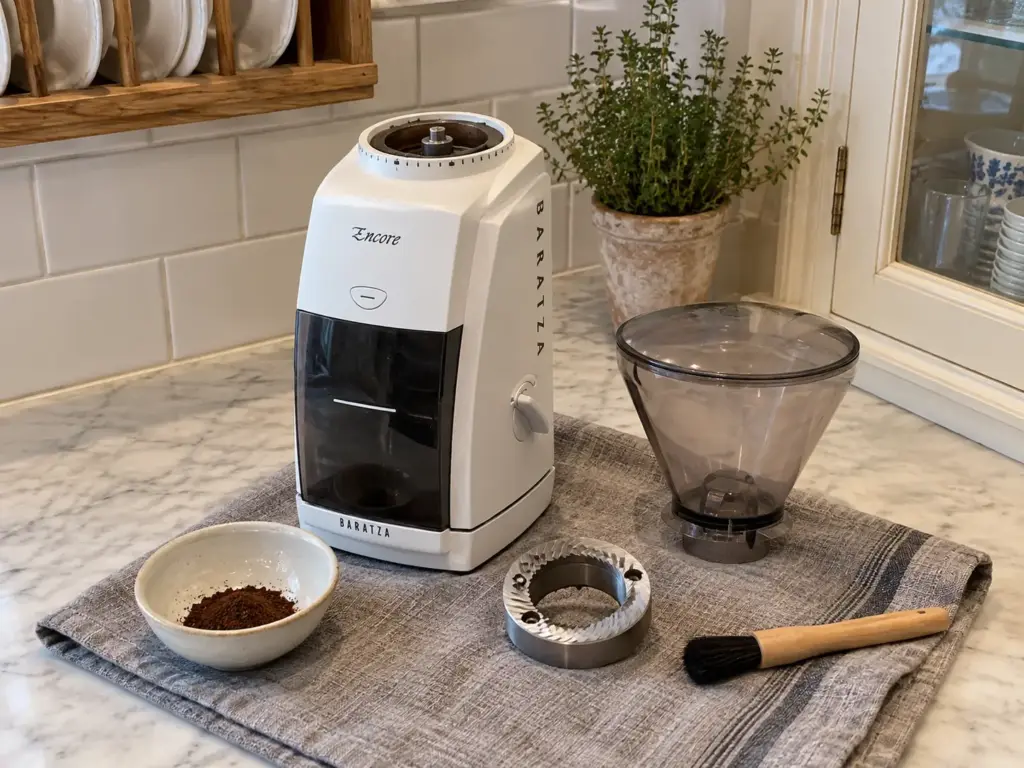
The most common way a grinder goes from fine to too coarse is a cleaning. The burr goes back in slightly off its seat, and the old number no longer means the old grind.
What Moves When the Burrs Come Out
The dial on a conical grinder does not measure size; it moves the ring burr closer to or farther from the cone, and that burr gap is how the two burrs set the size of every particle. Seat the ring burr a little high after a cleaning, or leave the adjustment ring short of its stop, and the gap at setting 1 is wider than it was. Same number, coarser grind. Baratza’s own troubleshooting video for the Encore names a fresh cleaning among the reasons a grind changes, right after hard objects in the beans.
Re-Seat the Burr the Way the Manual Says
The Baratza Encore is the grinder behind a good share of these complaints: 40 mm conical steel burrs, 40 settings from 1 (finest) to 40, and a manual that spells out the reassembly. Brush the burrs about once a month with daily use, and keep water away from the ring burr, which rusts. To put it back, turn the adjustment ring fully counterclockwise, press the ring burr fully into its seat with its red tab lined up with the red mark, and refit the hopper gasket. Only turn the dial while the grinder is running or empty, because both Baratza manuals warn that turning it with beans caught between the burrs can damage it.
Two weak spots show up often. The ring burr holder has three plastic tabs designed to break under load so the motor survives a stone, and holders can break and need replacing. The grind can swing from too fine to too coarse and back after a cleaning, which fits a burr seated differently each time. If an Encore suddenly grinds unevenly, look at those tabs before anything else.
If the burr is seated and you still run out of room on the fine end, Baratza’s dial-in guide names calibration as the next step and notes that many of its grinders ship with the calibration tools in the box. The steps differ by model, so take them from Baratza’s support pages for your grinder.
Before a cleaning, write down the setting you use and take a phone photo of the ring burr and its marks. After reassembly, grind a few grams and throw them out before judging anything: the first dose still carries grounds retained from the old setting, and it lies about where the dial now lands.
Test One Setting, Then Taste
Once it is back together, run one test and change nothing else. Grind the same weighed dose of the same beans at the setting that used to work, purge the first few grams, and brew or pull exactly as before. If the shot time or the taste is back, the seat was the problem and you are done; if it still runs fast by the same margin, move to the next check rather than turning the dial further and hoping.
A Stone, a Knock or Worn Burrs
If a clean, well-seated grinder still stopped going fine, something changed inside it. Either it happened all at once, when something hard went through, or slowly, as the burrs and the parts wore in with use.
When Something Hard Went Through
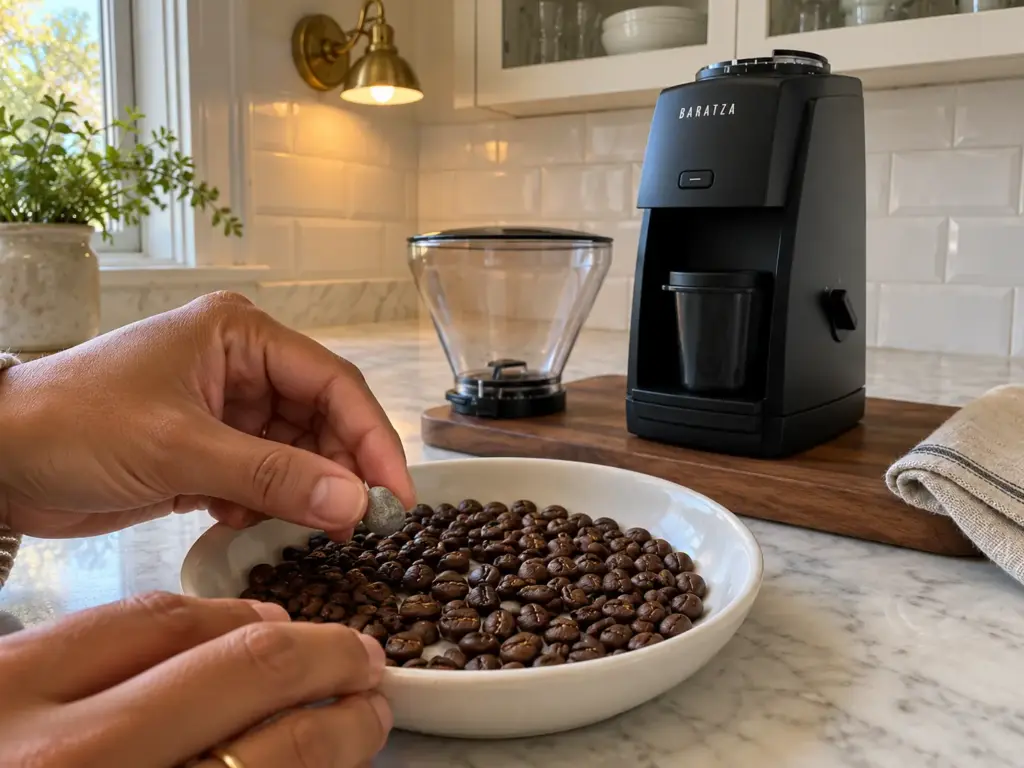
Baratza’s Encore troubleshooting video opens with a plain warning: a dense under-roasted bean, a rock fragment or a piece of metal can end up in a bag of freshly roasted beans. Those hard pieces can damage the upper burr collar, the adjustment ring or the paddle wheel, and once the collar or the ring has shifted, the grind goes coarse whatever the dial says. If one dose made a sharp crack or a new noise, stop, unplug the grinder, empty the hopper and look at the burrs and the grounds before you grind another gram.
A burr that took a stone often grinds unevenly before it grinds coarser. The dose comes out as an inconsistent grind, dust and chunks together, and the cup tastes sour and bitter at once, which is the giveaway that the gap is no longer even all the way around.
And this is where the free fixes carry their own cost. The Encore’s one-year warranty excludes lack of cleaning, normal wear, lack of proper adjustment and foreign objects such as stones and screws in the beans, so the repair after a stone, and any slip made while re-seating, is yours to pay for.
The Drift of the First Months
Month two has an official version, and it comes from the maker. The manual for the Baratza Encore ESP, the Encore’s espresso-minded sibling with 40 mm conical burrs, an espresso range of 1 to 20 and a filter range of 21 to 40, says that as the grinder is used, parts settle and the setting you rely on slowly has to move finer. Baratza calls that normal wear that eventually stops, and then admits: “in some cases, the finest grind settings may not be fine enough.”
For that case the box includes shims. One shim moves the whole range by about five settings, so a shot that needed 10 before lands at roughly 15 afterward, which gives the dial room again at the fine end. The catch is that fitting a shim means taking out the hopper, the ring burr and the cone burr, and if the grinder still cannot reach espresso after that, the manual says there may be an assembly problem or a faulty part and sends you to Baratza support.
A setting that creeps finer on a new grinder is normal for a while. A grinder that loses its whole fine end in eight weeks, like that Bodum, is a different story.
Tell settling from damage by how fast the setting moved. Settling nudges your usual number finer a little at a time over the first months; a stone or a knock throws it coarse all at once, often right after one noisy dose; worn burrs slide it coarse over years. The speed of the change tells you which fix you are looking at.
Burrs That Have Simply Worn
Dull burrs arrive slowly, over years of daily grinding rather than weeks. A Virtuoso+ owner describes recalibrating his grinder with a screwdriver after several years, once the main burr had dulled a little. Worn burrs do more than shift the average coarser: the dose carries more dust and more chunks at the same time, and the cup reads weak and harsh together.
So the answer is a new set of burrs, or at least it is once the free checks have all come back clean and the grinder has years on it rather than weeks. Read the signs that the burrs need replacing before you order anything, and weigh them against how long a coffee grinder lasts, because new burrs cost a fraction of a new grinder when the motor is still sound.
One fault does not belong here at all. If the motor hums, stalls or stops mid-dose, you are dealing with a grinder that hums, stalls or jams, which has its own checks.
When the Grinder Never Could Go That Fine
Back to the other half of the fork. If the grinder never made that grind, nothing is broken: the finest stop is where the maker put it, and on many grinders it was put there for filter coffee, not espresso.
Reach Is a Design Limit, Not a Fault
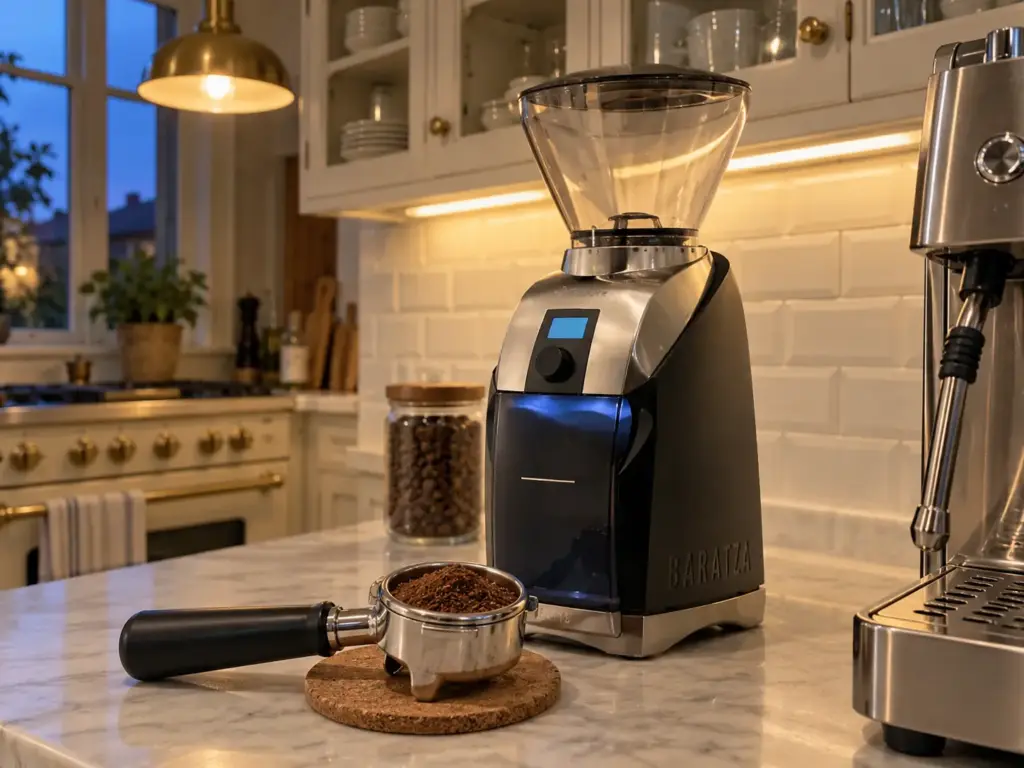
The Encore manual shows how far from the edge most methods sit. Its suggested starting points are 8 for espresso, 12 for AeroPress, 15 for a Hario V60, 18 for an automatic drip brewer, 20 for a Chemex and 28 for a French press, on a dial where 1 is the finest. A drip machine owner starts 17 clicks away from the stop, so running out of room at 1 is never a drip problem (the full list of what number a grinder should be on for each method has its own page).
Step Size at the Fine End
But reaching espresso and being usable for it are not the same thing. Espresso needs small moves near the fine end, and a stepped grinder with big steps can land on one side of the shot you want and then jump past it. The Baratza Virtuoso+ is the clearest case: 40 mm conical burrs, 40 settings and a timer that counts to a tenth of a second, and owners say it serves every filter method well. For espresso, the grind can get fine enough but is hard to dial in properly, since the right setting can sit between two steps with no calibration that lands in the middle.
A stepless grinder, or a hand grinder set with a thumbscrew, has no steps to jump over, which is the whole reason espresso grinders are often built that way.
Recalibrating shifts the whole range finer, and one owner who did it made espresso work with the help of puck screens. The price is range at the other end: every step you move toward espresso comes off the coarse end, where a French press wants to be.
Notes by Model
These notes are model-specific, so check your own manual before you turn an inner burr.
The Breville Barista Express builds its grinder into the machine, with a side selector from 1 (finest) to 16, a suggested start at 5, and an adjustable upper burr under the hopper. Breville’s booklet says some coffees may need a wider grind range and that the upper burr is how you extend it, one adjustment at a time. That makes two dials in series, so setting 1 is not a fixed place: move the inner burr and every number on the side dial lands somewhere new. With the outer dial already on 1 and the inner burr at its factory setting, it can be unclear how the two dials relate.
Adjusting the burrs finer is a common requirement on Breville grinders. The standalone Breville Smart Grinder Pro works the same way, with 60 settings and an upper burr that ships at 6. On coffeeforums.co.uk, an owner of the UK version (sold there as a Sage) had it on setting 1 with fresh beans and still got a 16-second shot; the reply was to pull the upper burr and change its setting, by hand, with the grinder open.
On a grinder with two adjustments, write the setting down as a pair, inner burr first and side dial second, every time you change either one. Without the pair on paper there is no reliable way back to a shot that worked.
What to Do When the Finest Stop Isn’t Enough
If the grinder is healthy and simply ends too soon, there are three honest ways out, and only one of them is a purchase. Take them in order.
Keep It for the Methods It Suits
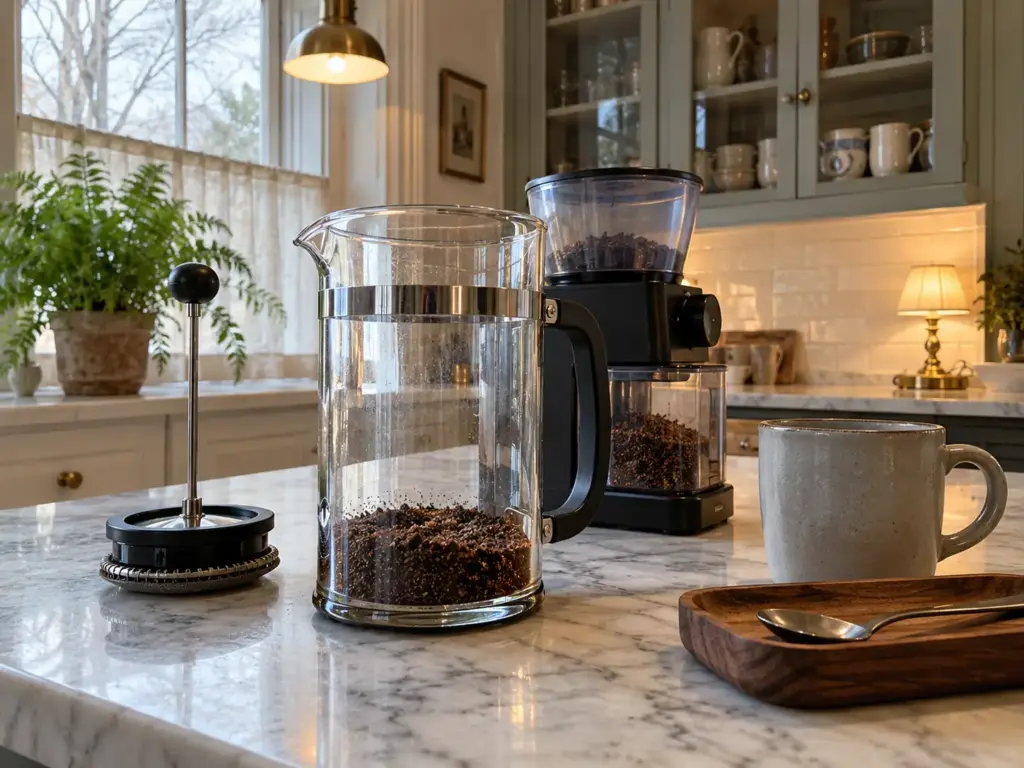
A grinder that stops short of espresso is often a very good filter grinder, and the cheapest fix is to let it be one. Drip, pour-over and French press never ask for the finest stop; on the Encore their starting points run from 15 for a V60 to 28 for a French press, and even AeroPress starts at 12, eleven clicks short of the stop. The UC Davis Coffee Center’s work on the brewing control chart shows the same beans landing in different corners of the chart depending on how they are ground and extracted. A grinder that cannot reach one corner can still hit the others squarely.
So the fix for a sour drip cup from this grinder is to tune the method it does suit, starting with the grind a drip coffee maker wants, rather than chasing a stop it does not have. A grinder built around filter tends to be at its most even through the middle and coarse settings, which is exactly where a French press lives. The Bodum owner ended up thinking about keeping his for the French press and buying a separate espresso grinder, and that split is often the cheapest setup that does both jobs well.
Stopgaps Before Buying Anything
Grind finer is the standard answer to a sour, fast shot, and it stops being an answer the moment the dial sits on 1. At that point Baratza’s own next move is more coffee, not more grinding. Take the stopgaps one at a time, with a taste between each:
- Add a couple of grams to the dose. Baratza suggests a few grams more in the basket when you run out of room on the fine end. More coffee slows the shot at the same setting; if the next one tastes less sour, keep it, and if it turns bitter and slow, take a gram back.
- Go back to the pressurized basket. On an entry machine it will pull a drinkable shot from a coarse grind, which is why one Virtuoso+ owner says the step size hardly matters with those baskets for a mocha. Its drawback is that it hides the grind rather than fixing it, so the shot stops telling you much.
- Use the maker’s own adjustment where one exists. The Encore ESP’s shim, or a calibration from the maker’s support for your model, moves the whole range finer before you spend anything.
Keep the first months in mind, too. A grinder already at its last click on day one has no room left for the settling that comes with use, or for the next bag that wants a finer setting, so a stopgap that works this week is working at the very edge.
When Espresso Really Needs a Different Grinder
If espresso is the point and the stopgaps leave you at the edge, the grinder is the limit and a new one is the answer. What matters is not the badge but fine steps near the espresso end and reach past it, which is what makes a grinder fit for espresso. The cheaper route is manual: a hand grinder with room to dial in espresso costs a fraction of a motorized espresso grinder (and asks for a crank turned by hand before every shot). Keep the old grinder for the drip machine.
Before You Replace Anything, Weigh and Re-Seat
Three things decide what you do next:
- Ask first whether the grinder ever made that grind. Never means reach, and nothing is broken; stopped means something changed.
- Run the free checks in order and one at a time: the dose on a scale, the beans, the basket, then the seat of the burrs.
- Leave damage and wear for last. They are real, but a grinder that runs out of room for espresso is a filter grinder, not a broken one.
A month from now, grind the same weighed dose of the same beans at the same number and time the shot or taste the cup; if it has moved finer or coarser since today, you have caught the settling or the wear while it is still one click and not a new grinder.
Tomorrow morning, weigh the dose, leave everything else as it was, and move only the grind setting one step finer. Then taste: less sour and a little fuller means the grinder still has room, and a bitter edge means you went one step too far.
Frequently Asked Questions
01Why is my coffee grinder not grinding fine enough?
Either it never could, because its finest stop was set for filter coffee rather than espresso, or something changed since it last made that grind. Check in order: a light dose, new or aging beans, a burr re-seated wrong after cleaning, damage from a stone, then worn burrs.
02How do I make my coffee grinder grind finer?
Turn the dial finer only while the grinder is running or empty, and change nothing else before you taste or time the result. If you run out of room, the maker’s calibration or shim comes next. A blade grinder has no dial, so it only grinds finer by running longer.
03My Encore isn’t grinding fine. What can I do to fix this?
Weigh the dose, then re-seat the ring burr fully, with its red tab on the red mark and the adjustment ring turned fully counterclockwise. The standard Encore starts espresso around 8 of 40; if it still runs fast there, Baratza support covers calibration, and the Encore ESP is built for that range.
04Why isn’t my coffee grinder grinding at all?
A grinder that will not grind at all has a different fault, such as a jam, a stone, a tripped motor or a broken burr holder, rather than a setting that is too coarse. Unplug it, empty the hopper and check the burrs before anything else.



How did your cup turn out?
No comments yet. Tell us what you changed — and whether the needle moved.