




We may earn a commission when you buy through links on this page. It never changes what we recommend. How we pick
On this page9 parts
- Why No Chart Can Tell You What Number Your Grinder Should Be On
- Where Five Common Grinders Start, From Each Maker's Own Guide
- Your Grinder Isn't on the List? Find Its Number in Three Brews
- Move by Taste, Then Write the Number Down
- Why Your Number Drifts, and When the Dial Runs Out
- No Numbers on the Dial, or No Dial at All
- If No Setting Fixes the Cup
- Start From Your Grinder's Own Number, Then Let the Cup Move It
- Frequently Asked Questions
A coffee grind chart says medium is 15, so you turn your grinder to 15, brew the same pot you always brew, and pour something thin and sour. If your grinder is an OXO Brew Conical, that chart just sent you to the coarsest setting it has, and water runs through grounds that coarse before it has pulled enough out of them.
That is why the honest reply to what number should a coffee grinder be on is another question: out of how many? A grinder’s number is not a size but a place on that one grinder’s dial, and makers number dials of different lengths, 15 steps on one, 40 on another, 60 on a third. Below is where five common grinders start by their makers’ own guides, how to find the number on a grinder that came with no guide, how far to move it once you know which way grind size moves the taste, and why the number won’t stay put.
Quick Answer
There is no universal number: a grinder’s number is a position on its own dial, and every maker numbers a different range. Match your brewer’s word (fine for espresso, medium for drip, coarse for French press) to your maker’s setting, such as 18 of 40 for drip on a Baratza Encore, then taste and move. Lower is usually finer.
Why No Chart Can Tell You What Number Your Grinder Should Be On
A chart can tell you which grind a brewer wants. It cannot tell you where that grind sits on your dial, because the digit on a grinder marks a position on one maker’s adjustment ring and measures nothing about the grounds themselves. The question only gets an answer once the grinder has a name, and for five common grinders the answers land a long way apart.
Five Grinders, Five Different Scales
The Baratza Encore runs from 1, very fine, to 40, very coarse. The Breville Smart Grinder Pro has 60 settings, the OXO Brew Conical Burr runs from 1 to 15 with micro-settings in between, and the Fellow Ode Gen 2 fits 31 settings onto a dial printed 1 to 11. The Comandante C40 hand grinder prints no scale at all: you count clicks from a zero you find yourself.
Now ask each maker where a drip coffee maker goes. Baratza says 18. Breville prints a band from 31 to 45, OXO prints 6 to 10, Fellow draws an arc that covers roughly 7 to 9½, and Comandante prints no drip row.
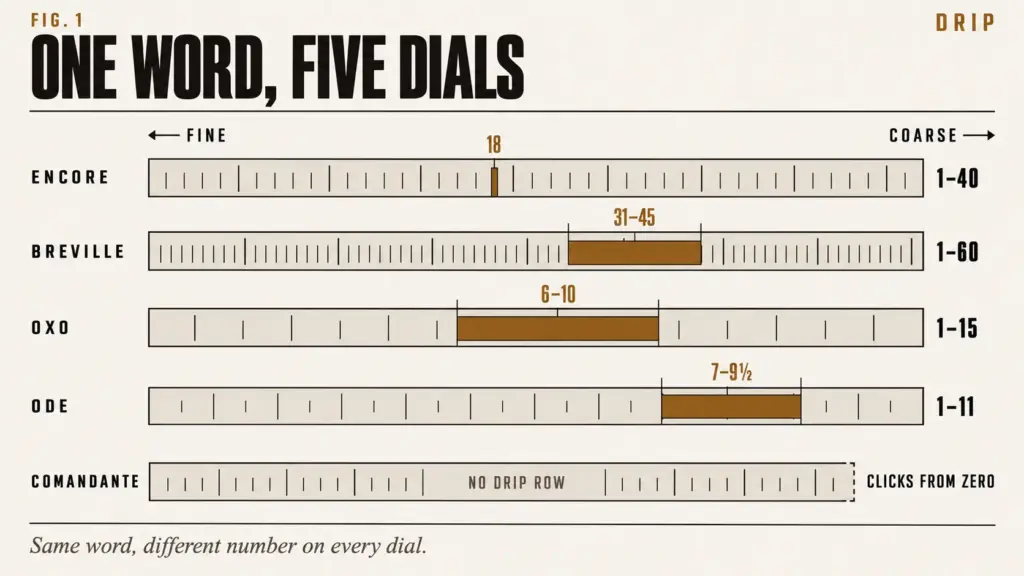
Laid side by side, one word ends up in very different places. Eighteen of 40 sits a little before halfway, while 31 to 45 of 60 sits past it (those shares are our arithmetic; no maker prints them). A number carried from one grinder to another misses by more than you would guess. Take 15: on the Encore it is Baratza’s own start for a Hario V60, and on the OXO it is the coarsest grind the machine makes.
Ask what a number 5 grind is and the answer splits four ways. On the Encore it is finer than Baratza’s own espresso start of 8. On the OXO it sits at the top of the espresso band, on the Ode it falls inside both the AeroPress and the pour-over arcs, and on a Comandante five clicks from zero is in the maker’s band for Turkish coffee in an ibrik. One digit, four different grinds.
The Same Dial Changes When the Burrs Change
A digit is not even fixed on one model. The original Ode shipped with standard burrs that grind as fine as 500 microns, and the grind guide printed under its hopper lid was drawn for them. The Gen 2 burrs go as fine as 250 microns, and Fellow’s own help page says that printed guide is not exactly applicable to them. Same dial, same numbers stamped around it, a finer grind behind every one.
The Breville hides a second version of the same problem under its hopper. Its upper burr is adjustable too, with a default position of 6, and Breville’s manual shows moving it one number at a time to stretch the range finer or coarser. So two owners of the same grinder, both set to 38, can be grinding different sizes if one of them moved that upper burr and forgot about it.
On a Smart Grinder Pro that came secondhand, or one somebody once set up for espresso, run it empty, lift out the hopper and read the upper burr’s number before you trust any chart. If it is not at the default 6, every number on the front dial has shifted with it, and Breville’s printed bands no longer point where they say.
Why a Setting Converter Can’t Exist
A grinder setting converter sounds like something that should exist: type in 18 on an Encore, get the Breville number back. It can’t work. A converter needs a unit that both numbers share, and the digits have none. Mahlkönig, which builds grinders for cafés, says so in writing: “the grind collar numbers are arbitrary,” and they don’t line up with an objective measurement of the distance between the burrs.
And more settings don’t close the gap. Consumer Reports, which tests every grinder at a coarse, a medium and a fine setting, notes that some grinders go up to 60 settings and says plainly that “extra settings don’t automatically mean better results.” Its top-rated grinder, the OXO, does the job with 15.
What does travel between grinders is the word. Fine, medium and coarse mean the same thing on every machine, and the grind size chart by method gives that word for each brewer. Your dial turns the word into a number, and the cup tells you whether the number was right.
Where Five Common Grinders Start, From Each Maker’s Own Guide
If the number belongs to the grinder, the honest place to start is the one its maker prints. Here are those starts for five grinders, where the maker prints a band instead of a single number, and what each machine does badly. Every figure comes from the maker’s own manual, FAQ or dial guide.
The Starting Settings, Brewer by Brewer
The Baratza Encore is the only one of the five whose maker prints one starting number per method: 8 for espresso, 12 for AeroPress, 15 for a Hario V60, 18 for an automatic drip brewer, 20 for a Chemex and 28 for a French press. Baratza still calls these starting points, and its manual says the exact setting comes only from experimenting and from your own palate. The other four makers print bands, drawings or click counts, and the table keeps them as printed.
| Grinder | Scale | Espresso | AeroPress | Pour-over | Drip machine | French press |
|---|---|---|---|---|---|---|
| Baratza Encore | 1–40 | 8 | 12 | 15 (V60), 20 (Chemex) | 18 | 28 |
| Breville Smart Grinder Pro | 1–60, plus upper burr | 1–30 (start 12) | not printed | not printed | 31–45 | 55–60 (recipe: 58) |
| OXO Brew Conical Burr | 1–15, plus micro-steps | 1–5 | not printed | 6–10 | 6–10 | 11–15 |
| Fellow Ode Gen 2 | 1–11, 31 steps | not for espresso | ≈2½–6 | ≈3½–8½ | ≈7–9½ | ≈8½–10½ |
| Comandante C40 MK4 | clicks from zero | 7–13 clicks | depends on your recipe | 18–35 clicks | no drip row | 25–35 clicks |
Fellow’s guide is a drawing with no digits in its text, so the Ode figures are read off its arcs by eye and can be half a number out either way. Not printed means the maker gives no setting for that brewer, and the cell stays empty rather than borrowing someone else’s number.
Even a single printed number can move under you. One Amazon reviewer whose Encore was replaced found that the new unit ground differently from the first (Baratza had changed the burr calibration in between), and his own ballpark became 6 to 8 for espresso, 18 to 24 for drip and pour-over and 30 to 35 for French press, against the printed 8, 18 and 28. Same model name, same numbers on the ring, a different grind.
Where a Maker Prints a Band, Start in Its Middle
The Breville Smart Grinder Pro prints its chart in bands: espresso 1 to 30, drip 31 to 45, filter and percolator 46 to 54, French press 55 to 60. For a drip machine, start near the middle of that band, around 38, and know that the middle is our arithmetic, not Breville’s number. The espresso start of 12 is Breville’s own, as is the advice to start at 30 with dual-wall (pressurized) filter baskets and go finer if needed, and its French-press recipe calls for 58. Fifteen numbers is a wide band, and that width is why the cup has to finish the job.
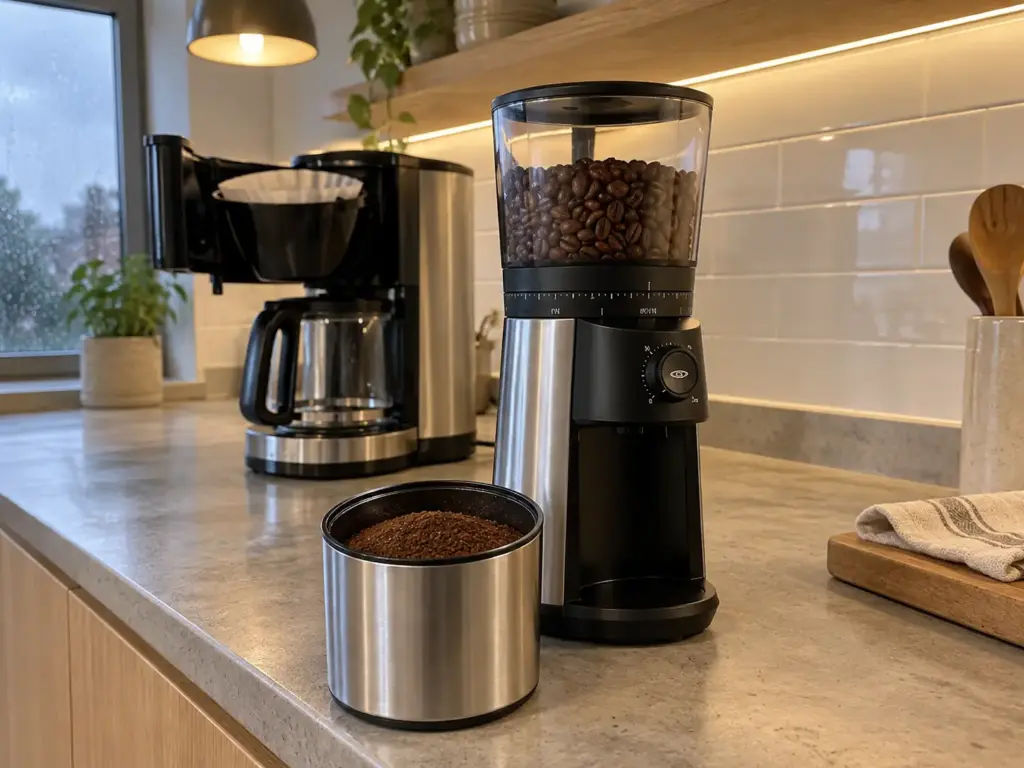
On the OXO Brew Conical Burr, medium runs from 6 to 10 and covers both pour-over and drip, so a drip machine starts around 8, again our midpoint. Fine is 1 to 5, and coarse, for French press and cold brew, is 11 to 15.
Fellow prints a picture instead. Its dial guide for the Gen 2 burrs is a set of arcs laid over the dial, and read by eye the electric coffee maker arc runs from about 7 to 9½. Start the Fellow Ode Gen 2 near 8 for a drip machine and treat every Ode figure as roughly, never exactly.
A hand grinder needs a zero before it has a number. On the Comandante C40 MK4, close the burrs a click at a time: zero is the first click at which the handle no longer falls on its own, and the step-by-step for finding a hand grinder’s zero covers the rest. From there the maker’s pour-over band is 18 to 35 clicks depending on dose and brewer, which is 17 clicks wide. For AeroPress it simply says the setting depends on your recipe, and it calls every one of these a starting point, with your own taste and your own grinder deciding the rest.
What Each of These Grinders Gets Wrong
Durability is the worry that keeps coming back with the Encore. Several Amazon reviewers report one failing within about two months, and owners who keep theirs running name the plastic tabs on the burr holder, which can snap under load, as the part to keep a spare of. Noise and static on the counter come up too.
Expect the Breville’s steps to be too coarse for fine espresso work. Sometimes 7 is too coarse and 6 too fine for a shot, with nothing in between, so changing the dose is the way out; grinders can also leave grounds inside and clump.
The OXO gives up a few conveniences for its grind. Its timer runs a little past the time you set, the lower burr doesn’t come out for cleaning, and the worst reviews describe it stopping mid-cycle and clogging.
Buy an Ode knowing it can jam. Amazon’s review summary says it jams often, and one 2-star owner takes it apart once or twice a week to clear the exit. Fellow’s own FAQ adds that the dial can stick when you turn it finer with the motor off, so adjust toward fine with the grinder running.
With the Comandante, the number lives in your head. There is no dial to read, so you have to remember the click count, and reviewers say the clicks are big enough at the fine end that some add an aftermarket click kit to split them for espresso.
Your Grinder Isn’t on the List? Find Its Number in Three Brews
Most grinders on most counters aren’t any of those five, and plenty of makers print nothing more useful than numbers around a ring. That’s workable. The chart gives you a word for your brewer, and three brews turn that word into a number on any dial.
Check Which End Is Fine Before Anything Else
On all five grinders above, a lower number or fewer clicks means finer grounds. Consumer Reports says fine is usually the lower setting, and usually is the word to keep.
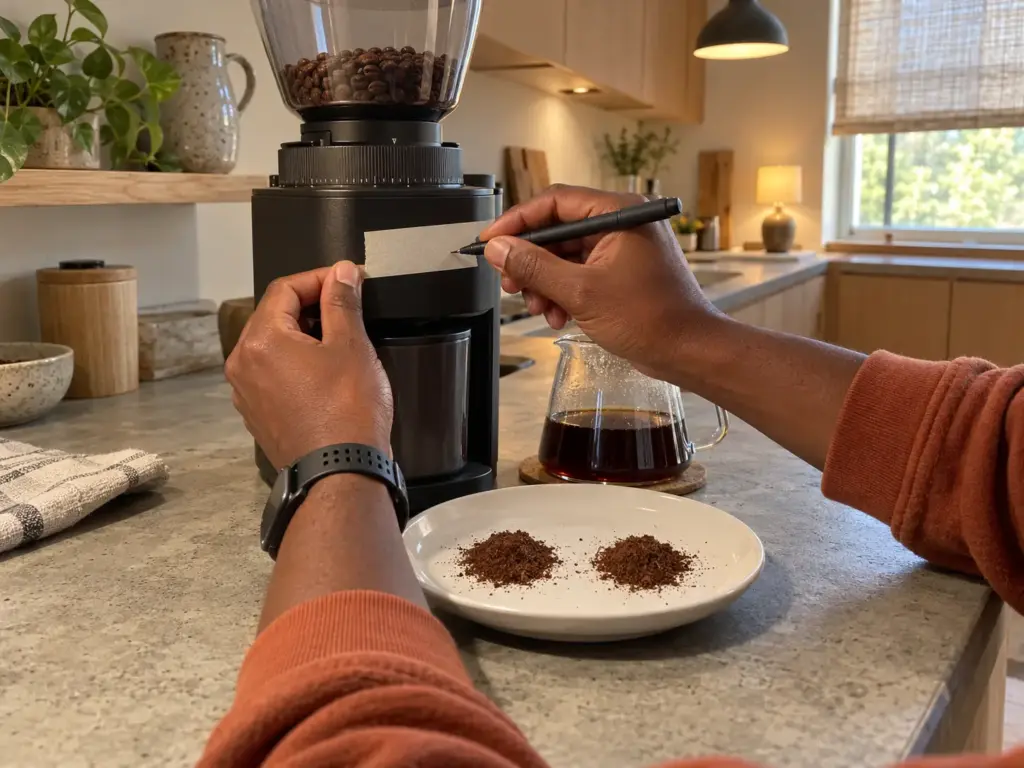
But a ring can be printed either way, and a store-brand grinder with no manual in the drawer gives you nothing to check against. Grind a small pinch at each end of the dial and rub each one between your fingers. Powder marks the fine end, and grit you can feel, like coarse salt, marks the coarse end.
Put Your Brewer’s Word on Your Dial
Starting in the middle of the dial sounds like a safe rule for a drip machine, and on the OXO it holds, with drip at 6 to 10 of 15. On the others it slips. Drip lands just under halfway on the Encore (18 of 40) and in the coarser half on both the Breville (31 to 45 of 60) and the Ode (about 7 to 9½ of 11). The makers only agree at the ends: espresso sits in the fine end on all five, and French press sits near the coarse end.
So on a dial with no guide at all, our reading of those five makers goes like this: espresso near the fine end, a moka pot or AeroPress a little coarser (medium-fine), drip and pour-over around the middle or a little past it, French press near the coarse end and cold brew at the extra coarse end. Then the cup moves it. Before the first brew, give your eye something to aim at. Take a small pinch from a bag of pre-ground coffee sold for your brewer and check the grounds against a sample on a white plate, turning the dial until your pinch and the reference look alike. Then run the three brews, with the same weighed dose, the same water and the same brewer each time:
- Brew at that position and taste for one direction only: sour, or bitter.
- Move the dial the way the cup points and brew again with nothing else changed.
- Brew a third time at the new number, or halfway back if the second cup went too far, to confirm it.
Keep that reference pinch in a small labeled jar next to the grinder. It will go stale for drinking long before it stops being useful, because a reference only has to look right. After a deep clean, or on the day the ring gets bumped, it lets you check the dial by eye in half a minute instead of spending a pot on it.
Mark the Number Where You’ll See It
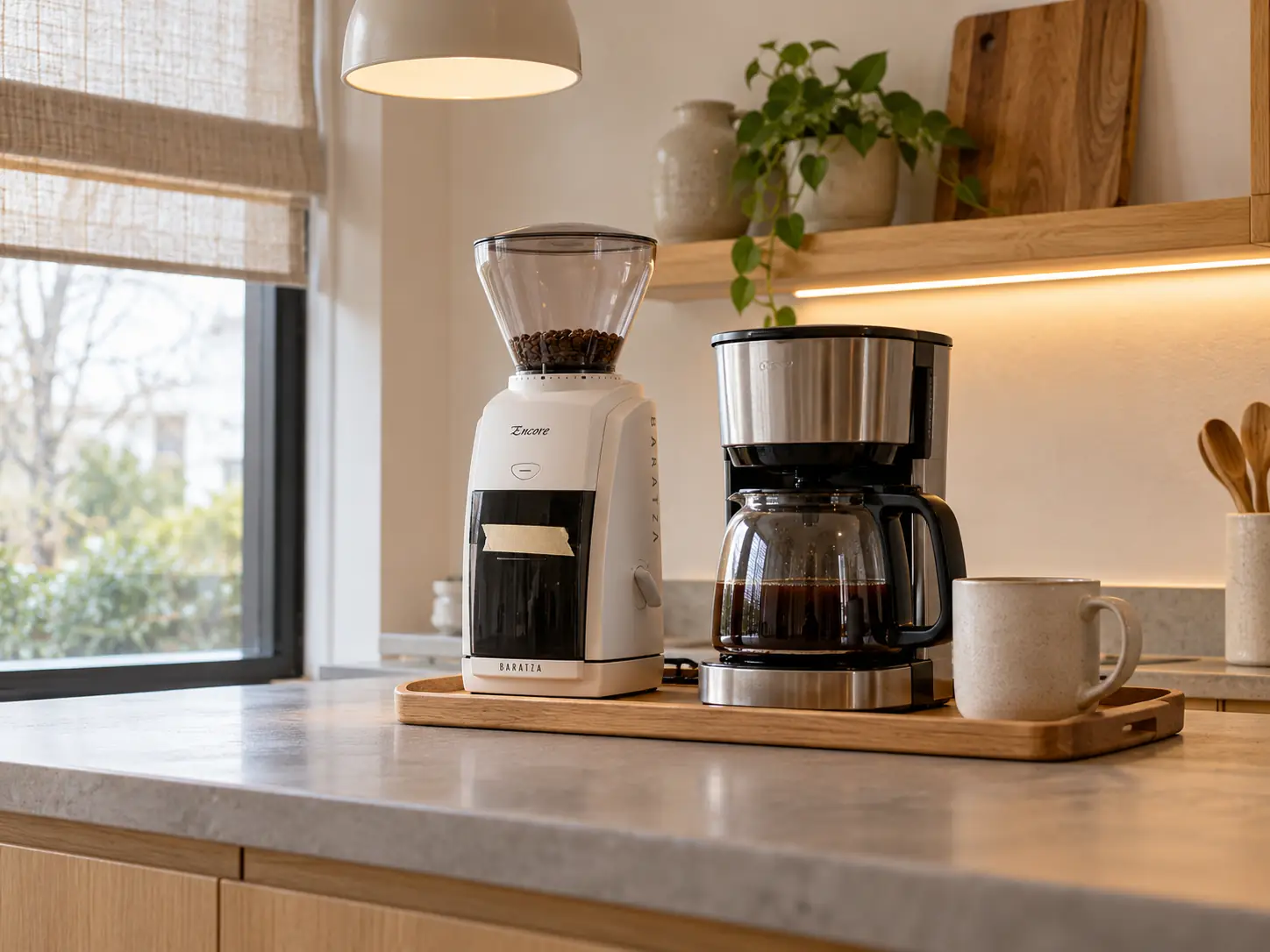
Once a number works, write it where you will see it the next time you brew: a strip of masking tape on the grinder with the number and the brewer, or a note inside the cupboard door if two people make coffee in the same kitchen. The tape does a second job on a ring with no detents, which can creep a hair when you wipe out the hopper or knock the grinder while cleaning around it. If the ring no longer lines up with the mark, you know it moved before the cup tells you.
Move by Taste, Then Write the Number Down
The starting number is only a start. The cup decides the rest: which way to move, how far to go on your particular dial, and when to stop turning the dial and change something else.
Sour Means Finer, Bitter Means Coarser
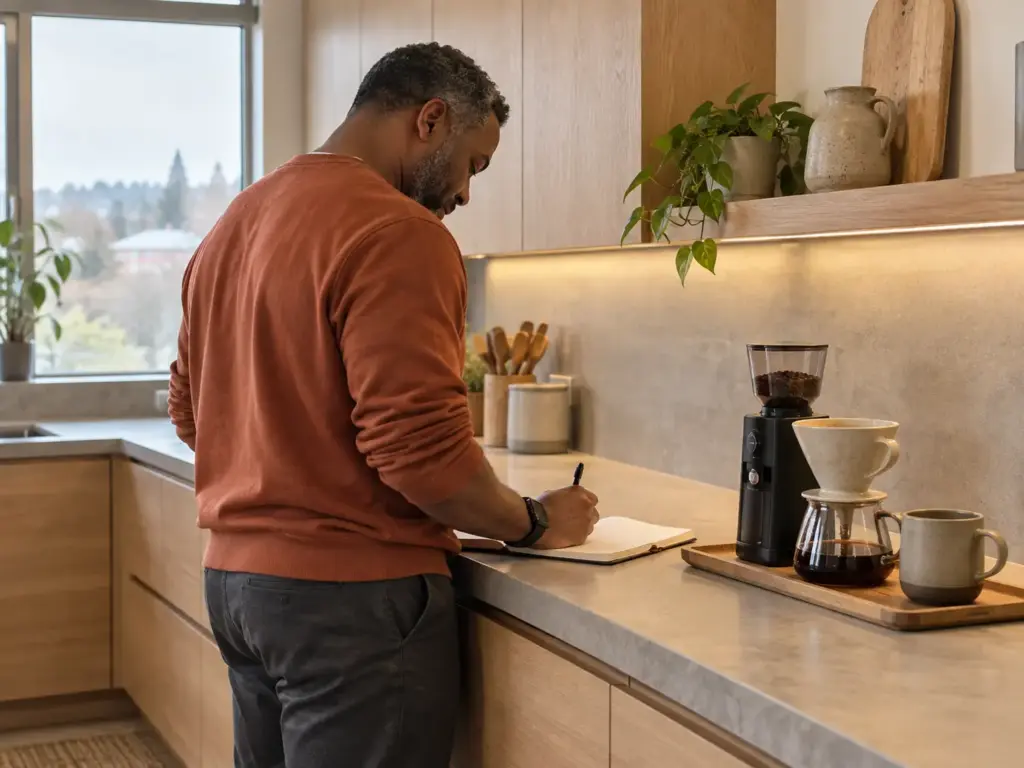
A sour, thin or weak cup is under-extracted: the water left the grounds before it pulled enough out of them, so go finer. A bitter, harsh or astringent cup is over-extracted: the water had too long or too much surface to work on, so go coarser. That is all dial in means, whatever the grinder.
One catch after every move: a grinder holds some grounds inside, so the first dose after you turn the dial still carries part of the old setting. Run a few grams through and throw them out before the brew you plan to judge.
How Many Numbers to Move on Your Dial
A step on a 60-step dial is a smaller change than a step on a 15-step dial, so one step means something different on every burr grinder (and on a stepless one there are no steps at all, only how far you turn the ring). A single click at a time works on the OXO, where each number is a big slice of the range. On the Breville’s 60 or the Encore’s 40, one step may make no difference you can taste, and a couple of pots disappear finding that out.
A bigger first move can work: 3 or 4 clicks in the direction the cup points, then back if it overshot, which is faster and less wasteful than going click by click. It is still one change, then taste. The second move should be smaller, about half the first, so a jump of four that turned a sour cup bitter comes back two, not four.
When One Step Overshoots, Change the Dose Instead
Sometimes the right grind falls between two steps. The 3-star Breville reviewer hit exactly that, with 7 too coarse and 6 too fine. When a single step already overshoots, the dial has done what it can, so change the dose by a gram or two, the same logic as the advice to weigh the dose before you move the dial. The same reasoning settles whether 3 or 4 is stronger: 3 is finer on most grinders and extracts more at the same dose, but how strong a cup tastes depends mostly on how much coffee goes in, which is where which grind setting makes the stronger cup picks it up.
Then write the number down, with the brewer and the bag. Your starting setting may differ from anyone else’s: a starting 12 may be 13, 14 or 11 for you.
Put three things on the tape, not one: the number, the brewer and the roast of the bag. When the next bag is a darker or lighter roast, you will already expect the number to move a step, instead of wondering whether something happened to the grinder.
Why Your Number Drifts, and When the Dial Runs Out
The number on the tape is right for that bag, that stretch of weeks and those burrs. Change any of the three and it moves, and sometimes the number your brewer needs sits past the last one on the dial.
A New Bag Can Move It a Step
A new bag, especially a different roast, can shift the right number by a step or so, which is why the roast belongs on the tape. Mahlkönig goes further for espresso on its commercial grinders: it says the best espresso grind shifts during the day with humidity, bean age and burr temperature. That is a café claim about espresso, not something a home drip pot will show you. It still makes the point that the number was never a fixed property of the coffee.
A new grinder resets everything, even when it is the same model. The Encore owner whose replacement unit ground differently had to find all his numbers again, and an Ode reviewer who came over from a worn hopper grinder, one run nearly to the coarse end of its dial, needed a completely different number for the same cup. Recalibrate on a new grinder: re-find the number, never copy it from the old one.
Worn Burrs Show Up as Time Before They Show Up as a Number
One OXO reviewer clocked his grinder at its lowest setting: exactly 20 seconds for his dose when it was new, and 28 to 30 seconds after about three years, which he reads as burr wear: as the burrs dull, each bean takes longer to pass through. The dial never moved. The time did.
That order is worth knowing, because drift at the counter tends to show up the same way, as a change in time before a change in taste. A drip pot drains a little faster at the same number, or the shot time on an espresso machine gets a little shorter. And when you find yourself several numbers finer than the tape just to get the cup the tape’s number used to give you, check the signs it’s time to change the burrs before you blame the beans.
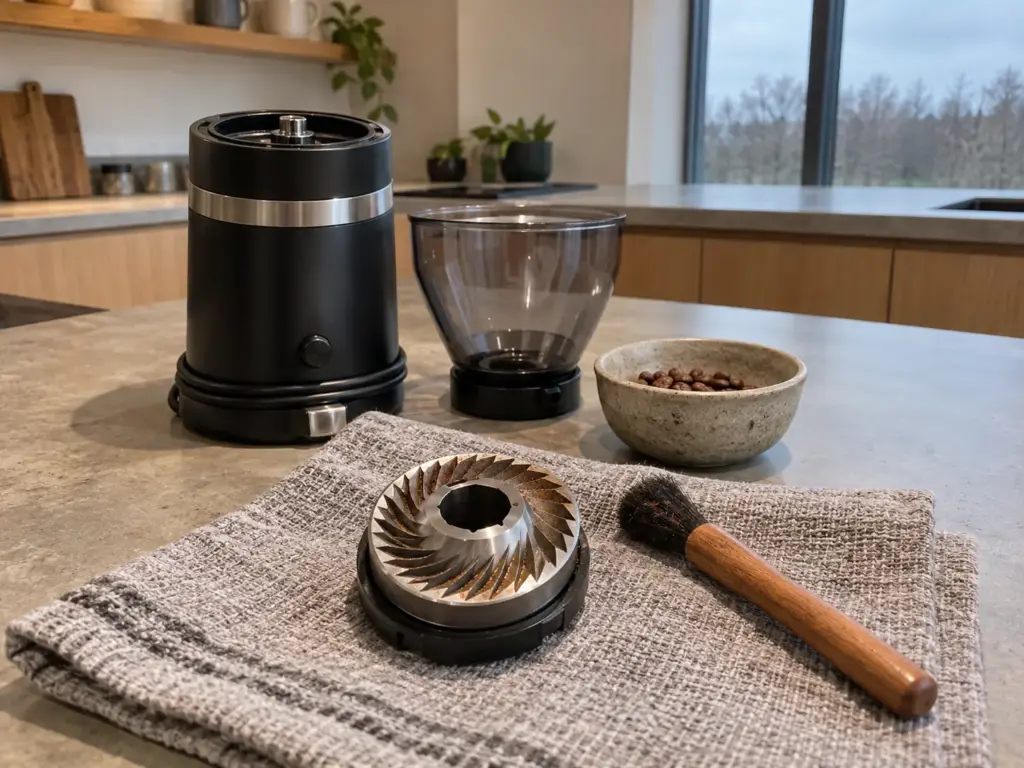
Brush the grinder out first, though. Old grounds packed around the burrs and in the chute can slow a grind too, and a cleaning costs nothing, so it goes ahead of any conclusion about wear. If the grind time comes back after a proper clean, the burrs were never the problem.
While the grinder is new, time how many seconds it takes to grind your usual dose at your usual number, and add that figure to the tape. A slower grind at the same number is the earliest sign the burrs are wearing, and a stopwatch reads it long before your palate does.
When the Number You Need Is Past the End of the Dial
Every dial has an end, and on some grinders it comes before espresso. Fellow says it plainly about the Ode: it isn’t suitable for espresso, because its range won’t get down to the under-200-micron grind espresso needs. The 3-star Breville reviewer reached his shot only after moving the upper burr. When the number your brewer needs is past the last one printed, there is no finer number to find, and the next question is what to do about a grinder that won’t grind fine enough.
No Numbers on the Dial, or No Dial at All
Plenty of kitchens have a grinder with pictures instead of digits, a blade grinder with one button, or a bag that came already ground. For each of them the number means something different, and in two of the three cases it isn’t a number at all.
A Dial With Pictures Instead of Digits
An icon is a maker’s band drawn as a picture. Start at the icon for your brewer and move toward the neighboring icon by taste, the same way you would move a number: toward the espresso cup if the pot is sour, toward the French press if it is bitter. Breville’s own chart shows how much a picture can carry, since its drip column is split by filter, one for a gold-tone mesh filter and one for paper. The icon is telling you the filter as well as the brewer.
A Blade Grinder Counts Seconds, Not Settings
A blade grinder has no setting. The size comes from how long it runs and how much coffee is in the chamber, and it makes large and small pieces at once, which is why the cup can taste sour and bitter together: the dust over-extracts while the boulders stay under-extracted.
Short bursts with a shake between them, and the same dose every time, is as close as it gets to a number; how long to run a blade grinder gives the seconds. The dose matters more than it looks: the same count of seconds makes a finer grind in a half-full chamber than in a full one, because the blade hits each bean more often. Keep the dose fixed and the seconds become your setting.
Pre-Ground Coffee and Reusable Pods
With pre-ground coffee, the word on the bag is the setting. For drip or for French press is a number somebody already chose, there is nothing on the counter to move, and the fixes left are the dose and the water. A reusable K-Cup wants a medium grind, and the grind for a reusable pod covers the rest.
Without a scale, OXO’s booklet gives a usable yardstick: the level scoop that comes with its grinder holds about 8 grams of medium-ground coffee, enough for one cup. For a new timer grinder, it suggests grinding for 10 seconds and weighing what comes out, which turns a timer into a dose you can repeat.
If No Setting Fixes the Cup
The dial is one adjustment among several. When three honest moves haven’t fixed the pot, the grind setting probably isn’t the problem, and the other suspects come in this order, free and likeliest first:
- Weigh the dose. A scoop of one bag doesn’t weigh what a scoop of another does, and the OXO’s level scoop of about 8 g is a starting point, not a measurement.
- Check the roast date. Stale beans make a flat cup at any number, and no setting brings back what has already faded.
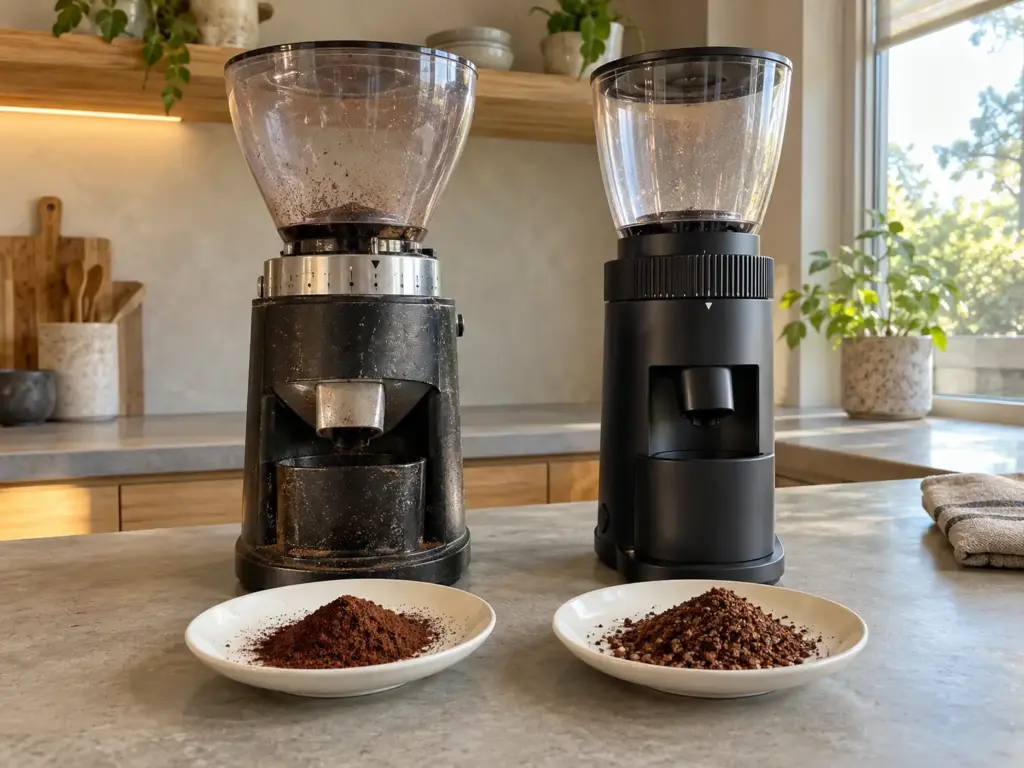
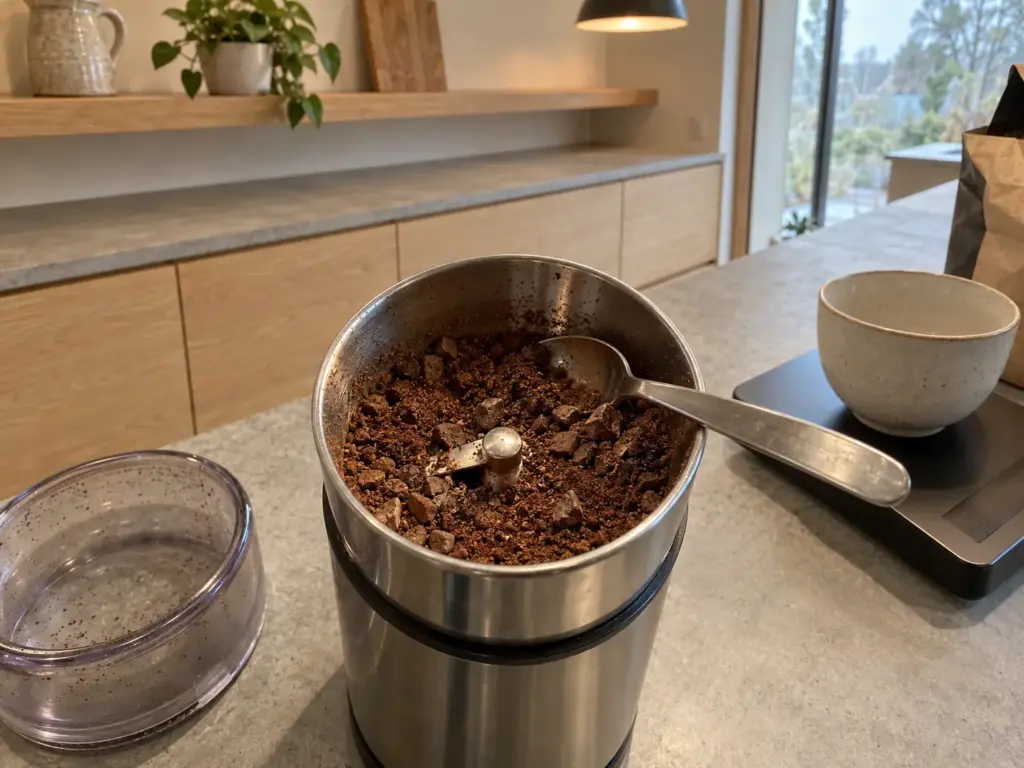
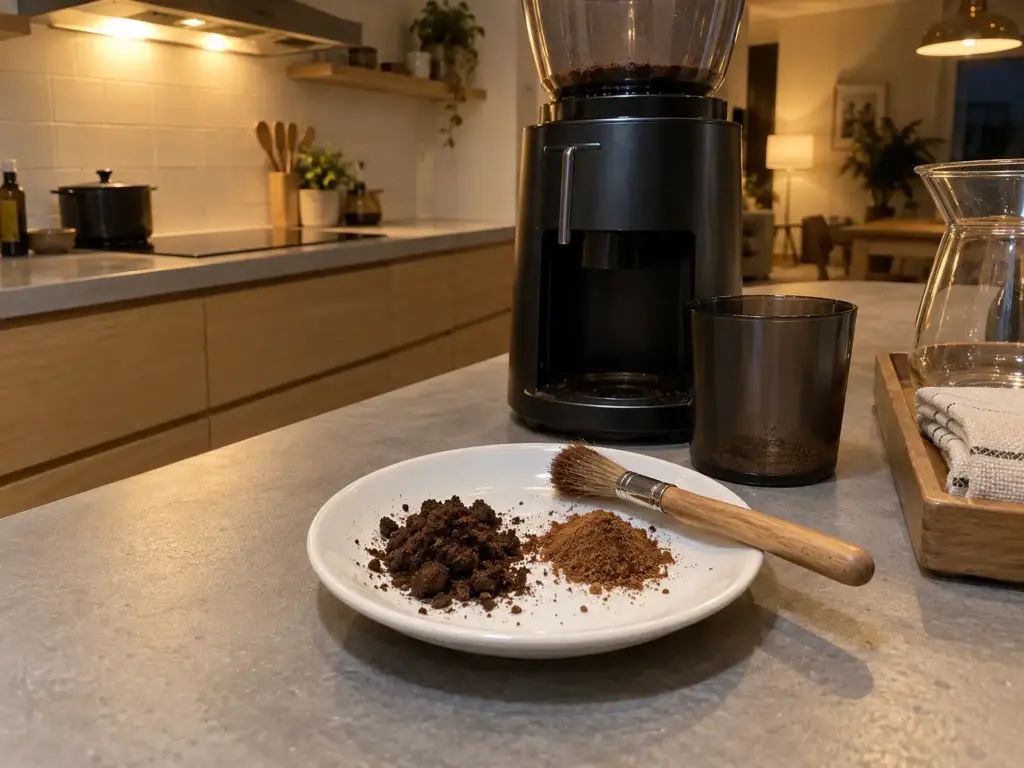
- Brush out the grinder. Old grounds and oils collect in the chute, and a spoonful of fresh grounds tipped onto a white plate shows them as darker, dusty specks mixed in with today’s grind.
- Descale the machine. A drip machine that has scaled up runs cooler and slower, which pulls the cup toward sour whatever you feed it.
Consumer Reports’ point that extra settings don’t buy a better cup works from this side too: 15 steps set in the right place beat 60 set in the wrong one, and no number rescues a dose, a bag or a machine that is off.
Start From Your Grinder’s Own Number, Then Let the Cup Move It
- The number belongs to your grinder. Start from its maker’s setting for your brewer, or the middle of the maker’s band, and on a dial with no guide, from the word.
- Move by taste, one change at a time: a bigger first move on a finely stepped dial, a smaller second one, and a gram of dose when a single step overshoots.
- Write the number on the grinder with the brewer and the roast, and expect it to move with a new bag, a new grinder and older burrs.
A month from now, brew the same kind of bag at the number on your tape and time the pot or the grind; if it runs faster or tastes thinner at the same number, check the bag, then the ring against its mark, then the burrs. Tomorrow morning, set your maker’s start for your brewer, brew your usual pot, taste for one thing only, sour or bitter, and move the dial once in that direction.
Frequently Asked Questions
01What is the best grind number for coffee?
There is no single best number, because every grinder numbers its own range and the same digit means a different grind on each one. Start at your grinder maker’s setting for your brewer (the Baratza Encore prints 18 of 40 for a drip machine), then move by taste.
02Which number is finer on a coffee grinder?
On most grinders the lower number is finer, and on all five grinders in this article, 1 or the fewest clicks is the fine end of the range. Check yours by grinding a pinch at each end and rubbing it between your fingers before you trust the ring.
03Is coffee 3 or 4 stronger?
On most grinders 3 is the finer setting, and a finer grind extracts more from the same dose, so a cup ground at 3 usually tastes stronger than one at 4. How strong a cup tastes still depends mostly on how much coffee goes in, so weigh the dose first.
04What number should a coffee grinder be on for a latte?
A latte starts with a shot of espresso, so use your grinder’s espresso setting: Breville prints a start of 12 of 60, and Baratza prints 8 of 40 on the Encore. Some grinders, like the Fellow Ode, cannot grind fine enough for espresso at any number.
05Is there a coffee grinder setting converter?
No converter can carry a number from one grinder to another, because their scales share no unit and each maker numbers a different range of grind sizes. What carries over is the word, fine, medium or coarse, and the taste of the cup you are trying to match.



How did your cup turn out?
No comments yet. Tell us what you changed — and whether the needle moved.