

We may earn a commission when you buy through links on this page. It never changes what we recommend. How we pick
On this page8 parts
- The Coffee Grind Size for a Moka Pot Is Medium-Fine
- Why a Moka Pot Chokes on an Espresso Grind
- Read the Pot, Then Move One Step
- Why Your Grinder's Number Disagrees With Every Chart
- Pot Size, Roast and Pre-Ground Coffee
- When It Isn't the Grind, and What Changes by Month Two
- Start at Table Salt, Then Let the Pot Steer
- Frequently Asked Questions
Three pages about your new moka pot all say medium-fine, which sounds settled until one of them tells you to set a Baratza Encore to 6, the next says 7, and the Encore’s own manual starts espresso at 8. That would put the moka setting finer than the maker’s espresso. The pot on your stove doesn’t care which page you trusted, only how hard it has to push.
So what coffee grind size for a moka pot actually works? A moka pot, the stovetop espresso maker Alfonso Bialetti designed in 1933, drives its water up with steam from a small boiler, at a small fraction of the pressure an espresso pump uses, so it can’t force its way through an espresso bed, and it shows you which way the grind is off before the cup reaches your mouth. Below: where to start, why an espresso grind chokes the pot, how to read the pot and move one step, why your grinder’s number disagrees with the charts, what pot size, roast and pre-ground change, and what shifts after a few weeks.
Quick Answer
Start at medium-fine: finer than drip, clearly coarser than espresso, about the texture of table salt. A moka pot’s steam pushes at a small fraction of an espresso pump’s pressure, so an espresso-fine bed chokes it. Thin, sour or a fast gush means one step finer; harsh, or sputtering early, means check the heat, then one step coarser.
The Coffee Grind Size for a Moka Pot Is Medium-Fine
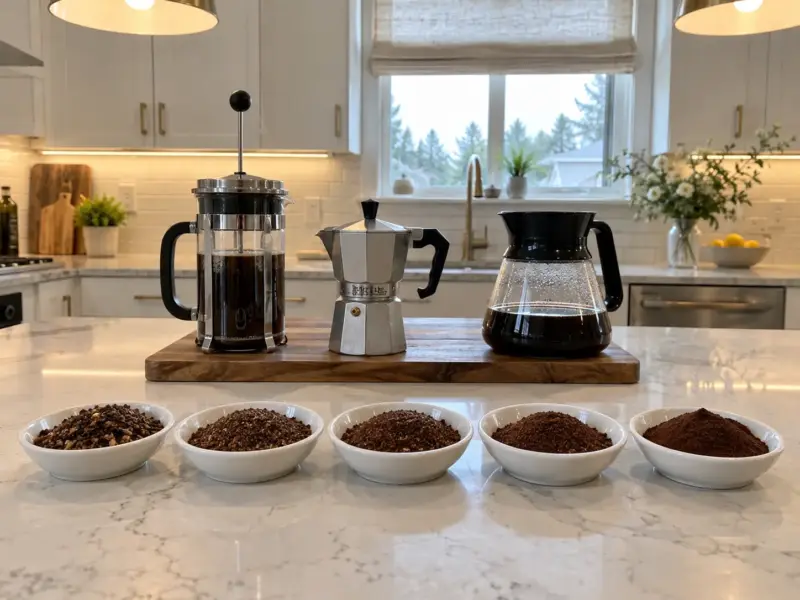
The moka pot grind size to start at is a medium-fine grind: a notch finer than drip and well short of espresso. The trouble begins when you look for a number to go with that word, because the millimeters and microns printed next to it don’t agree with each other. So the texture comes first here, and then what each of those numbers really is.
What Medium-Fine Looks Like on a Spoon
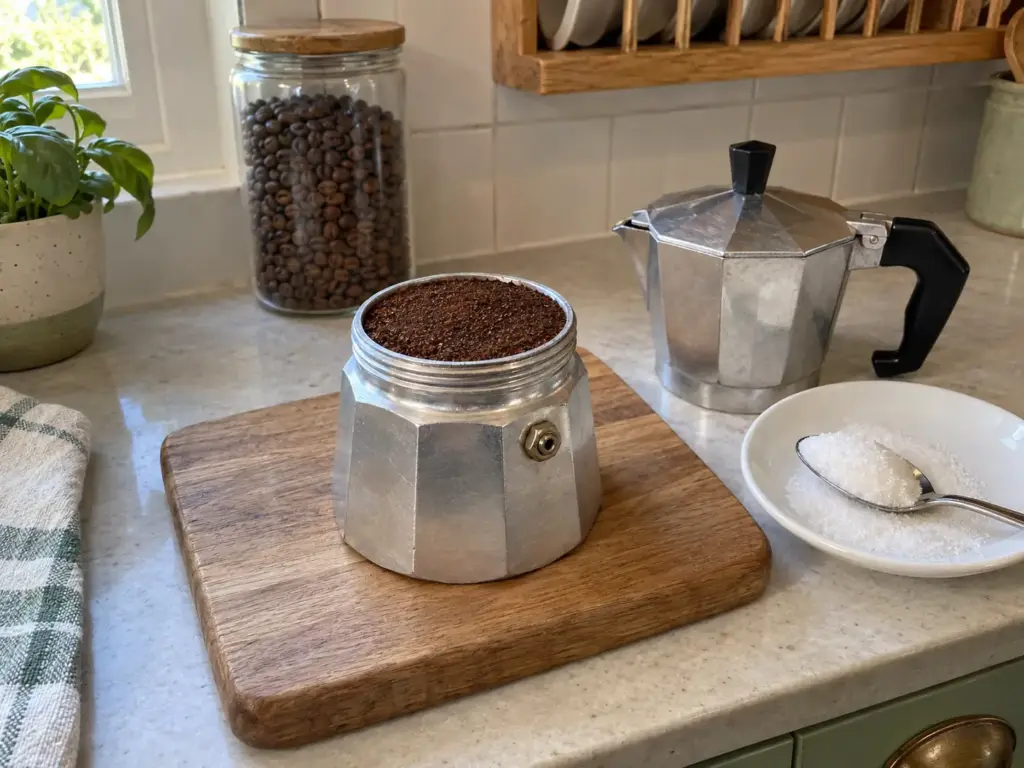
Rub a pinch of grounds between your thumb and finger. Medium-fine feels like table salt: separate grains with a little grit, finer than the sand of a drip grind (and far finer than the coarse sea salt of a French press), and nowhere near the flour of espresso. If the grounds clump when you pinch them and leave a dusty film on your fingertip, you’re in espresso territory, and that’s too fine for this pot (the next section explains why). The pinch test gets a full walk-through in how to tell fine, medium and coarse apart by feel.
Texture words slip, though. The feel of a moka grind is often described as fine sand, and a grind that looks like aquarium gravel is far too coarse.
Same spoon, three different words for it. That’s why the pot’s own signals, further down, count for more than any adjective.
Tip a pinch of table salt and a pinch of fresh grounds side by side on a dark plate, under good light. Grains that match the salt are your starting point. If most of yours look like small gravel next to it, go finer before the first pot, not after it, and skip a couple of thin, sour trial pots.
Where It Sits Between Drip and Espresso
A moka grind sits between espresso and V60. That gives you both edges. The coarse edge is the pour-over grind a V60 uses, and just finer than that is the medium grind a drip machine starts at. The fine edge is espresso, the one grind the pot can’t take.
Medium-fine lands between them, a notch finer than drip. Every brewer’s range sits side by side in the full grind size chart, in microns, so there’s no reason to reprint it here; this page keeps to the moka pot’s row and what to do when that row is wrong for your pot.
Why the Micron Charts Don’t Agree
Two numbers travel with the moka pot, and they can’t both describe the same thing. The first comes from a coffee-science textbook, Britta Folmer’s The Craft and Science of Coffee, which lists an average grind size of 0.250mm for espresso and 0.300mm for stove pots. That’s an average particle, reported second-hand, and only 50 microns coarser than the espresso figure. The second is a range, somewhere between 360 and 660 microns, printed in a coffee guide.
Put them side by side and the problem shows. The textbook’s 0.3 mm is 300 microns, which sits below the range’s own floor of 360 microns. If both described the same grind, the average would land inside the range, not under it. So at least one of them is measuring something else, or both are conventions that picked up a decimal point along the way.
And the organization that sets coffee’s reference numbers doesn’t settle it. The Specialty Coffee Association has standards for extraction and brew strength, but a moka grind isn’t among them, so no standard stands behind either figure. Read both numbers as a neighborhood to start in, and let the pot do the rest.
Fair enough. The pot’s signals are the part that isn’t loose.
Why a Moka Pot Chokes on an Espresso Grind
Medium-fine only makes sense once you see what pushes the water. An espresso machine has a pump; a moka pot has a small boiler full of steam. That difference sets how fine you can go before the water stops moving.
Steam Pressure Versus a Pump
A 2009 experimental study of the moka in Applied Thermal Engineering opens by defining the drink the moka pot doesn’t make: espresso is water at about 194°F (90°C), pushed at around 9 bar for about 30 seconds through a compact cake of coffee. That pressure comes from a pump, and it’s what the grind an espresso machine needs, a fine grind, is built around. In a moka pot, the water in the lower chamber heats, the steam above it builds pressure, and that pressure pushes the water up the funnel, through the grounds in the filter basket and into the upper chamber.
How much pressure? No single figure is solid enough to call measured. A 2025 review of brewing methods in Beverages says the water has to reach about 230°F (110°C), which it puts at about 0.5 bar.
My guess is that the two count from different zeros, one of them including the air around the pot. Either way, the moka pot works at a small fraction of a pump’s push, and a bed fine enough for a pump to drive water through in 30 seconds is close to a wall for steam. If the bed stops the water completely, the pressure has one exit left, the safety valve on the side of the boiler. A hiss from that valve means the pot comes off the heat now, and the next pot gets a coarser grind.
What Fines Do to the Flow
Every grinder makes some fines, the particles under about 100 microns, and a finer setting makes more of them. A Scientific Reports study on fines and flow measured what they do: “An increase of share of fines decreases coffee bed permeability, leads to reduced flow rates and longer extraction times.” That study was on espresso, with a pump behind the water. A pump pushes through a slower bed; steam, at a fraction of the force, stalls in it.
The same study found no penalty in how the espresso tasted with more fines in it, so they aren’t a bitterness switch on their own. What they do in a moka pot is slow the water and, past a point, stop it. The 2009 moka study adds the detail that explains a pot slowing near the end: the coffee bed gets harder to pass as the brew goes on. A grind that only just runs in the first seconds can stall before the top chamber fills, which is why the early flow can look fine and the finish still goes wrong.
Level the Basket, Never Tamp It
Packing the funnel does the same job as grinding finer. A physics review of how water moves through food notes that the resistance of a coffee bed changes with tamping as well as with grain size, and the Beverages review ties the amount of coffee in the funnel to how compressed it is and how hard the water has to work. Pressing the grounds is a second dial. Turn two dials at once and you can’t tell which one mattered.
Packing the funnel hard to get a stronger cup backfires: it gives a weaker, under-extracted brew, and the puck looks almost dry when you knock it out. Water that can’t get through the coffee goes around it. A dry-looking puck is the sign to check your packing before you touch the dial.
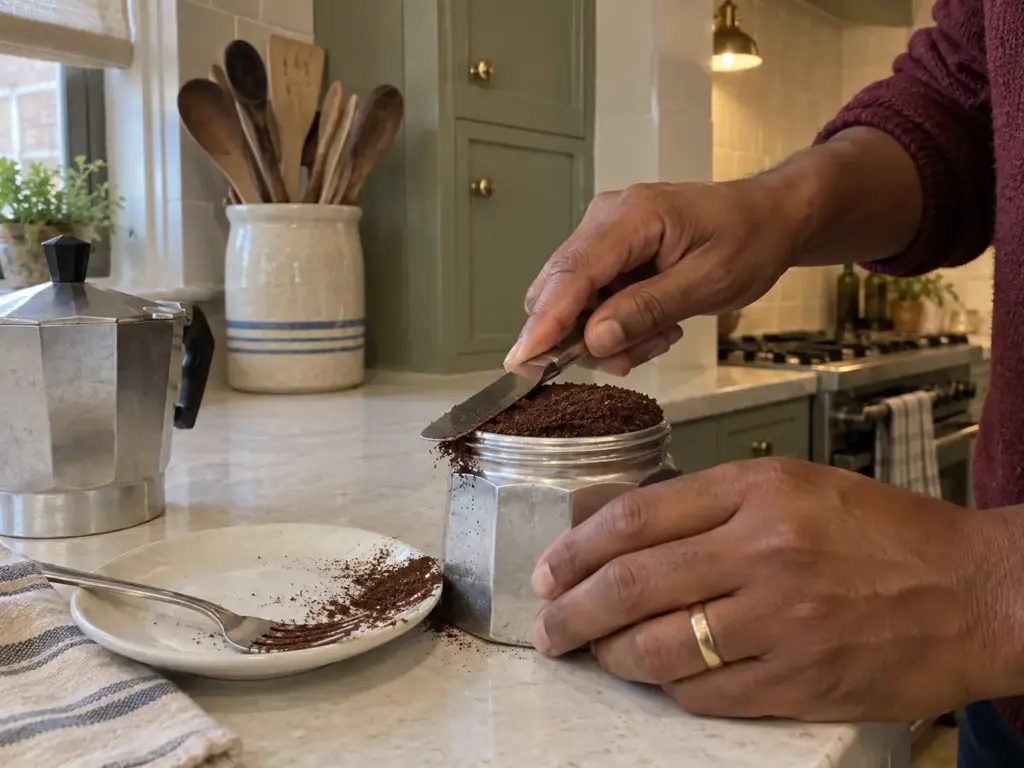
The fix needs nothing but a fork and a knife: fill the funnel almost to the top, run a fork through the loose grounds to break up clumps, add a little more, and level it off with a butter knife. No pressing. Leveling isn’t a grind change, so do it the same way on every pot and leave the dial alone until the basket is consistent.
Fill the funnel to the rim every time, even when you want a lighter cup. A half-full basket changes how much resistance the steam meets, so the pot’s signals stop telling you anything about the grind. For a milder cup, brew the full basket and add hot water to the finished coffee.
Read the Pot, Then Move One Step
The pot tells you which way you’re off before you taste: by how fast the coffee comes up, whether it sputters early, and then by the cup. Each of those signs points to one step on the dial. That step is free, and it comes before anything gets bought.
Signs the Grind Is Too Fine
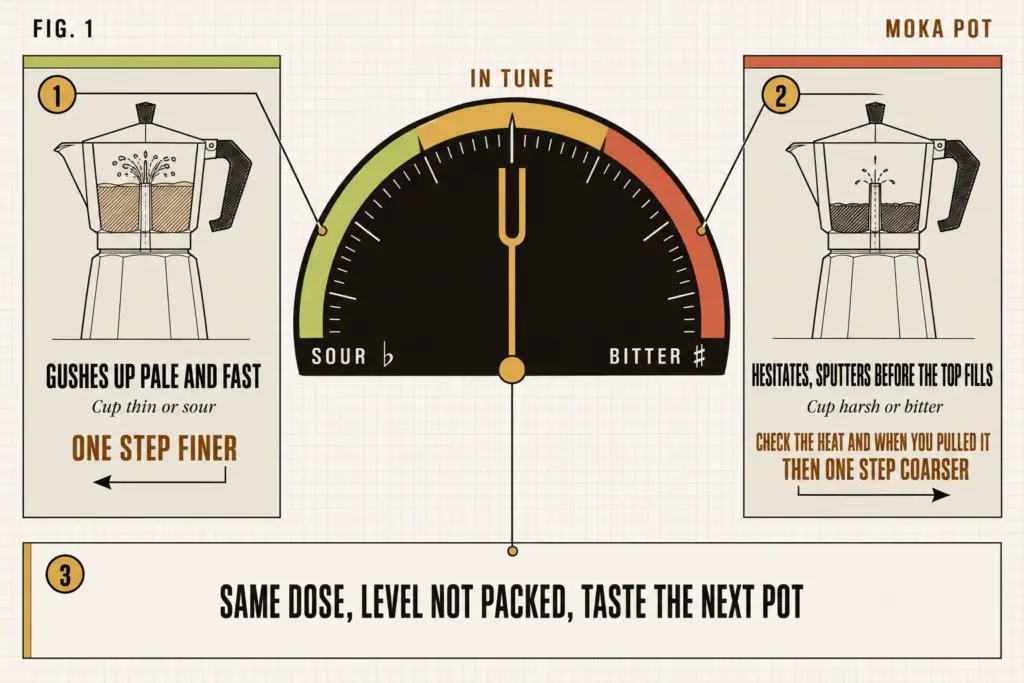
Lift the lid and watch. When the grind is too fine, the pot hesitates, the coffee rises slowly or in fits, and it starts to sputter before the top chamber has its coffee.
If the pot sputters before the desired amount of liquid is out, the grind may be too fine, the pot may have heated too quickly, or it needed to come off the heat sooner. The cup that follows tends to be harsh and bitter. The dial move is one step coarser, but read the bitter section below first, because two of those three suspects aren’t the grind.
Signs the Grind Is Too Coarse
Too coarse runs the other way. The first drip shows up early, then the coffee gushes up fast and pale in color, and the pot is done before you’ve had time to stand next to it. The cup is thin, weak and sour, the taste of water that left the grounds before it finished pulling anything out of them. Move one step finer.
Sometimes the signs mix. A grind set too close to espresso on a hand grinder can keep giving sour, watery coffee even after changes to water temperature, ratio or tapping. (Their workaround, grinding twice, comes up again near the end.)
Sour at a setting that fine points at the spread of the grind rather than its average: boulders that under-extract sitting next to dust that slows the flow. That’s the signature of a grinder that makes dust and chunks at once; a blade grinder makes that spread every time, and a worn or wobbly burr grinder can drift toward it. No single dial position fixes a spread.
Bitter Has Three Suspects
A bitter cup tempts you to go coarser straight away. Go coarser, yes, but only after checking two other things, because bitter has three suspects: a grind so fine the coffee over-extracts, heat that’s too high, and a pot left on the burner too long. The 2009 moka study describes a harsh, bitter taste, often called burnt, as a known moka outcome, and notes that the pot’s heat balance depends on several variables that aren’t easy to control. The grind is one of them.
The third suspect is the easiest to miss. Leaving the pot on the heat until it spurts can make the cup slightly bitter. The Beverages review lands in the same place: the pot shouldn’t sit on the heat once the extraction is ending.
So for a bitter pot, change one thing first: take the next pot off the burner as soon as the coffee starts to gurgle. If that cup is still bitter, go one step coarser on the pot after it. How to set the heat on gas, an electric coil or induction is the moka pot’s own subject, and it gets its own article.
One sound that seems like trouble isn’t. The loud gurgle at the very end is the pot running out of water, which the moka study calls the usual announcement that the brew is over, not a choke.
One Step, Same Dose, Then Taste
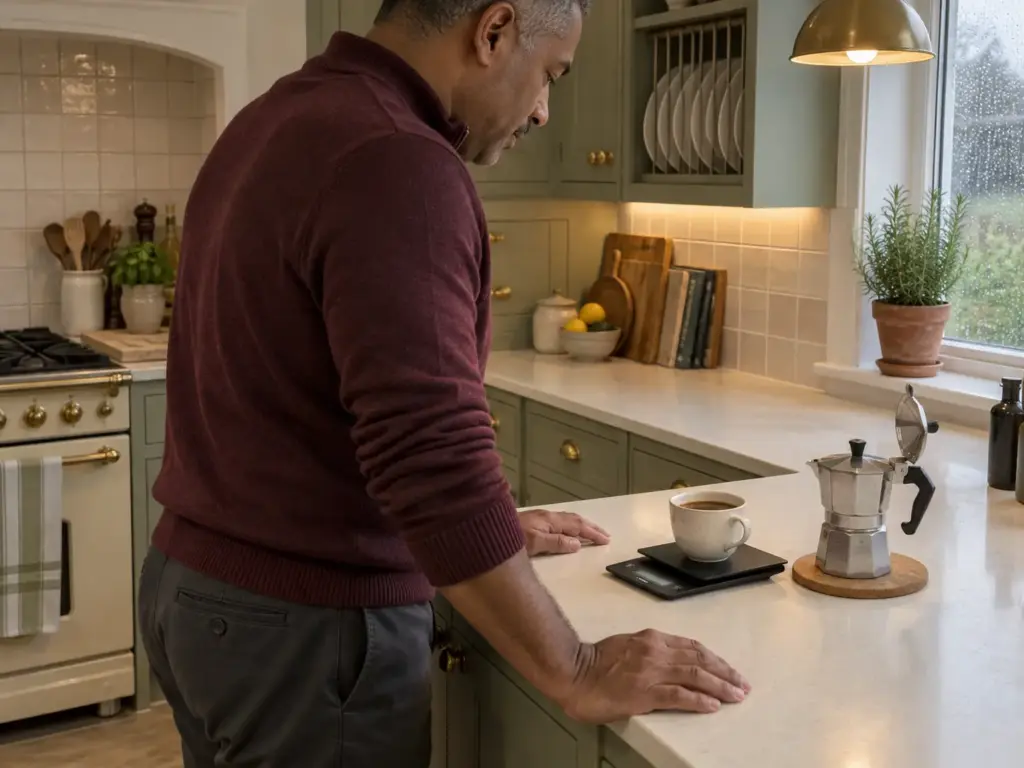
One change per pot. Keep the same dose, the same water line in the boiler and the same burner setting, move the dial one step in the direction the last pot pointed, and taste the next one. That’s the whole method to dial in a moka pot.
The SCA’s own description of dialing in puts it this way: “It’s a kind of tuning: adjusting variables methodically until the optimal flavor appears.” Methodically is the word that matters. Two changes at once and you won’t know which one helped.
What should the next cup taste like? After a step finer, a sour cup should come back rounder and a little heavier, with the coffee rising steadily instead of rushing. Overshoot and it turns harsh while the pot starts to hesitate; come back half a step if your grinder has one. After a step coarser, the harsh edge should drop away and the pot should finish without spitting.
The dose is what drifts without you noticing, since a heaped funnel and a level one look alike at a glance. A scale is what makes the same dose actually the same.
The Hario Drip Scale Timer reads in 0.1-gram steps and has a timer built in, so the dose, the time to the first drip and the brew time stop being variables, and the dial is the only thing that moved. Against it, Amazon’s review summary mentions several customers reporting it broke within six months, and it lags about five seconds when you switch it on. The free version is any kitchen scale plus your phone’s stopwatch. A whole-gram scale can’t show half a gram, but with a funnel you fill to the rim, a gram of drift is the thing you’re watching for.
Why Your Grinder’s Number Disagrees With Every Chart
Once you know which way to move, the next question is where to start on your own dial. That’s where grinder settings begin contradicting each other, grinder by grinder, and the useful answer turns out to be a window rather than a number. The reason dials don’t compare is covered in why a number on one grinder means nothing on another. Three grinders people actually own show the problem.
Baratza Encore: a Window, Not a Number
The Baratza Encore makes the clearest example, because its maker prints starting points. The manual lists, on a dial from 1 (finest) to 40 (coarsest): espresso 8, AeroPress 12, Hario V60 15, automatic brewer 18, Chemex 20 and French press 28. There’s no moka row. The manual adds that the right setting “can only be found through experimentation and the development of one’s palate.”
That’s still enough to bracket the pot. Moka sits finer than drip and coarser than espresso, so on an Encore it lands somewhere between 18 and 8. Start in the middle, around 12 or 13, and let the pot move you.
The moka numbers passed around for this grinder run from 5 to 17, and a couple of brewing guides settle on 6 or 7, which is finer than Baratza’s own espresso start. A pot set there can choke, and when it does, the number is to blame, not the pot.
The Encore’s weak spots are on record too. Amazon’s review summary notes multiple customers reporting it breaking after two months of use, and the manual, as above, gives no moka setting at all. If you run out of dial at the fine end while the pot still gushes, that’s a grinder that won’t go fine enough, a separate problem from this one.
KINGrinder K6: Find Your Zero First
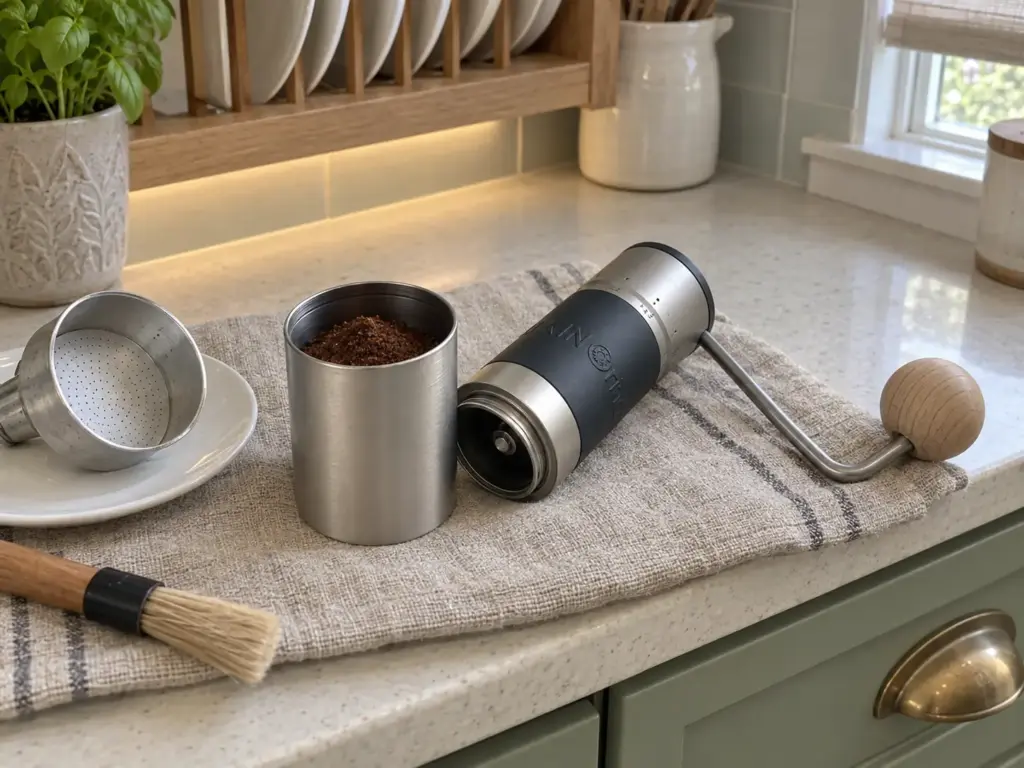
The KINGrinder K6 is the one grinder here whose maker prints a moka row: its listing puts the moka pot and the AeroPress at 60 to 70 clicks, and gives the scale as “1click=16μm & 1round=60 clicks.” So the moka window is one full turn plus up to ten clicks, and each click moves the burrs 16 microns, which is small enough to creep up on the right setting.
The catch is where the count starts. Owners on the same listing report that zero isn’t the same on every unit. One writes “The true zero is about 5 clicks past nominal zero.” Another found the grinder had arrived turned a full revolution, so a setting of 100 was really 160, and called the result “the worst pour-over of my life.”
Before you count grinder clicks at all, close the empty burrs gently until they touch and note where that falls on the dial; the full routine is in how to find a hand grinder’s zero.
Two more things before you buy one. The catch cup can bind when coffee gets into its screw threads and jams it, and the product listing itself warns to avoid second grinding because the fine powder may block the parts, which matters for a trick that comes up at the end of this article.
On a dial of 16-micron clicks, a single click is too small a move to judge one moka pot by. I’d define your step as five clicks (80 microns) and keep it that size every time, so one step means the same distance from pot to pot. Write the click count and what the pot did on a strip of tape stuck to the grinder.
Timemore Clicks Don’t Transfer Between Models
Click settings for Timemore grinders vary widely from one person to the next, so use them as a starting point only. Those are different models with different dials, and the same word, clicks, doesn’t cover the same distance on each.
The TIMEMORE Chestnut C2S is the cheaper hand-grinder route, with a 38 mm steel conical burr, but it’s another model again, so no count from other models carries over, only the direction and the size of the step. Its adjustment is internal, which means opening the grinder for every change, a nuisance when you’re moving one step per pot. A drop can also end it for good.
Across all three, a printed number is a starting square on one grinder. The pot’s signals finish the job.
Pot Size, Roast and Pre-Ground Coffee
Three questions come up with every new pot: does a smaller one want a finer grind, does a light roast, and what do you buy if you don’t own a grinder? The first two have opinions behind them rather than measurements. All three start from the same square and one step.
Does a Smaller Pot Need a Finer Grind?
The common rule of thumb is that the smaller the pot, the finer the grind, since a small boiler means less contact time between water and coffee. Another replies flatly that grind size “is dictated by the mechanics of the brewing method; pot size does not alter this.” A coffee guide splits the difference: you “should, but it’s not vital.” None of them measured it.
So for any size, start at medium-fine and let the first pot decide. If a 3-cup pot comes out sour at the setting your 6-cup or 9-cup likes, that sourness is your one step finer. The cup size printed on a moka pot is about 2 oz (around 60 ml), not a mug; how many cups a pot really makes belongs to the moka pot articles.
Light Roast, Dark Roast
Light roasts are often ground finer. On a K6, light roasts and very dark ones can sit at opposite ends of the dial, so both are extreme cases. A coffee guide warns in the other direction: “Large adjustments in grind size to compensate for roast level can lead to undesirable tastes.”
Both can be right, depending on where you start. I wouldn’t pre-compensate. Start a new roast at your usual setting; if a light roast comes out sour, that sourness is your step finer, and if a dark Italian roast tastes ashy or harsh, step coarser. The reasons behind the pattern are in why light roasts often grind finer.
Buying Pre-Ground for a Moka Pot
A tin labeled espresso is ground for a pump, and it’s often too fine for this pot. If you don’t own a grinder, look for ground coffee for a moka pot, labeled as such; failing that, a drip tin is the fallback, a touch coarse but workable once the basket is level.
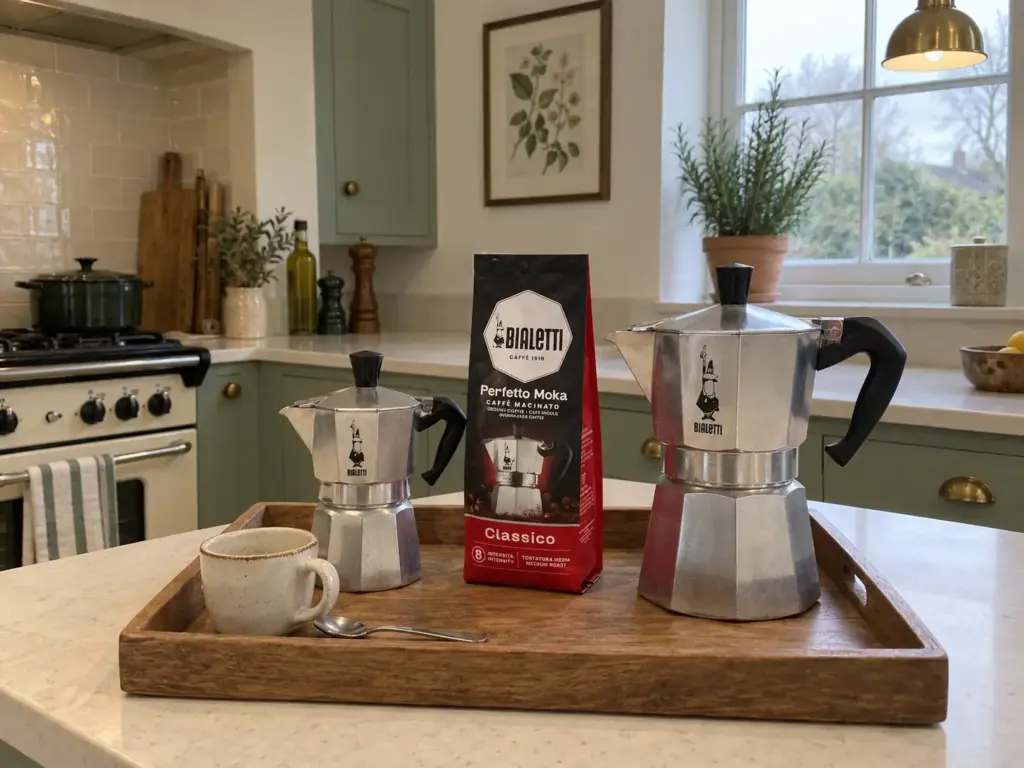
The Bialetti Perfetto Moka Classico is the mainstream ground coffee made for the pot, a medium roast in an 8.8-ounce (251 g) valve bag. Its label gives you nothing to measure against: the listing says only “Grind the coffee to Bialetti’s unique grinding level,” with no size and no number, and newcomers are warned it can be a little finicky and a little inconsistent. So even the bag made for the pot gets read by the pot, not by its label.
Ground coffee also goes stale faster than whole beans, so once it’s open, how to store ground coffee so it lasts matters more than it would for a bag of beans. Whether to keep buying it ground at all is a separate call: whether grinding your own is worth it.
When It Isn’t the Grind, and What Changes by Month Two
A setting that worked in the first week can stop working, and a bad first pot isn’t always the grind. Three other things move under you: the temperature the pot starts from, the beans and the grinder itself. Check them before you blame the dial.
A Cold Start Brews Cool
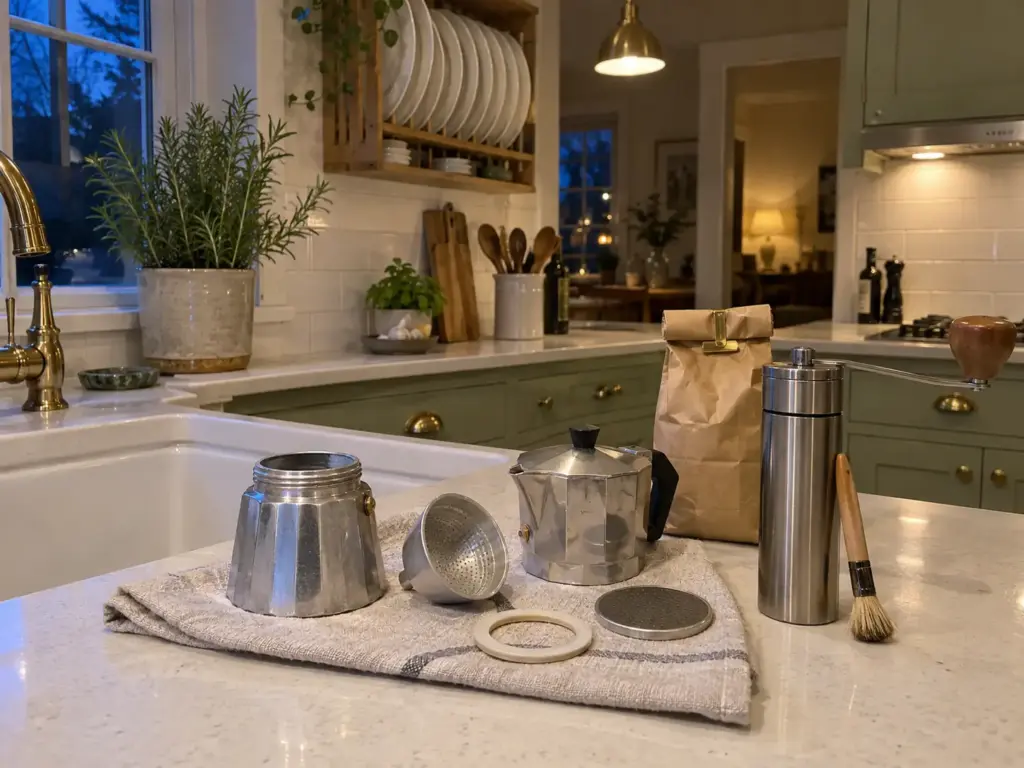
Fill the boiler with cold tap water, put it on the burner, and the coffee starts coming up long before the water is hot. A physics paper on the stove-top espresso maker found that the pressure in the pot rises much more slowly than the water’s vapor pressure, and that from a room-temperature start, half the coffee comes through well below the temperature you’d want. The 2009 moka study agrees that extraction begins at fairly low temperatures.
Cooler water pulls less out of the same grounds, and that tastes sour. So a sour first pot can be a cold start rather than a coarse grind. A hot water start, filling the boiler from the kettle, is the brewer’s own technique and gets its full treatment in the moka pot articles; the point here is not to move the dial for a problem the kettle would solve.
Before you move the dial for a sour pot, brew one more at the same setting with the boiler filled from a kettle just off the boil (hold the hot base with a towel while you screw it together). If that pot comes out right, the grind was never the problem, and the dial stays where it is.
Old Beans Want a Finer Step
Old beans typically need a finer grind. Three weeks past the roast date, the number that was right on the first day can come out thin, and one step finer usually brings it back.
The pot that catches people out is the first one from a new bag, ground at the old bag’s number. The bag changed, not the dial. If you’re not sure whether you’re brewing stale beans, check how to tell if your beans have gone stale.
The Grinder Changes Too
Grinders drift. The K6’s maker tells owners to clean it regularly, and “do not exceed 30 days between cleanings.” Burrs dull with use, and a worn set stops giving you the grind its number used to mean; the signs are covered in when burrs are worn enough to replace.
Then there’s grinding twice. Some people grind twice for better extraction; the end of this article covers that trick. The K6’s own listing, as above, warns against a second grind for its burrs. It depends on the grinder, so I wouldn’t make it a habit before reading whether you can grind coffee that’s already ground.
But if your grinder can’t hold a setting between drip and espresso from one pot to the next, no amount of dialing will fix it, and the grinder is the next thing to decide on: home grinders and what wears out first.
Start at Table Salt, Then Let the Pot Steer
- Start medium-fine, about the texture of table salt and a notch finer than drip, in a funnel filled level and never pressed.
- Let the pot choose the direction. A fast, pale gush and a sour cup mean one step finer; an early sputter and a harsh cup mean pull it off the heat sooner first, then one step coarser.
- Treat every published number as a window on one grinder, never as your setting.
When you open a new bag, or three weeks into the current one, grind a single pot at your usual number and read it before assuming the setting still holds.
Tomorrow, level the basket without pressing, keep the dose and the water line where they were, and move only the dial, one step, in the direction the last pot pointed. Then taste. If the cup still misbehaves after that, the heat and the pot itself are next in line, and those are the moka pot’s own story.
Frequently Asked Questions
01What grind size is best for moka pots?
Medium-fine is best for a moka pot: about the texture of table salt, a notch finer than drip and clearly coarser than espresso. From there the pot corrects it. Go one step finer if the cup is sour, and one step coarser if the pot sputters early or the cup turns harsh.
02Can I use regular grind coffee in a moka pot?
Yes, if regular means a drip grind: it runs a little coarse for a moka pot, but it works once the basket is filled level and not pressed. If the cup comes out thin and sour, grind a step finer or switch to a bag labeled for the moka pot.
03Can I use espresso ground coffee in a moka pot?
You can, but espresso ground coffee is often too fine for a moka pot, because it is ground for a pump and the pot’s steam can stall on it. Fill the funnel level, never packed, and watch the first pot: an early sputter and a harsh cup mean it is too fine.
04What coffee do Italians use for a moka pot?
The moka pot is Italy’s most common household coffee maker, according to a 2009 study of it, and the bags sold for it, Bialetti’s own among them, are labeled for moka. Those labels print no grind number, so the pot’s signals still decide the setting.


How did your cup turn out?
No comments yet. Tell us what you changed — and whether the needle moved.