
We may earn a commission when you buy through links on this page. It never changes what we recommend. How we pick
On this page8 parts
- Why a Burr Grinder Comes Before Any New Coffee Maker
- What Separates a Good Home Grinder From a Frustrating One
- Match the Grinder to the Way You Brew
- Quiet, Portable, Plastic-Free or Hand-Cranked: the Filters That Narrow It
- What Changes as You Spend More (and When Cheap Is Enough)
- What Wears Out First, and How Long a Home Grinder Lasts
- Scale First, Then the Grinder Your Brewer Needs
- Frequently Asked Questions
You have ten minutes before work, a can of pre-ground coffee or a blade grinder that shrieks for a few seconds, and a cup that tastes thin and harsh in the same sip. Whether one of the best coffee grinders for home is the purchase that fixes it is a fair question, and a single winner is the wrong answer to it, because the right grinder depends on how you brew and on what it is still doing a year after the box went out with the recycling. The reason a grinder matters at all fits in one sentence: water pulls flavor out of small particles fast and large ones slowly, so a grind with dust and chunks in it overshoots and undershoots in the same brew, and nothing a coffee maker does afterward can even that out. What follows runs in the order the decision actually goes: the free checks, what separates a good grinder from a frustrating one, the fork by brewing method, the filters that narrow it, what each step up in budget buys, and what wears out first.
Quick Answer
A burr grinder, not a blade, is the purchase that changes the cup more than any new coffee maker, because it decides how evenly the water can extract. Best then forks on how you brew: one conical all-rounder for drip, pour-over and French press; a grinder built for the fine end if espresso is the plan; a steel-burr hand grinder as the floor.
Why a Burr Grinder Comes Before Any New Coffee Maker
A new drip machine changes how hot the water gets and how long it sits on the coffee. A grinder changes what the water finds when it arrives, and that sets a limit no machine downstream can raise. Before any of the best coffee grinders for home gets a name, it helps to see why that limit exists, and to rule out the three free causes that taste the same as a bad grinder.
What an uneven grind does to a single cup
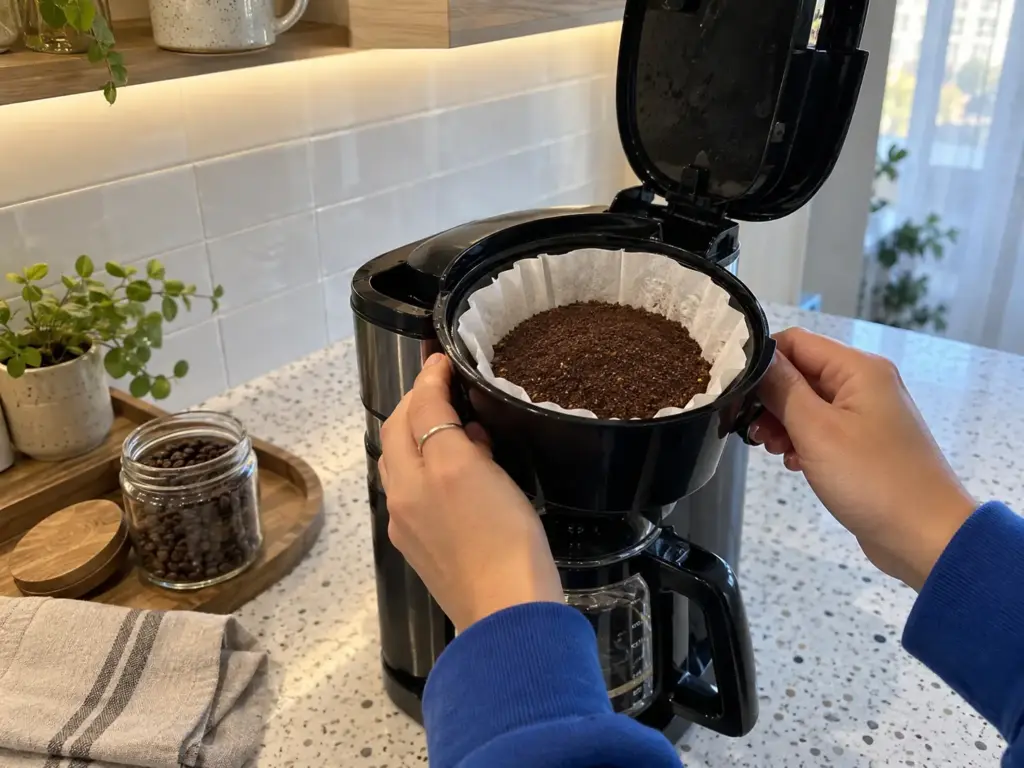
Every particle of ground coffee gives up its flavor from the outside in. The bright, sour compounds dissolve first, the sweet ones follow, and the heavy, drying ones come last, so how far a particle gets through that sequence depends mostly on how small it is. A speck of dust runs through all of it in the first minute. A chunk the size of a lentil (a boulder, in grinder talk) is still working on the sour part when the brew ends, and a grind that holds both gives you a cup that is bitter from the over-extracted dust and sour from the under-extracted chunks at once.
The coffee world’s own extraction target hides this. The 18 to 22 percent range set out in The Coffee Cuppers’ Handbook describes how much of the coffee’s dry weight should end up dissolved in the cup, and it is an average across every particle in the bed.
A brew where the dust went well past the top of that range and the chunks stopped short of the bottom can land in the middle on paper and still taste wrong. You don’t taste the average. You taste both ends.
That spread is the whole case for a grinder that cuts to one size, and it is also why a blade grinder makes a cup sour and bitter at the same time, a mechanism with its own page. Here it matters for one practical reason: a drip machine leaves you a short list of things to control (the dose, the water, the grind), and the grind is the one that caps what the others can do.
Three free checks before you blame the grinder
A cup that tastes flat, stale or muddled has more suspects than the grinder, and three of them cost nothing to rule out. Take them one at a time, in this order, and brew the same way between them so the only thing that changed is the thing you checked.
- The beans. Look for a roast date on the bag rather than a best-by date, and notice how long the bag has been open. Coffee loses the aromatics that carry its sweetness in the weeks after roasting, and ground coffee loses them much faster because every particle is exposed to air. Brew a fresher bag exactly the way you brewed the old one: if the cup comes back brighter and sweeter, the beans were the problem, and if it tastes the same, move on.
- The dose. Weigh it instead of scooping it. A standard coffee scoop holds about two level tablespoons, and how many grams that holds changes with the roast, because a longer roast drives off water and puffs the bean up, so a scoop of dark beans weighs less than a scoop of light ones. Weigh what you normally scoop, write down the number in grams, and brew that number every morning. If the pot stops wandering between weak and heavy, the scoop was doing the wandering.
- The machine. Scale inside a drip machine slows the water and robs it of heat on the way to the basket, and a brewer that can’t get its water hot enough pulls too little out of whatever grind you give it. Run a descale, then brew the same weighed dose. A cup that comes back rounder and less sharp says the machine was holding it back.
If you’re still on pre-ground rather than whole bean, the first check covers you too: the can was ground long before it was opened, and that lost aroma is most of the case for whether grinding your own beans is worth it. Only when all three checks come back clean is the grinder the next suspect, and by then the cup usually tells you which way it leans. A cup that is only sour or only bitter wants a move on the dial, and which way the grind should move when a cup tastes sour or bitter is the thing to learn next. A cup that is sour and bitter at once is the grinder itself.
Give the kitchen scale a full week before you change anything else. Same grams every morning, same grind, same water, and taste each pot. If the coffee steadies, the scoop was the variable and a grinder can wait; if it still swings from one day to the next with the dose held still, you have ruled out the cheapest suspect and the grinder moves to the top of the list.
If the grinder on your counter has a blade
A blade grinder has no setting. It has a lid, a button and a spinning blade, and the only thing you control is how long you hold the button down, so the grind depends on how many beans are in the chamber and how long they bounced around in there. Hold it for the same few seconds tomorrow with a slightly fuller chamber and you get a coarser grind than today’s, with nothing on the grinder telling you so.
Lift the lid after a single press and the grinder shows you the problem. A film of powder clings to the underside of the lid and up the walls, while loose chunks rattle at the bottom around the blade: two grinds from one press. The powder is what turns the pot bitter, and the chunks are what keep it sour and thin.
The Hamilton Beach Fresh Grind is the grinder a lot of kitchens already own, and it does what its listing promises: stainless steel blades and a chamber that takes enough beans for a 12-cup pot in one go. It is also the plainest example of the design limit, because a spinning blade makes dust and chunks together however long you press and however you time it. Short pulses with a shake between them narrow the spread a little. They don’t close it.
One Reddit poster who moved from a blade to a burr grinder summed up the switch in two words, no regrets, and the reason shows up in the catch bin: one size of grounds instead of two. If the blade grinder has to stay for now, give it the jobs where spread matters least, like spices or a batch of cold brew, where a long steep forgives more than a drip basket ever will.
The first pot after the switch can surprise you, and not always pleasantly. The blade’s dust was dissolving fast and adding heft to every cup, so the same scoop through a burr grinder at a middle setting often tastes lighter, cleaner and a touch sour. That is not the new grinder failing. Leave the dose where it is, move one step finer, and brew again: the next pot should keep the cleaner taste and gain back the sweetness, and if it turns dry at the finish, come back half the distance.
What Separates a Good Home Grinder From a Frustrating One
Once the floor is a burr grinder, the word burr on a box stops telling you much. Two burr grinders can land as far apart in the cup as a burr and a blade, and the difference hides in four places a listing rarely explains, all of which come back to grind consistency.
Burr type and burr size
Both kinds of burr do the same job: a fixed gap between two cutting surfaces, one of them turning, sets the size of what gets out. Conical burrs nest a cone inside a ring; flat burrs face each other like two plates. The anatomy of what the two burrs inside a grinder actually do has its own page. For buying, the useful difference is what each tends to put in the cup.
Well-made flat burrs lean toward a tighter spread of particle sizes (more grind uniformity), which reads as clarity in a pour-over: flavors that sit apart instead of blurring together. Well-made conicals leave a little more fine material, and that slight spread makes them forgiving across several brew methods, because a cup brewed a bit off the ideal still comes out drinkable. Neither type wins in general. A badly made example of either loses to a well-made example of the other.
Burr size gets more attention than it deserves. Bigger burrs grind faster at a given setting and generally run cooler, and the 64 mm flat burrs in a filter grinder like the Fellow Ode Gen 2 move through a dose quicker than the 40 mm conicals in the Baratza Encore family. But 40 mm is a proven size for daily grinding at home, and what decides the cup is whether the burrs are cut evenly and held in line with each other. A large burr set wobbling in a loose carrier grinds worse than a small one held straight.
One r/espresso owner described the standard Encore’s trade-off in a way that fits most grinders at its level: capable burrs held back by a frugal build. That points a buyer at where to look. On a decent grinder the burrs are rarely the weak part; the carrier that holds them, the adjustment ring and the plastic around them usually are, and that is where the months show up first.
Stepped, stepless, and why the numbers on the dial mean nothing between brands
A grinder with stepped adjustment clicks from one setting to the next; a stepless one turns smoothly and can stop anywhere along the way. Steps are easier to live with when more than one person or more than one brewer shares the grinder, because anyone can count back to their own number. Stepless earns its keep at the fine end, where espresso needs changes smaller than most clicks.
The numbers printed on the adjustment dial are not a shared scale. Grind setting 12 on one brand has nothing to do with setting 12 on another. What matters is how far the grind moves with each click, and whether the range reaches your brewer at all.
That is where a spec like 40 settings can mislead. Forty steps spread across a range from French press to the edge of espresso are small steps; forty spread across a range that stops at drip would be smaller still. And 15 steps covering the same span as another grinder’s 40 would each move the grind more than twice as far. More settings is a better number only once you know the range they divide, so the count on the box tells you less than the distance between two clicks does.
The same logic applies to any chart that tells you a setting number for your brewer. It was written for one grinder, and it transfers to yours only as a direction to start in. For what number your grinder should be on, the honest starting point is your own grinder’s manual, then the cup.
Retention and static — the grounds that stay behind
Grind retention is the ground coffee that stays inside the grinder after a dose: in the burr chamber, down the chute, packed into corners. It goes stale there and falls into tomorrow’s dose, which means part of every cup is yesterday’s coffee. There is a subtler effect too. After you move the dial, the first few grams out of the chute are still the old grind, because they were already sitting in the chute when you turned it, so a change of setting doesn’t taste like a change until those grams are gone.
Static is retention made visible. Beans rubbing against burrs pick up a charge, and the charged grounds cling to the chute, the catch bin and your fingers, then jump onto the counter when you pull the bin out. The standard Encore has a reputation for it: Reddit owners call its static awful and rank it among the messiest grinders they’ve used. The Ode Gen 2 ships with anti-static features and still collects reports of mess and retention in aggregated owner reviews, which says something about how far a feature on the box gets you.
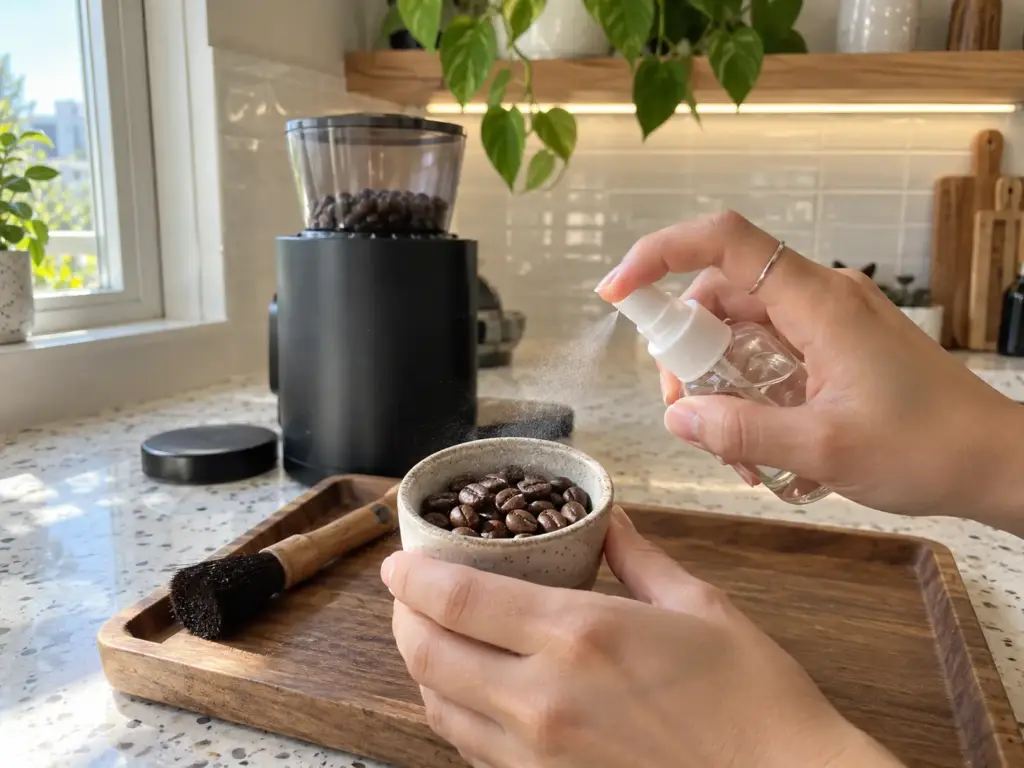
The fix owners land on costs nothing. Mist the beans with a single spritz of water before they go into the grinder (a damp spoon handle stirred through them works in a pinch), and most of the static cling disappears; the community calls it RDT, for Ross Droplet Technique. The water is gone long before it reaches the cup, and it does more for static than paying extra for an anti-static model. For stopping grinder static for good on grinders that fight back harder, there is more to try.
Two habits, both free. Before grinding, give the weighed beans one spritz from a spray bottle and shake the container so every bean gets a trace of it; the grounds drop into the bin instead of climbing the chute. And every time you move the dial, run a few grams through and throw them out before you grind the dose you will brew, so the cup you taste is the setting you actually chose.
The standard behind the numbers
Grinder specs get read against each other and almost never against a reference, even though one exists. The Specialty Coffee Association’s standard for home coffee grinders, SCA-320, sets out specifications and test methods for exactly this kind of machine, and it belongs to a library the association describes this way: “SCA Standards create a shared framework for quality, consistency, and best practices across the coffee industry.” Its test figures sit behind the association’s member login, so none of them appears here, and none of the grind-setting counts in this article is the SCA’s. They are the makers’ own claims.
What is public points in a useful direction. The cupping standard of the Coffee Quality Institute and the SCA, as printed in the same handbook and reproduced in an article by the green-coffee importer Royal Coffee, defines the grind for tasting as a spread: 70 to 75 percent of the grounds should pass through a US No. 20 sieve.
That is a reference for cupping, where professionals taste coffees side by side, not a target for your drip machine. The lesson is in how the industry judges a grind at all: by how much of it lands inside a band, never by one magic particle size.
You can run the home version of that judgment without owning a sieve. Brew the same weighed dose twice, one step apart on the dial. On an even grinder, one step finer moves a sour cup toward sweet and little else changes; on an uneven one, the sourness eases while a dry, bitter edge climbs at the same time, because the step made more dust along with smaller chunks.
A good grinder moves the cup in one direction per click. If yours moves it in two, the grinder is the limit, and no chart of setting numbers will fix that.
Match the Grinder to the Way You Brew
The spec that decides the most is one listings tend to bury: whether the grinder’s range reaches the brewer you actually use, with steps small enough to land where that brewer wants. Filter methods want even grounds from medium to coarse, espresso wants very fine grounds and very small steps (an AeroPress and a moka pot sit between the two), and a grinder built for one end is usually weak at the other. The grind size each brewer wants has its own chart; this section is about which grinder gets you there.
If you brew more than one way: one all-rounder
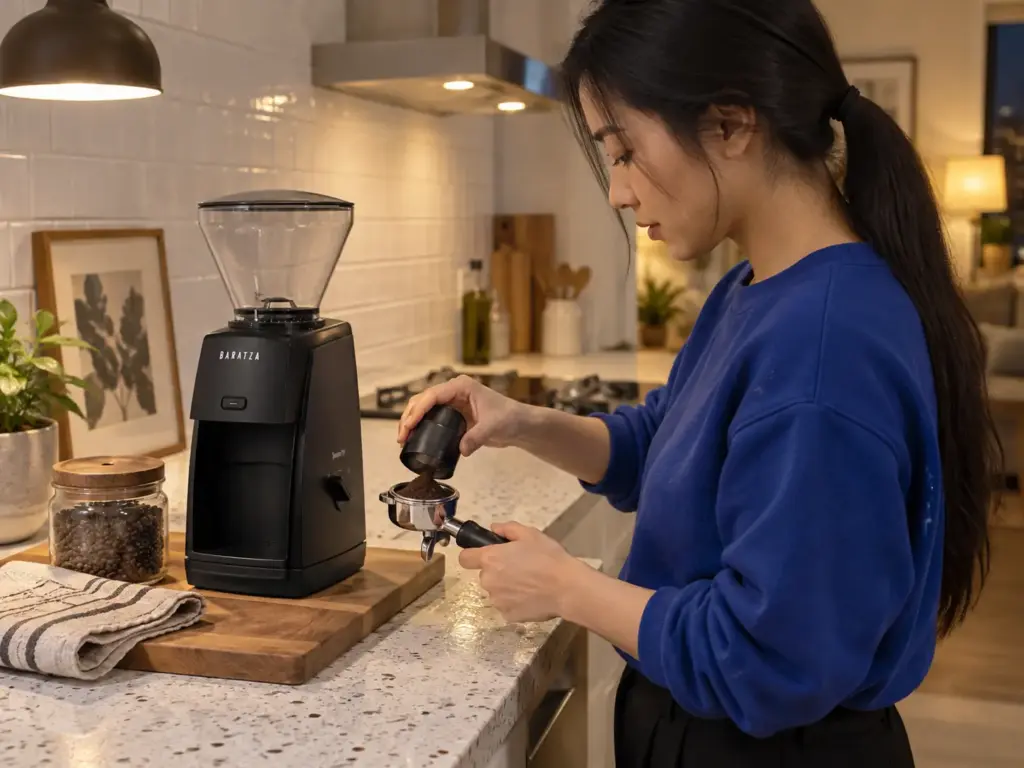
Most counters hold more than one brewer: a drip machine for the weekday pot, maybe a pour-over cone or a French press for slower mornings. For that kitchen the answer is one conical grinder with a range from coarse to medium-fine and plenty of steps in between. A 40 mm conical with around forty stepped settings covers drip, pour-over, French press and cold brew, and it lets two people keep two different numbers without either one guessing.
When two brewers pull the grinder in opposite directions, the burr type starts to matter, and choosing between conical and flat burrs when you own just one grinder takes that decision apart properly. For a household that only brews filter coffee, the conical’s slightly wider spread is the forgiving choice, because the same grinder has to make a good French press on Saturday and a good drip pot on Monday.
The Baratza Encore is the grinder most of those conversations reach first, and for filter coffee it has earned that. Forty stepped settings on 40 mm conical steel burrs run from a French press grind through drip to pour-over, and the steps are small enough that a sour pour-over can be nudged sweet without jumping past it. The stronger reason to choose it is what happens later: Baratza sells its burrs, gears and wear parts for owners to fit themselves, so a worn part is a repair rather than a replacement grinder. The static covered above is its catch, and owners mention it often enough that the spritz of water becomes part of the routine from day one.
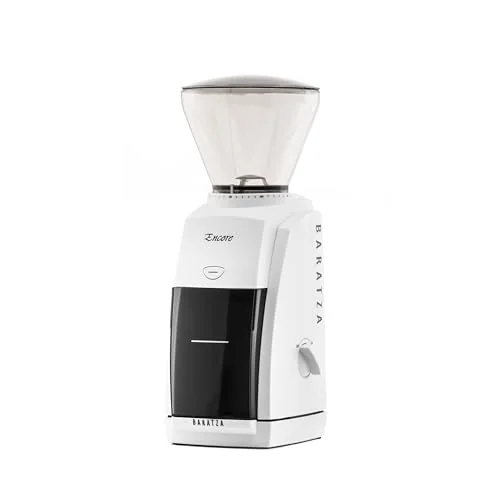
The Encore stops being the obvious pick the day an espresso machine goes on the wish list. It isn’t built to reach a true espresso grind, so a household headed that way either buys the espresso version further down or plans on a second grinder. That second option is more common than it sounds: a poster on r/BrevilleCoffee describes a counter with a single-dose grinder for pour-over, a stepless one for espresso, and a hand grinder kept around for whenever someone wants decaf. One grinder per job, and none of them asked to do everything.
Drip and pour-over: the clarity end
Pour-over punishes an uneven grind more than a drip machine does. The water passes through the bed once, over a few minutes, and fines that migrate to the bottom of the paper slow the drain, so the last of the water sits on the grounds longer than you meant and drags a dry edge into a cup that was otherwise fine. A drip machine’s flat basket and fixed schedule hide some of that; a cone with a slow, hand-poured stream shows all of it.
A grinder with a tight spread gives the cleaner separation between flavors that pour-over drinkers call clarity, and flat burrs built for filter are the usual way there. The Fellow Ode Gen 2 is the clearest example of a grinder matched to a method: 64 mm flat stainless steel burrs, 31 settings, and a single-dose design, where you weigh the beans for one brew, pour them in and grind them all, so nothing sits in a hopper going stale between mornings.
The Ode can’t grind fine enough for espresso at all, and that is a matter of design rather than a quibble; some owners also report retention and mess despite the anti-static features. If the next brewer in your plans is an espresso machine, it is the wrong grinder to buy now, however good its pour-over is.
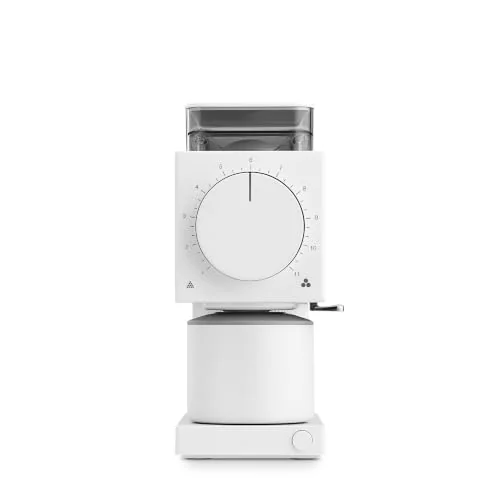
For a household that brews only drip coffee, a flat-burr filter grinder is more than the pot can show, and the all-rounder above makes an equally good cup. The Ode pays off where the pour is slow and deliberate and the cup is meant to taste of the bean. The full shortlist of grinders for pour-over and drip goes further down that road.
French press and cold brew: the coarse end
The coarse end is where cheap burrs are most forgiving and where fines do the most visible damage. A French press filters through a metal mesh, not paper, so any dust in the grind passes straight into the cup or packs against the screen. Push the plunger down over a grind with too much fine material and it fights you the whole way; the dust has clogged the mesh, the same idea the community means when it says a machine got choked. Then the last inch of the cup turns to silt.
Cold brew’s long steep evens out part of the spread, since even the chunks get hours to give up their flavor, but fines still cloud the concentrate and slow the straining.
Both jobs sit comfortably inside the all-rounder’s range, which is why this section has no grinder of its own. A separate coarse grinder only makes sense if the press is all you brew, and then the choice narrows to grinders built for the French press.
Espresso: the fine end most grinders cannot reach
Espresso asks a grinder for two things at once: a grind much finer than any filter method uses, delivered into a portafilter basket, and steps small enough that one change moves a shot by a few seconds instead of from gushing to choked. Most filter grinders miss one or both, and a grind one coarse click off shows up as a sour, watery shot or a trickle that barely reaches the cup.
That is why the budget advice on r/espresso keeps landing in the same place: pair an entry-level machine with a dedicated grinder from the middle of the range, rather than spending the whole budget on the machine and grinding with whatever is cheapest.
The Baratza Encore ESP comes from the same 40 mm conical burr family as the Encore, set up for the fine end of the range that the all-rounder can’t reach. Owners report a ceiling: it can struggle to grind fine enough for more demanding espresso machines, and owners who hit that wall tend to step up to the ESP Pro. For an entry-level machine and a newcomer’s first months of dialing in, that ceiling is a long way off.
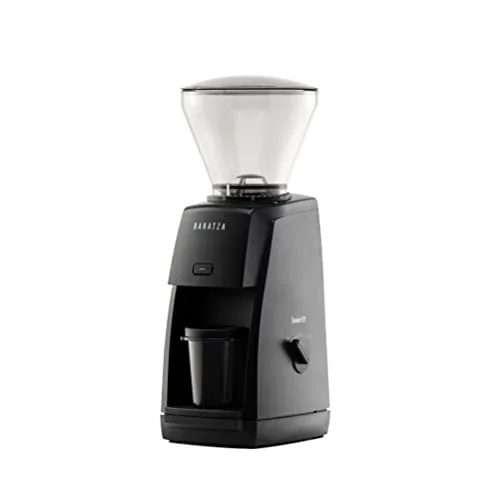
If espresso is the main event rather than one brewer among several, the grinder deserves as much thought as the machine, and the options for grinders for espresso at home run well past this one.
Quiet, Portable, Plastic-Free or Hand-Cranked: the Filters That Narrow It
The method fork isn’t the only one. Some readers are ruled out before the burrs come into it at all, by a sleeping partner behind a thin wall, a suitcase, a dislike of plastic, or a simple preference for turning a crank. Each of those filters costs something in grind quality, speed or budget, and each has its own page.
Noise before the house is up
Burr grinders turn slower than blades, so their sound is lower and less piercing, but the motor and the housing decide how loud a given grinder actually is. Even a well-liked burr grinder can be loud: in aggregated Reddit reviews of the Encore ESP Pro, loud operation tops the list of complaints.
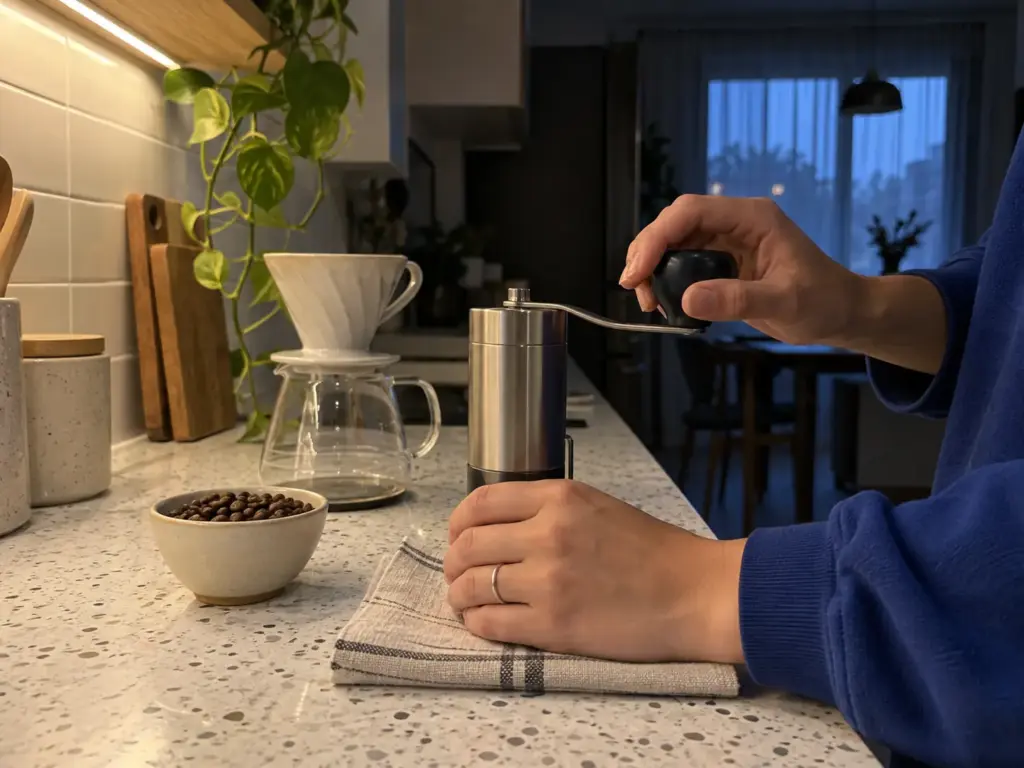
The obvious workaround is to grind the night before and brew in silence. It trades noise for flavor, and it’s a poor trade: ground coffee starts losing aroma as soon as it leaves the burrs, and a night in a container undoes most of what the grinder was bought to do. A quiet grinder with a slower motor is the better call. For one or two cups, a hand grinder beats even that, since the loudest thing it does is a soft, steady crunch.
Hand grinding also moves the noise to wherever you want it. You can crank on the far side of the kitchen, or on the back step, while the motor of any electric grinder stays wherever its cord reaches. For a shortlist built around the sound, see the quietest grinders for early mornings.
A grinder that travels
Hand grinders win on the road without much contest. They’re small, they need no outlet, and the only part likely to suffer in a bag is the crank handle. The trade is time per dose and a small hopper: the KINGrinder P2, a hand grinder that comes up again below, holds 25 to 30 g of beans by its maker’s figure, about one mug’s worth.
The detail that matters on a trip is whether the setting holds. A dial that shifts when the grinder is knocked around in a bag means a different grind at every stop, so a grinder whose setting locks or clicks firmly is worth more on the road than a few extra steps. Most of what separates portable grinders worth packing comes down to that and to weight.
Metal all the way through
Grinders of all-metal construction exist, and they cost more and weigh more than their plastic-bodied equivalents. Many budget hand grinders use plastic for the outer shell to reach their price; the KINGrinder P2 is one, with an ABS plastic housing around its steel burr.
Whether that matters is a personal call about what surrounds the coffee, and a durability question over years of use, rather than a question of grind quality: the burrs are steel either way, and the burrs set the grind. If metal is the requirement, the list of grinders with no plastic parts is shorter and pricier, and it starts where the budget models stop.
Manual or electric
The choice between manual versus electric grinders comes down to where you’d rather spend: money or effort. A hand grinder puts its money into the burr and the bearing instead of a motor, so at the same spend it usually grinds more evenly, makes almost no noise and has no motor to fail. An electric grinder spends on the motor and gives you a button, speed, and a whole pot’s worth of coffee without a sore wrist.
The effort isn’t even across the dial, either. The crank turns easily at a French press setting and gets harder and slower the finer you go, so an espresso dose takes noticeably longer than a pour-over dose on the same grinder. Grinding for a full 12-cup drip pot by hand every morning is a workout most people give up on by the second week.
So the split is simple. One or two cups at a time, a hand grinder is the better grinder for the money; a full pot every morning, or several people with several brewers, and the motor earns its place. If the hand grinder fits your mornings, the next step is the best manual grinders.
What Changes as You Spend More (and When Cheap Is Enough)
The free fix still comes first: a kitchen scale changes more cups than stepping up a tier, because no grinder can rescue a dose that drifts by a scoop’s worth of grams every morning. After that, what each step up the ladder buys is specific: evenness, step size, speed, and parts you can replace. No level here comes with a price, because prices move with the seasons and what you get at each level doesn’t.
The floor: a hand grinder
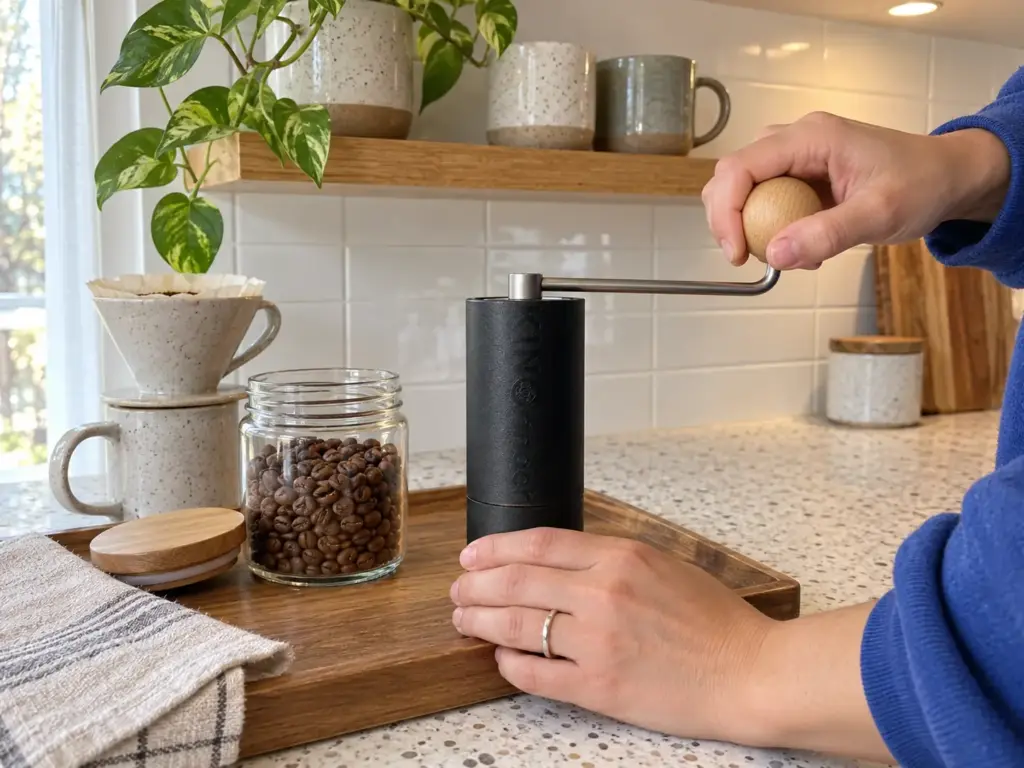
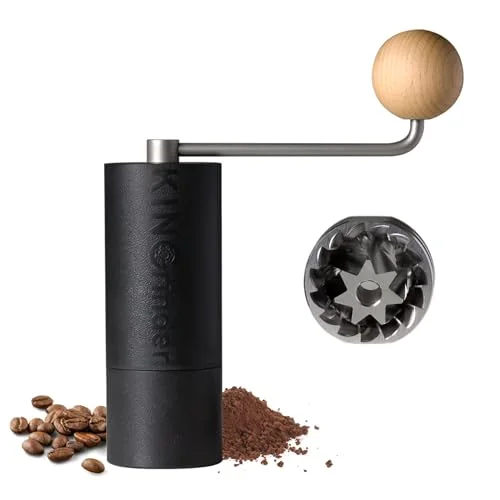
At the lowest spend, a hand grinder with a steel conical burr grinds more evenly than any electric grinder at the same money. The reason is simple arithmetic: every dollar that doesn’t go into a motor and a housing big enough for one goes into the burr and the bearing that holds it steady. The trade is your time and your wrist.
The KINGrinder P2 is that trade in its plainest form. A stainless steel conical burr does the grinding, a small hopper holds one mug’s worth, and there is no motor to fail in year three. What pays for the low price is an ABS plastic housing, where the other grinders recommended here are mostly metal outside, plus a few minutes of cranking per dose that grow longer at the fine end.
For one person brewing one or two cups a day, the floor is often enough, full stop. There are several cheap grinders that still grind evenly, and the right one depends mostly on how fine you need to go.
The budget electric
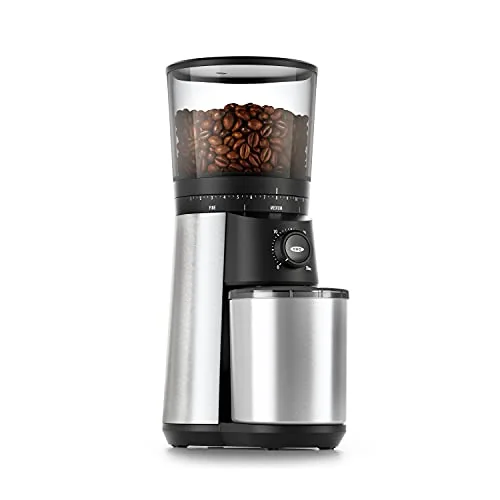
One step up is the entry-level grinder with a motor, the first electric burr grinder worth owning, for the reader who wants a button. The OXO Brew Conical Burr puts conical stainless steel burrs, 15 settings and a 12-ounce hopper below the Baratza tier, and for a drip machine or a French press it makes an even grind with no crank involved.
Fifteen steps is a coarse ladder, though, so each click moves the grind further than one of the Encore’s forty, and there is no dosing mechanism, which puts the scale back on the counter. For drip and French press, where a step either side of ideal still makes a good cup, the big steps rarely get in the way.
Pour-over is where they show. The right grind for a slow cone can fall between two clicks, and the cup you get is a little sour at one setting and a little dry at the next, with no stop in the middle. If pour-over is the brewer you care about most, that gap is the reason to spend one tier more.
Before you buy up a tier, find out whether the steps are really what’s holding you back. Brew three cups with the same weighed dose: one at your usual setting, one a click finer, one a click coarser. If one of the three tastes right, the grinder you own is fine and you only needed the click. If the finer cup is already dry and the coarser one still sour, the right grind lives between two steps, and that is a problem only smaller steps can solve.
The middle of the range
The middle is where a grinder stops being a compromise for filter coffee. The steps get small enough for pour-over, the burrs are held more squarely, and the maker sells the parts that wear. The Encore lives here, and so does the Cuisinart Electric Burr One-Touch, which puts conical stainless steel burrs behind 18 grind positions and a one-touch automatic grind for a kitchen that wants a burr grinder from a different maker. Supply of that model has run short, so the listing may come and go.
The one-touch setting deserves the same caution as any timed grinder. Any grinder that stops itself, on a timer or a cup setting, is measuring by time, and time doesn’t know how dense today’s beans are, so a dark roast and a light one come out as different doses at the same setting. Use the button to grind and the scale to decide how much.
For a household that brews only drip, the middle buys less than it promises. A budget electric makes nearly the same pot, and the difference goes into the burrs’ alignment and a repair program the drip pot may never need. I’d spend at this level only if pour-over or the long haul is part of the plan.
What the splurge actually buys
At the top of the home range the money goes into five things: bigger or flat burrs, smaller steps or stepless adjustment, lower retention, single dosing, and above all repairability. The first four show up in the cup as speed, clarity and the ability to land exactly where a brewer wants. The fifth shows up years later.
A grinder whose burrs, gears and belt the owner can replace can outlive several sealed budget grinders, because the sealed ones go in the trash when a small part fails. Baratza’s model of selling burr replacement sets and wear parts direct to owners is the clearest right-to-repair example among home grinders, and on home-barista.com owners point each other to the maker’s own repair guides. That is the argument for spending more that holds up once the box is gone.
It is also where spending can go past what the cup can show. A splurge grinder feeding a drip machine is a fine grinder waiting for a better brewer, and the savings would buy a scale, a gooseneck kettle and a year of fresh beans. For the long version of why good grinders cost what they do, the price-to-part arithmetic has its own page.
What Wears Out First, and How Long a Home Grinder Lasts
Reviews of grinders get written in the first few weeks, when the burrs are sharp, the chute is clean and the static hasn’t found its way back yet. The grinder that matters is the one still on your counter at month two and in year five. This section counts what goes first, and which of it is a habit, a part or a replacement.
Month two: static, chaff and a dial that seems to drift
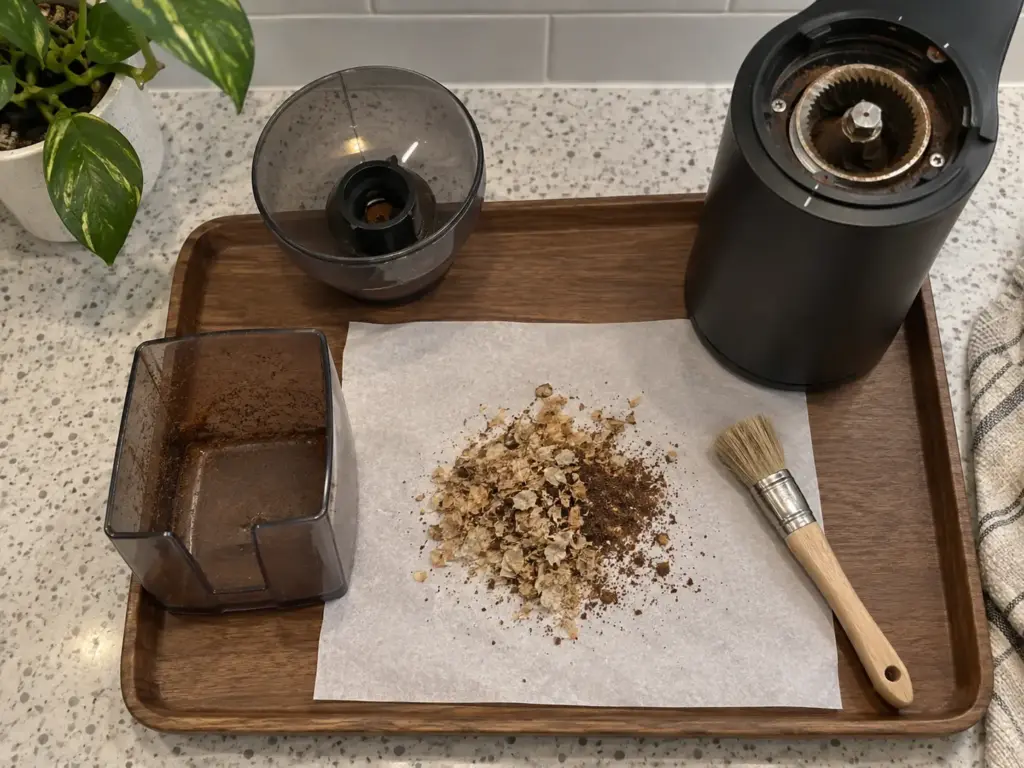
A few weeks in, most grinders start doing things they didn’t do in week one. Static and clinging grounds creep back as fines and coffee oils build up in the chute. Chaff, the papery skin left on roasted beans, collects in corners and falls into doses as pale flakes. And the dial seems to drift: the setting that made a sweet cup in the first week now makes a sour one.
The dial rarely moved. What usually changed is the coffee: a new bag, a different roast, or the same bag three weeks older than the one you dialed in on, which extracts differently at the same setting. Before you blame the grinder for drifting, brew a fresh bag of the same beans at the same setting and taste. If the cup comes back, the beans were the variable all along.
Static has a season as well. Charge builds more easily in dry air, so a grinder that behaved through a humid summer can start throwing grounds across the counter once the heating comes on, with nothing wrong inside it. The spritz of water that seemed optional in August becomes the habit that keeps the counter clean in January.
The sound is the other thing worth learning in the first weeks. A burr grinder has a steady note when it runs empty for a second and a lower, working note under load, and once you know both, a new buzz, rattle or labored hum stands out. That change in sound is usually the first report from a belt, a gear or a motor, well before the cup says anything.
The three-star reviews are where this stage shows up, not the five-star ones. The pattern across grinder listings repeats: praise for the first few weeks, then a specific complaint by month two or three about static, retention or a part that loosened. Read those before buying, because they describe the grinder you’ll own after the novelty wears off.
Every couple of weeks, unplug the grinder and set aside time for cleaning burrs and chute together. Lift out the upper burr if your model allows that much disassembly, and brush the burrs and the chute with a stiff, dry brush. Then grind a few grams, throw them away and go back to your usual dose. Cleaning shakes loose old grounds and can nudge the burrs, and that sacrificial handful catches both before they reach a cup.
The burrs, against the maker’s own numbers
Burr life is usually given in vague years, when what wears a burr is the weight of coffee pushed through it. Baratza gives the weight. The maker states 500 to 1,000 pounds of coffee (about 225 to 450 kg) for the steel burrs in grinders like the Encore, and 1,000 to 1,500 pounds for the ceramic burrs in its higher models. Baratza’s own worked example is a Forté-AP, a model built for heavier use, going through about 198 pounds a year, which lands its burrs at five to seven years.
A figure in pounds means nothing until you divide it by your own dose. At roughly a pound of beans a week, a steady single-person pace, a grinder goes through 52 pounds a year, and even the low end of Baratza’s steel range comes out close to ten years of grinding. Grind 20 g a day instead, a little under three-quarters of an ounce, and the yearly total drops to about 16 pounds.
That second pace is a real one. On home-barista.com, the owner of a refurbished Baratza Vario with ceramic burrs had ground about 20 g a day for six years, somewhere near a hundred pounds in total, and was, in the post’s own words, “nowhere near 1000lbs.” The post was quoting the same ceramic-burr figure Baratza prints on its own page, and six years of daily grinding had not come near its floor.
When burrs do wear, the cup changes in a recognizable direction. Coffee Machine Depot, a grinder retailer and repair shop, describes worn burrs as crushing and tearing instead of cutting cleanly, which widens the spread of particle sizes: more chunks and more dust from the same setting. The cup drifts back toward the muddled, sour-and-bitter taste this article started with, slowly enough that you adjust to it before you notice it.
So burr dulling is rarely the first thing to go in a home kitchen. The first sign that it has started is the dial creeping finer over months to hit the same taste with the same beans; if a fresh bag doesn’t bring the old setting back, the grinder is telling you about its burrs. What to look and taste for next sits under the signs that burrs need replacing.
The parts that go before the burrs
The same six-year-old Vario is a better lesson in what fails first. It went to an authorized Baratza repair shop for a buzzing sound and a loss of calibration the owner couldn’t fix at home: mechanical symptoms, not a dull cup. The technician’s list covered the drive belt, the pinion and a plastic gear, and the burrs as well, since the grinder was already open.
There is a second lesson in that post: the grinder was refurbished, and the owner had no way of knowing how much coffee the first owner had put through it. On a sealed grinder that uncertainty would be a gamble. On one whose parts the maker still sells, it barely matters, which is why a refurbished grinder from a repairable brand is a reasonable buy and a used sealed one mostly isn’t.
The reply in that thread is the whole argument for a repairable grinder in two sentences. “It’s super easy to do this work by owner,” another owner wrote, pointing to Baratza’s PDF and video guides, and “The parts are a lot less expensive than a new grinder.” A sealed grinder with the same buzzing sound is a replacement. A repairable one is an evening with a screwdriver.
That makes one check worth doing before any grinder goes in the cart: look up whether the maker sells burrs, a belt and gears for that exact model, and whether it publishes guides for fitting them. Two minutes of searching tells you whether the grinder you’re about to buy has a year five.
Plastic is the recurring weak point further down the line, too. In aggregated Reddit reviews of the Encore ESP Pro, a fragile plastic burr holder is among the top complaints, next to loud operation and retention.
Yet the same owners rank durability and repairability among its top strengths, and some call it old faithful: a grinder people keep using past the honeymoon because the part that breaks can be replaced. That is a stronger recommendation than any week-one review, and it is the practical case for the middle of the range over a sealed budget grinder, whatever the budget grinder does in its first month. For the full picture of how long a coffee grinder lasts across types and brands, the lifespan page has the rest.
Every pick and its flaw, side by side
Every grinder in this article sits below next to the one flaw to watch first, with the blade grinder included only as the contrast:
| Grinder | Burrs | Best for | Flaw to watch first |
|---|---|---|---|
| Baratza Encore | Conical, 40 mm steel | Drip, pour-over, French press, cold brew | Static; mist the beans, brush the chute |
| OXO Brew Conical Burr | Conical, stainless steel | Drip and French press on a budget | Coarse steps and no dosing; pour-over falls between clicks |
| Baratza Encore ESP | Conical, 40 mm steel | Espresso on an entry-level machine | May not reach fine enough for demanding machines |
| Fellow Ode Gen 2 | Flat, 64 mm steel | Pour-over and drip clarity | No espresso at all; retention and mess |
| KINGrinder P2 | Conical, stainless steel, by hand | The lowest spend, and travel | ABS plastic housing; slow at fine settings |
| Hamilton Beach Fresh Grind | Blade, stainless steel | Spices; the contrast row | Dust and chunks from every press |
Read the last column as a to-do list rather than a warning. Every flaw on it has either a habit that manages it (the spritz, the brush, the scale) or a line past which the grinder is simply the wrong one for the job.
Scale First, Then the Grinder Your Brewer Needs
A grinder is the purchase that changes the cup most, but only after the cheaper suspects are cleared, and only when it matches the way you brew. Three things to carry away:
- Clear the free suspects first. Check the roast date, weigh the dose and descale the machine, one at a time, before a grinder takes the blame.
- Pick by the brewer you use most. A conical all-rounder for drip, pour-over and French press; a grinder built for the fine end once espresso is the plan; a steel-burr hand grinder when the budget is the floor.
- Buy the grinder you can open. Replaceable burrs, gears and belts outlast sealed grinders, and brushing the chute is part of owning any of them.
A month from now, notice two things: whether the dial has crept finer to hit the same taste, and whether grounds are clinging to the chute again. The first points at the beans or the burrs; the second only needs a brush and a spritz. Once the grinder is chosen, the next decision is the grind size your brewer wants, and the chart linked in the method section above takes it from there.
Tomorrow morning, before anything new arrives, weigh the beans for one pot, grind them and taste the result. Then change one thing, and taste again.
Frequently Asked Questions
01What is the best coffee grinder for home use?
The best home grinder is a burr grinder whose range reaches the method you brew most, rather than one model that suits every brewer in every kitchen. For drip, pour-over and French press, a 40 mm conical all-rounder covers it. For espresso, choose a grinder built for the fine end.
02Do I really need an expensive coffee grinder?
No: a steel-burr hand grinder or a budget electric burr grinder grinds far more evenly than any blade grinder, and that evenness is most of what the cup needs. Spending more buys smaller steps, speed, lower retention and parts you can replace.
03Can one grinder handle both espresso and French press?
Rarely well, because filter grinders are built for even medium-to-coarse grounds while espresso needs very fine grounds and very small steps between settings. Many households end up with one grinder for filter coffee and a second one for espresso.
04How long does a burr grinder last?
Usually many years: Baratza rates its steel burrs at 500 to 1,000 pounds of coffee, which comes to close to a decade at a pound a week. Belts, gears and other small parts often wear first, and on a repairable grinder the owner can replace them.
05Is a manual grinder as good as an electric one?
At the same spend it is often better, because a steel-burr hand grinder puts the money into the burr instead of a motor and grinds more evenly for it. The trade is time and effort per dose, especially at espresso-fine settings.

How did your cup turn out?
No comments yet. Tell us what you changed — and whether the needle moved.