
We may earn a commission when you buy through links on this page. It never changes what we recommend. How we pick
On this page7 parts
You priced a burr grinder, glanced back at the blade grinder next to your drip machine, and the numbers didn’t add up: several times the money for what looks like a motor inside a plastic shell. The question is an old one: a grinder’s price can look odd beside a stainless refrigerator, which seems like it should cost more to build.
So why are coffee grinders so expensive? A grinder’s whole job is to hold two pieces of metal a fixed distance apart while beans pass between them, and to keep that distance while the motor strains under the load. That precision is where the money goes, and it is also what you taste. What follows traces the price part by part, what it changes in the cup, the one upgrade worth paying for, and the point where more money stops reaching a filter cup.
Quick Answer
A grinder’s price pays for precisely machined burrs, a motor that holds its speed under load, and a housing tooled for thousands of buyers, not millions. That buys an even grind, not automatically a better cup. Blade to burr is the upgrade you’ll taste; past an entry burr grinder, drip, pour-over and French press cups barely change.
Why Are Coffee Grinders So Expensive to Build?
Open almost any electric grinder and you’ll find a motor, two pieces of metal and a shell, which is exactly why the price looks wrong. Each of those three parts costs more than it seems to, for a different reason, and only two of them ever touch the coffee. It’s worth knowing which is which before you compare which grinders hold up at home.
The Burrs, and the Gap They Have to Hold
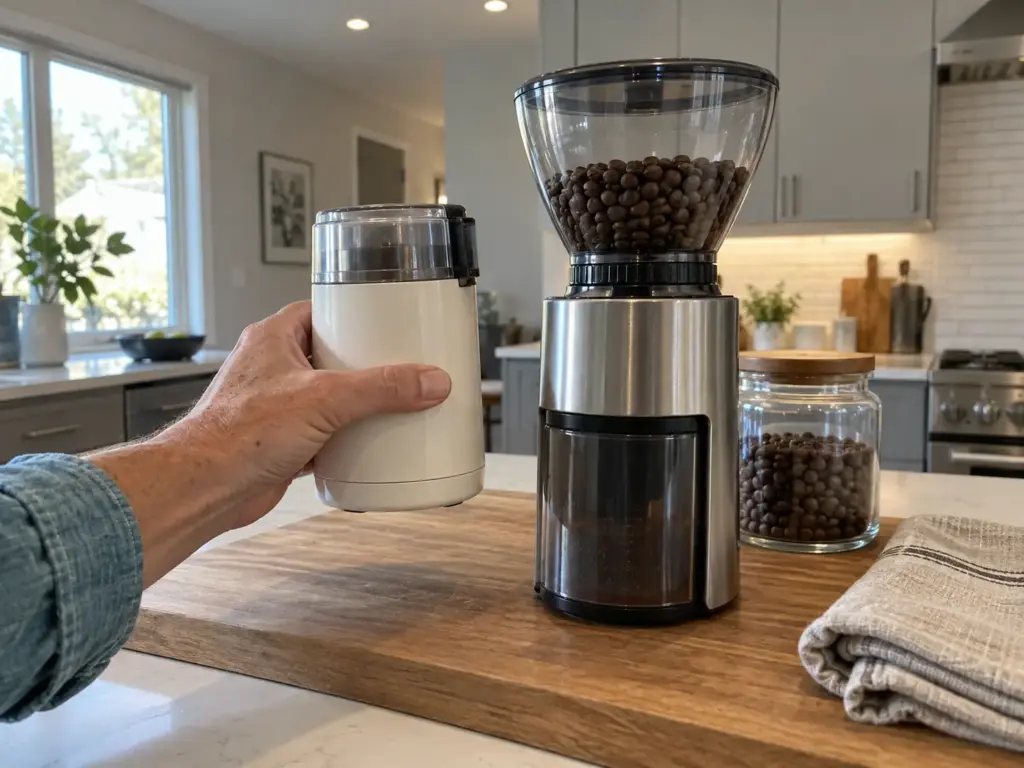
A burr set is two rings of hardened steel (the burr material is ceramic on some grinders) with teeth cut into them, one fixed and one turning. The teeth grab a bean, crack it, and walk the pieces down toward a gap that decides how big they can be when they fall out. You can read how a burr grinder is put together elsewhere; for the price, the gap is what counts.
The job boils down to three demands: hold two spinning pieces of metal a precise distance apart while coffee passes through, let the owner adjust that distance finely, and turn them slowly without stalling.
Every clause of that costs money. The teeth take precision machining to a geometry that makes evenly sized particles, not just smaller ones, and that evenness (the particle size distribution) is the grind consistency you’re paying for. Burr alignment matters as much as the teeth: a burr sitting a hair off its axis opens and closes the gap once per revolution, so the grounds come out in two sizes instead of one.
The adjustment has to move the gap in small, repeatable steps without letting it creep when the beans push back. A cheap burr grinder has all of those parts too. It just holds them to looser tolerances.
A Motor That Turns Slowly Without Stalling
Burrs work best turning slowly, and slow is harder to build than fast. LeBrew, a company that makes burrs and grinder parts, explains that a larger burr diameter needs more torque to keep turning without a motor stall, so a bigger burr is never just more metal: it drags a bigger motor along with it. Low-cost designs pair a small motor with reduction gears, while heavy-duty ones put more motor power behind the burrs, with a direct drive or a belt.
The gap between those two approaches shows up under load. GEVI, a grinder maker, publishes a table putting its own motor at less than 1 percent speed variation under load, against a 20 to 35 percent drop for a generic low-cost motor. Those are a seller’s numbers about its own product, not an independent test.
But they describe something you can hear at the counter. Run a small grinder through a full bean hopper and the pitch sags as beans pile onto the burrs, then climbs again as the hopper empties. Each sag is the burrs slowing down, and GEVI’s argument is that those dips at low rpm shatter more of the bean into fines.
If your electric grinder labors with the hopper full, stop filling it to the top. Load one or two doses at a time: less weight pressing beans into the burrs means less load on the motor, and the pitch should hold level from the first second to the last. If it still bogs down on a single dose, the motor is small for its burrs, and no setting will change that.
The Case, and How Few People Buy It
The shell is the part people wave away, and it’s the one that gets argued over longest. A case that fits closely around one particular set of internals has to be designed and tooled for that grinder alone, with its own molds, fixtures and trial runs. That tooling cost, the bulk of the housing cost, is paid once, before the first unit ships, and it gets divided by however many units the maker sells. Often it is not what’s inside that drives the price up, but what surrounds the internals.
That’s where the refrigerator comes back in. A grinder can cost nearly what a stainless fridge does, even though the fridge is so much bigger and does so much more. Another reply answered with freight: twenty or more grinders ship for what it costs to move one refrigerator, so the size of the box explains nothing.
What separates them is volume, which is economies of scale working in reverse. A refrigerator line spreads its tooling across an enormous production run; low-volume manufacturing loads a real share of that cost onto every grinder that ships. Seen from the buyer’s side, few people buy serious grinders, so supply and demand set the price more than the parts do.
A heavier case does buy something for the cup, though less than its weight suggests. Metal holds the burr carrier steady and soaks up vibration, which helps the gap stay where you set it. But build quality wrapped around loosely toleranced burrs buys heft, not evenness, which is why grinders built without plastic parts are a question of durability first. Put two grinders side by side and the burrs and motor are what the cup tastes; the case is mostly what you pay for the factory.
What the Price Changes in Your Cup
All that precision matters for one reason: whether the particles leave the grinder close to the same size. The cup is where you can check it, with no sieve and no lab, using the beans already in your pantry.
A Blade Grinder Sets the Time, Not the Size
A blade grinder doesn’t have a size. It has a button. The blade spins and chops for as long as you hold it, and holding it longer doesn’t shrink the big pieces so much as it turns more of what’s already small into dust.
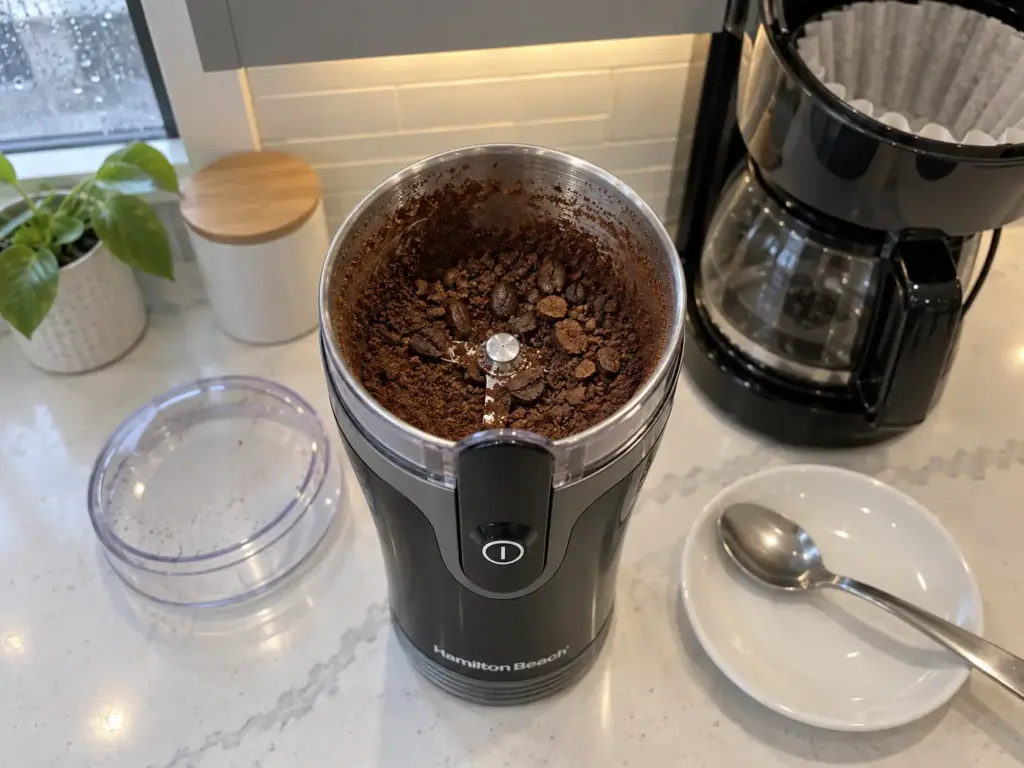
The Hamilton Beach Fresh Grind is a fair picture of what most kitchens already own: stainless steel blades and a cup that takes enough beans for a full 12-cup pot of drip coffee in one go. It’s quick, and it’s the baseline this whole comparison measures against. Its weakness is built in: blade timing decides how long the blades run, not how fine the coffee gets, so every batch is a mix of powder and pieces, and no setting exists that makes two batches match.
Lift the lid after a run and look. A film of powder clings to the walls, with pieces that still look like quarter-beans sitting in it. And the blades dull over months of use, which pushes each batch further toward chunks and dust at the same time.
Sour and Bitter in the Same Sip
Put that mix in hot water and two opposite things happen at once. The powder gives up its flavor fast and keeps going past the point where it tastes good: over-extraction, and the cup turns bitter. The big pieces barely get started before the brew ends: under-extraction, and they stay sour.
The result is uneven extraction, a cup that tastes muddy and unfocused. Changing beans won’t fix it, because the beans were never the problem. It’s the same reason behind why burrs beat blades at all, and in an immersion brew you can see the fines’ trail as the silt at the bottom of a French press.
This is where the direction of the cup decides everything. A cup that’s only sour, or only bitter, points at the grind size: finer for sour, coarser for bitter. A cup that’s sour and bitter together points at the spread of sizes, and no setting fixes a spread. Narrowing that spread is what a burr grinder’s price pays for.
“Grind coarser” is what every chart says for bitter coffee, and on a burr grinder it works. On a blade grinder it backfires. Coarser means a shorter run, which leaves more big pieces without removing the dust already made, so the cup picks up sourness and keeps most of its bitterness. With a blade, the better call is to leave the run time alone for now and test the grinder itself.
How to Taste the Difference With the Beans You Already Have
You don’t need a second grinder to find out whether the spread is your problem. You need two mornings and one change.
- On the first morning, brew the way you always do, with the same beans, the same brew ratio and the same water, so water quality stays out of the comparison. Taste it and note whether it’s sour, bitter, or both.
- On the second morning, change only the blade’s run time, a few seconds longer than usual. Keep everything else identical, and weigh the coffee if you own a scale.
- Compare. If the second cup is more bitter but no less sour, the spread is the problem, not the beans. If it simply moved toward bitter and lost its sourness, the run time was off, and you’ve just found a better one.
Shake a spoonful of blade-ground coffee through a fine-mesh tea strainer over a white plate. The dust that falls through in the first few seconds is the part that turns bitter; the pieces left in the mesh are the part that stays sour. When the plate and the strainer both end up holding a lot, you’re looking at the spread a burr grinder narrows.
The One Upgrade Worth Paying For
Before any money changes hands, three free things can make coffee taste wrong on any grinder, blade or burr. Rule them out first. If the cup still tastes sour and bitter at once afterward, the purchase that changes it is a burr grinder, and it doesn’t need to be an expensive one.
Rule Out the Free Fixes First
The instinct is to start with the grind. Start one step earlier, with the bag, and taste between each change so you know which one did the work:
- Coffee freshness: beans roasted within the last few weeks. Read the roast date, not the best-by date. If a fresher bag makes the cup brighter and clearer, stop there; if it changes nothing, the beans weren’t it.
- The right grind for the brewer: coarse for a French press, medium for a drip machine. If the cup turns cleaner, you’ve found it.
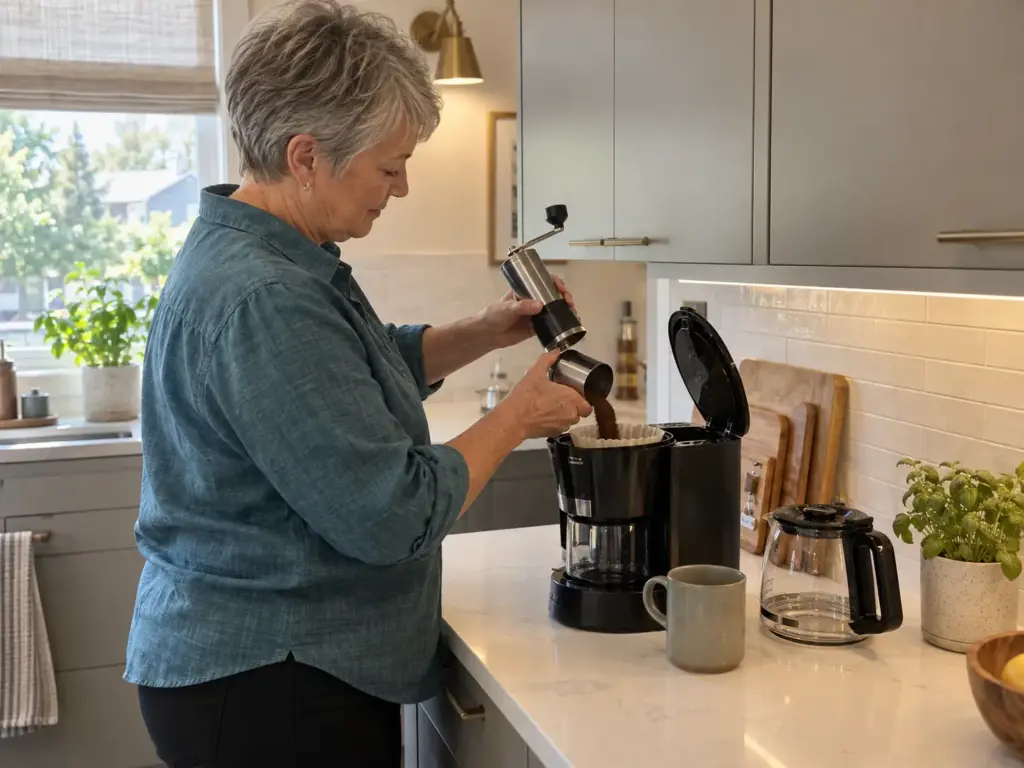
- A clean chamber. Old grounds and coffee oil coat the inside of every grinder and go stale. Brush it out, and if that was the cause, the next cup loses a flat, papery note.
If you already own a burr grinder and it simply won’t reach the setting you need, that’s a calibration question, not a shopping one: see a grinder that won’t go fine enough before you replace it.
An Entry Burr Grinder Closes Most of the Gap
A blade grinder cuts by time; a burr grinder crushes to a set gap. That swap is the one change nearly every cup tastes, and it happens at the bottom of the burr range. The Baratza Encore is the usual example: 40 mm conical steel burrs, 40 grind settings, and burrs that turn at about 550 RPM, according to a review at Coffee Chronicler by a licensed Q Grader. Set a number and the same number gives you the same grind the next morning, which no blade grinder can promise.
It has a real flaw, and it ties straight back to the motor. The Encore can popcorn: beans bounce around loosely in the hopper instead of feeding steadily into the burrs, which slows the grind. The same review traces it to a wing nut on the upper burr that’s there to slow the feed so the motor doesn’t stall on a full hopper.
That’s the torque trade-off from the first section, showing up on your counter (along with a little static in the grounds bin, which scatters coffee when you pull it out). If the Encore isn’t the one, the same logic sorts the other cheap burr grinders that stay even from the ones that don’t.
After you change the setting on any burr grinder, grind a few grams and throw them out before the dose you’ll brew. Yesterday’s grounds are still sitting in the chute at the old setting, and they come out first, so the first cup after a change tastes like something halfway between the two settings.
Still, the Encore is the default answer, not the only one. If you brew one or two cups at a time and don’t mind turning a crank, a manual grinder gets you real burrs for less, with no feed problem at all.
Take Out the Motor and the Price Drops
Remove the motor and you also remove the gearing, the switch and the housing built around them, which are the biggest costs after the burrs. The TIMEMORE Chestnut C2S is what’s left: a 38 mm conical steel burr, around 36 adjustment clicks, an aluminum-alloy shell, and a 20-gram hopper, one dose for a big mug. For a fraction of an electric burr grinder’s price, it holds a set gap the same way. In Tom’s Guide’s own test it kept almost nothing inside, about 0.1 grams per dose.
Its weakness turned up in that same test. At click 20, a medium setting, the grounds spread across a wider range of sizes than the pricier grinders it was measured against, and the reviewer named that as its one real shortcoming. For drip and French press, that spread still beats a blade by a wide margin; for espresso, it’s the ceiling.
The other cost is your arm: every dose is turned by hand, and the finer you go, the longer you turn. Whether that trade suits your mornings is the whole question of manual or electric, and if the crank wins, the budget hand grinders are sorted by the same measure of evenness.
Where Spending More Stops Changing the Cup
Past the entry burr grinder, the money keeps buying real things: finer adjustment, bigger burrs, less coffee left inside, a quieter motor. Most of it is not marketing. The question for a drip, pour-over or French press drinker is which of those things ever reaches the cup.
The Middle Step Buys Adjustment
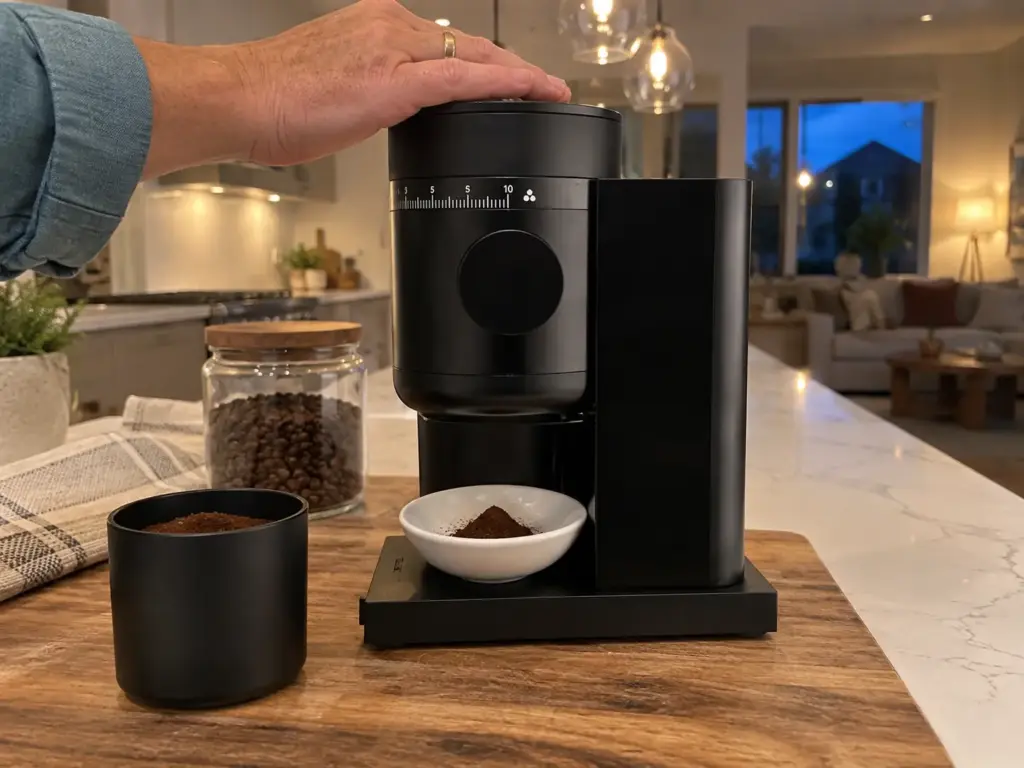
The first thing the next price tier adds is fine adjustment: control over the gap in smaller increments. There is a reference for what a home grinder should do, and it isn’t a store’s marketing copy. According to the Specialty Coffee Association, which publishes a standard for home coffee grinders with its own specifications and test methods, “SCA Standards create a shared framework for quality, consistency, and best practices across the coffee industry.” How fine the steps on your grinder need to be, though, depends almost entirely on your brewer.
Espresso pushes water through a packed puck of coffee in well under a minute, and a tiny change in the gap can swing a shot from sour to bitter. That is why stepless adjustment earns its price there, and why what an espresso grinder needs is a question of its own. A drip pot is far more forgiving: the brew runs for minutes, and the stepped adjustment on an entry burr grinder is usually fine enough to dial in.
The Fellow Opus 2 is a typical middle step, with 48 mm conical burrs, stepless adjustment and an advertised range from espresso to cold brew. For someone who splits the week between a drip pot and the occasional espresso, that range is the reason to pay for it.
The complaint that keeps coming back is retention, the coffee that stays inside after the grind. Some grinders hold back a few grams of grounds, so the dose comes out short, and daily users often have to tap the machine to get it out. Those are reports from daily use, not from an unboxing.
The Splurge Buys Workflow
At the top of the home range, the prosumer end, the money goes into how the grinder works more than into what it makes. The Fellow Ode Gen 2 shows it clearly: 64 mm flat steel burrs, 31 grind settings and a hopper built for single dosing, so you weigh one dose, grind it, and leave nothing behind. Bigger flat burrs and a single-dose design mean less mess and fresher grounds every time, and the choice between conical or flat burrs is a real one. What it doesn’t do by itself is make a filter cup taste better than a well-set entry burr grinder fed fresh beans.
On some units it also struggles with the very problem it was designed around. Retention varies a lot from one setup to another: stock burrs can keep very little, while aftermarket burrs can leave more in the chute.
Another owner returned a unit whose retention neither the local distributor nor Fellow could diagnose, and a third ran stock burrs, then aftermarket ones, then stock again, without ever seeing it. Static is the usual suspect. It’s a unit-by-unit problem, not a defect of the model, but it’s worth weighing your first few doses in and out.
Before grinding a single dose, wet the handle of a spoon, stir the beans with it, and grind. That trace of water on the beans, known as RDT, cuts the static that makes grounds cling to the chute. Weigh the beans going in and the grounds coming out: if the gap closes to a tenth of a gram or so, static was the problem, not the grinder.
“Buy once, buy the best” sounds like thrift, and for an espresso drinker it often is. For someone who only brews filter coffee it breaks down, because the top tier’s gains land mostly in workflow. The better call there is an entry burr grinder, fresh beans and a scale, and if pour-over is your brewer, a grinder for pour-over is chosen by how it handles the medium-fine range, not by its rung on the price ladder.
Timers and Dosing Are Convenience, Not Flavor
An electronic dosing model of a commercial grinder cost nearly as much as the same maker’s larger model with a manual doser, and one reply summed up the difference as “a funnel and a timer.” The same reply judged the bigger manual model the better buy for grind quality.A timer doses by seconds, and seconds aren’t grams. Beans change density with the roast and as they age, so the same run time delivers a different weight from one bag to the next. A kitchen scale does that job more accurately for a fraction of what a timer adds to a grinder’s price.
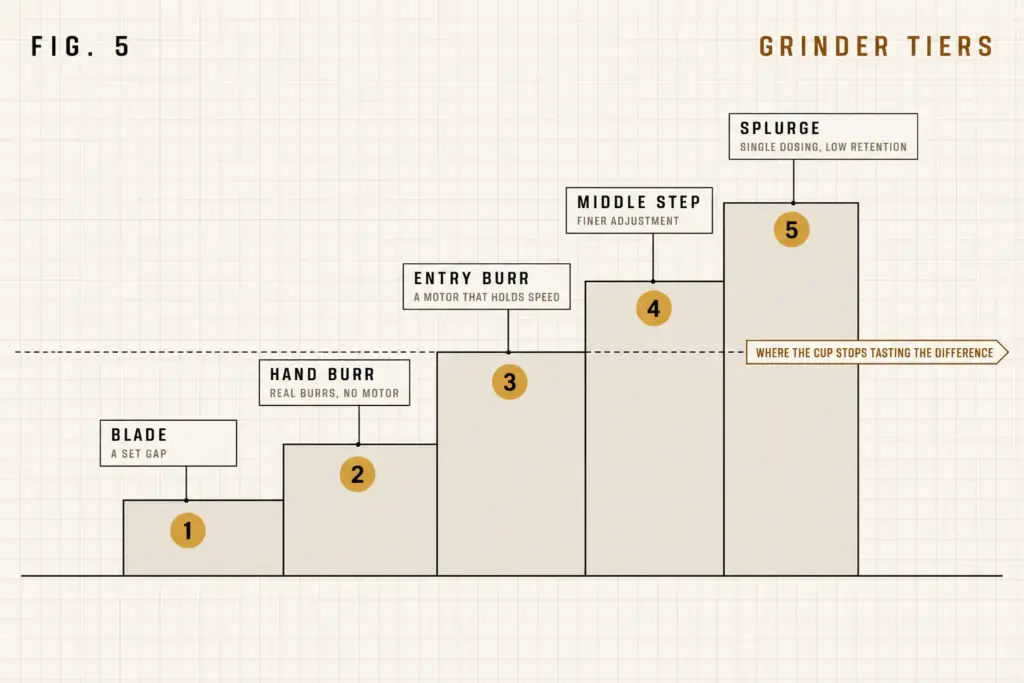
Put the whole price ladder together and the diminishing returns are plain. Blade to burr changes the cup; a motor that holds the gap for you changes it again; finer adjustment is something espresso tastes and a drip pot mostly doesn’t; and the splurge adds workflow first. For drip, pour-over and French press, the returns flatten after the entry burr step. Espresso is where precision keeps paying.
That leaves the one thing a grinder’s price buys that no first-week review can measure.
What the Money Buys by Month Two
Week one hides most of what a grinder’s price pays for, because every grinder is sharp and aligned on the first day. The difference shows up after months of mornings, in whether the setting you found still gives you the same cup.
Burrs Wear, and a Cheap Grinder Drifts
Burr wear is slow and silent. A dull edge crushes less cleanly and makes more fines, so to get the same cup you nudge the setting finer, and over the months the dial creeps toward its fine end without the cup ever tasting quite as clear as it did at first.
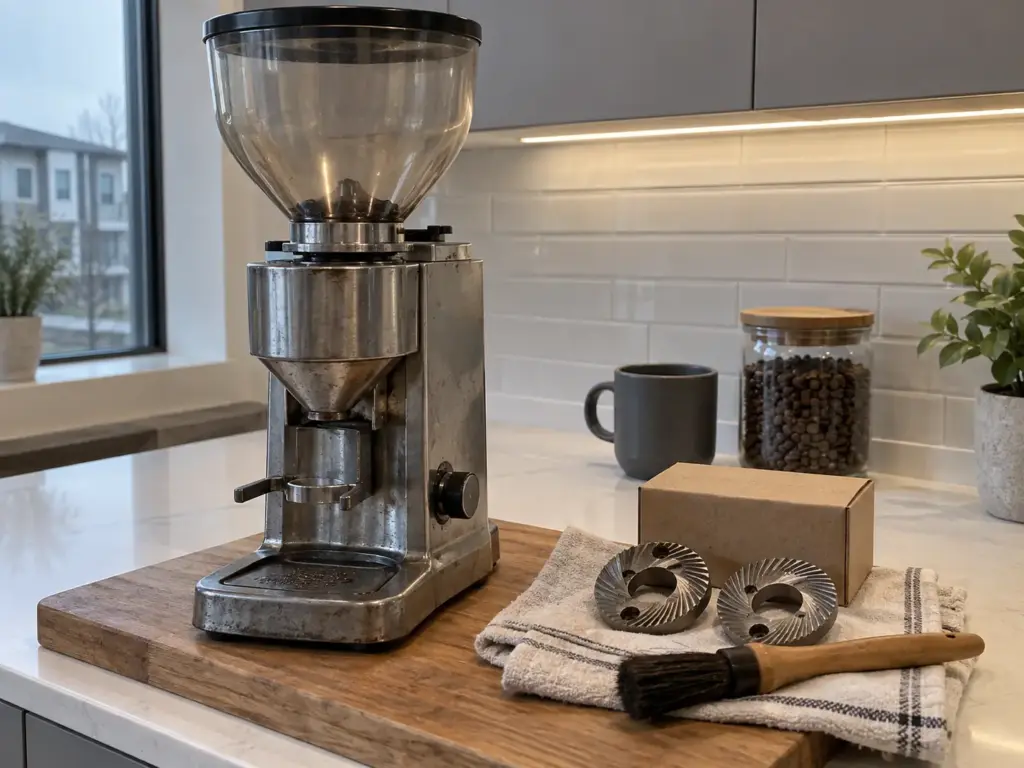
The expensive grinders are built to last for years of heavy use with minimal maintenance, and when their burrs wear, you buy replacement parts rather than a new grinder. That repairability is a large part of what the price buys, and knowing when to change the burrs is how you collect on it: burr lifespan is measured in the cup, not in the calendar.
Price isn’t a promise of longevity, though. That’s one owner’s two machines, not proof in either direction, and how long a grinder lasts depends more on its burrs than on its badge. The test that matters is simpler: same beans, same setting, and if the sour-and-bitter-at-once cup comes back, the burrs or their alignment have moved.
The Used-Grinder Route
The cheapest path to durable gear skips the new market: buy a used grinder of commercial grade and set aside money for new burrs, which cost a fraction of the grinder. You get a machine built for a café’s workload for less than a new splurge grinder (it will also be bigger and louder than anything designed for a kitchen).
Before buying, check that replacement burrs are still sold for that model, and look inside the chute. Commercial grinders are built around a full hopper and keep coffee inside, so if you brew one pot at a time, expect to purge a few grams before every dose.
Where to Go Next
For a drip or French press kitchen, I’d stop at the first burr grinder and spend the rest on beans; for espresso, the tier to stop at is the one whose steps are fine enough to steer a shot. And if you’re still deciding whether a grinder belongs on your counter at all, settle whether grinding your own is worth it before you weigh any of the tiers above.
Pay for the Gap, Then Taste Before Paying More
A grinder’s price pays for burrs that hold a precise gap, a motor that keeps its speed under load, and a case built in small numbers. Of those, the jump from blade to burr is the one your cup tastes every time. Past the entry burr step, a filter brewer is mostly buying workflow, lower retention and years of service, which are real, but they aren’t flavor.
A month from now, brew the same beans at the same setting and ask whether the cup still tastes the way it did in the first week; if it has drifted, the burrs will tell you before the price tag does.
Tomorrow morning, before buying anything, brew with beans roasted in the last few weeks, at the grind for your brewer, from a chamber you’ve brushed out, and taste for one thing: sour and bitter at the same time. If it’s there, a burr grinder is your next purchase. If it isn’t, the grinder you own is already doing its job.
Frequently Asked Questions
01Is an expensive coffee grinder worth it?
For espresso, often yes, because a tiny change in the gap moves a shot from sour to bitter and finer control keeps paying off. For drip, pour-over or French press, the cup mostly stops improving after an entry burr grinder. Past that point, the money buys workflow, lower retention and build.
02How much does a decent coffee grinder cost?
A decent electric burr grinder costs several times what a blade grinder does, and a hand burr grinder puts real burrs on the counter for a fraction of that. Above the entry burr tier, extra money buys workflow and finer adjustment rather than a better filter cup.
03Is it less expensive to grind your own coffee?
Grinding your own doesn’t make each cup cheaper by itself, since you still buy the same coffee and add a grinder up front. What it buys is freshness: ground coffee starts losing its aroma soon after grinding, while whole beans hold it far longer.
04Why are hand grinders cheaper than electric ones?
A hand grinder has no motor, no gearing and no housing built around them, which are the biggest costs in an electric grinder after the burrs themselves. The trade is your arm: every dose is turned by hand, and finer settings take longer.
05Do expensive grinders last longer?
Expensive grinders are usually built for years of heavy use and take replacement burrs, so they can be serviced instead of thrown out when the burrs wear. Price is not a guarantee, though: a cheap blade grinder can keep running for years.

How did your cup turn out?
No comments yet. Tell us what you changed — and whether the needle moved.