




We may earn a commission when you buy through links on this page. It never changes what we recommend. How we pick
On this page9 parts
- What Grinding Coffee at Home Actually Changes
- The Roast Date Decides Before the Grinder Does
- Grind Size per Brewer Is the Other Reason to Grind at Home
- The Grinder Is the Catch
- What the Extra Step Costs You, Morning After Morning
- Who It's Worth It For, and Who Can Skip It
- Settle It With Two Cups in Your Own Kitchen
- Start With the Date on the Bag You Already Own
- Frequently Asked Questions
You’re holding a can of pre-ground whose Best By date sits a year away, and the advice you keep hearing for the flat cup inside it is to start grinding your own. Before you decide whether grinding coffee is worth it, look at what that date describes: a sealed can, not the coffee in it. The date that decides the cup is the roast date, and plenty of bags and cans never print one.
Grinding opens every particle to the air at once, so it speeds up a loss that began the day the beans left the roaster, and it can’t put back what a months-old bag already gave up. What follows is the short answer, then what grinding changes, the date that matters more, grind size per brewer, the grinder that decides whether it pays off, what it costs you day to day, who can skip it, and a two-cup test that settles it in your own kitchen.
Quick Answer
Yes, when three things line up: beans roasted recently, a grinder that cuts evenly (a burr, not a cheap blade), and a brewer that can use the size you pick. Grinding can’t rescue a stale bag, so read the roast date first. For pods, a pot that sits on the warmer, or heavily flavored cups, the gain mostly disappears.
What Grinding Coffee at Home Actually Changes
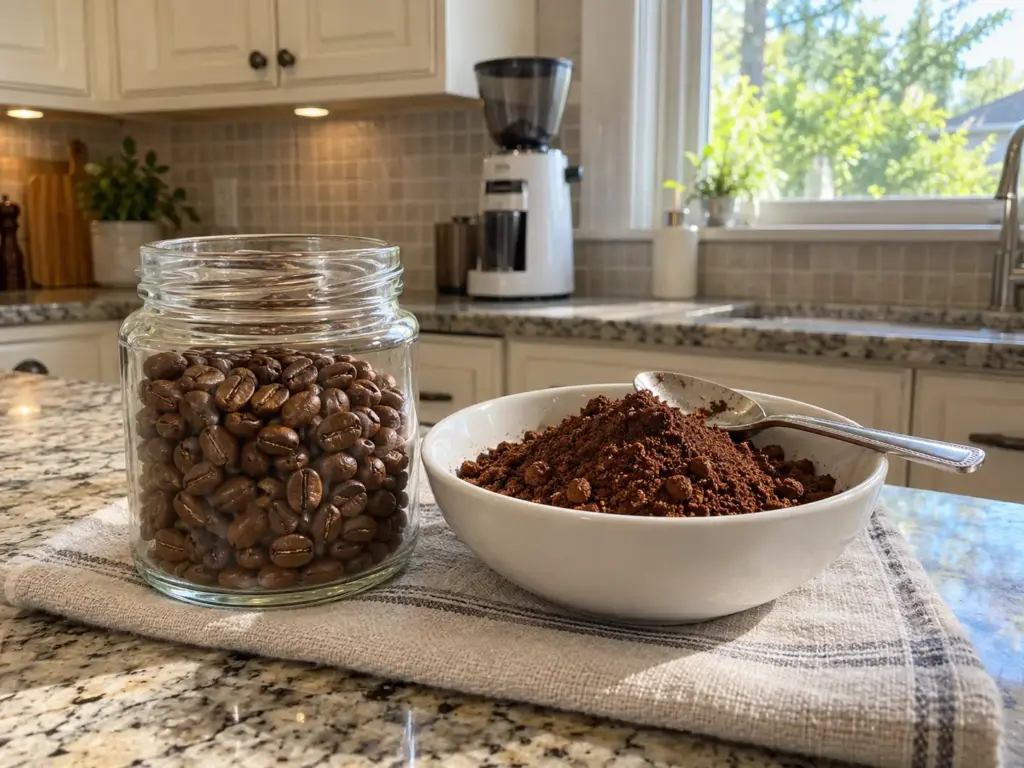
Grinding does one thing to coffee: it multiplies the surface the air can reach. Everything else in this article, from the smell that fades out of an open bag to the reason the roast date outranks the grinder, follows from that one fact.
Why Ground Coffee Goes Flat Faster Than Beans
Open a bag of pre-ground and the smell that hits you on the first day is loud. Two weeks later the same bag gives off a faint, papery version of it, and the cup brewed from it tastes flat and dull: less aroma, less sweetness, none of the bright acidity it had, and nothing sharp or bitter enough to point anywhere. That isn’t your nose and it isn’t your brewer. According to the Specialty Coffee Association’s 2012 literature review on staling, “When coffee is ground, the porosity and surface-to-volume ratio increase, which accelerates degassing and staling.”
Two losses run at once. The carbon dioxide and the aroma compounds trapped inside a roasted bean leak out, and a whole bean lets them go slowly through its own walls, while a ground particle has almost no walls left. At the same time the coffee’s oils react with oxygen, and the review ties that lipid oxidation, the source of the rancid note in old coffee, to the surface area of the grounds. More surface, more of both.
You can see the first loss at the brewer. Pour hot water over coffee ground a minute ago and the bed swells and bubbles as the trapped gas escapes; that’s the bloom. Pour it over grounds that sat open for a week and the bed barely rises; it just darkens and sinks. The bloom is the visible share of what the air already took.
Heat, Air and the Jar It Sits In
Heat speeds all of it up, and it hits ground coffee harder. The review summarizes work showing whole-bean degassing running about 1.5 times faster for every 18°F (10°C) of warming, with ground coffee reacting about twice as strongly as beans to the same rise. A jar of grounds on the shelf above the stove (the classic spot, because that’s where the kettle is) loses more than a bag of beans would in that same spot. Room temperature, away from heat and light, is the ordinary answer, and a cupboard on the far side of the kitchen does it for free.
Oxygen is the bigger lever. In the studies the review cites, cutting the oxygen in a container to 0.5% stretched shelf life up to twentyfold, and every extra 1% of oxygen raised the rate of degradation by about 10%. So the headspace matters as much as the lid: a mason jar one-third full of grounds holds far more air than the same jar packed to the top, and a big canister with a little coffee in the bottom is the worst of both.
The containers and the rules for keeping them are their own subject, and how to store ground coffee covers them.
How Fast Is Fast? What the Research Can and Can’t Say
Here the numbers run out. The review, published when the association was still the SCAA, is candid about its own evidence: 12 of the 28 studies it covers were never submitted for peer review, most measured aroma with instruments or noses rather than how the cup tasted, and about half ran on robusta or robusta blends, not the arabica most home brewers buy. What the field agrees on is the direction. Surface area, oxygen, heat and time all push the same way.
What it doesn’t have is a stopwatch for a home cup. The review gives no hours figure for ground coffee at all, so any claim that ground coffee goes stale in so many minutes, or lasts so many hours, is an estimate somebody made. Some brewers who grind in the evening into an airtight container find the overnight wait makes little difference to the cup. Another person’s palate might catch it.
Direction, yes. Clock, no.
The Roast Date Decides Before the Grinder Does
If grinding only speeds up a loss that starts at the roaster, then a bag roasted months ago has already lost most of what grinding would protect. So the first question isn’t which grinder. It’s the date on the bag.
“Best By” Is a Sealed-Bag Date
Say you bought whole beans at the supermarket to do it right, unboxed a new grinder, and found the first cup tasting no different from the can. The grinder wasn’t the problem. Those beans may have sat roasted on the shelf as long as the can beside them, and that’s the objection people raise in coffee groups: store-bought whole beans can be every bit as old as bagged ground coffee.
The packaging figures in the review explain the long dates. In coffee packed in plain air, trained assessors picked up rancidity after four months; nitrogen-flushed bags held about six months against three without the flush; vacuum packs staled at one-fifth the rate of air-packed ones. A Best By date a year out describes a package that is still sealed.
Once you open it, a secondary shelf life starts, and it may run faster than the staling inside the sealed bag. For the full sealed-versus-opened picture, see how long coffee beans last once the bag is open.
“Buy whole bean and grind it fresh” quietly assumes the whole bean is fresh. Between a bag of whole beans roasted months ago and a bag a local roaster ground for your brewer last week, I’d take the second one, and I’d expect it to win a blind taste.
Where the Loss Happens — the First Days and the First Month
The review’s timeline starts at the roaster. Losses of gas and aroma were “most dramatic within the first few days” after roasting, and the fastest rate of freshness loss came in the first month. One aroma compound typical of fresh roast was down to about 30% of its starting level after eight days, and a trained panel rated coffee one week off roast “distinctly less odor-intensive” than fresher coffee.
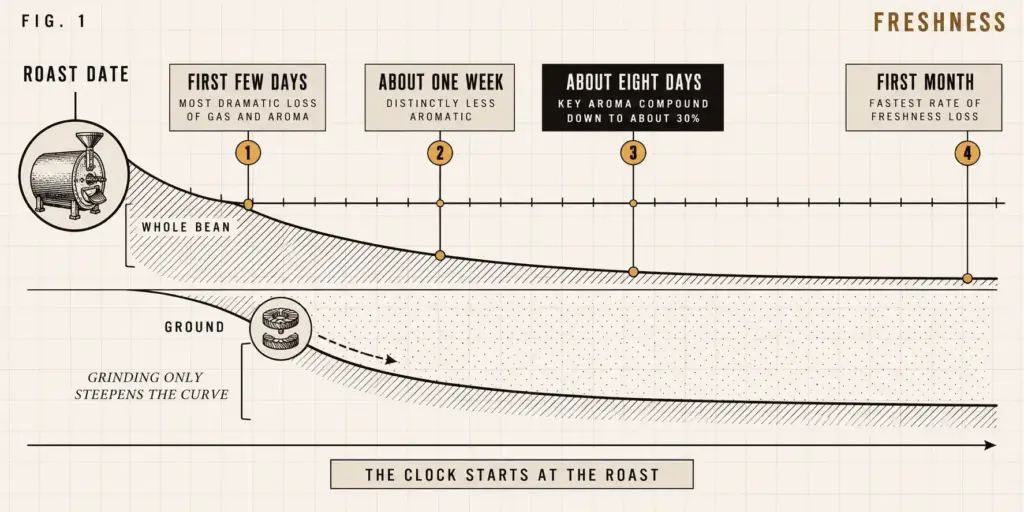
Put the two halves together and the order follows. Grinding steepens the curve from wherever the beans already are. Grind beans that are a week off roast and you protect a lot; grind beans that are five months off roast and you protect very little, because the steep part of the curve happened in a warehouse.
There’s a sign you can read at the store shelf. Most specialty bags carry a one-way valve, and a bag that still puffs gently from the valve when you press it is still releasing gas. A bag that stays flat and quiet under your thumb has been waiting a while. If you suspect the beans already in your cupboard, learn to tell if coffee beans are stale before you blame the grind.
How to Read the Bag Before You Buy Anything
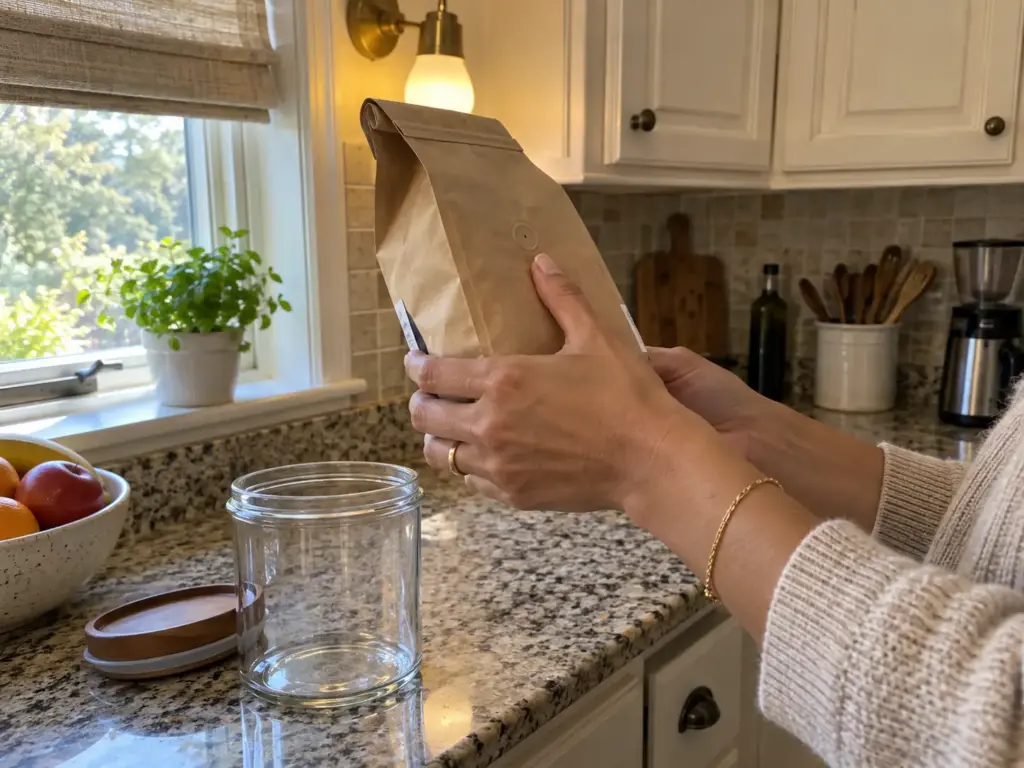
This is the free fix, and it comes before any purchase. Look for a roast date, not only a Best By; if the bag prints only a Best By, you don’t know where its curve started. Buy a size you’ll finish in two to three weeks, and keep it sealed, dark and away from the stove. The rest of what the bag tells you, from origin to process, belongs to the next decision.
The order of priorities runs in three steps: buy locally roasted coffee within days of roasting, then the best grinder your budget allows, then grind on demand. The grinder is step two for a reason.
Write the day you open the bag on the bag, next to the roast date. The roast date tells you where the curve started; the opening date tells you when the air got in. To size your next bag, divide: a 12 oz bag (340 g) at two 15 g doses a day lasts about 11 days, and at one dose a day about three weeks. If the bag is still half full at week three, buy smaller.
Grind Size per Brewer Is the Other Reason to Grind at Home
Freshness is half of the case, and the other half has nothing to do with time. Pre-ground comes at one size that somebody picked for an average brewer, and a cup that’s off in a known direction can only be moved if the grind can move with it.
Why Pre-Ground Is Somebody Else’s Medium
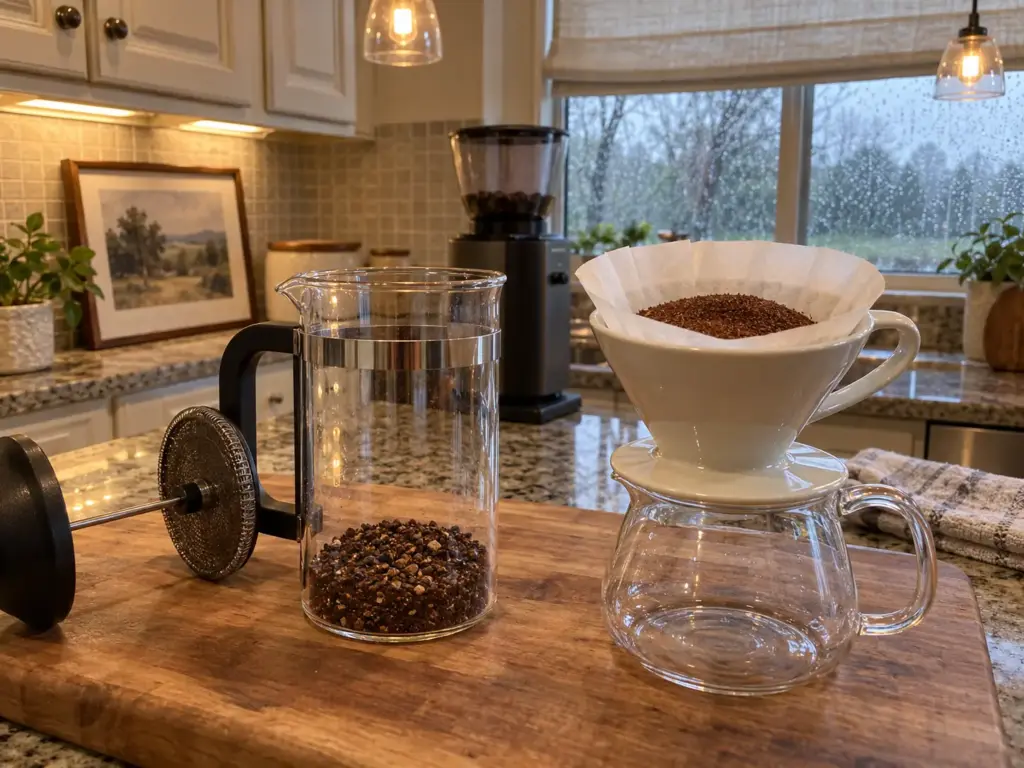
The same bag of pre-ground can taste fine from the drip machine and muddy, harsh and gritty from the French press somebody gave you. The coffee didn’t change. The brewer did, and the grind couldn’t follow.
The rule behind it is simple: the longer the coffee sits in contact with the water, the coarser the grind should be. Cold brew, which steeps for hours, wants the coarsest; a French press wants coarse, a drip machine medium, an AeroPress or a moka pot finer, and espresso fine. A bag of whole beans can serve two brewers in the same house; a can of pre-ground serves one. The grind size chart lays out every method.
According to the National Coffee Association’s drip coffee guide, “While you can buy and use ground coffee, buying whole coffee beans and grinding them immediately before brewing guarantees maximum freshness.” True, with the condition from the last section attached: it guarantees the freshness the beans still have. The same guide lays out the contact-time rule above.
You can see the mismatch in the mug. Drip-size pre-ground in a French press pushes a fine silt through the mesh filter, and the last third of the cup turns gritty and bitter where the fines kept steeping on the bottom.
Sour Points One Way, Bitter the Other
A cup that’s off tells you which way to go. Sour and thin means the water left before it finished extracting, so the grounds were too coarse for that brewer: go one step finer. Bitter and harsh means the water stayed too long, so go one step coarser. With pre-ground, neither move exists; the size is fixed at the factory.
Make one change and taste. If a sour cup was the problem, the next one should taste rounder and sweeter with the sharp edge gone. Overshoot and it turns dry and bitter at the finish, which means come back half a step.
Go two steps finer if the cup was very sour. No, make it one: a big jump can skip straight past the cup you wanted, and one step at a time is how you dial in a new bag. The whole direction-and-adjust method is in how grind size changes the taste.
The Brewers Where It Shows, and the Ones That Hide It
Immersion brewers and espresso are the picky ones. A French press steeps everything together for minutes, so a wrong size shows as silt or as a thin, sour pot, and espresso moves visibly with even a small change in size.
A drip machine is forgiving by comparison: the water passes through a paper filter at its own pace, which is why the pre-ground can mostly works there. If a drip machine is what you own, the right grind for a drip coffee maker tells you what medium actually looks like.
That forgiveness is also why many home grinders still keep a bag of pre-ground for travel and camping. One brewer, one size, no grinder in the bag.
The Grinder Is the Catch
Everything so far assumes the grinder gives you the size you asked for. That’s where grinding your own most often fails, because the cheapest way to start is the one grinder that can’t hold a size at all.
A Blade Grinder Makes Boulders and Dust in One Chamber
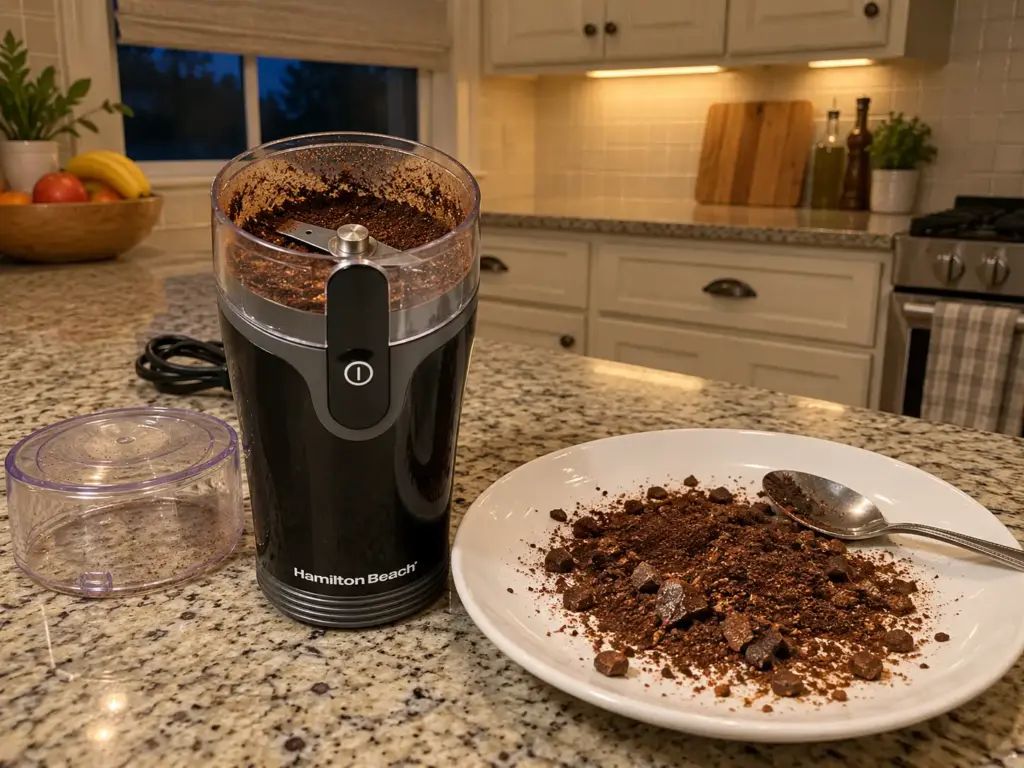
Maybe it’s the spice-style grinder that came as a gift, or one you’re eyeing because it costs a fraction of a burr grinder. A blade grinder doesn’t set a size: its blade chops until you stop it, so the chamber holds big chunks and fine powder at once. The powder gives up everything fast and pulls the cup bitter; the chunks barely start and leave it sour.
That uneven extraction is why the cup can taste sour and bitter in the same sip, and why the National Coffee Association recommends a burr grinder over a blade, which can’t make the grind consistent. The full argument lives in burr vs blade.
Tip a blade-ground batch onto a white plate and the two sizes separate on their own, and inside the grinder the powder coats the lid while the chunks sit in the middle. The Hamilton Beach Fresh Grind (80335R) is the blade grinder in a lot of kitchens, and it can grind unevenly. The motor can burn out easily, so grind in little 3-second pulses, and units can break down within months.
Still, the blade you already own isn’t worthless. With fresh beans and a French press, a blade used carefully can beat a months-old can. A cheap blade plus a French press is a low cost, low effort entry. With stale beans, nothing here helps. The pulse method is in how long to run a blade grinder.
With a blade grinder, run short bursts of a few seconds and shake the whole grinder between them, so the chunks that rode the walls fall back onto the blade. Judge the result on a white plate, not by the clock: if powder and peppercorn-sized pieces still sit side by side, add another short burst and another shake rather than one long run, which only makes more dust.
An Entry Burr Grinder, Flaws Included
A burr grinder crushes each bean between two toothed rings set a distance apart (conical and flat burr sets both work this way), and a piece only falls out once it’s small enough to pass the gap. The gap sets the size, so the size stays put from one morning to the next. A burr grinder fed a stale bag still makes a flat cup, just very evenly, so the roast date comes first.
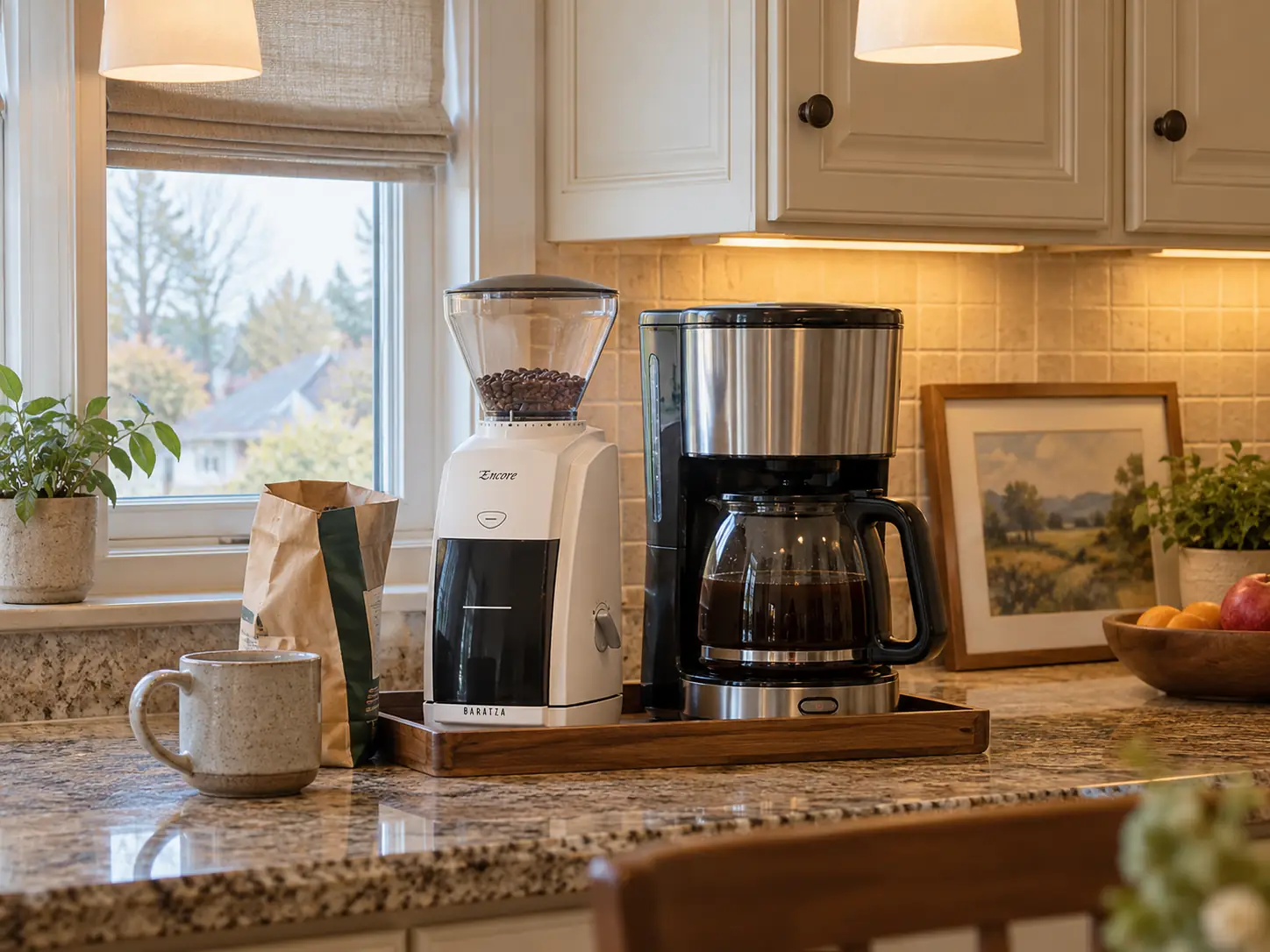
With the beans sorted, the Baratza Encore is the usual reference for an entry electric burr grinder: 40 mm conical steel burrs and 40 grind settings, a range that covers the French press and the drip machine. It comes with two catches. Static makes grounds cling and scatter when you empty the catch cup, and durability is a concern, since units can break within months of use.
The OXO Brew Conical Burr is the cheaper electric step: conical stainless steel burrs, several grind settings and a one-touch start, enough for a drip machine and a press. Its trade shows up later, not on day one, since the grinder can break down within months of use and can clog during operation. Tighter budget still? Look for a cheap grinder that stays even rather than a second blade.
Which one fits your counter is the next question, and the best coffee grinders for home answers it with what wears out first on each.
What the Extra Step Costs You, Morning After Morning
A grinder that works on the first day still has to be used on an ordinary weekday, half awake, with somebody asleep behind the wall. So the real price of grinding is counted in seconds, noise, counter space and cleaning, not only in what the grinder costs.
Seconds, Not Minutes
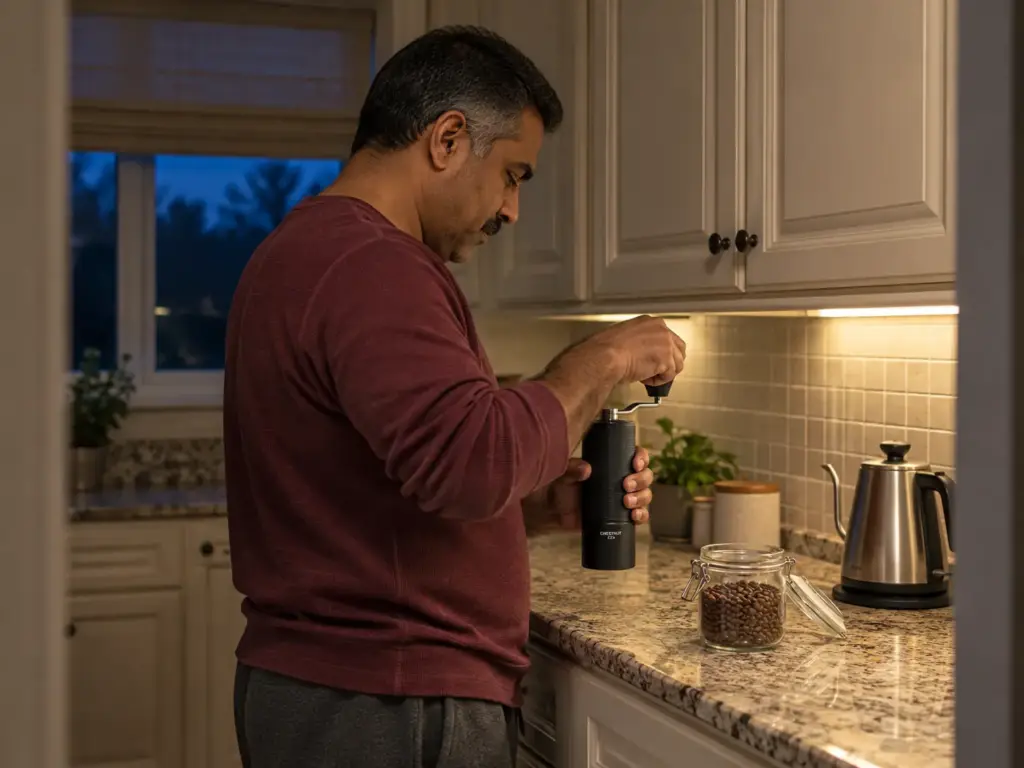
The only timings anyone has put on this come from people who grind every day. Grinding by hand takes about 30 to 90 seconds for a dose, depending on the grinder and the amount. Electric grinders run from about 20 seconds to a minute for a dose. These are community figures, not lab ones, and how long hand grinding really takes breaks them down by grinder and grind size.
The number moves with the coffee, though. Half a minute holds for a medium roast at pour-over size, and a dark roast, more brittle after its longer roast, goes through faster still. A light roast is denser and harder, and light beans are very tough to grind by hand no matter the grinder, so a light roast at a fine setting lands at the top of that range or past it.
Either way, the grinding runs while the kettle heats. Seven cups a week at a minute each is seven minutes, spent mostly waiting for water you were heating anyway.
Weigh tomorrow’s beans tonight and leave the dose in a small cup beside the kettle. In the morning, switch the kettle on first and grind second; a single dose is done before the water is hot, so the extra step adds nothing to the wait. For many people that is only a minute or two of work.
The Noise Problem
Seconds are easy. Noise is the cost that decides it for a lot of households. Noise is a real limit: some people grind only on weekends because the household is asleep on weekday mornings, and others shut the grinder inside a cupboard.
An electric grinder is short, sharp and loud, and a closed door doesn’t stop it. If noise is the objection, start with the quietest grinders, and know that the quietest of all has no motor.
The TIMEMORE Chestnut C2S is that route: a manual grinder with a 38 mm conical burr in 420 steel, about 36 internal clicks of adjustment and an aluminum alloy housing. The sound it makes is a low crunch that stays in the kitchen, it needs no outlet, and it lives in a drawer instead of taking counter space.
What you give up is capacity and your arm. The hopper holds 20 g, so it grinds one dose at a time, and by the community figures above that dose takes 30 to 90 seconds of cranking (more with a light roast). Whether a crank or a motor suits your household is the question of manual or electric.
Month Two — Static, Clogs and Motors
Reviews get written in the first week, and the first week flatters every grinder. The complaints that matter show up later.
Amazon’s own summaries of the reviews, which are generated from owner reports and not from any lab, report the Encore breaking after two months for multiple customers, the OXO breaking down “within months” and clogging, and the Hamilton Beach blade grinder breaking down after four months. The same complaint repeated across many owners is a design flaw, not bad luck, and it belongs in the decision.
Then there’s the mess. On a dry winter morning an electric burr grinder’s catch cup comes out with grounds clinging to its walls, and a spray of them lands on the counter when you tip it. A tap on the side and a few seconds’ wait before opening keep most of it inside, and the rest of the method is in stop grinder static.
Every burr grinder also keeps a little coffee inside after each dose. That grind retention means the first dose after you change the setting still comes out partly at the old one, so grind a few grams after a change and throw them out before you judge the new setting. Old retained grounds are also stale grounds, which is one more reason to brush out the chute when you clean the grinder.
The hand side has its own failures. A cheap hand mill can get tiresome fast: it takes a long time and a lot of effort, and the grind can be inconsistent. A well-built hand grinder, on the other hand, can keep a daily routine going for months and still feel worth it. The difference between those two people is mostly the grinder.
Who It’s Worth It For, and Who Can Skip It
With the date, the size, the grinder and the daily cost on the table, the answer stops being yes or no. Some kitchens gain a lot from whole bean, some gain almost nothing, and a few are better served by a middle path.
Worth It If…
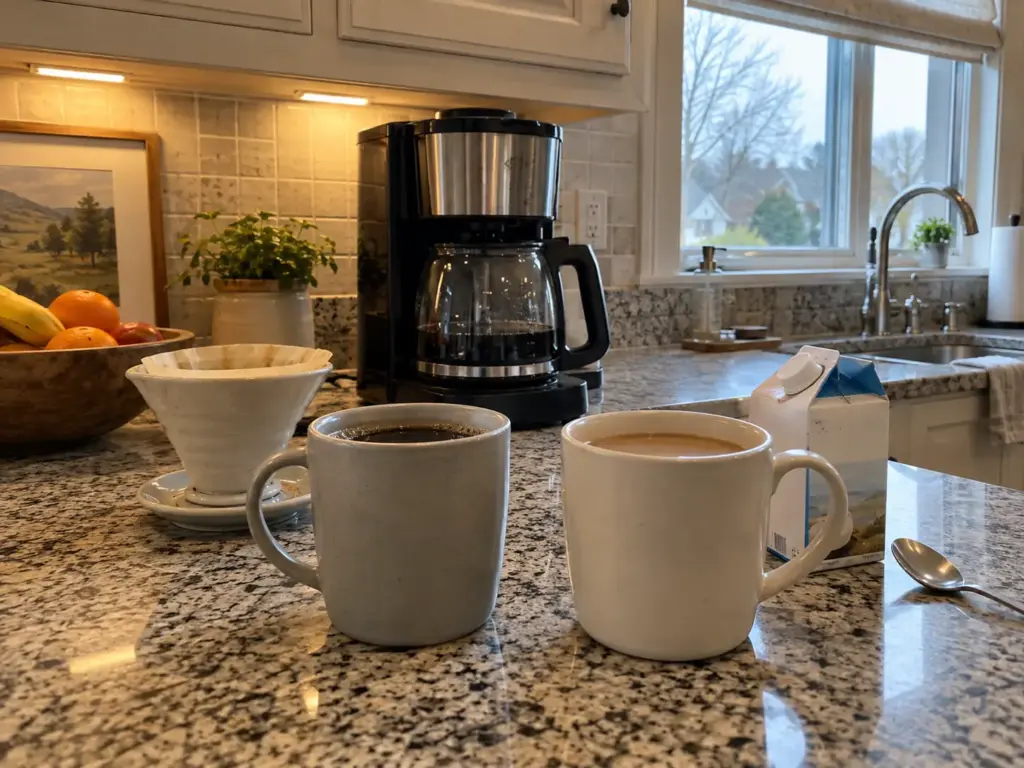
Think of a household where one person drinks a pour-over black and the other pours flavored creamer into a mug from the drip pot. The same beans are worth grinding for one of them and hardly for the other. Grinding at home pays off when most of these are true:
- The bag has a roast date, and it’s recent.
- The grinder is a burr grinder, or a blade used with care on fresh beans.
- The brewer is picky about size: French press, pour-over or espresso.
- The coffee is drunk black or with a splash of milk.
- There’s more than one brewer in the house, so one bag has to serve two sizes.
Not Yet, or Not Worth It, If…
Some setups hide most of what grinding adds, and where no study covers them, what follows is this blog’s judgment with its reason. A Keurig or any pod machine brews from coffee ground and sealed at the factory, so there’s nothing to grind. With a refillable basket you can grind your own, but the machine’s short, fixed brew leaves little to tune, and grind size for a K-Cup is the problem worth solving there.
| What changes | Whole bean, ground at home | Pre-ground |
|---|---|---|
| Freshness once the bag is open | Surface stays small until the dose you grind | Every particle open to air from the first day |
| Grind size you can change | Any size, one step at a time | Fixed at the factory |
| Time per cup | About 20 to 90 seconds, during the kettle | None |
| Noise | Loud electric, or a quiet crank | Silent |
| Gear you need | A grinder, ideally burr, and some cleaning | A scoop, or better a scale |
| Best for | Fresh beans, black cups, two brewers | Pods, milky or flavored cups, travel |
A drip pot that sits on the warming plate turns harsh and flat within the hour, whatever it was made from, and past that point fresh grinding is invisible. Heavily flavored creamer and a lot of milk cover most of the aroma that freshness adds. A blade grinder paired with old beans combines the two weak links.
And travel and camping favor one bag and no gear. Some people program a drip machine the night before with pre-ground, find the difference minimal, and keep the convenience. That’s a fair trade, not a mistake.
If you already have pre-ground at home, use it up. Running it through a grinder again doesn’t make it usefully finer or fresher, and grinding coffee that’s already ground explains why.
The Middle Paths
Between grinding every cup and buying pre-ground there’s room. The most common is grinding the night before into a small airtight jar, filled close to the top so there’s little air above the grounds, and a night in an airtight container is not going to make a huge difference. The window has limits, and grinding the night before covers how far ahead it holds.
The second is to ask the roaster or the shop to grind a small bag for your brewer, which gets you fresh coffee at the right size with no grinder at all (the bag just has to be small enough to finish fast). The third is freezing: split a large bag into smaller airtight bags, freeze them until needed, and open one at a time; the method for that lives under storing coffee beans.
If you have beans and no grinder yet, you can still grind coffee beans without a grinder while you decide.
Settle It With Two Cups in Your Own Kitchen
No study can say whether your palate, your brewer and your beans will notice the difference. One morning and two cups can, as long as only one thing changes between them.
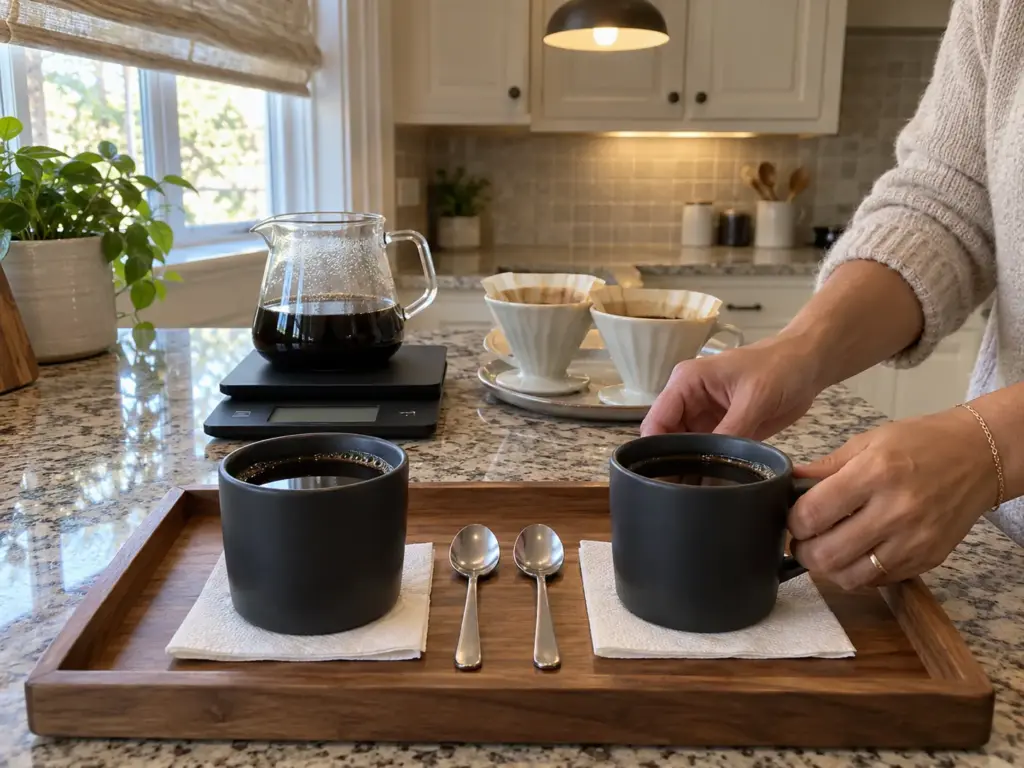
Set Up the Test — One Change Only
This is the test that ends the household argument about whether the new grinder “does anything,” without taking anyone’s word for it. It only works if the dose is equal, and a scoop can’t promise that: freshly ground coffee is fluffier and holds more gas than grounds that have settled overnight, so the same scoop weighs less.
A scale turns scoops into grams, and any kitchen scale already in the house will do. If you don’t own one, the Hario Drip Scale Timer reads in 0.1 g steps and has a built-in timer, so it holds both the dose and the brew time equal, and it switches itself off after five minutes. Amazon’s summary notes several customers reporting that it “broke within 6 months,” and it’s slow to wake, with about a five-second lag at power-on before it reads.
A cheaper route works for this test. The Etekcity 11 lb kitchen scale weighs in 1 g steps with a tare button. It can be not accurate, with inconsistent readings, and some stop working. And 1 g is a coarse step for a 15 to 18 g dose: one gram off on 15 g is nearly 7% more or less coffee, so weigh both doses on the same scale, back to back.
Then set it up like this:
- Use one bag of beans for both cups.
- Grind half the night before and keep it in a small sealed jar, or have the shop grind that half. This is the one change.
- Grind the other half just before brewing.
- Weigh the same dose in grams for each, and the same weight of water.
- Use the same water, the same brewer and the same brew time for both.
- Brew them back to back and let them cool for the same few minutes.
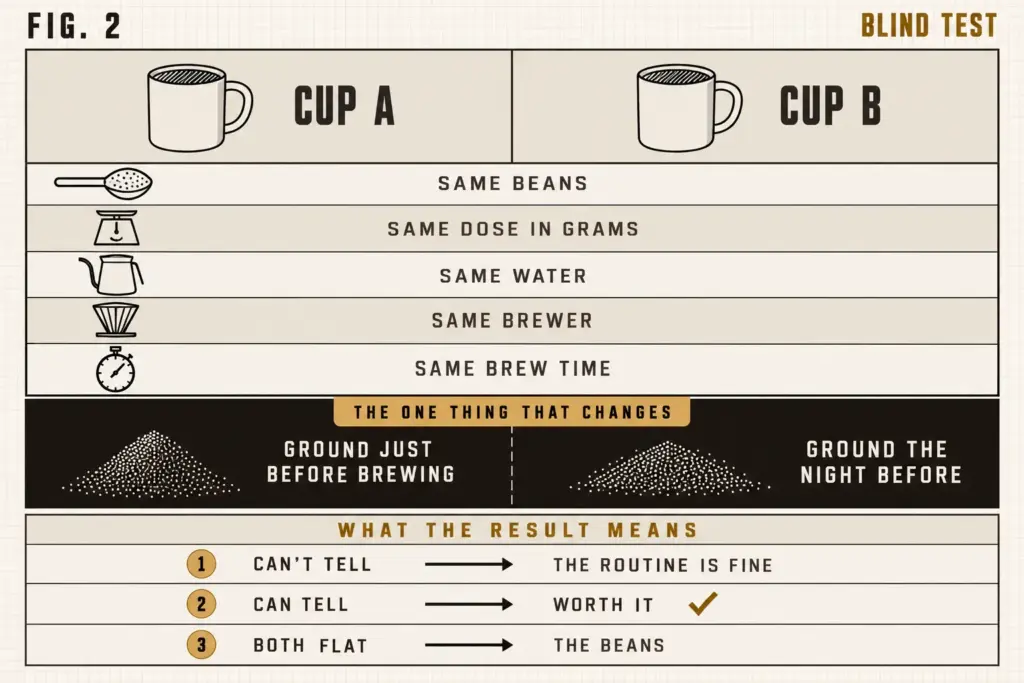
Have somebody else pour the two cups into identical mugs and mark the bottoms with a strip of tape, A and B, so you taste without knowing which is which. Taste each one twice, once hot and once a few minutes cooler: aroma differences show first, and a flat cup often gives itself away as it cools.
How to Read the Result
Watch the brewer as well as the cup. The freshly ground dose should rise and bubble when the first water hits it, while the older grounds sink and darken. If the two blooms look alike, there’s a good chance your palate will find them alike too.
If you can’t tell the cups apart, your night-before or pre-ground routine is fine for your cup, and there’s nothing to buy. That’s a real result, not a failure.
A simple test is to grind in the evening and in the morning, taste both, and if you can’t tell, grind at night.If you can tell, grinding is worth it in your kitchen, and the grinder becomes the next decision. If one of you can tell and the other can’t, let the person who drinks it black decide, since a black cup shows the most of the difference.
If both cups taste flat, the grind isn’t the problem at all. Fresh ground or not, a bag that’s months off roast gives you two versions of the same dull cup. It’s the beans, and the answer is back at the roast date on the bag.
Start With the Date on the Bag You Already Own
Three things decide whether grinding pays off for you:
- Grinding speeds up a loss that starts at the roaster, so read the roast date before you buy a grinder or blame one.
- The gain needs a grinder that holds a size, a burr or a blade used with care on fresh beans, and a brewer that notices the size.
- The price is seconds, noise and a grinder that needs looking after, and the two-cup test tells you whether your palate collects the return.
A month from now, check the roast date on the next bag you buy and tip a dose from your grinder onto a white plate; both drift without announcing it. For tomorrow, read the date on the bag you already have before you buy anything, and if it shows a recent roast, run the two-cup test this weekend. If the cups come out different, choosing the grinder is the next step, burr or blade first and the model after.
Frequently Asked Questions
01Is it better to grind your own coffee?
Yes, when the beans were roasted recently and the grinder cuts evenly, because the cup keeps more aroma and you can set the size for your brewer. With old beans or a blade grinder, the gain is small, so check the roast date first.
02How long does coffee stay fresh once you grind it?
There is no reliable clock for a home kitchen: ground coffee loses aroma faster than beans because of surface area, air and heat, but the studies give no hours figure. Keep grounds sealed, cool and in a small jar filled close to the top.
03Is grinding coffee beans cheaper than buying pre-ground?
Not per cup: a brew takes the same grams whether the coffee arrives whole or ground, so a 12 oz bag makes the same number of cups either way. The added cost is the grinder, and the return is taste and control, not savings.
04Can I grind coffee the night before?
Yes, ground in the evening and kept in a small airtight jar, coffee loses little by morning for most drip and pour-over cups. Taste one night-before cup against a freshly ground one; if you can’t tell them apart, keep the routine.
05Is grinding coffee worth it for a drip coffee maker?
Often yes, if you drink it black and the beans are fresh; less so if the pot sits on the warming plate or gets flavored creamer. A drip machine forgives the grind size, so freshness is most of what you gain.



How did your cup turn out?
No comments yet. Tell us what you changed — and whether the needle moved.