



We may earn a commission when you buy through links on this page. It never changes what we recommend. How we pick
On this page8 parts
- The Best Grind Size for a French Press, in Words and on the Dial
- Why a French Press Needs a Coarse Grind
- Read the Cup and the Plunger Before You Turn the Dial
- Isn't a Finer Grind Safer in a French Press?
- The Numbers That Sit Next to the Grind
- When a Notch Won't Fix the Cup
- Set It Coarse, Then Let the Plunge and the Last Sip Move It
- Frequently Asked Questions
You had the store grind the bag on its coarse setting, gave the press its four minutes, and the plunger sank with no effort at all; the cup came out thin, closer to tea than coffee. Or it went the other way: the plunger stalled halfway, you leaned on it, and the last sip left grit on your tongue. Those two cups point in opposite directions, and between them sits the whole answer to what coffee grind size is best for French press.
A press has no paper, so the grind does the filter’s job on top of setting how fast the water pulls flavor out of the grounds, which is why this brewer gives you two gauges instead of one: the taste of the cup, and how hard the plunger pushes back. Below are the setting in words and on a real dial, why it has to be coarse, how to read both gauges, whether finer is really the safe bet, the numbers to check before the dial, and when no notch will fix the cup, all of it one brewer’s row of the full grind size chart.
Quick Answer
French press wants a coarse grind, close to coarse sea salt (medium-coarse if your grinder’s coarse end runs uneven), because the mesh lets fines through and the steep lasts about four minutes. Thin or weak cup: one notch finer. Silty cup or a plunger that fights you: one notch coarser. Change nothing else between cups.
The Best Grind Size for a French Press, in Words and on the Dial
Every source agrees on the word: coarse. The trouble is that the word means one thing printed on a bag, another on the grocery store’s grinder and a third on the numbered dial on your counter. So the word has to become a French press grind size you can find on your own grinder.
Coarse, and What Coarse Looks Like
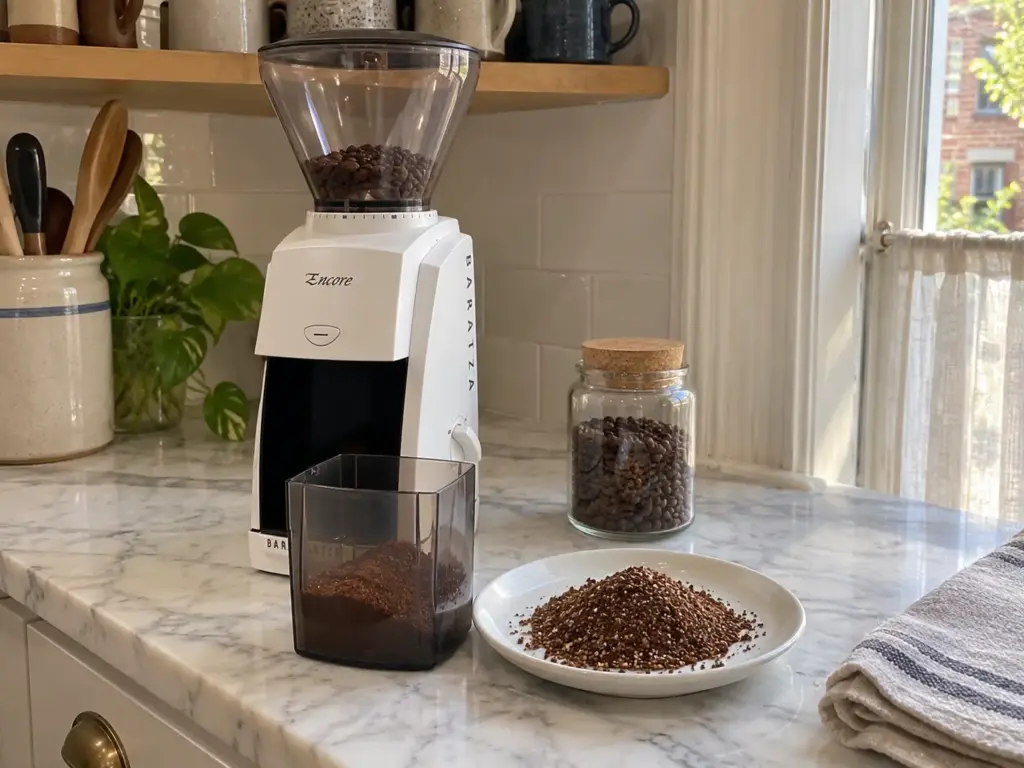
Aim for grounds about the size of coarse sea salt: separate granules you can see one by one, no powder, nothing that clumps when you pinch it. The sources can’t settle on a pantry word for it. The National Coffee Association (NCA) says rock salt, a roaster’s brew guide says sea salt, one press maker’s manual says breadcrumbs, and the usual comparisons run from coarsely ground pepper to kosher salt.
They are all describing the same pile, and none of them is exact. Pick one picture (sea salt is the one most kitchens can check against) and treat it as a starting point that the cup confirms or corrects. Evenness (grind consistency, in grinder terms) counts as much as size here: a handful of coarse granules mixed with dust looks coarse at a glance and still leaves silt in the mug.
Tip a teaspoon of fresh grounds onto a white saucer next to a pinch of coarse salt and look at both from the side. The grounds should sit as loose grains of roughly one size. Then tilt the saucer: if it leaves a brown film behind, that film is the silt waiting at the bottom of your next cup, and no amount of steeping will turn it into anything else.
Where Coarse Lands on a Numbered Dial
A dial of numbers with no words on it is where the confusion starts, and the instinct is to turn it all the way to the coarse end. On at least one common grinder, that overshoots. The Baratza Encore, with 40 mm conical steel burrs and 40 stepped settings running from 1 (finest) to 40 (coarsest), is the rare grinder whose maker prints a French press number: Baratza’s manual for the Encore suggests 28 as the starting point, twelve steps short of the coarsest. So coarse on that machine does not mean all the way.
The same manual says the exact setting can only be found through experimentation, and the owners bear that out. On the Encore, a setting around 18 is a common starting point, and one retailer’s guide prints numbers into the high 30s. There is a second catch with using it as a reference: a new set of burrs throws slightly more fines until it has ground roughly one to two pounds of coffee, according to that same retailer’s guide, so the first weeks at 28 aren’t quite the grind you’ll get later.
The number doesn’t travel between grinders, or even between two owners of the same one. The texture and the cup do. Finding a starting grind setting on your machine is covered in what number your own grinder should be on.
No Settings to Turn: the Store Grinder, a Blade, a Pre-Ground Bag
The grocery store grinder has a word on its dial, and the word misleads more often than you’d expect. Store settings can disappoint: the store’s coarse setting can give very weak cups, and the store’s French press setting can still give weak coffee that needs a finer grind. A third noticed that their own grinder’s medium matched the grocery store’s coarse.
When someone suggested asking the store for a No. A setting number means nothing without the grinder it belongs to, so the right question is what scale and what equipment. Treat the store’s word as a first guess, and let the first cup decide whether the next bag gets ground a step finer or coarser.
A blade grinder has no coarse at all, only a pulse count. Counting pulses on the button does not travel: a count on one machine rarely carries over to someone else’s grinder. What carries over is the method (count, look, taste, change the count by one), which is what how long to run a blade grinder walks through. Expect some silt whatever the count, since a spinning blade makes big chunks and dust in the same pulse.
Pre-ground coffee is the one case where somebody else chose the size. A bag labeled for French press is the right call, and the press maker’s own manual suggests exactly that. A bag ground for a drip machine is too fine for the mesh. And if a bag came out too coarse, whether regrinding coffee that’s already ground can rescue it depends on the grinder you’d be feeding it to.
Why a French Press Needs a Coarse Grind
Coarse is the setting; the reason behind it is what tells you which way to move when a cup comes out wrong. A press differs from a drip machine in two ways, the filter and the clock. Both push the grind toward coarse, but only one of them gets it all the way there.
The Metal Mesh Is the Only Filter
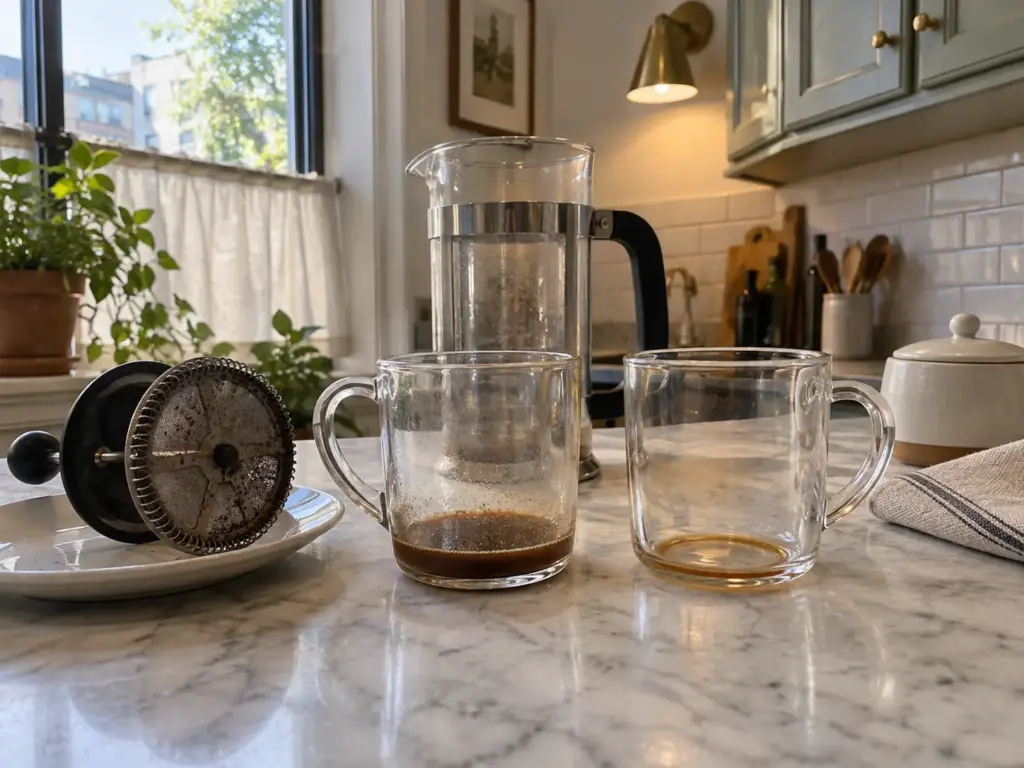
A drip machine pours through a paper filter, and paper holds back almost everything, which is why the medium grind a drip machine wants can carry a bit of powder without anyone noticing. A French press filters through a metal mesh, and anything smaller than its holes ends up in your mug. The manual for one 8-cup press tells owners to use only coarse ground coffee and warns that a fine grind can clog the filter.
The Specialty Coffee Association’s Protocols and Best Practices (2018), written for certifying brewing machines, caps sediment at less than 75 milligrams per 100 milliliters. A mesh has no paper to meet a number like that, so the grind does the filtering: a coarse grind leaves fewer fines, the flour-like fragments every grinder makes, to slip through.
You can see where they go. The last half-inch of the carafe is where the fines that passed the mesh settle, which is why a grind that’s too fine shows up first in the final pour, not the first one.
Four Minutes, and What the Standard Says About Time
Then there is the clock. A press steeps all of the grounds in all of the water for about four minutes, and nothing drains away until you push the plunger. According to the National Coffee Association’s French press guide, “As a general rule, the longer the coffee is in contact with water during the brewing process, the coarser the grind should be.”
The SCA’s document says the same in its own terms: the grind “matches the time of coffee-to-water contact.” It is the same rule that sends cold brew, which steeps for hours, to a grind coarser still.
Read the SCA’s contact-time row closely, though, and the clock alone doesn’t get a press to coarse. The table lists 1 to 4 minutes as Fine, 4 to 6 as Drip and 6 to 8 as Coarse, which puts a four-minute press right on the seam between its fine and drip rows. That table was written to certify brewers, so it says nothing about presses directly. My reading of it: by contact time alone, a press would sit around a medium grind, and the mesh is what pushes it the rest of the way to coarse.
What a Finer Grind Does in the Same Four Minutes
Smaller particles have more surface and a shorter path for the flavor inside them to travel out, so they give it up faster. In a 2023 study in Applied Food Research, researchers measured how much faster in a cold immersion test: in the first five minutes, a very fine grind had released 93% of what it would eventually give, while a very coarse grind had released 61%. By the one-hour mark, both were past 90%.
Those figures come with limits. The water was 73°F (23°C), the ratio was 1:3 in a lab vessel, and the coffee was paper-filtered before measuring, so none of it is a hot press. What carries over is the direction: at any given minute, a finer grind is further along. And when the same researchers made a hot French press brew for the paper, they set their grinder to its coarsest setting.
Put that inside a four-minute press and a finer grind has pulled more out by the time you plunge, while the fines that got past the mesh keep giving up flavor in the mug. Same clock, different cup.
Read the Cup and the Plunger Before You Turn the Dial
Knowing why coarse works is half of it; the next cup tells you whether your coarse is the right one. A press gives you two readings, and the first arrives before you’ve tasted anything, on the way down.
How Hard the Plunger Pushes Back
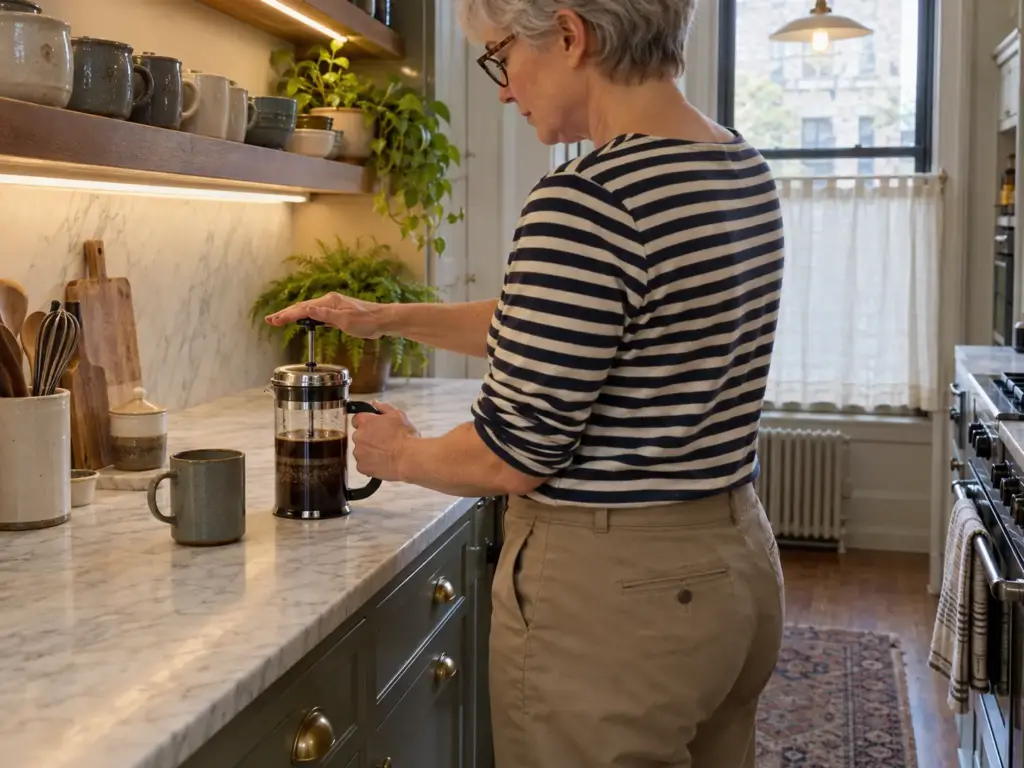
Blue Bottle, a roaster, lays the cue out in its brew guide: the plunge should take about 20 seconds, strong resistance means the grind is likely too fine, and a plunger that drops quickly with little resistance means it may be too coarse. The mechanism is easy to picture. Fines pack against the mesh filter and partly block it, so the water has to force its way through a clogged screen, while big, even granules leave wide gaps and the plunger falls through them. Finer grinds also make the press harder to push, which can lead to spillage or breakage.
That last part matters. The press maker’s manual says that if the plunger gets hard to push, take it out, stir the brew and plunge again slowly, and never force it, because hot coffee can spray out. A stuck plunger is a grind signal, not a strength test. Every method has some gauge like this: espresso uses the shot’s time as its gauge, and the press gives you the plunge.
A stiff plunge turns up most in kitchens where one grinder serves two brewers. A common habit is to brew at the same setting as a V60, because moving the grinder back and forth between brews is a chore, and a pour-over setting is exactly the grind that stiffens a plunger and turns the last sip gritty. If both brewers share one grinder, give the press its own number and write it down.
Glance at a timer, or just count, when you start pushing. Twenty seconds of steady pressure with one hand is the target. If the plunger hits bottom in a few seconds, stick a note on the grinder that says finer; if you’re leaning your weight on it past half a minute, stop, lift, stir, finish slowly, and make the note say coarser. Tomorrow’s grind is decided before you’ve rinsed the press.
Thin and Sharp, or Muddy and Bitter
Now taste, and name which way the cup is off before you touch anything. A cup that’s thin, watery, sour or sharp means the water left the grounds before it finished: under-extraction, and the direction is one notch finer. A cup that’s bitter, dry, astringent or harsh, or one with a gritty last sip, means the water stayed too long or the fines got through: over-extraction or silt, and the direction is one notch coarser. The NCA’s troubleshooting lines agree on the two ends, sending a flat or watery cup finer and a bitter one coarser.
Put the two gauges together and most cups sort themselves:
- Thin cup, and the plunger dropped with no effort: one notch finer.
- Muddy or bitter cup, and the plunger fought you: one notch coarser.
- A cup you like and a steady 20-second plunge: leave the dial alone.
- Thin cup, but the plunger pushed back normally: the grind probably isn’t the problem, so check the dose before the dial.
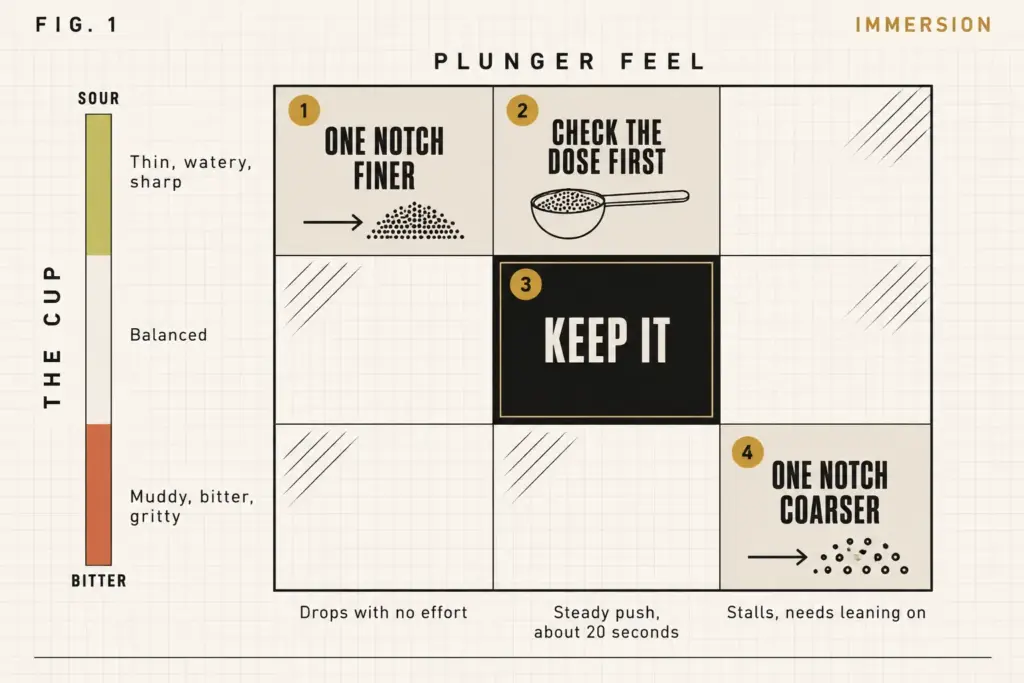
That fourth case is the one that burns through beans. The plunger is telling you the grind is in range, the cup is telling you it’s weak, and turning the dial finer will only add silt to a cup that needed more coffee in it. The dose section below deals with it; trust the plunger here.
One Notch, the Same Recipe, Taste Again
Move one notch in the direction the cup pointed, and keep everything else still: the same grams of coffee, the same water, the same four minutes. If the change worked, a thin cup comes back heavier and sweeter, and a silty one comes clean at the bottom of the mug. If it swung past, with thin turning harsh or an easy plunge becoming a fight, come back half a step where your grinder allows it, or keep whichever of the two notches tasted closer.
Often you feel the change before you taste it. One notch finer is frequently the notch where the plunger suddenly starts pushing back, and that resistance is the grind telling you it moved. Most grinders also keep some old grounds inside, so the first dose after a change comes out partly at the previous setting; a small throwaway grind before the real dose clears it.
To tell whether a cup is over or under extracted, the usual method is the one every press gets dialed in with: change one thing, taste, repeat. It sounds slow. It is the only way to know which change did the work. If you can’t tell whether the grounds themselves shifted, how to tell what grind you actually have covers reading them directly.
Isn’t a Finer Grind Safer in a French Press?
Some brewers argue the opposite of everything above: grind extra fine, because you can’t over-extract in an immersion brewer. That argument is half right. Which half matters depends on whether you press at four minutes.
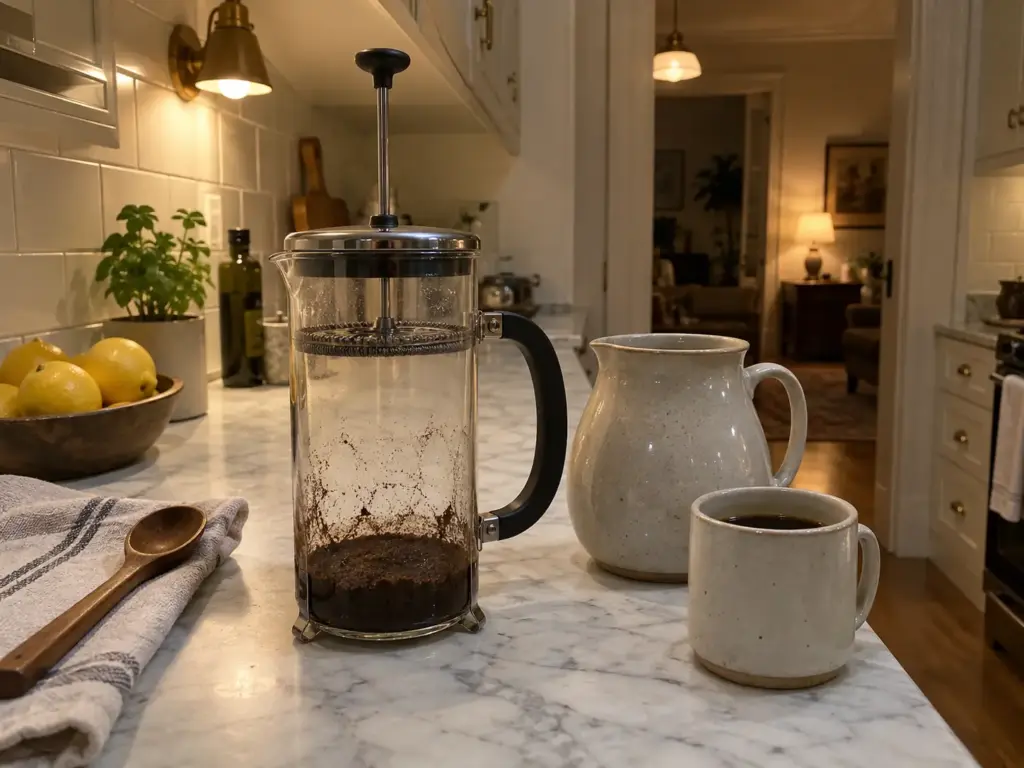
What Immersion Forgives
Start with the half that holds. In a 2021 Scientific Reports study of full-immersion brewing, researchers found that extraction settles at about 21% across a wide range of brew ratios, and that the point where it settles barely moved with grind size, roast level or water temperature between 176 and 210°F (80 and 99°C). Their conclusion was that full immersion gives you precise control over strength but very little over extraction, and that the brew ratio is the parameter to watch most closely.
That plateau is why immersion feels forgiving. Leave the grounds in a little longer and the extraction doesn’t keep climbing without end, the way it can when fresh water keeps running through the bed. On that point, the fine-grind camp has the science on its side.
The fine-grind camp adds a second argument: grinding coarse can leave a lot of unextracted coffee in the pot. Others push back that a weak cup on a coarse grind is a time or ratio problem, not a reason to grind finer, and the Scientific Reports study sides with that view. If the ratio sets the strength, a weak press wants more coffee before it wants a finer grind.
What It Doesn’t: Speed, Silt and the Pot Left Sitting
The plateau is where extraction ends, not how fast it gets there. The cold-immersion study showed a very fine grind reaching most of its end point within five minutes while a coarse one lagged well behind, so at four minutes a fine press and a coarse press are not the same cup, even if they’d drift closer after an hour on the grounds.
Given long enough, the grind barely moves the finish line. In that same cold study, the calculated yield after 18 hours ran from 18.6% for the very coarse grind to 20.0% for the very fine one, a gap of under a point and a half. The grind mostly sets the speed. A French press is stopped at four minutes, though, and speed is precisely what four minutes measures.
The bigger gap is what neither study measured. Both filtered their coffee before testing it, so they say nothing about what a metal mesh lets through, and silt is the whole complaint in a press. Fines that pass the mesh keep sitting in the mug, and they add a slight bitterness to the taste.
The NCA and the press maker both add that coffee left on the grounds keeps brewing and turns bitter. Whether that bitterness is more extraction or the sludge itself hasn’t been pinned down, but either way the answer is to get the coffee off the grounds.
You’ll taste it if you leave half the pot sitting on the press. The second cup comes out harsher than the first, and the grind gets the blame for something the pot did.
Fine and Settle Is a Different Recipe
The fine-grind side mostly runs a different method: grind fine, let the pot sit 10 to 20 minutes so the silt drops, then pour it off gently into another vessel without pressing hard. That method can give a cup with no bitterness and no overextraction. It isn’t crazy, since the plateau is on its side. But it is a separate recipe, finer and longer with a settle and a decant, and its costs are a longer wait, a pot you have to pour with care and some sludge left in the bottom anyway.
It is not a shortcut for someone who presses at four minutes. For a fine grind on a short steep, the better tool has paper in it: the AeroPress, where a fine grind and a short steep do work.
So, the verdict. Going a notch or two finer than sea salt is a legitimate way to a heavier cup if you accept a little silt, and workarounds help, from a second filter screen on the plunger to pouring the whole pot into a carafe so the sediment stays behind. Extra fine at four minutes buys sludge, not safety. And if the real complaint is a weak cup, the stronger cup comes from the dose before the dial, which is also the answer to which grind size really makes the strongest coffee.
The Numbers That Sit Next to the Grind
Before the next notch, three other numbers can make a right grind taste wrong. They cost nothing to check, and the dose goes first because it’s the one most often measured with a scoop and a guess.
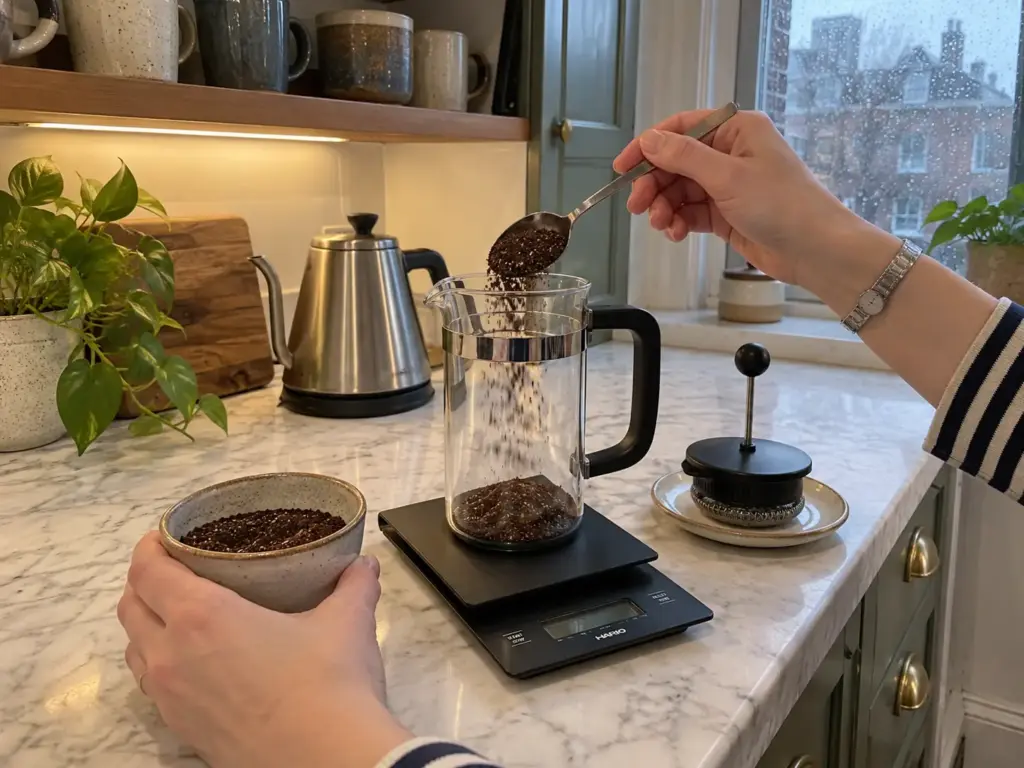
Weigh the Dose Before You Move the Dial
The SCA’s Golden Cup ratio is 55 grams of coffee per liter of water, give or take 10%, a standard written for drip brewers. Press guides run stronger: the NCA gives 1:10 to 1:16 by weight, and Blue Bottle’s recipe uses 30 g of coffee to 350 g of water.
For a 34 oz (1-liter) press, the SCA’s figure is about 55 g, which is roughly five to six level two-tablespoon scoops. Or rather, five to six of one particular scoop: they vary enough that the count is a rough guide at best. The NCA’s range puts the same press anywhere from about 62 to 100 g, and the full ratio chart by press size belongs to the press recipe, not to the grind.
A thin cup with a steady plunge is a dose problem before it’s a grind problem. The immersion study above named the brew ratio as the lever that matters most, and the grind has a different job, laid out in what the grind changes in the cup, and what it doesn’t. Change one thing per morning, the dose or the dial. Move both at once and you won’t know which one fixed it.
That rule only works if the dose is weighed, and any kitchen scale that reads in 1 g steps does the job. The Hario Drip Scale Timer reads in 0.1 g steps and puts a timer on the same display, so it holds the four minutes without a second gadget on the counter. Owners on its Amazon listing report some units failing within about six months, and a lag of a few seconds when it powers on, so switch it on before the kettle rather than after.
Set the empty press on the scale and tare it, add the grounds and note the weight, then tare again and pour the water by weight. A gram of water is a milliliter, so 900 g on the display is about 30 fl oz, with no squinting at faint lines on the glass. Weighing the water as well as the coffee is what makes tomorrow’s cup comparable to today’s.
Water Just Off the Boil
The SCA’s protocol puts the water at about 200°F (94°C) where it meets the coffee, give or take a few degrees. Press guides spread around that: the NCA says about 194 to 205°F (93°C, give or take 3°C), the press maker’s manual roughly 198 to 205°F (92 to 96°C), and Blue Bottle 205 to 210°F (96 to 99°C), the top of which sits above the SCA’s range. For a kettle without a thermometer, let it sit about 30 seconds after it clicks off and you land close to 200°F.
Water that cooled too long under-extracts, just as a grind that’s too coarse does, and it leaves the same thin cup behind. A press made with water that sat while you hunted for the grinder can look like a grind problem that isn’t one. So can a cold glass carafe, which pulls heat out of the first minute; a splash of hot water to preheat the press, poured out before the grounds go in, keeps the four minutes honest. Check the kettle before the dial.
Four Minutes, Then Pour It All Out
Give it about four minutes, the figure the NCA, Blue Bottle and the press maker all land on. Break the crust of floating grounds with a stir at the one-minute mark, plunge in about 20 seconds, and then pour everything into mugs or a carafe. What stays in the press keeps brewing on the grounds, and a pot poured an hour later tastes of the pot, not of the grind you set. Steep time and stirring have more to them than that, but the grind only needs the four minutes to be real ones.
When a Notch Won’t Fix the Cup
If the dose, the water and the four minutes are right and the cup is still off after a notch or two each way, the dial isn’t the problem. Three things can change underneath a setting that used to work, and turning the dial again fixes none of them.
Thin and Silty in the Same Cup
A cup that’s thin and gritty at once is the giveaway. That’s an uneven grind: the big boulders under-extract and taste weak while the fines slip through the mesh as silt. No notch cures it, because turning the dial moves both ends of the spread together; go finer and the silt grows, go coarser and the cup thins out further. The problem is the grinder’s coarse end rather than your setting, and the next decision is a grinder that stays even at the coarse end.
A New Bag, a New Roast, a New Grinder
Every bag can move the setting. Roast is one reason the setting changes with every new bag: lighter roasts generally want a finer grind and a dark roast a coarser one, which is the subject of why lighter roasts grind finer. Some brewers go as fine as espresso for very light roasts, though that is a practice, not a rule. Start a new bag at the last setting that worked and let its first cup and first plunge tell you which way to go.
A new grinder or a fresh set of burrs brings its own drift. New burrs throw a few more fines while they season, about one to two pounds of coffee on the Encore by one retailer’s guide, so the first weeks may need a notch coarser than where the setting ends up. Much later the wear runs the other way: dull burrs crush more than they cut and make more fines again, which is the point of when burrs are worn enough to change.
Write the setting and one word about the cup on the bag itself with a marker: 28 thin, then 27 good. When the next bag arrives, the last good setting is sitting in the recycling bin instead of your memory, and the first press of the new bag becomes a comparison rather than a guess.
When the Beans Are the Problem
Stale beans taste flat whatever the dial says, and a bag well past the roast date printed on it mimics a grind that’s off: the cup goes thin and hollow, and turning finer only adds bitterness to it. You can often see it before you taste it. Fresh coffee is still releasing gas, so the crust blooms and puffs up by the one-minute stir; the grounds from an old bag sit flat and barely bubble. If the setting that worked a month ago keeps drifting, the bag aging is usually the cause, not the grinder moving on its own, and the signs are laid out in how to tell if the beans have gone stale.
Set It Coarse, Then Let the Plunge and the Last Sip Move It
Start coarse, about the size of coarse sea salt, and find that size on your own grinder by the cup rather than by any printed number, including the one in the manual. Read the plunger and the cup together, and move one notch at a time in the direction they point, with the dose, the water and the four minutes held still. And weigh the dose, use water just off the boil and pour the pot off the grounds before you blame the dial.
Whenever you open a new bag, or a few weeks into new burrs, press the first pot at the old setting and read the plunge and the last sip before you trust it again.
Tomorrow, touch nothing but the grinder: one notch in whichever direction today’s cup pointed, then taste whether the thinness or the grit moved.
Frequently Asked Questions
01Is it okay to use fine ground coffee in a French press?
It works, but it costs you: fine grounds slip through the metal mesh as silt, extract faster and make the plunger hard to push. If that is the bag you have, steep a little shorter, press gently and pour the whole pot off the grounds right away.
02What type of grind should you use for a French press?
Use a coarse, even grind about the size of coarse sea salt, ideally from a burr grinder rather than a blade, which chops the beans into uneven pieces. Even matters as much as size, because the mesh lets any fines through into the mug.
03What is the golden ratio for French press coffee?
The SCA’s Golden Cup standard is 55 g of coffee per liter of water, about 1:18, but it was written for drip brewers and press guides run stronger. The NCA gives 1:10 to 1:16 by weight. Pick a ratio in that range, weigh it, and change the dose before the grind.
04What are the common French press mistakes?
The common ones are grinding too fine, measuring with a scoop, water at a rolling boil or cooled too long, forcing a stiff plunger, and leaving coffee on the grounds. Each one can pass for a grind problem, so rule them out before you move the dial.
05What number should a Baratza Encore be on for French press?
Baratza’s manual for the Encore suggests setting 28 of 40 as the French press starting point, twelve steps short of the coarsest. Owners land anywhere from the high teens to the high 30s, so start at 28 and let the cup and the plunger move it one notch at a time.


How did your cup turn out?
No comments yet. Tell us what you changed — and whether the needle moved.