



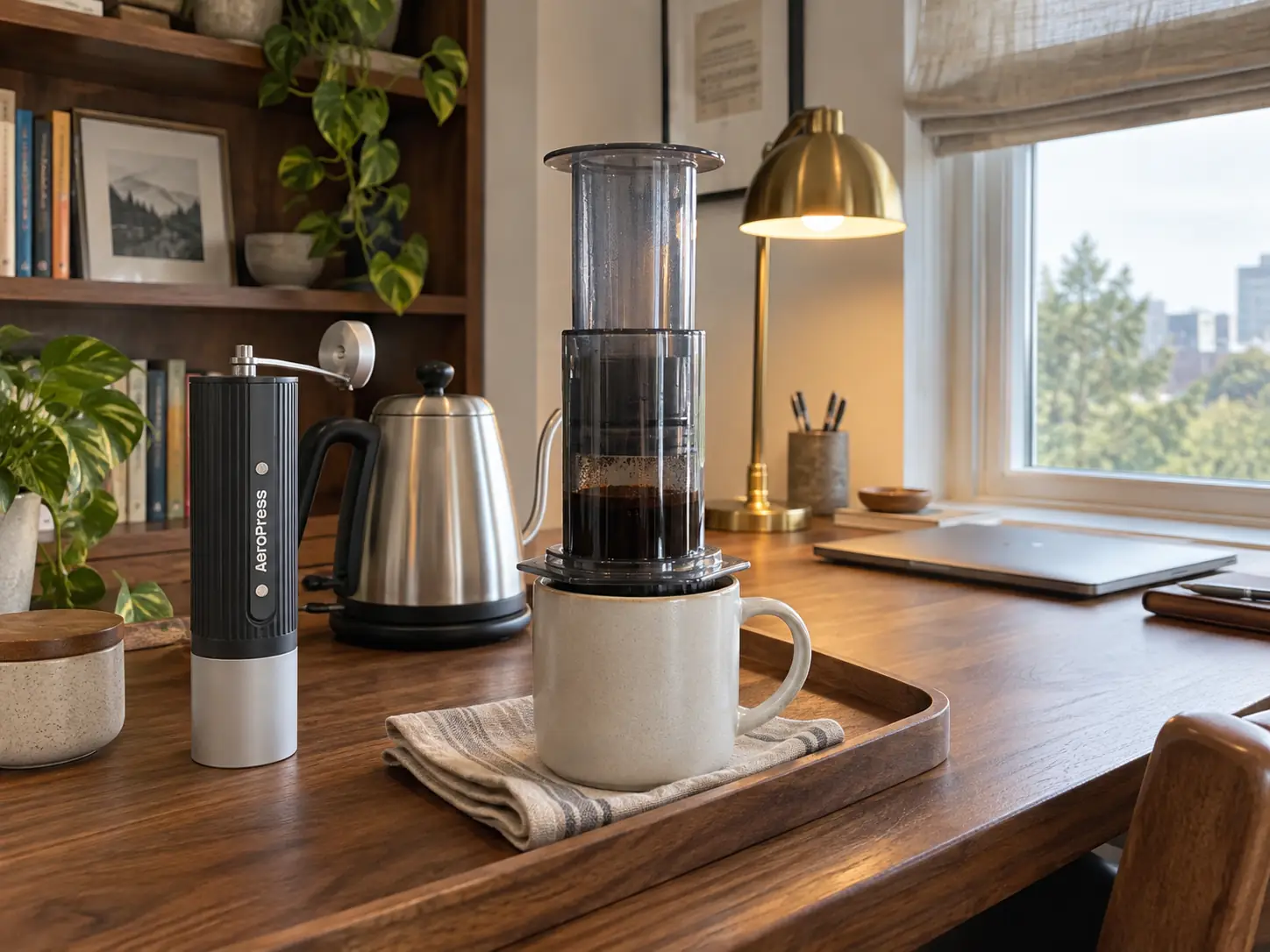
We may earn a commission when you buy through links on this page. It never changes what we recommend. How we pick
On this page8 parts
- The Best Coffee Grind Size for AeroPress Starts at Medium-Fine
- Why the Right Grind Changes With the Steep Time
- Upright or Inverted: How Much the Grind Has to Hold
- Read the Cup and the Plunger, One Step at a Time
- Starting Settings for Your Grinder, a Blade, or Pre-Ground
- When the Setting Is Right and the Cup Is Still Off
- Medium-Fine Is the First Cup, Not the Last
- Frequently Asked Questions
You set the grinder to medium-fine because the AeroPress maker’s own help page says so, pressed after half a minute, and got a cup that was thin, with a sour pinch at the sides of the tongue. The next morning you went two steps finer and the plunger fought you all the way down.
The best coffee grind size for AeroPress was never a single setting, and the maker’s own instructions show it: medium-fine when you wait 30 seconds before pressing, a store-bought medium grind when you wait 60. Finer grounds give up their flavor faster and hold the water back harder, so every grind has a steep it finishes in, and the cup turns sour or bitter when the two don’t match. Start with where AeroPress sits on the grind scale, then the two things that slide the setting (the steep, and whether the brewer stands upright or inverted), how to read the cup and the plunger one step at a time, the first number for your grinder, and what to check when the setting is right and the cup still isn’t.
Quick Answer
Start at medium-fine, table-salt size: finer than a drip machine, coarser than espresso (a blade grinder needs about 30 seconds, the maker says). Move it with the steep: finer for 30 seconds to a minute, a step coarser for two minutes. Sour or thin, one step finer; bitter, muddy or a stiff plunger, one step coarser. Taste between steps.
The Best Coffee Grind Size for AeroPress Starts at Medium-Fine
Medium-fine is the right place to start, and it is the answer AeroPress gives on its own FAQ. It puts the grounds where the bed slows the water without choking the plunger, which is most of what this brewer asks of a grind. What the word leaves out is the other half of any AeroPress grind size: how long those grounds will sit in the water before you press.
Finer Than Drip, Coarser Than Espresso
The maker lays its grind scale out in five stops, coarse to fine: French press, Chemex at medium-coarse, drip at medium (where most pre-ground coffee lands), AeroPress at medium-fine, and true espresso at fine. Its one-line version is “finer than drip coffee but coarser than espresso”, which places the AeroPress band between two neighbors most kitchens already know. The same ladder in microns, for every brewer, lives in the full grind size chart.
Coming from a drip machine, the practical move is one notch finer than your drip machine’s setting, not a leap. The fine end has a hard edge. A true espresso grind is built for a pump that forces water through at 9 to 10 bar, the maker’s own figure, which is far more than an arm on a plunger can give, so your arm meets a wall long before the cup gets any stronger.
What Medium-Fine Looks Like on a Plate
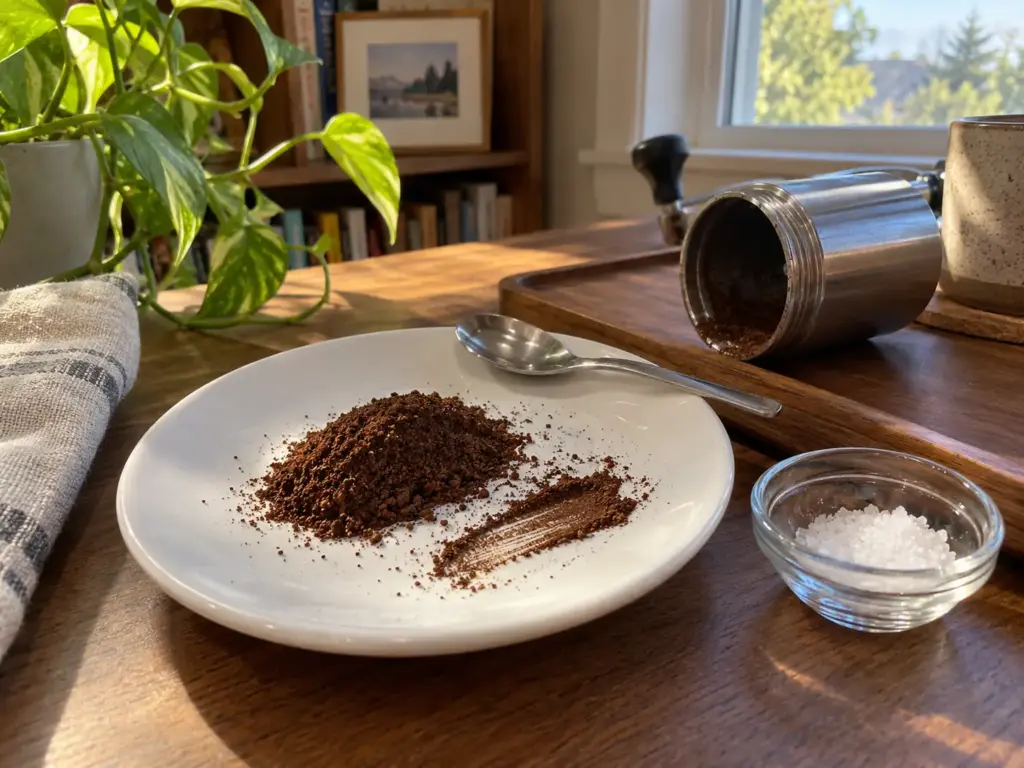
You’ve just moved over from a drip machine and you’re holding the grinder’s catch cup up to the window, trying to decide whether this is medium-fine or plain medium. From there, the two look almost the same. Table salt is the usual reference: separate grains you can see, a touch finer than sand, with no clumps.
The better test is a white plate. Tip a pinch onto it and rub it under a fingertip: medium-fine leaves a faint dusting in the lines of your fingerprint, while a medium grind rolls around as grit and leaves the skin nearly clean. An espresso grind goes further and clumps when you squeeze it. For the whole pinch-and-rub routine across every size, here is how to tell fine from medium by feel.
Keep a spoonful of supermarket pre-ground coffee in a small jar next to the grinder. The maker’s scale puts most pre-ground at medium, so it works as a free reference sample: set a pinch of it beside a pinch of your AeroPress grind on a white plate, and yours should look one shade finer, not two.
Why “Setting 12” Only Means Something on One Grinder
Every grinder brand numbers its own dial, from its own zero, with its own step size. A 12 on a Baratza Encore is the maker’s medium-fine starting point for that machine and means nothing on any other one, which is why what the number on your grinder means is a question about the grinder before it’s one about the coffee: a grinder setting describes that grinder and nothing else. The maker’s table (the full list is in the settings section below) calls every number a starting point, to be adjusted for the beans and for taste, and those numbers assume burrs in good shape.
A newcomer grinding on a Timemore C3S asked whether a setting was right, and the answer kept coming back to tasting it. On a C3, the right setting shifts with the coffee. That spread is the whole lesson: the number moves because the steep and the bean move, and a good number for one bag is a guess for the next.
And a few drops in the mug before you press don’t mean the number is wrong. The maker says it plainly: “Even with optimal grind, 2-3% pre-drip is normal”.
Why the Right Grind Changes With the Steep Time
Medium-fine is where the maker starts, but its own brewing instructions give a second grind for a second steep. That pairing decides every AeroPress setting: a grind is only right or wrong for the time it spends in the water.
The Maker’s Own Pair: Medium-Fine at 30 Seconds, Medium at 60
The mechanism is surface area, and in an immersion brewer like this one it runs the whole show. The maker’s FAQ spells out the trade: finer grounds mean more surface, faster extraction and more resistance to the plunger, while coarser grounds mean less surface, slower extraction and an easier press. So a short steep time needs a finer grind to finish its work before you press, and a long steep can get the same work out of a coarser one.
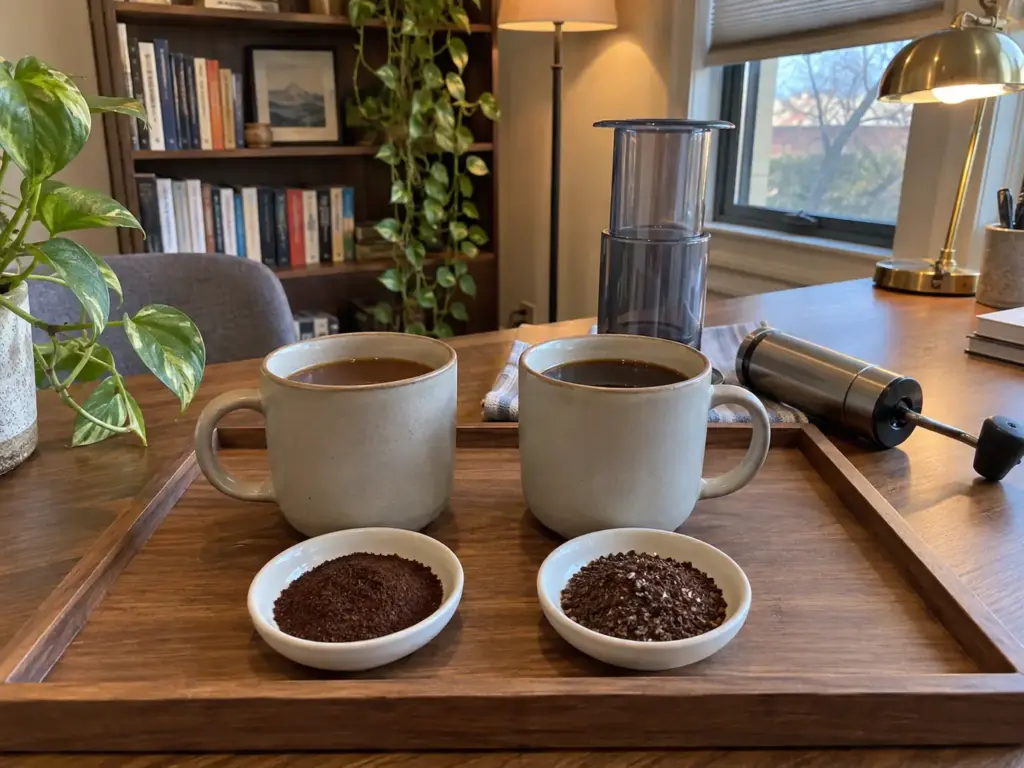
The maker’s how-to page writes that trade into two recipes. If you grind your own, it calls for medium-fine, one heaping scoop or 16 to 18 g, water at 185°F (85°C) up to the 4 on the chamber, a 3-second stir and a 30-second wait. If you bought the coffee already ground, it’s the same scoop and the same water with a store-bought medium grind and a 60-second wait. One step of grind is swapped for 30 more seconds of steep, and neither recipe is treated as the lesser one.
At the fine end sits the maker’s espresso-style concentrate: 18 to 22 g of coffee, one very generous scoop, ground between fine and medium-fine and just short of true espresso, with 75 to 80 g of water at 190 to 202°F (88 to 94°C) and a 30-second steep. More coffee, less water (a much tighter brew ratio), the same short clock, and so a finer grind.
Three recipes, three grinds, one maker.
Recipe by Recipe: Grind, Steep and Water Together
The World AeroPress Championship recipes, published on the maker’s own site, stretch the pairing much further. The 2019 winner ground 30 g medium coarse, “like table sugar”, brewed at 198°F (92°C) with the Flow Control Filter Cap, pressed at 45 seconds and diluted the concentrate afterward. The 2021 winner brewed inverted with two paper filters and water at 176°F (80°C), finished in about two minutes, and described his grind as “a little bit coarser than you would use with chemex”, the coarse side of a pour-over grind. The 2022 winner ran 18 g through two grinders, sifted out the fines, brewed at 198°F (92°C), set the plunger on at 1:20 and pressed at 1:30, then topped the concentrate up with hot water.
| Recipe | Grind | Steep | Water | Setup |
|---|---|---|---|---|
| Maker’s standard | Medium-fine | 30 s | 185°F (85°C) | Upright, paper filter |
| Maker’s no-grinder | Store-bought medium | 60 s | 185°F (85°C) | Upright, paper filter |
| Espresso-style | Between fine and medium-fine | 30 s | 190–202°F (88–94°C) | Upright, 75–80 g water |
| 2019 world champion | Medium-coarse, like table sugar | 45 s | 198°F (92°C) | Flow Control cap, diluted after |
| 2021 world champion | A little coarser than Chemex | About 2:00 total | 176°F (80°C) | Inverted, two filters |
Read across any row and the grind never travels alone. The 2021 winner said as much about how he built his recipe: he moved “from really fine grind to really coarse, from high to low water temperature” and cut the stirring back as well. His grind came to 27 clicks on a Comandante, the brand whose C40 the maker’s table starts at 18 to 20 clicks for medium-fine. That is seven to nine clicks coarser than the maker’s start, paid for with cooler water and a longer steep.
The 2022 recipe shows where all that engineering is aimed. It asks for a strength reading of 1.3 to 1.35 percent TDS (total dissolved solids, what a refractometer measures), which sits inside the 1.15 to 1.35 percent band the SCA’s Golden Cup calls ideal, according to the peer-reviewed paper cited further down. A winning cup is an ordinary strength reached by an unusual route. The grind is one lever among four, set to whatever the other three leave for it to do.
Why a Champion’s Grind Fails in Your Recipe
Say you find that 2021 recipe, set your grinder a little coarser than you would for a Chemex, and brew it the way you always do: upright, hot water, a 30-second wait. The cup comes out weak and watery, thin at the first sip and hollow by the bottom of the mug. That grind was built to spend almost two minutes in the chamber with nothing dripping out. In half a minute it has barely started, because it has drifted toward the French press end of the scale, where steeps are counted in minutes.
Borrowing the grind from a winning recipe is the obvious shortcut, and it breaks exactly where your recipe differs from theirs. The better call is to take the whole row or none of it: grind, steep, water and setup together.
When you change the steep on purpose, move the grind with it: a longer steep, one step coarser; a shorter one, one step finer. While you are still working out which way a cup is off, though, move only the grind and leave the clock alone. Two changes at once and you can’t tell which one did the work.
Write your recipe as one line with the grind setting first and the steep second, for example 12 and 30 seconds on an Encore. When a new recipe asks for a longer steep, the pair on the line tells you which number has to move with it, before a thin cup does.
Upright or Inverted: How Much the Grind Has to Hold
The steep is one clock. The other is how fast water escapes through the filter before you press, and which way up the AeroPress stands decides how much of it gets away.
Upright Leaks a Little by Design
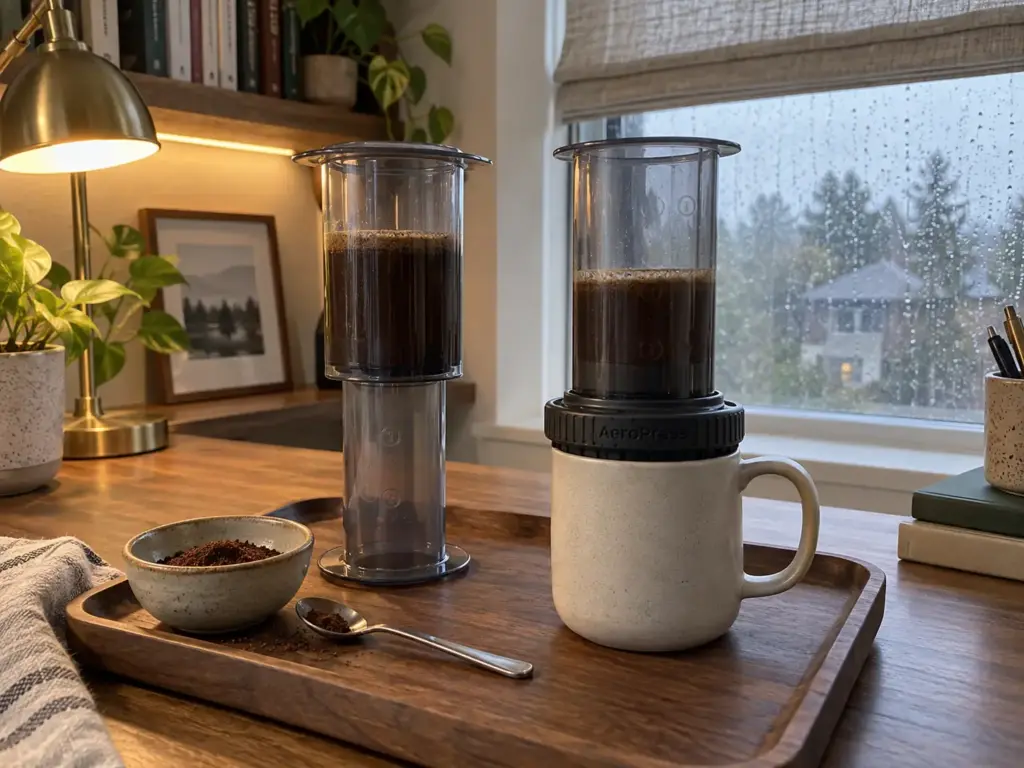
Standing on the mug, the paper filter lets some water through while the coffee steeps (drip-through, in the maker’s words), and the maker counts 2 to 3 percent of pre-drip as normal. The first drops land in the mug before the stir is even finished, and that thin, pale coffee is the share the grind failed to hold back. A coarser grind leaves wider gaps between particles, so it drains faster; just coarser than espresso, and any further coarsening lets the water simply fall through.
That is why the upright recipe starts at medium-fine: the grind has to slow the leak as well as the extraction. The maker adds a free trick to its own instructions. After the stir, set the plunger about half an inch into the chamber and pull it up slightly, and the vacuum holds the water in until you press.
Inverted Holds the Water, So the Grind Can Go Coarser
Inverted means the plunger goes in first and the AeroPress stands upside down, so nothing drips until you flip it onto the mug and press. The leak is gone, and with it the limit on how far toward a coarse grind you can go. With an inverted brewer you can go as coarse as you want, and only a few drops come through. There’s no number for how coarse. It’s a direction, not a setting.
The switch itself catches people out. You watch a video, flip to inverted, keep the grind and the steep you already had, and the cup comes out heavier and more bitter than before. Nothing left early, so all the water stayed with the grounds for the whole steep and pulled more out of them. Move one step coarser or shorten the steep (one of the two, not both), then taste again.
The Flow Control Cap: The Upright Fix, and Its Catch
Going inverted costs nothing, and neither does the vacuum trick.
If you’d rather keep the brewer upright and still hold the water, the maker’s answer is the AeroPress Flow Control Filter Cap, which in its words “eliminates pre-drip with its pressure-actuated valve”. With the leak closed, the grind can follow the steep instead: finer for an espresso-style shot, or coarser for a regular cup, as the maker suggests, and the 2019 champion brewed with one. The catch is the seal it depends on: in its Amazon reviews, 75 of 90 comments about sealing and 38 of 57 about fit are negative, leaks are a recurring complaint, and the paper filter tends to stay stuck in the cap instead of leaving with the puck. Its own listing advises against using it on AeroPress Originals made before 2014, since a material change can affect the fit.
If you already brew inverted and like the cup, the cap solves a problem you don’t have.
Read the Cup and the Plunger, One Step at a Time
Dialing in an AeroPress goes faster once you trust two readings. The cup already tells you which way it’s off, the plunger gives a second reading of the same thing, and together they point at a single change to make next.
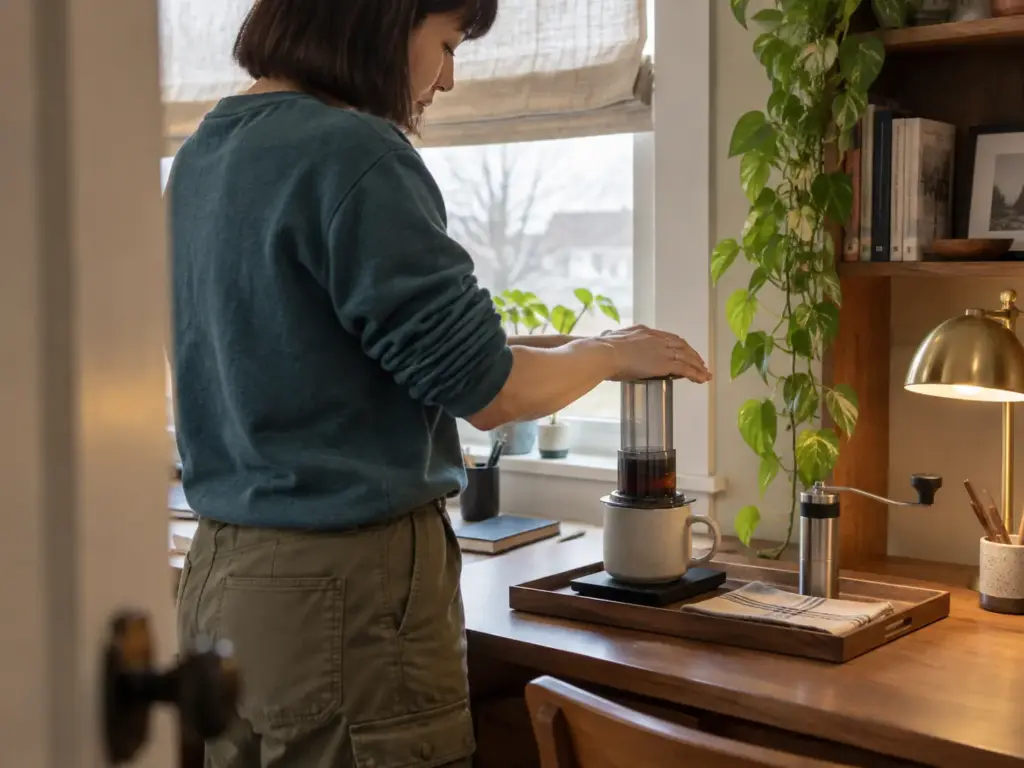
Sour or Thin: One Step Finer
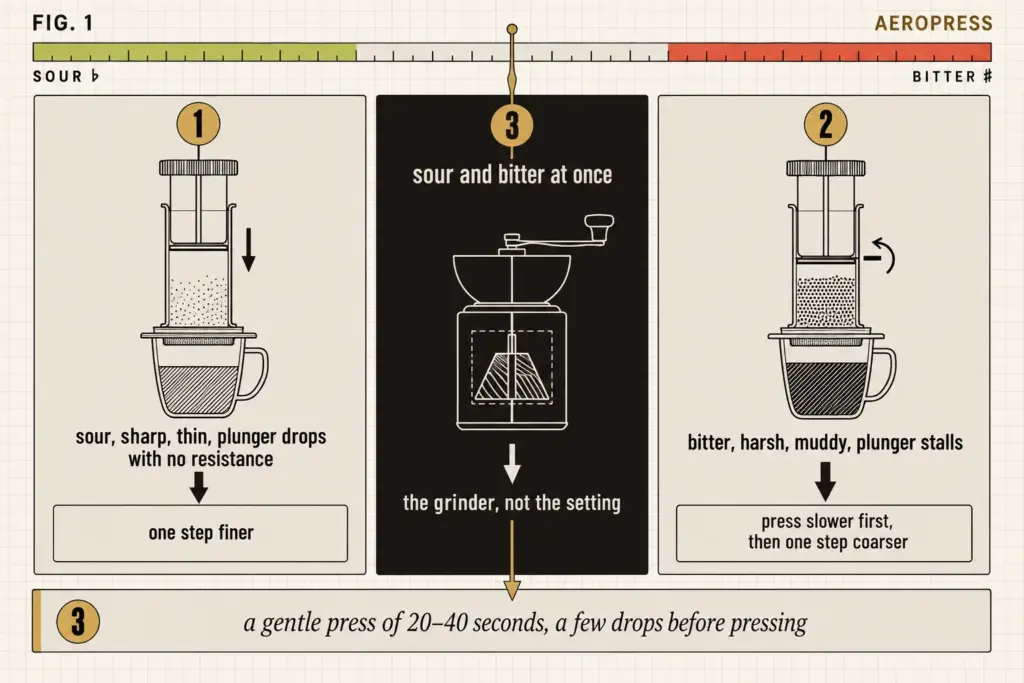
Sour, sharp or thin means the water left before it finished: the grounds were too coarse for the time they had. Go one step finer, keep everything else the same, and taste. If it worked, the next cup is rounder and a little sweeter, with the sharpness pulled back from the sides of the tongue. If it overshoots, the finish turns dry and bitter, and you come back half a step (on a hand grinder, one click).
The plunger usually agrees. A grind too coarse for an upright brew drips more before you press, and the plunger sinks with almost no push because the water is running out ahead of it. In the plainest terms, a very sour, underextracted cup means go finer.
Bitter, Muddy or a Stalled Plunger: Press Slower First, Then Coarser
You lower the plunger and, instead of the steady push that ends in the soft hiss of air reaching the bed, it stalls half an inch in. Leave the grinder alone for now. The maker’s help center, answering what’s wrong when it’s hard to press, lists four causes in this order: dust from a cheap or dull grinder filling the gaps between larger particles, pressing too hard, a grind that is simply too fine, and a seal that dried out after the brewer sat unused for several days.
Pressing slower is the free fix, and the maker explains why force backfires: “Pressing hard actually compacts the coffee particles into a barrier, making it harder to press.” Press down half an inch, hold the plunger there for about 5 seconds while the air in the chamber does the work, then press another half inch. If the brewer has sat for days, the maker suggests washing the chamber with plain vinegar and putting a very small amount of olive, vegetable or mineral oil on the rim of the seal. Only if a gentle press still fights you does the grind move, one step coarser.
The target is written down too: go coarser until a small amount, 2 to 3 percent, drips through before you press and a slow, gentle press takes 20 to 40 seconds. That’s a gauge with a number on it, and it checks your grind every morning before the first sip.
The physics behind a stall shows up in a Scientific Reports study of fines and flow, done on espresso rather than an AeroPress: “An increase of share of fines decreases coffee bed permeability, leads to reduced flow rates and longer extraction times.” Fines slow the water and stretch the brew, which fits the bitter edge a stalled cup tends to carry. In the mug, the cue is sludge, and the same logic that sends sour cups finer sends a sludgy cup coarser. If it worked, the next cup finishes cleaner and the plunger lands inside that 20 to 40 second window.
Sour and Bitter at Once Is the Grinder, Not the Setting
Sometimes one mouthful is both: a sour snap up front and a dry, bitter finish behind it. Move the dial and the cup only trades one fault for the other. The maker’s FAQ names the cause: “small (powder-like) grinds create bitterness and block water flow, while large chunks create sourness”. The boulders under-extract while the dust over-extracts, in the same brew, and no setting fixes that, because an uneven grinder makes both at once; I’d stop turning the dial the moment the faults start swapping places and look at the grinder instead.
Hold the Dose and the Clock Still
Bracketing finds the spot faster than guessing. One method is to keep grinding finer until it tastes bitter, then roll it back a notch; that notch is your fine edge. Do the same from the other side, going coarser until the cup turns sour and thin and then back one notch, and the setting you want sits between the two. The rule that makes it work is one variable at a time: change only one thing, so that you know which thing mattered.
On a hand grinder, the way you feed it counts as a variable too. Slow-feeding the beans can change where a setting lands, so pour them in the same way every time you compare two settings.
The dose and the steep have to stay put while the grind moves, and the scoop is where they slip. The maker equates one heaping scoop with 16 to 18 grams, and a heap is never the same twice, so a cup that changed may be the scoop and not the step. Any kitchen scale you already own plus the timer on your phone holds both still without buying anything.
If you do want one tool for both, the Hario Drip Scale Timer (VSTN-INT-2000B) reads to 0.1 g, carries a 2 kg capacity and a built-in timer, and according to its listing the five-minute auto-off stays suspended while the timer runs. Longevity is where owners part ways with it: its review summary mentions several units that broke within 6 months, 44 of 75 comments on the auto-off are negative, and one owner’s scale lasted two and a half years before it began shutting off mid-pour.
When you can’t tell which way a cup leans, grind two doses one click either side of your current setting and brew them back to back, same water, same steep. Side by side, the direction shows in a way a single cup never does. Some people land between the two, on the finer side, and then move a single click coarser.
Starting Settings for Your Grinder, a Blade, or Pre-Ground
With the direction sorted, the question most people start with (what number on my grinder?) has an answer, as long as you read it as the first cup’s setting and not the last. Every figure below is the maker’s.
Electric Burr Grinders
The maker’s table gives these medium-fine starting points for electric burr grinders:
- Baratza Encore: 12
- Baratza Virtuoso(+): 12
- Baratza Sette 270: 13/E
- Fellow Ode Gen 2: 4 (Gen 1: 3)
- Niche Zero: 30–35
- Mahlkönig X54: 15–25
The Baratza Encore (ZCG484WHT) is the one the maker also names inside its own recipe, at setting 11 to 13, which makes it the easiest start: 40 mm conical steel burrs and 40 settings, with the AeroPress range in the lower third of the dial. Noise leads its complaints, with 721 of 1,198 comments on it negative, and its review summary reports multiple customers whose grinder broke after 2 months of use.
After you move the dial, the first spoonful out still carries grounds left inside from the old setting, so grind a little and throw it out before the dose you’ll taste.
Hand Grinders, in Clicks From Zero
Hand grinders count in clicks from the point where the burrs touch, so the first job is finding that zero and learning to count clicks from zero the same way every time. The maker’s hand-grinder starting points:
- AeroPress Manual Grinder: comes preset to medium-fine
- Comandante C40: 18–20 clicks
- 1Zpresso J-series (JX, JX-Pro): 50–55 clicks
- Timemore C2 and C3: 14–20 clicks
- Hario Skerton family: 4–9 clicks
- Hario Mini-Slim family: 5–8 clicks
- Porlex Mini and Tall: 4–7 clicks
The AeroPress Manual Coffee Grinder is the only one on that list the maker ships already set for this brewer, and it’s built to fit inside the AeroPress plunger: titanium-coated steel conical burrs, 60 settings, a 25 g hopper and a magnetic crank that stows inside the grinder. Its early record is thin. It sits at 4.2 stars on 61 ratings, and some buyers find metal shavings coming off the inside of the handle knob early on, with the knob already loose and much more effort needed than on a Timemore C2 Max at a similar setting, though the grind can come out slightly more uniform.
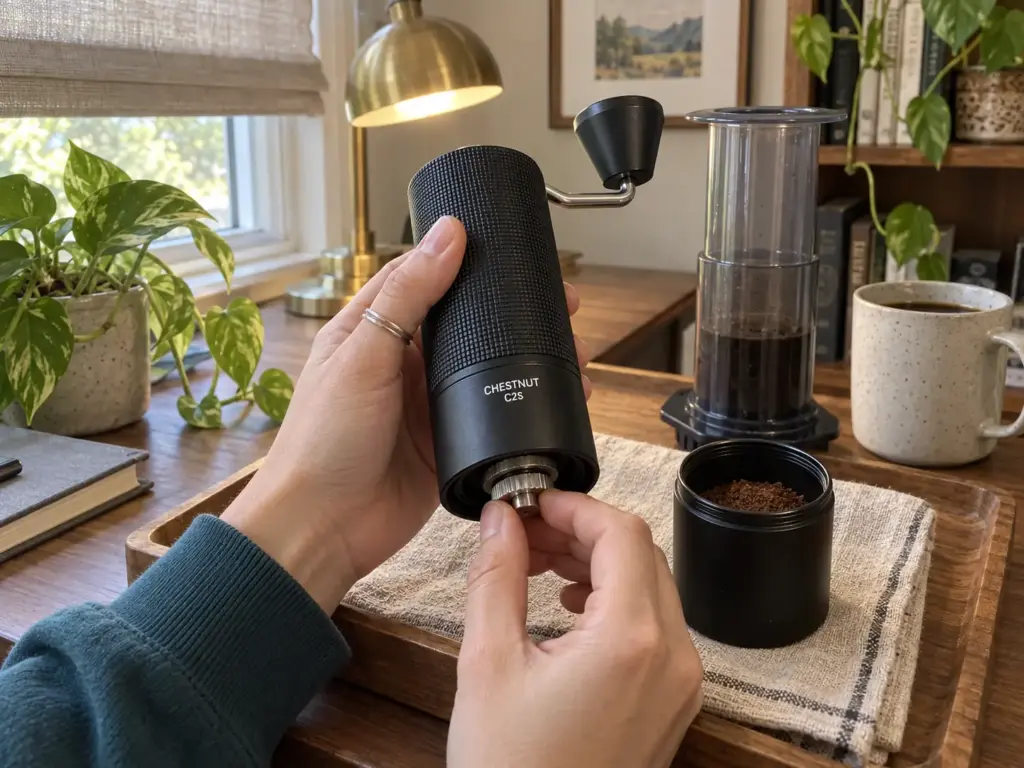
A hand grinder doesn’t have to be the brewer’s own to hold medium-fine. The TIMEMORE Chestnut C2S Manual Coffee Grinder costs less than most electric burr grinders and brings a 38 mm conical burr in 420 steel, a 20 g hopper and an all-metal aluminum-alloy housing. The maker’s 14 to 20 clicks is its figure for the Chestnut C2 and C3, not this model, so on a C2S start at the low end, around 14, and let the cup move you from there. A drop can end it for good, so it is worth knowing if the grinder travels with you.
Check the hopper against the dose before you adopt a recipe. A 20 g or 25 g hand grinder covers the maker’s 16 to 18 g in one load, but the 2019 champion’s 30 g takes two, and both loads need the same click and the same feeding pace or the second half of the dose is a different grind.
A Blade Grinder at 30 Seconds
A blade grinder you already own will do for a start. The maker’s figure is 30 seconds of continuous grinding for medium-fine, and how long to run a blade grinder has the rest of the timing. But the cost is the clean end of the cup.
Blades chop rather than grind, so there is no grind consistency to speak of: the same 30 seconds makes powder and boulders together, the exact mix the maker blames for a cup that’s bitter and sour at once, and its FAQ is blunt that “Burr grinders beat blade grinders every time”, because a burr set turns out a uniform grind. The paper filter keeps much of that dust out of the mug, but not out of the bed, where it slows the press. When the blade becomes the limit, a cheap burr grinder that stays even is the next step up.
Pre-Ground Coffee and a Longer Wait
No grinder at all is a case the maker planned for. Its no-grinder recipe takes a store-bought medium grind, the drip grind most bags and cans already hold, with the same scoop and 185°F (85°C) water, and doubles the wait to 60 seconds: the steep does the work the grind can’t.
With pre-ground coffee the grind is fixed, so the clock becomes your only dial. If the cup is sour, stretch the wait by 15 seconds; if it’s bitter, shorten it by the same. One change, then taste, exactly as with a grinder.
When the Setting Is Right and the Cup Is Still Off
Sometimes you land on the setting, the plunger goes down in half a minute, and the cup is still flat or muddy. Then the grind is no longer the thing to move, and turning the dial further only walks you away from a setting that was right.
Fines and a Grinder Past Its Best
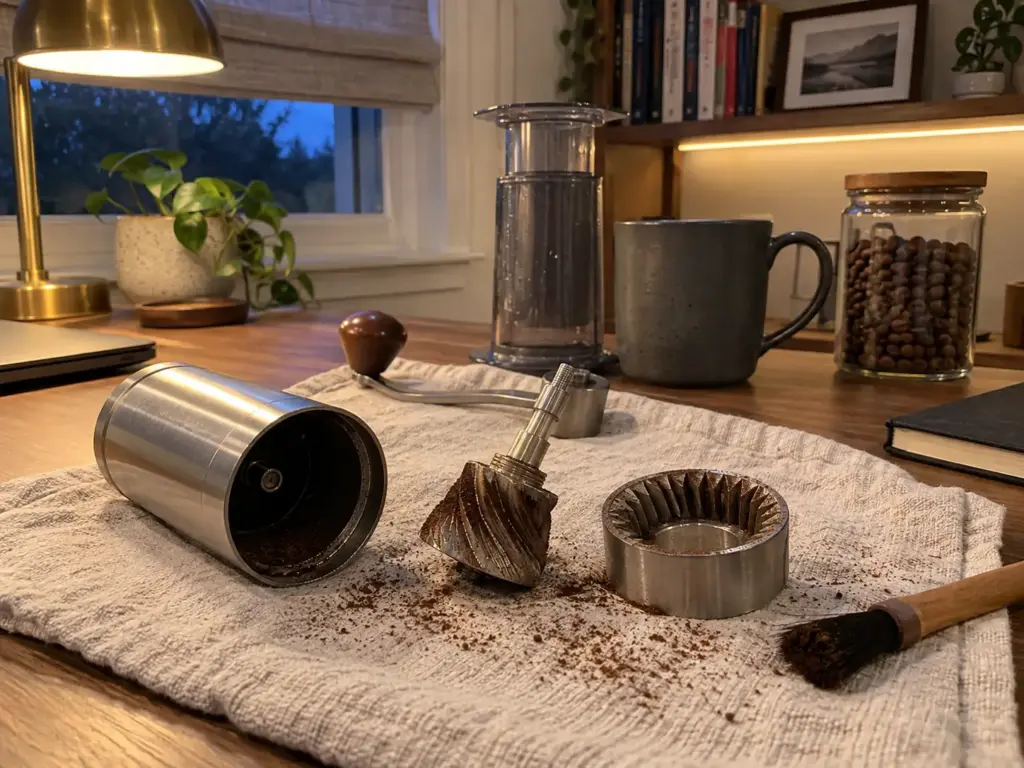
A muddy cup at a setting that presses well points at the grinder’s evenness, not its number. The maker names dust from a cheap or dull grinder as what blocks the bed, and the 2022 champion took fines seriously enough to write “Sift the fines out” into the winning recipe, removing everything around 100 to 200 microns after running the beans through two grinders. You don’t need a sieve to see the signal. A fine layer of sediment on the bottom of the mug at the last sip, at a setting that tasted right last month, is the grinder telling you something before any number does.
Before blaming the burrs, look at the filter. The maker notes that a metal filter lets micro-fines and oils through where paper holds much of them back, so silt from a metal disc may just be the disc doing its job. On paper, brush out the grinder’s burrs and catch cup, and if the silt stays, check when the burrs need replacing rather than chasing it with the dial.
A second paper is a free way to test the diagnosis. The 2021 champion brewed through two rinsed paper filters, and a doubled filter should catch more of the dust on its way to the mug. If the cup cleans up with two papers, the silt was fines from the grinder, not the setting. Two layers do resist the plunger more than one, though, so a grind that pressed in 30 seconds through one paper may drift past 40 through two, and a step coarser brings it back.
Water That Runs Cooler Than the Standard
The SCA’s brewing standard, as reported in a peer-reviewed brew-temperature study on drip coffee, puts water at about 198 to 205°F (92 to 96°C) and extraction at 18 to 22 percent. The maker’s basic recipe runs at 185°F (85°C) and the 2021 champion at 176°F (80°C), both well under it. Cooler water pulls flavor out more slowly, so a cool recipe makes up the difference with a finer grind or a longer steep.
That range was written for drip machines. For certification, the paper reports, the SCA asks a home brewer to reach 92°C within the first minute and never exceed 96°C, a test of a heater the owner can’t adjust. With an AeroPress you set the kettle yourself, so running below the range is a choice rather than a fault, as long as the grind and the steep are chosen to match it. The maker even ties the kettle to the roast: its espresso-style page says darker roasts do better with cooler water and lighter roasts like it hotter, and the 2019 recipe carries the same note, darker beans, lower temperature.
That same study backs the trade from an unexpected side. Brewing drip coffee at 87, 90 and 93°C, the researchers adjusted grind size and brew time to reach the same strength and extraction at each temperature, and with those matched, “surprisingly the brew temperature had no appreciable impact” on the sensory profile. It’s drip rather than an AeroPress, and it stops at 93°C, so read it as a direction, not a measurement of your cup.
So should a flat cup send you to 200°F? Probably not first. If your kettle has no temperature setting, the maker’s own instruction is to use boiling water, which already runs hotter than its 185°F recipe, and with water that hot a bitter cup points at a step coarser or a shorter steep, not a new kettle.
And if you brew cool on purpose, the way the 2021 recipe does, expect the finer end or the longer steep. Temperature is one change and the grind is another, and they go in on separate mornings.
The Beans, Not the Grind
When the grinder is clean and even and the water is where you want it, the last suspect is the bag. Before blaming the step you just made, check whether the beans have gone stale, and when you switch roasts, look at how roast level moves the starting notch instead of assuming yesterday’s number carries over. Keep the order: fines first, then the water, then the beans, one at a time, tasting between.
Medium-Fine Is the First Cup, Not the Last
Medium-fine, about the size of table salt, is the right place to start, and it’s the maker’s own answer. The steep moves it: a short steep wants the finer end, a two-minute or inverted brew a step coarser, and a champion’s grind only works with the champion’s clock and kettle. From there the cup and the plunger steer together, one step finer for sour and thin, a slower press and then one step coarser for bitter and stuck, and a hard look at the grinder when both faults land in the same sip.
A month from now, brew the same dose at the same setting and time the press; if it has slowed past 40 seconds or the bottom of the mug has turned muddier, the grinder moved and the recipe didn’t. If your grinder can’t hold the medium-fine range evenly, that’s the next thing to solve, whether with a hand grinder that travels with the AeroPress or a manual grinder that holds medium-fine evenly on the counter at home.
Tomorrow, keep the dose and the steep exactly where they were and move the grind one step in the direction the last cup pointed. Taste the first sip and the last one: if the sourness or the dry finish has eased at both ends of the mug, the step was right.
Frequently Asked Questions
01What grind size is best for AeroPress coffee?
Medium-fine, about the texture of table salt, finer than drip and coarser than espresso, suits the maker’s standard steep of 30 seconds to a minute. Go a step coarser for a two-minute or inverted brew, and a step finer for an espresso-style concentrate.
02Can you use pre-ground coffee in an AeroPress?
Yes, store-bought medium grind works in an AeroPress as long as you let it steep longer than you would a medium-fine grind. The maker’s own no-grinder recipe waits 60 seconds instead of 30, with water at 185°F (85°C).
03Is AeroPress grind the same as espresso grind?
No, a standard AeroPress cup uses a medium-fine grind several steps coarser than espresso, and even the espresso-style concentrate stays just coarser than true espresso. A full espresso grind packs the bed and stalls the plunger.
04What is the best coffee to grind for an AeroPress?
Any coffee you enjoy, bought whole bean and ground fresh, works in an AeroPress, because the grind and the steep shape the cup as much as the bag does. When you switch bags, especially between a light roast and a dark roast, taste again and expect to move a step.
05What kind of scale do you need for AeroPress?
A scale that reads to 0.1 g and has a built-in timer is enough, because it keeps the dose and the steep steady while you change the grind. Any kitchen scale plus a phone timer does the same job.

How did your cup turn out?
No comments yet. Tell us what you changed — and whether the needle moved.