



We may earn a commission when you buy through links on this page. It never changes what we recommend. How we pick
On this page7 parts
- What a Twelve-Cup Pot Does to One Mug
- The Grams for One Cup, Checked on a Scale
- The One-Cup Drip Machine, and What It Gives Up
- When a Pod Machine or a Pour-Over Cone Is the Better Answer
- Month Two, and a Mug That Starts Warm
- Weigh One Mug Tomorrow, Then Watch the Spout for a Month
- Frequently Asked Questions
You press brew on a twelve-cup machine for one mug, and eleven cups’ worth of coffee is left to cool on the plate. If you are asking what the best coffee maker for one person is, that is probably the morning behind the question, and the answer starts with what a machine does to the water, not with a brand. A machine built for one cup changes the amount of water, the size of the basket and the time the water spends in the grounds, while a twelve-cup machine run at one mug changes none of them, and the dose printed on a box does not always match the one a standard would give. This article answers from the drip side: the pot that wastes a mug, the grams for one cup, the one-cup drip machine with its flaws written down, and the mornings when a pod machine or a pour-over cone is the better call (those two get a short hand-off, because each has its own questions).
A machine built for one cup makes a mug that a twelve-cup maker is not built to make at that volume, and for drip the pick is the Moccamaster Cup-One, whose flaws are a drip at the spout and a five-minute brew, while pods and manual brewers win some mornings, as the table shows.
| Family and cup size | What it does at one cup | What you give up |
|---|---|---|
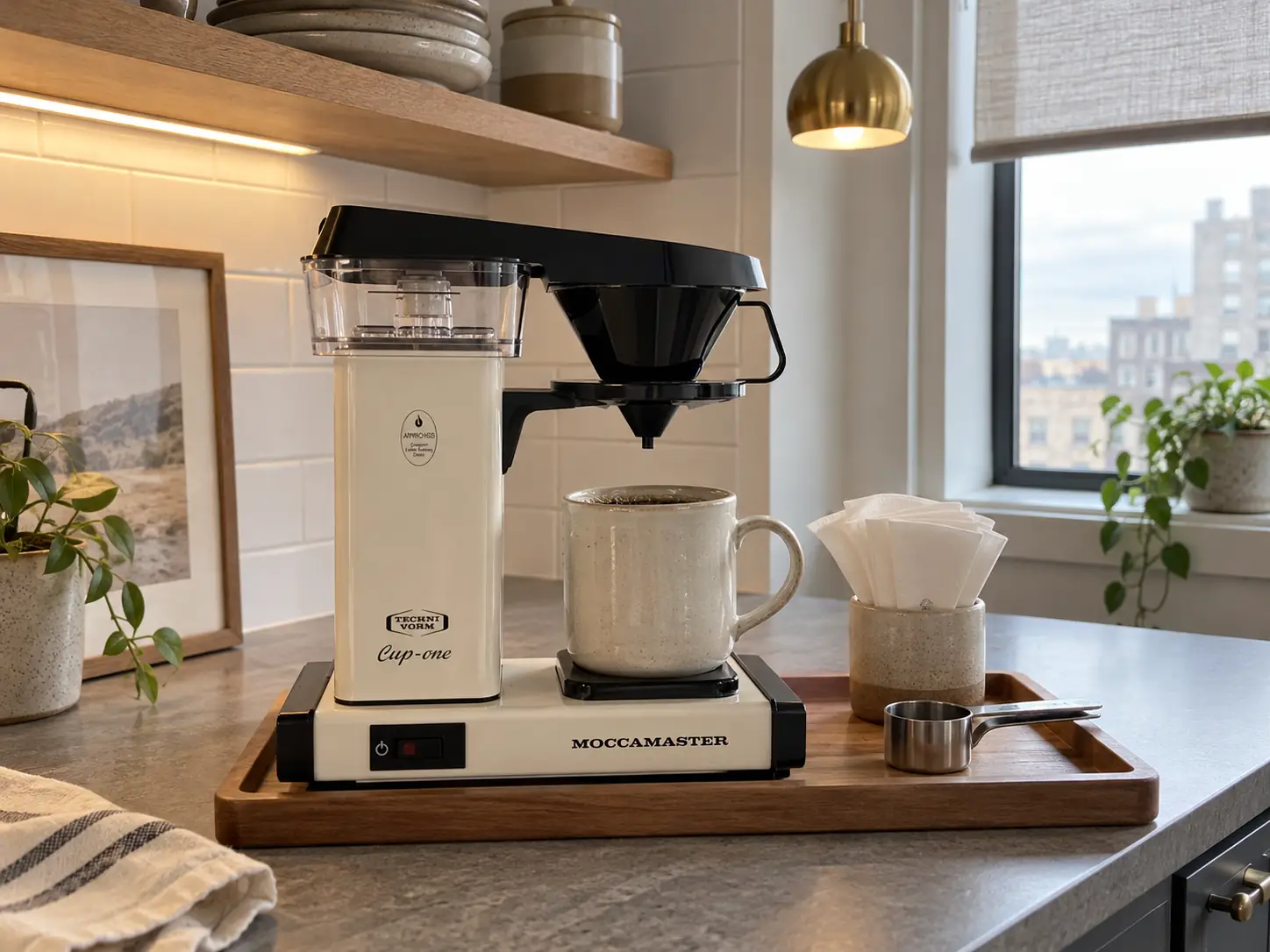
| One-cup drip machine (Moccamaster Cup-One), 10 oz | Holds the water at 197 to 204°F (92 to 96°C) and brews exactly one cup, in about five minutes | Drips at the spout, the tank does not come out, only mugs and low tumblers fit under it |
| Twelve-cup drip machine on its 1 to 4 cup setting (Hamilton Beach 46299J) | Makes a mug from a machine you may already own, if the dose comes off a scale | A thin bed of grounds in a basket made for twelve, and a carafe and plate sized for a full pot |
| Pod machine, about 6 to 12 oz | One button, and the dose is the pod’s, not yours | Every cup is a pod to throw away, and a weak cup is not always the grind |
| Pour-over cone or AeroPress | One cup at whatever size you pour, with no machine at all | A kettle and a grinder are part of the setup, and you are the timer |
What a Twelve-Cup Pot Does to One Mug
Most readers who ask about a machine for one person already own a twelve-cup drip maker and brew a single mug from it, so the first question is not what to buy but what that pot is doing to the mug. Three things change at one-mug volume: the bed of grounds in the basket, the plate under the carafe, and the direction in which the cup tastes off. What follows about the mechanics is reasoning from how a basket and a plate work, labeled as reasoning and not passed off as measurement.
A thin bed of grounds and the water that runs through it
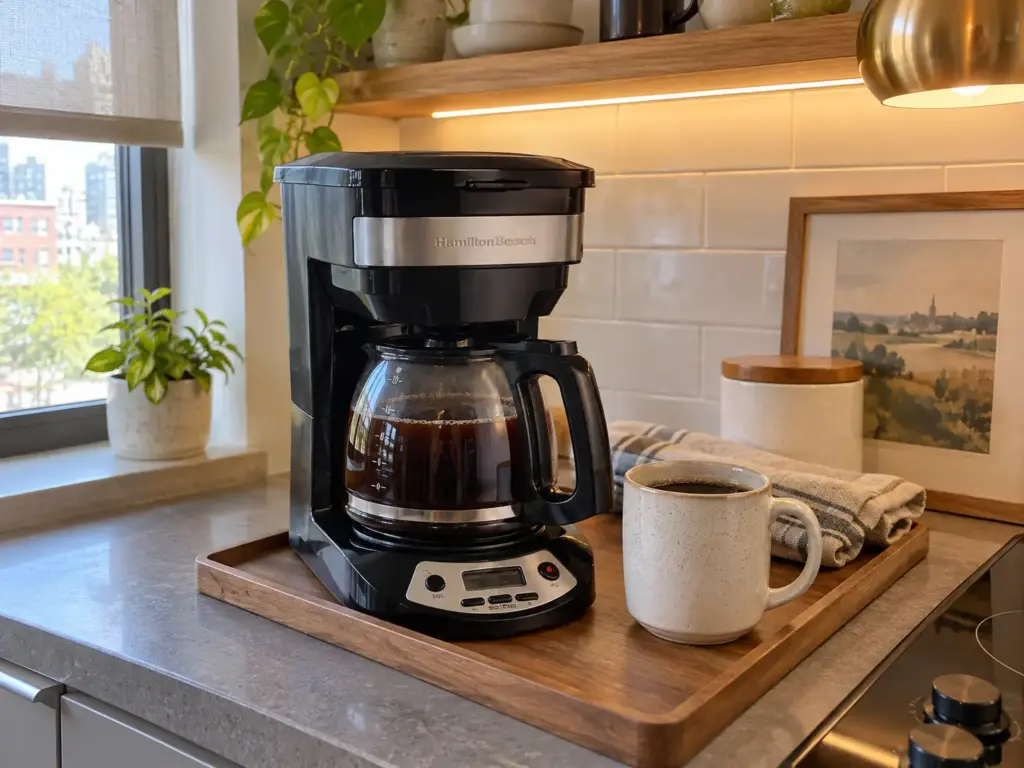
A twelve-cup basket is built to hold a deep bed of coffee, with the water working down through all of it. Put one mug’s worth of grounds in the same basket and the bed turns into a thin layer across the bottom. The water has a short path through that layer, spends less time touching each ground, and takes less out of them.
The likely direction is a cup that is thin, weak or sour, and that points at the dose before it points at the machine. This is the article’s own reasoning about how a basket behaves, not a lab result, so treat the direction as something to taste for rather than a verdict.
Serious Eats makes the same point from the other side: it says a mini basket on an 8-cup machine is better designed for brews of at least 16 ounces, and a single mug sits well below that line. A basket has a volume it was designed around, and the further a brew falls under it, the more the cup depends on how you load it.
Many twelve-cup machines carry a setting for small brews, usually labeled one to four cups. Nothing in a spec sheet says what that setting changes inside the machine, so treat it as a place to start and let the cup decide. The scoop adds its own noise. Heaped one morning and level the next, the same scoop is two different doses, and with only one mug’s worth in the basket the difference lands entirely in the cup you drink.
The warming plate and the first cup that cools
A twelve-cup machine of this kind stands a glass carafe on a nonstick warming plate and keeps the plate on until an auto-off that runs for two hours. Coffee held hot goes on changing the whole time it is held: it gets flatter and more bitter the longer it sits, which is the reason a pot poured over two hours is not one drink. That is the usual reading of what a plate does to coffee, and it is reasoning here, not a measurement of any one machine.
Pour a mug from a full carafe and the rest stays behind on the plate. The mug in your hand cools on the counter while the other eleven cups keep cooking, and the second mug from the same pot is not the first one, only older. Anyone who has poured a mug from the bottom of a pot knows the difference without a number.
Brew less and the problem changes shape instead of going away. A few ounces in a carafe sized for a dozen small cups spreads into a thin layer on glass that sits on a plate meant to warm a full pot, so the small amount can keep heating when it should already be in a mug. The practical answer is to pour the moment the brew ends and to treat any coffee that sat on the plate as a different cup. How hot the water is when it reaches the grounds is a separate question from what the plate does afterward, and the drip guide covers how a drip machine’s water temperature is judged, so this section stays with what happens after the brew.
Which way the mug is off
Read the cup before touching anything. Thin, watery and a little sharp points to too little extraction: too little coffee for the water, or water that left the grounds early, as it does in a thin bed. Dry, harsh and bitter points the other way: too much coffee, or coffee that sat on the plate. The two directions call for opposite changes, and the fix for one makes the other worse, which is why the direction comes before the change.
The Hamilton Beach 12 Cup Programmable 46299J is the twelve-cup machine this section is about, and its one-to-four-cup setting is the first thing to try before shopping, because it is a setting you may already own. It has a glass carafe, a nonstick warming plate and a two-hour auto-off, and it costs a fraction of what a machine built for one cup does. No repeated complaint turned up for this exact model, so the flaw to name is the one this section describes: a machine and a carafe sized for twelve cups making one. The reports on that exact model live in the under-50 article, along with its heat and its carafe.
There is a second reason to start with the machine you own, and it is not money. A twelve-cup maker that gives a good mug on a weighed dose has answered the question, and the Cup-One would only move the same cup into a smaller box. What a machine built for one cup adds is a fixed amount of water and a short, steady brew, and the next sections show where that is worth having and where it is not.
One more check belongs before the first change, because a machine’s “cup” is not a mug. Makers count cups in small units (the Ratio Four, for one, counts 5-ounce cups, according to Bon Appetit), so a carafe marked in cups and a mug marked in ounces do not speak the same language. Fill the reservoir to the mark for one cup and run a brew with no grounds in the basket, then weigh what lands in the carafe; a gram of water is a milliliter, so the scale tells you in seconds what the marking means for your machine.
Change one thing, then taste. First, weigh the dose for the mug instead of counting scoops (the next section has the grams). A thin cup should come back fuller with the sharpness still there, and if it turns dry and bitter instead, the dose went up too far.
Second, if it is still thin, switch to the one-to-four-cup setting and brew the same weighed dose again. Third, if the cup is still sharp, go one step finer on the grind. Changing all three in the same morning leaves a cup that tastes different and a reader who cannot say which change did it.
The same bind shows up at the scale of a household: two people who drink one cup a day each, and like different coffees, may want a machine that makes one cup at a time, because a single pot would suit only one of them.
On the one-to-four-cup setting, brew two mugs’ worth, pour the first mug and set it aside, then pour the second ten minutes later and taste them side by side. If the second is flatter or harsher, the plate did that, and no change to the grind will fix a plate.
The Grams for One Cup, Checked on a Scale
Before any machine, the free fix is the dose, the coffee to water ratio in grams per cup, and the numbers a reader will find for it do not agree. This section says which way each one points, shows the arithmetic in the open, and makes the scale the first purchase. A scale changes more cups than a new machine does.
The two numbers that disagree
Serious Eats brews with 15 g of coffee to 250 g of water, about 1 to 16.7. Bon Appetit reports that the Cup-One’s own box calls for four tablespoons of grounds for a 10-ounce cup, which it says is about twice what other machines suggest for 8 ounces. Tom’s Guide says Moccamaster recommends 18 to 21 g of filter-ground coffee for the full 10 ounces of water, and used 18 g for its own test.
None of these is a standard; all are readings. According to the SCA’s standards page, “SCA Standards create a shared framework for quality, consistency, and best practices across the coffee industry.” A shared framework is what a ratio needs behind it, because a number copied from a box can be checked against nothing, and a number tied to a standard can be checked against the standard. The line does not print a dose for a mug, so the grams below are arithmetic done in the open, not the SCA’s figure.
Ten fluid ounces of water is about 296 ml, which weighs about 296 g. At 1 to 16.7 that needs about 18 g of coffee, which is the dose Tom’s Guide used.
Four tablespoons is a volume, and a tablespoon of medium grounds weighs roughly 5 g (an estimate that moves with the grind and the roast), so the box’s dose lands near 20 g, about 1 to 15, inside the maker’s own 18 to 21 g. The two ends are about 2 g apart at ten ounces, a tenth more coffee in the same water, which is enough to taste when a cup is already borderline. A scale settles it in under a minute. A tablespoon never will, because it weighs differently by grind and by roast, and the same four tablespoons are a different dose from a different bag.
Grams for 8, 10 and 12 ounces
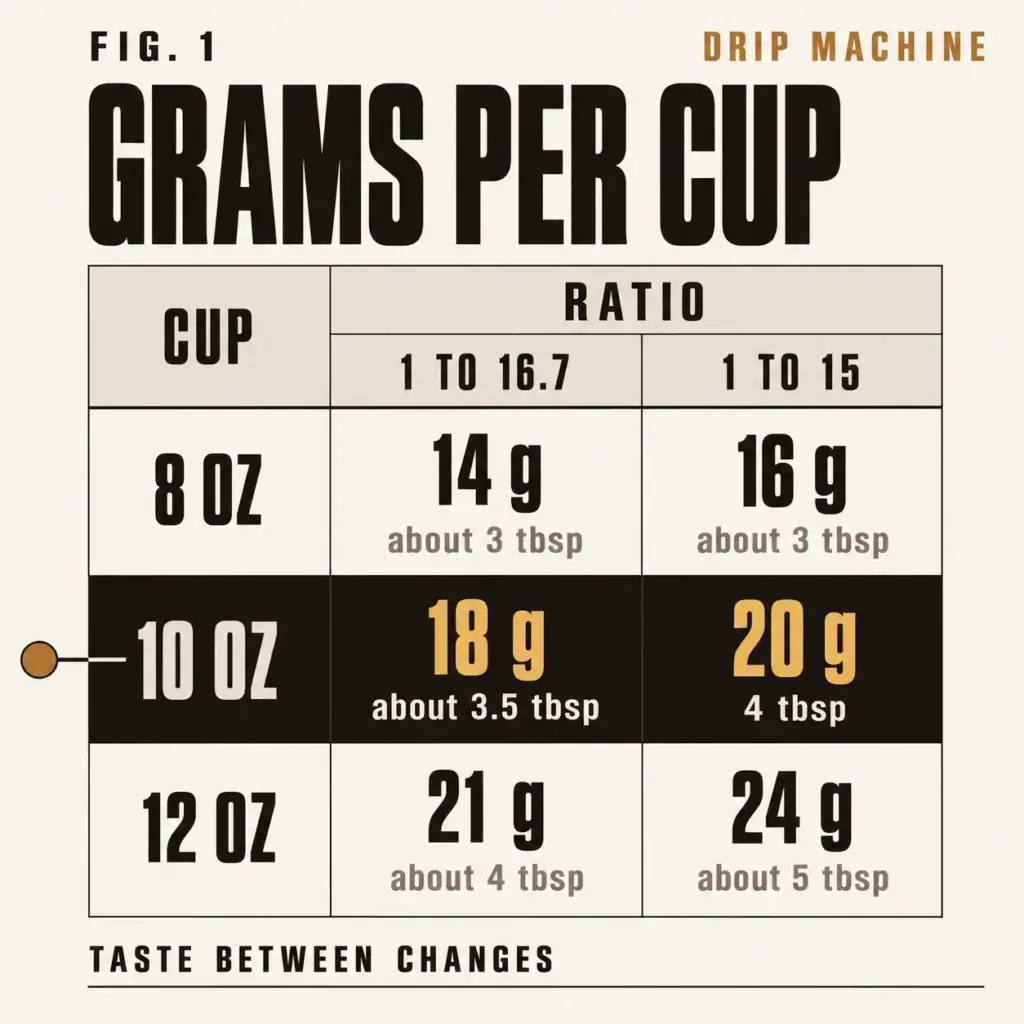
Ounces here are fluid ounces of water poured in. The grounds hold some of it back, so the mug ends up a little under the number. At both ratios, with the tablespoons counted at the 5 g estimate:
- 8 ounces (about 237 ml of water): 14 g at about 1 to 16.7, 16 g at about 1 to 15, roughly 3 tablespoons either way.
- 10 ounces (about 296 ml): 18 g and 20 g, between 3.5 and 4 tablespoons.
- 12 ounces (about 355 ml): 21 g and 24 g, between 4 and 5 tablespoons.
The direction of the cup decides what moves, and only one thing moves at a time. A thin, watery cup gets more coffee by weight first, a gram or two, and the next cup should taste fuller with the same brightness.
A sharp, sour cup is the water leaving the grounds too early, so it goes one step finer on the grinder, and the grind step for a drip machine has its own article that starts from a sour cup. A harsh, dry, bitter cup gets less coffee first, then one step coarser. Taste between each change, and expect the overshoot to taste like the opposite problem: a cup that was sour and is now bitter went a half step too far.
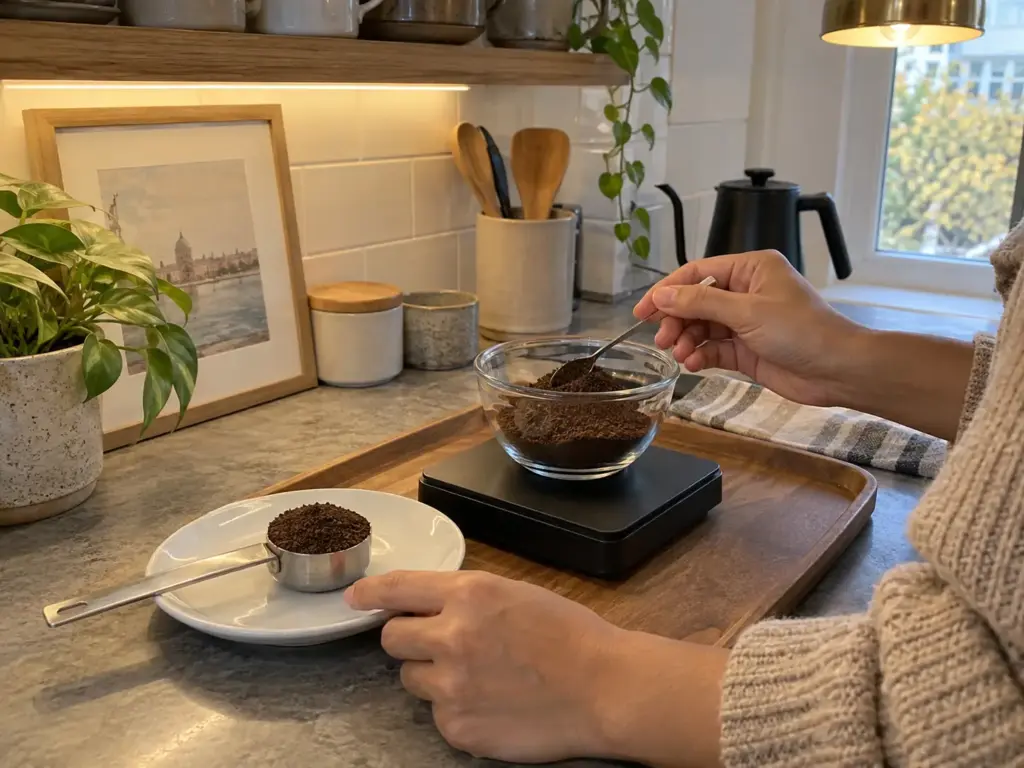
Put the empty paper filter in the basket on the scale and zero it, then spoon in grounds until the display reads the dose you chose. Write that number on the canister lid. After the first week the tablespoons stop mattering, and the scale does the arguing.
If the coffee is pre-ground, the grind step is not available and the dose is the only lever. That is not a loss: for a drip machine, a weighed dose fixes more cups than a grinder setting does, and the grinder comes later.
Starting points are not endpoints, and a single gram is a real step at this size. At 18 g, a gram is more than five percent of the dose, so move in single grams, brew the same way, and write down the number that gave the cup you liked. Two or three mornings of that is the whole calibration. It also gives the machine a fair trial: a twelve-cup maker that makes a good mug on a weighed 18 g has nothing left to prove, and one that makes a thin mug on 18 g and a harsh one on 20 g has told you its sweet spot is narrow, which is information about the machine and not about you.
If the weighed dose is right and the cup is still off, the cause may not be the dose at all. Look at the roast date on the bag, at whether the machine has ever been descaled, and at the mug that still tastes of last week’s coffee, because each of them flattens a cup without touching the grind or the ratio. Those are checks that cost nothing, and they come before any shopping.
What a bag gives you at that dose
A 12-ounce bag holds 340 g. At about 18 g a cup that is about 19 cups, and at 20 g it is 17. For the rest of the arithmetic, including the bags in between, how many cups a 12-ounce bag makes is worked out by the gram. For one cup a day, 19 cups is also 19 mornings, which is how long that bag sits open on the counter, and it is a reason to buy the smaller bag and not the bigger one.
The arithmetic runs in the other direction too. A twelve-cup pot brewed for one mug and poured out spends the same grams as a pot drunk by four, so a household that throws away a pot a day is going through a bag several times faster than the one-mug dose says it needs to. That ratio, bag to mornings, is the cost of wasting a pot, and it needs no price to show: divide the bag by what you actually pour, and compare it with the number of days the bag actually lasts.
The One-Cup Drip Machine, and What It Gives Up
The dose is settled, so this is the machine. This section covers one machine in depth instead of a list: the Moccamaster Cup-One, the one-cup drip machine whose listing and certification check out, with its flaws written down and the source of each one named. The evidence is as thin as it is, and the section says where.
What a 10-ounce tank changes
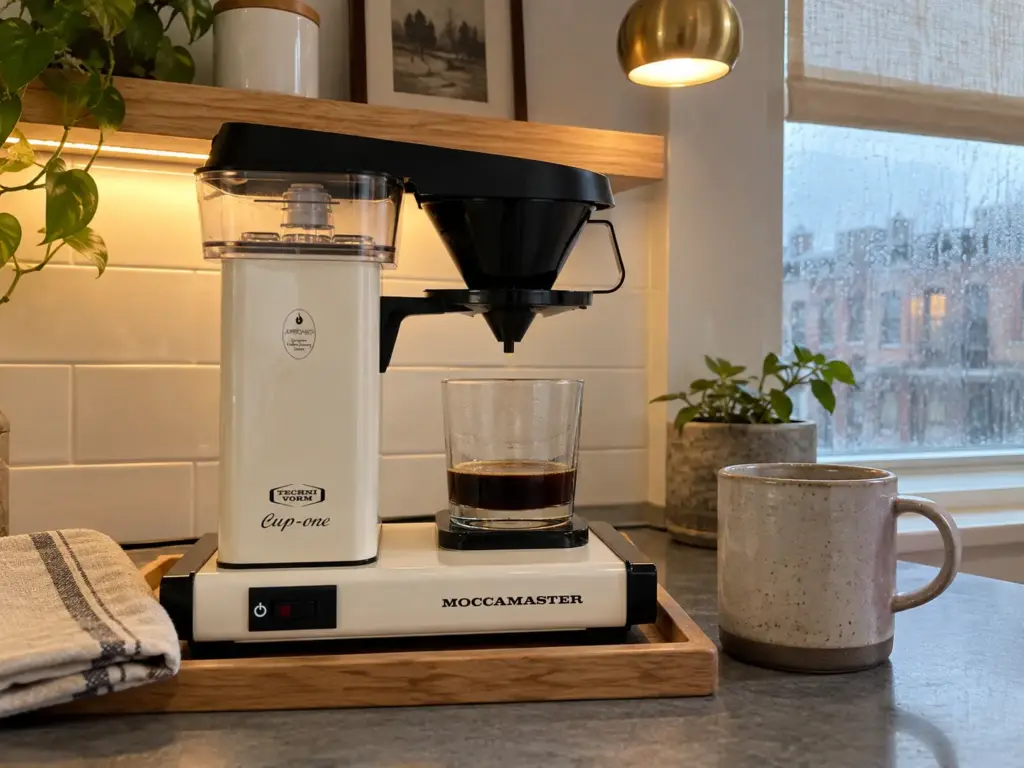
A twelve-cup machine has to guess how much coffee you want. A one-cup machine does not: the Cup-One’s water tank holds a maximum of just 10 ounces, marked with a black line, and the tank is the cup. Tom’s Guide describes scooping the coffee into a pre-wetted #1 paper filter and filling the tank to that line, and from there the amount of water is decided before the dose is. That removes one variable from the list of things that can make a cup thin and leaves the two this article has been about, the weight of the coffee and the grind.
A third party tested the one-cup claim. The machine is on the SCA’s certified home brewer list, where it is described as a “Single-serve brewer for ground coffee; makes one 10 oz cup in about 4 minutes.” The copper heating element holds the water between 197°F and 204°F (92°C and 96°C), according to Tom’s Guide, so the brew temperature belongs to the machine and the dose and the grind stay with you.
The same tank sets the limits. A 12-ounce mug cannot be filled from a 10-ounce tank, and Bon Appetit reports that the clearance under the spout leaves room only for mugs and low tumblers, so a tall travel cup is out. A one-cup machine is also not a plastic-free one: Tom’s Guide describes a plastic water tank, and the filter holder looks like a black plastic V60. The pods are gone; the plastic is not.
What the same tank gives back is a short routine. Tom’s Guide calls ease of use the Cup-One’s main selling point: fill the filter with coffee, fill the tank with water, press go and walk away, and the paper filters are compostable. The one extra step is the pre-wetted filter, which rinses the paper before the grounds go in. For a reader with ten minutes before work, the whole job is two chores, and neither involves a carafe to scrub or a pot to pour out.
The five minutes, the drip and the basket
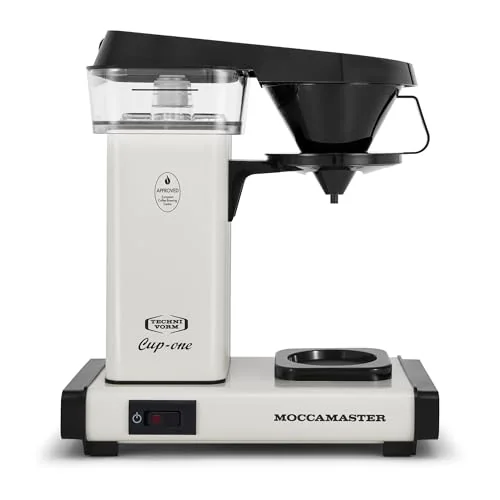
The SCA entry says about four minutes. Tom’s Guide timed it: the Cup-One switched itself off at 2 minutes 59 seconds, and the last of the water dripped through at 5 minutes 11 seconds. Food & Wine reports about five minutes for the ten-ounce brew, the longest of the machines it tested. The cup is ready at about five minutes from the button, so a timer set for four sends the reader to the mug early.
Tom’s Guide calls the click at the auto shut-off quite loud, and it is not the end of the brew: the machine switched itself off at 2 minutes 59 seconds, and the last water was still coming through two minutes later. Wait for the dripping to stop.
The drip comes next. Moccamaster claims an anti-drip spout, and Tom’s Guide found otherwise: “I did have to wipe up the drip after every coffee.” The reviewer was clear that it was not enough to flood a kitchen, so the cost is a daily wipe, not a spill, and it is a first-week finding, not a long test.
The basket is the third item, and it is a comment, not a test. The Cup-One’s grounds basket is shaped like a V, where other Moccamaster baskets have a flat bottom, and its extraction can be less consistent than other models.
Tom’s Guide saw a little funneling in its own spent grounds and judged it a decent sacrifice for the convenience. The shape is checkable on any Cup-One at the counter, and a V does gather grounds toward one point, which is the reasoning behind the claim. Taste for it: a cup that is sharp one morning and flat the next on the same weighed dose is the sign.
Heat is the last. Serious Eats found heat loss across the board in single-cup brewers and gave no fix, and a single cup has little water to hold it.
Bigger machines are sorted by how a drip machine’s carafe holds its heat, and this one has no carafe: the cup falls straight into the mug, so the mug becomes the heat store. That is reasoning, not a finding. The free step is a mug that is not cold, and no source offers a better one.
What month two asks of it
No month-two report exists for this machine, so what follows is what the first-week evidence points to, not what it proves.
Food & Wine reports that the tank does not come out, so emptying means tipping the whole machine. Tom’s Guide reports that the machine ships with 240 #1 filters, which is eight months of one cup a day, and that #1 is a less common size than the #2 most machines take. Week one’s chore is the wipe at the spout. Month two’s is the tank, and eight months in, the filter that has to be found.
This is also the place to say who should skip the card above and keep scrolling. A reader who drinks one mug a day, owns a twelve-cup machine, and gets a cup they like from a weighed dose on its small setting does not need the Cup-One: the machine on the counter already does the job, and the Cup-One is the bigger spend of the two. Tom’s Guide itself names price and versatility as its only issues with the machine.
The Cup-One earns its place for the reader who wants a brew that is set before the dose is, who dislikes pouring out a pot, and who will accept five minutes, a wipe and a tank that tips. It also asks that the mug be one the spout can clear, and that the cup be ten ounces and not twelve. If any of those is a deal-breaker, a pour-over cone is the next stop, and the free fixes above come first either way.
When a Pod Machine or a Pour-Over Cone Is the Better Answer
A drip machine is one answer to one person, and it is not the only one this reader will meet: shops sell a single serve coffee maker, or a single cup coffee maker, as a pod machine, and ten of the first eleven machines on Amazon’s single-serve best-seller list take pods. So this section says where each family wins and where this article stops.
A pod machine, and where its answer lives
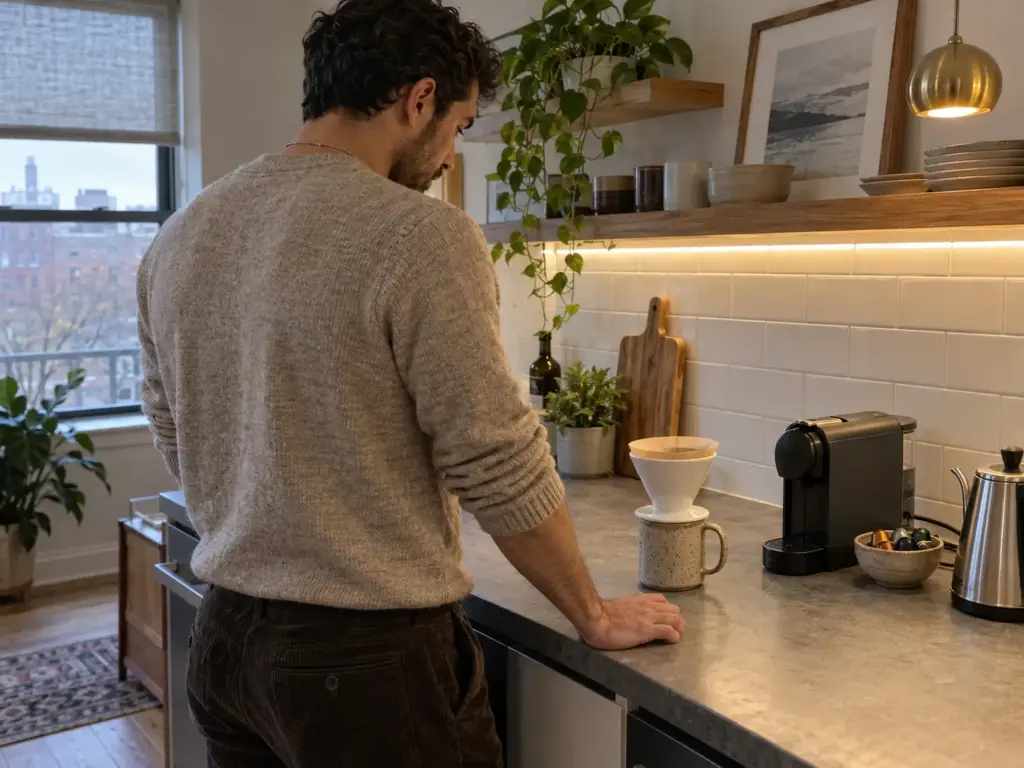
A pod machine wins on speed and on not having a dose to weigh at all: Keurig-style machines brew from about 6 up to 12 ounces at the press of a button, and nothing sits on a plate afterward. The costs are on the other side of the same trade. Every cup leaves a pod to throw away, the dose belongs to the pod and not to you, and a weak cup is not always the grind, which when weak is not the grind takes up from the pod side.
Pod machines are a separate family with questions of their own, pods or grounds, plastic and the cost per cup, and this article stops at their door. Pod coffee makers, in the blunt view of some, are made to produce trash and are not repairable. A reusable pod softens the trash and not the dose, and some households that use reusable pods still end up wanting no plastic at all.
For a pod reader the useful number is not on the box. Pod machines brew a set amount of water through a set amount of coffee, so the lever you have is the water, which is the volume button, and a larger cup from the same pod is a weaker one. That is a mechanism, not a measurement, and it is why a pod cup that tastes thin at the largest size can be fixed by the smaller size before any other change.
A pour-over cone or an AeroPress for one cup
A pour-over cone or an AeroPress makes one cup with no machine at all. Both need a kettle and a grinder, and the grinder is the next decision, not the first. A ceramic cone on the desk, filled from the electric kettle the office already allows, is one way to avoid pods.
The couple who started the thread ended on a glass and stainless AeroPress, and reported that it took some getting used to on ratios and takes slightly more time than pushing a button. The dose from the last section carries over as a starting point, but a steeped brew moves with the time, and the grind that moves with the steep is its own article.
Which family fits which morning
Ten minutes before work and one button wanted: a pod machine or the Cup-One, with the flaws above. Pods ruled out and a few extra minutes available: a cone or an AeroPress, with the kettle and the grinder as part of the bill.
Two people who drink different coffees: two cones, or a cone and a machine. Already own a twelve-cup drip maker: weigh the dose and use its small setting before buying anything. Whichever family wins, the grinder is the decision after it, and a grinder for a pour-over cone is the next stop for a reader who goes the manual way.
Month Two, and a Mug That Starts Warm
Week one is when every machine behaves. This section says what the evidence shows for the months after, how thin that evidence is for a one-cup machine, and the free step that keeps a small brew from cooling.
What the reviews report first, and what they do not
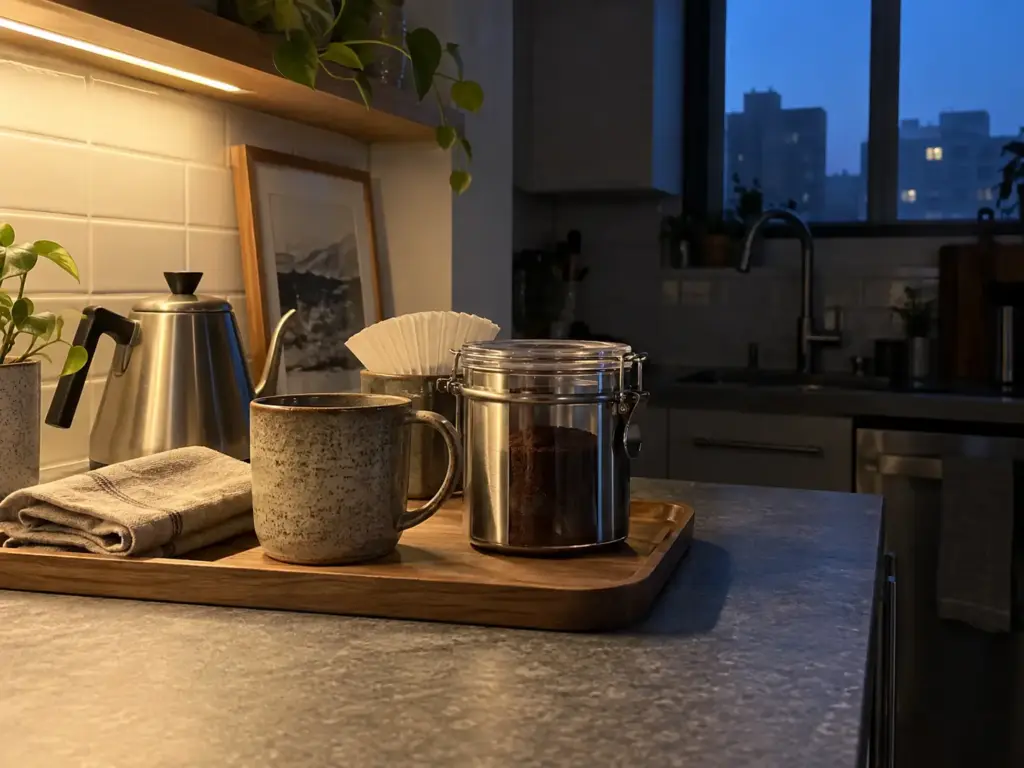
The first things to annoy are a drip at the spout (Tom’s Guide, first week), the fixed tank (Food & Wine) and the basket shape. What none of them offers is a month-two report on a one-cup drip machine. Long-use examples are about other machines, an old drip pot and a Jura, and they show that the family lasts, not that one-cup drip does.
That gap is the useful finding, and it should change how the first month is spent. Reviews run for a week or a few weeks, so a fault that appears in month two arrives with no earlier report to warn the reader. What the buyer can do is make the first month a test with a few fixed points: the same weighed dose, the same filter, the same water, and one line written down each time the cup or the spout changes. Three changes noted over a month are worth more than a general impression of “it still works.”
A check for the end of the first month
At the end of the first month, brew the same weighed dose twice in one day and taste the first mug against the second. Look at the spout, because a drip that has grown from a wipe to a puddle is the sign. Tip the tank only when the machine is cool. A cup that is sharp one day and flat the next, on the same weighed dose, is the V-shaped basket talking.
Pre-warm the mug: rinse it with hot tap water before it goes under the spout. Ten ounces of coffee has little heat to spare, and a cold stoneware mug takes some of it before the first sip.
When to step up to a grinder or a bigger machine
The next decision is the grinder, because a one-cup dose is small, about 18 g, and a blade grinder has the least room to hide uneven grounds: boulders and dust in the same scoop, so the cup comes out sour and bitter at once. If the cup stays off after the dose, the setting and a warm mug, the grind is the likely cause. Whether it should sit inside the machine or on the counter is a separate question, and our guide on whether the grinder belongs in the machine settles it.
Stepping up to a bigger machine is a different decision, and the reason to make it is a queue and not a flavor. A one-cup machine makes one cup in about five minutes, so two people who want coffee at the same time wait ten, and that is the point at which a twelve-cup machine on a weighed dose, poured at once into two mugs, becomes the better answer for that household. For one person on a weekday, five minutes is the cost of the cup; for two, it is the cost of the morning.
Weigh One Mug Tomorrow, Then Watch the Spout for a Month
A machine built for one cup makes what a twelve-cup machine run at one mug cannot, and the dose in grams is the first free fix, before either machine. The Cup-One is the one-cup drip pick, with its drip, its five minutes and its fixed tank written down. Pods and manual brewers win some mornings, and they live in their own articles.
A month from now, brew the same weighed dose twice in a day, taste the first mug against the second, and check whether the spout is still a wipe or has become a puddle.
Tomorrow morning, weigh the dose for the mug you drink, 18 g for 10 ounces if you use the 1 to 16.7 arithmetic above, instead of counting tablespoons, and brew it the way you always do. If the cup tastes fuller and no less bright than yesterday’s, the scoop was the problem. If it turns dry and bitter, take a gram off and brew again.
Frequently Asked Questions
01What is the best coffee maker for a single person?
For drip, the best coffee maker for a single person is a machine built for one cup, the Moccamaster Cup-One, which makes one 10-ounce mug with no pot to pour out. It drips at the spout and takes about five minutes, so a pod machine or a pour-over cone suits some mornings better.
02What is the best way to make coffee for one person?
Weigh the dose for the cup you drink, then match the method to the morning. About 18 grams of coffee makes a 10-ounce cup at a 1 to 16.7 ratio, and a drip machine, a pod machine, a pour-over cone or an AeroPress can all start from there.
03Can I make one cup in a 12-cup coffee maker?
Yes, use the one-to-four-cup setting where the machine has one, and weigh the dose for the mug instead of counting scoops. The cost is a thin bed of grounds and a carafe sized for twelve, so pour the mug as soon as the brew ends.
04What are the best single-serving coffee machines for one person?
Most machines sold as single-serve take pods, so the pod family is the usual answer, and it has its own questions about plastic and cost per cup. For drip without pods, the Cup-One is the one-cup machine covered here.
05How many grams of coffee for one cup?
About 18 grams for a 10-ounce cup at 1 to 16.7, which is a calculation to check on a scale. The four tablespoons on a Cup-One box come to about 20 grams, so weigh once and write the number on the canister.




How did your cup turn out?
No comments yet. Tell us what you changed — and whether the needle moved.