

We may earn a commission when you buy through links on this page. It never changes what we recommend. How we pick
On this page8 parts
- Pick the Pod by Cup Size Before You Pick a Flavor
- The Black Coffee Pods: Where the Standard Cup Size Lives
- Espresso and Double Espresso: The Sources Disagree, and the Label Says Why
- Milk and Iced: The Same Pod Gets Two Verdicts
- Flavored and Decaf: Where the Pod Fails Black
- Check the Machine Before Blaming the Pod
- Order a Sampler in Your Mug's Size, Then Check Again in Month Two
- Frequently Asked Questions
The name on a Vertuo sleeve tells you almost nothing about what ends up in your mug, and the label under it tells you most of it: the cup size and the drink the pod was built for. A first-time buyer who picks a Vertuo on impulse faces a wall of capsule names, which is exactly when a first box gets chosen by name alone. The machine reads a barcode on each pod, injects a little water and spins the pod, so the pod, not a button, sets how much coffee you get. That is why the answer to what are the best Nespresso Vertuo pods starts with cup size, then moves through black coffee, espresso, milk and ice, flavored and decaf pods, and ends at the machine on your counter.
There is no single best Vertuo pod, because the drink sets the cup size. Pick the size first, then let the roast decide how the pod holds up to milk and ice.
| Drink | Cup size | Pods the sources name | What goes wrong |
|---|---|---|---|
| Black coffee | Coffee, 7.77 fl oz | Melozio, Odacio, Mexico, Ethiopia, Colombia | Mexico turns tart and lingering, worse with cream |
| Espresso | 0.85 to 1.35 fl oz, or Double Espresso at 2.7 fl oz | Double Espresso Scuro, Chiaro, Altissimo | Scuro is first at one site and last at another |
| Latte or other milk drink | Double Espresso, 2.7 fl oz | Bianco Doppio, Double Espresso Dolce, Costa Rica | Made for milk, so it loses points tasted black |
| Iced | Small cup: Ice Leggero goes with the 2 oz espresso group. | Ice Leggero, Ice Forte, Double Espresso Dolce | Ice Leggero reads fruity at one site and extremely mild at another |
| Decaf | Gran Lungo, 5 fl oz, for the Fortado | Fortado Decaffeinato Vertuo, Melozio Decaffeinato | The Fortado fits Vertuo machines only |
Every pod in the table is one that reviewers and buyers keep coming back to, and the cup sizes are Nespresso’s own figures.
Pick the Pod by Cup Size Before You Pick a Flavor
A Vertuo pod is a size before it is a flavor. That is how the same pod ends up first in one tasting and last in another, as the Double Espresso Scuro does a few sections down: the tasters were not always judging the same volume or the same drink. Start from the cup, and most of the contradictions get easier to read.
Why one ranking can’t hold a 1.35 fl oz espresso and a 7.77 fl oz coffee
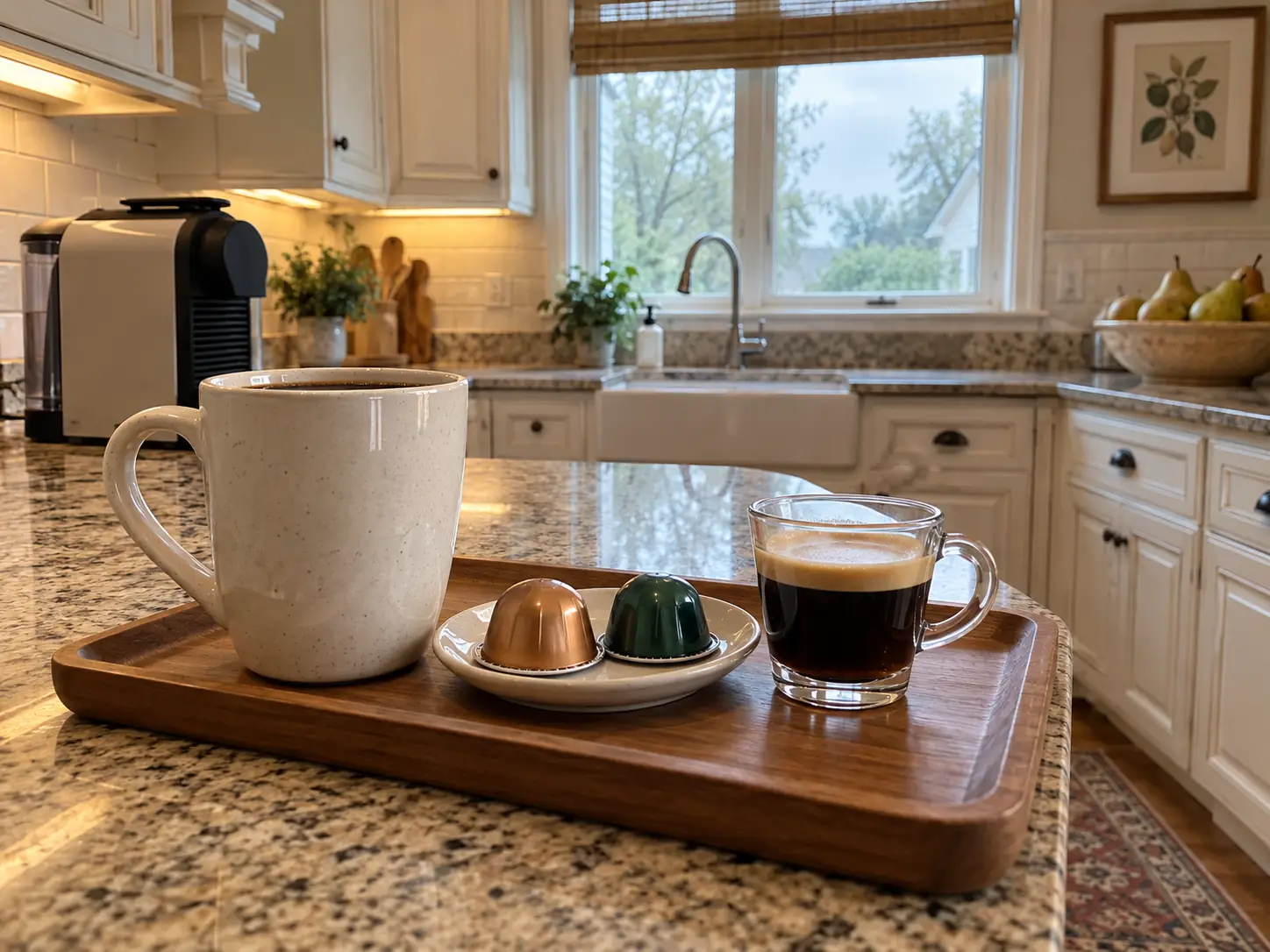
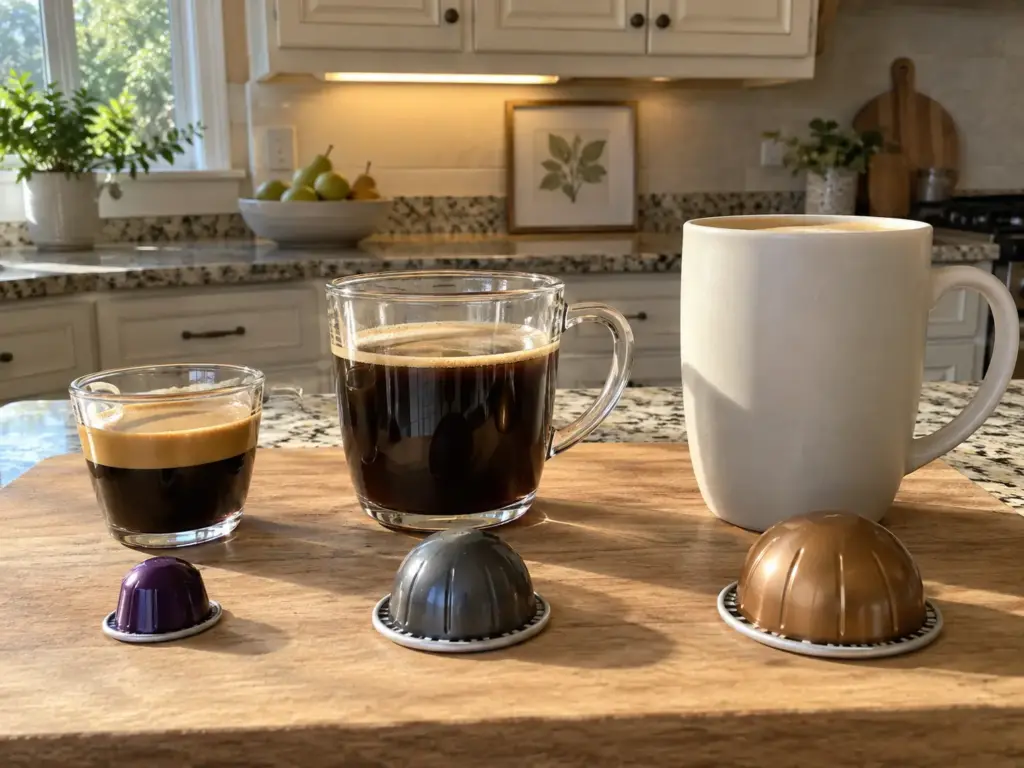
According to Nespresso’s own size range, Vertuo pods come in six cup sizes “from a 1.35 oz espresso to an 18 oz pour-over style coffee,” and the category tiles print the ranges: Ristretto and Espresso at 0.85 to 1.35 fl oz, Double Espresso at 2.7 fl oz, Gran Lungo at 5 fl oz, Coffee at 7.77 fl oz and XL Coffee at 12 to 18 fl oz.
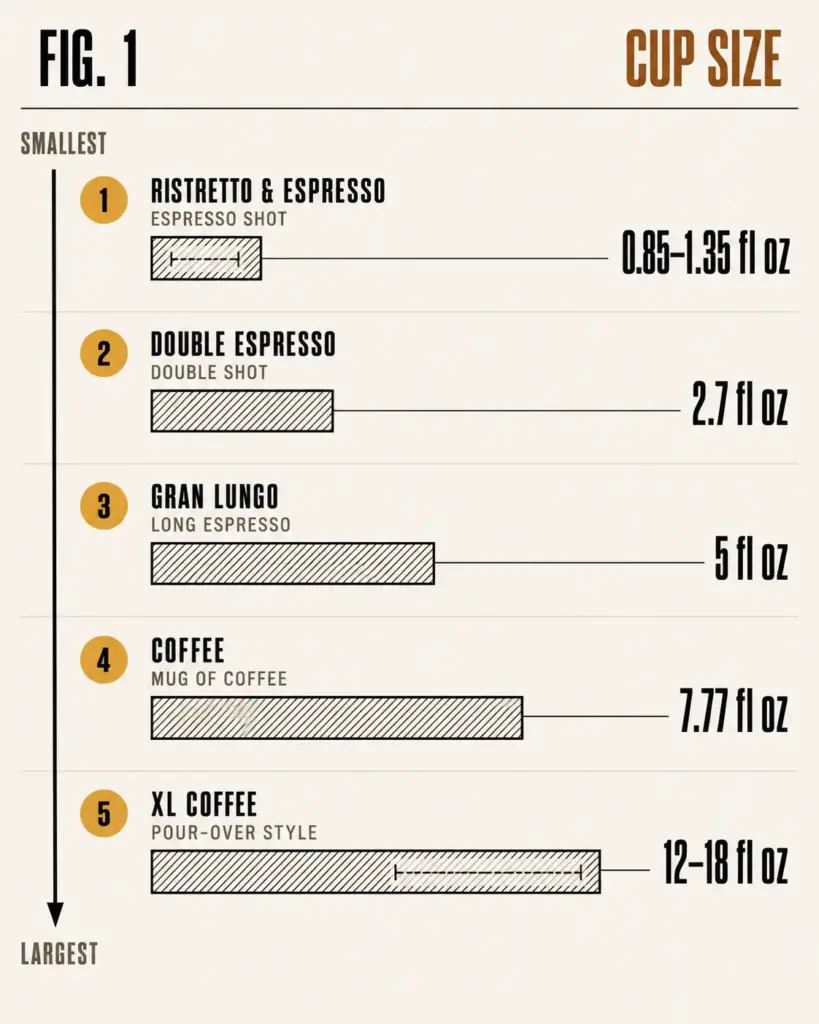
Hold the two ends side by side and the problem shows. A 7.77 fl oz mug and a 2.7 fl oz cup poured from the same machine are two different drinks before the roast even enters: more water through the grounds makes a longer, milder cup, and a short pour is concentrated and sharp.
One review ranked 17 pods as if they were one drink, and Serious Eats put espresso and coffee pods through one test. The useful way to read these picks is to sort them into “coffee” pods at about 7.7 fl oz and “espresso” pods at about 2 fl oz, and the verdicts later on this page make more sense that way. The same sorting separates Keurig and Nespresso, whose verdicts change once you look at mug size.
Fill the mug you actually use from a measuring cup and write down the fluid ounces. If it holds well over 8 fl oz, a standard coffee pod leaves it short, and topping that gap with hot water is the quickest way to a thin cup. Match the mug to the pod size, or accept two small pods or an XL.
What the barcode decides, and what it leaves to you
The barcode is the one fixed part. Serious Eats puts the mechanism plainly: “Each Vertuo pod includes a barcode.” The machine scans it, adjusts the brew to suit the coffee, then injects a small amount of water into the pod and spins it while the coffee infuses.
So the pod tells the machine how much to pour and how to brew it. What it leaves to you is everything around the cup: black, over milk or over ice, and whether the roast on the sleeve suits that.
If you are still weighing the Vertuo against the Original line, whether a Vertuo is the right system at all is its own question, and this page assumes it is already settled.
The Black Coffee Pods: Where the Standard Cup Size Lives
The 7.77 fl oz family is the one meant to be drunk as a plain cup, so it is where “which roast do I like” actually applies, and where the sources disagree least. The one trap is a flavored pod, which gets its own section later. For now the only question is which roast you want in a normal mug.
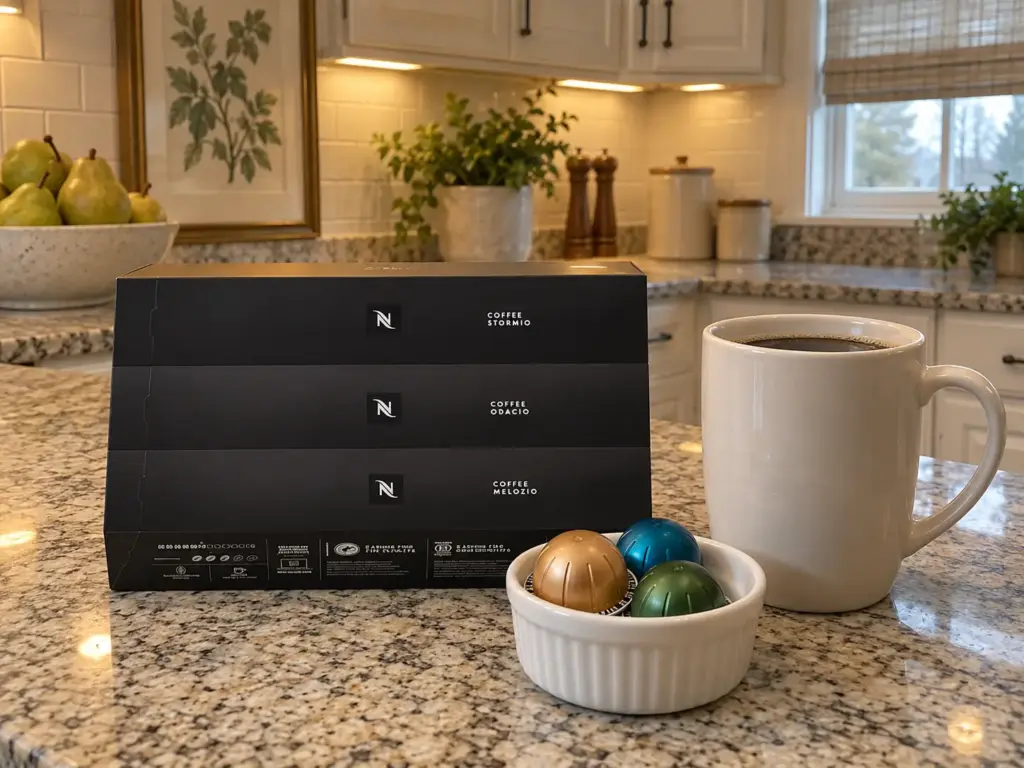
The pods three sources keep naming for black coffee
One review and Serious Eats both name pods for a plain cup, and a few names keep coming back from buyers too. Melozio is the clearest case: it gets named as a go-to for a plain cup, and one review places it seventh of 17 as the nearest thing to an ordinary cup of coffee in the Nespresso lineup, mild and sweet with a cereal flavor and a juicy, honeyed edge. It is a fan favorite too, and the plain description fits what a first pod should be: a regular good cup of coffee.
The roast is where the picks split. Odacio reads fairly mild, with a faint cereal note, though it has a heavily roasted, smoky edge that some drinkers will taste as bitter.
Mexico is tart with a lingering finish and gets worse, not better, when cream goes in. Ethiopia is usually described as a lighter roast, slightly acidic, with a fruity dark berry note. Serious Eats has no black pick of its own, but its light-roast pick, Colombia, is a single origin with red-berry notes that milk can overpower, so it suits people who take their coffee black.
Where the roast scale helps and where it only describes the maker
Every pod page carries Nespresso’s own scales for body, bitterness, roast and acidity, plus an overall intensity number. That is the maker’s rating, not a measurement, and only part of it held up when a reviewer tasted. The Serious Eats reviewer didn’t always pick up the listed tasting notes but wrote, “I did find that I agreed with the overall intensity score.” Use the number as a rough sort inside Nespresso’s own range, not as a verdict on how a pod will taste to you.
It also explains why one pod is “mild” in one review and “tart” in another. A lighter roast earns both words depending on who is tasting and what goes into the cup, so the two reviews are not in conflict. Serious Eats lists the Colombia at 1 of 5 on the roast scale and the Scuro at 3 of 5; if the roast itself is the doubt, the question of light or dark roast is answered for espresso machines in its own article.
Start with a sampler, not a full box
Every verdict above comes from one tasting or a few, so whether a pod still tastes the same by month six is unrecorded. That is one more argument for buying small. The advice for flavored pods is to buy them in single sleeves first, which works for the whole family: taste before you commit to a box.
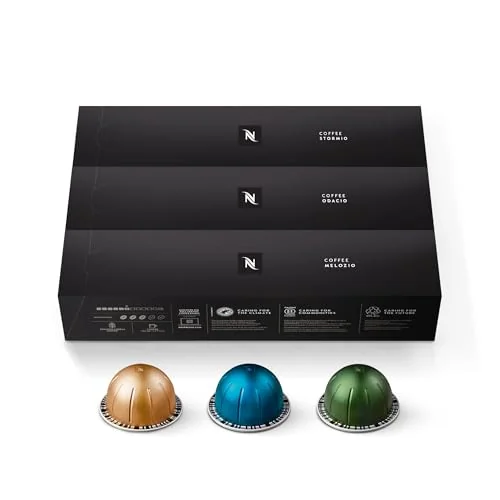
For the standard cup size, the cheapest way to do that is a mixed pack. The Nespresso Capsules Vertuo Variety Pack in medium and dark roast holds 30 pods of the 7.77 fl oz coffee size, so one order gives you 30 plain cups across two roast levels and shows which one you reach for. Its limit is what it leaves out: no espresso, milk, iced, flavored or decaf pods.
Espresso and Double Espresso: The Sources Disagree, and the Label Says Why
Unlike the black-coffee family, the small cup is where two reviews flatly contradict each other, and the contradiction is the most useful thing on this page. It is also where the label does the most work. Read it before you read the verdicts.

Double Espresso Scuro: first at one site, last at another
Serious Eats names the Double Espresso Scuro its top pick for dark roast: a medium-dark blend with cacao, vanilla and chocolate notes that stay well balanced and toasty without swamping the subtler flavors. One review ranks the same pod last of 17. Its reviewer found it intensely acidic even over ice and with cream, despite Nespresso describing it as low in acidity, and noted a bitter, roasted flavor that lingers.
Neither reviewer is careless; they are scoring different things. Serious Eats reports Nespresso’s roast scale at 3 of 5 and calls the intensity mid-level, while one review describes the same pod as nearly maxing out the official intensity scale. Those are two separate scales on one label, so the reviews are not quoting the same number. Add that Serious Eats flags the pod as a Robusta and Arabica blend that may be too toasty for some, and the split makes sense: it is a dark, short cup, and whether it reads balanced or sharp depends on how you take it.
So skip the verdict and answer the question that decides it: black or with milk, and in which size? Black at 2.7 fl oz is the hardest way to drink any dark double espresso, and with milk it is closer to the job the pod was built for, since creamy milk helps balance the bitterness of a dark roast.
Nespresso’s own page agrees. It describes the Double Espresso size with three words, “Just add milk,” followed by a promise of a latte. A pod made for milk loses points whenever it is tasted black first.
Taste any double espresso pod twice from the same sleeve: once black, once with a splash of milk, changing nothing else. If the black cup is harsh and the milk cup settles, the pod was built for milk, and you have your answer without buying a second sleeve.
The two small pods a review warns against
Serious Eats warns against the Ristretto, which it found overly bitter with a burnt finish and a thin mouthfeel, and against the Napoli, an intense dark roast it found creamier than the Ristretto but still too bitter for its taste. One caution before acting on either: that review tasted Original and Vertuo pods in the same test, so check which line a sleeve belongs to before you order it (the last section shows how).
The Intenso is the middle case. The review calls it a dark, intense roast, good with milk and too bitter alone, and it still gets named as a go-to by buyers. Chiaro and Altissimo usually come up for espresso alongside the Scuro, so they are the natural pods to try next if the Scuro does not suit your cup.
Milk and Iced: The Same Pod Gets Two Verdicts
Once milk or ice enters the cup, the pod is diluted and cooled, so the same pod earns a different verdict. A pod that tastes sharp black can be the right one for a latte, and a pod that is lovely hot can disappear over ice. The reviewers changed the cup, not just the pod.

The pods made for milk
Bianco Doppio is the plainest case. It is named for lattes and cappuccinos, and one review ranks it 12th of 17 because it is a double espresso built for milk: “That means it really isn’t meant to be enjoyed black.” Judged black, it loses points it never competed for. With milk, one review found it nutty with faint caramel notes and not acidic.
Double Espresso Dolce is the other name that repeats. It is recommended for lattes and cappuccinos, and one review found the bitterness lingers black but the pod transforms with a splash of cream. Costa Rica is a pod that suits a tall latte. Colombia is the pod to keep away from milk, since the Serious Eats review says its delicate light-roast cup can be overpowered by it.
There is a pattern under the names, and it cuts against the instinct to buy the mildest pod for a milky drink. Serious Eats found that bolder, darker pods stood out better once milk went in, while a medium roast was lovely alone and got lost. The mildest pod is the one the milk erases.
Ice Leggero: why the verdict flips
Ice Leggero is the iced pick in one review, where it comes 10th: light and delicate, “perfectly fruity without being acidic.” It is also recommended for iced drinks and iced lattes. The Serious Eats review found it pleasantly toasty and fruity, then reports that once milk and ice went in together it made an extremely mild drink.
Neither review says which of those two additions did it. The tastings were run differently, though. One review tasted each pod black, then with milk, then over ice, as separate steps, while the Serious Eats note describes the pod after milk and ice were both in the glass.
What follows is an inference, not a finding: milk and ice both dilute a mild pod, and stacking them leaves the least coffee flavor per sip. That would make the flip a property of the glass, not of the pod.
And an iced cup keeps changing after the first sip, because the ice melts into it and each sip is weaker than the last. A pod designed for ice only buys time against that.
One change at a time for a thin iced cup
If an iced cup tastes thin, resist swapping the pod. The free first step is to brew the same pod hot and black and taste it, which shows whether the pod or the dilution is thin. If the hot cup is full, the pod is fine and the glass is the problem, so make one change: less milk, or fewer ice cubes.
Taste again before touching anything else. Cutting the milk too far gives a sharper cup, and cutting the ice too far gives a warm one.
If the hot black cup is thin too, the pod is the problem, and a pod made for ice, such as the Ice Forte, which Serious Eats called a solid choice for iced coffee devotees, is the next step. And if every iced cup you make thins out whatever the pod, the machine and the melt are the suspects, which is the subject of a hot and iced coffee maker that doesn’t run thin.
Flavored and Decaf: Where the Pod Fails Black
The two pod families that fail most often are the ones with a flavor added and the ones with the caffeine taken out, and they fail for the same reason: neither tastes like plain coffee. Both are fine in the right cup. They are just not the pod for a black-coffee habit.
Flavored pods: terrible straight, decent in a latte
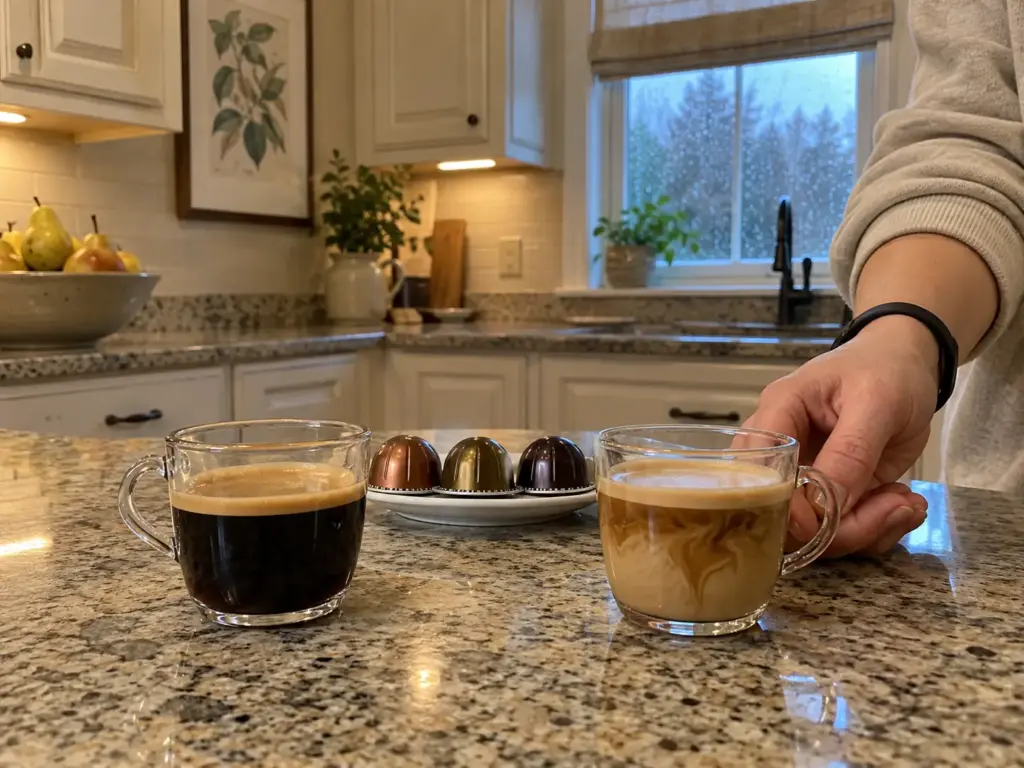
The complaint shows up more than once in the sources behind this page. Serious Eats wrote of the Sweet Vanilla, “This flavored pod was overly sweet and tasted artificial,” and of the Roasted Hazelnut, “This pod yielded a cloyingly sweet and artificial-tasting drink.” Golden Caramel and Rich Chocolate are hard to enjoy black, but they taste decent in a latte. And one review ranked the Golden Caramel 16th of 17 after finding the caramel nearly absent without added creamers and the coffee underneath surprisingly bitter.
The fix every source points to is milk, not a different flavor. One review put the Sweet Vanilla 4th because the vanilla stays sweet when cream goes in and the cream mellows the bitterness underneath, which makes a flavored pod a latte pod. Taste is personal here, though: some drinkers can’t stand hazelnut and chocolate, while others pick vanilla, chocolate and hazelnut as favorites. That split is why the single-sleeve advice from the black coffee section applies to flavors above all.
One caution about a pod that will not be on the shelf: the top-ranked Maple Pecan in one review is a limited fall release, so it is a seasonal treat, not a standing pick.
If a flavored sleeve is already in the cupboard, label it for milk drinks and keep it apart from your black-coffee pods. That way a harsh cup is never blamed on the wrong pod, and the flavored one gets the only test it passes.
Decaf: the pods sources name and the machine each needs
Serious Eats’ best decaf is the Fortado Decaffeinato Vertuo, a dark roast with medium-high intensity and cacao, oak and caramel notes. Nespresso suggests serving it as a Gran Lungo (5 fl oz), and it works well with a splash of milk. It is sold for Vertuo machines only.
One review’s pick is the Melozio Decaffeinato, in 9th place: woody and earthy, mellow, and a very different cup from the caffeinated Melozio, which is juicier and more syrupy. One review explains that caffeine is removed from the beans before roasting and can change the flavor, so do not expect the decaf twin of a favorite to taste like it.
Check the Machine Before Blaming the Pod
The decaf above fits only one system, and that is the pattern to check before a pod gets blamed: was it built for the machine on the counter? The obvious reading of a bad cup is that the pod was bad. The better reading, when the sleeve came from the wrong line, is that the machine never had a chance. A pod that does not fit shows itself at the first brew, because the machine either reads the barcode or it doesn’t.
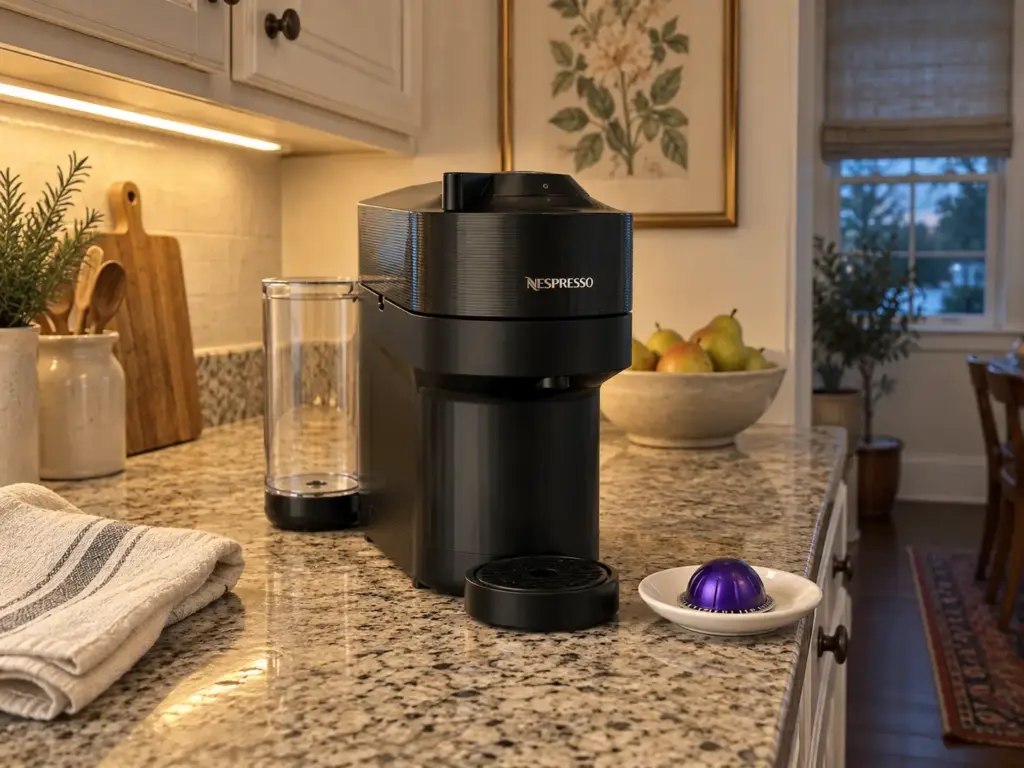
Original-only and Vertuo-only pods
Serious Eats says it flatly about its best flavored pick: “Vaniglia pods are only available in the Original espresso format.” The Fortado Decaffeinato goes the other way, Vertuo only. The Double Espresso Scuro and the Colombia are sold for both systems, so the name alone doesn’t tell you which sleeve is in your hand. The line printed on the sleeve does.
A Vertuo machine is built around the barcode on its own pods, and the story of why Original and Vertuo pods are different systems is told in its own article.
XL capsules fit named machines only
The same check applies to the largest size. Nespresso’s page says its XL capsules, at 12 to 18 fl oz, are “designed to brew exclusively with” the Creatista, Lattissima, Next, Pop and Up machines. That list mixes Vertuo and Original-line names, so do not treat it as a shopping list. Read the model name on your machine and on the box, and confirm before ordering a case.
The Vertuo Pop+, with a 25 fl oz side tank, a 30-second warm-up and five cup sizes, belongs to the Pop line the list names, but the page says Pop, not Pop+, so the box is the proof. A complaint about giving up on the Vertuo Pop does not say what failed or whether it applies to the Pop+, so read it as a reason to look up that model’s reviews, not as a verdict.
The Vertuo Next with milk frother is named on the list outright, so its 12 and 18 fl oz capsules are its own, and the reviews and threads quoted here carry no complaint about it. A model that is not on the list is a different case. The first-generation Vertuo by Breville in matte black is absent from it, so check before buying an XL capsule for it; it is the older model, and nothing repeated shows up against it.
Read the model name off the machine itself, not off the box it arrived in. Boxes get recycled and machines get gifted, and the model on the machine is the name Nespresso’s XL list is written against.
Which model fits which size gets a full comparison in which Vertuo model takes which size.
What to decide next
With the pod and the machine matched, the next decision is which model takes the size you want, and then what each cup costs. That second question is arithmetic: divide the box by the number of pods, then by the fluid ounces each pod pours, because a 1.35 fl oz espresso pod and a 7.77 fl oz coffee pod are not the same unit. The full division is in what the cup costs per ounce, and it is also why a second pod brewed to rescue a thin iced cup roughly doubles the cost of that cup.
Order a Sampler in Your Mug’s Size, Then Check Again in Month Two
Three things carry over from the sections above. The drink sets the cup size, and the size is the first thing to pick, before a flavor name. A flavored pod fails black and wants milk, while a pod made for milk loses points when it is judged black. And a pod that “doesn’t work” is more often the wrong system or the wrong model than the wrong pod, which is why the sleeve and the machine get checked first.
A month from now, look at which pod you actually reached for most and whether it matched the cup you drink. None of the verdicts above covers a pod past its first weeks, so your own month two is the best evidence there is.
Tomorrow morning, change one thing: choose the cup size for the drink you actually make, and taste a sampler of the standard-size roasts black, one pod at a time. A good pod gives you a cup that tastes like coffee, not like the milk or the sweetener you were counting on. Then the next decision is which Vertuo model takes the size you want.
Frequently Asked Questions
01Which Nespresso Vertuo pods are the best value?
The best value is the pod with the lowest cost per fluid ounce of the cup you actually pour, not the lowest cost per pod. Divide the box by pods, then by fl oz. A pod that needs a second one to fill your mug costs double. See what the cup costs per ounce.
02Which Nespresso pod has the best taste?
There is no single best-tasting pod, because the reviews split by cup size and by whether the pod goes into milk. Start with a standard 7.77 fl oz coffee pod black, then add espresso, milk and ice pods one at a time, tasting between.
03What are the best Vertuo capsules for a latte?
The pods the sources name for milk are Bianco Doppio, Double Espresso Dolce and Costa Rica, and Serious Eats found bolder, darker pods hold up best in a latte. A pod made for milk loses points when tasted black, so judge it with milk.
04Are flavored Vertuo pods good black?
Mostly no: Serious Eats and one review report flavored pods tasting sweet, artificial or bitter when drunk black, and better with milk. Taste in flavors is personal, so buy a single sleeve before a larger order.
05Can I use Original pods in a Vertuo machine?
No, Original pods are made for the Original machine and Vertuo pods for the Vertuo machine, because the two lines are separate systems. Check the line printed on the sleeve, since names like Scuro and Colombia exist in both.


How did your cup turn out?
No comments yet. Tell us what you changed — and whether the needle moved.