

We may earn a commission when you buy through links on this page. It never changes what we recommend. How we pick
On this page8 parts
- Which Machine Pours the Stronger Cup, and Which the Thin One
- The Size Button Comes First on a Keurig
- When the Cup Is Watery and Bitter at Once
- The One Keurig Line That Changes the Answer
- What the Pod Cannot Fix: Freshness, Roast and the Dose
- Month Two: Scale, the Pierce and the Cup That Drifts
- Tomorrow's Mug: the Smallest Size, Then One Taste
- Frequently Asked Questions
You pressed the largest size on the Keurig because it fills the mug, and the cup that came out was thin and harsh in the same sip. So does Keurig or Nespresso make better coffee, or is the problem a setting you have not touched yet?
In the Keurig vs Nespresso argument over which tastes better, the pod comes first: a pod machine fixes its dose before the water arrives (a K-Cup holds about 10 g of coffee whether it fills 6 ounces or 12), so the size of the cup decides how weak the coffee reads far more than the logo on the front does. The Nespresso cup is the stronger, darker one in every review that pours both; a Keurig closes part of that gap through its size button and its Strong setting, one Keurig with a pressure setting stands apart, and some of what spoils a cup is in the pod and never reaches the machine. If you still have to choose between the two, the buying guide for this pair carries that decision.
Quick Answer
Nespresso makes the fuller, darker cup in the Epicurious same-blend test. A Keurig comes closer only when the size button drops to the smallest size and the Strong setting goes on. The K-Crema, the one Keurig with a pressure setting, is the exception to weigh separately.
Which Machine Pours the Stronger Cup, and Which the Thin One
One machine makes the stronger cup in every comparison that pours both, and neither makes a cup that beats drip, pour-over or a real espresso machine. That verdict comes first here, with each taste claim left to the reviewer who made it. The settings that move it come after.
What the reviewers pour from the same pod
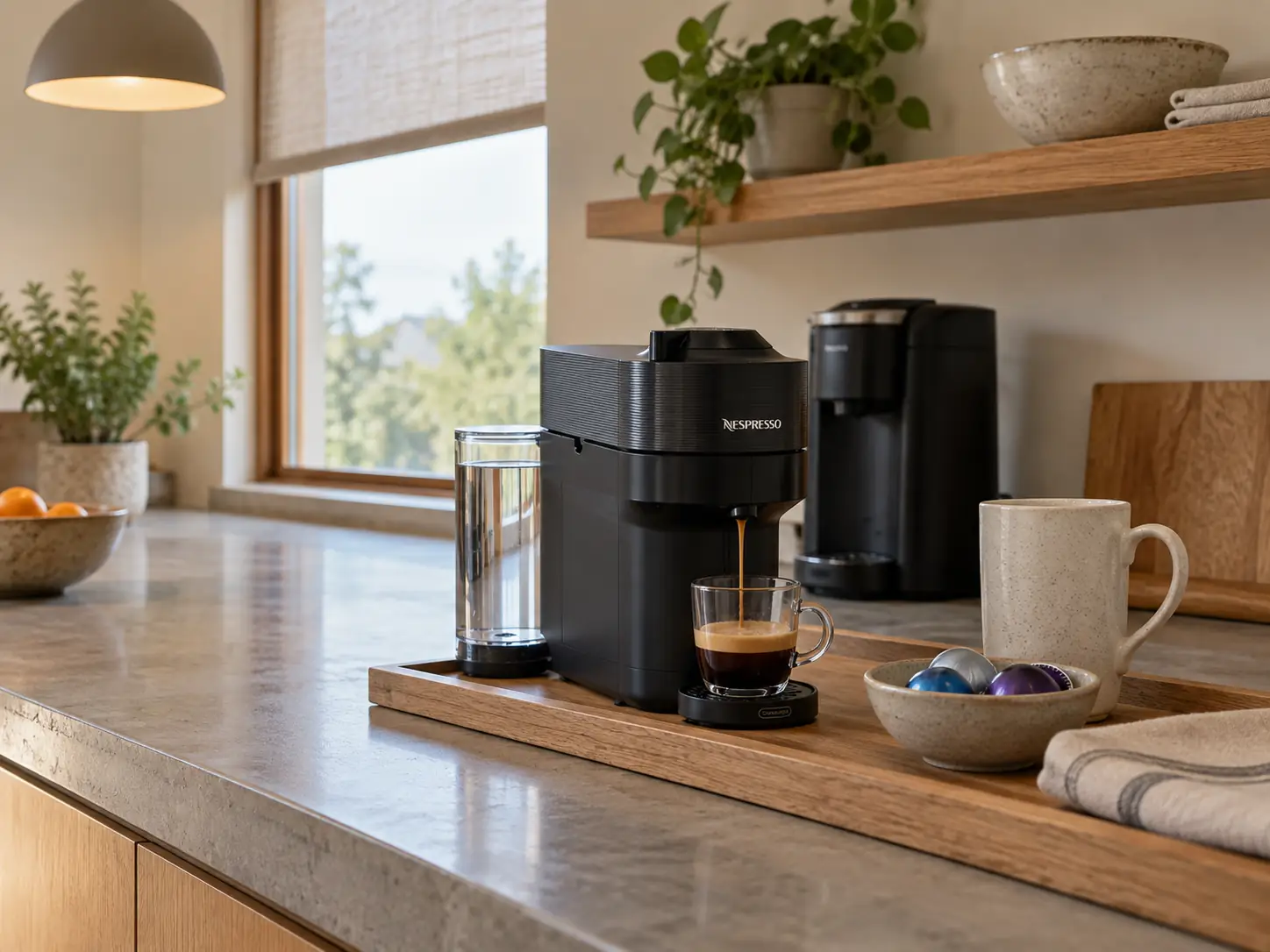
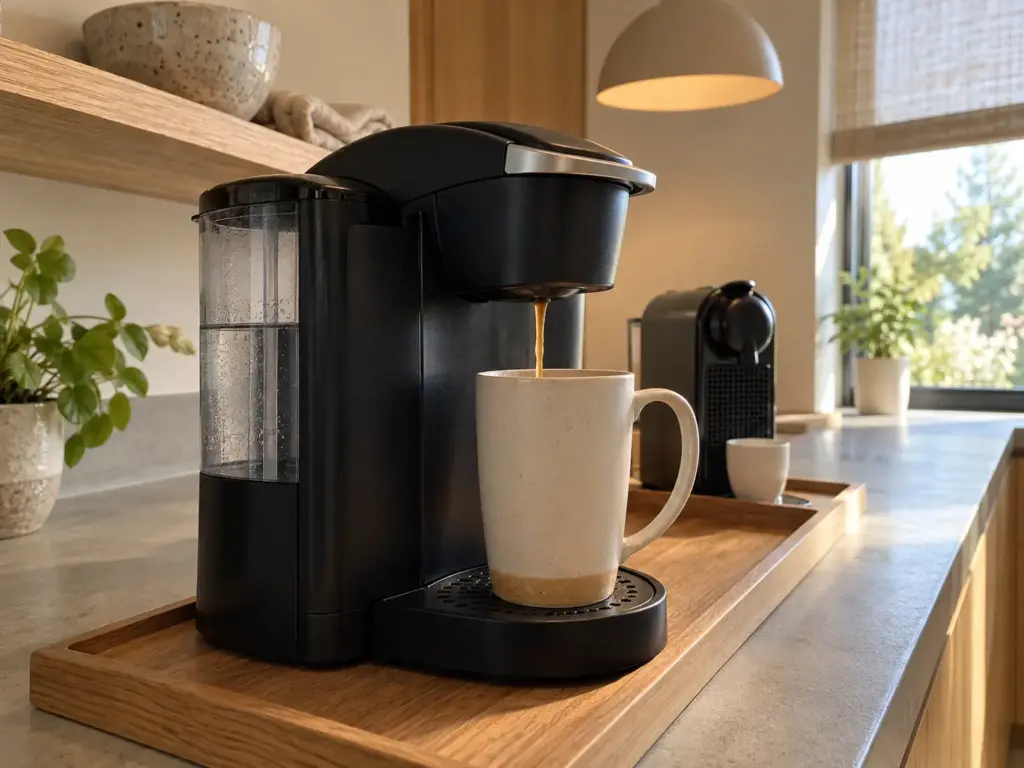
The cleanest comparison in print is a same-blend test that Bon Appétit reports for Epicurious: the same Starbucks blend was brewed on both machines, and the Keurig cup came out watery and bitter, while the Vertuo cup was fuller, with a nice crema on top. Serious Eats lands in the same place from the other direction: Keurigs “tend to brew a weak, bitter version of drip coffee,” while most Nespresso capsules “are strong and taste very darkly roasted.”
Same pod, different cup is what that test proves. Why the cups differ it cannot say, because the account gives no water temperature and no dose, so the whole design of each machine is on trial and no single part of it. One reviewer and one blend are evidence about the cup, never about the mechanism.
A Keurig can taste watery and not fresh at all, and it can also come out too acidic. Watery coffee with an acidic edge tends to describe a cup pulled off the grounds too soon or too thin, which makes it a settings question before it is a question of brand.
The table sets the three machines this page keeps coming back to, with the first setting each one offers.
| Machine line | How it pushes the water | The cup it makes | The first setting to change | Its flaw |
|---|---|---|---|---|
| Keurig K-Express (a standard Keurig) | A low-power pump lightly pressurizes the pod (Serious Eats) | Weak and bitter, drip-style (Serious Eats); watery and bitter in the Epicurious same-blend test | The size button (8, 10 and 12 oz on this listing), then Strong Brew | Durability: 1,554 of 1,706 durability mentions on the listing are negative |
| Keurig K-Crema | A pressure setting; the listing claims 5x more pressure, with no bar figure | A crema top that “mimics its competitor,” and may not brew quite as strong a cup as the Nespresso (Delish) | The pressure setting | Not compatible with the reusable filter; only 2 ratings on the listing so far |
| Nespresso Vertuo Pop+ | Spins the capsule; its barcode sets the water amount and temperature (Serious Eats, Bon Appétit) | Fuller, more nuanced, with crema (the Epicurious reviewer); strong and creamy at 230 ml (Taste of Home) | Cup size (five sizes on the listing) | Leakage: 30 of 35 mentions negative; reliability: 64 of 119 negative |
Why a Keurig cup reads thin and a Nespresso cup reads dark
A standard Keurig, Serious Eats says, uses a low-power water pump to lightly pressurize each K-Cup. Homegrounds describes what follows: the pod is pierced at the top and bottom, the water flows through, and the result is akin to a drip coffee machine. Newer Keurig brewers pierce the pod five times instead of once, which Homegrounds credits with better saturation of the grounds, but the water that meets them is still a mug’s worth.
A Nespresso Original does the opposite on every count. The pump pushes hot water at 19 bar until the foil underneath the capsule ruptures, which Homegrounds says produces a coffee similar to an espresso shot, with a thin layer of crema. The Vertuo line skips the pump and brews by spinning the capsule (centrifugal brewing), up to about 7,000 rpm according to Serious Eats, and the rim carries a barcode that tells the machine how much water to use and how hot, as Bon Appétit reports. The 19 bar belongs to the Original line, so the Vertuo gets no bar figure here.
What the cup reads like follows from two things: how hard the water is pushed, and how much water the same grounds are asked to color. A Keurig stretches one pod’s coffee across a tall mug, and a tall mug looks like coffee and tastes like a rumor of it.
What neither machine will do next to drip
Serious Eats is blunt about the ceiling: “Neither machine can brew a great-tasting coffee when compared to drip coffee makers, pour-over, or espresso machines.” So “better” here means the better of two compromises. If the cup you want is the one a drip machine pours when its water runs hot enough, a drip machine picked by water temperature is the comparison to hold a pod machine against, and the Specialty Coffee Association’s home-brewer standard asks for water at 194 to 205°F (90 to 96°C). No source gives a Keurig’s outlet temperature, so nothing on this page claims a pod machine reaches that window.
Taste the pod machine against the cup you already know. Pour one mug of your usual drip coffee next to one pod at the smallest size, and the gap you are trying to close stops being abstract.
The Size Button Comes First on a Keurig
If the thin cup is the Keurig’s, the cheapest change is not a new machine but how much water meets the pod. This section puts what the pod holds and what the size button does to it ahead of any shopping, then orders the changes so one cup can be tasted against the next.
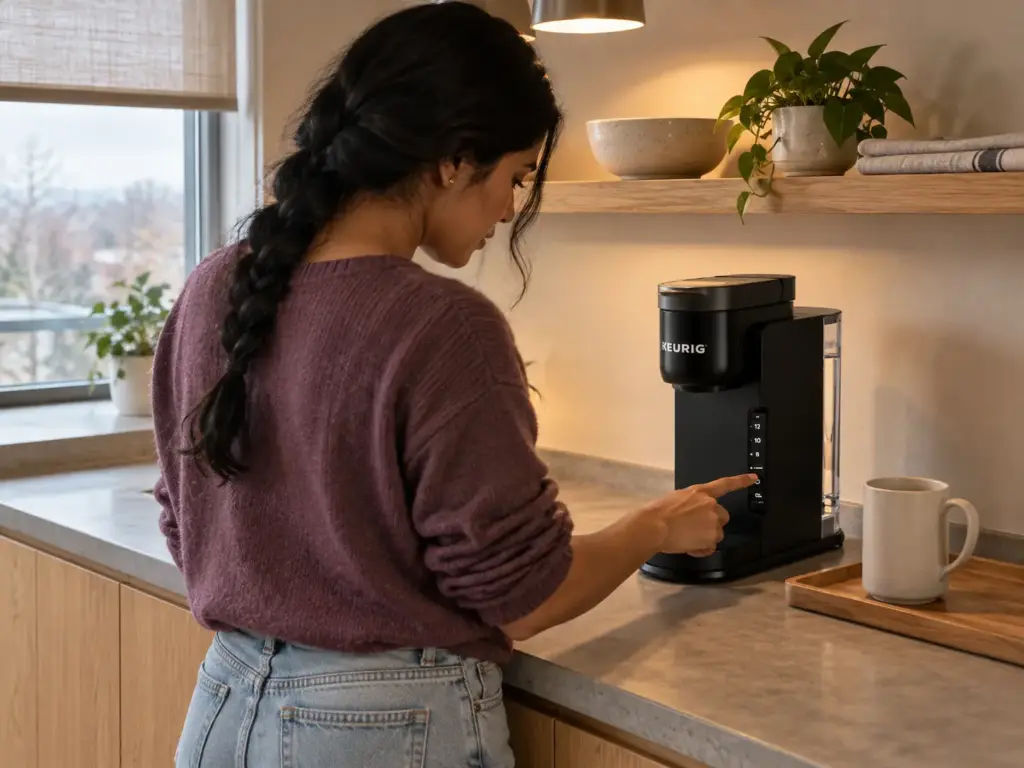
Check the size list in the manual first
Button availability varies by model, so the manual’s list of sizes comes before anything else. The K-Express listing shows 8, 10 and 12 ounce brews and a Strong Brew button, while Taste of Home found the iced setting on the K-Elite has a single size; another model may start lower or higher than either. Nothing here promises a 6-ounce button on yours.
Find the smallest size the manual lists and press that one with the pod you always use. Run a water-only cycle at that size first, brew the pod, and taste the second mug rather than the first, because a first sip you are bracing for tends to taste like the old cup.
What 6 ounces and 12 ounces do to the same pod
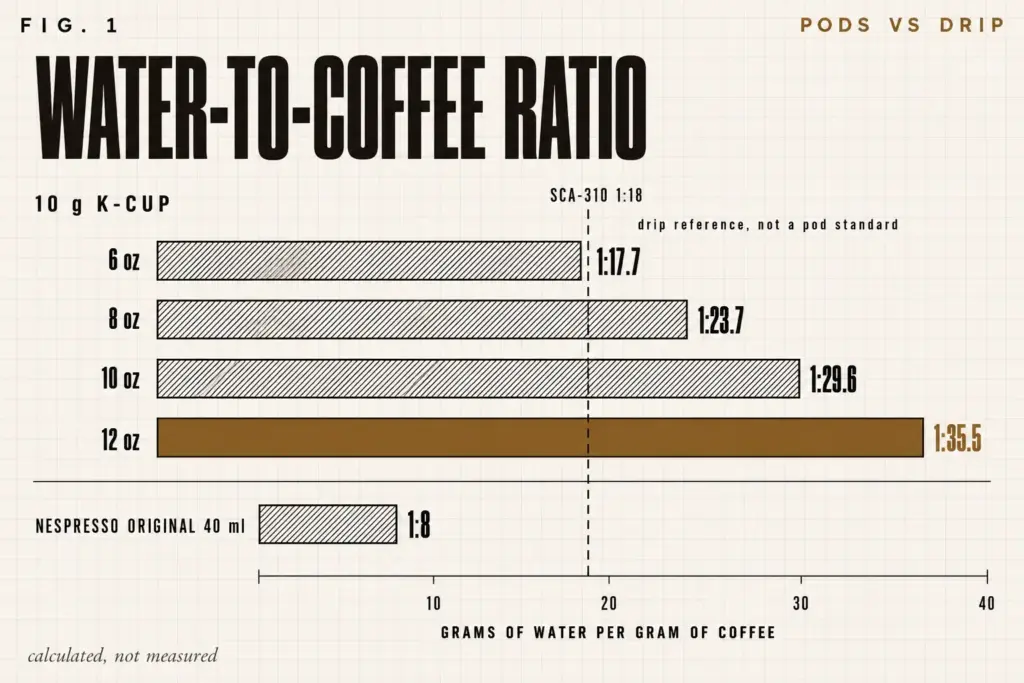
Homegrounds puts a K-Cup at about 10 g of coffee, enough for a brew of up to 12 ounces at roughly 1:35 (coffee to water, by weight). A Nespresso Original capsule holds about 5 g for a 1.35-ounce shot, close to 1:8. Ten grams per pod is about two level tablespoons, so a 12-ounce Keurig mug gets roughly half the coffee a drip machine would use for the same volume.
Dividing that 10 g by the water gives the brew ratio at each size. These are calculations from Homegrounds’ dose figure, not measurements, and pods vary by brand: about 1:17.7 at 6 oz (177 ml), 1:23.7 at 8 oz (237 ml), 1:29.6 at 10 oz (296 ml) and 1:35.5 at 12 oz (355 ml).
The Specialty Coffee Association’s home-brewer standard, SCA-310, asks for 55 g of coffee per 1,000 g of water, about 1:18, a ratio you can check a drip machine against in grams rather than scoops. It is only a yardstick for a pod, because the standard’s own scope says “pod/capsule brewers are excluded from this standard.” Even so, the 6-ounce setting lands near it and the 12-ounce setting sits at about half.
The dose you cannot read off the box can be weighed. Put ten pods from one box on a scale, divide by ten, and the unprinted number is yours; the Hario Drip Scale Timer reads in 0.1 g steps, and a plain kitchen scale with 1 g steps, like the Etekcity 11 lb model, still gets there because ten pods average the rounding out. A scale only reports the dose and fixes no cup by itself, and no repeated complaint turned up for the Hario. The full version of this weighing lives in the ten-pod dose check in the buying guide.
Keep the same pod from the same box for the whole size comparison. Switch the brand halfway and you are tasting two roasts and two doses at once, and the cup can no longer say which change did anything.
Then the Strong button, and taste again
Once the brew size is as low as the manual allows, taste again before touching anything else. Then comes the strength setting, the Strong button: the Keurig K-Express is the model whose listing carries one next to its three sizes, and the listing describes it as increasing strength. Which Keurig line you own and what its Strong button does is worth a read before you press anything. One change at a time means one change per cup: if the smaller size got you closer and the Strong setting then turned the cup sharp, you know which button to leave alone.
Taste of Home’s tester called the K-Elite’s medium size “a little weak, but overall, a passable cup,” which is about what a size change alone promises. The K-Express carries its own flaw: multiple units can break within six months of use, and durability is the complaint that stands out. Learn the Strong button on a machine you already own before it becomes a reason to buy this one.
When the Cup Is Watery and Bitter at Once
A cup can come out as weak coffee and bitter coffee at once, and that is a symptom to check before it is a reason to switch brands. The checks below run from free to bought, with a taste between each.

A damp or old pod comes first
A Keurig can be watery half the time and bitter the other half, which is the symptom in one line. The likeliest mechanism is uneven extraction, with water passing through part of the grounds and over-extracting the rest, so one cup carries both the thin and the harsh note. That is a hypothesis, not a measured cause; nothing opened for this page measures it.
The first suspect is the pod. Homegrounds notes that plastic K-Cups “are not airtight, which means that the pre-ground coffee inside is often stale.” A pod left in an open drawer for weeks does not look any different from a fresh one, so the cup is the only sign. The free test: open a box you have not touched, brew one pod at the same size, and taste it against your usual pod.
A loose reusable pod comes second
Reusable pods bring their own version of the problem. Reusable K-Cups can taste pretty watery. The cause that costs nothing is the fill.
The Keurig-made My K-Cup Reusable Coffee Filter prints MAX, “cup” and “mug” lines inside, and the line is the dose, so a pod packed below it is a loose pod; how full a reusable pod should be walks through those lines. Fill to the line, brew, taste.
If the cup is thin and gritty at once, a paper disc is the cheap change to try next. The Irmidi 300 count disposable filters are made for reusable pods on Keurig 1.0 and 2.0 brewers, and the review summary on the listing says some customers find they hold together while others find them flimsy (3,901 global ratings), so test one before trusting the box.
The reusable pod itself has a weak point too: its plastic lid hinge can break after a few uses, and Keurig’s support page says it does not fit the K-Crema. Which reusable pod suits your machine depends on the needle, and which reusable pod fits which needle type sorts that out. A finer grind feels like the obvious next move, but when a weak cup is not the grind explains why the size setting usually comes first.
A reusable pod is the one place a Keurig lets you set the dose yourself, so move only the fill and leave the grind alone. If both change in the same brew, the next cup cannot tell you which one worked.
A blocked or dull pierce is the last check
Last comes the pierce. A standard K-Cup is pierced at the top and bottom, and newer Keurig brewers pierce it five times, which Homegrounds says saturates the grounds more evenly. If the needles that make those holes are partly blocked with grounds, it is reasonable to suspect the water finds fewer paths through the pod, which would feed the uneven extraction above. That is an inference from how the pod is built, not a result anyone measured.
The manual’s cleaning section is where to look. It is the one check here that needs no purchase and the one that takes longest to notice, because nothing looks wrong until a cup has already gone thin.
The One Keurig Line That Changes the Answer
Everything above belongs to a standard Keurig. One line breaks the pattern, and the verdict has to say which Keurig it is about before it names a winner.
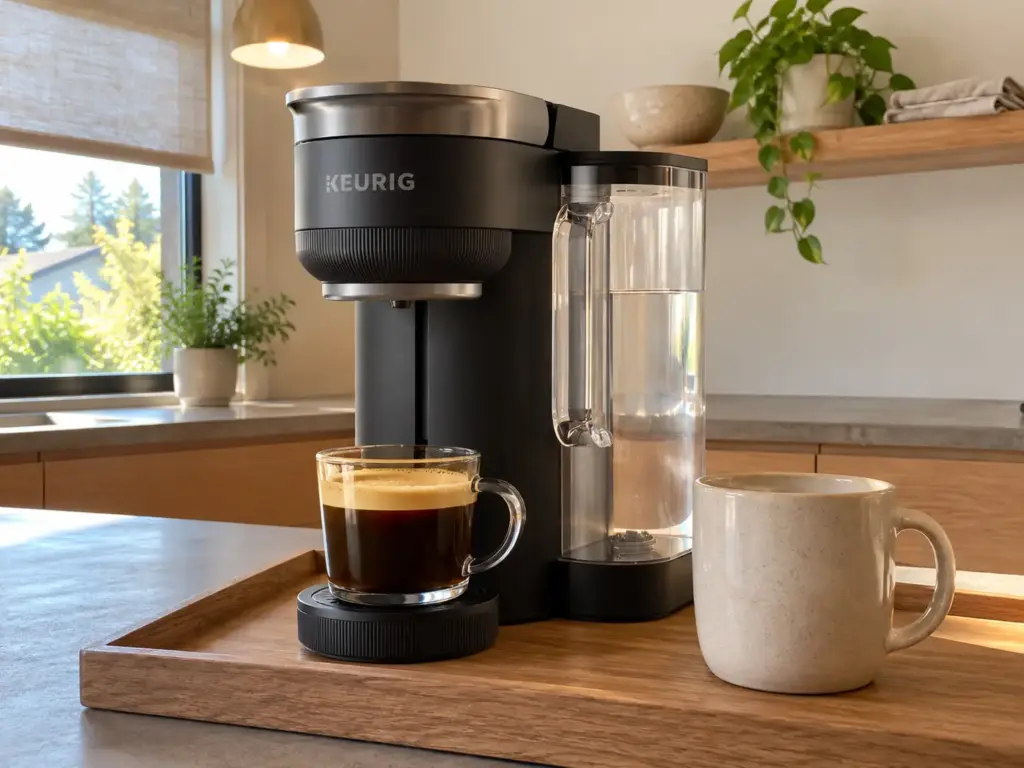
What “5x more pressure” is and is not
The K-Crema’s listing claims “5x more pressure for crema-topped coffee and espresso-style shots.” That is the maker’s comparison with its own standard machine, a claim with no bar figure and no brew-size list printed on the listing, and it was not tested for this page. A standard Keurig lightly pressurizes the pod and a Nespresso Original runs 19 bar, so five times a light push may still be a light push; the listing does not say. What the K-Crema adds for certain is a setting: a pressure option beside the regular one, on a machine with a 2.12 liter reservoir.
What Delish’s reviewer, who owns both, concluded
Delish picks the K-Crema as the overall champ, while granting that Nespresso is better for people who want strong coffee and simplicity. The K-Crema may not brew quite as strong a cup as the Nespresso, and its pressure version has a crema top that mimics the competitor. The verdict covers the Vertuo Pop+ Deluxe, a variant of the Pop+ named later in this article, so it applies to that pair and does not stretch to every Keurig or every Vertuo.
So the verdict, in one sentence: what this page says about the Keurig belongs to a standard Keurig, and the K-Crema is the one to weigh on its own. A crema-topped cup is a texture, not a strength, and it can look like espresso while the cup underneath is closer to drip.
What a K-Crema owner cannot do
A K-Crema owner cannot use the reusable-pod fixes from the last section. Keurig’s support page is plain about it: “K-Crema is not compatible with a reusable coffee filter.” That takes the fill line and the paper disc off the list and leaves the pod, the size and the setting.
The other flaw is time: with two ratings on its listing, no complaint has had the chance to repeat, which is not the same as there being none. If the Keurig you own is the weak link and a new machine is on the table, the cheaper pod machines that still work is the next read before buying.
What the Pod Cannot Fix: Freshness, Roast and the Dose
Some of the gap lives in the pod, not the machine. The dose and the seal are set before the water arrives, and the Nespresso side has flaws of its own in the cup and in the machine.
Plastic against aluminum
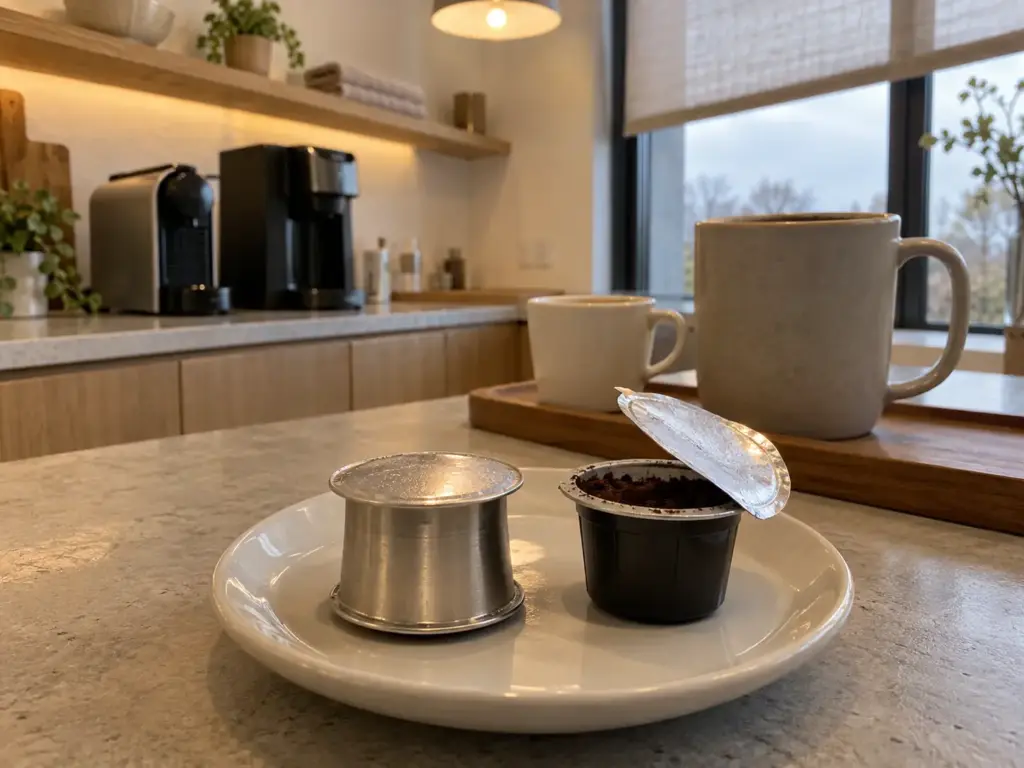
A plastic K-Cup lets air in, and Nespresso capsules are sealed aluminum, so freshness is set at the factory and no button on a Keurig puts back what a pod lost on the shelf. A pod also hides the smell that would warn you about a bag of beans, and how to tell if coffee has gone stale is a list of signs you only get to use once the foil is off.
The dose is the other thing the pod decides. About 10 g in a K-Cup that has to fill up to 12 ounces, against about 5 g in an Original capsule for a 1.35-ounce shot, is a difference no machine setting can erase: the pod is the dose, and the Nespresso asks its dose to work in a fraction of the water.
A dark roast is not the same as a strong cup
Serious Eats says most Nespresso capsules “taste very darkly roasted,” and dark roast reads as bitter and charred to several reviewers. That is the roast talking. Strength is how much coffee meets how much water, and roast is how far the bean was taken before it was ground, so the two get confused until the same roast is poured through both machines. The machine’s own pressure decides what a given roast does in the cup, which is the question behind whether an espresso-style machine wants a light or dark roast.
Taste of Home’s 230 ml Nespresso coffee shows what the strength side looks like when the dose is right for the water: “The results are strong and creamy rather than watery,” Taste of Home reports. That is one tester’s result with one machine, not a rule, but it is the cup the Keurig’s tall mug is being asked to match.
If you are judging machines at someone else’s counter, ask which roast is in the pod. Starbucks makes pods for both systems, which is how Epicurious could run its test; the same roast in both formats keeps the roast out of the argument.
Where the Nespresso cup stops
The Nespresso Vertuo Pop+ is the cup this verdict rests on: a 25 fl oz side tank, five cup sizes (5, 8 and 12 ounce coffee, plus single and double espresso), a 30-second heat-up and a descaling alert you can act on. Its flaws are the listing’s own tallies, with leakage at 30 of 35 mentions negative and reliability at 64 of 119, and the Delish tester used the Deluxe variant, not this one.
The pod supply is narrower too. Delish counts over 75 authorized brands making K-Cups, while the Vertuo pod selection is, in its words, “a little more limited,” sold exclusively by Nespresso and Starbucks. That narrows what you can try if the first roast turns out wrong for you.
Month Two: Scale, the Pierce and the Cup That Drifts
Week one decides the purchase and month two decides the cup. The cup drifts before the machine fails, and neither side is spared.
Descaling is a taste question before it is a repair
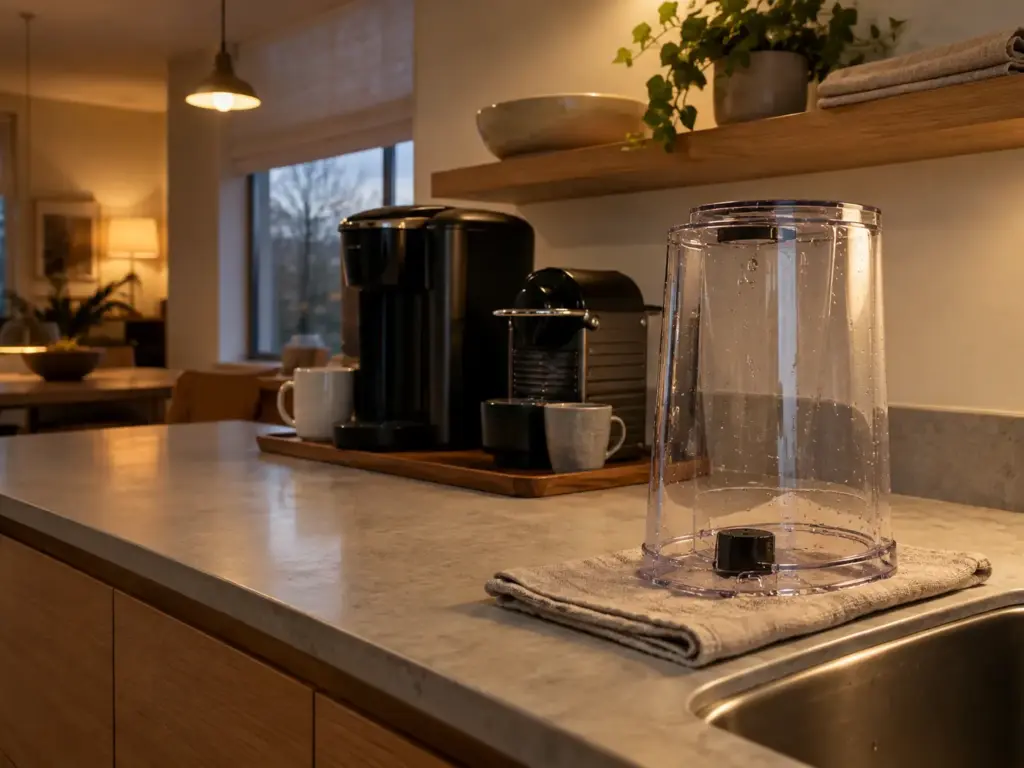
Taste of Home reports that Nespresso advises descaling the Vertuo Plus every three months or 300 pods. On the encouraging side, long-term use holds up when the machine is descaled and maintained regularly.
Scale comes from tap water, and the tank on a pod machine gets refilled from the tap every few days, which is why a descale interval exists at all. No source opened for this page ties descaling to the taste of the cup, so the claim stays a question you can test. Descale, brew the same pod at the same size, and taste. The result is yours to read, and no outlet temperature is written here, because none was measured.
Put the date of the last descale on a strip of tape on the reservoir. A cup that drifts slowly is easier to date than to notice, and the tape turns a vague feeling into a number you can compare against the manual’s interval.
Warranty and what the reviews say about month six
Homegrounds notes that “Nespresso machines are backed with 2-year warranties, while Keurigs are only covered for 1 year.” The month-six reports line up with that, with the sides kept straight. On the Keurig side, the K-Express listing’s durability summary describes multiple units breaking within six months, and many Keurig machines are said to stop working early. On the Nespresso side the reports are leakage and reliability on the Vertuo Pop+ listing, covered above, which is not the same failure as a Keurig that stops working.
Neither list says your machine will fail. A complaint that repeats across many reviews is a design question, though, and worth knowing before you buy. Whichever machine you pick, the pods are what you will keep buying, and what each pod costs per ounce is the next decision.
Tomorrow’s Mug: the Smallest Size, Then One Taste
Three things carry over. The cup you taste is set by the pod’s dose and freshness plus how much water you let meet it, which is why the Nespresso pours the fuller cup and why a Keurig’s size button is the first thing to touch. On a standard Keurig the size comes first and the Strong button second, with a taste between them. And the K-Crema is the one Keurig to weigh on its own, while whichever machine you choose still has to get through month two.
The check for later is the same pod at the same size a month from now, after a descale: if the cup is not the one you remember, the water side of the machine moved before anything broke.
Tomorrow morning, press the smallest size your manual lists, brew your usual pod, and taste for whether the cup stops reading like tinted water. If it turns sharp instead, leave the Strong button for the cup after.
Frequently Asked Questions
01Does a Nespresso make stronger coffee than a Keurig?
Yes, in every comparison that pours both, the Nespresso cup is the stronger and darker one, and a Keurig cup is milder and closer to drip. The pod does much of the work: about 5 g of coffee in an Original capsule for a small shot, about 10 g in a K-Cup spread across a mug.
02Why does my Keurig coffee taste watery and bitter at the same time?
Start with the pod, then the pod holder, then the size setting. A pod that sat too long, a reusable pod filled loosely or the biggest size can each thin a cup. Uneven extraction is the working hypothesis, not a measured cause. Change one, brew, taste, then move on.
03Which Keurig setting makes the strongest cup?
The smallest size your manual lists comes first, then the Strong button on models that have one. The K-Express listing shows 8, 10 and 12 oz and a Strong Brew button, but availability varies by model. Taste between the two changes so you know which one worked.
04Does the Keurig K-Crema make real crema?
Its listing claims 5x more pressure for a crema-topped cup, and Delish’s reviewer says the pressure version has a crema top that mimics a Nespresso’s. No bar figure is printed and it was not tested here, so treat it as a claim with one reviewer behind it.
05How often should you descale a Nespresso machine?
Nespresso advises descaling the Vertuo Plus every three months or 300 pods, as Taste of Home reports. Your manual is the authority for your model, and the descaling alert listed on the Vertuo Pop+ tells you when it is due.



How did your cup turn out?
No comments yet. Tell us what you changed — and whether the needle moved.