



We may earn a commission when you buy through links on this page. It never changes what we recommend. How we pick
On this page8 parts
- Keurig vs Nespresso Pod Cost Starts With the Ounce, Not the Pod
- The Thin Cup You Brew Again Spends a Second Pod
- Why the Pod Price You Read Is a Snapshot
- The Descaler, the Return Bag and Other Costs Outside the Box
- The Cheapest Pod on Each Side, and What It Gives Up
- Which System Costs Less for the Cups You Actually Drink
- Press the Smaller Size Once, Then Divide Again Next Month
- Frequently Asked Questions
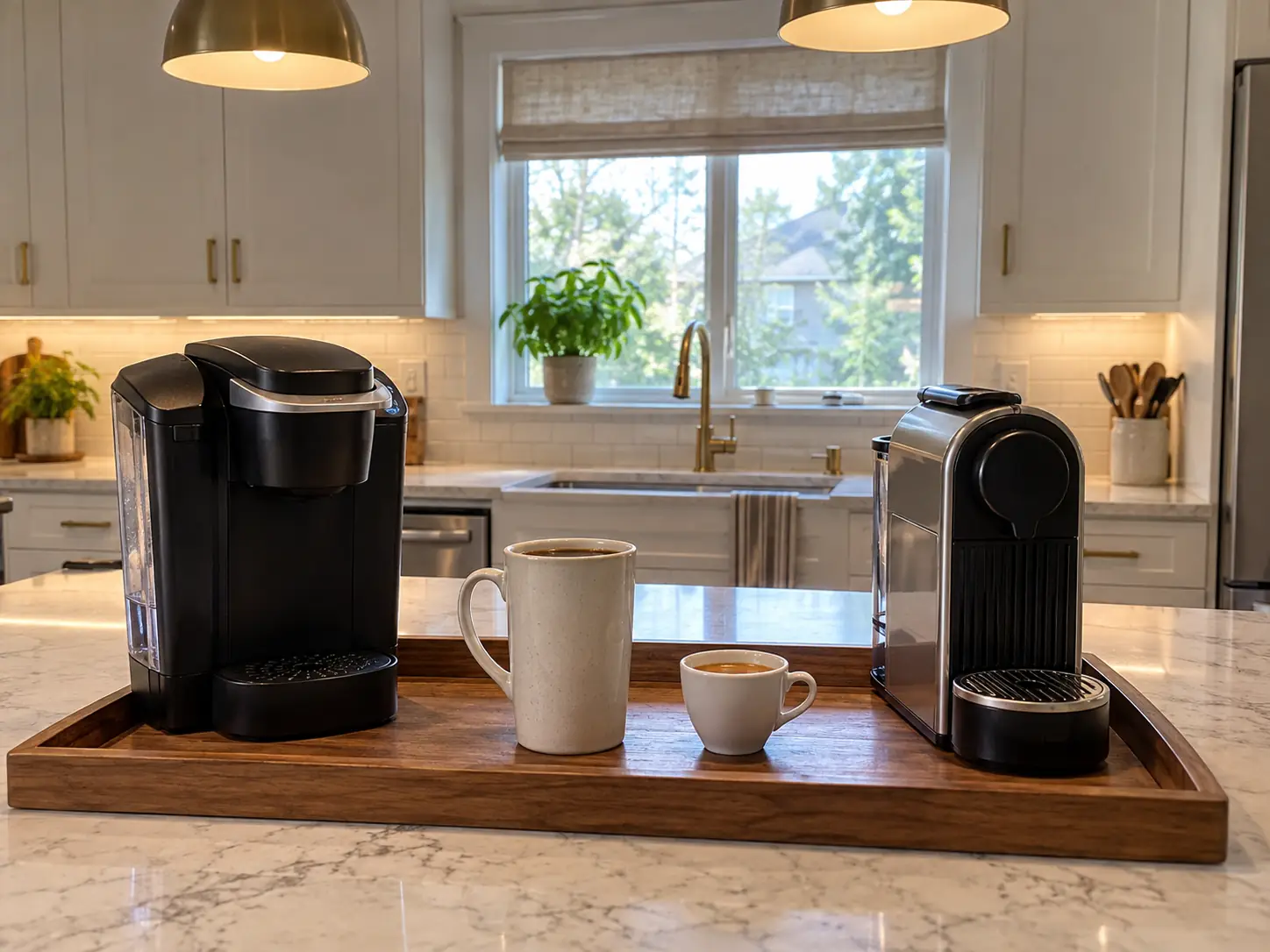
The price on a pod box is a price per pod, and nobody drinks a pod. What ends up in the mug is a cup, and a Keurig and a Nespresso Vertuo pour cups of very different volumes from pre-dosed pods, so a Keurig vs Nespresso pod cost comparison made at the shelf sets two numbers side by side that were never measured in the same unit.
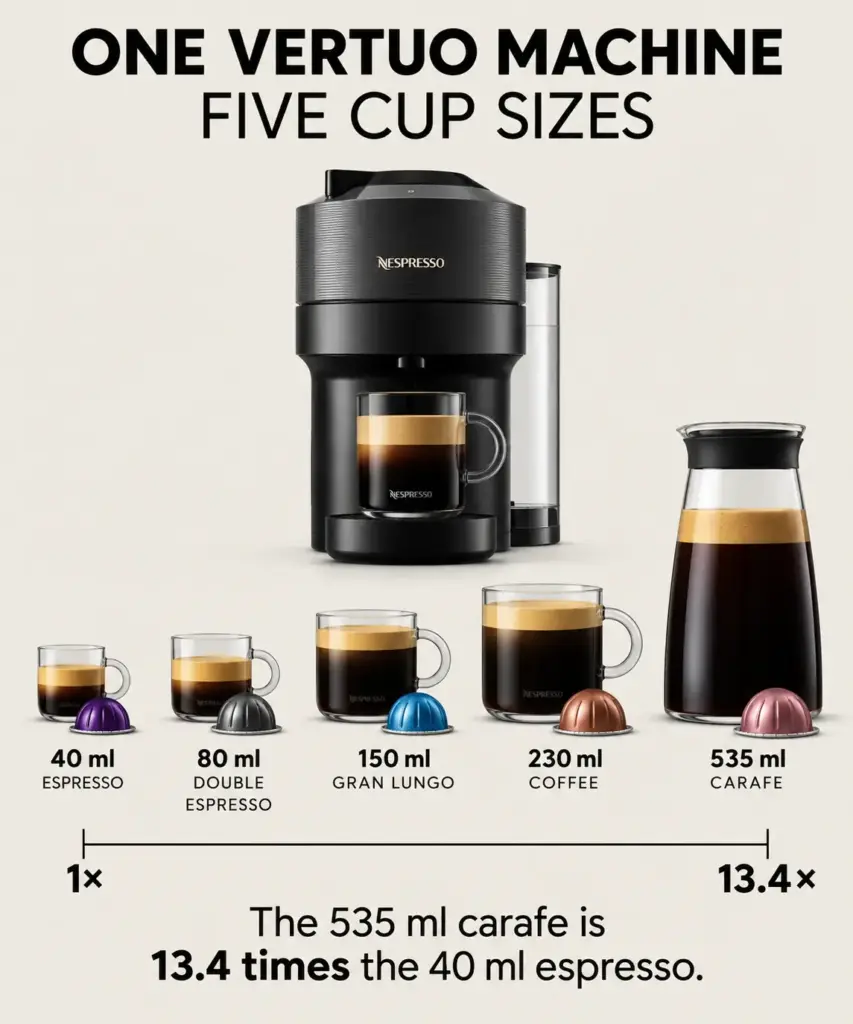
Nespresso’s own listing for the Vertuo Next shows five cup sizes, from 40 ml (about 1.4 fl oz) to 535 ml (about 18 fl oz), while a K-Cup’s size button moves over a much narrower range. This article divides instead of quoting, and it prints no price, because a price quoted here would be wrong by the time you read it: it covers the cost per ounce, the cup you brew twice, how to read a price as a snapshot, the costs outside the box, the cheapest route on each side, and a rule by cups per day. Which machine to buy is a separate question with its own page: which of the two machines to buy.
A K-Cup is not automatically the cheaper cup. Compare the two systems per ounce of the cup you pour, by dividing the pod price by the ounces you brew, not by reading the price on the box.
| Cost input | Keurig K-Cup | Nespresso Vertuo | Where the number comes from |
|---|---|---|---|
| Price per pod | Box price ÷ pods in the box | Box price ÷ capsules in the box | Your own receipt |
| Ounces per cup | The size button you press, 6 to 12 oz on the models covered here | Five sizes on the Vertuo Next, 40 ml to 535 ml (about 1.4 to 18 fl oz) | Your machine model |
| Cost per ounce | Pod price ÷ ounces brewed | Capsule price ÷ ounces brewed | The division itself |
| A thin cup, brewed again | A second pod for the same mug | A second capsule for the same drink | Your own count |
| Outside the box | The maker’s descaling powder; the return bag is bought on Keurig.com | The maker’s descaling powder; the US return bag is free with an order | Each maker’s site and manual |
Keurig vs Nespresso Pod Cost Starts With the Ounce, Not the Pod
The box hands you one number, and the cup needs a different one. Before any two pods are compared, this section turns the first number into the second, because every later section stands on that conversion.
The Division on the Back of Any Box
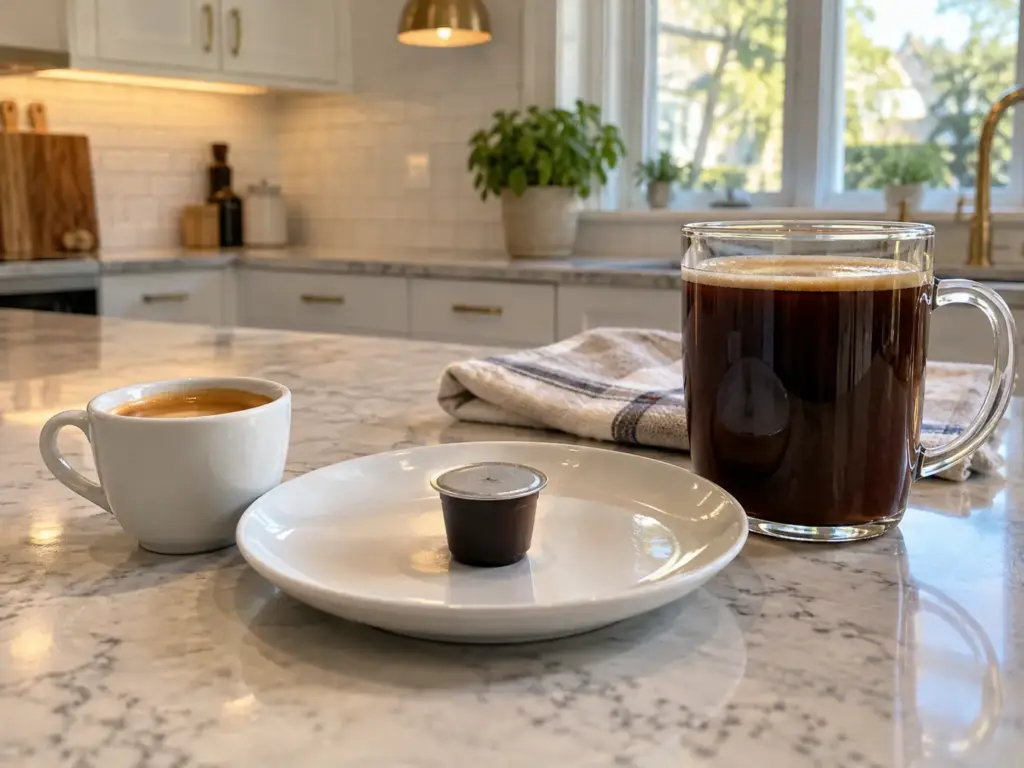
Two divisions, in this order. The box price divided by the pods per box gives the price per pod; that figure divided by the ounces you actually brew gives the cost per ounce. Only the second number can sit next to a different system’s second number. A pod with a low price on the shelf wins the comparison only while both pods fill the same cup, and the moment the cups differ, which they do here, the ounce decides.
The unit that matches a habit is usually smaller than a pod and larger than a single cup. One way to budget a single daily cup is by the sleeve of capsules, not by the pod, restocking a handful of sleeves a few times a year. That is the same instinct as the division: start from what you finish, not from what the box prints.
One Vertuo Machine, Five Cup Sizes
The maker’s listing for the Vertuo Next gives its sizes in milliliters, and the ounce equivalents here are converted from them: Espresso at 40 ml (about 1.4 fl oz), Double Espresso at 80 ml (2.7 fl oz), Gran Lungo at 150 ml (5 fl oz), Mug at 230 ml (7.8 fl oz) and Carafe at 535 ml (18 fl oz). A capsule’s price gets divided by the ounces in its cup, so the cup size is the divisor that moves the most.
Measured against the 40 ml espresso shot, the sizes run 1, 2, 3.75, 5.75 and 13.4 times larger, so the carafe is about thirteen times the shot (535 ÷ 40 ≈ 13.4). A capsule’s price does not have to scale with its cup, and the listing does not say how the two line up, so read that 13-to-1 as the room the size gives the cost per ounce to move, and run the division on the capsule you actually buy for the size you actually press.
A K-Cup’s Size Button Spreads Less
On the Keurig models covered in what the size buttons on a Keurig actually do, the buttons run 6, 8, 10 and 12 oz: a spread of two to one, not thirteen to one. A K-Cup brews a drip-style cup at whichever size you press, and larger models press past 12 oz, so the mug size you pick, measured on your own machine, is the divisor. Because a pod is a fixed dose, every ounce you add past the size you need dilutes the cup and lowers the cost per ounce in the same stroke. The cheapest ounce is rarely the best one.
Set a liquid measuring cup under the spout once, press the size you use every day, and read the ounces it catches. That reading, not the number printed on the button or the largest size on the machine, goes under the division line.
The Thin Cup You Brew Again Spends a Second Pod
A cost per ounce assumes the first cup is the cup. When the first cup comes out thin and gets brewed again, that assumption breaks, and the box never counted the second pod. This section prices the remake.
Why a Big Button Makes a Thin Cup
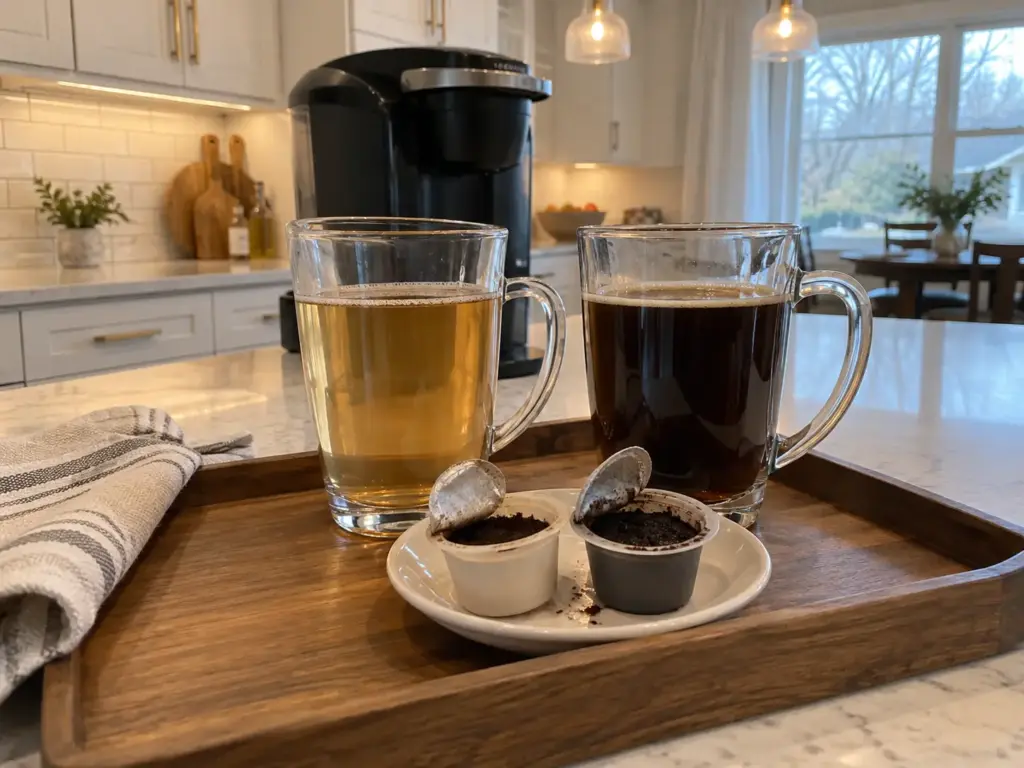
A pod carries a fixed dose, and the size button decides how much water passes through it. Press 12 oz instead of 8 and the same coffee meets half again as much water, so the 12 oz cup carries a third less coffee per ounce than the 8 oz one. Read the other way, an 8 oz cup holds half again as much coffee per ounce as a 12 oz cup from the same pod. The direction of the problem is weak and watery, never sour or burnt, and the lever is the button.
A sealed pod’s grind and dose are already decided, so the button is the only setting you hold. A reusable pod hands you the grind and the fill as well, and that case is worked through in when a weak K-Cup cup is not the grind. The coffee world’s brew-ratio standard, SCA-310, sets 55 g of coffee per 1.000 kg of water, about 1:18 by weight, but it states that pod and capsule brewers are excluded, so no SCA number can tell you whether a pod’s cup is thin. The dose belongs to the maker, and the cup is the judge.
The Second Pod Nobody Counts
Brew a pale 12 oz cup, taste it, press the button again with a fresh pod, and one drink has spent two pods. Divide two pods by one cup and the price per cup is double what the box implied, however good the price per pod looked. A second capsule for the same drink counts the same way on the Vertuo side. Whatever the system, the pods are divided by the cup you finally drink, not by the cups you started.
Stick a note to the machine for one week and draw a mark for every pod you use. Subtract the cups you drank from the marks: the leftover is your remake count, and it is the only figure that moves your real cost per cup.
Taste It, Then Press the Smaller Size
One change, then taste. The free change comes first: press the next size down, brew a fresh pod, and taste. The cup should come out stronger and denser. If it turns harsh and heavy instead, you overshot, and the size above it was closer.
If the smallest size you will drink is still thin, the next change is the pod itself, not the machine: a dark roast pod on the same setting, tasted again. Only after both is a descale worth running, since scale builds up inside a machine over time (more on that below). A smaller size does raise the cost per ounce by half, from 12 oz to 8 oz, but it ends the remake, and a cup you finish with one pod beats a bigger cup that took two.
Why the Pod Price You Read Is a Snapshot
The first two sections used no price on purpose, and this one explains why none will appear in this article. It also shows how to get your own number in a minute, from a receipt, so the answer is right on the day you check.
Five Writers, One Pod, Close to a Threefold Gap
Look up what one K-Cup costs in a few places and the figures for the same pod can sit close to threefold apart. The Vertuo capsule is the same story, with quotes far enough apart that you cannot pick one and trust it. The spread itself is the finding. A price moves with the shelf, the retailer, the box size and the promotion running that week, and it ages quickly, so a figure printed here would already be old.
The division does not age. Divide each box, not each brand, because the price per pod changes with the box size. And the bigger box is not automatically the cheaper one per pod: run both divisions and let the receipt say so.
Divide With Your Own Receipt
Take the price on the receipt, divide by the pods in the box, then divide by the ounces you brew. If an order came with a free sleeve of capsules, divide what you paid by every capsule that arrived, free ones included. The same arithmetic works on a bag of beans: how many cups a bag of beans really makes does it in grams instead of pods.
Write the date and the price per pod on the lid of every box when you open it. Next season the old figure is still on the lid, and the new division tells you at once whether the shelf moved.
Weigh the Pod if You Want the Real Dose
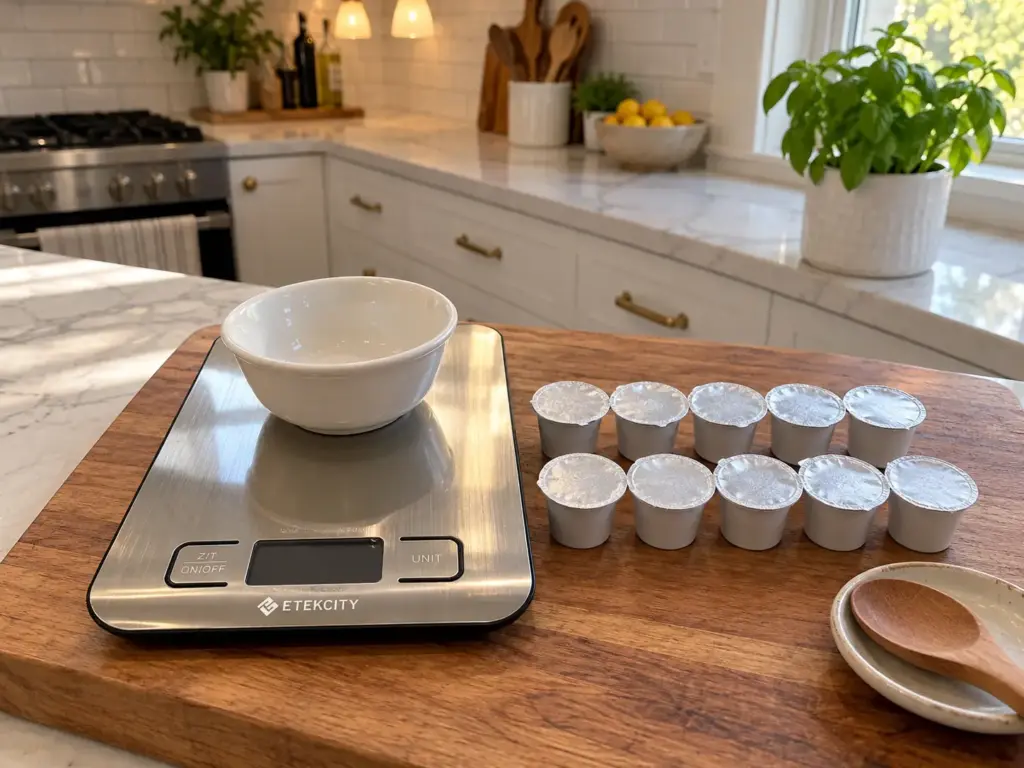
Neither maker publishes what a pod weighs, so the dose stays a guess until it is weighed. The free method needs no gadget beyond a kitchen scale: weigh ten sealed pods and divide by ten. The receipt division comes first because it costs nothing, and the weighing only matters when you want the dose, or the fill of a reusable pod, in grams.
A scale that reads in 1 g steps does the job, and the one most often used for it carries a flaw: Amazon’s own summary of its reviews calls the accuracy and reliability of the Etekcity Food Kitchen Scale mixed, with some owners finding it accurate, others not, and several saying it stops working. For a task measured in single grams, test it against a known weight before trusting a reading.
Any kitchen scale can be checked against a US nickel, which weighs 5 g. Zero the scale, set the coin down, and if the reading is off by more than a gram, use the scale for rough work only and not for a pod’s dose.
The Descaler, the Return Bag and Other Costs Outside the Box
The pod price stops at the shelf. What the machine asks for once the box is open, a powder, a bag, an order, never shows up in it. This section lists those lines for both systems, using only what the makers themselves say.
The Maker’s Own Descaling Powder
Descaling is a recurring cost the pod price never mentions, and on both systems the manual is the authority on how and how often: use the descaling product the maker names, follow its steps exactly, and do not improvise a recipe from the cupboard. The arithmetic is the same as anywhere else. Divide the powder’s box by the cycles it runs, then by the cups between cycles, and add that sliver to the cost per cup.
It is also the free check before blaming the pods. A Nespresso machine can stop making good coffee after a couple of years, even with regular cleaning and descaling. That is one account, not a failure rate, but it makes the point: when a cup goes flat on a machine that has had its scale cycle skipped, look at the cycle before deciding the pods are the problem.
A Return Bag You Buy and One You Don’t
Keurig Dr Pepper’s announcement of its K-Cycle At Home program says “Consumers can purchase a bag with a prepaid return label from Keurig.com”. The same announcement tells consumers to check with their local town or recycling provider before purchasing, since where you live may already take the pods.
Nespresso’s US recycling page reads the other way: “Our free, prepaid recycling bags make it easy to send your used capsules back to our state of the art facility.” The page also offers to add a bag to the next coffee order. That is the US page, so a reader outside the US checks their own country’s. In the US, then, one side of this comparison pays for the bag and the other gets it with an order.
Before buying any return bag, peel one used pod, empty it, and check your town’s recycling page for whether the household bin takes it. If it does, the bag line drops out of the sum.
The Order Itself
Where a pod is bought shapes how it is bought. Nespresso capsules come from its own site and boutiques, with Starbucks-branded capsules sold at big-box stores, so the reader buys in boxes or sleeves of a set count. K-Cups sit on grocery and big-box shelves in many sizes. That changes the first division: a reader on the capsule side divides the sleeve, a reader on the pod side divides whichever box fits the week, and both should ignore the label on the front.
The Cheapest Pod on Each Side, and What It Gives Up
Every division so far assumed the maker’s own pod. This section meets the route that takes the pod line out of the sum, and the flaw that arrives with it.
The Reusable K-Cup
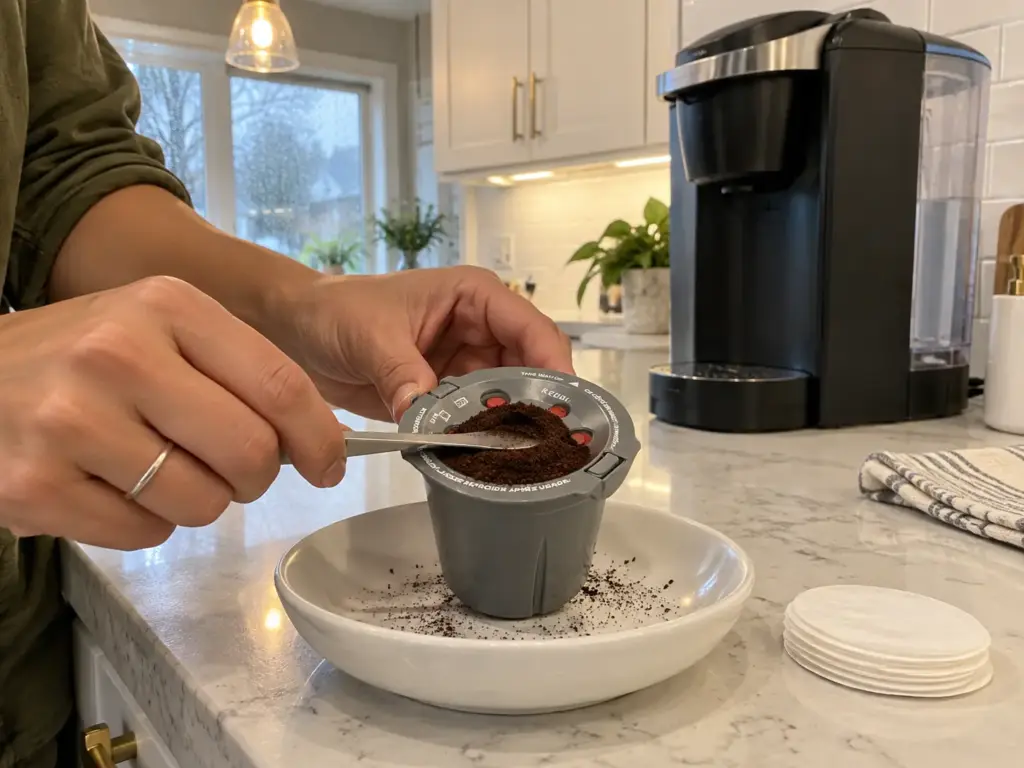
A reusable pod removes the price per pod from the sum: the grounds you fill are the dose. The Keurig My K-Cup Reusable Coffee Filter (2025 design) is a stainless mesh basket in a plastic holder with a lid, with MAX, cup and mug fill lines, and Amazon’s summary of its reviews says owners consider it money-saving and that it works well in small Keurig machines. The same summary reports the weak spots: several customers say the plastic lid hinge breaks after a few uses, and fit is mixed across Keurig models, so match your model to the listing before you count the saved pods.
The obvious pick stops being obvious when the cup comes out thin. Reusable K-Cups can taste pretty watery, and a thin cup sends you back to the remake arithmetic. How full to fill the basket is its own question, answered in how full to fill a reusable pod, and the reusable K-Cups that actually hold up compares the options.
The reusable route also hides a line of its own. A paper disc under the grounds keeps sediment out of the cup, and the Irmidi 300 Count Disposable Coffee Filters for Keurig 1.0 and 2.0 pack fits both generations of Keurig machine and cleans up easily, per Amazon’s review summary. The catch is that every brew now spends a disc, and some buyers find them flimsy, so the saving is real but smaller than the pod line alone suggests.
The Vertuo Refill, Named and Not Linked
Keurig sells its own reusable filter, while one review of both systems notes that Nespresso has no reusable capsule of its own, so the Vertuo refill route is a kit assembled at home, with a foil seal over your own grounds, and no kit is linked or carded here. The refill route is labor-intensive, and grinding and filling your own coffee may point you toward a drip machine instead. Another found the reusable Nespresso pods watery, the same complaint as the reusable K-Cups.
Third-party capsules exist for the Original line, and whether they cost less is a division to run, not a given. Third-party pods can make an Original machine start leaking. A single story proves no rate, yet a replaced machine is a cost the pod price never shows.
The Machine’s Price Over the Cups It Makes
Every comparison quotes the machine’s price next to the pod price, and none divides one into the other. The division is simple: the machine price over the cups it makes before it stops working turns a one-time cost into a figure per cup. No source measures a machine lifespan, so none is printed; pick a conservative one for your own household and run the sum with today’s price.
The volume effect is simple: if you drink a lot of coffee, Keurig is cheaper. The machine’s own price changes that sum before you press a button, and there is a cheaper machine that still takes K-Cups when the first division comes out heavy on the machine side.
Which System Costs Less for the Cups You Actually Drink
With the division, the remake, the date and the costs outside the box laid out, the verdict can be a rule instead of a price. The rule runs on cups per day, and the cheapest route on each side comes with its flaw attached.

One Cup a Day
The rule, in order:
- Divide the box price by the pods in the box.
- Divide that by the ounces you actually brew.
- Add a second pod for every cup that took two tries.
- Add the lines outside the box: the descaling powder and the return bag.
- Multiply by your cups per week, and repeat the whole sum with the shelf price on the day you check.
At one cup a day, the sleeve or box size and how long a box lasts decide most of the sum, and the machine’s price is spread over few cups. A pod-free route is also in play here: a drip machine made for one cup needs no pod at all and belongs in the division as a third column.
Five Cups a Day
At five cups a day, the machine’s price spreads over many more cups and the reusable route weighs more, so the flaw of the cheapest route matters more too. The reusable pod can brew a thin cup, the refill kit is labor, and third-party capsules can leak. A saving that arrives with a remake is not a saving.
No price crowns a winner here, because the variable that decides is cups per day, then the size you press, then the box size.
When a Machine That Takes Both Is the Better Question
Many people keep a Keurig for the easy pods found everywhere and a Nespresso for the taste. When the answer is both, the better question is which machine suits the kitchen, and that lives in Keurig or Nespresso for your kitchen. A machine that takes both pod systems comes after it.
Press the Smaller Size Once, Then Divide Again Next Month
Three things carry over. Compare per ounce of the cup you drink, not per pod. A cup brewed twice is two pods. And a price is a dated snapshot, so divide with your own receipt.
A month from now, count how many boxes actually went into the bin and divide again with the new shelf price, because the second division is the one that shows whether the cheaper-looking system still is. A mug that used to take two pods and now takes one will show up right there, in the count.
Tomorrow morning, press the smaller size once, taste the cup against yesterday’s, and count the pod it saved. If the cup is denser and you stopped at one pod, the change worked. If it turned harsh, go back half a step to the size in between.
Frequently Asked Questions
01Are Nespresso pods more expensive than Keurig?
Not always, because the pods are priced per pod but poured in cup sizes that differ a lot, so only the cost per ounce compares them fairly. Divide the box price by the pods in it, then by the ounces you brew. Your own receipt settles it on the day you check.
02Are Keurig K-Cups a better option than Nespresso pods?
It depends on the cup you drink and how many you drink a day, because a K-Cup machine gives you a size button while a Vertuo Next gives five fixed sizes from 40 ml to 535 ml. Each gives something up: the K-Cup cup can come out thin at a big size, and the Vertuo asks for capsules bought through fewer channels.
03What’s the cheapest way to buy Nespresso pods?
The cheapest way is the box you finish at the lowest price per capsule on the day you check, so compare the maker’s site and a store the same day using the division. Free sleeves in an order count in it. Third-party capsules exist for the Original line, but whether they cost less is a division to run.
04Do Keurig and Nespresso charge for the recycling bag?
Keurig sells its K-Cycle At Home mail-back bag on Keurig.com, while Nespresso’s US page calls its prepaid recycling bags free, added to a coffee order. Other countries may differ, so check the maker’s own site. Check local recycling first, since your town may already take the pods.




How did your cup turn out?
No comments yet. Tell us what you changed — and whether the needle moved.