



We may earn a commission when you buy through links on this page. It never changes what we recommend. How we pick
On this page7 parts
- The Pod Stops at the Rim, and the Reverse Falls to the Bottom
- Check Which Nespresso You Own Before You Try Anything
- Use the K-Cups You Already Own Without Forcing Them
- The First Cup After the Swap Is a Dose Test
- What It Looks Like in Month Two, and What to Settle Next
- Weigh One K-Cup Tomorrow, Then Taste Before You Change Anything
- Frequently Asked Questions
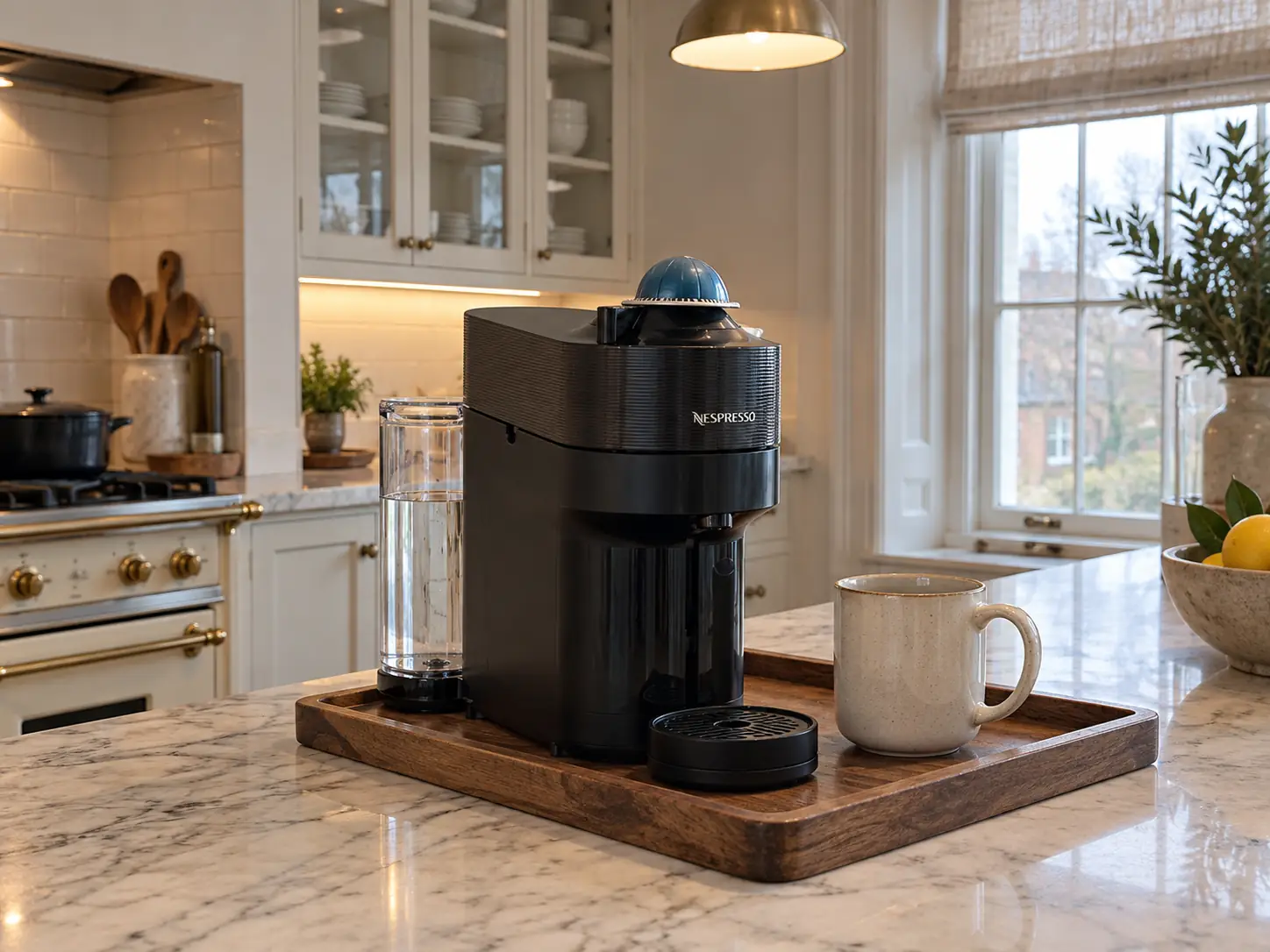
The box of K-Cups is still in the cupboard, the capsule machine is on the counter, and the pod you just set in the holder sits a little too high for the lid to close. So, can I use Keurig pods in Nespresso? No, and the reason has nothing to do with coffee quality: a K-Cup is a wider cup than any Nespresso holder is cut for, and the reverse swap fails the other way, with a small capsule rattling loose where a big pod belongs. What does work is keeping the grounds and leaving the plastic, which is the route this guide follows after a first check of which Nespresso you own, the free option, the one swap that works and the test cup that follows it.
If you are still deciding which machine suits your mug in the first place, choosing between a Keurig and a Nespresso by the cup you drink is the better place to start.
Quick Answer
No. A K-Cup is about two inches across and a Nespresso capsule is much smaller, so neither seats in the other’s holder, and Vertuo capsules also carry a barcode the machine reads. The swap that works is decanting the grounds into a reusable pod made for your machine, which changes the dose.
The Pod Stops at the Rim, and the Reverse Falls to the Bottom
The “no” above is a physical one, which means you can tell it apart from a coffee problem the moment the pod is in your hand. A K-Cup that will not drop into its seat and a Nespresso capsule that sits loose in a Keurig are two different failures, and each leaves its own sign at the counter.
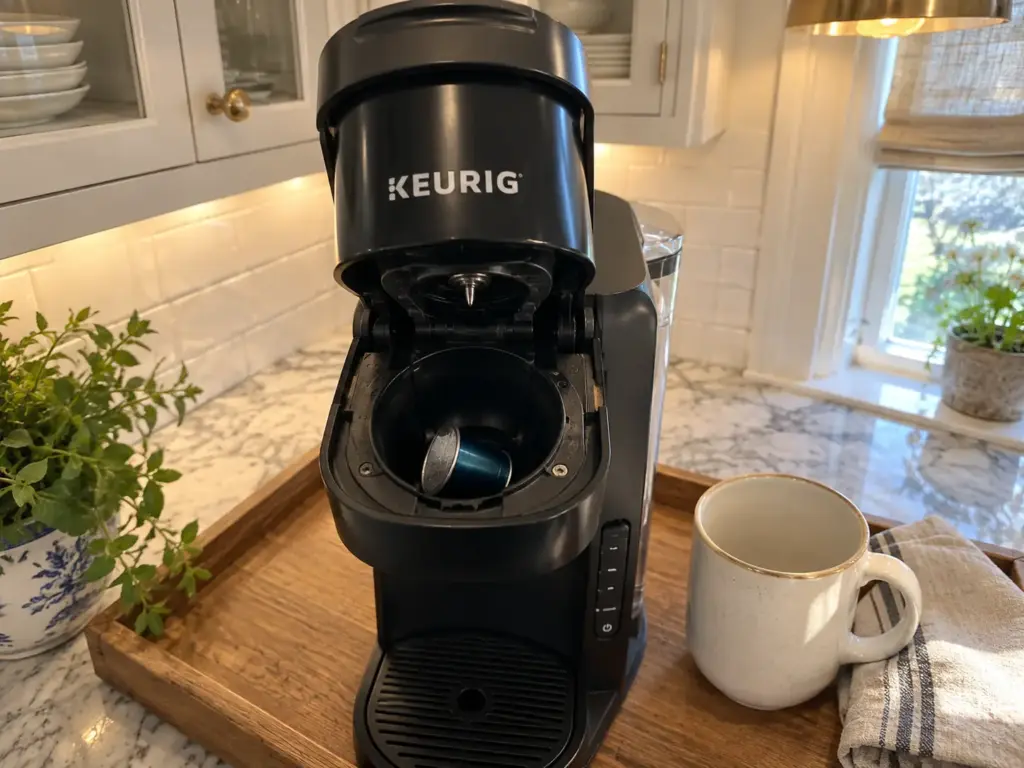
A K-Cup is about two inches across; a Nespresso capsule is much smaller
Tasting Table puts the K-Cup at about 2.08 inches (roughly 53 mm) across and a Nespresso capsule at around 1.45 inches (roughly 37 mm), and states it flatly: “it’s physically impossible to fit a K-Cup into a Nespresso and vice versa.” Those are the magazine’s figures for the pod size, so a ruler on your own pods is the final word, but the gap between them is wide enough that no ruler is needed to see which way the problem runs. The pod shape differs too, as the magazine describes it: the K-Cup is a small plastic cup with a foil lid, and the capsule is a rounder, more compact aluminum shell that the machine punctures.
Put a K-Cup toward a Nespresso holder and, in the magazine’s words, “the pod would be stuck.” It rests on the rim, above the seat the machine is built around. The tell is the lid or the brew head: if it will not close over a pod that is sitting high, the pod fit is wrong, and pressing the lever a second time will not change that.
The Keurig side of the question is easy to picture with a machine like the Keurig K-Express, a K-Cup system with three cup sizes (8, 10 and 12 oz), a Strong button and a 42 oz removable tank. Its holder is cut for the two-inch pod and nothing else, which is the limit this whole guide works around. The Strong button is the only setting on it that moves the cup, so it cannot compensate for a pod that does not belong.
A Nespresso capsule in a Keurig sits unseated
The reverse is quieter and, for that reason, easier to misread. Tasting Table’s description is that a Nespresso pod put into a Keurig “it’ll just fall to the bottom without securing properly.” Nothing holds it where the machine punctures a K-Cup, which according to the same article happens at the top and the bottom, with high-pressure hot water beamed in from above and the brew leaving through the lower hole. A capsule loose in that space has no way to line up with either.
What you see at the counter is a small pod tipped on its side in a holder built for something much larger. That is a fit problem, not a taste problem, so no grind change, no new beans and no stronger setting will rescue the cup.
Forcing It Is Not a Test
Incompatible pods are an easy mistake to make, and it is tempting to press harder, on the theory that plastic gives and a pod will find its seat. Tasting Table warns that forcing the wrong pod “can result in damage to not only the capsule but also to the machine.” That is a magazine’s warning, not a repair record, and this guide makes no claim about what happens to a warranty. The practical reading is simpler: a pod that does not drop in on its own is a pod to take back out.
A pod that sits above its seat is the machine telling you the fit is wrong. Take it out, set it on the counter next to the right-sized pod and compare the two before the lever goes down a second time.
Check Which Nespresso You Own Before You Try Anything
“Nespresso” is not one system, so the “no” of the first section has a second layer. It is the model on the machine, not the brand on the box, that decides which pod goes in, and the reader who turns the capsule over before reading the model is checking the wrong thing first.
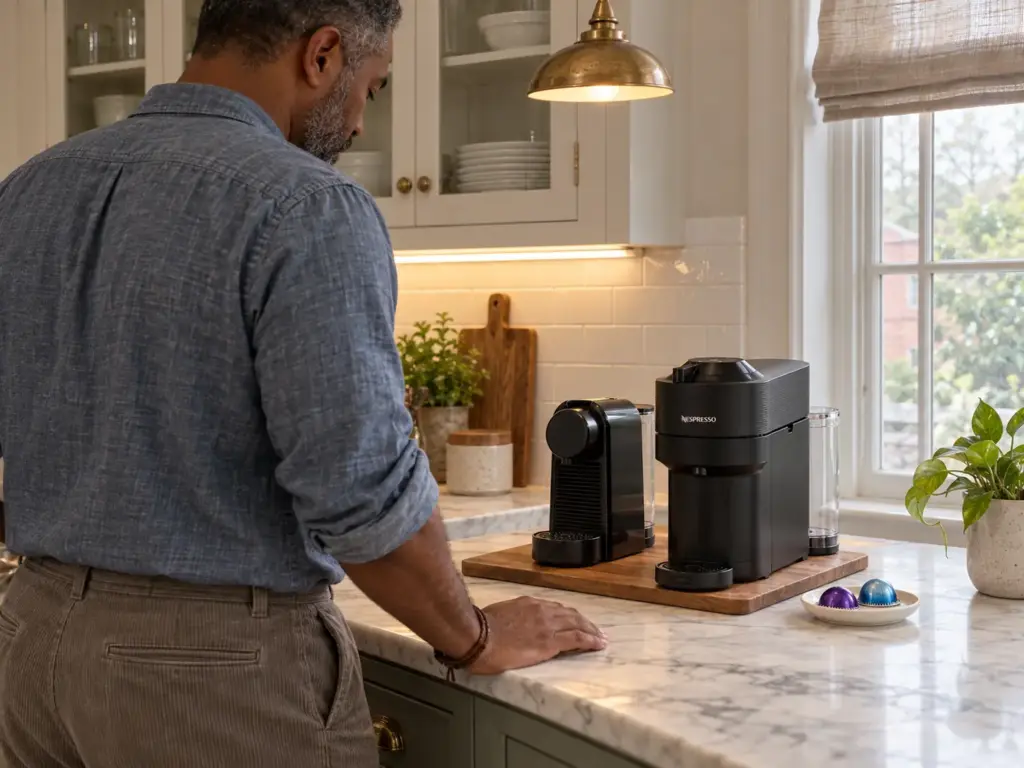
Original and Vertuo are two shapes, not one brand
Nespresso sells two incompatible lines. The Original line takes the small capsule, and Tasting Table says Original pods and K-Cup pods “look similar in shape but pretty different in size.” The Vertuo line is another case altogether: the same magazine calls its pods “a completely different shape” that also vary in size. So a box of capsules bought for one line is no guarantee for the other.
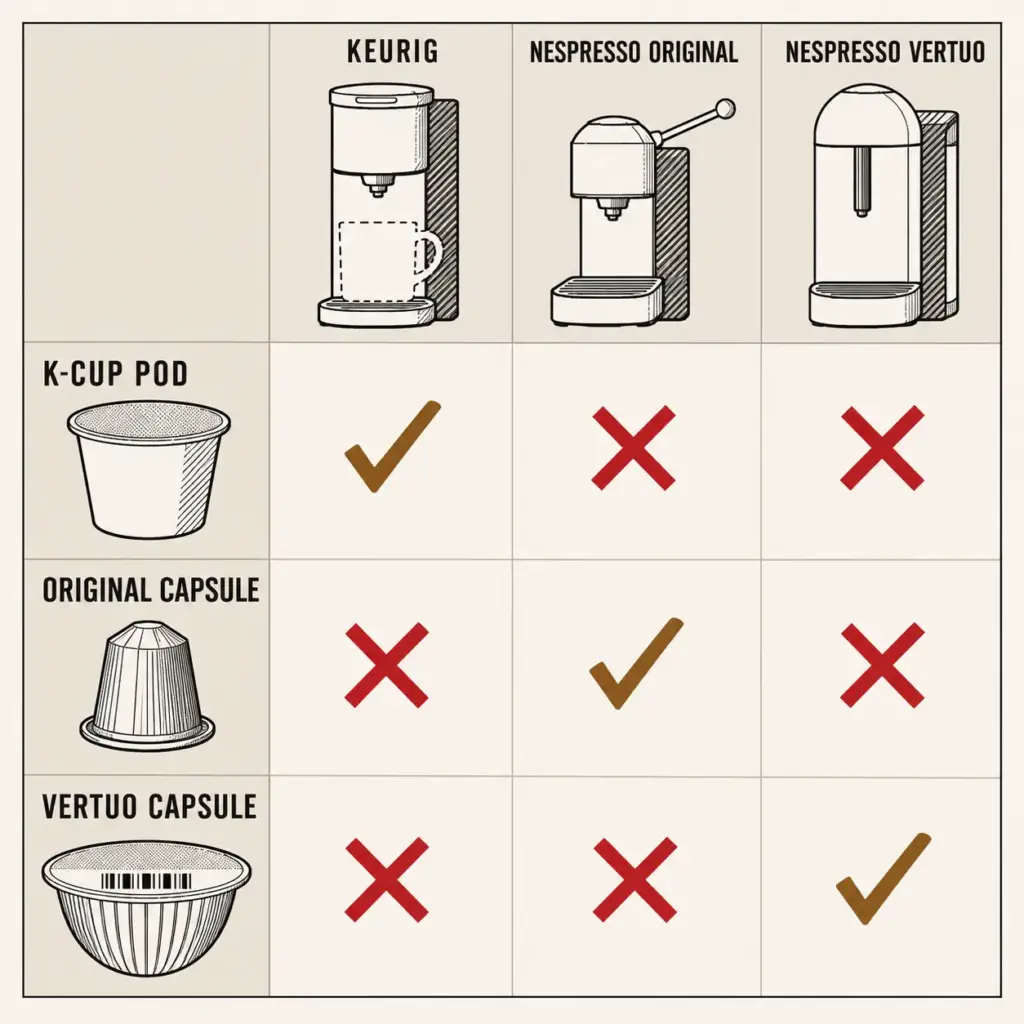
That is why the first move is at the machine, not at the cupboard. Read the model name, work out whether it is Original or Vertuo, and only then look at the box of pods you were hoping to use. Everything else in this guide depends on that answer.
The barcode that refuses an unknown pod
Vertuo machines add a second gate. A barcode is printed on the capsule, the machine reads it before it brews, and a code it does not recognize ends the attempt: according to Tasting Table, the machine “would just straight up refuse to work.” So even a pod that fit the holder would be turned away by the reader before any water moved. The Nespresso Vertuo Pop+ is the example to hold in mind: a 25 fl oz side tank, a 30-second warm-up, five cup sizes, and that reader in front of the capsule.
The refusal is the line’s behavior as the magazine describes it, not a fault in one unit, and it was not checked on this model. The cost is plain: nothing the reader does to a pod outside the line makes the reader accept it.
The brew routes differ as well, and Tasting Table’s reasoning is worth keeping: even a K-Cup that somehow fit and got past the barcode reader would most likely not brew right, because the Keurig route, a hole at the top and the bottom and water pushed down through the grounds, is not the route a Nespresso takes. The Original line punches three holes instead. Different pods and a different water route answer the same question the same way.
A newer Keurig can read a code too
The barcode is not exclusive to Nespresso. Tasting Table notes that “all Nespresso Vertuo and some newer Keurigs like the Keurig K-Supreme” carry a reader of their own. A Keurig can therefore refuse a pod it does not recognize even when the pod happens to sit in the holder, and the habit of treating every Keurig as an open door to any small pod stops being safe.
If a machine in your kitchen is one of the newer Keurigs, the Keurig lines and what the Strong button does is the place to find out which one you have. The same check applies on both sides of the counter: model first, pod second.
Read the model name on the machine before you open a box of pods. The line the machine belongs to decides which capsule fits, and a box only tells you what the capsule is, never whether your machine will take it.
Use the K-Cups You Already Own Without Forcing Them
Once you know the pod will not seat, the box in the cupboard becomes a coffee problem, not a machine problem. The grounds inside are worth keeping and the plastic around them is not, which points to two routes in a fixed order: the free one first, then the one purchase.
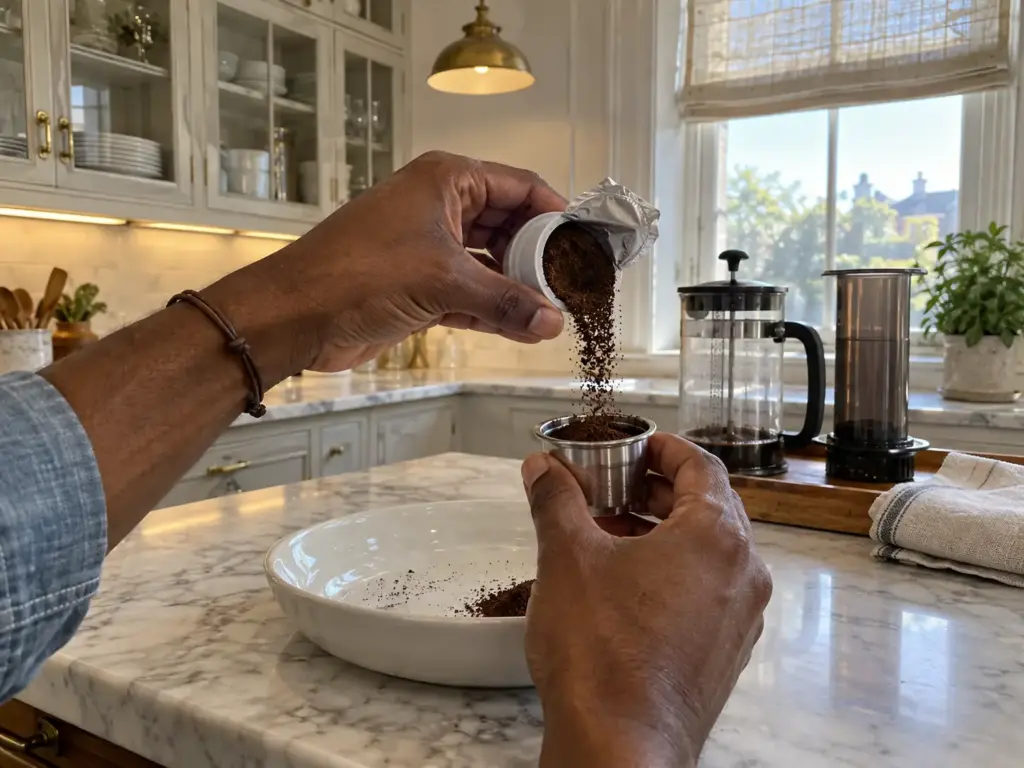
The free route first: open the lid and brew the grounds another way
Peel the foil lid off a K-Cup over a small dish and the grounds are loose coffee, and an AeroPress or a French press already in the cupboard can brew them. Tasting Table suggests exactly this for a capsule that does not fit the machine at hand, and it costs nothing. The AeroPress is the cleaner of the two, because its paper filter holds back the fine particles that a press mesh lets through.
Expect a different cup, though, not the same cup in a different vessel. Pod coffee is ground finer than the coffee made for other methods, as Tasting Table points out, so a French press brewed with pod grounds tends toward muddy and heavy. The direction decides the change: if the cup is gritty with a muddy edge, the grounds are too fine for that method, and a shorter steep is the first thing to move. Change that one thing, taste again, and do not touch anything else until you have.
Tear the lid over a dish, never over the sink or the mug. Every gram of the pod’s grounds then ends up in the dish you are about to weigh.
The one swap: decant into a reusable pod made for your machine
The workaround that works with a Nespresso on the counter is the one Tasting Table names directly: “decant the coffee into a reusable pod.” You open the K-Cup, pour the grounds into a stainless, refillable reusable Nespresso pod made for the system you own, and the machine receives a pod it recognizes. For a Keurig owner holding Nespresso capsules, the trick works in reverse too, which is the one place the reusable pods for Keurig, sorted by needle type come in.
The catch is that a reusable pod is not a universal part. The magazine’s own warning is that “not all reusable pods are made equal — compatibility still matters,” so the packaging for the model you own is the thing to read, not the word “Nespresso” on the front. A pod made for the Original line is not made for a Vertuo machine, so the model name is the thing to match.
What a reusable pod does not fix
A reusable pod does not undo the system it sits in. Tasting Table’s warning about forced pods covers the wrong-pod case, and no source used for this guide says what a reusable pod does to a warranty, so the manual’s page on accessories is worth reading before you rely on one. That gap stays open here and nothing in this guide fills it with a guess.
Then there is the cup itself. A reusable pod filled with grounds from the coarsest setting, brewed on the tall button, can give a thin cup, even weaker than a K-Cup.
Only the coffee in the center of the pod can be pressed down, which reads as water not spreading evenly. That is one owner’s first-week report, not a measurement, but it points at the fill and the grind, and the next section is about measuring exactly that.
The First Cup After the Swap Is a Dose Test
The swap works, but it changes how much coffee reaches the water, so the first mug is a measurement before it is a taste. A cup that comes out pale or gritty on the first try is not a verdict on the pod; it is a number you have not weighed yet, and a weak cup at this stage is a dose question before it is a grind one.
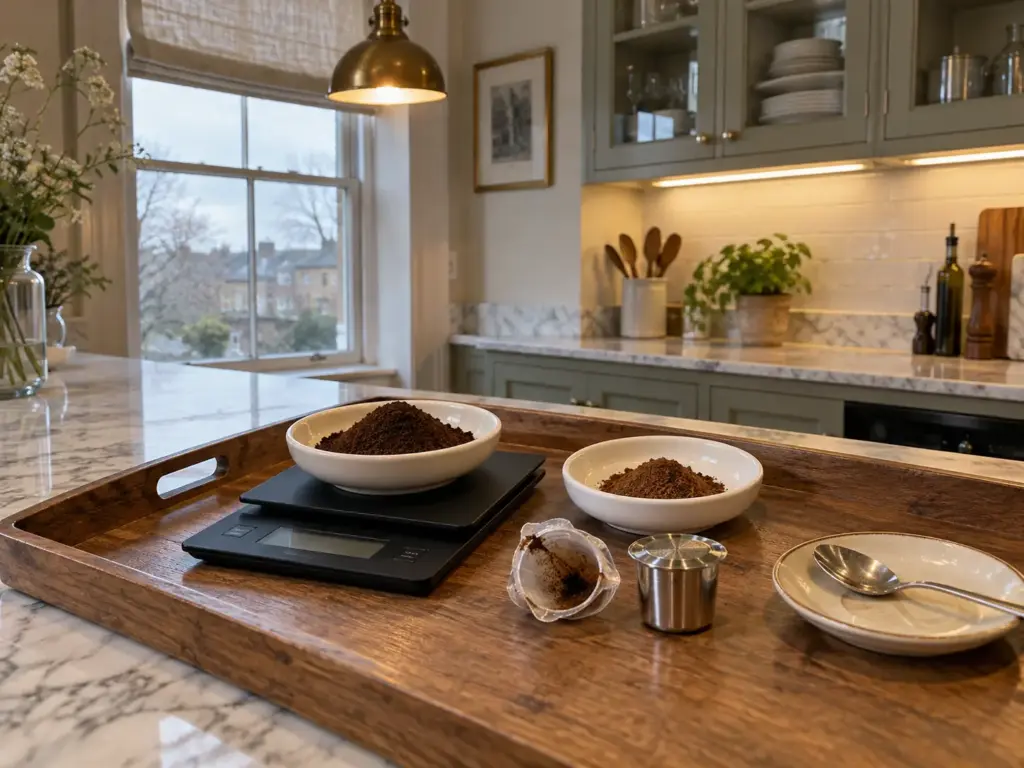
Weigh what the K-Cup held and what the reusable pod holds
Tasting Table claims that reusable containers made for Nespresso hold “half a gram less coffee than branded pods.” It is a single source and it has not been measured for your pod, so the claim is a reason to weigh, not a figure to trust. A half gram is a small number, and only a scale with 0.1 g steps can show it; a scale that reads in whole grams cannot.
That is the job for something like the Hario Drip Scale Timer, which reads in 0.1 g steps and has a built-in timer. Its trade-off comes from its spec: it shuts itself off after five minutes, so if you stop between additions it may be dark when you come back and need switching on and taring again.
The procedure is short. Tear a K-Cup and tip its grounds onto the scale in a small dish, write the weight down, then fill the reusable pod to the lip and weigh that. The two numbers are your dose gap, and the fill-line guide for reusable pods is where the arithmetic of the fill itself lives.
Write the K-Cup’s grounds weight on a strip of tape inside the cupboard door. The target for every later fill is then a number you can read, not a memory of how full the pod looked.
Medium-fine is a starting point, and one change comes at a time
Tasting Table’s advice for a reusable pod’s grind is “Medium-fine is the way forward.” It is one magazine’s starting point, and the guide on grind size for a K-Cup covers the Keurig side of the same question. The two are written for different containers, so do not average them. Let the first cup decide.
The order is what protects the result. Fill the pod to the same weight as the K-Cup’s grounds and brew, then taste. Only then move the grind by a single step, and taste again. A fill, a grind change and a water change in one go would leave you holding a cup you cannot read, and the thinner it is, the more the fault could be in any of the three.
What to taste for in the first mug
Read the direction before touching anything. A pale, watery cup points to too little coffee in the pod or a grind too coarse for the water to work against, so the weight and then one step finer are the pegs. A gritty cup with a muddy edge points the other way, to a grind too fine or a pod packed too hard, and one step coarser is the change. After the fix, the next cup should be fuller if it was thin and cleaner at the finish if it was muddy; if it tips over into a harsh, drying bitterness, that is the overshoot, and half a step back is the answer.
Tasting Table’s own forecast is that a reusable pod will still give a slightly weaker cup than the branded one, so aim for close, not identical, starting from a medium-fine grind. The same logic as in the guide to grind size against roast applies: weigh the dose before you touch the dial. And judge one pour at a time. The first mug from a freshly packed pod and the next mug from the same pod refilled are separate tests, and treating them as one is how a good fill gets blamed for a bad rinse.
What It Looks Like in Month Two, and What to Settle Next
Once the first cup is dialed, the question that remains is whether the habit survives a second month and which pod you keep buying. Both come down to small routines that are easy to skip and cheap to keep.
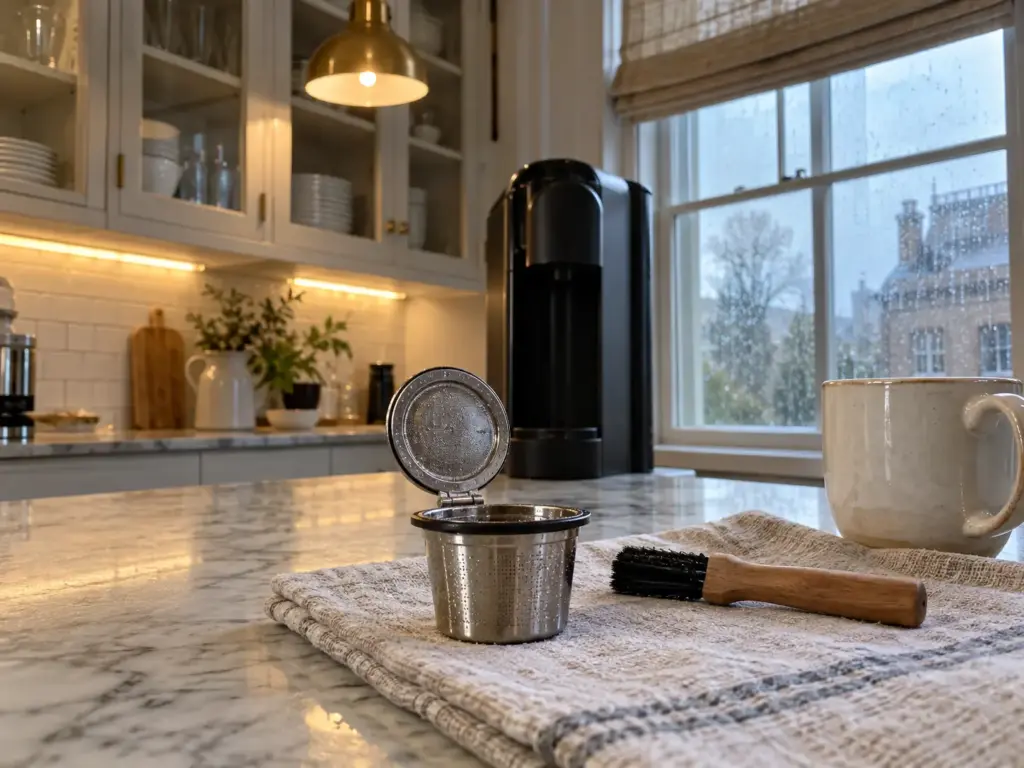
Rinse the reusable pod after every brew
The routine that matters most is rinsing the mesh basket after every brew. A pod left unrinsed carries the last brew’s wet grounds, so the next fill packs unevenly and the cup tastes faintly of the one before it. Rinse it, let it dry on a towel, and fill it fresh each time.
The slow version of the same fault shows up as a cup that turns thin again after a few weeks at the same fill level. That is usually the mesh clogging with fine particles, since pod-grind coffee is the fine kind, and the grounds weight has not changed. The pod, not the coffee, is the part to check first.
Adapters are sold for this, and nothing here tests one
A pod adapter is sold as a second route to the same swap, and they turn up in the same searches as reusable pods. No source used for this guide tested one, and the open question with an adapter is whether it carries the water through the grounds the way the machine expects. So this guide does not recommend one, and it does not claim an adapter fails either. The decant is the workaround with a source behind it.
The next decision: which pods to keep buying
The fork after all this is practical. You can keep buying K-Cups and decanting them into a reusable pod on the Nespresso, or you can buy capsules made for the machine and skip the step. What decides it is cost per ounce, not per pod, because a Nespresso cup is small and a K-Cup brews a larger one, and Keurig vs Nespresso pod cost per ounce runs that division. Whether the capsule cup is worth it in the mug is a separate question, and whether Keurig or Nespresso makes the better coffee by mug size takes it on.
Weigh One K-Cup Tomorrow, Then Taste Before You Change Anything
Three things carry over from all of this. The answer to “can I use Keurig pods in Nespresso” is no in both directions, so a pod that will not drop in on its own gets taken back out. Nespresso is two systems, and the reader’s machine may be one with a barcode reader, so the model gets checked before the box. And if you swap, the dose comes first: weigh, change one thing, taste, and only then change the next.
A month from now, look at the mesh basket of the reusable pod and at the first cup of the morning. A pale cup at the same fill means the mesh is clogging, not that the coffee has changed.
Tomorrow morning, tear one K-Cup over a dish, weigh the grounds, fill the reusable pod to the same weight, brew one cup and taste it before you move anything. If the cup is pale, the weight is the first suspect; if it is gritty, the grind is. Either way the next question is which pods to keep buying, and the pod cost guide is where to take it.
Frequently Asked Questions
01Can I use Keurig pods in my Nespresso machine?
No. A K-Cup is about two inches across and a Nespresso capsule is much smaller, so the K-Cup stops at the rim. Decanting the grounds into a reusable pod made for your model is the swap that works.
02Can Nespresso pods be used in a Keurig?
No. A Nespresso capsule is too small to seat in the K-Cup holder and drops to the bottom. The reverse swap works the same way: tear the lid and decant the grounds into a Keurig reusable pod.
03Is it safe to put the wrong pod in a Nespresso?
It is not recommended. Tasting Table warns that forcing the wrong pod can damage the capsule and the machine. The sources used here give no warranty consequence, so check your manual.
04Are Nespresso pods more expensive than K-Cups?
It depends on the mug, because a Nespresso cup is smaller and a K-Cup brews a larger one. The cost per ounce, not per pod, is the comparison, and the pod cost guide runs the division.
05Which is better, a Keurig or a Nespresso Vertuo?
It depends on the cup you drink: a tall mug points to the pod machine and a small strong cup to the capsule. Our main guide picks by the cup.


How did your cup turn out?
No comments yet. Tell us what you changed — and whether the needle moved.