

We may earn a commission when you buy through links on this page. It never changes what we recommend. How we pick
On this page9 parts
- The Vertuo Cup Sizes, From Espresso to Mug
- What the Barcode on the Rim Sets
- Why a Bigger Cup Needs a Bigger Pod
- How the Original Does It Differently
- Pod Size Is Not a Strength Setting
- Which Numbers to Trust: Check the Model, Not Another Blog
- The Catch: Every Size Comes From One Supplier
- Choose the Cup First, and the Pod Follows
- Frequently Asked Questions
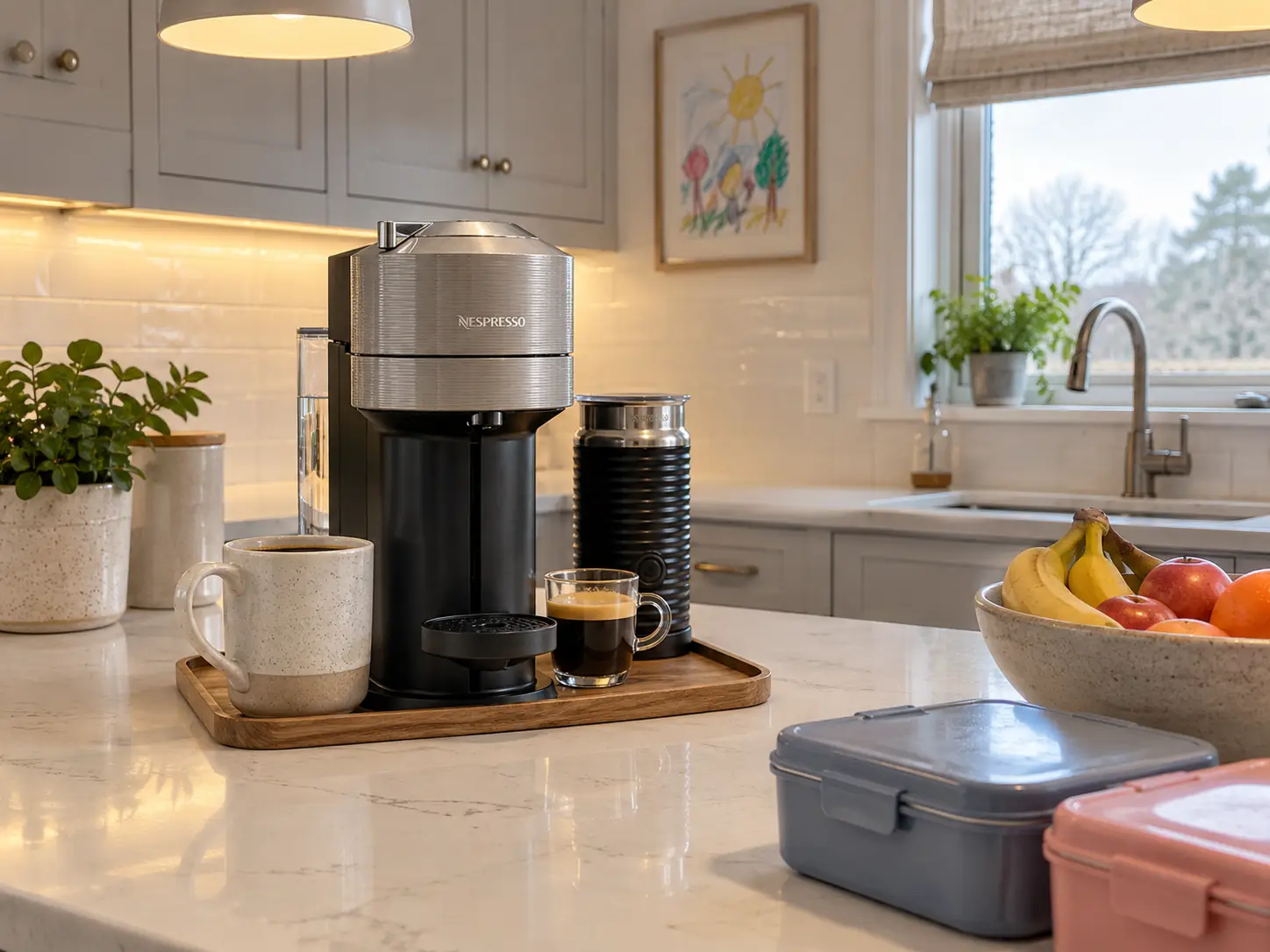
Two sleeves of Vertuo pods sit in the drawer, one squat and one visibly taller, and the mug you just filled from the wrong sleeve came out thin and pale. Why are Nespresso Vertuo pods different sizes? Because the pod is the recipe: the barcode on its rim tells the machine how much water to pour and how to run the brew, and the capsule carries the coffee that cup needs. A pod’s size is the cup it was made for, which is why the label on the box matters less than the code on the rim.
The sections below take the Vertuo pod sizes in order, from the sizes Nespresso lists to what the code sets, why size is not strength, and which numbers to check before trusting any single source.
Quick Answer
A Vertuo pod’s size is the cup it was made for. The barcode on the rim tells the machine how much water to pour and how to run the brew, and a bigger drink gets a bigger capsule holding the coffee for it, so a mug does not come out thin. On default settings, size sets volume, not strength.
The Vertuo Cup Sizes, From Espresso to Mug
A Vertuo box is sold by cup size, so the list of sizes has to be in your hand before the “why” makes sense. This section gives the Nespresso pod sizes and volumes Nespresso lists, in milliliters and ounces, and then explains why the capsules in the drawer are not all the same height. If you only want to know which pod to buy for each drink, the pods worth buying for each size are sorted in a separate article.
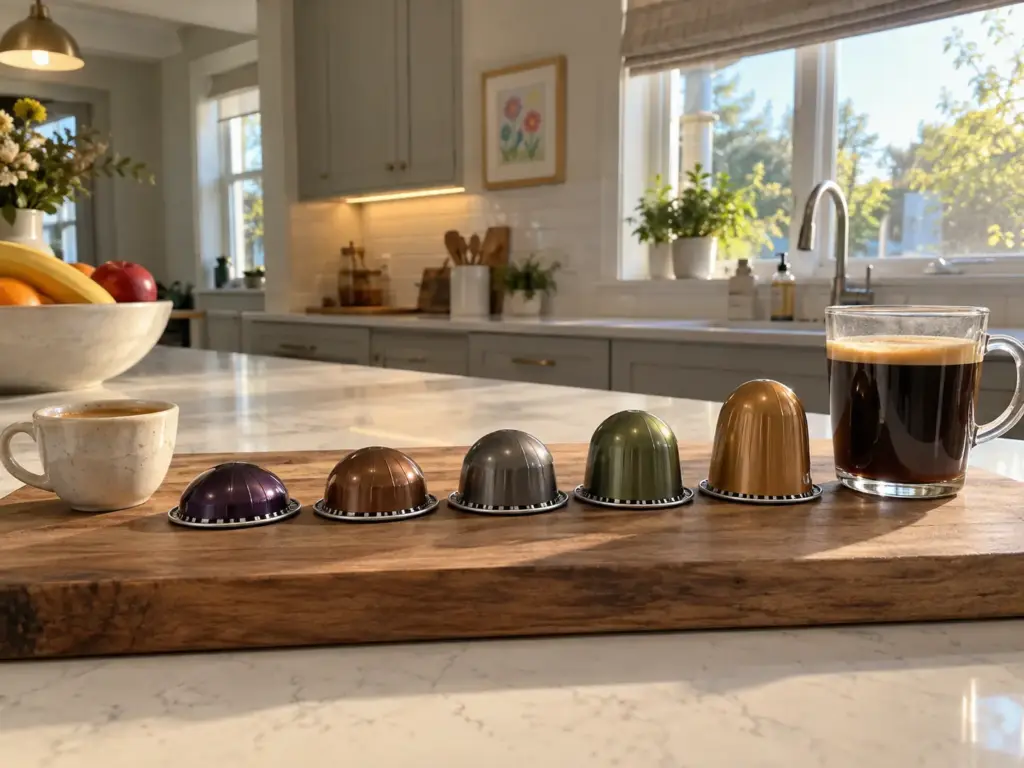
The default cups: ristretto, espresso, double espresso, Gran Lungo and mug
Nespresso’s Korea support page lists five default cups for the Vertuo: ristretto at 25 ml, espresso at 40 ml, double espresso at 80 ml, Gran Lungo at 150 ml and the mug at 230 ml. To get ounces, divide by 29.57, the milliliters in a fluid ounce. That makes the espresso 1.35 oz, the double espresso 2.7 oz, the Gran Lungo about 5 oz and the mug 7.77 oz, the same figure Nespresso’s US support page uses. The ristretto comes to roughly 0.85 oz.
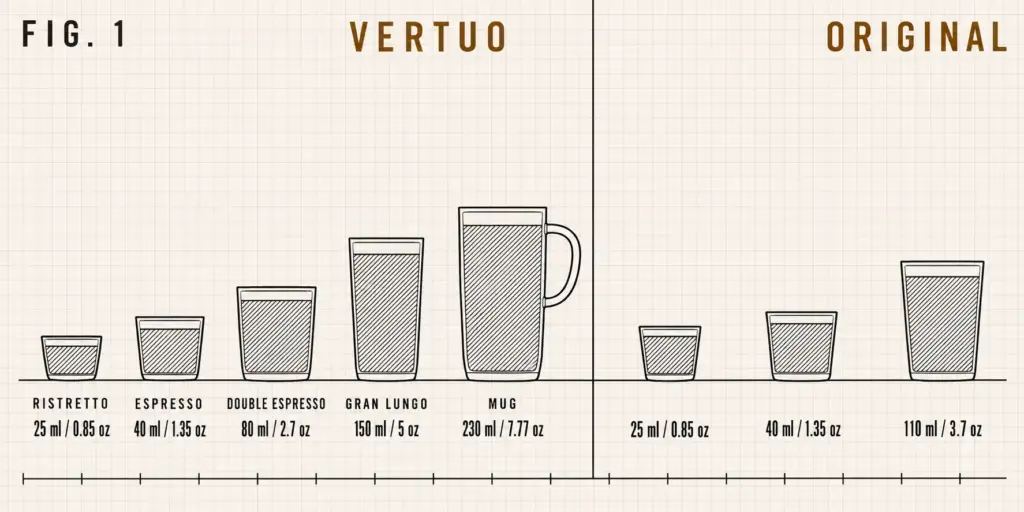
Read the list as a ladder and the spread is wider than it looks: the mug holds 5.75 times the water of the espresso (230 divided by 40). Nespresso’s Singapore support page, written for the Vertuo Next, puts the consequence in one line: “The four capsule sizes create different sized coffees.” That page sorts them as a small capsule for the espresso, a medium one for both the double espresso and the Gran Lungo, a large one for the mug and an extra-large one for the carafe. The cup you pour is the capsule you chose.
Why the pods look different on the shelf
A Vertuo capsule is a wide, round, dome-shaped capsule with a barcoded rim, and the thing that changes from size to size is the pod height. Stand the sleeves next to each other and the tall ones are the big cups, which shows in the drawer long before it shows in the cup.
The tallest of all, the 18 oz carafe pod, is “designed exclusively for Vertuo Next”, according to Nespresso’s US page for that machine, and it gets its own section further down because the numbers around it do not agree. At the other end of the range, a Gran Lungo is a 5 oz cup, against the standard 7.7 oz cup. That matches the arithmetic above, give or take the rounding.
What the Barcode on the Rim Sets
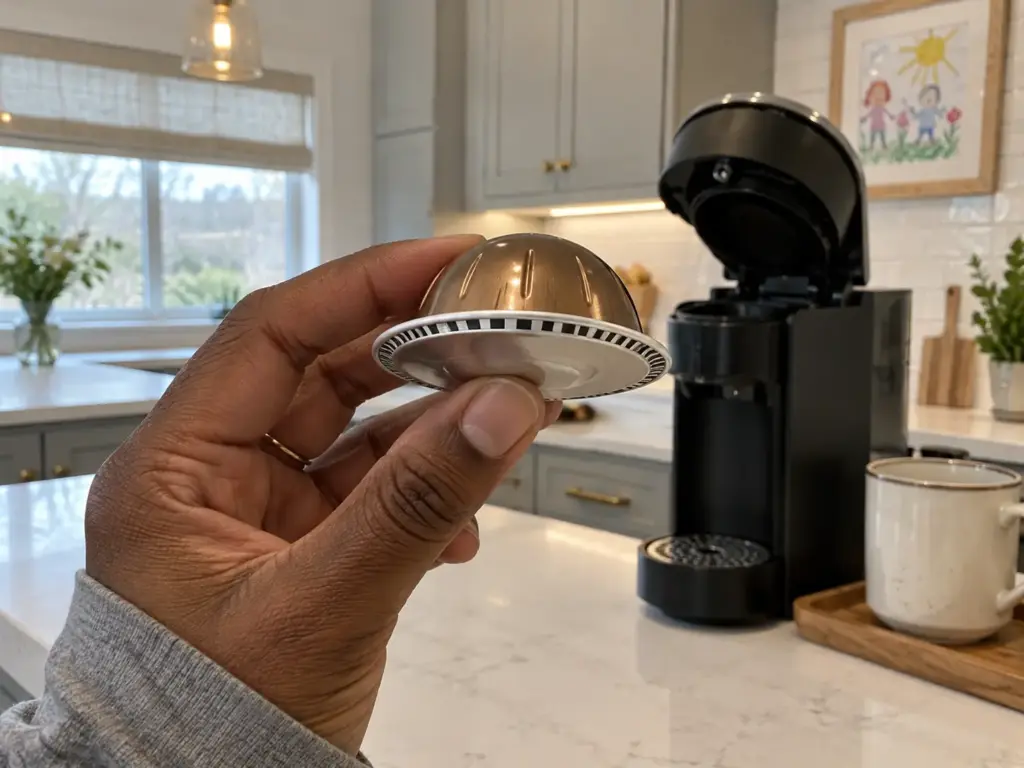
The box does not tell the machine what to pour. A ring of fine lines around the rim does: the Vertuo barcode, which the machine reads each time the head closes on a capsule. That puts the cup volume on the pod instead of on the machine, and it is the one idea the rest of this article leans on.
Water volume, flow, temperature and infusion time
Nespresso’s Malaysia support page says the unique barcode on each capsule “adjusts the flow and volume of water, temperature, infusion time and capsule rotation”. That is five settings, from water flow to water temperature, all carried by the pod.
The machine does not decide that a ristretto should be short and a mug long; it reads the code and runs the cycle that capsule was built for. Nespresso’s US support page says the same thing from the blend side: “Each blend is designed to brew to a specific cup size to guarantee the best in-cup result.” The dome and the code are one design. A capsule that holds the coffee for 230 ml carries a code that pours 230 ml.
Those five settings all sit on the water side. What the code cannot change is the coffee sealed in the dome: its amount, its grind and its roast were fixed at the factory, and no setting on the machine reaches them. A Vertuo owner cannot grind finer or dose heavier, and that matters the moment a cup tastes off.
The consequence is easy to miss. Because the volume comes from the pod, there is no cup-size button to press and no way to ask for a different size from the same capsule, short of the programming route covered in the numbers section below. Pick the pod and you have picked the cup.
Why the capsule spins
“Capsule rotation” is on Nespresso’s list of what the code sets, and the reason is plain: the Vertuo uses centrifugal force to extract the flavor, so it spins the capsule. Water goes into a spinning capsule and the brew is thrown outward through the grounds (centrifugal extraction), instead of being forced through at the high pressure an espresso machine uses. That is why the Vertuo behaves as a volume-first machine. Time, flow and spin are fixed per pod, so the water that goes in is the water that comes out as cup, and the machine has nothing to adjust on the way.
A dented rim or a capsule sitting crooked is the first thing to rule out when a pour comes out short or long, ahead of blaming the machine. The code can only be read if the rim is clean and flat.
When a pour comes out the wrong size, swap the pod before you touch anything else. Wipe the rim dry, look for a dent, seat the capsule flat and run it again. If a second pod of the same size pours the volume you expect, the first rim was the problem; if both pour short, the machine is next.
Why a Bigger Cup Needs a Bigger Pod
The obvious question is why Nespresso does not make one pod and let the water run longer. The answer is a ratio, and it is easier to see with numbers than with brand names.
The coffee has to grow with the water
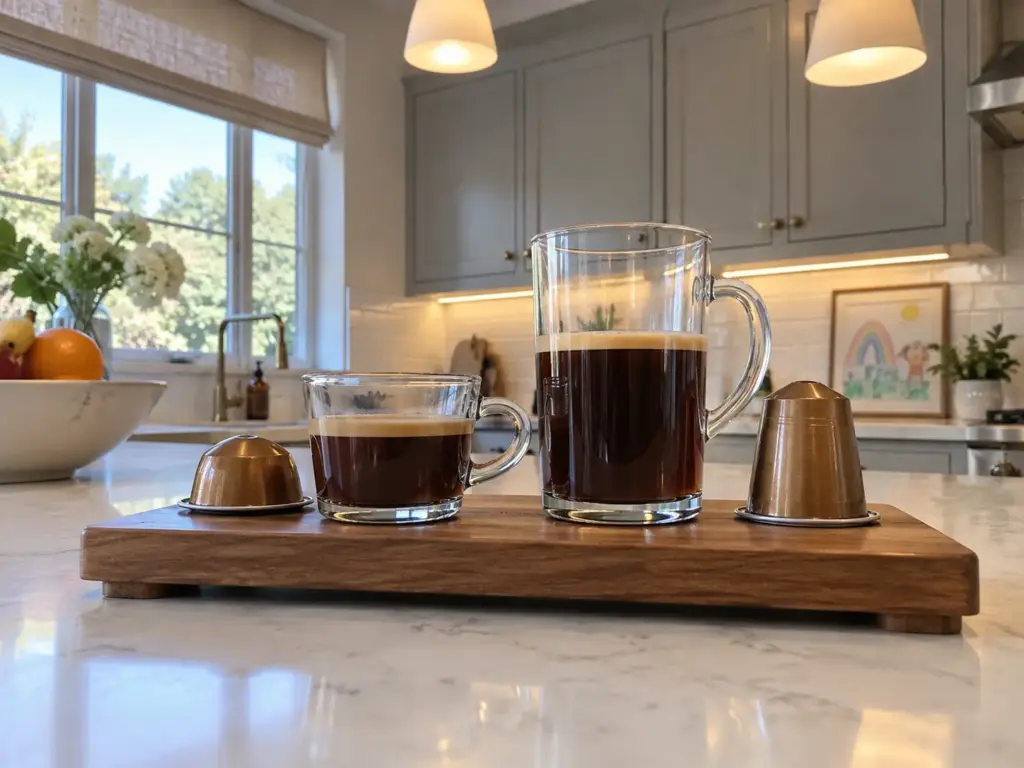
Strength is coffee against water. Push twice the water through the same coffee and the cup comes out twice as long and clearly thinner, because the coffee only has so much to give, which is how you get a thin cup.
To keep the taste at a larger volume, the coffee has to grow along with the water, and the Vertuo puts that growth inside the capsule. The mug is 5.75 times the water of the espresso; the 18 oz carafe is about 13 times the 1.35 oz espresso (18 divided by 1.35 is 13.3). A pod that carried the same coffee for all three would make a mug of tinted water. (Nespresso does not print grams of coffee per capsule, so these ratios are for the water side only.)
What happens when the same coffee is stretched to a mug
Picture a pod built for 40 ml pushed all the way to a 230 ml mug. The coffee now has to flavor 5.75 times the water, and the cup points one way: watery and pale, as if the coffee ran out before the water did.
Some owners get there on purpose. One workaround is to run the same pod twice to make a long americano. It works as a longer drink, but it is water added to an espresso, which is dilution and not a different strength recipe, and the second pass runs through coffee that has already given most of what it will give. For a bigger cup with its flavor intact, the better call is the pod made for that size.
The Gran Lungo is the same stretching done by design. A longer cup is a less concentrated one, and Nespresso builds a pod for that length instead of leaving the stretching to you.
If you stretch a pod anyway, stretch it one size, not three. A 40 ml pod taken to 80 ml has twice the water and still reads as a short coffee; taken to 230 ml it has 5.75 times the water and you are drinking a different, much weaker drink.
How the Original Does It Differently
Everything so far makes the Vertuo sound like the only sensible design, and it is only one of two. Nespresso’s Original line works the opposite way. If you have an Original at the office and a Vertuo line machine at home, the contrast explains why the Original has no such thing as one pod for one size.
One pod, a button picks the cup
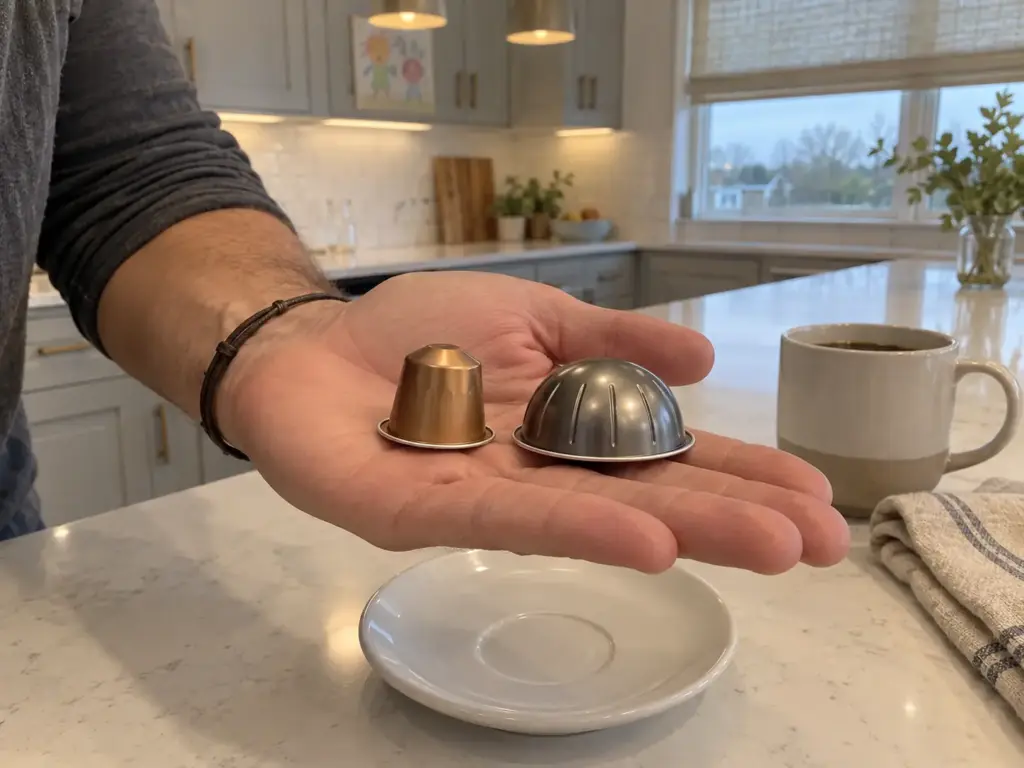
Nespresso’s Australia support page puts it simply: “Espresso and Lungo are the two main coffee extraction sizes used with the Original system.” On the Original the button picks the volume (the button volume), 40 ml for the espresso (1.35 oz) and 110 ml for the lungo (about 3.7 oz), and the same small capsule serves both. The Vertuo flips it. The pod picks the cup, and the button only starts the brew.
Why the Original pods are small and the same
Because the volume is chosen at the machine, an Original capsule has no reason to grow with the cup. What differs between Original capsules is what is inside: the same Australian page says “The Lungo capsules contain coffee of a coarser grind”. Treat that as an Original fact. The Vertuo support pages quoted here describe the code, not a grind, as what separates one cup from another, so do not assume the same trick carries over.
The trade is simple: Vertuo tech is different, not superior, and it is better suited to cup-sized coffees. The two systems also do not share a capsule shape, and why an Original capsule will not fit a Vertuo has the fit question to itself.
Pod Size Is Not a Strength Setting
The easy misreading is that a bigger pod makes a stronger cup, or a weaker one, depending on who is guessing. On the default settings neither is true. Seeing why also shows the one change that does move strength.

Size sets the volume of the cup, not how strong it tastes
The capsule carries the coffee for its cup and the barcode carries the water for it. Both grow together, so the strength the pod is built to hit stays put while the cup gets bigger. A mug pod is not a stronger espresso; it is the same idea at a larger volume. A thin mug therefore points one way: too much water for the coffee in the dome.
Since the dose is sealed in, the ratio belongs to the pod, which leaves exactly one lever.
A Keurig works the other way around. It takes the same pod, a size button that only adds water and a separate setting for strength, which what the Keurig Strong button does covers. The same question by mug size, Keurig against Nespresso, sits in which one tastes better by mug size.
The one change: the size, then taste again
Start with the free change. If the mug is thin, move to the smaller size of the same blend and taste. The next cup should be shorter and more concentrated, closer to what the box promised. If it now tastes pinched and harsh, you went shorter than you wanted, so go back one size.
Only if the cup is the right size and still weaker than you like does the second change come in, and it is a different pod, a different blend made for the same cup, with the volume left alone. Do not reach for the programming route to get “more”: it pours more water through the same coffee, which gives you more cup and a thinner one. Taste after each change, never both at once.
There is no strength dial on a Vertuo. That is the cost of putting the recipe on the pod. The only way to a stronger mug is a different capsule, and finding out means opening a new sleeve.
Read the cup size on the sleeve before the flavor name. Two pods that look alike on the shelf can be built for different volumes, and the volume is what decides how the cup tastes in your mug.
The Ice and Latte mode, the same pod at a smaller volume
Nespresso’s Korea support page describes an Ice and Latte mode in which the same capsule brews a smaller volume: espresso from 40 to 25 ml, double espresso from 80 to 40 ml, Gran Lungo from 150 to 40 ml and mug from 230 to 80 ml. In that mode, it says, “the coffee is brewed with a richer and more intense flavor profile”. The Gran Lungo going from 150 ml to 40 ml is 3.75 times less water over the same coffee, which is exactly why it tastes more concentrated.
This is the one place the manufacturer ties a smaller volume to a stronger cup, and it fits the mechanism. Same coffee, less water. It is a mode, though, set separately from the pod’s size, on machines that offer it. So the rule holds on the default setting: the pod’s size sets the volume, and strength is a separate matter.
Which Numbers to Trust: Check the Model, Not Another Blog
Nespresso’s own pages do not all give the same figure for every size, and some write-ups add a third version. Before you read a number off a spec list, here is which statements are firm and which are still open.
The mug: 8 oz on the box, 7.77 oz in the FAQ
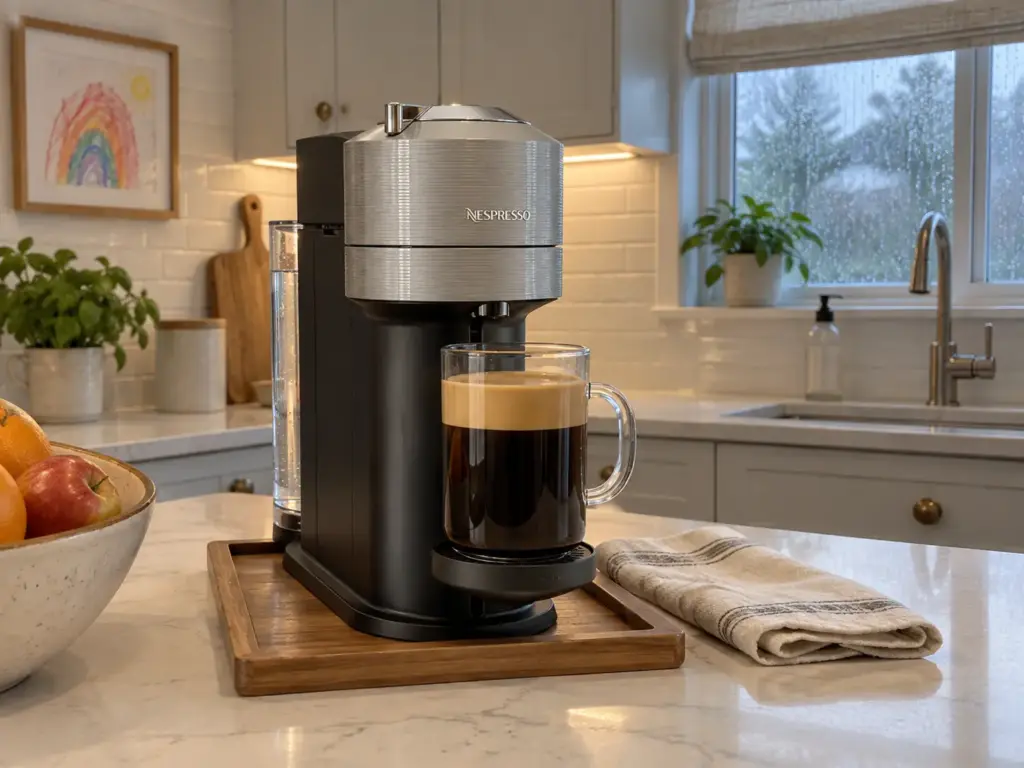
The Vertuo Next page lists the mug as 8 oz. Nespresso’s US support page gives 7.77 oz, which is the 230 ml of the default cup divided by 29.57. An 8 oz cup would be 236.6 ml, so the label rounds up by about 7 ml, roughly a teaspoon and a half.
That is why one write-up says 7.7 and a box says 8. Trust the milliliters; the ounces are the rounding.
The biggest cup: the 18 oz carafe belongs to the Next
The largest Vertuo capsule is the carafe. Nespresso’s US page for the Vertuo Next lists a Pour-Over Style coffee at 18 oz, about 532 ml (18 times 29.57), and calls it “designed exclusively for Vertuo Next”. The US support page agrees on the number for carafe capsules: “Our Carafe capsules are designed to brew 18 oz”.
Two conflicts are worth knowing. The same support page also lists Pour-Over Style among the capsules that brew 12 oz, and the Alto shows as 12 oz there but as 14 oz in a spec list on the Next page, so a post that gives one flat ounce for either is picking one of Nespresso’s two answers. And the XL size is only for the Vertuo Next and Pop series, while the Nespresso pages quoted here tie the carafe to the Next only.
That leaves one machine to name. If the 18 oz cup is the one you want, the machine Nespresso’s own page ties to it is the Nespresso Vertuo Next with milk frother, in light gray, which takes the whole run, from the 1.35 oz espresso up to the 18 oz carafe pod. Check first whether the machine you already own takes the pod you are after, because that costs nothing. As for the catch, a single durability report, with no model named, is no verdict on the Next.
Programming a bigger volume, and what Nespresso’s own pages disagree on
The cup volume is a default, not a lock. Nespresso’s US support page says: “All Vertuo models allow for the 7.77 oz capsules to be programmed to brew up to 17 ounces.” Seventeen times 29.57 is about 503 ml, more than double the 230 ml of the mug.
Programming adds water to the same coffee, which is dilution, the opposite of what a reader chasing strength wants. For the carafe capsule the same page gives a separate, much higher maximum, and given the disagreements above, the manual for your model is the place to read it, not a number from a random website.
For the Pop line there is one statement to go on, a compatibility line in the US support page that lists the Pop with the machines taking the 12 oz capsules. It does not say whether a given Pop takes the carafe, and nothing else quoted here settles it. Which machine takes which size is the question to check by model, not to guess.
The Catch: Every Size Comes From One Supplier
The mechanism that makes every size work has a price. The same barcode that sets the cup also makes the pod a proprietary pod shape, and it is worth knowing that before you commit to a size.
One supplier for every size
Vertuo pods come from the Nespresso website or from a Nespresso store front. Pods are restricted to Nespresso’s own brand because the company holds the rights to that pod shape, and that is a point about rights, not a legal finding.
The Original side of the family looks different to a third, who writes “I like having 3rd party pods available”. Whatever size you settle on, you reorder it from a single supplier, in whatever flavors that place stocks. If third-party choice matters more to you than a bigger cup, that is a point for the Original.
Month two: what to watch for on a Vertuo
By the end of the second box, the size question has turned into a supply question: the cup you like is the cup you reorder from the same site, and if the machine fails, the pods go with it. The one line on reliability in those comments is vague: “Next and Pop have a lot of problems”, with no detail about what breaks.
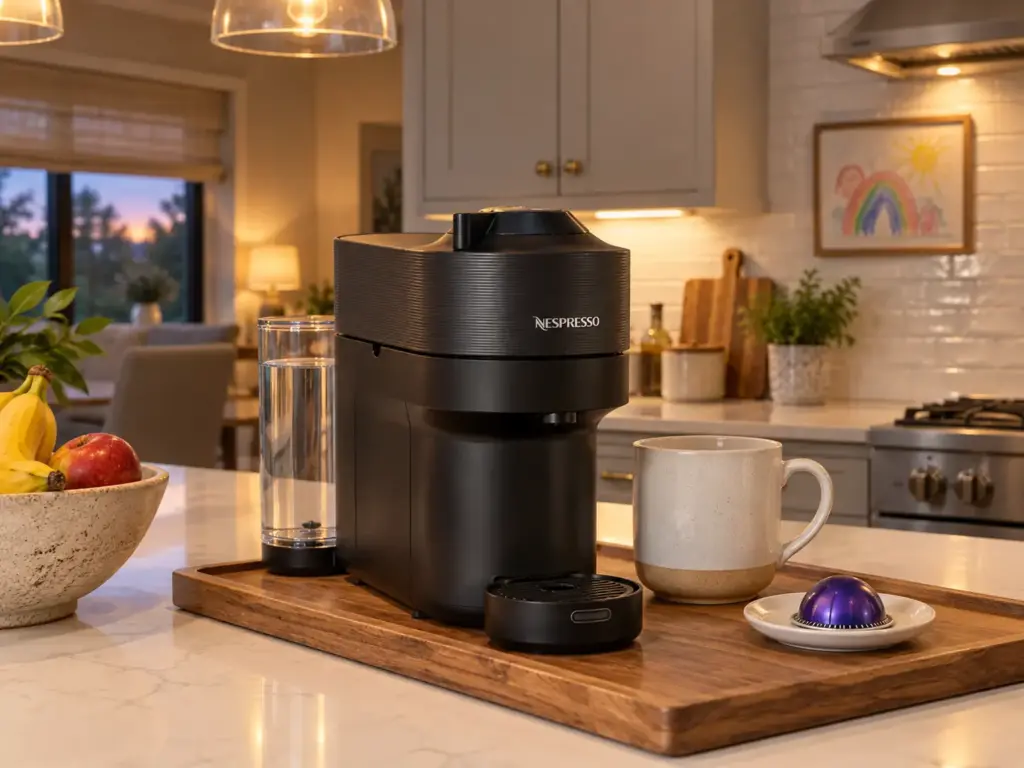
The Nespresso Vertuo Pop+ by De’Longhi, in black, is the second machine many readers own, with a 25 fl oz side tank and five cup sizes. The biggest size it takes is the one no Nespresso page quoted here settles. No complaint specific to the Pop+ turns up on pod sizes either; the Pop series line above is all there is, and it names no fault.
Pour a mug pod into a clear measuring cup once, when the machine is new, and note where the line lands. Repeat the same pour a month later. A visible drift points first at the rim or at scale in the water path of a machine fed hard tap water, so descale before blaming the pods.
If the one-supplier catch is a dealbreaker, the bigger question is whether the Vertuo system suits you at all.
Choose the Cup First, and the Pod Follows
Three things carry over from all of the above:
- The size is the cup. The barcode on the rim carries the volume and the brew settings, and the capsule carries the coffee for that cup.
- A bigger cup needs a bigger pod, and size is volume, not strength. To change the strength, change the pod, never the water.
- Check your model for the biggest size, and remember that every pod comes from one supplier.
A month from now, ask whether the size you settled on still pours the cup you wanted when you first filled the drawer, and whether reordering from one place still suits the way you drink.
Tomorrow morning, set the cup size by choosing the pod, not by programming the volume. Take the pod made for the cup you want, brew it and taste. If the cup is the right size but thin, change the pod before you touch the volume. When you are ready to buy, pick by size and let the cup you want decide the pod.
Frequently Asked Questions
01Are all Nespresso Vertuo pods the same?
No. Vertuo capsules come in several sizes, and each is made for a cup size, from a 1.35 oz espresso to a 7.77 oz mug. A barcode on the rim tells the machine the water volume and brew settings for that pod.
02What are the different sizes of Nespresso Vertuo pods?
Nespresso lists five default Vertuo cups: ristretto 25 ml, espresso 40 ml, double espresso 80 ml, Gran Lungo 150 ml and mug 230 ml, about 7.77 oz. A separate 18 oz carafe pod is designed exclusively for the Vertuo Next.
03Are all Nespresso pods the same size?
No. The Original and Vertuo are separate systems with different capsule shapes, and an Original capsule will not fit a Vertuo machine. On the Original one small pod serves a button-picked cup; on the Vertuo the pod picks the cup.
04What is the difference between small and big Nespresso pods?
A small pod makes a small cup, and a big pod carries the coffee for a big cup. The difference is volume, not strength: the barcode sets the water, and the capsule holds the coffee that volume needs.
05Can I make a bigger cup from a small Vertuo pod?
Yes, but it dilutes. Running the pod twice for a long americano is a community workaround, and Nespresso’s US support page says a 7.77 oz capsule can be set to brew up to 17 ounces. Either way the coffee stays the same while the water grows, so the cup thins.


How did your cup turn out?
No comments yet. Tell us what you changed — and whether the needle moved.