



We may earn a commission when you buy through links on this page. It never changes what we recommend. How we pick
On this page8 parts
- The Three Philips Lines and What Each One Adds
- The First Cups Are Thin, and One Setting Stays Put
- The Milk System Makes One Foam
- The Iced Drink Is a Hot Brew Poured Over Ice
- What Wears by Month Two, and the Weekly Rinse That Slows It
- Where the Cup Sits Against the Rivals, and the Verdict
- Raise the Aroma First, and Check the Cup Again Around Number 150
- Frequently Asked Questions
Your first cup out of a new Philips tastes like espresso cut with tap water, and every knob on the display starts to look like a suspect. This review of the Philips coffee maker begins one step earlier, because the name covers three bean-to-cup super-automatic lines that make the same kind of cup and differ in drinks and saved profiles. If a pot with a glass carafe is what you pictured, a drip machine picked by water temperature is the page you want. Philips’s own support page admits the early cups can come out thin while the machine settles, and its manual asks you to leave the grind knob alone for a month, so what follows is the order in which to touch things, then the milk, the iced button, the parts that wear, and the verdict against the rivals.
Quick Answer
A Philips LatteGo is worth buying for milk drinks and an easy clean, when its price sits clearly below a De’Longhi in the same class. A concentrated straight cup favors the De’Longhi. The 3300, 4400 and 5500 differ in drinks and saved profiles, and the listings promise no better cup higher up the ladder.
The Three Philips Lines and What Each One Adds
Three super-automatic espresso machines sit under one brand name, and a shopper scanning the shelf reads them as a ladder of coffee quality: more drinks, better cup. The catalog tells a different story, because the steps on that ladder are drinks and profiles. Sorting out which rung you are holding comes before any verdict on the cup.
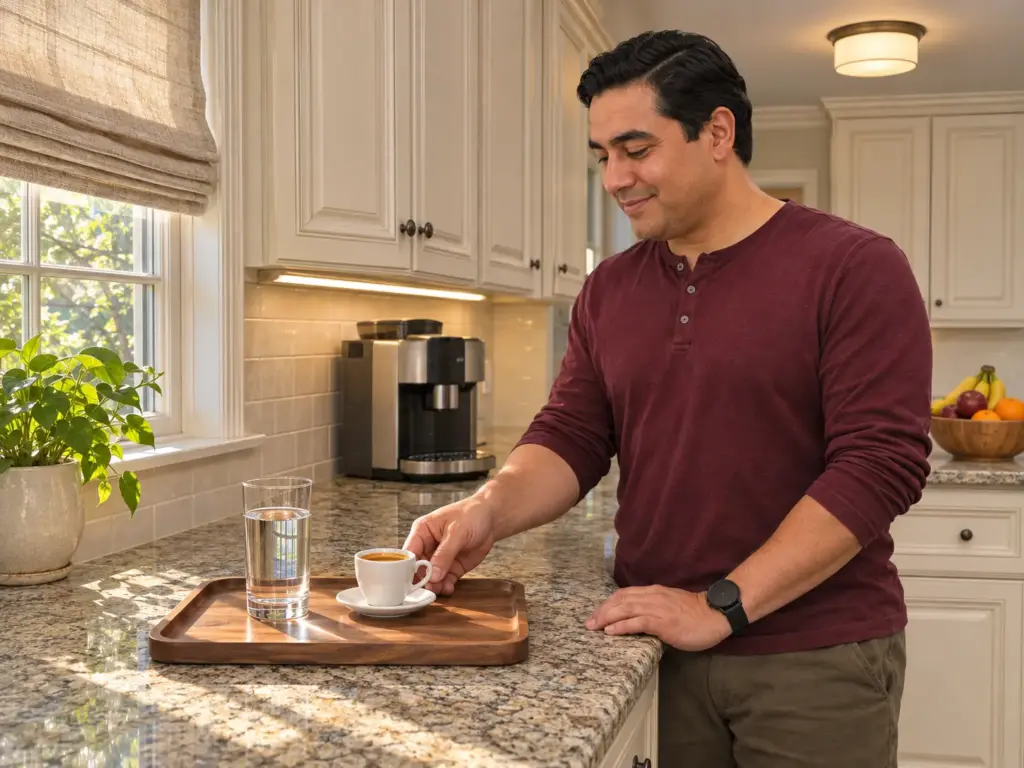
The step from 5 drinks to 20 is a menu, not a stronger cup
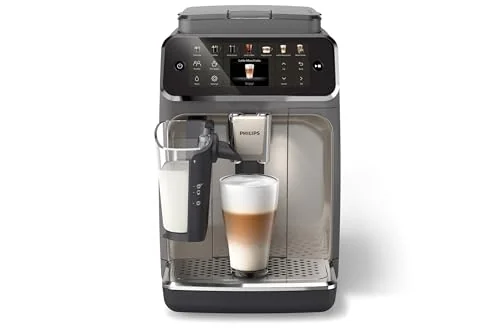
All three lines are listed at 15 bar and share the LatteGo milk system, a carafe of three parts with no tubes inside. What climbs from one line to the next is the number of presets (five on the 3300, going by the title of its listing; twelve on the 4400; twenty on the 5500) and the number of saved profiles (none listed on the 3300, two on the 4400, four on the 5500). The 4400 listing adds QuickStart, which it puts at three seconds to ready. SilentBrew is the maker’s name for sound shielding, and the 3300 listing carries it too; how quiet it is in your kitchen is the maker’s claim until you hear it.
| Line | Presets and saved profiles | What it adds |
|---|---|---|
| Philips 3300 LatteGo | 5 presets, no profiles listed | The shortest menu, iced coffee among the presets |
| Philips 4400 LatteGo | 12 presets, 2 profiles | QuickStart, ready in about three seconds |
| Philips 5500 LatteGo | 20 presets, 4 profiles | The longest menu and the most profiles |
Picture a counter where one person drinks cappuccinos and the other drinks a plain black coffee. An extra drink button is a convenience for the first of them. What the household misses without a profile is the second person’s aroma strength and cup volume, re-set every morning after the other has changed them. That is the reason to pay for the top line, and it applies only to a shared machine.
The 3300, the shortest menu and the shortest list of promises
The Philips 3300 Series LatteGo EP3341/50 is the entry line: five presets, no saved profiles on the listing, and a footprint of about 17 inches wide and 15 inches tall, with 9.7 inches of depth, so counter space and the gap under your upper cabinets are worth measuring before you plan around it. For one person who wants a cappuccino and a black coffee, the menu covers the ground. Its weak point sits in its record: some units fail within the first two months, and the cup itself is a mixed bag, from fine to short of what was expected. A thin first cup is the usual start with this line, and the next section is about exactly that.
The 5500, the most drinks and profiles, and a small hopper
The Philips 5500 Series LatteGo EP5544/94 tops the family with twenty presets, four profiles, 15 bar and a water tank of about 61 fluid ounces (1.8 L). Nothing in its spec sheet points to a different pump or a different milk system from the lines below it, so the money buys menu and profiles.
Two flaws sit on the list. The hottest temperature setting is not great, which matters in a cup you want to stay hot through a slow morning. And the bean hopper holds about 280 grams (roughly 10 ounces) of beans, less than a 12-ounce bag of 340 grams, so at ten grams a cup a household of four drinking two or three cups each empties it in about three days.
If you want to see the rest of the category before choosing, other machines that make coffee and espresso in one unit are compared on that page.
The First Cups Are Thin, and One Setting Stays Put
The first cup from a new machine comes out weaker than the box promised, and the urge is to turn everything at once: strength, volume, grind, beans. Hold that, because a thin cup has one direction, and the direction says what to touch first. This section covers the break-in and sets the order, with a taste between each move.
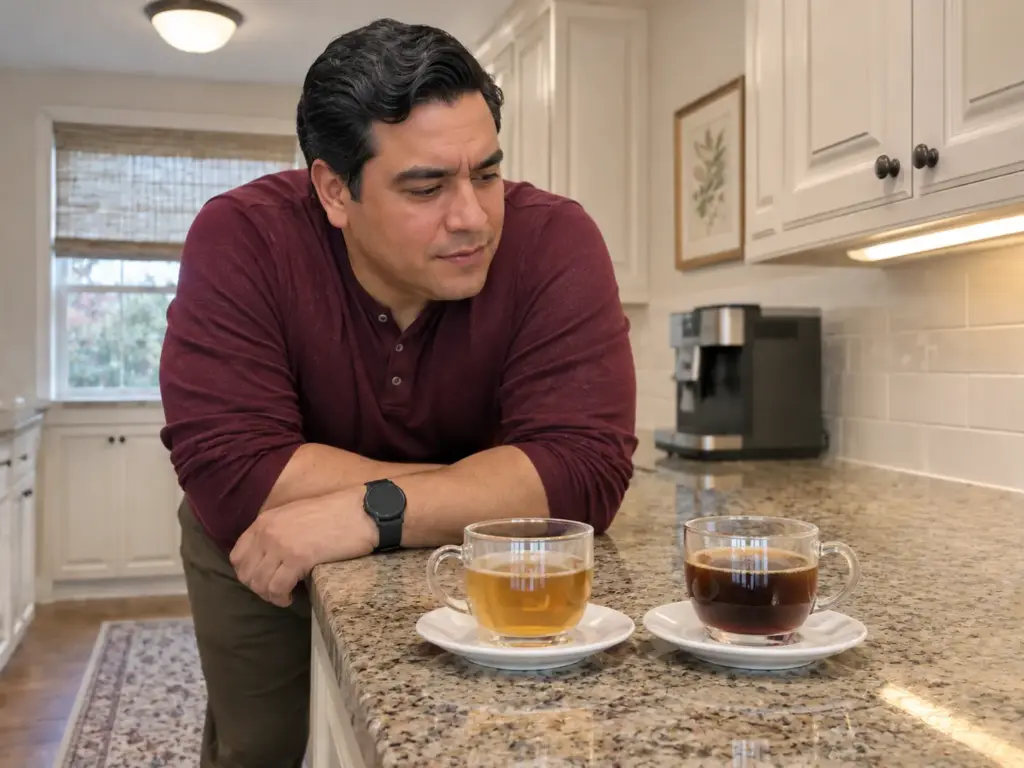
The machine needs a few cups to settle itself
Thin means the water ran through the grounds too fast, or through too little coffee, so too little got dissolved: an under-extracted cup, weak and watery rather than bitter.
That is the direction of the early Philips cup, and the maker says so itself. Philips’s support page on watery coffee states that “the first brewed coffees could be a bit watery as the system needs time to adjust.” The manual for the 4400 and 5500 puts a number on it: “You should brew 5 coffees initially to allow the machine to complete its self-adjustment.” During those cups the machine is settling how much ground coffee it uses per drink, so a verdict at cup three judges a machine mid-calibration.
The manual covers the 4400 and 5500, while the 3300 follows the wording of the support page, which prints no count. Five is the maker’s figure. In practice a thin stretch can run closer to ten cups, and tasting before then judges the settling instead of the settings.
Strength and cup size come before the grind
Philips’s own list for a stronger cup runs: the highest aroma strength, a finer grind, a medium cup volume. The manual’s month-long hold on the grind knob changes the order, so the sequence below keeps the knob for last and moves a single control between tastes. Brew the same drink with the same beans each time.
- Let the first five cups run, then brew your usual black drink and taste it. This is the baseline: watery, short on aftertaste.
- Raise the aroma strength to the top. The next cup should taste fuller, with more bitterness at the edges. If it turns harsh and dry after the swallow, the strength overshot, so come down one level.
- Bring the cup volume down to medium. The dose is small, measured at about six to seven grams on the lowest strength and eleven to twelve on the highest on the 4400, so a big cup stretches it thin: twelve grams into a twelve-ounce mug works out near one part coffee to thirty of water, roughly double the water per gram that a drip machine would use. The next cup should be shorter and heavier. If it turns sharp and bitter, the cup went too small, so raise the volume a notch.
- Only then touch the grind, in the next section.
Judge every step on a black drink, in the same mug, with beans from the same bag. Milk hides a thin cup, so a latte is the wrong place to find out whether the strength setting worked.
The grind knob waits for the maker’s window
The same manual asks for restraint on the control most people reach for first: “we advise you not to adjust the grind setting until you have brewed 100-150 cups (approx. 1 month of use).” Its reasoning is that the machine ships set to get the best taste out of the beans. Two details sit around that rule.
The grinder has 12 settings, and the knob turns only while the machine is grinding. A change then shows up fully after two or three drinks, because the grounds already in the grinder were ground at the old setting. A cup tasted right after the turn tells you nothing.
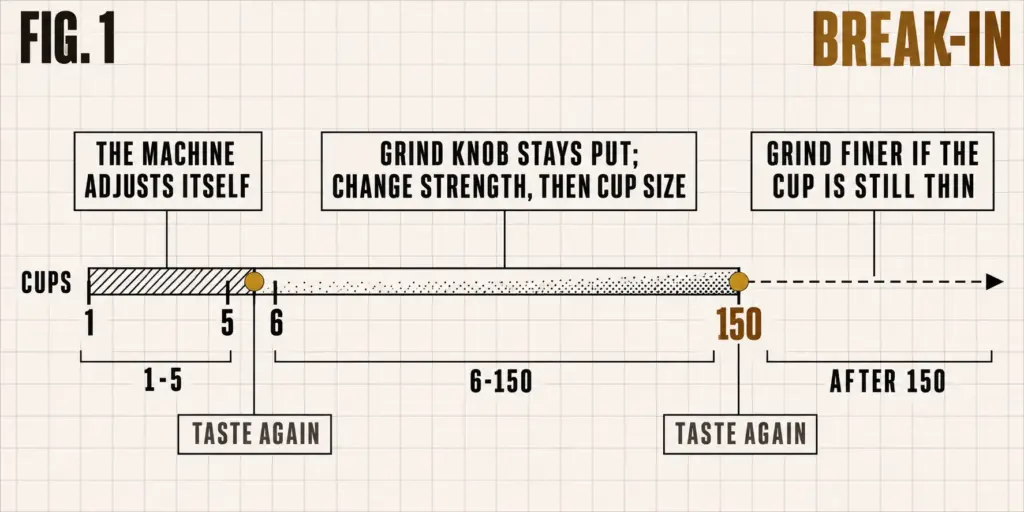
The maker’s support list for a stronger cup ends with a finer grind, while the manual holds the knob for about a month. The order above respects both, since strength and volume cost nothing and the grind can wait.
Out of the box the grind sits coarse for a thin cup, and a coarse grind lets water through quickly, which is the exact direction of a watery cup. That makes the window the place for patience. If the flow stays too fast even at the top strength and the finest setting, no control is left to turn on that machine.
A cup that is still thin after the window points at the grind, so go one step finer, brew two or three drinks, and taste. A finer step should give a heavier, more complete cup, and bitterness with a dry finish means to step back. For why a finer step helps and how a grinder drifts as it wears, see how a burr grinder works and how it drifts.
The Milk System Makes One Foam
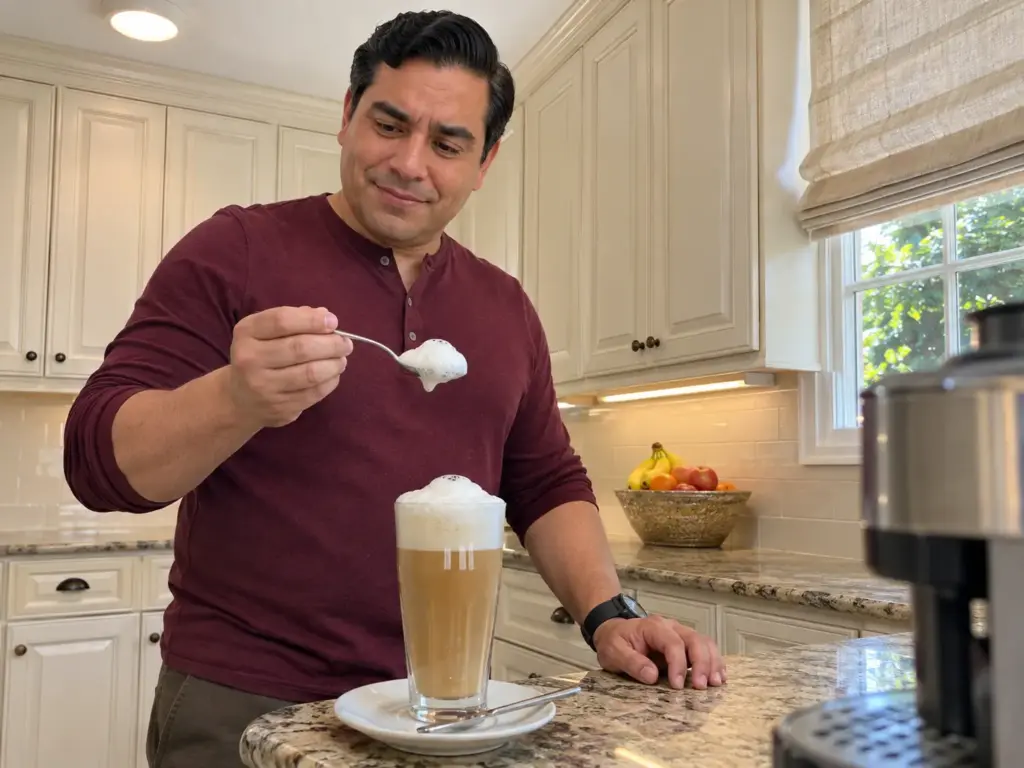
The LatteGo does one thing well: its carafe has three parts, no tubes, and rinses in seconds. What it cannot do is shape the milk, and that is worth knowing before a flat white enters your plans.
One texture, airy, whatever the drink
The simplicity that makes the carafe easy to clean also leaves little room to tune the foam. The settings change how much milk comes out, and what comes out is an airy froth. On a tall latte it sits on top and takes minutes to settle, even when stirred.
A drink that wants hot milk with a finger of foam gets the froth anyway, and that is the cup the household with the milk-heavy drinker sees first. In a few machines the milk instead arrives lukewarm with almost no air, a fault in that unit and rarer than the froth.
The free fix comes first: choose the smaller milk quantity, or a drink with less milk in it. If the froth still ruins the cup, a separate electric frother with a low-foam heating mode handles hot milk, and it costs a fraction of the machine. Check the frother’s description for that mode before ordering.
The part it gets right is the cleaning
Three parts and no tubes means no hose to flush, and the 3300’s listing puts the rinse at as little as ten seconds. That is the genuine upside of the design, and the reason a household that makes milk drinks daily keeps using the machine in month two instead of skipping the cleaning.
Rinse the carafe right after the last milk drink, while the milk is still wet. Dried film is what turns a ten-second rinse into a scrub.
The carafe is a wear part all the same. After a few years it starts making odd sounds during a milk drink, and that sound is the first sign it is tiring. A replacement costs a fraction of the machine, a fraction large enough to count in the cost of the line.
What the one-touch rivals do with their carafes
Rivals with a one-touch carafe pay for their control in cleaning. The Gaggia Magenta Prestige offers four one-touch milk drinks and a full-color display like the 4400’s, with twelve drinks that can be set by temperature and strength. Daily cleaning is the price. The coffee does not come out very hot, and the carafe lid sits unsteadily.
Set against that, the LatteGo’s single foam looks like a trade: cleaning in seconds bought with control of the milk. An integrated carafe with automatic rinse and four profiles puts the Gaggia Cadorna Prestige closer to the 5500, with fourteen drinks and a one-year warranty handled by Gaggia. It asks for significant cleaning, and some units failed within two weeks.
The Iced Drink Is a Hot Brew Poured Over Ice
A snowflake on a button reads as a cold process. The maker’s manual describes something else, and that changes which drink to expect.

What the box says and what the manual says
The manual for the 4400 and 5500 is short on this: “The coffee is brewed with warm water. Brew over ice cubes for optimal results.” The recipe it gives runs in four steps:
- Fill a glass two-thirds with ice cubes.
- Set the glass under the coffee spout.
- Tap the iced coffee icon, with aroma strength at 3, the level it recommends.
- Press start. Cold milk on top is optional.
So the iced preset is a hot brew poured onto ice, and the 4400 and 5500 list an iced latte beside it. The 3300 listing also counts iced coffee among its presets, but the manual covers the 4400 and 5500, so the 3300’s own manual is where its recipe lives.
Ice, aroma and the first sip
Ice dilutes as it melts, so the first sip is the strongest and the last is the thinnest. A stronger aroma setting and a smaller cup volume keep the glass from tasting watery, and the manual’s two-thirds fill leaves room for the drink without swamping it. Ice that melts before the cup is finished turns the last third thin, and filling the glass less than that only makes it happen sooner.
If the glass tastes thin by the halfway mark, raise the aroma strength before touching the volume. The next glass should hold its flavor longer. If it turns bitter and harsh, the strength is too high for the amount of ice.
Drink the glass while the ice is still ice. Once it has melted, the drink is mostly water, and no setting on the machine fixes a glass that sat on the counter.
Cold brew belongs to the rivals’ menus
Some rivals say in their own catalogs what they do for a cold drink. The De’Longhi Magnifica Evo lists an Over Ice recipe that changes the dose and the brew. The De’Longhi Eletta Explore ECAM45086S goes further, with a cold brew in under three minutes among more than fifty recipes, a 13-setting grinder, four profiles and a 3.5-inch touchscreen. A machine that lists a cold-brew recipe is making a different drink from one that pours hot coffee onto ice, although under three minutes is quick for a method whose steep usually runs for hours, so read it as the machine’s version of cold brew.
The Eletta sits at the high end of the price range, and the temperature of its infusion is inconsistent in some units, with trouble in the milk frother on some. If cold brew is the point of the purchase, buy the machine that names it, or steep it in a jar in the refrigerator and skip the machine altogether.
What Wears by Month Two, and the Weekly Rinse That Slows It
Week one lies: a bean-to-cup machine is judged by the rinse it gets, not by its first month. The maker asks for a short routine, and the parts that fail at years follow a pattern worth knowing before they fail.
The weekly rinse and the monthly clean
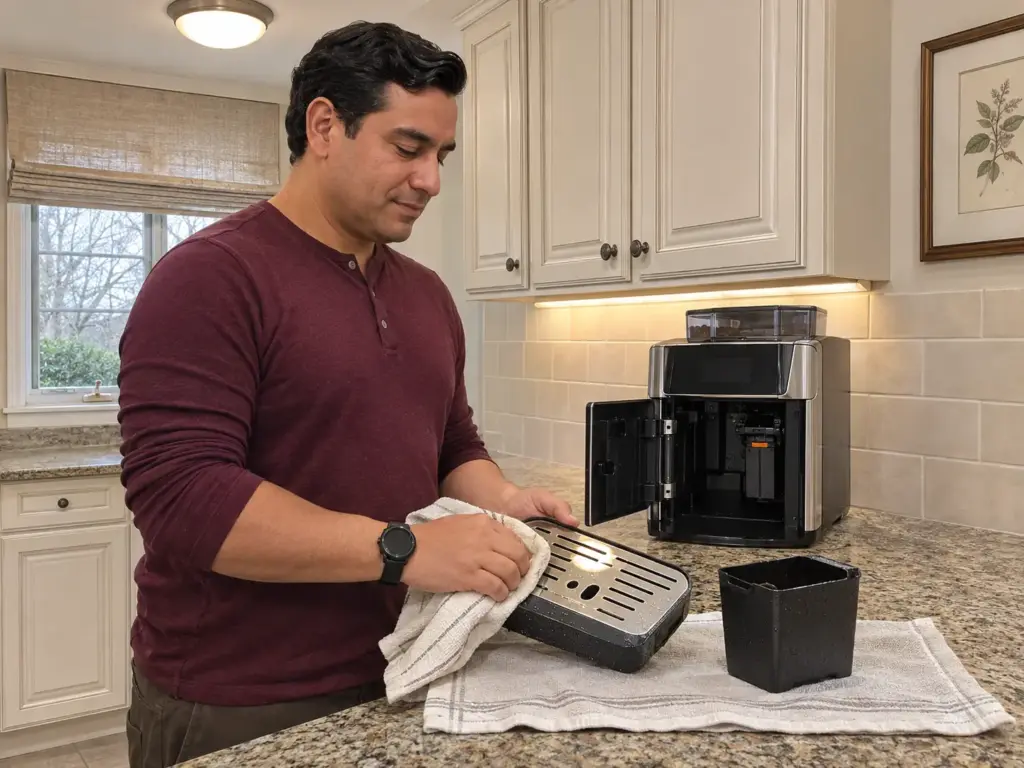
Philips says to rinse the brew group weekly, because a dirty brew group causes poor water flow and affects the taste of the cup. The manual adds the rest of the rhythm: clean the brew group monthly with the coffee oil remover tablet, and empty and clean the grounds container weekly. The brew group is the removable unit the water and the grounds pass through, so what builds up there reaches the next cup.
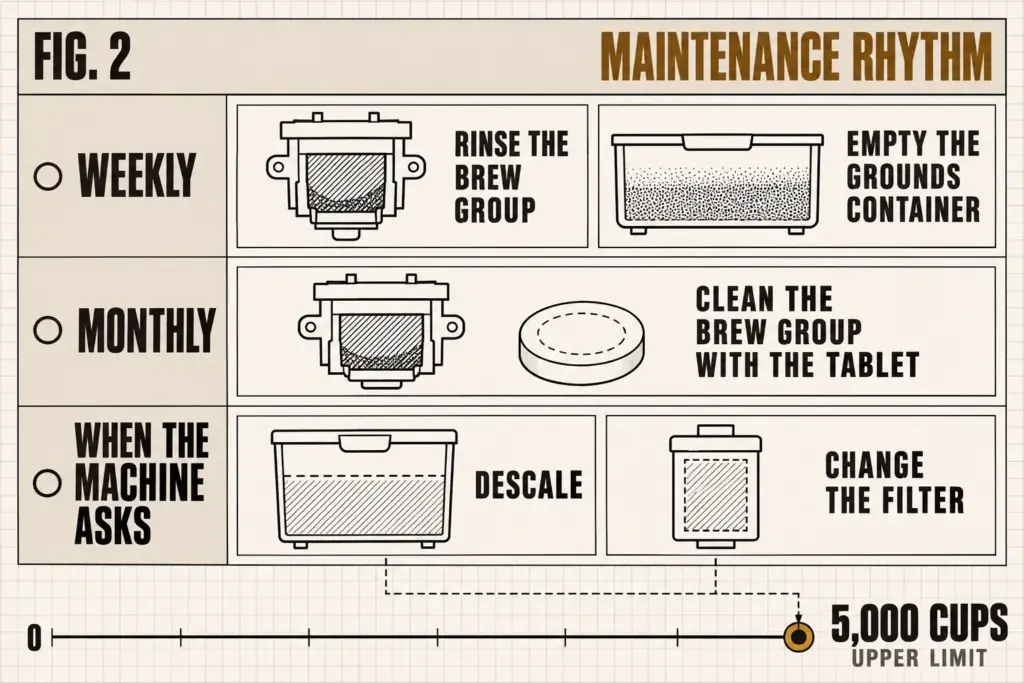
Tie the brew group rinse to a fixed day, the same one you empty the grounds container. The sign it is overdue is water running into the drip tray faster than coffee reaches the cup, and a cup that comes out short.
The filter, the hardness setting and the descale
The water hardness setting is set with the test strip that comes with the machine, and the default is the hard-water setting 4. When the machine asks for a descale, the job takes about 30 minutes.
The AquaClean water filter is where the maker makes its biggest promise: “With AquaClean, you can enjoy up to 5,000 cups before descaling is needed.” Read that as a ceiling. It assumes the filter is changed when the machine asks, and the maker gives no figure for how hard water changes the count. For the other end of the range, the Jura’s descale and filter get their own review in how a premium one-button machine handles the descale and the filter.
The parts that go at years, not months
Failure at weeks to months does happen: some 3300 units break after about two months, and the Magnifica Evo, the rival in the same class, has units that worked for a month and then broke within two. Past that early window the parts follow a pattern.
A long-lived machine asks for small parts in a rough order: the valve o-rings at about two years, the valve itself and the milk container at about four, and a finest grind setting that can stop being fine enough around year three. None of that cancels the rhythm above, and a weekly rinse and a monthly clean keep the schedule slow.
The grinder sign is the same on any machine: the finest setting stops giving a fine grind, and the cup drifts thin again after months of being right. That is the point to learn when worn burrs show up in the cup, because a grinder that cannot go fine enough has stopped doing its job.
Where the Cup Sits Against the Rivals, and the Verdict
Everything before this settles what the Philips is. This section decides whether to buy one, and the honest answer depends on what you drink and what it costs against a machine in the same class. It starts with a concession: the Philips cup is the family’s weak side.
Philips against De’Longhi, cup first
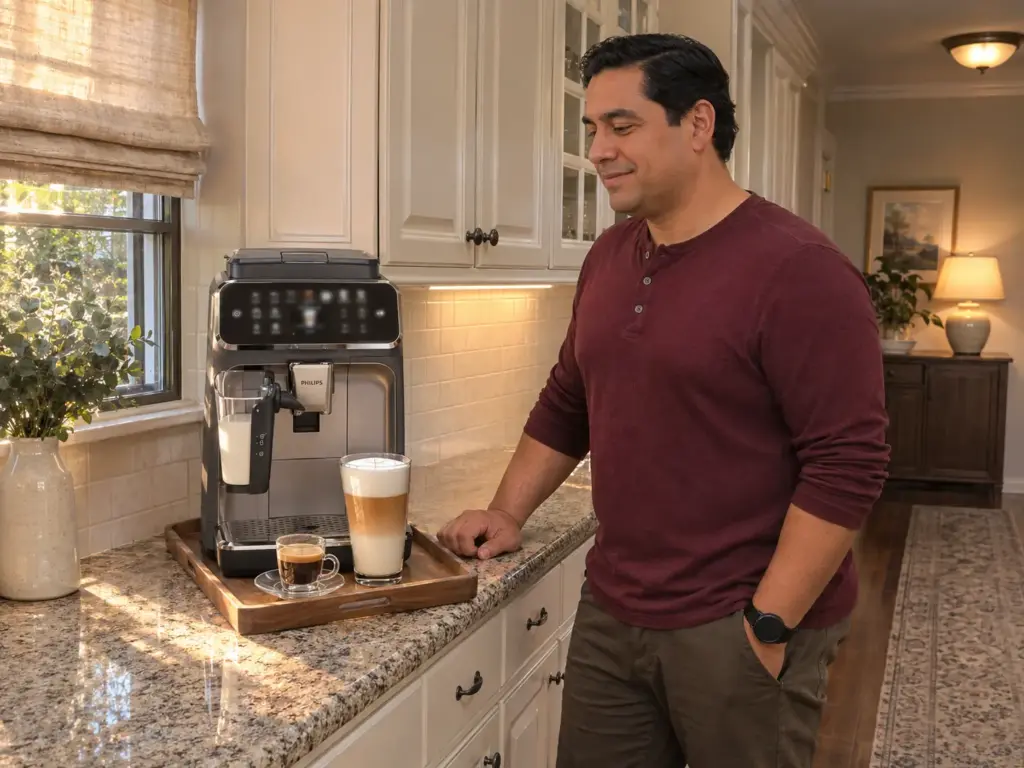
The split follows what you drink. Milk drinks and an easy clean favor the Philips, while a concentrated straight cup favors the De’Longhi, and the thin Philips cup is the recurring weak point. Some 4400 units pour weak, watery cups, and the stock grind sitting coarse is part of the reason. A black coffee or espresso drinker lands on the other side of that split.
The De’Longhi Magnifica Evo ECAM29084SB is the same-class rival. It has a 13-setting conical burr grinder, seven one-touch recipes and the Over Ice recipe mentioned above. Some units worked for a month and then broke within two, which is the same early-failure pattern that touches the 3300.
The by-hand option at the top of the range
The Breville BES881BSS Barista Touch Impress is the semi-automatic route. It has a 30-setting integrated conical grinder, a cold-extraction function and an automatic steam wand for milk, with step-by-step guidance on the screen. You do more of the work and get more control of the cup, and it costs the most of anything in this article. Its flaw sits in the line’s record: the earlier BES880BSS has units that broke within seven months and others that failed at ten.
The verdict, line by line
Buy a Philips for milk drinks and an easy clean when it is on sale at a price clearly below a De’Longhi’s in the same class. At parity, the De’Longhi’s cup wins. A deep enough gap forgives a thin cup, and the cup is the family’s weak side at any price. Where the price gap comes from is laid out in what the money in a bean-to-cup machine actually pays for, which breaks the grinder, the brew unit and the milk system apart.
The 4400 is where the verdict lands for most households, with twelve drinks and two profiles. Take the 5500 only if four people share it, and the 3300 only if the budget forces it and the household has one drinker.
Raise the Aroma First, and Check the Cup Again Around Number 150
The three lines pour the same kind of cup and differ in drinks and profiles, and the 4400 is where most households land. A thin first cup is the machine settling: strength and cup size come before the grind, and the grind waits for the maker’s window. The milk comes out as a single airy foam, the iced button is a hot brew over ice, and a weekly rinse of the brew group slows most of what wears. A Philips earns its place on milk drinks and an easy clean when its price sits clearly below a rival’s.
Around the hundred-and-fiftieth cup, where the manual’s window closes, brew the same drink at the same strength and volume and taste it once more. If it is still thin, that is the moment for the finer grind, and not before.
Tomorrow morning, raise the aroma strength one level, brew your usual cup and taste it before touching anything else. A fuller cup that does not turn dry at the finish means the first move did its job. If you are still choosing between lines or between brands, the other all-in-one machines worth weighing against it are compared on that page.
Frequently Asked Questions
01Are Philips coffee machines any good?
Philips machines are good at milk drinks and an easy clean, and weaker on a strong straight cup. The LatteGo carafe rinses in seconds, while the cup tends to start thin and some units fail within months. A Philips earns its place when its price sits clearly below a De’Longhi in the same class.
02Which Philips coffee machine is best?
The 4400 suits most households, because the three lines differ in drinks and saved profiles and the listings promise no better cup higher up. It brings twelve presets and two profiles. Take the 5500 only if four people share the machine, and the 3300 only if the budget forces it and one person drinks.
03Why does a new Philips LatteGo make watery coffee?
The machine is still settling how much coffee it doses, and Philips says the first cups can be a bit watery. The manual counts five cups of self-adjustment. Raise the aroma strength to the top and bring the cup volume down to medium before touching the grind, which the manual holds for about a month.
04Can a Philips LatteGo make iced coffee?
Yes, though the iced preset brews warm coffee that you pour over ice cubes, following the 4400 and 5500 manual. That makes a hot brew chilled over ice, a different drink from cold brew. Fill the glass two-thirds with ice and use aroma strength 3 so the glass stays flavorful.
05How often should you rinse a Philips brew group?
Rinse it weekly, as Philips advises, and clean it once a month with the coffee oil remover tablet. A dirty brew group slows the water through the coffee and flattens the taste, so a cup that comes out short is the sign it is overdue.

How did your cup turn out?
No comments yet. Tell us what you changed — and whether the needle moved.