



We may earn a commission when you buy through links on this page. It never changes what we recommend. How we pick
On this page7 parts
- The Grind Dial on the E8, and Which Way the Cup Is Off
- Which E8 This Is and What It Pours From One Dose
- Water, the Filter Cartridge and the Descale Prompt
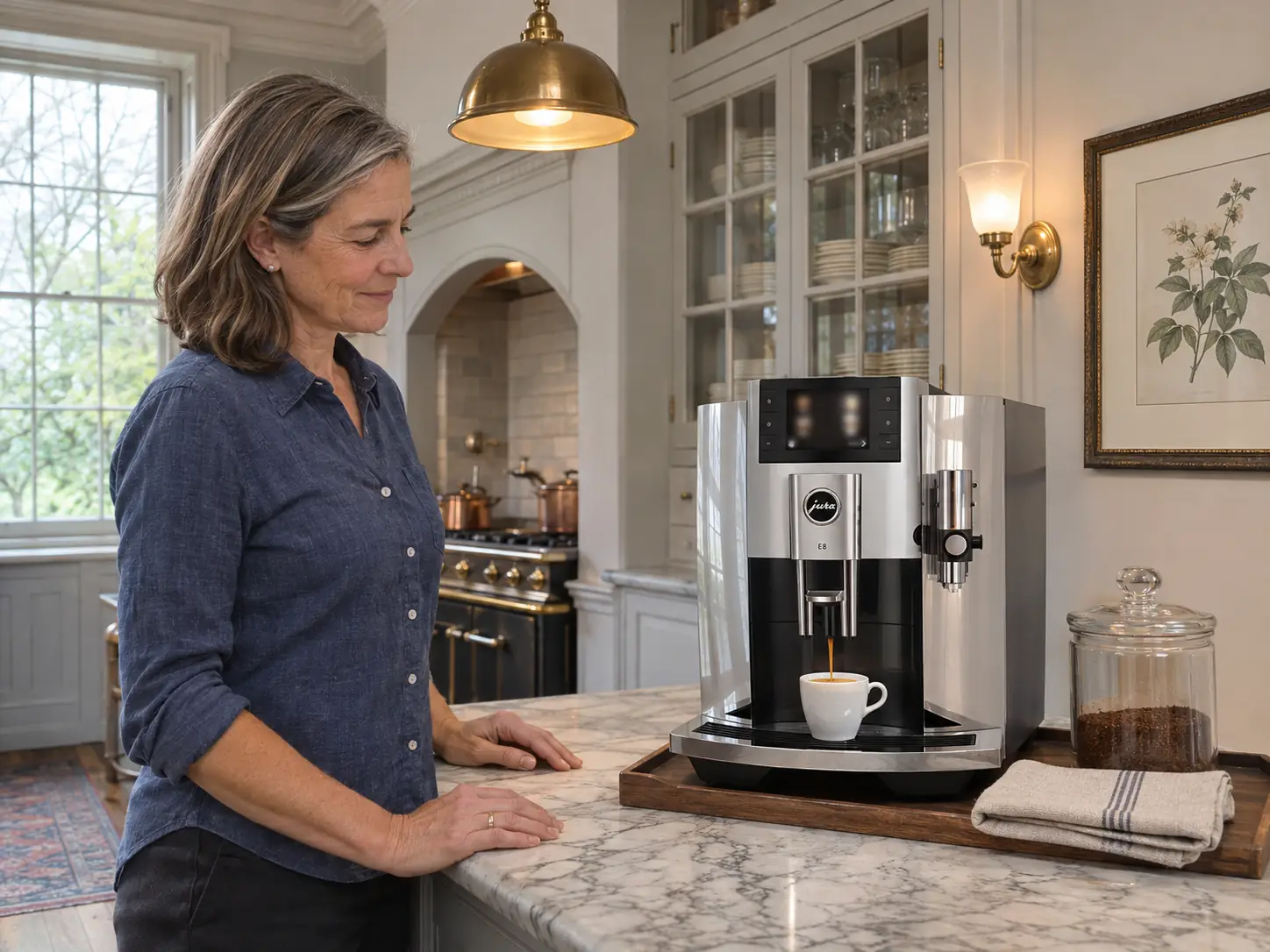
- The E8 on an Ordinary Counter
- The E8 Against the S8 and Z10, and Who Should Skip It
- Read the Cup, Settle the Code, Type the Number
- Frequently Asked Questions
One button on the Jura E8 pours one cup, the screen reports a finished espresso, and the cup in your hand is sharp and thin anyway. This guide to the coffee maker Jura E8 starts with the cup, then covers the model, the water, the counter and the neighbours, with every flaw written down. The beans and the machine are usually innocent: sour means the water left the grounds early, and here two settings decide how early, the grinder dial and the water-hardness number typed on day one. The model code decides which E8 the figures belong to, so the code gets settled before any number does.
Quick Answer
The Jura E8 is a bean-to-cup super-automatic espresso machine that makes espresso, milk drinks and one cup of coffee at a time, with no carafe. Two settings move its cup and its working life: the grinder dial, turned only while the grinder runs, and the water-hardness number typed on the first day.
The Grind Dial on the E8, and Which Way the Cup Is Off
A sour, thin cup and a bitter, harsh cup call for opposite moves, and the E8 gives you a single dial to make them with. Read the direction of the cup first, because it decides which way the dial goes and whether the dial is even the right place to start.

How the Manual Judges a Grind
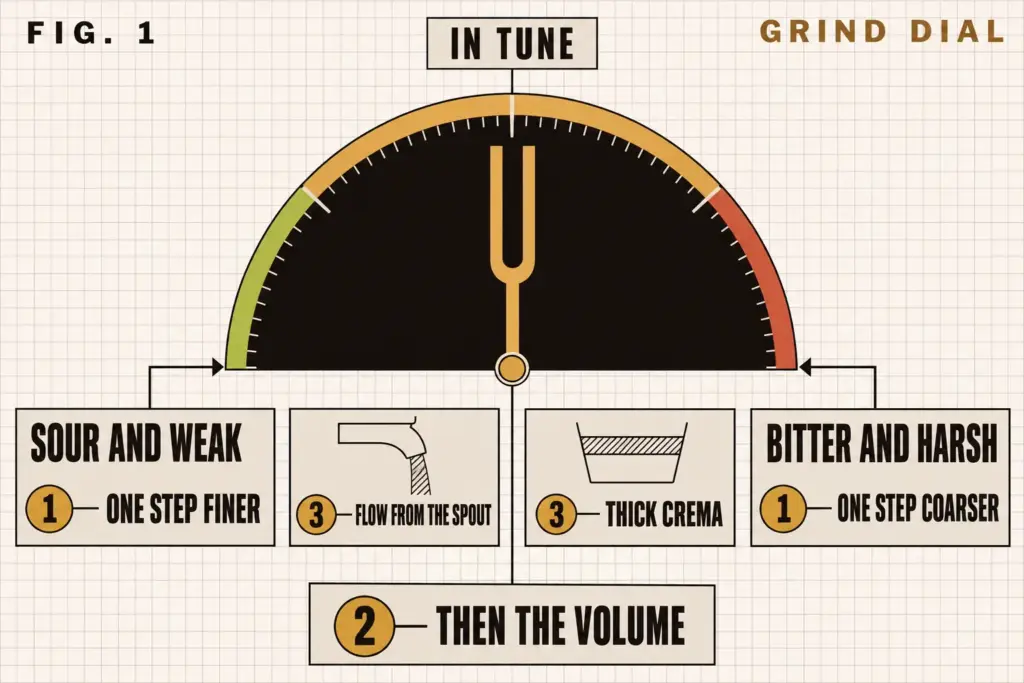
Jura’s test for the grinder dial is the cup itself: the consistency of grind is right when the coffee flows regularly from the spout and a fine, thick crema forms on top. There is no gauge and no number to hit. The scale is continuous and meant to follow the roast of the beans in the hopper, so a new bag of a different roast is a reason to look at the dial again.
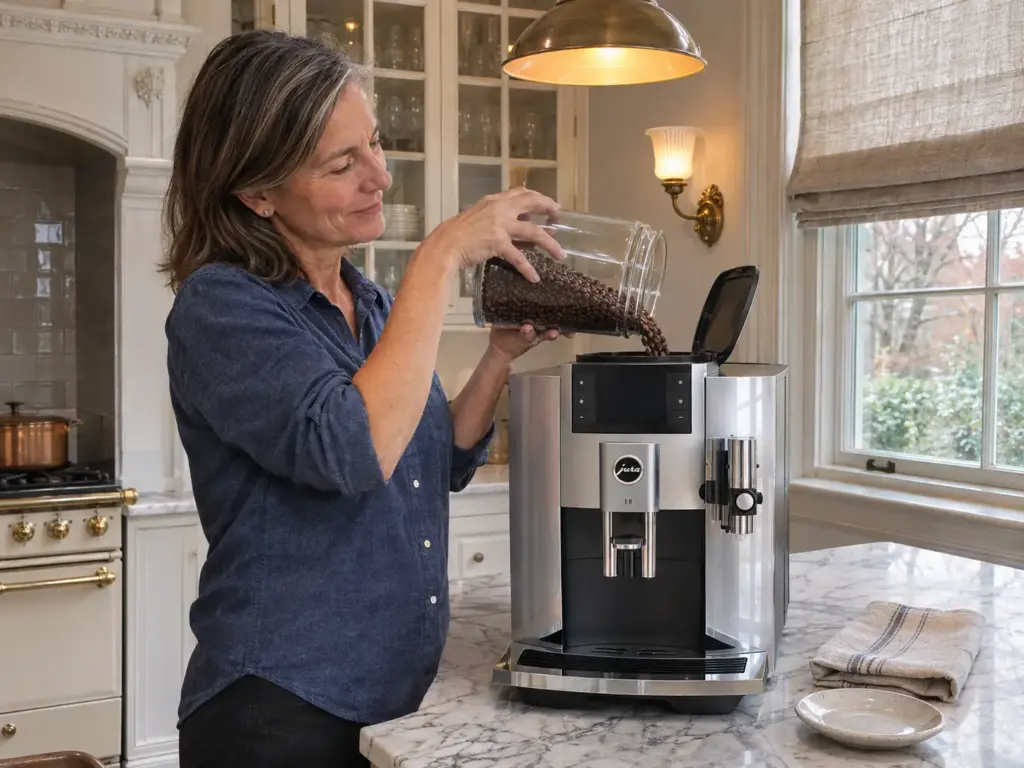
The mechanics matter more than they look. The dial sits behind a small cover, and the manual says to turn it only while the grinder is running: open the cover, press the espresso button, and move the switch while the grinder is grinding. Turning it on a stopped machine can damage the adjustment switch. And after a bean change the grinder still holds some of the old beans, so the first cup of a new bag says little about the dial.
After a bean change, pour the first cup into the sink and judge the second. The grinder keeps a little of the previous beans, so the first dose still carries the old roast, and a dial move made on that cup chases a taste that is already gone.
Sour or Bitter: What the Cup Says About the Dial
Sour and thin means the water left too early: the grind is too coarse, or the shot ran through too fast. A shot that is over in four or five seconds is a grind problem before it is a machine problem. Bitter and harsh points the other way, a grind too fine or a shot that ran too long and pulled out what should have stayed in the grounds. If you want the full ladder from sour to bitter, how grind size changes the taste from sour to bitter lays it out for any grinder.
Here the E8’s paperwork goes quiet. The manual says the grinder can be adjusted on a continuous scale and calls for a coarser setting when coffee only drips, but it never says which way to turn the switch to get finer or coarser. A dial position is not a size anyway, and what a number on a grinder dial actually means is worth a minute before you trust any marking.
So find the direction on the machine, with one step. Start an espresso, move the switch one step while the grinder runs, and watch the stream from the spout. A slower, thicker stream means that step went finer; a thin, fast one means it went coarser.
Then taste. A sour cup that improves with a finer step is on the right path, and a cup that turned bitter went one step too far and wants half a step back.
The second move, only after the grind is settled, is the volume. The E8 pours 0.5 to 2.5 oz (15 to 80 ml) of water per espresso, and a shot that tastes balanced at one volume can tip into bitter a few milliliters higher on a given bean. The volume is the cup you get, since nothing here pours into a carafe, so it moves in small steps. Coffee strength comes next, on eight levels in the expert menu, and the brewing temperature last, with only normal and high to choose from.
When the Coffee Only Drips
Coffee that comes out in drips has a grind cause before a water cause. The manual’s own warning is about very fine ground coffee dropped into the ground-coffee funnel, which can block the system so the coffee only comes out in drips; it also limits that funnel to two level measuring spoons. Check what went into the funnel first. The troubleshooting table adds a grinder set too fine, a hardness number set wrong and limescale in the water tank, with a coarser grind and a descale as the actions.
Take them in that order: what went into the funnel, then one step coarser on the dial, then the descale described below. And if the dial is already at its finest end and the cup is still sharp, that is a different problem, a grinder that has run out of room to go finer, and no dial move will reach it.
Which E8 This Is and What It Pours From One Dose
A dial position only means something on a known machine, and the listings for this one carry several model codes. Settle the model first, then take the maker’s figures before anyone else’s.
The Model Code That Decides Everything Else
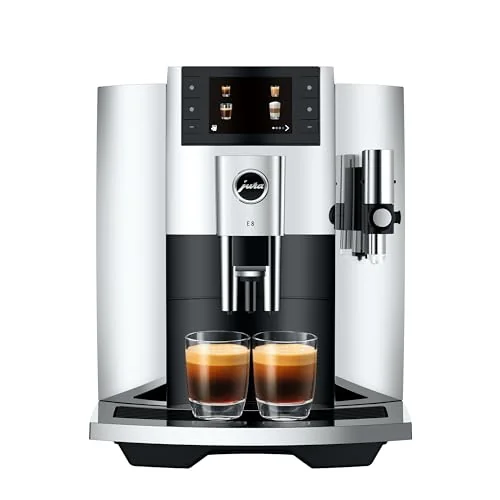
This article describes model 15646, the E8 in Chrome with a 3.5-inch color display. The code printed on the listing is the one to match against the box.
Other codes turn up along the way: 15400 on one Amazon listing, 15722 on a color variant, 15648 on a retailer page next to a separate “Gen 5” entry. A listing with a 2.8-inch display is another generation. Model years are no help either, since 2023, 2024 and 2025 all get attached to what looks like the same machine, so the article keeps the code and leaves the year out.
What One Bean Dose Becomes
Jura’s figures first. The pump runs at 15 bar on 1,450 W, the water tank holds 64 oz (1.9 L), the bean hopper 9.9 oz (280 g), and the brewing unit takes a dose of 5 to 16 g. The machine sets that dose itself from the strength setting, so the weighing that why the dose is weighed before the dial is touched describes for a separate grinder has no counterpart here, and strength and grind should still not be moved together.
Whatever the drink, the E8 builds it for one cup and judges the result the way an espresso is judged at any counter, by the time and the look of the stream, with no lab number involved, which what an espresso grind is judged by, in seconds rather than microns walks through. With no carafe in the picture, the volume you set is the cup you drink.
Where the Maker’s Figures and the Listings Disagree
Amazon’s catalog lists 17 drinks for this model; that is Amazon’s count, not Jura’s, and the 27 that circulates belongs to the S8. The sheet describes the grinder with seven levels, while the manual describes a continuous scale, so a number on the dial is something to verify on the machine before it is trusted. Where a figure differs, Jura’s own sheet and manual are the ones to set expectations against.
Before the card, the one flaw that outweighs the rest. Durability is the weak point of this model, and the part that most often gives out is the water-cover door, so it is the part to inspect on arrival.
Water, the Filter Cartridge and the Descale Prompt
The second number that shapes the machine’s life is typed once, on the first day: the water hardness. Everything the E8 asks for after that, and when it asks, follows from it.
The Hardness Number You Type on the First Day
The manual sets the hardness on a continuous scale from 1 to 30 dH, and the machine asks for it at first use. If you do not know your water, the test strips supplied with the machine settle it: hold one under running water for a second, shake it off, wait about a minute and read the discoloration against the table on the packaging. The harder the water, the more often the machine gives its descale prompt, and a number guessed too low makes that prompt come late, while one guessed too high brings it early.
The dial sets the descale schedule, not the taste. The Specialty Coffee Association’s write-up on water alkalinity puts it this way: “It is far more important to keep alkalinity within a certain range than pH when it comes to choosing a water for coffee extraction.” A sour cup from the E8 is a grind question first and a water question second, so the hardness number is no place to look for a flavor fix.
Use the strip, even if a water report for your area sounds familiar. A report gives a figure for the supply, while the strip reads what comes out of your own faucet, and the number you type on day one sets every descale prompt afterward. A minute with the strip on the first day keeps those prompts from coming at the wrong time.
With the Filter Cartridge, No Descale Prompt
The manual recommends a filter cartridge from 10 dH upward. With a CLEARYL Smart cartridge fitted, the machine does not prompt for descaling at all. The water filter cartridge Jura names for this model is the Jura 24234 CLEARYL Smart+, an RFID cartridge the machine recognizes by itself. How long one lasts varies with your tap water and with how many cups the machine pours, and the value for money follows that number.
That leaves the older cartridge, the Jura 71794 Claris Smart, sold in a pack of three. Amazon lists it for the E8, but the manual names CLEARYL for the no-prompt behavior, so the Claris is not promised to do the same. A pack of three also commits you to three cartridges at once, and the value and the authenticity of that pack both draw mixed ratings; check on arrival that the cartridges are genuine Jura.
Soft water changes the arithmetic. The manual’s recommendation starts at 10 dH, and below it the descale prompt arrives less often, so the filter buys little.
The Descale Itself
The descale program takes about 40 minutes and should run without interruption. Its first step dissolves one blister of three original tablets in 17 oz (500 ml) of water in a separate receptacle. The Jura 66281 descaling tablets are the only agent the manual accepts, and the box reads 3×3, three blisters of three tablets, so one descale uses one blister. Vinegar is out: the manual warns that agents like it may contain substances that could damage the machine or leave residues.
Whether the tablets are good value is an open question, and a descale can leave a taste in the next cups. Run the rinse steps the program asks for, then taste the first cup before deciding the beans went off.
Between prompts, the daily jobs are the drip tray, the grounds container and the milk system. The machine itself reminds you about the first two, and the milk system wants a rinse on every day it is used. Those jobs have nothing to do with the hardness number, and they are the easiest to let slide.
Start a descale when the kitchen is free for the whole 40 minutes, with the 17 oz of tablet solution already mixed in its receptacle. The manual warns that an interrupted descale may damage the machine and says to let the program run to the end, so choose an evening when nobody needs a cup.
The E8 on an Ordinary Counter
The machine also has to live somewhere, and a one-cup machine is judged by what fits under its spout. The footprint, the cups and the daily jobs decide whether it suits the counter you have.
Footprint, Weight and the Cabinet Above
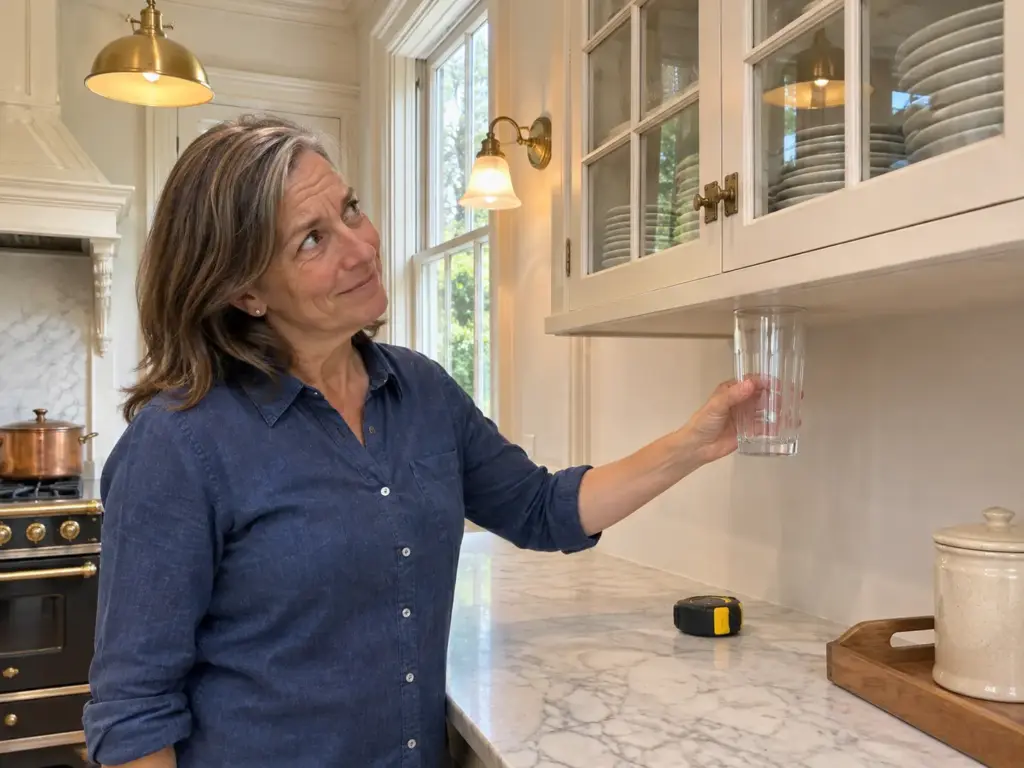
Jura’s sheet gives 11 × 13.8 × 17.6 in (28 × 35.1 × 44.6 cm) for width, height and depth, and the weight is 22.1 lb (10 kg). The manual prints the depth as 43.9 cm (17.3 in), so allow about 17.5 in of counter from the wall. Amazon’s catalog agrees on the outline and the weight but orders the three dimensions differently. The 13.8 in height is the one that decides whether it fits under a cabinet.
Measure the space from the counter to the cabinet with the hopper lid lifted in mind. You open it to fill the beans, and the lid adds height beyond the resting figure.
Run a tape from the counter to the cabinet’s underside and read it against the 13.8 in height plus the room to lift the hopper lid. A gap that clears the closed machine but not the open lid turns every refill into a chore, so settle it at the tape measure.
Which Cups Fit Under the Spouts
The coffee spout clears cups from 2.6 to 4.4 in (65 to 111 mm), and the cappuccino spout from 4.2 to 6 in (107 to 153 mm). A tall glass or a travel mug has to pass that cup-height test before anything else. A mug taller than 6 in will not fit under either spout, and no setting changes that.
The Daily Jobs: The Tank, the Tray and the Milk
The 64 oz (1.9 L) tank is filled by hand, and the drip tray and the 16-serving grounds container are emptied when the machine prompts. Milk drinks on a one-cup machine work best in two moves: pour the espresso first, then add the froth or the hot water by hand instead of stretching the recipe’s volume.
The flaws belong here too, in writing. The housing is plastic. The brew group is fixed, so it stays in the machine. The coffee timer lives in the app, and WiFi comes through a separate transmitter.
The E8 Against the S8 and Z10, and Who Should Skip It
After the fit comes the question of the neighbours, and of who should buy none of them. Stepping up adds some things, costs more to keep, and leaves some households better off with a cheaper machine.
The Three Machines Compared
| Machine | Screen and drinks | Flaw in writing |
|---|---|---|
| Jura E8 Chrome 15646 | 3.5-inch color display, 17 drinks listed by Amazon | Durability, with the water-cover door the usual failure; plastic housing and a fixed brew group |
| Jura S8 Chrome 15653 | 4.3-inch touchscreen, 27 specialties listed by Amazon | A bigger screen and more programs add weight and a bigger bill, and the grind and the water still decide the cup |
| Jura Z10 Aluminum White 15792 | 4.3-inch touchscreen, 51 specialties listed by Amazon | 27 lb (12.2 kg) and the biggest bill of the three, for programs a one-cup morning rarely uses |
What Stepping Up Adds, and What It Does Not Touch
Moving up the range buys a bigger screen, more programs and a longer drink list: the S8 and Z10 are listed with 27 and 51 specialties against the E8’s 17. None of that moves the grind or the water, the two things that decide the cup. The one step-up part that can touch the cup is the grinder, and the Z10’s listing names a different one (P.R.G.2+) from the P.A.G.2 on the other two. Why machines like these cost what they do, and where the grinder caps the cup goes through what a bigger bill pays for.
Spend nothing first. A grind step and a hardness number cost nothing, and they decide more cups than a bigger screen will. If the cup is still off after both, the next suspect is the beans’ roast date, and no model in the family fixes stale beans.
Who Is Better Off With Something Simpler
A super-automatic earns its place on one-cup, one-button mornings. A household that pours a full pot for two gets the same job done by a different machine for a fraction, and the comparison of machines that make both coffee and espresso is where those trade-offs are weighed. For the one-pot morning, a drip machine with a grinder built in grinds fresh and brews a carafe with no milk system to rinse. And if the question is temperature, drip machines judged by their water temperature sorts out which ones get the water hot enough.
The E8’s flaws repeat in short: durability, the plastic housing, the fixed brew group, the app and the extra transmitter. If any of those is a deal-breaker, the cheaper machine wins.
Read the Cup, Settle the Code, Type the Number
Read the cup before touching the dial: sour and thin goes finer, bitter and harsh goes coarser, and the volume moves last. Settle the model code before trusting any figure, since 15646 is the E8 this article describes. Type the hardness once, from a test strip, and let the filter decide the descale plan. Check the spout against the mug before the counter, and remember that the grind and the water make the cup on every machine in this family.
For later, watch the descale prompt and the cartridge’s life as the weeks of brewing pile up, and the grounds container and drip tray on the schedule the machine sets. A prompt that comes far sooner than the hardness number suggests points to a number typed wrong, and a cartridge that runs out early on a hard-water counter is worth dating the day it goes in. By the second month of regular use, those signs show whether the machine has settled in.
Tomorrow morning, make one grind step while the grinder runs, pour one cup, and taste it: a slower, thicker stream and a cup that has lost its sharpness mean the step went the right way. Once the dial is settled, the beans are the next thing to look at, and whether a light or a dark espresso roast suits a machine like this is where that starts.
Frequently Asked Questions
01Is the Jura E8 a good machine?
It makes a steady, adjustable cup from a one-button machine, and the weak point is durability, with the water-cover door the part that most often gives out. The grind dial and the hardness number decide the rest.
02What are some common problems with Jura coffee machines?
Three recur on the E8: limescale, which the hardness number and the descale prompt manage; coffee that only drips, which the manual ties to very fine ground coffee in the funnel; and durability, with the water-cover door singled out.
03How much does it cost to run a Jura E8?
Running it means buying either a filter cartridge or original descaling tablets, depending on your water. With hard water, 10 dH or more, the manual recommends the cartridge; otherwise each descale uses one blister of tablets, and the box reads 3×3.
04How often do you descale a Jura E8?
It depends on the hardness number typed on the first day, since the machine prompts you when it needs one. With a CLEARYL Smart cartridge fitted, it does not prompt at all. The program takes about 40 minutes.
05Can you use vinegar to descale a Jura E8?
No. The manual warns against vinegar, which may contain substances that could damage the machine or leave residues, and accepts only the original Jura descaling tablets.



How did your cup turn out?
No comments yet. Tell us what you changed — and whether the needle moved.