




We may earn a commission when you buy through links on this page. It never changes what we recommend. How we pick
On this page9 parts
- What the Spout Actually Does, and the Pour a Substitute Has to Match
- The Brewers That Never Needed a Spout
- Test Any Substitute With a Scale and a Timer
- Free Pourers From the Kitchen Drawer, and Where Each One Gives Out
- The Small Tools Sold for the Job
- Water Temperature When the Kettle Cannot Hold It
- When a Gooseneck Kettle Earns Its Place, and When It Does Not
- Run One Test Pour Tomorrow, Then Recheck as the Weeks Go By
- Frequently Asked Questions
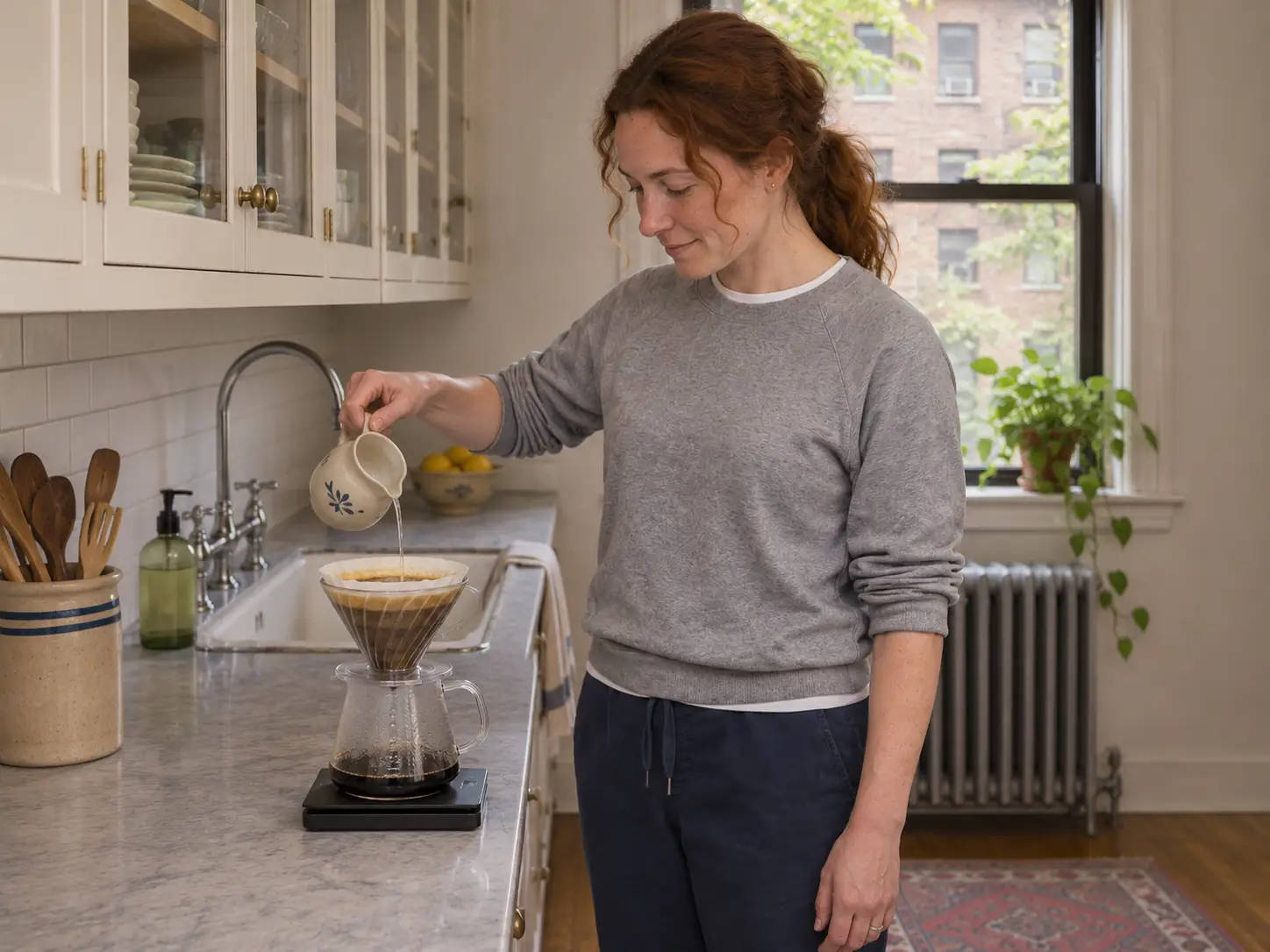
The dripper is on the mug, the filter is rinsed, and the kettle you already own sends a rope of water as wide as a pencil into one spot of the bed. By the time the bloom is over there is a crater in the grounds, and the cup tastes thin and sharp. An alternative to a gooseneck kettle is easier to find than it sounds, because the spout is only a gate on flow rate: whatever pours the water at about the same pace gets the same result, whatever the metal looks like. What follows runs in the order of the decisions: the brewers that never needed a spout, a way to test any pouring vessel on a scale, what the kitchen drawer holds, what is sold for the job, the water temperature, and the point where the spout pays for itself.
Quick Answer
Most brewers never needed the spout, and for the rest the test is a single pour on a scale:
- Keep your kettle for drip, French press, AeroPress, Clever or moka pot.
- Pour a V60, Chemex or Kalita from a creamer, pitcher or lidded paper cup.
- Tare a cup on a scale and pour for 30 seconds.
- Aim for 60 to 90 grams, about 2 to 3 grams a second.
- Pour lower and tilt less if the scale reads higher.
- Rest the boil half a minute so the water lands near 200°F (93°C).
What the Spout Actually Does, and the Pour a Substitute Has to Match
The gooseneck spout gets the credit for good pour-over coffee, but it sets only one thing: how fast and how narrow the water arrives. That pace is the bar every substitute is held to, and a kitchen scale can read it, which turns whether you need the spout at all into a measurement instead of an opinion. A wide spout does something different to the bed, and the cup shows it within the first minute.
A Narrow Stream, a Level Bed
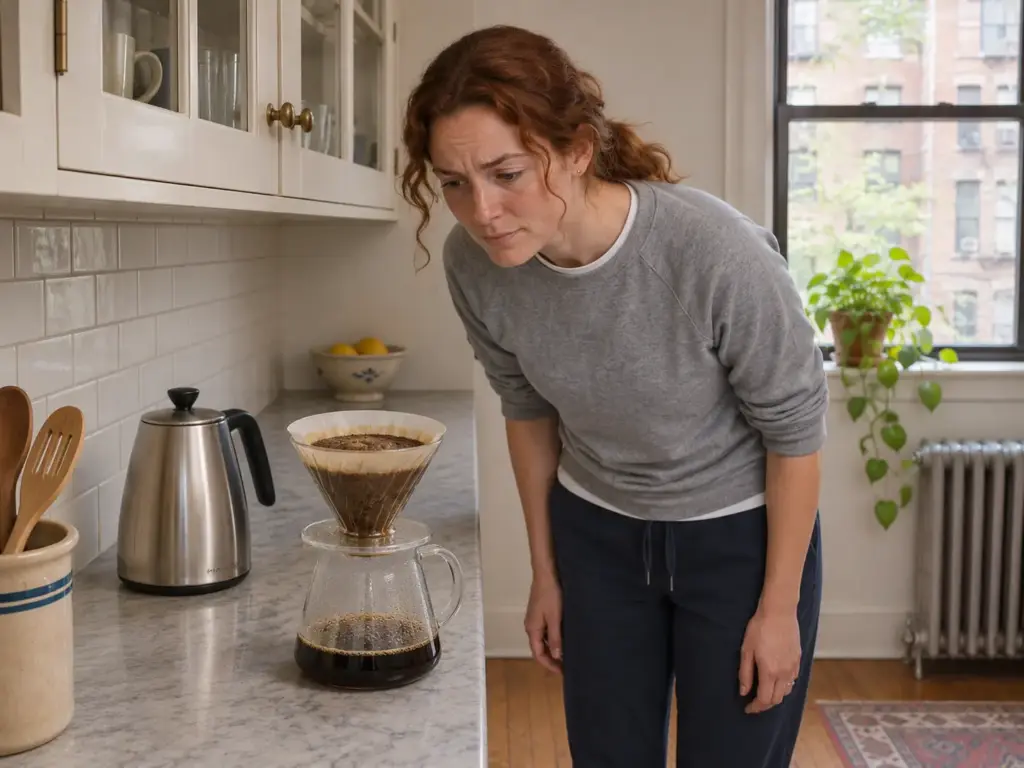
The working target is about 2 to 3 grams of water a second, which puts 250 ml (8.5 fl oz) into the dripper over roughly a minute and a half to two minutes. At that pace the bed soaks up water about as fast as it arrives, so the surface stays level, the bloom (the first wetting, where fresh grounds puff up and let out gas) rises evenly, and every gram of coffee gets wet. Temperature and extraction figures come with an owner because the SCA writes them down; according to the SCA’s published standards, “A standard is a documented set of guidelines or requirements used across an industry to create consistency, quality, and shared best practices.” The flow figure is the one you measure yourself, with the 30-second scale test further down.
The routine a substitute has to imitate, the bloom, the slow circles and the height of the pour, is laid out in the pour routine a gooseneck makes easy.
What a Wide Spout Does Instead
A wide spout at full tilt delivers several times that pace, and the stream arrives with enough mass to dig. It cuts a channel, the water takes the shortest path down it, and the grounds on either side stay barely touched while the strip along the channel gets washed far too long. The cup points one way first: sour and uneven, because part of the dose is under-extracted and gave up its acids and little else, with a harsh edge from the over-extracted strip along the channel. The dripper shows it before the cup does, because the grounds climb the wall of the cone on one side while the other side stays dry.
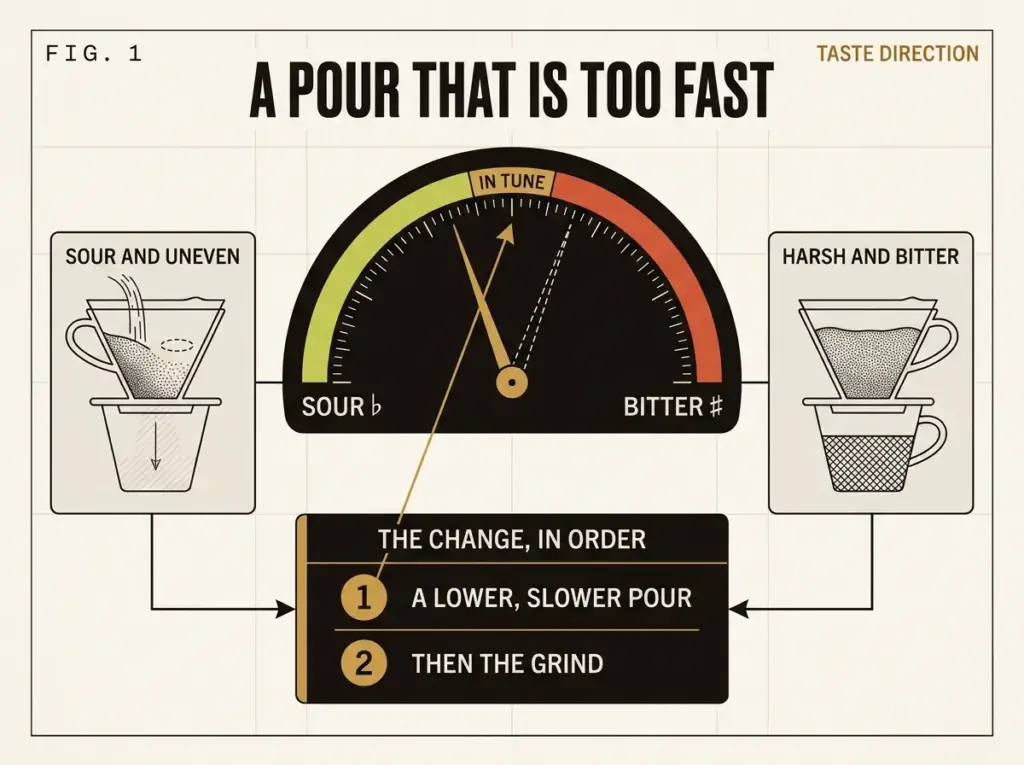
Before anything gets bought, the adjustment is a slow pour, held lower, from the same kettle. A smaller tilt cuts the pace, and a spout held close to the bed takes the force out of the landing. If the pour was the problem, the next cup comes out rounder and more even; if the sourness stays exactly where it was, the pour was never the cause and the grind is the next suspect.
Does a Regular Kettle Work for Pour-Over
It does, as long as the stream it makes can be slowed to that pace. A wide spout runs faster and is harder to aim, but the kettle that floods the bed at full tilt can land inside the band when it is tipped less, held low and filled only halfway, since less water above the lip means a slower stream. Some wide spouts never get there, which the 30-second test settles in a minute.
The pace also depends on the brew. One mug at 2.5 grams a second needs about 100 seconds of pouring, while a 500 g Chemex brew at the same pace needs more than three minutes, so a bigger brew is where the upper half of the band earns its place.
The Brewers That Never Needed a Spout
For most coffee on most days the spout question never comes up. A drip machine, a French press, an AeroPress, a Clever or a moka pot has no pour to aim, so only V60, Chemex and Kalita readers need the rest of this article. The weekday drip pot and the Saturday V60 can share a counter, and only one of them cares where the water lands.
Drip Machines, French Press, AeroPress and Moka Pot
A drip coffee maker’s showerhead does the aiming, spreading water over the whole bed at a pace the machine sets, so a sour pot from one is decided by the grind and the water temperature, and the grind for a drip machine that runs sour is the lever to reach for. A French press is pure immersion: the water goes in at once, the grounds steep, and the plunger separates them, which leaves a coarser setting as the only adjustment that matters. AeroPress’s own steps are to pour water over the grounds, stir, let it steep 30 seconds and press, so nothing needs steering there either, and the grind sets how that short steep tastes.
A moka pot has no pour at all: the water sits in the base, and heat pushes it up through the grounds. A drip machine can still deliver a sour pot when it never reaches the temperature window, which is a question for the water temperature section below and a probe, and the spout never enters into it.
The Clever Dripper Steeps Instead of Pours
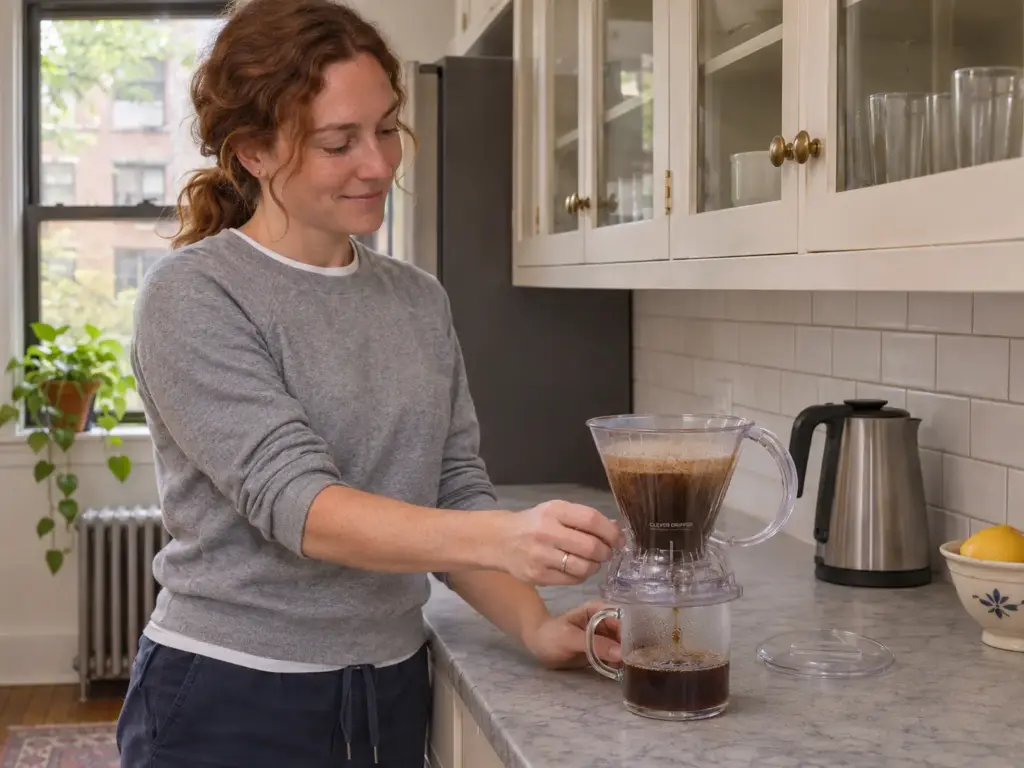
One purchase removes the pour question altogether, and it is an immersion brewer shaped like a cone. The Clever Coffee Dripper holds 18 oz (about 530 ml) and drains through a release valve that opens when the brewer is set on a mug. You pour everything in at once, let it steep, then set the cone on the cup and walk away while it empties. The water never has to fall through the bed under pressure, so a rough pour stops mattering.
Durability is the soft spot of its record: some cones crack, and it costs more than a plastic cone feels like it should. The valve also opens under the weight of any flat surface, not only a mug rim, so a Clever set down on the counter with coffee still inside empties onto the counter.
A Flat Bed Forgives a Rough Pour
A deep cone drops the water a long way before it meets the bottom of the bed, and a flat bed shortens that fall. Kalita lists a flat bed with a 2-inch dripping area and a 4-inch bottom on the Kalita Wave 185 Stainless Steel Dripper, which takes only Wave 185 filters, so a hurried pour digs less of a crater than it does in a V60. Forgiving is a long way from immune, since the stream still lands somewhere and a fast one still disturbs the bed. The size is the argument against it: the 185 is a small cone, and the 2 to 4 cups on its label means small cups.
Test Any Substitute With a Scale and a Timer
The shape of a pouring vessel says nothing about how it pours. One 30-second pour onto a scale does, and it costs nothing if there is a scale in the house. The reading shows whether the creamer, the measuring cup or the kettle itself lands in the band, and which way to move if it does not.
Tare, Pour for 30 Seconds, Read the Grams
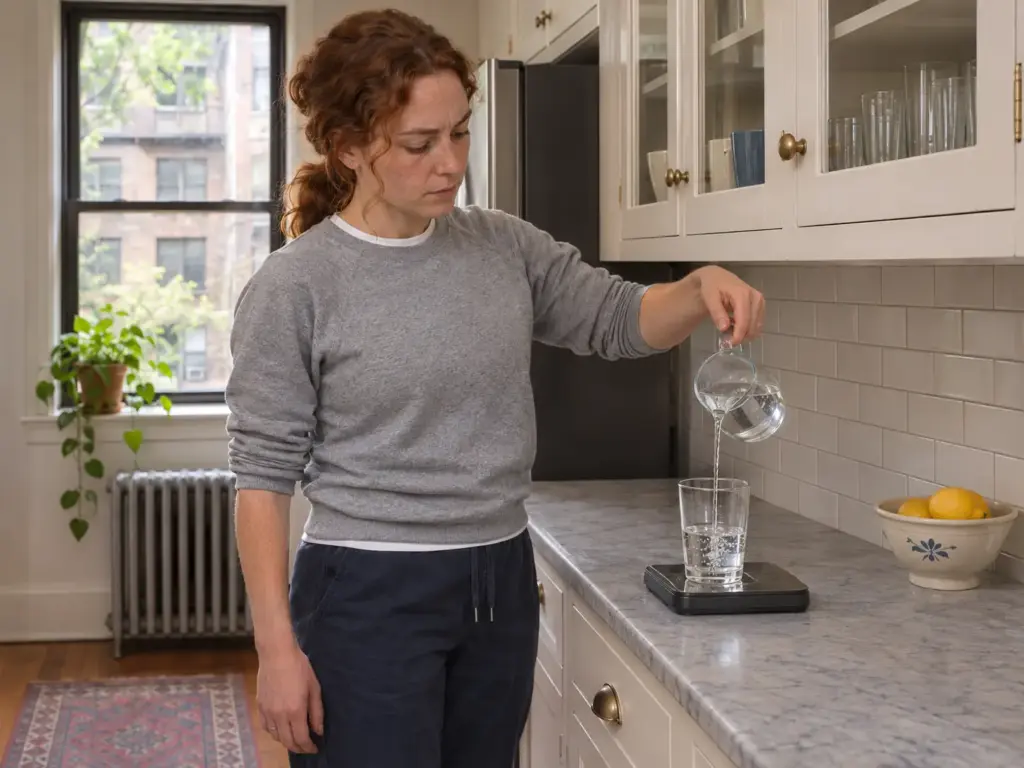
Set the cup or server you will brew into on the scale, press tare, and pour plain water from the vessel in question for 30 seconds by the timer, at the pace you would use for the brew. The display is the answer: 60 to 90 grams (about 2 to 3 fluid ounces) is the band, the same 2 to 3 grams a second from earlier. The steps for taring cleanly and pouring by weight are in how to tare twice and pour by weight, and they matter here because the whole test is one number.
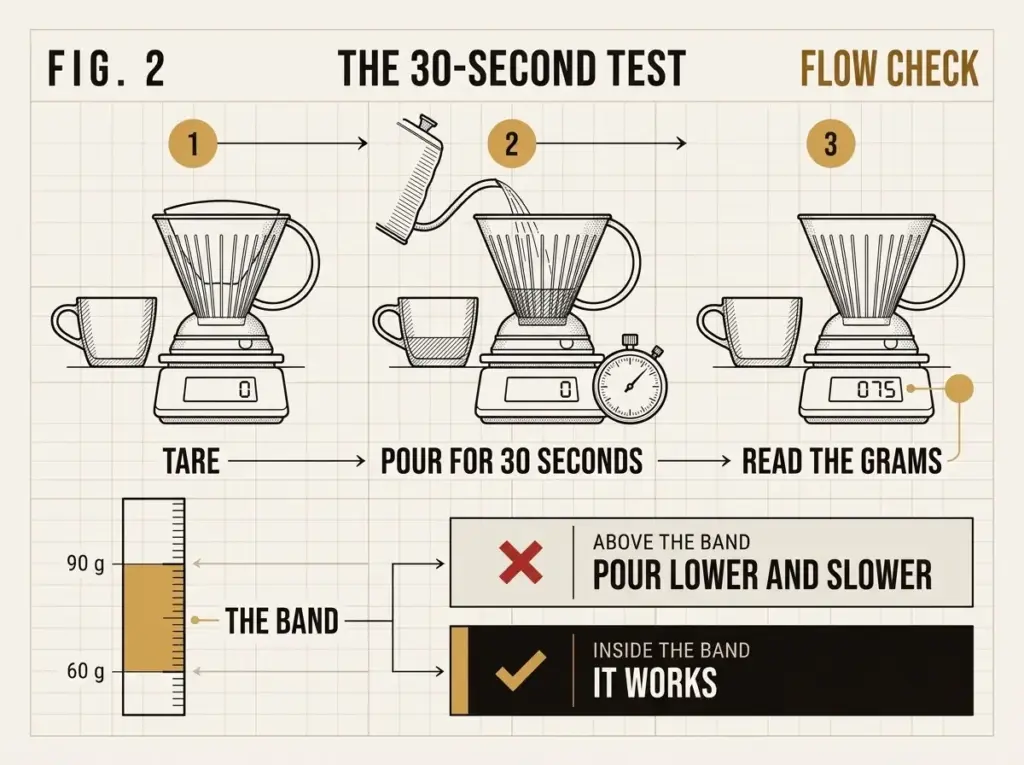
Start the timer once the stream has settled. The first tilt of a measuring cup or a creamer surges, so the first five seconds read high even when the rest of the pour crawls. The same coffee scale that proves the stream also weighs the dose, which puts it ahead of every gadget in this article in the order of purchases.
Run the test twice, once with the vessel full and once with it half empty. A jug pours slower as it empties because less water sits above the lip, so the reading you get when it is full is the fastest that vessel will ever pour.
Too Fast: Pour From Lower
A reading above 90 grams means the pour is too fast, and two levers fix it without spending anything. Tilt sets the pace: a smaller tilt puts less water over the lip, so less leaves it. Height sets the force: held a couple of inches over the bed, the same stream lands gently instead of drilling in. Move the tilt first, run the 30 seconds again and read the grams.
A pour inside the band with a cup that is still sour points at the grind and leaves the vessel alone, and the grind to change before the pour is where the next adjustment goes, a step finer, with a taste after it. When the stream was the problem, the next cup comes out rounder and more even. Overshoot into a pour that crawls and the bed stalls, so the cup turns dry, bitter and astringent.
Too Slow or Too Little: Rest the Jug on the Rim
Under 60 grams the stream is too slow, and the cup drifts toward bitter because the bed stays wet too long. Slowing the pour is good advice until the water stops leaving as a stream: at a shallow tilt a wide lip lets it dribble down the underside and miss the bed, so past a certain point slower becomes messier. Resting the lip of the jug on the rim of the dripper steadies the wrist and lets you tip a little further without chasing the water.
An 8 oz creamer holds a little less than the 250 ml (8.5 fl oz) a mug brew uses, so the last pour is a refill between pulses while the bed is still wet. Free first means the scale before any gadget, and what a scoop gets wrong compared with a scale is the reason to measure the refill in grams too.
Free Pourers From the Kitchen Drawer, and Where Each One Gives Out
Almost anything with a lip can pour a pour-over, and each one fails in a different place. They run below from the steadiest to the least steady, with the flaw of each written down, since every one of them shows up on the scale.
A Small Creamer or Teapot
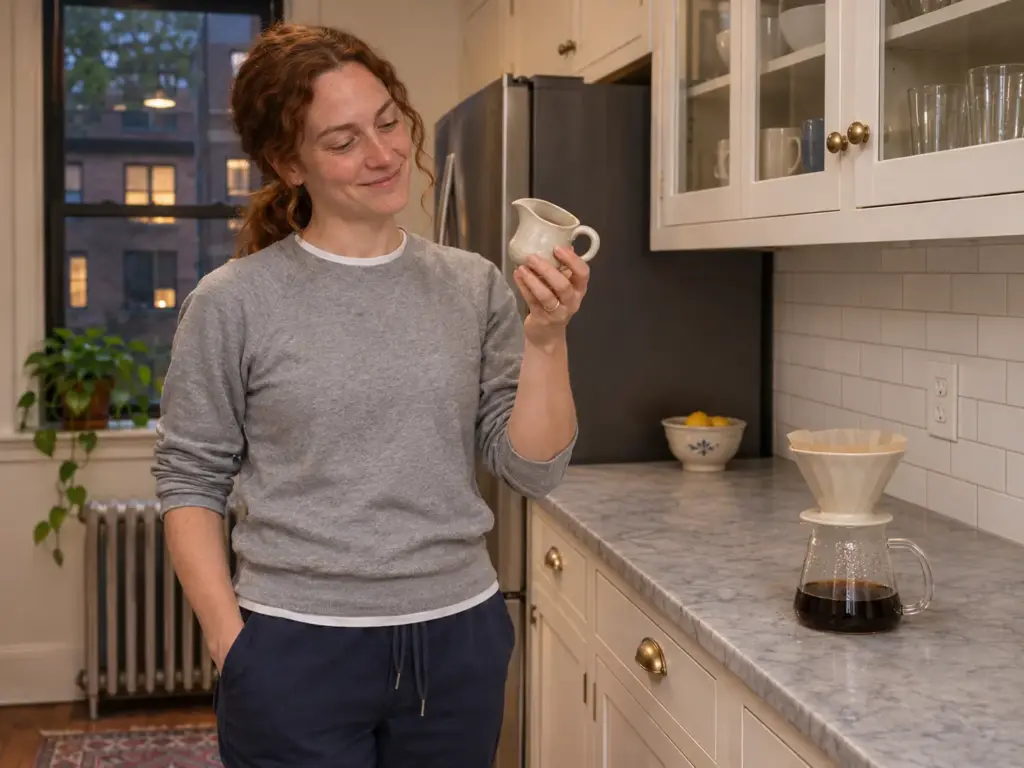
An 8 oz ceramic creamer from the cupboard gives a steady, narrow stream, and a small teapot does the same for a bigger brew. Ceramic that sat in a cold cupboard pulls heat out of the first fill, so it needs preheating, and the half-minute rest off the boil covers the other half of that arithmetic. The flaws are capacity and weight: it holds less than a mug of coffee needs, and a full teapot gets heavy for a wrist that has to stay steady.
The same trick turns any kettle into a non-electric gooseneck. Boil in the kettle you own, pour the water into the spouted jug, then pour from the jug. Two vessels, no electronics, a spout for free; the spouted one loses heat, so set the kettle 4°F (2°C) higher.
Pour 250 ml of water into the creamer from a measuring cup and mark the level on the outside with a strip of masking tape. On ordinary mornings the tape replaces the scale for the water, and the scale only comes out again when the pour itself needs checking.
A Measuring Cup, and Why It Surges
A glass or plastic measuring cup with a lip pours well once it is moving, but the first tilt surges: the water leaves in a wave instead of a stream, and the bed gets a hole before the bloom is over. Starting with the cup nearly level and tipping it slowly takes most of the surge out. The marks on the side double as the volume check when the scale is in a drawer, and the thin walls cool the water a little on the way through.
The Paper Cup With a Pinhole
A lidded paper cup with a pinhole in the lid is the improvised pourer of last resort. Aim is the one thing it does well, because a pinhole is as narrow as any spout gets. Heat and capacity are where it fails: the thin wall pulls warmth out of the water, the paper softens as hot water sits in it, and a lidded 16 oz cup barely holds a full mug’s worth. It handles one pour for one cup.
A Spoon or Strainer Over the Bed
A spoon held just above the bed, with the water poured onto its back, turns one stream into a spread, the free version of a shower screen. A mesh strainer or the plunger part of a French press does the same job over a wider area, and an egg separator works on the same principle. All three fix aim and none fixes pace, and each pays for the spread differently: a hand held steady for two minutes is rarely steady, the spoon stirs the surface, and the small holes clog with fines until the water backs up and then dumps.
The Small Tools Sold for the Job
When the drawer is not enough, two small Hario pieces answer the question without buying a kettle: one is a spouted vessel and the other spreads the stream. Each does one half of a gooseneck’s job and leaves the other half to your hand. The figures below are Hario’s own.
Hario V60 Air Drip Kettle: a Second Vessel With a Spout
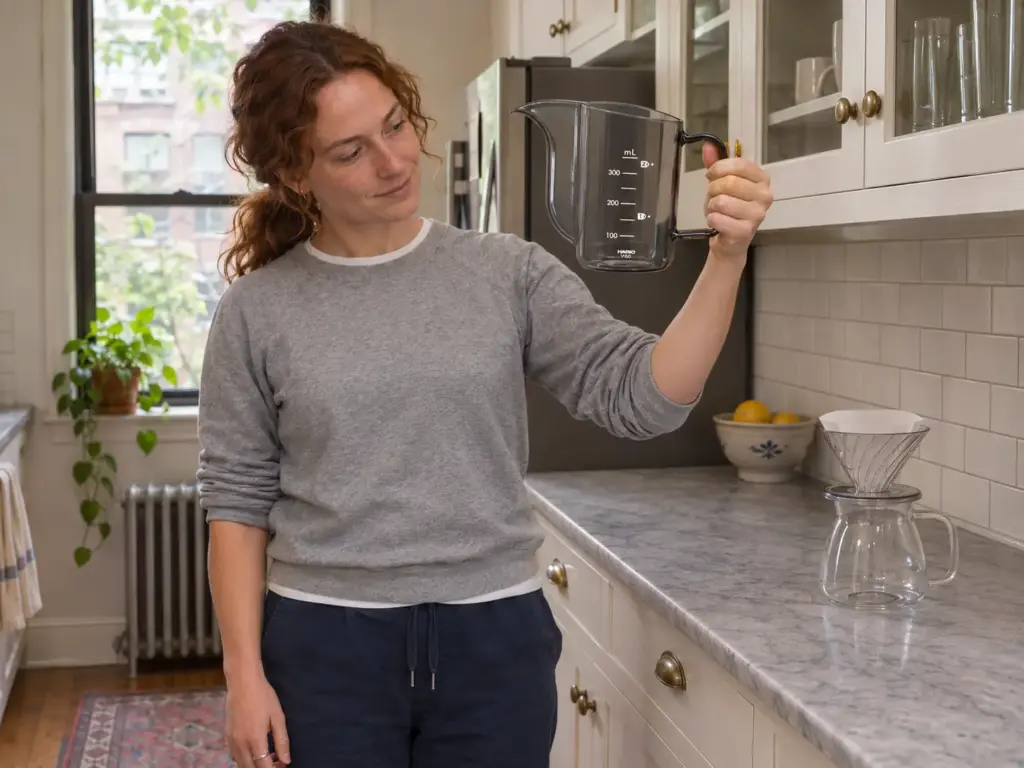
The Hario V60 Air Drip Kettle is the drawer’s two-vessel trick made into a product: a transparent jug with a spout that holds 350 ml (about 12 fl oz), with marks every 50 ml from 100 to 350. The kettle you already own heats the water, the Air Drip Kettle does the pouring, and the marks let you stop at 250 ml without a scale on the counter.
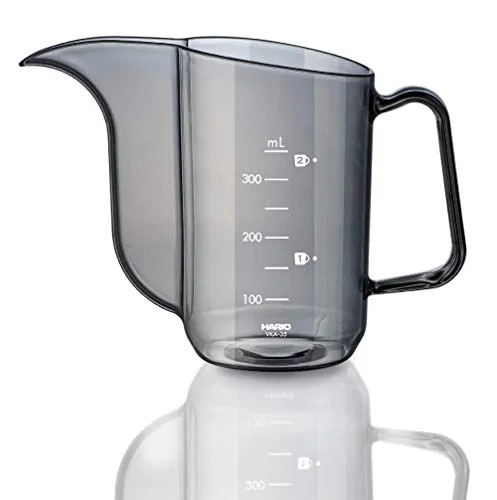
Heat and size are the limits. The resin shell takes warmth from the water when it has not been rinsed with hot water first, so fill it once, tip it out, and set the kettle 4°F (2°C) higher than the target. And 350 ml is one large mug, so a two-cup brew means a second fill.
Hario V60 Drip-Assist: Aim, Not Speed
The Hario V60 Drip-Assist is a shallow perforated dish that sits inside a size-02 V60, measuring 4.4 × 4.4 × 2.1 in and holding 140 ml by Hario’s listing. It takes the wide stream a regular kettle delivers and hands it back as many thin ones spread over the bed, so the pour stops digging a single hole.
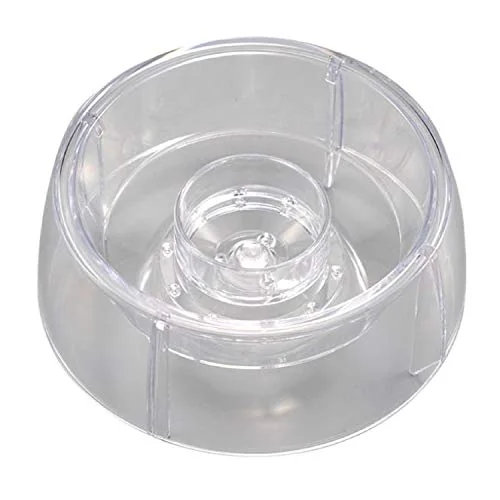
It does not slow the kettle. A fast, wide spout still delivers the same grams a second, only spread out, so a kettle that reads 150 grams in the 30-second test still reads 150 grams with the dish in place. A diffuser is often named as the stand-in for a gooseneck, and that holds for aim and fails for speed. What the dish does for the taste of the cup is less settled than what it does for the look of the pour.
The holes slow down as fines clog them, and resin put away wet holds old coffee oils, so rinse it after each brew. A diffuser does not become obsolete when a gooseneck arrives: on a brew where the surface should stay undisturbed it keeps a place on the counter.
Which One Fixes Which Problem
Match the tool to the failure the scale found. A reading above the band with a crater in the bed is a speed problem, and the Air Drip Kettle fixes speed because it is a second vessel you can pour slowly. A reading inside the band with a bed that still digs one spot is an aim problem, and the Drip-Assist fixes aim. If neither is enough, the spout itself is the answer, and which gooseneck kettles hold up past the first month is where that purchase gets sorted out.
Water Temperature When the Kettle Cannot Hold It
A substitute for the spout often means a plain electric or stovetop kettle, and a plain kettle raises a second question: how hot the water is when it lands. A probe and a short wait answer it, and a new kettle does not enter into it.
Rest the Boil and Check at the Grounds
The SCA puts a number on the target: the Specialty Coffee Association’s certified home brewers hold the water at 198 to 205°F (92 to 96°C) through the whole brew with even water distribution, and the association describes them this way: “SCA Certified Home Brewers are coffee makers that meet SCA’s rigorous standards for brewing quality, consistency, and performance.” That window is only 7°F (4°C) wide, and a kettle without a set point has to be steered into it.
A boil is 212°F (100°C), so the simple route is to rest the kettle about 30 seconds off the boil and start there, which lands the water in the jug around 195 to 205°F (90.5 to 96°C). A thin-walled vessel takes some of that heat on the way through, so set the kettle 4°F (2°C) higher whenever the water has to wait in a creamer or a resin jug.
What a Stovetop Kettle Loses in Ten Minutes
A stovetop kettle has no hold, and the numbers show what that costs. In Food & Wine’s kettle test a stovetop model fell from boiling to 199°F (93°C) in ten minutes and to 171°F (77°C) in thirty. Ten minutes is about the length of one pour-over session, so a stovetop kettle starts inside the window and leaves it by the last pour unless you reheat it or check it.
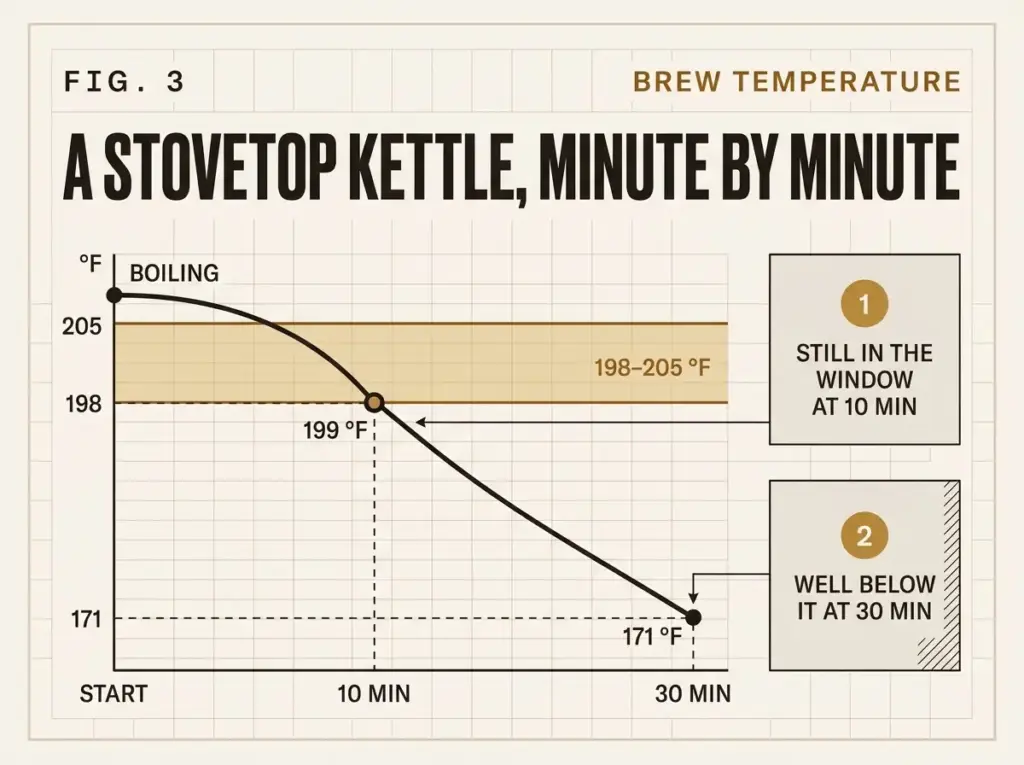
How fast a stovetop kettle gets to the boil depends on the burner, since gas, glass-top and induction all differ. In practice that means doing the bloom and the first pour from the hottest water and finishing with the last of it.
One Probe Checks Every Kettle in the House
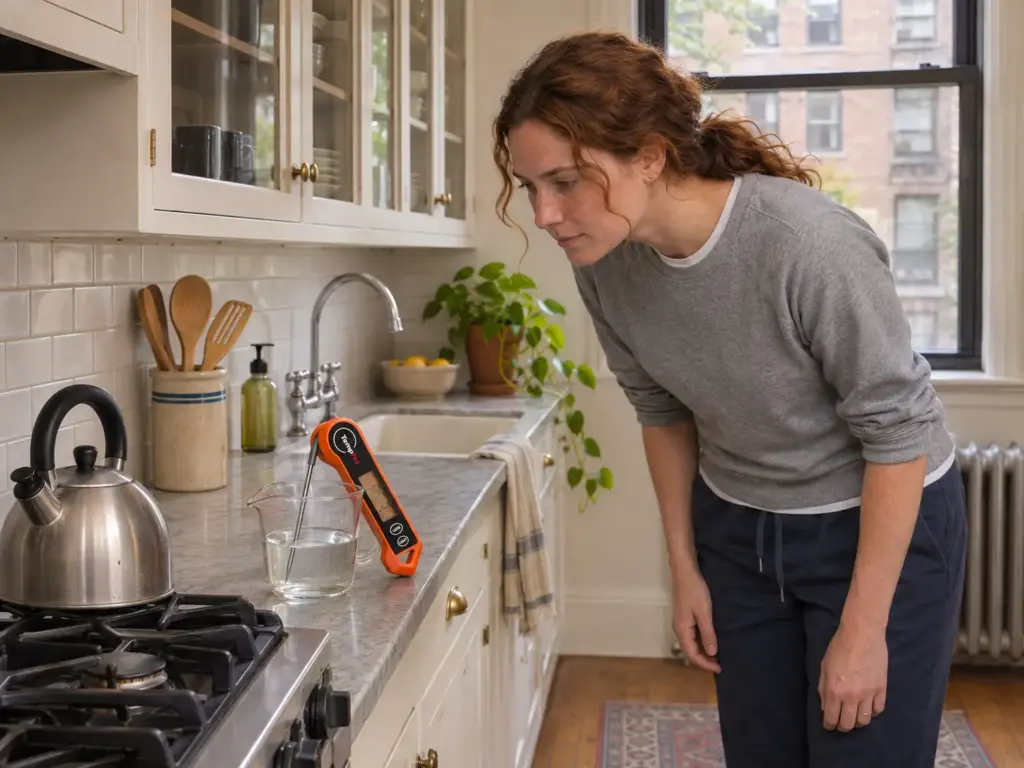
A kettle’s display reads the water inside the kettle, and the water that matters is the water on the bed, which is the gap what a kettle’s display does not measure explains. A probe closes it. The TempPro TempSwift TP19H reads in 1 second to within ±0.9°F, has a 4.3-inch probe, a calibration function and an IP65 rating, and it checks the kettle already on the counter: a boil-only kettle with a probe in your hand has a set point after all.
Two things go wrong in its record: readings that disagree with a reference thermometer, and a housing that feels light in the hand. Check it in ice water (32°F, 0°C) before trusting it, and the routine for how to take the reading at the grounds covers where to hold it.
Put the probe in the cup or jug the water was poured into, in the first seconds of the pour, and leave the kettle itself out of it. The kettle always reads hotter than the water that reaches the bed, and the cup is the closest stand-in for the bed.
If a spout does end up on the list, a boil-only kettle with a probe keeps that purchase down to the part that matters.
When a Gooseneck Kettle Earns Its Place, and When It Does Not
After the substitutes, the question left over is the buyer’s, and it depends on how often you pour more than on how good a spout looks. A plain order of choices settles it, and there is a point where the spout beats every substitute here.
Grind First, Then the Pour
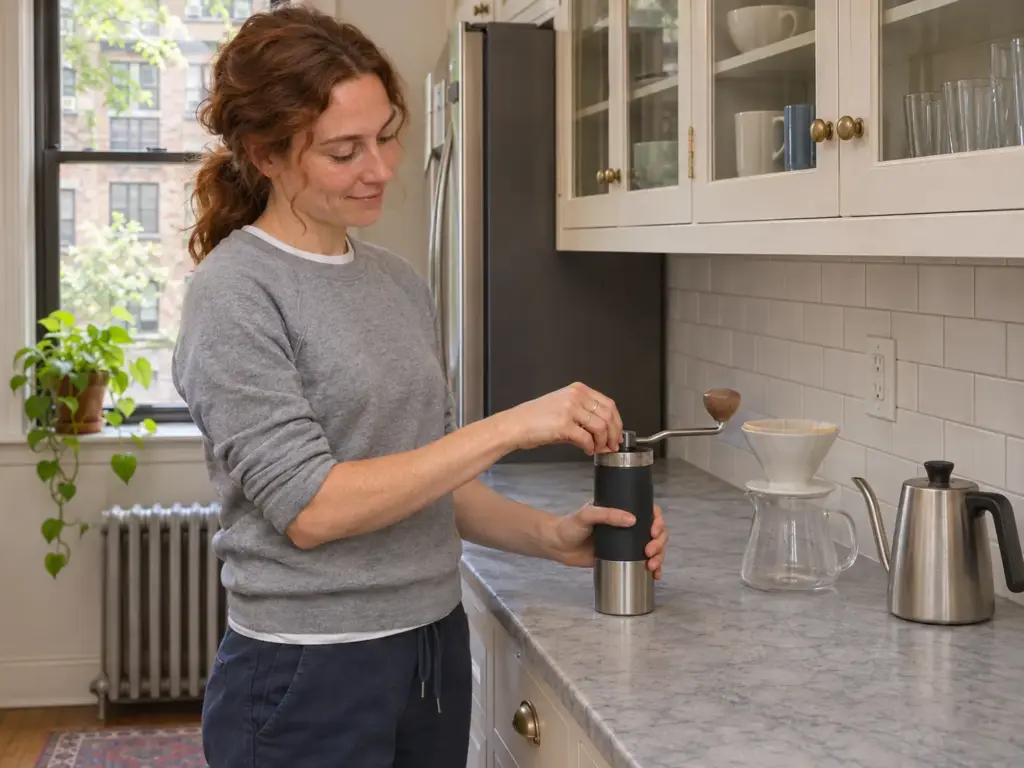
A sour cup poured through a good spout is still a sour cup. Grind and dose move the cup more than the stream does, so the order is grind, then brew ratio, then the pour, with a taste after each step. The ratio that comes before any gear is the free lever, a scale comes before a gadget and a probe before a new kettle, and the scale that fits the brewer is the one purchase that makes every other test possible.
If the grind is the lever, a burr grinder matters more than any vessel, since a blade grinder leaves the fines that clog the bed and slow the drawdown, and no spout fixes that. The direction of the cup keeps the order honest: sour points toward a finer grind or a slower pour, bitter toward a coarser grind or a faster one, and whichever you move, a taste comes before the next move.
When you compare a substitute with a gooseneck, hold the dose, the grind, the ratio and the water temperature fixed and swap only the vessel. Otherwise the cup you taste is a mix of two changes, and you cannot tell which one did the work.
Two Pour-Overs a Day Is Where the Spout Pays
The gooseneck earns its place with two or more pour-over sessions a day, or when the same kettle is the only hot-water source in the kitchen. It does not close the math for one V60 a week beside a drip machine the other six days, because the weekly cup needs a creamer and a scale, and both are probably already in the house. A gooseneck is called a unitasker because it pours water, and so does a pitcher.
What the spout sells is control, and control is a number: the 2 to 3 grams a second you can now read yourself. A reader who pours that number every day with a creamer and a probe has already bought what a spout sells, and the one who cannot hit it with anything in the drawer, or who pours three times a day and tires of refilling a jug, is the reader the spout was made for.
What the Months Do to a Substitute
The months change the spout too. Hard water leaves a white crust of limescale on a spout tip, a thin spout can bend, and a thermostat can drift, and each one shows up as a stream that no longer lands where it used to. The white crust is the first sign the water is hard, so look at the tip first when a familiar pour starts misbehaving. Drift is the quieter one: a kettle display that disagrees with a probe you have checked in ice water by more than a few degrees is telling you the thermostat has moved, and the probe is the number to trust.
Substitutes age in other ways. Paper cups every morning add up to a bin of waste, a ceramic creamer can crack in the dishwasher or chip at the lip, and a plastic diffuser left wet stains and holds old coffee oils. All of that follows from how paper, ceramic and resin behave, which makes it the list to recheck when the test pour comes out different from the first one.
Run One Test Pour Tomorrow, Then Recheck as the Weeks Go By
A drip machine, French press, AeroPress, Clever or moka pot keeps whatever kettle is already in the kitchen. A V60, Chemex or Kalita starts with the creamer or the measuring cup, poured low and tested on the scale, and a tool gets added only if the test fails. A probe checks the water the kettle gives, and the grind comes before the pour.
After a few weeks of use, run the 30 seconds again, because a ceramic lip chips and a resin jug warps with hot water, and look at the spout tip of whichever kettle you use for a white crust.
Tomorrow, set the cup on the scale, run the 30-second pour and brew the same dose the same way at the pace it shows. Taste for a rounder, sweeter, more even cup if the pour was the problem. If nothing changes, the grind was, and the full question of whether a spout earns its keep can wait for the day you want the purchase case.
Frequently Asked Questions
01Do I really need a gooseneck kettle?
Not for drip, French press, AeroPress, Clever or moka pot, and not for a pour-over if a small pitcher lands the stream near 2 to 3 grams a second. A scale and 30 seconds settle it.
02Can I use a regular kettle for pour-over?
Yes, as long as the stream lands slowly enough: a wide spout runs faster and is harder to aim, so pour from lower and tilt less. Check one 30-second pour on a scale before brewing; 60 to 90 grams is the band.
03Why is a gooseneck kettle better?
It narrows and slows the stream, so the water lands where you aim it and wets the whole bed evenly. A pitcher can match the pour, but only a kettle with a set point also holds the temperature.
04Why are gooseneck kettles so expensive?
A long, thin spout that keeps its shape and a heating base with a set point cost more to build than a boil-only kettle with a plain spout. The stovetop version skips the base and the electronics.
05Does a spoon or strainer over the bed really slow the stream?
It spreads the stream across the bed, which fixes where the water lands but leaves how fast it arrives untouched, so the pour still needs the 30-second test. Held by hand it also stirs the surface, and a mesh strainer clogs with fines.



How did your cup turn out?
No comments yet. Tell us what you changed — and whether the needle moved.