




We may earn a commission when you buy through links on this page. It never changes what we recommend. How we pick
On this page8 parts
- What a Stovetop Gooseneck Kettle's Spout Does to the Bed
- How Much Water a Stovetop Gooseneck Holds, and How Full to Fill It
- What You Give Up Against an Electric Gooseneck
- Reaching 195–205 °F With No Thermostat
- Which Cooktops Take a Stovetop Gooseneck, and Why the Base Decides
- What Wears Out by Month Twelve on a Kettle That Lives on a Burner
- Rest the Boil, Read the Spout, Then Decide What to Buy
- Frequently Asked Questions
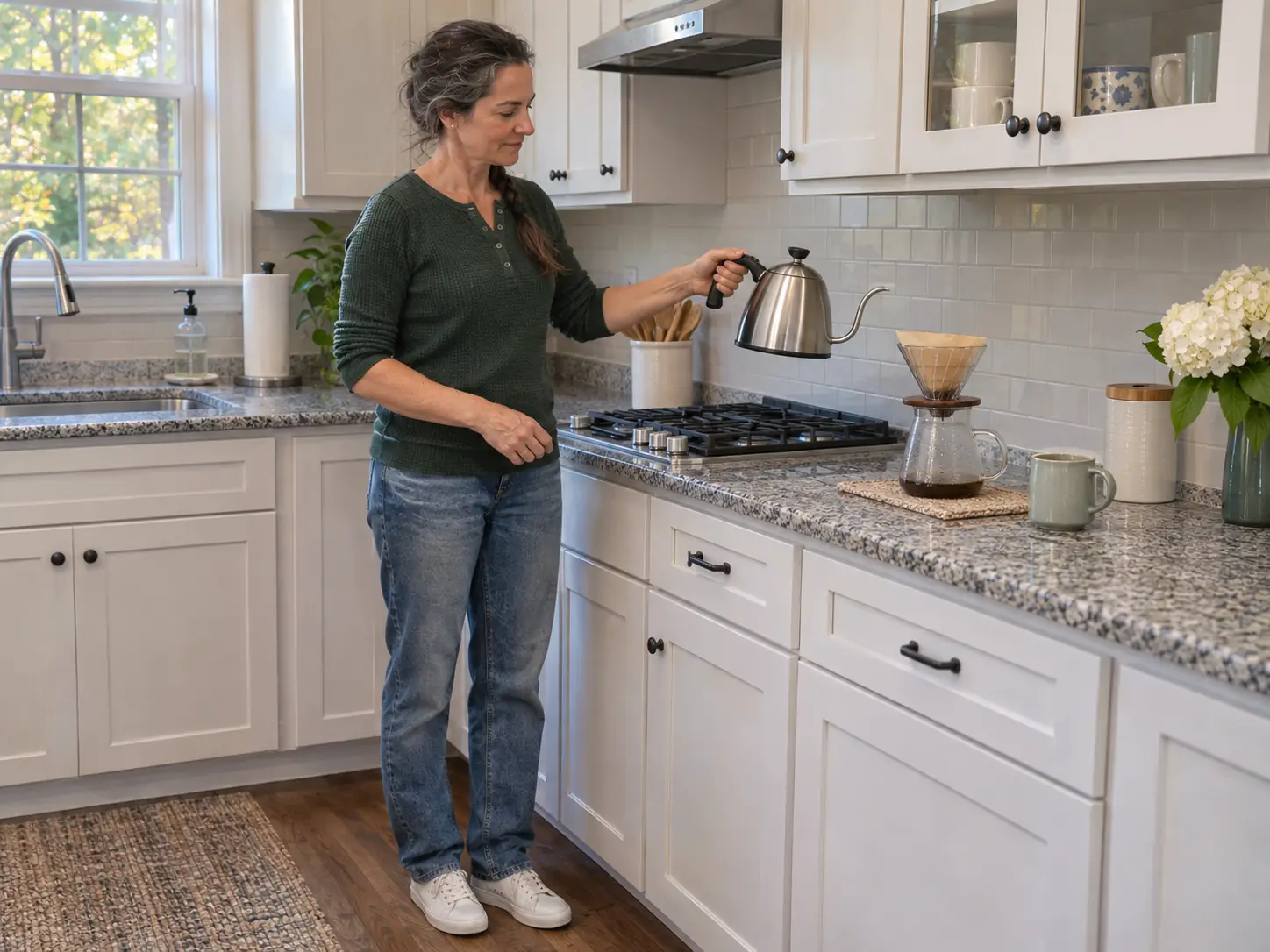
The water has been rolling for a minute, the dripper is rinsed, the filter is wet, and the recipe asks for water below the boil. Nothing on the burner and nothing on the kettle says where the water is now. That is the situation a gooseneck kettle stovetop model lives in: its spout pours exactly like an electric gooseneck’s, the neck is the same at every price, and what decides whether it works in your kitchen is the cooktop under it and the hand holding it, since the badge on the lid changes nothing in the pour.
This guide covers what the neck does to the bed, how full the kettle can go, what the plug adds and what it costs the counter, how to reach 195–205 °F (90–96 °C) without a thermostat, which burners take which base, and what wears out first on a kettle that lives on a flame. If your brewer is a drip machine or a press, a gooseneck changes nothing in the cup, and the first section says where to settle that.
Quick Answer
Yes. A stovetop gooseneck pours exactly like an electric one; it only lacks a thermostat. Rest the water 30–45 seconds off the boil and read 195–205 °F (90–96 °C) at the spout with a probe. The cooktop matters more than the kettle: induction needs a magnetic base, and a thin base warps on a strong flame.
What a Stovetop Gooseneck Kettle’s Spout Does to the Bed
The neck is the same part on a kettle that costs a fraction of another, so what sits under it and around it matters more than the spout does. First, though, the part everyone buys it for: what the narrow spout changes in the dripper.
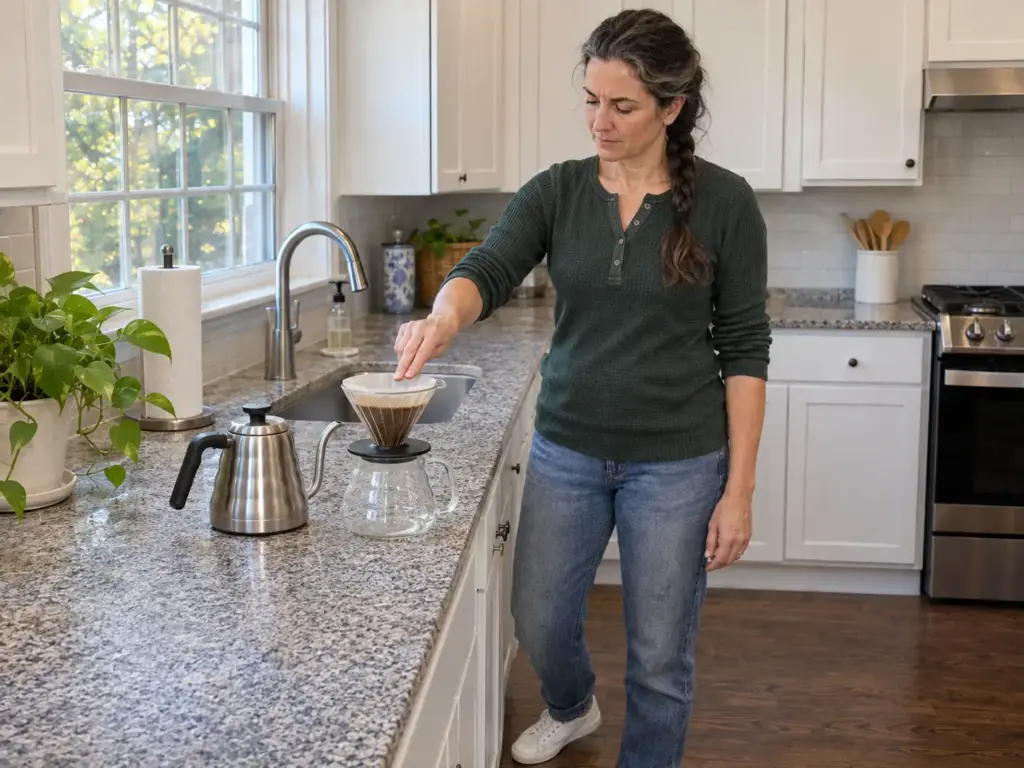
A thin, steerable stream is what the neck is for
A pour-over is not free-form.
The National Coffee Association’s pour-over guide puts contact time at 2 to 4 minutes, opens with a bloom of 30 to 45 seconds and works from a ratio of 1:13 to 1:16, which for a single pour of 250 g of water (about 8.5 fluid ounces) means roughly 15 to 19 g of coffee, three to four level tablespoons. Over those minutes the stream has to reach every part of the coffee bed at about the same slow rate, for even saturation, or one patch of grounds ends up with more water than the rest. That contact time is the brew time, and it only comes out right when the flow rate is steady. The dripper can be a V60, a Kalita Wave or an Origami; the demand on the stream is the same.
The neck exists to do that. A gooseneck spout narrows and slows the stream, and its reach lets the hand set the water down where it is wanted, a circle through the wet middle first and then outward.
Brewers call that pour control, and a plain kettle cannot supply it. Coffee Gator is the only maker here that prints a number for it, a claimed flow of 2.5 mm/s. The bed has to be built to take the stream, and the grind size a pour-over bed needs to wet evenly sets how fast that water can pass through.
What a wide lip does to the bed
A wide lip pours a short, thick rope of water, and a rope lands in one place. That spot floods, the water drills a hole straight through the bed (channeling) and the grounds around the hole barely get wet. The cup carries the evidence: sour and thin from the dry pockets, bitter and harsh from the flooded spot, both in the same cup because some of the coffee saw too little water and some saw too much.
Going finer is the reflex for a sour cup, and here it backfires, since a finer bed drains slower and keeps the flooded spot underwater longer. Move the stream and leave the grind where it was: the next cup should taste less harsh at the end and less hollow at the start. If it turns evenly flat instead, the stream is fixed and the water temperature is next.
When the kettle is down to its last third, bring the spout lower, within a couple of inches of the bed, and tilt in smaller moves. The tilt that held a thin stream at the start now delivers a thicker one, and a lower spout gives that stream less room to splash across the grounds.
Why none of this depends on the heat source
Nothing in the stream cares how the water got hot: the same neck sits on a gas burner, a plug-in base or a camp stove, and a stovetop pour over kettle and an electric one part ways only in how the water heats and how long it stays that way. For a drip coffee maker, a French press, an AeroPress or a moka pot a gooseneck changes nothing in the cup, and whether a gooseneck is worth having at all for your brewer is settled on the page about that decision.
How Much Water a Stovetop Gooseneck Holds, and How Full to Fill It
The neck needs a vessel behind it, and the capacity that vessel is sold on, 1.0 or 1.2 liters, is not the amount that should be in it when the pour begins. Here are the capacities the makers publish, the one fill rule any of them states (a max fill line is not a working line), and what the weight does to the wrist.
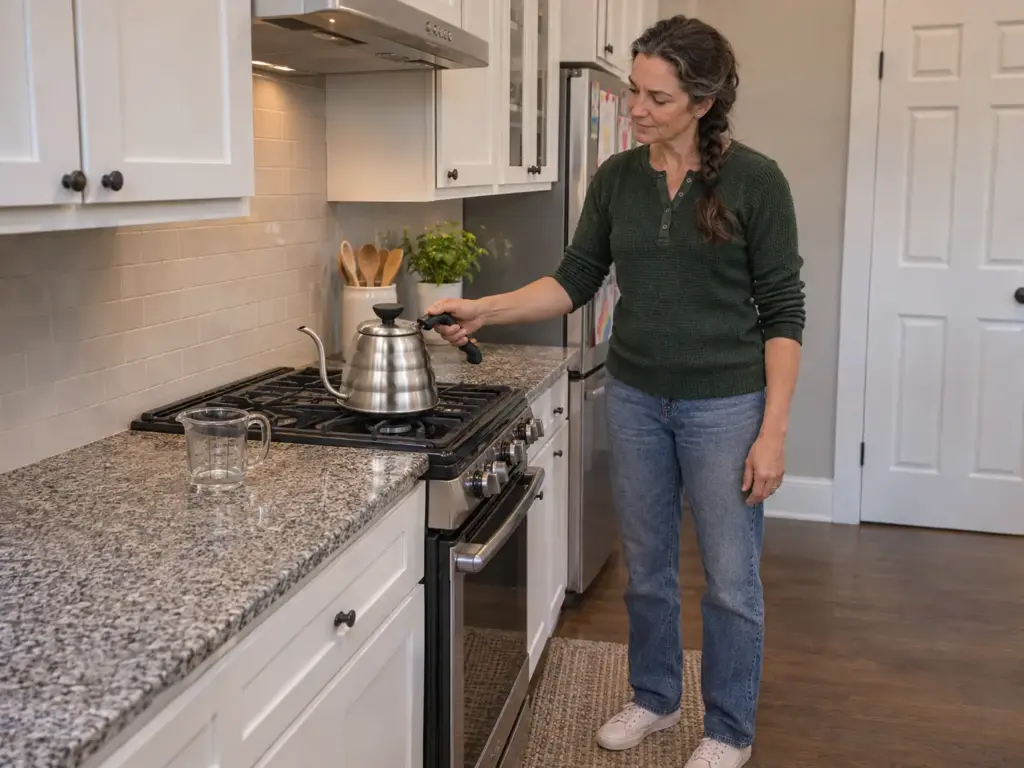
The number on the box and the number to use
Stovetop goosenecks run from 1.0 L, the boiling capacity Fellow lists for its Stagg stovetop (about 34 fluid ounces), to 1.2 L (40 ounces) for the Hario, the Coffee Gator and the Barista Warrior. Only one maker publishes a working fill. Hario says its 1.2 L kettle is best filled to about 800 mL, roughly 27 fluid ounces and two thirds of the way up, and that is the line to fill to, since the brim is only the number the box was written around.
The Hario V60 Buono stovetop kettle is the one to measure this against: 304 stainless steel, a plastic handle, no thermometer, and a rating from its maker for induction, gas and electric burners. The plastic handle is light in the hand, and it is also what suffers when a flame licks past the base.
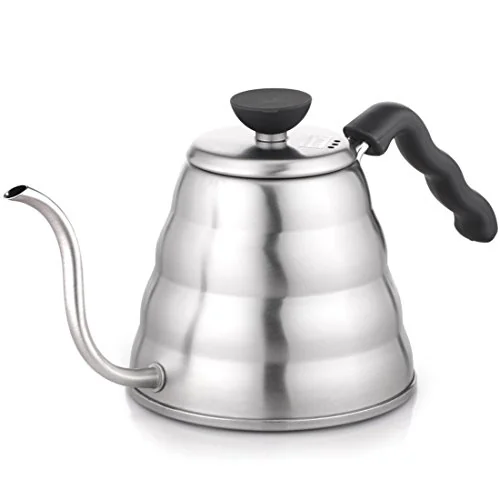
What one V60 cup asks of the kettle
A single pour-over uses about 250 g of water, so a full 1.2 L kettle holds close to five brews’ worth: all of it heated and all of it carried at arm’s length to make one mug. The 800 mL line covers three cups at that size with a little left over to wet the spout. Pouring by weight instead of by eye is how the hand learns what 250 g looks like coming out of the neck, and the habit pays back on every brewer in the house.
A smaller fill also reaches the boil sooner on the same burner. Filling to what the brew needs shortens the wait before the rest off the boil even begins, and that wait is the longest part of a stovetop morning. A manual grinder fits inside it: grinding by hand while the water heats turns the dead minutes into the grind.
Balance when the kettle is full and when it is nearly empty
A full kettle at arm’s length loads the wrist, and a slow pour needs a steady wrist. Fellow sells the Stagg stovetop with a counterweighted handle, its own wording for a handle shaped to offset the weight of the water, and the Hario leaves that job to a lighter plastic handle and to the 800 mL fill.
The second and third mugs of a brew come from a kettle that is lighter and cooler than it was at the start. The stream and the temperature both drift between the first pour and the last. One more thing about the Hario: after the final pour, empty it, wipe the interior and leave the lid off so the waterline does not stay damp, because the rust that shows up in some of them starts at that line.
What You Give Up Against an Electric Gooseneck
Everything so far holds for an electric gooseneck too, and the only honest reason to choose the stovetop is knowing exactly what the plug adds. This is where the electric enters, priced in minutes and mornings.
Heat-up: slower by a third, and it is the burner
The heat-up time is the first number that separates the two kettles.
Bonavita gives about 5 minutes to a boil for its 1 L electric with a 1200 W element. A stovetop kettle with a short fill on an ordinary burner needs closer to 7 minutes for 14 ounces (about 400 mL), roughly a third slower, and that gap belongs to the burner’s output more than to the steel. A strong burner closes much of it, and a weak coil on a glass-top stretches it. Fill matters as well: the burner that needs 7 minutes for 14 ounces needs noticeably longer for the full 1.2 L, which is one more reason to heat only what the brew will use.
Either way, the boil is the smaller cost, because it happens once per kettle. The larger one comes later in the morning, and it is the one nobody counts when comparing the two kettles on a shelf.
No hold means the second cup is a second boil
A variable temperature kettle, which means an electric, holds a setpoint: temperature control and a temperature hold in one box. The Bonavita steps in 1 °F increments between 140 and 208 °F, has six presets and keeps the water there for up to 60 minutes. A stovetop kettle has no hold at all.
The second pour means putting the water back on the flame, waiting out the rest off the boil again, and accepting that the last mug in the row is poured at a different temperature than the first. In the cup that reads as a third pour that tastes thinner and a little sour, because the kettle that began hot is now lighter and cooler.
The moment the flame goes out is the moment that costs. You lift the kettle off the burner and it sits there with no display, no beep and no hold, with about a minute of usable water that cannot be extended without a second boil.
For a second mug, add only the water that mug needs plus a splash, and put the kettle back on right after the first pour. A short second boil and the same rest off the boil lands the second cup closer to the first than topping up to the brim would.
What the plug is worth, and when a stovetop plus a probe does the same cup
Before either kettle, there is a free version of the thermostat: a plain kettle, a rest off the boil and a probe at the spout. The gooseneck changes the pour, and the heat stays yours to manage, plug or no plug. For a household with two mugs in every morning the electric is the obvious pick, and it is the right one when the hold and the speed matter more than the counter space the base takes.
The Bonavita 1 L digital variable-temperature gooseneck shows what the plug buys at the entry end of the electrics: a setpoint and a hold behind the same spout. It also shows the risk at that end, since the heating element has stopped working around the five-month mark in a run of units, and some units never reach the temperature they were set to. A basic stovetop gooseneck with a probe thermometer gets most of that result for a fraction of the money, because the premium buys speed and a hold, not a better pour. The electric goosenecks compared tier by tier lay out the full set for the reader who decides the plug is worth it.
And the base stays out on the counter all day, while the stovetop kettle lives on the range it already uses.
Reaching 195–205 °F With No Thermostat
With nothing to set, temperature becomes something you read and wait for. The small dial on a lid does not do that job the way it looks like it does.
The window, checked against the standard
The Specialty Coffee Association’s standard puts brewing water at roughly 194–205 °F (93 ± 3 °C) before it meets the grounds, a figure the National Coffee Association’s consumer guide publishes as the temperature the SCA asks for before the water meets the grounds. The SCA’s certified home brewers sit inside the same window, and the SCA’s certified home-brewer list describes them in one line: “Maintains 198–205 °F with even water distribution for full flavor.”
Quoted numbers run anywhere from 190 to 208 °F depending on the roast, and the standard sits inside that spread. In round numbers the pour wants 195 to 205 F (90 to 96 C). Boiling is 212 °F (100 °C), so on a stove the aim is always below the boil: the water has to come down into the window, and a stovetop gives no setting to bring it there.
The rest off the boil, in seconds
The same National Coffee Association guide gives the no-thermometer version in one line: “Allow the boiled water rest for a minute to bring it down to the optimal temperature before pouring it over the coffee grounds.” That minute is for water at a hard roll. The shorter rest used here, 30 to 45 seconds off the boil with a probe check, covers water that has already stopped rolling, and the two do not contradict each other because they start from different points.
A light roast tolerates the hotter water and a dark roast turns bitter sooner in it, so the light roast takes the shorter rest and the dark one the longer. Why the water should rest off the boil explains the mechanism behind that.
Run the check once for your own kettle. After a full boil, take it off the heat and probe the water at the spout every ten seconds until it reads 205 °F (96 °C), then write the count on a sticky note. The kettle becomes its own timer for that fill, and the probe only has to come back out when the fill changes.
What the lid dial shows and what the probe at the spout shows
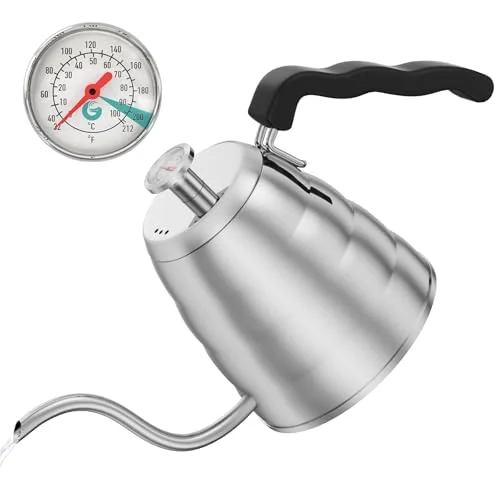
Coffee Gator publishes a dial range of 160–212 °F, Barista Warrior prints the 195–205 °F band on its dial, and Fellow calls its dial a brew-range dial. None of the three says where the sensor sits or what it measures, so the built-in thermometer is a guide on the way up and says nothing certain about the water in the stream. The Hario has no dial at all. And the dial reaches its number first: it and a probe read the same kettle at different moments, and the water in the stream, the water that counts, is the last to arrive.
The Fellow Stagg stovetop pour-over kettle is the clean example of what a brew-range dial means. It holds 1.0 L, is made of 18/8 stainless with a counterweighted handle, and Fellow lists it for gas and electric ranges. Two parts of it do not last in the same way as the pour: the paint on the base chips where the burner touches it, and the handle runs very hot over a strong flame.
The number that decides the cup is the one taken at the spout, and a probe thermometer is the tool for it. The ThermoWorks Thermapen ONE reads in one second to ±0.5 °F, carries a NIST-traceable calibration certificate, is rated IP67, carries a five-year warranty and has a display that rotates a full 360°. Read the water as it is about to be poured, never the steam above it, and for the method in full see reading the water at the grounds instead of at the kettle. It is expensive, and a minority fail inside three months, so a cheaper probe is the alternative: a budget kettle paired with a probe gets to the same reading.
Reading the cup when the water was off
Sour and weak points at water that was too cool or a rest that ran too long, which is under-extraction. Bitter and harsh points at water that was too hot or a brew that ran long, which is over-extraction. Before touching the grind, move the rest by about ten seconds and taste again: on a stove the rest is the free dial. If ten seconds shorter overshoots into harsh, come back five.
Which Cooktops Take a Stovetop Gooseneck, and Why the Base Decides
Everything above assumed the burner would heat the kettle at all, and on two of the four common cooktops that depends on a part the box rarely names: the base.
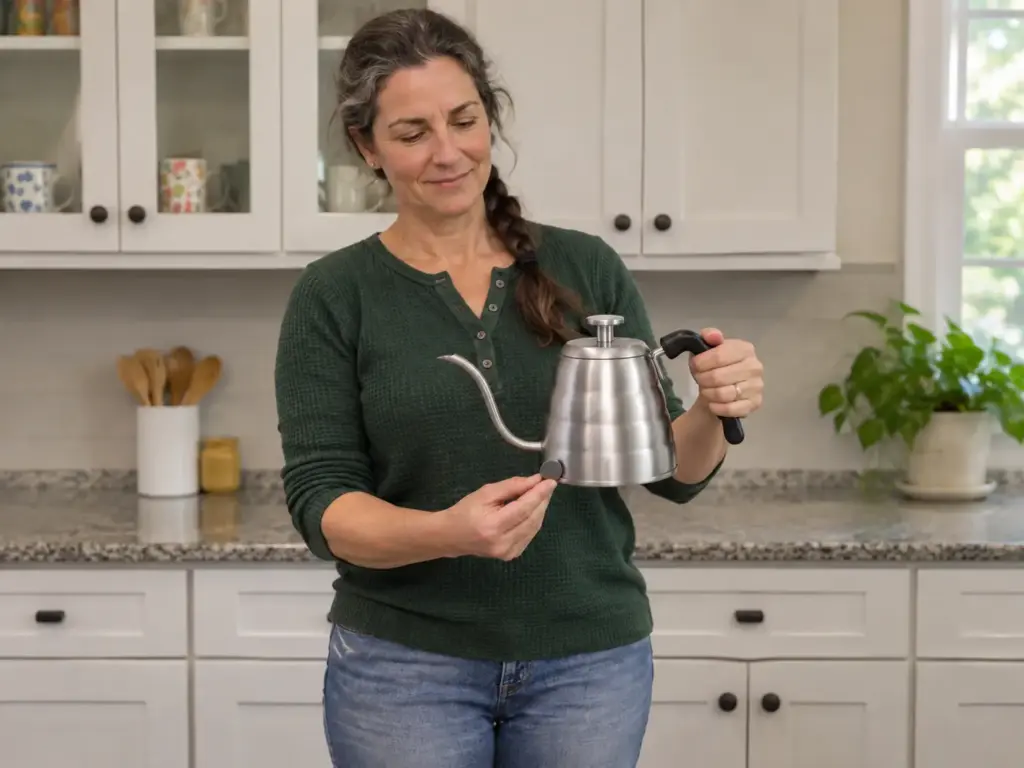
Gas, coil and glass-top: what the base has to do
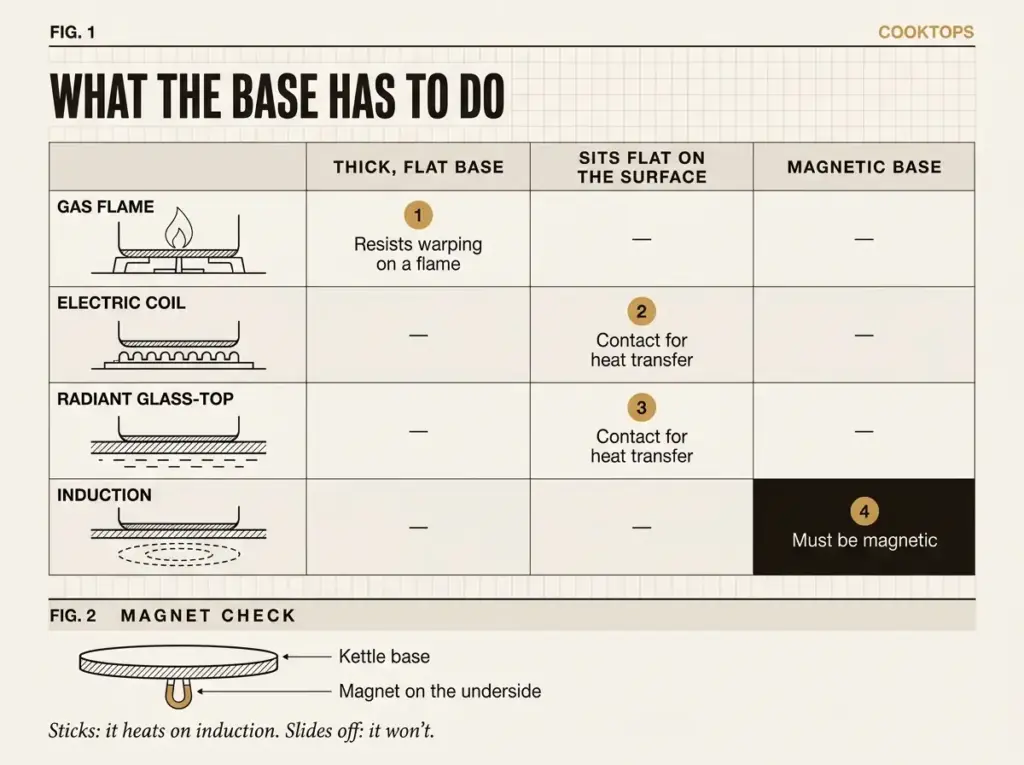
Gas stove burners, electric coil and a radiant glass-top stove (a ceramic cooktop) take most stainless steel kettles, but each asks something different of the base. A flame wants a thick, flat base that resists warping. A coil or a glass-top wants the base to sit flat on the surface so the heat transfers, and a thin disc that rocks heats unevenly. On gas the base also decides how the flame is spent: a thick base spreads the heat across the floor of the kettle, while a thin one hands the hottest spot straight to the water above it.
Induction and the magnet test
Induction needs a magnetic, ferrous base, and an induction cooktop will not heat a kettle without one. The test is a magnet held against the underside of the kettle, at the shop or on the kettle already in the cupboard: if it sticks, the kettle heats. How flat the bottom looks does not enter into it, and a brushed finish or a shiny bottom proves nothing either way.
What each maker says about your burner
Hario rates the V60 Buono stovetop for induction, gas and electric. Coffee Gator claims gas, electric, radiant, halogen and induction on a three-layer base. Fellow lists the Stagg stovetop for gas and electric ranges only, so induction is not claimed for it, which settles the Fellow for an induction cooktop before any magnet comes out. Barista Warrior says any stovetop, on a double-layer base.
A claim is a claim, and the magnet settles it at home in two seconds.
The base that warps
A thin disc on a strong flame warps, then rocks on the burner and heats unevenly. The symptom is a kettle that spins slightly when you set it down and takes longer to boil, and it boils on one side first. A thicker or multi-layer base next time and a lower flame in the meantime solve it. A camp stove is a gas flame in a worse wind, so the same base warps the same way.
The kettle that no longer sits quietly on the burner, that rocks or ticks as it heats, is the one with a failing base. The Coffee Gator gooseneck kettle with thermometer is the budget pick that names induction in so many words, on a three-layer (three-ply) base that is meant to stay flat. It also carries the weakness of its dial, which comes up again in the last section.
What Wears Out by Month Twelve on a Kettle That Lives on a Burner
A kettle on a flame is heated every morning with nothing to limit it, so the useful question is durability: what gives out first. It is rarely the steel.
The dial and the plastic go first
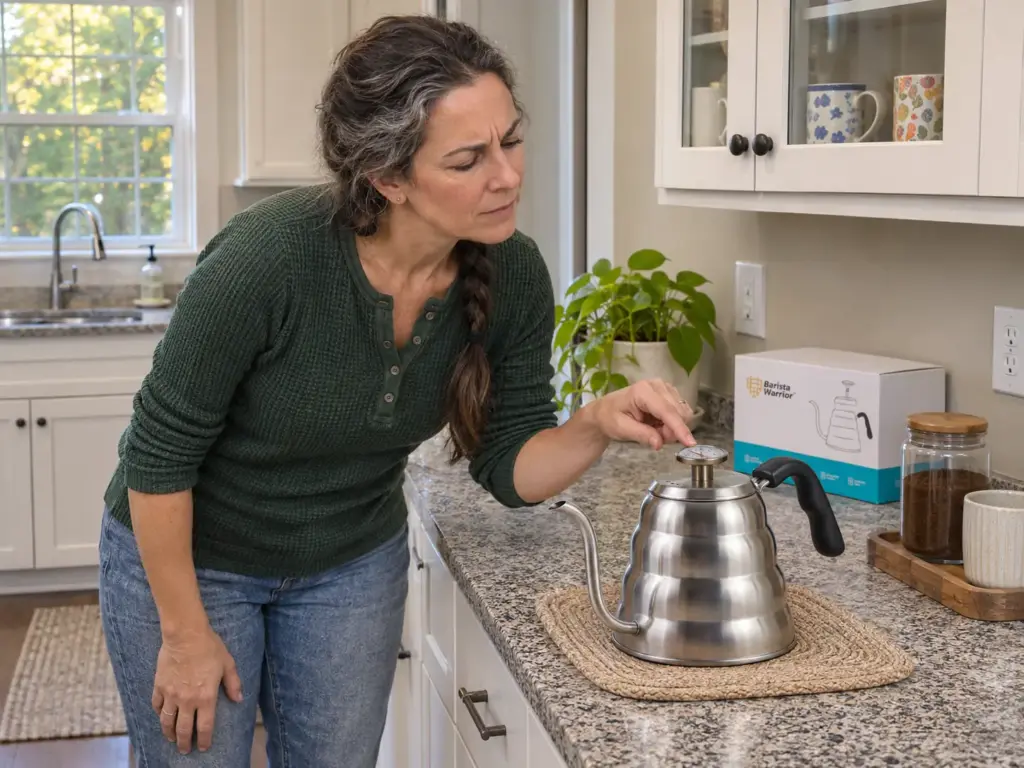
The order of failure is consistent across stovetop kettles. The dial or the thermometer goes first, the finish on the base second, and rust at the waterline and the seams third. The steel outlives the parts that were added to help it.
The Barista Warrior 1.2 L gooseneck kettle prints the 195–205 °F band on its lid dial in place of a 0–212 scale, which answers the question of when to stop waiting more directly than a general-purpose dial does.
It is 1.2 L (40 oz) in 18/8 stainless with a double-layer base and a stainless handle. The thermometer is the weak point: it has stopped working within weeks in several units. The Coffee Gator fails in a slower way, with the plastic around its dial softening inside a year. A kettle with no dial and a probe in the drawer loses nothing that matters.
The five kettles of this guide line up below, each with its first failure.
| Kettle | Capacity | Steel and build | Lid thermometer | Gives out first |
|---|---|---|---|---|
| Hario V60 Buono 1.2 L | 1.2 L (40 oz) | 304 stainless, plastic handle | None | Interior rust at the waterline on some kettles |
| Coffee Gator 1.2 L | 1.2 L (40 oz) | 304 stainless, three-layer base | Dial, 160–212 °F | Plastic around the dial, inside a year |
| Fellow Stagg Stovetop 1.0 L | 1.0 L boiling capacity | 18/8 stainless, counterweighted handle | Brew-range dial | Paint on the base where the burner touches it |
| Barista Warrior 1.2 L | 1.2 L (40 oz) | 18/8 stainless, double-layer base | Dial marked 195–205 °F | The dial, within weeks in some units |
| Bonavita 1 L (the electric, for contrast) | 1 L | 304 stainless, 1200 W element | Digital setpoint, 140–208 °F | The heating element, around month five in some units |
The finish on the base and the rust at the waterline
The finish on the Fellow’s base is the second casualty: the paint wears where the burner touches it. Rust is the third, and it arrives from the inside out, at the waterline and the spout seam, on kettles whose pour is otherwise perfectly good. Some Hario kettles pit while others stay clean for years, and water and drying habits are the difference. The free fix goes first: after every use, empty the kettle, rinse the spout and leave the lid off so the waterline dries.
The chalky ring is the schedule
Hard water leaves a chalky ring inside the kettle and a crust around the spout well before it changes the taste of the cup. That scale slows the heat and dulls the stream, and it builds fastest at the waterline and in the spout, where the water sits between uses, and scale buildup there is what dulls the stream; rinsing the spout after each pour leaves less for it to hold on to. What the hardness of your tap water leaves behind decides how quickly the ring builds, and the first sign is usually a kettle that now takes a minute longer on the same fill.
Coffee Gator’s own care instruction is to boil lemon juice and vinegar in the kettle when limescale shows. Nothing specialized needs buying, and the maker’s manual is the authority on the steps.
After a descale with lemon juice and vinegar, boil one full kettle of plain water and pour it out before brewing. The first cup from a freshly descaled kettle is the one most likely to taste of it.
Rest the Boil, Read the Spout, Then Decide What to Buy
The neck is the same part at every price, so the heat source and the hand decide the cup. Fill the kettle to the working line, about two thirds on the Hario, because a lighter kettle heats sooner and pours steadier.
A stovetop has no hold, so every extra mug is a second boil with a second rest. Take the temperature at the spout and treat the lid dial as a guide on the way up, and let a magnet settle the induction question before the kettle comes home. The dial and the base give out before the steel does, which makes a kettle with no dial and a probe in the drawer a sensible place to start.
After the first season of hard-water mornings, or whenever the boil starts taking noticeably longer, look again at two things: whether the kettle still sits quietly on the burner, and whether the chalky ring inside has grown.
Tomorrow, before anything is bought, rest the boil, read the water at the spout and taste the cup. Say which way it is off: sour and thin points at cooler water or a longer rest, bitter and harsh at hotter water. Buy a kettle, a probe or an electric only if the cup still points the same way after that. And when the water is right, the pour is the next thing to make repeatable, which is what a scale that matches the way you brew is for.
Frequently Asked Questions
01Can I use a gooseneck kettle on an induction cooktop?
Only if its base is magnetic: hold a magnet to the underside of the kettle, and if it sticks, the kettle will heat on induction. Coffee Gator claims induction for its stovetop model, while Fellow lists its Stagg stovetop for gas and electric ranges only.
02Can you set the temperature on an electric gooseneck kettle?
On a variable-temperature model, yes: the Bonavita sets it in 1 °F steps between 140 and 208 °F and holds it for up to 60 minutes. A stovetop kettle has no setting, so you rest the water off the boil and read it with a probe instead.
03How full can I fill a stovetop gooseneck kettle?
Hario says its 1.2 L stovetop kettle is best filled to about 800 mL, which is roughly 27 fluid ounces and two thirds of the way up. Fill to what the brew needs instead of the brim: a lighter kettle also reaches the boil sooner.
04Does the thermometer in the lid show the water’s temperature?
It works as a guide while the water heats, and the makers do not say where the sensor sits or exactly what it reads. The number that decides the cup is the one taken at the spout with a probe, after the water has rested off the boil.
05Is a stovetop gooseneck kettle harder to use than an electric one?
The pour is identical, and what changes is the heat: a stovetop kettle has no thermostat and no hold, so you rest the water and check it yourself. Every extra mug is a second boil.



How did your cup turn out?
No comments yet. Tell us what you changed — and whether the needle moved.