
We may earn a commission when you buy through links on this page. It never changes what we recommend. How we pick
On this page8 parts
- Weigh the Dose on the Scale You Already Own First
- Four Specs Separate a Coffee Scale From a Kitchen Scale
- A Full Pot and a Slow Pour Ask Different Things of the Platform
- What a Scale Does in Month Twelve That It Didn't in Week One
- Espresso Scales Have to Clear the Drip Tray
- When the Scale Reads True and the Cup Is Still Off
- Buy for the Brewer, Then Check the Scale Again After a Spill
- Frequently Asked Questions
The scale at the top of a ranking can still be the wrong one for your counter: too small to hold a full carafe, too wide to slide under a portafilter, or quick to go dark halfway through a slow press. So what is the best coffee scale? The one whose platform fits the brewer you own and whose display keeps up with the way you pour, because a scale never improves the coffee; it only repeats the dose, and four specs decide whether it can do that twice. Below you get the free test first, then the four specs, what each brewer asks of them, what wears out by month twelve, and the cases where the scale was never the problem.
Four specs separate a good coffee scale from a bad one: 0.1 g steps, a display that keeps pace with the pour, a timer beside the weight and a platform that fits the brewer. One mid-range scale covers the dose for drip, pour-over and a beginner’s espresso, and only a full carafe needs the 3 kg platform; a premium one buys response speed and data, and the cup tastes the same. What each brewer asks of them:
| Brewer | Capacity it has to clear | The spec that decides | Timer |
|---|---|---|---|
| Full drip pot | Over 2.2 kg of carafe and water, so a 3 kg platform | Capacity first, then 0.1 g on the dose | Not needed |
| Pour-over | 2 kg is plenty for a dripper and a server | A display that keeps up with the pour | Running beside the weight |
| Espresso | A cup and a small server, very little weight | A footprint that clears the drip tray | Starts automatically |
| French press or AeroPress | Forgiving | An auto-off that does not fire mid-steep | Helpful |
Weigh the Dose on the Scale You Already Own First
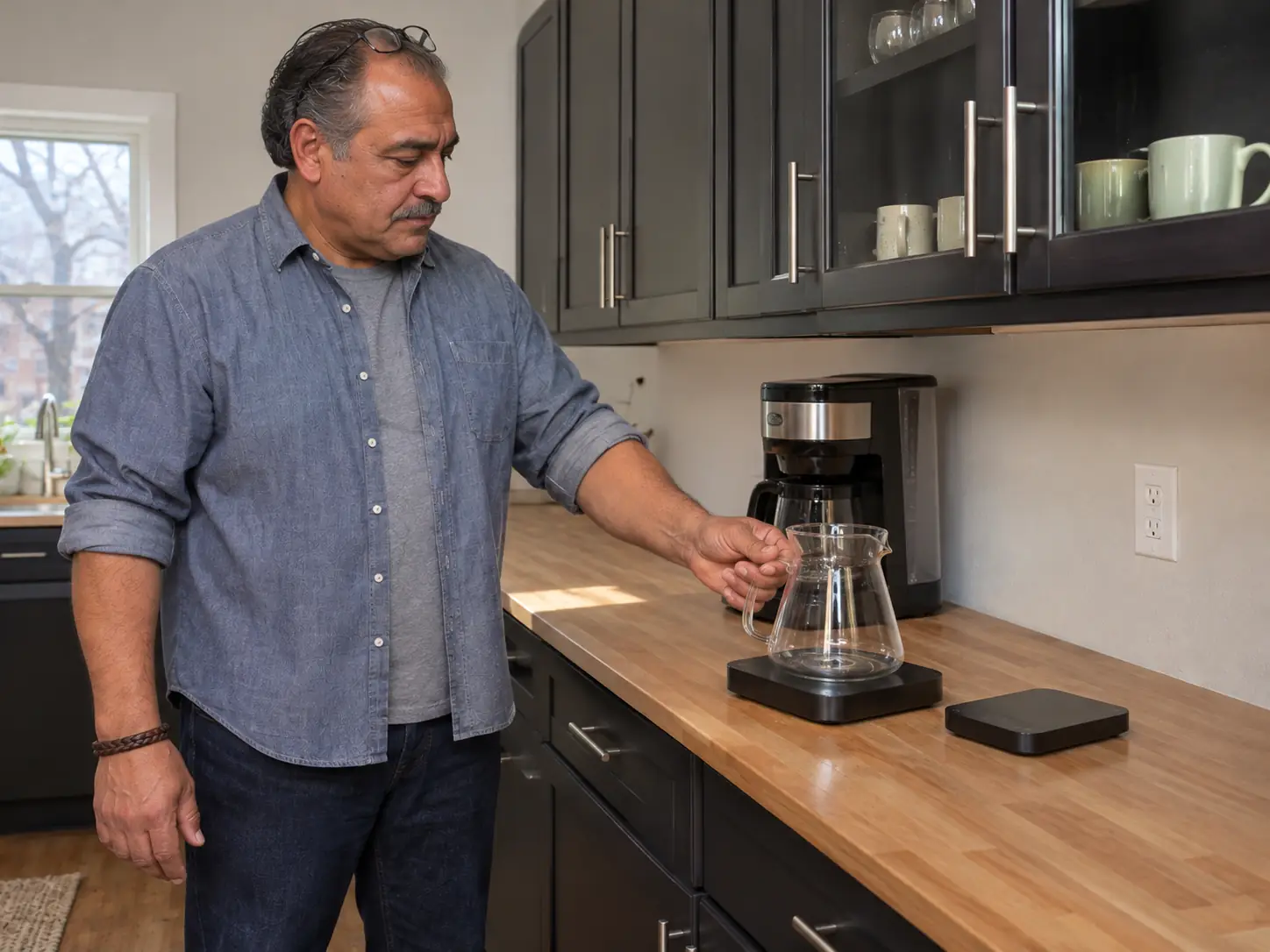
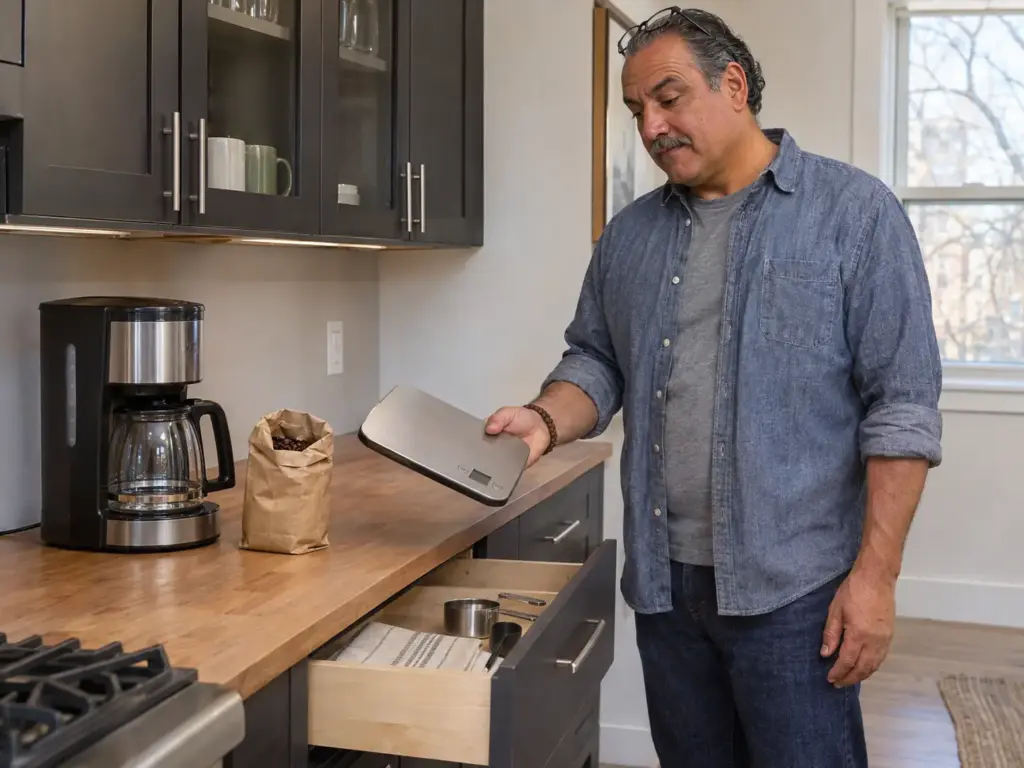
Any kitchen scale in the drawer can do the first weighing, and that one test costs nothing: it tells you whether the dose was ever the problem. Only after it does it make sense to ask what a coffee scale adds, because the answer depends on what the drawer scale could not show you.
Weigh the dose, taste, then move the grind
The pot that comes out thinner than yesterday’s, from the same bag in the same machine, is usually a dose problem before it is a grind problem. A scoop and a carafe mark are volumes, and a volume of coffee changes weight with the roast (a dark roast has swelled and lost mass, so a level scoop of it weighs less than the same scoop of a light one) and with the grind, which is the whole case in why a scoop never gives the same dose twice. Weight is the only version of the ratio you can check.
So the first test runs in a fixed order. Weigh the coffee and the water on whatever scale you own, brew, and taste. A thin, sour cup that came from a dose a few grams light is fixed by the dose, and the grind never entered into it.
If the cup is still off at the right weights, the brew ratio is settled and it is time to dial in the grind: move the grind size a single step finer for a thin, sharp cup or coarser for a harsh, bitter one, and taste again. A better scale sits at the bottom of that list.
Scoop your usual beans into a cup three times and weigh each scoop. The spread between the lightest and the heaviest is the error your recipe has been carrying, and it tends to run wider than the step of any scale you could buy.
What a whole-gram reading does to a small dose
A drawer scale with 1 g resolution is fine for a pot and rough for a cup. On a 20 g dose (about four level tablespoons) a reading of 20 can be 19.5 or 20.4, so one gram of rounding is half a gram either way, a 2.5 % swing in the ratio before any water is counted. That is a wider swing than most people give the grind in a whole step. It also hides drift: a dose that reads 20 on Monday and weighs 19.5 on Tuesday never shows on the display, and the cup tastes it anyway.
The ratio the scale exists to serve has two anchors that disagree. SCA Standard 310, one of the SCA’s published brewing standards, sets the test ratio for home filter brewers at 55 g of coffee per liter of water (near 1:18 by weight), aimed at a strength of 1.15 to 1.55 % TDS. Households tend to settle closer to a 1:16 starting ratio, a touch stronger, because 55 g per liter is a reference for judging a brewer and the cup poured at breakfast gets tuned to taste.
The National Coffee Association writes pour-over as 1:13 to 1:16 in grams, and its drip line is still a tablespoon count: 1 to 2 tablespoons per 6 ounces of water. Grams are the only side of that you can check.
The kind of kitchen where a coffee scale adds nothing
There is one. A drip machine with a basket filled the same way every day, a single bean that never changes and a cup you already like: the drawer scale did the weighing, a coffee scale would add a timer you would never watch, and the money is better spent on a grinder. And when the cup is thin because the beans are stale, or because a blade grinder made boulders and dust in the same dose (sour and bitter at once), the scale reads 18.0 g faithfully and the cup does not move. Those cases are sorted near the end.
Four Specs Separate a Coffee Scale From a Kitchen Scale
A digital coffee scale is a kitchen scale with four things done on purpose: a finer step, a faster display, a timer beside the weight and a platform sized for what sits on it. That is the full answer to whether the two differ. A dearer one mostly buys more speed and more data.
0.1 g is a step size, not a promise
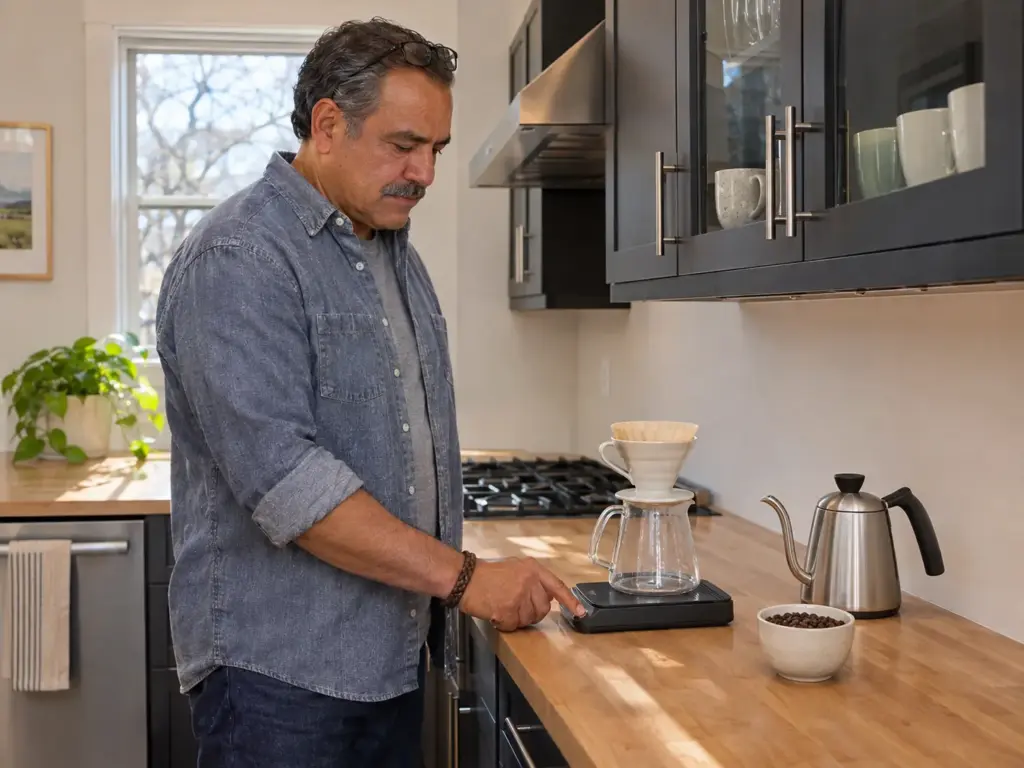
Start with what the decimal means: 0.1 g resolution is the size of the step, nothing more. NIST Handbook 44, the US code for weighing devices, is titled “Specifications, Tolerances, and Other Technical Requirements for Weighing and Measuring Devices,” and it separates the scale division (the step a scale counts in) from the verification division that sets its accuracy class. The code is written for commercial scales, but the distinction is the useful one: the number after the decimal tells you how finely the display counts and says nothing yet about how close it counts to the truth, which is a question of accuracy and precision, not of display.
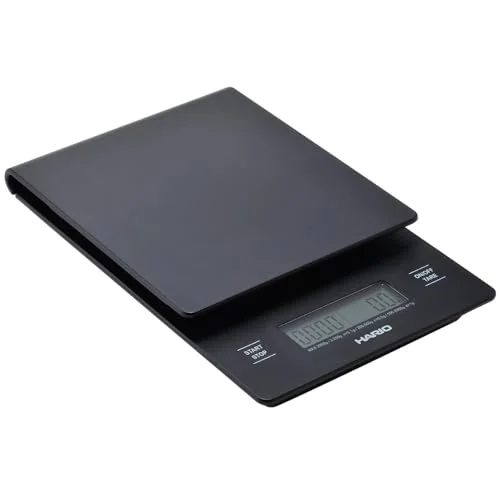
Hario’s manual prints its accuracy table, which makes the V60 Drip Scale the one scale here whose limits can be written down. It displays 0.1 g from 2 to 200 g at a stated accuracy of ±0.2 g. From 200 to 500 g it steps in 0.5 g at ±1 g, and from 500 to 2,000 g it steps in 1 g at ±3 g, all of it assured at 68°F (20°C), give or take 9°F (5°C). Under a full carafe, the “0.1 g scale” is a 1 g scale, and a hot server on the platform shifts the reading before any water is counted.
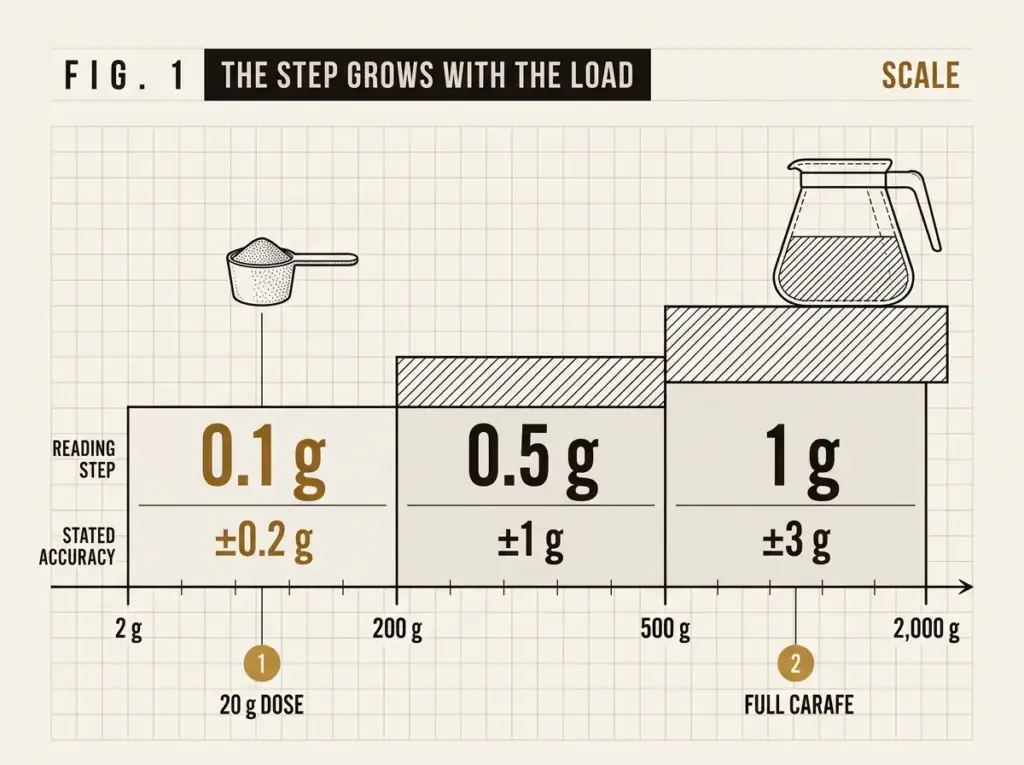
So the tenth of a gram belongs to a range; the scale as a whole does not have it. For a 20 g dose it holds. For the 320 g of water that goes with it, the same scale counts in half grams, and that is fine: half a gram of water is under two-tenths of a percent.
A display that keeps up with the pour
A display that lags the kettle makes you overshoot, because you pour by the number. At around 4 g of water a second, which a gooseneck reaches easily, a half-second of lag puts two grams past the mark before the display admits it. The number keeps climbing after the pour has stopped, and those are the grams that were never meant to be in the dripper.
Display speed, the refresh rate of the readout, is the spec behind that, and the premium response time is a maker claim: under 100 ms for the BOOKOO Themis Ultra. A cheaper scale lags by a visible beat. On a 40 g bloom that beat is a rounding error; on the final pour it is the two grams you were aiming at.
A timer that runs beside the weight
Pour-over is read as a flow, grams against seconds, so the built-in timer has to sit on the same screen and keep counting up while the weight changes.
The auto-off belongs to the same spec, and it is where the makers’ numbers matter. TIMEMORE states a 3-minute standby before the Basic 2.0 switches off; Hario states 5 minutes, with the shutoff held back while the timer is running. A 45-second bloom never touches either. A French press with a four-minute brew time sits on the platform perfectly still and outlasts the first one.
On the morning there are guests and the carafe fills in three slow pours, the pause between them is the kind of stillness a short standby reads as nobody being there. Run the pot size you actually brew through 1:16 against the SCA’s 55 grams per liter, because a pour weighed to the gram only matters if the ratio on paper is the one you meant.
A platform that fits what sits on it
Capacity belongs to the load cell, and it is a different number from the display’s. A scale rated to 2 kg with a carafe zeroed on it is still carrying the carafe: taring hides the weight from the display while the sensor goes on bearing it. Footprint is the other half, and it is measured against the drip tray. The arithmetic for the pot and for the espresso tray comes with the shortlists.
A Full Pot and a Slow Pour Ask Different Things of the Platform
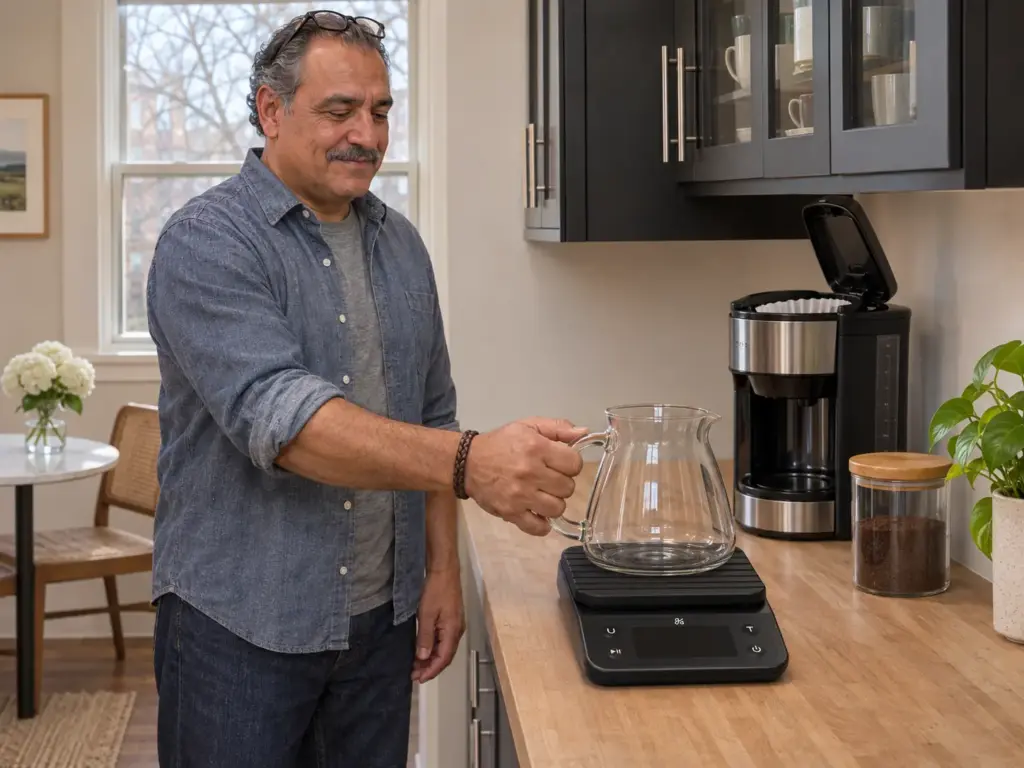
The four specs are the same for every brewer, but their order changes: a drip machine asks for capacity first, a pour-over asks for speed and a timer, and the shortlist below is sorted by that once the free test has been spent. Start with the number that catches people out, the weight of a full pot.
A full pot is heavier than a 2 kg scale can hold
A “12-cup” carafe is not twelve of anything standard (what a machine’s cup really holds is closer to 5 ounces), and a full one is about 62 fluid ounces of water. KitchenAid’s own dosage chart for its 12-cup machine lists that pot as roughly 1,835 g of water and 57 g of coffee (around eleven level tablespoons). Add a glass carafe in the range of 400 g, and the three together come to about 2.3 kg, past what a 2 kg scale can read, with its tenth of a gram perfectly intact.
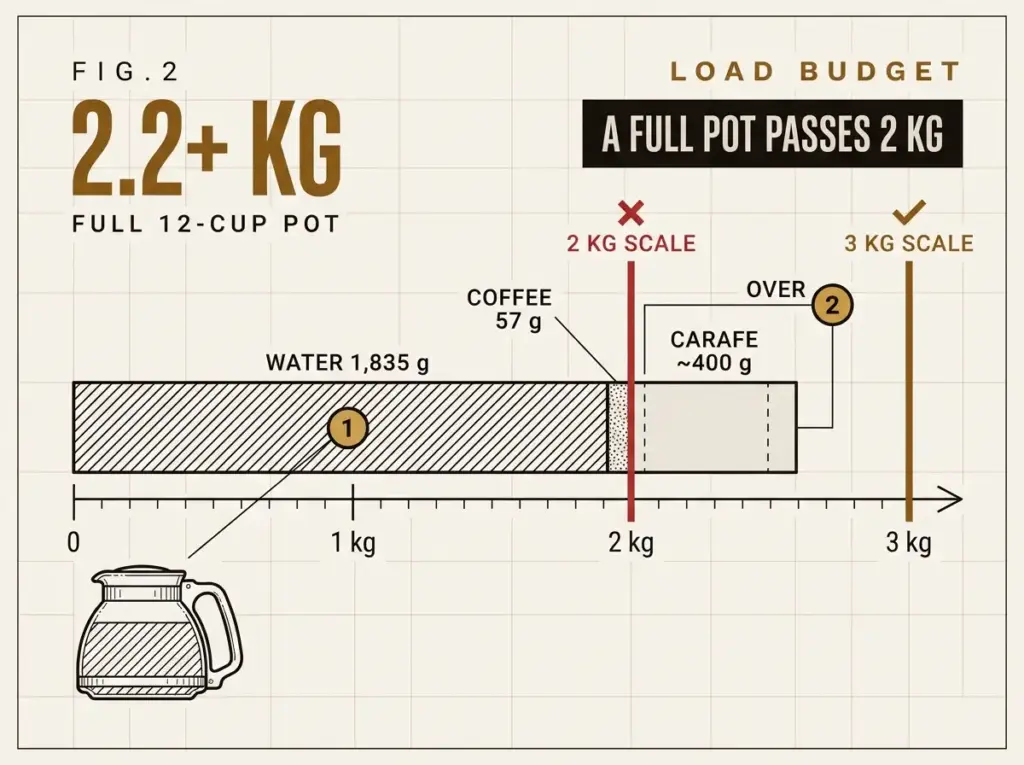
A scale maker’s capacity guidance runs the same way. American Weigh Scales puts pour-over at 2,000 to 3,000 g and a carafe with its brewer and water at 2,000 to 5,000 g, and it notes that zeroing the carafe does not hand its weight back to the capacity. So a 3 kg platform is the one that weighs a whole pot, and a 2 kg one is enough for a pour and a server. Setting a full carafe on a scale bought for espresso is how the limit shows itself: the display goes over capacity and the pot is half-made.
Weigh the water for a full pot once, then note where it reaches on the carafe’s marks. After that the pot can be filled by the mark, and the heavy scale goes back in the drawer.
Once the platform is chosen, a first pot weighed in grams instead of scoops walks through the tare, the dose and the pour in order.
Pour-over wants speed and a timer, not extra capacity
Pour-over sits at the other end of the weight range. A 20 g dose at 1:16 is 320 g of water, and a dripper and a server together fit comfortably under 2 kg, so a bigger platform buys nothing, and precision on the dose matters more than capacity. What matters is the National Coffee Association’s pour-over ratio, 1 gram of coffee to 13 to 16 grams of water, and that it is stated in grams on both sides, the only version a scale can check.
Two failures send a pour-over off: a display that lags the kettle, and a timer that does not run beside the weight. The auto-off has to let a long bloom finish as well. Once the timer is running, the drawdown shows what the grind is doing, and the grind a dripper wants and how the drawdown shows it is where to take the result next.
The shortlist for a pot and a pour
Four picks, sorted by that arithmetic, each with what it gets wrong. The free fix comes first: if the drawer scale and the marked carafe already give the same pot every morning, none of these is needed.
For the full pot, the Greater Goods Coffee Scale with Timer 0460 is the only pick here with a 3,000 g platform (6.6 lb). It reads 0.1 g, has a 5.25 in platform to check against the carafe’s base, and carries five years of coverage, the longest of the eight. Durability is its doubt: a unit can stop after six weeks or three months of light use, batteries can drain fast, and some readings miss the tenth of a gram. A nickel stack in the first week is cheap insurance.
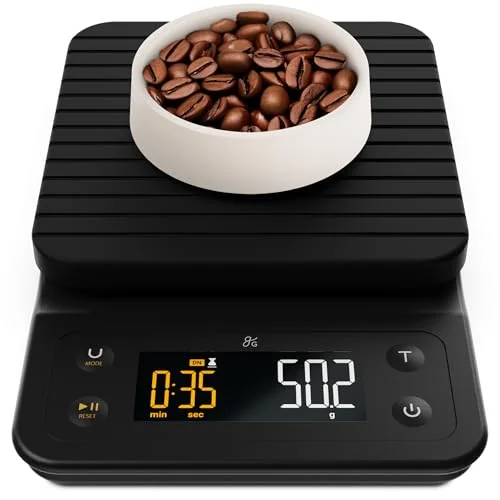
The obvious pick is the TIMEMORE Coffee Scale Basic 2.0 Black Mirror, and it stops being the obvious pick for a pot. It reads 0.1 g up to 2,000 g, shows the flow rate, runs a timer and stores flat, which covers the dose for drip, a pour-over with its server and a beginner’s espresso. It runs out of platform before a full carafe does.
The pattern to plan for is a unit that quits inside the first month or by the sixth, a surface that reads too sensitively and a flow figure that moves faster than the eye follows. That is reason enough to run the nickel check the day it arrives.
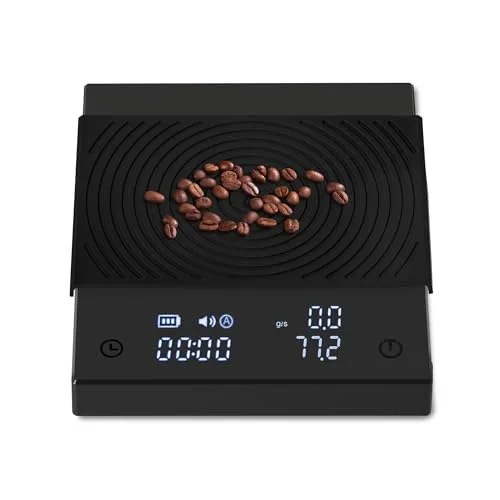
For the pour itself, the Hario V60 Drip Scale Black New Model is the reference: 2,000 g, an auto-off at 5 minutes that stays awake while the timer runs, and the accuracy table quoted above. Its limits are the ones already written down. Tenths end at 200 g, the buttons are the weak part, and the display trails the pour.
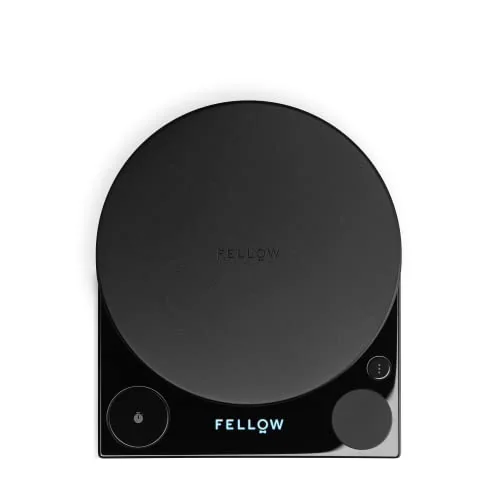
The Fellow Tally Pro Coffee Scale is the premium pour-over pick, and what it sells is arithmetic done for you: a brew assist mode holds the ratio on screen and counts the water. It costs several times what the Timemore does and the cup tastes the same. Its accuracy is the part that gets argued, it has no flow-rate readout, and it is far too large to be an espresso scale.
What a Scale Does in Month Twelve That It Didn’t in Week One
Every pick above was written from its specs, and specs describe week one. They say nothing about what the button, the battery or the display does after a year of wet mornings, so this section counts what wears out and in what order.
The auto-off that fires mid-steep
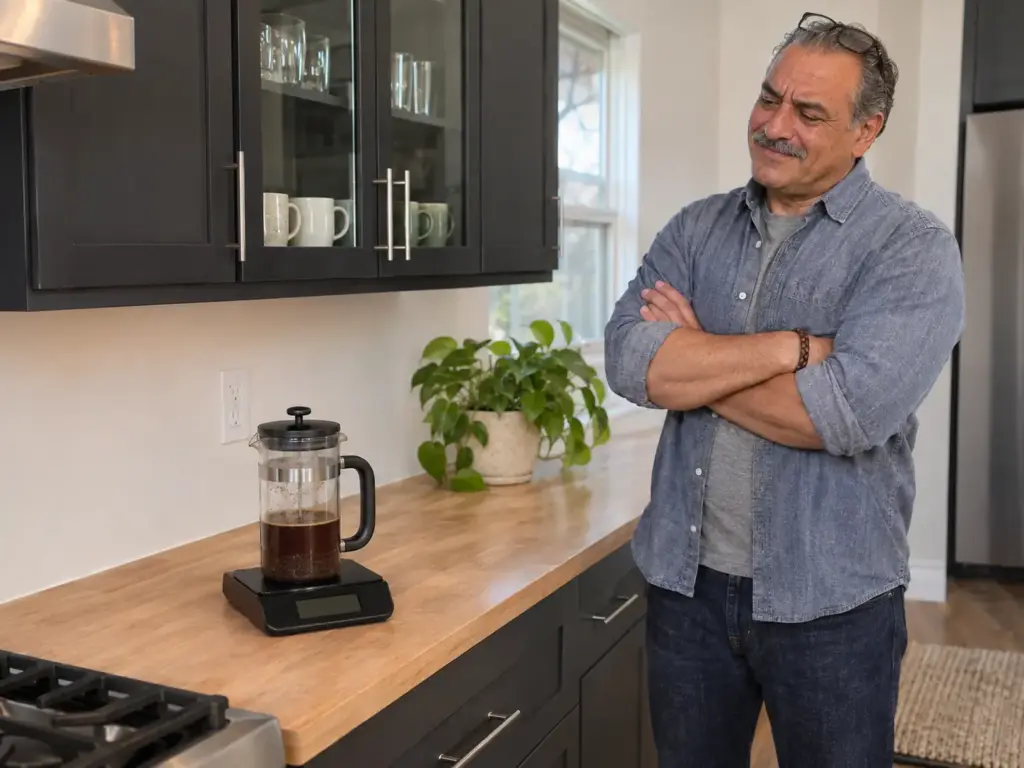
The failure of week one that looks like month twelve is the auto-off. A long bloom, a slow press or a second pour begins, the screen goes dark, and the weight on the platform is no longer being read. The scale is working as designed: TIMEMORE’s 3-minute standby is shorter than a four-minute French press steep, while Hario’s 5 minutes is held back for as long as the timer runs. The way out is a model whose auto-off is longer or stays awake with the timer, and the habit of starting the timer when the steep starts.
Buttons, displays and a wet counter
What wears first on a cheaper scale is the button. The display follows (a screen that has faded by the second winter), then the rechargeable battery or the charging port, and the weight reading is the last thing to go.
Water speeds all of it for the units that are not sealed. A splash-resistant label is not waterproof, and a wet drip tray is where a cheap scale ends: of these eight only the BOOKOO is sealed, at IP67. A soaked budget scale sometimes comes back after drying out, and that outcome is luck, since no spec promises it. Warranty length is a clue worth reading: five years on the Greater Goods says its maker expects it alive in year four, and a one-year term makes the same statement more quietly.
The signs arrive in a recognizable order: a button that wants a harder press, a display whose edge segments fade first, a battery that needs charging more often. None of them shows up in the weight itself, so the nickel test is the one that catches a scale after it starts to wear. If ten nickels still land close to 50 while the case is aging around them, the load cell is still doing its job, and a dead screen says nothing about the readings that came before it.
An error code that is not a dead scale
A scale that was fine yesterday and now shows a string of error digits is, more often than not, sitting on an unstable surface or has lost a rubber foot. Move it to a hard, level patch of counter, check the feet, and tare again before declaring it dead. Newer scales add a second route: a unit shipped with factory firmware can sit dead until the battery is unplugged and reconnected, and two units of one model can wake up differently. And a scale that reads true on a level counter and drifts on a tilted one is telling you about the counter.
Check the counter before the scale: put a coin on the platform, note the reading, lift it, set it back on the same spot and tare. If the number does not return to the same figure, move the scale to a hard, level patch before suspecting the load cell.
Espresso Scales Have to Clear the Drip Tray
For espresso the scale is not asked for capacity at all. It is asked for a footprint, a case that survives a wet tray and a timer that starts by itself. And yes, a shot needs one: the machine’s volume button measures the water going in, while the numbers a shot is judged by are the dose that went in and the yield that came out.
Measure the drip tray before the scale
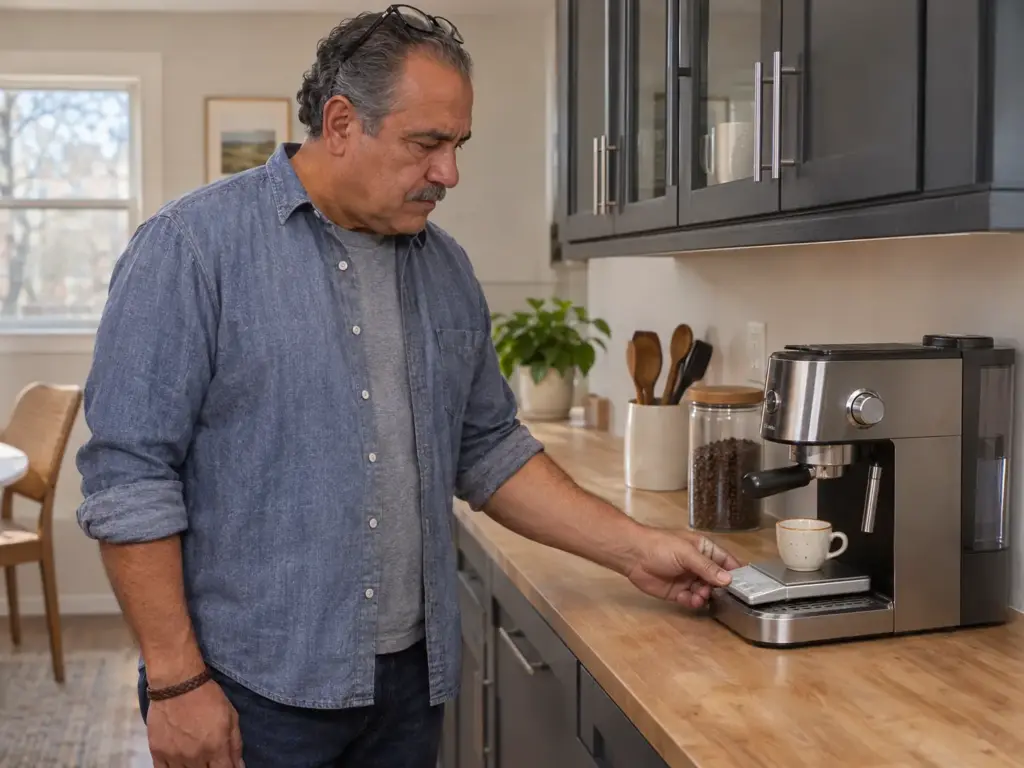
A scale wider than the tray it stands on tilts, and a tilted scale reads wrong in the way month twelve will teach anyway. A compact machine’s five-inch tray against a scale nearly six inches across leaves an inch of overhang, and a thin 4.75 × 2.71 in case is what actually clears a portafilter. Measure the tray first, then the scale.
A shot of 18 g in and 36 g out is a ratio of 1:2, and both numbers need the scale: the dose before the grounds go into the basket, and the yield in the cup on the platform. When nothing fits under the spout, the workaround costs nothing.
Weigh the dose on the counter before grinding, tare an empty cup, pull the shot into it and weigh the cup afterward. The yield comes from the difference, and no scale has to fit under the spout.
Auto-timing and a case that survives water
Auto-start timing, which starts the clock when the espresso first reaches the cup (solid to liquid), is what most budget units leave out and what a dark kitchen wants, because the other hand is busy and the shot time is read off that clock. The MHW-3BOMBER has it. The Brewista has five modes, so its auto-timer can be switched off when it guesses wrong, though that same carousel is slow to cycle through on a dark morning.
And water: a drip tray is wet by design, and only one pick here is sealed against it. Once the scale shows the same dose pulling different shots, the grinder is what it is exposing, and a grinder that repeats a dose to the click is the purchase that follows.
The shortlist for a small tray
One benchmark gets a sentence and no more. Bon Appétit names the Acaia Lunar the best espresso scale, and it is the one the others are judged against: 2,000 g at 0.1 g with a 0.01 g option, in a case of about 4.1 × 4.1 × 0.6 in. Price comes first among its flaws, then mode symbols that send you to the manual, and the load cell and the battery are the parts that end up needing repair over the years.
The cheapest that fits is the WEIGHTMAN Small Coffee Scale with Timer WM133SL: 1,000 g at 0.1 g, a stainless platform, and a case thin enough to pass under a compact machine’s portafilter where almost nothing else does. Accuracy and battery are its mixed parts: random weight steps, accuracy that drifts with time, a timer that can fail, and no water resistance at all. A soaked unit has been known to recover after drying, and that is luck again.
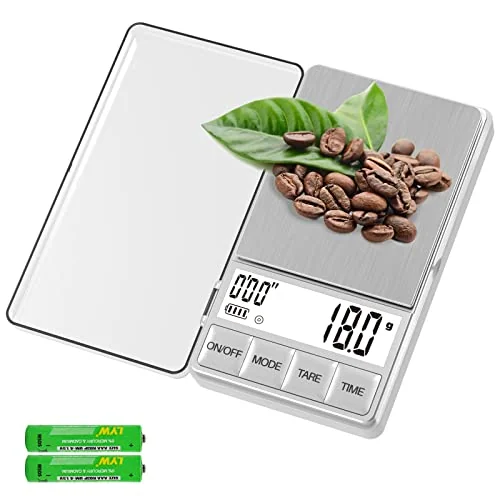
The middle step is the MHW-3BOMBER Espresso Scale ES6027B-OS. It reads 0.1 g from 0.3 g, takes a cup and a small server in a 4.9 × 4.9 in case, and starts its timer by itself. Weight can fluctuate, some units last only a couple of months, and charging is the other weak spot.
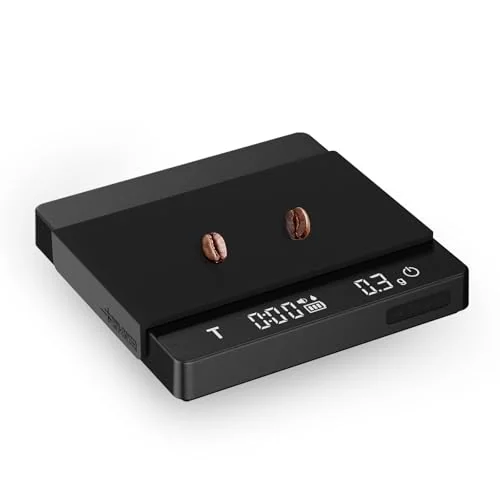
The one built to last is the Brewista Smart Coffee Scale III. A long service life is where short-lived scales fail, and its five modes (auto tare and auto timer among them) let the timer be turned off when it guesses wrong. The mode carousel is the grievance, the orange backlight is the other, and a III can still die inside a month.
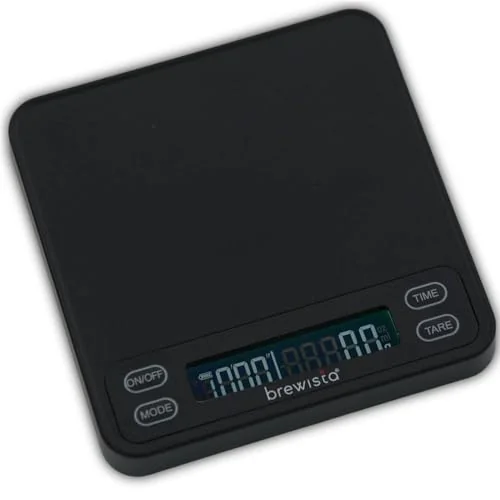
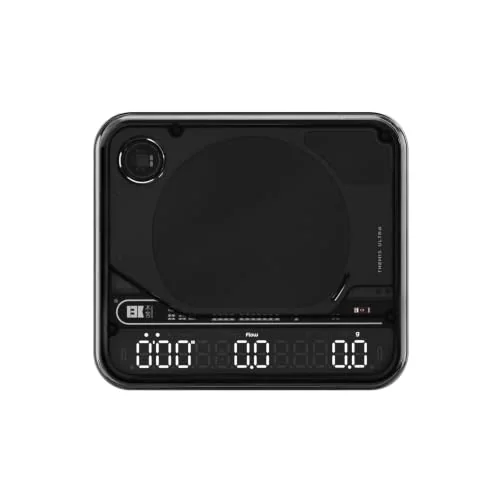
For a counter that stays wet, the BOOKOO Themis Ultra is the sealed pick and has the fastest display here. Its accuracy is the open question, and a sibling model shipped with firmware that had to be updated before it behaved. What it buys is speed and survival, and the grinder behind the shot decides the taste.
When the Scale Reads True and the Cup Is Still Off
A scale that reads 18.0 g of stale beans, of boulders and dust from a blade grinder, or of a dose headed into a machine that brews cold is working perfectly and still gives the wrong cup. The job here is telling a broken scale from a scale that was never the problem, and a coin settles the first half.
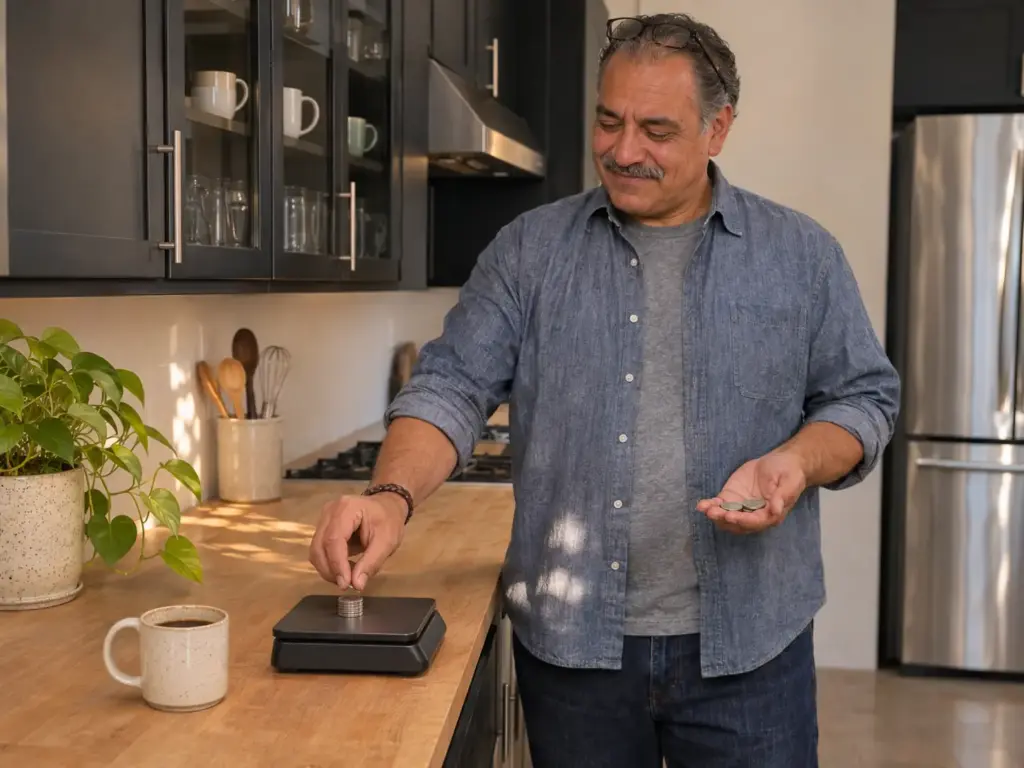
The nickel check
A US nickel is specified at 5.000 g, so ten of them make 50 g and twenty make 100 g. Stack ten on the platform and the display should land close to 50.0; twenty should land near 100. Coins are rougher references than a calibration weight, and one that has spent years in pockets can sit a touch under spec, so the stack screens a scale that has lost its way and does not certify one. A clear miss means inaccurate readings, and that is the moment for a calibration weight.
The forgotten tare breaks the cup quietly, with every spec intact. Skip the first tare and the display counts the carafe or the dripper as water. Skip the second tare, after the coffee goes in, and it counts the dose as water. Either way the water runs short by that weight, and a 20 g dose on a 320 g target turns 1:16 into about 1:15 without a single reading being wrong.
Why one bean never registers
A working scale ignores a single bean because it re-zeroes itself quietly. Auto-zero tracking treats a very small, slow change as drift and cancels it. A bean weighs a fraction of a gram, TIMEMORE states a starting minimum of 0.5 g, and the MHW reads 0.1 g only from 0.3 g up, so the behavior is built in. The same test fails on a dearer scale in the same way, and the answer for a suspect reading is a calibration weight; sending the scale back fixes nothing.
When the scale is honest and the grind is the problem
Once the coin stack and the tare are clean, the suspects sit upstream of the scale. Stale beans come first: read the roast date on the bag before reading the numbers. A blade grinder gives boulders and dust in the same dose, so the cup tastes sour and bitter together however exactly it was weighed. A drip machine that never gets hot enough under-extracts whatever it is fed, and a grind set too fine swings the other way into over-extraction.
To sort them out, brew the same 20 g and 320 g twice, once with the bag you have and once with beans from a recent roast date: if the cup changes, the scale was never involved, and if it does not, the grinder is next.
Then the order: weighing the dose before turning the dial, tasting, moving the grind a step, tasting again. The tell for a grinder is the same 20 g reading true and tasting different on the third morning. The scale is honest and the grind is drifting. When the dose is right and the setting still will not go finer, a grinder that is maxed out or worn is the part to blame.
Buy for the Brewer, Then Check the Scale Again After a Spill
Buy the platform for the brewer on the counter: 3 kg for a full pot, 2 kg and a fast display for a pour, and for espresso a thin case, an auto-start timer and a sealed housing if the tray is always wet. A premium scale buys speed and data, and the Fellow’s ratio on screen or the BOOKOO’s seal are conveniences worth paying for only when the counter calls for them. Every pick here carries its weak spot, and the drawer scale does the first test for nothing.
After the first spill or the first soaked counter, run the nickels across the platform again (ten should still land close to 50 g) and leave the scale through one slow press to see whether the auto-off outlasts the steep.
Tomorrow morning, weigh the dose on the scale you have, brew at the ratio on paper and taste. If the cup is off, turn the grind a single step and taste again. A scale exposes a grinder, so when the same dose tastes different from one morning to the next, a manual grinder’s dose counted at the crank is where the money goes next.
Frequently Asked Questions
01Is a coffee scale different from a kitchen scale?
Yes: a coffee scale reads to 0.1 g, with a display that keeps up with a pour and a timer beside the weight, where a kitchen scale usually counts in whole grams. For a first test of the dose, the kitchen scale is enough.
02Which Timemore scale is the best?
The Basic 2.0 Black Mirror, which reads to 0.1 g up to 2 kg, shows the flow rate and times the brew. It covers drip dosing, pour-over and a beginner’s espresso, and units that quit inside the first months are the risk to test for.
03Do you really need a scale for espresso?
Yes, because the machine’s volume button measures the water going in, not the espresso coming out, and dose in and yield out are the two numbers a shot is judged by. A 1:2 shot is 18 g in and 36 g out.
04What is the best coffee scale for a drip coffee maker?
One with a 3 kg platform and 0.1 g steps on the dose, since a full 12-cup carafe of water passes 2.2 kg and a 2 kg scale cannot weigh it. Or use a 2 kg scale for the coffee and the carafe mark for the water.
05Does a coffee scale need to be waterproof?
Only for espresso, where the drip tray is wet and a thin scale sits in it. For pour-over a wipe-down is enough, and of the eight scales here just one, the BOOKOO Themis Ultra, is sealed to IP67.

How did your cup turn out?
No comments yet. Tell us what you changed — and whether the needle moved.