




We may earn a commission when you buy through links on this page. It never changes what we recommend. How we pick
On this page9 parts
- A Kitchen Scale Weighs the Dose; Only a 0.1 g Scale Sees the Shot
- Subtract the Scale and the Cup From the Gap Under the Spouts
- A Shot Leaves the Spout at 1.3 Grams a Second
- The Wet Tray Is Where an Espresso Scale Gets Retired
- Four Scales Under the Budget Ceiling That Still Clear a Compact Tray
- When the Machine Reads the Scale, and When One Scale Must Do Two Jobs
- When the Scale Reads True and the Shot Still Tastes Wrong
- Weigh the Dose, Watch the Yield, Dry the Tray
- Frequently Asked Questions
The volumetric button stops a double on a clock, so the same press can hand you a thin 32 g shot on Tuesday and a heavy 40 g one on Wednesday, and nothing in the cup says which way it went. That is the real job behind the question of the best coffee scale for an espresso machine: catching the yield in grams while the shot pours, on a drip tray that is cramped, wet and rarely level. Two numbers decide whether a scale can do it, the room left under the portafilter once a cup sits on the platform and how far the display runs behind a stream leaving the spout at about 1.3 grams a second, and every scale in this guide reads the same 0.1 g. The free test comes first, then fit, then lag, then what a wet tray does by month two, then the picks, then the cases where the scale was never the problem.
Two numbers settle the choice: the room left under the portafilter with a cup on the platform, and how fast the display settles. Every scale in this guide reads 0.1 g, so the extra money above a basic scale buys speed, water resistance and auto-tare, never accuracy.
| What decides it | What to check on your machine | What the extra money buys |
|---|---|---|
| Room under the portafilter | The gap from the spouts to the tray, minus the scale’s height, must still take a cup (a shot glass at the least) | A slimmer housing; a bottomless basket buys back more room than any scale does |
| How fast the display settles | At about 1.3 g a second, every second of lag is more than a gram of yield | A faster sensor, the one spec that costs real money |
| Resolution | 0.1 g, the same on every pick here (an 18 g dose is a 0.55% step) | Nothing, so do not pay for it |
| Timer and tare | A timer in the same unit as the weight and a tare you can hit with a wet finger | Auto-start when the first drop lands, and auto-tare |
| A wet tray | A wipe-dry habit, or a sealed housing | IP-rated sealing and a warranty that names water |
A Kitchen Scale Weighs the Dose; Only a 0.1 g Scale Sees the Shot
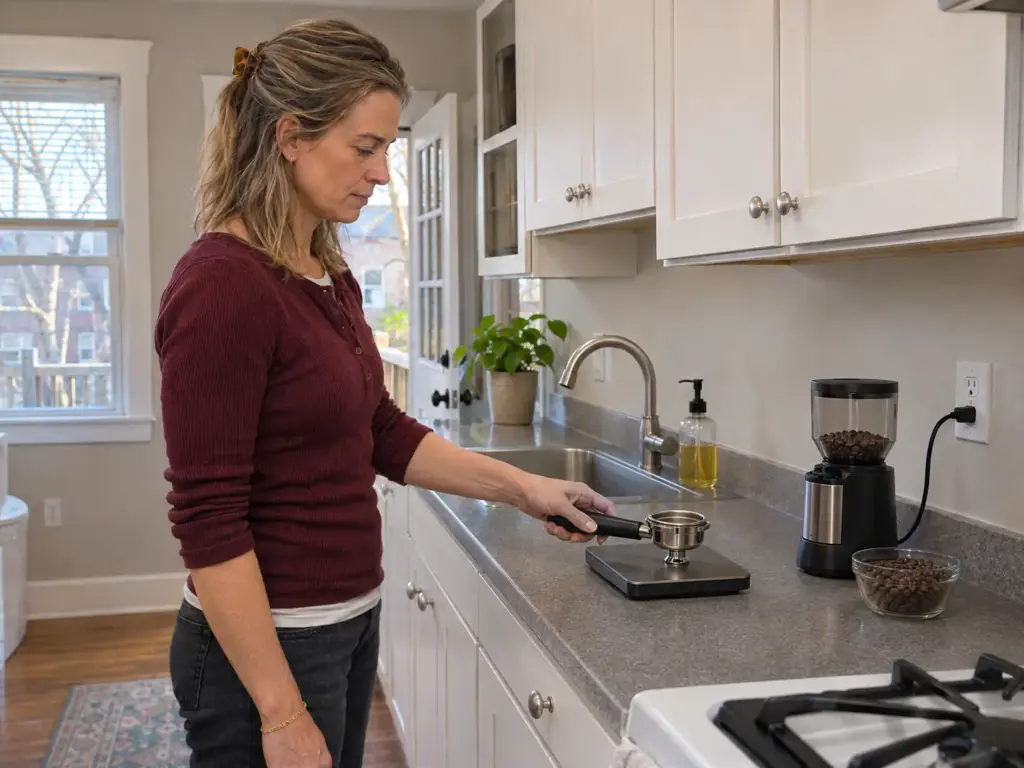
Before any shortlist there is a free test, and it may settle whether the dose was ever the trouble: the 1 g digital scale already in the drawer weighs what goes into the basket. What a coffee scale adds is the one thing the drawer scale cannot do, which is to watch what comes out of the spouts. That is the whole reason a 0.1 g scale earns a place under the cup.
Weigh the dose first, taste, then move one thing
A kitchen scale that reads in whole grams weighs an 18 g dose to within a gram, and a gram is about 5.5% of that dose. That is enough drift to taste, and not enough to ruin a shot.
Weigh the basket every time, because why a scoop never gives the same dose twice is the cheapest explanation for a double that wanders from morning to morning. Then taste it. Only if the cup is still off does the grind dial move, and the dose goes on the scale before that, exactly as in weighing the dose before turning the grind dial.
The drawer scale does the dose and stops there. Its display updates about once a second, and its platform is too wide to slide under the spouts. So the order is dose on the drawer scale, yield on a 0.1 g scale.
Dry the bottom of the cup before it goes on the platform. A cup fresh from a warming rinse leaves a film of water on the scale’s top, and that film is what the tare button has to fight through for the rest of the shot.
The volume button stops on the clock, not on the cup
The volumetric button on a home machine is a timer dressed as a volume, and volumetric dosing of that kind stops on the clock or the count it was set to, whatever the cup holds. Dose the basket half a gram heavy or move the grind a step, and the same press gives 32 g one morning and 40 g the next. Both cups look the same on the counter and sit eight grams apart on a scale. The scale shows what the button actually delivered, and the grind gets corrected against that number.
The trade works from the same numbers: an average dose of 18 to 20 g, an average output of 36.5 g, and a shot time of 25-30 seconds, with 82% of those surveyed measuring the yield by weight instead of by volume. Brew by weight is the habit, and the scale is what makes it possible on a semi-automatic machine. According to the Specialty Coffee Association’s own survey of how baristas pull a shot, “Our research suggests that the average barista uses a 1:2 brew ratio when extracting espresso and uses weight for output measurement.”
What a tenth of a gram does to an 18 g dose
An 18 g dose read to 0.1 g is a 0.55% step; a 36 g yield read to the same 0.1 g is 0.28%. At those sizes the tenth of a gram is already finer than a shot can repeat, so 0.1 g accuracy is enough for espresso, and every pick in this guide reads it. The digit never separates them. What separates them is time.
A plain timer scale at 0.1 g does the job for shots, and what it saves goes into beans. Where two scales share the counter, the plain one is grabbed for weighing the dose and the better one stays under the spouts.
Subtract the Scale and the Cup From the Gap Under the Spouts
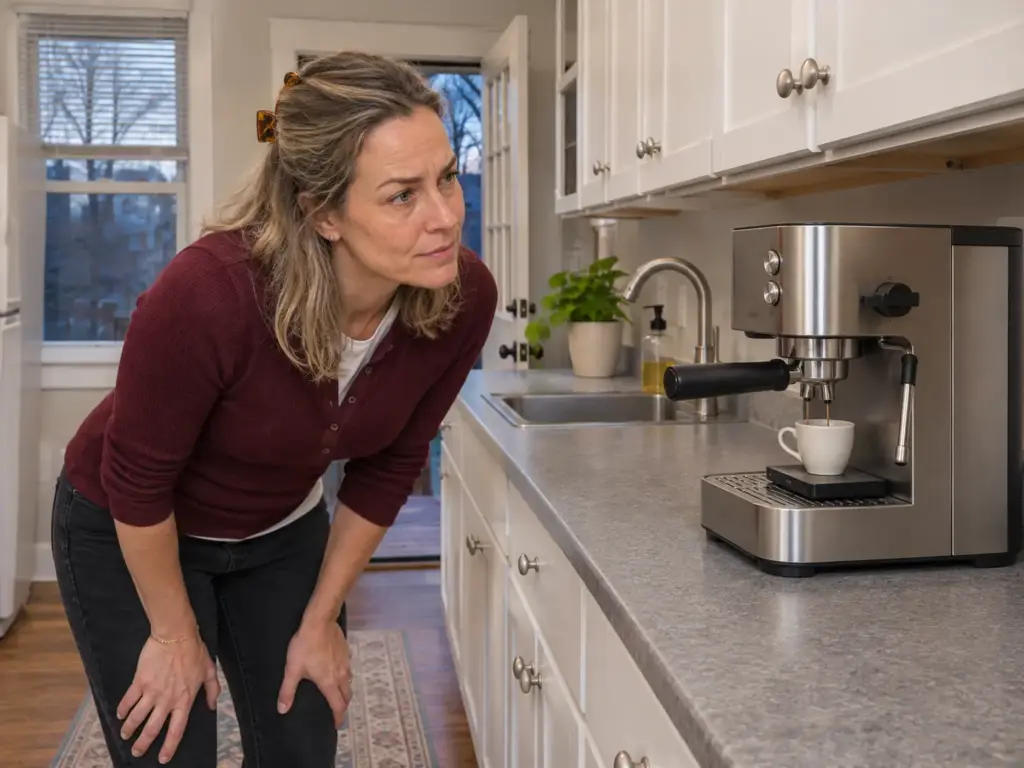
Fit is a sum, and no listing prints the answer. The gap under the portafilter, minus the height of the scale, is all that is left for the cup, and a compact scale with a low profile still goes back to the shop if the cup clearance is gone.
The gap under the spouts, with the cup on the platform
Acaia’s own fit test for its scales asks that the scale pass under an engaged portafilter with a standard six-ounce cappuccino cup on top of it, a cup about 60 mm (2.4 in) tall. That is the right way to measure, with the cup already on, because the cup is the thing that has to get under there. Measure your own machine the same way: lock the empty portafilter in, then run a tape from the bottom of the spouts down to the tray grate. Take away the height of the scale, and what remains must hold the cup you actually pull into.
Cut a piece of cardboard to the listed footprint and fold it to the listed height, then slide it under the spouts with your cup on top. If the stack scrapes the portafilter, the real scale will too, and the test cost nothing.
What the subtraction leaves on a compact machine
Take a stock Gaggia Classic Pro. Its published numbers give about 70 mm (2.8 in) from the tray to the spouts of a double portafilter and about 95 mm (3.7 in) to a bottomless portafilter.
A slim scale stands about 18 mm (0.7 in) tall, a thicker one about 26 mm (1 in). Seventy minus 18 leaves 52 mm, a shot glass, not a cappuccino cup. Put the same scale under a bottomless basket and 77 mm are left, enough for the bigger cup.
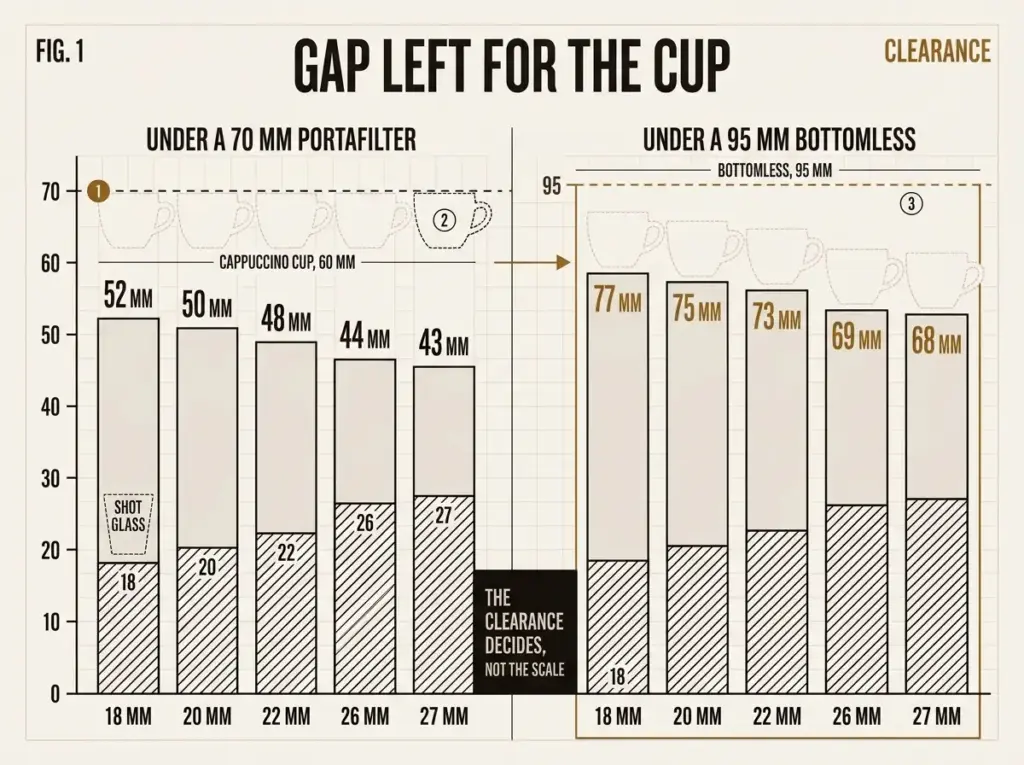
So a bottomless basket buys back more than any few millimeters of scale height ever will. The heights of the scales in this guide, about 18, 20, 22, 26 and 28 mm, leave about 52, 50, 48, 44 and 42 mm under that 70 mm machine, and the tallest two leave under 45 mm, less than most shot glasses stand.
Rocking on the tray and the free fixes
The tray is the other fit problem. A drip-tray grate that is uneven, or has a lip, leaves the scale rocking on one edge, and the reading creeps while the shot runs. Two fixes cost nothing, and they go in this order: flip the grate around so a small scale sits flat (the price is hiding the full indicator), then slide a strip of rubber mat or a thin tile under the scale. Check whether the reading still creeps before you reach for a second fix.
Width matters too. A 54 mm and a 58 mm basket machine have different trays, and the platform has to be narrow enough that the cup still sits on top. The square 4.13 in housing and the 2.71 in strip that anchor the picks below are the two ends of that range.
A Shot Leaves the Spout at 1.3 Grams a Second
Once the scale fits, the next number is its response time, or how fast the display catches up. A shot adds more than a gram a second, and the figure you are reading is always a little in the past. This section does the sum, then says where the premium money goes.
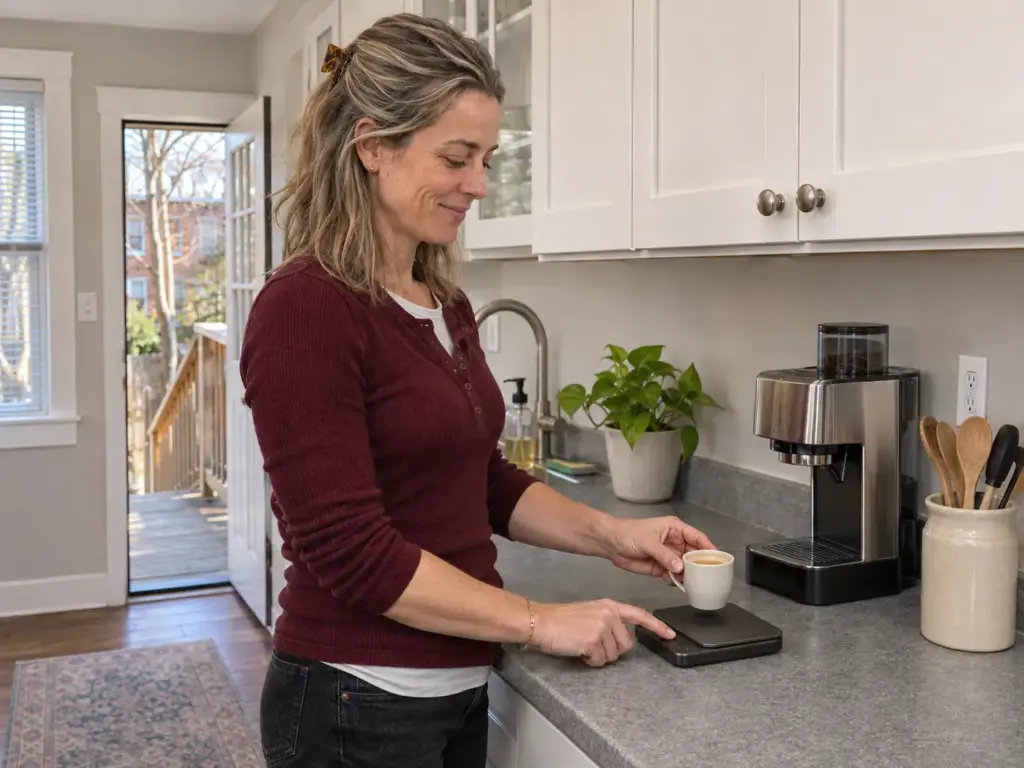
One second of lag is more than a gram of yield
A 40 g shot in 30 seconds lands about 1.33 g in the cup every second, a flow rate of about 1.3 grams per second on average, and the peak runs higher. One second of lag at 1.3 g a second is about 1.3 g of error, thirteen steps on a 0.1 g display. Half a second is about 0.65 g. A 0.1 g readout only starts to pay off once the lag is under about a quarter of a second.
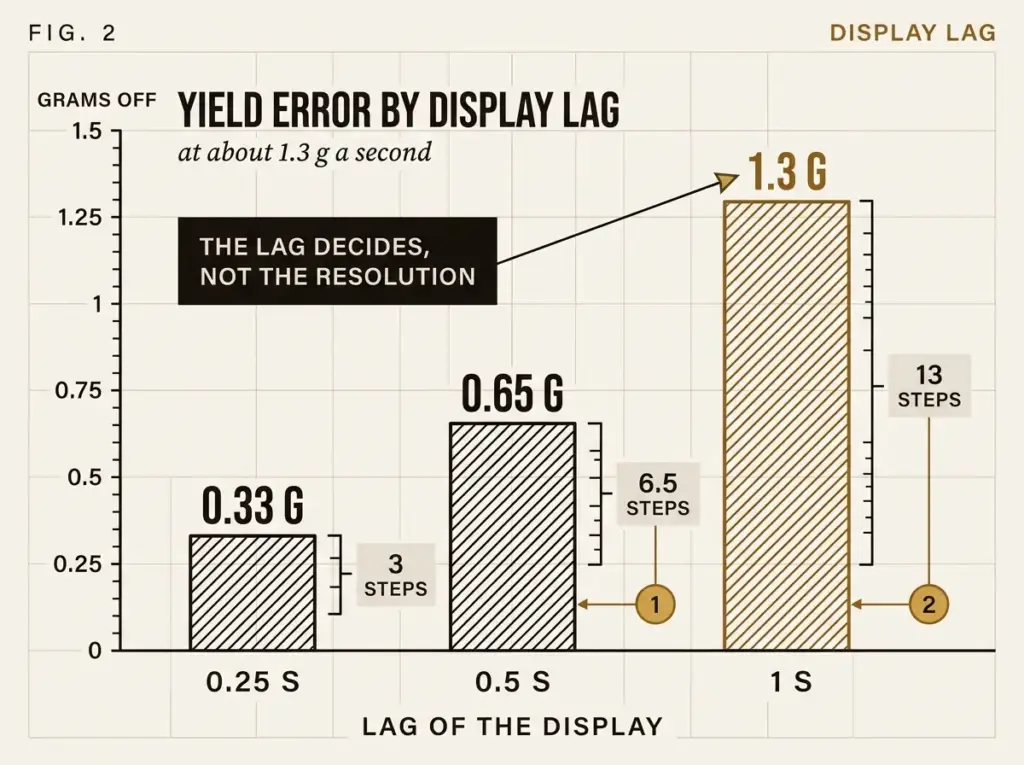
That is why a mid-range scale is late and not inaccurate. An independent bench test put the readout lag of a single-sensor Black Mirror at roughly 0.3 to 0.5 seconds, and that settle time at 1 to 2 g a second leaves the display 0.5 to 1 g behind the cup. You stop on 36.0, the cup is already at 37.3, and the correction you make next morning is made against a number that was stale.
Tare, timer and the button you hit with a wet finger
Ask a spec sheet how long the display takes to catch a falling stream, because the resolution is the same on all of them. Acaia’s own help pages give stabilization under a second at the 1 g step and longer at 0.1 g, which is the usual shape of the trade: a finer step settles slower.
The timer has to run in the same unit as the weight, and the tare has to answer a wet finger. A timer that starts itself when the first drop lands, called solid-to-liquid detection, is what a hand with no free fingers wants. A tare that stops answering once the platform is damp is the month-two failure.
Time your own scale with a US nickel, which weighs 5 g. Tare, drop the coin and count how long the display takes to stop moving. Every half second it takes is about 0.65 g of error at the spout.
Where the premium money goes
The premium scales are not more accurate. They are faster, they are sealed, and they start their own timer. Whether that is worth several times the price depends on how many shots a day get weighed: for one double each morning and a tray that is wiped dry, a basic scale does the job. On a counter that pulls several, the lag and the sealing start to pay for themselves.
The Wet Tray Is Where an Espresso Scale Gets Retired
Every spec above holds in week one. An espresso scale lives under a dripping group head, so what it does in month two depends on water, switches and a battery more than on the load cell.
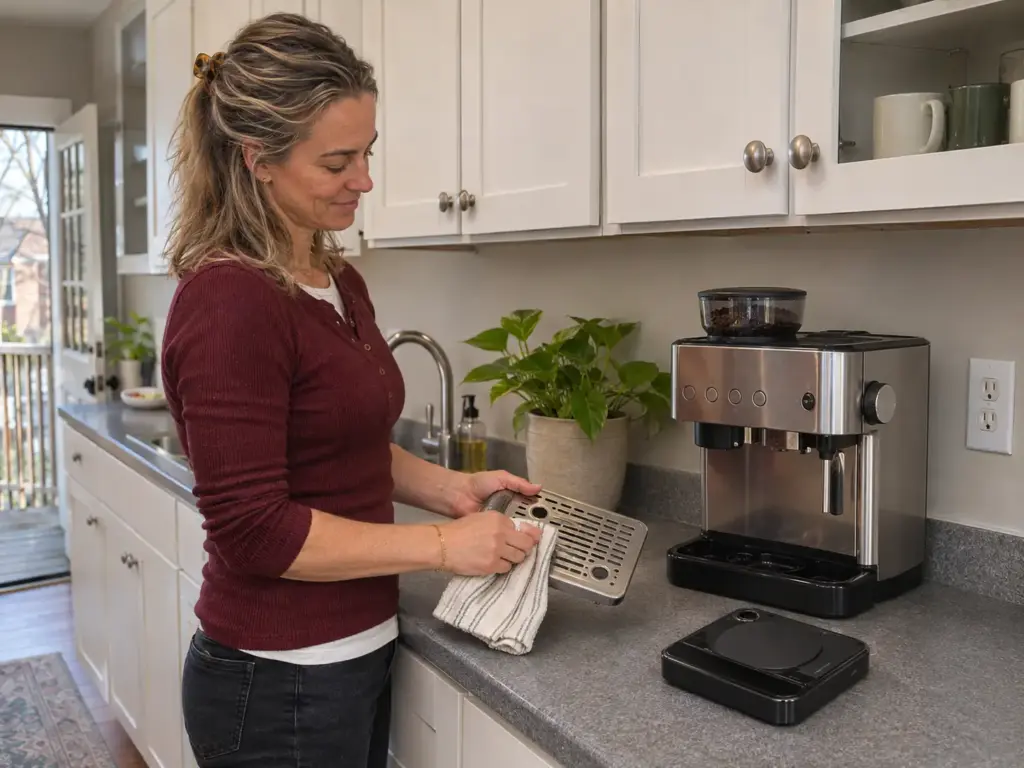
Why the tare button stops answering first
The electronics at the switch go before the platform, or the strain gauge under it, does.
A power button stops answering in the first months. A tare shifts the reading instead of zeroing once the platform is damp. The zero wanders while beans trickle in, and a ghost weight appears with nothing on the platform at all. The tare that answers every press on a dry platform and shifts the reading after one wiped-over splash is the clearest sign of it.
Acaia’s own advice is to dry the drip tray before the scale goes on, and a maker saying that tells you the seal is a wear item. If the zero wanders on a scale that has a recalibration mode, run it once on a dry platform. The free fix comes before any purchase.
Wipe the tray and the platform after the last shot of the day, not before the first. A tray that dries overnight is dry when the first dose goes on, and the scale never sits in standing water.
Batteries that go in a month and batteries that go in years
A rechargeable that runs about 15 months on one charge at two or three drinks a day is the good case. The common one is a cell that stops holding a week of shots. A basic scale that takes AAA cells can run for years, because the cells are swapped and never charged. A scale still working after years of daily shots shows that the category is not doomed, only the cheap rechargeable end of it, and which cheap scales still read the same later ranks that end by what survives month two.
What a sealed housing and a water-damage warranty buy
A housing that is drip-proof is not the same as one that is waterproof, and only a rating such as IP67 says which.
The reference the whole category is measured against is the Acaia Lunar: a 105 × 105 × 15 mm anodized aluminum housing, water-resistant, with a flow readout, Tare Save and a two-year warranty that names water damage. Its money buys the seal and the warranty. It does not buy a better number, because every pick here reads the same 0.1 g. And it is not reliably available on Amazon, so the pick that does the same job comes next.
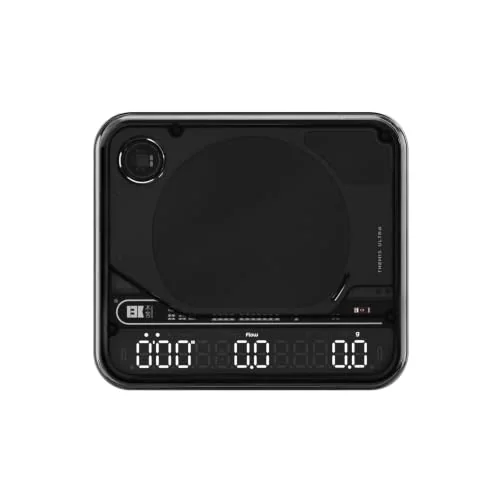
The buyable stand-in is the BOOKOO Themis Ultra, sealed to IP67, with weight, flow and ratio modes and Bluetooth, the one built for the wet tray. Its soft spot is accuracy: some units read less steadily than the sealing would suggest.
Four Scales Under the Budget Ceiling That Still Clear a Compact Tray
If the sealed one is more than the machine is worth to you, the four below do the job for less. The order is fit first, then what each leaves out, because the sums from the last two sections are the filter instead of the price.
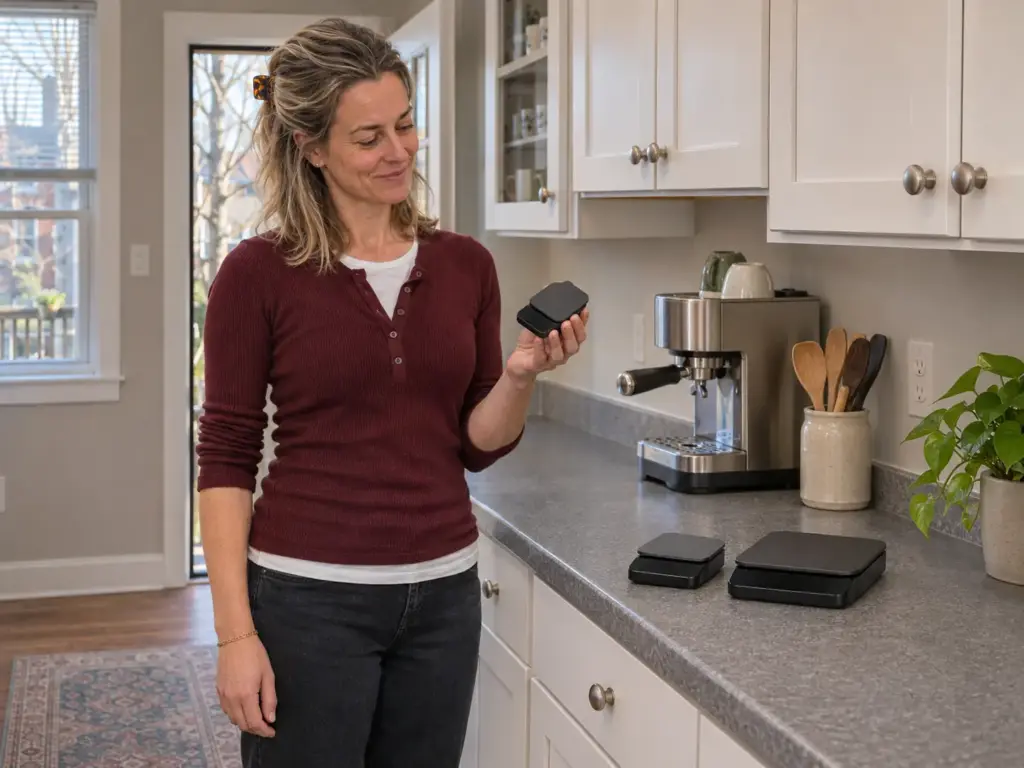
The strip that fits where a square will not
A tray five inches across and a scale nearly six is the whole fit problem in one picture. The WEIGHTMAN WM133SL is a compact scale that reads 0.1 g up to a 1,000 g capacity on a stainless platform that measures 4.75 × 2.71 × 0.7 in, and it runs on two AAA cells. It goes where a square scale will not. Accuracy and battery life are its weak points: some units skip to odd weights, the cells run down fast, and the battery cover is the first part to wear.
The square one with a real timer
The Maestri House S2 is the smallest square housing that still holds a demitasse: 4.13 × 4.13 × 0.78 in, 0.1 g from 0.5 g up to 2 kg, a 500 mAh USB-C battery, two timer modes and a borosilicate glass top. The square footprint fouls very narrow trays, and there is no flow readout.
The one that starts its own clock
The MHW-3BOMBER ES6027B-OS is 4.9 × 4.9 × 0.87 in with a 1,500 mAh battery and reads 0.1 g from 0.3 g up to 2 kg. Its timer starts itself when liquid reaches the cup, which the maker’s own spec sheet states as solid and liquid detection, so no button gets pressed mid-shot. Weight fluctuations, units that lasted only a couple of months and charging problems are the reasons not to treat it as a long-term buy.
The value pick with the ratio on screen
The TIMEMORE Black Mirror Basic 3 reads 0.1 g from 0.2 g up to 2,000 g in a 5.98 × 5.12 × 1.02 in case with a 1,600 mAh USB-C battery. Its regular, pour-over and espresso modes come with a ratio calculator on screen, and it is the lowest scale of these that shows both, and the tallest of the four. Some units only work some of the time, and whether it is worth what it costs is argued.
Against the sealed pick of the last section, the four give up sealing, a faster display and a warranty that names water. They keep 0.1 g, a timer and the fit. For a reader who dries the tray, the less expensive scale is where to stop, and the drawer scale already covers the dose. For a drip pot or a pour-over, which scale suits each of those brewers answers the same question.
When the Machine Reads the Scale, and When One Scale Must Do Two Jobs
Every pick so far is a stopwatch with a number. Two cases ask for more: a machine that reads the scale and stops the shot itself, and a counter that has to share one scale between a portafilter and a dripper.
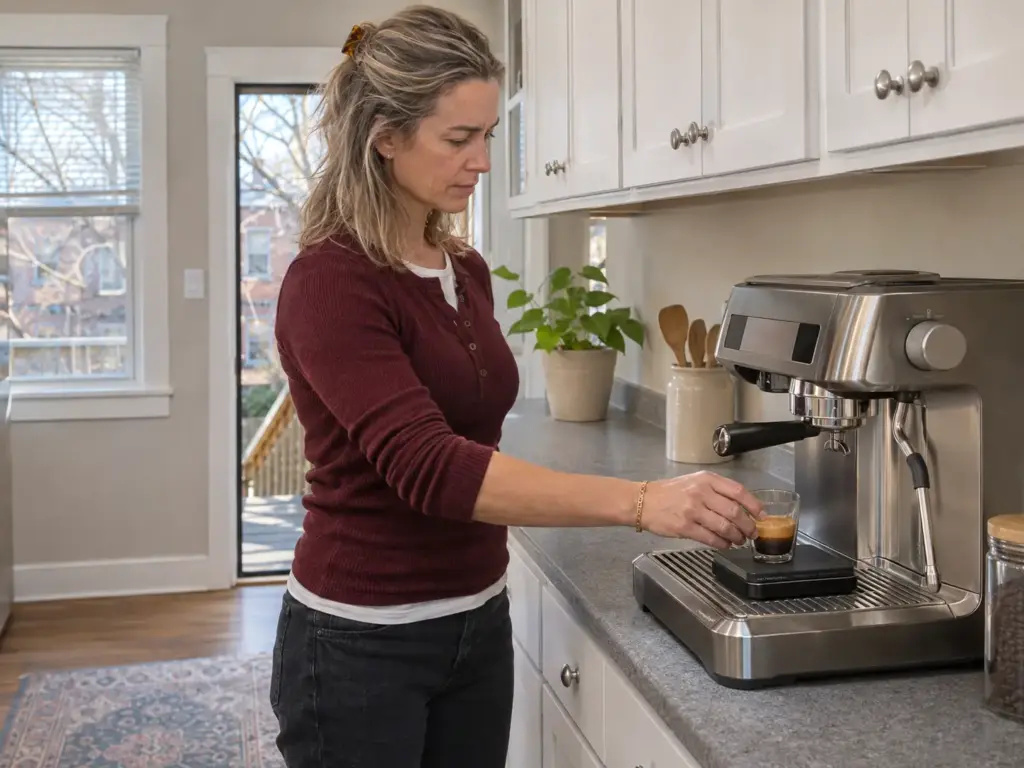
Brew-by-weight works only with two machines
The Breville Precision Scale Duo reads 0.1 g up to 2 kg on a dual-cup platform that measures 5.4 × 4.3 × 0.7 in, with Bluetooth, USB-C and five modes. Breville’s own product listing credits Acaia as the technology behind it. The hands-free brew-by-weight, which starts from the first drop and stops at the target yield, works only with the Breville Oracle Jet BES985 and the Oracle Dual Boiler BES995. On every other machine it is a plain scale, so a reader with a different machine should not buy it for the feature.
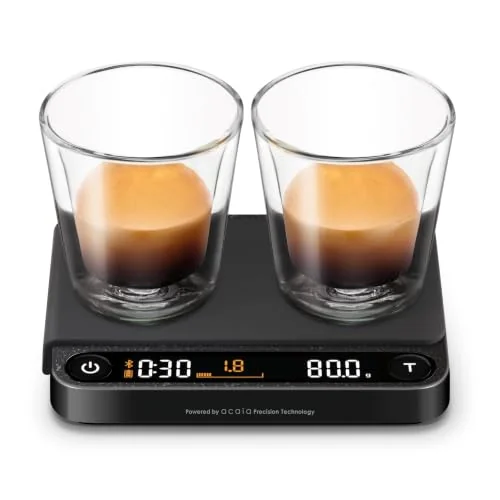
This is the one case where the scale is half the routine. The machine reads the weight and cuts the shot, so the display lag worked out earlier stops being your problem and becomes the machine’s. A scale with a brew-by-weight bullet that sits on a machine it was never paired with does nothing but weigh.
One scale for espresso and a dripper
The HARIO Polaris CST-2000-W is the only pick whose screen does the ratio arithmetic for a dripper: 2,000 g, 5.0 × 6.5 × 1.1 in, 437 g, with a pour-over ratio and percentage display, the kind of tool a V60 or a French press session wants. The listing’s own numbers carry the trade: a stated 1 g accuracy and a 6.5 in deep case, the largest footprint in this guide, and its modes are filter tools. So it is the honest answer to “one scale for both” only on a counter with room and a dripper first, and a portafilter second.
The two ends of the question pull opposite ways. A slim scale for the portafilter is bad at a wide dripper, because the platform is small. A wide scale for the dripper is bad at the tray. The answer is the one the counter votes for.
The kitchen reader who came from drip
If your coffee has been a drip coffee maker and a scoop, the same arithmetic holds on that side: weigh the coffee in grams, and the pot stops being a guess. A first drip pot weighed in grams instead of scoops is the same argument on the drip side, and the scale you buy for the tray will do it.
When the Scale Reads True and the Shot Still Tastes Wrong
A scale that reads 36.0 g exactly is working. A 36 g yield that still tastes sour or bitter is the grind or the puck, so the scale’s number is where the diagnosis starts and not where it ends.
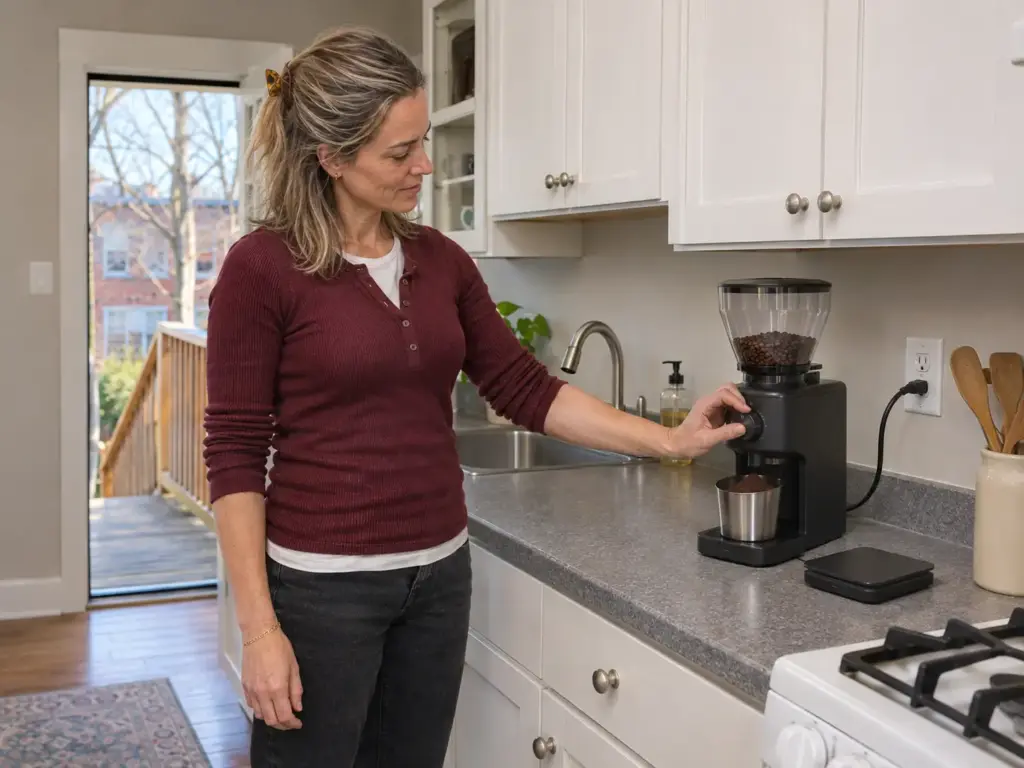
Dose and yield first, then the grind one step
Fix the dose and the yield, and the shot time becomes the reading.
A shot that gushes and tastes sour means the water left before it finished, which is under-extraction: go a step finer. A shot that chokes and tastes bitter ran too long, which is over-extraction: go a step coarser. Move the dial one step, taste, and only then decide whether to move it again. What the grind should do to a shot’s time is the next stop, and moving the grinder one step at a time covers the routine that the yield reading drives.
According to the SCA’s explanation of what dialing in actually changes, “It’s a kind of tuning: adjusting variables methodically until the optimal flavor appears.” The scale is the instrument that makes the variable visible.
After a grind move, run a few grams through the grinder and bin them before the next dose. A grinder keeps grounds inside, so the first dose after a change still comes out at the old setting and fools the shot you weigh.
The cases where the scale was never the problem
Channeling, uneven tamping, a stale or badly distributed dose and the wrong basket all give a 36 g yield that still tastes wrong, and no scale fixes a puck that channels. The sorting question is the same: how a finer or coarser grind turns a cup sour or bitter separates a grind problem from a puck problem. Work done at the UC Davis Coffee Center with the SCA shows sweetness peaking at low extraction and low strength, and bitterness at high of both, which is why a scale that can hold one variable still while another moves is the useful instrument.
Take the third morning, with the same dose and the same yield and a shot that runs five seconds faster. That is the grinder drifting while the scale stays blameless.
The next purchase is the grinder
A scale that tracks the dose to a tenth of a gram only helps if the grinder repeats it. Once the yield is measured, the grinder and its setting are what move it. A grinder that repeats an espresso dose is the purchase that follows the scale, and for a counter with no room for a large grinder, a hand grinder with room to dial in does the same job.
Weigh the Dose, Watch the Yield, Dry the Tray
Weigh the dose on the drawer scale first, and measure the gap under the spouts before you order anything, with the cup in the sum. The money buys speed, sealing and auto-tare, never a better number, and every pick here carries a flaw in writing. The number the scale gives is where the diagnosis starts.
After the scale has been wet a few times, check whether the tare still answers on a damp platform and whether the zero wanders while the beans trickle in. If either has started, the tray is the cause and a dry cloth is the fix.
Tomorrow, weigh the dose, pull the shot to the yield the cup wants, and if the time runs off, move the grind a single step. A cup that comes out less sour at the same dose and yield means the step was right; a cup that turns bitter means it went one too far, so come back half a step.
Frequently Asked Questions
01What is the best coffee scale for an espresso machine?
The one that fits under your portafilter with a cup on top and settles fast enough to follow a pour; every scale here reads the same 0.1 g. Measure your clearance first, then choose between a slim budget scale and a faster, sealed one by how many shots a day you weigh.
02Does an espresso scale need to read 0.1 g?
Yes, 0.1 g is enough: an 18 g dose read to 0.1 g is a 0.55% step, and a 36 g yield is a 0.28% step. Every pick in this guide reads it, so what differs is how fast the display catches up with the stream.
03Do I need a scale if my machine stops the shot by volume?
Yes, because a volume button stops the shot on a clock instead of the mass in the cup, so the same setting gives different shots as the dose and the grind shift. A scale shows what the button actually delivered, and the grind is corrected against that number.
04Can one scale serve espresso and pour-over?
Yes, if the counter has room: a wide, ratio-showing scale suits a dripper and crowds the tray, while a slim one fits the tray and cramps a wide dripper. Choose by the brewer you use most. The HARIO Polaris trades a stated 1 g accuracy and a 6.5 in deep case for its ratio display.
05Which scale works with a machine’s brew-by-weight?
Of the scales here, only the Breville Precision Scale Duo, and only with the Breville Oracle Jet BES985 and Oracle Dual Boiler BES995 machines. On any other machine it works as a plain scale, so buy it for the pairing or not at all.



How did your cup turn out?
No comments yet. Tell us what you changed — and whether the needle moved.