
We may earn a commission when you buy through links on this page. It never changes what we recommend. How we pick
On this page7 parts
Your scale showed 20.3 g for the scoop yesterday and shows 20.5 g this morning, same bag, same hand, nothing added. Whether that is the beans, the counter or the scale is the question under every search for the best cheap coffee scale, and the answer decides whether a budget coffee scale can be steadier than the one you own. A scale has one job, repeating a number, and a cheap strain-gauge scale repeats it; what the low end gives up is speed, size and a sealed top. Below: what the job really is, the free fixes to try before spending, where the cheap tier gives out, which platform fits which brewer, and a shortlist with each flaw written beside the name.
Quick Answer
The best cheap coffee scale is one with 0.1 g steps, a built-in timer and a platform wide enough for the brewer you own. Judge it on consistency instead of absolute accuracy: the same scoop of beans has to read the same number tomorrow, and a cheap scale does that. Extra money buys speed and a wider platform.
What the Best Cheap Coffee Scale Has to Do
The verdict above rests on one idea. A coffee scale does a small, specific job every morning, and the cheap tier covers most of it. Four things make up that job: steps of a tenth of a gram, a timer beside the weight, a platform that fits the brewer, and a number that settles instead of crawling.
A tenth of a gram, and why the second decimal rarely matters
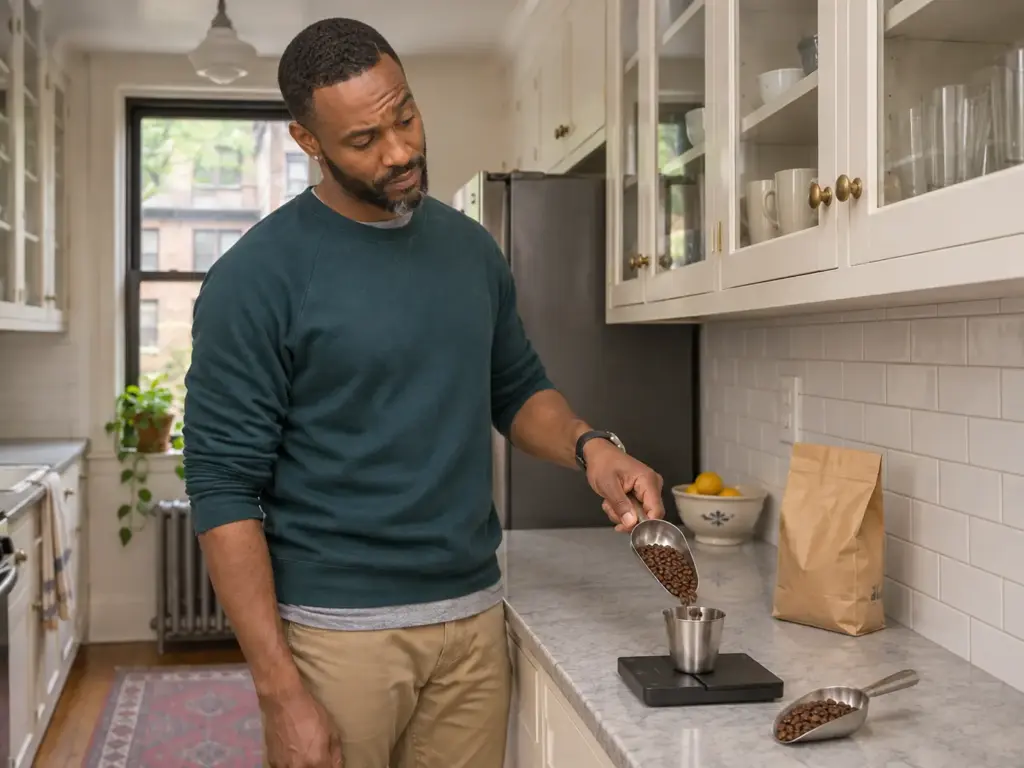
Start with the step. On an 18 g dose, a 0.1 g step is 0.55 % of the coffee, while a whole-gram step is 5.5 %, so a scale that only reads whole grams can sit half a gram off and the cup never says which morning it happened. That is the whole case for 0.1 g as the floor. Twenty grams of coffee is roughly four level tablespoons, and a tablespoon can swing by a gram or more depending on how it is heaped, so the tenth of a gram is already finer than the spoon it replaces.
The second decimal (0.01 g) is another matter. A 0.01 g scale, the jeweler’s scale kind, matters for a recipe weighed in a tiny batch or a check on a coarser scale, and for almost nothing else on a kitchen counter.
The weighing happens in the load cell under the platform, a strain gauge that bends a hair when weight lands and reports the bend as a number, which is why even the cheap ones can repeat to a tenth. A kitchen scale is also not a legal-for-trade instrument, and nothing obliges it to meet the tolerances in NIST Handbook 44, the federal specifications for weighing and measuring devices, which govern scales used to sell goods. The fair test of a home scale is therefore repeatability: does it give the same answer twice.
Repeating the same number matters more than being exact
A coffee brew is a ratio, and a ratio forgives a scale that is wrong by the same amount every time. It does not forgive a scale that is wrong by a different amount each time. The Specialty Coffee Association puts the point in one line about its published standards for home brewers: “A standard is a documented set of guidelines or requirements used across an industry to create consistency, quality, and shared best practices.” Consistency is the word that carries the weight, and it is exactly what a scale buys you over a scoop (a scoop is a volume, which is why a scoop never gives the same dose twice).
Put two cheap 1 kg scales next to each other and weigh one bean can: 50.41 g on one, 50.40 g on the other, and 124.5 g on both for a tin of grounds. Agreement to a hundredth of a gram is the job done, and the simple strain bridge inside a cheap scale is the reason it can happen: two units built the same way bend the same way.
In grams, a 1:16 ratio as the starting brew ratio turns a 20 g dose into a 320 g cup, about 11 fluid ounces. The SCA’s own figure of 55 g/L (55 g per liter) works out to roughly 1:18, which calls for 82.5 g of coffee in a 1.5 L pot where 1:16 calls for 94 g; the standard sits in the middle of the road, and the working ratio starts a little stronger so you have room to move both ways when you taste.
A scale that reads 20.3 g on the scoop one morning and 20.5 g the next with nothing added is drifting instead of weighing, and the number that keeps climbing after the beans stop is the sign. That is the first thing to check before blaming the beans. If the reference weight reads right at 20 g but wrong at 500 g, the scale has a linearity problem, and the fix is a calibration routine with a known calibration weight, when the scale offers one, or a return when it does not. Precision is the repeat, linearity is the straight line from one end of the range to the other, and a coffee scale needs the first far more than the second.
Pick one object that never changes, a sealed jar or a full bean can, and weigh it the day the scale arrives. Write that number on the base with a marker. Whenever a cup seems off later, weigh the same object: if it matches, the scale is fine and the beans or the grind moved; if it does not, the scale did.
What the extra money does buy
If accuracy is not what costs more, something else must, and four things do. The first is refresh rate and response speed, how quickly the display follows a pour and how long the settle time is before the number stops moving.
The second is platform size: 5.25 in across on the widest cheap scale against 2.71 in on the smallest.
The third is capacity, which runs from 3 kg and 2 kg down to 1 kg and, for a pocket scale, 100 g. The fourth is the build, meaning a splash-proof top, a backlit display you can read in a dim kitchen and a rechargeable battery with an indicator in place of AAA battery cells that give no warning. Premium names such as Acaia and Difluid sit above the budget tier and win on speed and a smaller footprint, which is a different purchase from this one. Escali, MyWeigh and Adams make plain kitchen scales, and RENPHO, Coffee Gator, Etekcity, Diyife and BOMATA sell budget scales that mostly repeat one of the platforms below, so the same questions apply to each label.
The same what-the-money-buys argument applies to grinders, where what a grinder’s extra money does and does not change is a longer story, and it is the grinder, not the scale, where a dose usually goes wrong.
Fix the Counter Before You Replace the Scale
Most complaints that a cheap scale is inaccurate trace back to the counter, the cup or the heat. So the free fixes come first, and each is worth trying with the scale already in your kitchen. Take them in the order below and re-weigh between them, so you know which one did the work.
Level the counter and keep the steam away
Weigh the same full mug three times, lifting it off and setting it down between readings. If the three numbers agree, the scale is repeating and the problem is somewhere else.
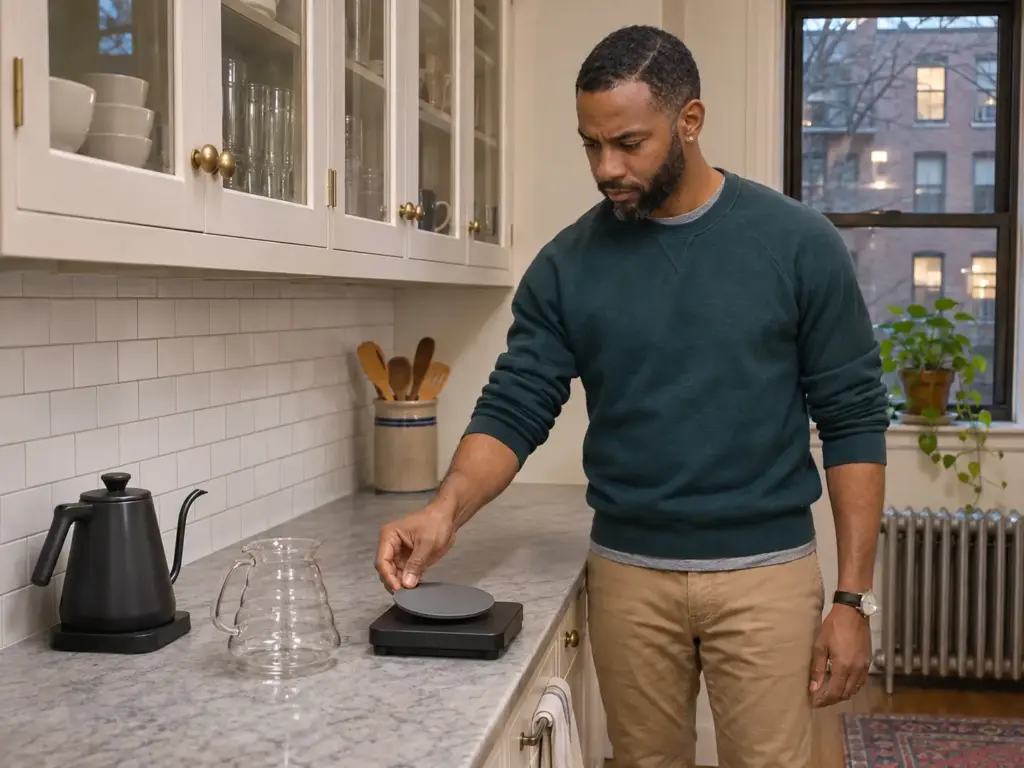
If they wander, look at the surface first: a counter that tilts or a board that flexes under the platform changes the reading, and so does a kettle venting steam onto the glass or a draft crossing the top. Either one can move a tenth of a gram without any help from the electronics.
Move the scale to a level surface, rigid and away from the kettle, and weigh the mug again. Vibration from a running grinder or a washing machine on the same counter moves the number too, and so does airflow from a fan or an open window. Stop there if the numbers now match.
Weigh into the same cup, and re-tare
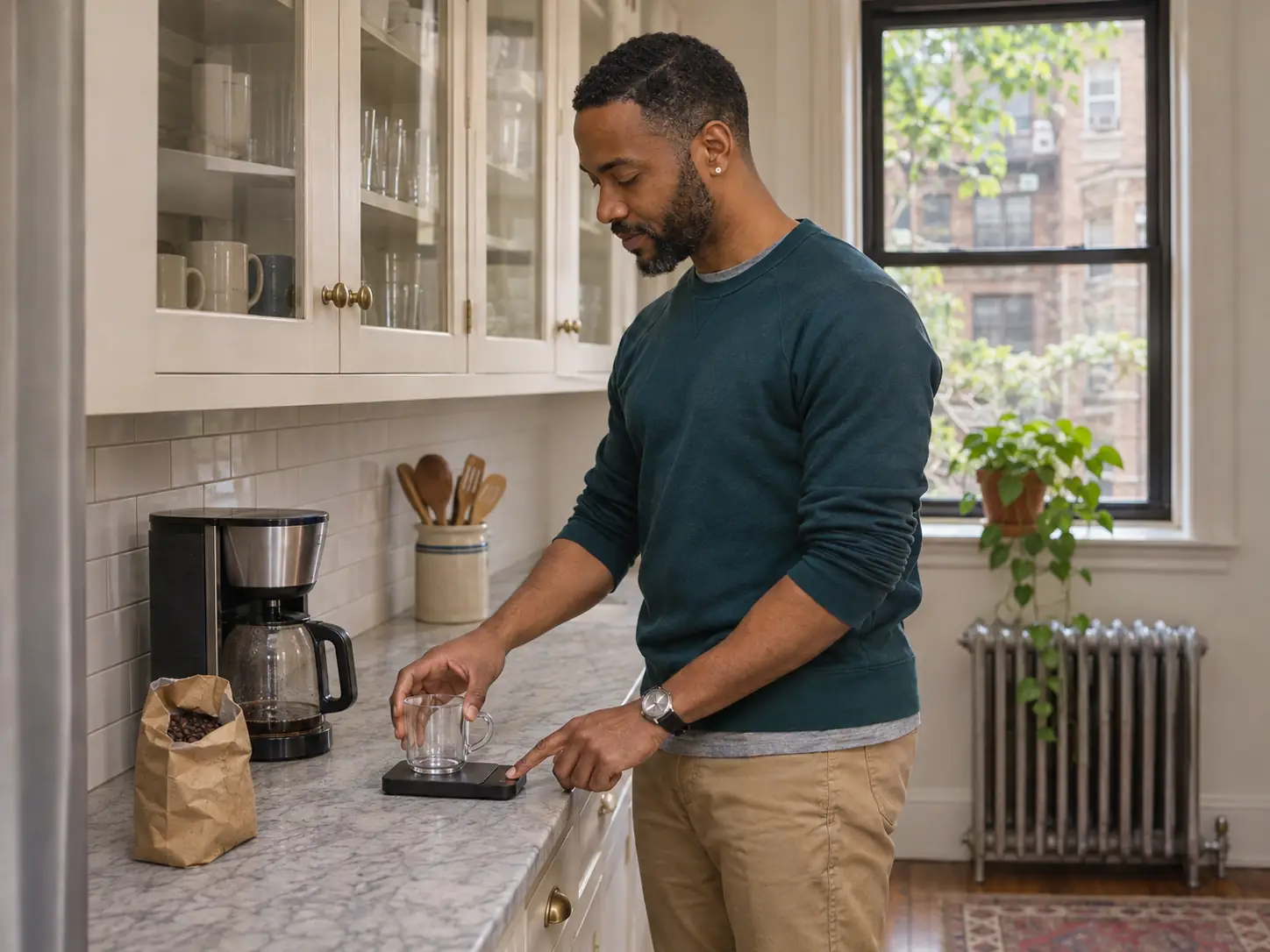
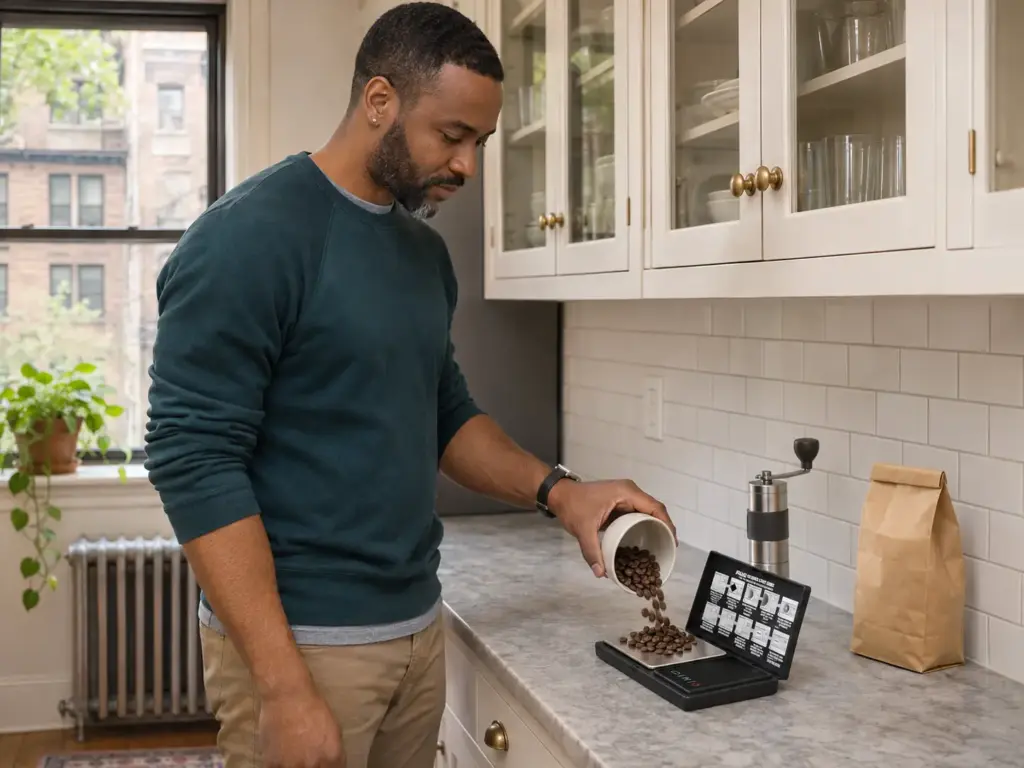
Weigh into the dosing cup you grind from. Set the cup on the platform and press tare. Weigh beans first, then grind and weigh grounds on the same scale. The difference between the two numbers is the grinder’s retention in grams, which the scale reports for free.
Tare again whenever the load changes, because trusting the old zero is how a gram goes missing. A reader who would rather not spend at all can still get most of this from level spoons for the reader who will not buy a scale at all, at the price of the spoon’s wider spread.
Jot the grinder’s retention on a sticky note beside it each time you check. A loss that holds steady means a normal grinder. A loss that jumps from week to week points at the beans, usually oilier or staler than the last bag, and not at the scale.
Put a pad between a hot brewer and the platform
Heat is the quiet culprit. On one cheap scale, a hot glass brewer set straight on the platform lost about 1 g over five minutes. The same brew on a coaster with a ceramic carafe lost about 0.5 g, and with no heat involved the reading did not move in ten minutes. The silicone pad that ships with the scale is there for this, as much as for spills.
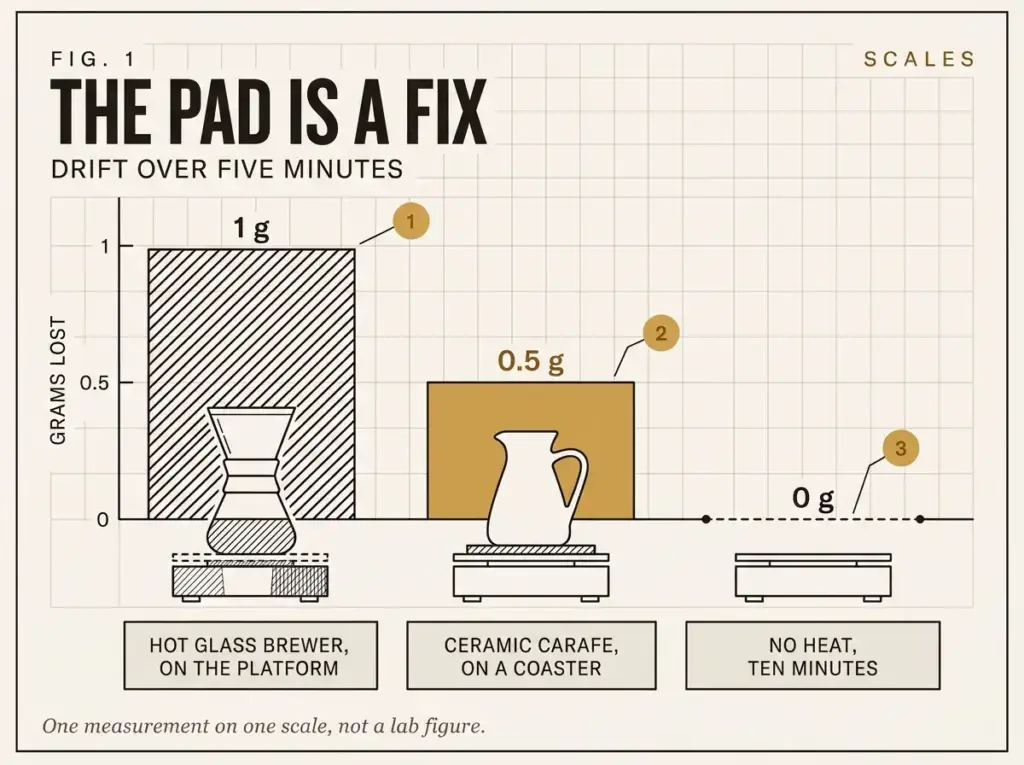
A reading that creeps while nothing is added is the signature of heat on the platform. A reading that sits still and then jumps is something else, and it belongs to the next section. Change one thing, then weigh again, and stop at the first fix that works.
Where a Cheap Scale Actually Gives Out
Once the counter is sorted, what remains are the flaws of the cheap tier itself. They are specific, and each one shows up on a particular job or in a particular month. Hearing them before spending is cheaper than hearing them after.

The tare that re-zeros while beans trickle in
Cheap scales use strain gauges, and strain gauges drift, so the firmware runs drift correction in the background, a kind of auto-tare. That correction reads a slow addition of two or three grams as drift and applies a tare re-zero instead of counting it. The result is a number that sits still through the first two or three beans and then jumps, which is exactly how beans arrive from a scoop, and why a cheap scale seems to lose a gram while a mechanical balance would not.
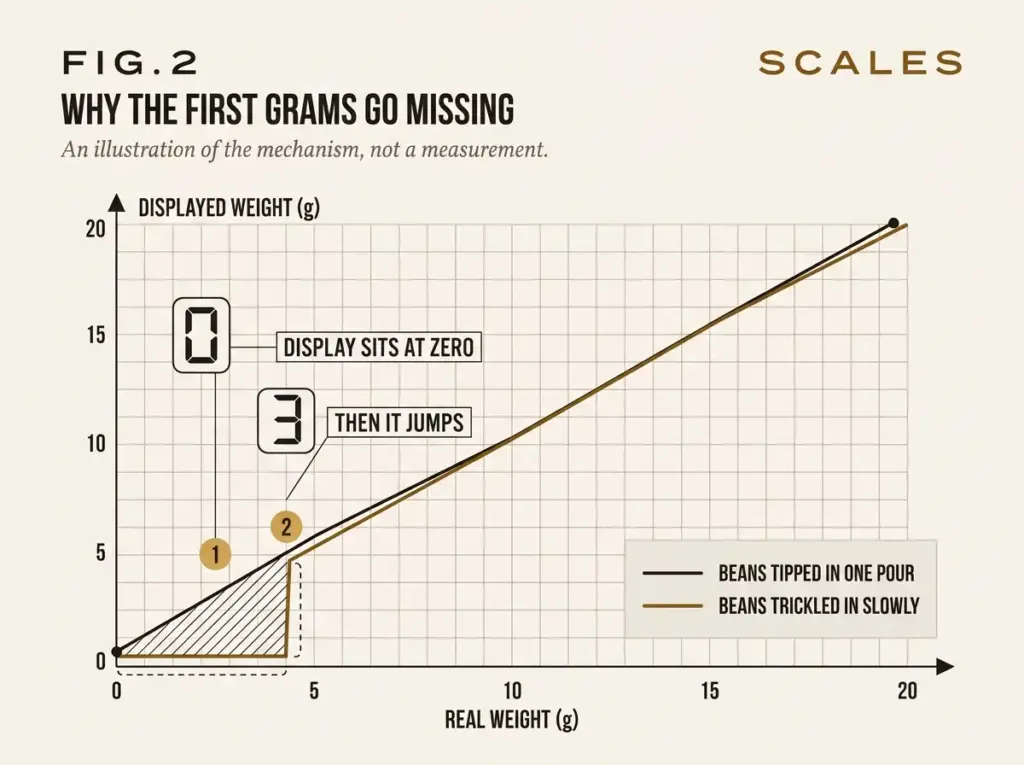
Tip the beans in with one steady pour and let the number land. If you must add a last few beans one by one, tap tare first and weigh only the addition, then do the sum yourself. The scale will not re-zero a load it has just been told to expect.
A display that cannot keep up with a short shot
A display that is fine for a four-minute pour is wrong for a 28-second shot. At 1.2 to 1.4 g of espresso per second, a one-second lag puts you 1.2 to 1.4 g past the target yield before the number even shows it. That is the one job a slow display loses, and a reader weighing espresso should hear it before spending; what a 28-second shot asks of the grind is the longer discussion. For pour-over the lag is forgiving, since a pour-over grind by dripper and drawdown gives you minutes to watch the number settle.
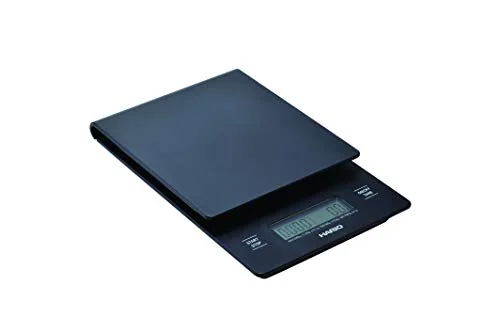
The Hario Drip Scale Timer VSTN is the honest example of how that feels. It is the pour-over timer the hobby grew up on, with a count-up timer, 2 kg capacity and two AAA cells, and no water rating on the top. Its display takes about five seconds to wake at power-on, and units have broken inside six months, so it suits a patient pour and nothing faster.
The battery and the port at month two
A scale on AAA cells with no battery indicator works for weeks, then one morning reads short or resets mid-pour, and the whole brew is guesswork.
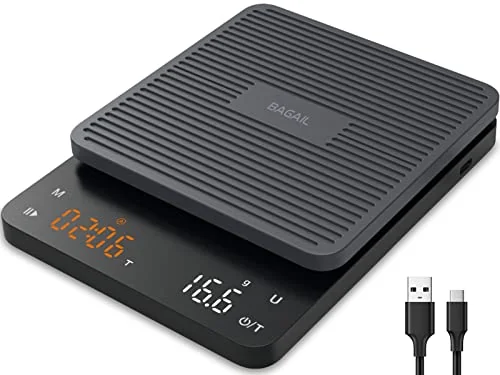
A rechargeable scale with an indicator solves that and brings its own failure: a charging port that fills with coffee dust, and touch keys that stop answering. When buttons fail on a scale like this, the weighing still works and the timer or the tare does not, which is the moment to use the return window. The BAGAIL Coffee Scale with Timer SC01 is the cheap example with the indicator the AAA scales lack: USB-C, auto and manual timing, a 3 kg ceiling and a silicone pad. Its battery has a way of stopping holding a charge around the six-month mark, accuracy varies between units, and one unit broke at thirteen months.
The pattern across the tier is consistent. The cheap scale that is still exact in month two is usually the one never asked to hold more than half its capacity, and the ones that fail first are used near the top of their range. Dead units cluster early, between six weeks and six months, with the timer still counting and the sensor gone. The defect rate is the one spec no listing prints, so buy where returns are easy.
Match the Platform and the Capacity to Your Brewer
A scale can be exact and still be the wrong size, and the capacity trap is the flaw the box never mentions. So this section matches the scale to the brewer on the counter, and the answer to which coffee scale to get comes down to the smallest one that still holds your biggest load. Check what the brewer weighs when full before looking at any model.
A full pot is more than a pocket scale can hold
A 1.5 L pot holds 1,500 g of water, about 50 fluid ounces, before the brewer and the carafe go on the platform.
That figure rules out the 1 kg and 100 g scales for a pot, since they are for a dosing cup and a basket. A scale pushed past its rated range either shows an error or reads wrong, and overload protection, where a model has it, only stops the damage and does not make the number right. A 6.6 lb (3 kg) platform about 5 in across is what a full pot or a Chemex needs, and the same reasoning makes a pour over scale a smaller job than a pot. At 1:16, that pot wants 94 g of coffee, so the dose is what the small scale weighs and the pot is what the big one has to hold; turning the pot size into the gram dose takes a minute and settles which one you need.
A drip coffee scale only has to hold the carafe and the water, so a twelve-cup carafe is the heavy case, while a V60 or an AeroPress is lighter and a 1 kg or 2 kg platform handles either. A French press and a moka pot sit between the two, that is heavy before any water goes in, so weigh the empty brewer first and tare it. Once the platform is right, a drip machine run in grams instead of scoops becomes an ordinary routine, no longer a project.
The scale that fits under a drip tray
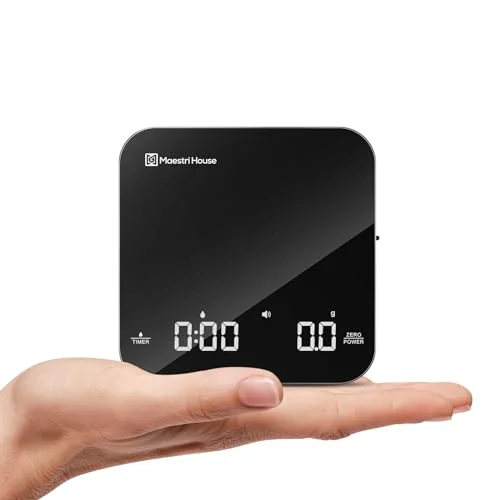
An espresso scale is the opposite problem: the scale has to fit under the spout of the machine. The Maestri House S2 Espresso Coffee Scale is 0.78 in tall on a 4.13 in square and still holds 2 kg, which is the one job the wide scales cannot do.
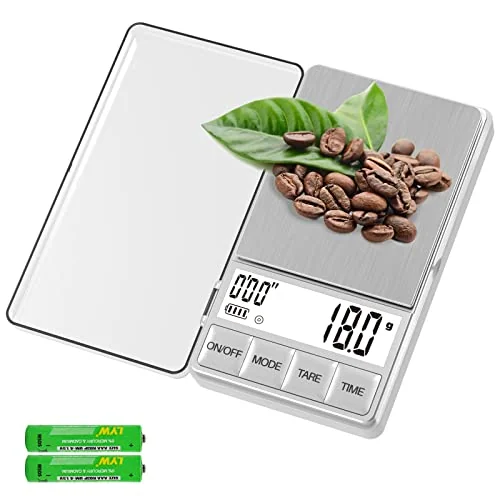
Its accuracy varies from unit to unit, and its auto-start timer is finicky, sometimes starting late or not at all. The WEIGHTMAN Small Coffee Scale WM133SL is the cheapest scale that physically fits a tray, with a 4.75 by 2.71 in steel platform, a timer and a tare. Its 1 kg ceiling makes the capacity trap concrete, since a full carafe would leave it unable to settle; random weight increments and mixed battery life are its flaws.
Add up the heaviest load the brewer will ever put on the platform (water, brewer, carafe) and pick a capacity at least double that. Headroom is not decoration: a scale used near the top of its range is the one that fails first.
A bean scale, and what the second decimal is for
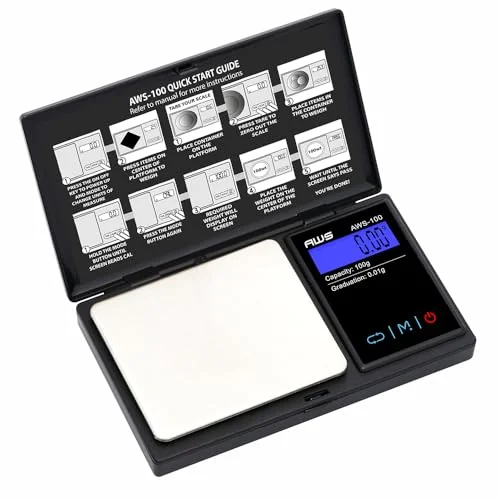
A pocket scale that reads to 0.01 g and tops out at 100 g is for beans only. The American Weigh Scales AWS-100 is the example: 3 by 5 by 0.8 in, a tare button and a backlit LCD under a stainless top.
It answers what 0.01 g is for, which is weighing a filter and a rinse, a tiny recipe batch or a check on a coarser scale, and nothing past that. It is not for the pot, and an espresso tray does not need it. Its reliability is mixed, with units that have stopped working within a week.
Capacity and resolution trade against each other, and the buyer’s job is to match the capacity to the biggest load the brewer will carry, not to the biggest number printed. A small batch is where resolution beats capacity, and a small batch where 0.1 g matters more than 3 kg is a fine example of a brewer that wants the small scale.
The Shortlist, With the Flaw of Each Pick
With the spec test, the free fixes, the failures and the platform match in hand, the picks follow by brewer. Each carries what is wrong with it next to the name, and the table at the end gathers all eight in one place.
A full pot or a Chemex
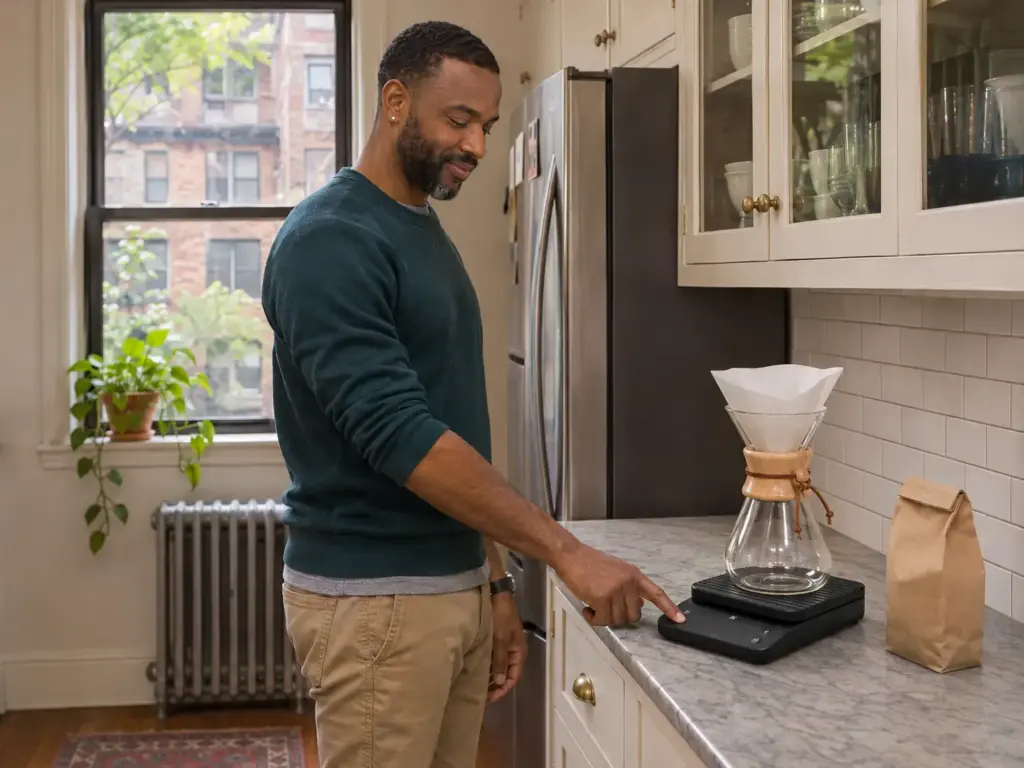
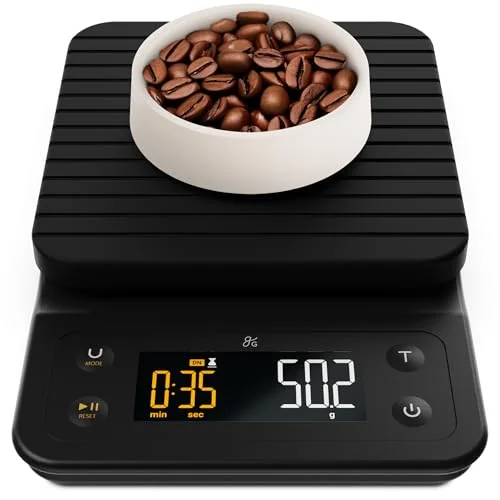
For a full pot or a Chemex, the widest platform in the cheap tier is the Greater Goods Coffee Scale with Timer 0460. It is rated for 3 kg (6.6 lb) on a 5.25 in platform, with a count-up and count-down timer and a waterproof silicone cover. Its weak point is the life of the unit, not the reading.
Pour-over, with a flow readout
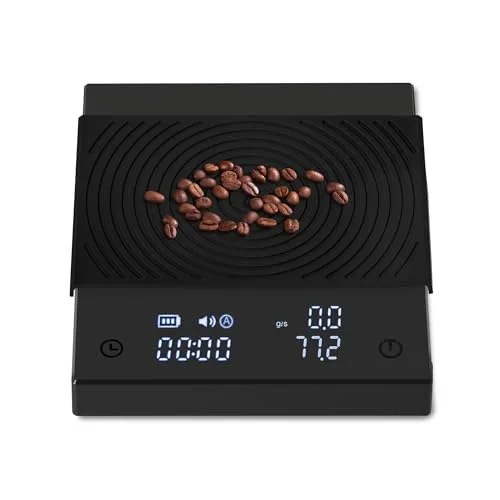
The pour-over pick is the TIMEMORE Coffee Scale Basic 2.0, from the Black Mirror line, a 2 kg scale that adds a live flow-rate readout to weight and timer, with USB-C charging and a hidden LED display. It is the one built for the pour, and the spending sits at the top of this list. Its weak point is the electronics: some units stop working within a month or break after six, and the sensor reads as too sensitive. A reader who wants a step up and has room in the budget should read which scale fits which brewer once the budget is not the limit.
The cheapest full-size scale with a timer
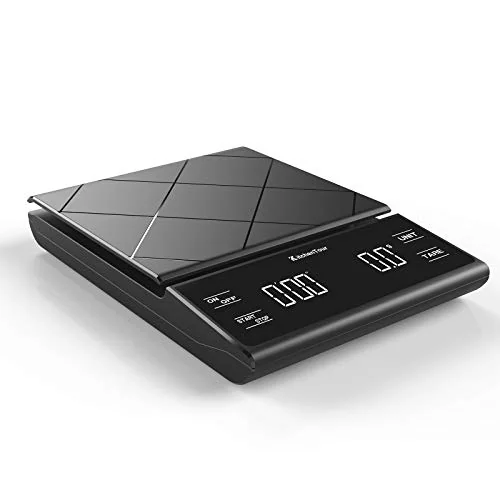
The cheapest full-size scale with a timer is the KitchenTour Coffee Scale with Timer EK6012: 3 kg at 0.1 g, a built-in timer, AAA cells in the box and a 8.46 by 6.3 in platform, with thousands of ratings behind it. No repeated complaint turns up, and the only mark against it is that it ships under two model numbers with identical bullets, so check which one is in the cart.
The pick that lasts is the one used at half its capacity, with a pad under the brewer and a fresh tare at the start of every weighing. For quick reference, all eight models sit in the table below.
| Model | Capacity | Timer | Power | The flaw |
|---|---|---|---|---|
| Greater Goods 0460 | 3 kg, 5.25 in platform | Count-up and count-down | 3 AAA, no battery indicator | Units that stop at six weeks to three months |
| TIMEMORE Basic 2.0 | 2 kg | Timer plus live flow rate | USB-C | Electronics, an oversensitive sensor |
| KitchenTour EK6012 | 3 kg | Built in | AAA included | Two model numbers, identical bullets |
| BAGAIL SC01 | 3 kg | Auto and manual | USB-C | Battery fades near six months |
| Maestri House S2 | 2 kg, 0.78 in tall | Two modes | USB-C | Accuracy varies, finicky auto-start |
| Hario VSTN | 2 kg | Count-up | 2 AAA | Slow display, no water rating |
| WEIGHTMAN WM133SL | 1 kg, fits a drip tray | Timer and tare | AAA | Random increments |
| American Weigh AWS-100 | 100 g at 0.01 g | None | AAA | Reliability mixed |
Three Weighings Tomorrow, and What to Recheck Later
Consistency is the spec, the free fixes come before any purchase, and capacity follows the pot instead of the price tag. Every pick on the list carries a flaw, and the flaws are knowable before the scale arrives.
For the first morning, weigh the same full mug three times on a flat, dry counter, and tare the cup before each dose. If the number repeats, the scale you have is fine, and the next cup should taste like the last one. If it does not, level the counter and move the kettle away before anything else. After a few months of daily use, weigh the reference object again: the same reading means the scale held, and a drifted reading, a sluggish port or a button that has stopped answering means it is time to return it while the return window is open.
The scale only measures what the grinder hands it, and a dose that is right on paper still tastes different when the grind wanders, which is where a grinder that stays even at the coarse end picks up the story.
Frequently Asked Questions
01Is a cheap coffee scale accurate enough for brewing?
Yes for the dose, because a brew needs the same scoop to read the same number each morning, and a cheap 0.1 g scale repeats that. The extra money buys display speed and a wider platform, not a more repeatable reading.
02What brand of coffee scale is most accurate?
No brand is accurate by name. The useful test is repeatability: weigh the same cup three times and compare. Cheap scales repeat to a tenth of a gram, so the money buys refresh speed and platform size, not a better answer.
03Why does my coffee scale number keep creeping up?
Heat or steam on the platform is the likeliest cause, with an uneven counter second. Put a silicone pad or coaster between a hot brewer and the platform and level the surface, which fixes it before any replacement.
04Which coffee scale should I get for a drip machine?
Pick one with a 3 kg platform about 5 in across that clears a full carafe, 0.1 g steps and a timer. A 1 kg pocket scale cannot hold a full pot of water, so it works only for the dose.
05Does a coffee scale need a timer?
For pour-over, a count-up timer beside the weight is enough. Auto-start matters mainly for espresso, where both hands are busy and the clock has to begin the moment the first drop lands.

How did your cup turn out?
No comments yet. Tell us what you changed — and whether the needle moved.