
We may earn a commission when you buy through links on this page. It never changes what we recommend. How we pick
On this page8 parts
- The Same Grams Over Two Different Clocks
- What the Clock Counts in a Pour-Over
- The Shot Window and What It Tells You About the Grind
- Where a Timer Gets the Number Wrong
- When a Phone Stopwatch Does the Same Job
- Guided Modes, and What Breaks by Month Two
- Tomorrow's Pour-Over: One Grind Step, Two Written Numbers
- Frequently Asked Questions
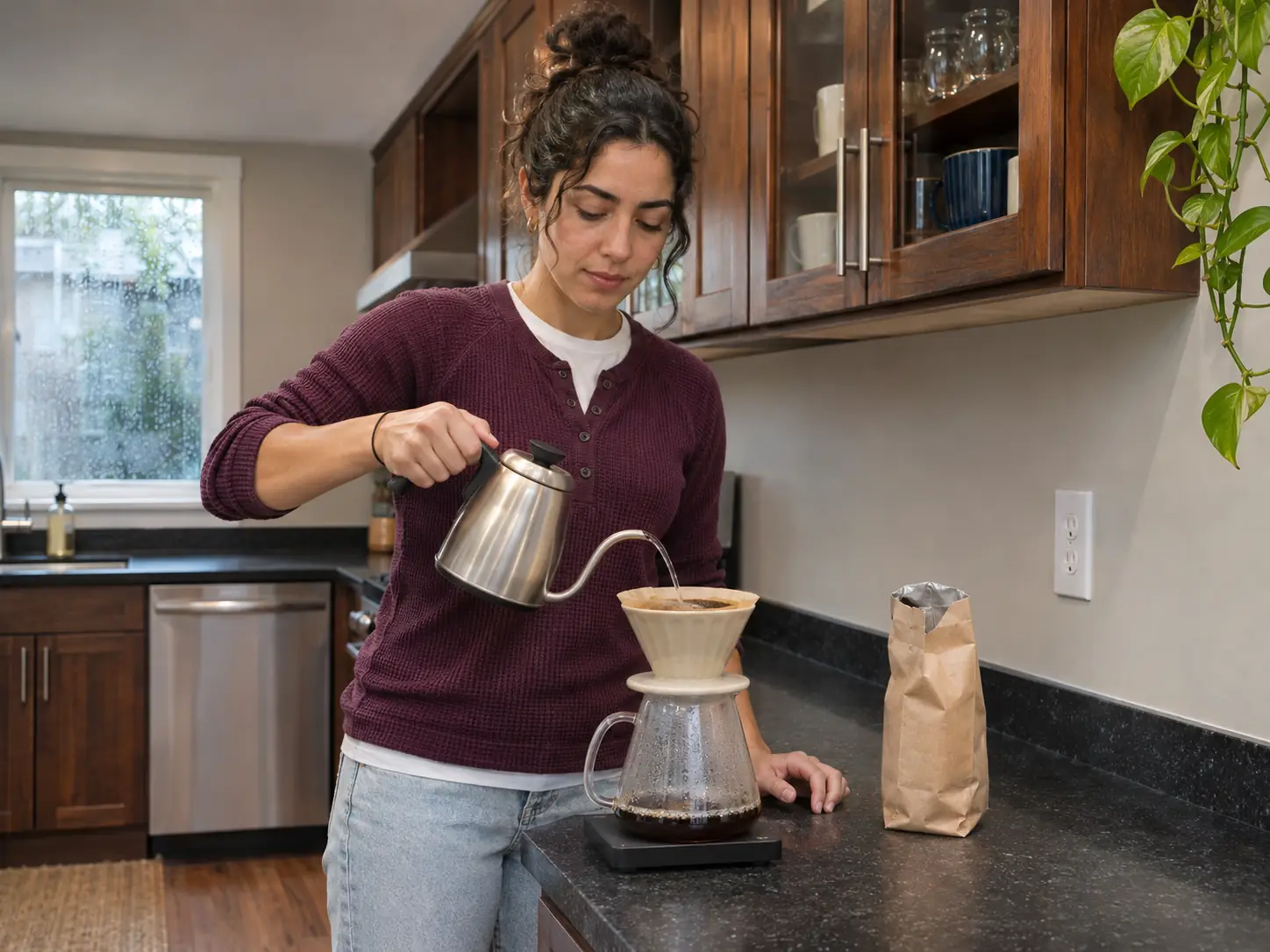
You weigh 15 g of the same coffee and 250 ml of water (about 8.5 fluid ounces) on Monday and again on Wednesday, same kettle, same dripper, and Monday’s cup is flat and sharp while Wednesday’s is heavy and dry. Nothing on the scale moved, so the beans take the blame, and the beans did nothing: the number that went unwritten was the one on the clock.
So why do coffee scales have timers? The second figure on the display is contact time, the other half of extraction, and a scale that carries it puts both numbers where the pour happens. Below: what the clock counts in a pour-over and in a shot, where it reports the wrong number, whether the phone in your pocket does the same job, and what to look at in a model.
Quick Answer
A coffee scale carries a timer because time is the second variable of extraction: the same weight poured over 2:00 and over 3:30 is two different cups. The scale puts the clock beside the weight, so you read both while pouring. A phone stopwatch covers most brews; an espresso shot is the exception.
The Same Grams Over Two Different Clocks
Time is half of extraction, and the proof is one dose poured over two clocks. Whether one brewing method is healthier for you is a question for your doctor, and nothing on this page answers it. Everything below stays on the cup and the seconds.
What contact time changes in the cup
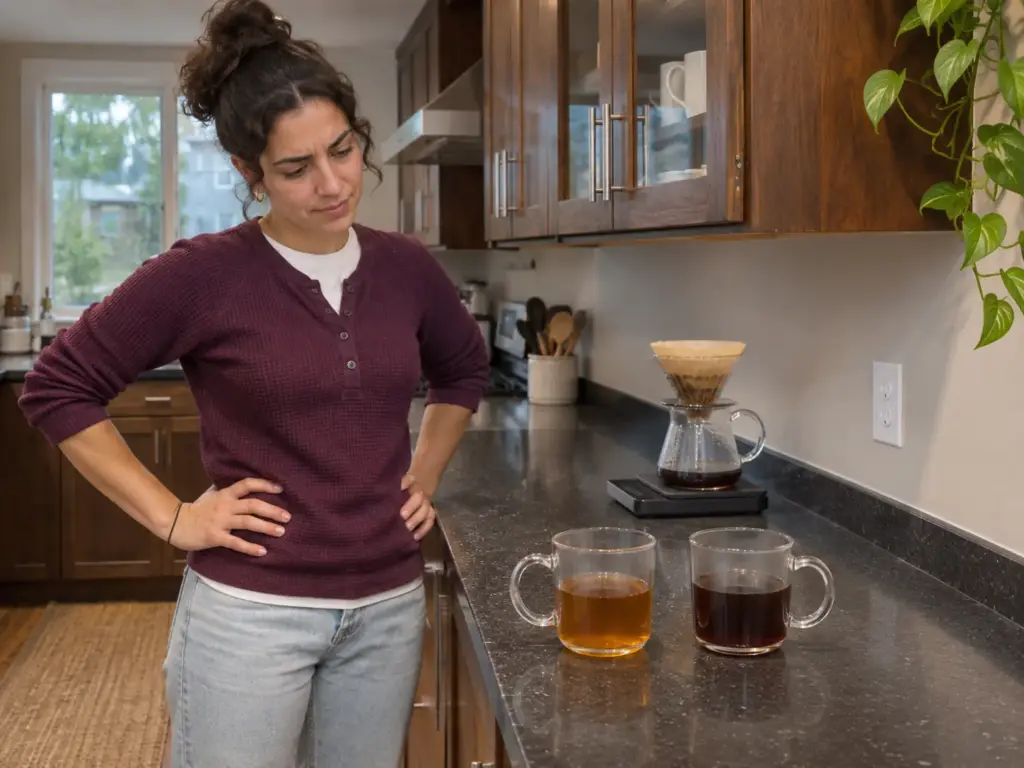
Extraction is dissolving. From the moment water touches the grounds it pulls material out of them: the quick, sharp-tasting compounds leave first and the heavy, bitter ones later, so the cup depends on how long the water stayed as much as on how much of it went through. Pour 250 ml through 15 g of coffee (a little over half an ounce) in two minutes, then the same amounts in three and a half, and the scale shows the same final number both times. The slower brew had longer to dissolve, so it is a different cup, and the display offers no explanation.
That is the Monday and Wednesday gap. A brew timed by feel drifts by tens of seconds from one morning to the next, and the drift gets blamed on the beans. A bloom that felt like thirty seconds runs past a minute while the kettle refills, and the cup carries the extra time with no record of it.
A drip machine is the exception, since it runs its own clock and the contact time is the machine’s business. The timer earns its spot on methods where your hand sets the seconds: pour-over, immersion (an AeroPress or a French press) and espresso.
Sour and bitter are the two ends of one timeline
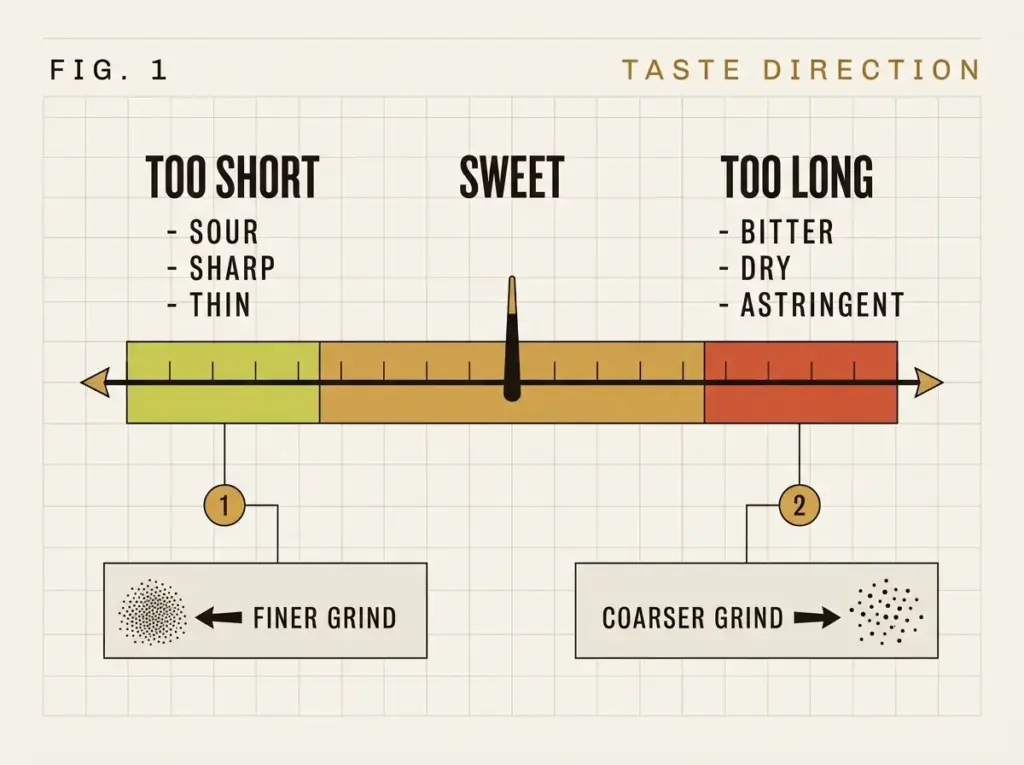
Sour and bitter sit at opposite ends of one timeline. Under-extraction is the sour, sharp, thin cup, where the water left before it finished; over-extraction is the bitter, dry, astringent one, where it stayed too long. Extraction time is the lever both cups have in common. Insufficient and excessive contact time both appear on the SCA’s own list of causes, which is why the clock and the grind are always read together.
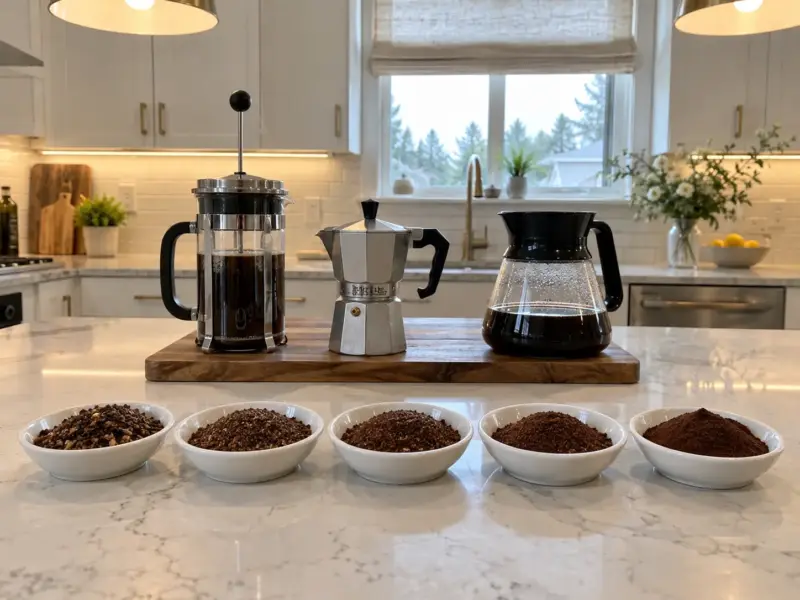
The target itself is a band. According to the SCA Golden Cup Standard, “Total contact time of 4 to 8 minutes for batch/drip brewing.” The same reference puts a pour-over at 2.5–4 minutes of contact for about 15 g of coffee to 250 ml of water (roughly 1:16 to 1:17), and an espresso at about 1:2 by weight in 25 to 30 seconds. Behind all three sits an extraction yield of 18–22 % at 1.15–1.35 % strength, and being twenty seconds off inside a good brew matters less than landing outside that band.
When the time is in the window and the cup is still off
Time is the check, never the target. When the clock lands inside 2.5–4 minutes and the cup is still sour, more seconds are the wrong lever: the grind comes first, and it costs nothing. Go one step finer, brew the same dose the same way and taste, watching how a one-step change in grind moves the cup from sour toward bitter. The sharp edge should round off; if the cup tips into dry bitterness, you overshot, so give half a step back.
The brew ratio is the other number to rule out before blaming the clock, and the ratio the clock is checked against is also where a reader who counts the dose in spoons lands. And the 2.5–4 minute window depends on the brew: it describes 15 g to 250 ml, and a larger batch or a different dripper moves the drawdown without making the cup wrong.
Tape an index card inside a cabinet and write two numbers after every pour-over: grams in the cup and total seconds. After three brews the card shows which pair belongs to the cup you liked, and that pair is the only target worth keeping. A scrap-paper brew journal like this also gives the repeatability a scale’s display alone never records.
What the Clock Counts in a Pour-Over
A pour-over has three moments worth watching: the bloom, the pours after it and the finish. The clock counts the same three whether it lives on a scale or on a phone, so the useful question is which of them you can read with a wet hand.
The bloom and its rest
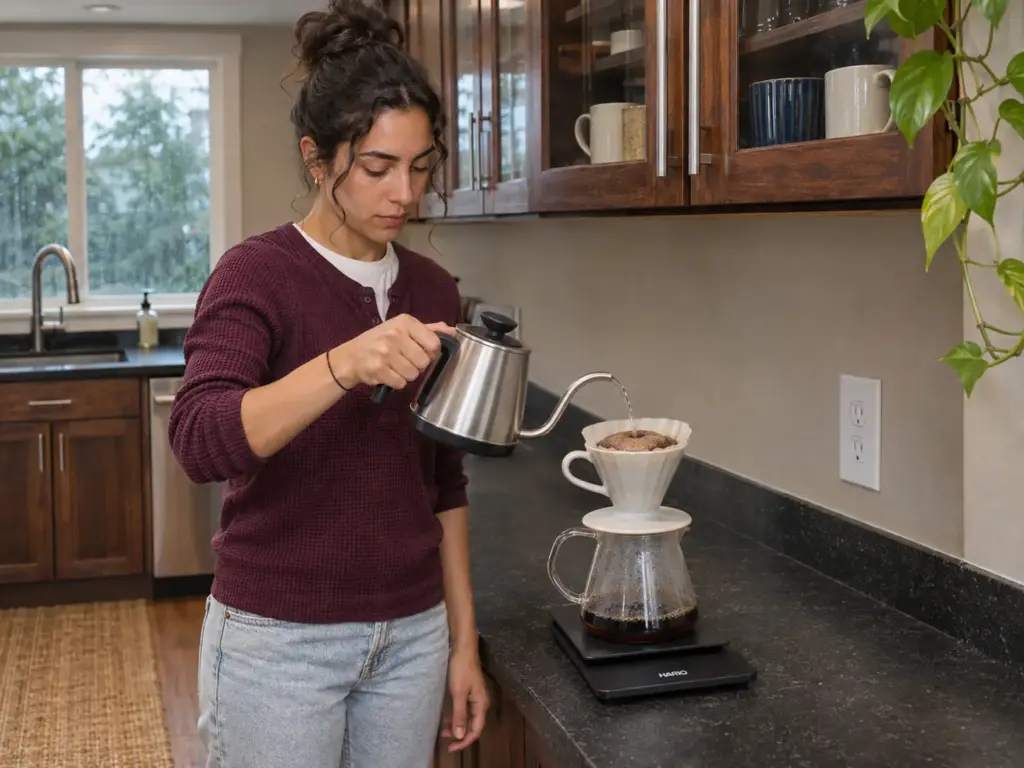
The bloom comes first: pour about twice the coffee’s weight in water (for 15 g, around 30 g), then wait 30–45 seconds before the main pour. That is the SCA reference as Roastopedia summarizes it. Fresh coffee puffs up during the wait because it is still releasing gas, stale coffee barely moves, and the clock is the only way to know the rest was long enough. A count-up timer shows the seconds elapsed; a count-down timer counts toward the end of the rest, and for a 30–45 second bloom the count-down is the easier read.
The free way covers this: a kitchen scale and a phone stopwatch started on the first pour. The failure is touching the phone with a damp finger mid-pour, so start the stopwatch once and leave it alone. A clock built into the scale matters for the reader who wants weight and seconds in one line of sight.
The Hario V60 Drip Scale is the plain reference for that. It reads 0.1 g up to 2,000 g on two AAA cells, and Hario states that its 5-minute auto-off is not activated while the timer is running, so the clock survives the brew. The buttons are where it gives ground: they respond poorly and are hard to use, and some units stop working properly. The slip to guard against is a second pour that arrives early because the 45 on the display was read as grams when it was seconds.
Staged pours and the total
The total is the second number worth reading: 2.5–4 minutes of contact for about 15 g to 250 ml, per the SCA reference. Staged pours are where the clock earns its place, since each stage has a target weight and a target moment, and a miss on either shifts everything after it. The total is also a reading of the grind: the grind that sets the drawdown decides whether the finish lands at 2:30 or 4:30 with every pour on time.
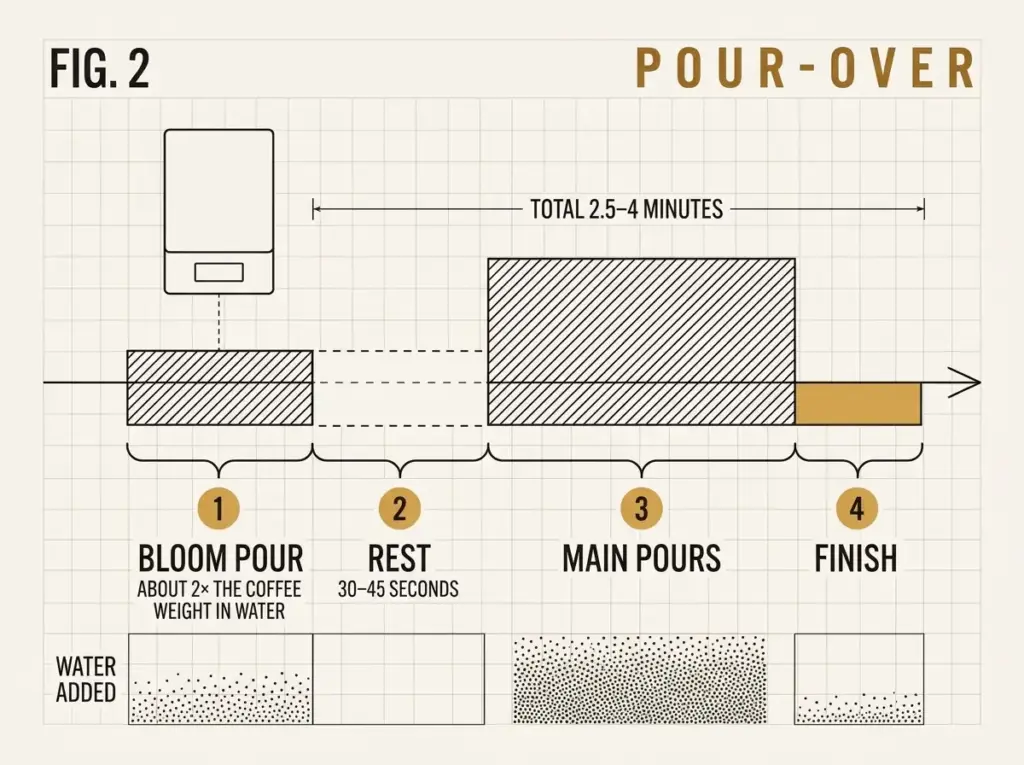
Read the total as a direction. A drawdown that finishes well under 2.5 minutes points to a cup that tastes sour and thin, with the grind a step too coarse; one that drags past four minutes and tastes dry and bitter points the other way, and the bed may have clogged. One grind step, then taste, and leave the pour pattern alone.
Flow rate, the third number on the display
Flow rate is grams per second, printed live beside weight and time on scales that carry the readout; Felicita and Acaia both describe a flow-rate indicator on their scales, and TIMEMORE’s Scale 2.0 prints it too. It describes the pour, not the cup: 50 g poured over 25 seconds is 2 g/s, and a steady 2 g/s is easier to repeat than a pour you only remember as slow.
The TIMEMORE Black Mirror Basic 3 reads 0.1 g and has three modes (Regular, Pour-Over, Espresso), and its pour-over mode carries a built-in water-to-coffee ratio calculator next to the clock. The mode is the feature here, since a timer alone never does the ratio sum. Reliability is the mixed part: some units only work some of the time, and reaching the automatic timer takes five presses of one button.
Read the clock during the rest, not during the pour. The rest is the only stretch of a pour-over with both hands free, so it is the one place to compare elapsed seconds against the plan and correct the next pour.
The Shot Window and What It Tells You About the Grind
For a pour-over, the free stopwatch is nearly enough. A shot is where it stops being enough, because the whole brew is over in about half a minute and the weight and the clock have to be read together.
Eighteen in, thirty-six out, in about half a minute
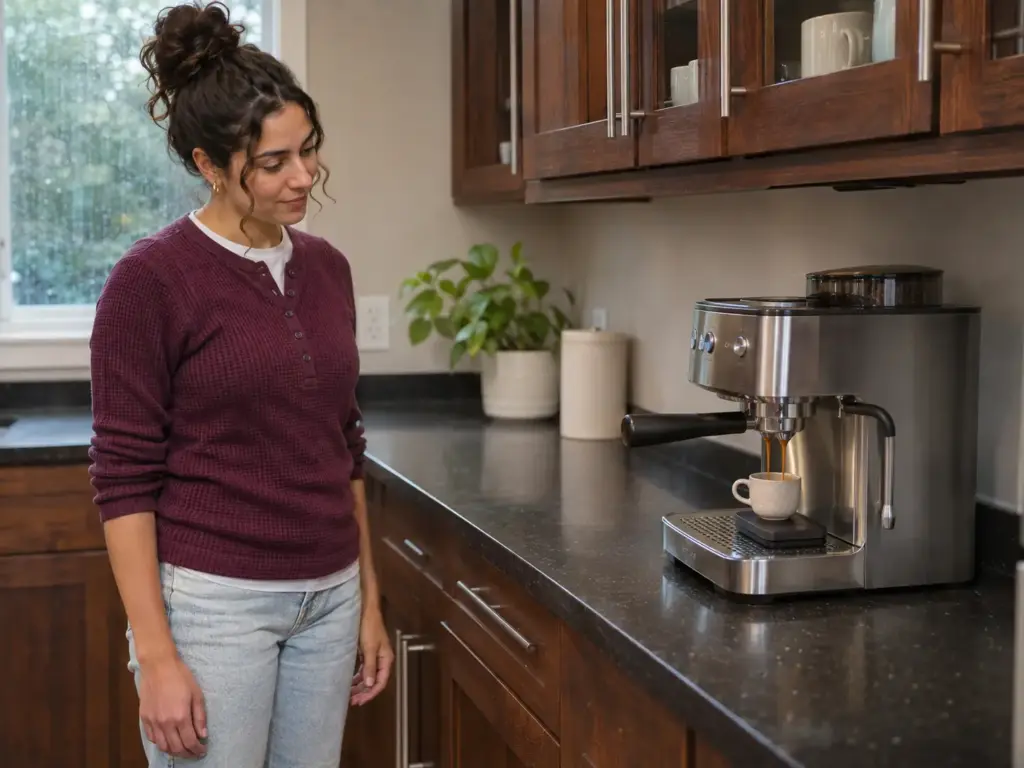
The SCA reference for espresso is about 18 g of coffee pulled to about 36 g in the cup (1:2) in 25–30 seconds at about 9 bar. The espresso grind that gets a shot into that window matters more than any clock setting, because the seconds are what the grind produces. A shot that runs well under the window tastes sour, thin and weak, since the water passed through before it finished; one that runs well over tastes bitter and dry.
When the weight is right and the second is wrong
If the shot lands at the right weight at the wrong second, the grind moved, not the recipe. Go finer to slow it or coarser to speed it, one step, then taste: a fast, sour shot that slows down should come back rounder, and a bitter one that gets too quick should lose its dryness. Leave the dose alone, because a dose that keeps changing hides which of the two moved.
A kitchen scale cannot see this. Its 1 g steps and a 1–2 second lag on the display miss a 0.5 g dose error and the moment a shot finishes, and the scale keeps counting after the cup is pulled, so a shot that ran 28 seconds can end up reading 34.
The FELICITA ARC Coffee Scale is the clock this section explains, and a model that can be bought. It has five modes, including espresso timing and an automatic espresso timing mode that starts on the first drops, a real-time flow-rate indicator, and a profile 15.5 mm thin that fits under a portafilter. Its limit is the same as its strength: the extra modes help only if you pull shots, and for drip or French press it adds nothing a kitchen scale and a stopwatch lack. If shots are the plan, which scales are thin and quick enough for a shot is the next read.
If the scale starts its shot clock on the first drops, it reads a few seconds shorter than the machine’s own timer, by the length of the wait before the drips begin. Pick one clock and stay with it; mixing the two makes a recipe look like it drifted when it did not.
Where a Timer Gets the Number Wrong
So far the clock is a good witness. This section covers the ways it misreports, and a number that looks precise is trusted most when it is off.
Auto-start counts from the first drop, not the first pour
Auto-start means the clock begins by itself on the first drop or the first gram instead of a button press, and the convenience has a cost: the water that went in before the trigger is uncounted. The Acaia Pearl is the reference pour-over scale, with a dual display that shows time and weight together and an auto-start mode where the timer begins when pouring begins. The total on that display reads shorter than the brew ran, and by how much depends on how fast the first water lands.
A display that lags 1–2 seconds behind the weight does a quieter version of the same damage: the time on screen no longer matches the number beside it.
Auto-off and the buttons that stop answering
Auto-off is the one that surprises people mid-brew. A kitchen scale ends at 2 minutes of inactivity, before a slow pour-over is done; the Hario waits 5 minutes and does not count down while its timer runs; Acaia lets the user set the interval. The line to find on any spec sheet is that last clause of the Hario’s: the clock survives the brew.
The buttons are the other trap. The Acaia Pearl’s touch buttons sleep during brewing and answer only when held longer, a wet-finger failure that usually shows up at the first ruined pour, and a scale with that behavior has a clock you cannot reliably start or stop.
The swirl that stops the clock
Lift the dripper to swirl the bed and the clock stops dead, so the number you were relying on is the one you no longer have. The Acaia Pearl’s pour-over timer stops when the carafe and dripper are lifted, and auto-start modes that treat any change in weight as a new brew stop or reset the timer on a swirl, a jiggle or a bumped spout. The free fix is to turn auto-start off and start the clock with a press, or to run a phone stopwatch for any brew that swirls. A clock that reads three minutes on a brew that ran four gives no way to tell which half went missing.
Rehearse with dry gear before the first real brew: set the dripper and carafe on the scale, start the timer, lift the dripper as if to swirl, set it back and tap the counter. If the clock stopped or reset, you found out before it cost a cup.
When a Phone Stopwatch Does the Same Job
If a timer can misreport, the cheapest clock deserves a serious look. This section says which brews the free clock covers and which it does not, before any scale is bought.
Drip, French press and the casual pour-over
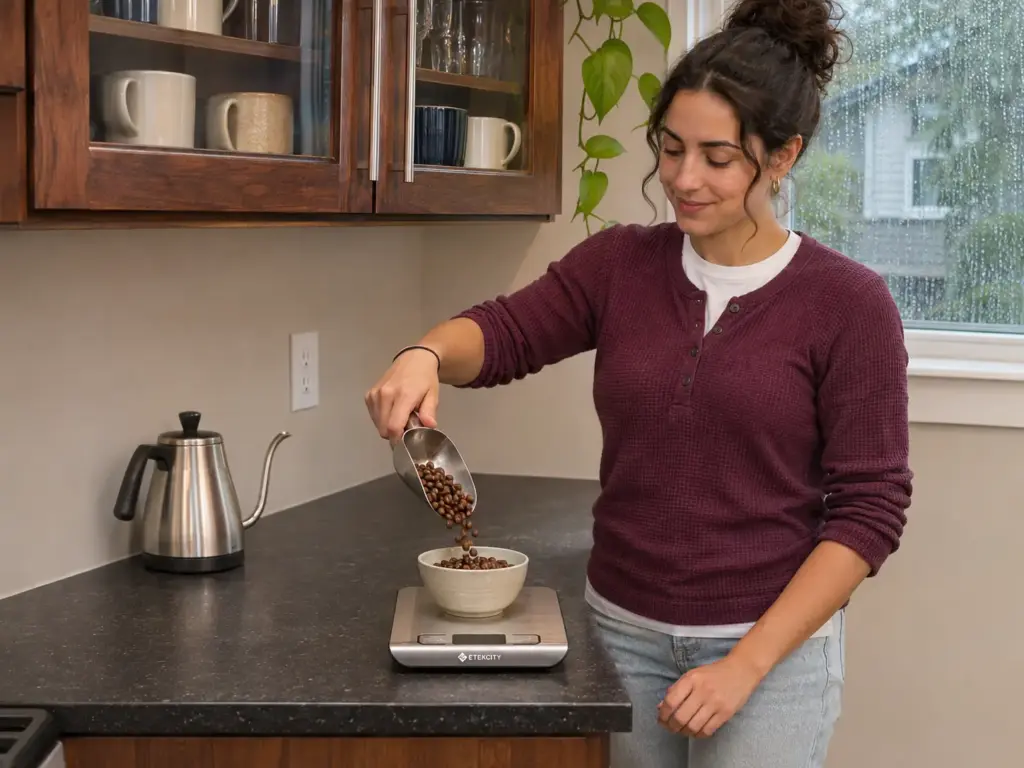
A kitchen scale and a phone stopwatch started on the first pour cover drip, French press and the casual pour-over, and the cost is nothing. Skip the scale with a clock for any of the three. A drip coffee maker keeps time itself, so only the dose and the water need weighing; a French press needs one timer started when the water goes in; and the phone keeps counting through a slow pour-over, which is a point in its favor over a kitchen scale’s auto-off.
The Etekcity Food Kitchen Scale is the honest baseline of that answer: 1 g steps, up to 5 kg (11 lb), a tare function and two AAA cells. Its limits are what you give up for the low cost: the 1 g steps and a 2-minute auto-off mean it cannot follow a shot and it ends its clock before a slow pour-over finishes, and its accuracy is mixed, with some units that stop working. The guide on whether the scale you own already does the job covers the rest of that decision.
Where the kitchen scale stops being enough
The 1 g steps cannot see a 0.5 g dose error or the end of a shot, and a 1–2 second display lag is fine for a slow pour and useless for a shot. That is the line. The integrated clock earns its place for espresso to the gram, for fast staged pours, and for the reader who wants the weight and the time in one glance with a wet hand.
The free clock has a free partner for the dose: weighing the dose in level spoons instead. Between the two, a counter with no scale at all can still brew the same cup tomorrow that it brewed today.
Guided Modes, and What Breaks by Month Two
The free clock is mostly enough, and the models that go further turn the clock into a target. This section covers what a guided mode does, what it costs and what wears out first on a scale with a clock.
The clock as a target instead of a stopwatch
A guided ratio mode sets the target weight for you: choose the ratio once and the display says when to stop pouring, so no arithmetic happens mid-pour. The grams arithmetic these modes automate is the sum the reader would otherwise do by hand, and the TIMEMORE’s ratio calculator, already covered above, is the lower-cost version of the same idea.
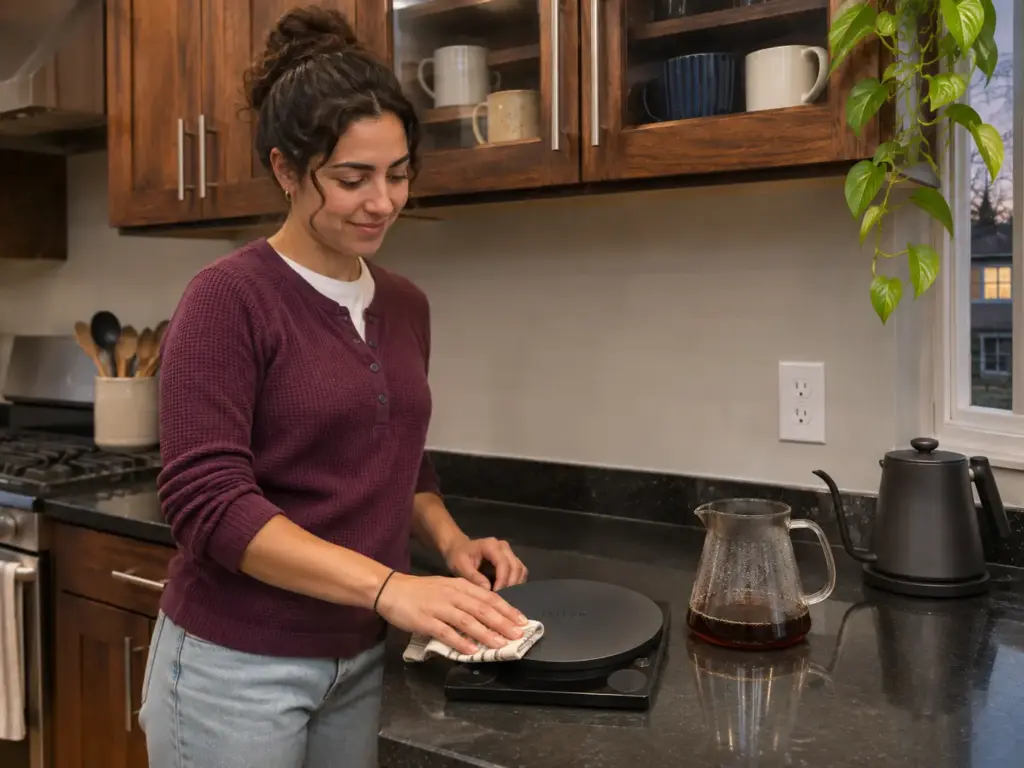
The Fellow Tally Pro is the clearest example. Its Brew Assist mode is the guided ratio, and it reads 0.1 g with a 2,500 g capacity, an OLED display and up to 13 hours of weighing per charge. It has no flow-rate readout at all, and it is the priciest of the five scales here for modes you may never leave.
The battery and the buttons wear out before the sensor does
By month two the cell ages first: a scale that ran weeks on a charge starts asking for one after two or three brews, and a fresh cell is the cure, since the scale itself is fine. The buttons go next, with an unresponsive tare or power key on a scale that is still accurate. And a scale with no low-battery warning stops mid-pour and takes the cup with it, so the display goes dark between the bloom and the second pour and the brew gets finished by feel, with no idea whether it ran three minutes or five.
A cheaper battery scale has a cheap fix: rechargeable NiMH cells instead of fresh AAAs every few months. If a scale is on the list at all, match a scale to the brewer you actually own and weigh the dying cell before the digit count.
Tomorrow’s Pour-Over: One Grind Step, Two Written Numbers
The clock sits on a scale because seconds are the second half of extraction, and sour and bitter sit at opposite ends of that timeline. A phone stopwatch started on the first pour covers drip, French press and the casual pour-over; the shot is where a clock built into the scale is hard to replace. The clock also misreports in nameable ways (the trigger that counts late, the auto-off that arrives early, the swirl that stops it), so the spec line worth finding is a timer that is not cut off mid-brew.
After a few weeks of daily brews, look at the scale’s battery and buttons before suspecting the sensor, because those are the parts these scales lose first.
Tomorrow’s move costs nothing. Write down the grams in and the total seconds of one pour-over, change only the grind by one step, brew the same dose the same way and taste it against yesterday’s cup: if yesterday was sour, a finer step should come back rounder, and if it was dry and bitter, a coarser step should loosen it. If that routine convinces you the clock is worth owning, a budget scale that keeps its readings is where to start looking.
Frequently Asked Questions
01Do I need a timer on my coffee scale if I have a phone?
Not for drip, French press or a casual pour-over: a phone stopwatch started on the first pour does the job. It falls short on espresso, where the weight and the second have to be read together.
02How long should a pour-over bloom last?
About 30–45 seconds, with water at about twice the coffee’s weight, before the main pour. Then the whole brew runs roughly 2.5–4 minutes at about 15 g of coffee to 250 ml of water.
03How long should an espresso shot take?
About 25–30 seconds for roughly 18 g of coffee pulled to about 36 g in the cup. If the weight is right at the wrong second, change the grind one step, not the dose.
04What does auto-start do on a coffee scale?
The clock begins by itself on the first drop or the first gram instead of a button press. It misses the water that went in before the trigger, and some modes stop or reset when the scale is lifted or bumped.
05Will a kitchen scale’s auto-off cut a slow pour-over short?
It can: a common kitchen scale switches off after 2 minutes of inactivity, which is shorter than many pour-overs. A coffee scale such as the Hario waits 5 minutes and does not switch off while its timer runs.

How did your cup turn out?
No comments yet. Tell us what you changed — and whether the needle moved.