

We may earn a commission when you buy through links on this page. It never changes what we recommend. How we pick
On this page8 parts
- Divide the Water by 16, Then Look Up the Brewer
- 1:16, 60 g/L or 55 g/L: Which Number Do You Type In?
- Where the Water Goes: Why a 1,000 g Pour Leaves About 885 g in the Pot
- Your Machine's Cup Is 5 Ounces, Not 8
- Weigh It, or Weigh the Scoop Once
- Stronger or Weaker Is the Ratio, and Sharp Is the Grind
- Weigh Tomorrow's Pot, Then Read the Cup Before Touching the Ratio
- Frequently Asked Questions
You type 1,000 g of water into a coffee to water ratio calculator, it answers 62 g, your scale agrees, and the machine runs its full cycle. Then the carafe comes up an inch or two short of the line and the cup tastes thin, or sharp, or both.
The arithmetic was right; the number it was handed did not describe the pot. A ratio sets a weight of coffee against a weight of water poured, and what reaches the mug is always less than what went in, because the wet grounds keep a share. This guide gives the sum in both directions, a ratio table with a row for each brewer, the number worth typing in, and where the missing water goes, plus the one problem no ratio fixes.
Quick Answer
Use one gram of coffee for every 16 grams of water, which is about 62 g for 1,000 g of water, and divide the water’s weight by 16 to get the dose. The SCA’s standard runs a little lighter at 55 grams per liter, so anything from about 50 to 60 g per liter is inside it.
Divide the Water by 16, Then Look Up the Brewer
A ratio widget runs two lines of arithmetic, one in each direction, and the only reason to open one is to skip them while the kettle is still heating. Do the sums by hand once and the widget stops being a black box. The brewer’s row comes second, because the same grams per liter make a different drink in each.
Water in, coffee out
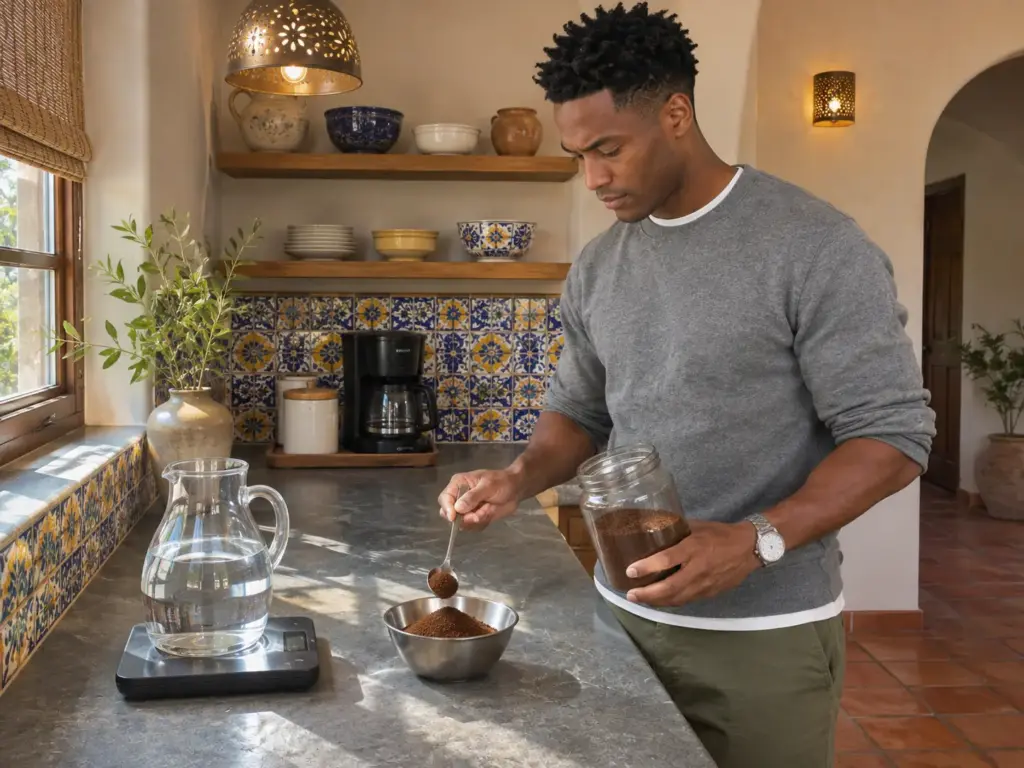
Divide the weight of the water by the ratio. At 1:16, 500 g of water wants about 31 g of coffee and 1,000 g wants 62.5 g. The ratio is written coffee first, so 1:16 means one part coffee to sixteen parts water poured. The sum is the same for a mug and for a carafe, and it is worked once, by weight, for a six-cup pot if you would like to watch it run on a real machine.
Coffee in, water out
Run it backward when the dose is the fixed end: multiply the coffee by the ratio. A 20 g dose at 1:16 wants 320 g of water, and 15 g at 1:17 wants 255 g. Start from whichever end you already know, the water in the jug or the coffee left in the bag, make one division or one multiplication, and write the answer where you will see it tomorrow.
Why grams and not cups
Both sums only work in weight. A milliliter of water weighs about 1 g, which is the only reason grams per liter and a 1:x ratio swap at the counter, and the SCA’s brewing chart writes its ratio lines as weight ratios, grams to grams or ounces to ounces. A jug marked in cups does not give that number, so cups to grams and ounces to grams are the first two conversions, and a scoop of coffee is a volume that moves with the grind and the roast. A pot that tastes wrong on its first morning usually comes from a misplaced decimal or a cup poured into a gram sum, and the ratio was fine.
For a sense of scale, a 6-ounce cup is about 180 g of water, which at the usual ratios puts the grams of coffee per cup at 10 to 11, and the same division asked from the bag’s side tells you how many cups a 12-ounce bag makes.
What each brewer counts
Filter methods count the water poured. The espresso ratio counts the liquid that lands in the cup, so 18 g of coffee at 1:2 makes about 36 g of espresso, and the two ratios measure different liquids: they cannot be compared or converted into each other. The table gives each brewer’s starting ratio and the coffee that ratio puts against 250 g of water, worked with the sum above.
| Brewer | Starting ratio (coffee:water) | Coffee per 250 g of water |
|---|---|---|
| Drip machine (auto drip) | 1:16 | about 16 g |
| Pour-over (V60, Chemex) | 1:16 to 1:17 | about 15 g |
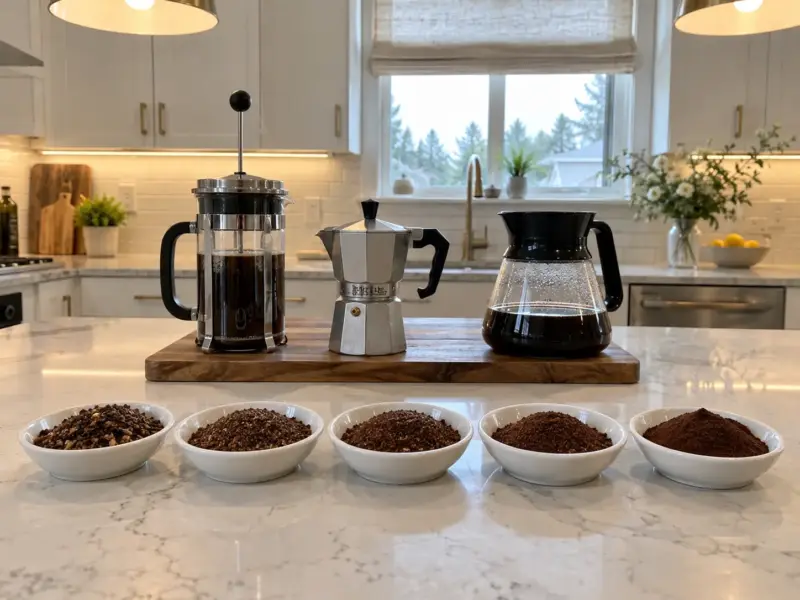
| French press | 1:12 to 1:15 | about 17 to 21 g |
| AeroPress | 1:10 to 1:15 | about 17 to 25 g |
| Moka pot | 1:7 to 1:12, printed ranges vary widely | about 21 to 36 g |
| Cold brew, ready to drink | 1:8 | about 31 g |
| Cold brew concentrate | 1:4 to 1:5, diluted 1:1 or more | about 50 to 63 g |
| Espresso | 1:2, dose to the liquid in the cup | counts the cup, not the pour: 18 g makes about 36 g |
Moka pot ranges are wide because the baskets differ from maker to maker, so start with the maker’s own basket and treat the printed range as the outer edges. Concentrate is a different animal from a drinking ratio: it is cut with water or milk after the brew, which is why its row looks so heavy.
Tape the dose for your usual pot to the canister lid: 62 g for 1,000 g of water at 1:16, or 55 g at the standard’s figure. After that the sum only comes back out when the pot size changes.
1:16, 60 g/L or 55 g/L: Which Number Do You Type In?
Two calculators can give two different weights for the same pot and neither is broken. The default a calculator ships with, 1:16, is a house number, sometimes sold as the golden ratio, and the Golden Cup standard’s own figure sits lower. This section traces where each number comes from and why the popular one tastes stronger.
Three ways to write the same band
According to the SCA’s Golden Cup numbers, the test ratio for a home brewer is “55 grams of ground coffee per liter of water, with an acceptable tolerance of ±10% (i.e., 49.5–60.5 grams per liter).” The figure belongs to the Specialty Coffee Association, and the SCA’s published brewing standards are where its home-brewer rules are kept.
That one band can be written three ways, and most of the confusion between calculators comes from mixing them up:
- 55 grams per liter, the standard’s own figure: about 1:18 by weight (1:18.2 exactly), with a band running from 49.5 to 60.5 g per liter.
- 60 grams per liter, the number a bag’s back panel often prints: about 1:16.7.
- 1:16, the usual calculator default: 62.5 g per liter, which is over the top of the band.
The chart itself does not pin a single ratio. The Golden Cup box on the SCA’s brewing control chart, 18 to 22 % extraction at 1.15 to 1.35 % dissolved coffee in the cup (the TDS), is reached along a band of ratios, depending on where the TDS lands inside it.
Why 1:16 tastes bolder than the standard
A weight of 62.5 g per liter is what 1:16 means, and the standard’s band tops out at 60.5, so the house default sits just outside it on the heavy side. The other numbers people type fall around it: 1:15 is 66.7 g per liter, 1:17 is 58.8 and 1:18 is 55.6, which puts 1:17 and 1:18 inside the band and 1:15 well over.
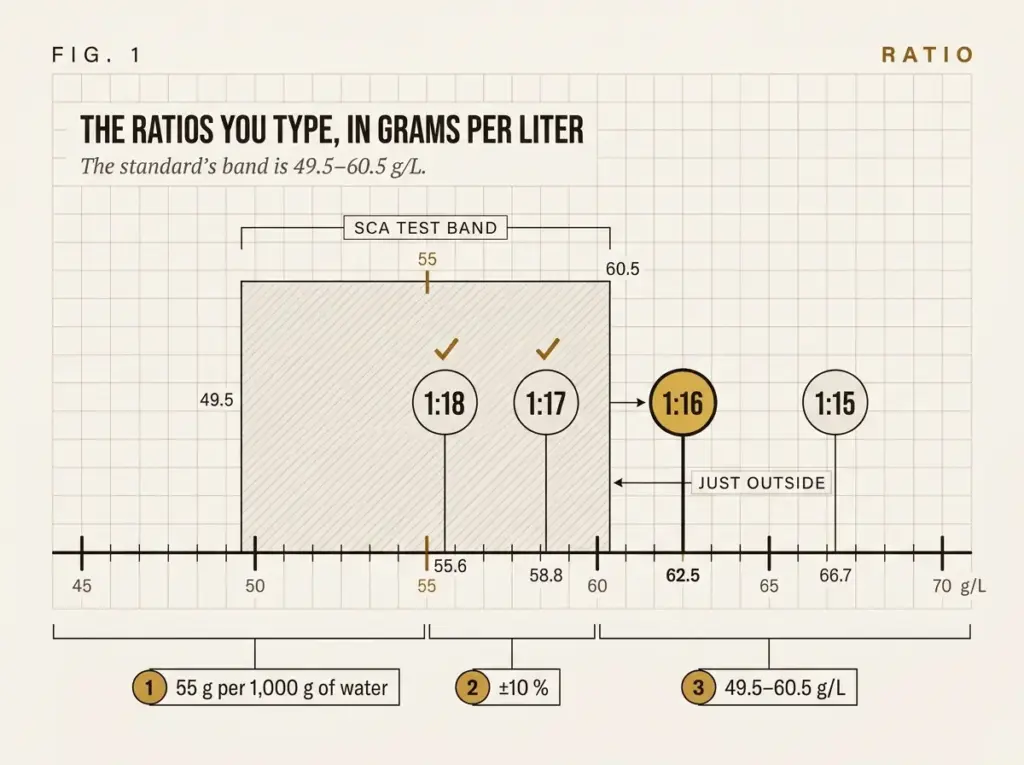
Move a pot from a calculator’s 1:16 to the standard’s 55 g per liter and it loses 7.5 g of coffee in every liter, about 12 %. That is a visibly lighter cup, and it is the moment a reader decides the new number is wrong, though nothing happened to the grounds: the strength moved because the ratio moved. A bag and a widget drift apart in the same way. A bag printing 60 g per liter and a calculator at 1:16 differ by 2.5 g in every liter, a few grams across a full pot, before anybody has done anything wrong.
What to type in tomorrow
Start at 1:16 if you like a heavier cup, or at 1:17 if you would rather begin inside the standard’s band. Start a drip machine at 1:17: it sits in the band, so when the cup tastes thin you know you are moving away from the standard on purpose. Taste it, then move the dose by about a gram of coffee for the pot. Why 16 to 1 is the usual starting point is argued on that page; what matters here is that you choose the number deliberately and then let the cup correct it.
To compare a bag’s ratio with a calculator’s, turn both into grams per liter: divide 1,000 by the second number of the ratio. If the answer lands between 49.5 and 60.5 it is inside the standard, and anything above 62 is a heavier cup than the standard’s.
Where the Water Goes: Why a 1,000 g Pour Leaves About 885 g in the Pot
A ratio calculator prints the water it was given, and the carafe holds less, because the wet grounds keep a share. Make this correction first, before the machine, the beans or the ratio take the blame. It is the reason a pot that was dosed correctly still looks short.
The bed keeps about twice its weight
Wet grounds hold on to liquid, and that absorbed water never reaches the carafe. This water retention is why the weight poured and the weight served differ. In drip brewing the spent bed keeps about 2.1 g of water per gram of coffee, a figure that comes from the 2023 study behind the modern brewing chart in the Journal of Food Science; a separate set of immersion brews kept 2.48 ± 0.19 g per gram.
For a home pot, call it 2 g per gram. The same paper notes that “brew ratio is often expressed in terms of the mass of coffee grounds per mass of water”, which is exactly the one input a calculator takes. What it hands back is the dose, and the weight that reaches the mug is lower than the weight you poured.
What that does to a mug and a pot
Take a 30 g dose with 500 g of water poured. The bed keeps about 63 g, so about 437 g reaches the mug: that is the drink, and the 500 g was only the pour.
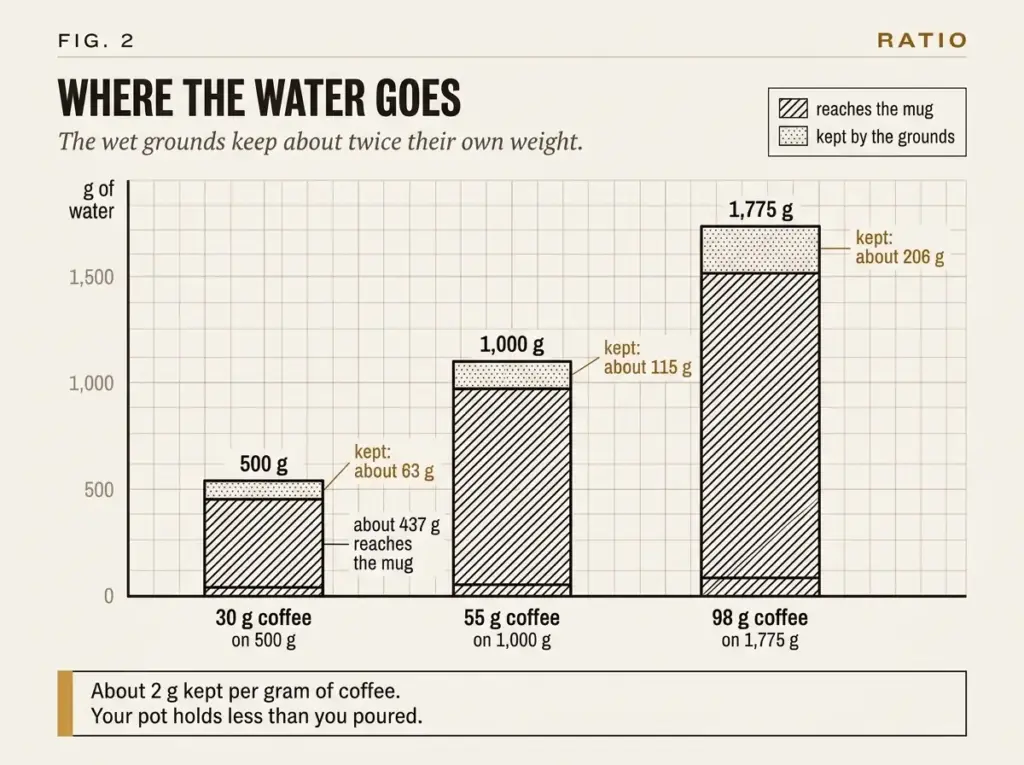
Scale it up and the loss grows with the dose. A 480 g pour at 1:16 is a 30 g dose and about 417 g of drink. A 55 g dose on 1,000 g keeps about 115 g, which leaves about 885 g in the carafe. A full 60-ounce pot at 55 g per liter takes about 98 g of coffee and keeps about 206 g of the pour, so roughly 1,570 g reaches the carafe, shy of the reservoir line by about seven ounces.
A 1.25-liter brew at 55 g per liter takes about 69 g of coffee, a count that looks like too much and is not. The bed keeps about 145 g of the pour, so about 1,105 g reaches the carafe and the level lands under the line. Neither a faulty machine nor a lost dose caused that; it is the water the grounds kept.
A lab brew shows the same loss at a larger scale. A UC Davis drip study that fixed 3,075 g of water averaged 2,830 g of beverage, so about 245 g, 8 %, stayed in the bed. The number on the reservoir is an input, never a yield.
What to do with it comes down to one adjustment and no new ratio. To end with a full 6-ounce cup, about 180 g, pour about 205 to 210 g. To fill a mug, pour a little over the mug. The ratio itself holds, because the dose is still set from the water you poured.
A one-brew test you can run
The retention of your own pot is easy to measure, and it rarely moves after the first brew:
- Weigh the dry dose, and use the paper filter you normally brew with, since it is part of the pot’s retention.
- Note the water you poured in.
- Weigh the coffee that lands in the carafe (empty carafe first, then full, and subtract).
- Subtract the coffee in the carafe from the water poured, then divide the difference by the dose.
A 55 g dose on 1,000 g that fills the carafe with 884 g means 116 g stayed behind, and 116 divided by 55 is 2.1. Any digital scale that reads whole grams will run this test on a pot: at a dose near 62 g a 1 g step is about 1.6 % of the coffee, so it cannot spoil a 1:16 pot, and the Etekcity Food Kitchen Scale EK6015 is the budget line of that kind, a fraction of what a coffee scale costs. Plan around its weak spots: the accuracy is called mixed, a run of units stops working, and the batteries go quickly. The 0.1 g scales belong to single cups, and they come up again with the scoop.
That is also how a short pot ends up blamed on the machine. The carafe level and the cup size are the first things anyone checks, and the water in the bed is the last.
Your Machine’s Cup Is 5 Ounces, Not 8
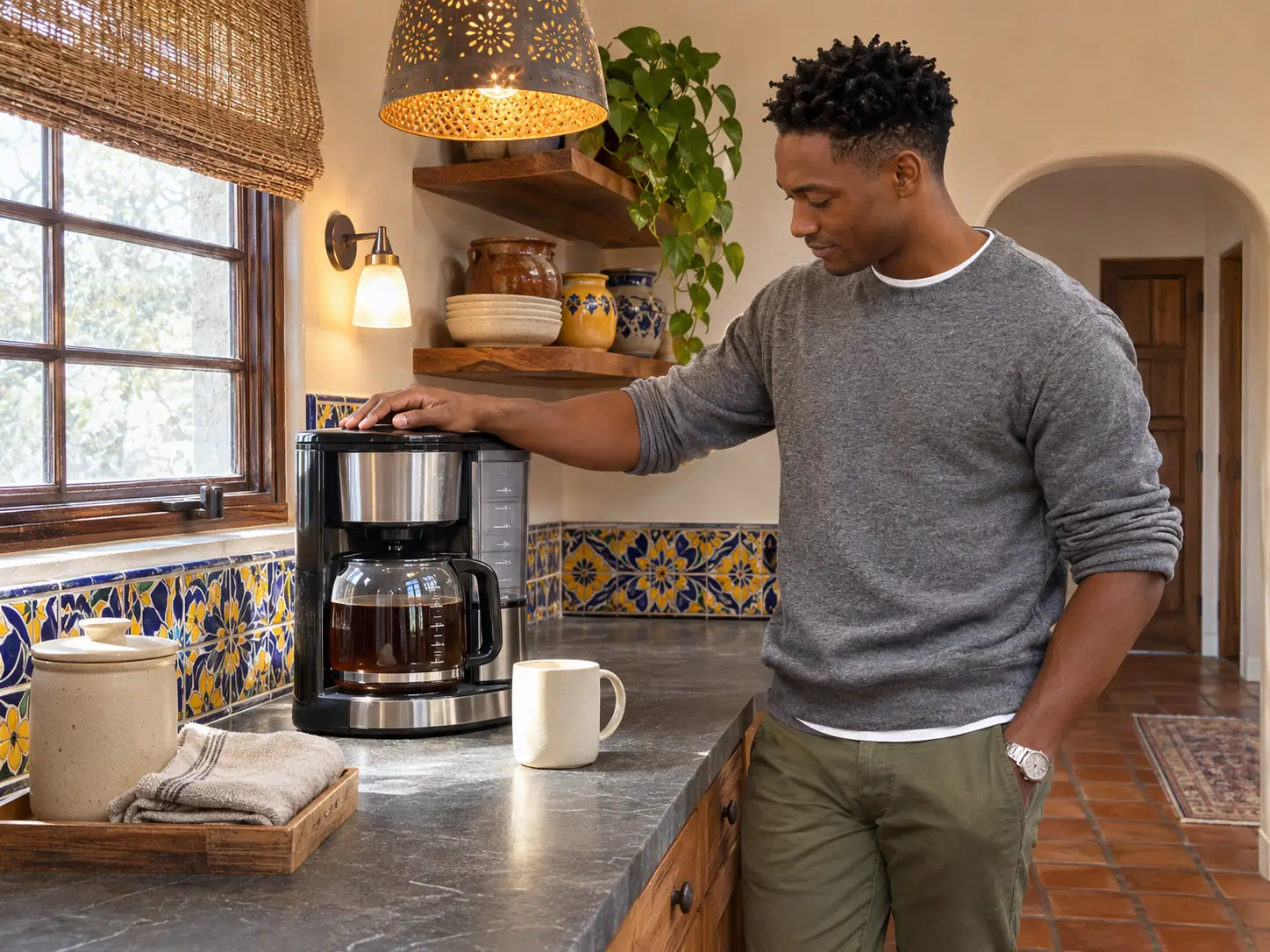
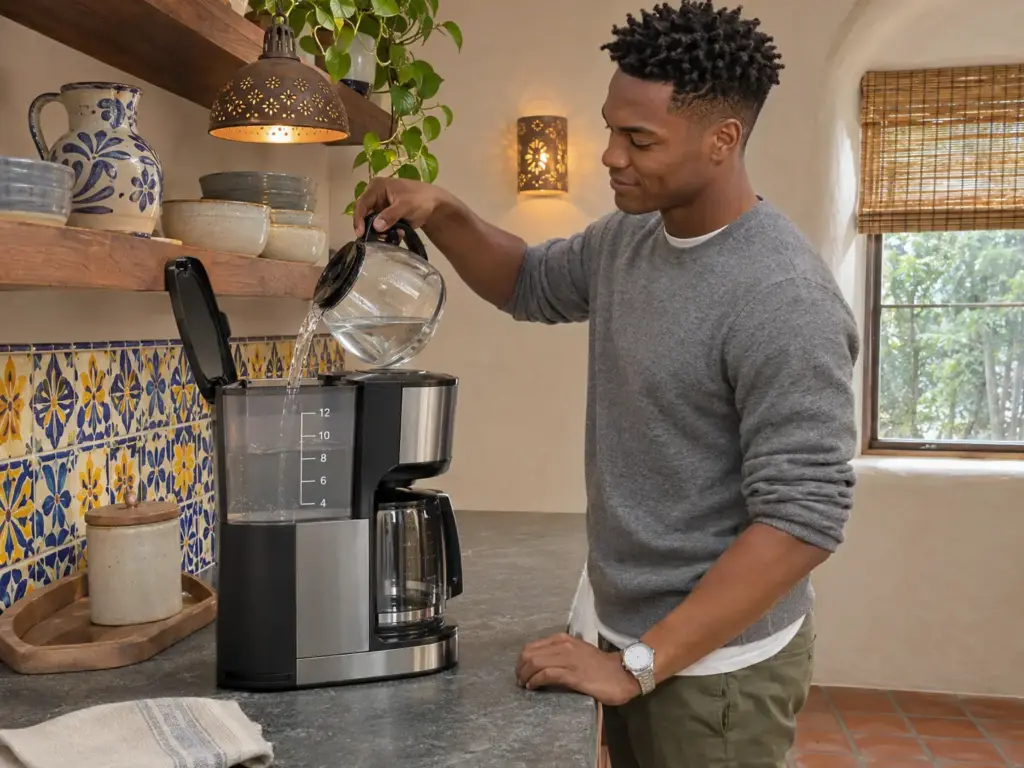
A 12 cup coffee maker counts in its own cup, and the water line on its reservoir is the only number that matters for the dose, with the carafe line a rough check beside it. The number of mugs in your cupboard has nothing to do with it. Convert the machine’s cup into grams of water first, then into grams of coffee, and a 12-cup pot can be dosed without guessing.
What a “12-cup” pot holds
An American drip machine’s cup is 5 fluid ounces, about 148 ml, as DeLonghi and BLACK+DECKER state it for their machines; Technivorm and some Japanese machines print a 4-ounce cup. A 12-cup carafe therefore holds about 60 fl oz, roughly 1.78 liters, and a 14-cup one 70 fl oz. A US measuring cup is 8 oz, so the reservoir line is not eight to the cup. Past twelve cups the sum is the same with a different line, and there is a page on counting ounces on a machine bigger than twelve cups.
To cross-check a machine’s cup from its own listing, divide the carafe ounces by the cup count: 60 divided by 12 is 5. And if the reservoir marks say one thing and the box another, the carafe’s printed ounces win.
The same sum works at a partial line. The 6-cup mark is 30 fl oz, about 887 g of water, which takes about 49 g of coffee at 55 g per liter or 55 g at 1:16. Counting one scoop for every marked cup is the common way to miss it: twelve level 2-tablespoon scoops is about 120 g on a 60-ounce line, 67.6 g per liter or about 1:14.8, heavier than the 1:16 default and well above the standard’s band. The scoop rule on a bag is written for a 6-ounce cup, and the machine’s cup is smaller.
From the line to the grams
A full 60 fl oz line is about 1,775 g of water. At 55 g per liter that takes about 98 g of coffee, at 60 g per liter about 106 g, and at 1:16 about 111 g, which is ten to eleven level 2-tablespoon scoops. Start from twelve 8-ounce mugs instead and the sum begins at 96 fl oz, about 2,840 g: 36 fl oz, roughly a liter, more water than the carafe holds, and a dose scaled to it comes out near 156 g at 55 g per liter, about 58 g more coffee than the pot can use.
Fill the reservoir to the printed line once with a jug you have weighed, note the grams, and write that number on a strip of tape on the machine. The lines are molded into the plastic and become a rough guide after a while; the weighed number stays put.
A twelve-cup machine for one mug
A 6-ounce cup, about 180 ml, is about 10 g of coffee at 55 g per liter. An 8-ounce mug, about 237 ml, is about 13 g, or about 15 g at 1:16. The bed’s share from the section above still applies, so a single mug needs a pour a little over the mug.
The arithmetic does not care how big the machine is; only the line changes, and a twelve-cup carafe on a one-mug morning leaves most of it empty. A smaller machine fixes that: a machine that does not waste a pot on one mug.
Weigh It, or Weigh the Scoop Once
Grams are the only unit the arithmetic accepts, so a reader without a scale needs a bridge from grams to a spoon, and the bridge works only after the spoon has been weighed once. The bridge comes first, then the cases where a scale is worth owning.
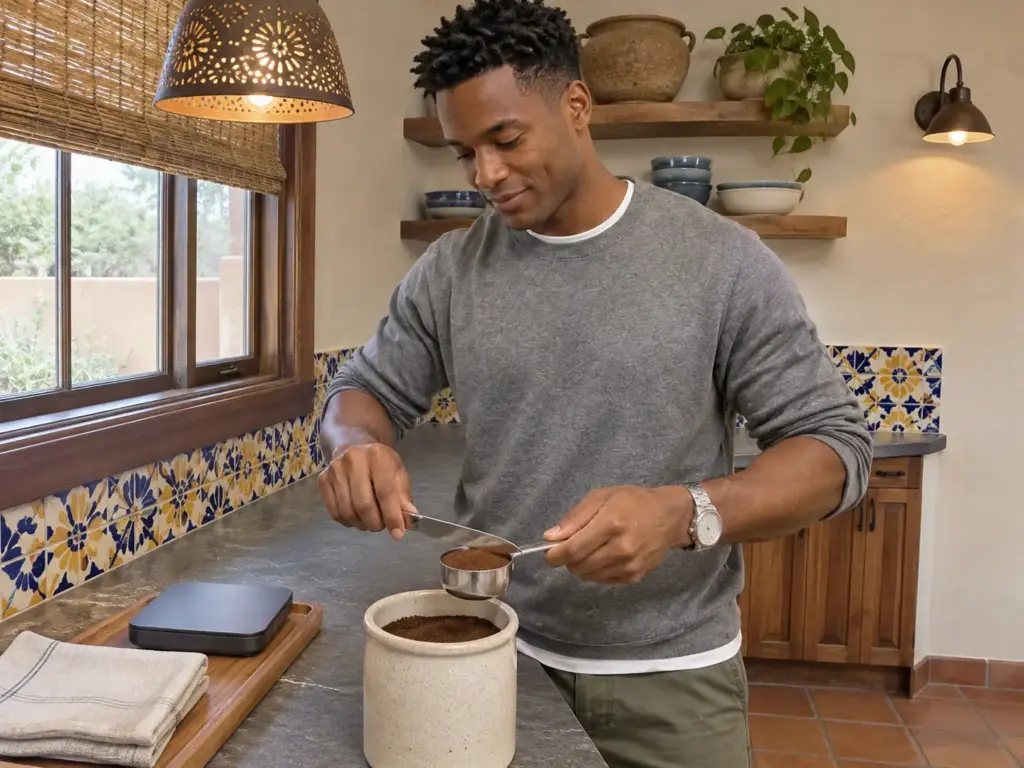
The scoop, weighed once
A level scoop of 2 tablespoons (six teaspoons) holds about 10 g of medium-ground coffee. Level means struck flat with a knife; a heaped scoop is about a fifth more, enough to move a 1:16 pot to about 1:13.
Weigh the scoop once, level, then count: what a scoop actually holds lays out the full count per cup. The U-Taste 18-8 Stainless Steel Coffee Scoop carries US and metric measures engraved on the handle, so its count can be checked against the table above. Nothing repeated turns up as a complaint about it; the limit is the arithmetic, because roast level changes density: a level scoop of dark roast weighs less than one of light roast, and medium roast sits between them.
Weigh it again when the bag changes roast, and keep the order straight: weighing the dose before touching the grinder comes first, the dial second. The machine’s own marks work the same way once they have been checked against a scale, and then they become the measuring cup.
When a 1 g scale is enough and when 0.1 g matters
At a pot dose a 1 g step is about 1.6 % of the coffee. At a 15 g single-cup dose it is almost 7 %, and that is where a 0.1 g scale earns its place. The scale that reads a tenth of a gram is the one everybody names, and for a twelve-cup pot it adds nothing a 1 g scale does not already do. A scale changes more cups than a new machine.
For the single cup, the TIMEMORE Coffee Scale Basic 2.0 reads 0.1 g up to 2,000 g, has a timer and a flow-rate readout that kitchen scales lack, and fits under a dripper.
A run of units has stopped working within the first months, and its touch surface is too sensitive for some hands. Whichever scale it is, switch it on and tare it before the filter goes in.
The plainer alternative is the Hario Drip Scale Timer, metric only: tare the mug and pour to the gram, on a pad wide enough for a mug and a dripper. Several units have broken within six months, and the display lags about five seconds after power-on, which leaves the bloom unweighed if you start pouring straight away.
A brewer with the ratio printed in it
For mornings with no scale at all, one dripper carries a ratio aid in the drip cup itself: the Fellow Stagg XF Pour-Over Dripper, a double-wall stainless cone whose 600 ml bed fixes the cup the arithmetic is done for. Its limit is size: it makes one to two cups, so it answers a mug and not a twelve-cup pot.
Stronger or Weaker Is the Ratio, and Sharp Is the Grind
A calculator can fix a pot that is too weak or too strong. It cannot fix a cup that is sharp, and you need to know which one you have before changing anything.
A weak pot or a sharp one
Weak (thin, watery) and strong (heavy) belong to the ratio: more coffee in the same water for a stronger cup, less for a weaker one, by about a gram for the pot. Sour (sharp, the water left early) and bitter (harsh, the water stayed too long) belong to extraction, which means the grind and the contact time and has nothing to do with strength. A sour cup is under-extracted and a bitter one is over-extracted; water temperature and filtered water move extraction too, so they sit with the grind and not with the ratio.
Strength is how much dissolved coffee sits in the cup; extraction is how much of the grounds got dissolved. The page on which grind makes the strongest cup goes into that split. The Golden Cup box puts a balanced cup at 18 to 22 % extraction: sour sits below it, bitter above.
Adding water thins a bitter cup
Do the arithmetic once. 15 g of coffee brewed to 200 g of cup at 1.50 % TDS holds 3.0 g of dissolved coffee, which is 20 % of the 15 g. Add 50 g of water and the cup is 250 g at 1.20 %, still 3.0 g, still 20 %. Watering a bitter cup keeps the bitterness and thins it.
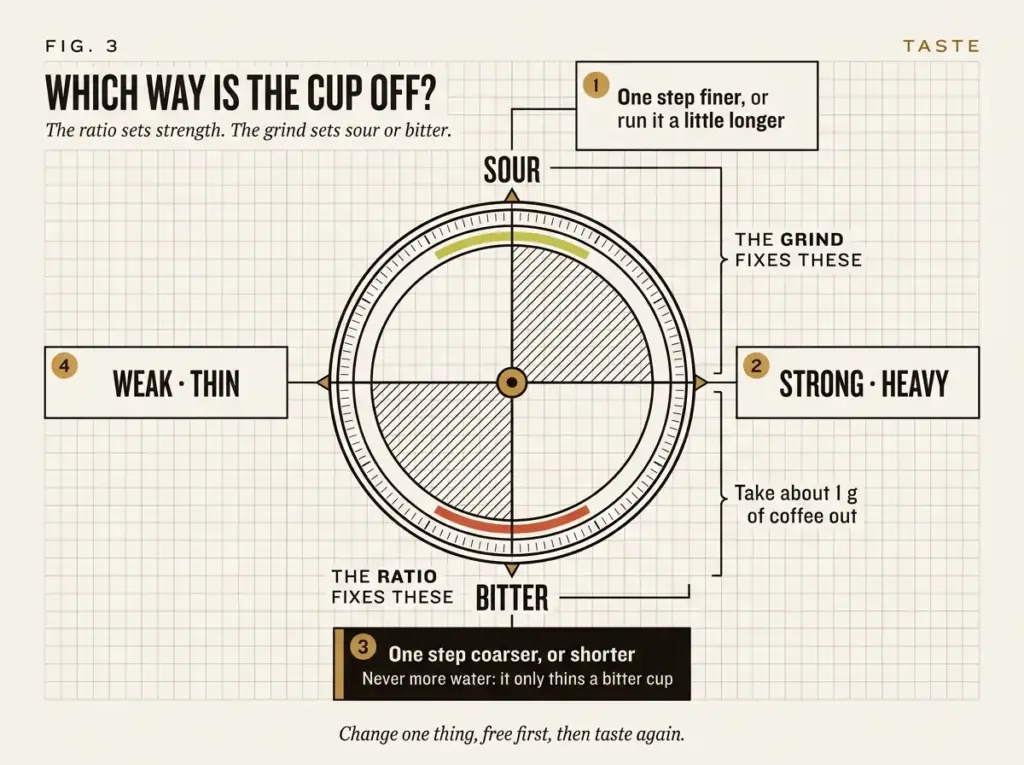
So the instinct to add water to a harsh cup, or more coffee to a sharp one, goes in the wrong direction on both counts. The first thins what you tasted; the second adds weight to a cup that was short of extraction, not of coffee.
One change, then taste
Order the fixes free and likeliest first, and taste between them.
A sour cup goes one step finer on the grinder, toward the medium-fine most drip baskets want, or in a French press a little longer in the pot, before any bigger dose. The next cup should taste rounder and less sharp. If it is flatter but still sharp, take one more step. If it turns dry and harsh at the finish, you went past it, so come back half a step.
A bitter cup goes one step coarser, or shorter, and never gets more water. The first dose after a grinder adjustment still comes from the old setting, because the grinder keeps grounds inside, so the second cup is the one to taste. How grind size moves the cup from sour to bitter follows the full sweep of the dial.
Keep four numbers for each brew in a notes app: the dose, the water poured, the grinder setting and one word for the taste. Two weeks of those lines show whether you are chasing strength or extraction.
The weak pod cup is usually the brew size
A sealed pod fixes both the grind and the dose, so the only thing you set is how much water meets it. Press the largest brew size and the same grams meet more water, which lowers the ratio and thins the cup, and the grinder never entered into it. The smallest setting brings the ratio back up. The page on when a weak pod cup is not the grind covers the brew sizes.
Weigh Tomorrow’s Pot, Then Read the Cup Before Touching the Ratio
Divide the water by the ratio, type the number you chose on purpose, and add back the water the bed keeps. Follow the line on the reservoir instead of the mugs in the cupboard, weigh the scoop once, and let the cup vote before the ratio moves: a thin cup wants a gram more coffee, a sharp one a finer grind.
Recheck two things as the gear ages: the weight of the level scoop whenever a bag arrives in a different roast, and the reservoir line against a weighed jug after the machine has run through a few months of hard water or a descaling.
For tomorrow, fill the reservoir to the line, weigh that water, divide by 16 and weigh the coffee to match. Taste the carafe, and if it tastes thin, move the dose up by a gram before anything else. Once that pot is in grams, how to use a drip coffee maker in grams, not scoops turns it into a routine.
Frequently Asked Questions
01How much water do I use for one cup of coffee?
A 6-ounce cup is about 180 g of water, and at the usual ratios that takes roughly 10 to 11 g of coffee. The grounds keep about twice their weight in water, so pour about 205 to 210 g for a full cup, which lifts the dose to about 11 to 13 g.
02How much coffee do I put in a 12-cup Mr. Coffee?
A 12-cup machine’s carafe holds about 60 fl oz, 1,775 g of water, which takes about 98 g of coffee at 55 g per liter or 111 g at 1:16. That is roughly ten to eleven level 2-tablespoon scoops, because the machine’s cup is 5 ounces, not 8.
03How many coffee scoops for 16 ounces of water?
Sixteen fluid ounces of water weighs about 473 g, which takes about 26 g of coffee at 55 g per liter or 30 g at 1:16, so three level 2-tablespoon scoops. Weigh your scoop once, because a heaped one holds about a fifth more.
04How much coffee grounds do I use for 2 cups of water?
Two 5-ounce machine cups are about 296 g of water and take 16 to 18 g of coffee; two 8-ounce mugs are 473 g and take 26 to 30 g. Check the machine’s cup size on the carafe: printed ounces divided by the cup count.
05How do you calculate a coffee to water ratio?
Divide the weight of the water by the ratio to get the dose, or multiply the dose by the ratio to get the water. At 1:16, 500 g of water takes about 31 g of coffee, and a 20 g dose takes 320 g.

How did your cup turn out?
No comments yet. Tell us what you changed — and whether the needle moved.