
We may earn a commission when you buy through links on this page. It never changes what we recommend. How we pick
On this page8 parts
- Two Level Tablespoons, Not the One on the Tin
- Check the Scoop in Your Drawer Against a Measuring Spoon
- Scoops for a Cup, a Mug, a Travel Mug and a Full Pot
- The Half Scoop Is One Level Tablespoon
- When a Third Scoop Makes the Pot Worse
- The Scoop Against the Scale by the Fourth Bag
- Test the Scoop Tomorrow, Then Taste the Pot
- Frequently Asked Questions
The scoop from the box of your last drip machine moved into the drawer with the new one, and the pot has tasted a little off since. How many coffee scoops per cup is a fair question to put to a tool nobody ever measured: the word scoop is not a unit, and the ones on sale hold 1, 1.5 or 2 tablespoons, so a single sentence on a tin makes pots that differ by half. This guide covers what a level scoop holds, a half-minute check for the one you own, the count for the cup, mug or pot you actually pour, and the point where another scoop stops helping. The grams and the ratio for each brew method sit in the full coffee-to-water ratio in grams, and this page leaves them there.
Quick Answer
One level scoop of 2 tablespoons, roughly 10 to 11 grams, per 6-ounce cup. The cup printed on a drip machine’s carafe is closer to 5 ounces, so a 12-cup pot holds about 60 ounces of water, not 96, and takes 5 to 10 scoops depending on how much coffee per cup you like.
Two Level Tablespoons, Not the One on the Tin
The rule printed on scoop listings is one scoop per cup, and the line on the tin says one tablespoon per cup. Those two instructions are a factor of two apart, and they only meet once you know what a scoop holds and which cup is meant.
What One Level Scoop Holds
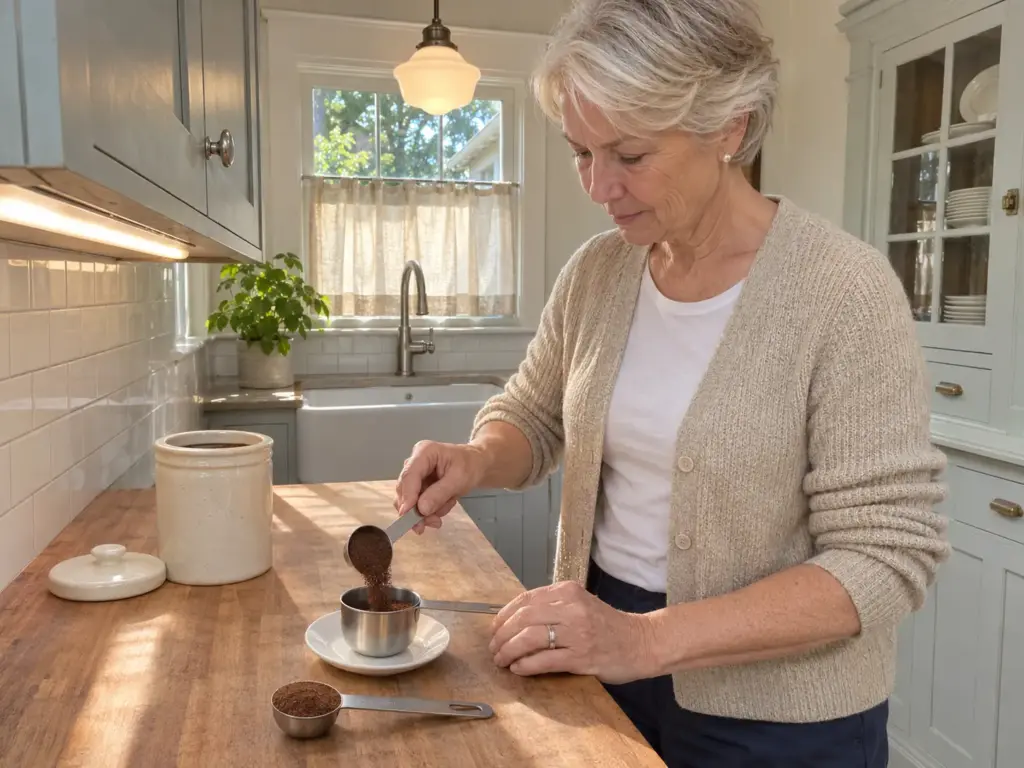
The scoop the rule means is a 2-tablespoon measure, which is also 1/8 cup or 30 milliliters. A level US tablespoon of medium-roast ground coffee weighs about 4.9 grams, so one level scoop comes to about 10 grams: a little more for a light roast, less for a dark roast. That is the dose for a 6-ounce cup (177 milliliters), and it is ground coffee that the scoop measures, so a scoop of whole beans is a different dose again.
A scoop with the measure stamped into the metal ends the guesswork, and the Chef Craft Select Coffee Measurer is the least expensive way to get one: 2 tablespoons in stainless steel, about 4 inches long, dishwasher-safe. The steel is thin, though, and the handle can snap the first time it is leaned on, so it belongs in loose grounds and not dug into a packed bag.
Why the Tin’s Number Is the Floor of a Range
“1 to 2 tablespoons of ground coffee for every 6 ounces of water” is the National Coffee Association’s drip-coffee ratio, and the sentence describes a span. The tin’s one tablespoon sits at the bottom of it, written for the mildest drinker. Two tablespoons, one level scoop, sits at the top.
Cuisinart’s manual for its 4-cup coffeemaker prints both instructions in a single paragraph: some manufacturers recommend one tablespoon per cup, and Cuisinart itself recommends 1 to 1½. Before any dosing advice, the same manual states that its cup is 5 ounces. Follow the tin to the letter on a 12-cup pot and you scoop out 12 tablespoons, about 60 grams, for 60 ounces of water. The professional standard in the table below asks for close to 100 grams for that pot, so the carafe looks right and tastes of almost nothing by the second cup.
Level Against Heaped
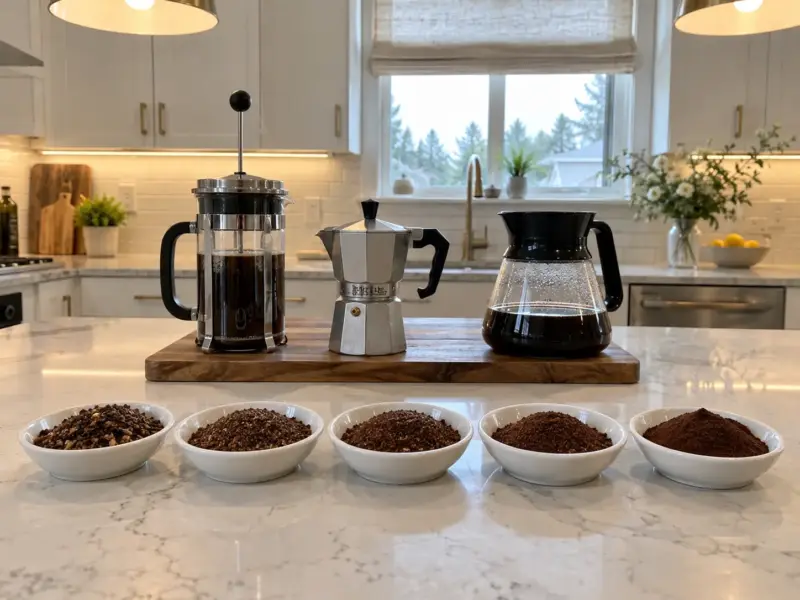
Level means the coffee sits flush with the rim, struck off with a knife edge. Heaped means a mound above it, and a mound has no number on it: depending on the grind and how it was poured, a heaped tablespoon or a heaped scoop adds close to half again as much as the level one. Two people reading the same sentence end up with pots a full ratio apart, and the one who heaps never learns the amount.
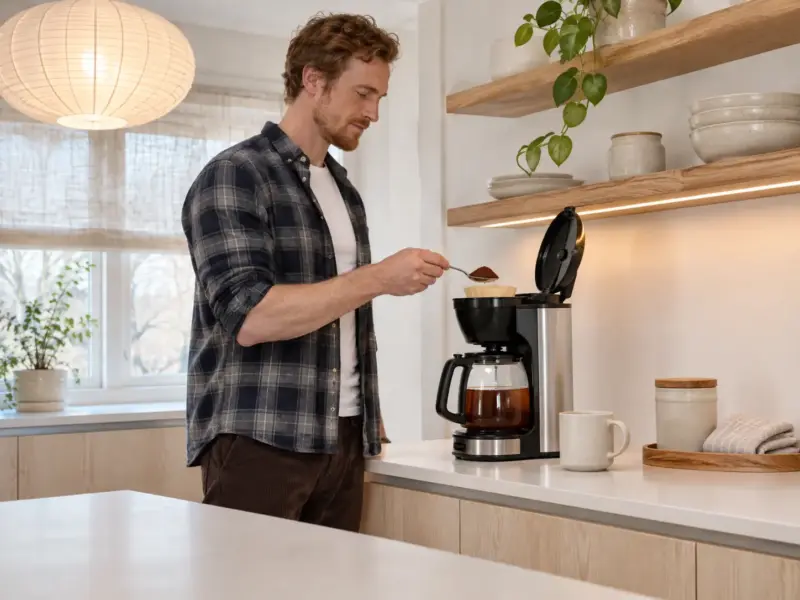
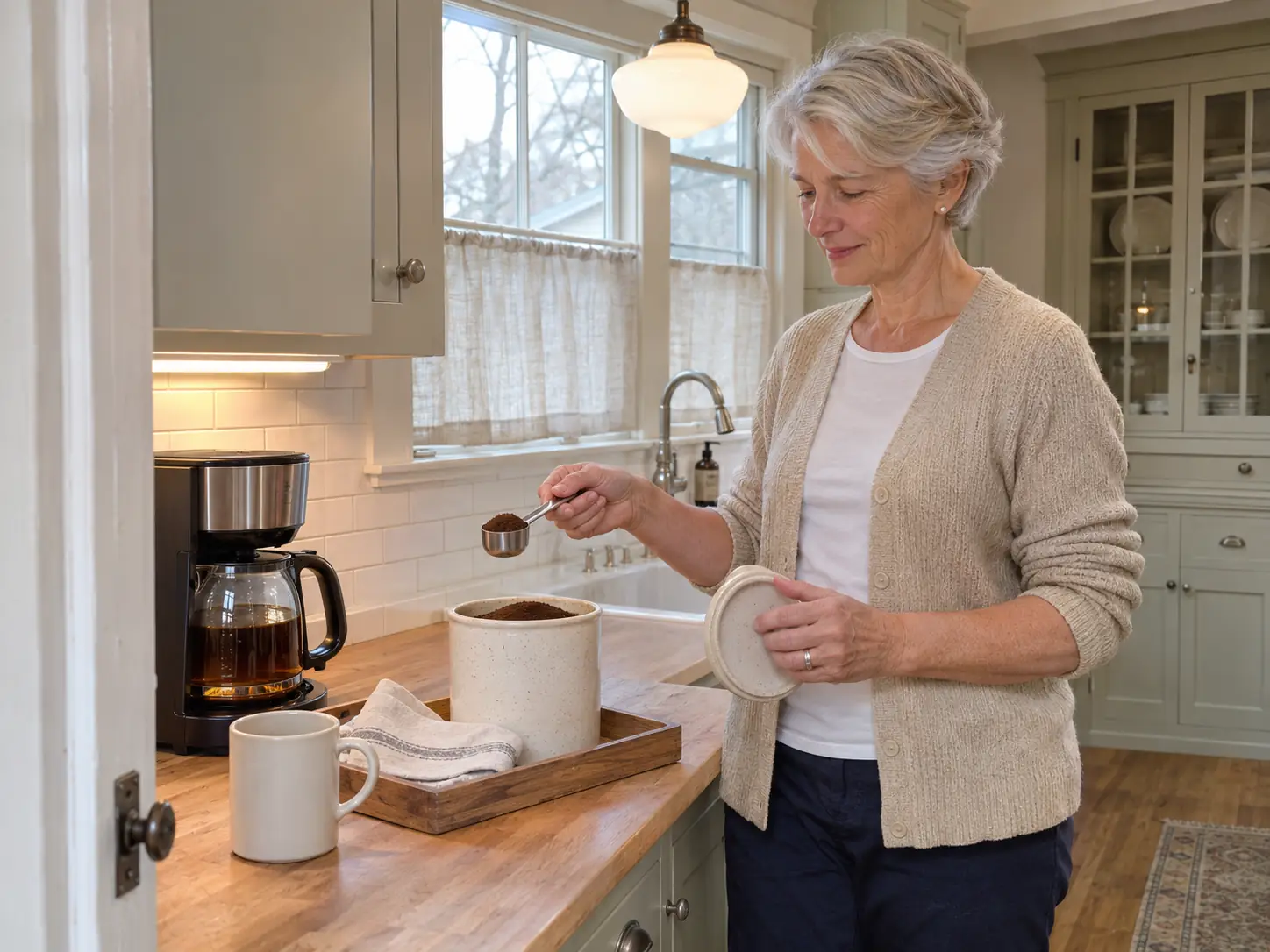
Strike the scoop off with the back of a butter knife and skip the tap on the counter. Tapping settles ground coffee and lets a little more in, which turns the same scoop into a bigger dose. Pick a method and repeat it every morning.
Check the Scoop in Your Drawer Against a Measuring Spoon
A rule that says “one scoop” is only as good as the scoop in your hand. The ones on sale hold a tablespoon, a tablespoon and a half, or two tablespoons, and the plastic one that rode along in a machine box or a tin carries no number at all. The check takes half a minute, costs nothing and happens once.
The Thirty-Second Test
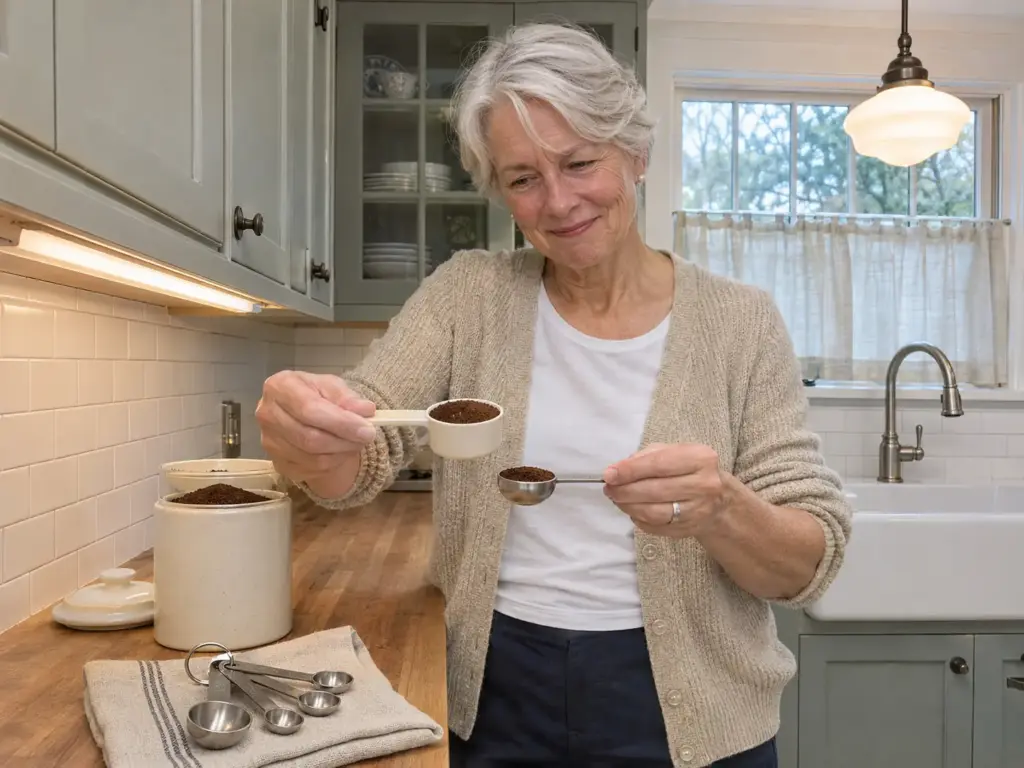
Measure into the scoop, not out of it. Fill a level tablespoon with water over the sink (water behaves like coffee for this and leaves no mess) and tip it into the scoop, then repeat until the scoop is full to the rim.
Two tablespoons fill it: you hold a 2-tablespoon scoop, the one the rule means. A tablespoon and a half-tablespoon fill it: it is a 1.5-tablespoon scoop. A single tablespoon fills it: it holds half of what the rule counts on.
The referee needs a real tablespoon and a real half-tablespoon. The U-Taste 18/8 stainless measuring spoon set has both, engraved, and it comes as a set of seven. Only two of the seven pieces do this job; the teaspoons down to 1/8 stay in the baking drawer. Any measuring spoon you already own works as well.
Reading the Result
The three sizes change the count for the same 6-ounce cup. A 2-tablespoon scoop takes one per cup. A 1.5-tablespoon scoop takes 1⅓. A 1-tablespoon scoop takes two, and a pot dosed with one per cup from that scoop gets half of the intended coffee.
In a cupboard holding scoops from three different machines, the coffee changes with whoever reaches in first.
A scoop that takes three or four tablespoons was made for something other than coffee, and it is better off in the baking drawer. Once you know yours, write the answer on the lid of the can and stop thinking about it. That is the free fix, and it comes before any purchase.
When the Scoop Has No Number on It
The unmarked scoop from a box or a tin is the one that needs the test. The marked ones state 2 Tbsp, 1/8 cup or 30 ml somewhere on the handle, and that is the number to look for. If the test says yours is the right size but you would rather read a number than remember one, the U-Taste 18/8 stainless coffee scoop has 2 tablespoons (30 ml) engraved in both US and metric units on the handle, and the 18/8 steel does not hold the smell of coffee between uses. At 4.92 inches the handle does not reach the bottom of a 2-pound bag without the knuckles going in, so it works from a canister or a jar and not from the bag.
Scoops for a Cup, a Mug, a Travel Mug and a Full Pot
A coffee cup in the brewing standards is 6 ounces, the mug you pour into holds 8 or more, and the “cup” printed on a carafe is neither. The count that matters is the one for the vessel in your hand.
What “Cup” Means on Three Labels
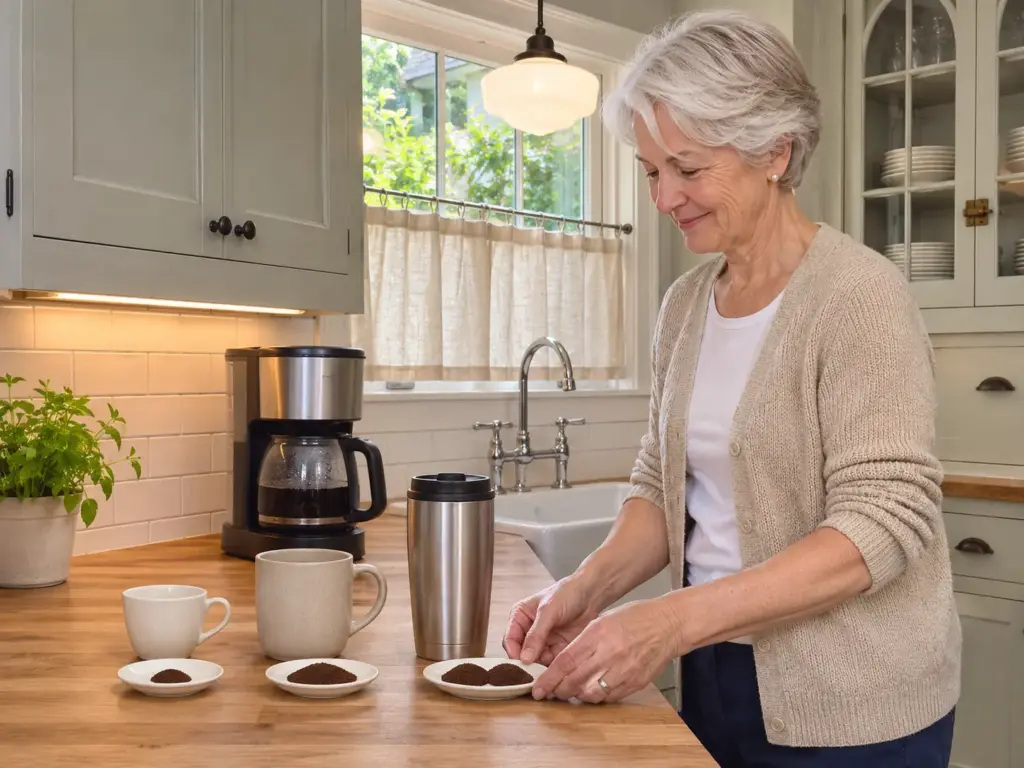
Three different cups are in play. The coffee cup of the brewing rules is 6 fluid ounces of water. The US measuring cup is 8 fluid ounces.
The cup line on a coffee maker’s carafe is about 5 ounces, a figure Cuisinart’s manual gives before it gives any dosing advice. A 12-cup coffee maker therefore holds about 60 ounces of water, where twelve US cups would be 96.
The mug is the loosest of the three, with no standard at all: 8 ounces is common, 10 is easy to find, and a travel mug runs 12 or more. The dose follows the ounces you pour, and the table below turns those ounces into scoops. For a household that only ever pours one mug, a coffee maker that brews one mug skips the conversion altogether.
The Count by Vessel
SCA Standard 310-2021 tests home brewers at 55 grams of coffee for every 1,000 grams of water, a brew ratio of about 1 to 18.2. Applied to each vessel, with a level 2-tablespoon scoop counted at about 10 grams, it gives the table below. Read it as a starting point to taste against.
| Vessel | Water | Coffee at 55 g per kg | Level 2-Tbsp scoops |
|---|---|---|---|
| Coffee cup | 6 fl oz (177 ml) | 9.8 g | 1 |
| Mug | 8 fl oz (237 ml) | 13.0 g | 1⅓ |
| Large mug | 10 fl oz (296 ml) | 16.3 g | 1⅔ |
| Travel mug | 12 fl oz (355 ml) | 19.5 g | 2 |
The 6-ounce row lands almost exactly on the top of the National Coffee Association’s range, so one level scoop per cup works as the rule. A household that likes a milder mug can start a tablespoon under these numbers and taste its way up.
A Full Pot Dosed From the Carafe Line
Read the carafe in its own ounces. A 12-cup pot holds about 60 ounces, which is ten 6-ounce cups. At 1 to 2 tablespoons each that is 10 to 20 tablespoons, or 5 to 10 level scoops: five is the mild end of the window, ten is the strong end at about 100 grams of coffee. A half pot takes half of that, 2½ to 5 scoops.
One scoop per printed cup means 12 scoops for a full pot, a fifth past the top of that window. The same read-it-in-ounces move applies to carafes bigger than twelve cups.
Fill the carafe with tap water to its top line, pour it into a liquid measuring cup once, and put the ounces on a strip of masking tape on the handle or on the fridge door. That number, not the one printed on the glass, is what your scoop count divides into.
The Half Scoop Is One Level Tablespoon
“Add half a scoop” is the standard adjustment for a pot that runs a little thin or a little heavy, and it only works as a measure if you know how big the half is. Cut by eye on a mound, it is a different amount every morning.
What the Honest Half Is
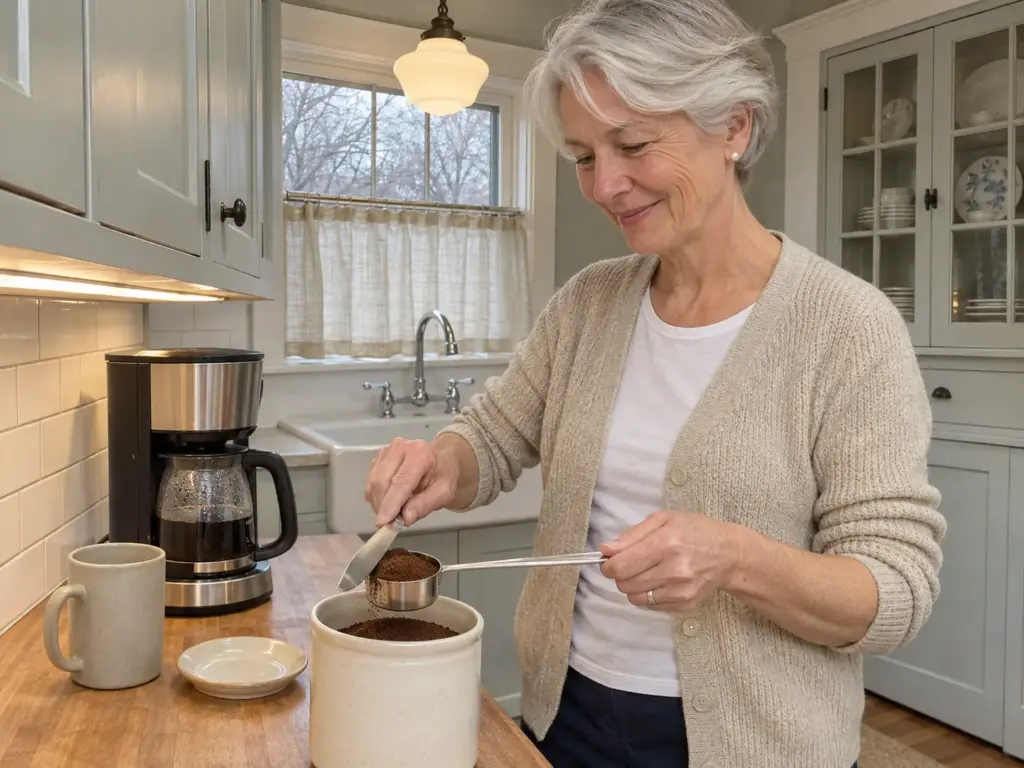
Half of a 2-tablespoon scoop is one level tablespoon, about 4 to 6 grams depending on the roast and the grind. A whole scoop is a 10-gram jump, which is too large a step for most pots; the half is the step that fits. It is also exactly what the tin means by one tablespoon.
The Fino Coffee Measure is a true 1-tablespoon measure in 18/8 stainless steel, made in Japan, with a 6-inch handle that reaches into a bag. Its capacity is not always what it claims, and the handle bends under a hard pack, so check it against a measuring spoon with the thirty-second test above before trusting it. The tablespoon in a measuring set does the same job for less.
Adjusting by the Half, One Change at a Time
Add or take one half into the filter in the brew basket, brew the pot the same way in the same drip coffee maker, and taste before touching anything else. If the pot was a little thin and the next one is rounder, the half was enough. If it turned sharp or drying at the end, the half overshot: go back, then add a level teaspoon and taste again. A house that has never measured is better off starting at the low end of the window than guessing the middle: five scoops in a 60-ounce pot, then a tablespoon more each morning until the pot suits the house.
Make the adjustment on a morning when the whole pot will be drunk. A pot that sits on the warming plate for an hour turns bitter whatever the count, and that muddies the test.
If the cup after the change is only thinner, or only harsher, another half is the wrong move and the grind is the suspect.
The Pot That Was Right Yesterday
When yesterday’s pot was right and today’s is not, the count did not move, so something else in the scoop did. Someone else filled it and heaped it. A different scoop came out of the drawer. The bag changed, and with it the weight a scoop carries (the last section covers that one).
Check them in that order, because the first two cost nothing and the third needs a scale.
When a Third Scoop Makes the Pot Worse
A thin pot at the right count looks like a dosing problem, and one more scoop feels like the obvious answer. It is the wrong lever. Strength and extraction move separately, and a scoop only moves one of them.
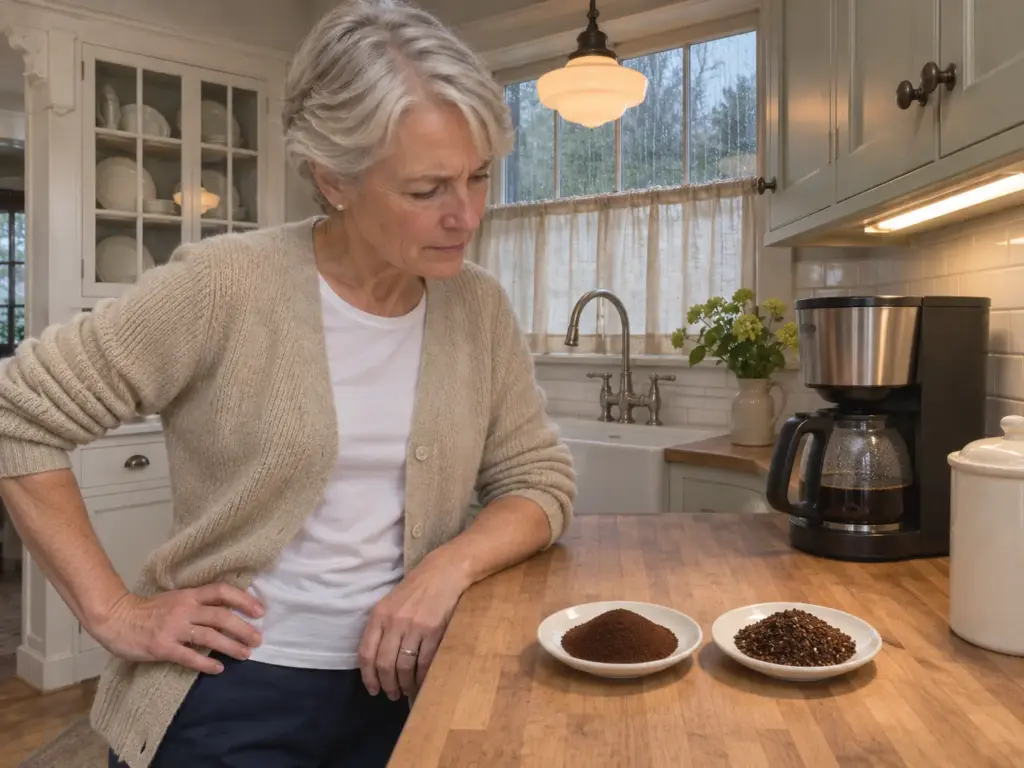
Why More Coffee Is Not More Extraction
Two numbers describe a brew. TDS is its strength, the dissolved coffee in the cup. PE is the percent extraction, the share of the grounds that dissolved.
In the SCA’s own explainer on dialing in, “coffee’s sweetness is maximized at low TDS and PE, while bitterness is maximized at high TDS and PE”. An extra scoop raises the first number and leaves the second where the grind and the water put it, so the cup gets heavier and its harshness grows with it.
That is the reason which grind pulls the most from the same dose is a separate question from the count. The count sets how much coffee meets the water. The grind sets how much of that coffee the water gets to take.
Which Way the Cup Is Off
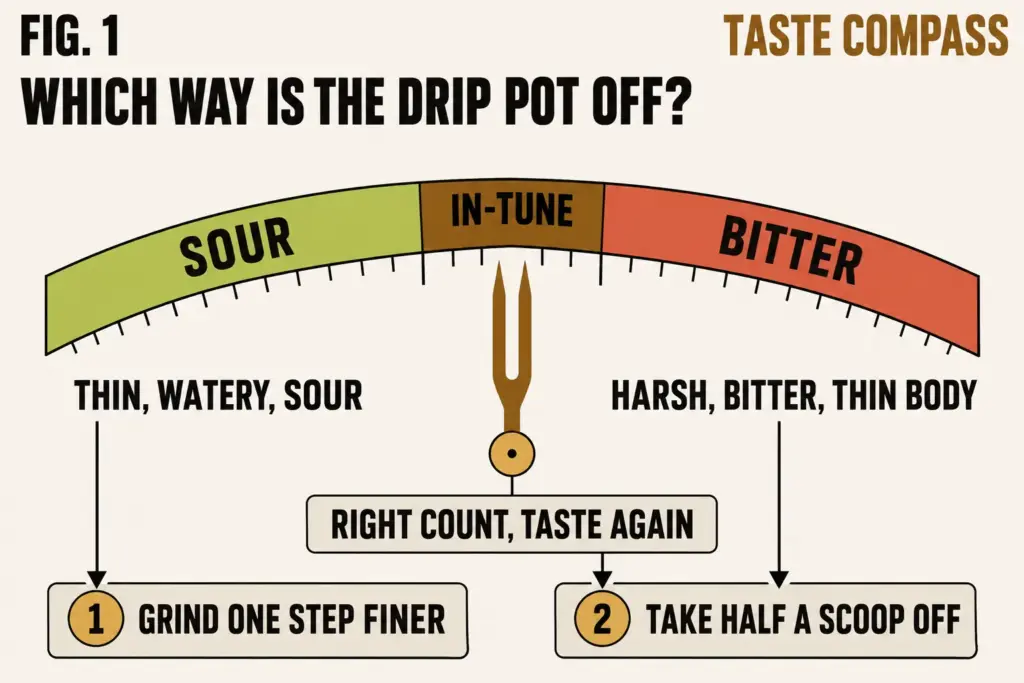
A cup that tastes thin, watery and sour at the right count points at the grind: the water went through before it finished, and a grind one step finer is the change. A cup with a harsh, bitter top and a thin body at a high count is over-dosed and under-extracted at once, the count and the grind pulling against each other, and half a scoop off with the grind held is the change.
By this point the beans get the blame, since they are the one thing that has not changed. They are rarely the cause.
The Grind Before the Third Scoop
Grind a step finer, keep the count, brew, taste. Most drip machines want a medium grind. A coarse grind lets the water through before it has finished, while a fine grind slows the water and pulls more from the same dose, which moves a thin, sour cup toward sweet.
If the next pot is rounder but a touch sharp at the end, that is far enough; back off half a step, because past it over-extraction takes the sweetness back. Only when the grind sits where the cup wants it do you touch the half scoop. If the pot stays thin at every step, the water temperature of a machine that runs cool is the next suspect. The grind that suits a drip machine has the step sizes.
The advice fails on pre-ground coffee, where there is no dial to turn. There the half scoop is the lever you own, and the direction still comes first: add for thin and sour, take away for harsh and thin.
The Scoop Against the Scale by the Fourth Bag
A scoop gives a volume and a scale gives a weight, and the difference shows up when the bag changes, not on the first morning. Each tool has a flaw, and the free one stays in the drawer either way.
What Changes Between Roasts
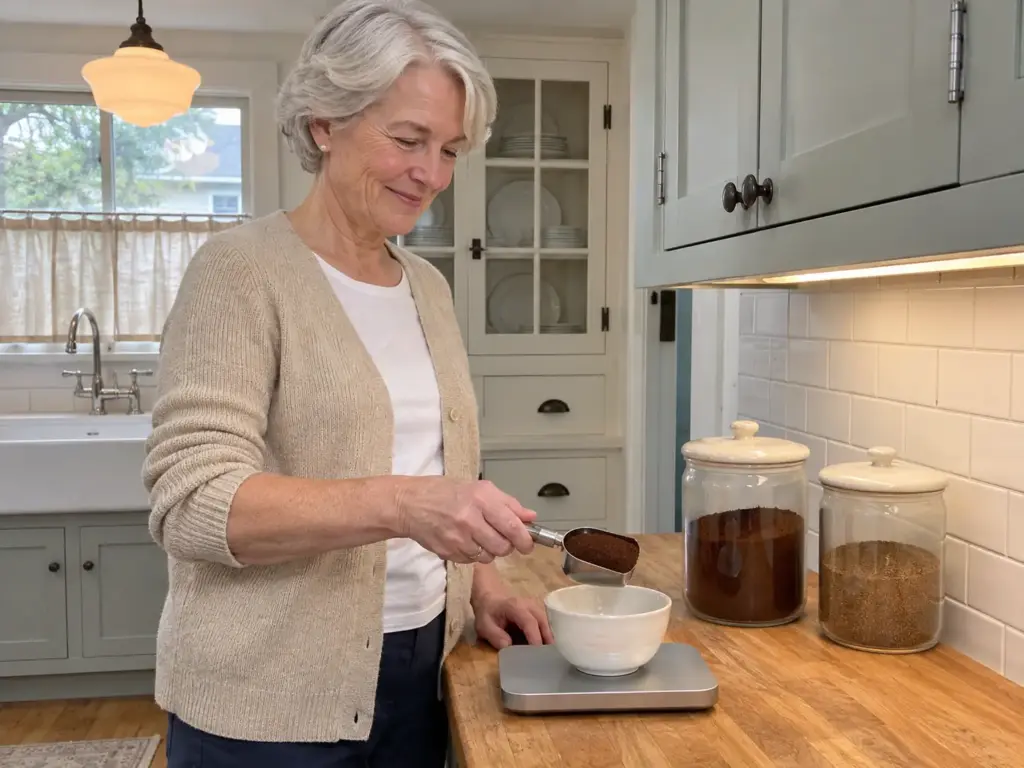
Published density measurements put ground coffee between 0.28 and 0.39 grams per milliliter, and the roast moves it. A level tablespoon holds about 5.8 grams of light roast, 4.9 of medium and 4.1 of dark. Double that for a scoop and the spread is plain: about 11.6 grams of light, 9.8 of medium, 8.2 of dark, a gap of more than 3 grams between the two ends.
So the count that made a good pot on a medium roast goes weak by the fourth bag if the bags have been getting darker. The scoop did not change; it just carries less coffee. The morning after switching bags the same count tastes watered down, and nothing in the kitchen moved except the roast. How the grind shifts from one roast to the next covers the dial side of the same switch.
The Scoop as the Backup, the Scale as the Upgrade
Weighing both the coffee and the water is the repeatable method, and the UC Davis Coffee Center’s brewing chart is read the same way, by weighing the dose and comparing your coffee-to-water ratio to the graph. A scoop gives a volume. A scale gives the same dose every morning.
A digital scale that reads whole grams is enough for a 10 to 20 gram coffee dose; a 0.1 gram scale is an espresso tool. The Etekcity Food Kitchen Scale EK6015 steps in 1-gram increments, holds up to 11 pounds (5 kg) and has a tare button, which covers the job. Its accuracy is uneven from unit to unit, some units stop working altogether, and the batteries drain fast, which is why the scoop stays in the drawer as the fallback. Weighed, a 12-ounce bag (340 grams) divides into 34 doses of 10 grams, the arithmetic that how many cups a twelve-ounce bag makes works out in full.
Put the empty mug on the scale, tare it, fill the level scoop with the new bag and read the number. Do it once per bag and write the grams on the bag with a marker. The scoop then becomes a calibrated tool again, and the next roast change costs a few seconds instead of a week of off pots.
What to Do on the Day the Scale Is Out of Reach
A dead battery, a rental kitchen, a trip: the scoop and the half scoop are what is left, with the count you wrote down for this bag. After a switch to a darker roast, add a level tablespoon to the count and taste. After a switch to a lighter one, hold the count and taste first, since the same scoop now carries more coffee than before.
Test the Scoop Tomorrow, Then Taste the Pot
The scoop in your hand is the unit, and it is two level tablespoons, about 10 grams, for a 6-ounce cup. The tin’s one tablespoon is the floor of a range that tops out at two. Count the ounces your mug and your carafe really hold, move the dose by the level half, and send a thin pot to the grind before reaching for a third scoop.
After a bag or two, a darker or lighter roast will have moved the dose without the count changing, so look at the pot again then, and weigh a scoop of the new roast if you have the scale.
Tomorrow morning, check the scoop against a measuring spoon, write the answer on the lid of the can, brew the usual pot with it and taste once. If the pot comes out different from yesterday’s, you now know why. When the count is settled, a drip machine used in grams, not scoops turns the same pot into a weighed dose.
Frequently Asked Questions
01How many scoops of coffee do I put in for 2 cups of coffee?
Two level 2-tablespoon scoops, about 20 grams, make two 6-ounce cups. A machine’s two cups are two 5-ounce lines, 10 ounces of water in all, so a bit under two scoops, about 1⅔, is enough.
02How many scoops of coffee grounds do I use for 8 cups of coffee?
Eight carafe cups are about 40 ounces of water, which takes 6½ to 7 level scoops at the 6-ounce rule. If you fill the pot with eight US cups, 64 ounces, it needs 10 to 11. The carafe line decides.
03How many scoops of coffee grounds should I use for 5 cups of coffee?
Five carafe cups are about 25 ounces of water and take about 4 level scoops. If the pot comes out weak, add a half scoop, which is one level tablespoon, and taste again.
04Is it 1 or 2 tablespoons of coffee per cup?
For a 6-ounce cup, 2 level tablespoons is the top of the National Coffee Association’s 1-to-2 range and matches the SCA’s standard. One tablespoon is the floor. An 8-ounce mug takes about 2⅔ tablespoons.
05Does a heaped scoop count as one scoop?
No, one scoop means level, struck flat across the rim. A heaped scoop holds close to half again as much coffee, so the same count gives a pot about half again as strong.


How did your cup turn out?
No comments yet. Tell us what you changed — and whether the needle moved.