



We may earn a commission when you buy through links on this page. It never changes what we recommend. How we pick
On this page8 parts
- Six Cups Is About 60 Grams If the Cup Is Six Ounces
- Your Six Is Not My Six: 30, 36 or 48 Ounces
- What a Six-Cup Basket Will Hold, and Why the Label Says Less
- The Scoop You Own, Weighed Once
- Weak or Harsh First Pot? Change the Grind Before the Dose
- When Six Cups Quietly Becomes Five
- Weigh Your Own Carafe, Write the Number on the Machine
- Frequently Asked Questions
How much coffee do you use for 6 cups of water? Read the labels on one pot and you get three different answers: the chart molded into the machine asks for less than half of what the Specialty Coffee Association (SCA) standard does, and the line on the bag asks for more than the standard does. They disagree because a “cup” is whatever the machine’s maker decided it was, so the dependable answer is a weight of coffee for a weight of water. What follows gives the dose, works out which six cups are yours, shows what a six-cup basket will hold, weighs the scoop in your drawer, orders the fixes for a weak or harsh first pot and covers the drip coffee maker that slowly starts pouring short, with the full coffee-to-water ratio guide for the ratio itself.
Quick Answer
Six 6-ounce cups is 36 fluid ounces of water, and that takes about 60 grams of coffee, a ratio between 1:16.5 and 1:18: six level two-tablespoon scoops or 12 level tablespoons. If the carafe’s lines are 5 ounces, six lines are 30 ounces and the dose is about 50 grams.
Six Cups Is About 60 Grams If the Cup Is Six Ounces
A pot’s dose is the weight of its water divided by a ratio, and the only unknown is how much water “six cups” really is. The arithmetic comes first and the arguments about the cup follow it, so you can redo the sum for any carafe in the kitchen. Everything below hangs on that one division.
Water first, then divide
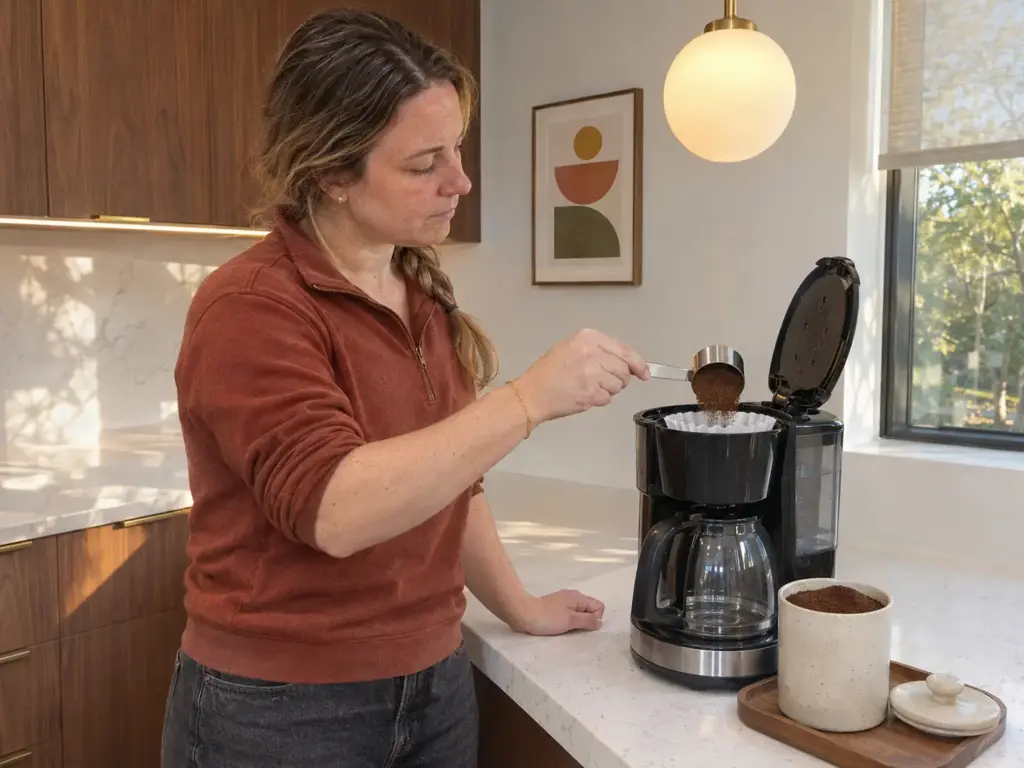
Start with the water, because it is the one part you can measure without arguing. Six 6-ounce cups is 36 fluid ounces, and since a fluid ounce is 29.57 milliliters and a milliliter of water weighs a gram, that pot holds about 1,065 g of water. Divide by the ratio you want: 1,065 ÷ 17 is 62.6 g, and 1,065 ÷ 18 is 59.2 g. So about 60 grams is the dose, which is 12 level tablespoons at the 5 g per tablespoon coffee makers print, or six level two-tablespoon scoops.
For any other pot the steps stay put: ounces times 29.57 gives grams of water, and that number divided by 17 gives grams of coffee. A phone calculator on the counter is the whole kit, and a measuring cup in ounces helps for the water.
Where 55 and 60 grams per liter come from
Two figures circulate for the same standard, and both sit in range. The SCA’s Golden Cup standard sets the ratio at 55 g of coffee per liter of water, give or take 10 percent. That spans 49.5 to 60.5 g/L, or roughly 1:20 down to 1:16.5.
The SCA’s own note on how a brew ratio is written says: “Most commonly written as ground coffee per volume of water 60 g/L.” Sixty g/L is 1,000 g of water divided by 60 g of coffee, about 1:16.7.
On the 1,065 g pot, 55 g/L is 59 g and 60 g/L is 64 g, so “about 60” sits in the middle of a working range, not a single number to defend. Both 1:17 and 1:18 are inside it. And 1:16 sits a hair over the top edge (62.5 g/L), which suits a stronger pot if you are ready to grind a step coarser to keep it from turning bitter.
Four, six, eight, ten and twelve cups at a glance
The table runs the same arithmetic for common pot sizes, with cups of 6 fluid ounces. Grams run from the Golden Cup’s 55 g/L to the SCA note’s 60 g/L; tablespoons are level at 5 g each, and scoops are the two-tablespoon kind.
| 6-oz cups | Water | Level tablespoons | 2-tbsp scoops | Grams of coffee |
|---|---|---|---|---|
| 4 | 24 fl oz (710 ml) | 8 | 4 | 39 to 43 g |
| 6 | 36 fl oz (1,065 ml) | 12 | 6 | 59 to 64 g |
| 8 | 48 fl oz (1,419 ml) | 16 | 8 | 78 to 85 g |
| 10 | 60 fl oz (1,774 ml) | 20 | 10 | 98 to 106 g |
| 12 | 72 fl oz (2,129 ml) | 24 | 12 | 117 to 128 g |
Read down the last column and the scale-up is plain: roughly 10 g for every 6-ounce cup, nothing cleverer than that. A pot dosed this way looks darker in the carafe than one made from the machine’s printed chart, and the difference shows before the first sip.
Your Six Is Not My Six: 30, 36 or 48 Ounces
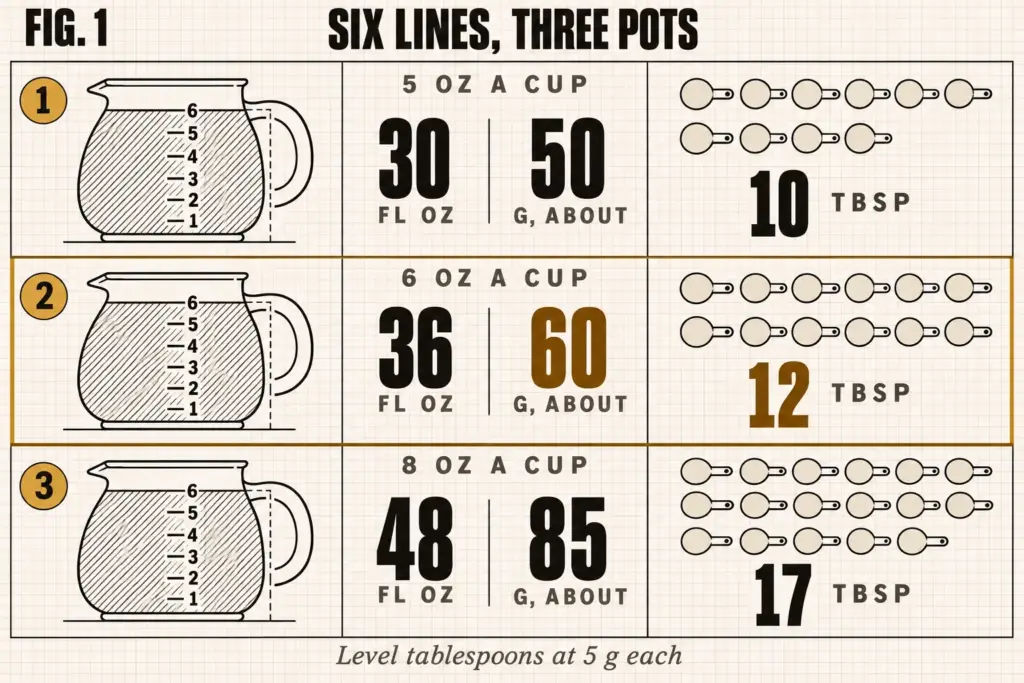
“Six cups” means whatever the machine’s maker decided a cup is, and the cup lines printed on the carafe are the maker’s, not your kitchen’s. The same six lines can be three different pots depending on the machine, and that moves the dose by about 35 g.
The five-ounce line
Plenty of drip machines count a cup as 5 fluid ounces (148 ml), and the chart in the Mr. Coffee owner’s manual does exactly that. For what that kind of machine does once the novelty wears off, read the Mr. Coffee machine and how it holds up in year two.
Six lines on a 5-ounce carafe are 30 fluid ounces, 888 ml, which wants 49 to 53 g: about 10 level tablespoons, or five scoops. The same ounces-over-cups sum on the largest carafes is in what a machine bigger than twelve cups really pours.
The cup is the maker’s unit, and it runs wide. The SCA’s list of certified home brewers carries a Technivorm Moccamaster sold as a 10-cup that holds 40 ounces, which is 4 ounces a cup. A Bonavita 8-cup on the same list delivers a full 40-ounce carafe, 5 ounces a cup. And the Moccamaster Cup-One makes 10 ounces for one cup.
Six mugs are not six lines
Count six mugs instead of six lines and the pot changes again. An 8-ounce mug times six is 48 fluid ounces, 1,419 ml, and that pot needs 78 to 85 g, nearly double what the 5-ounce machine takes.
That makes three totals for one phrase: 30, 36 or 48 fluid ounces, which is 888, 1,065 or 1,419 ml of water and about 50, 60 or 85 g of coffee. The ratio never moved. The pot did.
The same effect runs the other way on a machine with small lines. A carafe sold as a 10-cup that holds 40 ounces has 4-ounce lines, so six lines is 24 ounces, 710 ml, and the dose lands near 40 g, well under the 60 g a 6-ounce reading asks for. The 36-ounce arithmetic would give that pot half again too much coffee.
Fill it once and weigh it
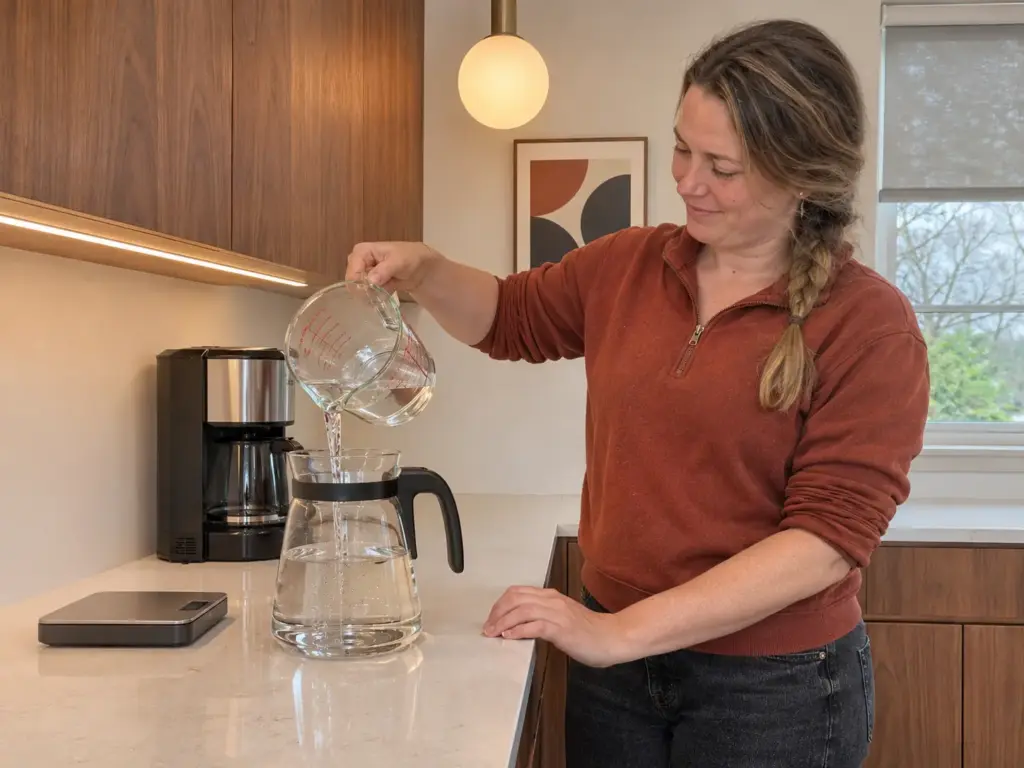
The free way to find out which six is yours: fill the carafe to its sixth line from the tap, pour it into a measuring cup or jug and divide by six. A kitchen scale gives the same answer with the carafe on the platform, because one milliliter of water is one gram. Write the result on the machine. The printed lines are molded plastic or etched glass, and they wear into a rough guide; the jug and the scale are the check.
Weigh the dry, empty carafe once and put that weight on a strip of masking tape under the handle, next to the grams the sixth line holds. Every later check is then a single subtraction, and when the figure moves, the machine is what changed.
A digital scale does the same job and reads in grams directly, which saves washing a jug. The Hario Drip Scale Timer reads in 0.1 g steps, runs on two AAA batteries (no charging routine to remember) and has a 7.4 by 4.7 inch platform that takes a full carafe. It wakes slowly and the display is slow to settle, which is how a pour overshoots its target, and a run of units has broken inside six months. For one weighing a season that is tolerable; for a daily pour-over habit it would be a worse bargain.
What a Six-Cup Basket Will Hold, and Why the Label Says Less
The dose that fits the carafe has to fit the basket too, and the number printed on the machine fits neither. That label is the first reason a first pot tastes thin.
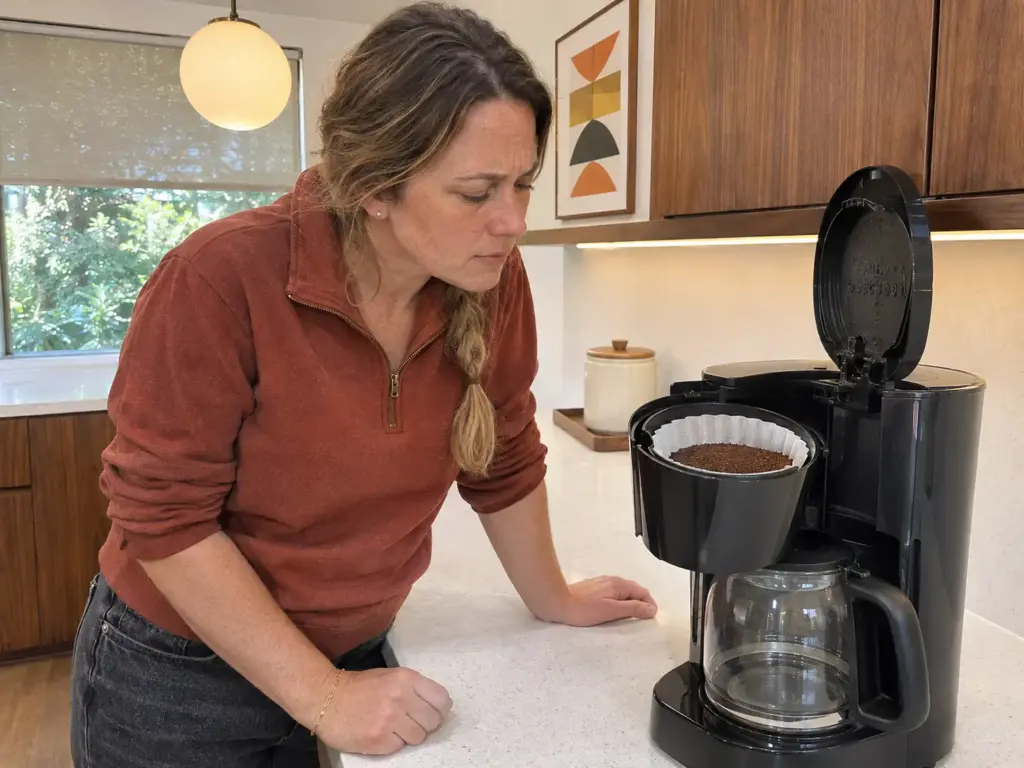
The chart on the machine, divided
Take the Mr. Coffee owner’s manual for its 12-cup machine. Its chart asks for 4.5 level tablespoons for six cups, and the manual counts a tablespoon as 5 g, so the pot gets 22.5 g of coffee for 30 fluid ounces of water.
Divide it out and that is about 1:39, less than half the roughly 53 g the SCA’s 60 g/L gives the same pot. Follow the label to the letter and you get a pale pot and a verdict against the beans.
That makes three instructions for one pot. A bag’s back label often reads two tablespoons a cup, about 60 g for six; the machine’s chart says 22.5 g; the SCA’s range says 49 to 53 g for a 30-ounce carafe. The bag’s rule is written for a 6-ounce cup, so on a 5-ounce machine it brews a pot near 1:15, stronger than the bag intends.
Only the SCA’s range is checked against a measured cup. Once you trust it, running a drip machine in grams instead of scoops is the routine that follows.
Why a big dose can still overflow
A basket sets a ceiling the carafe does not. A full 12-cup dose, 100 g and more, is a 12-cup basket’s job, and the six-cup dose for a 30-ounce carafe is the amount that basket was built around. Size the dose for 36 or 48 ounces (59 to 64 g, or 78 to 85 g) and the bed can swell past the rim of the filter as it blooms.
A 6-cup filter basket can’t take a 12-cup dose, and the margin in between is smaller than it looks. No single number marks the limit, so judge it by the filter: the dry grounds should sit below the fold of the paper, with room to rise, or the grounds will overflow at the first pour.
When the basket does run over, change the grind first. Go slightly coarser so the water passes sooner, or split the pot into two smaller batches. Shaving the dose is the move that makes a thin pot, so it comes last. Taste after the coarser step: a pot that was right for strength will come out a touch lighter and brighter, and that is the sign to come back half a step.
The first pour makes the problem visible, since the foam of the bloom crests the paper and a basket filled to the brim shows it first.
Tap the filled basket flat before you close it. A heap in the middle of a paper cone is where the first pour drills a channel and skips the grounds at the edge, and a level bed also rises more evenly when the bloom starts.
The Scoop You Own, Weighed Once
A scoop measures volume and coffee is sold by weight, so the same full scoop is a different dose with every bag. The table above becomes a repeatable number only after the scoop has been checked once.
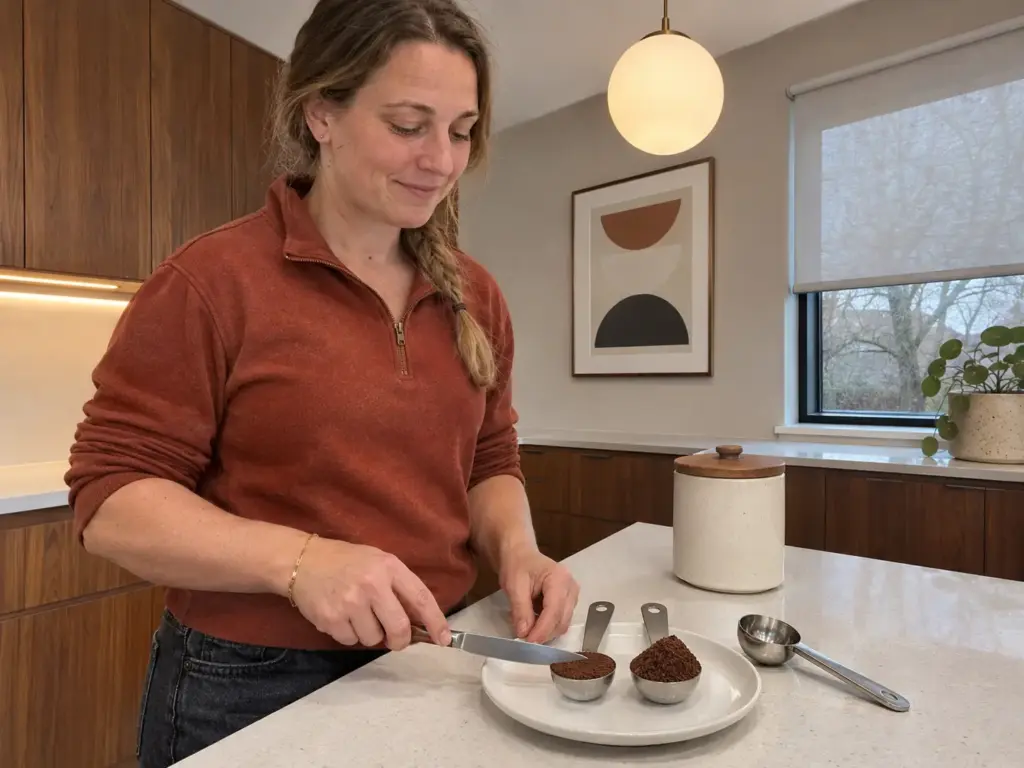
Level, packed and heaped
Start with a free test. Fill the scoop from the drawer level, tip it into a tablespoon measure and count how many level tablespoons it takes. Many scoops carry no volume mark at all, and this tells you whether yours is one tablespoon, two, or something in between.
A scoop engraved with its volume turns the test into a printed fact: the U-Taste 18/8 Stainless Steel Coffee Scoop is exactly 2 tablespoons (30 ml), with US and metric marks on the handle, and it goes in the dishwasher. It has the limit every scoop has: it fixes the volume and says nothing about the weight, so one level scoop of your bag still goes on a scale.
How the scoop is filled matters as much as its size. The maker’s figure is 5 g for a level tablespoon, and a scoop packed down or a heaped tablespoon holds 21 to 31 percent more than the same measure levelled, which is a fifth to almost a third of extra coffee in the pot. For the count per single cup, see what a scoop holds per cup; this page keeps the whole pot.
Light roast weighs more than dark
Roasting swells the bean and drives off weight, so roast density falls as the roast darkens and darker coffee is lighter per spoonful. Whole beans ground at home and pre-ground coffee pack differently too, so weigh the scoop of whichever you buy.
A 2019 study that weighed light, medium and dark ground coffee measured the loose density of fine-ground Arabica at 0.39 g/cm³ for light, 0.33 for medium and 0.28 for dark, and its authors put the cause this way: “the noticeable reduction of density is observed owing to the volume increase and weight decrease.” In spoon terms, a level US tablespoon holds about 5.8 g of light roast, 4.9 g of medium and 4.1 g of dark, and a level two-tablespoon scoop holds 8.3 to 11.5 g. Packed down, the same study puts the densities at 0.51, 0.41 and 0.34.
On a six-scoop pot the swing is bigger than a whole ratio step. Six level scoops of dark roast come to about 50 g and six of light roast to about 69 g, which is 47 g/L at one end and 65 g/L at the other. One pot lands under the Golden Cup range and the other over it, from the same six scoops.
Weigh one scoop of the bag you have
The calibration costs nothing: level one scoop of the bag you are actually using, weigh it on any kitchen scale, and write the grams on the bag or the canister lid. After that the table is arithmetic. When a new bag comes in, repeat it, because the weighed scoop of the new bag is rarely the weight of the bag before it.
The scoop that shipped with the machine can stay the measure once it has been checked against a measuring spoon; the brown scoop that comes with a Moccamaster is about 10 g level, so three of them is 30 g for half a liter.
Then comes the question of whether to buy a coffee scale at all. The free route first: a kitchen scale you already own does this job, and so does the jug from the last section. A digital coffee scale earns its place when you brew every day and want the grams without the sum.
The TIMEMORE Coffee Scale Basic 2.0 reads to 0.1 g up to 2,000 g, with a timer and a separate flow-rate display, USB-C charging and a 26 mm profile, and a 1-liter carafe fits on it with the display still in view. The weak point sits in the electronics while the load cell holds up: some units stop working within a month or at six months, and the display is sensitive enough that it settles slowly.
A US nickel weighs 5 grams, so one on the platform checks any scale, and two make 10 g, close to a level scoop. If the readout is off by more than a tenth of a gram, try a fresh battery and a flat, hard surface before you blame the scale.
Weak or Harsh First Pot? Change the Grind Before the Dose
With the dose set and the scoop weighed, the first pot tells you which way it is off, and the direction says which setting moves first. It is the free one, and it comes before the amount of coffee.
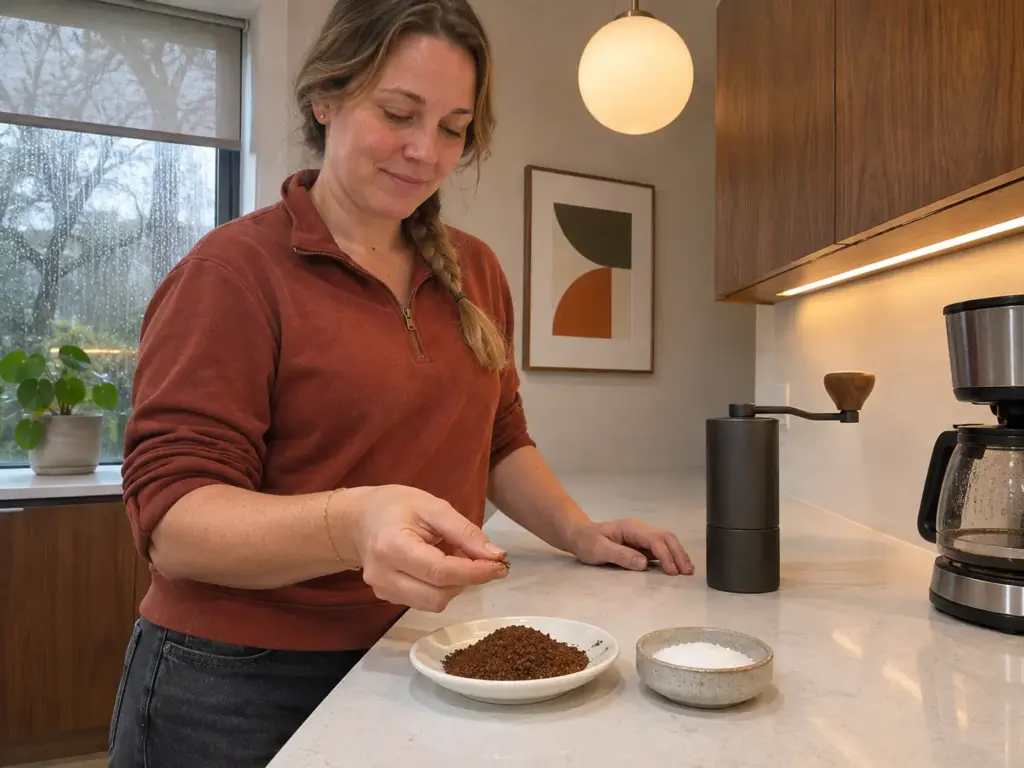
A thin or sour pot
Thin, watery and sour all point the same way: the water left the grounds before it finished the job. Go one step finer on the grind first (here is the grind that suits a drip basket), brew the same dose the same way and taste. A fine grind slows the water down and pulls more from the grounds.
Grind size, water temperature and brew time frame that step. A drip basket wants a medium grind, close to table salt, with water at 195 to 205°F (90 to 96°C) and 4 to 6 minutes of contact; the Golden Cup puts the water at 200°F ±5°F (93°C ±3°C). If the next pot is rounder, stop there. If it turned harsh, you passed the mark, so come back half a step.
More coffee looks like the obvious answer to a weak pot and often fails. The SCA’s brewing-chart work notes that sourness rises when strength rises while extraction falls, so extra grounds in an under-extracted pot make it sourer without making it better. If the grind has moved a step or two and the pot is still thin, the machine’s brew temperature is the next suspect, ahead of the scoop.
A harsh or bitter pot
Harsh, bitter and burnt-tasting pots run the other way: the water stayed too long or pulled too much. Go one step toward a coarse grind first, brew, taste, and trim the dose only if the pot is still sharp. The coarser step also passes water sooner, which is why it settles a basket that runs over. The tell that you overshot is a pot that turns thin and faintly sour, the other side of the same dial.
Moving the dose when the grind is right
When the grind is right and the strength isn’t, the dose moves 1 to 2 g per 8 fluid ounces, which on a 36-ounce pot is about 5 g, one level tablespoon, up or down. Strength lives inside the range: 1:15 is the stronger end, just past the top of the Golden Cup band, and 1:18 is the lighter one. Taste between every move.
A flat-bottom drip machine starts well at 10 g per carafe cup, and a volume rule scaled down, 1.5 level tablespoons per 5-ounce cup (7.5 g), tends to come out weak and gets raised. The adjustment is made in the cup, not in the arithmetic.
Read a grind change on the second pot. The grinder keeps some grounds inside, so the first dose after a turn still carries the old setting.
When Six Cups Quietly Becomes Five
A dose that was right in spring can taste harsh by summer without anyone touching a setting, because the machine stops delivering the water its line claims. The recipe stayed the same; the water arriving did not.
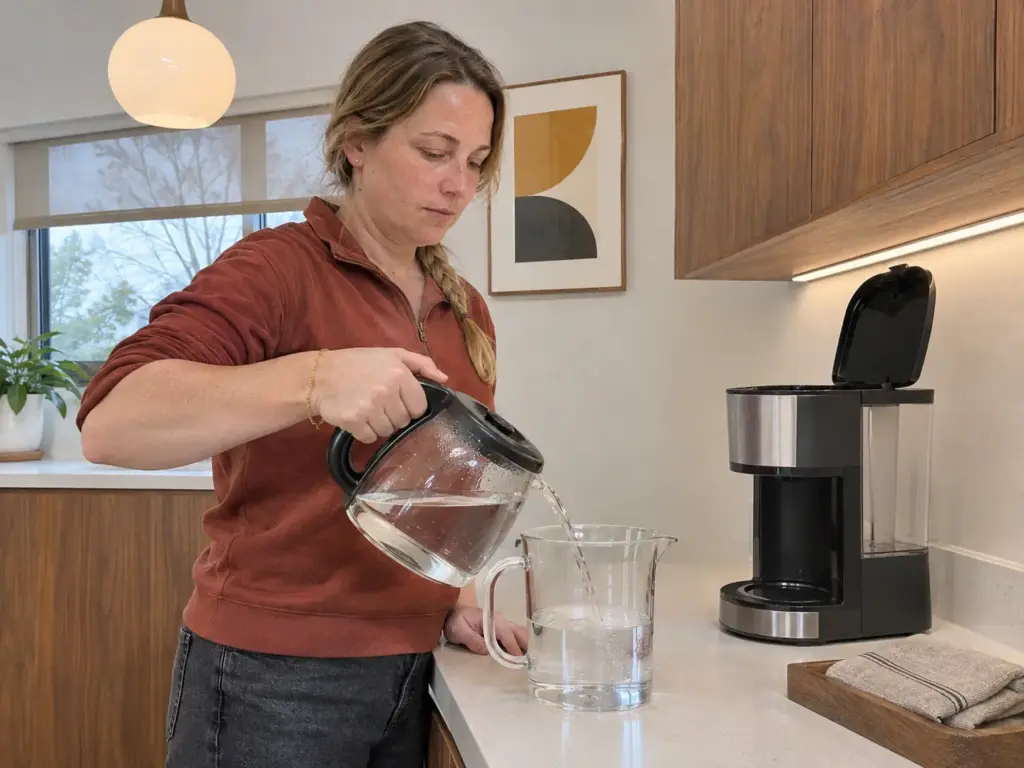
What the minerals do to the water that arrives
Hard tap water leaves calcium and limestone deposits in the reservoir, the valve and the shower head. Mr. Coffee’s manual states that minerals in water leave deposits in the coffeemaker and affect its performance, and the machine carries a Clean cycle and a red Clean light that tracks brew cycles rather than sensing minerals.
Less water reaches the grounds, so the same 60 g now over-extracts and tastes harsher. The scoop is innocent; the missing water is the cause. For why a short pour changes what is extracted, read how the water gets to the grounds in a drip coffee maker.
The first sign is a carafe that is not full when the cycle ends, a machine brewing short of its sixth line. Filtered water slows the mineral buildup but never stops it, so the descale cycle stays on the calendar.
When the brew stops, lift the reservoir lid and look at the basket. Water still sitting in the tank, or a basket that is wet and still dripping with the carafe short, means the machine quit before the water ran out.
Descale, then check the line once
Take the repairs in order. Run the descale cycle as the manual says, then fill to the sixth line, brew plain water and pour the carafe’s output into a jug, and compare it with the figure you wrote on the machine. If it matches, the recipe stands and the pot should taste right again; change the recipe only if the check says so. A scale makes the repeat quicker, and the KitchenTour Coffee Scale with Timer EK6012 is the cheap version.
It reads 0.1 g up to 500 g, 0.5 g to 1 kg and whole grams to 3 kg, on an 8.46 by 6.3 inch platform wide enough for a 1-liter carafe, and whole grams are plenty for weighing water. It takes three AAA batteries. Expect accuracy that varies from unit to unit, a slow response, a timer that runs fast and units that quit after about a year, so test it against a nickel and ignore its timer.
Heat drifts too, and the carafe shows it
Heat belongs to the same drift. A tired machine can fall below the 195 to 205°F window while the water volume still looks right, and no dose repairs a thin pot that is under-heated; the heat a drip machine needs to reach is the number to hold the machine to. So when a pot goes thin with the dose right, the grind right and the machine descaled, suspect the heat. And once a season, weigh the full carafe at its sixth line and keep the number beside the one you wrote on day one; the difference between them is the machine, measured.
Weigh Your Own Carafe, Write the Number on the Machine
Fill your carafe to its sixth line once and write down what it holds in grams. That number divided by 17 is tomorrow’s dose, and it is the one measurement the rest depends on. Check the scoop against the bag in hand, and weigh a level scoop again when the bag changes.
When a pot comes out wrong, move the grind first, finer for sour and coarser for bitter, and touch the dose only when the grind is right. If a pot that used to be right turns harsh, descale before touching the recipe.
For later, look at two numbers: the weight of a level scoop whenever a new bag arrives, and the carafe’s real output after a couple of descales on hard water. Those two drift; the ratio doesn’t.
Tomorrow morning, brew at the grams your own carafe calls for, taste the pot, and only then turn the grind if the cup points a direction. Once the dose is steady, how many pots a bag of beans makes turns the same grams-per-cup arithmetic into bag size.
Frequently Asked Questions
01How much coffee should I add to 6 cups of water?
Use about 60 grams of ground coffee for six 6-ounce cups, which is 36 fluid ounces of water and roughly 12 level tablespoons. If the machine’s lines are 5 ounces, the pot is 30 ounces and about 50 grams does it. The pot’s size sets the dose; the word cup does not.
02How many scoops of coffee for a 6 cup coffee maker?
Six level two-tablespoon scoops fit a pot of six 6-ounce cups, and five fit a machine whose lines are 5 ounces. A level scoop holds between 8 and 11.5 grams depending on the roast, so weigh one scoop of your bag first.
03What is the recommended coffee to water ratio for drip coffee?
The SCA’s Golden Cup standard is 55 grams of coffee per liter of water, plus or minus 10 percent, which runs from about 1:20 to 1:16.5. Start near 1:17, taste, and move the grind before you move the dose.
04How much coffee grounds do I use for a 12 cup coffee maker?
A full 12-cup pot of 5-ounce cups is 60 fluid ounces, about 1,775 milliliters of water, so it takes roughly 100 grams of coffee. Fill the carafe to its twelfth line once and weigh it, because the maker’s cup may not be 5 ounces.
05Is a 6-cup coffee maker 6 cups of 8 ounces?
Usually not: the maker’s cup runs from about 4 ounces to 10 ounces on certified machines, and many lines are 5 or 6. Fill the carafe to its sixth line, pour it into a measuring jug and divide by six.



How did your cup turn out?
No comments yet. Tell us what you changed — and whether the needle moved.