




We may earn a commission when you buy through links on this page. It never changes what we recommend. How we pick
On this page9 parts
- A Level Scoop Is Not the Same Dose Twice
- Reading the Cup Before You Spend Anything
- Where a Scale Earns Its Place in Espresso and Pour Over
- A Drip Pot or a French Press Runs Fine on the Scale in Your Drawer
- What the SCA Number Says About 1:16 and 1:2
- What to Check Before You Buy One, and What Breaks by Month Two
- When the Scale Is Not the Fix
- Weigh the Scoop Tomorrow, Then Taste Before You Touch the Grind
- Frequently Asked Questions
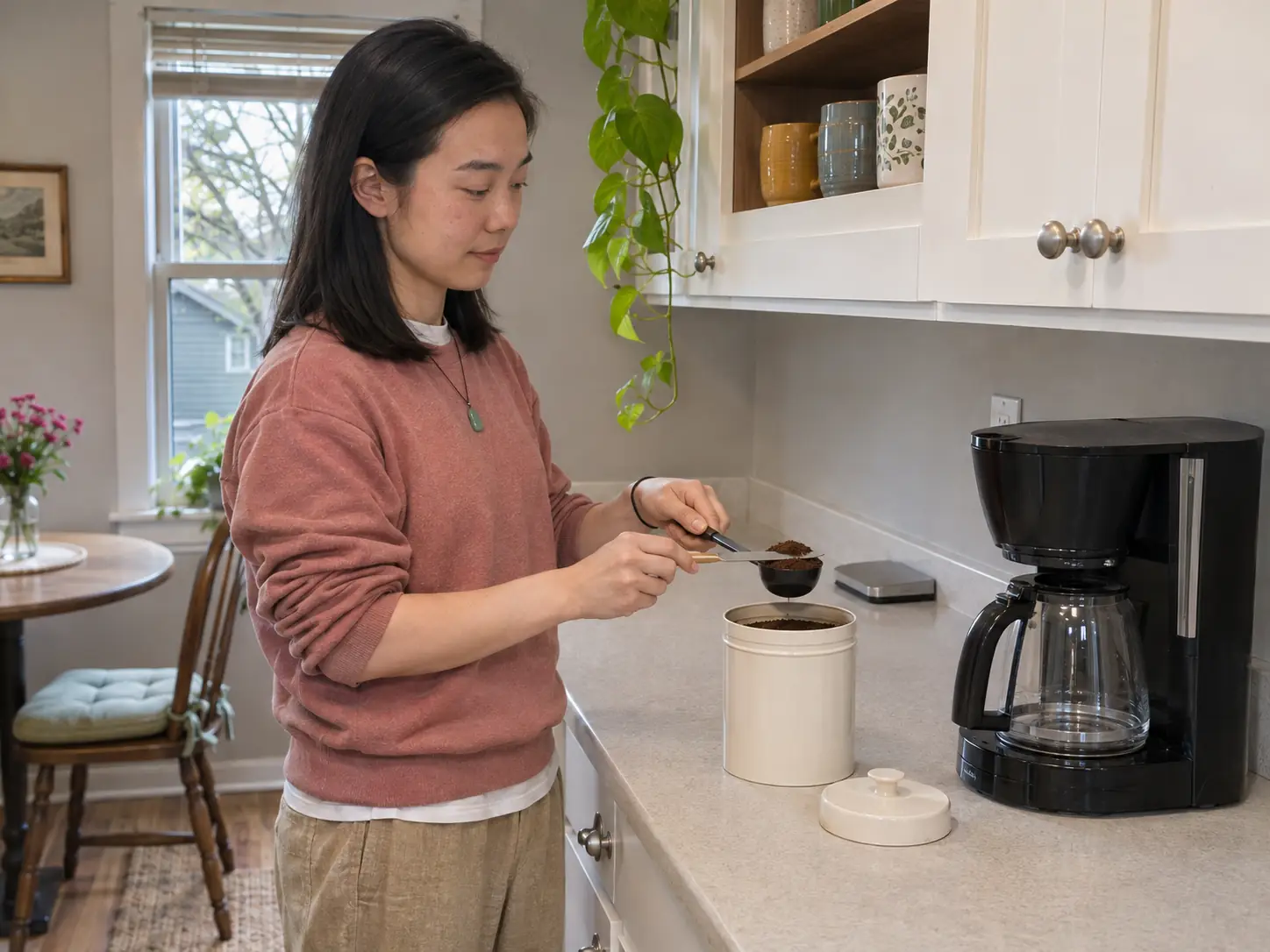
The pot tastes heavier than yesterday’s, and nothing in the kitchen changed: same bag, same grind, same machine, same plastic scoop. The scoop is the one tool that never got weighed, and it measures space, so the grams inside it move with the roast. So do I need a coffee scale? That depends on how far the spoon is lying and on which brews cannot afford it.
Grams of coffee per ounce of water settle how strong the cup tastes, while what coffee does inside you is a question for your doctor that no scale answers, so this page stays with the cup. Ahead: what a scoop really holds, which way the cup points when the dose drifts, where a tenth of a gram pays, where the scale in your drawer already does the job, what the standard says about the numbers, and what goes wrong with the scales themselves.
Quick Answer
No, you do not need a scale to make coffee. You need one the moment you want the same cup twice. Espresso (18 g in, 36 g out) and pour-over (the bloom by weight) are where it pays off; a drip pot or French press stays repeatable on a 1 g kitchen scale and 1:16 arithmetic.
A Level Scoop Is Not the Same Dose Twice
A scoop measures space, and ground coffee fills a different amount of space depending on how far it was roasted. So the same scoop quietly becomes a different dose the day a new bag goes into the canister. The numbers show how far it moves.
A Spoonful of Light Roast Outweighs a Spoonful of Dark
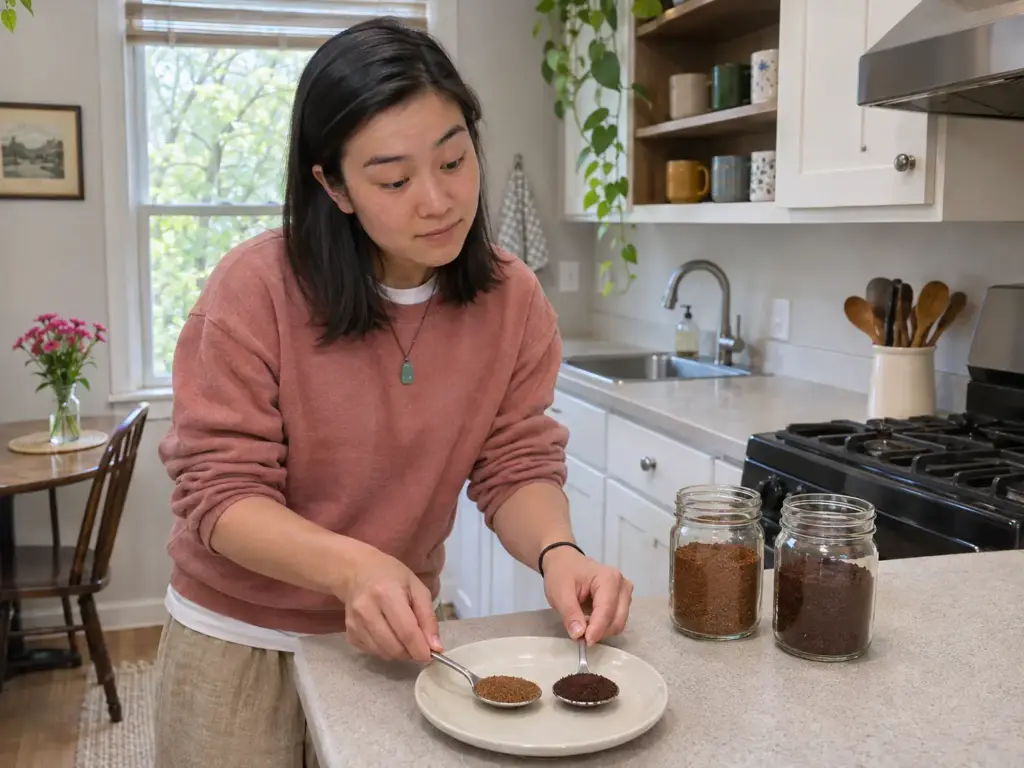
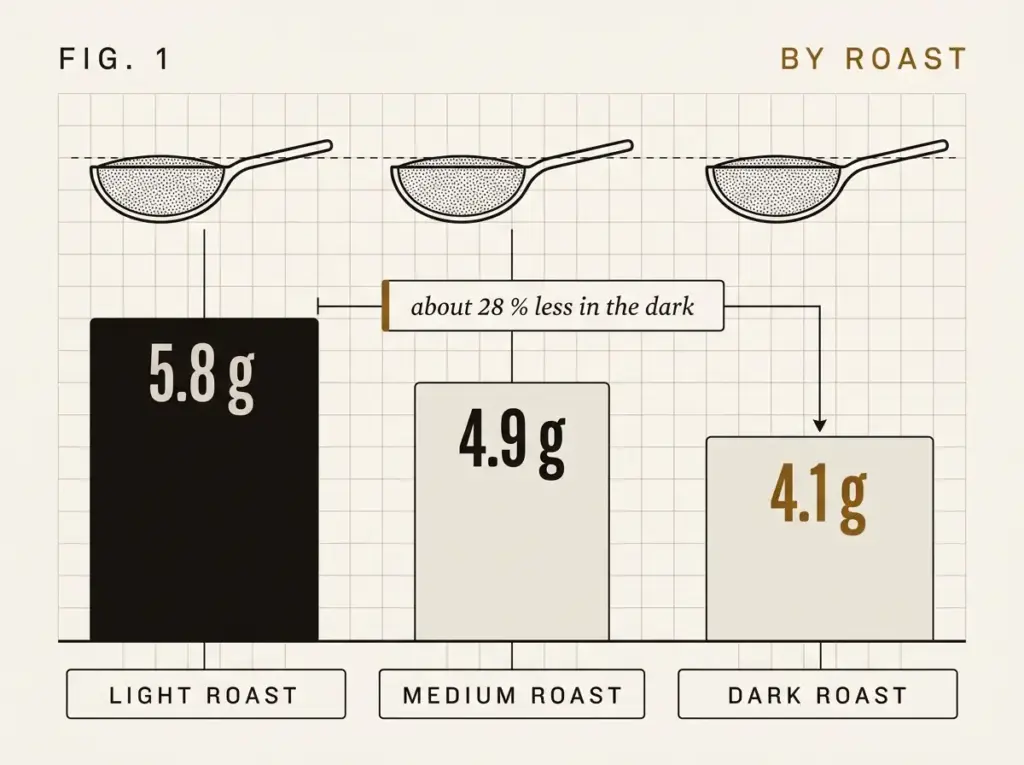
Roasting drives out moisture and puffs the bean up, so bean density falls as the roast level climbs and a darker roast packs less mass into every spoonful. Measured loose bulk density of ground coffee runs about 0.39 g/mL for a light roast, 0.33 for a medium and 0.28 for a dark one (Nakilcioğlu-Taş and Ötleş, 2019, in the Anais da Academia Brasileira de Ciências). A level US tablespoon therefore holds roughly 5.8 g of a light roast, 4.9 g of a medium and 4.1 g of a dark one: about 28 percent less coffee in the same spoonful.
A test-kitchen measurement shows the same effect from the other direction: reaching 1.5 oz of ground coffee took 2.5 more tablespoons of a dark roast than of a light roast of the same coffee (America’s Test Kitchen). Two spoons of dark roast can be one and a half spoons of light roast. The arithmetic of what one level scoop actually holds is worked through in full on that page.
What a 2 g Swing Does to 1:16
A 20 g dose into 320 g of water (about 11 fluid ounces) is 1:16. Put 21 g into the same water and it is 1:15.2; 22 g makes it 1:14.5. A heaped scoop against a level one, a packed scoop against a loose one, a new bag of a different roast: any of them adds 2 to 3 g to a single cup dose, and that nudge slides the ratio toward 1:15, where the cup reads heavier and a little muddy.
Roast moves it further. Four tablespoons come to about 16.5 g of dark roast and about 23 g of light, which in the same 320 g of water is the difference between roughly 1:19 and nearly 1:14. Nothing in the cup announces that the spoon changed. It just tastes different.
Why the Pot Tastes Heavier and the Beans Get the Blame
Direction first: a cup that turns heavier and muddier with the same beans and the same grind points at a dose that grew. Stale beans taste flat; they do not taste heavy. The first move costs nothing: weigh the scoop the way you always fill it, twice, before the grind dial is touched.
That also answers the waste question, because a heavy week is not only a stronger pot but more beans in the basket than the bag assumed. The scoop that suited the old bag runs a gram or more off for the first week of the new one, and the cup still passes as fine, only different. If you stay with spoons, measuring in level spoons when no scale is in reach is the careful way to do it.
Weigh three scoops of a new bag the day you open it, average them, and write that number on the canister lid. A new roast is a new number, and the lid saves you the arithmetic every morning after.
Reading the Cup Before You Spend Anything
Before a scale goes on a shopping list, the cup should say which way it is off. Heavy, thin and flat point in different directions, and only one of them points at the dose.
Heavy and Muddy Points at the Dose
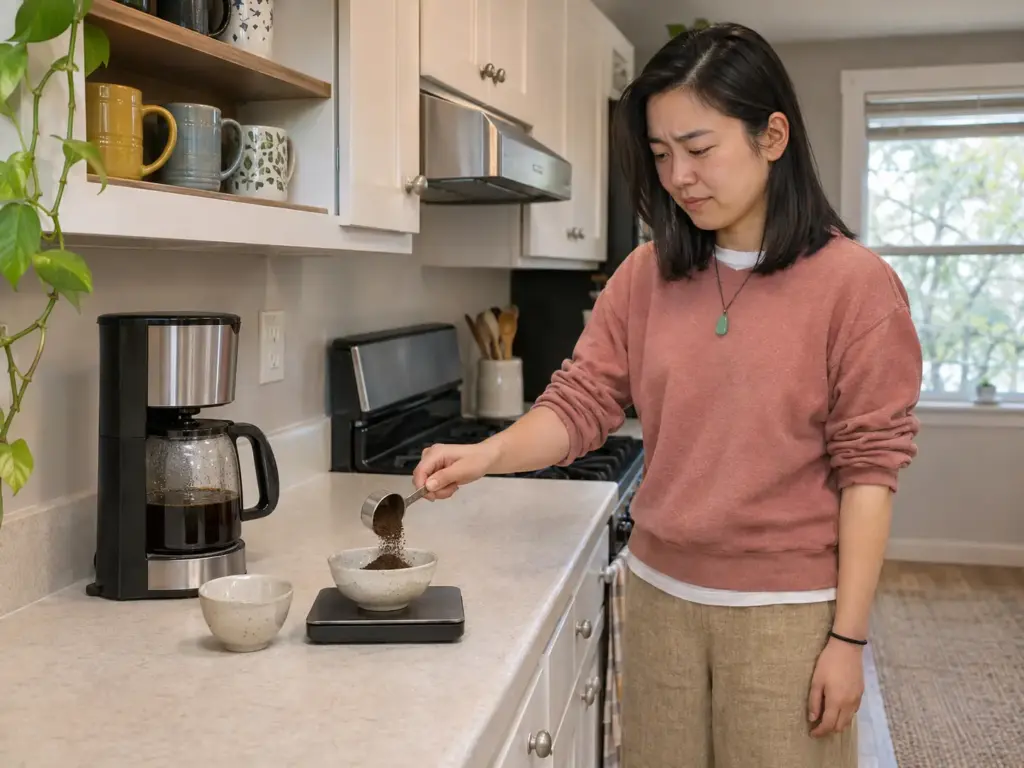
A heavy, slightly muddy cup from the same beans and the same grind points at a dose that grew. Weigh the scoop you usually fill on a kitchen scale (or level it the same way two mornings in a row) and see whether the grams agree within a gram. Packing counts too: a scoop pressed against the side of the canister holds more than one dipped and leveled with a knife, and the gap is the same 2 to 3 g that moves the ratio.
If the grams disagree, the spoon is the cause: pick one weight and brew the usual way. The next cup should come back to the one you remember. If it goes thin and watery instead, the dose dropped further than it needed to, so move it back up a gram.
Thin and Sour Points Somewhere Else
Thin and sour is a different direction. Sour means the water left the grounds before it finished, so the grind size goes finer first, with the coffee weighed the same every time so that the grind is the only thing that moved.
Weigh the dose before you turn the dial, and the grind step for each roast is waiting there. The next cup should lose its sharp edge; if it turns dry and bitter, that is over-extraction and you went a step too far, so come back half a step. One detail trips people up: after a grind change the grinder holds back some grounds, so the first few grams that come out are still the old setting. A weighed dose is the one that tells you which dose that was.
And if a finer grind leaves the cup sour, the water is the next suspect: a drip machine that never gets near 200°F (93°C) under-extracts however carefully the dose is weighed.
The Free Test Before Any Purchase
The test needs a kitchen scale and four mornings of attention:
- Weigh your usual scoop twice and note both numbers.
- If they differ by more than a gram, pick one weight and use it for every pot this week.
- Taste each pot against the one you remember.
- Touch the grind only when the cup is still off with the weight holding steady.
A flat, dull cup from a dose that no longer moves points at the beans or the grinder instead, and that case comes up near the end of this page. Weighing comes first because it removes one variable: when the grind or the roast changes the next cup, you know which one did it. Four mornings is short on purpose. A result that holds for a week is a dose you can trust, and a cup that drifts back means the weight was never the cause.
Where a Scale Earns Its Place in Espresso and Pour Over
After the free route, two brews remain that do not forgive a spoon. A shot is over in half a minute, and a pour-over is a recipe written in weights. Each repeats only when its numbers do.
Espresso Is Dose In, Yield Out, Seconds Between
A common starting recipe for espresso is 18 g of coffee in, 36 g of espresso out, in 25 to 30 seconds. Roasters and machine makers repeat it and no standards organization publishes it, and it earns its place for one reason: it fixes the dose and the yield and leaves the grind and the clock as the variables.
Tare the portafilter on the scale, dose the grounds, and 18 grams in 36 grams out starts from a number you can read, with the brew time running on the same display.
A spoon cannot hold 18 g steady, and a 1 g kitchen scale rounds a 20 g dose by up to half a gram, 2.5 percent, enough to separate a shot that runs about 27 seconds from one that runs about 31. The TIMEMORE Black Mirror Basic 3 is the one scale in this article that handles both brews: 0.1 g resolution, a slim 5.98 × 5.12 in footprint that sits on a drip tray, and an espresso mode that tares and times the shot. Reliability is uneven, with some units that work only some of the time, and whether it justifies the money is a fair question for a scale that lives under a hot machine. Once the dose is fixed, the grind that moves the shot in seconds is the next thing the clock measures.
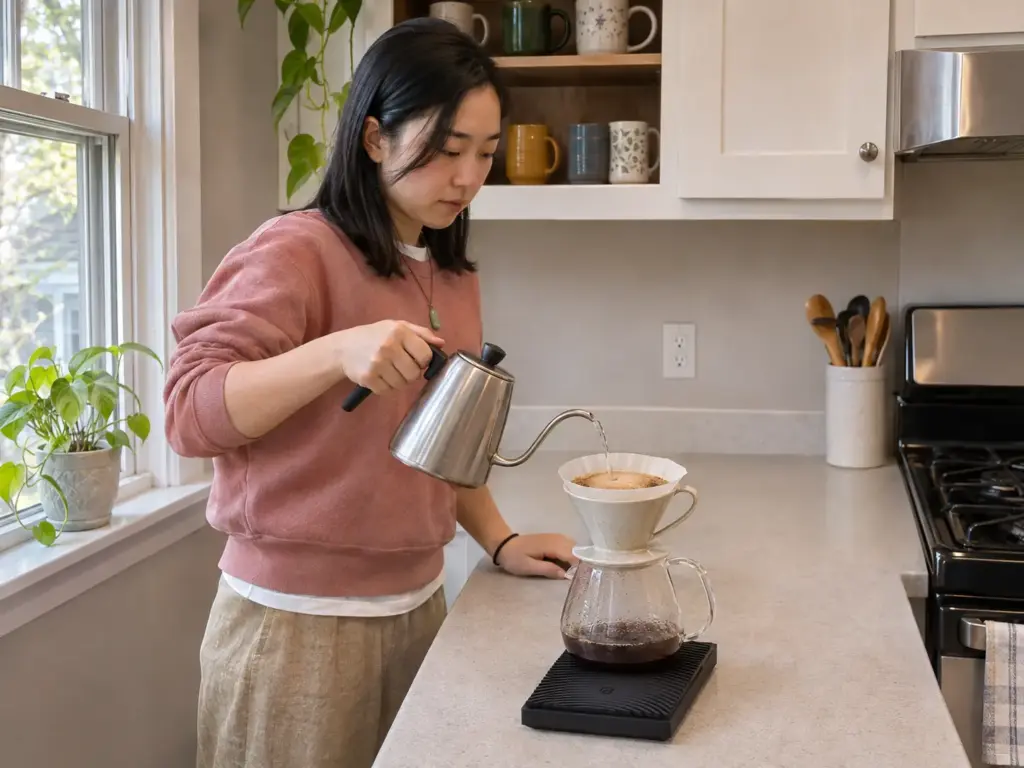
Pour Over Is a Bloom and a Final Weight
A pour-over is a sequence: a bloom, then the pour carried to a final weight. A common starting recipe wets the grounds with two to three times their weight in water for 30 to 45 seconds (40 to 60 g on a 20 g dose), then pours up to 320 g total, following the number on the display.
Weighing as you pour is what makes the recipe repeat, and that is why the timer and the tenth of a gram count here and not for a drip pot.
The Hario V60 Drip Scale VSTN-2000B is the classic: 0.1 g, a timer, and a weighing platform (about 4.7 × 7.5 in) that holds a server. Hario states a 5-minute auto-off, long enough to carry a bloom and a full pour. The buttons are slow to answer and hard to press, the 0.1 g precision holds only up to about 200 g, and some units stop working altogether, so treat the tenth of a gram as a resolution rather than a guarantee. Dose, bloom and water set the stage, and how the grind changes the drawdown of a pour is what comes after.
The 0.1 g That Matters and the 1 g That Does Not
The advice to always buy a digital scale that reads 0.1 gram falls apart on a full pot, where 1 gram of resolution is plenty.
Accuracy and repeatability are different things: a scale can show the same number every time and still sit a gram off, and for a dose it is the repeatability you use. At a dose of about 66 g, rounding to the nearest gram moves the dose by under 1 percent, well inside the noise of a drip machine. At 20 g the same rounding is 2.5 percent, and a tenth of a gram on that dose is a quarter of a percent. So match the resolution to the dose: tenths for the shot and the pour, whole grams for the pot.
Put a silicone mat or an old mouse pad under the scale when it sits on a drip tray or next to a hot server. Heat shortens the life of a load cell, and the pad costs nothing.
A Drip Pot or a French Press Runs Fine on the Scale in Your Drawer
The other half of the answer belongs to the reader whose daily brew is a drip coffee maker (the auto-drip kind) or a French press. For that counter the scale is a habit you form once, and a plain kitchen scale already does what a coffee scale would be bought for.
Weigh the Water Once, Then Divide by Sixteen
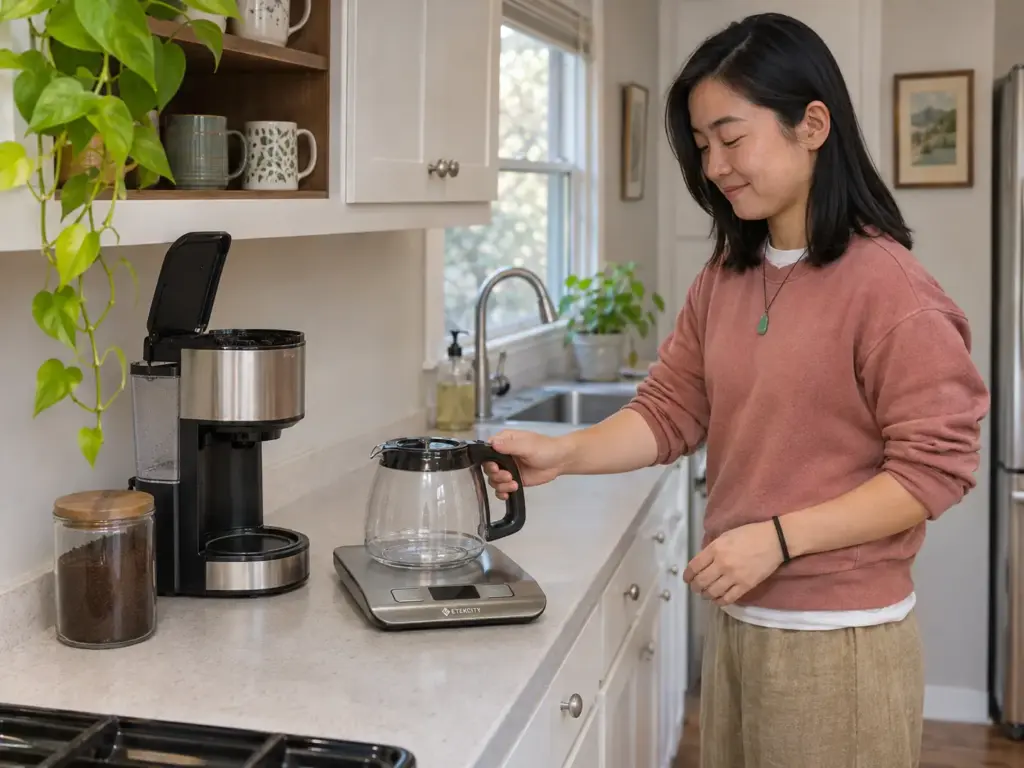
Tare the empty carafe, fill the tank to its cup line, pour that water into the carafe and read the weight. (How a machine’s cup line compares with a mug matters here, because the line counts small machine cups, and that gap is exactly why the water gets weighed.) Divide by 16 and weigh that many grams of grounds into the basket.
As one example, a tank filled to 36 fluid ounces holds about 1,065 g of water and takes about 66 g of coffee, a little over 13 level tablespoons of a medium roast, and the grams a full pot of six cups takes covers other pot sizes. After that first morning the weight is a number you write on the canister and never work out again.
The scale this routine assumes is the Etekcity Food Kitchen Scale EK6015: 1 g steps, a tare button, a stainless-steel platform, batteries. Half a gram of rounding on a 66 g dose is under 1 percent, which is nothing to a drip machine. Some units stop working, the precision varies from one to the next, and the batteries drain quickly, so keep spares in the drawer.
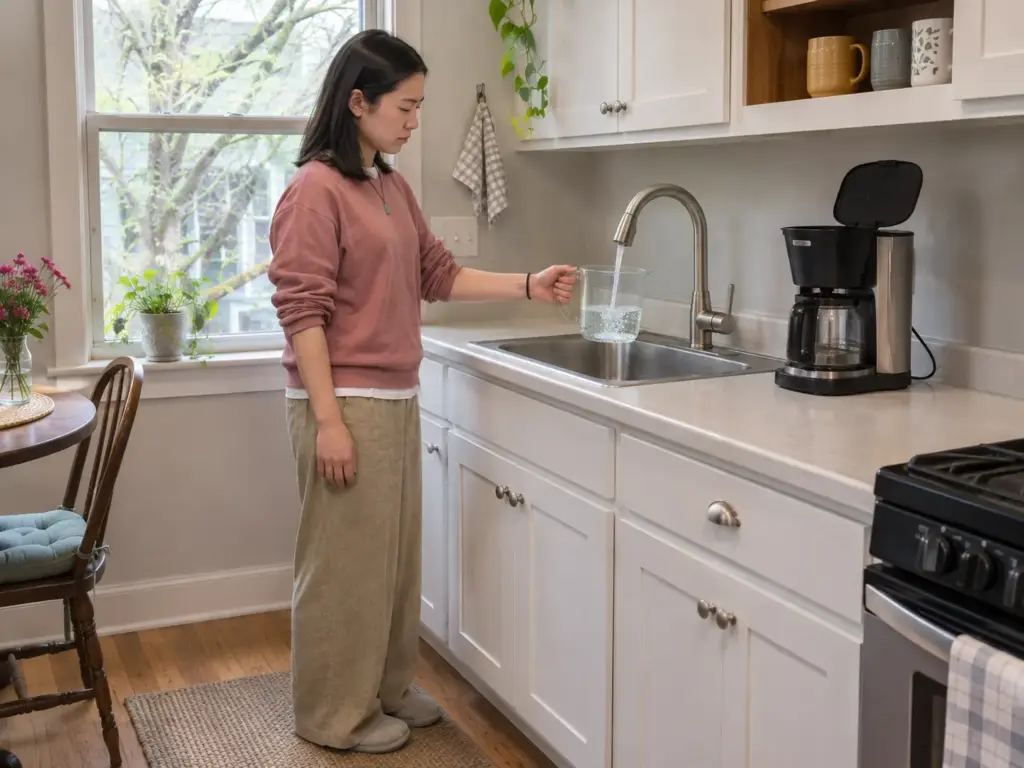
The common move is to weigh the water in the kettle, or to trust the lines on a measuring cup. A kettle loses water to steam as it heats, so the number written on the kettle is not the number that reaches the grounds; weigh it in the carafe instead. If a pour against marks on the carafe is easier on a busy morning, that works too: the dose is the number that moves the cup, and the pour is one a 1 g scale follows well enough. Running a drip machine on grams instead of scoops is laid out step by step elsewhere on the site.
The French Press Needs a Number, Not a Gadget
A French press runs on the same arithmetic, weighed once. At 1:16, 500 g of water takes about 31 g of coffee: tare the press, add the coffee, tare again, add the water, and write the pair on the canister. No timer is needed beyond the clock on the wall, so the 1 g scale does the whole job. A cold brew batch or a moka pot basket runs on a weighed number too, though each has its ratio of its own.
What a Coffee Scale Adds to the Kitchen One
A coffee scale buys four things over the kitchen one: a tenth of a gram instead of a whole gram, a built-in timer, a display that settles quickly after the pour, and a footprint that fits under a server or on a drip tray. None of them improves a drip pot, and all of them matter when the recipe has a clock and a 20 g dose. The kitchen scale gives up the timer and the tenth and keeps the weight of the pot, which is the entire difference for this counter. What the pot needs is consistency from one morning to the next, and a whole gram gives it.
Some kitchen scales ignore small weights below about 50 g. Leave a bowl on the platform, tare it, and test with a few grams of grounds before trusting the number on a 20 g dose.
What the SCA Number Says About 1:16 and 1:2
Every ratio in the sections above came from somewhere, and most of them have no owner. This section sets them against the one standard that does exist and says which are preferences.
The Golden Cup Band in Grams per Liter
Start with the Golden Cup ratio the SCA maintains, which calls for “a coffee-to-water ratio of approximately 55 grams of coffee per liter of water (±10%).” That ±10 percent makes a working band of 49.5 to 60.5 g/L, or roughly 1:16.5 to 1:20 by weight, centered near 1:18.
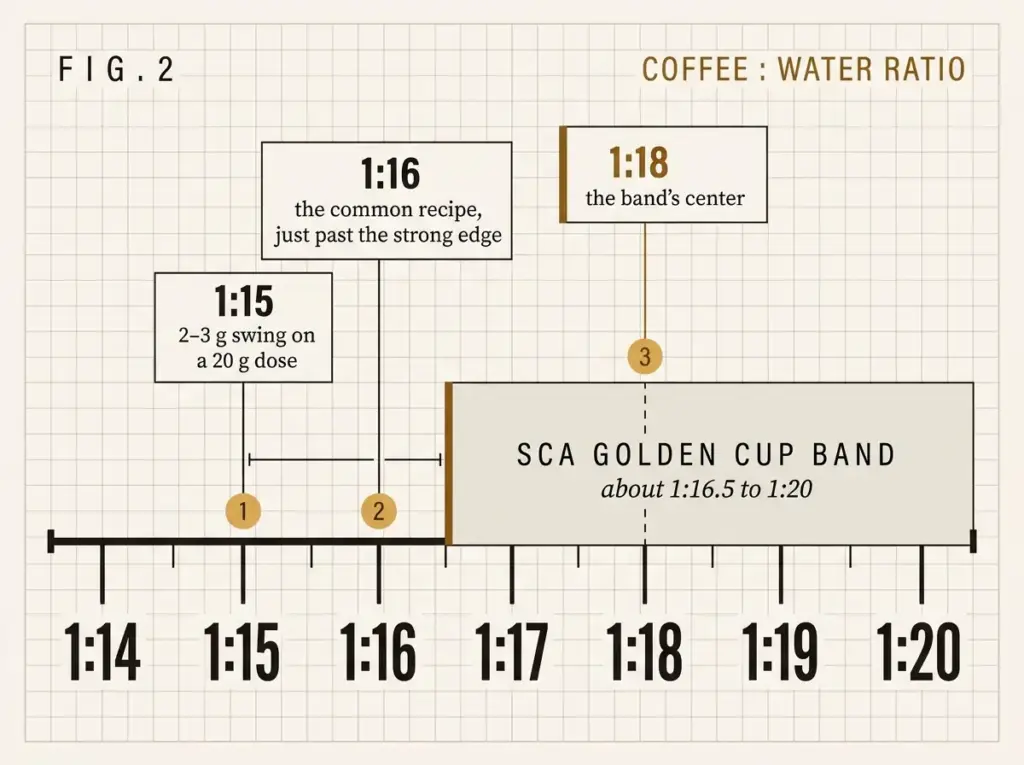
A liter of water weighs about a kilogram, so the band reads straight off the scale: 55 g of coffee into 1,000 g of water, give or take 5.5 g. For a 12 fluid ounce mug (about 355 g of water) the center of the band is roughly 19.5 g of coffee, and the band runs from about 17.5 g to 21.5 g. That is the number a scale makes repeatable, and how the ratio sets the strength of the cup is the full account of what moving along the band does to the taste.
Where 1:16 and 1:2 Come From
1:16 is 62.5 g/L, a little past the stronger-tasting end of that band (60.5 g/L). It is a common and reasonable preference, and this article does its arithmetic with it because it divides cleanly, but the SCA does not set it.
In that same mug 1:16 means 22 g of coffee, only 2.5 g more than the center of the band, which is the size of the swing a drifting scoop produces. The espresso recipe has an even looser pedigree: 1:2 in 25 to 30 seconds is repeated by roasters and machine makers, and the SCA’s own standards framework shows what a published standard looks like by comparison. It remains the most useful starting point there is, because it fixes the dose and leaves the grind as the variable. For your own pot, running 1:16 against 55 g per liter works in both directions.
A Scale Fixes the Dose, Not the Temperature
The same standard puts water temperature at the point of contact at 200°F (93°C), give or take 5°F (3°C). A scale does not control that. What it does tell you is how much water was poured at that temperature, which turns the ratio into something that repeats.
A pour that runs 20 g long on a 320 g target shifts the ratio by about 6 percent, more than the rounding of any kitchen scale, so a pour-over gets its water weighed as well as its dose. And the Golden Cup band is written for filter brewing: set against an espresso recipe it is a category error, so each brew keeps to its numbers.
What to Check Before You Buy One, and What Breaks by Month Two
A scale that is right on day one can still fail in the second month. This section covers which numbers on a spec sheet matter at a coffee counter and which parts give out first.
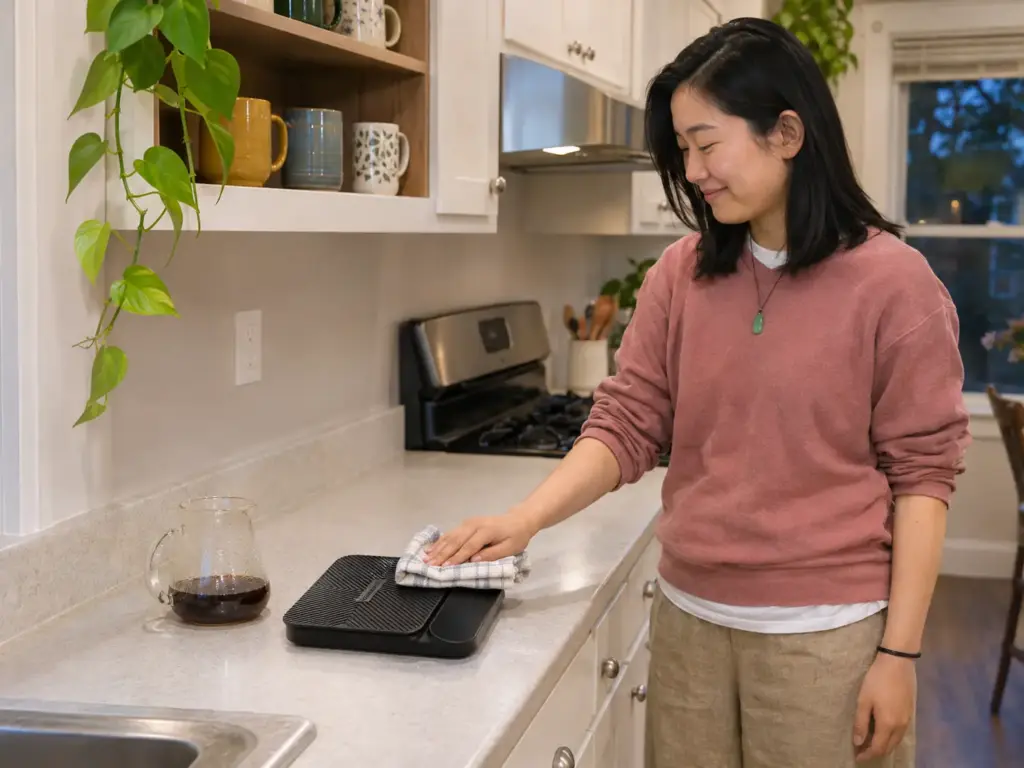
The Five Checks Worth Making on a Spec Sheet
Decimals are the least of it. Five checks decide whether a scale survives a coffee counter:
- Resolution in your dose range: 0.1 g for a shot or a pour, 1 g for a pot.
- Settle time (the response time of the display), meaning how quickly the number stops moving after the pour, since a slow display is a late pour.
- Auto-off against the length of the brew: a four-minute pour-over outlasts a kitchen scale’s timeout.
- Footprint: the Timemore is 5.98 × 5.12 in and slim, the Fellow’s platform is 7 × 5.9 in and 1.3 in tall, and a drip tray with a cup on it leaves little counter space for either.
- Splash on the buttons: splash resistance in the panel survives a wet counter, and a plain panel does not.
Auto-Off, Splash and Heat Are How a Scale Dies
Auto-off is the most common way a scale ruins a brew. A kitchen scale’s timeout is far shorter than a four-minute pour, and a 30-second shot never reveals it. When the scale sleeps mid-pour, re-taring loses the number you were pouring to, and there is no way to tell where you stopped.
Heat does the quiet damage. The load cell fails without warning, and a hot server or a drip tray straight off the machine is what shortens it, which is why the better kits ship a silicone pad and tell you to use it. A cheap scale usually dies from a splash, not from age. The second most common ending is buttons that stop answering on a scale that still weighs: the number is right, tare does nothing, and the workaround is lifting the cup and re-zeroing by hand.
Then there is drift. A display that read right in winter can read a gram or two heavy by spring, and the free check is a liter of tap water, which weighs about a kilogram. If the display disagrees, trust the jug.
Tare the empty cup or server first, so the pour is the only number on the display. If the scale has no timer, start the stopwatch on your phone at the first drop of water.
A Ratio Mode Replaces the Arithmetic, and an App Rarely Does
A smart scale with an app is the most common regret in the category: the app gets opened twice, and every extra mode adds taps to a routine repeated each morning.
The scale that gets used has one button and a display readable across the counter. A ratio mode is the exception, because it replaces arithmetic that is otherwise done mid-pour. The Maestri House S3 is the budget route to it: 0.1 g, a timer, an adjustable ratio from 1:1 to 1:18, a splash-resistant panel and USB-C, at a fraction of the cost of the Fellow below. Precision and the timer are mixed across units, with some that read wrong or a timer that stops, and the battery is the weak point.
The Fellow Tally Pro is the same idea done well: set 1:16 once and the OLED display carries the target to the last gram, with 13 hours a charge over USB-C. It is the splurge, and for a drip pot nothing about the weighing justifies the gap in cost. It also has no flow-rate display, which matters if espresso is the plan.
When the Scale Is Not the Fix
A scale only tells the truth about the dose. If the cup is still off after weighing everything, these are the places left to look, in the order they usually pay off.
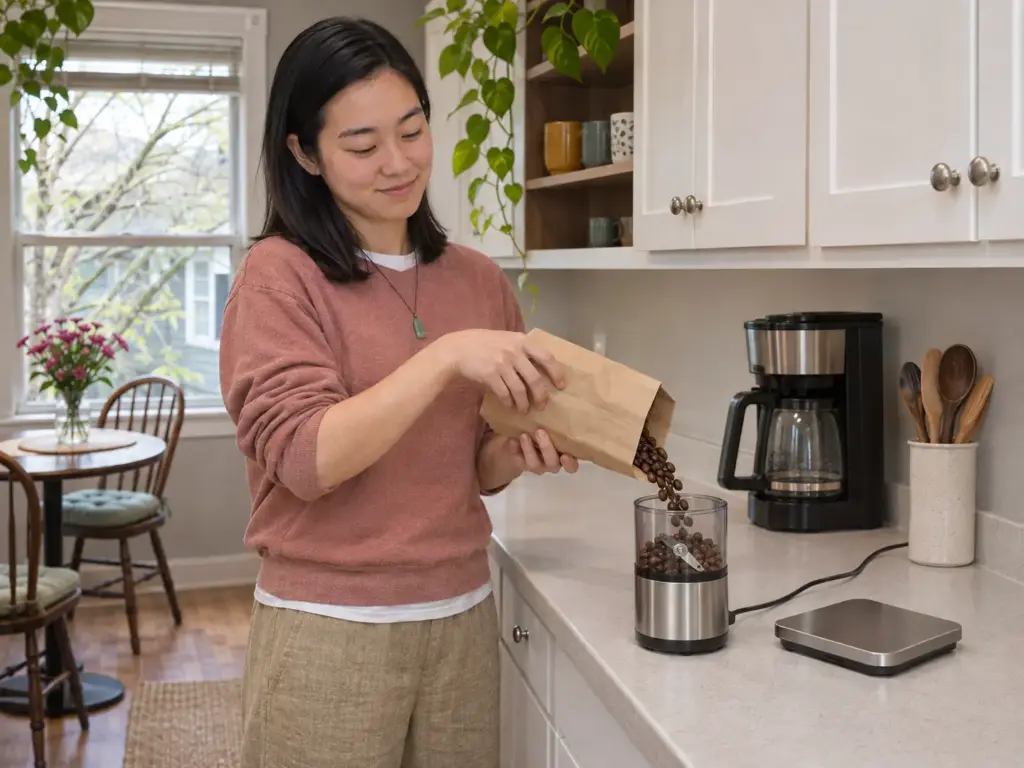
A Precise Dose Through a Blade Grinder Is Still Uneven
A blade grinder chops beans into boulders and dust at once, so a precisely weighed dose still brews as an uneven bed: sour from the coarse pieces and bitter from the fine ones, in the same cup. The scale makes the dose repeatable, and only the grinder makes the grind repeatable. Weighing to a tenth of a gram does not repair that, and it is the reason a cup can taste off on a morning when every number was right. A blade grinder also grinds finer the longer the button is held, and nothing on the scale records that, so count the same number of seconds each time.
Three-Week-Old Beans Taste Flat at Any Weight
Beans that have been open for weeks taste flat at any weight, and no scale puts the aroma back. Stale coffee reads flat, neither sour nor bitter, just dull, which is how to tell it from a dose problem: the scale fixes heavy, the grind fixes sour, and only fresher beans fix flat. A bag that smelled loud on day one and faint by week three is the cue to look at the roast date before blaming the scale. How long beans stay good after the bag is opened depends on the roast and on where the bag sits.
What to Weigh First, and What Comes After
The order that works when you dial in a cup: the dose first, because it is free; then the grind; then the age of the beans; and only then a new piece of gear. A scale removes one variable so the next one becomes visible, and it keeps doing that for as long as you taste between changes. Every step in that order costs less than the one after it, and the purchase comes last.
Weigh the Scoop Tomorrow, Then Taste Before You Touch the Grind
A scoop is a volume, and the roast changes what that volume weighs. A swing of 2 to 3 g moves a single-cup dose from 1:16 toward 1:15. A drip pot or a French press runs on a 1 g kitchen scale and the sixteen-to-one arithmetic; espresso and pour-over are where 0.1 g and a timer pay for themselves; and a scale removes one variable, not the three that come after it.
Once the scale has been through a few weeks of wet counters and hot servers, set a one-liter jug of water on it and see whether the display still reads about a kilogram, and watch whether the auto-off has started to cut the pour. Tomorrow morning, weigh the scoop the way you usually fill it, twice, and taste before touching the grind. If the grams agree and the cup is still off, the question moves to the grinder and the bag.
What is left is the buying question: which scale, and whether the one already in your drawer is enough. If your daily brew is a drip pot or a press, it very likely is. If it is a shot or a pour, the choice comes down to whether the scale will live on a drip tray or under a server.
Frequently Asked Questions
01Do I need a coffee scale for a drip machine or a French press?
No, a 1 g kitchen scale and the sixteen-to-one arithmetic make a drip pot or a French press repeatable from one morning to the next. A coffee scale adds a timer and a tenth of a gram, and a full pot cannot use either.
02Do I need a scale for espresso?
In practice, yes, because the dose in, the yield out and the seconds between them are the shot, and a spoon cannot hold 18 g steady. The common starting recipe is 18 g in and 36 g out in 25 to 30 seconds, a convention roasters repeat and no published standard.
03Is a kitchen scale good enough, or do I need one that reads to 0.1 g?
A 1 g kitchen scale is enough for a full pot, because half a gram of rounding on a 60 g dose is under 1 percent. Reading to 0.1 g matters on a 20 g dose, which is what a shot or a single pour uses.
04Why does my scale turn itself off in the middle of a pour?
Auto-off timers on kitchen scales are far shorter than a four-minute pour-over needs. Check the timeout on the spec sheet (Hario states 5 minutes, long enough for a bloom), and re-tare if the scale sleeps mid-pour.
05Can a coffee scale fix a sour or bitter cup?
Not by itself: a scale makes the dose repeatable, and a repeatable dose shows whether the grind, the water or the beans moved the cup. Sour points at a finer grind first and bitter at a coarser one, with the coffee weighed the same each time.



How did your cup turn out?
No comments yet. Tell us what you changed — and whether the needle moved.