




We may earn a commission when you buy through links on this page. It never changes what we recommend. How we pick
On this page8 parts
- What One Gram Does to a 20-Gram Dose
- Drip and French Press Do Not Need the Second Digit
- Where a Kitchen Scale Gives Out in the Middle of a Pour
- Espresso and Pour-Over, Where the Rounding Is the Adjustment
- Testing the Scale You Own Before Replacing It at Month Two
- When the Arithmetic Says Buy, and the Flaw You Accept
- Weigh Tomorrow's Pot, Then Test the Zero After Four Weeks
- Frequently Asked Questions
You open a new bag, level the same scoop you used yesterday, and the pot comes out thinner. Nothing in the routine changed except the density of the beans, and the only instrument that would have caught it is a scale, which is probably already in a drawer next to the baking sheets.
So the question behind kitchen scale vs coffee scale is what that digital food scale already does and where it stops. The answer comes down to one number, what a single gram is as a percentage of the dose, and that number changes with the brewer. The table comes first, then the arithmetic, then the places a kitchen scale gives out mid-pour, the two brewers that need more, a free check for later and the one purchase that holds up.
A kitchen scale you already own doses a drip pot and a French press well, because one gram is a few percent of a 20 to 30 g dose and under one percent of a full pot. Steps of 0.1 g and a timer only start to matter at espresso (18 g in, 36 g out) and in a timed pour-over, so buy for those two, and leave the scale’s cup and milliliter modes alone for coffee. The two kinds, compared on what the counter tests:
| What is compared | A 1 g kitchen scale | A 0.1 g coffee scale |
|---|---|---|
| Display step | 1 g, so a 20 g dose reads 19 or 20 and never in between | 0.1 g, though some models hold that step only up to a limit and then coarsen, so read the interval for the load you use |
| Capacity | About 5 kg, so a full carafe sits on it easily | About 2 kg, enough for a pour-over and most pots, tight for a full 12-cup pot with its carafe |
| Timer | None | Built in, and on the better models it starts with the pour |
| Auto-off | A few minutes at best, about two on a cheap one, and it can fire in the middle of a slow pour | Selectable, or held awake while the timer runs |
| Settling | Updates in whole grams and can lag a slow stream | Follows a slow pour; faster on the premium models, instant on none |
| Wet counter | A sealed panel helps, but most are not water resistant | A silicone pad and a thin frame, though only a few are water resistant |
| Where it is enough | Drip machine, French press, big batch | Espresso (18 g in, 36 g out) and pour-over |
What One Gram Does to a 20-Gram Dose
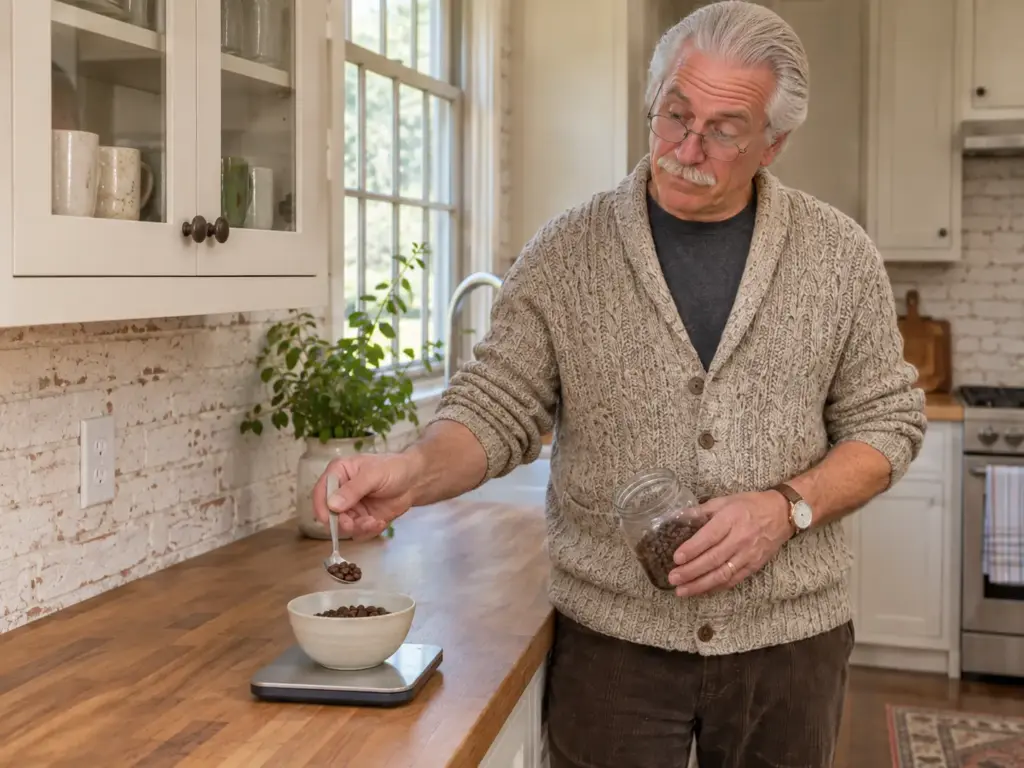
The table lists the differences, and its first row decides most of the others: how big one step on the display is next to the dose it measures. Put as a percentage, that step changes with the brewer far more than with the scale. The three parts below turn it into numbers, take apart the cup and milliliter modes, and separate digits from accuracy.
How much of the dose one step moves
On a scale that reads in whole grams, a dose of coffee can only show up as 19 or 20, and the gap between neighbors is 5 % of a 20 g dose. Shrink the dose and the same step grows: 5.6 % at 18 g, 6.7 % at 15 g, 8.3 % at 12 g. A 0.1 g display on that 18 g dose moves 0.56 %, and one gram on a 36 g espresso yield is 2.8 %. On a full pot of about 120 g of coffee, one gram is 0.8 %, and a 0.1 g step is nearly invisible at 0.08 %.
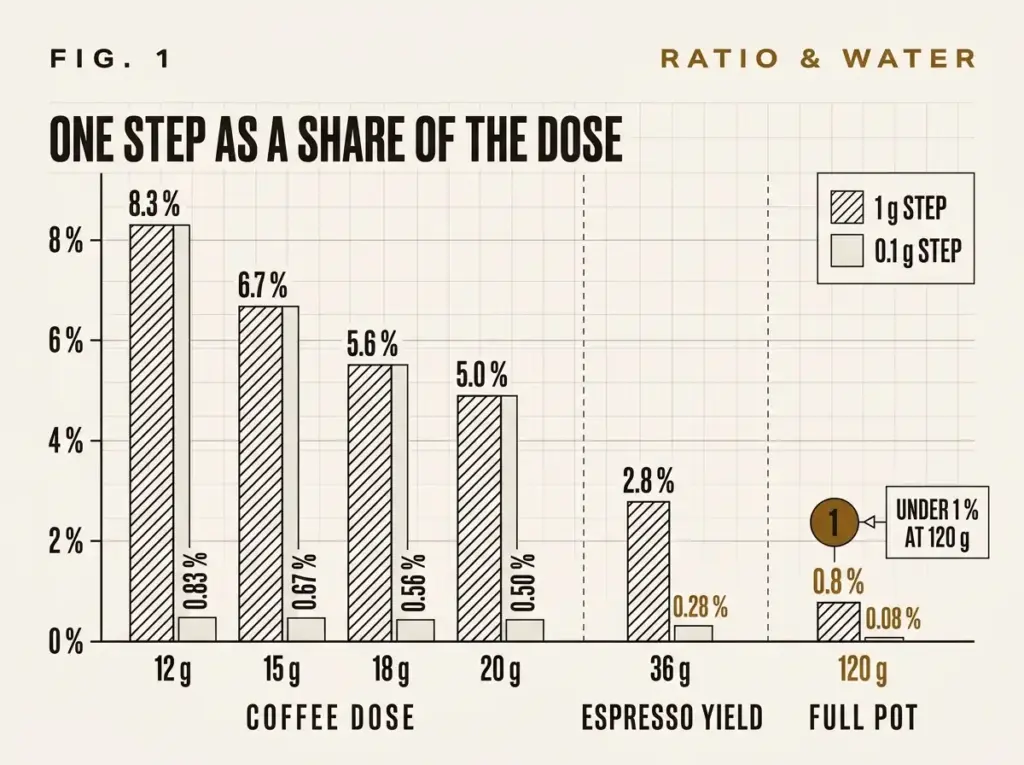
There is a standard behind that 20 g line. NIST puts the minimum recommended load on a class III scale at 20 scale divisions, which leaves a 2.5 % uncertainty from the display alone. A 1 g scale weighing a 20 g dose sits exactly on that floor, and a 0.1 g scale reaches the same 2.5 % at 2 g.
Why the cup and milliliter modes read a liquid that is not in the cup
Kitchen scales offer cups, fluid ounces and milliliters because they convert weight at the density of water: 8 fl oz of water is about 237 g. Ground coffee is not water. The usual level scoop is about 10 g of grounds per 6 ounces of water in the machine (the arithmetic is in what a level scoop holds in grams), so a volume readout describes a liquid that never went into the filter.
Volume versus weight is the whole problem, because the scoop itself drifts with the bean. A dark roast fills the same scoop with less coffee than a light roast does, and the roast level and the origin of the bean both change how much one scoop weighs, which is why a scoop never gives the same dose twice. Grams do not care what is in the bag.
A 0.1 g display is not automatically more accurate
According to NIST’s explanation of scale resolution, “the scale division, d, is defined as the resolution of the scale.” Resolution is the step the display can show. Accuracy is how close the reading is to the truth, and two scales can show the same digits without being equally accurate, so a cheap 0.1 g scale is not automatically better than a good 1 g one. Precision and repeatability are separate again: a scale that reads the same cup the same way every morning gives a consistent dose even when its absolute accuracy is a gram off.
The drawer scale has habits of its own too. One that does not move until several grams of beans are already in the cup turns two doses that both read 20 g into different doses. One that jumps from 18 to 20 and never shows 19 means the dose you were aiming for was never on offer.
Drip and French Press Do Not Need the Second Digit
At the scale of a pot, one gram almost vanishes. That is why the drawer scale does the whole job for the two brewers most kitchens own, and why the free routine in this section is the first thing to try before any purchase.
A full pot is a load a kitchen scale carries easily
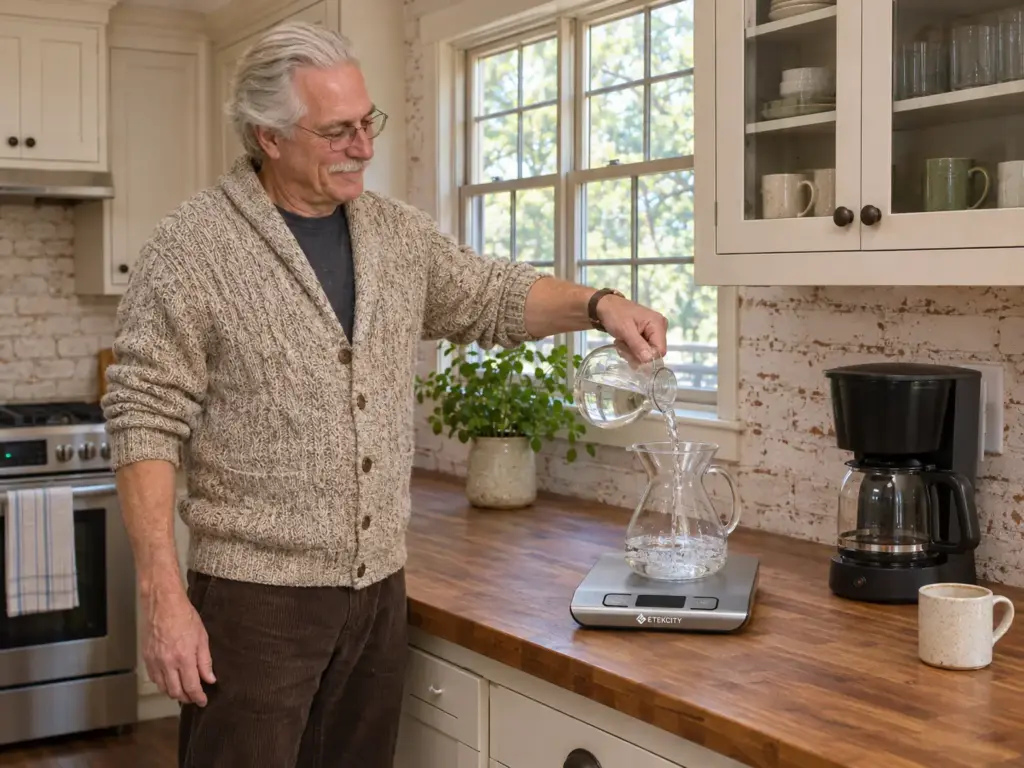
A US cup of water is 8 fl oz, about 237 g, and a 12-cup carafe line stands for 60 to 72 fl oz, so roughly 1,775 to 2,130 g of water. At 1:16 that is 111 to 133 g of coffee, and one gram on that is under 1 %. The load is the thing to watch: a 5 kg kitchen scale takes a full carafe comfortably, while a 2 kg coffee scale is tight (how much coffee goes with six cups of water by weight covers the smaller batches). The 0.1 g display looks like the obvious upgrade, and for this brewer it buys nothing.
The machine and the scale do different jobs. SCA-certified home brewers hold 198 to 205 °F (92 to 96 °C) through the brew, and that is the machine’s side of the work. A scale cannot rescue a pot brewed cool, and a certified brewer cannot rescue a scoop that changed with the new bag. The line that says twelve cups also holds a different weight of water on each machine.
French press at thirty grams
Thirty grams at 1:16 is 480 g of water, about 16 fluid ounces. One gram on 30 g is roughly 3 %, and a four-minute steep with a grind that suits a French press absorbs that before the plunger goes down, with no change in extraction you could taste. An AeroPress dose is small enough that the step matters there a little more, and it follows the same arithmetic.
The National Coffee Association’s pour-over guide gives the coffee to water ratio as 1:13 to 1:16 and tells brewers to weigh in grams, while its drip guide still talks in tablespoons. The same bean arrives in two languages, and the scale is what translates. On a 20 g dose, 1:16 is 320 g of water and 1:13 is 260 g, and the 1:15 to 1:17 brew ratio common on recipe cards runs from 300 to 340 g, so the range is wide enough to taste in the strength of the cup.Weigh the water, then taste
The free routine takes three steps, and it works on any 1 g scale. Taste the pot between rounds of it.
- Set the empty carafe or cup on the scale and tare it to zero.
- Pour water to a number in grams, ignoring the cup marks on the machine.
- Weigh the coffee the same way, as a single dose in a cup, and brew.
That is running a drip machine in grams instead of scoops, and the number to aim for is the water, not the coffee: one gram on 300 g of water is a third of a percent. Expect the carafe to hold a little less than the water you poured in, since the grounds keep some (the water the grounds keep explains how much). If the first pot tastes flat, add coffee by a gram or two; if it tastes harsh, take a gram or two away. A sour, thin pot points to under-extraction or too light a dose, and a bitter one to over-extraction or too heavy a dose, so the display only reports the gram and the cup judges it.
Fill the carafe to its 12-cup line on the scale one time and write the grams on a strip of tape. That number is what the line really holds on your machine, and dosing from it at 1:16 replaces the guesswork of the marks for every pot after.
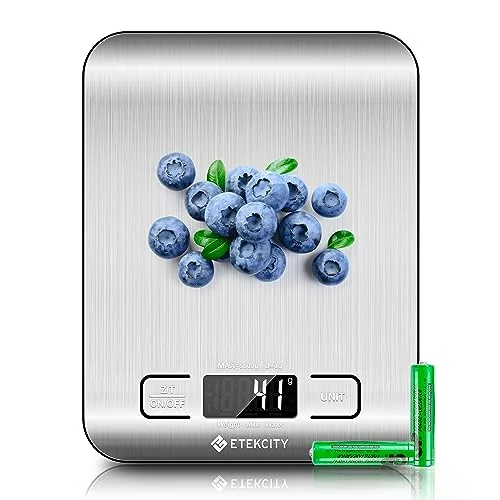
The drawer scale in its plainest form is the Etekcity EK6015, and it fits this job. Accuracy is a split verdict on it, with some units weighing true and others drifting, so the 100 g check later in this article is worth running on it.
Where a Kitchen Scale Gives Out in the Middle of a Pour
On paper the drawer scale is enough, and a real counter finds the exceptions. They show up in the middle of a slow pour or beside a wet kettle, which is where the arithmetic stops being the whole answer. Four failures cover most of it, and each has a free fix to try first.
The auto-off that fires in the middle of the pour
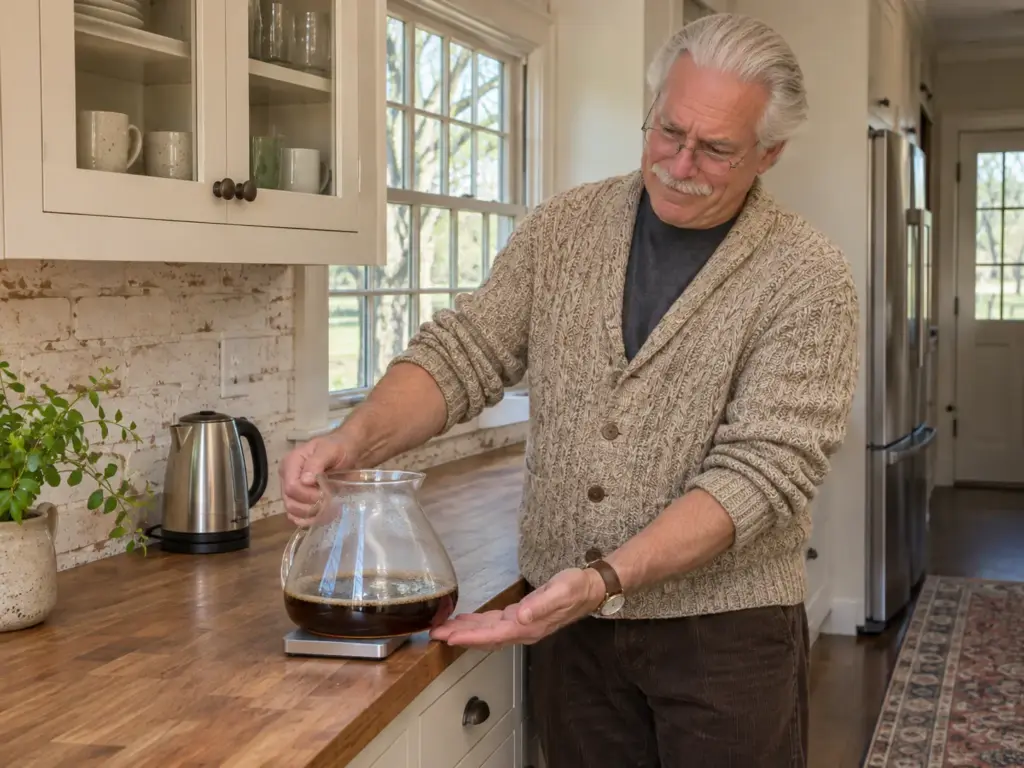
A cheap kitchen scale can shut off at about two minutes with 120 g of water already on it. A slow pour is the worst case, because the weight barely changes and the idle timer decides you left. Pressing down on the platform makes the weight jump and resets the timer. The published figures differ by maker: Hario’s scale sleeps after five minutes but not while its timer is running, Escali’s shuts off after four minutes of inactivity, and coffee scales let you pick the interval or switch it off.
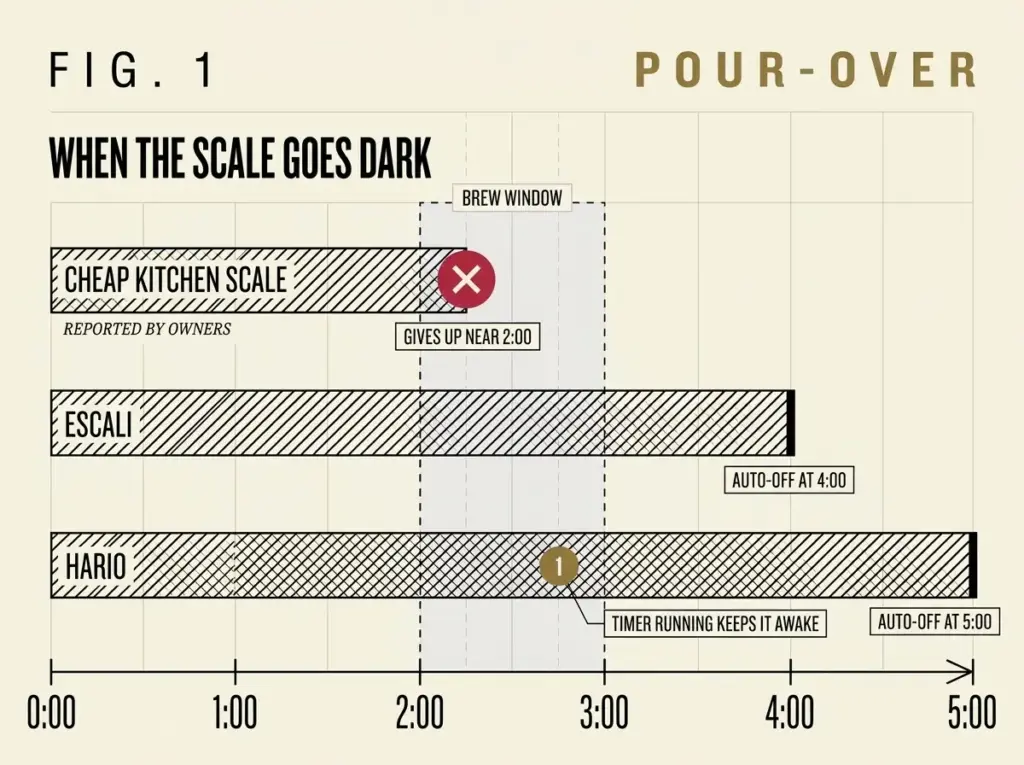
The fixes come in this order: press the platform at the minute mark, pick a scale with the long interval, and only then one that stays awake while a clock runs (what a timer on a scale actually does covers that last case). The Escali Primo P115C already has the four minutes, a sealed two-button panel for the wet counter, 1 g steps up to 5 kg and a lifetime warranty. Its auto-shut-off is the mixed point, since some units never switch off at all, and the display is hard to read once a big bowl is on the platform.
A display that lags, jumps or creeps
A 1 g step updates in whole grams, so the settling time and response time both show: the number lands late and in jumps, and a scale can show 20 g a moment after you meant to stop. A reading can also creep upward when a hot brewer sits on the platform, and on some scales the display gets coarser as the load rises. The check costs a minute: set the scale with the hot brewer on it, leave it, and watch whether the zero moves.
A platform that does not fit the brewer
A wide carafe overhangs a small platform, and a bowl can hide the display, so the reading turns into a guess. A flat silicone coaster or a smaller vessel fixes that before any new scale does. Pressing a hand onto an overhanging carafe to steady it adds weight the scale reads as coffee.
Give the scale a spot a couple of feet from the kettle. Steam on the platform is what makes the zero walk, and a sealed panel protects the buttons, not the load cell underneath.
Espresso and Pour-Over, Where the Rounding Is the Adjustment
For a drip pot, rounding to the gram is noise. For two brewers it is the same size as the change the reader is trying to make, and this is where 0.1 g and a clock stop being optional (or close to it).
Eighteen in, thirty-six out
Espresso’s working recipe is a ratio, not a volume: 18 g of coffee in the basket, 36 g in the cup, in about 25 to 30 seconds. One gram is 5.6 % of that dose and 2.8 % of that yield, so on a 1 g scale the step is the size of the adjustment being made. On some setups a single gram of dose is the difference between a shot that chokes and one that runs free, the same direction a finer grind size pushes it.
Pull a shot with a kitchen scale under the cup and the display jumps from 34 to 37, with the recipe living in the two grams it never shows. A 0.1 g scale cuts the same shot to 0.56 % of the dose and 0.28 % of the yield, the one case in this article where the extra digit is not snobbery.
The platform also has to fit under the basket, which is where scales that fit under a portafilter come in.
Pour-over wants the clock beside the weight
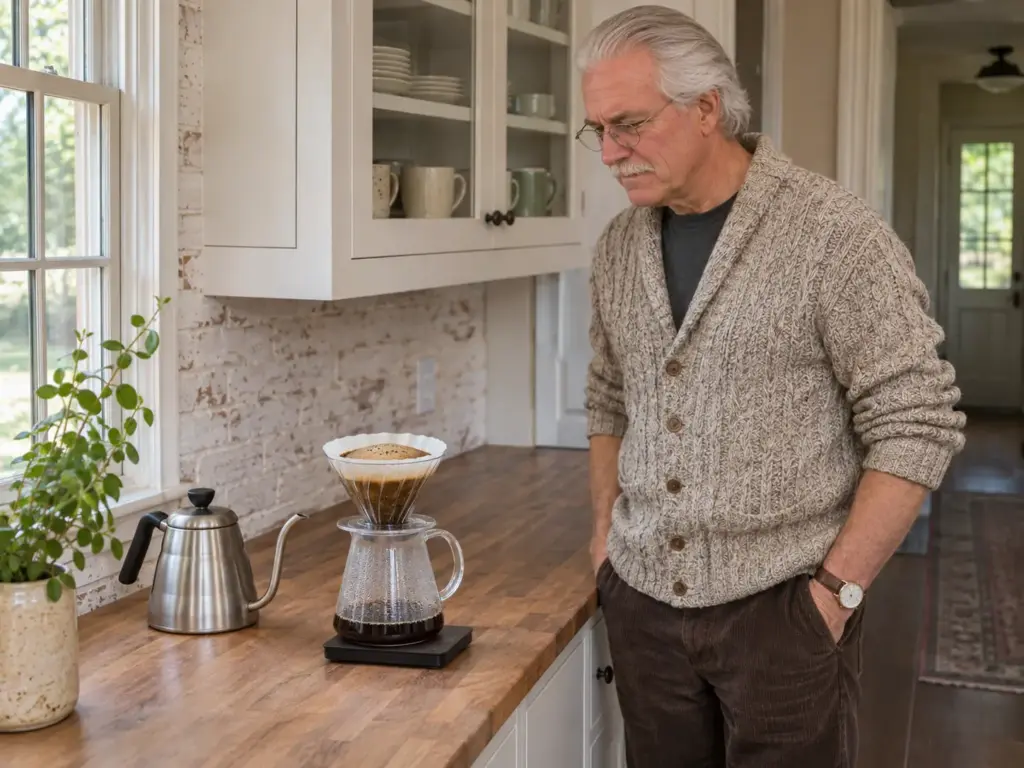
A pour-over runs 1:13 to 1:16, with a bloom of about 45 seconds, long enough for the carbon dioxide in fresh grounds to escape, into a total brew time of 2:00 to 3:00, and the pour is timed against the weight. That is the job of a built-in timer: the pour goes lopsided when the stopwatch is a phone and the phone is in the other hand, and the contact time drifts with it. The grind belongs in the same loop, and the grind that suits a pour-over dripper sets how long the bloom and the drawdown really take.
A 0.1 g scale that is 0.1 g only part of the way
Hario documents its V60 drip scale’s display as 0.1 g up to 200 g, 0.5 g from 200 to 500 g and 1 g up to 2,000 g.
A scale sold as a 0.1 g coffee scale is often 0.1 g only at the bottom of its range, so the interval is read per load. The Hario V60 Drip Scale Timer is the simple manual option, with weight and seconds on one screen and a timer that keeps it awake for the whole pour. Durability is its recurring complaint, with units failing inside six months, plus a five-second lag on power-on and a gap in the platform that collects grounds. Hario itself does not call it water resistant.
Put the brewer and its water on the scale and watch the last digit. If it still moves in tenths, you have 0.1 g at that load; if it jumps in halves or whole grams, that is the interval you are really working with.
Testing the Scale You Own Before Replacing It at Month Two
A scale that read true in week one can drift, and a replacement bought for the wrong reason drifts too. The free checks come first, in order, with the same measured cup between them.
The measured 100 g of water
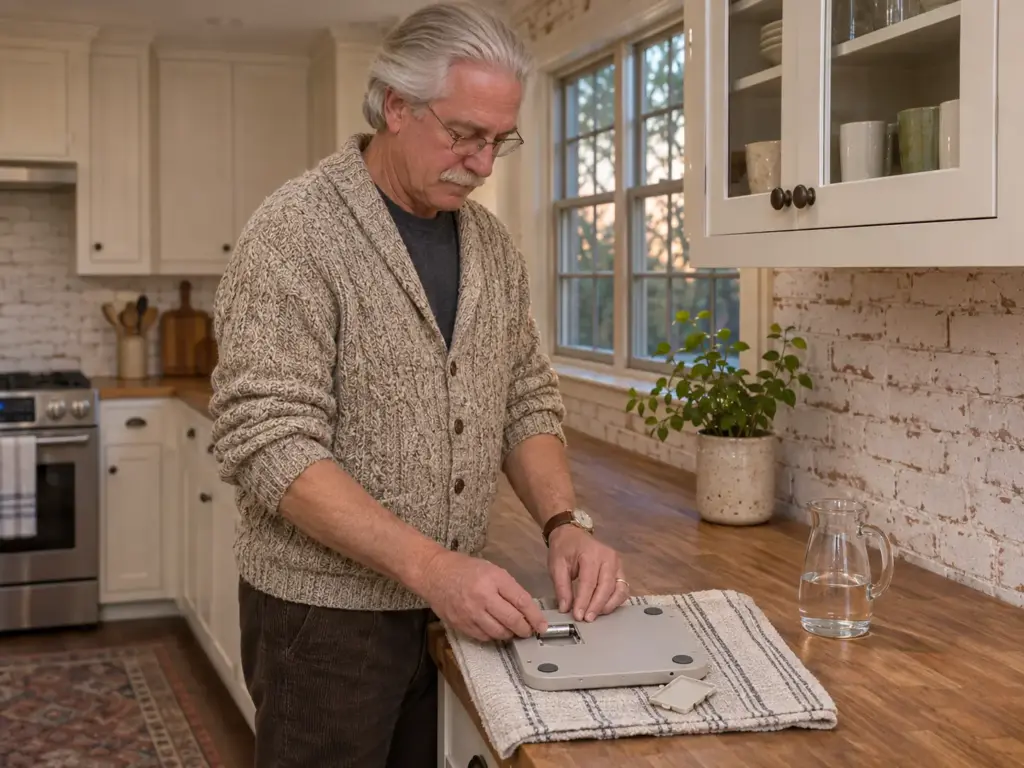
Weigh 100 g of water on a good second scale or from a measuring jug, set that cup on the drawer scale and read it. A calibration weight of 100 g does the same job better if you own one, and it can live in the drawer with the scale. The stretch to watch is the first month the scale spends near the kettle, and the same cup tells you whether the zero and the weight still agree. If they do not, move to the next check before the checkout.
Re-tare, dry the platform, change the battery
Re-tare with the vessel on, then dry the platform, then fit a fresh battery, and weigh the 100 g again after each step.
Moisture is the slow enemy on a kitchen counter beside the kettle: a platform that is not dry, a button panel that is not sealed, a reading that creeps when steam sits on the platform. (The Escali’s sealed panel and the Hario’s lack of water resistance are the two ends of it.) A dose that reads a gram light after the grinder may also be static that costs grams at the grinder, a reading that moved while the grounds were in the air. The zero that comes back at 1 g on an empty platform after the kettle has stood beside it all morning is the sign that moisture, not the scale, is the problem.
Save the first 100 g reading in a note on your phone with the date. A number you can compare against beats trusting a scale that looks fine.
Why a bigger scale can read steadier
Resolution is not accuracy, and this is its second form. The higher a scale’s capacity, the less sensitive the same electronics tend to be to small changes, so the rated range says as much about a scale as its digits do.
A 5 kg kitchen scale can therefore be steadier than a 1.5 kg coffee scale with a finer display, and the digits do not tell you which. Coffee scales have their own failures at this stage: some TIMEMORE units stop holding a charge, and some Hario units fail inside six months. That is another reason for the free checks to come before a replacement, for both kinds.
When the Arithmetic Says Buy, and the Flaw You Accept
If the free checks pass and the brewer is an espresso machine or a pour-over cone, the arithmetic has already made the case, and one question is left: which flaw to live with.
The two cases that justify a 0.1 g scale
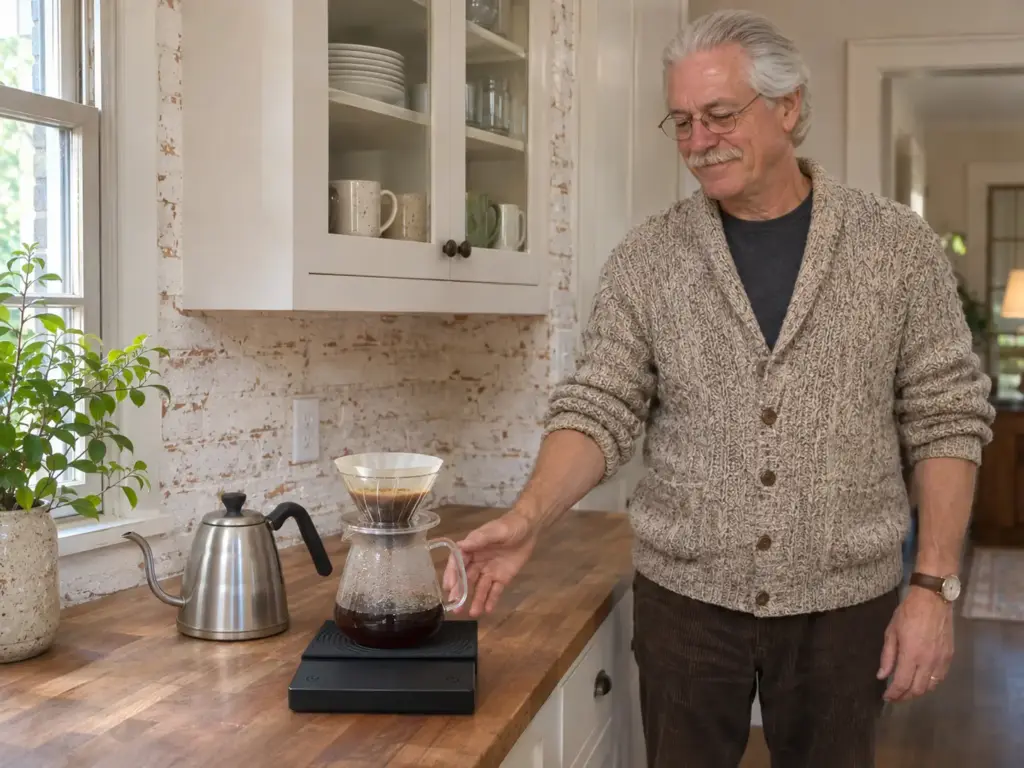
Two cases justify the money, and both are in grams. The first is the shot, 18 g in and 36 g out, where one gram is 5.6 % of the dose and 2.8 % of the yield. The second is a pour-over timed to the weight, where a clock on the same screen replaces the phone in the other hand. Everything else stays on the drawer scale, and a drip pot is better served by the weigh-the-water routine from earlier.
The one pick and its flaw
The TIMEMORE Black Mirror Basic 2.0 is the one scale in this comparison that covers both ends. It reads 0.1 g at the dose and at the yield, starts its timer with the pour, and carries a 2 kg platform that still takes a 600 g pour-over. Its flaw comes with the spec: some units stop holding a charge or stop working somewhere between a month and six months, and the touch controls are sensitive enough that a wet finger can register twice.
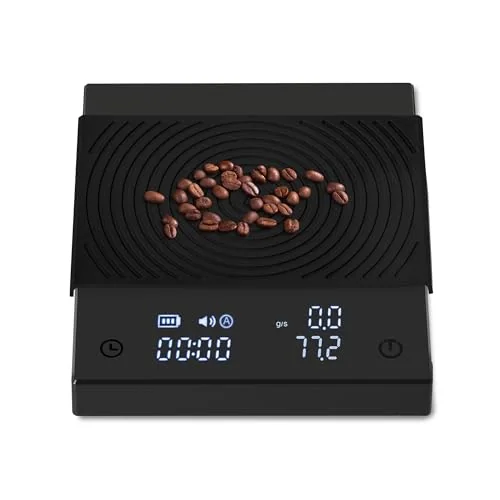
The Hario scale from the pour-over section is the cheaper manual route: it times the pour but does not read flow.
Which scale next, and the free way out
Once the arithmetic says a coffee scale is worth it, which coffee scale matches the brewer you own is the question to carry forward. A reader who wants to spend the least should read about a cheaper scale that keeps its accuracy by month two. And a reader who decides the drawer is enough has a free fallback in measuring coffee in level spoons.
Weigh Tomorrow’s Pot, Then Test the Zero After Four Weeks
A drawer scale covers a drip pot and a French press, because one gram is a few percent of a dose and under one percent of a pot. The cup and milliliter modes read water, so they stay off. The espresso shot and the timed pour-over are where 0.1 g and a clock earn their place, and the failures worth watching on any kitchen scale are the idle timer, the lag and the wet platform.
After the scale has spent its first four weeks beside the kettle, set 100 g of water on it again and see whether the zero and the weight still agree. The same goes for the first battery change.
For tomorrow, put the carafe on the scale you already own, tare it, pour to a weight and taste the pot against yesterday’s. If it comes out steadier, the drawer was enough. If you pull espresso or time a pour-over and the number keeps landing between the two grams you wanted, that is the cue to read on to the scale that matches the brewer.
Frequently Asked Questions
01Can I use a kitchen scale for coffee?
Yes, for a drip machine and a French press: one gram is a few percent of a 20 to 30 g dose and under one percent of a full pot. It only starts to fall short at espresso and in a timed pour-over.
02Is a 0.1 g coffee scale necessary for pour-over?
It is more useful than necessary: 0.1 g gives a steadier dose and a timer keeps the bloom and the pour on schedule, but the free routine on a 1 g scale still works. Where the display coarsens above 200 g, read the interval for your load.
03Why does my kitchen scale turn itself off while I pour?
Its idle timer is short, sometimes about two minutes, and a slow pour barely changes the weight, so the scale thinks you left. Press the platform to reset it, or choose a scale with a long interval or a timer that holds it awake.
04What can I use if I don’t have a scale?
Level spoons, a marked jug for the water and the roast date on the bag will get a drip pot close, with coffee measured in level spoons as the method. The scoop moves with the roast, so a scale stays the steadier answer.
05How do I check if my kitchen scale is accurate?
Weigh 100 g of water from a measuring jug, set it on the scale and read it. If it reads off, re-tare, dry the platform and change the battery, then check again before replacing anything.



How did your cup turn out?
No comments yet. Tell us what you changed — and whether the needle moved.